
Dental Piezoelectric Ultrasonic Unit Market Size and Share
Market Overview
| Study Period | 2021 - 2032 |
|---|---|
| Market Size (2027) | USD 1.18 Billion |
| Market Size (2032) | USD 1.47 Billion |
| Growth Rate (2027 - 2032) | 4.53 % |
| Fastest Growing Market | Asia-Pacific |
| Largest Market | North America |
| Market Concentration | Medium |
Major Players *Disclaimer: Major Players sorted in no particular order Image © Mordor Intelligence. Reuse requires attribution under CC BY 4.0. | |
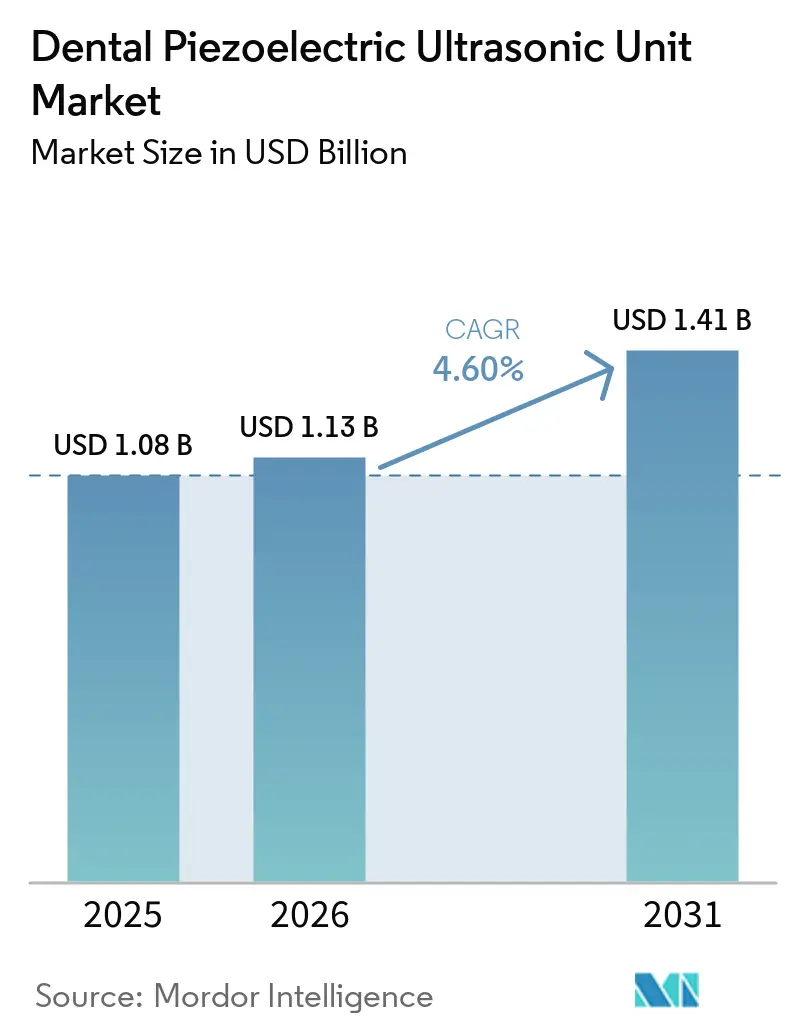
Dental Piezoelectric Ultrasonic Unit Market Analysis by Mordor Intelligence
The Dental Piezoelectric Ultrasonic Unit Market size is projected to be USD 1.13 billion in 2026, USD 1.18 billion in 2027, and reach USD 1.47 billion by 2032, growing at a CAGR of 4.53% from 2027 to 2032.
Periodontal disease continues to create a durable need for equipment used in non-surgical debridement. The Global Burden of Disease Study 2021 recorded 1.07 billion cases of severe periodontitis, and the age-standardized prevalence is projected to rise from 27,605 per 100,000 in 2021 to 28,607 per 100,000 by 2035. Demand is also moving toward systems that combine ultrasonic scaling with air polishing, laser functions, or digital controls. This favors suppliers that can support clinical workflows, consumables, training, and maintenance across large practice networks. Smaller practices remain sensitive to capital cost, while the updated ISO requirements increase the validation work required for new devices and tips
Key Report Takeaways
- By product type, Piezoelectric Ultrasonic Scalers held 48.6% revenue share in 2026, while Handpieces & Tips is forecast to grow at a 5.8% CAGR through 2032.
- By end user, Dental Clinics held 52.4% revenue share in 2026, while Group Dental Practices is forecast to grow at a 5.6% CAGR through 2032.
- By technology, Piezoelectric Ceramic Technology held 62.8% revenue share in 2026, while Integrated Laser-Piezo Systems is forecast to grow at a 6.7% CAGR through 2032.
- By portability, Benchtop Units held 58.2% revenue share in 2026, while Portable & Handheld Units is forecast to grow at a 6.3% CAGR through 2032.
- By application, Periodontal Treatment held 46.9% revenue share in 2026, while Oral Surgery & Implantology is forecast to grow at a 6.1% CAGR through 2032.
- By geography, North America held 40.8% revenue share in 2026, while Asia Pacific is forecast to grow at a 5.3% CAGR through 2032.
Note: Market numbers in this report are based on Mordor Intelligence's proprietary estimation framework, which combines nine months of actuals with Q4 projections for base year 2026.
Market Trends and Insights
Drivers Impact Analysis of Dental Piezoelectric Ultrasonic Unit Market*
| Driver | (~) % Impact on CAGR Forecast | Geographic Relevance | Impact Timeline |
|---|---|---|---|
| Rising Periodontal Disease Treatment Volumes | +1.4% | Global, with highest burden in South Asia and Latin America | Short term (≤ 2 years) |
| Expansion of Implantology and Bone-Management Procedures | +1.1% | North America, Europe, Asia Pacific | Medium term (2-4 years) |
| Demand for Minimally Invasive and Patient-Comfort-Oriented Care | +0.9% | North America and Europe, with spillover to Asia Pacific | Medium term (2-4 years) |
| Replacement of Aging Scaler and Handpiece Fleets | +0.7% | North America and Europe | Short term (≤ 2 years) |
| Integration of Smart Frequency and Irrigation Control | +0.6% | Global, with early gains in North America and Europe | Long term (≥ 4 years) |
| Procurement Shift Toward Autoclavable, Workflow-Ready Platforms | +0.5% | Global, with fastest uptake in Asia Pacific and Middle East and Africa | Medium term (2-4 years) |
| Source: Mordor Intelligence | |||
Rising Periodontal Disease Treatment Volumes
Severe periodontitis affected 1.07 billion people globally in 2021, keeping periodontal debridement central to the dental piezoelectric ultrasonic unit market[1]. The World Health Organization[2] set reporting milestones under the Global Oral Health Action Plan 2023 to 2030. These milestones encourage ministries to strengthen preventive oral health services. Public clinics and teaching hospitals can therefore become more important equipment buyers in countries with high disease burden. Their larger purchases tend to favor mid-range benchtop units over premium integrated systems. South Asia had 310 million cases of severe periodontitis in 2021, making India and China important volume markets for public and private dental equipment investment. Projections through 2040 indicate that the disease burden will continue to rise, supporting demand that is not tied only to replacement cycles
Expansion of Implantology and Bone-Management Procedures
Implantology broadens the dental piezoelectric ultrasonic unit market beyond routine prophylaxis. Piezoelectric cutting is used in surgical preparation because it can work on mineralized tissue while limiting contact with adjacent soft tissue and neurovascular structures. This supports use in sinus lifts, ridge augmentation, and peri-implant procedures. Neocis launched the FDA-cleared Yomi S system for minimally invasive implant surgery in November 2025. Greater precision at implant placement can raise expectations for precision during the surgical preparation that precedes it. Asia Pacific brings together an aging population, higher disposable income, and an expanding private clinic base, which supports implant procedure demand.
Demand for Minimally Invasive and Patient-Comfort-Oriented Care
Patient comfort is becoming a practical equipment purchasing factor in the dental piezoelectric ultrasonic unit market. Piezoelectric scalers can disrupt biofilm through cavitation and acoustic streaming during non-surgical periodontal treatment. These clinical functions can reduce the need for adjunctive antibiotics in some treatment settings. Manufacturers are developing adaptive systems that adjust operating conditions to limit unnecessary contact. Practices focused on patient experience are more likely to consider intelligent frequency-modulating units. Price-sensitive practices can continue to purchase basic scalers, leaving room for both premium systems and entry-level volume. The 5.8% CAGR for Handpieces & Tips also reflects spending on ergonomic improvements and application-specific tips before a full control-unit replacement.
Replacement of Aging Scaler and Handpiece Fleets
A large share of the installed scaler base in North America and Europe was placed from 2010 to 2018. This creates a replacement window during 2027 to 2032 for the dental piezoelectric ultrasonic unit market. Worn ultrasonic inserts can increase scaling time by 30% and require up to 40% more force at a 1 mm degradation point. Reduced chair efficiency and higher operator fatigue create a practical case for renewal. Heartland Dental supported more than 1,900 locations in 39 U.S. states in December 2025. Centralized procurement means that a single DSO renewal decision can cover a large number of locations. Brands with enterprise service agreements are better positioned in this purchasing channel. Large networks also value predictable maintenance, compatible tips, and consistent user training. These requirements make a fleet contract different from a single-practice purchase. The replacement cycle can therefore reinforce suppliers that already support the network. Independent practices still purchase directly, but their order patterns are more fragmented.
Restraints Impact Analysis of Dental Piezoelectric Ultrasonic Unit Market*
| Restraint | (~) % Impact on CAGR Forecast | Geographic Relevance | Impact Timeline |
|---|---|---|---|
| High Upfront Capital Cost in Small Practices | -0.7% | Global, most acute in Southeast Asia, South America, Middle East and Africa | Medium term (2-4 years) |
| Shortage of Trained Piezoelectric Technique Users | -0.4% | Global, especially in emerging markets | Long term (≥ 4 years) |
| Tip Wear, Compatibility and Reprocessing Complexity | -0.3% | Global, with disproportionate impact in multi-brand practices | Medium term (2-4 years) |
| Regulatory and Clinical-Evidence Burden for New Entrants | -0.3% | North America and European Union, with spillover to Asia Pacific | Long term (≥ 4 years) |
| Source: Mordor Intelligence | |||
High Upfront Capital Cost in Small Practices
Capital cost remains a major barrier for independent and rural practices in the dental piezoelectric ultrasonic unit market. Financing and leasing options are limited in several emerging markets. Premium multi-function systems can exceed the purchase capacity of small practices operating with narrow margins. Many active dental practice sites remain independent, even as DSOs expand their footprint. Cost pressure often shifts demand toward lower-priced Chinese scalers rather than removing it completely. This protects entry-level demand but limits the share available to premium suppliers in high-growth geographies. Trade-in programs and consumable-linked acquisition plans can create a more accessible recurring relationship for price-sensitive buyers.
Shortage of Trained Piezoelectric Technique Users
Piezoelectric scaling requires correct tip angulation and adaptation to the tooth and root surface. Incorrect back-surface contact can cause discomfort, noise, and incomplete calculus removal. Training programs in some markets have not fully incorporated piezoelectric-specific technique modules. This limits the clinical value practices obtain from deployed equipment in the dental piezoelectric ultrasonic unit market. A weaker user experience can reduce enthusiasm for later upgrades. The periodontitis burden is projected to increase through 2040, which can widen the gap between treatment volume and trained operator capacity. Manufacturers that provide structured education and digital learning tools can support sustained device use and tip demand.
*Our forecasts treat driver/restraint impacts as directional, not additive. The impact forecasts reflect baseline growth, mix effects, and variable interactions.
Dental Piezoelectric Ultrasonic Unit Market Segment Analysis
By Product Type:
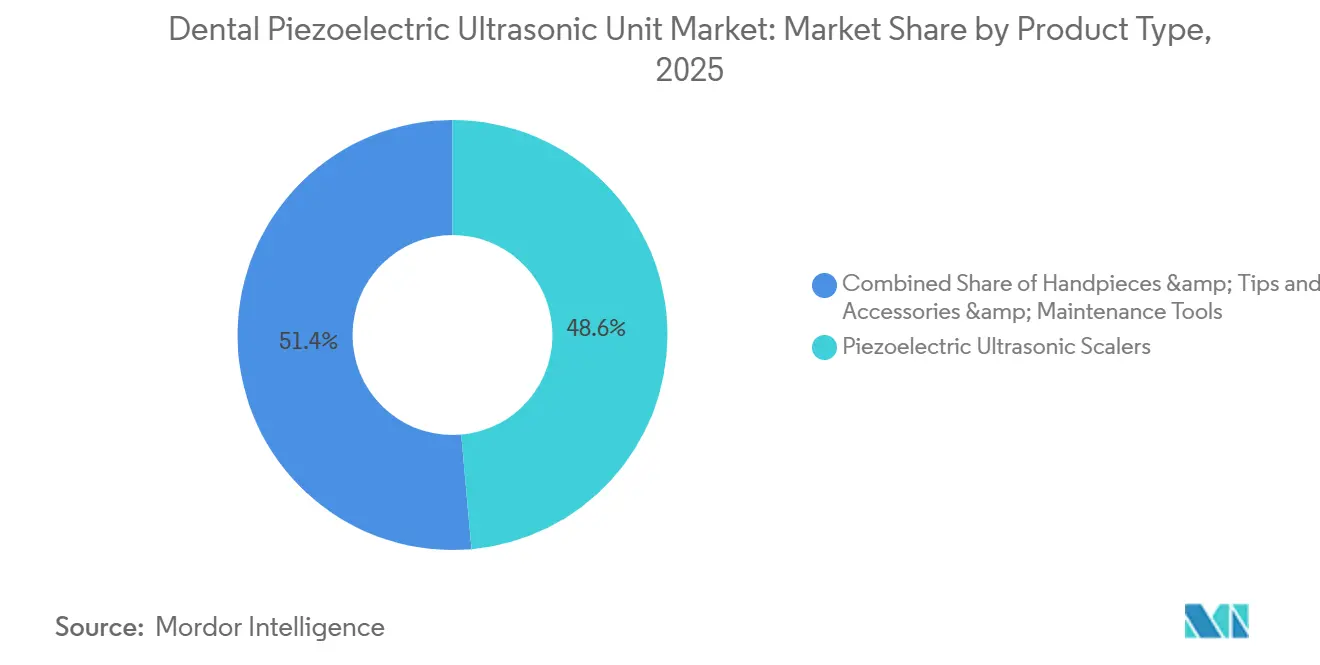
Consumable Revenue Compounding Ahead of Capital EquipmentPiezoelectric Ultrasonic Scalers held 48.6% of the dental piezoelectric ultrasonic unit market share in 2026. They remain the main capital purchase for clinics and group practices building periodontal treatment capacity. Handpieces & Tips is forecast to grow at a 5.8% CAGR through 2032. This rate exceeds the overall market forecast and the rate expected for capital equipment. Each additional installed control unit creates future demand for replacement handpieces and tips. Consumable purchases can therefore continue even when clinics defer a complete unit replacement. Leading suppliers use broad proprietary tip libraries to reinforce this replacement cycle.
The dental piezoelectric ultrasonic unit market is also changing at the boundary between products and treatment platforms. Ultrasonic functions are increasingly combined with air polishing and laser modules. Procurement teams can then evaluate a prophylaxis system rather than a standalone scaler. This may move some capital purchases into broader platform categories. Handpieces & Tips remain important because each clinical mode requires its own application-specific tip. Subgingival, supragingival, endodontic, and surgical work can require different tip designs. Accessories & Maintenance Tools remain the smallest product group. Proprietary compatibility requirements also narrow the opening for generic accessory suppliers.

By End User:
Group Practice Scale Reshaping Procurement LogicDental Clinics accounted for 52.4% of the dental piezoelectric ultrasonic unit market share in 2026. They remain the principal setting for periodontal treatment delivery. Group Dental Practices is forecast to expand at a 5.6% CAGR through 2032. This reflects the transfer of buying authority from individual dentists to multi-location dental organizations. DSOs use centralized formularies to standardize brands and models across their locations. This can shorten replacement cycles when a network changes its equipment standard. It also gives established suppliers an advantage when they offer enterprise service support.
Hospitals, ambulatory surgical centers, and academic institutes are smaller end-user groups. They remain strategically important because they support complex procedures, research, and clinician training. Academic institutions can generate evidence that shapes purchasing decisions in clinics and DSOs. Comparative studies of ultrasonic devices continue to inform clinical protocol choices. Manufacturers may compete for research placements and academic partnerships, even when the immediate sale is smaller. These relationships can influence future treatment practice and formulary selection. The dental piezoelectric ultrasonic unit industry therefore depends on both routine clinical demand and academic evidence development. Group practice growth does not remove the role of independent clinics, but it changes where major purchasing decisions are made.
By Technology:
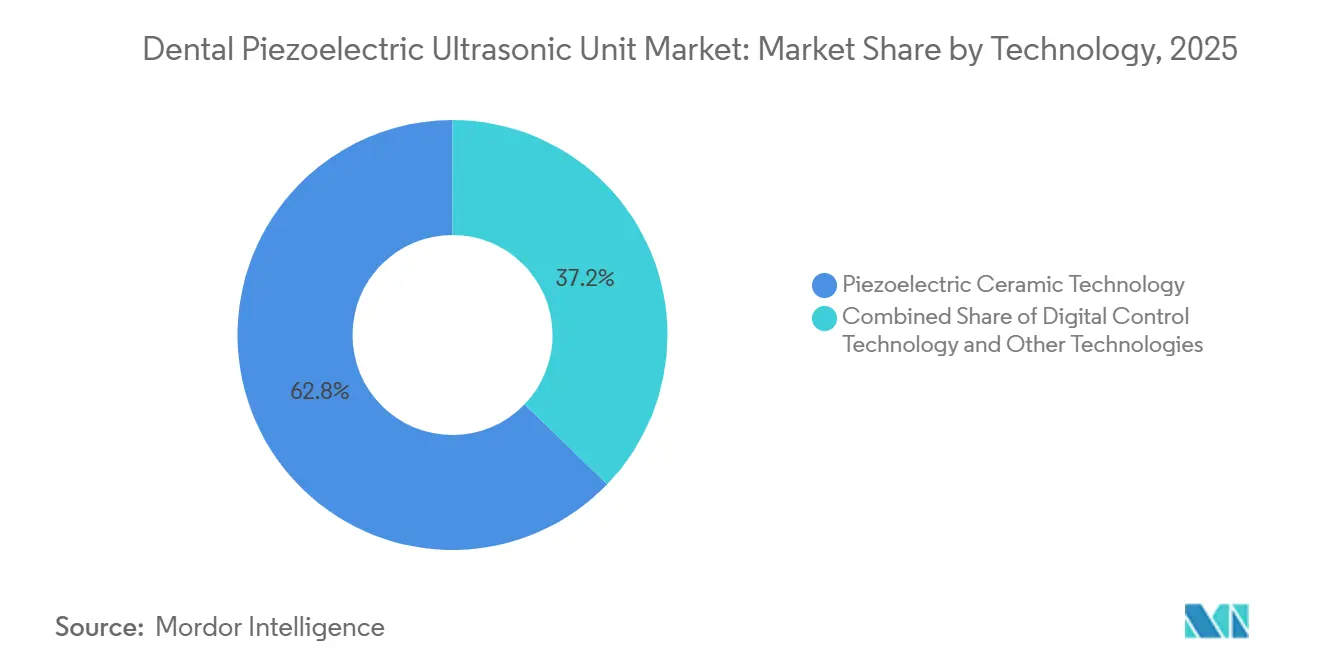
Integrated Platforms Accelerating the Share ShiftPiezoelectric Ceramic Technology held 62.8% share of the dental piezoelectric ultrasonic unit market size in 2026. Its position reflects the large installed base of standard ceramic transducer systems. Integrated Laser-Piezo Systems is forecast to grow at a 6.7% CAGR through 2032. This is the highest forecast rate among the listed segmentation types. Combined systems can bring ultrasonic debridement and laser-assisted soft-tissue management into one device. They can reduce setup steps for clinicians treating periodontally compromised implant sites. Digital Control Technology sits between these approaches and is progressing toward automated frequency management.
Integrated systems change the conditions for competition. Suppliers must manage device requirements for both ultrasonic and laser functions. This raises the clinical evidence and regulatory burden for new participants. Larger companies with multiple product lines are better able to support these requirements. The dental piezoelectric ultrasonic unit market may therefore see its fastest-growing technology area concentrated among established suppliers. Combined systems can also increase switching costs because a clinic adopts linked treatment workflows and proprietary consumables. Digital control systems offer another route to differentiation through load sensing and reduced manual adjustment. Low-cost suppliers may retain opportunities in conventional equipment, but they face greater difficulty in the integrated category. The contrast between ceramic systems and integrated platforms is therefore a contrast in both clinical scope and supplier capability. Clinics can choose standard units where routine debridement is the primary need. They can select integrated units when they want fewer devices and a wider procedure range. This choice can sustain parallel demand for established and newer technologies.
By Portability:
Portable Units Gaining Ground Beyond the ChairsideBenchtop Units held 58.2% of the dental piezoelectric ultrasonic unit market share in 2026. They remain the standard form factor for chairside periodontal and endodontic care in equipped operatories. Portable & Handheld Units is forecast to grow at a 6.3% CAGR through 2032. Demand comes from mobile dental units, community outreach programs, military deployments, humanitarian work, and rural clinics. Self-contained water systems and battery-powered designs support use in locations with limited infrastructure. The segment is especially relevant where a permanent dental operatory is not available. Chinese manufacturers have a cost advantage in portable equipment for first-time buyers in emerging markets.
Portable use changes the accessory and training requirements of the dental piezoelectric ultrasonic unit market. Mobile deployments often need lightweight, autoclavable handpieces and a shorter, focused tip library. This creates demand for a specialized part of the accessory category. New users can include community health workers and dental hygienists operating outside conventional practice settings. Some may not have formal training in piezoelectric technique. The operator training restraint can therefore be more visible in portable settings. Suppliers can address this need by bundling video guidance or remote training with equipment. These services can help maintain procedure quality while enabling mobile access to periodontal care. Portable equipment also allows programs to reach patients who do not routinely visit a fixed dental clinic. The equipment choice must balance mobility with dependable water delivery, power supply, and sterilization. Those operating conditions favor practical designs and readily available service. They also make follow-up education important after the original unit purchase.
By Application:
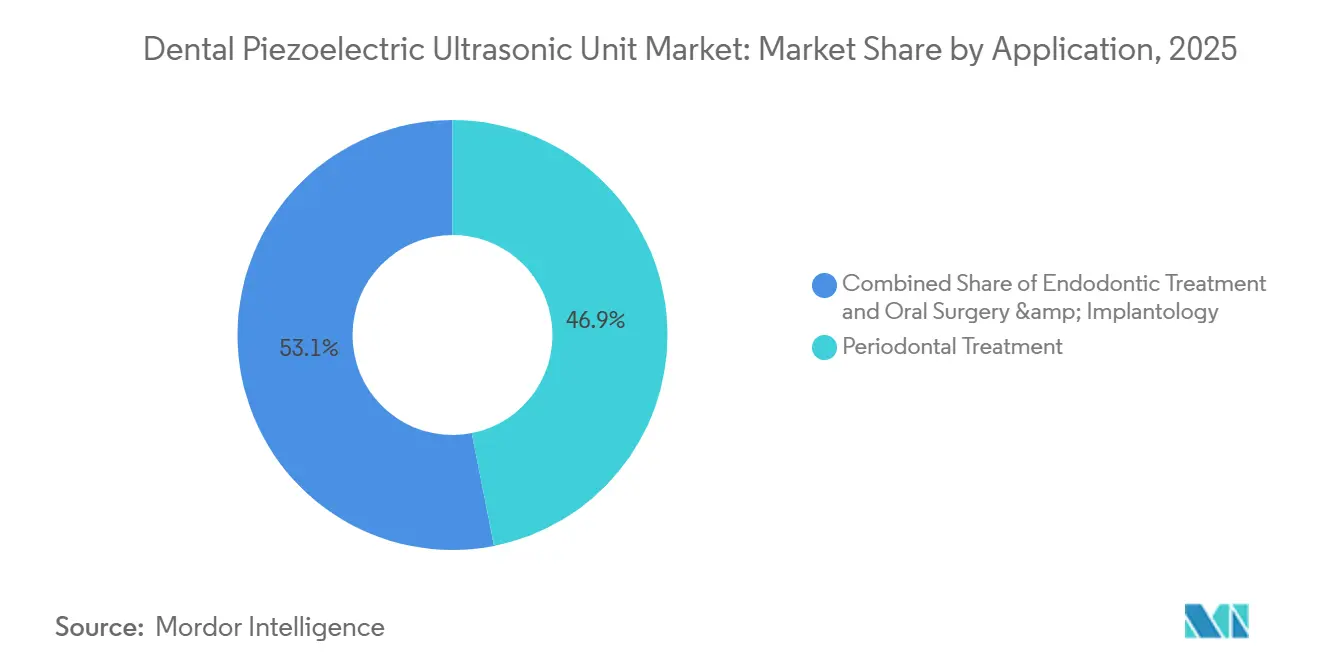
Implantology Extending the Clinical Utility BoundaryPeriodontal Treatment accounted for 46.9% of the dental piezoelectric ultrasonic unit market share in 2026. It remains the core clinical use because scaling and root planing create a large base of recurring procedures. Oral Surgery & Implantology is forecast to grow at a 6.1% CAGR through 2032. Piezoelectric cutting is gaining use in implant site preparation, guided bone regeneration, crown lengthening, and peri-implantitis debridement. It can cut mineralized bone while limiting contact with nerves, membranes, and surrounding soft tissue. This supports minimally invasive and flapless surgical approaches. Endodontic Treatment remains a steady application supported by advances in irrigation activation and access refinement.
Periodontal maintenance has lower equipment intensity per procedure than oral surgery. Maintenance visits generally use a smaller tip library and may not require a new handpiece. Oral surgery can require higher-power units, cooling irrigation, and several surgical tips. These procedures occur less often but have higher capital intensity. This explains why implantology can add more value to the dental piezoelectric ultrasonic unit market than its procedure volume alone suggests. The growth of robotic implant systems can reinforce expectations for precision throughout the workflow. Piezoelectric devices can serve as an adjunct during surgical preparation. The application mix therefore shifts toward equipment value as well as procedure count. Periodontal care remains essential because it supports the largest share of routine use. Surgical growth broadens the addressable clinical setting for the same core technology. Suppliers can respond with higher-power units and specialized surgical tip options. This allows the application portfolio to serve both maintenance care and advanced procedures.
Geography Analysis
North America Dental Piezoelectric Ultrasonic Unit Market
North America held 40.8% of the dental piezoelectric ultrasonic unit market share in 2026. The United States leads regional demand because of its dense private practice network, trained clinical workforce, and DSO consolidation. Purchasing is moving from individual practices toward group-level formulary management. Heartland Dental's[3] December 2025 selection of Dentira for enterprise lab management built on its clinical supplies procurement relationship. Canada has a mature periodontal care base. Mexico is a smaller but developing market where private clinic expansion is outpacing rural public facility investment. Regional growth through 2032 is expected to come mainly from fleet replacement rather than first-time adoption.
Europe Dental Piezoelectric Ultrasonic Unit Market
Europe is the second-largest regional market for dental piezoelectric ultrasonic units. Germany, the United Kingdom, France, Italy, and Spain account for much of the regional demand. Germany benefits from a high density of private practices and established reimbursement frameworks. The region also includes major suppliers such as W&H in Austria and Mectron in Italy. Their location supports equipment distribution and service availability. Regulatory requirements can favor brands with established conformity documentation. ISO 18397:2025 adds updated requirements for powered scalers and their tips. Eastern European markets are growing as clinic infrastructure investment increases. The regional pattern combines mature demand in Western Europe with developing demand in newer clinic networks. Service coverage matters because practices depend on timely handpiece and tip support. Established local distributors can therefore influence brand selection. Regulatory compliance and distribution capability work together in regional competition.
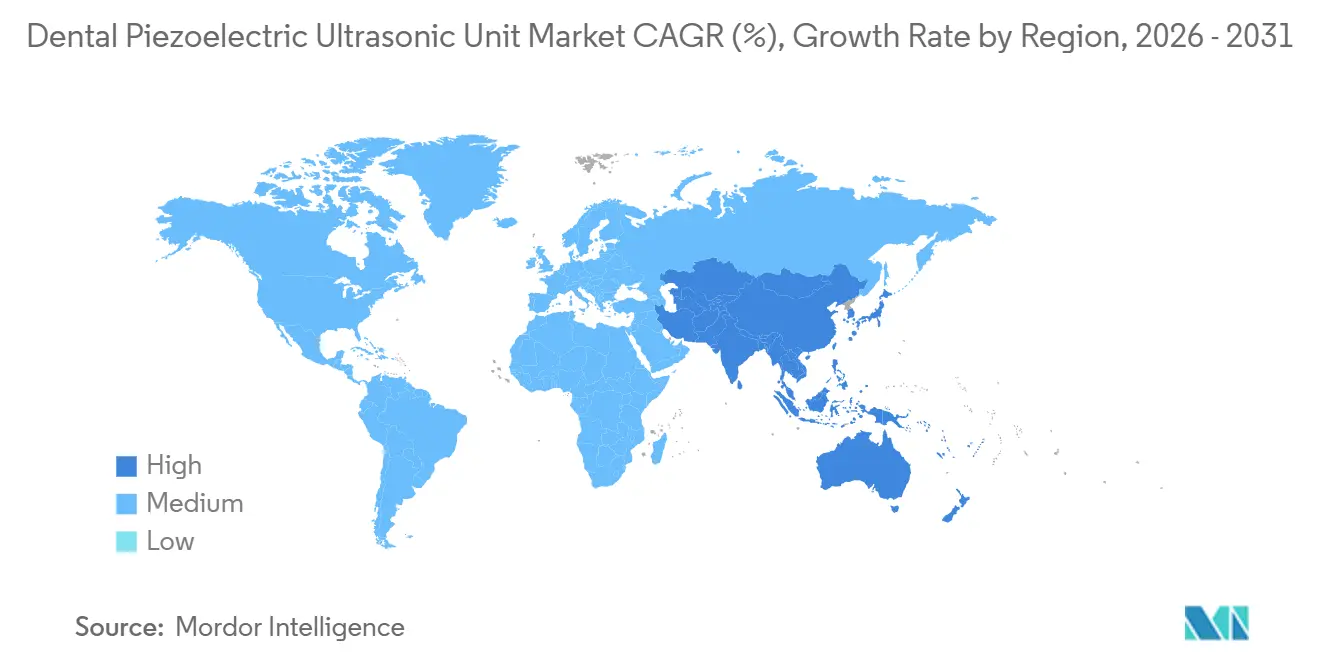
The Americas, APAC and MEA Dental Piezoelectric Ultrasonic Unit Market
Asia Pacific is forecast to grow at a 5.3% CAGR through 2032, the highest regional rate in the dental piezoelectric ultrasonic unit market. China offers the largest volume opportunity as private clinics purchase both imported and domestic equipment. The country plans 80,000 new dental chairs by 2030. India is also expanding through greater periodontal awareness, a growing middle class, and public oral health investment. Japan supports maintenance-scaling demand because its population is older and periodontal disease is prevalent among older adults. South Korea and Australia support premium demand through implantology adoption and clinician investment in high-precision equipment. Middle East and Africa and South America remain smaller, underserved regions, with Brazil and Mexico serving as important country-level growth engines. Equipment affordability is especially important in these regions. Suppliers must often balance price, local service, and consumable access. Entry-level products can expand the installed base where premium platforms are harder to finance. As clinic infrastructure improves, these markets can also create demand for broader treatment systems.
Competitive Landscape
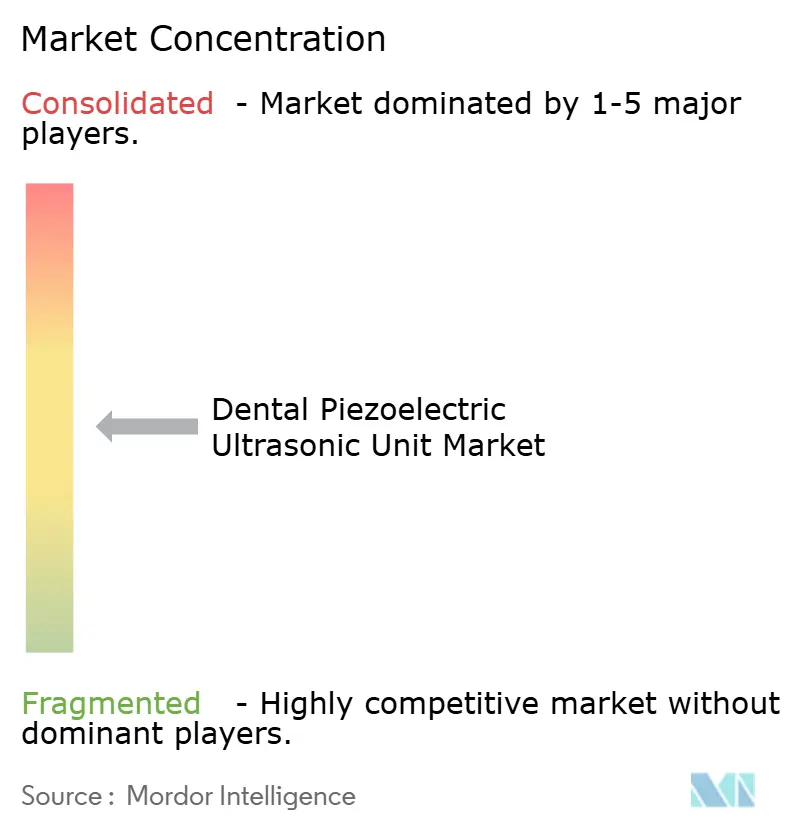
The dental piezoelectric ultrasonic unit market is moderately concentrated. EMS, Acteon, mectron, W&H, and NSK have installed-base and clinical positioning advantages in North America and Europe. Woodpecker, Being Foshan Medical Equipment, and Coxo Medical compete strongly on price in Asia Pacific, Latin America, and the Middle East. Leading suppliers are broadening from standalone scalers into platforms that combine ultrasonic scaling, air polishing, and laser functions. This approach increases the value of a capital purchase and supports proprietary consumable demand. It also makes it harder for a clinic to switch systems after adopting an integrated workflow. ISO 18397:2025 can add further pressure to suppliers that lack established documentation and validation systems.
EMS launched the next-generation GBT Machine at IDS 2025 with the PIEZON PS NO PAIN MAX module, EMS Partner 2.0 connectivity, and automated GBT mode. The product places workflow data and maintenance schedules inside the equipment offering. Dentsply Sirona launched Smart View Detect in May 2026 as an FDA-cleared diagnostic aid for periapical radiolucencies in CBCT scans. This shows how device companies are adding digital functions that can connect diagnosis and treatment workflows. Neocis[4] introduced Yomi S in November 2025 for minimally invasive robotic implant surgery. Its precision focus can strengthen demand for accurate adjunct surgical tools. These moves place more importance on digital integration, clinical support, and enterprise service.
Opportunities remain in portable units, predictive maintenance for DSOs, and training platforms bundled with equipment. Portable products can serve community, rural, and humanitarian settings that do not have a fully equipped operatory. Predictive maintenance can help larger organizations reduce disruption across many locations. Training platforms can address technique gaps in emerging markets and help clinics obtain more value from equipment. Chinese suppliers can continue to gain where capital cost is the leading purchase criterion. Mid-tier Western suppliers face greater pressure if they compete only on price. The dental piezoelectric ultrasonic unit market rewards suppliers that combine device performance with training, service, consumables, and workflow support. The competitive structure is consistent with a moderate level of supplier concentration rather than a single-company market. Established firms compete on clinical credibility, broad system offerings, and service coverage. Lower-cost suppliers compete where purchase price has greater weight. The result is a divided field that varies by customer type and region. No single strategic approach applies across every purchasing environment.
Dental Piezoelectric Ultrasonic Unit Industry Leaders
-
Dentsply Sirona Inc.
-
Ultradent Products, Inc.
-
COLTENE Group
-
Kerr Corporation
-
Den-Mat Holdings, LLC
- *Disclaimer: Major Players sorted in no particular order
Dental Piezoelectric Ultrasonic Unit Market Companies Covered in this Report
- EMS Electro Medical Systems S.A.
- Acteon Group
- Dentsply Sirona
- mectron S.p.A.
- NSK Nakanishi Inc.
- W&H Dentalwerk Burmoos GmbH
- Ultradent Products, Inc.
- COLTENE Group
- BonART Co., Ltd.
- Woodpecker Medical Instrument Co., Ltd.
- Brasseler U.S.A. Dental, LLC
- Flight Dental Systems
- Kerr
- Den-Mat Holdings, LLC
- APOZA Enterprise Co., Ltd.
- Being Foshan Medical Equipment Co., Ltd.
- Osada Electric Co., Ltd.
- Coxo Medical Instrument Co., Ltd.
- Techdent SAS
- Aseptico, Inc.
- TPC Advanced Technology, Inc.
Recent Industry Developments in Dental Piezoelectric Ultrasonic Unit Market
- May 2026: Dentsply Sirona launched Smart View - Detect, the world's first FDA-cleared and CE-approved AI-enabled diagnostic aid for detecting periapical radiolucencies in CBCT scans, available via its cloud-based DS Core platform beginning May 12, 2026, for both newly installed and existing compatible CBCT systems. The tool demonstrated approximately a 46% relative improvement in tooth-level detection sensitivity in an internal multi-reader clinical study, extending Dentsply Sirona's AI-driven diagnostic reach into adjacent procedural workflows.
- November 2025: Neocis launched Yomi S, the next-generation AI-powered robotic system for dental implant surgery cleared by the FDA, featuring autonomous foot-pedal and touchscreen operation, advanced AI planning via YomiPlan, and a flapless minimally invasive surgical approach designed to shorten patient recovery. The platform's precision standard raises expectations for adjunct piezoelectric bone preparation, creating downstream demand for high-precision piezo surgical units.
- August 2025: ISO 18397:2025, Dentistry Powered Scaler, was issued by the International Organization for Standardization, updating requirements and test methods for air-powered and electrically powered scaler handpieces and scaler tips, including piezoelectric and magnetostrictive types, for stand-alone and dental-unit-connected applications. The revision introduced updated safety, marking, and reprocessing-instruction requirements.
- March 2025: EMS launched the next-generation GBT Machine at IDS 2025 in Cologne, featuring the PIEZON PS NO PAIN MAX module for adaptive piezo scaling, EMS Partner 2.0 smart connectivity that tracks treatment data and maintenance schedules, and an automated GBT mode.
Global Dental Piezoelectric Ultrasonic Unit Market Report Scope
Segmentation Overview
| Piezoelectric Ultrasonic Scalers |
| Handpieces & Tips |
| Accessories & Maintenance Tools |
| Dental Clinics |
| Hospitals & Ambulatory Surgical Centers |
| Group Dental Practices |
| Academic & Research Institutes |
| Piezoelectric Ceramic Technology |
| Digital Control Technology |
| Integrated Laser-Piezo Systems |
| Benchtop Units |
| Portable & Handheld Units |
| Periodontal Treatment |
| Endodontic Treatment |
| Oral Surgery & Implantology |
| North America | United States |
| Canada | |
| Mexico | |
| Europe | Germany |
| United Kingdom | |
| France | |
| Italy | |
| Spain | |
| Rest of Europe | |
| Asia-Pacific | China |
| Japan | |
| India | |
| South Korea | |
| Australia | |
| Rest of Asia-Pacific | |
| Middle East and africa | GCC |
| South Africa | |
| Rest of Middle East and Africa | |
| South America | Brazil |
| Argentina | |
| Rest of South America |
| By Product Type | Piezoelectric Ultrasonic Scalers | |
| Handpieces & Tips | ||
| Accessories & Maintenance Tools | ||
| By End User | Dental Clinics | |
| Hospitals & Ambulatory Surgical Centers | ||
| Group Dental Practices | ||
| Academic & Research Institutes | ||
| By Technology | Piezoelectric Ceramic Technology | |
| Digital Control Technology | ||
| Integrated Laser-Piezo Systems | ||
| By Portability | Benchtop Units | |
| Portable & Handheld Units | ||
| By Application | Periodontal Treatment | |
| Endodontic Treatment | ||
| Oral Surgery & Implantology | ||
| By Geography | North America | United States |
| Canada | ||
| Mexico | ||
| Europe | Germany | |
| United Kingdom | ||
| France | ||
| Italy | ||
| Spain | ||
| Rest of Europe | ||
| Asia-Pacific | China | |
| Japan | ||
| India | ||
| South Korea | ||
| Australia | ||
| Rest of Asia-Pacific | ||
| Middle East and africa | GCC | |
| South Africa | ||
| Rest of Middle East and Africa | ||
| South America | Brazil | |
| Argentina | ||
| Rest of South America | ||
Key Questions Answered in the Report
How large is the dental piezoelectric ultrasonic unit market?
The dental piezoelectric ultrasonic unit market size is USD 1.18 billion in 2027 and is forecast to reach USD 1.47 billion by 2032 at a 4.53% CAGR.
Which product category is growing fastest?
Handpieces & Tips is forecast to grow at a 5.8% CAGR through 2032, supported by replacement demand from the installed base.
Which application is expanding fastest?
Oral Surgery & Implantology is forecast to grow at a 6.1% CAGR through 2032 as piezoelectric cutting supports implant-related procedures.
Which region is growing fastest for dental piezoelectric ultrasonic units?
Asia Pacific is forecast to grow at a 5.3% CAGR through 2032, supported by clinic expansion and first-time equipment adoption.
What factors shape supplier competition?
Clinical evidence, service coverage, integrated workflows, consumable availability, training, and purchase price all influence supplier selection.