
Dental Delivery System Market Size and Share
Market Overview
| Study Period | 2021 - 2032 |
|---|---|
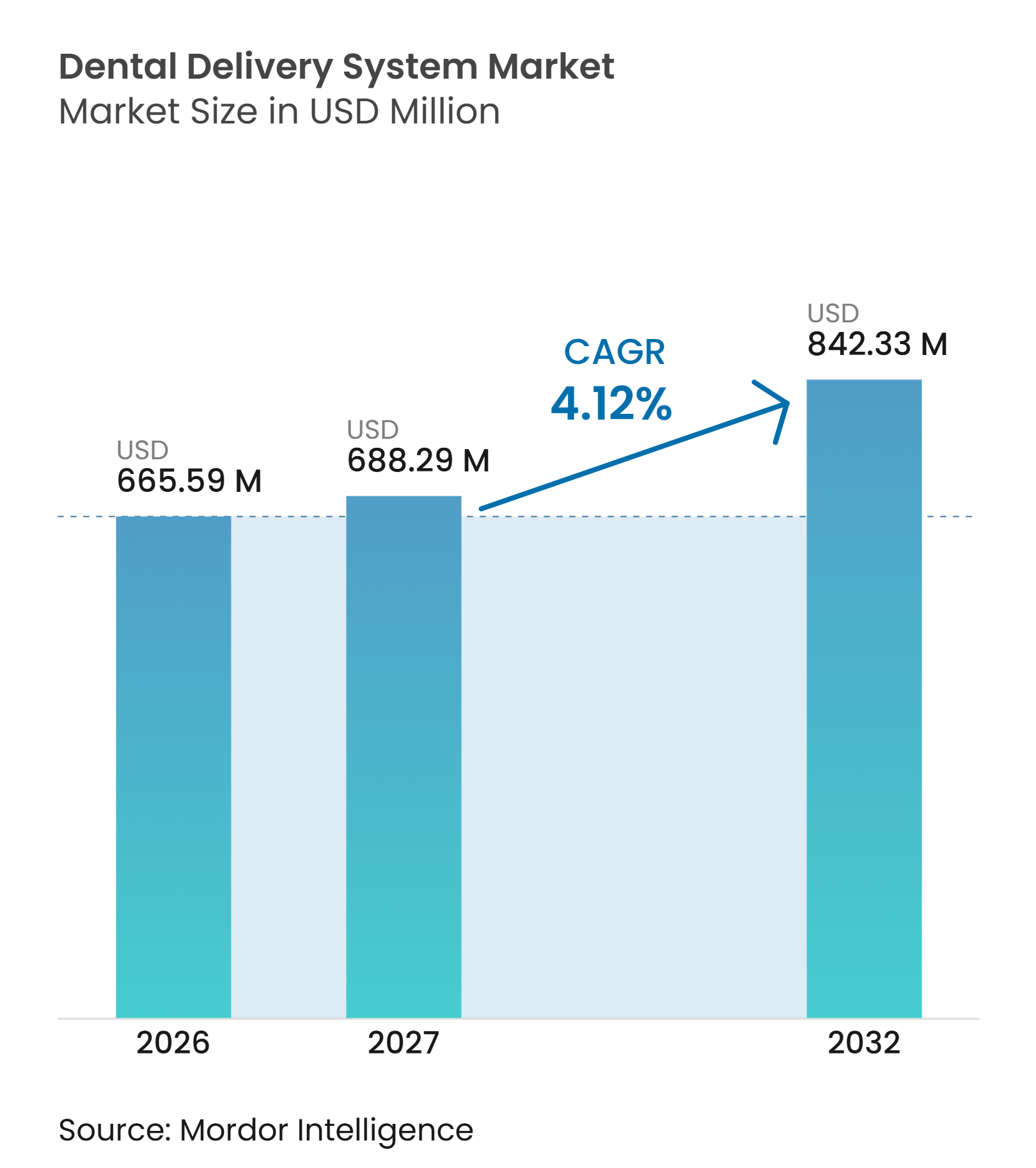
| Market Size (2027) | USD 688.29 Million |
| Market Size (2032) | USD 842.33 Million |
| Growth Rate (2027 - 2032) | 4.12 % |
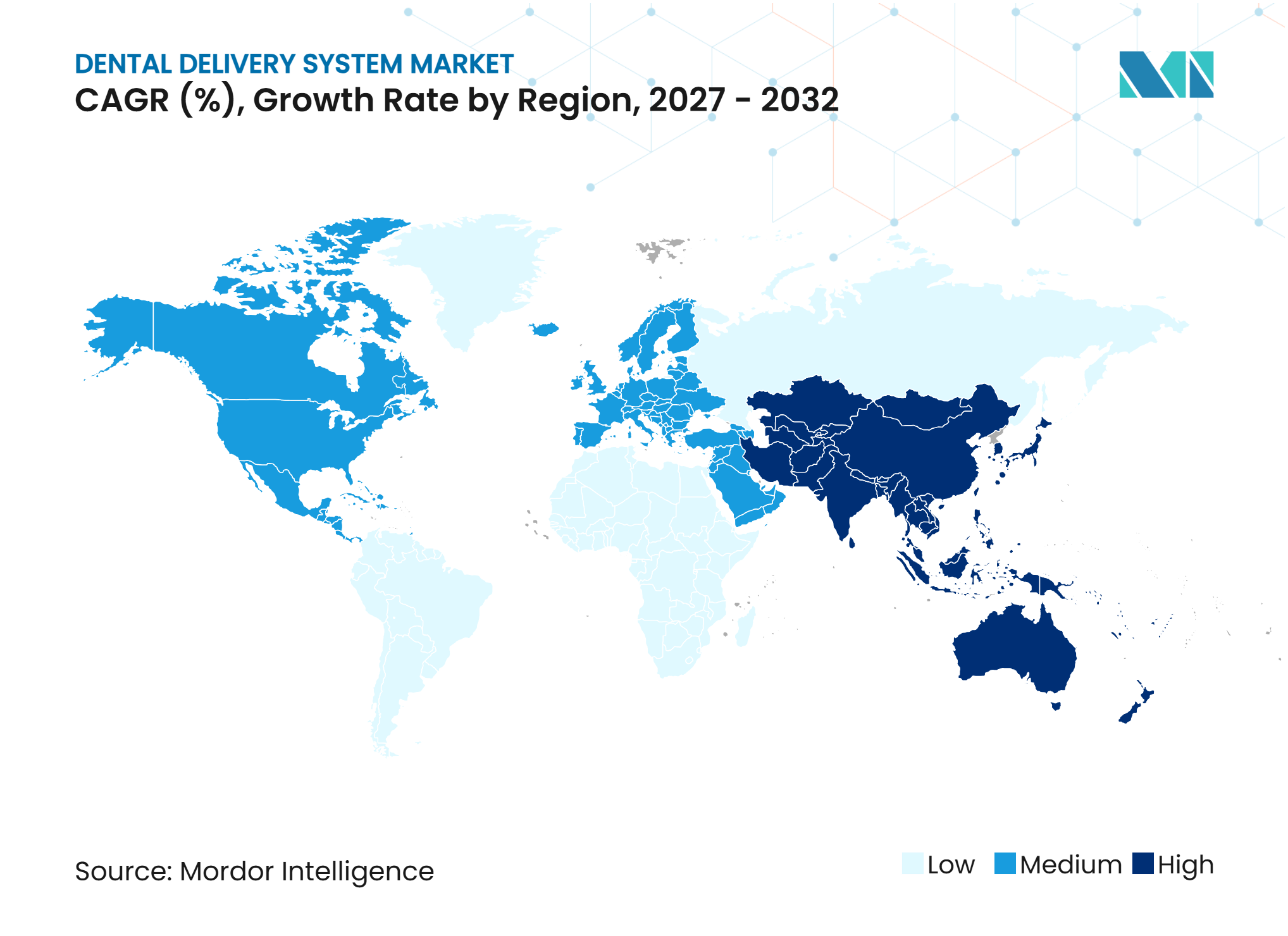
| Fastest Growing Market | Asia-Pacific |
| Largest Market | North America |
| Market Concentration | Medium |
Major Players *Disclaimer: Major Players sorted in no particular order Image © Mordor Intelligence. Reuse requires attribution under CC BY 4.0. | |
Dental Delivery System Market Analysis by Mordor Intelligence
The Dental Delivery System Market size is expected to grow from USD 665.59 million in 2026 to USD 688.29 million in 2027 and is forecast to reach USD 842.33 million by 2032 at 4.12% CAGR over 2027-2032.
The dental delivery system market is being supported by new clinic construction, replacement demand, and the broader use of standardized operatories in group practices. Equipment choices increasingly combine clinical workflow, infection control, software connectivity, and service access rather than focusing on the chair alone. This favors manufacturers that can offer modular systems, installation support, and dependable maintenance across several locations. The dental delivery system market also has an opportunity in mid-tier systems that combine connected features and waterline treatment without the cost of premium treatment centers. Cost, installation disruption, and limited local technical support continue to slow adoption outside well-funded practices.
Key Report Takeaways
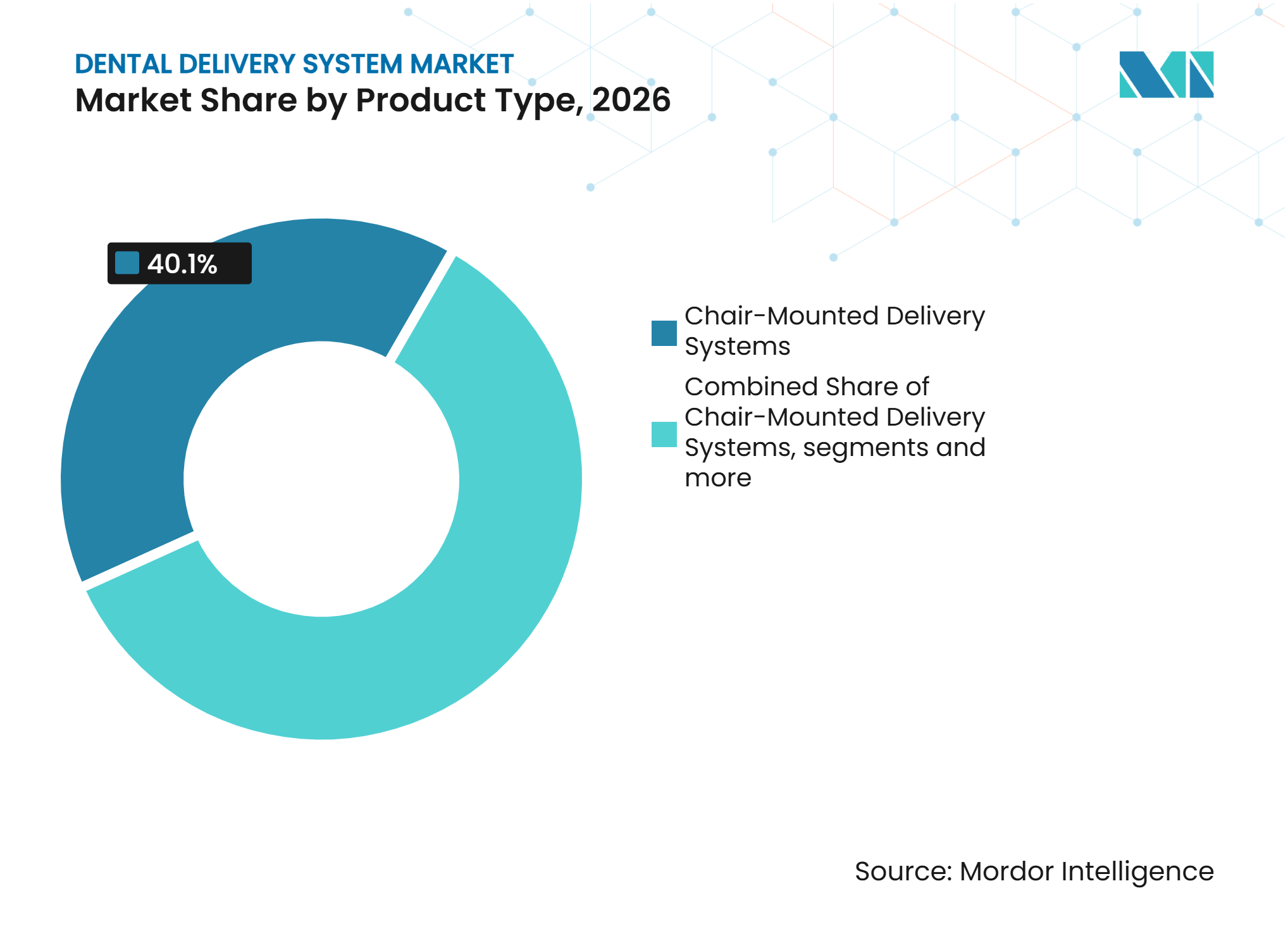
- By product type, chair-mounted delivery systems held 40.10% of revenue in 2026, while cabinet-mounted delivery systems are forecast to expand at a 5.24% CAGR through 2032.
- By application, general dentistry held 38.22% of revenue in 2026, while oral surgery is expected to expand at a 6.15% CAGR through 2032.
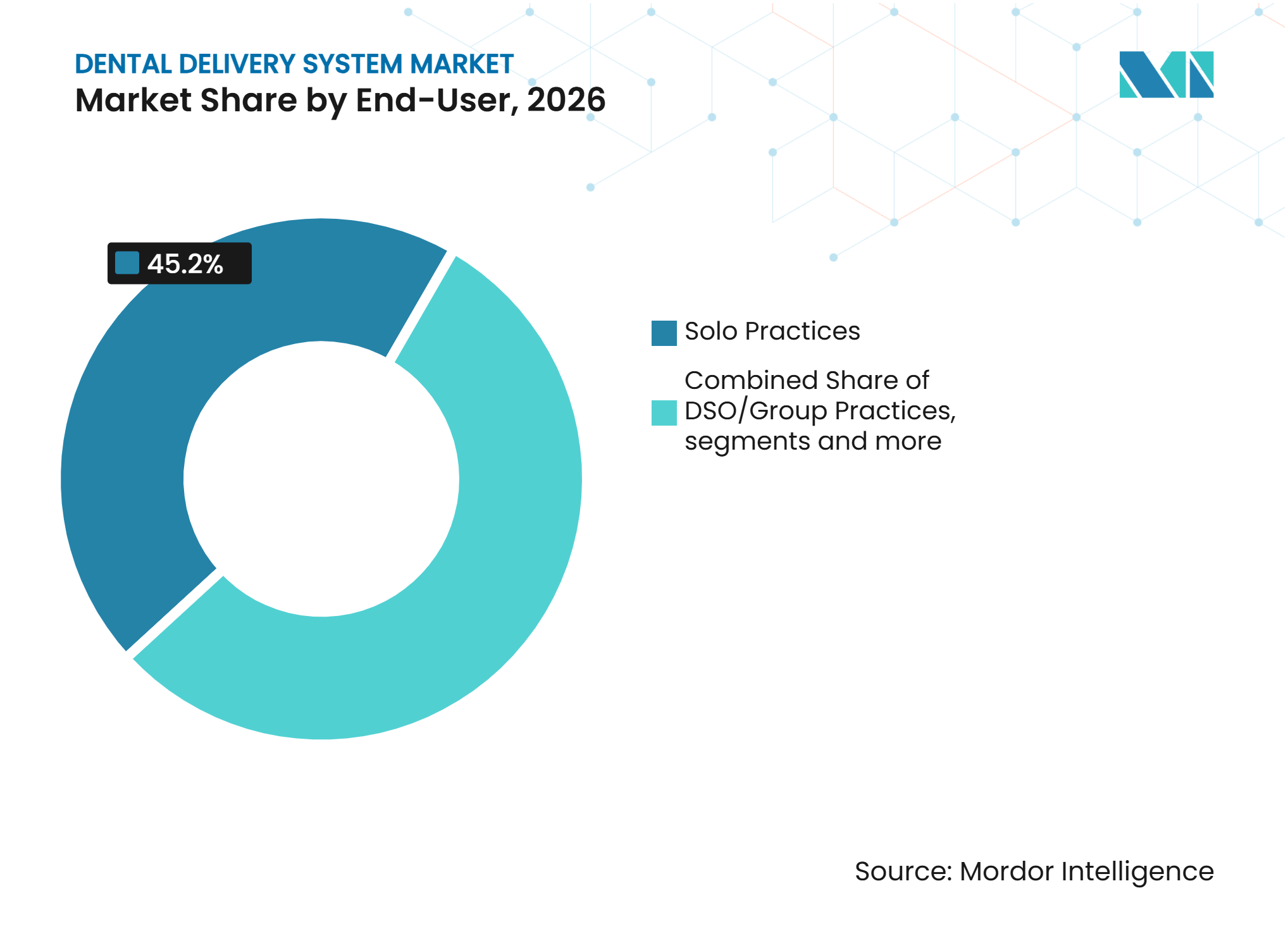
- By end-user, solo practices held 45.15% of volume in 2026, while DSO/group practices are forecast to expand at a 4.66% CAGR through 2032.
- By geography, North America held 47.11% of volume in 2026, while Asia-Pacific is projected to expand at a 7.33% CAGR through 2032.
Note: Market numbers in this report are based on Mordor Intelligence's proprietary estimation framework, which combines nine months of actuals with Q4 projections for base year 2026.
Market Trends and Insights
Drivers Impact Analysis of Dental Delivery System Market*
| Driver | (~) % Impact on CAGR Forecast | Geographic Relevance | Impact Timeline |
|---|---|---|---|
| Expansion of Dental Clinics and Group-Practice Operatories | +1.1% | Global, concentrated in North America and Asia-Pacific | Short term (≤ 2 years) |
| Rising Demand for Ergonomic and High-Throughput Workflows | +0.9% | North America and Europe | Medium term (2-4 years) |
| Digital Integration of Treatment Centers with Imaging, Scanning, and Practice Software | +0.7% | North America, Europe, and East Asia | Medium term (2-4 years) |
| Growth of Portable and Compact Dentistry in Underserved Settings | +0.5% | Asia-Pacific, Middle East and Africa, and South America | Long term (≥ 4 years) |
| Higher Infection-Control Expectations for Dental Unit Waterlines | +0.4% | North America, Europe, and Australia | Short term (≤ 2 years) |
| Retrofit Demand from Connected, Ambidextrous, and Space-Efficient Operatories | +0.3% | Global, with early gains in North America and Europe | Medium term (2-4 years) |
| Source: Mordor Intelligence | |||
Expansion of Dental Clinics and Group-Practice Operatories
The dental delivery system market benefits when group practices open new operatories because each room requires a complete clinical equipment installation. PDS Health planned to open more than 100 de novo practices in 2026, while Heartland Dental approached its 2,000th location. Specialty DSO practices grew by 5.5% in the 12 months ending May 2026, compared with 1.8% for general dentistry groups, which favors systems configured for surgical and endodontic work.[1] Central procurement can make equipment specifications more consistent across locations and increase demand for configurable platforms. New clinic designs also make waterline treatment and ergonomic layouts part of the initial equipment specification instead of a later upgrade. Standardized buying can increase unit volumes, although it can also favor modular platforms over customized room builds and place pressure on unit margins.
Rising Demand for Ergonomic and High-Throughput Workflows
The market is affected by the need to reduce physical strain during routine clinical work. Musculoskeletal disorders affected more than 80% of dental professionals in most published clinical surveys, with the neck, lower back, and shoulders repeatedly identified as affected areas.[2] A 2025 survey of 1,109 Chinese dentists found that 12.5% reported no occupational disease, while lumbar and cervical spondylosis were common diagnoses.[3] These findings support demand for adjustable instrument positions, ambidextrous configurations, and delivery arms that keep tools within an accessible work zone. Group practices that rely on four-handed dentistry are likely to treat these features as operational requirements during procurement. Delivery geometry that limits repeated reaching can therefore affect both clinician comfort and the consistency of high-throughput treatment routines.
Digital Integration of Treatment Centers with Imaging, Scanning, and Practice Software
The dental delivery system market is shifting toward systems that connect imaging, scanning, case records, and specialist instruments within the operatory. Henry Schein One launched LinkIt in August 2025 to connect case management, scanning, and imaging for Dentrix users through a centralized image repository. Planmeca made Romexis 7 available in June 2025 with AI-supported CBCT and intraoral scan fusion. A-dec+ supports software updates and integrations without physical hardware changes, which can extend the clinical value of an installed unit. A practice selecting a connected delivery platform is therefore also selecting a digital workflow partner and a future path for software updates. This link between hardware and software can increase switching costs when a clinic has built its records, imaging, and specialist workflows around one ecosystem.
Higher Infection-Control Expectations for Dental Unit Waterlines
The market gains replacement demand when older units cannot meet current waterline management expectations. An American Dental Association study released in 2024 found that nearly 1 in 3 dental professionals were unsure whether their practice met CDC waterline guidance, and nearly half did not have a designated infection control coordinator. The CDC HICPAC workgroup began developing updated evidence-based guidance in August 2024, which points to greater emphasis on monitoring and documentation. Systems with cartridge-based treatment or automated waterline functions can reduce the gap between legacy equipment and these expectations. Independent water-bottle systems alone may not meet drinking-water standards for dental unit output water, making integrated treatment more important.
Restraints Impact Analysis of Dental Delivery System Market*
| Restraint | (~) % Impact on CAGR Forecast | Geographic Relevance | Impact Timeline |
|---|---|---|---|
| High Total Cost of Ownership for Advanced Treatment Centers | -1.3% | Global, most acute in emerging markets and solo practices | Long term (≥ 4 years) |
| Installation, Utility, and Practice-Interruption Complexity | -0.7% | Global | Short term (≤ 2 years) |
| Fragmented Service Networks and Technician Shortages | -0.5% | Asia-Pacific, Middle East and Africa, and South America | Medium term (2-4 years) |
| Compatibility Risk Across Legacy Chairs, Handpieces, Software, and Utilities | -0.4% | Global, especially mature markets | Medium term (2-4 years) |
| Source: Mordor Intelligence | |||
High Total Cost of Ownership for Advanced Treatment Centers
The market faces a cost barrier when advanced systems require software subscriptions, utility upgrades, and certified installation in addition to the equipment purchase. DSO valuation multiples declined to 9-10 times EBITDA in 2026 from 13-16 times during 2019-2021. That environment can direct group operators toward same-store efficiency and careful capital allocation. Smaller practices may choose mid-range or legacy configurations when connected equipment exceeds their budgets. This creates a split between well-capitalized operators that can purchase integrated systems and smaller providers that defer higher-cost upgrades. OEM financing and modular upgrade paths can soften the decision, but they do not remove the affordability constraint in lower-income geographies.
Fragmented Service Networks and Technician Shortages
The dental delivery system market depends on local technical support because downtime can interrupt scheduled care and reduce confidence in new equipment. The issue is more pronounced in parts of Asia-Pacific, the Middle East and Africa, and South America, where trained service networks are less dense. Connected units can be harder to repair because their software, sensors, and communication protocols require manufacturer-specific expertise. Manufacturers may find technician training difficult to justify in lower-volume locations, which can leave prospective buyers concerned about service availability. The risk is especially significant in oral surgery and implant procedures, where an equipment failure can disrupt treatment and affect patient confidence. It also links equipment uptime to practice reputation when the procedure cannot be readily deferred.
*Our forecasts treat driver/restraint impacts as directional, not additive. The impact forecasts reflect baseline growth, mix effects, and variable interactions.
Dental Delivery System Market Segment Analysis
By Product Type:
Chair-Mounted Holds the Base, Cabinet-Mounted Captures New BuildChair-mounted delivery systems held 40.10% of the dental delivery system market share in 2026. Their position reflects broad compatibility with operatory layouts, lower installation costs, and flexible side or rear delivery arrangements. They remain a practical choice for replacement cycles and retrofits where installation speed is more important than a complete room redesign. Cabinet-mounted delivery systems are forecasted to grow at a 5.24% CAGR through 2032 as new DSO operatories adopt 12 o'clock delivery and four-handed workflows. This preference supports a less cluttered working area and a more consistent room layout across multi-site practices.
The dental delivery system industry is also seeing continued interest in delivery, portable systems, and cart-based configurations. Side delivery can suit shared operatories where clinical teams need flexible left-to-right handoff. Portable and cart-based options have a role in mobile outreach and school-based programs where fixed operatories are not available. Planmeca introduced the Pro50 S and Pro40 at IDS 2025, with compact delivery, digital features, and infection-control capabilities designed for space-limited treatment rooms.



By Application:
General Dentistry Anchors Volume, Oral Surgery Redefines CapabilityGeneral dentistry held 38.22% of application revenue in 2026 and remains the volume base of the dental delivery system industry. In North America and Western Europe, much of this demand comes from planned replacement cycles rather than new clinic construction. Endodontics benefits from integrated apex locator and rotary motor functions as root canal demand rises with an aging patient population. Orthodontic demand is more stable and often favors cabinet-integrated systems in pediatric and specialty clinics, where compact room design is important.
Oral surgery is expected to grow at a 6.15% CAGR through 2032, the fastest rate among applications in the dental delivery system market. Integrated surgical motors, apex locators, peristaltic irrigation pumps, and file motors allow a single platform to support several clinical tasks. The A-dec 500 Pro and 300 Pro received Midwest Motor System integration in early 2026, supporting restorative, endodontic, implant, and apex-locating workflows from one unit.
By End-User:
Solo Practices Define the Base, DSO Platforms Drive the Upgrade CycleSolo practices represented 45.15% of end-user volume in 2026, making them the largest purchasing base in the dental delivery system market. Independent offices still outnumber organized groups in global unit terms, which keeps replacement demand broadly distributed. Younger dentists are increasingly entering practice through DSO employment arrangements, moving some purchasing decisions from clinicians to central procurement teams.
DSO and group practices are forecasted to grow at a 4.66% CAGR through 2032. Their standardized models can simplify maintenance planning, staff training, and equipment selection across multiple locations. The dental delivery system market has a separate institutional channel that includes dental schools, military and government clinics, and hospital dental departments. Dental schools matter because the equipment used in training may influence later practice preferences among graduates.

Geography Analysis
North America
North America held 47.11% of the dental delivery system market share in 2026. The region is in an equipment upgrade cycle, supported by a large private-practice base and continuing DSO clinic development in the United States. CDC waterline guidance and state-level testing requirements can bring replacement decisions forward when older systems lack integrated treatment capability. Canada has a technically sophisticated but geographically dispersed market. Mexico is generating mid-range demand as private dental chains standardize clinic layouts in urban areas.
Europe
Europe remains an important revenue area for the dental delivery system market, led by Germany, Italy, the United Kingdom, and France. The region has established manufacturing bases and demanding requirements for device documentation and conformity assessment. These conditions support established manufacturers with existing regulatory capabilities and service networks. Italian producers have strong positions in their home market and Southern Europe, while also exporting to broader European and emerging markets.
Asia-Pacific, the Middle East and Africa, and South America
Asia-Pacific is projected to grow at a 7.33% CAGR through 2032 because China, India, and Southeast Asia are expanding clinic infrastructure from a lower installed base. China combines private clinic chain expansion in major cities with hospital investment in delivery system upgrades, while India is drawing investment into mid-range connected systems through private clinics, dental tourism, and dental college equipment upgrades. The Middle East and Africa rely on private healthcare and dental tourism investment in GCC countries and South Africa, while South America is led by Brazil and its domestic producer, Olsen Indústria e Comércio S.A. Argentina's economic instability limits capital equipment demand, although Colombia and Chile remain attractive private healthcare markets.
Competitive Landscape
Market Concentration
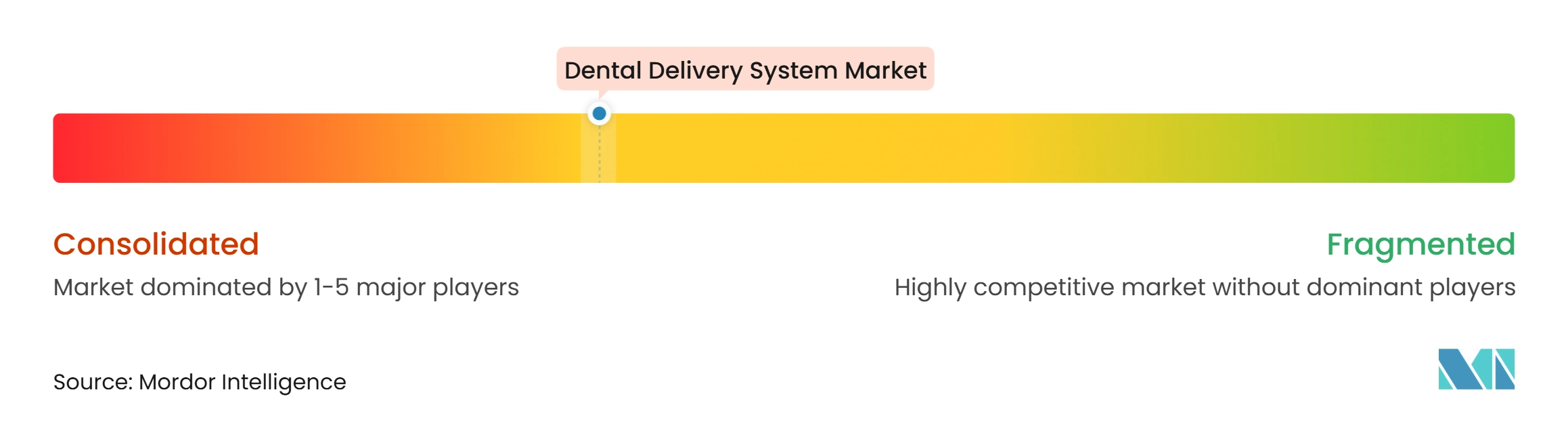
The dental delivery system market is moderately concentrated among established global manufacturers and regional specialists. A-dec, Planmeca, KaVo Dental, Midmark, and Italian manufacturers such as Castellini, Anthos, and Stern Weber compete through product ecosystems, dealer relationships, and certified service capabilities. Global companies emphasize connectivity, modularity, and service coverage, while regional producers can compete on manufacturing flexibility and price-to-value positioning. Software platforms can make an installed system more difficult to replace by providing updates and connected workflow features. This makes service continuity and digital compatibility important elements of supplier selection.
The dental delivery system market also has regulatory and service barriers that favor established suppliers. FDA 510(k) clearance for Class II configurations and European medical device requirements require technical documentation and resources that can limit undercapitalized entrants. Chinese ODM suppliers are challenging mid-tier prices in Southeast Asia and the Middle East and Africa, but limited service coverage constrains their reach in advanced settings. The largest opportunity remains modular mid-tier equipment with connectivity and waterline treatment for practices that cannot justify premium systems. Financing options and scalable upgrade paths would make this position more accessible to a wider set of buyers.
Midmark introduced a connected operatory platform and smart mechanical room equipment in February 2026, including the Smart Air Compressor and Smart G-Vacuum. The move extends its offering from chairside equipment to broader operatory infrastructure. KaVo introduced the CONNECTme app in 2026 for tablet-based hygiene plan monitoring across compatible unit lines. Planmeca's Romexis 7 image fusion feature gives customers a software-based point of differentiation alongside hardware specifications, showing why the dental delivery system market is increasingly shaped by connected workflows as well as physical equipment design.
Dental Delivery System Industry Leaders
-
A-dec Inc.
-
Dentsply Sirona Inc.
-
Planmeca Oy
-
Midmark Corporation
-
KaVo Dental GmbH
- *Disclaimer: Major Players sorted in no particular order
Dental Delivery System Market Companies Covered in this Report
- A-dec
- Anthos S.p.A.
- ASI Dental, Inc.
- Belmont Dental
- Castellini S.p.A.
- DentalEZ Group
- DENTALEZ, Inc.
- Dentsply Sirona
- Flight Dental Systems
- FONA Dental s.r.o.
- J. Morita
- KaVo Dental GmbH
- MGI Healthcare
- Midmark
- Olsen Industria e Comercio S.A.
- Pelton and Crane
- Planmeca
- Stern Weber
- Takara Belmont
- XO CARE A/S
Recent Industry Developments in Dental Delivery System Market
- July 2026: Planmeca received coverage in the British Dental Journal for the commercial launch of the Pro50 S and Pro40 dental units. Pro50 S features compact, ambidextrous side delivery designed for even the smallest treatment rooms, while Pro40 adds integrated digital intelligence and infection control features to an established side-lifting platform, targeting space-constrained DSO and multi-operator environments.
- June 2026: Henry Schein One integrated Align Technology's iTero intraoral scanners with Dentrix, Dentrix Ascend, and Dentally, enabling automatic patient record import from scan to care within a single connected environment. The integration eliminates manual uploads and system switching and is available across North America and select international markets.
- February 2026: Midmark Corporation launched a next-generation connected dental operatory platform and smart mechanical room equipment suite, including the Smart Air Compressor and Smart G-Vacuum, designed for ongoing over-the-air upgrades, ergonomics, and connectivity with delivery and lighting systems.
Global Dental Delivery System Market Report Scope
According to the report’s scope, the dental delivery system market refers to integrated workstations in dental clinics that centralize essential tools, such as handpieces, syringes, suction devices, and lighting, into ergonomic units, enabling efficient, precise, and patient‑friendly dental care. These systems streamline workflow, reduce strain for dentists, and improve patient comfort, making them a cornerstone of modern dental practices.
The dental delivery system market is segmented into product type, application, end-user, and geography. By product type, the market is segmented into chair-mounted delivery systems, cabinet-mounted delivery systems, side delivery systems, and other product types. By application, the market is segmented into general dentistry, oral surgery, endodontics, orthodontics, and other applications. By end-user, the market is segmented into solo practices, DSO/group practices, and other end-users. By geography, the market is segmented into North America, Europe, Asia-Pacific, the Middle East and Africa, and South America. The report also covers the estimated market sizes and trends for 17 countries across major regions globally. The report offers values (USD) for all the above segments.
Segmentation Overview
| Chair-Mounted Delivery Systems |
| Cabinet-Mounted Delivery Systems |
| Side Delivery Systems |
| Other Product Types |
| General Dentistry |
| Oral Surgery |
| Endodontics |
| Orthodontics |
| Other Applications |
| Solo Practices |
| DSO/Group Practices |
| Other End-Users |
| North America | United States |
| Canada | |
| Mexico | |
| Europe | Germany |
| United Kingdom | |
| France | |
| Italy | |
| Spain | |
| Rest of Europe | |
| Asia-Pacific | China |
| Japan | |
| India | |
| Australia | |
| South Korea | |
| Rest of Asia-Pacific | |
| Middle East and Africa | GCC |
| South Africa | |
| Rest of Middle East and Africa | |
| South America | Brazil |
| Argentina | |
| Rest of South America |
| By Product Type | Chair-Mounted Delivery Systems | |
| Cabinet-Mounted Delivery Systems | ||
| Side Delivery Systems | ||
| Other Product Types | ||
| By Application | General Dentistry | |
| Oral Surgery | ||
| Endodontics | ||
| Orthodontics | ||
| Other Applications | ||
| By End-User | Solo Practices | |
| DSO/Group Practices | ||
| Other End-Users | ||
| By Geography | North America | United States |
| Canada | ||
| Mexico | ||
| Europe | Germany | |
| United Kingdom | ||
| France | ||
| Italy | ||
| Spain | ||
| Rest of Europe | ||
| Asia-Pacific | China | |
| Japan | ||
| India | ||
| Australia | ||
| South Korea | ||
| Rest of Asia-Pacific | ||
| Middle East and Africa | GCC | |
| South Africa | ||
| Rest of Middle East and Africa | ||
| South America | Brazil | |
| Argentina | ||
| Rest of South America | ||
Key Questions Answered in the Report
What is the projected value of the dental delivery systems market by 2032?
The dental delivery system market is projected to reach USD 842.33 million by 2032, from USD 665.59 million in 2026 to USD 688.29 million in 2027, expanding at a 4.12% CAGR. from 2027 to 2032.
Which product configuration leads dental delivery system sales?
Chair-mounted delivery systems led with 40.10% of revenue in 2026 because they fit a broad range of layouts and retrofit projects.
Which dental application is growing fastest through 2032?
Oral surgery is forecasted to grow at a 6.15% CAGR as integrated platforms combine several specialty functions.
Which region is growing fastest for dental delivery equipment?
Asia-Pacific is projected to grow at a 7.33% CAGR through 2032 as clinic infrastructure expands across several countries.