
DDR5 AI Server Memory Market Size and Share
Market Overview
| Study Period | 2020 - 2031 |
|---|---|
| Market Size (2026) | USD 10.94 Billion |
| Market Size (2031) | USD 29.36 Billion |
| Growth Rate (2026 - 2031) | 21.83 % |
| Fastest Growing Market | Asia-Pacific |
| Largest Market | North America |
| Market Concentration | High |
Major Players *Disclaimer: Major Players sorted in no particular order Image © Mordor Intelligence. Reuse requires attribution under CC BY 4.0. | |
DDR5 AI Server Memory Market Analysis by Mordor Intelligence
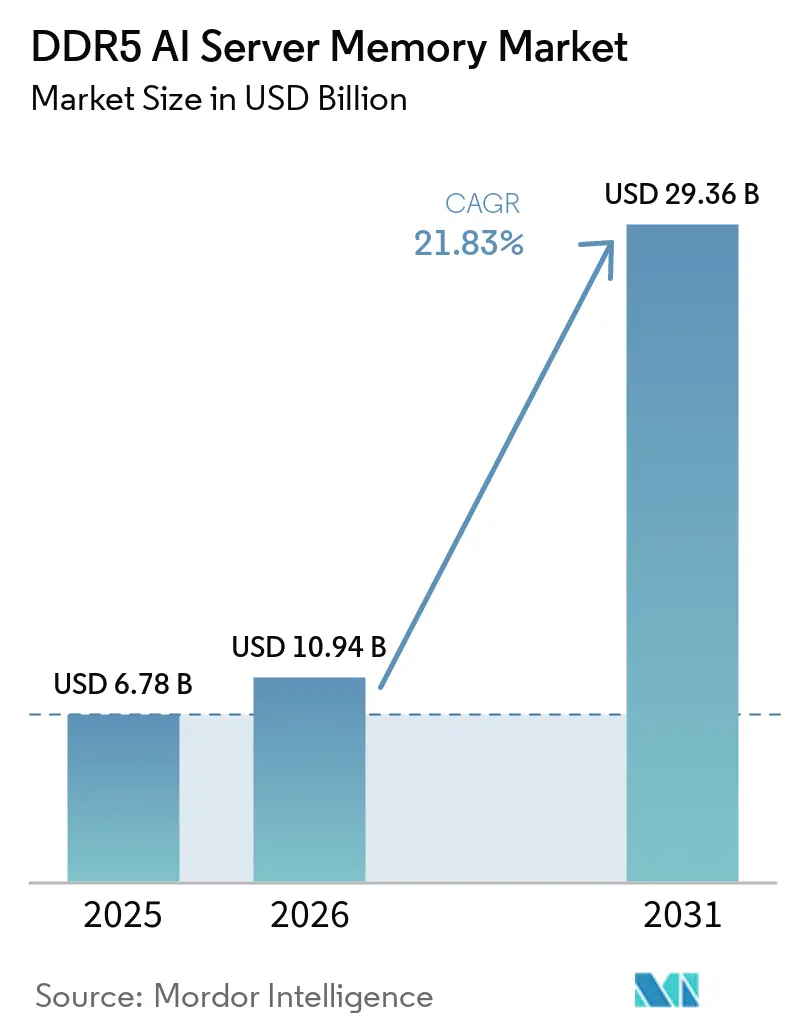
The DDR5 AI server memory market size is projected to be USD 6.78 billion in 2025, USD 10.94 billion in 2026, and reach USD 29.36 billion by 2031, growing at a CAGR of 21.83% from 2026 to 2031. Demand is being shaped by larger memory footprints in AI training and inference systems, rather than server shipments alone, because larger models require the host processor to retain more working data besides the accelerator and its onboard memory, while production systems also need to serve growing volumes of prompts, user sessions, and application-specific context without degrading response times. New server platforms now require DDR5, which has shifted memory selection from an upgrade choice to a system design requirement and has made the module's speed, capacity, power profile, and qualification status relevant from the moment a server configuration is planned. Cloud providers are also using multiyear supply arrangements to protect access to advanced memory components, making procurement capability, qualification depth, and delivery reliability central considerations for suppliers seeking long-term program wins, particularly when server deployments must be coordinated with accelerators, processors, networking equipment, facility power, and application rollout plans across several global data center locations and changing deployment schedules. This approach favors suppliers that can qualify high-capacity modules across several CPU platforms, while tighter advanced DRAM supply continues to limit availability for smaller buyers and makes predictable allocation, delivery timing, and module compatibility more important in enterprise procurement planning, especially for organizations that lack the purchase volumes or established supplier relationships of global cloud operators and must coordinate component purchases carefully across multiple hardware vendors and deployment locations.
Key Report Takeaways
- By module type, RDIMMs held 69.24% of the DDR5 AI server memory market share in 2025, while MRDIMMs and MCRDIMMs are forecast to grow at a 22.92% CAGR through 2031.
- By capacity, the 96 GB to 128 GB tier accounted for 46.82% of demand in 2025, while modules above 128 GB are forecast to grow at a 22.61% CAGR through 2031 in the DDR5 AI server memory market.
- By data rate, 5600 MT/s modules captured 42.37% of demand in 2025, while modules above 8000 MT/s are forecast to grow at a 22.83% CAGR through 2031 in the DDR5 AI server memory.
- By application, AI training servers accounted for 41.28% of application demand in 2025, while generative AI and LLM serving servers are forecast to expand at a 22.74% CAGR through 2031 in the DDR5 AI server memory.
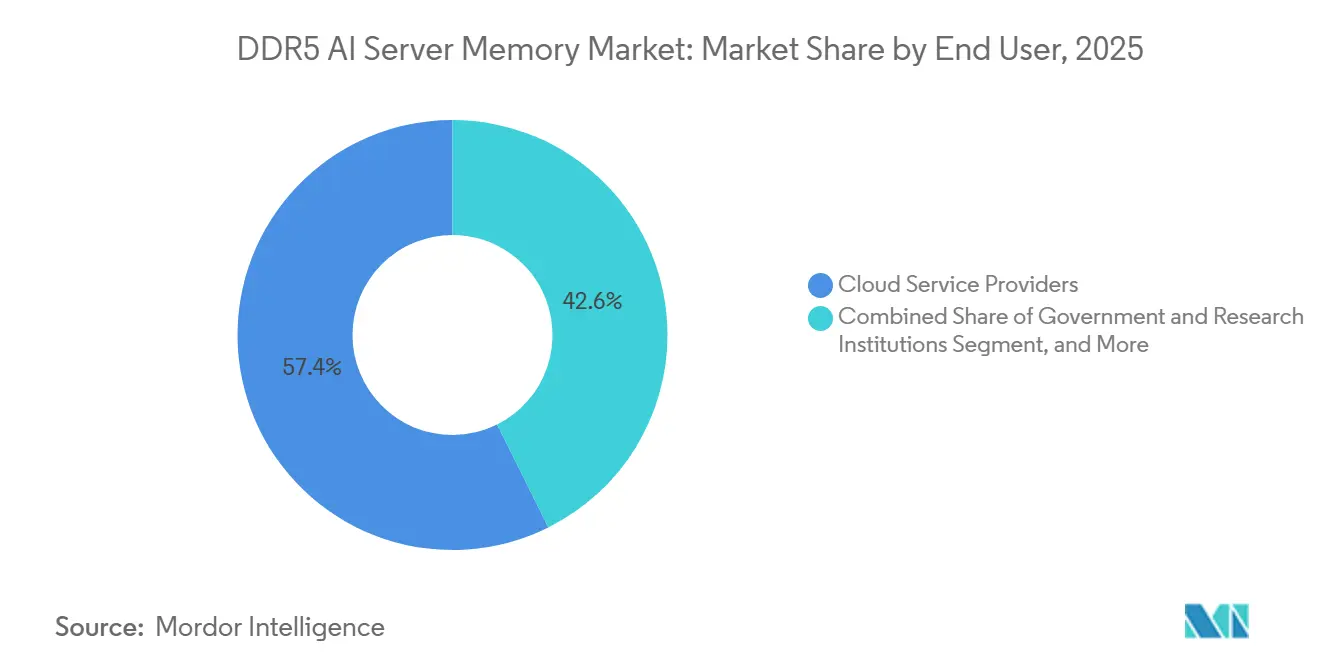
- By end user, cloud service providers held 57.36% of the DDR5 AI server memory market share in 2025, while government and research institutions are forecast to grow at a 22.35% CAGR through 2031.
Note: Market size and forecast figures in this report are generated using Mordor Intelligence’s proprietary estimation framework, updated with the latest available data and insights as of January 2026.
Global DDR5 AI Server Memory Market Trends and Insights
Drivers Impact Analysis*
| Driver | (~) % Impact on CAGR Forecast | Geographic Relevance | Impact Timeline |
|---|---|---|---|
| Accelerating AI Training and Inference Memory Intensity | +6.5% | Global | Short term (≤ 2 years) |
| Hyperscale Server Refresh Cycles Favoring DDR5-Only Platforms | +4.5% | North America and Europe | Short term (≤ 2 years) |
| Higher Memory Bandwidth Per Watt in Power-Constrained Data Centers | +3.0% | Global | Medium term (2-4 years) |
| Broader Platform Qualification Across Intel Xeon and AMD EPYC Servers | +2.5% | Global | Short term (≤ 2 years) |
| Larger Per-Socket Capacity to Reduce GPU Stall Time | +1.5% | North America and Asia Pacific, with spillover to Europe | Medium term (2-4 years) |
| Sovereign AI Infrastructure Increasing Domestic Memory Sourcing | +1.0% | National programs, led by Europe, Canada, and South Korea | Long term (≥ 4 years) |
| Source: Mordor Intelligence | |||
Accelerating AI Training and Inference Memory Intensity
AI training systems need substantial host memory bandwidth, and DDR4 configurations can restrict GPU use in newer server designs. A 70-billion-parameter model trained in full precision requires gradients, optimizer states, and intermediate activations simultaneously, creating a memory requirement 3 to 4 times larger than inference alone. Production inference also uses host memory for key-value cache overflow when GPU memory is full, especially when longer prompts or simultaneous user sessions increase the active context that must remain readily accessible. NVIDIA states that Grace Blackwell uses a 900 GB/s NVLink-C2C link to share a unified DDR5 and HBM memory space across CPU and GPU nodes.[1] This architecture makes host memory bandwidth a key factor in inference quality and throughput, broadening the DDR5 AI server memory market beyond a limited group of training-focused cloud buyers and creating a clearer link between memory design choices and the operating performance of deployed AI services. The growing use of inference systems drives greater demand for qualified server modules after initial infrastructure builds are complete, because production services require ongoing capacity planning, replacement cycles, and incremental additions as usage grows across applications and customer groups.
Hyperscale Server Refresh Cycles Favoring DDR5-Only Platforms
Intel Xeon 6 and AMD EPYC 9005 platforms require DDR5, removing DDR4 as an option for new AI server deployments at scale. AMD EPYC 9005 supports up to 12 DDR5 channels at up to 6400 MT/s data rates, giving each socket substantially more available memory bandwidth. The DDR5 AI server memory market, therefore, benefits when cloud operators refresh their fleets around these platforms. Direct supply agreements between large cloud buyers and DRAM manufacturers further strengthen allocation for the largest customers, allowing those buyers to plan cluster expansion with more confidence even when broad market availability is constrained. That practice can leave enterprise buyers more exposed to spot pricing and uncertain delivery schedules. It also means that reported demand may convert into purchases more readily at hyperscalers than in the midmarket, a pattern that can shape growth across the DDR5 AI server memory market, where capital budgets, existing DDR4 systems, and less certain access to components can delay decisions that are technically justified but commercially harder to schedule.
Higher Memory Bandwidth Per Watt in Power-Constrained Data Centers
Data center operators are managing rising electricity costs and limits on power delivery, making memory efficiency a material procurement consideration. An Intel and SK Hynix case study reported that DDR5 used 14.4% less power than DDR4 while providing 1.5 times higher starting memory bandwidth in the tested configuration. The study also reported 1.22 times higher performance per watt for integer compute workloads. Micron began sampling a 256 GB DDR5 RDIMM in May 2026 that used 11.1W, compared with 19.4W for 2 128 GB modules with the same total capacity. The lower module count can reduce power and thermal pressure in systems with thousands of memory slots, which is useful for operators trying to expand computing capacity inside existing data center power envelopes rather than build additional facilities. These operating benefits support higher-density adoption within the DDR5 AI server memory market, where power budgets are fixed, while strengthening the case for efficient designs throughout the DDR5 AI server memory market, since a reduction in memory power per unit of capacity can free a useful portion of the site-level envelope for processors, accelerators, networking, and cooling equipment.
Broader Platform Qualification Across Intel Xeon and AMD EPYC Servers
Platform qualification determines whether a module can be deployed with a specific processor, motherboard, firmware, and operating environment. SK hynix completed Intel Data Center Certification for its 256 GB DDR5 RDIMM on the Xeon 6 platform in December 2025. The company reported 16% higher inference performance and 18% lower power consumption than its prior 256 GB module based on 1a 16 Gb DRAM. Samsung and AMD also established a collaboration covering high-performance DDR5 for 6th Gen EPYC Venice CPUs and the Helios rack-scale architecture. Such work shortens the path from a new memory speed grade to an approved server configuration by connecting component design, processor behavior, board settings, and workload testing before products reach broad commercial deployment. JEDEC compliance remains the baseline for secure and mission-critical procurement, so module vendors with broad validation can reach more enterprise programs, avoid repeated qualification work for each sale, and give customers greater confidence that replacement and expansion modules will perform consistently in line with established fleet policies.
Restraints Impact Analysis*
| Restraint | (~) % Impact on CAGR Forecast | Geographic Relevance | Impact Timeline |
|---|---|---|---|
| HBM Prioritization Tightening Advanced DRAM Supply for Server Modules | -3.5% | Global | Short term (≤ 2 years) |
| Qualification Complexity Across RDIMM, LRDIMM, and High-Density Modules | -2.0% | Global | Medium term (2-4 years) |
| High Transition Cost Versus DDR4 in Enterprise Server Refreshes | -1.5% | North America and Europe | Medium term (2-4 years) |
| Yield and Thermal Constraints on High-Capacity DDR5 Modules | -1.0% | Global | Short term (≤ 2 years) |
| Source: Mordor Intelligence | |||
HBM Prioritization Tightening Advanced DRAM Supply for Server Modules
Leading DRAM producers are allocating advanced wafer capacity to HBM for AI accelerators, restricting the capacity available for DDR5 server modules. HBM requires more wafer area per gigabyte than conventional DDR5, making the allocation decision especially consequential for high-volume memory producers. The supply constraint can extend through multiyear server investment programs when manufacturers continue to prioritize HBM output for accelerator deployments and component roadmaps remain tightly linked to accelerator demand. This condition supports elevated prices, less predictable allocation, longer procurement cycles, and more complex system-planning decisions for DDR5 server memory. Large buyers can manage the constraint through supply agreements, but smaller buyers can face delays that defer server refreshes, reduce flexibility in system specification, and raise the risk that planned deployments will wait for components or be redesigned around available capacity. The restraint affects the realized growth of the DDR5 AI server memory market without eliminating the underlying need for capacity, as project schedules and component availability can become misaligned even when customers still need to install systems for training, inference, research, or public-service workloads.
Qualification Complexity Across RDIMM, LRDIMM, and High-Density Modules
Every new module type requires separate validation by server platform, CPU stepping, firmware, and software environment. JEDEC published JESD82-552, the DDR5 Multiplexed Rank Data Buffer standard, in April 2026 and reported that the MRDIMM Gen2 module standard was nearing completion. The standard improves interoperability, but it does not replace the qualification work carried out by each vendor and CPU partner. Module assemblers without their own DRAM die supply must manage both allocation uncertainty and validation schedules. These issues are most pronounced in 256 GB 3DS RDIMMs and emerging MRDIMMs, where demand is expanding quickly, and vendors must demonstrate stable operation at higher capacities and rates before customers can standardize on a configuration. The slower launch process can narrow the selection of validated high-density products available for each server release, leaving procurement teams with a smaller set of module speeds and capacities until further testing is completed and platform support becomes more widely available across the DDR5 AI server memory market.
*Our forecasts treat driver/restraint impacts as directional, not additive. The impact forecasts reflect baseline growth, mix effects, and variable interactions.
Segment Analysis
By Module Type: RDIMMs Retain the Installed Base While MRDIMMs Raise the Bandwidth Limit
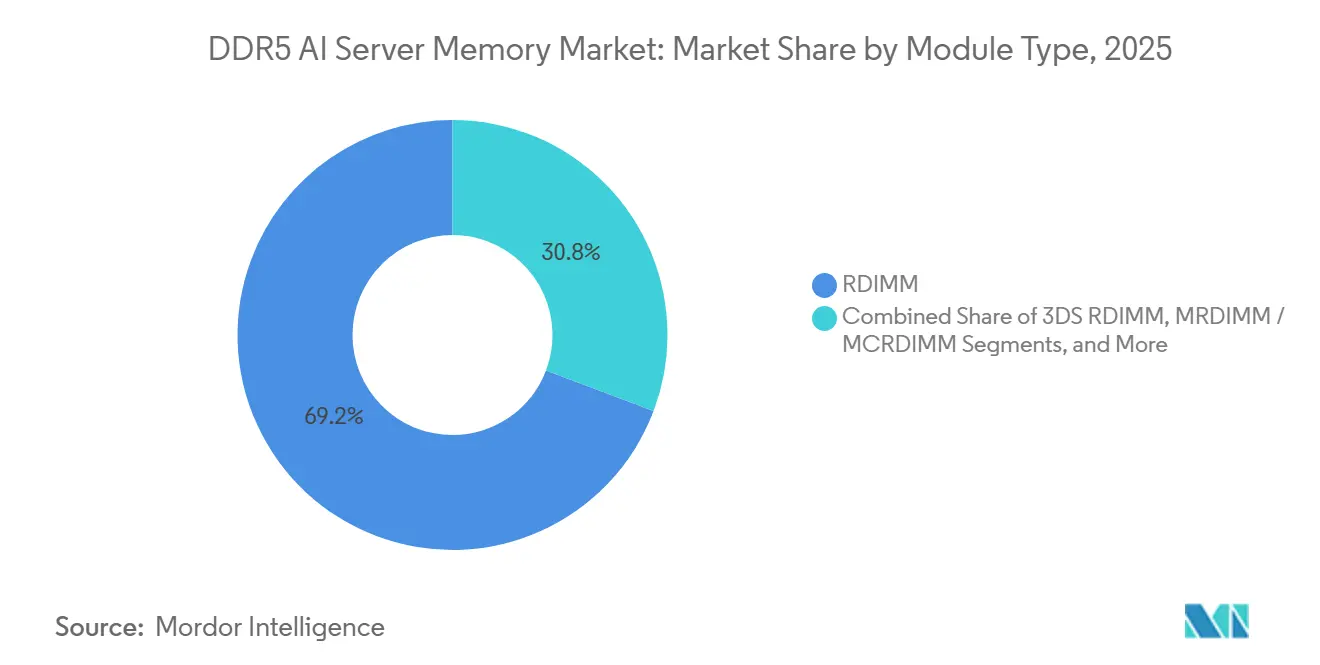
RDIMMs accounted for 69.24% of module-type demand in 2025, giving them the largest share of the DDR5 AI server memory market. Their position reflects a long track record of qualifications across Intel Xeon and AMD EPYC server platforms, and compatibility with widely used server management and provisioning tools reduces deployment risk for commercial fleets that standardize configuration and maintenance procedures. JEDEC compliance and Intel certification processes continue to treat RDIMMs as a reference configuration for enterprise systems. 3DS RDIMMs extend this established format by increasing capacity per module. Micron's 256 GB 3DS DDR5 RDIMM, sampled in May 2026 at up to 9200 MT/s, is designed for systems that need high capacity per socket without adopting a new memory topology.
MRDIMMs and MCRDIMMs are forecast to grow at a 22.92% CAGR from 2026 to 2031, the fastest rate among module types in the DDR5 AI server memory market. Gen1 MRDIMMs reach 8800 MT/s on current Xeon 6 Granite Rapids systems, while JEDEC reported that Gen2 raw-card designs target 12,800 MT/s, raising bandwidth per DIMM slot by 45% from Gen1 levels. Intel's planned support for the Xeon 6900P creates a larger platform base for Gen2 modules. Supermicro and Arm also announced rack-scale systems supporting up to 6 TB of DDR5-8800 MT/s RDIMMs, showing that high-bandwidth memory configurations are extending beyond the main x86 server ecosystems.[2]

By Capacity: Mid-Range Modules Lead While Higher Densities Expand
The 96 GB to 128 GB tier accounted for 46.82% of DDR5 AI server memory demand in 2025. This range suits server clusters that seek high aggregate memory bandwidth without maximizing capacity on every socket, and it can reduce the number of DIMM slots required compared with 64 GB modules in memory-dense configurations. It also remains within the thermal and power limits of many air-cooled deployments, which helps systems remain practical for enterprise and colocation environments that cannot readily adopt more specialized cooling designs. The up-to-64 GB tier remains relevant to cost-sensitive enterprise inference configurations, particularly where model sizes are controlled, workloads are limited to a defined application, or an organization is expanding an existing server estate in measured stages rather than building a large new cluster. The 96 GB to 128 GB tier is supported by supply across several DRAM generations, including 24 GB die configurations used in contemporary server module designs.
Modules above 128 GB are forecast to grow at a 22.61% CAGR from 2026 to 2031 as larger model contexts and parameter counts consume available DIMM capacity. This segment of the DDR5 AI server memory market size serves inference systems where 128 GB modules can fill sockets before the required host-memory target is reached, while Micron's 256 GB product uses 3D stacking with through-silicon vias and operates at up to 9200 MT/s. Its 11.1W consumption compares with 19.4W for 2 128 GB modules at equal total capacity. SK hynix's 256 GB certified module also reported a 16% improvement in inference performance and 18% lower power consumption than its predecessor. These designs make density and efficiency complementary choices rather than opposing ones.
By Data Rate: 5600 MT/s Provides Volume While Higher Speeds Lead Growth
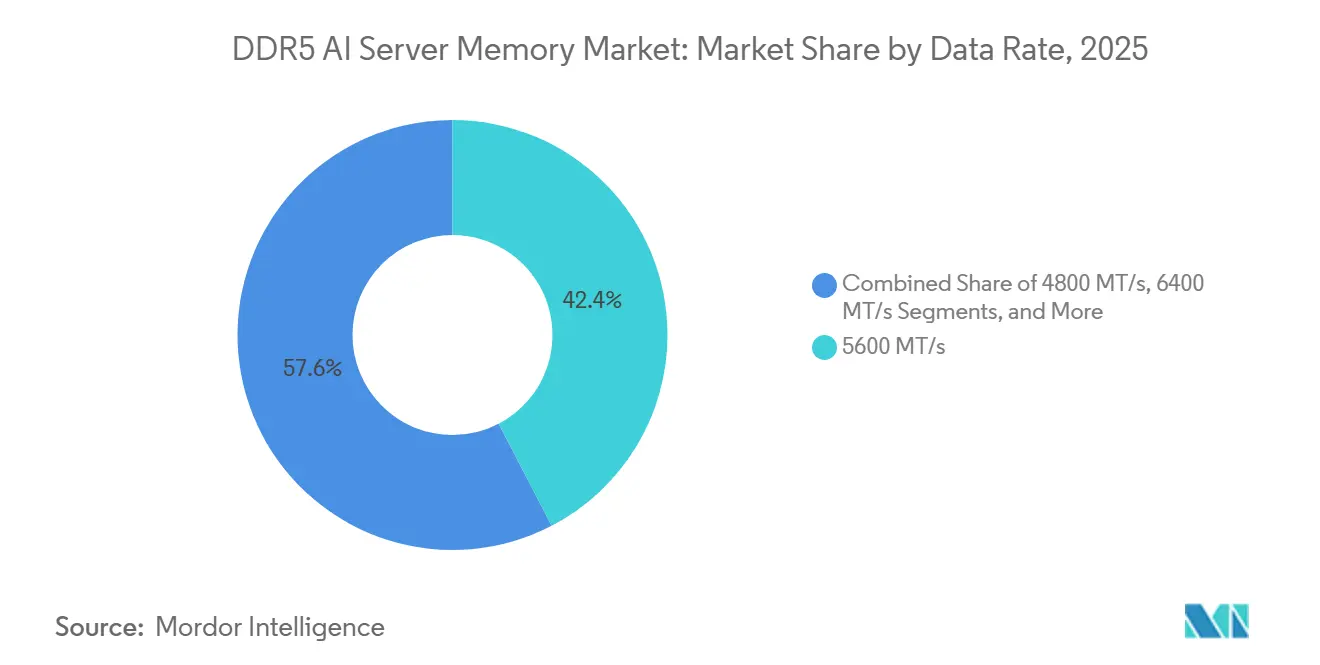
Modules operating at 5600 MT/s accounted for 42.4% share of DDR5 AI server memory demand in 2025. This data rate had a mature base of firmware and signal-integrity validation across deployed AI server fleets, while the 6400 MT/s tier gained traction as AMD EPYC Turin entered broader use in hyperscale. AMD lists 12-channel DDR5-6400 support as a platform capability for its EPYC 9005 processors. Modules from 7200 MT/s to 8000 MT/s gained attention as newer DRAM process nodes supported qualification at higher rates. The initial 4800 MT/s DDR5 speed continued in lower-cost configurations, but its share declined as faster grades became more practical.
The above-8000 MT/s tier is forecast to grow at a 22.8% CAGR through 2031, making it the fastest-growing data-rate range in the DDR5 AI server memory market. Its growth follows the commercial use of 8800 MT/s Gen1 MRDIMM platforms and the development of Gen2 designs at 12,800 MT/s, with JEDEC's JESD82-552 standard establishing the buffer interface needed for this next stage of MRDIMM development. Micron's 9200 MT/s 256 GB RDIMM shows that high speed is not limited to MRDIMM designs. Server architects must choose between bandwidth and capacity based on the memory bottleneck in a particular workload, since a training system may prioritize sustained transfer rates, whereas an inference system may require more resident data closer to the CPU and accelerator. The ongoing MRDIMM roadmap provides this tier with a technical path beyond the current product cycle, which is important for buyers who want memory investments to remain compatible with future CPU platforms and to support higher throughput requirements without changing the server's broader purpose.
By Application: Training Holds the Largest Base While LLM Serving Expands Faster
AI training servers accounted for 41.28% of application demand in 2025, the largest application share in the DDR5 AI server memory market. Training requires steady memory throughput during backpropagation across transformer workloads, and EPYC 9005 systems can use all 12 DDR5 channels to support that throughput. AI inference servers are the next largest application, using host memory for prompt data and activations beyond GPU VRAM. Enterprise AI servers and high-performance computing systems make up the remaining demand. HPC is especially relevant to government supercomputers and national laboratories where standards-based module qualification is important, because system procurement often values repeatable performance, documented compatibility, and long service lives across complex research workloads.
Generative AI and LLM-serving servers are forecast to grow at a 22.74% CAGR from 2026 to 2031, the highest application growth rate in the DDR5 AI server memory market. These systems require sustained host memory, as cloud providers run frontier models for user-facing services, and an IEEE Cloud 2025 paper found that larger batches yield only marginal throughput gains once DRAM bandwidth becomes saturated. This makes faster DDR5 a direct performance input for some inference operators and strengthens the role of the DDR5 AI server memory market in serving deployed AI applications. NVIDIA's Grace Blackwell and Grace Hopper designs enable GPU stacks to access host DDR5 memory via NVLink-C2C. As a result, higher host-memory bandwidth can contribute to usable inference capacity, not simply to system capacity.
By End User: Cloud Providers Lead Purchases While Public Institutions Grow Faster
Cloud service providers held 57.36% of end-user demand in 2025, the largest end-user share in the DDR5 AI server memory market. Their buying scale comes from large AI server deployments and direct supply arrangements with major DRAM manufacturers, while enterprises form the next large buyer group and include financial services, healthcare, and manufacturing organizations, refreshing private AI infrastructure. Telecom operators are deploying DDR5-equipped systems at the edge for network optimization and customer-facing inference services, where response times, distributed sites, and the need to process operational data near the network can influence the preferred balance between server capacity and power use. OEMs, ODMs, and system integrators procure memory while configuring and validating complete server systems. Supermicro introduced its H15 portfolio in July 2026 with 6th Gen AMD EPYC 9006 CPUs and expanded DDR5 memory and I/O bandwidth.
Government and research institutions are forecast to grow at a 22.35% CAGR from 2026 to 2031. Canada's 2025 sovereign AI data center program sought proposals for facilities exceeding 100 MW, linking public investment to procurement of compatible AI compute infrastructure. South Korea procured 9704 GPUs valued at KRW 2.08 trillion in 2025 for sovereign foundation model work. This form of public procurement creates a separate demand channel alongside commercial cloud spending, while European government buyers are also applying transparency and traceability requirements to high-risk AI systems. Certified DDR5 modules can therefore gain relevance where public-sector specifications emphasize platform qualification and standards compliance, particularly when buyers need to document hardware choices for long-lived facilities serving research or national capability objectives.
Geography Analysis
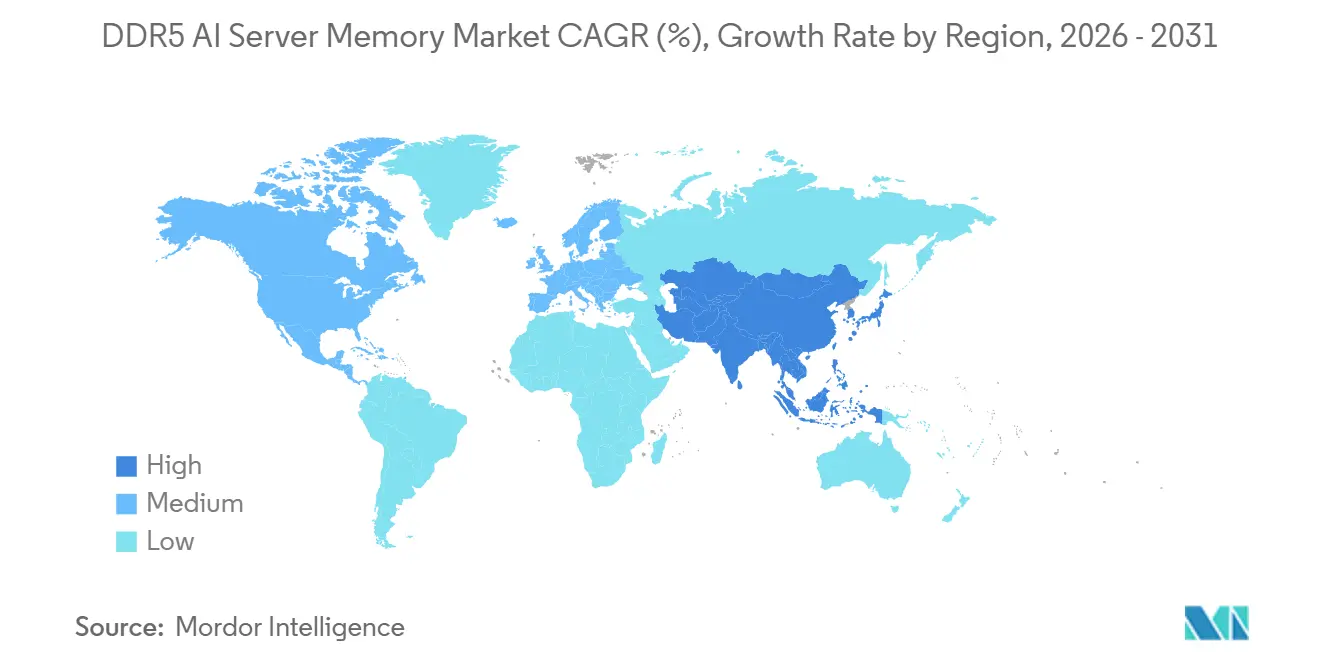
North America accounted for 48.44% of DDR5 AI server memory demand in 2025. The region hosts many of the largest cloud providers and AI model developers, supporting very large training cluster deployments, and its lead is strengthened by the presence of CPU validation programs, system partners, established data center capacity, large enterprise buyers, and a deep base of software and infrastructure providers that support AI deployment planning. SK hynix completed Xeon 6 certification for its 256 GB RDIMM at Intel's Advanced Data Center Development Laboratory in the United States in December 2025.[3]
Asia Pacific is forecast to grow at a 22.58% CAGR from 2026 to 2031, making it the fastest-growing region in the DDR5 AI server memory market. The region combines major DDR5 die production with rising local AI infrastructure demand, giving the DDR5 AI server memory market an important production and consumption base, with South Korea central to both sides of this equation through Samsung and SK hynix, as well as sovereign AI investment, creating close links between advanced memory supply, local compute programs, and the platform ecosystems that consume these components. Taiwan's server ODM ecosystem supports the configuration and assembly of global AI servers. Japan contributes through investment in high-performance computing, while its established technology base and research infrastructure support demand for validated server configurations with predictable performance and power characteristics. China's domestic server procurement is also supporting demand for memory configurations used in government and local AI deployments.
Europe and the Rest of the World account for the remaining demand, with Europe supported by sovereign cloud requirements and research investment, and the Canadian sovereign AI program illustrates how government procurement can set technical expectations for compute systems. Middle East and Africa, South America, and other markets are expanding AI infrastructure through sovereign funds and digital transformation programs. Their procurement volumes remain lower than those in North America and Asia Pacific, yet local data rules, national AI programs, and the need to provision regional services can create focused demand even where the overall server base remains smaller. The DDR5 AI server memory market has opportunities in these regions when local data rules and public programs favor qualified domestic or regional supply chains.
Competitive Landscape
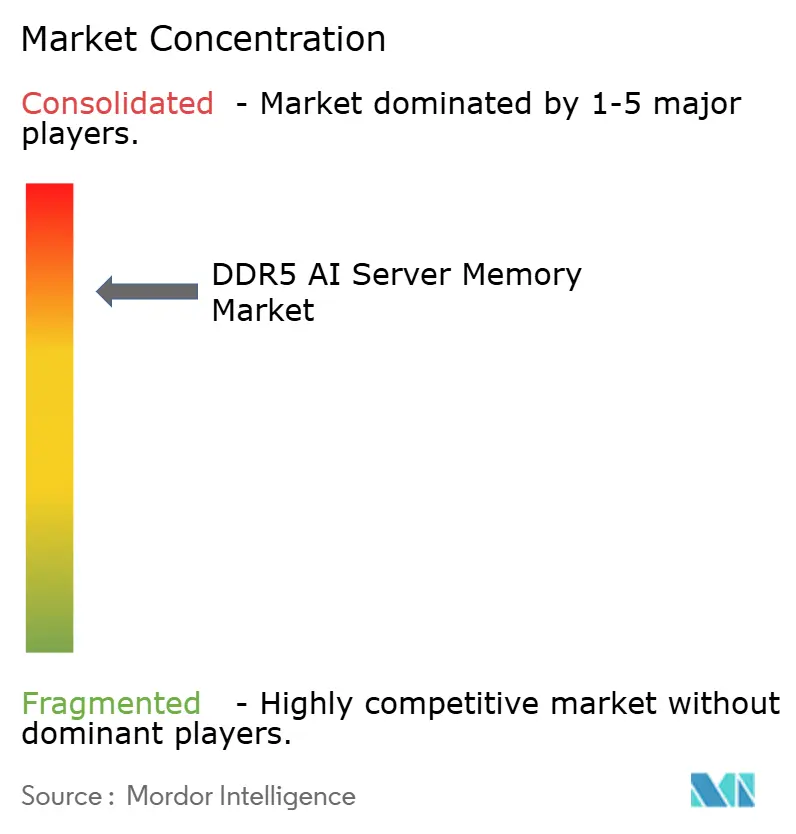
The DDR5 AI server memory market is concentrated at the DRAM die level, where Samsung Electronics, SK hynix, and Micron Technology supply leading-edge components used in server modules. Their competition centers on process-node progress, capacity, data rate, and power characteristics, with Samsung using 1b and emerging 1c DRAM technologies, SK hynix advancing 1b and 1c DDR5 products, and Micron introducing 1-gamma technology. These die capabilities determine the speed and capacity available to module suppliers and influence how quickly assemblers can qualify designs for new CPU generations, high-density applications, and demanding thermal conditions. SK hynix and NVIDIA announced a multiyear technology partnership in June 2026 to advance memory for AI factories.[4] Samsung's 2025 collaboration with AMD focuses on DDR5 for future EPYC CPUs and rack-scale systems.
Module assemblers such as Kingston Technology, ADATA Technology, TEAMGROUP, and Transcend Information compete through platform qualification, thermal design, and service commitments, with customers also considering product availability, validation documentation, support responsiveness, replacement options, and the ability to maintain consistent module specifications across a fleet. Their position is more fragmented than the die supplier tier, but the DDR5 AI server memory market gives these vendors room to differentiate in high-density and emerging MRDIMM products. Supermicro, Hewlett Packard Enterprise, and Dell Technologies are important route-to-market partners because their server configurations determine which module types and speeds are deployed by enterprise and public buyers. Supermicro's Data Center Building Block Solutions method allows memory topology to be adjusted across GPU node architectures, which can reduce qualification time when new server designs move to a higher DDR5 speed grade, while allowing OEMs and integrators to adapt memory layout to the balance of accelerators, CPUs, storage, networking, power delivery, and thermal design required by different AI workloads.
MRDIMM remains an important opening for module assemblers because no assembler has established a dominant position in the fastest-growing module format within the DDR5 AI server memory market. Innodisk and ATP Electronics, along with suppliers that support Arm-based server platforms, can compete as qualification broadens. Supermicro and Arm introduced rack-scale infrastructure in June 2026 with support for up to 6 TB of DDR5-8800 MT/s RDIMMs. JEDEC's April 2026 buffer standard provides the technical basis for Gen2 MRDIMM products. The first suppliers to complete broad Gen2 qualification could gain an advantage in a segment where platform support remains decisive, because buyers often select modules from the limited group of products already validated for the server platforms they operate.
DDR5 AI Server Memory Industry Leaders
-
SK hynix Inc.
-
Samsung Electronics Co., Ltd.
-
Micron Technology, Inc.
- *Disclaimer: Major Players sorted in no particular order
Recent Industry Developments
- July 2026: SK Group and NVIDIA announced a USD 500 billion-plus comprehensive partnership spanning AI factory construction and a long-term AI memory supply agreement. SK hynix is entering into a multiyear memory partnership with NVIDIA covering next-generation AI memory, including HBM4 and advanced DDR5 server modules, for NVIDIA's AI infrastructure roadmap. The partnership cements SK hynix's role as NVIDIA's largest memory supplier for the foreseeable future, intensifying competitive pressure on Samsung and Micron to secure equivalent strategic offtake agreements.
- July 2026: Super Micro Computer announced its H15 server portfolio powered by 6th Gen AMD EPYC 9006 Series CPUs, delivering a 1.7x generational CPU performance improvement with expanded DDR5 memory and I/O bandwidth, optimized for agentic AI, HPC, and cloud workloads. This represents a significant platform-generation acceleration in DDR5 AI server module consumption at scale.
- June 2026: NVIDIA and SK hynix announced a multiyear technology partnership to advance next-generation memory for the global AI factory buildout, building on deep co-engineering collaboration. The agreement is structured to support supply for advanced memory aligned to NVIDIA's AI infrastructure roadmap, with extended development cycles and capital investments in next-generation DDR5 and HBM products.
- June 2026: Supermicro and Arm announced a rack-scale infrastructure collaboration for enterprise agentic AI, featuring Arm AGI CPU-based servers with support for up to 6 TB of DDR5-8800 MT/s RDIMMs, extending high-bandwidth DDR5 memory adoption to non-Intel and non-AMD CPU architectures in commercial server deployments.
- May 2026: Micron Technology announced the sampling of 256 GB DDR5 RDIMM modules operating at up to 9200 MT/s to key server ecosystem partners, built on Micron's leading-edge 1-gamma process using 3D stacking with through-silicon vias. A single 256 GB module consumes 11.1W versus 19.4W for 2 128 GB modules, enabling a 40%-plus power reduction at equivalent capacity.
Global DDR5 AI Server Memory Market Report Scope
The DDR5 AI Server Memory Market is Segmented by Module Type (RDIMM, 3DS RDIMM, MRDIMM / MCRDIMM, and LRDIMM / Other Buffered DIMMs), Capacity (Up to 64 GB, 96 GB to 128 GB, and Above 128 GB), Data Rate (4800 MT/s, 5600 MT/s, 6400 MT/s, 7200 MT/s to 8000 MT/s, and Above 8000 MT/s), Application (AI Training Servers, AI Inference Servers, Generative AI / LLM Serving Servers, Enterprise AI Servers, and High-Performance Computing Systems), End User (Cloud Service Providers, Enterprises, Telecom Operators, Government and Research Institutions, AI Server OEMs, and ODMs, and System Integrators), and Geography (North America, Europe, Asia Pacific, and Rest of the World). The Market Forecasts are Provided in Terms of Value (USD).
| RDIMM |
| 3DS RDIMM |
| MRDIMM / MCRDIMM |
| LRDIMM / Other Buffered DIMMs |
| Up to 64 GB |
| 96 GB to 128 GB |
| Above 128 GB |
| 4800 MT/s |
| 5600 MT/s |
| 6400 MT/s |
| 7200 MT/s to 8000 MT/s |
| Above 8000 MT/s |
| AI Training Servers |
| AI Inference Servers |
| Generative AI / LLM Serving Servers |
| Enterprise AI Servers |
| High-Performance Computing Systems |
| Cloud Service Providers |
| Enterprises |
| Telecom Operators |
| Government and Research Institutions |
| AI Server OEMs, ODMs, and System Integrators |
| North America | |
| Europe | |
| Asia-Pacific | China |
| Japan | |
| South Korea | |
| Taiwan | |
| Rest of Asia-Pacific | |
| Rest of the World |
| By Module Type | RDIMM | |
| 3DS RDIMM | ||
| MRDIMM / MCRDIMM | ||
| LRDIMM / Other Buffered DIMMs | ||
| By Capacity | Up to 64 GB | |
| 96 GB to 128 GB | ||
| Above 128 GB | ||
| By Data Rate | 4800 MT/s | |
| 5600 MT/s | ||
| 6400 MT/s | ||
| 7200 MT/s to 8000 MT/s | ||
| Above 8000 MT/s | ||
| By Application | AI Training Servers | |
| AI Inference Servers | ||
| Generative AI / LLM Serving Servers | ||
| Enterprise AI Servers | ||
| High-Performance Computing Systems | ||
| By End User | Cloud Service Providers | |
| Enterprises | ||
| Telecom Operators | ||
| Government and Research Institutions | ||
| AI Server OEMs, ODMs, and System Integrators | ||
| By Geography | North America | |
| Europe | ||
| Asia-Pacific | China | |
| Japan | ||
| South Korea | ||
| Taiwan | ||
| Rest of Asia-Pacific | ||
| Rest of the World | ||
Key Questions Answered in the Report
What is driving demand for DDR5 AI server memory,and what will be the market size in 2031?
Larger training and inference workloads need more host memory bandwidth and capacity. New Intel Xeon 6 and AMD EPYC 9005 platforms also require DDR5, so memory selection is increasingly part of the original server architecture rather than a later refresh decision. The DDR5 AI server memory market size is projected to be USD 6.8 billion in 2025, USD 10.9 billion in 2026, and reach USD 29.4 billion by 2031, growing at a CAGR of 21.8% from 2026 to 2031.
Which DDR5 module type leads AI server deployments?
RDIMMs led module demand with a 69.24% share in 2025 because they have a broad qualification base across server platforms, established support in management tools, and familiar deployment processes for commercial operators.
Why are modules above 128 GB growing quickly?
Larger LLM context windows and parameter counts can exhaust 128 GB module configurations. The above-128 GB tier is forecast to grow at a 22.6% CAGR through 2031 as operators seek more capacity per DIMM slot without expanding the total module count.
What role do cloud service providers play in DDR5 purchasing?
Cloud service providers held 57.36% of end-user demand in 2025 and use multiyear supply agreements to secure memory allocation for large AI deployments, which can provide more certainty in a supply environment shaped by competing demand for advanced DRAM.
Which region is expanding fastest for DDR5 AI server memory?
Asia Pacific is forecast to grow at a 22.58% CAGR through 2031, supported by AI infrastructure growth and its role in memory production, including the regional presence of major DRAM suppliers and server manufacturing ecosystems.
What constrains supply of DDR5 server modules?
Advanced DRAM capacity is being allocated to HBM production, and new high-density modules require extensive platform qualification before broad deployment, creating a combination of component availability constraints and longer time-to-market cycles for some products.