
Data Entitlement Management Market Size and Share
Market Overview
| Study Period | 2020 - 2031 |
|---|---|
| Market Size (2026) | USD 1.11 Billion |
| Market Size (2031) | USD 2.71 Billion |
| Growth Rate (2026 - 2031) | 19.54 % |
| Fastest Growing Market | Asia-Pacific |
| Largest Market | North America |
| Market Concentration | Medium |
Major Players *Disclaimer: Major Players sorted in no particular order Image © Mordor Intelligence. Reuse requires attribution under CC BY 4.0. | |
Data Entitlement Management Market Analysis by Mordor Intelligence
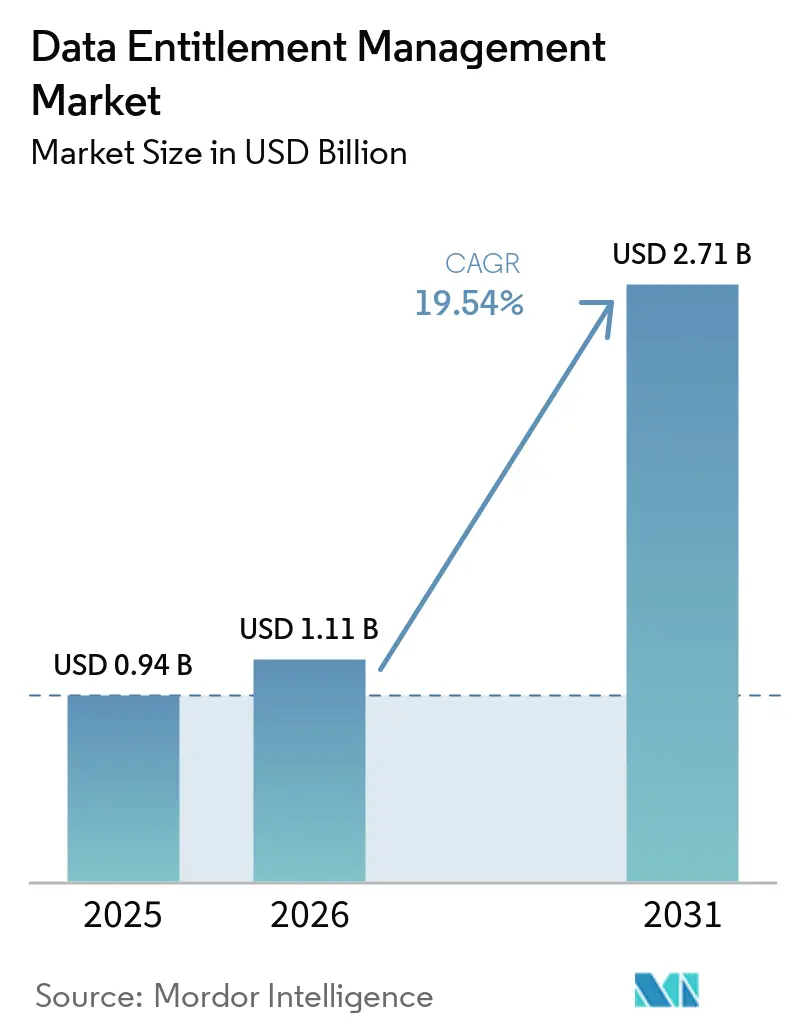
The data entitlement management market size was valued at USD 0.94 billion in 2025 and estimated to grow from USD 1.11 billion in 2026 to reach USD 2.71 billion by 2031, at a CAGR of 19.54% during the forecast period (2026-2031). The data entitlement management market is growing as cloud services, AI workloads, and machine credentials add access points faster than conventional identity governance programs can review them. Organizations in which AI had materially expanded identities needing access recorded a 43% breach rate in the preceding 12 months, compared with 11% among organizations without that change. The resulting need is not limited to checking employee permissions, because organizations also need to control what AI agents and automated systems can retrieve or pass to a user. Vendors are responding by linking identity entitlements with data classification, allowing access decisions to consider both the requester and the sensitivity of the data. Integration limits remain important because 76% of organizations could not immediately remove standing access that was no longer required.
Key Report Takeaways
- By component, software held 74.31% of revenue in the data entitlement management market in 2025, while services are projected to expand at a 23.74% CAGR through 2031.
- By deployment mode, cloud accounted for 57.83% of revenue in 2025 and is projected to grow at a 24.65% CAGR through 2031.
- By organization size, large enterprises held 69.74% of revenue in the data entitlement management market in 2025, while small and medium enterprises are projected to expand at a 26.58% CAGR through 2031.
- By data format, unstructured data held 44.86% of revenue in 2025, while semi-structured data is projected to expand at a 24.93% CAGR through 2031.
- By industry vertical, banking, financial services, and insurance held 26.58% of revenue in 2025, while the IT and Telecommunications industry is projected to expand at a 28.26% CAGR through 2031.
- By geography, North America accounted for 41.37% of data entitlement management market revenue in 2025, while Asia-Pacific is projected to expand at a 27.61% CAGR through 2031.
Note: Market size and forecast figures in this report are generated using Mordor Intelligence’s proprietary estimation framework, updated with the latest available data and insights as of January 2026.
Global Data Entitlement Management Market Trends and Insights
Drivers Impact Analysis*
| DRIVER | (~) % IMPACT ON CAGR FORECAST | GEOGRAPHIC RELEVANCE | IMPACT TIMELINE |
|---|---|---|---|
| Growth of AI, Copilots, and Non-Human Identities | +5.1% | Global, with peak pressure in North America and Asia-Pacific cloud-native ecosystems | Short term (≤ 2 years) |
| Expansion of Hybrid and Multicloud Data Estates | +4.3% | Global, especially North America, Europe, and Asia-Pacific | Medium term (2-4 years) |
| Escalating Regulatory and Audit Requirements | +3.1% | North America and EU, with spillover to Asia-Pacific and MEA regulated verticals | Medium term (2-4 years) |
| Authorization Requirements for Agentic Workflows | +2.4% | Global, concentrated in North America and Asia-Pacific technology hubs | Short term (≤ 2 years) |
| Increasing Insider and Excessive-Privilege Risk | +1.8% | Global, with acute exposure in BFSI, healthcare, and government sectors | Medium term (2-4 years) |
| Rising Demand for Real-Time Data Provisioning | +1.0% | North America and Asia-Pacific, with spillover to Europe | Long term (≥ 4 years) |
| Source: Mordor Intelligence | |||
Growth of AI, Copilots, and Non-Human Identities
The data entitlement management market is being shaped by a rapid increase in AI agents, service accounts, API tokens, and OAuth credentials. Entro Security reported that non-human identities outnumbered human identities by 45:1 in the average enterprise and by as much as 144:1 in cloud-native environments. Its H1 2025 analysis covered 27 million non-human identities, highlighting the scale of credentials requiring governance. Human-paced access reviews do not keep pace when an automated agent can acquire and use permissions in milliseconds. Only 19% of organizations had implemented continuous governance for non-human identities in 2026.[1] Platforms must therefore govern both human access and the data that an AI agent may retrieve or relay for a user.
Expansion of Hybrid and Multicloud Data Estates
The data entitlement management market also reflects the move from a single directory to several policy environments. Data now sits across Snowflake and Databricks warehouses, AWS and Azure object storage, SaaS collaboration tools, and on-premises databases. Each environment uses its own permission model, which complicates a single business rule for access. Research on heterogeneous database environments found that organizations provisioned 20%-30% additional computing capacity to handle governance overhead and experienced longer transitions for API-based legacy integration.[2] Every additional cloud service can widen entitlement sprawl when permissions cannot be viewed in a single view. Veza reported more than 16 billion permissions under active management at the time it announced its April 2025 Series D financing.
Escalating Regulatory and Audit Requirements
The data entitlement management market benefits from rules that require more visible and defensible control of sensitive data access. DORA Article 9 requires privileged-access controls for Tier-1 financial institutions, while the EU AI Act requires formal access governance for high-risk AI systems. The SEC cybersecurity disclosure rule requires public companies to disclose material cybersecurity incidents within 4 business days, increasing the value of prebuilt entitlement audit trails. European Data Protection Authorities imposed EUR 1.2 billion (USD 1.31 billion) in GDPR fines during 2024. That enforcement environment supports automated discovery, certification, and correction of excessive data access. It also moves buyers from static role assignments toward authorization that considers data attributes and business purpose.
Authorization Requirements for Agentic Workflows
Agentic systems can chain together tool calls, query both structured and unstructured sources, and act on behalf of a human principal. This behavior makes broad-standing access unsuitable for many tasks in the data entitlement management market. The Cloud Security Alliance stated that such systems need just-in-time access, task-specific scope, time-limited credentials, and automatic revocation when a task ends or its context changes. LangGraph, CrewAI, AutoGen, and the Model Context Protocol did not provide built-in confinement for agent-level entitlements. An empirical study from September 2026 linked this limitation to data exfiltration via prompt injection and lateral movement.
Restraints Impact Analysis*
| RESTRAINT | (~) % IMPACT ON CAGR FORECAST | GEOGRAPHIC RELEVANCE | IMPACT TIMELINE |
|---|---|---|---|
| Legacy-System Integration Complexity | -2.1% | Global, most acute in North American enterprise manufacturing, government, and BFSI sectors | Medium term (2-4 years) |
| High Implementation and Operating Costs | -1.6% | Global, strongest constraint in emerging markets and SME-dominated South American and MEA segments | Medium term (2-4 years) |
| Fragmented Authorization Standards and Policy Languages | -0.9% | Global, with spillover to enterprise technology procurement cycles | Long term (≥ 4 years) |
| Authorization Latency and Performance Trade-Offs | -0.6% | Asia-Pacific and North American real-time workload environments | Short term (≤ 2 years) |
| Source: Mordor Intelligence | |||
Legacy-System Integration Complexity
Legacy integration remains a major limit on the data entitlement management market. Mainframe-era applications, on-premises databases, and early directory services were not designed for external authorization controls. Cloud IAM, SaaS roles, on-premises groups, and legacy application permissions also change on different schedules. This makes stale access difficult to find and even harder to certify with evidence suitable for an audit. The Non-Human Identity Management Group noted that hybrid entitlement reviews require consistent visibility across these environments.[3] Systems without native logging cannot produce the behavioral signals needed for continuous governance. Proprietary authorization schemas can also require custom connectors when they do not map to modern attribute-based or policy-as-code approaches.
High Implementation and Operating Costs
Implementation and operating costs can delay adoption, particularly where an organization is also managing identity sprawl, cloud migrations, and security programs. This constraint is stronger for smaller buyers and for organizations operating under limited budgets. A large financial institution could require a GBP 8-14 million (USD 10-18 million) one-time investment to consolidate legacy attribute-based access control stacks. The same analysis estimated annual run-rate synergies of GBP 18-24 million (USD 23.77-31.70 million), but only after a multiyear transition. Smaller organizations may continue manual access reviews when they cannot sustain this initial investment. They may instead use managed service providers, where recurring fees become a material operating cost.
*Our forecasts treat driver/restraint impacts as directional, not additive. The impact forecasts reflect baseline growth, mix effects, and variable interactions.
Segment Analysis
By Component: Services Growth Signals Market Maturation
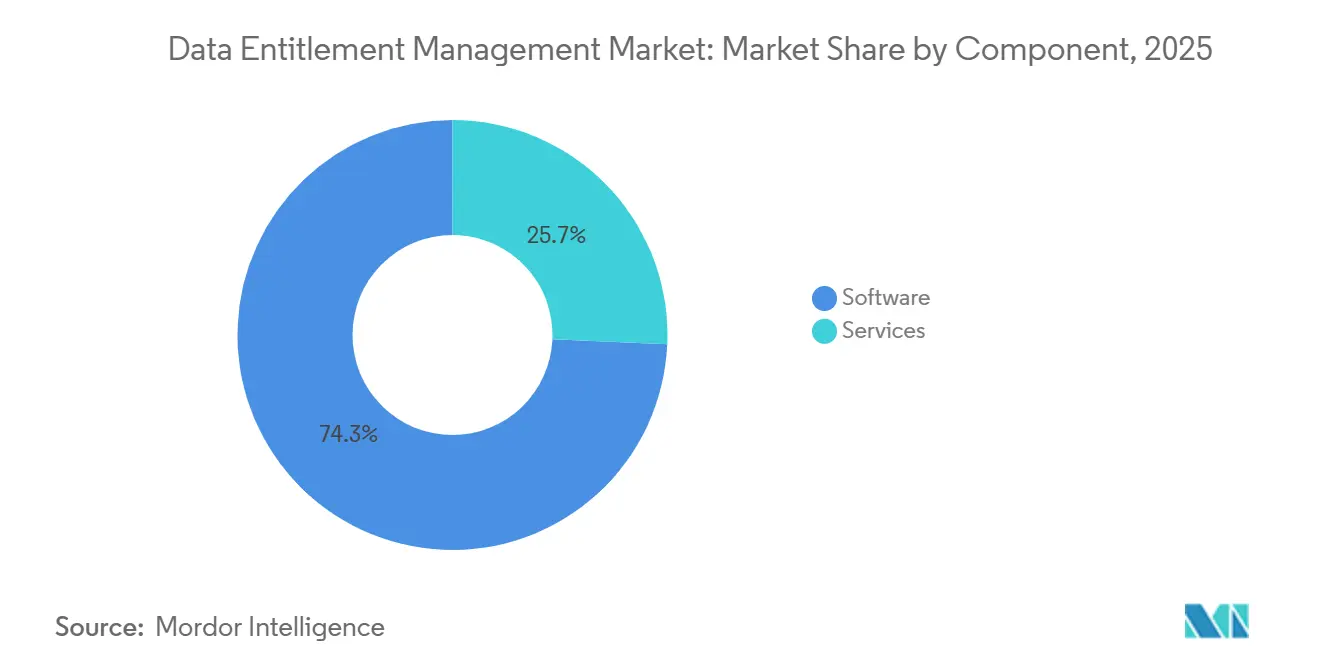
Software held 74.31% of the data entitlement management market share in 2025. This lead reflected an early preference for automated platforms that organizations could deploy under license across their existing access environment. Cloud-native software can be provisioned quickly and billed through consumption models that fit enterprise budget cycles and phased procurement decisions. Software also gives security teams a repeatable way to apply access policies across connected data systems without creating separate manual review processes. The data entitlement management industry has therefore relied first on platforms that provide policy enforcement, entitlement visibility, and a foundation for later expansion.
Services are projected to grow at a 23.74% CAGR through 2031, the fastest rate among the 2 components. Implementation, integration, policy tuning, and managed operations become more important as deployments reach older systems and several data platforms. The data entitlement management market size for services is supported by work that cannot be completed through a standard software rollout or resolved by a single connector. Organizations often need external support to align policy rules across cloud services, SaaS applications, and legacy systems with different permission structures. In 2026, Immuta introduced agentic data access capabilities that govern temporary AI-agent access across Snowflake, Databricks, and BigQuery, illustrating why specialized implementation work is becoming increasingly necessary.[4]
By Deployment Mode: Cloud Consolidates While On-Premises Persists
Cloud deployment held 57.83% of the data entitlement management market share in 2025. It is also projected to grow at a 24.65% CAGR through 2031, the fastest rate among deployment modes. Cloud environments support policy changes that can be distributed to enforcement points without modifying application code across every connected workload. This structure is well-suited to attribute-based and policy-as-code authorization that needs regular adjustment as data conditions change. It also supports dynamic access control across connected cloud data services and the applications that use them.
On-premises deployment remains relevant in regulated settings where data sovereignty rules restrict cloud-side policy evaluation. DORA Article 9 and U.S. FedRAMP requirements reinforce the need for controls over sensitive and regulated workloads. Hybrid deployment connects established on-premises estates with cloud-native data platforms while allowing organizations to maintain selected local controls. Varonis released region-specific data classification collectors in April 2025 to support data residency within a unified governance model.[5] The data entitlement management market continues to require this approach, as organizations cannot quickly replace older systems or move sensitive policy decisions outside their jurisdiction.
By Organization Size: SMEs Accelerate as SaaS Lowers the Entry Point
Large enterprises held 69.74% of revenue in 2025. Their data estates are commonly distributed across several platforms and require dedicated security engineering teams to operate access policies consistently. These organizations also have more resources to configure and maintain enterprise entitlement platforms through long deployment cycles. Complex access requirements across business units, applications, data repositories, and user groups drive demand. Large deployments still provide the largest revenue base for the data entitlement management market.
Small and medium enterprises are projected to expand at a 26.58% CAGR through 2031. SaaS delivery reduces the need for on-premises infrastructure and lowers the initial adoption barrier for organizations without large security teams. PCI DSS 4.0, GDPR, and CCPA requirements extend pressure on access governance by offering simplified onboarding and tiered pricing, thereby enabling midmarket organizations that handle sensitive customer information. Netwrix found that organizations with 500-999 employees had the highest breach rate by size cohort at 40.3% in 2026. Vendors are addressing this exposure with simplified onboarding and tiered pricing, expanding the data entitlement management market beyond the largest enterprises.
By Data Format: Unstructured Data Dominates While Semi-Structured Data Grows Fastest
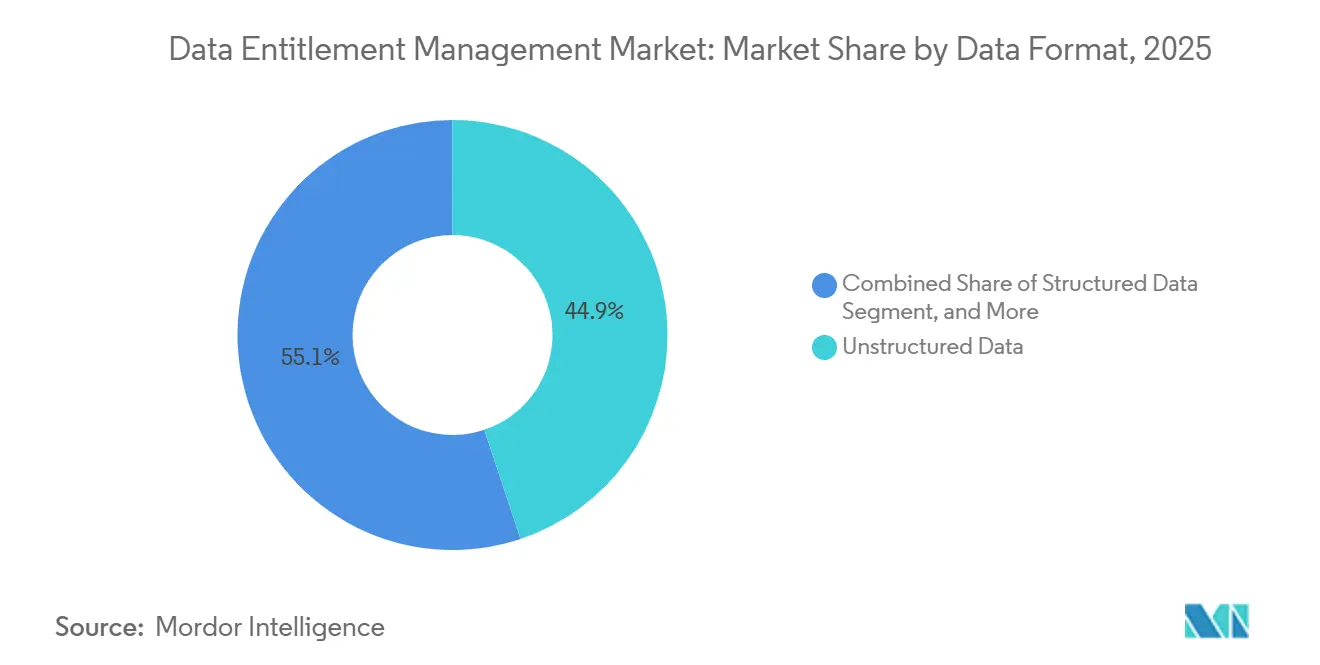
Unstructured data held 44.86% of revenue in 2025. Sensitive content is widely stored in file shares, collaboration platforms, email archives, and document repositories, which often accumulate access permissions over time. Controls in these environments are often applied at a folder or bucket level rather than to each record or individual item. That can leave permissions broader than the sensitivity of individual files requires, making review work more difficult. These conditions gave unstructured data the leading share in the data entitlement management market.
Semi-structured data is projected to grow at a 24.93% CAGR through 2031, the fastest rate across data formats. AI and analytics pipelines increasingly process JSON logs, API responses, and event streams containing personal identifiers, financial transactions, and health codes. These data types may contain regulated attributes without the schema enforcement found in relational databases and conventional database controls. Research on heterogeneous data sources found that AI retrieval requires filtering and chunk-level redaction to limit exposure of sensitive tokens. Structured data retains a role because SQL databases have mature row-level and column-level controls, while the data entitlement management market must cover all 3 formats in combined AI and analytics workflows.

By Industry Vertical: BFSI Anchors Demand While IT and Telecommunications Accelerate
The banking, financial services, and insurance industry held 26.58% of revenue in 2025. The sector operates under SOX, PCI DSS, GDPR, DORA, and Basel III requirements that mandate traceable, least-privilege access to financial data. Financial institutions increasingly need purpose-based controls at the data layer, rather than role-based controls only at the application layer. This need is strengthened where sensitive records move across cloud systems, analytics tools, and operational data environments. BFSI remains the largest vertical in the data entitlement management market.
The IT and telecommunications industry is projected to expand at a 28.26% CAGR through 2031. Hyperscaler-adjacent providers manage cloud platforms, developer tools, API gateways, and SaaS environments simultaneously. This combination produces entitlement sprawl across a wide technical estate with many systems requiring linked access decisions. Healthcare and life sciences also support demand through HIPAA audits and AI deployment in clinical workflows. Government and public administration, retail and e-commerce, energy and utilities, oil and gas, transportation and logistics, media and entertainment, and education and research institutions each face sector-specific access requirements that the data entitlement management industry must address.
Geography Analysis
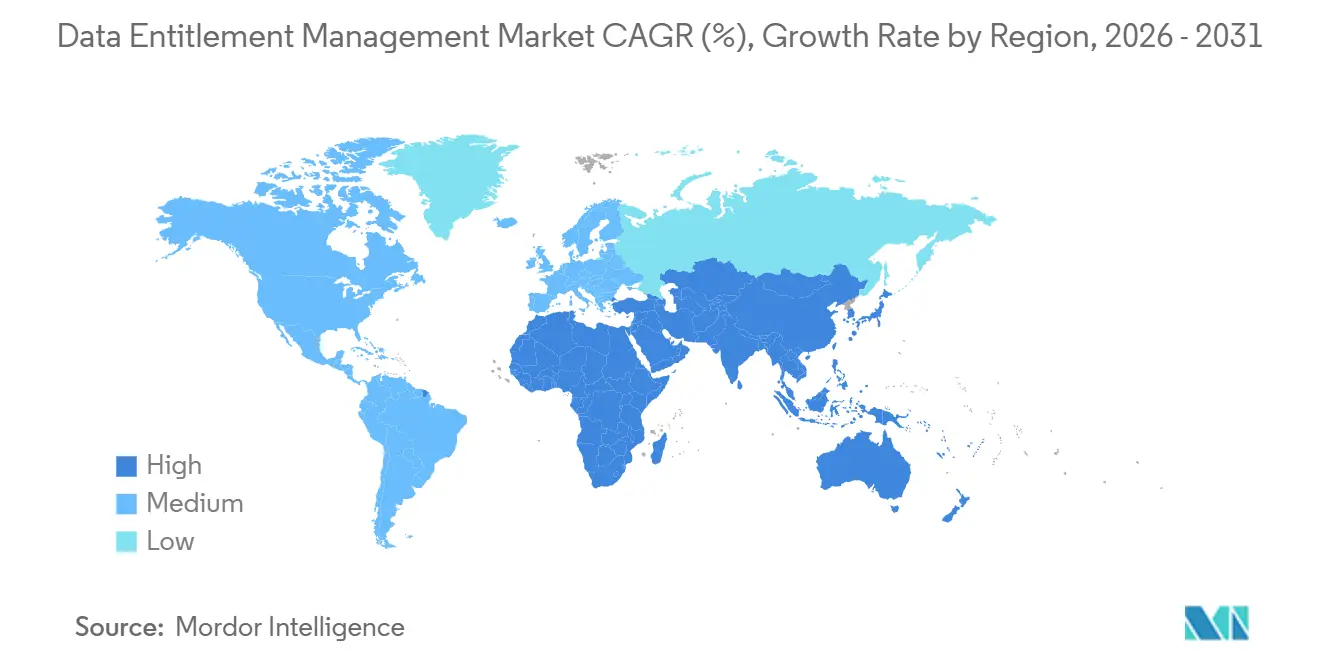
North America held 41.37% of the data entitlement management market share in 2025. The United States has a high concentration of cloud-first enterprises, established cybersecurity budgets, and rules, including SEC disclosure requirements, CCPA, CPRA, HIPAA, and FISMA. Among breached North American organizations, 24% reported losses of at least USD 100,000 and 12% reported losses above USD 250,000 in the preceding year. These losses support board-level spending on access controls and a broader review of the access risk attached to data estates. Canada adds demand from financial services and energy organizations working with PIPEDA and guidance from the Office of the Superintendent of Financial Institutions.
Europe is the second-largest regional market. GDPR, DORA, NIS2, and the EU AI Act create overlapping requirements for access governance. Germany supports demand through manufacturing and financial services organizations updating entitlement programs in response to DORA controls and GDPR findings on excessive access. UK financial institutions worked toward the March 2025 operational resilience deadline set by the Bank of England and the Financial Conduct Authority. European organizations often favor hybrid designs that keep policy evaluation within their jurisdiction, supporting continued demand for on-premises and hybrid deployment in the data entitlement management market.
Asia-Pacific is projected to grow at a 27.61% CAGR through 2031. India is adopting cloud-based entitlement platforms as enterprise services shift from on-premises to multicloud architecture, while Japan needs fine-grained controls for operational technology data used in AI analytics. South Korea’s semiconductor and electronics companies are protecting intellectual property across global research and development work, and China’s Personal Information Protection Law and Data Security Law support domestic platform development. The Middle East and Africa are seeing public-sector adoption in Saudi Arabia and the UAE, while South America is developing demand through Brazil’s Lei Geral de Proteção de Dados and its financial services and retail sectors.
Competitive Landscape
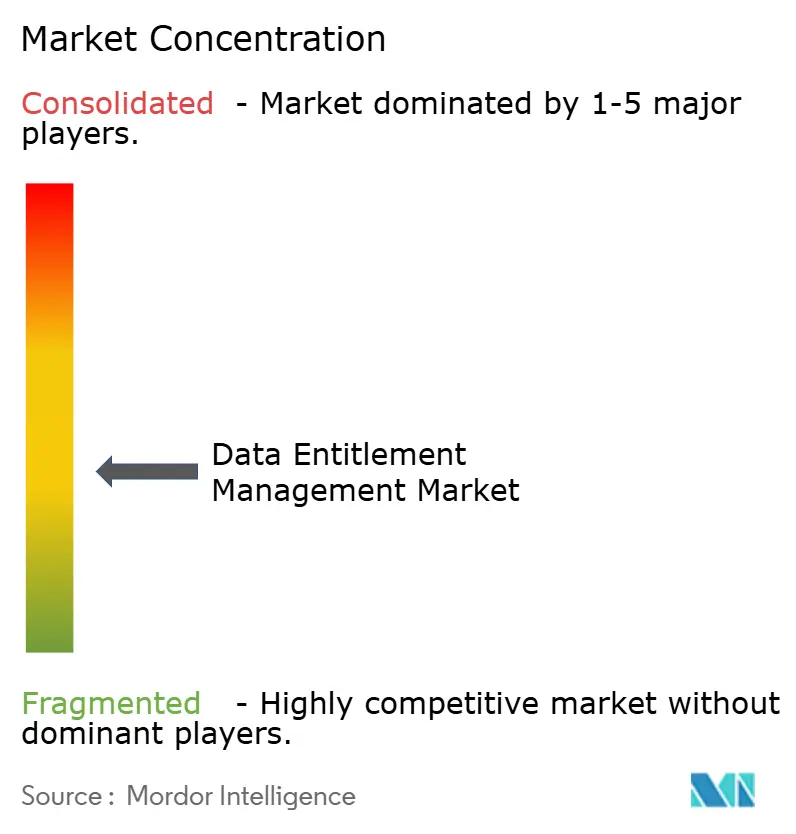
The data entitlement management market is moderately fragmented in 2026. No single vendor has a dominant share across data access governance, fine-grained enforcement, entitlement certification, non-human identity governance, and agentic authorization. Varonis Systems, SailPoint Technologies, and Microsoft compete through broad platforms and enterprise integration. Veza Technologies, Immuta, and PlainID compete on policy capabilities and deployment speed. This creates a mix of established identity vendors and specialized authorization providers that address different access-control requirements.
Consolidation is becoming more visible as vendors seek integrated controls. Cyera’s USD 1 billion acquisition of Oasis Security combined cloud data security posture management with non-human identity management. SailPoint completed its acquisition of Entro Security in June 2026, adding discovery and governance for more than 1,200 types of machine credentials across CI/CD pipelines and container registries. Saviynt and Cyera announced an integration in March 2026 that connected identity security posture management with real-time data classification. These moves address the need to use identity and data context together in access decisions across cloud, SaaS, and hybrid environments.
Competition also centers on agentic authorization and accessible policy-as-code tools. Legacy IAM platforms were built for human identity workflows, leaving room for systems that assess the purpose of an AI agent’s request. Permit.io and Aserto are targeting developer-led authorization at the application layer. Veza’s April 2025 Series D included Snowflake Ventures, Workday Ventures, and Atlassian Ventures, showing interest in access-graph visibility as infrastructure. P0 Security, Apono, and Concentric AI are competing in just-in-time cloud access, self-service access workflows, and autonomous data classification, leaving the data entitlement management market contested as focused products narrow the differentiation of larger vendors.
Data Entitlement Management Industry Leaders
-
Varonis Systems, Inc.
-
BigID, Inc.
-
SailPoint Technologies, Inc.
-
Immuta, Inc.
-
Securiti, Inc.
- *Disclaimer: Major Players sorted in no particular order
Recent Industry Developments
- September 2026: SailPoint announced an integration with CrowdStrike Falcon Next-Generation SIEM at Fal.Con 2026, embedding SailPoint SecOps Identity Intelligence into Falcon to correlate identity governance and access context with endpoint and cloud security telemetry, enabling SOC teams to accelerate threat detection.
- June 2026: SailPoint completed its acquisition of Tel Aviv-based Entro Security, a non-human identity and credentials security pioneer. Entro's capabilities, automated discovery of over 1,200 types of machine secrets and tokens across CI/CD pipelines, and real-time NHI behavioral anomaly detection, are immediately available to SailPoint customers, strengthening the Agentic Fabric platform with machine credential governance.
- May 2026: Varonis Systems announced general availability of Varonis Atlas, an end-to-end AI Security Platform built on the Varonis Data Security Platform. Atlas covers AI inventory, posture management, security testing, runtime guardrails, and compliance reporting mapped to the EU AI Act and NIST AI RMF, connecting to hosted AI platforms, custom LLMs, agentic frameworks, and embedded AI tools.
- March 2026: Saviynt and Cyera announced a strategic integration linking Saviynt's Identity Security Posture Management with Cyera's Data Security Posture Management platform, providing a unified view of identity entitlements and real-time data classification to enable automated least-privilege enforcement across cloud, SaaS, and hybrid environments.
- February 2026: Veza introduced Native Access Agents and launched its Enterprise Agent Identity Control Platform, extending the Veza Access Graph to visualize, monitor, and control entitlements for AI agents alongside human and non-human identities, with global enterprise customers including Wynn Resorts, Expedia, and Blackstone live on the platform.
Global Data Entitlement Management Market Report Scope
The data entitlement management market includes platforms that govern and enforce granular access rights and permissions to data assets across an organization's data ecosystem. This market focuses on implementing least-privilege access by defining, auditing, and continuously validating who (users, roles, service accounts, applications) can access what data, under which conditions, and for what purposes. Solutions provide centralized visibility into data entitlements across databases, data lakes, cloud storage, and SaaS applications, enable policy-based access governance, detect overprivileged accounts and orphaned permissions, automate access certification workflows, and integrate with identity providers and data governance platforms to ensure data access aligns with business roles, compliance requirements, and zero-trust security principles.
The Data Entitlement Management Market Report is Segmented by Component (Software, and Services), Deployment Mode (Cloud, On-Premises, and Hybrid), Organization Size (Large Enterprises, and Small and Medium-Sized Enterprises), Data Format (Structured Data, Unstructured Data, and Semi-Structured Data), Industry Vertical (Government and Public Administration, Industrial Manufacturing, Retail and E-Commerce, Transportation and Logistics, Energy and Utilities, Oil and Gas, IT and Telecommunication, Media and Entertainment, Education and Research Institutions, Healthcare and Life Sciences, Banking, Financial Services, and Insurance (BFSI), and Other Industry Verticals), and Geography (North America, South America, Europe, Asia-Pacific, and Middle East and Africa). The Market Forecasts are Provided in Terms of Value (USD).
| Software |
| Services |
| Cloud |
| On-Premises |
| Hybrid |
| Large Enterprises |
| Small and Medium Enterprises |
| Structured Data |
| Unstructured Data |
| Semi-Structured Data |
| Government and Public Administration |
| Industrial Manufacturing |
| Retail and E-Commerce |
| Transportation and Logistics |
| Energy and Utilities |
| Oil and Gas |
| IT and Telecommunication |
| Media and Entertainment |
| Education and Research Institutions |
| Healthcare and Life Sciences |
| Banking, Financial Services, and Insurance (BFSI) |
| Other Industry Verticals |
| North America | United States | |
| Canada | ||
| South America | Brazil | |
| Argentina | ||
| Mexico | ||
| Rest of South America | ||
| Europe | Germany | |
| United Kingdom | ||
| France | ||
| Italy | ||
| BENELUX | ||
| Rest of Europe | ||
| Asia-Pacific | China | |
| Japan | ||
| India | ||
| South Korea | ||
| Australia | ||
| Rest of Asia-Pacific | ||
| Middle East and Africa | Middle East | United Arab Emirates |
| Saudi Arabia | ||
| Rest of Middle East | ||
| Africa | South Africa | |
| Nigeria | ||
| Egypt | ||
| Rest of Africa | ||
| By Component | Software | ||
| Services | |||
| By Deployment Mode | Cloud | ||
| On-Premises | |||
| Hybrid | |||
| By Organization Size | Large Enterprises | ||
| Small and Medium Enterprises | |||
| By Data Format | Structured Data | ||
| Unstructured Data | |||
| Semi-Structured Data | |||
| By Industry Vertical | Government and Public Administration | ||
| Industrial Manufacturing | |||
| Retail and E-Commerce | |||
| Transportation and Logistics | |||
| Energy and Utilities | |||
| Oil and Gas | |||
| IT and Telecommunication | |||
| Media and Entertainment | |||
| Education and Research Institutions | |||
| Healthcare and Life Sciences | |||
| Banking, Financial Services, and Insurance (BFSI) | |||
| Other Industry Verticals | |||
| By Geography | North America | United States | |
| Canada | |||
| South America | Brazil | ||
| Argentina | |||
| Mexico | |||
| Rest of South America | |||
| Europe | Germany | ||
| United Kingdom | |||
| France | |||
| Italy | |||
| BENELUX | |||
| Rest of Europe | |||
| Asia-Pacific | China | ||
| Japan | |||
| India | |||
| South Korea | |||
| Australia | |||
| Rest of Asia-Pacific | |||
| Middle East and Africa | Middle East | United Arab Emirates | |
| Saudi Arabia | |||
| Rest of Middle East | |||
| Africa | South Africa | ||
| Nigeria | |||
| Egypt | |||
| Rest of Africa | |||
Key Questions Answered in the Report
What is the data entitlement management market size?
The data entitlement management market size was valued at USD 0.94 billion in 2025 and estimated to grow from USD 1.11 billion in 2026 to reach USD 2.71 billion by 2031, at a CAGR of 19.54% during the forecast period (2026-2031).
What is driving demand for data entitlement management?
AI agents, non-human identities, multicloud data estates, and stronger audit requirements are increasing the need for more precise access control.
Which component leads revenue?
Software led revenue with a 74.31% share in 2025, while services are projected to grow faster at a 23.74% CAGR through 2031.
Which deployment mode is growing fastest?
Cloud deployment held 57.83% of revenue in 2025 and is projected to grow at a 24.65% CAGR through 2031.
Which vertical is expanding fastest?
IT and Telecommunications is projected to grow at a 28.26% CAGR through 2031 as providers manage APIs, cloud platforms, developer tools, and SaaS estates.
Which region is projected to grow fastest?
Asia-Pacific is projected to expand at a 27.61% CAGR through 2031, supported by cloud adoption and data governance requirements.