
Data Center Water Management Market Size and Share
Market Overview
| Study Period | 2021 - 2032 |
|---|---|
| Market Size (2027) | USD 3.81 Billion |
| Market Size (2032) | USD 6.38 Billion |
| Growth Rate (2027 - 2032) | 10.86 % |
| Fastest Growing Market | Asia-Pacific |
| Largest Market | North America |
| Market Concentration | Medium |
Major Players *Disclaimer: Major Players sorted in no particular order Image © Mordor Intelligence. Reuse requires attribution under CC BY 4.0. | |
Data Center Water Management Market Analysis by Mordor Intelligence
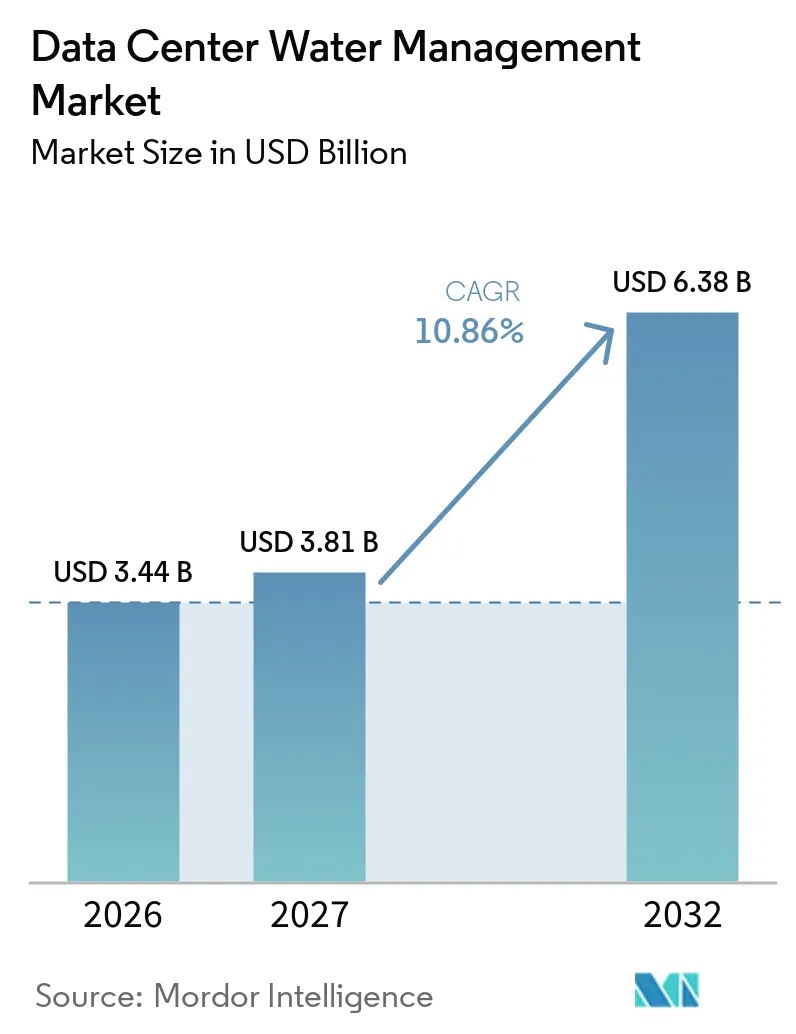
The Data Center Water Management Market size was valued at USD 3.44 billion in 2026 and estimated to expand from USD 3.81 billion in 2027 to reach USD 6.38 billion by 2032, at a CAGR of 10.86% during the forecast period 2027-2032. AI training and inference workloads are increasing thermal loads, making water supply, treatment, and cooling design central to facility investment decisions. The International Energy Agency expects global data center water consumption to reach 1.2 billion cubic meters by 2030, compared with 560 million cubic meters in 2023, which raises the importance of reuse and alternative water sources. Higher rack densities are also moving coolant quality, leak prevention, and metering from operational tasks to core design requirements. Operators are responding with integrated systems that combine monitoring, treatment, recycling, and reporting functions. The Data Center Water Management Market also faces high installation costs, difficult retrofits, water-energy trade-offs, and varied Water Usage Effectiveness, or WUE, reporting rules.
Key Report Takeaways
- By solution type, Water Treatment and Quality Monitoring Systems held 28.16% of Data Center Water Management Market share in 2026, while Water Recycling and Reuse Management Systems are projected to expand at an 11.22% CAGR through 2032.
- By water management application, Cooling System Water Management accounted for 45.22% of the Data Center Water Management Market size in 2026, while Water Recycling and Reuse is projected to expand at an 11.34% CAGR through 2032.
- By deployment model, On-Premises Systems held 54.21% share in 2026, while Cloud-Based Systems are projected to expand at an 11.14% CAGR through 2032.
- By service type, Managed Water Management Services accounted for 30.96% share in 2026, while Water Auditing and Efficiency Consulting is projected to expand at an 11.56% CAGR through 2032.
- By data center size, Hyperscale Data Centers held 36.46% share in 2026 and are projected to expand at an 11.27% CAGR through 2032.
- By data center type, Cloud Service Providers accounted for 41.86% share in 2026 and are projected to expand at an 11.18% CAGR through 2032.
- By geography, North America held 41.62% share in 2026, while Asia-Pacific is projected to expand at an 11.29% CAGR through 2032.
Note: Market numbers in this report are based on Mordor Intelligence's proprietary estimation framework, which combines nine months of actuals with Q4 projections for base year 2026.
Market Trends and Insights
Drivers Impact Analysis of Data Center Water Management Market*
| Driver | (~) % Impact on CAGR Forecast | Geographic Relevance | Impact Timeline |
|---|---|---|---|
| AI and Hyperscale Capacity Expansion | +3.8% | Global, concentrated in North America, Asia-Pacific, and Middle East | Short term (≤ 2 years) |
| Liquid Cooling and High-Purity Coolant Requirements | +2.6% | Global, strongest in North America and Asia-Pacific | Short term (≤ 2 years) |
| Water-Scarcity-Driven Reuse and Recovery Investment | +1.9% | Middle East, southwestern United States, and Southeast Asia | Medium term (2-4 years) |
| Real-Time Monitoring and AI-Based Optimization | +1.4% | Global, led by North America and Europe | Medium term (2-4 years) |
| Water-Use Effectiveness Reporting and Disclosure | +0.9% | Europe, North America, and China | Medium term (2-4 years) |
| Mission-Critical Reliability Requirements | +0.6% | Global | Long term (≥ 4 years) |
| Source: Mordor Intelligence | |||
AI and Hyperscale Capacity Expansion
AI training and inference workloads are changing the water-demand profile of data centers. Processor power densities exceed 700 watts, and leading hyperscale installations have rack loads above 100 kW. Cooling systems can account for up to 97% of a facility's water draw under these operating conditions. A 100 MW hyperscale campus can require water equivalent to the daily supply of 80,000 people, placing water procurement and treatment within capital planning decisions. The Data Center Water Management Market benefits when new AI clusters require treatment, reuse, and alternative-source infrastructure at the same time as computing capacity is added. These projects also require planning for source reliability, discharge management, community water expectations, and the ability to maintain computing availability during changing operating conditions.
Liquid Cooling and High-Purity Coolant Requirements
Direct-to-chip and immersion cooling require water-quality controls that standard facility supply systems often cannot provide. Open Compute Project guidance calls for coolant filtration at 25 µm or finer and conductivity targets below 10 µS/cm, which can require reverse osmosis or deionization before coolant enters server loops.[1] High-purity loops also need carefully controlled corrosion inhibitors and biocides. Ecolab introduced a program for direct-to-chip liquid cooling in 2025 that combines coolant health monitoring with treatment capabilities.[2] These requirements create recurring demand for treatment materials, membranes, monitoring, and service support as liquid cooling installations expand. The resulting demand extends beyond a new facility build because coolant loops need ongoing testing and condition management throughout their operating life.
Water-Scarcity-Driven Reuse and Recovery Investment
Water scarcity is making reuse and recovery part of site planning for new data centers. The US Environmental Protection Agency's Water Reuse Action Plan 2.0 identifies data center cooling as a priority application for recycled municipal effluent.[3] Veolia and Amazon Web Services announced a Mississippi project in April 2026 that uses containerized treatment to convert wastewater effluent into cooling-grade water. The project is expected to displace more than 83 million gallons of potable water each year after the first facility begins operating in 2027. The Data Center Water Management Market is therefore seeing reuse systems become a site-viability requirement in water-stressed areas rather than a voluntary environmental initiative. Operators that locate near constrained municipal systems must also evaluate permit risk, public acceptance, and the practical availability of reclaimed-water supply before committing to a campus design.
Real-Time Monitoring and AI-Based Optimization
Sensor networks and predictive controls are making real-time water management more practical across complex cooling systems. OVHcloud reported that its Smart Datacenter architecture uses more than 30 sensors per cooling module and reduced water consumption by up to 30% and cooling electricity use by up to 50% against earlier systems. Microsoft and GWF announced an AI-based pressure management and leak-detection deployment in November 2025 that targets a 35% reduction in pressure-related leakage. Integrated platforms can bring leak detection, WUE reporting, chemical dosing, and predictive maintenance into one managed service. Ecolab launched Water Navigator IQ in April 2026 to provide site-level monitoring and portfolio-wide performance benchmarking. The shift toward integrated data systems favors providers that can link equipment data with operational actions, compliance reports, and water-quality management.
Restraints Impact Analysis of Data Center Water Management Market*
| Restraint | (~) % Impact on CAGR Forecast | Geographic Relevance | Impact Timeline |
|---|---|---|---|
| High Upfront Cost and Long Payback Periods | -1.3% | Global, most acute in South America and Southeast Asia | Medium term (2-4 years) |
| Retrofit Complexity and Operational Disruption | -0.8% | North America and Europe, with large legacy facility bases | Short term (≤ 2 years) |
| Water-Energy Trade-Offs in Cooling Design | -0.5% | Global, pronounced in water-stressed and carbon-regulated locations | Medium term (2-4 years) |
| Fragmented Water Data and Inconsistent WUE Definitions | -0.3% | Global, most visible in multi-jurisdictional hyperscale operations | Long term (≥ 4 years) |
| Source: Mordor Intelligence | |||
High Upfront Cost and Long Payback Periods
Comprehensive systems require spending on pretreatment, closed-loop distribution, monitoring, and recycling equipment. Converting a legacy facility to liquid cooling can cost USD 2 million per MW, while a greenfield liquid-cooled build can exceed USD 11 million per MW. Smaller enterprise and edge operators cannot spread these fixed costs across the large loads managed by hyperscale campuses. Ecolab launched Cooling as a Service in November 2025 to shift part of the investment from capital expenditure to operating expenditure. Even with service models, fully integrated water management can have a long payback period for smaller facility owners. This constraint is most significant where operators cannot spread investment across large computing loads or lack a stable basis for valuing water savings, avoided disruption, and compliance benefits.
Retrofit Complexity and Operational Disruption
Legacy facilities designed for air-cooled workloads face structural and operational barriers when adding advanced water systems. Raised-floor cabling can constrain access, ceilings may not support liquid-cooling manifolds, and installation in live environments increases the consequence of a leak. ASHRAE identifies retrofit and modernization challenges for AI data centers, including the need to align existing buildings with new thermal and power requirements. In some cases, rebuilding can be more cost-effective than adapting an existing facility. This slow and uneven conversion of the pre-AI installed base limits near-term adoption of advanced solutions in the Data Center Water Management Market. Local building codes and water-efficiency requirements can further increase project complexity because operators need designs that address local conditions rather than a uniform global retrofit template.
*Our forecasts treat driver/restraint impacts as directional, not additive. The impact forecasts reflect baseline growth, mix effects, and variable interactions.
Data Center Water Management Market Segment Analysis
By Solution Type:
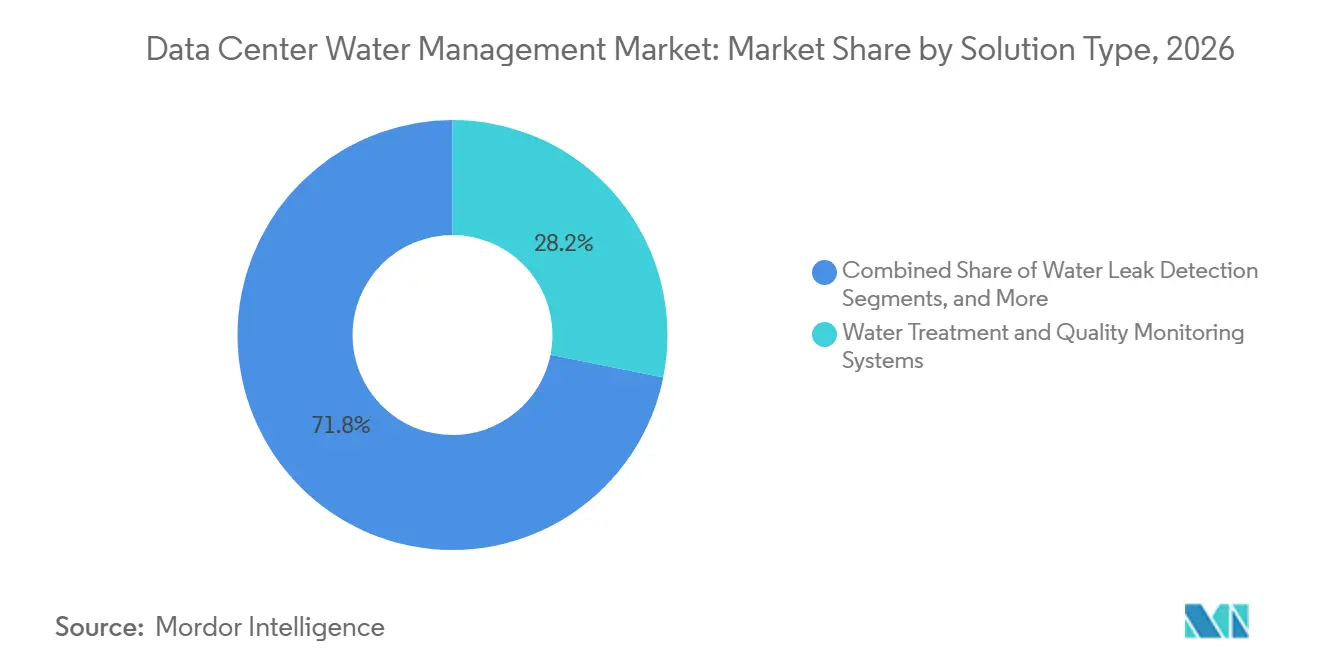
Treatment Systems Anchor Demand and Recycling Systems Lead ExpansionWater Treatment and Quality Monitoring Systems held 28.16% share in 2026. Direct-to-chip and immersion cooling require reverse osmosis, deionization, filtration, and chemical treatment to maintain conductivity, pH, and contaminant controls within operating limits. These systems run continuously in many liquid-cooling configurations, which makes them part of the basic water infrastructure rather than an optional add-on. The Data Center Water Management Market size for treatment systems is also supported by repeat purchases of consumables, membranes, monitoring services, corrosion inhibitors, and biocides as installed liquid-cooling capacity increases.
Water Recycling and Reuse Management Systems are projected to expand at an 11.22% CAGR from 2027 to 2032. EU reporting requirements and the US Environmental Protection Agency's Water Reuse Action Plan 2.0 support the shift toward closed-loop operation and recycled municipal supply. Gradiant announced the commercial deployment of HyperSolved with major hyperscalers in May 2026, combining alternative-source access, high-recovery blowdown concentration, and SmartOps AI. Water Usage Optimization and Control Systems benefit as facilities balance load, flow, temperature, and water quality across several cooling circuits. The segment also reflects operators' need to reduce potable-water use without compromising the thermal reliability expected from mission-critical computing environments.

By Water Management Application:
Cooling Management Holds the Largest Position and Reuse Advances FastestCooling System Water Management accounted for 45.22% share in 2026. The position reflects the high proportion of a facility's water draw associated with heat rejection, especially when AI workloads require liquid cooling. Cooling water chemistry now affects equipment reliability, maintenance schedules, and thermal performance in direct-to-chip environments. Water Supply and Distribution Management and Wastewater Management gain importance as operators address intake, discharge, alternative sourcing, and stewardship requirements at the same site. Leak Prevention and Detection also becomes more important because liquid-cooling equipment introduces exposure points that older air-cooled facilities did not manage.
Water Recycling and Reuse is projected to expand at an 11.34% CAGR from 2027 to 2032. The application benefits from municipal restrictions, recycled-water availability, corporate commitments, and modular treatment systems that can be deployed at new campuses or adapted to existing operations. Municipal restrictions, corporate water-positive commitments, and more mature modular treatment technology support this application. Veolia's Mississippi collaboration with Amazon Web Services shows how wastewater effluent can be converted into cooling-grade water at a hyperscale site. Water Consumption Reporting and Optimization also gains demand as operators need facility records that can support WUE reporting, compliance reviews, and public water-stewardship commitments. This shifts reporting from a periodic administrative exercise toward a continuous operational requirement for large facility portfolios.
By Deployment Model:
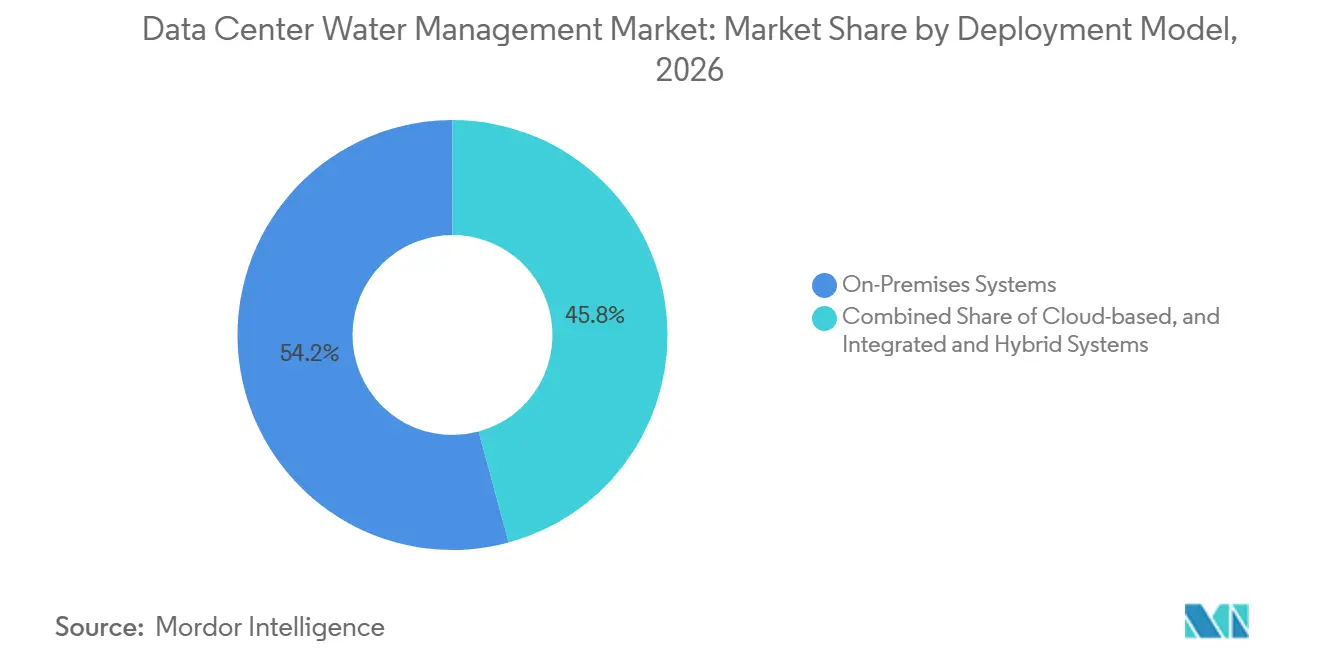
On-Premises Systems Retain Control While Cloud Platforms ScaleOn-Premises Systems held 54.21% of the Data Center Water Management Market in 2026. Operators use local systems for direct, low-latency control over mission-critical water loops and for rapid response to changes in flow, pressure, or coolant condition. ISO/IEC 30134-9 requires metered WUE data at the facility boundary, supporting the continuing need for local instrumentation. Integrated and Hybrid Systems suit large colocation and enterprise operators that require on-site response but also need coordinated visibility across several facilities. They provide a practical middle position for users that need local control during a fault while seeking portfolio comparisons and centralized reporting.
Cloud-Based Systems are projected to expand at an 11.14% CAGR from 2027 to 2032. They provide scalable monitoring for operators that manage dozens of facilities across different regions, water conditions, and reporting regimes. Water Navigator IQ allows portfolio-level benchmarking that cannot be achieved easily with isolated facility tools. Mandatory reporting, AI-based predictive maintenance, and the need for audit-ready documentation are expected to embed cloud platforms more deeply within routine data center workflows. Their adoption can reduce the difficulty of comparing water performance where facilities operate under different municipal rules, water sources, and climate conditions.
By Service Type:
Managed Services Lead Revenue and Auditing Expands FastestManaged Water Management Services accounted for 30.96% of revenue in 2026. Hyperscale and colocation operators use specialists for laboratory capacity, chemical supply, operational documentation, compliance records, and continuous treatment management. Cooling towers, direct-to-chip loops, and adiabatic systems often operate together, making it difficult for internal teams to maintain the full set of required expertise without significant scale. System Installation and Integration and Monitoring and Maintenance remain necessary as new facilities and liquid-cooling retrofits require specialized commissioning and ongoing service. Providers must align water treatment with facility controls, cooling hardware, safety practices, and the documentation needs of both operators and customers.
Water Auditing and Efficiency Consulting is projected to expand at an 11.56% CAGR from 2027 to 2032. EU Energy Efficiency Directive Article 12 requires annual WUE reporting for data centers above 500 kW, with results published in a public database. This creates a need for independent review, documentation, reporting support, and records that are ready for regulatory scrutiny. The Data Center Water Management Market industry also benefits because auditing services complement ongoing managed contracts, helping operators validate performance without replacing the daily role of service providers. Advisory providers can also support operators that need jurisdiction-specific upgrade plans rather than a single standard approach across their portfolio.
By Data Center Size:
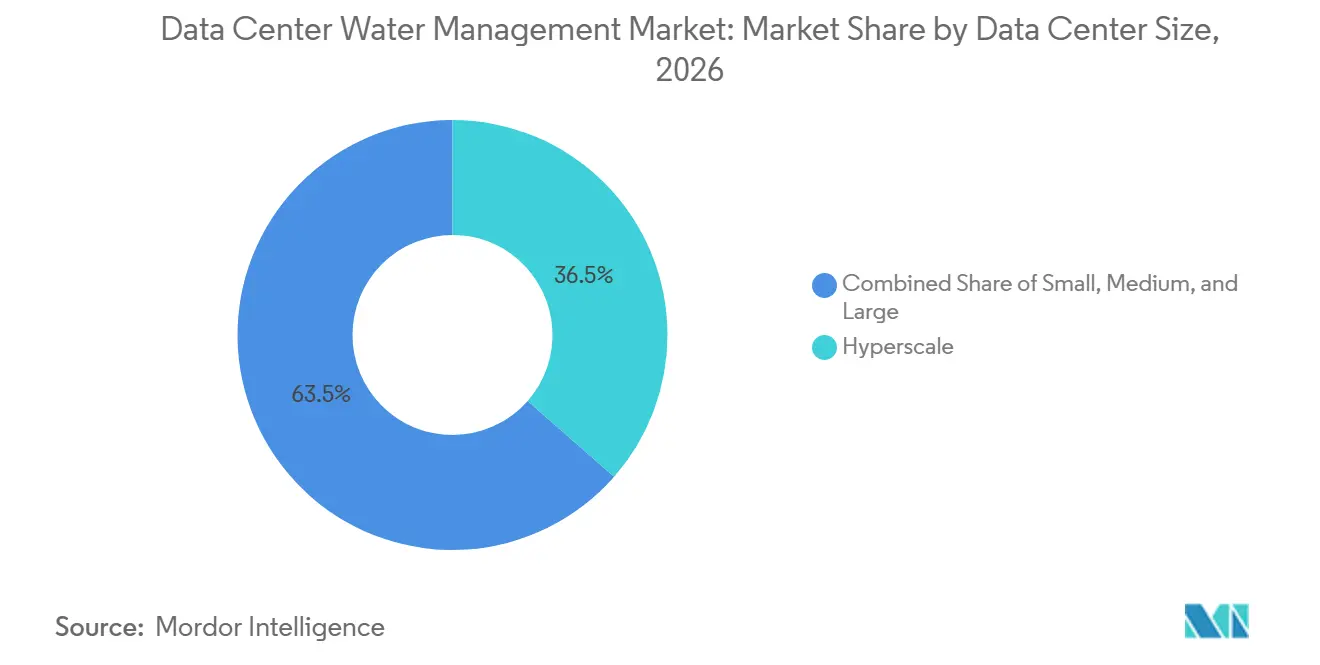
Hyperscale Facilities Lead Share and Forecast ExpansionHyperscale Data Centers held 36.46% share in 2026 and are projected to expand at an 11.27% CAGR through 2032. This dual position reflects the concentration of AI infrastructure investment in facilities above 100 MW, where treatment, recycling, and monitoring projects can be deployed at substantial scale. A 100 MW campus can require water equivalent to the daily needs of 80,000 residents. Large facilities are upgrading cooling infrastructure for higher rack density, while medium sites increasingly use managed services when internal water-management capability is insufficient. The largest campuses are also subject to closer community and regulatory scrutiny because their water requirements can rival those of local population centers.
Small data centers and distributed edge nodes create an opportunity for modular and containerized systems that require limited on-site technical support. Their smaller loads make bespoke installations difficult to justify, so managed-service delivery often offers a more practical route to treatment, monitoring, and compliance. Technologies demonstrated by Gradiant and Veolia in hyperscale settings could be adapted for smaller formats as edge AI deployment increases. Water monitoring is likely to become a standard operating requirement rather than a premium feature across data center tiers. This long conversion path supports broader future demand across the Data Center Water Management Market. Suppliers that can offer containerized treatment, remote monitoring, and routine service are better placed to address the technical and staffing constraints common at distributed facilities.
By Data Center Type:
Cloud Service Providers Lead Demand and Forecast ExpansionCloud Service Providers accounted for 41.86% of revenue in 2026 and are projected to expand at an 11.18% CAGR through 2032. Their facility scale and public water-stewardship commitments make them major buyers of integrated treatment, reuse, monitoring, and reporting services. Ecolab's Cooling as a Service offering covers cooling towers and server-level infrastructure, illustrating the integrated support sought by large cloud operators. Colocation providers remain important because tenants increasingly assess WUE performance and water practices when choosing facilities and negotiating lease requirements. Water performance can therefore influence facility marketing and customer retention alongside conventional measures of power availability and reliability.
Enterprise and Edge data centers are adopting private AI infrastructure, but their water-management budgets remain smaller and their procurement cycles are often longer than those of hyperscale operators. Government and Institutional data centers provide stable demand shaped by public procurement practices, digital-sovereignty needs, and performance requirements that may match or exceed private-sector standards. Across these facility types, water performance is becoming a contractual consideration rather than a voluntary objective. The Data Center Water Management Market industry serves each type with different equipment, service, financing, and reporting requirements. This variation supports demand for flexible delivery models and specialist support. It also limits the usefulness of a single technical template because system design must account for different facility sizes, cooling architectures, public commitments, and procurement practices.
Geography Analysis
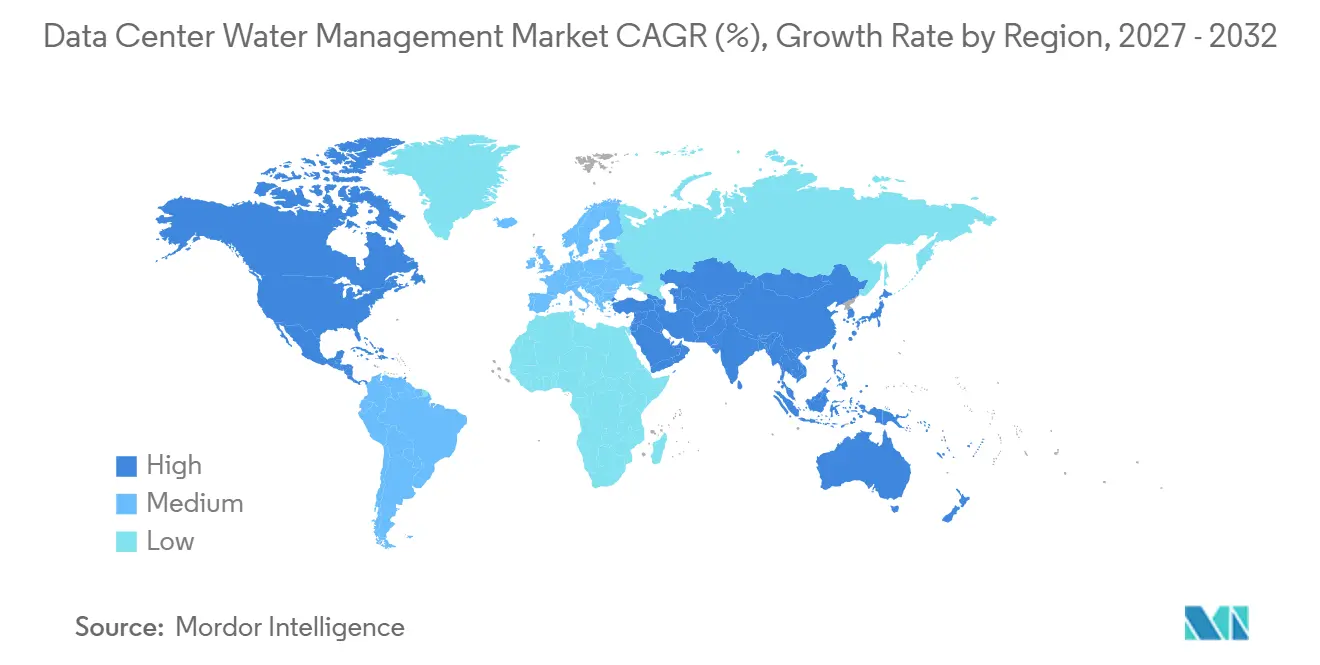
North America held 41.62% of the Data Center Water Management Market in 2026. The region has the largest installed hyperscale base, with major capacity hubs in Northern Virginia, Phoenix, and the Pacific Northwest, where growing water needs are closely linked to new AI and cloud construction. Rising municipal tariffs, water stress, and state-level reporting requirements are encouraging operators to make treatment, reuse, leak detection, and metering part of new facility plans. The regional opportunity in the Data Center Water Management Market reflects the need to secure reliable supply while maintaining the operating resilience expected by hyperscale customers.
South America has a smaller but increasing role in regional demand, with differences in water conditions shaping investment needs by country. Brazil has lower exposure to high water-stress basins than several neighboring markets, which gives operators a different site-selection profile from locations where freshwater availability is more constrained. Mexico and Chile face acute water constraints that affect facility design, alternative-source planning, discharge management, and the timing of new capacity decisions. These conditions require site-specific water management strategies, with system choices based on local water availability, municipal infrastructure, temperature, permitting conditions, and community expectations.
Europe is expanding because water efficiency is becoming a regulatory and operating requirement for data centers. EU Energy Efficiency Directive Article 12 requires annual WUE reporting for data centers above 500 kW, with results published in a public database, which makes water data, controls, and documentation relevant to operating decisions. The requirements support demand for systems that provide measurable performance records as well as the technical capability to improve cooling and reuse practices. Nordic facilities have ambient temperature advantages that can reduce evaporative water demand, while Southern and Eastern Europe face different water-governance challenges as capacity corridors develop. Asia-Pacific is projected to expand at an 11.29% CAGR from 2027 to 2032, supported by cloud and AI capacity additions in China, India, Japan, Singapore, Malaysia, and Indonesia. Singapore limits freshwater withdrawal for new facilities, while China has introduced GB/T 32910.6-2025 to define WUE calculation methods and cooling-water requirements. The Middle East has high treatment needs per MW because desalinated supply and temperatures above 40°C can increase the technical demands of cooling. GCC expansion under national AI programs therefore supports closed-loop cooling-water systems, reuse infrastructure, and advanced treatment services in the Data Center Water Management Market.
Competitive Landscape
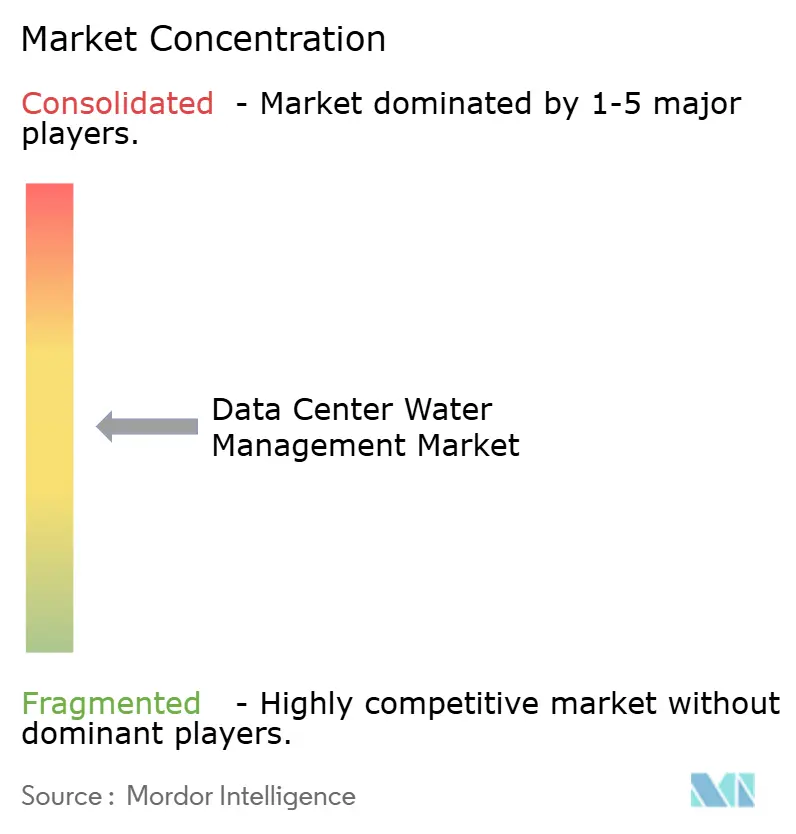
The Data Center Water Management Market is moderately fragmented, with established water companies and specialist providers serving different parts of the value chain. Veolia, Ecolab Inc., and Xylem Inc. have broad service networks, water-treatment knowledge, and compliance capabilities that support large customer portfolios. Gradiant Corporation focuses on integrated platforms designed for hyperscale deployments and positions its offer around the full cooling-water cycle. Competition in the Data Center Water Management Market centers on the ability to combine treatment, monitoring, reuse, reporting, installation support, and reliable field service within one coherent offer.
Ecolab acquired CoolIT Systems in March 2026 and launched Water Navigator IQ in April 2026. The moves extend its data center offering from cooling-tower chemistry to direct-to-chip liquid cooling, continuous coolant management, and enterprise-scale performance monitoring. This approach can help customers reduce the number of separate suppliers that must coordinate around complex water and thermal systems. Veolia launched Data Center Resource 360 in April 2026 and targets annual data center revenue above EUR 1 billion, or USD 1.17 billion, which shows the strategic importance of this customer group to the Data Center Water Management Market. Within the Data Center Water Management Market, the company states that the platform can reduce a facility's water footprint by up to 75% and deliver 95% waste circularity.
Gradiant's HyperSolved platform combines alternative-source access, high-recovery discharge treatment, and SmartOps AI within a single architecture. The company reported commercial deployment with major hyperscalers in May 2026, illustrating the demand for suppliers that can simplify water infrastructure decisions for large, fast-moving construction programs. Gradiant has also filed patents related to a containerized water-management module, reflecting increasing competition over solutions designed for constrained construction sites and repeatable campus deployment. The Data Center Water Management Market favors suppliers with audit-ready documentation as WUE reporting requirements become more established across different jurisdictions. Opportunities remain in multi-site reporting automation, water-as-a-service financing for mid-market facilities, alternative-water integration for new construction, and modular systems for distributed edge sites. The Data Center Water Management Market remains open to specialists because the reported supplier landscape does not identify one provider with a dominant combined position.
Data Center Water Management Industry Leaders
-
Veolia
-
Xylem Inc.
-
Ecolab Inc.
-
Kurita Water Industries Ltd.
-
SUEZ Water Technologies & Solutions
- *Disclaimer: Major Players sorted in no particular order
Data Center Water Management Market Companies Covered in this Report
- Veolia
- Xylem Inc.
- Ecolab Inc.
- Kurita Water Industries Ltd.
- SUEZ Water Technologies & Solutions
- Aquatech International LLC
- Gradiant Corporation
- Pentair plc
- DuPont Water Solutions
- Toray Industries, Inc.
- Ovivo Inc.
- Lenntech B.V.
- Solenis
- Saltworks Technologies Inc.
- IDE Technologies
- Grundfos Holding A/S
- Watts Water Technologies, Inc.
- Thermax Limited
- Wigen Water Technologies
- SAMCO Technologies, Inc.
- Veralto Corporation
- Black & Veatch Holding Company
- Carollo Engineers, Inc.
- Microsoft Corporation
- Google LLC
- Amazon Web Services, Inc.
- Digital Realty Trust, Inc.
- Equinix, Inc.
Recent Industry Developments in Data Center Water Management Market
- October 2026: Endeavour and Trevi Systems announced a partnership to deploy heat-driven desalination technology at data centers, targeting production of up to 200,000 gallons of clean water per day per MW of compute using waste heat, with up to 98% water recovery. First deployments are planned at Endeavour's US data center portfolio.
- May 2026: Gradiant Corporation announced commercial deployment of HyperSolved with several of the world's largest hyperscalers across major global markets, incorporating SmartOps AI, alternative-source water access, and high-recovery blowdown systems under a single-vendor contract model.
- April 2026: Veolia launched its Data Center Resource 360 platform, targeting annual revenue exceeding EUR 1 billion, approximately USD 1.17 billion, from data centers with claimed potential for 75% water footprint reduction and 95% waste circularity across priority US and European markets.
- April 2026: Veolia and Amazon Web Services announced a water reuse collaboration for data center operations in Mississippi, using modular containerized treatment systems to convert wastewater effluent into cooling-grade water, displacing more than 83 million gallons of potable supply annually once the first facility becomes operational in 2027.
Global Data Center Water Management Market Report Scope
The Data Center Water Management Market comprises technologies and services that help data center operators monitor, manage, conserve, and optimize water use across facility operations. It focuses on improving water efficiency, reducing wastage, supporting sustainable cooling practices, ensuring water quality, and meeting environmental compliance requirements. The market enables organizations to enhance operational resilience, lower resource consumption, and achieve sustainability goals through advanced monitoring, automation, analytics, and water conservation strategies, supporting the growing demand for environmentally responsible and resource-efficient digital infrastructure.
The Data Center Water Management Market Report is Segmented by Solution Type (Water Monitoring and Metering Systems, Water Leak Detection Systems, Water Usage Optimization and Control Systems,Water Recycling and Reuse Management Systems,Water Treatment and Quality Monitoring Systems, and Water Management Software and Analytics), Water Management Application (Cooling System Water Management, Water Supply and Distribution Management, Wastewater Management, Water Recycling and Reuse, Leak Prevention and Detection, and Water Consumption Reporting and Optimization), Deployment Model (On-Premises Systems, Cloud-Based Systems, and Integrated and Hybrid Systems), Service Type (System Installation and Integration, Monitoring and Maintenance, Water Auditing and Efficiency Consulting, and Managed Water Management Services), Data Center Size (Small, Medium, Large, and Hyperscale), Data Center Type (Colocation, Cloud Service Providers (CSPs), Enterprise and Edge, and Government and Institutional Data Centers), and Geography (North America, South America, Europe, Asia-Pacific, Middle East, Africa). The Market Forecasts are Provided in Terms of Value (USD).
Segmentation Overview
| Water Monitoring and Metering Systems |
| Water Leak Detection Systems |
| Water Usage Optimization and Control Systems |
| Water Recycling and Reuse Management Systems |
| Water Treatment and Quality Monitoring Systems |
| Water Management Software and Analytics |
| Cooling System Water Management |
| Water Supply and Distribution Management |
| Wastewater Management |
| Water Recycling and Reuse |
| Leak Prevention and Detection |
| Water Consumption Reporting and Optimization |
| On-Premises Systems |
| Cloud-Based Systems |
| Integrated and Hybrid Systems |
| System Installation and Integration |
| Monitoring and Maintenance |
| Water Auditing and Efficiency Consulting |
| Managed Water Management Services |
| Small |
| Medium |
| Large |
| Hyperscale |
| Colocation |
| Cloud Service Providers (CSPs) |
| Enterprise and Edge |
| Government and Institutional Data Centers |
| North America | United States |
| Canada | |
| Mexico | |
| South America | Brazil |
| Chile | |
| Colombia | |
| Argentina | |
| Peru | |
| Rest of South America | |
| Europe | United Kingdom |
| Germany | |
| France | |
| Netherlands | |
| Ireland | |
| Spain | |
| Italy | |
| Nordics | |
| Rest of Europe | |
| Asia-Pacific | China |
| India | |
| Japan | |
| Australia | |
| Singapore | |
| South Korea | |
| Malaysia | |
| Indonesia | |
| Rest of Asia-Pacific | |
| Middle East | Saudi Arabia |
| United Arab Emirates | |
| Israel | |
| Qatar | |
| South Africa | |
| Egypt | |
| Rest of Middle East and Africa |
| By Solution Type | Water Monitoring and Metering Systems | |
| Water Leak Detection Systems | ||
| Water Usage Optimization and Control Systems | ||
| Water Recycling and Reuse Management Systems | ||
| Water Treatment and Quality Monitoring Systems | ||
| Water Management Software and Analytics | ||
| By Water Management Application | Cooling System Water Management | |
| Water Supply and Distribution Management | ||
| Wastewater Management | ||
| Water Recycling and Reuse | ||
| Leak Prevention and Detection | ||
| Water Consumption Reporting and Optimization | ||
| By Deployment Model | On-Premises Systems | |
| Cloud-Based Systems | ||
| Integrated and Hybrid Systems | ||
| By Service Type | System Installation and Integration | |
| Monitoring and Maintenance | ||
| Water Auditing and Efficiency Consulting | ||
| Managed Water Management Services | ||
| By Data Center Size | Small | |
| Medium | ||
| Large | ||
| Hyperscale | ||
| By Data Center Type | Colocation | |
| Cloud Service Providers (CSPs) | ||
| Enterprise and Edge | ||
| Government and Institutional Data Centers | ||
| By Geography | North America | United States |
| Canada | ||
| Mexico | ||
| South America | Brazil | |
| Chile | ||
| Colombia | ||
| Argentina | ||
| Peru | ||
| Rest of South America | ||
| Europe | United Kingdom | |
| Germany | ||
| France | ||
| Netherlands | ||
| Ireland | ||
| Spain | ||
| Italy | ||
| Nordics | ||
| Rest of Europe | ||
| Asia-Pacific | China | |
| India | ||
| Japan | ||
| Australia | ||
| Singapore | ||
| South Korea | ||
| Malaysia | ||
| Indonesia | ||
| Rest of Asia-Pacific | ||
| Middle East | Saudi Arabia | |
| United Arab Emirates | ||
| Israel | ||
| Qatar | ||
| South Africa | ||
| Egypt | ||
| Rest of Middle East and Africa | ||
Key Questions Answered in the Report
What is the size of the data center water management market?
The Data Center Water Management Market is valued at USD 3.44 billion in 2026 and is forecast to reach USD 6.38 billion by 2032 at a 10.86% CAGR. The forecast reflects increased spending on cooling treatment, reuse, monitoring, and related water infrastructure as data center operators add higher-density computing capacity.
What is driving demand for water management systems in data centers?
AI workloads, higher rack densities, liquid cooling, water scarcity, and WUE reporting requirements are increasing demand for treatment, monitoring, and reuse systems. The Data Center Water Management Market is also supported by operators that need reliable cooling water while meeting site-specific water-stewardship and reporting expectations.
Which solution type has the largest share?
Water Treatment and Quality Monitoring Systems hold the largest solution-type share at 28.16% in 2026. Their position reflects the ongoing need to control coolant quality in direct-to-chip and immersion cooling systems, where poor water conditions can affect equipment performance and maintenance needs.
Which application is expanding fastest?
Water Recycling and Reuse is projected to expand at an 11.34% CAGR from 2027 to 2032. The application benefits from municipal restrictions, recycled-water availability, corporate commitments, and modular treatment systems that can be deployed at new campuses or adapted to existing operations.
Which region leads data center water management demand?
North America leads with 41.62% share in 2026, while Asia-Pacific is projected to record the fastest regional CAGR of 11.29% through 2032. North American demand is supported by the installed hyperscale base, while Asia-Pacific demand reflects cloud construction, AI capacity additions, and freshwater constraints in several major locations.
Why are cloud-based water management platforms becoming more important?
Cloud platforms enable cross-site benchmarking, reporting, predictive maintenance, and management of distributed data center portfolios. They help operators compare facilities with different water sources and operating conditions while keeping documentation accessible for internal reviews, customer requirements, regulatory reviews, and WUE-related reporting across changing operating conditions.