
Data Center Waste Heat Recovery Market Size and Share
Market Overview
| Study Period | 2021 - 2032 |
|---|---|
| Market Size (2027) | USD 0.57 Billion |
| Market Size (2032) | USD 1.52 Billion |
| Fastest Growing Market | Asia-Pacific |
| Largest Market | Europe |
| Market Concentration | Medium |
Major Players *Disclaimer: Major Players sorted in no particular order Image © Mordor Intelligence. Reuse requires attribution under CC BY 4.0. | |
Data Center Waste Heat Recovery Market Analysis by Mordor Intelligence
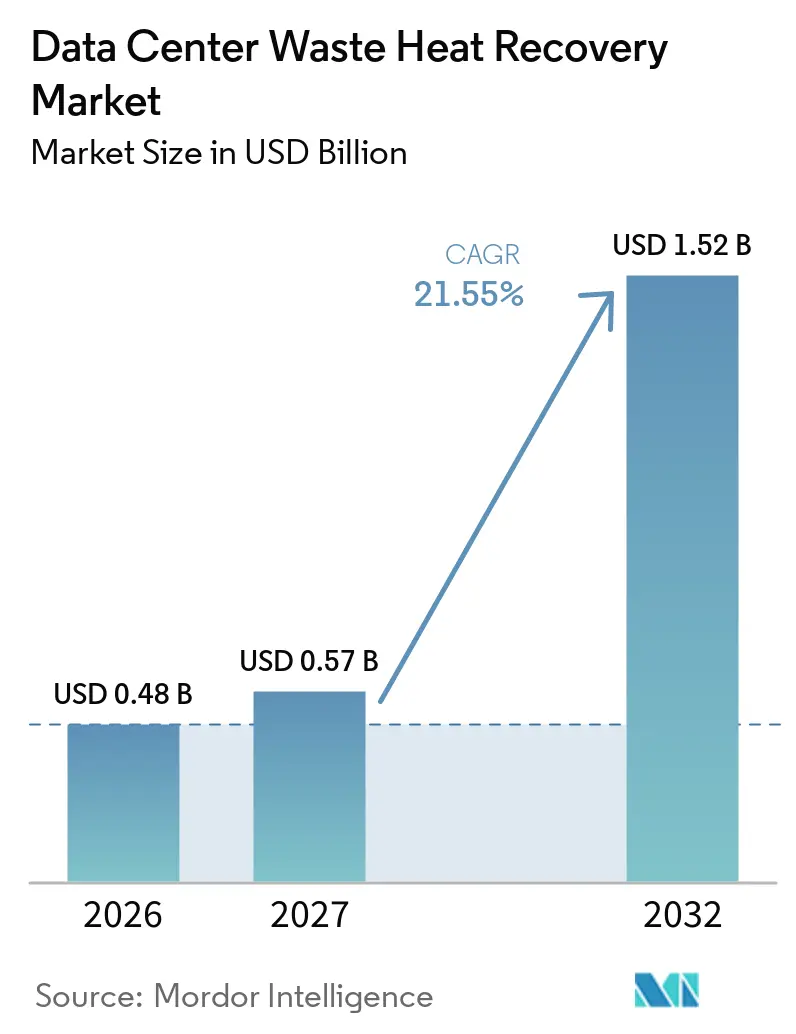
The data center waste heat recovery market size is USD 0.48 billion in 2026 and is forecast to reach USD 1.52 billion by 2032, expanding at a CAGR of 21.55% from 2027 to 2032. AI and high-performance computing are raising rack densities and increasing the case for liquid cooling. This shift raises the temperature and volume of recoverable heat, creating more viable links with district heating systems. Compliance requirements in Europe are moving heat reuse into early facility design and capital planning. The strongest opportunities combine large, steady heat loads with nearby demand, long-term off-take agreements, and thermal storage. Competition is widening as equipment suppliers, utilities, data center operators, and modular system providers work across the same projects.
Key Report Takeaways
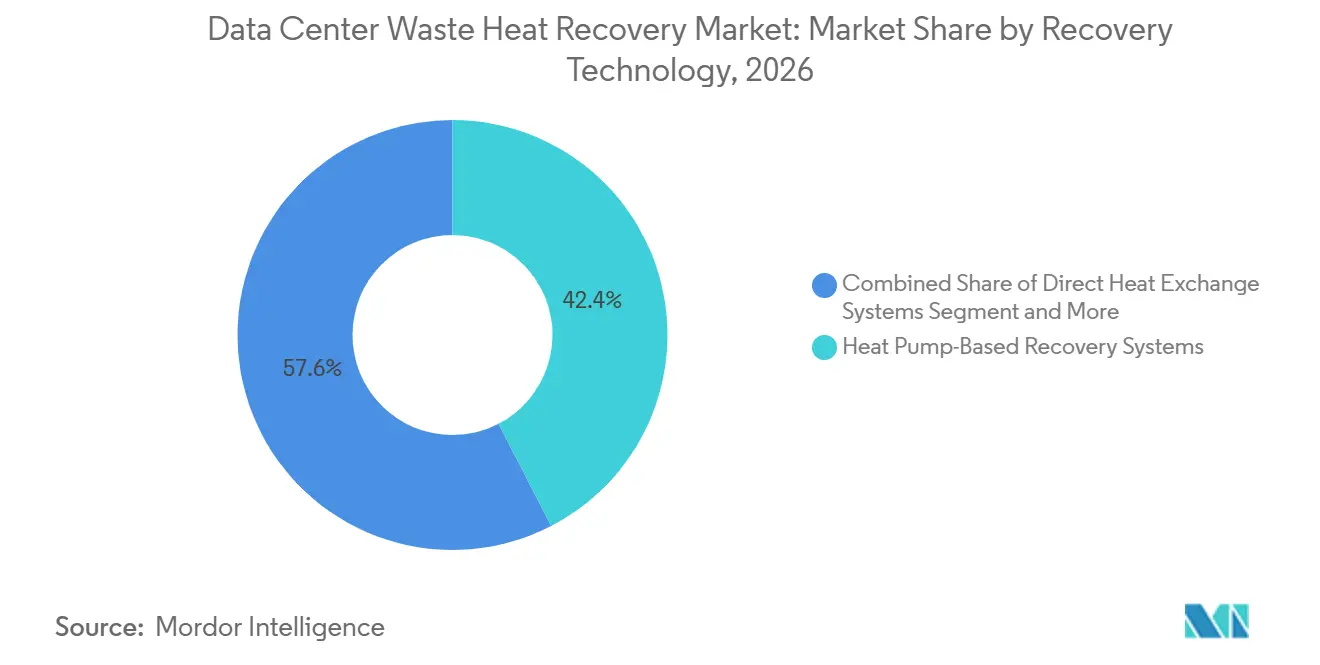
- By recovery technology, heat pump-based systems held 42.41% of the data center waste heat recovery market share in 2026, while thermal energy storage-integrated systems are projected to expand at a 28.13% CAGR through 2032.
- By heat reuse application, district heating accounted for 52.16% of the data center waste heat recovery market size in 2026, while greenhouse and agricultural heating is projected to expand at a 27.32% CAGR through 2032.
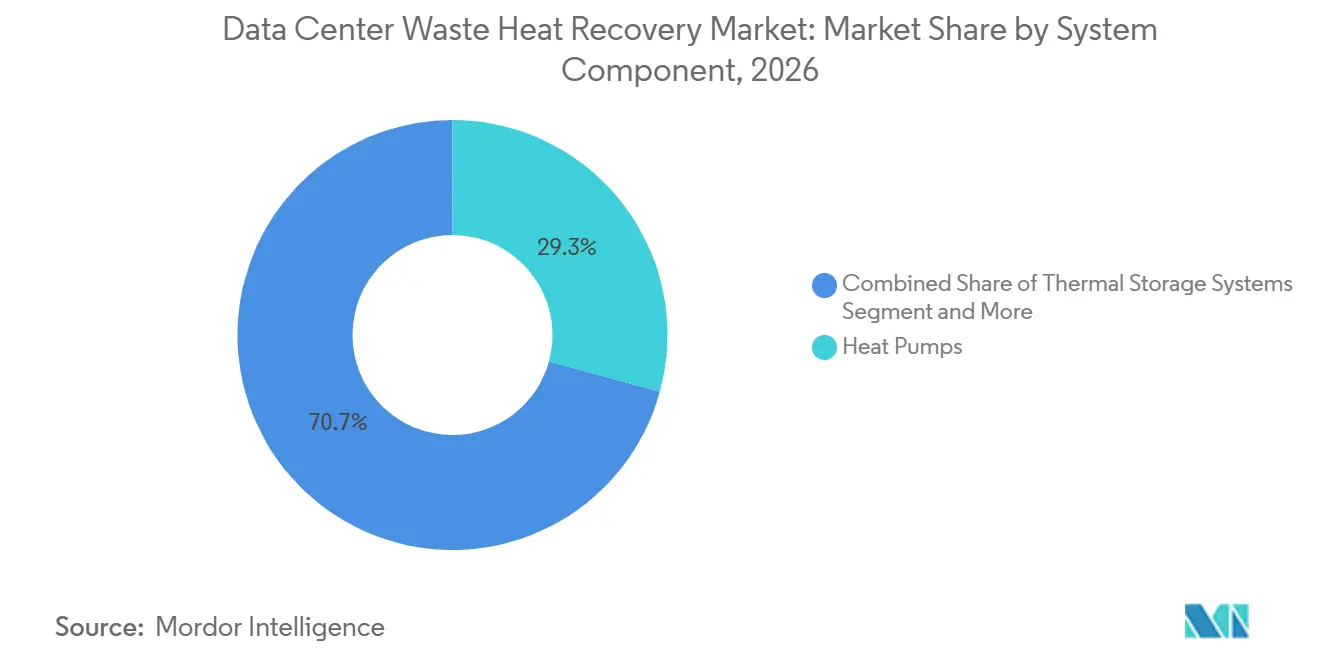
- By system component, heat pumps held 29.26% of the data center waste heat recovery market share in 2026, while thermal storage systems are projected to expand at a 27.45% CAGR through 2032.
- By heat delivery model, district heating network off-take held 57.92% share in 2026, while direct off-site heat supply is projected to expand at a 22.56% CAGR through 2032.
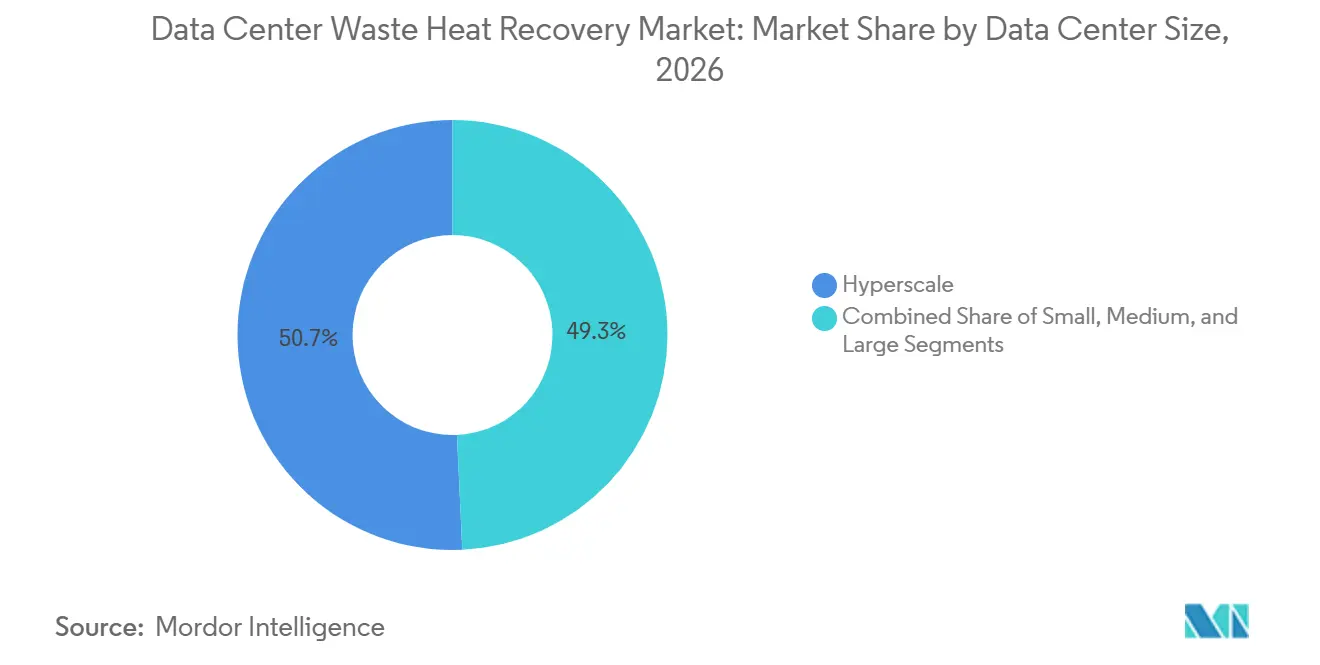
- By data center size, hyperscale facilities held 50.73% share in 2026 and are projected to expand at a 23.47% CAGR through 2032.
- By data center type, cloud service providers held 49.78% share in 2026 and are projected to expand at a 23.16% CAGR through 2032.
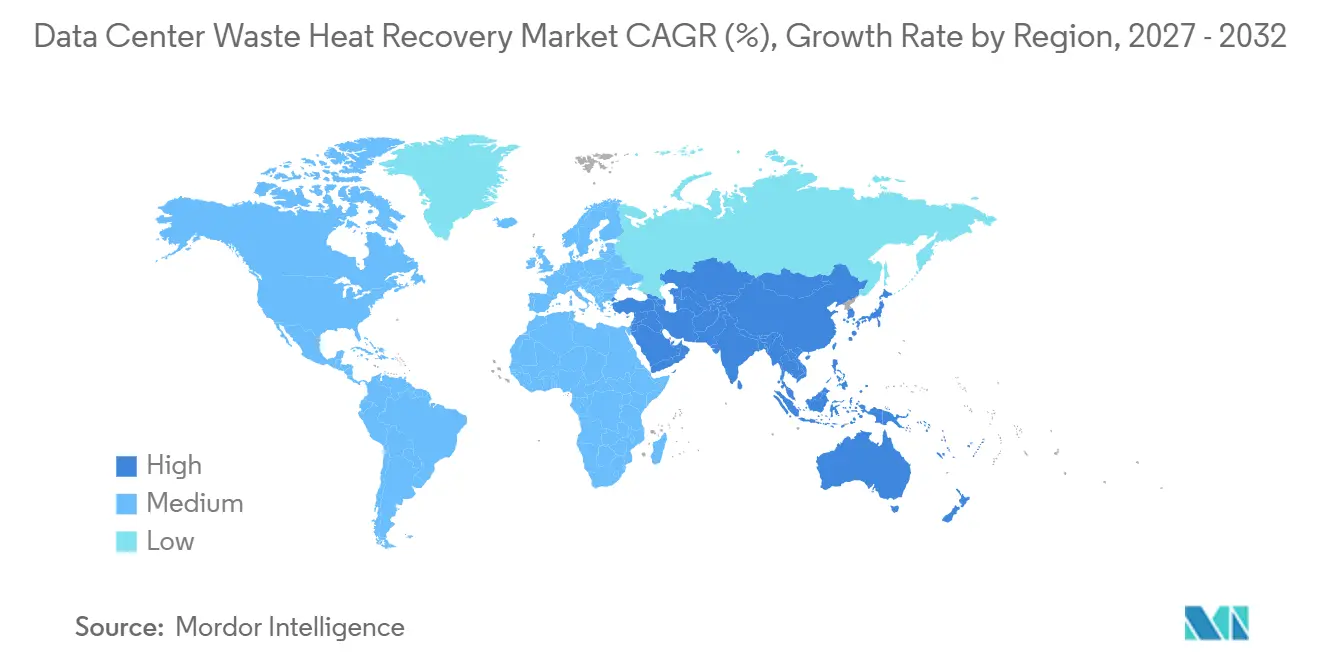
- By geography, Europe held 48.23% share in 2026, while Asia-Pacific is projected to expand at a 26.30% CAGR through 2032.
Note: Market numbers in this report are based on Mordor Intelligence's proprietary estimation framework, which combines nine months of actuals with Q4 projections for base year 2026.
Market Trends and Insights
Drivers Impact Analysis of Data Center Waste Heat Recovery Market*
| Driver | (~) % Impact on CAGR Forecast | Geographic Relevance | Impact Timeline |
|---|---|---|---|
| AI and High-Performance Computing Heat Density | +5.5% | Global, with early intensity in North America and Europe | Short term (≤ 2 years) |
| Data Center Energy Performance Reporting and Reuse Mandates | +4.0% | EU core, Germany, France, and Nordic countries, with spillover to the Netherlands and UK | Short term (≤ 2 years) |
| Decarbonization of District Heating Networks | +3.5% | Northern and Central Europe, including Denmark, Finland, Sweden, Germany, and the Netherlands | Medium term (2-4 years) |
| Liquid Cooling Raises Recoverable Heat Quality | +3.0% | Global, accelerating in Asia-Pacific and North America | Medium term (2-4 years) |
| Heat Reuse Revenue and Energy Cost Optimization | +2.5% | Global, with the highest impact in high-electricity-cost markets, including the EU and Singapore | Medium term (2-4 years) |
| Replicable Heat Off-Take Partnerships and Modular Deployment | +1.5% | Global, with early model formation in Nordic countries and the Netherlands | Long term (≥ 4 years) |
| Source: Mordor Intelligence | |||
AI and High-Performance Computing Heat Density
AI-optimized GPU clusters are changing the thermal profile of data centers and improving the case for heat recovery. Modern AI racks can exceed 100 kW per cabinet, and liquid cooling can capture more than 99% of waste heat at 55-70°C. This temperature range can align with the conditions of fourth- and fifth-generation district heating supply. The data center waste heat recovery market, therefore, benefits not only from higher heat volumes but also from better heat quality. Tokyo selected an implementation consortium for its Data Center Waste Heat Utilization Implementation Promotion Project in July 2026, focusing on GPU-server cooling and high-temperature heat recovery. The project shows how public programs are beginning to link digital infrastructure with community energy use.[1]
Data Center Energy Performance Reporting and Reuse Mandates
European policy is turning heat reuse from a voluntary sustainability measure into a project requirement. Germany's Energy Efficiency Act requires new qualifying data centers to meet waste heat reuse thresholds from July 2026, with a higher threshold for facilities commissioned from July 2028. France also applies an Energy Reuse Factor requirement to qualifying data centers. These obligations make early decisions on cooling, piping, heat pumps, and off-take contracts more important. The European Commission has proposed a common data center rating scheme that includes energy efficiency and waste heat reuse. Comparable reporting can make system performance more visible to customers, investors, regulators, and municipal partners.[2]
Decarbonization of District Heating Networks
District heating operators are replacing fossil heat sources, creating demand for a stable low-carbon supply. Data centers produce heat year-round, which can support a predictable base load when connected to suitable networks. The International Energy Agency states that recovered data center heat could provide up to 300 TWh of space heating for EU buildings within 5 km of facilities by 2030 if it is fully integrated into district heating networks.[3] This potential would be sufficient for 10% of European homes. Fortum and Microsoft commissioned a 350 MW thermal system in Finland during the 2025-2026 heating season, demonstrating the scale possible when a large campus is connected to district infrastructure. The data center waste heat recovery market is, therefore, the most advanced, with network operators providing dependable long-term demand.
Liquid Cooling Raises Recoverable Heat Quality
Liquid cooling increases return-water temperatures and can reduce the temperature lift required before heat is sold or reused. Single-phase and two-phase immersion systems can produce return water at 60°C or above. ITU-T Recommendation L.1328 defines Energy Reuse Factor, Recovery Factor, and Waste Heat Reuse Rate metrics for liquid-cooled data centers and telecommunications rooms. These metrics give operators a consistent basis for measuring and reporting heat reuse. A2A's Brescia project with Qarnot Computing demonstrated recovery at 65°C for direct injection into the district heating network. As liquid cooling becomes more common, projects can increasingly use heat exchangers rather than relying only on large heat pump systems.
Restraints Impact Analysis of Data Center Waste Heat Recovery Market*
| Restraint | (~) % Impact on CAGR Forecast | Geographic Relevance | Impact Timeline |
|---|---|---|---|
| High Upfront Cost and Uncertain Project Payback | -3.8% | Global, most acute in markets without subsidies or long-term heat purchase agreements | Short term (≤ 2 years) |
| Spatial and Seasonal Mismatch Between Supply and Demand | -2.7% | Global, more severe in North America, Middle East and Africa, and parts of Asia-Pacific | Medium term (2-4 years) |
| Low-Grade Heat and Heat Pump Electricity Dependence | -2.0% | Global, with higher impact in markets with volatile electricity pricing | Medium term (2-4 years) |
| Mission-Critical Reliability and Integration Risk | -1.3% | Global | Long term (≥ 4 years) |
| Source: Mordor Intelligence | |||
High Upfront Cost and Uncertain Project Payback
Heat recovery projects require investment in recovery stations, pump loops, piping, heat pumps, and network connections. The cost is especially difficult to justify when no public co-investment or long-term heat purchase agreement is available. A 2025 Turkish assessment found a 66.3-year payback period under its base case, with economics affected by thermal efficiency and distance to the heat user. Research from Aalborg University found that large facilities using efficient liquid cooling were more likely to achieve a positive net present value within 12 years. The Open Compute Project reported that a 15°C increase in cooling return temperature can raise the heat reuse business case return by 30%. Public funding can reduce the gap, as illustrated by an EUR 52 million (~USD 58 million) grant for the Haarlem Waarderpolder project in the Netherlands.[4]
Spatial and Seasonal Mismatch Between Supply and Demand
Data centers release heat continuously, while building demand is seasonal and often concentrated away from data center sites. Location remains a major constraint because facilities are frequently built on lower-cost land outside dense city centers. The European Commission reported that only 67 facilities recorded any waste heat reuse in the first EU reporting period. These facilities reused 1.8% of the heat they generated, largely because nearby off-takers and distribution infrastructure were unavailable. Legacy steam networks in North American urban areas can require costly modifications to use hot-water output from data centers. Seasonal storage and high-temperature heat pumps may improve the data center waste heat recovery market, where local demand does not match continuous supply.
*Our forecasts treat driver/restraint impacts as directional, not additive. The impact forecasts reflect baseline growth, mix effects, and variable interactions.
Data Center Waste Heat Recovery Market Segment Analysis
By Recovery Technology:
Heat Pumps Lead While Thermal Storage AcceleratesHeat pump-based recovery systems accounted for 42.41% of the data center waste-heat recovery market share in 2026. They upgrade low-temperature heat from air-cooled facilities, commonly from 20-30°C, to temperatures used by conventional district heating networks. This function remains important because air-cooled sites form a large part of the installed base. Heat pumps also let operators connect facilities to networks with higher supply-temperature requirements. Their relevance will continue during the shift toward liquid cooling because many existing sites still need temperature uplift. The technology supports a practical retrofit path for operators who cannot redesign their cooling systems immediately.
Thermal energy storage-integrated recovery systems are projected to expand at a 28.13% CAGR through 2032. Storage helps align continuous data center heat output with daily and seasonal heating demand. A 2025 study of a heat pump and Organic Rankine Cycle Carnot battery combination reported round-trip efficiency of up to 83% under optimized conditions. This creates an additional path for high-temperature heat where direct thermal sales are limited. Direct heat exchange systems hold a strong role at liquid-cooled sites with compatible exit temperatures. Heat recovery chillers also provide simultaneous cooling and heat recovery, while Organic Rankine Cycle systems offer an electrical output option for constrained urban sites.

By Heat Reuse Application:
District Heating Holds Scale While Agricultural Use ExpandsDistrict heating accounted for 52.16% of the data center waste-heat recovery market in 2026. Its leading position reflects the large volumes that district networks can absorb and the security offered by utility-grade contracts. Long-term agreements help operators finance heat recovery equipment over periods that align with data center assets. Commercial and residential building heating is the next major outlet, especially near new housing projects. These projects can link server cooling with local space heating and domestic hot water. District systems remain the clearest route for large campuses that need a stable, aggregated heat buyer.
Greenhouse and agricultural heating is projected to expand at a 27.32% CAGR through 2032. Waste heat at 45-65°C can support controlled-environment agriculture with limited supplemental heating. A 2025 academic paper estimated that U.S. data center waste heat could serve 30,085-45,448 hectares of greenhouse space. WA3RM and atNorth are pairing a 250 MW campus in Varde, Denmark, with a 40-hectare greenhouse for year-round vegetable production. SINTEF is also assessing tomato cultivation using surplus data center heat in Arctic Norway. Industrial process heating and domestic hot water broaden the addressable base where district heating networks are unavailable.
By System Component:
Heat Pumps Lead While Thermal Storage Changes Project EconomicsHeat pumps accounted for 29.26% of the data center waste-heat recovery market share in 2026. They are used in both air-cooled and liquid-cooled configurations and remain the main interface equipment in many district heating projects. Heat exchangers also constitute a major component category, as they transfer heat between cooling loops and heat networks. Alfa Laval reported that its HeatChain data boiler facilities delivered 50 GWh of district heating energy in 2025. Those facilities recorded an average annualized Energy Reuse Factor of 64% and reduced district heat production emissions by 3,650 tons of CO₂. Monitoring and controls are becoming more important as networks schedule multiple heat sources in real time.
Thermal storage systems are projected to expand at a 27.45% CAGR through 2032. Their role is to separate heat production from heat delivery and reduce the mismatch between server cooling and urban demand. A 2025 National Renewable Energy Laboratory assessment of reservoir thermal storage for a 5 MW data center cooling load found a levelized cost of cooling of USD 5/MWh. The study reported a 67% reduction in conventional chiller cooling and avoided 1,488 tCO₂e each year. Alfa Laval launched FreeWaterLoop in March 2026 as a modular external cooling system for data center facility loops. These technologies can make system configurations more flexible and improve the thermal baseline available for downstream recovery
By Heat Delivery Model:
District Network Off-Take Leads While Direct Supply AdvancesDistrict heating network off-take held 57.92% of the data center waste heat recovery market share in 2026. It is prevalent in Nordic countries, Germany, the Netherlands, and France, where established networks can absorb large amounts of heat. Utility agreements provide a clear counterparty and a predictable commercial structure. This helps recovery projects secure financing and recover capital over the long lives of equipment. On-site reuse has a lower investment threshold because it serves the data center building, domestic hot water, or a nearby facility. Its revenue potential is usually lower because the available local load is smaller.
Direct off-site heat supply is projected to expand at a 22.56% CAGR through 2032. This model uses bilateral agreements between an operator and a specific customer, such as a greenhouse, industrial site, or building owner. It can work in locations where a district network is absent or has limited capacity. The arrangement provides commercial flexibility and can be easier to develop around a new campus. However, a single off-taker leaves the project exposed to demand variation. Minimum-purchase commitments, reliability terms, and force majeure provisions are therefore important elements of contract design.
By Data Center Size:
Hyperscale Facilities Combine Scale and AdoptionHyperscale data centers accounted for 50.73% of the data center waste-heat recovery market share in 2026. Their thermal output can support large district heating contracts and justify dedicated recovery infrastructure. Campuses of 100 MW or more are better placed to finance network connections, heat pumps, and storage. Fortum's EUR 225 million investment, equivalent to USD 247.5 million, in heat pump plants for Microsoft's Espoo and Kirkkonummi campuses illustrates this scale advantage. The 350 MW system can serve a large district heating load because the campuses produce a steady heat output. Smaller facilities generally cannot replicate this scale through individual projects.
Hyperscale facilities are projected to expand at a 23.47% CAGR through 2032. Large and medium sites can use modular deployments that increase capacity in stages as tenant and computing demand rise. Fenagy deployed 15 heat pump units in two phases at a data center in Kajaani, Finland, producing 33.5 MW of heating capacity. This approach avoids putting all capital at risk in a single installation. Small data centers face higher per-unit costs and may have limited appeal to large off-takers. The YEXIO edge facility planned in Dorfen, Germany, still shows that small sites can be viable where municipal energy planning and local district heating are integrated from the outset
By Data Center Type:
Cloud Service Providers Combine Volume and MomentumCloud service providers held 49.78% market share in the data center waste heat recovery market in 2026. Their campuses provide steady thermal output and have the financial capacity to incorporate recovery systems into the design. They also face strong expectations to report progress against energy and emissions commitments. These factors make cloud operators more likely to negotiate with utilities and municipalities before construction begins. Microsoft has heat-recovery projects in Finland and Denmark that connect data center planning to district heating. The company’s Finnish project with Fortum has a thermal capacity of 350 MW, while its Danish agreement is designed to meet the heating needs of 6,000 households.
Cloud service providers are projected to expand at a 23.16% CAGR through 2032. Colocation operators are the next major type, but they must aggregate heat volumes across tenants and protect cooling service commitments. Enterprise and edge data centers account for a smaller share, although their urban locations can offer useful proximity to local heat demand. TIM Enterprise and GETEC launched a project in Rozzano, Italy, that supplies heat to more than 5,000 social housing units. This example shows how enterprise sites can operate as local energy contributors. The data center waste heat recovery market can, therefore, develop across several operating models when project partners align cooling reliability with delivery obligations
Geography Analysis
Europe
Europe held 48.23% of the data center waste heat recovery market share in 2026. Finland, Denmark, Sweden, Germany, and the Netherlands have mature fourth- and fifth-generation district heating networks that can receive recovered heat without entirely new distribution systems. Germany's Energy Efficiency Act applies waste-heat reuse obligations to qualifying new facilities commissioned from July 2026 onward. The European Commission’s reporting and rating work reinforces the importance of comparable energy and heat reuse performance. Fortum and Microsoft’s 350 MW project in Finland serves district heating demand across Espoo, Kauniainen, and Kirkkonummi, while Equinix, Diemen, and Vattenfall have assessed or planned local network supply.
Asia-Pacific
Asia-Pacific is projected to expand at a 26.30% CAGR through 2032. Greenfield hyperscale campuses are a key feature because they can include cooling and thermal infrastructure from the design stage. Japan has combined technology testing with public policy support, including AT TOKYO and elleThermo’s March 2026 test of power generation from 30-40°C exhaust heat. Tokyo’s July 2026 project supports the recovery of heat from high-temperature GPU servers for community use.[5] China’s installed data center base creates opportunities for municipal-scale recovery and heat storage, while Singapore, South Korea, India, and Southeast Asia offer distinct applications as capacity expands.
North America, South America, Middle East and Africa
North America faces integration challenges because legacy urban district heating often uses steam systems, although Virginia has recommended policies for heat reuse, and newer district energy systems offer entry points. South America has an early-stage opportunity in São Paulo, while the Middle East may favor industrial process heat and cooling performance over building heating. Turkey offers technically viable moderate-climate locations, but pipeline distance and server efficiency affect economics. Africa remains in its early stages, with South Africa attracting interest as its data center footprint expands.
Competitive Landscape
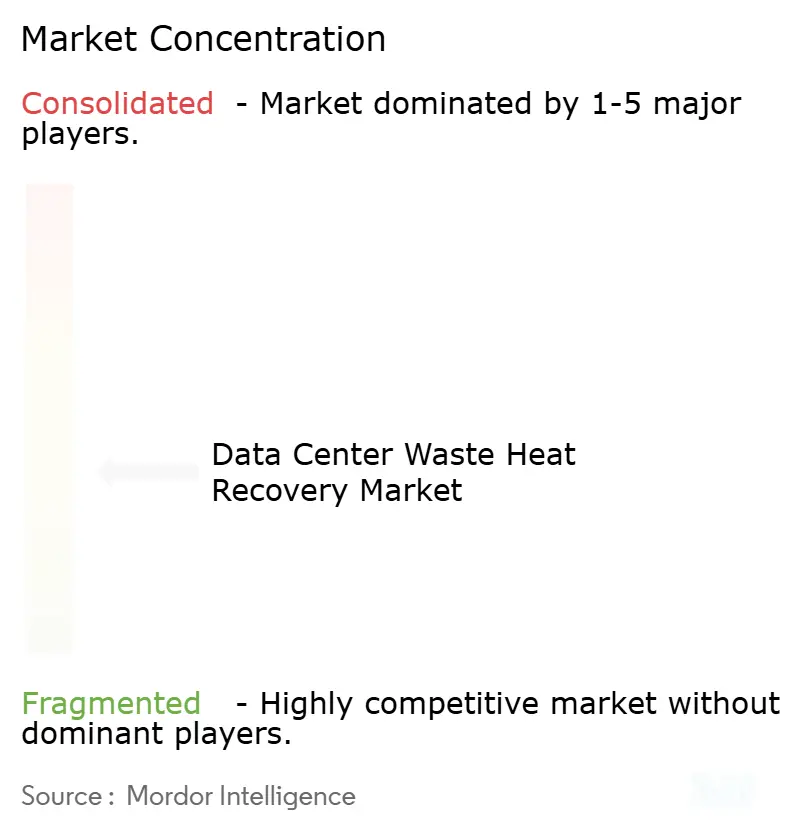
The data center waste heat recovery market is moderately fragmented because no company controls cooling integration, heat distribution, and end-customer supply across the full value chain. Thermal equipment specialists supply heat exchangers, heat pumps, and Organic Rankine Cycle equipment. Utilities and energy service companies develop and operate district heating assets. Modular system providers combine components and controls into project-specific configurations. Danfoss reported that data center sales nearly doubled in 2025, representing 7% of group revenue, while Alfa Laval began a SEK 1 billion capital program, equivalent to USD 90 million, to expand heat transfer capacity in the United States and Europe.
Companies increasingly compete on monitoring, system integration, and lifecycle support rather than on standalone equipment. Alfa Laval’s thermal condition audit approach, Trane Technologies’ Symbio controller, and Vertiv’s thermal management tools can support service revenue and performance documentation. Modular recovery systems can expand in locations without district heating networks. Agricultural and industrial heat customers offer alternatives where household heating demand is low. Vertiv and Oklo announced a July 2025 collaboration on integrated power and cooling solutions for hyperscale and colocation data centers, linking cooling design with a low-carbon power approach.
Qarnot Computing designs liquid-cooled computing infrastructure as a combined heat-and-computing platform. This model is relevant to utilities that seek community heat supply from digital facilities. Compliance rules favor suppliers that can document Energy Reuse Factor performance across complete systems, including under EU Delegated Regulation 2024/1364 and Germany’s Energy Efficiency Act.
Data Center Waste Heat Recovery Industry Leaders
-
Danfoss A/S
-
Alfa Laval AB
-
Johnson Controls International plc
-
Trane Technologies plc
-
Fortum Oyj
- *Disclaimer: Major Players sorted in no particular order
Data Center Waste Heat Recovery Market Companies Covered in this Report
- Danfoss A/S
- Alfa Laval AB
- Everllence SE
- Vertiv Holdings Co.
- Johnson Controls International plc
- Trane Technologies plc
- Carrier Global Corporation
- Rittal GmbH & Co. KG
- Turboden S.p.A.
- Submer Technologies, S.L.
- Munters Group AB
- Kelvion Holding GmbH
- SWEP International AB
- Mayekawa Mfg. Co., Ltd.
- Fenagy A/S
- Oilon Group Oy
- Star Refrigeration Limited
- Fortum Oyj
- Veolia Environnement S.A.
- E.ON SE
- Vattenfall AB
- Valmet Oyj
- GETEC Group
- Qarnot Computing SAS
- Nohewa Oy
Recent Industry Developments in Data Center Waste Heat Recovery Market
- October 2026: The European Commission's public consultation on minimum performance standards for EU data centers, including waste-heat reuse thresholds, remained open through December 14, 2026, following the formal rating scheme proposal dated September 21, 2026. The consultation output will inform the binding Delegated Regulation expected by Q2 2027, which will establish mandatory waste-heat reuse floors across EU member states.
- August 2026: Schwarz Digits, the digital division of the Schwarz Group, signed a waste-heat supply agreement with the city of Lübbenau, Germany, for its AI data center planned at the former Lübbenau coal power plant site. At full build-out, the campus could supply waste heat for up to 75,000 households, with the first heat injection targeted for 2028.
- July 2026: Tokyo Metropolitan Government formalized the adoption of its Data Center Waste Heat Utilization Implementation Promotion Project, with Tokyo Electric Power Holdings, MESH-X, and NHK Technologies selected as the implementing consortium, targeting high-temperature GPU server waste-heat recovery systems and community co-utilization models.
- July 2026: Stadtwerke Duisburg brought the Wedau Energy Center online in Germany, integrating waste heat from an adjacent data center via a 270 kW heat pump that raises it to 83°C, utilizing 1.4 GWh of data center heat annually for district heating.
Global Data Center Waste Heat Recovery Market Report Scope
The Data Center Waste Heat Recovery Market covers the equipment, technologies, engineering solutions, and associated implementation services used to capture, upgrade, transfer, store, and reuse excess thermal energy generated by data center operations. The market includes Heat Pump-Based Recovery Systems, Direct Heat Exchange Systems, Heat Recovery Chiller Systems, Thermal Energy Storage-Integrated Recovery Systems, Organic Rankine Cycle Systems, and Other Waste Heat Recovery Technologies. These solutions encompass heat extraction from air-cooled and liquid-cooled data center infrastructure, temperature upgrading through industrial heat pumps, thermal energy storage, heat transfer and distribution, automated thermal controls, and integration with district heating networks, commercial buildings, industrial facilities, and agricultural applications. Market revenue includes heat recovery equipment sales, system integration, engineering and installation services, and directly associated project implementation charges, while excluding conventional data center cooling systems without heat recovery functionality, standalone district heating infrastructure unrelated to data center heat reuse, electricity and thermal energy sales, and ongoing facility operating expenses not directly attributable to waste heat recovery systems.
The Data Center Waste Heat Recovery Market Report is segmented by Recovery Technology (Heat Pump-Based Recovery Systems, Direct Heat Exchange Systems, Heat Recovery Chiller Systems, Thermal Energy Storage-Integrated Recovery Systems, Organic Rankine Cycle Systems, and Other Waste Heat Recovery Technologies), Heat Reuse Application (District Heating; Commercial and Residential Building Heating; Industrial Process Heating; Domestic Hot Water; Greenhouse and Agricultural Heating; and Other Heat Reuse Applications), System Component (Heat Exchangers; Heat Pumps; Pumps and Thermal Distribution Systems; Thermal Storage Systems; Heat Recovery Controls and Monitoring; Piping and Heat Transfer Infrastructure; and Other Equipment, Engineering and Installation), Heat Delivery Model (On-Site Heat Reuse, Direct Off-Site Heat Supply, and District Heating Network Offtake), Data Center Size (Small, Medium, Large, and Hyperscale), Data Center Type (Colocation, Cloud Service Providers, and Enterprise and Edge), and Geography (North America, South America, Europe, Asia-Pacific, Middle East, and Africa), with country-level coverage across major markets within each region. Market sizes and forecasts are presented in value terms (USD).
Segmentation Overview
| Heat Pump-Based Recovery Systems |
| Direct Heat Exchange Systems |
| Heat Recovery Chiller Systems |
| Thermal Energy Storage-Integrated Recovery Systems |
| Organic Rankine Cycle Systems |
| Other Waste Heat Recovery Technologies |
| District Heating |
| Commercial and Residential Building Heating |
| Industrial Process Heating |
| Domestic Hot Water |
| Greenhouse and Agricultural Heating |
| Other Heat Reuse Applications |
| Heat Exchangers |
| Heat Pumps |
| Pumps and Thermal Distribution Systems |
| Thermal Storage Systems |
| Heat Recovery Controls and Monitoring |
| Piping and Heat Transfer Infrastructure |
| Other Equipment, Engineering and Installation |
| On-Site Heat Reuse |
| Direct Off-Site Heat Supply |
| District Heating Network Offtake |
| Small |
| Medium |
| Large |
| Hyperscale |
| Colocation |
| Cloud Service Providers (CSPs) |
| Enterprise & Edge |
| North America | United States |
| Canada | |
| Mexico | |
| South America | Brazil |
| Chile | |
| Colombia | |
| Argentina | |
| Rest of South America | |
| Europe | Germany |
| Denmark | |
| Finland | |
| Sweden | |
| Norway | |
| United Kingdom | |
| Netherlands | |
| France | |
| Poland | |
| Russia | |
| Rest of Europe | |
| Asia-Pacific | China |
| Japan | |
| South Korea | |
| Singapore | |
| Australia | |
| India | |
| Malaysia | |
| Indonesia | |
| Thailand | |
| Vietnam | |
| Rest of Asia-Pacific | |
| Middle East | Saudi Arabia |
| United Arab Emirates | |
| Israel | |
| Qatar | |
| Oman | |
| Bahrain | |
| Turkey | |
| Rest of Middle East | |
| Africa | South Africa |
| Egypt | |
| Morocco | |
| Rest of Africa |
| By Recovery Technology | Heat Pump-Based Recovery Systems | |
| Direct Heat Exchange Systems | ||
| Heat Recovery Chiller Systems | ||
| Thermal Energy Storage-Integrated Recovery Systems | ||
| Organic Rankine Cycle Systems | ||
| Other Waste Heat Recovery Technologies | ||
| By Heat Reuse Application | District Heating | |
| Commercial and Residential Building Heating | ||
| Industrial Process Heating | ||
| Domestic Hot Water | ||
| Greenhouse and Agricultural Heating | ||
| Other Heat Reuse Applications | ||
| By System Component | Heat Exchangers | |
| Heat Pumps | ||
| Pumps and Thermal Distribution Systems | ||
| Thermal Storage Systems | ||
| Heat Recovery Controls and Monitoring | ||
| Piping and Heat Transfer Infrastructure | ||
| Other Equipment, Engineering and Installation | ||
| By Heat Delivery Model | On-Site Heat Reuse | |
| Direct Off-Site Heat Supply | ||
| District Heating Network Offtake | ||
| By Data Center Size | Small | |
| Medium | ||
| Large | ||
| Hyperscale | ||
| By Data Center Type | Colocation | |
| Cloud Service Providers (CSPs) | ||
| Enterprise & Edge | ||
| By Geography | North America | United States |
| Canada | ||
| Mexico | ||
| South America | Brazil | |
| Chile | ||
| Colombia | ||
| Argentina | ||
| Rest of South America | ||
| Europe | Germany | |
| Denmark | ||
| Finland | ||
| Sweden | ||
| Norway | ||
| United Kingdom | ||
| Netherlands | ||
| France | ||
| Poland | ||
| Russia | ||
| Rest of Europe | ||
| Asia-Pacific | China | |
| Japan | ||
| South Korea | ||
| Singapore | ||
| Australia | ||
| India | ||
| Malaysia | ||
| Indonesia | ||
| Thailand | ||
| Vietnam | ||
| Rest of Asia-Pacific | ||
| Middle East | Saudi Arabia | |
| United Arab Emirates | ||
| Israel | ||
| Qatar | ||
| Oman | ||
| Bahrain | ||
| Turkey | ||
| Rest of Middle East | ||
| Africa | South Africa | |
| Egypt | ||
| Morocco | ||
| Rest of Africa | ||
Key Questions Answered in the Report
What is the data center waste heat recovery market size?
The data center waste heat recovery market size is USD 0.48 billion in 2026 and is forecast to reach USD 1.52 billion by 2032, expanding at a 21.55% CAGR.
What is driving the adoption of data center heat recovery systems?
Higher AI rack densities, liquid cooling, district heating decarbonization, and European reuse requirements are increasing adoption.
Which recovery technology leads this sector?
Heat pump-based recovery systems led with 42.41% share in 2026, while thermal energy storage-integrated systems are projected to record the fastest expansion at a 28.13% CAGR.
Why is district heating important for data center heat reuse?
District heating held 52.16% of heat reuse applications in 2026 because networks can absorb large heat volumes under long-term contracts.
Which region has the strongest outlook for data center waste heat recovery?
Europe led with 48.23% share in 2026, while Asia-Pacific is projected to expand at a 26.30% CAGR through 2032.
What limits the deployment of heat recovery systems?
High upfront costs, uncertain payback, distance to off-takers, seasonal demand variation, and heat pump electricity costs can limit project feasibility.