
Data Center Video Surveillance Market Size and Share
Market Overview
| Study Period | 2021 - 2032 |
|---|---|
| Market Size (2027) | USD 2.31 Billion |
| Market Size (2032) | USD 4.59 Billion |
| Growth Rate (2027 - 2032) | 14.72 % |
| Fastest Growing Market | Asia-Pacific |
| Largest Market | North America |
| Market Concentration | Medium |
Major Players *Disclaimer: Major Players sorted in no particular order Image © Mordor Intelligence. Reuse requires attribution under CC BY 4.0. | |
Data Center Video Surveillance Market Analysis by Mordor Intelligence
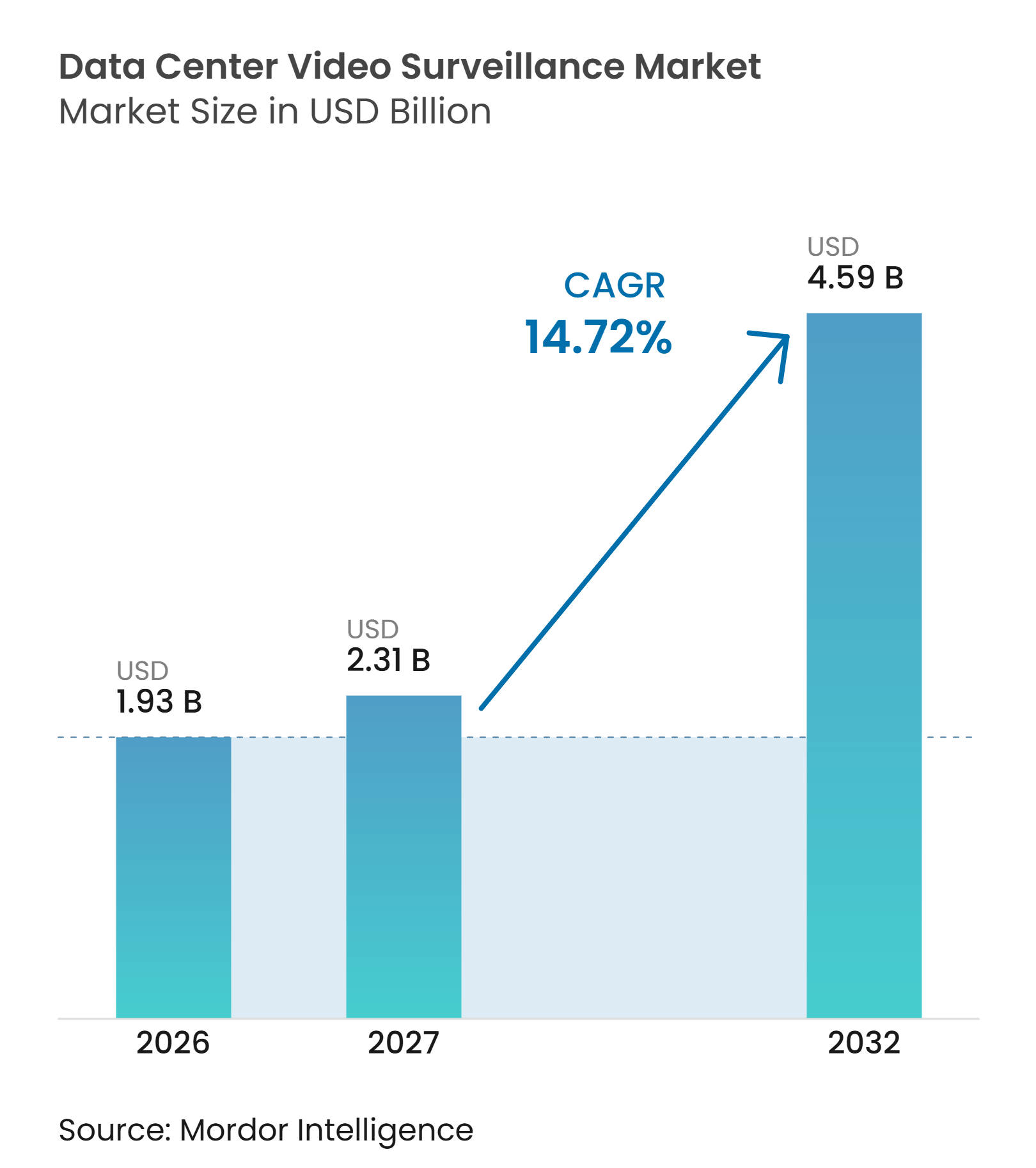
The data center video surveillance market size is projected to be USD 1.93 billion in 2026 and reach USD 4.59 billion by 2032, advancing at a CAGR of 14.72% from 2027 to 2032. Demand is tied to new hyperscale campuses, where large physical footprints require coverage across perimeters, entrances, data halls, and critical utility areas. AI-enabled analytics are shifting the value of surveillance systems from recording events to identifying operational and security exceptions in real time. Cloud-managed platforms are gaining attention because they support centralized administration, continuous logs, and access controls across multiple facilities. Compliance requirements also make retrieval, retention, and audit records more important in purchasing decisions. The data center video surveillance market is therefore moving toward integrated systems that combine cameras, software, storage, identity controls, and operational monitoring.
Key Report Takeaways
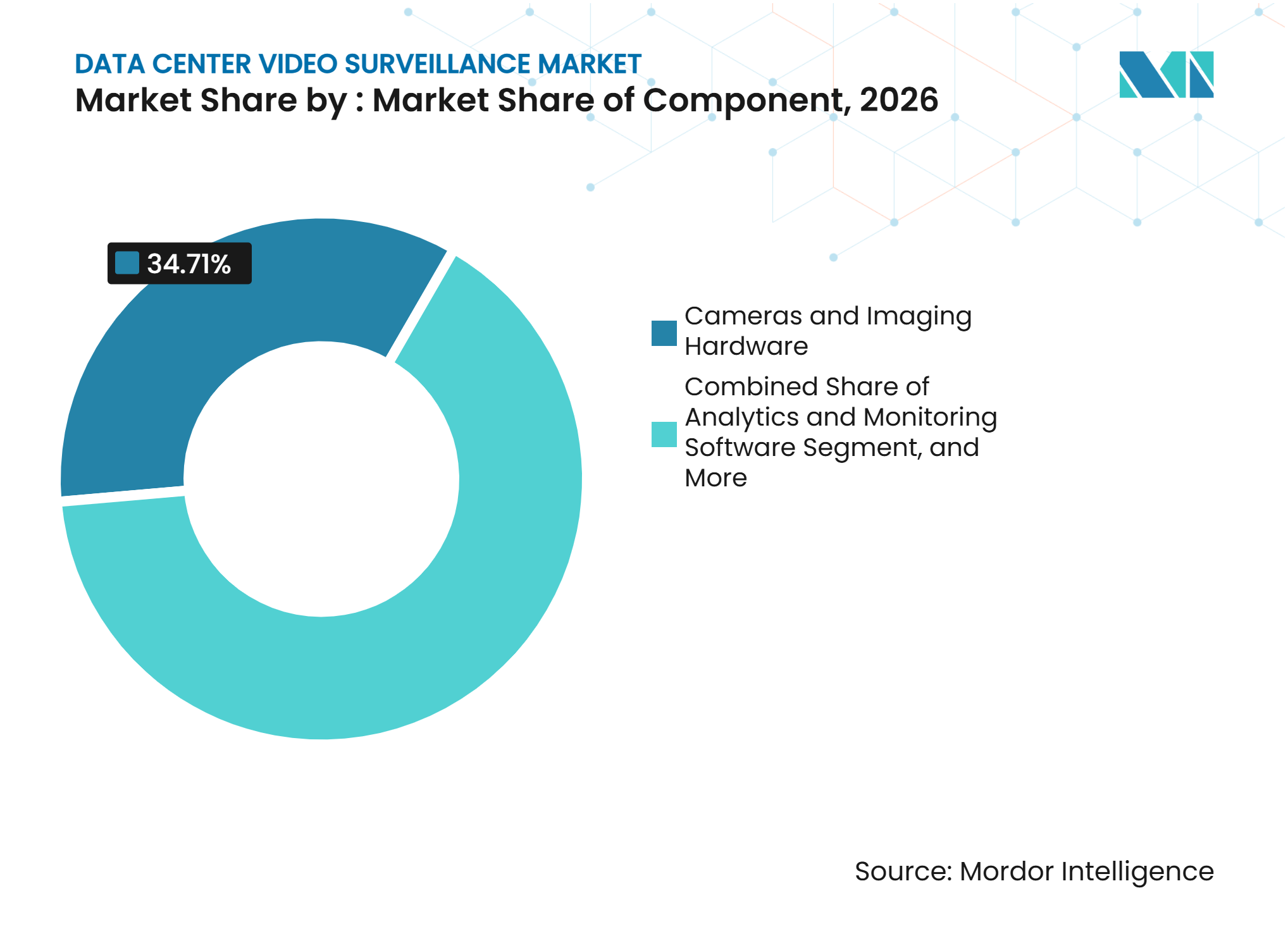
- By component, Cameras and Imaging Hardware held 34.71% of the data center video surveillance market share in 2026, while Analytics and Monitoring Software is projected to expand at a CAGR of 15.26% through 2032.
- By camera type, Fixed Cameras accounted for 63.28% of the data center video surveillance market share in 2026, while Pan-Tilt-Zoom Cameras are projected to expand at a CAGR of 15.92% through 2032.
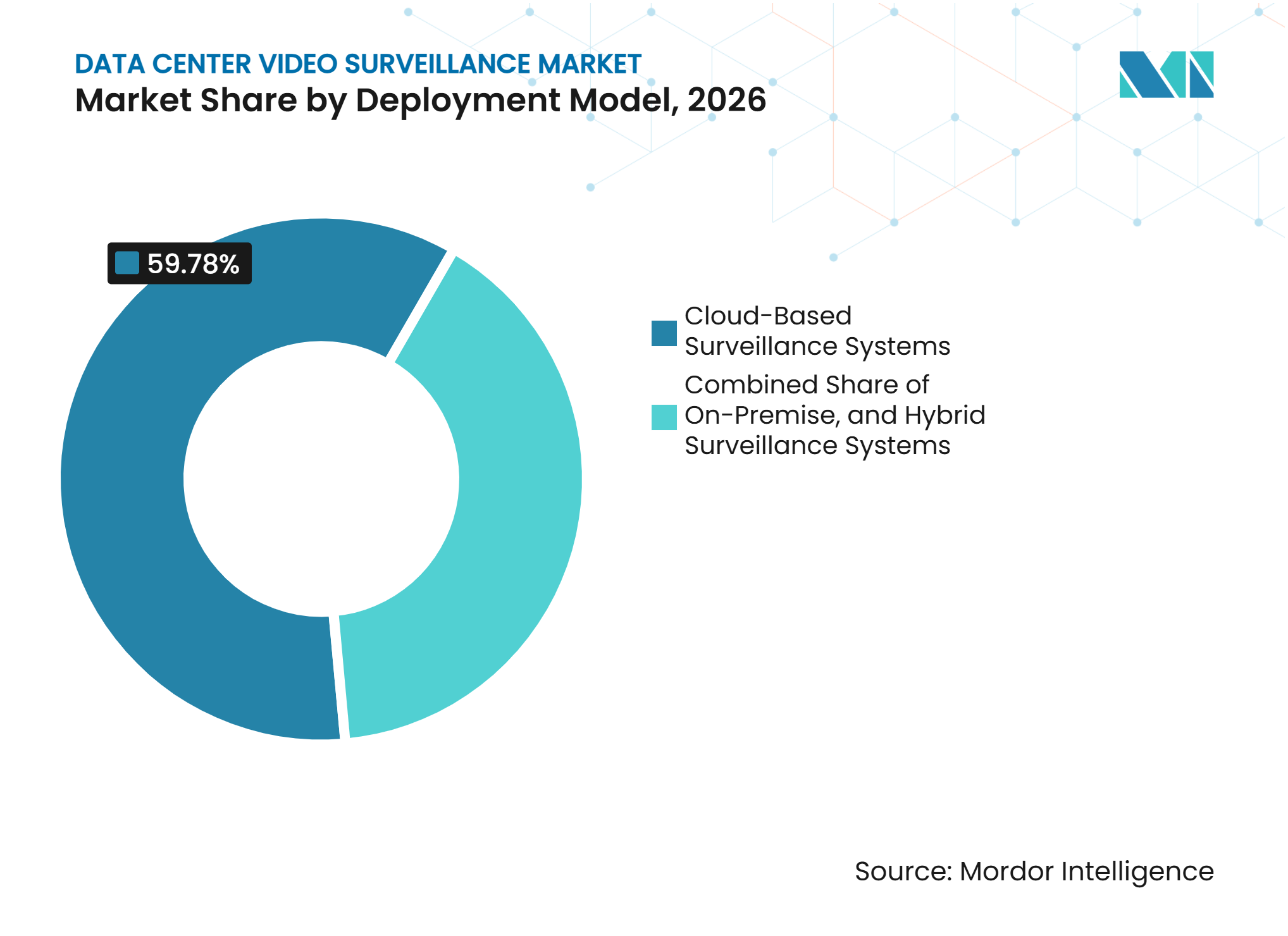
- By deployment model, Cloud-Based Surveillance Systems held 59.78% of the data center video surveillance market share in 2026 and are projected to expand at a CAGR of 17.39% through 2032.
- By application, Perimeter and External Area Monitoring accounted for 26.54% of the data center video surveillance market size in 2026, while Electrical and Mechanical Room Monitoring is projected to expand at a CAGR of 16.59% through 2032.
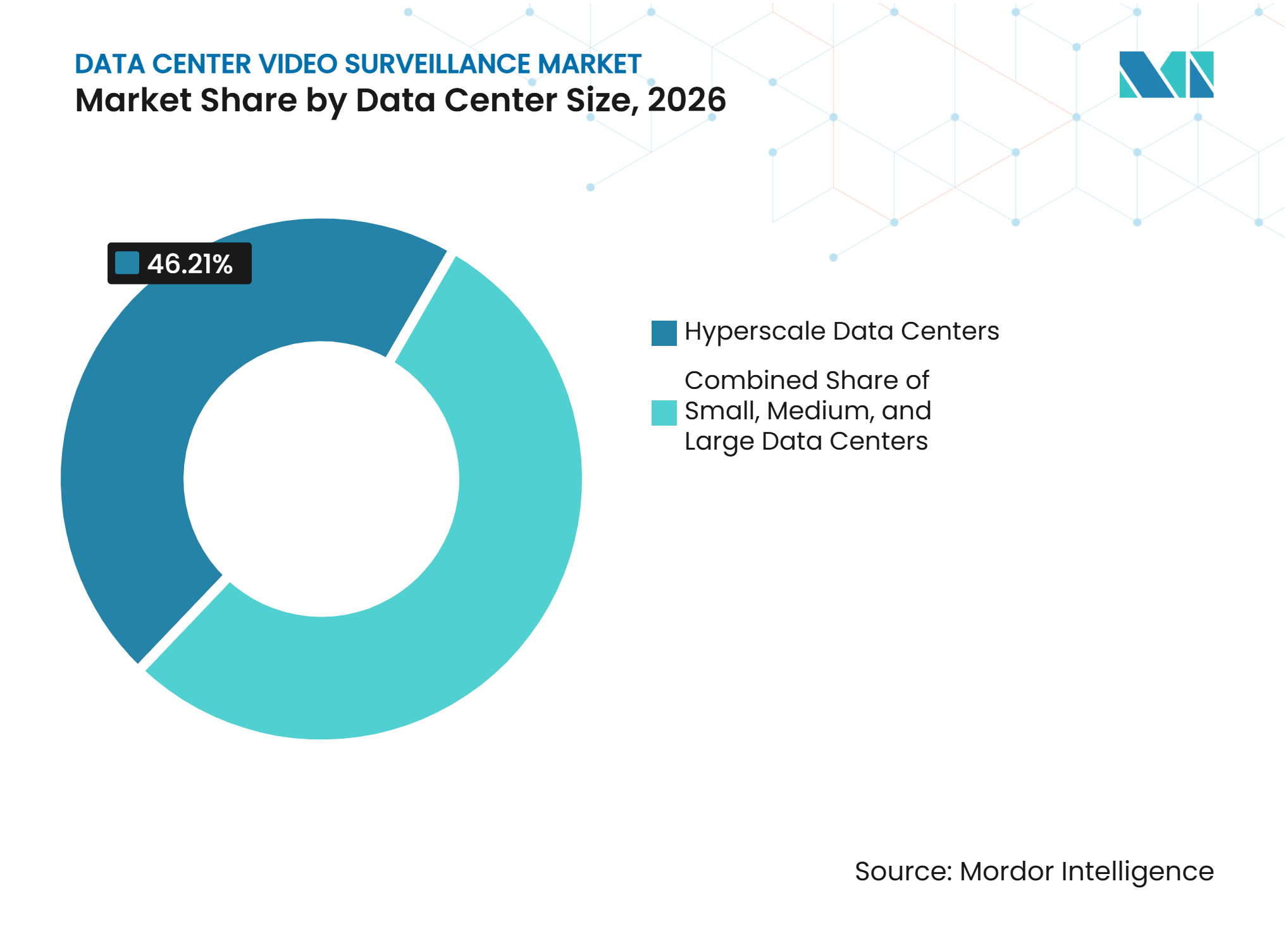
- By data center size, Hyperscale Facilities accounted for 46.21% of the data center video surveillance market size in 2026 and are projected to expand at a CAGR of 15.27% through 2032.
- By data center type, Colocation Facilities held 36.64% of the data center video surveillance market share in 2026, while Cloud Service Providers are projected to expand at a CAGR of 15.38% through 2032.
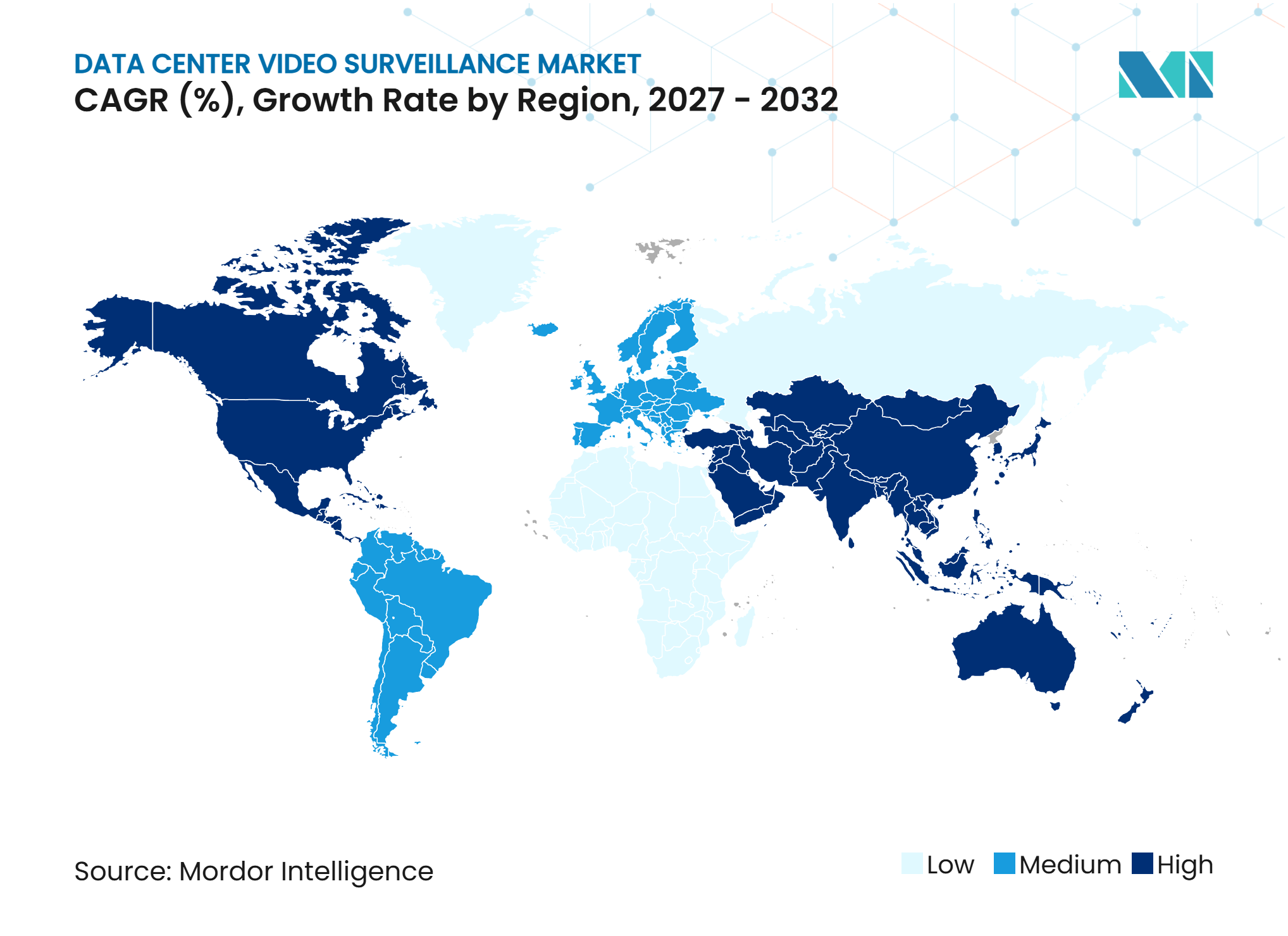
- By geography, North America accounted for 39.58% of the data center video surveillance market share in 2026, while Asia-Pacific is projected to expand at a CAGR of 16.91% through 2032.
Note: Market numbers in this report are based on Mordor Intelligence's proprietary estimation framework, which combines nine months of actuals with Q4 projections for base year 2026.
Market Trends and Insights
Drivers Impact Analysis of Data Center Video Surveillance Market*
| Driver | (~) % Impact on CAGR Forecast | Geographic Relevance | Impact Timeline |
|---|---|---|---|
| Hyperscale and Colocation Campus Expansion | +5.2% | Global, concentrated in North America and Asia-Pacific | Medium term (2-4 years) |
| AI Analytics Replacing Human-Only Video Monitoring | +3.8% | Global | Medium term (2-4 years) |
| Stricter Physical-Logical Security Convergence Requirements | +2.4% | North America and Europe | Medium term (2-4 years) |
| Compliance-Driven Evidence Retention and Auditability | +1.9% | North America, Europe, and Asia-Pacific | Long term (≥ 4 years) |
| Edge and Modular Data Center Proliferation | +1.4% | Global, with early gains in North America and Southeast Asia | Short term (≤ 2 years) |
| Video Telemetry for Operational Resilience and Safety | +0.8% | Global | Medium term (2-4 years) |
| Source: Mordor Intelligence | |||
Hyperscale and Colocation Campus Expansion
The expansion of hyperscale and colocation campuses is a central source of demand in the data center video surveillance market. IntelliSee reported 190 GW of announced hyperscale capacity across 777 projects globally in early 2026, including 21 GW under construction. Some developments cover more than 400 acres, requiring coverage across several perimeter layers, access roads, delivery zones, and buildings. The Security Industry Association reported that physical security specifications can trail construction activity, creating commissioning pressure as new facilities open.[1] Colocation operators also need tenant-specific camera zones and role-based viewing rights, which basic local systems may not provide. These requirements favor centrally managed video management systems that can scale as new halls and tenants are added.
AI Analytics Replacing Human-Only Video Monitoring
AI analytics are changing how operators assess the operating cost of surveillance in the data center video surveillance market. DEEPX presented a system at Yotta 2025 that supported more than 200 camera streams at less than 3.5 W per channel and reported up to 7x better efficiency than conventional GPU-server architectures.[2] Camera-edge processing can identify tailgating, extended dwell times, and unusual tool handling without placing all streams on centralized servers. This helps security teams focus on exceptions instead of reviewing routine video feeds. Better filtering can also reduce false alerts from changing light, weather, or nearby movement. The result is a clearer operational case for analytics licenses and camera upgrades in large facilities with limited monitoring staff.
Stricter Physical and Logical Security Convergence Requirements
Data center security is increasingly managed as a connected physical and digital risk environment. A 2025 study of 99 organizations identified shared identity frameworks, fusion centers, and unified analytics platforms as practices used in converged security programs.[3] This means cameras need to work with access-control records, while video management software needs interfaces that security operations teams can use with their existing tools. A unified event record can link a door access event, a video clip, and an alarm response. Providers with established integrations can avoid the time and cost of building separate middleware links. The data center video surveillance market benefits when surveillance footage is also used as an operational input rather than retained only for an audit.
Compliance-Driven Evidence Retention and Auditability
Audit obligations make reliable retention and retrieval capabilities an important consideration for video deployments. The Security Industry Association identifies compliance, auditability, and physical security planning as core issues for data center operators. Operators often need system logs and footage that can be located quickly for audit sampling or incident review. Cloud-managed systems can centralize access controls and produce consistent records across locations. Colocation sites face added complexity because different tenants may have different security and retention expectations. This supports hybrid designs that retain recent footage locally while archiving selected content in a controlled cloud environment.
Restraints Impact Analysis of Data Center Video Surveillance Market*
| Restraint | (~) % Impact on CAGR Forecast | Geographic Relevance | Impact Timeline |
|---|---|---|---|
| Legacy-System Retrofit Cost and Downtime | -1.8% | Global | Short term (≤ 2 years) |
| Privacy, Biometric Governance, and Data-Residency Constraints | -1.2% | North America, Europe, and Asia-Pacific core | Medium term (2-4 years) |
| Cybersecurity Exposure of Connected Cameras and VMS | -0.8% | Global | Short term (≤ 2 years) |
| Shortage of Multi-Vendor Integration and AI-Security Skills | -0.5% | Global | Medium term (2-4 years) |
| Source: Mordor Intelligence | |||
Legacy-System Retrofit Cost and Downtime
Legacy camera systems can slow replacement programs in the data center video surveillance market. Facilities built before 2018 may use analog or early IP equipment that needs encoder bridging or complete replacement before it can support AI-enabled cameras. Tier III and Tier IV sites cannot accept gaps in coverage at critical locations during a changeover. Each replacement may need a temporary feed and careful sequencing, which raises installation costs and lengthens project schedules. Colocation operators must also coordinate work with multiple tenants, adding notification and access requirements. In some cases, a legacy video management platform may prevent third-party stream access, leaving full platform replacement as the only workable option.
Privacy, Biometric Governance, and Data-Residency Constraints
Privacy rules can affect where and how advanced video capabilities are deployed. NPR reported that 23 U.S. states had passed or expanded laws restricting biometric data collection without consent as of August 2025. These rules can affect facial recognition used for access validation, depending on the law and its interpretation in each state. The Real Deal reported that Illinois biometric privacy risk redirected more than USD 100 billion in hyperscale investment to neighboring states, based on comments from JLL. Data-residency rules in Europe, Singapore, and Australia can also constrain the location of video storage and processing. Operators serving several jurisdictions may therefore require local recording, jurisdiction-specific retention policies, and more complex cloud architectures.
*Our forecasts treat driver/restraint impacts as directional, not additive. The impact forecasts reflect baseline growth, mix effects, and variable interactions.
Data Center Video Surveillance Market Segment Analysis
By Component:
Analytics Software Outpaces Hardware Revenue LeadershipCameras and Imaging Hardware held 34.71% of the data center video surveillance market share in 2026. This position reflects the large number of camera units needed at entry points, server aisles, corridors, perimeter lines, and utility rooms. Hardware demand rises with the physical footprint of a facility and with the number of separate access zones. Camera specifications also vary by lighting condition, coverage distance, and required level of detail. Operators usually combine fixed, PTZ, thermal, and low-light equipment rather than relying on one camera type. This creates continued demand for imaging hardware even as software takes a larger role in system value.
Analytics and Monitoring Software is projected to expand at a CAGR of 15.26% through 2032. The segment benefits from AI inference moving closer to the camera, which allows alerts to be created at the edge rather than after footage reaches a central server. Software supports event classification, incident search, user permissions, and multi-site monitoring. It can also package compliance reports and link footage with access-control events. Video Management Software remains important for federation across multiple sites and for tenant-specific access rights. Storage, recording equipment, installation, integration, and support services continue to support deployments because large sites require tuning, migration, API integration, and ongoing maintenance.



By Camera Type:
PTZ Cameras Accelerate Against Fixed Infrastructure LeadFixed Cameras accounted for 63.28% of the data center video surveillance market share in 2026. They are well suited to stable coverage zones such as server aisles, mantrap corridors, doors, and defined access points. Their lower cost and simple setup support high-volume deployment across a facility. Fixed devices provide consistent views that can be used for investigations and routine audit reviews. They are also useful where camera positions can be designed into a new building before construction is complete. These attributes keep fixed units important in both new facilities and upgrade projects.
Pan-Tilt-Zoom Cameras are projected to expand at a CAGR of 15.92% through 2032. PTZ units can follow events across broad exterior areas and can reduce the number of cameras needed for selected perimeter locations. This is particularly useful at large campuses where fixed-only coverage would require a very high camera count. Thermal cameras are also finding wider use in electrical and mechanical rooms because they combine temperature monitoring with physical security observation. Low-Light and Infrared Cameras serve loading bays, parking areas, and other locations where lighting conditions may be inconsistent. The data center video surveillance market therefore uses camera types based on the operational purpose of each area rather than a single equipment standard.
By Deployment Model:
Cloud Architecture Leads in Share and Growth SimultaneouslyCloud-Based Surveillance Systems accounted for 59.78% of the data center video surveillance market size in 2026. Their lead reflects the value of centralized administration across sites, tenants, and security teams. Cloud platforms can support remote access, role-based permissions, search functions, and system health monitoring through one interface. They also allow organizations to add locations without building a separate local operations center at every site. These capabilities are relevant to distributed data center portfolios and unmanned edge facilities. They are particularly useful where operators need continuous records for compliance reviews.
Cloud-Based Surveillance Systems are projected to expand at a CAGR of 17.39% through 2032. On-Premise Surveillance Systems remain necessary for some facilities where data sovereignty or internal security policies limit external processing. Hybrid Surveillance Systems bridge these needs by recording near the source while using cloud services for longer retention and central management. This approach can help sites manage network latency and maintain access during connectivity disruptions. Connected systems still need strong security controls because cloud integration creates additional attack surfaces. CISA issued an advisory in October 2025 for CloudEdge Online Cameras and App that described a hard-coded credential vulnerability with a CVSS v4 score of 8.7.

By Application:
Electrical Room Monitoring Closes the Gap on Perimeter DominancePerimeter and External Area Monitoring held 26.54% of the data center video surveillance market size in 2026. It provides the first layer of observation around fences, gates, roads, loading areas, and building approaches. These zones often cover the largest physical areas and require combinations of fixed, PTZ, thermal, and radar-supported equipment. Perimeter coverage also supports early event detection before a person reaches a controlled entry point. New campuses require temporary construction-phase coverage before permanent systems are commissioned. This application remains fundamental because it protects both ongoing operations and high-value equipment delivered during construction.
Electrical and Mechanical Room Monitoring is projected to expand at a CAGR of 16.59% through 2032. Higher-density AI computing environments raise the importance of watching cooling and electrical systems that support server operations. Bi-spectral cameras can provide a visible image and temperature-related data through the same device. This gives operators a security view and an operational signal without requiring a separate camera network. Entrance and Access Point Monitoring remains steady because personnel and vendor movements must be recorded. Data Hall, Internal Corridor, Loading Bay, Delivery Area, Remote Site, and Campus Monitoring will also benefit as campus footprints and modular deployments expand.
By Data Center Size:
Hyperscale Concentration Commands the Market in Share and GrowthHyperscale Facilities accounted for 46.21% of the data center video surveillance market size in 2026. Their scale creates a large surveillance requirement across extensive land, multiple structures, utility yards, and secure internal areas. The facilities carry valuable computing, electrical, cooling, and network assets that need continuous protection. IntelliSee projected hyperscale construction costs at USD 11.3 million per MW in 2026. This cost base can make a well-designed security system a comparatively small element of the protected asset value. Hyperscale operators can also standardize equipment and software across repeated campus designs.
Hyperscale Facilities are projected to expand at a CAGR of 15.27% through 2032. Large facilities in the 10 MW to 100 MW range also contribute demand as enterprises improve surveillance systems before colocation audits and subleasing arrangements. Medium and small data centers are more likely to replace older equipment to meet compliance or operational requirements. They may face higher integration cost per protected area because they lack hyperscale purchasing scale. At the same time, they may have complex multi-vendor environments that cannot be replaced quickly. The data center video surveillance market therefore has demand from both large greenfield projects and smaller upgrade cycles.
By Data Center Type:
CSPs Drive Fastest Growth as Colocation Anchors Market ShareColocation Facilities held 36.64% of the data center video surveillance market share in 2026. They have established campus footprints and must meet the physical security expectations included in customer service agreements. A colocation provider needs to protect shared areas while separating access and viewing rights for different tenants. This can require partitioned camera zones, fine-grained permissions, and detailed audit trails. Facility operators also need to coordinate security operations with customer-specific requirements. These needs make colocation a substantial and technically demanding part of the data center video surveillance market.
Cloud Service Providers are projected to expand at a CAGR of 15.38% through 2032. Their growth is associated with continued construction of provider-owned facilities and the wider deployment of cloud and AI workloads. CBRE indicated that aggregate hyperscaler capital expenditure could exceed USD 400 billion in 2026. Enterprise facilities range from highly regulated environments to sites that begin with minimal coverage and upgrade after audit findings. Edge Data Centers need a distinct approach because they are distributed, often unmanned, and frequently located away from central security teams. Remote cloud dashboards and preconfigured systems are valuable in these locations because there may be no onsite operations center.
Geography Analysis
North America
North America accounted for 39.58% of the data center video surveillance market share in 2026. Demand is concentrated in Northern Virginia, Phoenix, Silicon Valley, and Dallas-Fort Worth, where hyperscale and colocation development is extensive. Construction activity creates a requirement for temporary site protection and permanent surveillance at commissioning. LandSky AI reported USD 77.7 billion in U.S. data center construction starts during 2025 and USD 88 billion in planned groundbreakings for the first half of 2026. Canada and Mexico add regional demand through new colocation facilities. Canadian data sovereignty requirements can influence cloud video architecture when footage would otherwise be stored outside the country.
Asia-Pacific
Asia-Pacific is projected to expand at a CAGR of 16.91% through 2032. Australia, Japan, Singapore, India, and Southeast Asia are key locations for new capacity and associated security deployments. Cushman and Wakefield reported an Asia-Pacific data center pipeline of 26,455 MW in the first half of 2026, while vacancy declined from 10.9% in the second half of 2025 to 10.3%. Singapore added 2 new development tranches totaling 1.2 GW, while Malaysia and Thailand are attracting broader capacity requirements. Australia’s government security framework establishes a layered physical security baseline for some operators. Japan’s power constraints are also encouraging expansion into regional cities, which increases the need for remote system management.
Europe, and Middle East and Africa
Europe has meaningful demand in Germany, the United Kingdom, and France. General Data Protection Regulation requirements can influence where footage is retained and processed, especially for colocation providers serving customers in more than 1 jurisdiction. Hybrid local-recording designs can therefore be important for cross-border operators. The Middle East and Africa is advancing through greenfield facilities in the United Arab Emirates and Saudi Arabia, supported by national digital infrastructure programs. South America, led by Brazil and Argentina, remains an emerging area as global cloud providers build local infrastructure. Its scale remains below the leading regions, but each new campus creates initial demand for perimeter, access, and internal surveillance.
Competitive Landscape
Market Concentration
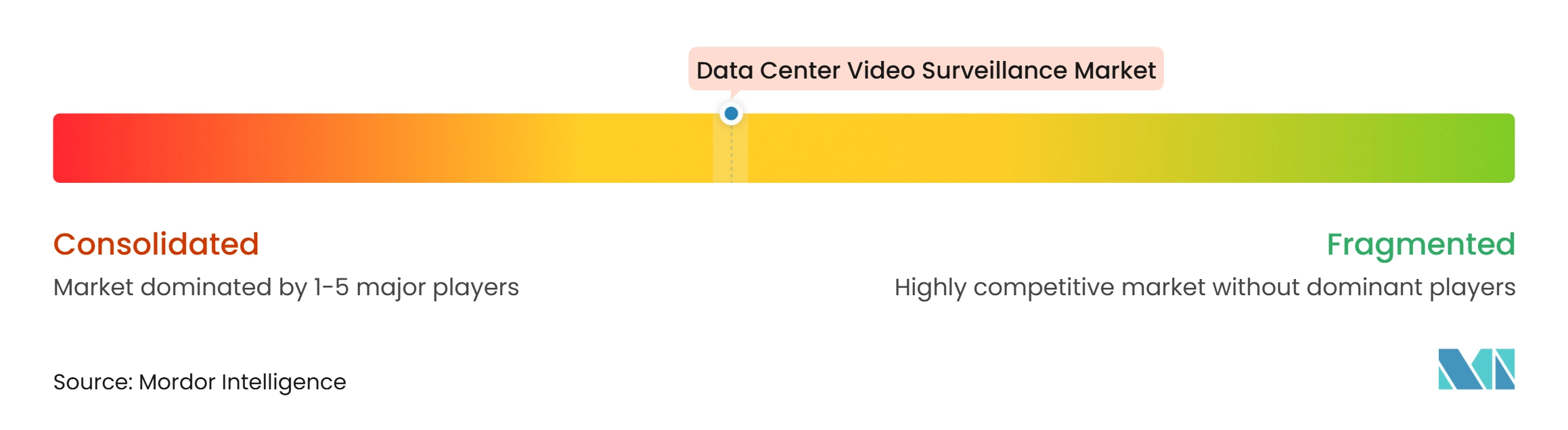
The data center video surveillance market is moderately fragmented across camera manufacturers, cloud video management providers, analytics specialists, and systems integrators. Hardware-focused participants are adding AI inference to camera system-on-chips to maintain differentiation as basic imaging equipment becomes more standardized. Software-led providers compete through multi-site federation, audit tools, application programming interfaces, and identity integrations. This makes the value proposition broader than camera supply alone. Buyers increasingly evaluate how well a platform works with access control, incident response, and their wider security operations environment. Vendor security practices have also become an important selection factor as connected devices have been targeted by disclosed vulnerabilities.
Motorola Solutions acquired Blue Eye in November 2025, adding AI-powered enterprise remote video monitoring services and 24-hour security operations center capabilities to its broader portfolio. Honeywell signed a 10-year global distribution agreement with Milestone Systems in April 2025, extending a partnership around access control and video management system integration. Axis Communications introduced private cellular deployment equipment, a global-shutter camera, and a bispectral camera at ISC West 2026. These moves show how providers are expanding beyond individual devices toward connected video, access control, remote operations, and specialized imaging capabilities.
Claroty disclosed 4 pre-authentication remote code execution vulnerabilities in Axis Device Manager in August 2025 and identified 6,500 exposed servers globally. This has increased the importance of vulnerability management, secure configuration, and published security performance in procurement decisions. A gap remains in the sub-100 MW enterprise tier, where hyperscale-level integrated systems may be excessive while small-site products lack needed audit and workflow features. Suppliers that can provide compliance-ready tools without excessive deployment complexity may be well placed in this part of the data center video surveillance market. The available information does not provide combined shares for leading firms, so a precise concentration measure based on those shares cannot be calculated. Competitive activity is instead characterized by differentiated technology, partnerships, and integration capability.
Data Center Video Surveillance Industry Leaders
-
Axis Communications AB
-
Hangzhou Hikvision Digital Technology Co., Ltd.
-
Bosch Sicherheitssysteme GmbH
-
Hanwha Vision Co., Ltd.
-
Motorola Solutions, Inc.
- *Disclaimer: Major Players sorted in no particular order
Data Center Video Surveillance Market Companies Covered in this Report
- Axis Communications AB
- Hangzhou Hikvision Digital Technology Co., Ltd.
- Bosch Sicherheitssysteme GmbH
- Hanwha Vision Co., Ltd.
- Motorola Solutions, Inc.
- Johnson Controls International plc
- Honeywell International Inc.
- Genetec Inc.
- Milestone Systems A/S
- Verkada Inc.
- Eagle Eye Networks, Inc.
- Cisco Systems, Inc.
- NVIDIA Corporation
- Schneider Electric SE
- Securitas Technology AB
- Convergint Technologies LLC
- ASSA ABLOY AB
- i-PRO Co., Ltd.
- Zhejiang Dahua Technology Co., Ltd.
- Canon Inc.
- Teledyne FLIR LLC
- MOBOTIX AG
- VIVOTEK Inc.
- Zhejiang Uniview Technologies Co., Ltd.
Recent Industry Developments in Data Center Video Surveillance Market
- October 2026: Truelink Capital signed a definitive agreement to acquire Johnson Controls' Global Intrusion Products Business, encompassing the DSC, Qolsys, PowerG, Visonic, and Bentel brands of intrusion panels, sensors, and alarm communications products. Pending regulatory approval and expected to close in H1 2027, the transaction signals that Johnson Controls is concentrating its security strategy around integrated access control, VMS, and building intelligence, directly shaping competitive boundaries for its Exacq VMS and Illustra camera lines.
- March 2026: Axis Communications unveiled a suite of unified security innovations at ISC West 2026, including the AXIS TP3604-E Private Cellular Back Box enabling camera deployment over enterprise private cellular networks without traditional cabling, the AXIS P1486-LE global-shutter camera, and the AXIS Q2802-E bispectral camera combining 640×480 thermal and 4K visual sensors for concurrent perimeter intrusion detection and temperature monitoring.
- March 2026: Schneider Electric and NVIDIA announced validated blueprints for designing, simulating, and operating gigawatt-scale AI factories, integrating AVEVA digital twin architecture in NVIDIA Omniverse and testing NVIDIA Nemotron agentic AI for data center alarm management. The collaboration positions video and environmental telemetry as inputs to unified AI-driven operational management for next-generation data center infrastructure.
- November 2025: Motorola Solutions acquired Blue Eye, a Salt Lake City-based provider of AI-powered enterprise remote video monitoring services, with Blue Eye operating 24-hour security operations centers delivering threat detection, live voice deterrence, and verified law-enforcement alerts interoperable with leading cameras and VMS platforms. Terms were not disclosed.
Global Data Center Video Surveillance Market Report Scope
The Data Center Video Surveillance Market encompasses technologies and services that enable visual security, monitoring, and surveillance of data center facilities. It includes solutions designed to enhance physical security, detect unauthorized activities, support incident response, and provide real-time operational visibility across critical infrastructure environments. The market is driven by increasing concerns over facility protection, asset security, business continuity, and the growing adoption of intelligent surveillance systems with advanced monitoring and analytics capabilities.
The Data Center Video Surveillance Market is Segmented by Component (Cameras and Imaging Hardware, Video Management Software, Storage and Recording Hardware, Analytics and Monitoring Software, and Installation, Integration, and Support Services), Camera Type (Fixed Cameras, Pan-Tilt-Zoom Cameras, Thermal Cameras, and Specialized Low-Light and Infrared Cameras), Deployment (On-Premise Surveillance Systems, Cloud-Based Surveillance Systems, and Hybrid Surveillance Systems), Application (Perimeter and External Area Monitoring, Entrance and Access Point Monitoring, Data Hall and Internal Corridor Monitoring, Electrical and Mechanical Room Monitoring, Loading Bay and Delivery Area Monitoring, and Remote Site and Campus Monitoring), Size (Small, Medium, Large, Hyperscale), Data Center Type (Colocation, Cloud Service Provider(CSPs), Enterprise / Edge, and Edge Data Centers), and Geography (North America, South America, Europe, Asia-Pacific, Middle East, and Africa). The Market Forecasts are Provided in Terms of Value (USD).
Segmentation Overview
| Cameras and Imaging Hardware |
| Video Management Software |
| Storage and Recording Hardware |
| Analytics and Monitoring Software |
| Installation, Integration, and Support Services |
| Fixed Cameras |
| Pan-Tilt-Zoom Cameras |
| Thermal Cameras |
| Specialized Low-Light and Infrared Cameras |
| On-Premise Surveillance Systems |
| Cloud-Based Surveillance Systems |
| Hybrid Surveillance Systems |
| Perimeter and External Area Monitoring |
| Entrance and Access Point Monitoring |
| Data Hall and Internal Corridor Monitoring |
| Electrical and Mechanical Room Monitoring |
| Loading Bay and Delivery Area Monitoring |
| Remote Site and Campus Monitoring |
| Small |
| Medium |
| Large |
| Hyperscale |
| Colocation |
| Cloud Service Provider(CSPs) |
| Enterprise / Edge |
| Edge Data Centers |
| North America | United States | |
| Canada | ||
| Mexico | ||
| South America | Brazil | |
| Argentina | ||
| Rest of South America | ||
| Europe | Germany | |
| United Kingdom | ||
| France | ||
| Italy | ||
| Rest of Europe | ||
| Asia-Pacific | China | |
| Japan | ||
| India | ||
| Singapore | ||
| Rest of Asia-Pacific | ||
| Middle East and Africa | Middle East | United Arab Emirates |
| Saudi Arabia | ||
| Turkey | ||
| Rest of Middle East | ||
| Africa | South Africa | |
| Nigeria | ||
| Rest of Africa | ||
| By Component | Cameras and Imaging Hardware | ||
| Video Management Software | |||
| Storage and Recording Hardware | |||
| Analytics and Monitoring Software | |||
| Installation, Integration, and Support Services | |||
| By Camera Type | Fixed Cameras | ||
| Pan-Tilt-Zoom Cameras | |||
| Thermal Cameras | |||
| Specialized Low-Light and Infrared Cameras | |||
| By Deployment Model | On-Premise Surveillance Systems | ||
| Cloud-Based Surveillance Systems | |||
| Hybrid Surveillance Systems | |||
| By Application | Perimeter and External Area Monitoring | ||
| Entrance and Access Point Monitoring | |||
| Data Hall and Internal Corridor Monitoring | |||
| Electrical and Mechanical Room Monitoring | |||
| Loading Bay and Delivery Area Monitoring | |||
| Remote Site and Campus Monitoring | |||
| By Data Center Size | Small | ||
| Medium | |||
| Large | |||
| Hyperscale | |||
| By Data Center Type | Colocation | ||
| Cloud Service Provider(CSPs) | |||
| Enterprise / Edge | |||
| Edge Data Centers | |||
| By Geography | North America | United States | |
| Canada | |||
| Mexico | |||
| South America | Brazil | ||
| Argentina | |||
| Rest of South America | |||
| Europe | Germany | ||
| United Kingdom | |||
| France | |||
| Italy | |||
| Rest of Europe | |||
| Asia-Pacific | China | ||
| Japan | |||
| India | |||
| Singapore | |||
| Rest of Asia-Pacific | |||
| Middle East and Africa | Middle East | United Arab Emirates | |
| Saudi Arabia | |||
| Turkey | |||
| Rest of Middle East | |||
| Africa | South Africa | ||
| Nigeria | |||
| Rest of Africa | |||
Key Questions Answered in the Report
What is the data center video surveillance market size?
The data center video surveillance market size is projected to be USD 1.93 billion in 2026 and reach USD 4.59 billion by 2032, at a CAGR of 14.72% from 2027 to 2032.
Which component leads data center video surveillance spending?
Cameras and Imaging Hardware leads with a 34.71% share in 2026, while Analytics and Monitoring Software is projected to expand at a CAGR of 15.26% through 2032.
Why are cloud-based surveillance systems used in data centers?
Cloud-based systems held 59.78% share in 2026 because they centralize administration, access controls, search, system monitoring, and multi-site video operations.
What application is expanding fastest in data center video surveillance?
Electrical and Mechanical Room Monitoring is projected to expand at a CAGR of 16.59% through 2032, supported by requirements to observe cooling and electrical infrastructure.
Which region is expanding fastest for data center video surveillance?
Asia-Pacific is projected to expand at a CAGR of 16.91% through 2032, supported by capacity additions in Australia, Japan, Singapore, India, and Southeast Asia.
What challenges affect data center video surveillance deployments?
Key challenges include legacy-system retrofit costs, biometric and data-residency rules, cybersecurity risks in connected devices, and shortages of integration skills.