
Data Center Transformer Market Size and Share
Market Overview
| Study Period | 2021 - 2032 |
|---|---|
| Market Size (2027) | USD 8.92 Billion |
| Market Size (2032) | USD 12.87 Billion |
| Growth Rate (2027 - 2032) | 7.61 % |
| Fastest Growing Market | Asia-Pacific |
| Largest Market | North America |
| Market Concentration | Medium |
Major Players *Disclaimer: Major Players sorted in no particular order Image © Mordor Intelligence. Reuse requires attribution under CC BY 4.0. | |
Data Center Transformer Market Analysis by Mordor Intelligence
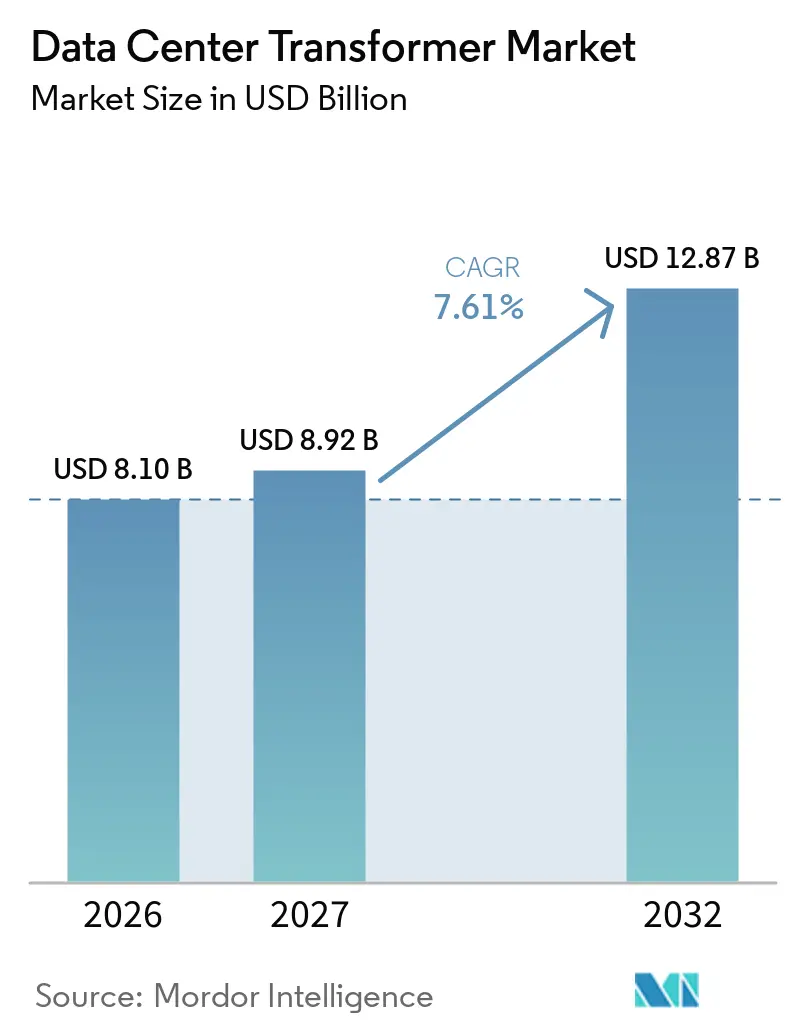
The data center transformer market size is projected to be USD 8.10 billion in 2026, USD 8.92 billion in 2027, and reach USD 12.87 billion by 2032, growing at a CAGR of 7.61% from 2027 to 2032. The data center transformer market is supported by rising AI computing loads, larger cloud campuses, and a shift toward higher-voltage grid connections. These conditions are extending procurement cycles because critical transformer equipment is often ordered well before construction begins. Suppliers are responding through capacity additions, acquisitions, and regional manufacturing investments. The data center transformer market also benefits from tighter efficiency rules that encourage replacement of older equipment, while raw-material costs and long delivery periods remain material constraints.
Key Report Takeaways
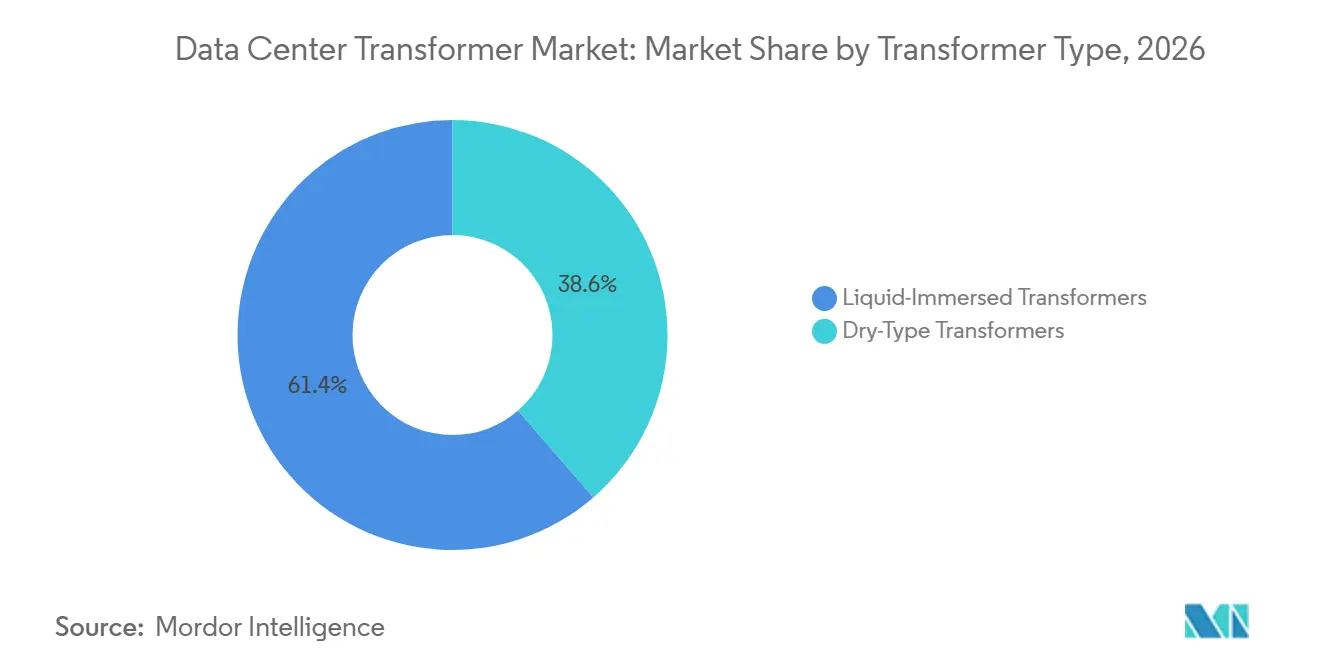
- By transformer type, liquid-immersed transformers held 61.37% of the data center transformer market share in 2026, while dry-type transformers are projected to expand at an 8.57% CAGR through 2032.
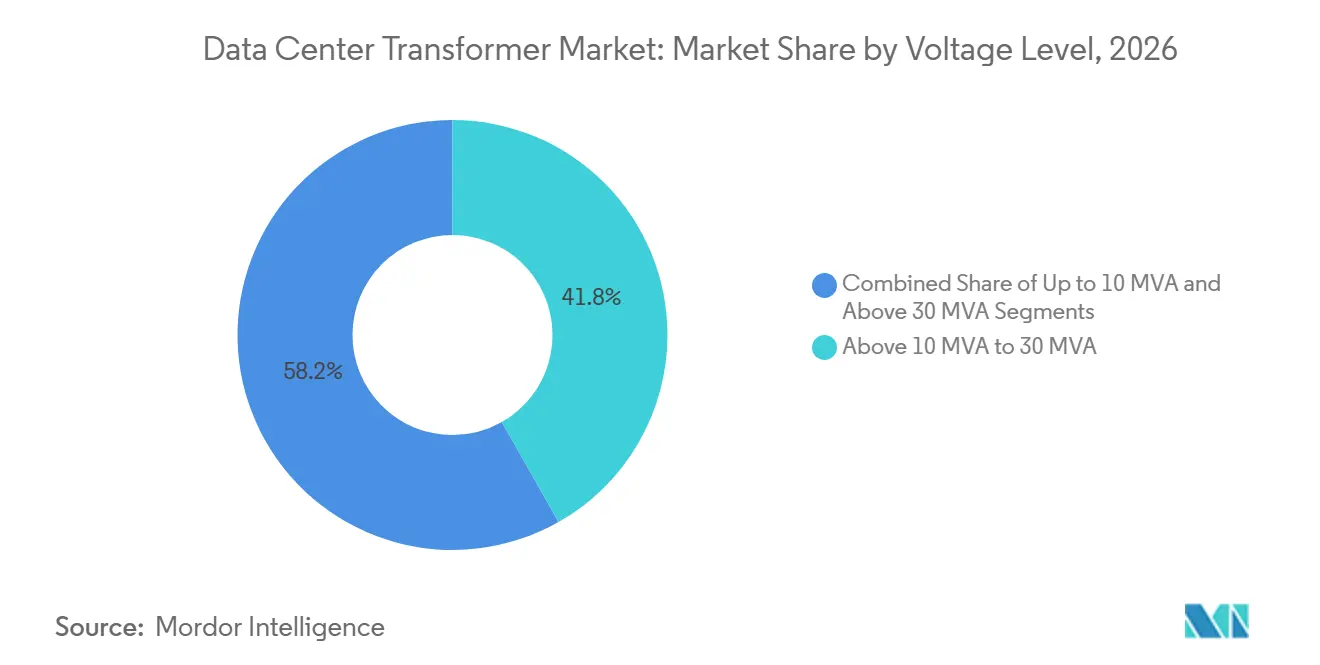
- By power rating, the 10-30 MVA segment accounted for 41.79% of the data center transformer market size in 2026, while the above-30 MVA segment is forecast to advance at a 9.12% CAGR through 2032.
- By voltage level, medium-voltage transformers held 60.41% revenue share in 2026, while high-voltage transformers are projected to expand at an 8.85% CAGR through 2032.
- By installation, outdoor configurations accounted for 64.29% revenue share in 2026, while indoor configurations are forecast to expand at an 8.43% CAGR through 2032.
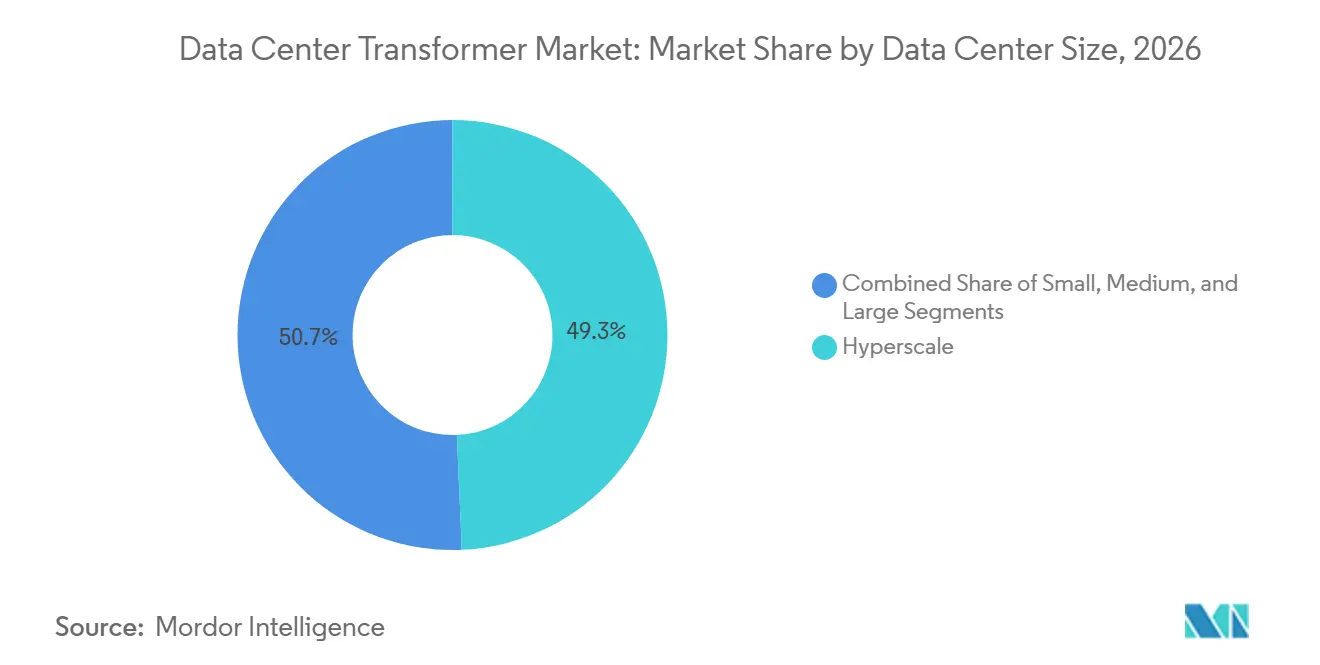
- By data center size, hyperscale facilities held 49.31% revenue share in 2026 and are projected to expand at an 8.78% CAGR through 2032.
- By data center type, colocation providers accounted for 46.57% revenue share in 2026, while cloud service providers are forecast to advance at a 9.10% CAGR through 2032.
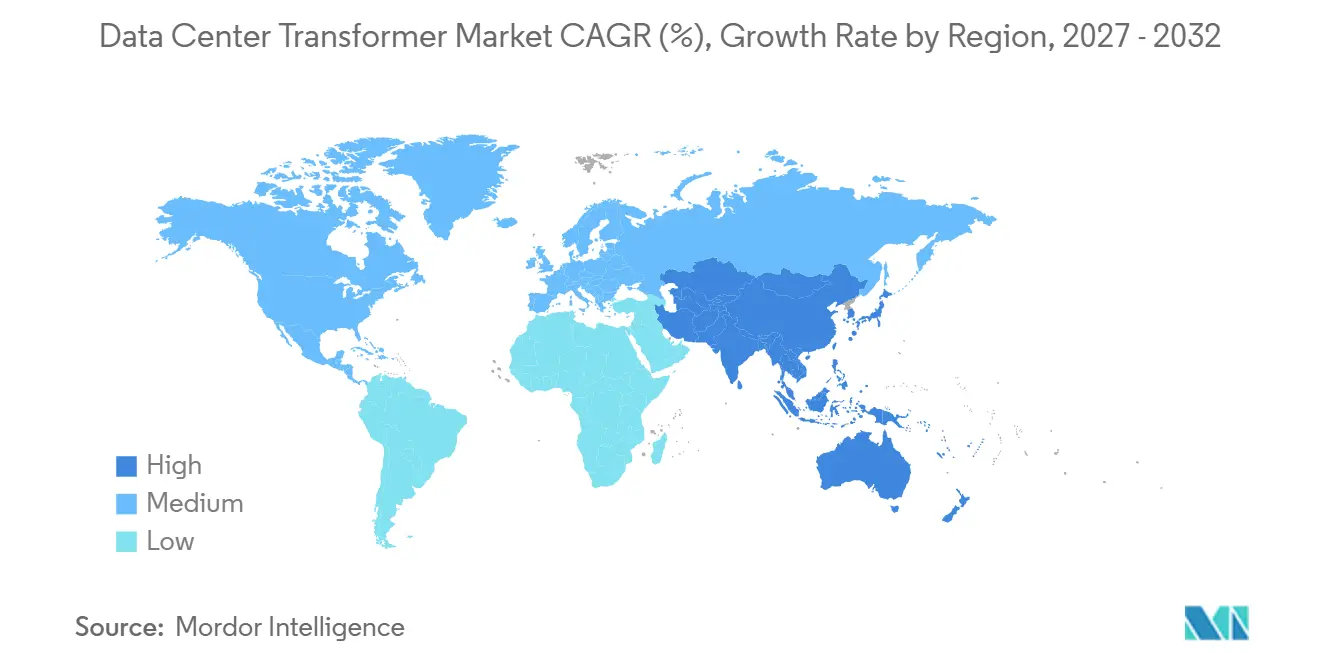
- By geography, North America held 37.62% of the data center transformer market share in 2026, while Asia-Pacific is projected to expand at a 9.21% CAGR through 2032.
Note: Market numbers in this report are based on Mordor Intelligence's proprietary estimation framework, which combines nine months of actuals with Q4 projections for base year 2026.
Market Trends and Insights
Drivers Impact Analysis of Data Center Transformer Market*
| Driver | (~) % Impact on CAGR Forecast | Geographic Relevance | Impact Timeline |
|---|---|---|---|
| AI and High-Performance Computing Capacity Expansion | +2.3% | Global, concentrated in North America and Asia-Pacific | Short term (≤ 2 years) |
| Hyperscale and Cloud Data Center Build-Out | +1.8% | North America and Asia-Pacific core, with spillover to Europe and the Middle East and Africa | Short term (≤ 2 years) |
| Rising Medium- and High-Voltage Grid Connection Requirements | +1.0% | Global, led by the United States, Germany, and Saudi Arabia | Medium term (2-4 years) |
| Energy-Efficiency Standards and Transformer Replacement Demand | +0.7% | North America, the European Union, and China | Medium term (2-4 years) |
| Digital Monitoring and Predictive Maintenance Adoption | +0.5% | Global, led by North America and Europe | Long term (≥ 4 years) |
| Factory-Standardized Power Modules for Faster Data Center Deployment | +0.4% | North America and Asia-Pacific | Medium term (2-4 years) |
| Source: Mordor Intelligence | |||
AI and High-Performance Computing Capacity Expansion
AI training and inference workloads are concentrating demand in large campuses with unusually high rack power requirements. This concentration is raising transformer specifications for thermal performance, harmonic management, and repeated load changes. NVIDIA’s GB200 NVL72 rack has a power draw above 120 kW, compared with the historical 6-8 kW range cited for conventional server racks in the supplied material. Higher-density facilities require closer coordination between transformer design, protection systems, and cooling infrastructure. The data center transformer market is therefore moving toward equipment selected for demanding operating profiles instead of standard building loads. NEMA’s data center transformer guidance addresses inrush-current coordination and harmonic loading, both of which are central to these designs.
Hyperscale and Cloud Data Center Build-Out
Large cloud and colocation projects create a longer and more visible order pipeline for transformer suppliers. The build-out is also spreading across regions with different grid codes, voltage standards, and interconnection practices. That diversity makes local engineering support and regulatory familiarity important during procurement. It also creates room for regional suppliers that can secure approvals faster than manufacturers with constrained order books. The data center transformer market benefits when projects standardize equipment packages, but local grid conditions still require site-specific adaptation. Hitachi Energy has identified data centers as a primary catalyst for U.S. grid infrastructure demand and its domestic manufacturing expansion.
Rising Medium- and High-Voltage Grid Connection Requirements
Very large campuses increasingly need dedicated utility connections rather than conventional distribution-level supply. This change increases demand for transformers capable of operating at transmission and sub-transmission voltage levels. LS ELECTRIC secured a KRW 459.8 billion (USD 312.04 million) contract in November 2025 to supply transformers up to 525 kV for a U.S. renewable-energy-to-data-center project.[1] IREN accepted delivery of a 345 kV/138 kV bulk substation transformer for its Childress, Texas, AI data center in July 2025.[2] Such projects make factory testing, grid-code compliance, and utility qualification central parts of the buying decision. The data center transformer market is consequently placing greater value on suppliers that already hold proven high-voltage references.
Energy-Efficiency Standards and Transformer Replacement Demand
Efficiency standards are adding replacement demand alongside new data center construction. The U.S. Department of Energy requires compliance with updated distribution-transformer standards by April 23, 2029. The final rule sets lower loss limits for low-voltage dry-type and common liquid-immersed transformer configurations. China’s GB 20052-2024 standard took effect on February 1, 2025, and tightened minimum efficiency grades for power transformers. ASHRAE Standard 90.4-2025 also accounts for electrical losses in data center energy performance
Restraints Impact Analysis of Data Center Transformer Market*
| Restraint | (~) % Impact on CAGR Forecast | Geographic Relevance | Impact Timeline |
|---|---|---|---|
| Electrical Steel and Copper Supply Constraints | -1.3% | Global, most acute in North America | Short term (≤ 2 years) |
| High Transformer Manufacturing and Installation Costs | -0.9% | Global, concentrated in North America and Europe | Medium term (2-4 years) |
| Transformer Qualification and Long Delivery Lead Times | -0.7% | Global, most acute in North America and Europe | Short term (≤ 2 years) |
| AI Load Ramp Transients and Harmonic Stress on Transformer Designs | -0.3% | Global, concentrated at AI-intensive data centers | Long term (≥ 4 years) |
| Source: Mordor Intelligence | |||
Electrical Steel and Copper Supply Constraints
Grain-oriented electrical steel and copper remain important limits on transformer production. The supplied material states that Section 232 tariffs on steel imports rose to 50% from August 15, 2025, while a 50% copper tariff also took effect in August 2025. The Congressional Research Service documents policy and supply considerations affecting U.S. distribution transformers. Higher input costs raise contract risk for manufacturers whose orders were priced before the changes. Supply concentration also exposes buyers to import disruption and limits the availability of high-grade materials. These conditions can delay delivery schedules for the data center transformer market, particularly where large units need specialized electrical steel.
High Transformer Manufacturing and Installation Costs
Transformer production requires specialized labor, testing capacity, and capital-intensive equipment. The cost burden rises further for high-voltage installations that need foundations, oil containment, and complex bus connections. Higher prices are more readily absorbed by major hyperscalers than by smaller operators with constrained capital budgets. This difference can change the timing of planned projects and reduce flexibility in site selection. The data center transformer market remains exposed to deferred construction when installed equipment costs exceed early project budgets. Capacity investment by manufacturers is intended to ease the constraint, but new facilities take time to commission and qualify.
*Our forecasts treat driver/restraint impacts as directional, not additive. The impact forecasts reflect baseline growth, mix effects, and variable interactions.
Data Center Transformer Market Segment Analysis
By Transformer Type:
Liquid-Immersed Scale Advantage and Dry-Type Safety MomentumLiquid-immersed transformers held 61.37% of the data center transformer market share in 2026. They remain well-suited to outdoor substations and large campus applications because they manage heat effectively at high power ratings. Oil-cooled units can offer lower unit costs at very high MVA ratings, despite the need for containment systems. Replacement demand is likely to support liquid-immersed units as operators prepare for the 2029 U.S. efficiency compliance date. The Department of Energy rule covers distribution transformers and establishes lower loss requirements for specified liquid-immersed configurations.
Dry-type transformers are forecast to expand at an 8.57% CAGR through 2032. They are gaining relevance in indoor electrical rooms where fire risk, spill liability, and environmental requirements limit the use of oil-filled equipment. The supplied material describes a 2025 Dutch installation with 3 units of 22.5 MVA dry-type transformers operating at 50 kV, showing that dry-type technology can serve larger intake applications than in earlier designs. NEMA guidance on harmonics and inrush current provides a useful framework for high-cycling data center loads. Suppliers that combine thermal design with strong application engineering are well placed in this part of the data center transformer market.
By Power Rating:
Above-30 MVA Demand Reflects Larger Campus RequirementsThe 10-30 MVA segment held 41.79% of the data center transformer market size in 2026. This range serves common step-down needs at colocation sites and mid-sized hyperscale campuses. It also supports upgrades where operators need more capacity without redesigning the entire facility's electrical system. Demand is sustained by campuses that add capacity in phases rather than through one large grid connection. These characteristics help preserve the segment’s role in the broader data center transformer market.
The above-30 MVA segment is projected to expand at a 9.12% CAGR through 2032. Its momentum follows the emergence of large campuses that need dedicated utility interconnections and multiple high-capacity transformers. The supplied material notes that a single connection at a very large site may require a transformer set above 200 MVA. Such equipment has lengthy test and qualification requirements, which raise entry barriers. The up-to-10 MVA category continues to serve edge and smaller enterprise facilities, but it contributes less revenue per unit.
By Voltage Level:
Medium Voltage Holds the Installed Base While High Voltage Gains GroundMedium-voltage transformers accounted for 60.41% revenue share in 2026. They link campus substations with the main distribution network and support a broad installed base of colocation and enterprise facilities. Existing sites often choose like-for-like replacement because it reduces downtime and avoids broader electrical redesign. Medium-voltage equipment also remains relevant for phased expansion projects. These features make the segment a stable source of volume across the data center transformer market.
High-voltage transformers are forecast to expand at an 8.85% CAGR through 2032. They address the power needs of large campuses that cannot rely solely on distribution networks. LS ELECTRIC’s 2025 contract for transformers up to 525 kV shows how data center projects are moving toward transmission-level equipment. High-voltage projects require compliance with IEC and local grid requirements, which can add months to the qualification process. European procurement is also influenced by Ecodesign requirements for transformers

By Installation:
Outdoor Systems Lead While Indoor Systems Address Site ConstraintsOutdoor installations accounted for 64.29% of revenue in 2026. They are widely used for utility-interface equipment and campus step-down transformers because clearance, access, and containment needs are easier to manage outside the building. Outdoor layouts also fit modular substation plans, where equipment can be installed before the main data hall is complete. This approach can shorten the path to power when construction schedules are tight. It remains useful for large sites that require multiple high-capacity units.
Indoor installations are projected to expand at an 8.43% CAGR through 2032. Urban data centers often lack space for external switchyards, which creates demand for indoor transformer rooms. Dry-type designs are particularly important because they reduce fire and coolant-spillage concerns within occupied buildings. Shorter cable runs can also reduce electrical losses between transformer rooms and high-density computing loads. ASHRAE Standard 90.4-2025 includes an Electrical Loss Component that places more attention on distribution efficiency.
By Data Center Size:
Hyperscale Facilities Combine Current Scale With Faster ExpansionHyperscale facilities held 49.31% of revenue in 2026. Their large electrical loads create substantial transformer demand at individual sites. Procurement commonly takes place through multi-year framework agreements that depend on vendor approvals and prior technical qualification. This favors manufacturers that can offer tested designs, delivery assurance, and application support. The concentration of very large orders makes hyperscale activity central to the data center transformer market.
Hyperscale facilities are forecast to expand at an 8.78% CAGR through 2032. Their projects increasingly need high-capacity transformer sets, dedicated substations, and direct utility coordination. This environment raises the value of customer relationships because new suppliers may not enter an approved vendor list during an active build cycle. Medium and small facilities remain relevant for colocation, edge computing, and capacity upgrades. The data center transformer industry, therefore, combines a concentrated large-project pipeline with a broader base of retrofit activity.
By Data Center Type:
Colocation Retains Scale as Cloud-Owned Sites AccelerateColocation providers accounted for 46.57% of revenue in 2026. They remain an important capacity layer for enterprises and cloud providers that need access to multiple locations. Their facilities commonly support ongoing upgrades as tenants add computing capacity or require higher-density deployments. This creates a continuing need for transformer replacements and additional distribution equipment. Their installed base gives them a leading role within the data center transformer market.
Cloud service providers are projected to advance at a 9.10% CAGR through 2032. Major cloud operators are increasing their owned infrastructure to gain greater control over power density and AI system design. That shift can favor equipment tailored to site-specific load profiles and utility connections. Enterprise data centers face pressure from public cloud migration, yet private AI inference activity can sustain investment in on-premises power capacity. These patterns allow both colocation and cloud-owned facilities to support demand in the data center transformer market.
Geography Analysis
North America held 37.62% revenue share in 2026. The region benefits from a large concentration of hyperscale and AI infrastructure in the United States. It also faces acute equipment lead-time and grid connection constraints, which make early procurement necessary. Canada is gaining relevance as both a data center destination and a manufacturing base. Hitachi Energy invested an additional CAD 270 million (USD 195 million) in its Varennes, Quebec, large power transformer facility in September 2025.
Europe has a premium procurement environment shaped by grid access limits and efficiency requirements. The European Commission identifies Ecodesign and energy-labeling requirements that apply to transformers. Nordic countries attract investment because of renewable energy availability and their ability to support high-voltage connections. Norway’s regulator authorized 6 transformers rated at 132/22 kV and 45 MVA for the Heggvin data center in February 2025.
Asia-Pacific is projected to expand at a 9.21% CAGR through 2032. China’s data center expansion is associated with higher-voltage product requirements and the East-West computational infrastructure transfer program. India is supported by data-localization requirements and new hyperscale construction in Mumbai, Chennai, Hyderabad, and Pune. Hitachi Energy India reported that data centers and renewables contributed to its order backlog as of December 31, 2025.[3] Singapore and Japan remain high-specification hubs because reliability and seismic design requirements are demanding.
Competitive Landscape
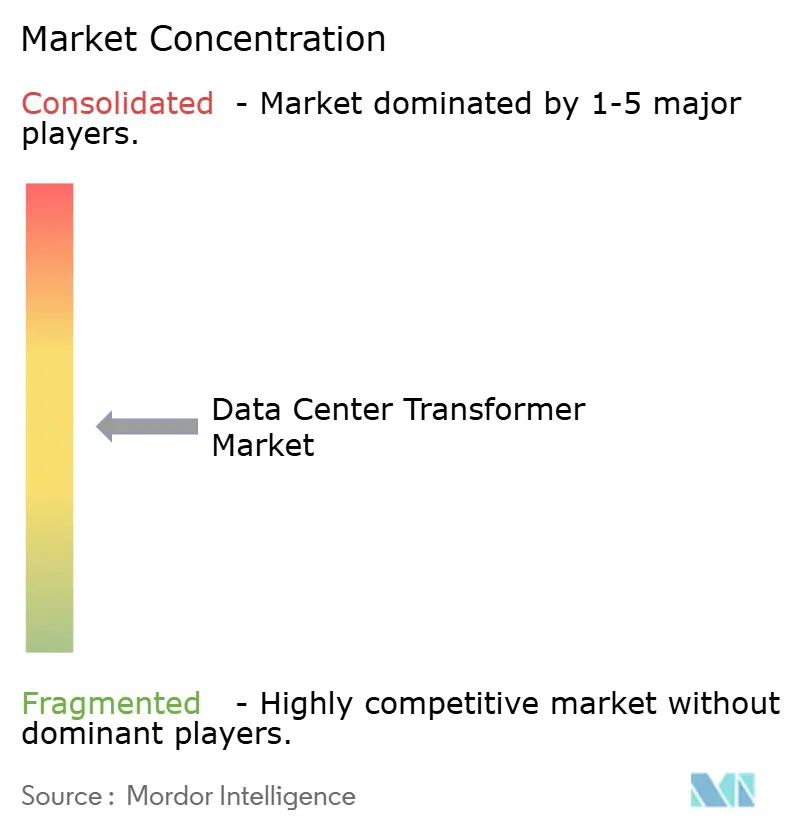
The data center transformer market has a concentrated top tier in high-voltage and large-capacity applications, while the wider supplier base remains fragmented. Hitachi Energy, Siemens Energy, GE Vernova, Schneider Electric, and ABB are established players in segments where qualifications and customer approvals are important. Entry barriers are high because buyers often require evidence of testing, installed references, and reliable delivery performance. NEMA’s design considerations for transformers in data center applications provide a technical reference point for supplier evaluation. These requirements favor suppliers that combine manufacturing depth with application-specific engineering.
GE Vernova completed its acquisition of the remaining 50% stake in Prolec GE for USD 5.275 billion in February 2026, consolidating a North American manufacturing network with 7 facilities. Hitachi Energy announced a USD 528 million transformer manufacturing facility in Gallman, Mississippi, in September 2026. Siemens Energy announced a USD 1 billion U.S. manufacturing program in 2026, including work on transformer capacity and high-voltage equipment. These moves strengthen delivery capability and secure regional supply for the data center transformer market.
Competition also extends to specialized dry-type products, high-voltage designs, and monitoring-enabled equipment. Hainan Jinpan Smart Technology and other Chinese manufacturers are building depth in regional supply chains and application-specific systems. Eaton announced a Nebraska medium-voltage switchgear facility in April 2026 and confirmed a USD 340 million South Carolina plant for three-phase transformers with production planned from 2027. Hammond Power Solutions reported strong sales and backlog growth in October 2026, citing data center investment and power infrastructure spending. These developments show that mid-tier specialists can capture orders in the data center transformer market when global leaders have limited available production slots.
Data Center Transformer Industry Leaders
-
Schneider Electric SE
-
Hitachi Energy Ltd.
-
Siemens Energy AG
-
GE Vernova Inc.
-
Eaton Corporation plc
- *Disclaimer: Major Players sorted in no particular order
Data Center Transformer Market Companies Covered in this Report
- Schneider Electric SE
- Hitachi Energy Ltd.
- Siemens Energy AG
- GE Vernova Inc.
- Eaton Corporation plc
- ABB Ltd.
- Mitsubishi Electric Corporation
- Toshiba Energy Systems and Solutions Corporation
- HYOSUNG HEAVY INDUSTRIES CO., LTD.
- Hainan Jinpan Smart Technology Co., Ltd.
- SGB-SMIT Group
- TBEA Co., Ltd.
- Virginia Transformer Corporation
- Hammond Power Solutions Inc.
- Hyundai Electric and Energy Systems Co., Ltd.
- Fuji Electric Co., Ltd.
- CG Power and Industrial Solutions Ltd.
- WEG S.A.
- Wilson Transformer Company Pty Ltd
Recent Industry Developments in Data Center Transformer Market
- October 2026: Enphase Energy has successfully demonstrated its IQ Solid-State Transformer (IQ SST) technology, converting 13.8 kV AC to 800 VDC at its research and development lab in Austin, Texas. The test system used 132 power modules, with 44 connected in series across each of three phases. The system maintained a stable 800 VDC output through load steps designed to simulate the fast-changing power demands of AI compute racks. The IQ SST is designed to convert medium-voltage AC directly to 800 VDC, eliminating multiple conversion stages found in conventional data center power architectures.
- September 2026: Hitachi Energy announced a USD 528 million transformer manufacturing facility in Gallman, Mississippi, projected to more than double large power transformer production capacity in the region and create more than 700 jobs. The facility reinforces Hitachi Energy’s total stated U.S. manufacturing commitment of USD 1.5 billion, directly addressing the transformer supply bottleneck delaying AI data center commissioning across North America.
- April 2026: Eaton announced a new Nebraska factory for medium-voltage switchgear, explicitly citing AI data center demand as the primary driver, and confirmed a USD 340 million South Carolina plant for three-phase transformers with production starting in 2027. Eaton’s Electrical Americas organic sales grew 18% in its most recently reported quarter, with electrical-sector backlog 43% above the prior year, signaling sustained demand visibility.
- February 2026: GE Vernova completed the USD 5.275 billion acquisition of the remaining 50% stake in Prolec GE, consolidating full ownership of a North American transformer manufacturing network with 7 facilities, including 5 in the United States. The transaction gives GE Vernova’s Electrification segment direct supply-chain control at a time when its data center electrification orders exceeded USD 5 billion in H1 2026, more than double the total for all of 2025.
Global Data Center Transformer Market Report Scope
The data center transformers refer to specialized, high-reliability electrical equipment engineered to step down high-voltage utility power to usable distribution levels within data processing facilities. They provide continuous, energy-efficient power conditioning and robust galvanic isolation to safeguard sensitive, mission-critical computing infrastructure from grid disturbances.
The Data Center Transformer Market Report is Segmented by Transformer Type (Liquid-Immersed Transformers and Dry-Type Transformers), Power Rating (Up to 10 MVA, Above 10 MVA to 30 MVA, and Above 30 MVA), Voltage Level (Low Voltage, Medium Voltage, and High Voltage), Installation (Indoor Installation and Outdoor Installation), Data Center Size (Small, Medium, Large, and Hyperscale), Data Center Type (Colocation, Cloud Service Provider, and Enterprise Data Centers/Edge), and Geography (North America, South America, Europe, Asia-Pacific, Middle East, and Africa). The Market Forecasts are Provided in Terms of Value (USD).
Segmentation Overview
| Liquid-Immersed Transformers |
| Dry-Type Transformers |
| Up to 10 MVA |
| Above 10 MVA to 30 MVA |
| Above 30 MVA |
| Low Voltage |
| Medium Voltage |
| High Voltage |
| Indoor Installation |
| Outdoor Installation |
| Small |
| Medium |
| Large |
| Hyperscale |
| Colocation |
| Cloud Service Provider |
| Enterprise Data Centers/Edge |
| North America | United States |
| Canada | |
| Mexico | |
| South America | Brazil |
| Argentina | |
| Rest of South America | |
| Europe | United Kingdom |
| Germany | |
| France | |
| Spain | |
| Rest of Europe | |
| Asia-Pacific | China |
| India | |
| Japan | |
| Australia | |
| Singapore | |
| Rest of Asia-Pacific | |
| Middle East and Africa | Saudi Arabia |
| United Arab Emirates | |
| South Africa | |
| Rest of Middle East |
| By Transformer Type | Liquid-Immersed Transformers | |
| Dry-Type Transformers | ||
| By Power Rating | Up to 10 MVA | |
| Above 10 MVA to 30 MVA | ||
| Above 30 MVA | ||
| By Voltage Level | Low Voltage | |
| Medium Voltage | ||
| High Voltage | ||
| By Installation | Indoor Installation | |
| Outdoor Installation | ||
| By Data Center Size | Small | |
| Medium | ||
| Large | ||
| Hyperscale | ||
| By Data Center Type | Colocation | |
| Cloud Service Provider | ||
| Enterprise Data Centers/Edge | ||
| By Geography | North America | United States |
| Canada | ||
| Mexico | ||
| South America | Brazil | |
| Argentina | ||
| Rest of South America | ||
| Europe | United Kingdom | |
| Germany | ||
| France | ||
| Spain | ||
| Rest of Europe | ||
| Asia-Pacific | China | |
| India | ||
| Japan | ||
| Australia | ||
| Singapore | ||
| Rest of Asia-Pacific | ||
| Middle East and Africa | Saudi Arabia | |
| United Arab Emirates | ||
| South Africa | ||
| Rest of Middle East | ||
Key Questions Answered in the Report
What is the data center transformer market size?
The data center transformer market is projected at USD 8.10 billion in 2026, USD 8.92 billion in 2027, and USD 12.87 billion by 2032.
What is driving demand for data center transformers?
AI workloads, hyperscale construction, higher-voltage grid connections, and efficiency-led replacement demand are expanding procurement needs.
Which transformer type leads data center installations?
Liquid-immersed transformers lead with 61.37% share in 2026, while dry-type transformers are projected to expand faster at an 8.57% CAGR.
Which power rating is advancing the fastest?
The above-30 MVA segment is forecast to advance at a 9.12% CAGR through 2032 as larger campuses require dedicated utility connections.
Which region has the fastest projected expansion?
Asia-Pacific is projected to expand at a 9.21% CAGR through 2032, supported by new capacity in China, India, Singapore, and Japan.
Why are transformer delivery times important for data center projects?
Large units require specialized materials, factory testing, and utility qualifications, so delayed delivery can postpone a project’s path to power.