
Data Center Testing, Inspection, and Certification Market Size and Share
Market Overview
| Study Period | 2021 - 2032 |
|---|---|
| Market Size (2027) | USD 4.81 Billion |
| Market Size (2032) | USD 15.84 Billion |
| Growth Rate (2027 - 2032) | 26.93 % |
| Fastest Growing Market | Asia-Pacific |
| Largest Market | North America |
| Market Concentration | Medium |
Major Players *Disclaimer: Major Players sorted in no particular order Image © Mordor Intelligence. Reuse requires attribution under CC BY 4.0. | |
Data Center Testing, Inspection, and Certification Market Analysis by Mordor Intelligence
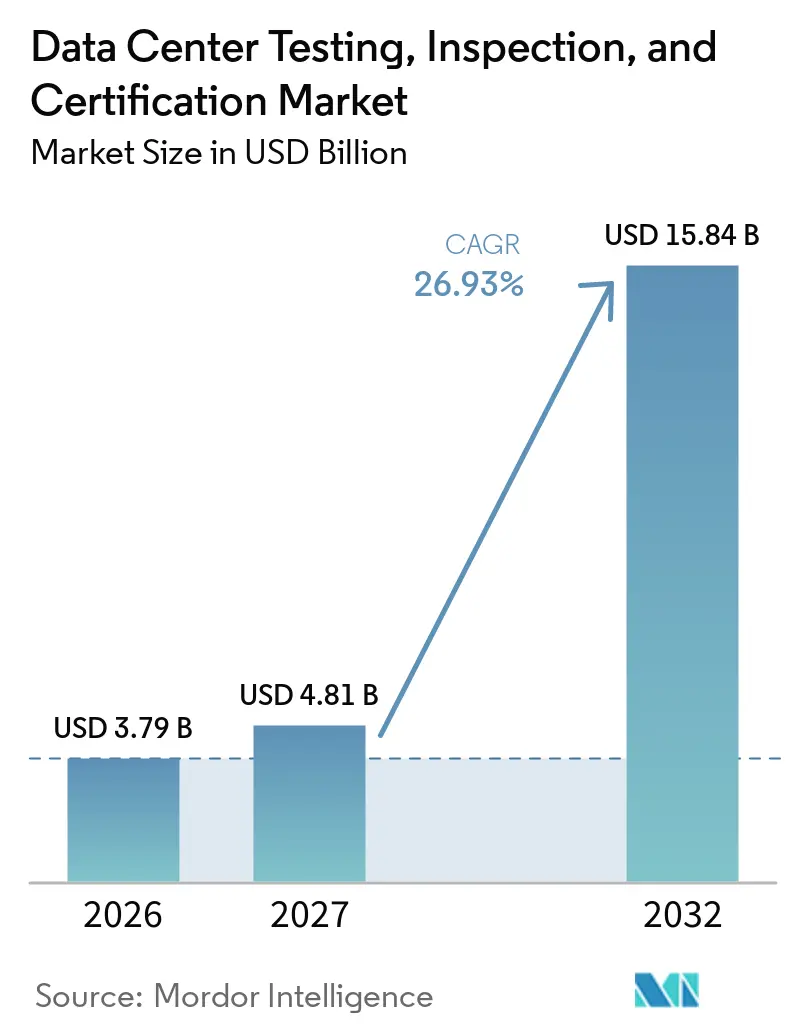
The Data Center Testing, Inspection, and Certification Market size is projected to expand from USD 3.79 billion in 2026 and USD 4.81 billion in 2027 to USD 15.84 billion by 2032, registering a CAGR of 26.93% between 2027 and 2032. The data center TIC market is being shaped by higher power densities, larger facility builds, and tighter requirements for proof that critical systems work as designed. AI and hyperscale facilities require testing across power, cooling, controls, and failure scenarios before equipment is placed into service. This raises the value of providers that can coordinate electrical, mechanical, cybersecurity, and certification work in one engagement. New European disclosure rules also make energy and water performance verification a recurring requirement for qualifying facilities. The opportunity is increasingly tied to repeat work after handover, including recertification, compliance checks, and assurance for changes to operating systems.
Key Report Takeaways
- By service type, Testing led with 40.22% of the data center TIC market share in 2026, while Compliance and Assurance Services is projected to expand at a CAGR of 27.54% through 2032.
- By data center lifecycle, Construction, Installation and Commissioning held 58.14% of the data center TIC market share in 2026, while Operations, Maintenance and Recertification is projected to expand at a CAGR of 27.18% through 2032.
- By infrastructure system, Electrical Infrastructure led with 37.16% of the data center TIC market share in 2026, while IT, Network and Cybersecurity Infrastructure is projected to expand at a CAGR of 27.34% through 2032.
- By data center type, Hyperscale and CSP data centers held 41.04% of the data center TIC market share in 2026 and are projected to expand at a CAGR of 27.16% through 2032.
- By tier type, Tier 3 held 55.23% of the data center TIC market share in 2026, while Tier 4 is projected to expand at a CAGR of 27.28% through 2032.
- By geography, North America held 38.14% of the data center TIC market share in 2026, while Asia-Pacific is projected to expand at a CAGR of 27.49% through 2032.
Note: Market numbers in this report are based on Mordor Intelligence's proprietary estimation framework, which combines nine months of actuals with Q4 projections for base year 2026.
Global Data Center Testing, Inspection, and Certification Market Trends and Insights
Drivers Impact Analysis*
| Driver | (~) % Impact on CAGR Forecast | Geographic Relevance | Impact Timeline |
|---|---|---|---|
| Growth in Data Center Construction and IT Load | +8.2% | Global | Short term (≤ 2 years) |
| Expansion of Hyperscale, AI and HPC Facilities | +6.8% | North America, Asia-Pacific core, spill-over to Europe and Middle East and Africa | Short term (≤ 2 years) |
| Increasing Reliability and Certification Requirements | +3.9% | North America and Europe, with spill-over to Asia-Pacific | Medium term (2-4 years) |
| Growing Regulatory, Sustainability and Cybersecurity Compliance | +3.4% | Europe, Asia-Pacific core, spill-over to Middle East and Africa | Medium term (2-4 years) |
| Growing Modernization and Retrofit of Legacy Data Centers | +2.1% | North America and Europe | Long term (≥ 4 years) |
| Rising Demand for Independent Third-Party Assurance From Customers, Investors and Insurers | +1.7% | Global | Medium term (2-4 years) |
| Source: Mordor Intelligence | |||
Growth in Data Center Construction and IT Load
The data center TIC market benefits directly when operators add new capacity because each facility requires testing and documented acceptance before energization. Factory acceptance testing helps verify equipment before it arrives on site. Site testing then confirms that electrical and mechanical systems work together in the completed facility. Handover certification gives operators, customers, and financiers evidence that defined requirements were met. The economic case is stronger when construction costs rise because operators have more reason to identify defects before a facility enters service. The data center TIC market also gains from a multi-year build pipeline because it gives providers a steady flow of commissioning work across established and emerging locations.
Expansion of Hyperscale, AI and HPC Facilities
Hyperscale, AI, and high-performance computing facilities increase the complexity of testing because dense computing systems place greater demands on power delivery and cooling. These sites may operate at 30-100 kW per rack, which requires coordinated validation of liquid cooling, power distribution, and resilience under failure conditions. A test of a single component is not enough when performance depends on the interaction of several systems. The data center TIC market, therefore, derives greater value from high-density capacity than from conventional builds. Hyperscale and CSP facilities represent a substantial share of the market and are expected to expand rapidly through the forecast period. Their combination of installed scale and rapid expansion keeps them central to demand for commissioning, handover checks, and operating assurance.
Increasing Reliability and Certification Requirements
Reliability certification has become relevant to occupancy arrangements, lending terms, and insurance conditions for many mission-critical facilities. Uptime Institute Tier Certification is used by operators that need to demonstrate the resilience of a completed design and facility. The institute has issued more than 4,300 Tier Certifications across more than 120 countries, which shows the wide use of this approach in the data center TIC market. ISO/IEC TS 22237-31:2026 introduced resilience indicators for power distribution, environmental control, and telecommunications cabling.[1] These indicators provide a common basis for testing and recertification work. An operator pursuing a Tier 3 to Tier 4 upgrade must validate added resilience and design changes, which can extend the relationship with a provider that already understands the site.
Growing Regulatory, Sustainability and Cybersecurity Compliance
The European Commission published a common Union rating scheme in September 2026 under the Energy Efficiency Directive, creating PUE and WUE disclosure requirements for covered data centers.[2] Independent verification of those disclosures creates an annual compliance need that does not depend only on new construction. Germany's C5:2026 criteria require third-party attestation for cloud service providers, linking cloud assurance with energy and cybersecurity expectations. IT, Network, and Cybersecurity Infrastructure is projected to expand at a 27.34% CAGR through 2032, outpacing the overall data center TIC market CAGR. NIS2, CMMC, and sector-specific obligations make cybersecurity assurance a contractual requirement for many regulated tenants. Providers that can work across EN 50600 and ISO/IEC 22237 requirements can offer a broader engagement where customers need both regional and international alignment.
Restraints Impact Analysis*
| Restraint | (~) % Impact on CAGR Forecast | Geographic Relevance | Impact Timeline |
|---|---|---|---|
| High Testing and Certification Costs | -3.3% | Global, with highest impact in South America and Middle East and Africa | Short term (≤ 2 years) |
| Fragmented Standards and Regional Regulations | -2.0% | Global, with acute impact in Asia-Pacific and Middle East and Africa | Medium term (2-4 years) |
| Shortage of Qualified TIC Personnel | -1.3% | North America, Europe, and high-growth Asia-Pacific markets | Short term (≤ 2 years) |
| Complex Multi-Vendor Data Center Infrastructure | -0.8% | Global | Long term (≥ 4 years) |
| Source: Mordor Intelligence | |||
High Testing and Certification Costs
Testing, commissioning, and certification for a large-scale facility can represent a modest share of project capital expenditure. The cost can rise further for AI-density facilities using liquid cooling and high-voltage power systems. Large hyperscalers can include TIC work in long-term framework agreements and obtain lower rates per megawatt. Smaller colocation operators often procure comparable work at significantly higher spot rates. This difference can limit the cadence of certification and assessment work for smaller operators. The effect is most pronounced in South America and the Middle East and Africa, where limited local accreditation capacity can add travel and mobilization costs to the engagement.
Shortage of Qualified TIC Personnel
Commissioning engineers, certified electrical inspectors, and cybersecurity auditors serve the same labor market as data center operators and construction contractors. The staffing gap can delay the start of testing when multiple projects reach the commissioning stage at the same time. It can also extend commissioning schedules when specialist personnel must move between distant sites. Providers face wage pressure for specialized roles even as contract volumes increase. This can narrow margins unless field teams can complete work more efficiently. Digital commissioning methods, such as SGS's System Start-up Matrix approach, can support handover readiness and reduce dependence on manual coordination.[3]
*Our forecasts treat driver/restraint impacts as directional, not additive. The impact forecasts reflect baseline growth, mix effects, and variable interactions.
Segment Analysis
By Service Type: Compliance and Assurance Services Accelerate as Operator Risk Profiles Deepen
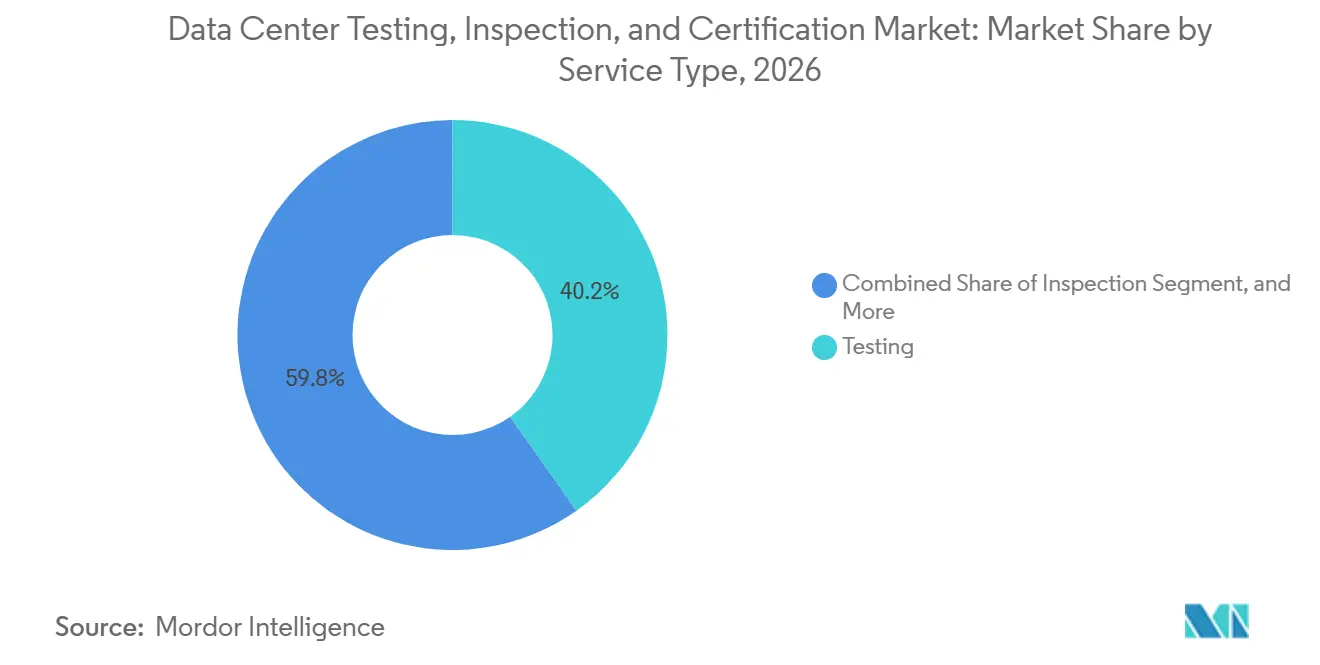
Testing held 40.22% of the data center TIC market size in 2026, supported by the high volume of factory and site acceptance work tied to new construction. Testing is needed before critical equipment is accepted for use and again when integrated systems are placed into service. It covers the physical evidence that power, cooling, controls, and safety systems meet defined performance requirements. Inspection supports compliance at key lifecycle gates and provides an independent view of installed conditions. Certification addresses formal requirements where customers, authorities, lenders, or insurers require a recognized assessment. Together, these service lines remain important because the physical build cycle is still the largest immediate source of work. Their role also provides providers with an early relationship that can continue after the site becomes operational.
Compliance and Assurance Services are the smallest service type by 2026 revenue, but their forecast CAGR of 27.54% makes them the fastest-growing service category through 2032. The shift reflects a move away from single point-in-time audits toward continuing work on energy, cybersecurity, and uptime requirements. This work is relevant after construction because operating risks and regulatory obligations change throughout the life of the facility. Intertek achieved global JAS-ANZ accreditation in 2025 for ISO/IEC 42001:2023 AI Management System certification. That accreditation supports AI governance validation alongside physical infrastructure and cybersecurity assurance. For tenants operating AI workloads, this combined scope can address risks that are not covered by traditional infrastructure testing alone. The data center TIC industry is consequently moving toward engagements that combine technical checks with evidence of continued governance and compliance.

By Data Center Lifecycle: Operations-Phase Spending Emerges as the Market's Long-Term Engine
Construction, Installation and Commissioning accounted for 58.14% of the data center TIC market share in 2026. This position is consistent with the large amount of work that occurs before a new facility becomes operational. Providers review equipment, confirm installation quality, test individual systems, and validate integrated operation before handover. Pre-Construction and Design engagements also contribute through technical due diligence, design review, and certification-readiness assessments. These early activities allow operators to identify compliance or resilience issues before they become expensive field changes. The construction phase remains a large revenue base because it requires a series of checks from design through final energization. It also creates the documentation that supports later recertification and operating reviews.
Operations, Maintenance and Recertification is projected to expand at a CAGR of 27.18% through 2032, making it the fastest-growing lifecycle phase. The installed base of certified facilities will need ongoing review as equipment ages, customer commitments change, and regulatory requirements become more specific. Recertification can become recurring work after a facility moves beyond its initial construction program. Retrofit and Modernization also adds work when legacy enterprise sites modify electrical systems or cooling infrastructure for denser AI workloads. Such changes can require fresh design review, resilience checks, and compliance assessments because the facility's risk profile has changed. Providers with a commissioning relationship may be well placed for multiyear operating contracts because they understand the original design and handover record. This supports a more predictable source of work than projects that end when the facility is placed in service.
By Infrastructure System: Cybersecurity Infrastructure Becomes the Fastest-Growing Verification Domain
Electrical Infrastructure held 37.16% of the data center TIC market size in 2026 because it is both capital intensive and essential to safe operation. Electrical systems must support equipment loads while maintaining continuity during planned maintenance and fault events. Their testing scope includes distribution equipment, backup power, protection systems, and the controls that coordinate those assets. The scale of this work reflects the central role of power availability in every data center classification. Mechanical, Cooling, and Fire-Safety Infrastructure forms the next major area of work. This category now includes more complex liquid and immersion cooling designs used for AI workloads. These systems need integrated testing because their effectiveness depends on the relationship between cooling, controls, power, and the physical equipment layout.
IT, Network, and Cybersecurity Infrastructure is projected to expand at a CAGR of 27.34% through 2032, exceeding the overall data center TIC market CAGR. The segment reflects the growing need to validate controls that protect hosted services and connected facility systems. NIS2, CMMC, and ISO/IEC 27001 obligations place cybersecurity assurance alongside physical infrastructure requirements for many operators. UL Solutions launched a certification program in 2026 for medium-voltage solid-state power units under UL 2877. The program addresses facilities moving from 400V AC to 800V DC systems for AI applications. UL 2755:2025 also enabled assessment of prefabricated modular systems as integrated products rather than only as individual components. These developments add defined verification work for providers serving sites with new power architectures and modular designs.
By Data Center Type: Hyperscale and CSP Dominance Deepens Across Both Scale and Speed
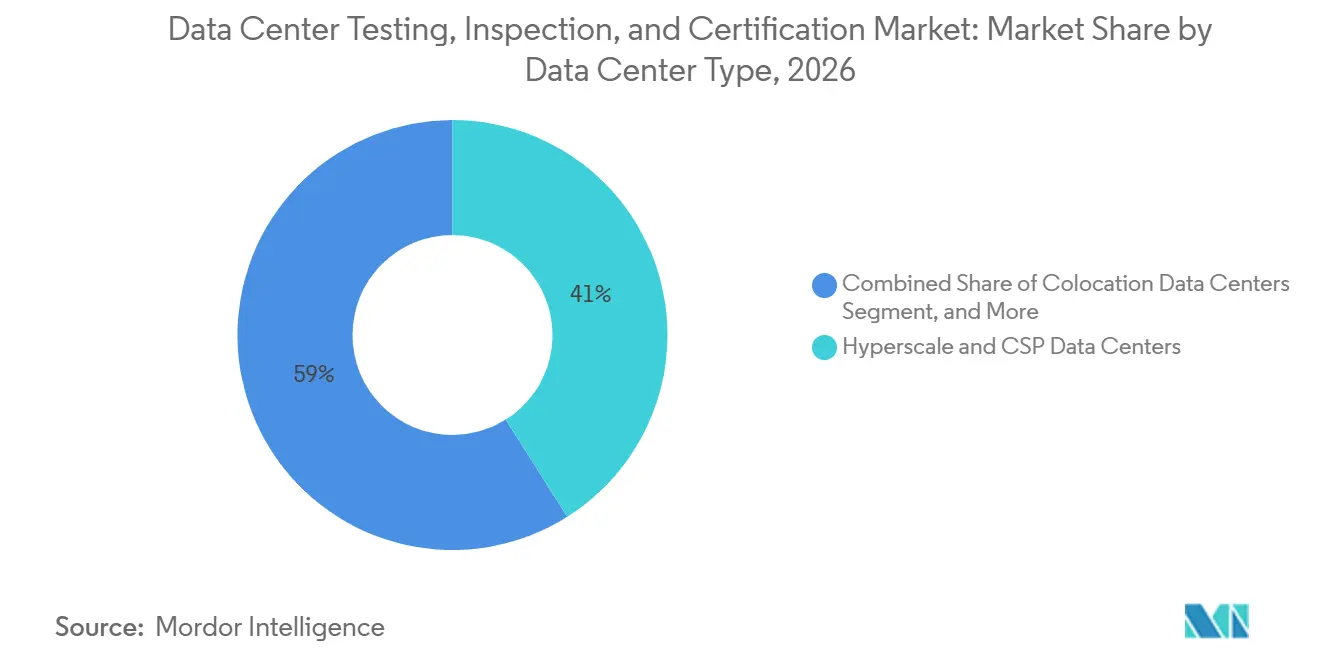
Hyperscale and CSP data centers accounted for 41.04% of the data center TIC market share in 2026. Their large campuses need testing and handover certification across a high volume of electrical, mechanical, and digital systems. The size of each project can justify a broad provider presence from the design phase through commissioning. Their operator standards are also often applied across multiple sites, which can support repeat engagements. Colocation facilities form the second-largest data center type by TIC revenue. Enterprise tenants commonly require SOC 2 Type II, ISO 27001, and Uptime Tier evidence as part of the lease and risk requirements. This keeps external assurance important even where the facility owner does not operate the customer systems within the site.
Hyperscale and CSP facilities are projected to expand at a CAGR of 27.16% through 2032, which gives this same segment the strongest growth rate among data center types. Their continued expansion links TIC demand to the need for faster commissioning without lowering resilience expectations. Enterprise facilities are expanding more slowly as cloud migration reduces some on-premises footprints. Operators that retain private facilities for sovereignty or compliance reasons still invest in certification to support continued operation. Edge and Modular facilities are a smaller but emerging area for the data center TIC market. UL 2755:2025 specifically addressed prefabricated modular data center systems and related modular units. Integrated assessment can reduce a prior gap where modular facilities were reviewed only at the component level. This supports a defined testing pathway for operators using standardized systems outside conventional large-campus designs.
By Tier Type: Tier 4 Emerges as the Premium Certification Category in an AI-First Market
Tier 3 accounted for 55.23% of the data center TIC market share in 2026, making it the largest tier category. This classification supports concurrent maintainability and is widely used by colocation and enterprise operators. It reflects the operating needs of facilities that require planned maintenance without interrupting customer services. Testing and verification are needed to establish that the design and completed facility meet the stated tier objective. Tier 1 and Tier 2 facilities serve smaller enterprise and edge applications with more modest requirements. These sites still require basic verification, but their technical scope and certification needs are lower than those of higher-tier facilities. The data center TIC market, therefore, receives the greatest tier-related work from facilities where availability commitments have a direct commercial impact.
Tier 4 is projected to expand at a CAGR of 27.28% through 2032, the highest rate among tier types. It requires fault tolerance and no single point of failure, which is important to AI inference clusters where an outage can affect revenue immediately. The move from Tier 3 to Tier 4 creates additional work because the operator must validate added resilience and changes in the design. Existing facility records and prior test results can be valuable during this process. The data center TIC industry can therefore benefit from upgrades as well as new construction. Tier 4 expectations are also becoming more closely aligned with ISO/IEC 22237 Availability Class 4 requirements. Providers that can work under both frameworks can address customers that want evidence against more than one recognized standard. This need for dual alignment favors providers that maintain broad accreditation coverage.
Geography Analysis
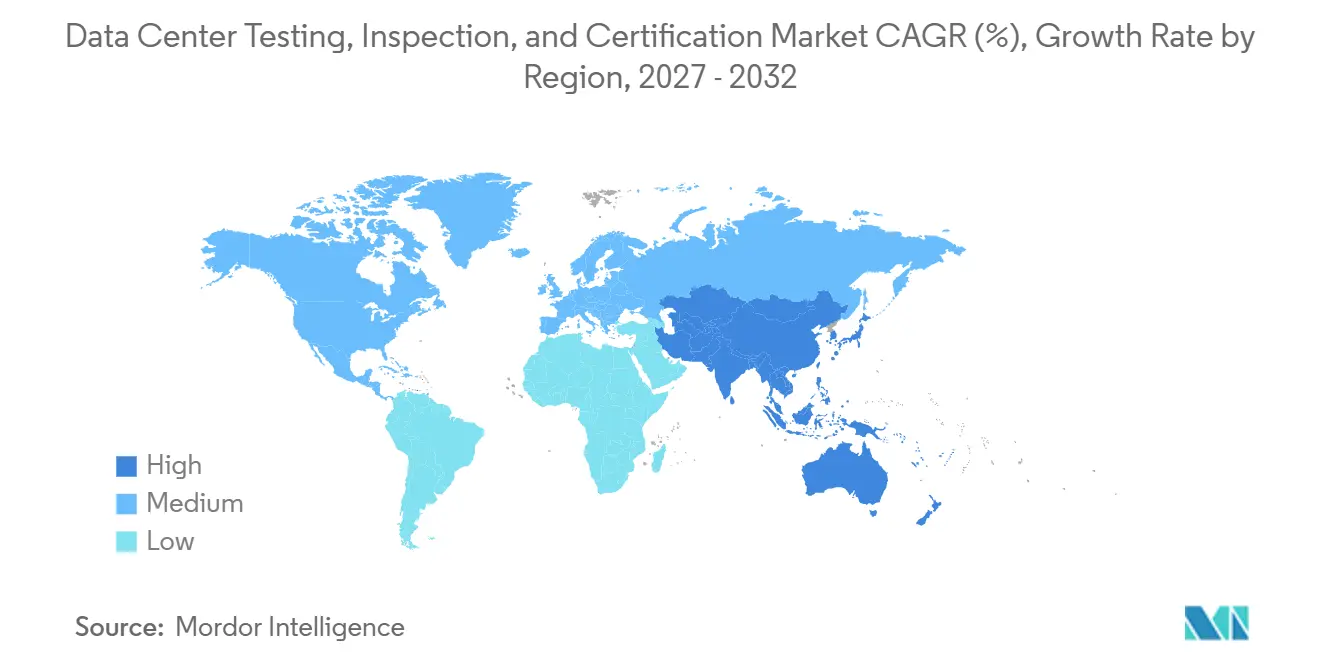
North America held 38.14% of the data center TIC market size in 2026 and is expected to retain the largest regional position through 2032. The region has a deep concentration of hyperscale self-build activity and a large installed base that requires operating assurance. New facilities create work at design, construction, commissioning, and handover stages. Operators also need recurring Tier Certification and cybersecurity assurance after a site opens. Construction is extending into locations with less developed pools of commissioning specialists. This makes provider mobilization and local delivery capacity important features of competition in the data center TIC market.
Europe follows North America in scale, with Germany, the Netherlands, Ireland, and the United Kingdom representing major centers of TIC demand. Nordic countries, Spain, and Italy are also receiving investment as power and land constraints limit development in core locations. The European Commission's rating scheme requires energy and water performance disclosures for facilities with IT power demand above 500 kW. This creates recurring compliance work across member states rather than only project-phase testing. Asia-Pacific is projected to expand at a CAGR of 27.49% through 2032, the fastest regional rate. Major providers are strengthening local delivery capabilities, as shown by TÜV SÜD's March 2026 inauguration of a regional hub in Singapore with the Singapore Economic Development Board.
South America and Middle East and Africa represent emerging geographies with potential for stronger TIC demand as large campuses and colocation facilities are developed. In the Middle East, operators are pursuing internationally recognized credentials to attract hyperscale tenants and institutional investors. BSI certified BK Gulf LLC in the United Arab Emirates under the ISO/IEC 22237-1-based Mark of Trust pilot. Brazil accounts for much of South American TIC demand because of cloud expansion and sovereignty requirements in financial services. Chile and Argentina are emerging colocation locations, while Nigeria, Egypt, and South Africa are important African markets. Limited local infrastructure means many providers must mobilize staff from Europe or the Middle East, which can constrain certification use where demand is building.
Competitive Landscape
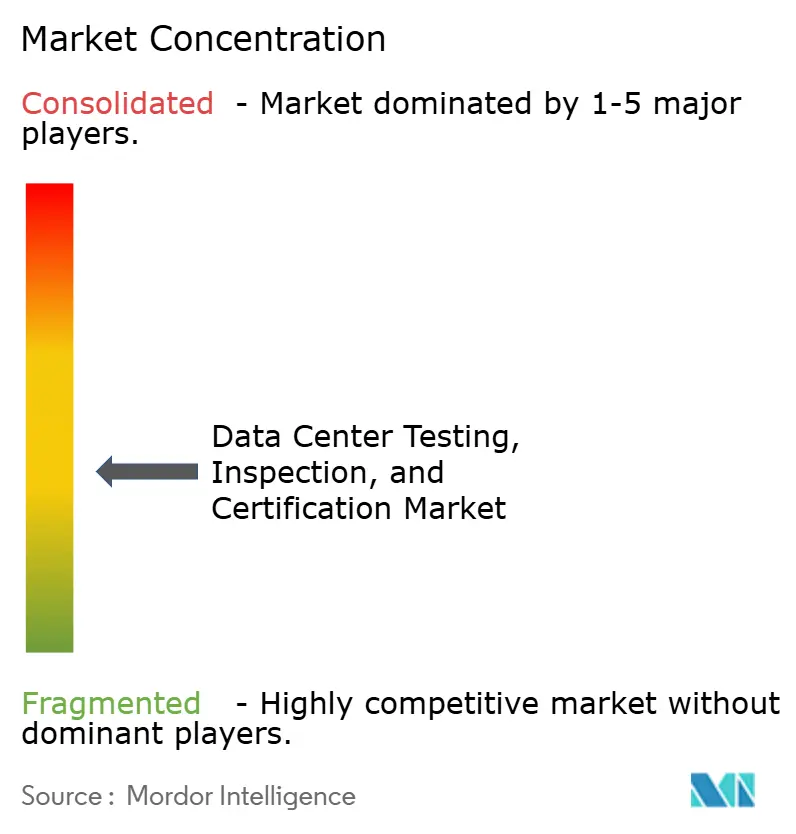
The data center TIC market is moderately fragmented globally, while high-value service areas are becoming more concentrated. SGS, Bureau Veritas, TÜV SÜD, TÜV Rheinland, Intertek, UL Solutions, DEKRA, and DNV compete through geographic reach and multidisciplinary accreditation portfolios. Their ability to deploy electrical, mechanical, and cybersecurity teams on the same project is important for complex hyperscale facilities. Smaller regional specialists, including Kiwa, SOCOTEC, and Applus+, retain positions in national markets where local standards and accreditations create barriers to entry. The data center TIC market share is therefore influenced by both global delivery capacity and local regulatory credibility. Providers that can combine commissioning with formal assurance can make their service offer more relevant over the full facility lifecycle.
Bureau Veritas signed an agreement in April 2026 to acquire Lotusworks for EUR 375 million (USD 423 million). The transaction added commissioning, quality assurance, calibration, and maintenance capabilities for mission-critical facilities. It reflects the value assigned to depth in commissioning and quality assurance when specialist labor is scarce. SGS completed its acquisition of Granite River Labs in March 2026, expanding digital trust and high-speed connectivity testing capabilities. This move broadens SGS's position in network infrastructure and digital systems that support data center operations. Both actions show that acquisition can be used to add specialist capability when building capacity through hiring alone is difficult.
TÜV NORD CERT issued ISO/IEC 22237 and EN 50600 certificates to T-Systems International GmbH for the Data Center Campus Magdeburg in March 2026. The dual certification demonstrates the value of providers who can work across regional and international frameworks. AI-specific assurance remains an area of opportunity in liquid cooling validation, immersion cooling certification, and cybersecurity assessments covering physical access and AI governance. Intertek's ISO/IEC 42001 accreditation provides a basis for providing AI management system certification. BSI's Mark of Trust adds a modular framework validated against ISO/IEC 22237-1. These framework additions enlarge the range of assurance work that can be offered to data center operators.
Data Center Testing, Inspection, and Certification Industry Leaders
-
SGS SA
-
Bureau Veritas SA
-
TÜV SÜD AG
-
UL Solutions Inc.
-
Intertek Group plc
- *Disclaimer: Major Players sorted in no particular order
Recent Industry Developments
- October 2026: The European Commission published a common Union rating scheme for data centers under Energy Efficiency Directive (EU 2023/1791), introducing mandatory PUE and WUE-based electronic labels for operators with IT power demand exceeding 500 kW, with minimum performance standards to be reviewed by December 2028, expanding the mandatory independent verification market across all EU member states.
- September 2026: ISO/IEC 27017:2026 was published, providing updated cloud security guidance aligned with ISO/IEC 27002 for cloud service providers and customers; data center operators hosting cloud infrastructure are expected to reassess their control frameworks with third-party auditors.
- April 2026: Bureau Veritas signed an agreement to acquire Lotusworks, an Ireland-headquartered provider of commissioning, quality assurance, calibration, and maintenance services for mission-critical facilities, for EUR 375 million (approximately USD 423 million); Lotusworks serves hyperscalers across the United States and Europe.
- March 2026: SGS completed the acquisition of Granite River Labs, expanding its digital trust and high-speed connectivity testing capabilities for data center network infrastructure and allied digital systems across Asia-Pacific and North American markets.
Global Data Center Testing, Inspection, and Certification Market Report Scope
The Data Center Testing, Inspection, and Certification (TIC) Market comprises independent third-party services that verify the safety, performance, reliability, and regulatory compliance of data center infrastructure across its full lifecycle from design review and construction through commissioning, operation, and modernization.
The Data Center TIC Market is Segmented by Service Type (Testing, Inspection, Certification, and Compliance), Data Center Lifecycle (Pre-Construction and Design, Construction, Installation and Commissioning, Operations, Maintenance and Recertification, and Retrofit and Modernization), Infrastructure System (Electrical Infrastructure, Mechanical, Cooling and Fire-Safety Infrastructure, Structural, Building and Physical Security Systems, and IT, Network and Cybersecurity Infrastructure), Data Center Type (Hyperscale and Cloud Service Provider Data Centers, Colocation, Enterprise, Edge and Modular), Tier (1 and 2, 3, 4), and Geography (North America, Europe, Asia-Pacific, South America, and Middle East and Africa). The Market Forecasts are Provided in Terms of Value (USD).
| Testing |
| Inspection |
| Certification |
| Compliance and Assurance Services |
| Pre-Construction and Design |
| Construction, Installation and Commissioning |
| Operations, Maintenance and Recertification |
| Retrofit and Modernization |
| Electrical Infrastructure |
| Mechanical, Cooling and Fire-Safety Infrastructure |
| Structural, Building and Physical Security Systems |
| IT, Network and Cybersecurity Infrastructure |
| Hyperscale and Cloud Service Provider Data Centers |
| Colocation Data Centers |
| Enterprise Data Centers |
| Edge and Modular Data Centers |
| Tier 1 and Tier 2 |
| Tier 3 |
| Tier 4 |
| North America | United States |
| Canada | |
| Mexico | |
| Europe | Germany |
| Netherlands | |
| United Kingdom | |
| Ireland | |
| Spain | |
| Italy | |
| Sweden | |
| Norway | |
| Finland | |
| Rest of Europe | |
| Asia-Pacific | China |
| India | |
| Japan | |
| Indonesia | |
| Australia | |
| Singapore | |
| Malaysia | |
| Vietnam | |
| Thailand | |
| Taiwan | |
| Philippines | |
| Rest of Asia-Pacific | |
| South America | Brazil |
| Chile | |
| Argentina | |
| Rest of South America | |
| Middle East and Africa | Saudi Arabia |
| UAE | |
| South Africa | |
| Nigeria | |
| Egypt | |
| Rest of Middle East and Africa |
| By Service Type | Testing | |
| Inspection | ||
| Certification | ||
| Compliance and Assurance Services | ||
| By Data Center Lifecycle | Pre-Construction and Design | |
| Construction, Installation and Commissioning | ||
| Operations, Maintenance and Recertification | ||
| Retrofit and Modernization | ||
| By Infrastructure System | Electrical Infrastructure | |
| Mechanical, Cooling and Fire-Safety Infrastructure | ||
| Structural, Building and Physical Security Systems | ||
| IT, Network and Cybersecurity Infrastructure | ||
| By Data Center Type | Hyperscale and Cloud Service Provider Data Centers | |
| Colocation Data Centers | ||
| Enterprise Data Centers | ||
| Edge and Modular Data Centers | ||
| By Tier Type | Tier 1 and Tier 2 | |
| Tier 3 | ||
| Tier 4 | ||
| By Geography | North America | United States |
| Canada | ||
| Mexico | ||
| Europe | Germany | |
| Netherlands | ||
| United Kingdom | ||
| Ireland | ||
| Spain | ||
| Italy | ||
| Sweden | ||
| Norway | ||
| Finland | ||
| Rest of Europe | ||
| Asia-Pacific | China | |
| India | ||
| Japan | ||
| Indonesia | ||
| Australia | ||
| Singapore | ||
| Malaysia | ||
| Vietnam | ||
| Thailand | ||
| Taiwan | ||
| Philippines | ||
| Rest of Asia-Pacific | ||
| South America | Brazil | |
| Chile | ||
| Argentina | ||
| Rest of South America | ||
| Middle East and Africa | Saudi Arabia | |
| UAE | ||
| South Africa | ||
| Nigeria | ||
| Egypt | ||
| Rest of Middle East and Africa | ||
Key Questions Answered in the Report
What is the size of the data center TIC market?
The data center TIC market is projected to increase from USD 3.79 billion in 2026 and USD 4.81 billion in 2027 to USD 15.84 billion by 2032, at a CAGR of 26.93%.
Which service type leads data center TIC demand?
Testing leads with 40.22% share in 2026 because new facilities require factory acceptance, site acceptance, and integrated system testing before handover.
Which lifecycle phase is expanding fastest?
Operations, Maintenance and Recertification is projected to expand at a CAGR of 27.18% through 2032 as the installed base requires ongoing assurance and compliance checks.
Why are AI data centers increasing TIC requirements?
AI and HPC facilities require validation of high-density power, liquid cooling, and resilience under combined failure scenarios, rather than isolated equipment testing.
Which region has the highest forecast growth rate?
Asia-Pacific is projected to expand at a CAGR of 27.49% through 2032, supported by new capacity and expanding delivery capability among major providers.
What is driving cybersecurity assurance at data centers?
Compliance with NIS2, CMMC, and ISO/IEC 27001 obligations is making IT, network, and cybersecurity assurance a required service line for many operators.