
Data Center Switchgear Market Size and Share
Market Overview
| Study Period | 2021 - 2032 |
|---|---|
| Market Size (2027) | USD 4.97 Billion |
| Market Size (2032) | USD 9.20 Billion |
| Growth Rate (2027 - 2032) | 13.11 % |
| Fastest Growing Market | Asia-Pacific |
| Largest Market | North America |
| Market Concentration | Medium |
Major Players *Disclaimer: Major Players sorted in no particular order Image © Mordor Intelligence. Reuse requires attribution under CC BY 4.0. | |
Data Center Switchgear Market Analysis by Mordor Intelligence
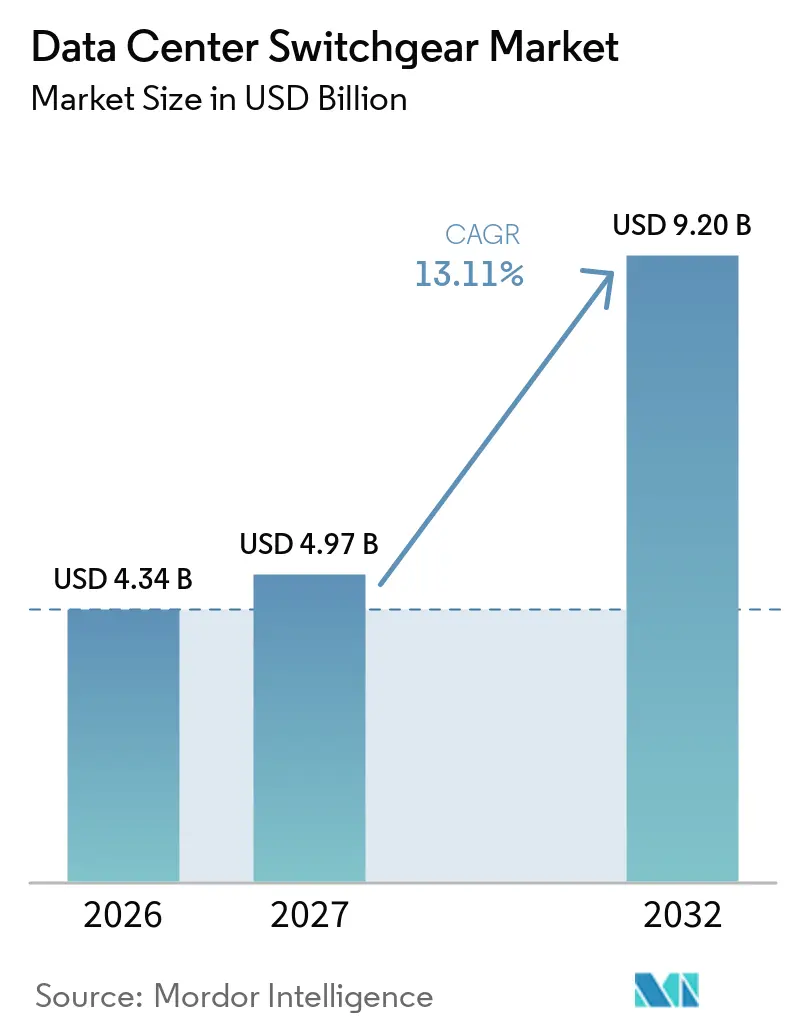
The data center switchgear market size is projected to expand from USD 4.34 billion in 2026 and USD 4.97 billion in 2027 to USD 9.20 billion by 2032, registering a CAGR of 13.11% between 2027 to 2032. Rising AI computing densities are changing the electrical design of new facilities and are increasing demand for medium-voltage equipment inside data center buildings. The data center switchgear market is also being shaped by hyperscale campus construction, colocation expansion, and large multi-site supply agreements that reserve manufacturing capacity. New limits on SF₆ use in Europe and parts of North America are moving buyers toward air, vacuum, clean-air, and solid-dielectric designs. Long equipment lead times and shortages of qualified commissioning labor remain material constraints, yet they also favor suppliers that can deliver certified systems and field support. Product opportunities are moving toward modular, outdoor-ready, digitally monitored, and arc-resistant switchgear that can support high-density loads.
Key Report Takeaways
- By voltage level, low voltage held 52.19% of the data center switchgear market share in 2026, while medium voltage is projected to expand at a 14.57% CAGR through 2032.
- By insulation type, air-insulated switchgear held 48.62% share in 2026, while other insulation technologies are expected to expand at a 14.71% CAGR through 2032.
- By installation type, indoor switchgear held 69.30% of the data center switchgear market share in 2026, while outdoor switchgear is projected to expand at a 15.21% CAGR through 2032.
- By configuration, withdrawable switchgear held 47.39% share in 2026, while modular switchgear is projected to expand at a 15.47% CAGR through 2032.
- By data center size, hyperscale facilities accounted for 43.17% of the data center switchgear market size in 2026 and are projected to expand at a 15.84% CAGR through 2032.
- By data center type, cloud service providers held 44.10% share in 2026 and are expected to expand at a 15.50% CAGR through 2032.
- By geography, North America held 41.69% share in 2026, while Asia-Pacific is projected to expand at a 14.93% CAGR through 2032.
Note: Market numbers in this report are based on Mordor Intelligence's proprietary estimation framework, which combines nine months of actuals with Q4 projections for base year 2026.
Market Trends and Insights
Drivers Impact Analysis of Data Center Switchgear Market*
| Driver | (~) % Impact on CAGR Forecast | Geographic Relevance | Impact Timeline |
|---|---|---|---|
| AI and High-Density Computing Capacity Expansion | +4.5% | Global | Medium term (2-4 years) |
| Hyperscale and Colocation Campus Build-Out | +3.0% | North America, Asia-Pacific, Middle East and Africa | Short term (≤ 2 years) |
| Medium-Voltage Distribution Closer to High-Density Loads | +2.0% | North America, Europe, Asia-Pacific | Medium term (2-4 years) |
| Prefabricated and Modular Power Infrastructure Adoption | +1.5% | Global | Short term (≤ 2 years) |
| Digital Monitoring and Predictive Maintenance | +0.8% | Global | Long term (≥ 4 years) |
| SF₆-Free Switchgear Regulation and Sustainability Requirements | +0.6% | Europe, North America | Short term (≤ 2 years) |
| Source: Mordor Intelligence | |||
AI and High-Density Computing Capacity Expansion
The move from kilowatt-scale to megawatt-scale server racks is changing the power distribution specification for new data center projects. NVIDIA’s roadmap for 800 VDC architecture serving server racks above 1 MW makes traditional 54 V in-rack distribution unsuitable for AI factories designed around far higher loads. ABB and NVIDIA announced a collaboration in October 2025 that combines ABB’s HiPerGuard solid-state medium-voltage UPS with DC distribution to the server room. This architecture introduces a need for switching and protection equipment at each voltage boundary. The four largest U.S. hyperscale cloud operators committed capital expenditure above USD 310 billion in 2025, directing substantial investment toward new AI capacity and its supporting electrical systems. Suppliers that can provide arc-resistant medium-voltage systems at data center installation speeds are better placed to participate in this procurement cycle.
Hyperscale and Colocation Campus Build-Out
The data center switchgear market is sustaining orders through new data center construction because operators are committing to larger campuses and longer project pipelines. Schneider Electric’s November 2025 agreements with Switch and Digital Realty show how operators are moving from project-by-project purchases to multi-year agreements that secure manufacturing capacity. These agreements can give project teams more certainty over equipment allocation during construction. Large campuses require multiple independent switchgear trains across building pods, which can turn one project into a continuing supply relationship. The resulting need to coordinate design, manufacturing, testing, delivery, and field support favors manufacturers with established data center delivery teams. This gives an advantage to suppliers that can meet volume, delivery, and certification requirements at the same time.
Medium-Voltage Distribution Closer to High-Density Loads
In the data center switchgear market, medium-voltage distribution within the building reduces losses across long low-voltage bus runs and supports larger blocks of protected capacity. ABB states that medium-voltage UPS systems can scale to 25 MW blocks, compared with the 3 MW blocks associated with traditional low-voltage architecture. As AI rack loads move from 100 kW toward 1 MW, improved distribution efficiency can release more capacity for IT equipment at the campus scale. Siemens and Compass Datacenters agreed to deploy as many as 1,500 modular medium-voltage skid units that integrate switchgear and transformers in pre-tested packages. Primary distribution equipment for these applications must meet arc-resistance and metal-enclosed assembly requirements under IEEE C37.20.9 and IEC 62271-200. These standards make dual technical certification an important qualification factor for data center switchgear market suppliers.
Prefabricated and Modular Power Infrastructure Adoption
Factory-built modular power systems in the data center switchgear market reduce site engineering variability and shorten commissioning schedules. Schneider Electric unveiled software-defined medium-voltage switchgear in September 2026 that it says can support 3 times faster ordering and manufacturing, and reduce control wiring by 87% compared with conventional engineered-to-order assemblies. The product was deployed in a live Equinix colocation pilot. Eaton and Siemens Energy combined Eaton’s medium-voltage switchgear with a 500 MW-class modular gas turbine concept in a June 2025 partnership.[1] Their approach allows data center and power plant construction to proceed concurrently, with a stated potential to reduce time to market by as much as 2 years. Pre-integrated skids can also lock a project into one supplier’s standard platform, increasing competition among comprehensive equipment providers.
Restraints Impact Analysis of Data Center Switchgear Market*
| Restraint | (~) % Impact on CAGR Forecast | Geographic Relevance | Impact Timeline |
|---|---|---|---|
| Long Lead Times and Qualification Bottlenecks | -2.5% | Global | Short term (≤ 2 years) |
| Shortage of Qualified Electrical Commissioning Labor | -1.5% | North America, Europe | Medium term (2-4 years) |
| Grid Interconnection and Available-Power Constraints | -1.0% | North America, Europe | Medium term (2-4 years) |
| Project-Specific Engineering and Specification Lock-In | -0.7% | Global | Long term (≥ 4 years) |
| Source: Mordor Intelligence | |||
Long Lead Times and Qualification Bottlenecks
In the data center switchgear market, extended lead times are limiting project schedules even where developers have secured sites and customer commitments. Nexans reported that custom medium-voltage lineups for data centers can require 70 to more than 100 weeks, with some configurations approaching 2-3 years.[2] This compares with a 12-16 week baseline before the pandemic. Equipment availability can delay work packages that depend on electrical rooms, utility connections, and final commissioning. Arc-flash studies, coordination studies, and factory acceptance testing add qualification work that cannot be increased as quickly as factory output. These bottlenecks increase the value of early design approval and production-slot planning.
Shortage of Qualified Electrical Commissioning Labor
In the data center switchgear market, commissioning labor is a separate project constraint from equipment supply. CSIS estimated that a high-growth U.S. generative AI infrastructure scenario requires 140,000 additional skilled trade positions by 2030. The same analysis estimated that each megawatt of AI data center construction requires 1,800 electrician-hours, which is 5-9 times the requirement for conventional commercial buildings. Apprenticeships take 4-5 years, and around 25% of U.S. construction workers are over 55. Specialist field roles pay USD 80,000-USD 120,000, compared with USD 50,000-USD 70,000 for instructor roles, which can limit the training pipeline. EPRI identifies skilled trade shortages, retention challenges, and apprenticeship gaps as issues that can affect data center construction and commissioning over the next 5-10 years.
*Our forecasts treat driver/restraint impacts as directional, not additive. The impact forecasts reflect baseline growth, mix effects, and variable interactions.
Data Center Switchgear Market Segment Analysis
By Voltage Level:
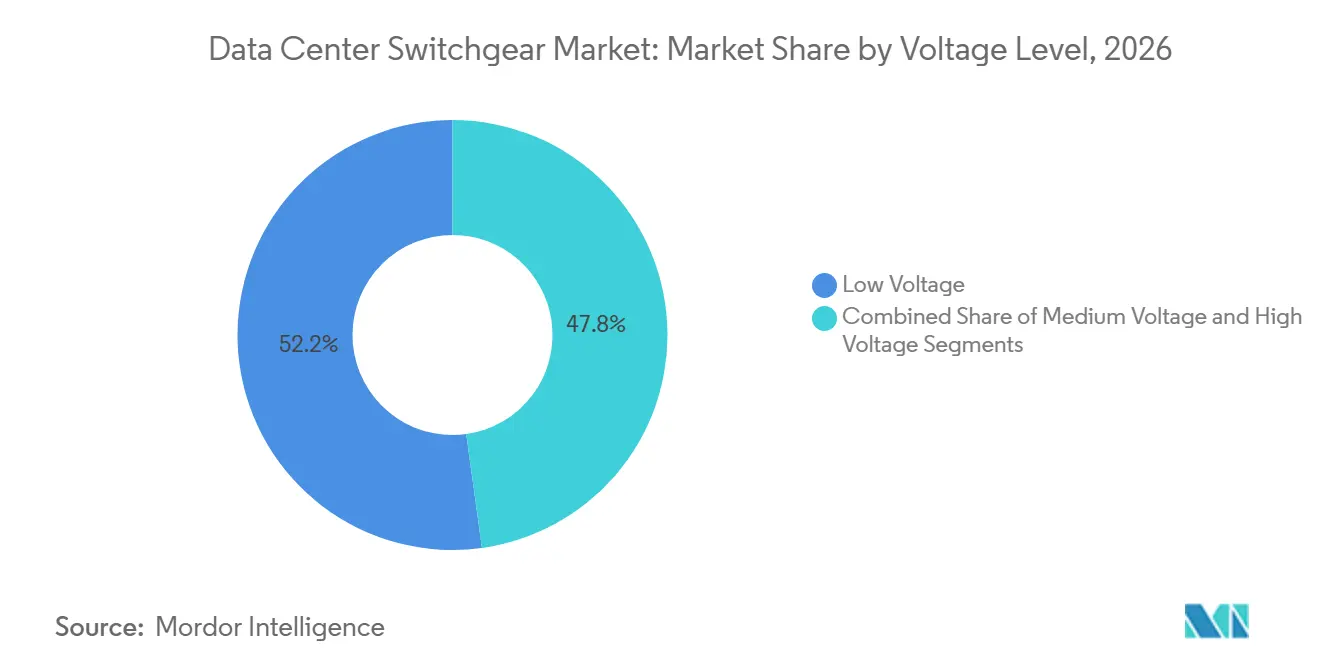
Medium Voltage Moves Further Into the BuildingLow voltage held 52.19% of the voltage-level segment in 2026. Its leading position reflects the established use of 480 V distribution across enterprise and colocation facilities with historically modest rack densities. The installed base and long renewal cycles continue to support low-voltage demand. Medium voltage is projected to expand at a 14.57% CAGR through 2032. AI data centers are moving distribution to 13.8 kV or higher within the building perimeter to support medium-voltage UPS systems that operate in tens-of-megawatt blocks.
High voltage remains a specialized category for direct utility-feed connections at the largest campuses. Its demand is tied to the emergence of single-site projects above 300 MW that require dedicated high-voltage substations. New medium-voltage and high-voltage purchases for AI campuses are increasingly planned as one infrastructure decision at the campus level. That process consolidates buying authority and raises qualification requirements for suppliers serving both voltage classes. IEEE Spectrum cited a Bureau of Labor Statistics projection of 9% job growth for data center electrical engineers through 2033.

By Insulation Type:
SF₆-Free Designs Gain RelevanceAir-insulated switchgear held 48.62% of the insulation-type segment in 2026. Buyers select it for relative simplicity and competitive cost, where the facility provides enough clearance space. Gas-insulated switchgear remains necessary for compact projects that need high fault-interruption capability in a limited footprint. Other insulation technologies are projected to expand at a 14.71% CAGR through 2032. The EU F-gas regulation restricts new SF₆-based medium-voltage switchgear up to 24 kV from January 2026, while regulations in California and New York also support the transition.
Schneider Electric introduced RM AirSeT 38 Software Defined in September 2026, extending SF₆-free medium-voltage technology to 38 kV through pressurized pure-air insulation and vacuum interruption. The launch indicates that alternative insulation is progressing from the 24 kV threshold toward the medium-high voltage range. Compliance requirements under IEC 62271-200 remain relevant for metal-enclosed assemblies. Evolving F-gas rules in the United Kingdom and Canada can widen the replacement opportunity beyond the initial European mandate. Suppliers must balance space, interruption performance, environmental requirements, and certification needs.
By Installation Type:
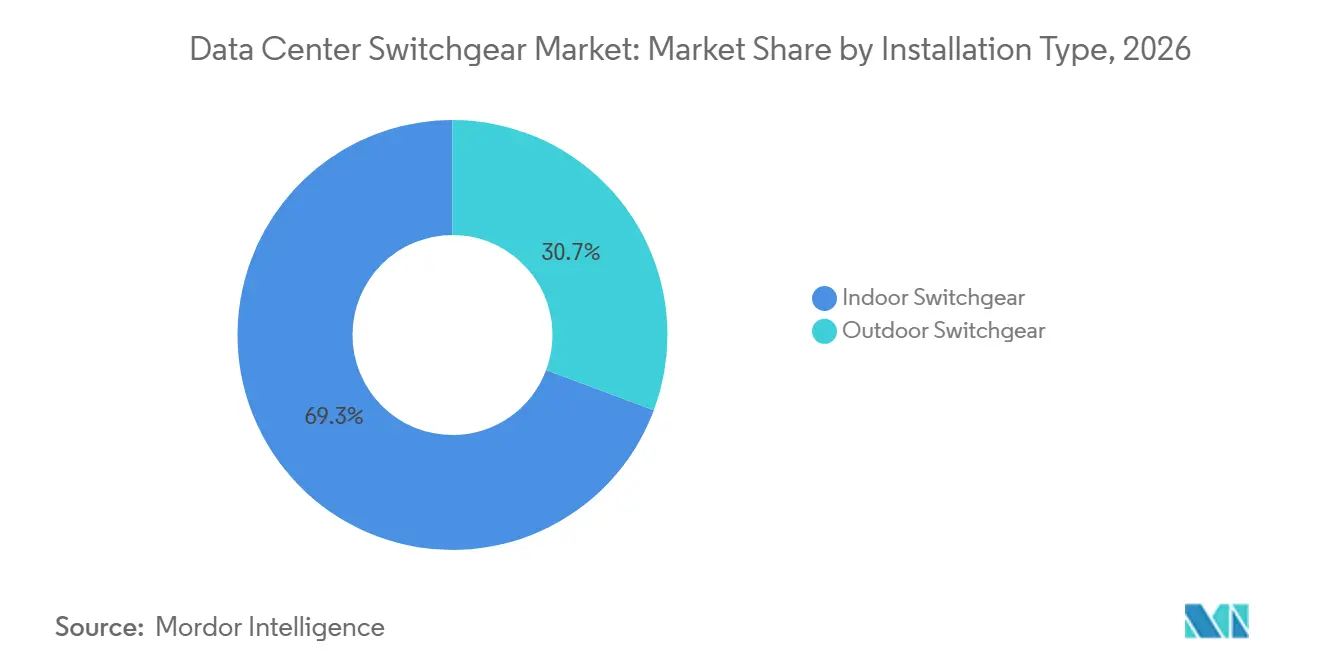
Outdoor Formats Support Campus DensificationIndoor switchgear held 69.30% of the installation-type segment in 2026. The format reflects the long-standing practice of placing primary distribution equipment in dedicated electrical rooms. This layout supports the concurrently maintainable requirements associated with Uptime Institute Tier III and Tier IV facilities. Outdoor switchgear is projected to expand at a 15.21% CAGR through 2032. Modular power skids place medium-voltage assemblies in weatherized external enclosures and can release internal floor space for IT equipment.
Outdoor formats are well-suited to hyperscale campuses that have sufficient site area for distributed equipment placement. They can support concurrent construction of the data center shell and external power infrastructure. New outdoor specifications increasingly require NEMA 3R and IP54 ingress ratings alongside arc-flash performance. These requirements make enclosure design and environmental protection relevant to purchasing decisions. Releasing large electrical rooms from the building interior can improve the area available for IT hardware.
By Configuration:
Modular Systems Gain Ground in Fast-Track ProjectsWithdrawable switchgear held 47.39% of the configuration segment in 2026. Users value the ability to remove individual breaker cassettes without de-energizing adjacent circuits. This feature directly supports concurrently maintainable design criteria for Tier III and higher facilities. Modular switchgear is projected to expand at a 15.47% CAGR through 2032. It fits the move toward factory-assembled and pre-tested power systems that can be installed in standardized blocks.
Fixed-mounted systems continue to serve price-sensitive projects and edge facilities with higher downtime tolerance. Their compact footprint can suit retrofits and smaller enterprise electrical rooms. Schneider Electric states that its software-defined medium-voltage architecture reduces control wiring by 87% and terminal count by 91% against conventional engineered-to-order systems. Such designs place protection and control logic in software rather than extensive hardwired assemblies. Over time, modular procurement can concentrate volume in factory kits and reduce demand for standalone project-specific assemblies.
By Data Center Size:
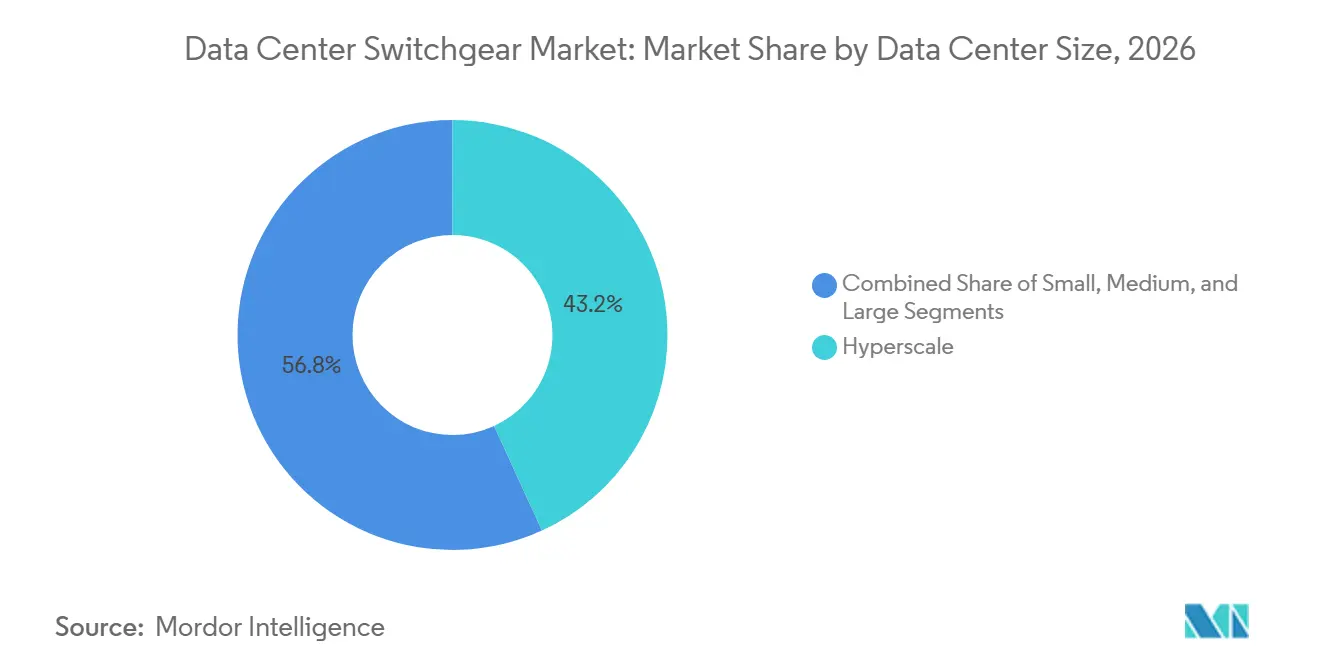
Hyperscale Facilities Lead Volume and ExpansionHyperscale facilities accounted for 43.17% of the data center switchgear market size in 2026. The segment is also projected to expand at a 15.84% CAGR through 2032. Its combined lead in volume and expansion reflects the concentration of AI infrastructure spending in the largest facility class. Gigawatt-scale campus plans require switchgear volumes and technical specifications that are not accessible to many smaller suppliers. Prelease commitments improve supply-chain visibility and support investments in dedicated manufacturing capacity.
Large data centers are the second-largest group and require primary medium-voltage equipment, with high-voltage distribution at the largest locations. Small and medium facilities primarily use low-voltage assemblies and standard withdrawable switchgear. This part of the market has historically had a more price-driven supply structure. AI inference deployments at network-adjacent edge locations are raising power density in smaller facilities. This is increasing equipment specifications and unit values in a category that had previously faced stronger cost competition.
By Data Center Type:
Cloud Providers Change Procurement PracticesCloud service providers held 44.10% of the data center-type segment in 2026. They are projected to expand at a 15.50% CAGR through 2032. Their centralized procurement teams negotiate platform-level agreements that can cover dozens of sites and require production commitments 18-24 months in advance. This concentrates competition among suppliers that can meet volume, lead-time, and certification needs at once. The purchasing model creates consolidation through buyer behavior as well as through technology requirements.
Colocation operators are the second-largest customer type for switchgear procurement. They must meet the electrical standards required by several hyperscale tenants. Their specifications can extend hyperscale procurement practices into the colocation channel. Enterprise and edge users make up the remaining demand. Enterprise facilities are selectively refreshing electrical systems as AI inference requires more power density than older installations were designed to provide.
Geography Analysis
North America
North America held 41.69% of the data center switchgear market share in 2026. The United States is the principal source of regional demand because hyperscale operators are expanding AI capacity. ABB supplied medium-voltage and low-voltage infrastructure for Applied Digital’s Polaris Forge AI campuses in North Dakota, including a 700 MW deployment across 2 sites.[3] This type of multi-campus commitment shows how suppliers can move from single-project delivery to broader customer relationships that include standardized equipment, technical service, and repeat orders. Canada is receiving hyperscale activity from capacity-constrained U.S. markets, particularly in Quebec and British Columbia, where power-advantaged sites attract cloud workloads.
Asia-Pacific
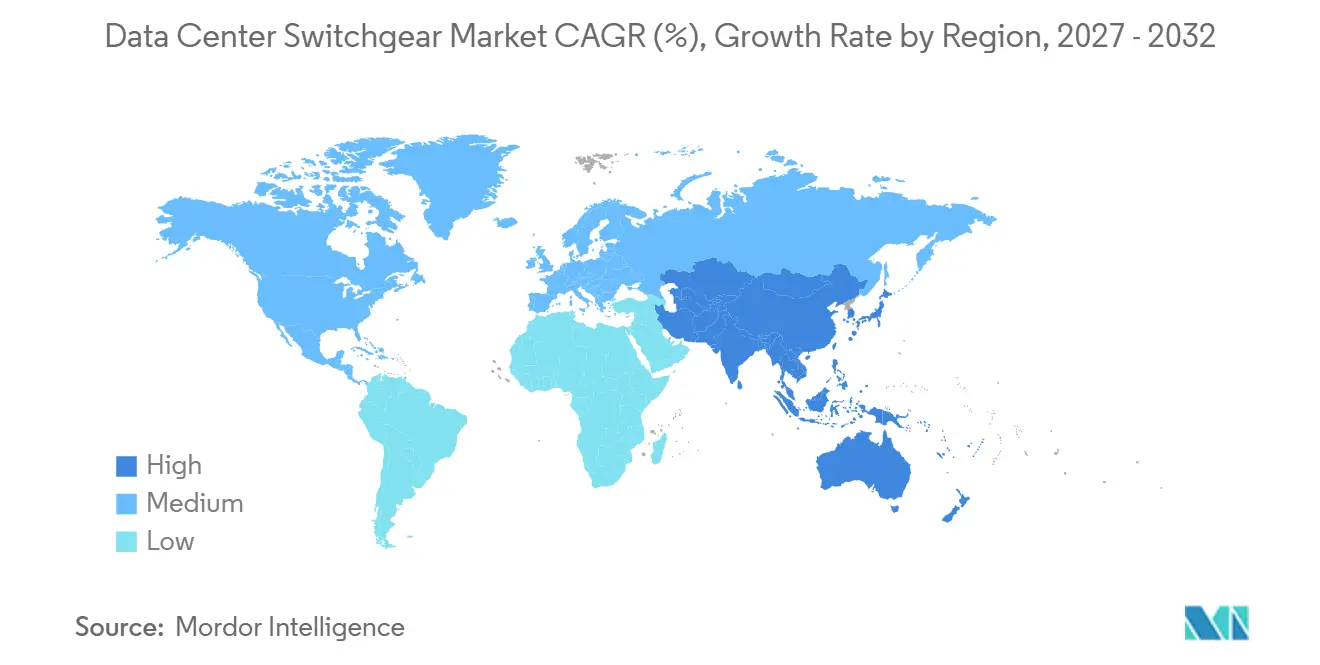
Asia-Pacific is projected to expand at a 14.93% CAGR through 2032, the fastest regional rate in the data center switchgear market. Development is shifting toward locations with reliable power access and more favorable infrastructure conditions. Japan’s seismic requirements raise the importance of certified switchgear designs, particularly given its network of submarine cable landings and the need for resilient facilities. South Korea has restricted new data center projects in Greater Seoul to 10 MW, encouraging development in secondary markets with different site conditions and equipment requirements. Regional suppliers that can provide IEC 60947-compliant equipment and local assembly can address this more geographically varied demand pattern.
Europe, South America, and Middle East and Africa
Europe’s demand is closely linked to the shift away from SF₆ in medium-voltage applications, which makes compliance a central purchasing factor for the data center switchgear market. Bitkom reported that German data center capacity reached 2,980 MW in 2025 after 9% annual expansion, while cloud infrastructure accounted for 49% of installed capacity.[4] In the Middle East and Africa, large hyperscale commitments are raising near-term demand for electrical infrastructure and accelerating the need for qualified supply partners. South America is centered on Brazil, where cloud providers are expanding capacity near Portuguese-language users, while Argentina and other markets remain earlier-stage enterprise and edge locations served by imports and locally assembled low-voltage equipment.
Competitive Landscape
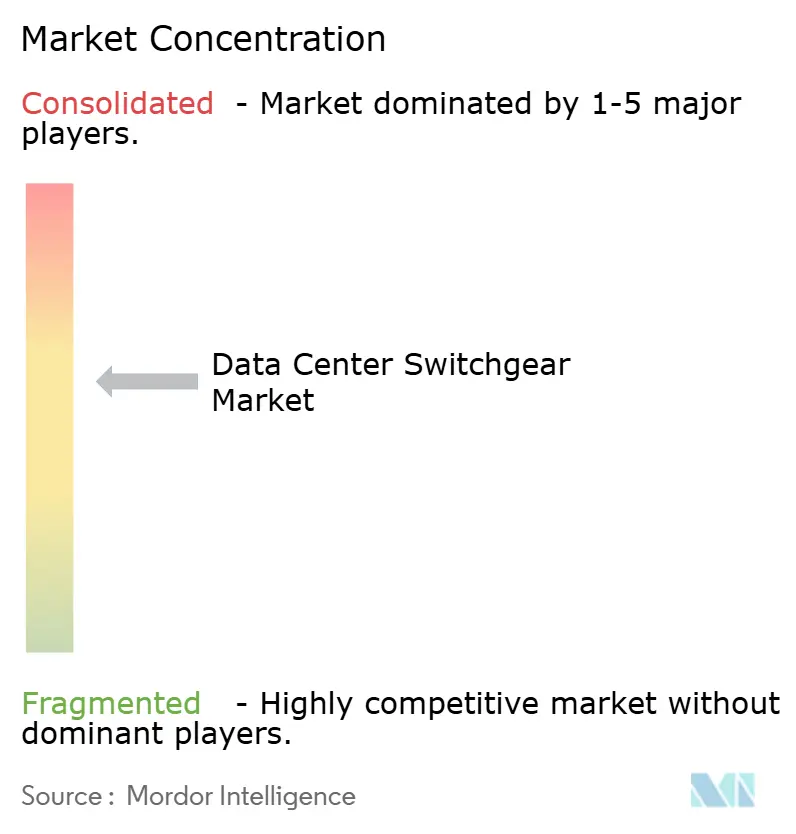
The data center switchgear market is moderately consolidated in premium medium-voltage and high-voltage applications. Schneider Electric, ABB, Eaton, Siemens, Hitachi Energy, and GE Vernova compete where engineering complexity, arc-flash certification, and access to manufacturing slots create significant entry barriers. Their technical teams must address protection coordination, product testing, site-specific layouts, and long delivery commitments before a project receives final approval. Competition increasingly centers on deployment speed and digital configurability rather than equipment ratings alone. Schneider Electric introduced software-defined medium-voltage switchgear in September 2026 and stated that the platform can provide 3 times faster ordering and manufacturing, 87% less control wiring, and 91% fewer terminals than conventional engineered-to-order assemblies. This approach aligns product competition with the time required to commission a new facility, which is a critical customer consideration during large campus construction.
ABB has pursued a related strategy through an NVIDIA collaboration on next-generation AI data center power architecture. The company also presented SACE Infinitus as the first IEC-certified solid-state circuit breaker, linking protection technology to high-density infrastructure needs. Eaton unveiled an 800 VDC reference architecture for AI factories in October 2025, extending its grid-to-chip power management approach. Siemens and Compass Datacenters agreed to deploy as many as 1,500 modular medium-voltage skids, which illustrates the importance of pre-tested integrated systems. These actions show that suppliers are seeking earlier involvement in the customer’s electrical architecture, from initial design decisions through factory preparation, site installation, and final commissioning, which makes it harder for smaller vendors to compete solely on equipment price.
A less crowded opportunity remains in arc-resistant, SF₆-free medium-voltage switchgear that meets IEC 62271-200 requirements at 38 kV and can operate in outdoor weatherized enclosures. Such products need to combine electrical reliability, environmental compliance, physical protection, and practical installation features in one approved configuration. Regional competitors such as LS ELECTRIC, Hyosung Heavy Industries, and CHINT Group are expanding internationally through lower prices and improving IEC certification portfolios. Their opportunity is strongest in colocation and cloud provider procurement where cost sensitivity is higher than in owner-operated hyperscale campuses. The data center switchgear industry has high qualification thresholds, but regional challengers can gain share in applications with more standardized requirements.
Data Center Switchgear Industry Leaders
-
Schneider Electric SE
-
Eaton Corporation plc
-
Siemens AG
-
GE Vernova Inc.
-
Hitachi Energy Ltd.
- *Disclaimer: Major Players sorted in no particular order
Data Center Switchgear Market Companies Covered in this Report
- Schneider Electric SE
- Eaton Corporation plc
- Siemens AG
- ABB Ltd
- Vertiv Holdings Co
- GE Vernova Inc.
- Mitsubishi Electric Corporation
- Hitachi Energy Ltd.
- Powell Industries, Inc.
- Toshiba Corporation
- Legrand SA
- LS ELECTRIC Co., Ltd.
- Hyosung Heavy Industries Co., Ltd.
- Fuji Electric Co., Ltd.
- Meidensha Corporation
- Anord Mardix
- Guangzhou Baiyun Electric Equipment Co., Ltd.
- CHINT Group Corporation
- Alfanar Group
- Socomec Group S.A.
- nVent Electric plc
Recent Industry Developments in Data Center Switchgear Market
- October 2026: Schneider Electric unveiled the world’s first fully software-defined medium-voltage switchgear at YOTTA 2026 in Las Vegas. The RM AirSeT 38 Software Defined was deployed in a live pilot at an Equinix colocation data center and extended SF₆-free medium-voltage technology to 38 kV for high-density data center architectures. Order intake is planned for 2027, with first deliveries planned for 2028.
- October 2026: LS Electric Co., a South Korean electrical equipment maker, secured a KRW 170 billion (USD 127 million) contract to supply switchgear for a data center project being developed by a major U.S. tech company.
- October 2026: Bajel Projects Limited has secured an Engineering, Procurement, and Construction (EPC) contract valued at approximately INR 200 crore (USD 21.02 million) for 400 KV Gas Insulated Switchgear (GIS) substations in Mumbai. The win reinforces the company's position in urban power transmission infrastructure.
- August 2026: Hitachi Energy has introduced new additions to its EconiQ high-voltage portfolio at CIGRE 2026 in Paris, expanding its lineup of SF6-free switchgear for transmission and distribution applications.
Global Data Center Switchgear Market Report Scope
Data center switchgear refers to a centralized collection of circuit breakers, fuses, and switches designed to efficiently manage, protect, and isolate electrical equipment within a facility. This critical infrastructure ensures an uninterrupted power supply while safeguarding sensitive hardware from electrical overloads and faults. By facilitating seamless power distribution, it maintains the operational continuity and resilience of the entire data center environment.
The Data Center Switchgear Market Report is Segmented by Voltage Level (Low Voltage, Medium Voltage, and High Voltage), Insulation Type (Air-Insulated Switchgear, Gas-Insulated Switchgear, and Other Insulation Technologies), Installation Type (Indoor Switchgear and Outdoor Switchgear), Configuration (Fixed-Mounted Switchgear, Withdrawable Switchgear, and Modular Switchgear), Data Center Size (Small, Medium, Large, and Hyperscale), Data Center Type (Colocation, Cloud Service Providers [CSPs], and Enterprise / Edge), and Geography (North America, South America, Europe, Asia-Pacific, and Middle East and Africa). The Market Forecasts are Provided in Terms of Value (USD).
Segmentation Overview
| Low Voltage |
| Medium Voltage |
| High Voltage |
| Air-Insulated Switchgear |
| Gas-Insulated Switchgear |
| Other Insulation Technologies |
| Indoor Switchgear |
| Outdoor Switchgear |
| Fixed-Mounted Switchgear |
| Withdrawable Switchgear |
| Modular Switchgear |
| Small |
| Medium |
| Large |
| Hyperscale |
| Colocation |
| Cloud Service Providers (CSPs) |
| Enterprise / Edge |
| North America | United States |
| Canada | |
| Mexico | |
| South America | Brazil |
| Argentina | |
| Rest of South America | |
| Europe | United Kingdom |
| Germany | |
| France | |
| Spain | |
| Rest of Europe | |
| Asia-Pacific | China |
| India | |
| Japan | |
| Australia | |
| Singapore | |
| Rest of Asia-Pacific | |
| Middle East and Africa | Saudi Arabia |
| United Arab Emirates | |
| South Africa | |
| Rest of Middle East |
| By Voltage Level | Low Voltage | |
| Medium Voltage | ||
| High Voltage | ||
| By Insulation Type | Air-Insulated Switchgear | |
| Gas-Insulated Switchgear | ||
| Other Insulation Technologies | ||
| By Installation Type | Indoor Switchgear | |
| Outdoor Switchgear | ||
| By Configuration | Fixed-Mounted Switchgear | |
| Withdrawable Switchgear | ||
| Modular Switchgear | ||
| By Data Center Size | Small | |
| Medium | ||
| Large | ||
| Hyperscale | ||
| By Data Center Type | Colocation | |
| Cloud Service Providers (CSPs) | ||
| Enterprise / Edge | ||
| By Geography | North America | United States |
| Canada | ||
| Mexico | ||
| South America | Brazil | |
| Argentina | ||
| Rest of South America | ||
| Europe | United Kingdom | |
| Germany | ||
| France | ||
| Spain | ||
| Rest of Europe | ||
| Asia-Pacific | China | |
| India | ||
| Japan | ||
| Australia | ||
| Singapore | ||
| Rest of Asia-Pacific | ||
| Middle East and Africa | Saudi Arabia | |
| United Arab Emirates | ||
| South Africa | ||
| Rest of Middle East | ||
Key Questions Answered in the Report
What is the data center switchgear market size?
The data center switchgear market is projected to increase from USD 4.97 billion in 2027 to USD 9.20 billion by 2032 at a 13.11% CAGR. The expansion reflects rising demand for power distribution systems that can serve AI computing and large data center campuses.
What is driving demand for data center switchgear?
The data center switchgear market is being supported by AI computing, hyperscale construction, colocation expansion, modular infrastructure, and SF₆ restrictions. These factors increase the need for higher-capacity equipment and certified power distribution designs across the data center switchgear market.
Which voltage level has the strongest outlook?
Low voltage held 52.19% share in 2026, while medium voltage is projected to record the highest expansion rate at a 14.57% CAGR through 2032. Medium-voltage systems help operators manage larger power blocks closer to high-density IT loads.
Why are SF₆-free switchgear systems important?
The data center switchgear market is shifting toward clean-air, vacuum, and solid-dielectric alternatives as restrictions in Europe and several U.S. states limit SF₆ use. These technologies can support compliance needs while serving compact or high-capacity applications.
Which region is expected to expand fastest?
Asia-Pacific is projected to expand at a 14.93% CAGR through 2032. Power-advantaged locations, regional capacity expansion, and local equipment assembly are reshaping the addressable data center switchgear market across the region.
What constraints affect data center switchgear procurement?
Long manufacturing lead times, testing and qualification needs, grid constraints, and a shortage of electrical commissioning labor can delay project completion. Early design approval and production-slot planning can help participants in the data center switchgear market manage these risks and reduce late-stage delivery disruption for project teams and suppliers.