
Data Center Sustainable Cooling Market Size and Share
Market Overview
| Study Period | 2021 - 2032 |
|---|---|
| Market Size (2027) | USD 19.07 Billion |
| Market Size (2032) | USD 32.69 Billion |
| Growth Rate (2027 - 2032) | 11.38 % |
| Fastest Growing Market | Asia-Pacific |
| Largest Market | North America |
| Market Concentration | Low |
Major Players *Disclaimer: Major Players sorted in no particular order Image © Mordor Intelligence. Reuse requires attribution under CC BY 4.0. | |
Data Center Sustainable Cooling Market Analysis by Mordor Intelligence
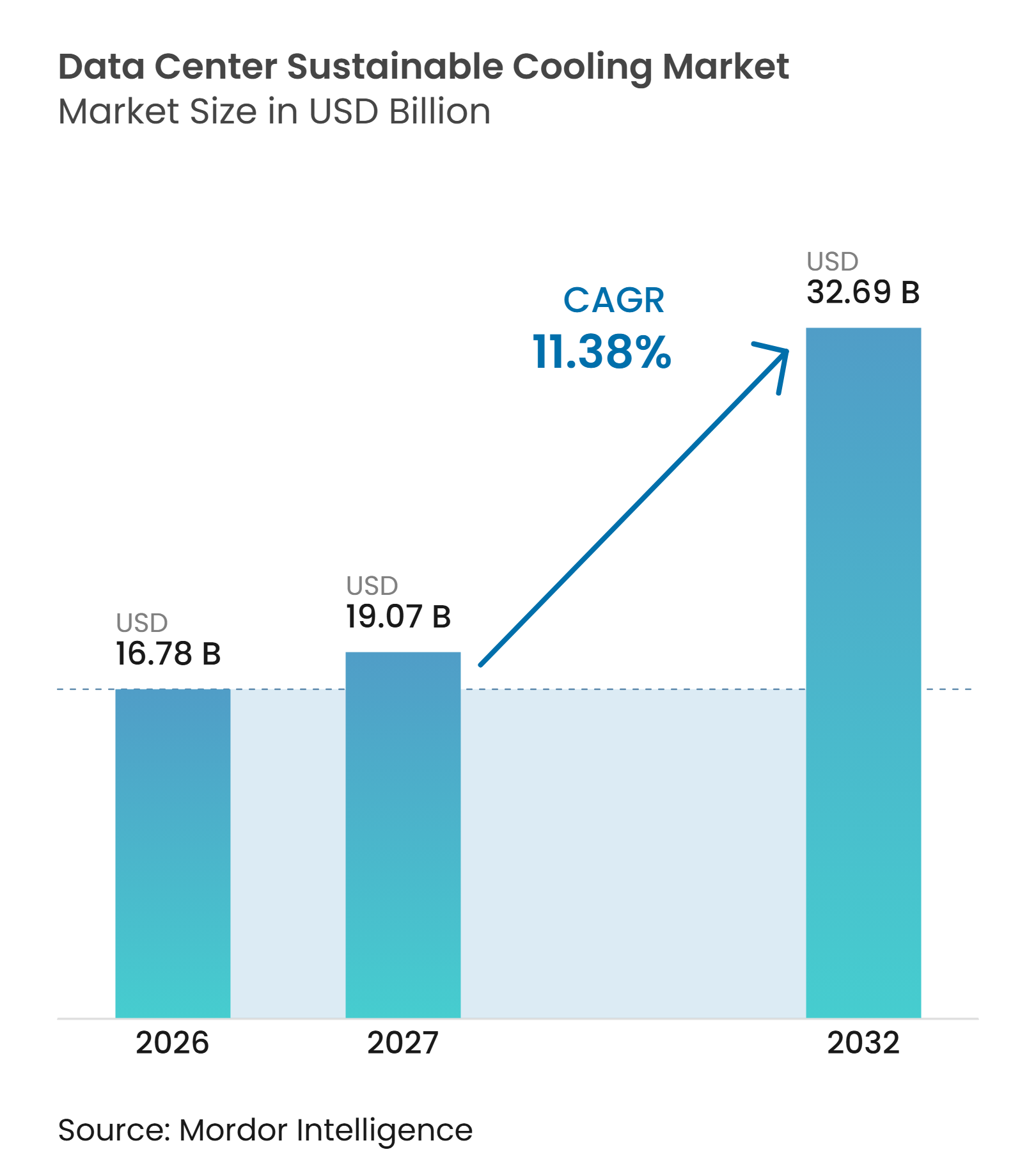
The data center sustainable cooling market size is projected to expand from USD 16.78 billion in 2026 to USD 19.07 billion in 2027, and to USD 32.69 billion by 2032, registering a CAGR of 11.38% between 2027 and 2032. Higher rack densities are changing cooling from a facility support function into a core design requirement for AI infrastructure. Conventional air systems remain relevant across the installed base, but they are less suitable for the highest-density training and inference clusters. The data center sustainable cooling market is therefore attracting investment toward liquid-ready designs, heat-rejection equipment, controls, and fluid management. Acquisitions and product integration are making it easier for large suppliers to offer equipment and services across the cooling chain. Regulatory requirements for energy, water, and refrigerants, as well as reporting, also place greater emphasis on efficiency and system interoperability.
Key Report Takeaways
- By cooling technology, air-based cooling held 34.27% of the data center sustainable cooling market share in 2026, while immersion cooling is projected to expand at an 11.66% CAGR through 2032.
- By heat-rejection technology, air-cooled systems accounted for 46.73% of the data center sustainable cooling market share in 2026, while hybrid heat-rejection systems are projected to expand at an 11.94% CAGR through 2032.
- By cooling system component, fans and air-handling equipment accounted for 17.14% of the data center sustainable cooling market share in 2026, while cooling distribution units are projected to expand at an 11.83% CAGR through 2032.
- By sustainability approach, energy-efficient cooling accounted for 38.29% of the data center sustainable cooling market share in 2026, while heat recovery-enabled cooling is projected to expand at a 12.14% CAGR through 2032.
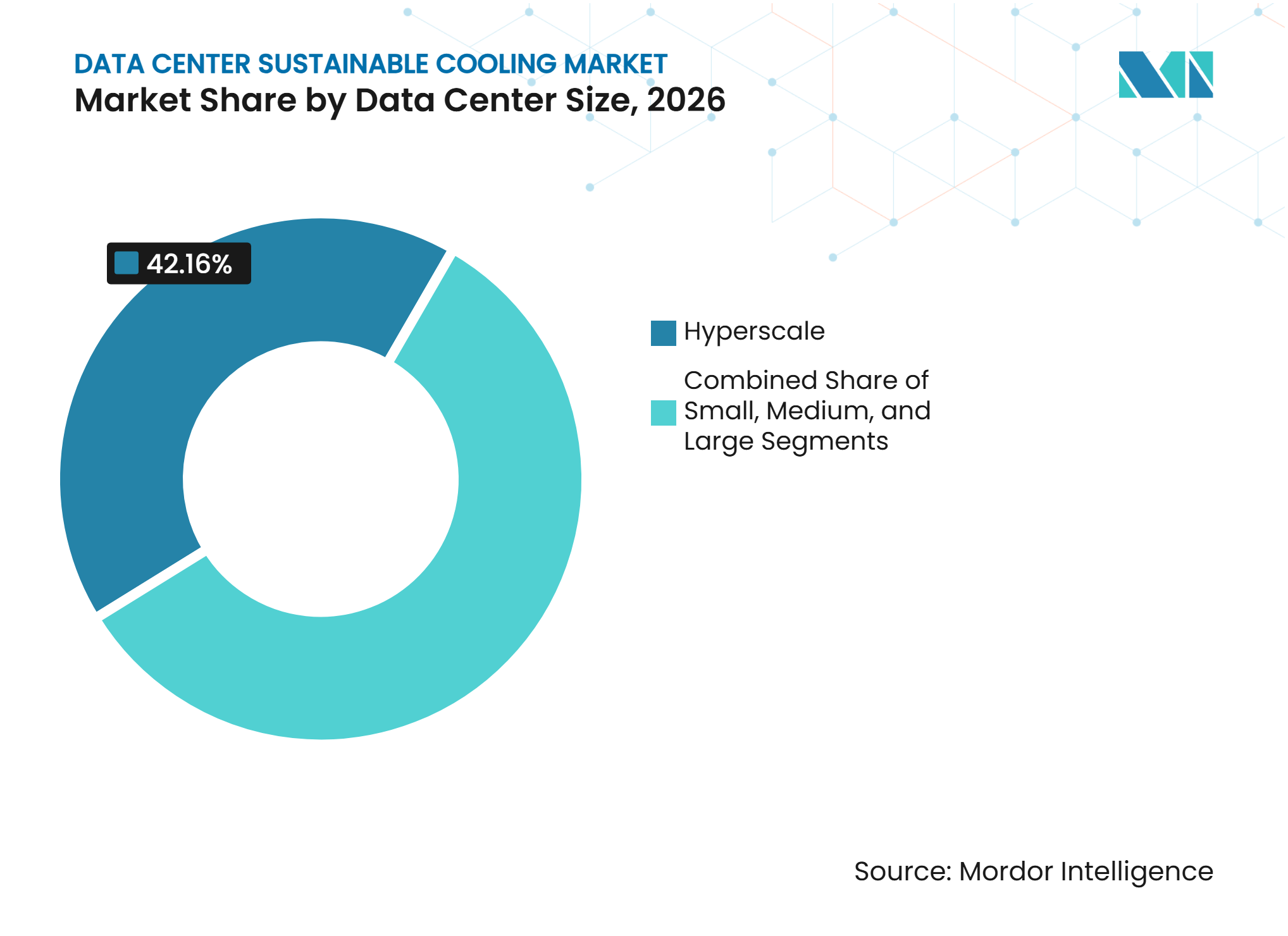
- By data center size, hyperscale data centers held 42.16% of the data center sustainable cooling market share in 2026 and are the fastest-expanding size category through 2032.
- By data center type, cloud service providers accounted for 44.26% of the data center sustainable cooling market share in 2026 and are the fastest-expanding operator category through 2032.
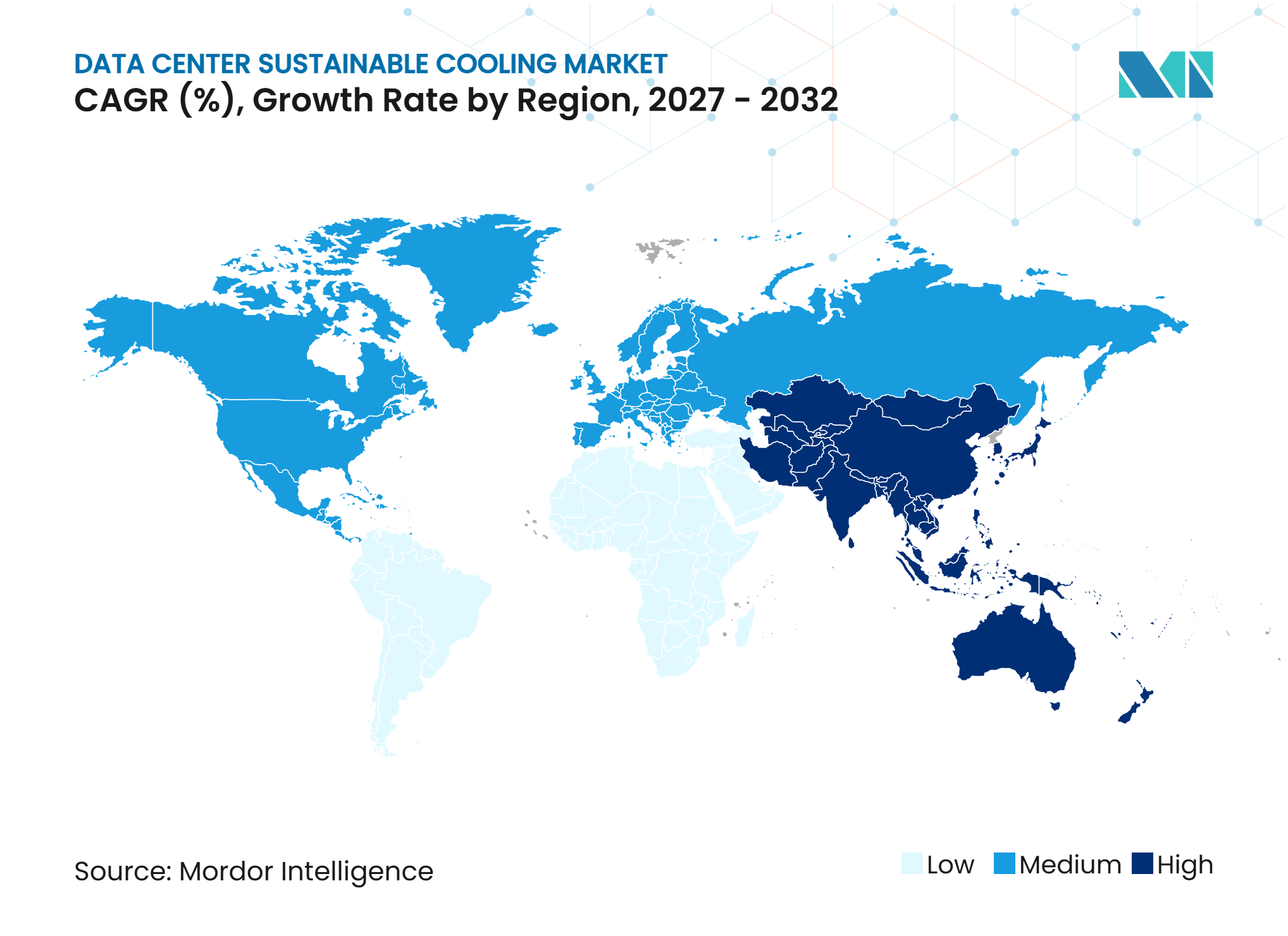
- By geography, North America held 36.28% of the data center sustainable cooling market share in 2026, while Asia-Pacific is projected to expand at an 11.99% CAGR through 2032.
Note: Market numbers in this report are based on Mordor Intelligence's proprietary estimation framework, which combines nine months of actuals with Q4 projections for base year 2026.
Market Trends and Insights
Drivers Impact Analysis of Data Center Sustainable Cooling Market*
| Driver | (~) % Impact on CAGR Forecast | Geographic Relevance | Impact Timeline |
|---|---|---|---|
| AI and HPC Workload Heat-Density Surge | +2.5% | Global | Short term (≤ 2 years) |
| Hyperscale Expansion in Secondary Metros | +1.8% | North America, Europe, Asia-Pacific | Medium term (2-4 years) |
| Mandatory PUE and GHG Disclosure | +1.5% | Europe, with spillover to North America and Asia-Pacific | Short term (≤ 2 years) |
| OEM Warranties Covering Direct-to-Chip Loops | +1.2% | Global, led by North America | Short term (≤ 2 years) |
| OCP-Compatible Coolant Standardization | +0.9% | Global | Medium term (2-4 years) |
| Waste-Heat Monetization Through District Energy Loops | +0.7% | Europe and North America | Long term (≥ 4 years) |
| Source: Mordor Intelligence | |||
AI and HPC Workload Heat-Density Surge
Leading AI accelerators have thermal design power above 1,000 W per chip and are moving toward 2,000 W or more. These loads create rack conditions that conventional air systems cannot manage without substantial mechanical support. ASHRAE recommends direct-to-chip or rear-door heat exchanger architectures for racks operating from 50 kW to 120 kW. The guidance shows that these levels are now associated with training and inference clusters rather than isolated edge cases. A 2025 peer-reviewed review found that direct liquid cooling and rear-door heat exchangers offer mature options for thermal efficiency, scalability, and heat reuse. It also found that predictive controls can improve facility performance relative to static air cooling, which makes the choice of cooling architecture relevant to equipment capacity, system control, reuse potential, and the ability to operate dense clusters within acceptable thermal limits.[1]
Hyperscale Expansion in Secondary Metros
New campuses in secondary locations are strengthening demand for liquid-ready cooling from the first stage of design. These locations often lack the large installed base of legacy cooling infrastructure found in established hubs. That makes it easier for operators to use liquid systems, dry coolers, and other suitable equipment without planning complex retrofits. Water efficiency and low-global-warming-potential refrigerants can have greater value where district heating networks are limited. The data center sustainable cooling market can therefore benefit from new-build projects that treat thermal architecture as part of site selection. The same projects may still need to balance cooling choices with local grid availability and water conditions, because a suitable system must meet density requirements while fitting the physical conditions, available utilities, expected operating practices, and sustainability priorities of the selected site.
Mandatory PUE and GHG Disclosure
The European Commission adopted a delegated regulation on September 21, 2026, establishing an A-to-G sustainability label for data centers with installed IT power demand of at least 500 kW. The label grades facilities based on power and water usage effectiveness, with the first labels expected in 2027. Sweden has required annual energy performance reporting from qualifying data center operators since July 1, 2025. These requirements place cooling performance in public reporting and procurement decisions. Operators that invest in efficient or heat recovery-enabled systems can use stronger performance results to support tenant discussions. The data center sustainable cooling market also gains a clearer compliance case as reporting moves from voluntary practice to formal disclosure, making energy use, water use, documented performance, and the technical choices behind those results more visible to operators, tenants, regulators, and other stakeholders.
OEM Warranties Covering Direct-to-Chip Loops
Warranty coverage has previously slowed the use of third-party liquid cooling systems around high-value processors. NVIDIA introduced a CDU Self-Validation pathway in September 2025 for providers seeking inclusion on its Reference Validated List. The approach gives equipment providers a clearer route to demonstrate compatibility with supported hardware. Schneider Electric has stated that its Motivair CDU portfolio supports NVIDIA hardware and ranges from 105 kW to 2.5 MW. The company also describes closed-loop air-cooled chillers as a means to reduce water use at data center sites. The OCP and ASHRAE alliance is working to align open specifications with established cooling standards, reducing uncertainty in multi-vendor deployments by linking equipment design, validation expectations, facility performance requirements, and coolant practices in a framework that operators can use when comparing supported solutions.[2]
Restraints Impact Analysis of Data Center Sustainable Cooling Market*
| Restraint | (~) % Impact on CAGR Forecast | Geographic Relevance | Impact Timeline |
|---|---|---|---|
| Advanced-Liquid Technology Capex Premium | -2.1% | Global, most acute in emerging markets | Medium term (2-4 years) |
| Legacy White-Space Retrofit Complexity | -1.5% | Global, most acute in established markets | Long term (≥ 4 years) |
| Limited Field Expertise Among Facility Engineers | -1.0% | Asia-Pacific, Middle East and Africa, South America | Medium term (2-4 years) |
| PFAS Restrictions and Two-Phase Fluid Replacement Uncertainty | -0.7% | North America and Europe | Long term (≥ 4 years) |
| Source: Mordor Intelligence | |||
Advanced-Liquid Technology Capex Premium
Direct-to-chip and immersion systems need more initial investment than conventional air-cooled installations. Their cost includes CDUs, cold plates, manifolds, chillers, secondary loops, and specialist commissioning. Immersion deployments can also require structural work to support tank weight. Operators must validate loop cleanliness, pH control, and corrosion inhibitor levels before service begins. The data center sustainable cooling market faces slower adoption where tenants do not yet need high-density AI capacity. In those cases, a conventional air-cooled system can remain less expensive at the point of installation, and the need to fund a full set of liquid equipment, preparation work, operational checks, and specialist support can delay a decision until workload density clearly justifies the added investment.
Legacy White-Space Retrofit Complexity
Most existing white space was designed around raised floors and perforated tiles to distribute air. Direct-to-chip systems need plumbing, leak detection, containment, and new thermal zoning that these facilities were not built to support. Live upgrades must often be phased to avoid cooling interruptions for existing customers. That can leave operators with mixed air-and-liquid environments that are harder to monitor and maintain. A 2025 peer-reviewed review found that retrofit feasibility depends on compatibility between the legacy water regime and the technology's cooling loop. ASHRAE Standard 90.4 adds facility performance requirements for new systems installed in existing facilities, so retrofit plans must consider the building layout, the existing system, the proposed liquid loop, the sequencing of work, and the post-installation performance requirements.[3]
*Our forecasts treat driver/restraint impacts as directional, not additive. The impact forecasts reflect baseline growth, mix effects, and variable interactions.
Data Center Sustainable Cooling Market Segment Analysis
By Cooling Technology:
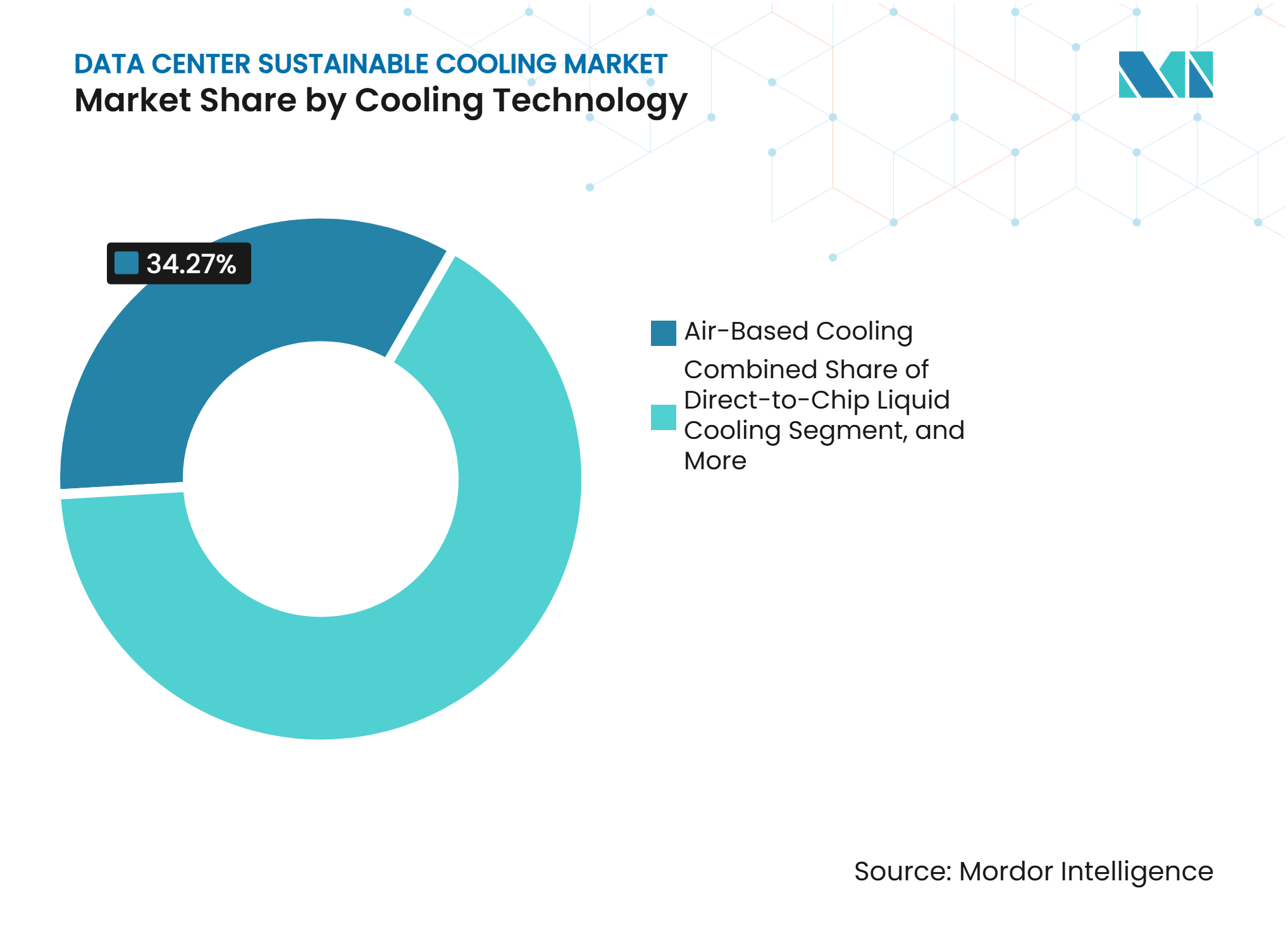
Air-Based Cooling Retains Its Installed-Base AdvantageAir-based cooling held 34.27% of the data center sustainable cooling market share in 2026. Its position reflects the size of the installed base created when racks commonly operated at 5-20 kW. Fans, computer room air handlers, aisle containment, and related systems remain familiar to facility teams. These systems can still be cost-competitive for workloads below 30 kW per rack. Direct-to-chip liquid cooling, rear-door heat exchangers, evaporative systems, adiabatic systems, free cooling, and economizer designs serve different density and cost requirements. The data center sustainable cooling industry continues to use air systems where their thermal limits fit the workload.
Immersion cooling is projected to expand at an 11.66% CAGR from 2027 to 2032. Its appeal is strongest for hyperscale operators that can accept tank-based designs in return for greater thermal capacity. A 2025 peer-reviewed review found that two-phase designs can provide high heat removal efficiency at demanding chip-level thermal loads. This makes them relevant to AI factory configurations where rack densities exceed 100 kW. Warranty support for immersion remains less mature than support for direct-to-chip systems. NVIDIA’s published validation pathway initially focuses on CDU-based deployments, which can limit immersion projects that depend on OEM-backed GPU support.



By Heat Rejection Technology:
Hybrid Systems Meet Water and Reliability NeedsAir-cooled systems accounted for 46.73% of the data center sustainable cooling market share in 2026. They offer lower installation costs, limited water use, and familiar maintenance practices for moderate-density facilities. Water-cooled equipment, evaporative systems, dry coolers, and hybrid systems serve the remaining demand. Operators select among them based on climate, water availability, cooling load, and sustainability goals. Closed-loop and dry cooling options have particular relevance in water-constrained areas. The data center sustainable cooling market depends on heat rejection choices that maintain capacity without creating unnecessary water exposure.
Hybrid heat rejection systems are projected to expand at an 11.94% CAGR from 2027 to 2032. These systems use dry coolers when ambient conditions allow and add evaporative or mechanical cooling during peak periods. This operating approach gives facilities a practical middle ground between wet cooling and a fully air-side design. Vertiv acquired ThermoKey in March 2026 to add dry coolers and microchannel heat exchangers to its portfolio. The company linked the acquisition to low-global-warming-potential options that support EU F-gas requirements. The European F-gas phase-down is therefore influencing equipment selection even where a fully water-based system could otherwise meet thermal needs.
By Cooling System Component:
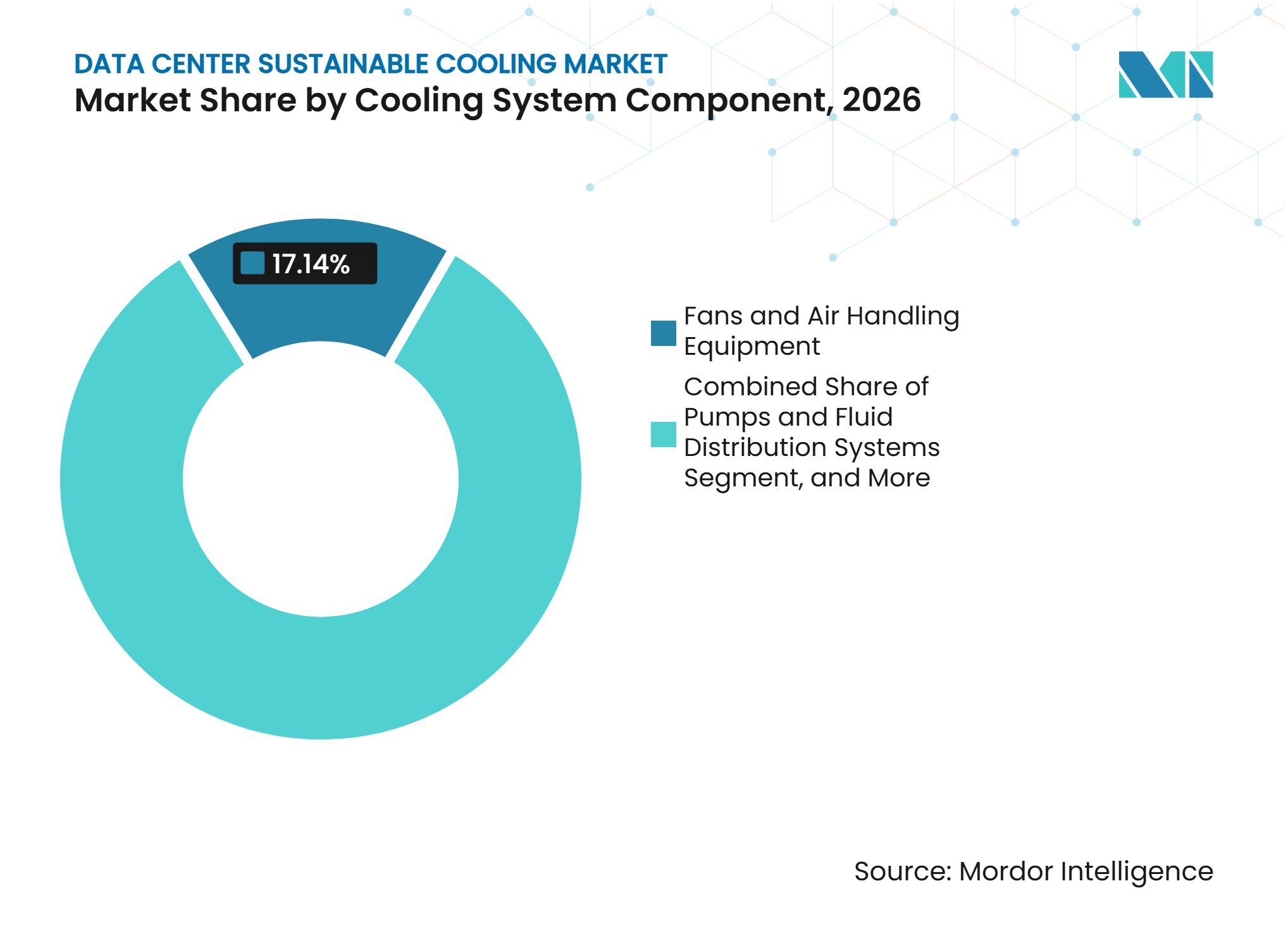
CDUs Gain Importance as Liquid Deployments ScaleFans and air-handling equipment accounted for 17.14% of the data center sustainable cooling market share in 2026. Their lead reflects the large installed base of computer room air handlers, in-row systems, and perforated-tile designs. Chillers, cooling towers, heat exchangers, pumps, fluid distribution equipment, and cooling controls make up the balance of the component mix. Monitoring systems are gaining importance as predictive controls become more common in facility management. They help operators observe fluid conditions, equipment load, and thermal performance. The data center sustainable cooling industry still relies on these components even as liquid cooling becomes more prominent.
Cooling distribution units are projected to expand at an 11.83% CAGR from 2027 to 2032. A CDU links the facility-side cooling system with the technology cooling loop, making it a core component in direct-to-chip designs. LiquidStack announced commercial availability of its GigaModular CDU platform with validated capacity up to 14 MW in May 2026. The modular design allows capacity to be added in line with campus deployment stages. The Open Compute Project issued Version 1.3 of its single-phase water-based cold plate coolant specification in August 2026. The specification sets common requirements for pH, corrosion, dissolved solids, and microbial control, improving interoperability across CDU loops.

By Sustainability Approach:
Heat Recovery Links Efficiency With Commercial ValueEnergy-efficient cooling held 38.29% of the data center sustainable cooling market share in 2026. This category includes equipment and control strategies that lower cooling power relative to IT load. Water-efficient cooling, low-global-warming-potential refrigerants, and integrated optimization controls address other sustainability measures. The European sustainability label will grade qualifying data centers on both power usage effectiveness and water usage effectiveness. This distinction confirms that low energy use and low water use are separate technical objectives. The data center sustainable cooling market needs systems that address both measures without reducing service reliability.
Heat-recovery-enabled cooling is projected to grow at a 12.14% CAGR from 2027 to 2032. Recovered heat can supply district energy networks rather than be rejected as waste. Fortum commissioned two heat pump plants at Microsoft data center sites in Espoo and Kirkkonummi during the 2025-2026 heating season. The sites provide 350 MW of thermal capacity to Fortum’s district heating network, serving 250,000 residents. The investment was EUR 225 million (USD 243 million). A 2026 study found that a large-scale, long-distance district heating system using multistage heat pumps could achieve a system coefficient of performance of 3.46 and a payback period of 2.57 years for a 100 MW heat source.
By Data Center Size:
Hyperscale Facilities Set Cooling RequirementsHyperscale data centers accounted for 42.16% of the sustainable cooling market share in the data center market in 2026. They also represent the fastest-expanding size category through 2032. Large facilities are increasingly preparing for liquid-ready deployment to meet tenant demand for AI-capable density. Medium and small operators face longer lead times and higher per-rack costs when considering a liquid transition. Their facilities often require further redesign before new loops can be installed. The data center sustainable cooling market, therefore, remains concentrated on projects that can fund integrated cooling designs at scale.
Hyperscale operators also have a strong role in defining equipment requirements through OEM co-development and open specifications. Their procurement volumes can influence the availability and cost of CDUs, cold plates, chillers, and controls for smaller operators. Google stated in May 2025 that half of its global data center footprint had liquid cooling enabled or deployed. The company described roughly 1 GW of liquid cooling capacity across 2,000 pods equipped with Tensor Processing Unit AI chips. It also reported 99.999% uptime for those deployments. This scale supports the broader adoption of liquid infrastructure and gives suppliers a strong incentive to develop equipment for multimegawatt sites.
By Data Center Type:
Cloud Service Providers Establish Technical StandardsCloud service providers accounted for 44.26% of the data center sustainable cooling market share in 2026. They are also the fastest-expanding data center type through 2032. Their choices around CDUs, coolant specifications, and loop design can affect the wider supply chain. Open specifications can encourage colocation providers and enterprise operators to align with a common technology baseline. Colocation, enterprise, and edge data centers make up the remaining demand. Enterprise and edge facilities need to address rising compute density even when their buildings were not originally designed for liquid cooling.
Colocation providers face a difficult financing and operating task. They must improve cooling capacity while honoring service-level agreements and power-density commitments made under air-cooled assumptions. Existing tenants may require uninterrupted service throughout the upgrade. This makes phased upgrades important, even when phased work increases complexity. Cloud service providers control more of their cooling architecture when they develop their own campuses. Colocation operators can respond by using modular equipment that supports high-density demand without requiring an immediate, full-facility replacement.
Geography Analysis
North America
North America held 36.28% of the data center sustainable cooling market share in 2026, reflecting its major concentration of hyperscale AI training campuses and established suppliers of CDUs and chillers. Texas, Virginia, Georgia, and Ohio are key development areas for AI-focused facilities, where rack-density requirements are increasing demand for closed-loop liquid cooling, dry coolers, and water-efficient heat rejection equipment. Facility owners must pair these systems with practical maintenance capabilities because the transition affects plumbing, fluid control, and service practices as well as the initial selection of thermal equipment. The Environmental Protection Agency’s review of PFAS approvals for two-phase fluids is an important regulatory influence for immersion cooling. This uncertainty supports interest in single-phase direct-to-chip systems while PFAS-free dielectric options mature and operators seek reliable equipment choices for projects already under development.
Asia-Pacific
Asia-Pacific is projected to expand at an 11.99% CAGR from 2027 to 2032. India is adding capacity across Mumbai, Chennai, Hyderabad, Pune, and emerging locations such as Visakhapatnam, while AI workloads and large cloud deployments increase the need for cooling systems capable of handling dense equipment. Malaysia is developing recycled-water infrastructure for data center cooling through the AirTrunk and Johor Special Water partnership, which targets a 50-70% reduction in freshwater demand for cooling. Singapore’s 2025 requirements for efficient IT equipment capable of operating at inlet temperatures up to 35°C demonstrate how hot-climate markets can use equipment standards to promote facility efficiency.
Europe, South America, Middle East and Africa
Europe is moving capacity beyond its established FLAP-D markets as cooling, grid, and site requirements change, and the EU Energy Efficiency Directive reporting framework and delegated sustainability label are key compliance factors in technology selection. Germany’s energy efficiency law requires data centers to source 100% renewable electricity from 2027, while Nordic district energy networks provide an avenue to monetize recovered server heat. Meta’s Odense site sends recovered heat to the Fjernvarme Fyn network and recovers 100,000 MWh annually. South America is developing through Brazil, Mexico, Chile, and Colombia, where cooler locations can extend free-cooling hours and reduce the mechanical cooling energy required by facilities. Saudi Arabia and the United Arab Emirates face hot, arid conditions that increase the importance of dry cooling and closed-loop liquid designs with low water use.
Competitive Landscape
Market Concentration
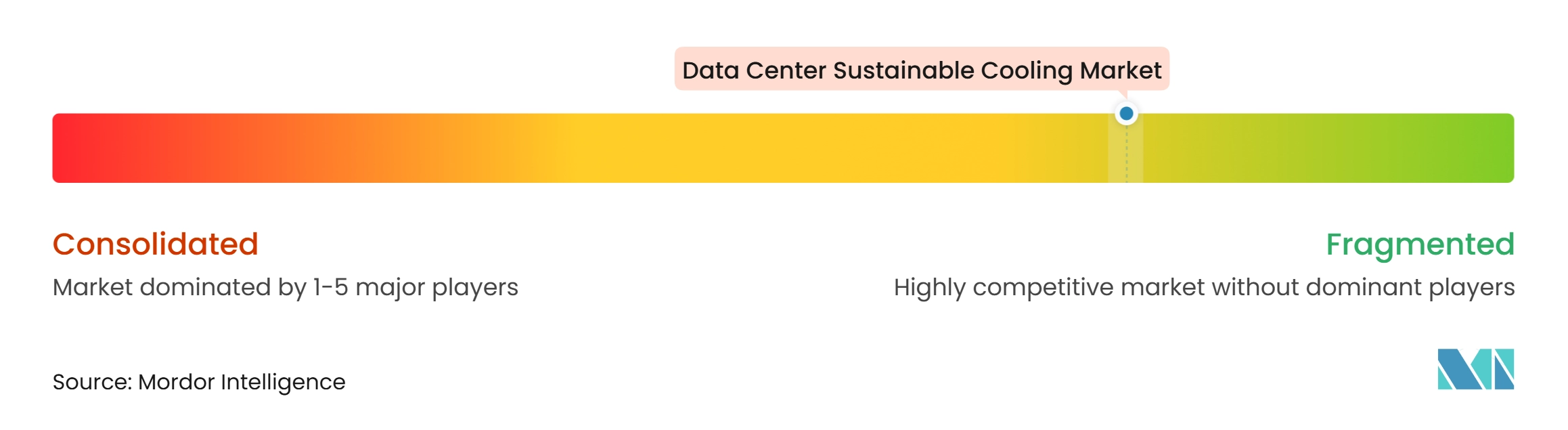
The data center sustainable cooling market is fragmented at the product level, but strategic consolidation is becoming more visible as large industrial suppliers seek to combine the equipment, fluid management, service, and technical support needed for high-density facilities. Ecolab entered into an agreement to acquire CoolIT Systems in March 2026 for USD 4.75 billion in cash, a transaction that illustrates the value placed on specialized hardware in a broader cooling and water management platform. Ecolab stated that the combination would pair CoolIT’s CDUs, cold plates, and direct-to-chip cooling capabilities with its water chemistry, digital monitoring, and global service network, giving customers access to a more integrated set of capabilities. This approach matters because customers with large AI deployments must manage thermal performance, loop quality, equipment availability, water use, and service access together rather than treating each item as a separate procurement decision.
Trane Technologies completed its LiquidStack acquisition in March 2026, adding high-density liquid, direct-to-chip, and immersion cooling products to a broader thermal management portfolio that already includes equipment used on the facility side of the cooling system. The transaction gives Trane Technologies a closer connection between cooling generation, heat rejection, controls, distribution, and server-level thermal equipment, which are increasingly interdependent in AI-focused site designs. LiquidStack subsequently made its GigaModular CDU commercially available with validated capacity up to 14 MW in May 2026, demonstrating the scale of equipment now being developed for phased campus buildouts. Schneider Electric also expanded its liquid cooling offer through Motivair, with a portfolio covering CDUs from 105 kW to 2.5 MW, rear-door heat exchangers, liquid-to-air heat dissipation units, dynamic cold plates, and technology cooling systems. Together, these moves show that large vendors are seeking to supply the full path from the facility cooling plant through fluid distribution to the server interface, rather than selling a narrow piece of an increasingly integrated system.
Specialists retain opportunities where they can simplify retrofits in air-cooled white space, especially when their equipment can connect to existing chilled-water networks and reduce the need for a full replacement of facility infrastructure. Modular CDUs can offer an incremental path for customers that need new liquid capacity but cannot accept a broad shutdown, major building works, or a sudden change to every rack in a live environment. The Open Compute Project’s coolant specification establishes common expectations for pH, corrosion, dissolved solids, and microbial control in single-phase cold plate loops, making technical interoperability more visible to buyers. This common framework can reward companies with strong applications engineering, commissioning, and service capability because they can help customers translate a standard into dependable operation at a specific site. It can also help colocation and enterprise customers compare multi-vendor solutions with clearer technical requirements, although the final choice will still depend on the facility’s water system, operating temperatures, tenant commitments, and ability to maintain the equipment.
Data Center Sustainable Cooling Industry Leaders
-
Vertiv Group Corp.
-
Schneider Electric SE
-
Trane Technologies plc
-
Johnson Controls International plc
-
Daikin Industries, Ltd.
- *Disclaimer: Major Players sorted in no particular order
Data Center Sustainable Cooling Market Companies Covered in this Report
- Vertiv Group Corp.
- Schneider Electric SE
- Trane Technologies plc
- Johnson Controls International plc
- Daikin Industries, Ltd.
- Carrier Global Corporation
- Mitsubishi Heavy Industries, Ltd.
- Mitsubishi Electric Corporation
- Munters Group AB
- STULZ GmbH
- Rittal GmbH & Co. KG
- Modine Manufacturing Company
- CoolIT Systems Inc.
- Motivair Corporation
- LiquidStack Inc.
- Submer Technologies SL
- Boyd Corporation
- Delta Electronics, Inc.
- Alfa Laval AB
- Baltimore Aircoil Company
Recent Industry Developments in Data Center Sustainable Cooling Market
- October 2026: Vertiv announced the acquisition of King Environmental Services, a data center fluid management specialist. The transaction is expected to close before year-end 2026 and strengthens Vertiv’s ability to provide integrated loop commissioning, chemistry management, and on-site service alongside its hardware portfolio. It extends Vertiv’s role from an equipment provider toward a lifecycle service partner for customers operating liquid cooling loops.
- September 2026: Trane Technologies and LiquidStack launched a 2.5 MW CDU, with commercial shipments scheduled to begin in Q2 2027. The unit targets hyperscale operators building NVIDIA Vera Rubin-class clusters that require multimegawatt cooling capacity per pod and adds a defined option for large, high-density deployments.
- September 2026: The European Commission adopted a delegated regulation establishing an EU-wide A-to-G sustainability rating scheme for data centers with installed IT power demand of at least 500 kW. It grades operators on power usage effectiveness and water usage effectiveness, with first labels expected in 2027 and a minimum energy performance proposal expected in Q2 2027. The rule makes both energy and water performance more visible within a common reporting framework.
- June 2026: Schneider Electric launched the Uniflair XCA chiller line, with up to 2.5 MW of cooling capacity per unit, for high-density AI data centers requiring close-coupled liquid infrastructure and redundancy. The product is intended for deployments that need cooling equipment to work closely with liquid systems serving dense IT loads.
Global Data Center Sustainable Cooling Market Report Scope
The Data Center Sustainable Cooling Market refers to the market for energy-efficient, low-carbon, and water-conscious cooling technologies, systems, and services designed to manage thermal loads in data centers while minimizing environmental impact, covering liquid cooling (direct-to-chip, immersion, rear-door heat exchangers), free/air-side economization, evaporative and adiabatic cooling, low-GWP refrigerant chillers, waste-heat recovery, AI-driven thermal optimization, and water-efficient closed-loop systems.
The Data Center Sustainable Cooling Market Report is Segmented by Cooling Technology (Air-Based Cooling, Direct-to-Chip Liquid Cooling, Immersion Cooling, Rear-Door Heat Exchangers, Evaporative and Adiabatic Cooling, Free Cooling and Economizer Systems, and Other Sustainable Cooling Technologies), Heat Rejection Technology (Air-Cooled Systems, Water-Cooled Systems, Evaporative Heat Rejection, Dry Coolers, and Hybrid Heat Rejection Systems), Cooling System Component (Cooling Distribution Units (CDUs), Chillers, Cooling Towers, Heat Exchangers, Pumps and Fluid Distribution Systems, Fans and Air Handling Equipment, and Cooling Controls and Monitoring Systems), Sustainability Approach (Energy-Efficient Cooling, Water-Efficient Cooling, Low-Global-Warming-Potential Refrigerant Solutions, Heat Recovery-Enabled Cooling, and Integrated Cooling Optimization and Controls), Data Center Size (Small, Medium, Large, and Hyperscale), Data Center Type (Colocation, Cloud Service Providers (CSPs), and Enterprise and Edge), and Geography (North America (United States, Canada, and Mexico), South America (Brazil, Argentina, Chile, Colombia, Peru, and Rest of South America), Europe (United Kingdom, Germany, France, Netherlands, Ireland, Spain, Italy, Nordics, and Rest of Europe), Asia-Pacific (China, India, Japan, Australia, Singapore, South Korea, Malaysia, Indonesia, and Rest of Asia-Pacific), and Middle East and Africa (Saudi Arabia, United Arab Emirates, Israel, Qatar, South Africa, Egypt, and Rest of Middle East and Africa)). The Market Forecasts Are Provided in Terms of Value (USD).
Segmentation Overview
| Air-Based Cooling |
| Direct-to-Chip Liquid Cooling |
| Immersion Cooling |
| Rear-Door Heat Exchangers |
| Evaporative and Adiabatic Cooling |
| Free Cooling and Economizer Systems |
| Other Sustainable Cooling Technologies |
| Air-Cooled Systems |
| Water-Cooled Systems |
| Evaporative Heat Rejection |
| Dry Coolers |
| Hybrid Heat Rejection Systems |
| Cooling Distribution Units (CDUs) |
| Chillers |
| Cooling Towers |
| Heat Exchangers |
| Pumps and Fluid Distribution Systems |
| Fans and Air Handling Equipment |
| Cooling Controls and Monitoring Systems |
| Energy-Efficient Cooling |
| Water-Efficient Cooling |
| Low-Global-Warming-Potential Refrigerant Solutions |
| Heat Recovery-Enabled Cooling |
| Integrated Cooling Optimization and Controls |
| Small |
| Medium |
| Large |
| Hyperscale |
| Colocation |
| Cloud Service Providers (CSPs) |
| Enterprise and Edge |
| North America | United States |
| Canada | |
| Mexico | |
| South America | Brazil |
| Argentina | |
| Chile | |
| Colombia | |
| Peru | |
| Rest of South America | |
| Europe | United Kingdom |
| Germany | |
| France | |
| Netherlands | |
| Ireland | |
| Spain | |
| Italy | |
| Nordics | |
| Rest of Europe | |
| Asia-Pacific | China |
| India | |
| Japan | |
| Australia | |
| Singapore | |
| South Korea | |
| Malaysia | |
| Indonesia | |
| Rest of Asia-Pacific | |
| Middle East and Africa | Saudi Arabia |
| United Arab Emirates | |
| Israel | |
| Qatar | |
| South Africa | |
| Egypt | |
| Rest of Middle East and Africa |
| By Cooling Technology | Air-Based Cooling | |
| Direct-to-Chip Liquid Cooling | ||
| Immersion Cooling | ||
| Rear-Door Heat Exchangers | ||
| Evaporative and Adiabatic Cooling | ||
| Free Cooling and Economizer Systems | ||
| Other Sustainable Cooling Technologies | ||
| By Heat Rejection Technology | Air-Cooled Systems | |
| Water-Cooled Systems | ||
| Evaporative Heat Rejection | ||
| Dry Coolers | ||
| Hybrid Heat Rejection Systems | ||
| By Cooling System Component | Cooling Distribution Units (CDUs) | |
| Chillers | ||
| Cooling Towers | ||
| Heat Exchangers | ||
| Pumps and Fluid Distribution Systems | ||
| Fans and Air Handling Equipment | ||
| Cooling Controls and Monitoring Systems | ||
| By Sustainability Approach | Energy-Efficient Cooling | |
| Water-Efficient Cooling | ||
| Low-Global-Warming-Potential Refrigerant Solutions | ||
| Heat Recovery-Enabled Cooling | ||
| Integrated Cooling Optimization and Controls | ||
| By Data Center Size | Small | |
| Medium | ||
| Large | ||
| Hyperscale | ||
| By Data Center Type | Colocation | |
| Cloud Service Providers (CSPs) | ||
| Enterprise and Edge | ||
| By Geography | North America | United States |
| Canada | ||
| Mexico | ||
| South America | Brazil | |
| Argentina | ||
| Chile | ||
| Colombia | ||
| Peru | ||
| Rest of South America | ||
| Europe | United Kingdom | |
| Germany | ||
| France | ||
| Netherlands | ||
| Ireland | ||
| Spain | ||
| Italy | ||
| Nordics | ||
| Rest of Europe | ||
| Asia-Pacific | China | |
| India | ||
| Japan | ||
| Australia | ||
| Singapore | ||
| South Korea | ||
| Malaysia | ||
| Indonesia | ||
| Rest of Asia-Pacific | ||
| Middle East and Africa | Saudi Arabia | |
| United Arab Emirates | ||
| Israel | ||
| Qatar | ||
| South Africa | ||
| Egypt | ||
| Rest of Middle East and Africa | ||
Key Questions Answered in the Report
What is the size of the data center sustainable cooling market?
The data center sustainable cooling market is projected to increase from USD 16.78 billion in 2026 to USD 32.69 billion by 2032, at an 11.38% CAGR from 2027 to 2032.
Why are liquid cooling systems becoming more important for data centers?
AI accelerators can exceed 1,000 W per chip, and high-density racks require cooling architectures that move more heat than conventional air systems can handle.
Which cooling technology is expanding fastest?
Immersion cooling is projected to expand at an 11.66% CAGR through 2032, supported by its high heat removal capability in dense AI configurations.
What role do cooling distribution units play in AI facilities?
CDUs separate facility cooling from the technology cooling loop and are essential to many direct-to-chip deployments. They are projected to expand at an 11.83% CAGR through 2032.
How do sustainability rules affect data center cooling decisions?
EU requirements will grade qualifying facilities on power usage effectiveness and water usage effectiveness, making cooling efficiency and water management more material in facility planning.
Which region is expanding fastest for sustainable data center cooling?
Asia-Pacific is projected to expand at an 11.99% CAGR through 2032, supported by new capacity in India, Malaysia, Singapore, and other regional locations.