
Data Center Security Risk Management Market Size and Share
Market Overview
| Study Period | 2021 - 2032 |
|---|---|
| Market Size (2027) | USD 14.91 Billion |
| Market Size (2032) | USD 31.63 Billion |
| Growth Rate (2027 - 2032) | 16.23 % |
| Fastest Growing Market | Asia-Pacific |
| Largest Market | North America |
| Market Concentration | Medium |
Major Players *Disclaimer: Major Players sorted in no particular order Image © Mordor Intelligence. Reuse requires attribution under CC BY 4.0. | |
Data Center Security Risk Management Market Analysis by Mordor Intelligence
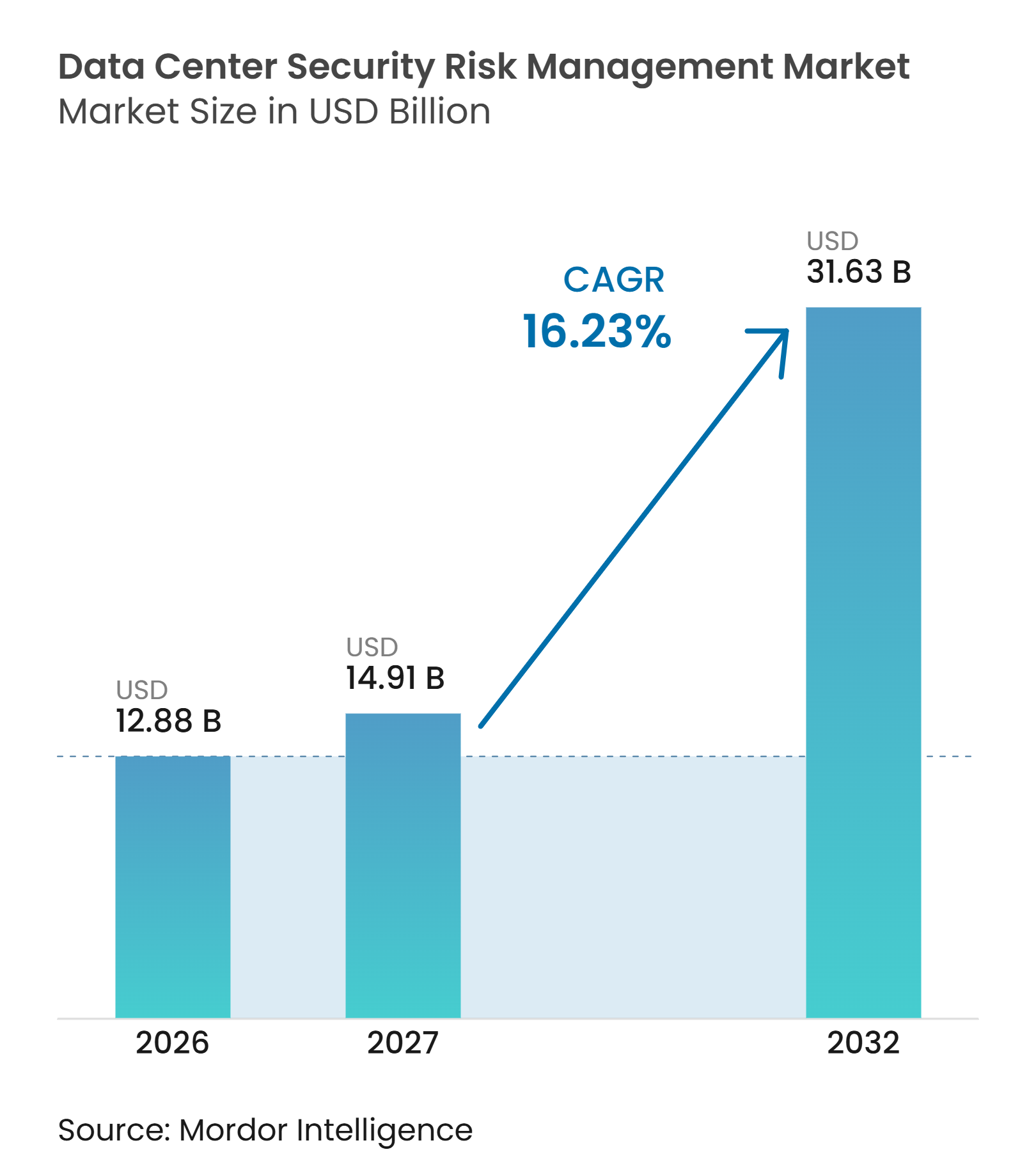
The data center security risk management market size is projected to expand from USD 12.88 billion in 2026 to USD 14.91 billion in 2027, and to USD 31.63 billion by 2032, registering a CAGR of 16.23% between 2027 and 2032. The data center security risk management market is being reshaped by denser AI infrastructure, larger campus footprints, and a closer link between physical access and cyber risk. Security specifications now extend beyond perimeter protection to data halls, equipment rooms, visitor workflows, centralized monitoring, stronger visitor screening, and detailed records for every approved movement through sensitive areas. Operators are favoring platforms that consolidate access, video, intrusion alerts, and audit records into a single operating view. This approach can reduce gaps between facilities and IT teams while supporting evidence needed for customer and regulatory reviews. The data center security risk management market also benefits from construction-led demand, since new hyperscale and colocation sites require layered controls before operations begin.
Key Report Takeaways
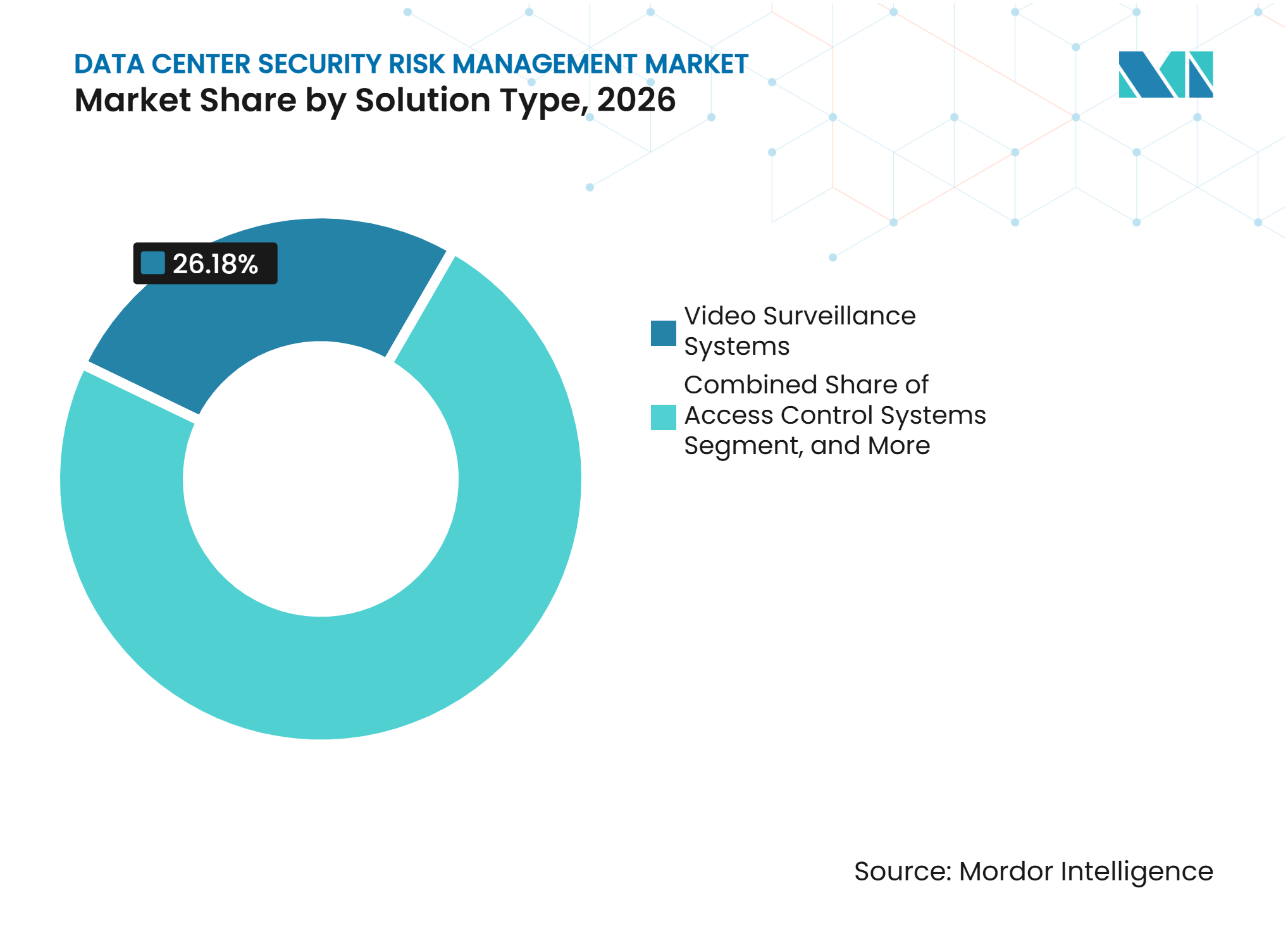
- By solution type, Video Surveillance Systems held 26.18% of the data center security risk management market share in 2026, while Integrated Physical Security Management Systems are projected to expand at a 16.78% CAGR through 2032.
- By security technology, Card and Credential-Based Access Control held 27.28% of the data center security risk management market share in 2026, while Video Analytics and Intelligent Surveillance are projected to expand at a 17.05% CAGR through 2032.
- By security layer, Data Hall and Restricted Area Access accounted for 37.15% of the data center security risk management market share in 2026, while Security Operations Center and Central Monitoring are projected to expand at a 17.36% CAGR through 2032.
- By service type, Security Guarding and Patrol Services held 38.25% of the data center security risk management market share in 2026, while Managed Security Monitoring is projected to expand at a 17.61% CAGR through 2032.
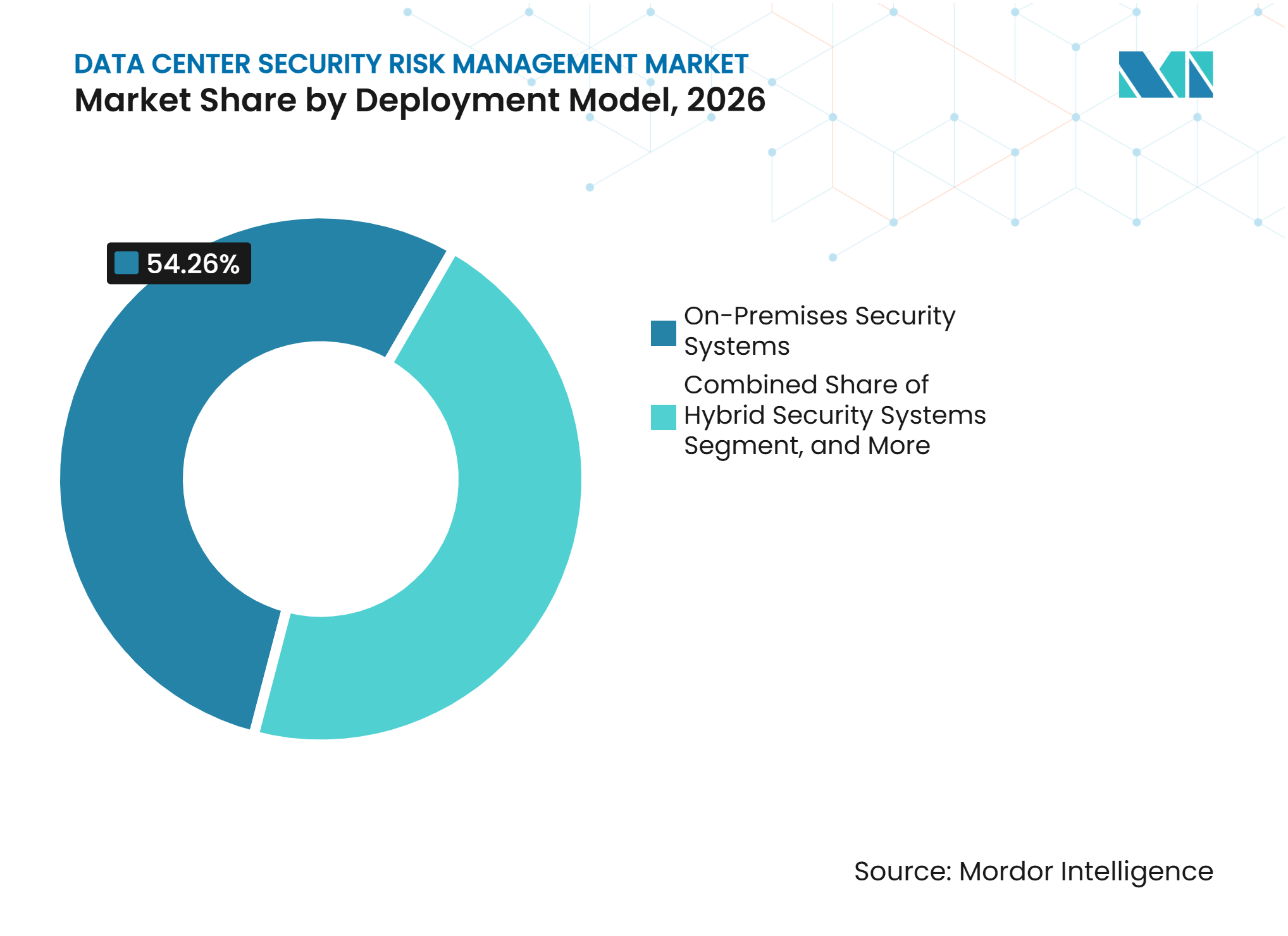
- By deployment model, On-Premises Security Systems accounted for 54.26% of the data center security risk management market share in 2026, while Cloud-Managed Security Systems are projected to expand at an 18.27% CAGR through 2032.
- By data center size, Hyperscale data centers held 57.39% of the data center security risk management market share in 2026 and are projected to expand at an 18.51% CAGR through 2032.
- By data center type, Colocation data centers accounted for 62.14% of the data center security risk management market share in 2026, while Cloud Service Providers are projected to expand at an 18.80% CAGR through 2032.
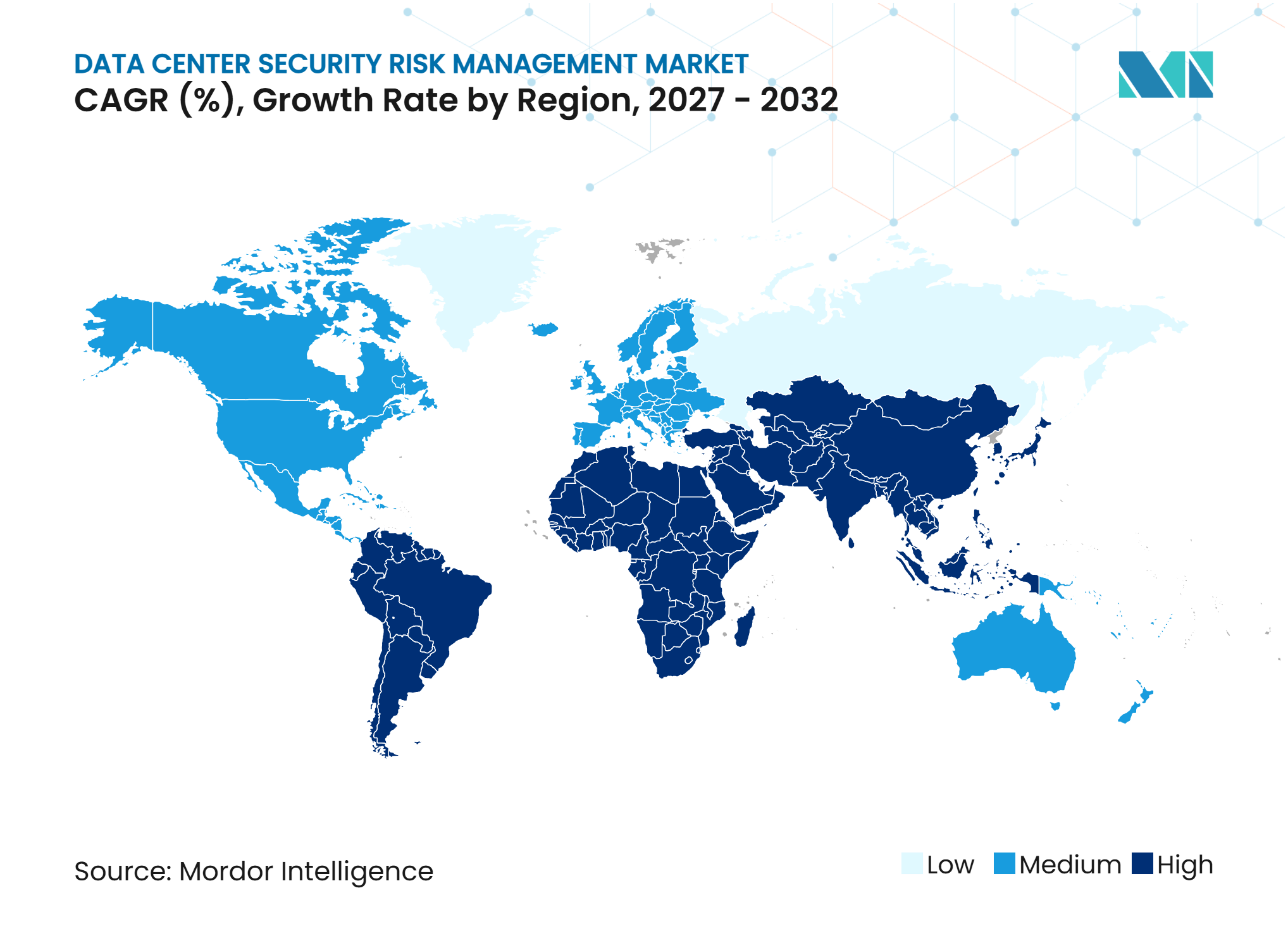
- By geography, North America held 46.19% of the data center security risk management market share in 2026, while Asia-Pacific is projected to expand at a 17.94% CAGR through 2032.
Note: Market numbers in this report are based on Mordor Intelligence's proprietary estimation framework, which combines nine months of actuals with Q4 projections for base year 2026.
Market Trends and Insights
Drivers Impact Analysis of Data Center Security Risk Management Market*
| Driver | (~) % Impact on CAGR Forecast | Geographic Relevance | Impact Timeline |
|---|---|---|---|
| Increasing Concentration of Critical Digital Infrastructure and High-Value Equipment | +3.5% | Global | Long term (≥ 4 years) |
| Rising Concerns About Unauthorized Access, Theft, Sabotage, and Insider Threats | +3.2% | Global | Short term (≤ 2 years) |
| Expansion of Hyperscale and Colocation Campuses Requiring Layered Security | +2.8% | North America, Asia-Pacific, and Europe | Long term (≥ 4 years) |
| Growing Adoption of Integrated Physical Security Management Platforms | +2.4% | North America and Europe | Medium term (2-4 years) |
| Increasing Requirements for Access Logging, Visitor Management, and Security Audits | +1.8% | Global | Medium term (2-4 years) |
| Greater Emphasis on Protecting Critical Infrastructure and Meeting Customer Security Requirements | +1.5% | North America and Europe | Long term (≥ 4 years) |
| Source: Mordor Intelligence | |||
Increasing Concentration of Critical Digital Infrastructure and High-Value Equipment
AI infrastructure is increasing the financial exposure concentrated in each data hall. AFCOM reported that average rack density reached 27 kW in 2026, compared with 16 kW in the prior year. Higher density makes a physical breach more consequential because a single restricted zone can contain valuable computing equipment and sensitive workloads. The data center security risk management market therefore places greater value on rack-level access control, biometric authentication, and continuous identity checks. Operators also need controls that preserve an evidence trail when staff, contractors, or visitors enter sensitive zones. These requirements shift physical security from a facility expense toward a core part of operational resilience.
Rising Concerns About Unauthorized Access, Theft, Sabotage, and Insider Threats
Human threats, both internal and external, were cited by 61% of AFCOM respondents in 2026, ahead of ransomware at 58%. This result places more attention on shift patterns, contractor access, zone design, and visitor supervision. CISA advises critical infrastructure operators to use prevention-focused programs that define, detect, assess, and manage insider risk before it becomes an incident.[1] The data center security risk management market is responding with stronger identity verification at restricted boundaries and more detailed access logs. Security teams are also reviewing whether older badge-only workflows can adequately address tailgating and shared credentials. These changes support demand for tools that connect identity, access events, and video evidence.
Expansion of Hyperscale and Colocation Campuses Requiring Layered Security
Large campuses need several layers of protection because they include separate perimeters, buildings, loading areas, and data halls. The Security Industry Association identifies the need to protect the entire data center environment, from the outer perimeter through sensitive internal spaces. Greenfield projects create opportunities to build access, surveillance, intrusion detection, and central monitoring into the site design. Colocation sites also need to separate tenants without slowing legitimate operations. This favors suppliers capable of coordinating multiple systems during construction and commissioning. The data center security risk management market gains from first-install projects because specifications can include integrated controls before the facility becomes operational.
Growing Adoption of Integrated Physical Security Management Platforms
Operators are consolidating standalone access control, video, and intrusion systems into integrated platforms. Johnson Controls introduced CCURE IQ 3.10 in March 2025 with unified access, video, intrusion management, edge analytics, and forensic audit capabilities. These systems can provide control rooms with a single view of incidents and reduce manual reconciliation across separate records. Integrated architectures also support the access documentation and audit evidence expected under ISO 27001 and SOC 2 programs. The approach can lengthen supplier relationships because platform changes require configuration, training, and ongoing integration support. It also increases competition among vendors seeking to offer a broader security stack.
Restraints Impact Analysis of Data Center Security Risk Management Market*
| Restraint | (~) % Impact on CAGR Forecast | Geographic Relevance | Impact Timeline |
|---|---|---|---|
| High Capital and Operating Costs of Comprehensive Physical Security Systems | -2.2% | Global | Long term (≥ 4 years) |
| Complexity of Integrating Access Control, Video Surveillance, and Intrusion Detection | -1.8% | Global | Medium term (2-4 years) |
| Challenges Securing Large Campuses and Geographically Distributed Facilities | -1.4% | North America and Asia-Pacific | Long term (≥ 4 years) |
| Shortages of Qualified Security Personnel and Specialist Integrators | -1.0% | Global | Short term (≤ 2 years) |
| Source: Mordor Intelligence | |||
High Capital and Operating Costs of Comprehensive Physical Security Systems
Comprehensive deployments require investment in readers, cameras, perimeter equipment, software, integration, and operating staff. This cost burden is particularly difficult for small and medium data centers that lack hyperscale purchasing power. Biometric systems can add hardware, credential management, and privacy governance requirements to each protected zone. Operators also incur recurring costs for software subscriptions, maintenance, model updates, monitoring, and periodic security reviews. ISO 27001 and SOC 2 processes can add recurring workload because documentation and control testing must remain up to date. These conditions encourage some facilities to use managed monitoring services rather than maintaining all security capabilities in-house.
Complexity of Integrating Access Control, Video Surveillance, and Intrusion Detection
Many operating facilities use security equipment from several generations and vendors. Connecting legacy access systems to modern video platforms or cloud management software can require gateways, middleware, and careful testing. The Security Industry Association lists siloed systems and interoperability issues among the persistent modernization challenges for data center operators. Live facilities must complete changes without interrupting continuous operations or weakening their audit evidence. Responsibility can also be divided between IT teams that manage networks and facilities teams that manage physical hardware. This division can delay projects and increase demand for integrators with both operational and security expertise.
*Our forecasts treat driver/restraint impacts as directional, not additive. The impact forecasts reflect baseline growth, mix effects, and variable interactions.
Data Center Security Risk Management Market Segment Analysis
By Solution Type:
Surveillance Retains Scale While Integrated Platforms AdvanceVideo Surveillance Systems held a 26.18% market share in the data center security risk management market in 2026. Cameras remain widely deployed because operators need visual verification at perimeters, entrances, loading zones, and data halls throughout routine operations and during incident investigation. Their established installed base supports replacement and upgrade spending across facility types, including established sites with equipment nearing refresh cycles. AI-assisted video also improves the value of existing coverage by helping teams identify unusual movement and correlate events. Access Control Systems remain essential at staff entry points and restricted areas where individual authorization is required.
Integrated Physical Security Management Systems are projected to expand at a 16.78% CAGR through 2032. They address the operational limits of managing separate products that produce disconnected alarms and records across sites, shifts, and facility security teams. The data center security risk management market size for integrated platforms is supported by demand for consolidated workflows, centralized reporting, and multi-site oversight. Intrusion Detection Systems and Perimeter Security Systems protect the outer boundaries of larger campuses, where cameras alone may not provide adequate coverage during periods of poor visibility or along long boundary lines. Security Risk Assessment and Consulting also benefit from the need to test controls and document results for audits.



By Security Technology:
Credential Systems Lead While Intelligent Video Gains GroundCard and Credential-Based Access Control held a 27.28% share in 2026 because it remains a practical and familiar method for many doors and administrative areas. The technology has a substantial installed base and a lower per-door cost than advanced biometric alternatives, which supports its continued use in lower-risk areas. It also fits routine staff access and visitor workflows when linked to identity records. However, physical cards do not independently identify tailgating or credential sharing. This limitation becomes more important at data hall entrances, cabinet rows, and other sensitive zones where credential misuse can create material operational exposure.
Video Analytics and Intelligent Surveillance are projected to expand at a 17.05% CAGR through 2032. These tools change video from a record used after an incident into a source of live operational alerts that can support earlier assessment by control-room staff. Motorola Solutions introduced Inform in September 2025 to unify video, access control, and third-party sensor data in a single incident response interface.[2] Biometric Access Control is also used at high-security thresholds where stronger identity confirmation is needed. Perimeter detection, radar, fence sensors, and license plate recognition form additional layers for large campuses with multiple access roads, buildings, and delivery points.
By Security Layer:
Data Hall Protection Anchors Spending While Central Monitoring ScalesData Hall and Restricted Area Access accounted for a 37.15% share in 2026. These areas contain the servers, network equipment, and customer workloads that operators consider the most sensitive facility assets and require consistent authorization checks at each entry point. The data center security risk management market share held by this layer reflects demand for access controls, video coverage, anti-tailgating measures, and detailed entry records. ISO 27001 and SOC 2 programs reinforce the need to document access to restricted spaces. Rack-level controls are also becoming more relevant as AI infrastructure increases equipment concentration and access must be limited to a smaller, approved group.
Security Operations Center and Central Monitoring are projected to expand at a 17.36% CAGR through 2032. Multi-site operators use central monitoring to reduce the cost of maintaining full security teams at every location while applying common escalation procedures across their portfolios. This model allows remote personnel to evaluate alarms, coordinate response, and maintain consistent operating procedures. It is particularly useful for distributed and lower-staffed facilities that still need continuous oversight. Perimeter, loading dock, and critical equipment room controls remain necessary because each exposes a distinct access pathway requiring its own verification and response procedure.
By Service Type:
Guarding Remains Essential While Managed Monitoring ExpandsSecurity Guarding and Patrol Services held a 38.25% share in 2026. Human personnel remain important for visitor escort, escalation, routine checks, and visible deterrence, particularly where conditions require judgment beyond a pre-set alarm response. Guards also manage situations that cannot be resolved by software or remote instructions alone. Their role is especially significant at loading areas and large perimeters with regular contractor activity. The data center security risk management market relies on trained personnel to consistently apply site procedures during access events that require immediate physical assessment.
Managed Security Monitoring is projected to expand at a 17.61% CAGR through 2032. Remote monitoring gives operators an alternative to staffing every site with a full local control room, especially where a facility operates with a limited on-site team. Motorola Solutions expanded its enterprise security offering in March 2026 with remote video monitoring and AI-assisted response capabilities. Security System Design and Integration, Installation and Commissioning, and Maintenance and System Upgrades remain tied to new construction and refresh cycles. Auditing services also remain relevant when customers require evidence that facility controls operate as intended.
By Deployment Model:
On-Premises Control Leads While Cloud Management AcceleratesOn-Premises Security Systems accounted for a 54.26% share in 2026. Operators value local control for access decisions that must remain available regardless of external connectivity, because restricted-zone entry decisions cannot be deferred during a disruption. This model also addresses concerns about data sovereignty and the handling of sensitive security records. Many hyperscale and colocation facilities have existing local infrastructure that supports their continued use. The data center security risk management market share for on-premises systems also reflects the long replacement cycles for physical hardware.
Cloud-Managed Security Systems are projected to expand at an 18.27% CAGR through 2032. They can simplify policy updates, reporting, and administration across dispersed facility portfolios where manual, site-by-site configuration would consume substantial staff time. Genetec launched a UK-hosted Security Center SaaS option in February 2026, allowing customers to store and process physical security data within UK borders. Hybrid Security Systems remain relevant for operators managing older local equipment alongside new cloud-connected tools. Managed Security Services combine monitoring and technology support in a single contractual arrangement.

By Data Center Size:
Hyperscale Sites Set Security Requirements Across The SectorHyperscale data centers held 57.39% of the data center security risk management market share in 2026. These facilities require extensive perimeter, building, data hall, and equipment-level security because their campuses concentrate valuable infrastructure in a small number of locations. AFCOM found that 72% of respondents expected AI workloads to increase capacity requirements, while 74% planned to deploy AI-capable solutions. This environment underscores the importance of biometric entry, intelligent video, centralized monitoring, and rack-level controls to protect sensitive areas without slowing authorized work. Hyperscale operators also establish detailed procurement standards that influence suppliers across the sector.
Hyperscale data centers are projected to expand at an 18.51% CAGR through 2032. Their combination of scale and growth makes them a major source of new security projects across design, installation, integration, monitoring, and ongoing maintenance services. Large data centers represent an upgrade opportunity because they seek controls comparable to those used at hyperscale sites. Small and medium facilities face tighter capital limits and more diverse technology environments. Managed service models can help those operators obtain monitoring and response capabilities without building every function internally.
By Data Center Type:
Colocation Needs Breadth While Cloud Providers Need ScaleColocation data centers accounted for 62.14% of the market in 2026. Their operators must protect several tenants with different access rights inside the same facility. This requires controls that separate cages, cabinets, suites, and shared spaces without limiting the authorized activities of each tenant, contractor, and approved visitor. The data center security risk management market supports colocation facilities through perimeter protection, biometrics, audit logging, cabinet security, and visitor controls. Tenant security reviews can also require operators to demonstrate how access events are documented and investigated.
Cloud Service Providers are projected to expand at an 18.80% CAGR through 2032. Their large campuses require security designs that can scale across multiple buildings and operational zones while maintaining a consistent identity and event records. Convergint delivered a physical security project for a hyperscale client in Frankfurt in September 2026, including video surveillance, access control, biometric authentication, anti-tailgating technology, key management, cabinet locks, and alarm monitoring. Enterprise and Edge data centers have lower security intensity per site, but their numbers can increase the need for remote supervision. Unattended edge facilities require automated access control, tamper detection, and reliable communications.
Geography Analysis
North America
North America held 46.19% of the data center security risk management market share in 2026. Hyperscale clusters in Virginia, Texas, Arizona, and the Pacific Northwest set demanding requirements for facility access, monitoring, and auditability. Government workloads add compliance factors through frameworks such as FedRAMP, the NIST Cybersecurity Framework, and CISA guidance. CISA’s insider threat guidance supports prevention-focused programs for critical infrastructure operators. Large operators are applying these expectations to contractor workflows and restricted-zone identity checks. The regional installed base also supports upgrades to older access and video systems. Centralized monitoring is gaining relevance as operators manage wider portfolios with consistent procedures.
Asia-Pacific
Asia-Pacific is projected to expand at a 17.94% CAGR through 2032 in the data center security risk management market. New hyperscale and colocation campuses create demand for security systems designed into facilities before commissioning. Digital Edge announced in January 2026 a USD 4.5 billion investment in an AI-ready campus in Indonesia with an initial capacity of 500 MW and the potential to scale to 1 GW. Projects of this scale require several controlled boundaries across buildings, data halls, and equipment areas. National data protection requirements in markets such as India also reinforce interest in governed access records and locally appropriate security architectures. Biometric and intelligent surveillance tools are relevant where operators need stronger identity confirmation at high-security thresholds. Greenfield construction allows providers to deploy integrated systems rather than connect fragmented legacy products.
Europe, South America, And The Middle East And Africa
Europe’s operators are applying layered security approaches that include biometric authentication, anti-tailgating measures, and cabinet-level controls. Convergint’s September 2026 project in Frankfurt demonstrates how these controls can be integrated into a hyperscale environment. The EU NIS 2 directive and ISO 27001 influence documentation, access governance, and ongoing review practices across European facilities. Genetec’s UK hosting option reflects demand for physical security platforms that meet local data-handling expectations.[3] South America is building demand alongside connectivity improvements and new colocation investment in major metropolitan areas. The Middle East and Africa are also developing cloud campuses under national data sovereignty and critical infrastructure requirements. Across these regions, integrated platforms can help operators apply common policies while accommodating local compliance needs.
Competitive Landscape
Market Concentration
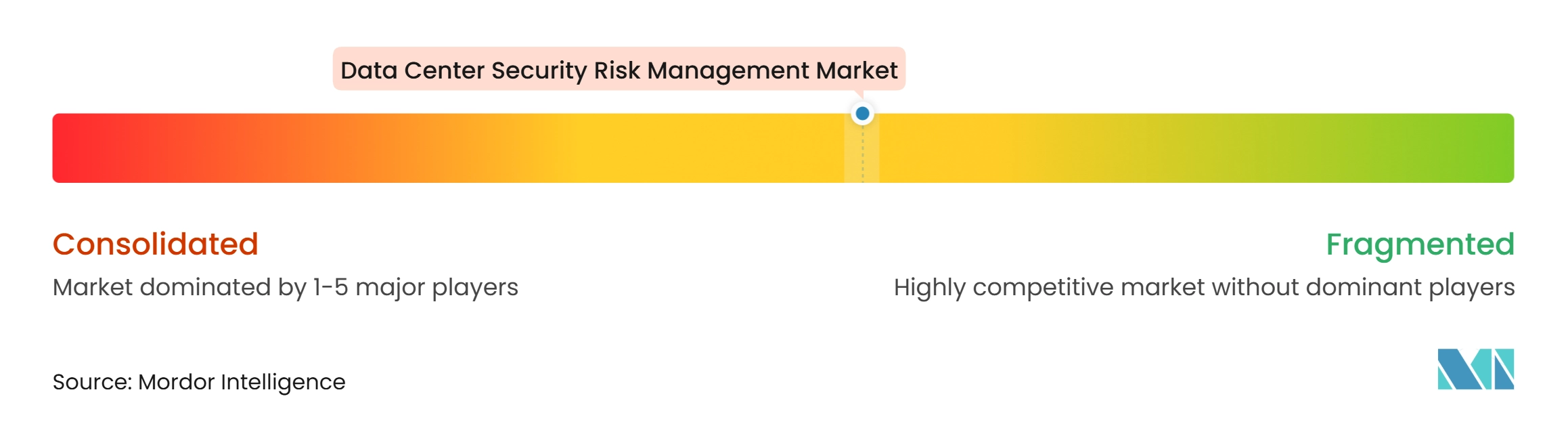
The data center security risk management market is moderately consolidated among broad platform suppliers and fragmented across specialist categories. Johnson Controls, Honeywell through LenelS2, Bosch Building Technologies, ASSA ABLOY, and Allegion offer portfolios across access control, video, and intrusion detection. Their scale is challenged by vendors that emphasize cloud management, AI-enabled analytics, and faster system integration. Johnson Controls introduced CCURE IQ 3.10 in 2025 with an integrated interface for access, video, intrusion management, and audit capabilities.[4] This type of offering addresses customer preference for a single operational view rather than several disconnected tools.
Competition is increasingly focused on the link between physical access events, sensor data, and incident response. Motorola Solutions introduced Inform in 2025 to connect Avigilon video, access control, and third-party sensor data into a single response workflow. It expanded the approach in 2026 with Operator, AI-supported alerts, and Blue Eye remote video monitoring. Vendors that can show clear interoperability and reliable audit evidence are better positioned for facilities with strict operational requirements. Specialist suppliers retain roles in perimeter detection, rack security, and compliance-oriented access control where deep technical expertise remains important.
Rack-level protection is becoming a clearer area of competition as dense AI deployments increase the value of individual equipment rows. Dormakaba acquired TANlock in July 2025 to expand its offering for data center and critical infrastructure security through electromechanical rack locks, authentication modules, and IP readers. TBS Biometrics demonstrated iris-authenticated cabinet access at the Stollen Luzern data center, showing the role of advanced authentication in high-security environments. Suppliers are therefore competing on the ability to protect each layer of a facility while linking events to a central platform.
Data Center Security Risk Management Industry Leaders
-
ASSA ABLOY AB
-
Allegion plc
-
Axis Communications AB
-
Genetec Inc.
-
Verkada Inc.
- *Disclaimer: Major Players sorted in no particular order
Data Center Security Risk Management Market Companies Covered in this Report
- Johnson Controls International plc
- Honeywell International Inc.
- Bosch Building Technologies GmbH
- Genetec Inc.
- Axis Communications AB
- Motorola Solutions, Inc.
- Verkada Inc.
- Avigilon Corporation
- HID Global Corporation
- LenelS2, Inc.
- Gallagher Security (Gallagher Group Limited)
- Suprema Inc.
- IDEMIA Group SAS
- ASSA ABLOY AB
- Allegion plc
- Securitas Technology Corporation
- Convergint Technologies LLC
- Allied Universal Holdco LLC
- Gunnebo AB
- Senstar Technologies Corporation
Recent Industry Developments in Data Center Security Risk Management Market
- October 2026: Motorola Solutions showcased Enterprise Intelligence and Operational Resilience at ISC West 2026 in Las Vegas, featuring Operator, formerly Inform, for agentic incident response orchestration across video, access, and sensor systems, new Avigilon H6A camera models, Assist Chat for AI-driven security queries, and Blue Eye remote video monitoring for 24/7 human-led virtual guard services across enterprise deployments including data centers.
- September 2026: Convergint delivered a complex, scalable physical security solution for a confidential hyperscale data center client in Frankfurt, Germany, covering enterprise video surveillance, access control, biometric authentication, anti-tailgating techno logy, intelligent key management, server cabinet locks, and alarm monitoring, with scope expanded from initial site perimeter to multiple data halls during construction.
- January 2026: Digital Edge announced a USD 4.5 billion investment to build the CGK Campus, one of Indonesia's largest AI-ready hyperscale data centers at 500 MW initial capacity with scalability to 1 GW, in the GIIC Industrial Estate in Bekasi, creating significant downstream demand for physical security system design and installation across a multi-building campus.
- January 2026: Mitsubishi Electric completed its acquisition of Nozomi Networks, the OT and IoT security company that surpassed USD 100 million in annual recurring revenue in 2025. The acquisition preserves Nozomi's vendor-neutral OT cybersecurity platform while establishing a new growth phase within Mitsubishi Electric's critical infrastructure and industrial security portfolio, which includes data center clients globally.
Global Data Center Security Risk Management Market Report Scope
The Data Center Security Risk Management Market encompasses physical security technologies, platforms, and services designed to protect data center facilities, personnel, critical infrastructure, and high-value IT assets from unauthorized access, intrusion, theft, sabotage, vandalism, insider threats, and other physical security risks. The market includes access control systems, surveillance solutions, intrusion detection technologies, perimeter protection systems, integrated security management platforms, monitoring services, and security consulting solutions that help operators maintain operational continuity, regulatory compliance, and critical infrastructure protection across colocation, cloud, enterprise, edge, and hyperscale data center environments.
The Data Center Security Risk Management Market Report is Segmented by Solution Type (Access Control Systems, Video Surveillance Systems, Intrusion Detection Systems, Perimeter Security Systems, Visitor and Contractor Management Systems, Security Operations and Monitoring Platforms, Integrated Physical Security Management Systems, and Security Risk Assessment and Consulting), Security Technology (Card and Credential-Based Access Control, Biometric Access Control, Video Analytics and Intelligent Surveillance, Motion and Perimeter Intrusion Detection, Radar and Fence Detection, License Plate Recognition, Security Information and Event Integration, and Identity and Access Management for Physical Facilities), Security Layer (Site Perimeter and Boundary Protection, Building Entry and Reception Security, Data Hall and Restricted Area Access, Critical Equipment Room Security, Loading Dock and Delivery Access, and Security Operations Center and Central Monitoring), Service Type (Security Risk Assessment and Auditing, Security System Design and Integration, Installation and Commissioning, Managed Security Monitoring, Security Guarding and Patrol Services, and Maintenance and System Upgrades), Deployment Model (On-Premises Security Systems, Cloud-Managed Security Systems, Hybrid Security Systems, and Managed Security Services), Data Center Size (Small, Medium, Large, and Hyperscale), Data Center Type (Colocation, Cloud Service Providers (CSPs), and Enterprise and Edge), and Geography (North America, South America, Europe, Asia-Pacific, and Middle East and Africa). The Market Forecasts are Provided in Terms of Value (USD).
Segmentation Overview
| Access Control Systems |
| Video Surveillance Systems |
| Intrusion Detection Systems |
| Perimeter Security Systems |
| Visitor and Contractor Management Systems |
| Security Operations and Monitoring Platforms |
| Integrated Physical Security Management Systems |
| Security Risk Assessment and Consulting |
| Card and Credential-Based Access Control |
| Biometric Access Control |
| Video Analytics and Intelligent Surveillance |
| Motion and Perimeter Intrusion Detection |
| Radar and Fence Detection |
| License Plate Recognition |
| Security Information and Event Integration |
| Identity and Access Management for Physical Facilities |
| Site Perimeter and Boundary Protection |
| Building Entry and Reception Security |
| Data Hall and Restricted Area Access |
| Critical Equipment Room Security |
| Loading Dock and Delivery Access |
| Security Operations Center and Central Monitoring |
| Security Risk Assessment and Auditing |
| Security System Design and Integration |
| Installation and Commissioning |
| Managed Security Monitoring |
| Security Guarding and Patrol Services |
| Maintenance and System Upgrades |
| On-Premises Security Systems |
| Cloud-Managed Security Systems |
| Hybrid Security Systems |
| Managed Security Services |
| Small |
| Medium |
| Large |
| Hyperscale |
| Colocation |
| Cloud Service Providers (CSPs) |
| Enterprise and Edge |
| North America | United States |
| Canada | |
| Mexico | |
| South America | Brazil |
| Chile | |
| Colombia | |
| Argentina | |
| Peru | |
| Rest of South America | |
| Europe | Germany |
| United Kingdom | |
| France | |
| Netherlands | |
| Ireland | |
| Spain | |
| Italy | |
| Nordics | |
| Rest of Europe | |
| Asia-Pacific | China |
| Japan | |
| India | |
| Australia | |
| Singapore | |
| South Korea | |
| Malaysia | |
| Indonesia | |
| Rest of Asia-Pacific | |
| Middle East and Africa | Saudi Arabia |
| United Arab Emirates | |
| South Africa | |
| Israel | |
| Egypt | |
| Qatar | |
| Rest of Middle East and Africa |
| By Solution Type | Access Control Systems | |
| Video Surveillance Systems | ||
| Intrusion Detection Systems | ||
| Perimeter Security Systems | ||
| Visitor and Contractor Management Systems | ||
| Security Operations and Monitoring Platforms | ||
| Integrated Physical Security Management Systems | ||
| Security Risk Assessment and Consulting | ||
| By Security Technology | Card and Credential-Based Access Control | |
| Biometric Access Control | ||
| Video Analytics and Intelligent Surveillance | ||
| Motion and Perimeter Intrusion Detection | ||
| Radar and Fence Detection | ||
| License Plate Recognition | ||
| Security Information and Event Integration | ||
| Identity and Access Management for Physical Facilities | ||
| By Security Layer | Site Perimeter and Boundary Protection | |
| Building Entry and Reception Security | ||
| Data Hall and Restricted Area Access | ||
| Critical Equipment Room Security | ||
| Loading Dock and Delivery Access | ||
| Security Operations Center and Central Monitoring | ||
| By Service Type | Security Risk Assessment and Auditing | |
| Security System Design and Integration | ||
| Installation and Commissioning | ||
| Managed Security Monitoring | ||
| Security Guarding and Patrol Services | ||
| Maintenance and System Upgrades | ||
| By Deployment Model | On-Premises Security Systems | |
| Cloud-Managed Security Systems | ||
| Hybrid Security Systems | ||
| Managed Security Services | ||
| By Data Center Size | Small | |
| Medium | ||
| Large | ||
| Hyperscale | ||
| By Data Center Type | Colocation | |
| Cloud Service Providers (CSPs) | ||
| Enterprise and Edge | ||
| By Geography | North America | United States |
| Canada | ||
| Mexico | ||
| South America | Brazil | |
| Chile | ||
| Colombia | ||
| Argentina | ||
| Peru | ||
| Rest of South America | ||
| Europe | Germany | |
| United Kingdom | ||
| France | ||
| Netherlands | ||
| Ireland | ||
| Spain | ||
| Italy | ||
| Nordics | ||
| Rest of Europe | ||
| Asia-Pacific | China | |
| Japan | ||
| India | ||
| Australia | ||
| Singapore | ||
| South Korea | ||
| Malaysia | ||
| Indonesia | ||
| Rest of Asia-Pacific | ||
| Middle East and Africa | Saudi Arabia | |
| United Arab Emirates | ||
| South Africa | ||
| Israel | ||
| Egypt | ||
| Qatar | ||
| Rest of Middle East and Africa | ||
Key Questions Answered in the Report
What is the data center security risk management market size?
The data center security risk management market size is projected to reach USD 31.63 billion by 2032, from USD 14.91 billion in 2027, at a 16.23% CAGR.
What is driving demand for data center security risk management?
Higher AI infrastructure density, expanding hyperscale campuses, and stronger access governance needs are increasing demand for layered security systems.
Which solution type leads data center security risk management?
Video Surveillance Systems led with 26.18% share in 2026, while Integrated Physical Security Management Systems are projected to expand at a 16.78% CAGR through 2032.
Why are cloud-managed security systems gaining adoption?
They can centralize policy, reporting, and monitoring across several sites, while regional hosting options can help address data handling requirements.
Which data center type has the largest share?
Colocation data centers accounted for 62.14% share in 2026 because operators must protect several tenants and demonstrate strong access segregation.
Which region is expanding fastest for data center security risk management?
Asia-Pacific is projected to expand at a 17.94% CAGR through 2032, supported by new hyperscale and colocation construction.