
Data Center Renewable Energy Market Size and Share
Market Overview
| Study Period | 2021 - 2032 |
|---|---|
| Market Size (2027) | USD 18.31 Billion |
| Market Size (2032) | USD 42.37 Billion |
| Growth Rate (2027 - 2032) | 18.27 % |
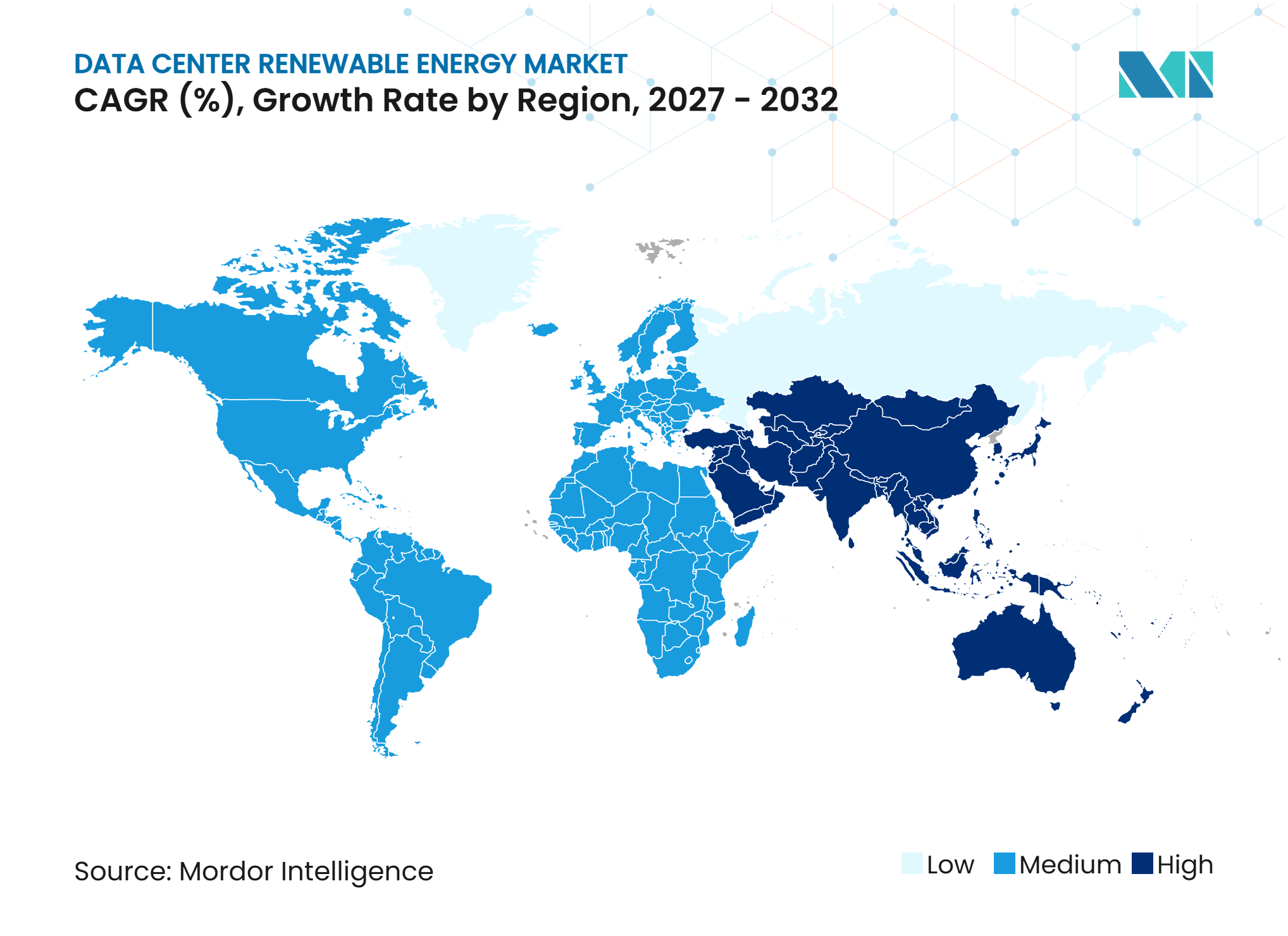
| Fastest Growing Market | Asia-Pacific |
| Largest Market | North America |
| Market Concentration | Medium |
Major Players *Disclaimer: Major Players sorted in no particular order Image © Mordor Intelligence. Reuse requires attribution under CC BY 4.0. | |
Data Center Renewable Energy Market Analysis by Mordor Intelligence
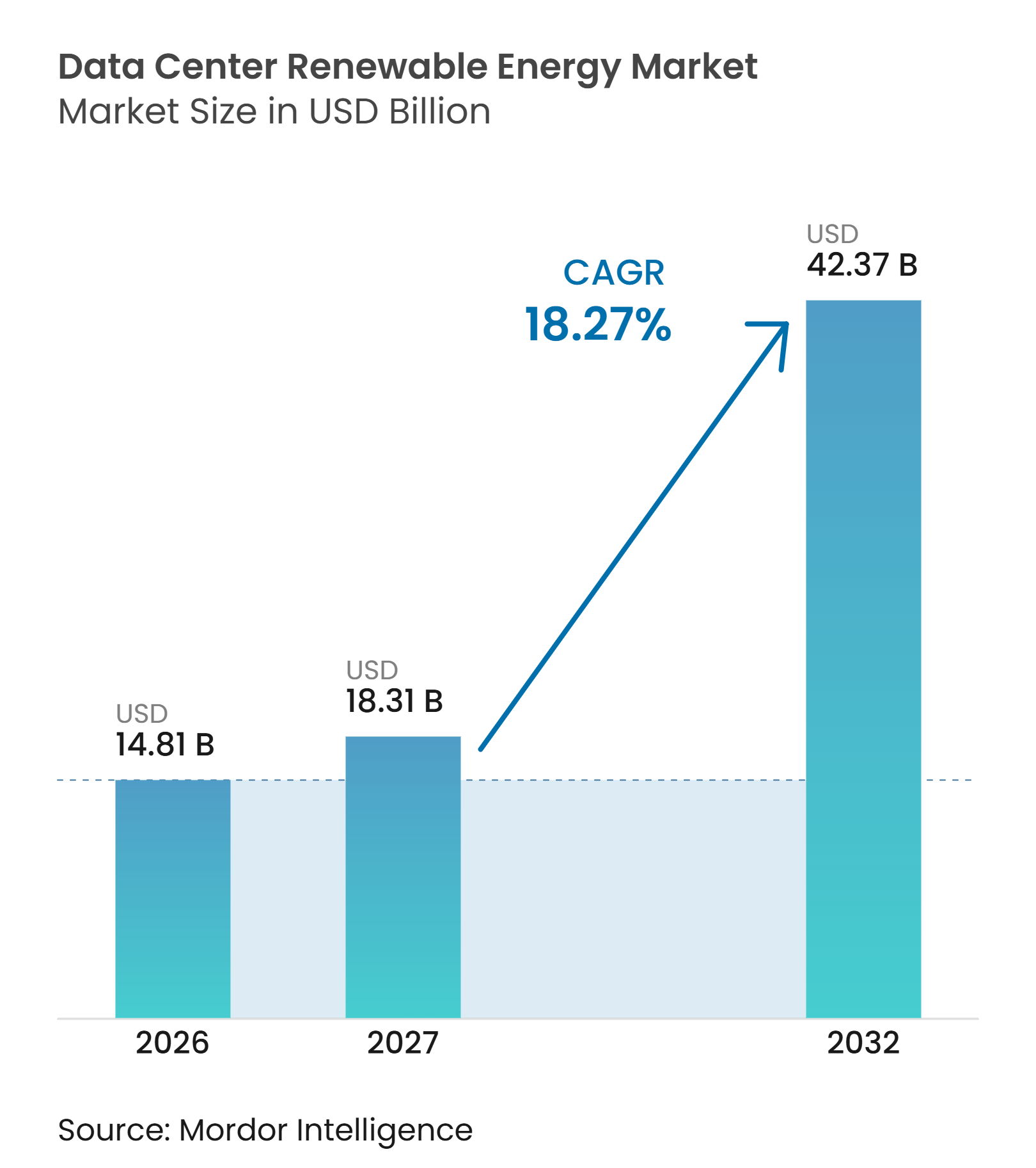
The data center renewable energy market size is projected to expand from USD 14.81 billion in 2026 to USD 18.31 billion in 2027, and to USD 42.37 billion by 2032, registering a CAGR of 18.27% between 2027 and 2032. By volume, the market is estimated at 197.46 million GWh in 2026 and 244.13 million GWh in 2027 and is projected to reach 516.19 million GWh by 2032, at a 16.19% CAGR over 2027-2032. AI training and inference workloads are increasing electricity needs faster than conventional data center planning models can accommodate. Renewable procurement has therefore become part of power availability planning and long-term cost control, rather than a separate sustainability activity. Large operators are using long-duration contracts and portfolios that combine several technologies to secure supply across their operating regions. Grid congestion and curtailment are raising the value of storage, geothermal power, hydropower, and other firm clean resources. These conditions favor buyers that can commit to large contracts, while creating openings for suppliers that can offer reliable power near new data center campuses.
Key Report Takeaways
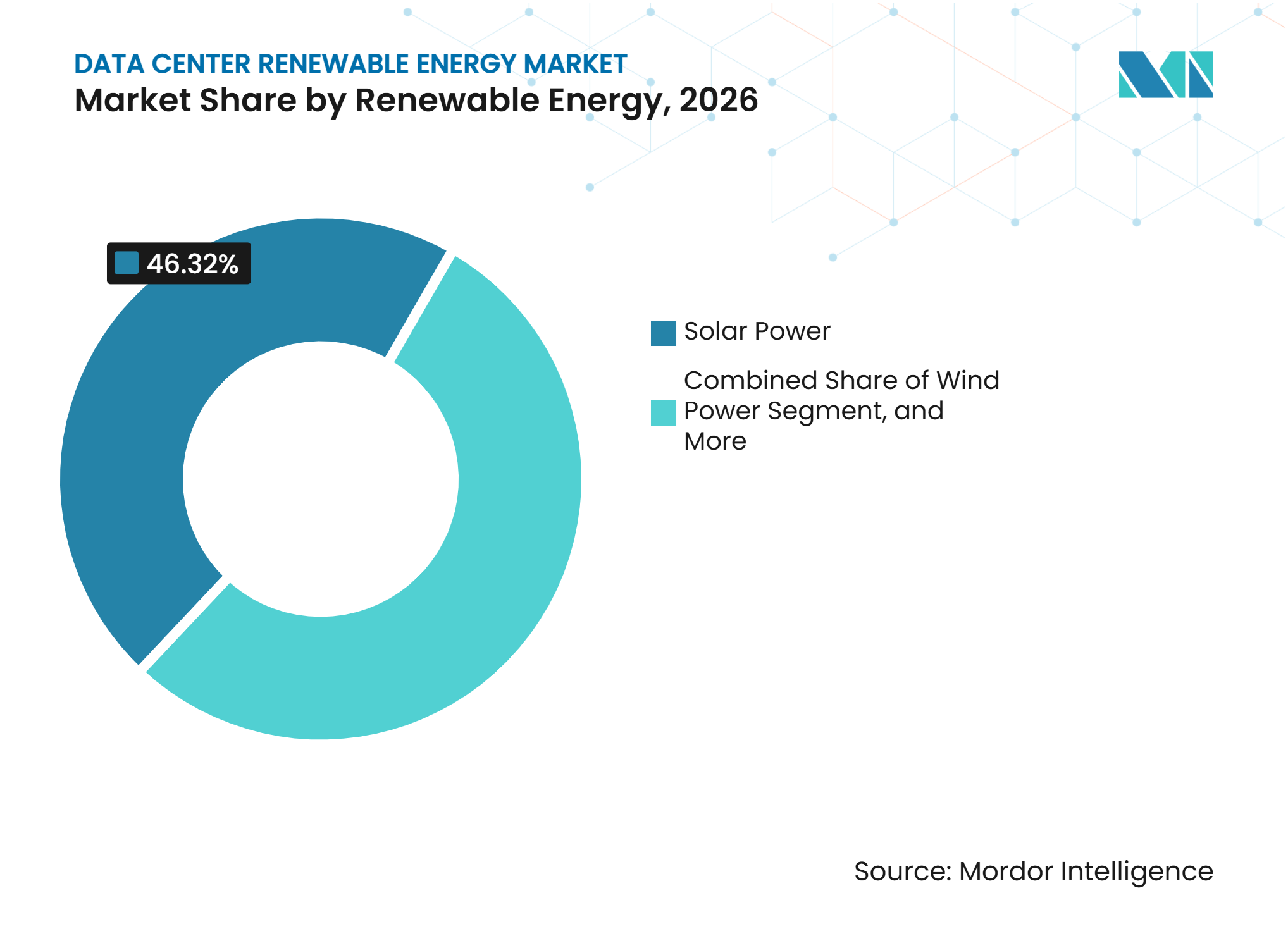
- By renewable energy source, solar power held 46.32% of the data center renewable energy market share in 2026, while geothermal power is projected to expand at a 19.47% CAGR through 2032.
- By procurement model, virtual or financial PPAs held 38.17% revenue share in 2026, while on-site renewable generation is projected to expand at a 19.26% CAGR through 2032.
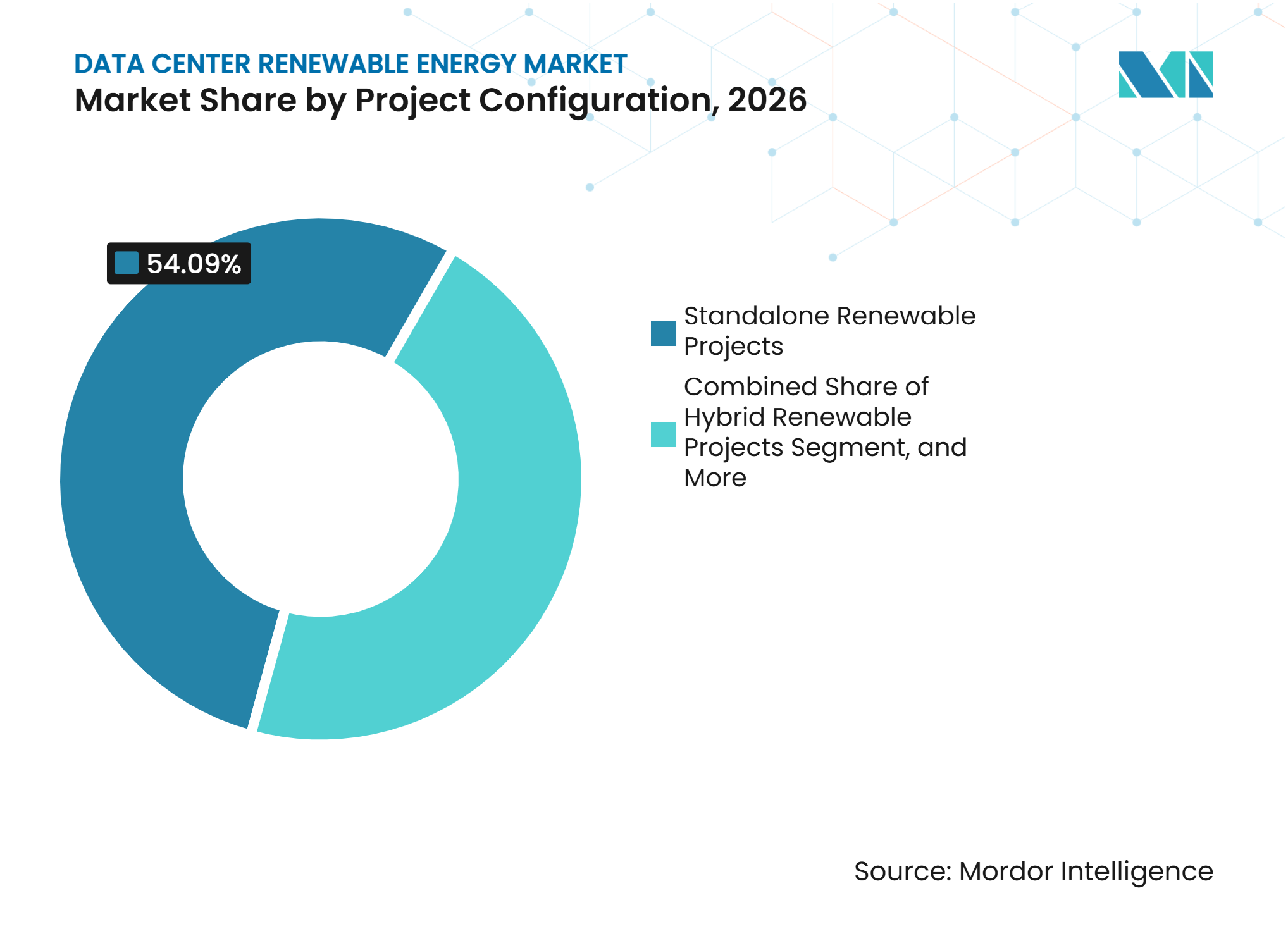
- By project configuration, standalone renewable projects held 54.09% revenue share in 2026, while renewable projects with other firming solutions are projected to expand at a 20.04% CAGR through 2032.
- By contract duration, long-term contracts accounted for 57.63% of revenue in the data center renewable energy market in 2026 and are projected to expand at an 18.87% CAGR through 2032.
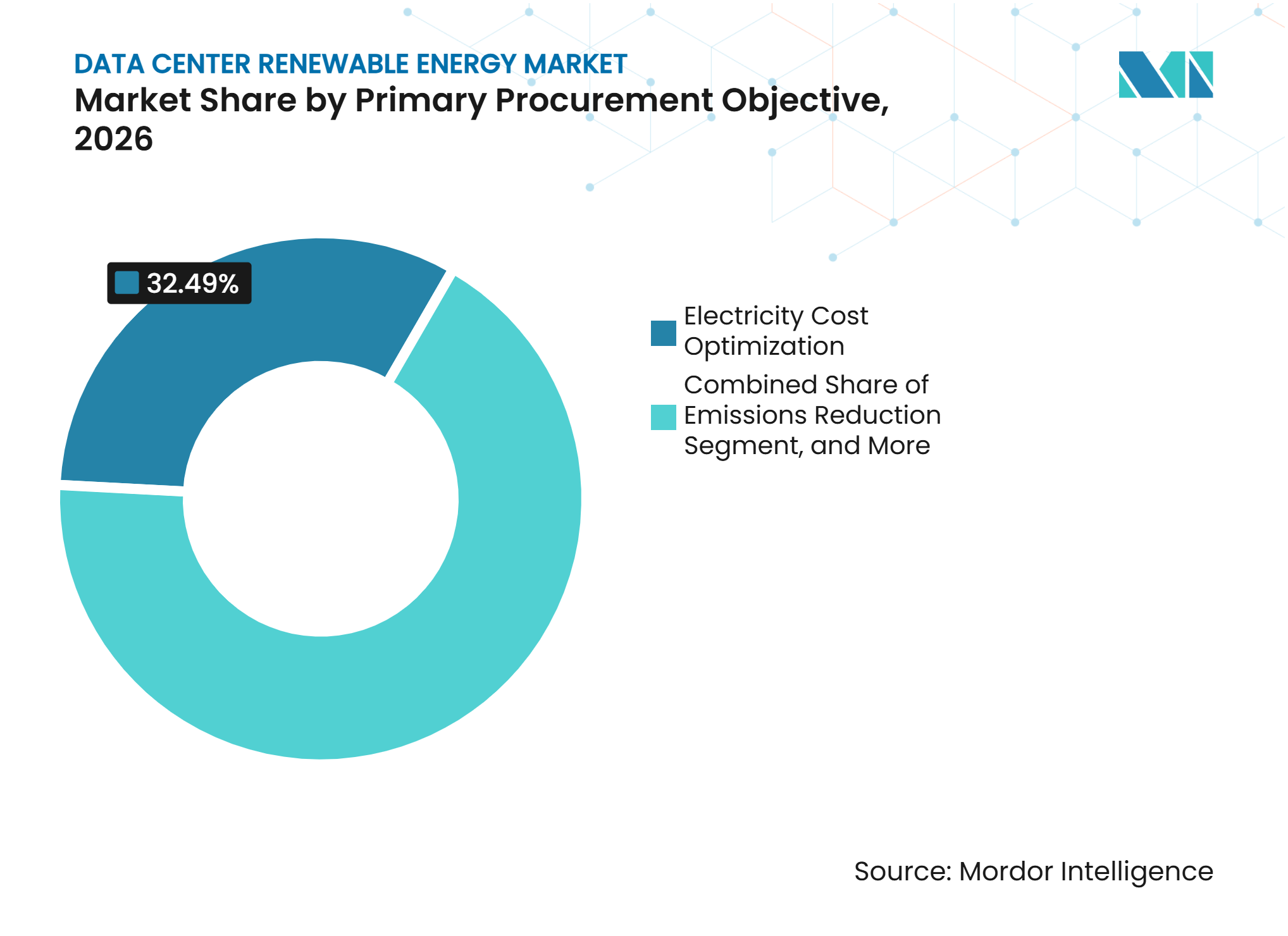
- By primary procurement objective, electricity cost optimization accounted for 32.49% of revenue in 2026, while renewable energy matching is projected to expand at a 19.02% CAGR through 2032.
- By data center size, hyperscale facilities held 54.26% revenue share in 2026 and are projected to expand at a 19.04% CAGR through 2032.
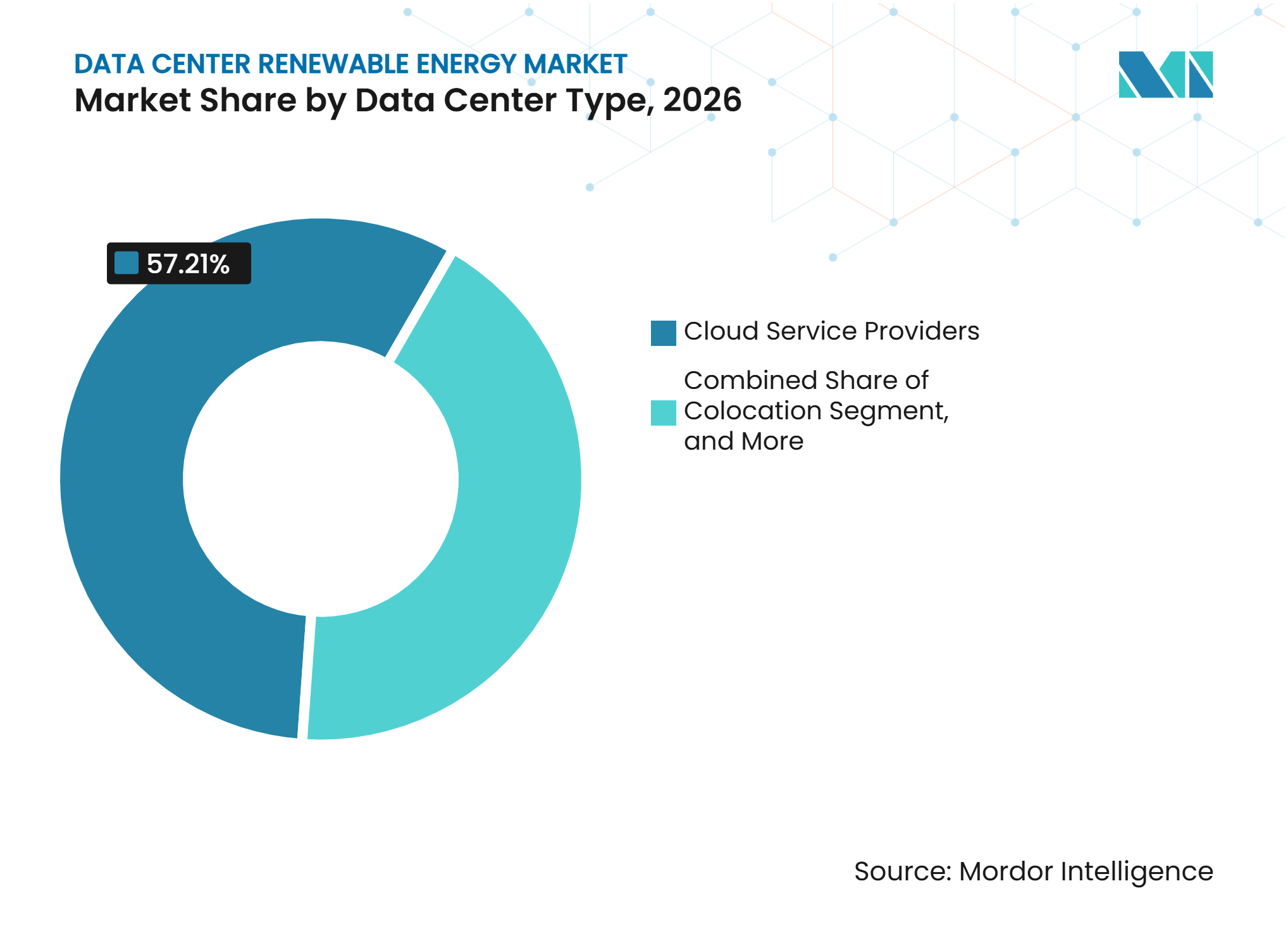
- By data center type, cloud service providers held 57.21% revenue share in 2026 and are projected to expand at an 18.79% CAGR through 2032.
- By geography, North America held 42.03% revenue share in 2026, while the Middle East is projected to expand at a 19.31% CAGR through 2032.
Note: Market numbers in this report are based on Mordor Intelligence's proprietary estimation framework, which combines nine months of actuals with Q4 projections for base year 2026.
Market Trends and Insights
Drivers Impact Analysis of Data Center Renewable Energy Market*
| Driver | (~) % Impact on CAGR Forecast | Geographic Relevance | Impact Timeline |
|---|---|---|---|
| Increasing Electricity Requirements of AI and Cloud Data Centers | +4.8% | Global, concentrated in North America, Asia-Pacific, and Europe | Short term (≤ 2 years) |
| Adoption of Renewable PPAs by Hyperscalers and Colocation Operators | +3.5% | Global, strongest in North America, Europe, and the Middle East | Short term (≤ 2 years) |
| Corporate Renewable Energy and Carbon Reduction Commitments | +3.2% | Global, strongest in North America and Europe | Medium term (2-4 years) |
| Improving Economics of Solar and Wind Power | +2.1% | Global, concentrated in Asia-Pacific, the Middle East, and North America | Medium term (2-4 years) |
| Government Incentives and Clean Energy Policies | +1.5% | Global, concentrated in North America, Europe, Japan, and India | Medium term (2-4 years) |
| Growth of 24/7 Carbon-Free Energy Procurement Strategies | +1.0% | Global, led by North America and Europe | Long term (≥ 4 years) |
| Source: Mordor Intelligence | |||
Increasing Electricity Requirements of AI and Cloud Data Centers
The data center renewable energy market is being shaped by AI training and real-time inference, which place far greater and more continuous demands on electricity systems than conventional cloud workloads. The International Energy Agency expects data center electricity consumption to reach 945 TWh by 2030, while AI-focused facilities are expected to triple their power use over the same period. The US Department of Energy has also cited Electric Power Research Institute work showing that U.S. data centers could account for as much as 9% of national electricity generation by 2030, compared with 4% in 2025. Major technology companies are translating their computing investments into longer and larger power commitments. The need for continuous power means that operators are increasingly seeking clean supply that can serve hourly demand, not only annual renewable matching. Conditional data center offtake agreements with small modular reactor projects reached 45 GW by April 2026, showing that buyers are also examining firm clean resources.
Adoption of Renewable PPAs by Hyperscalers and Colocation Operators
Renewable PPAs give large data center operators a practical way to secure supply, manage price exposure, and support new project development. Data center operators signed 45 TWh of renewable PPAs in the first half of 2026, nearly 20% above the same period of 2025, with nearly 70% of contracted volume in the United States. The contract mix is extending beyond solar and wind to include enhanced geothermal systems, long-duration energy storage, small modular reactors, and virtual power plant arrangements. This shift makes procurement more demanding because buyers must assess technology, delivery, and grid risks across a portfolio. Clearway Energy Group signed 3 long-term PPAs with Google totaling 1.17 GW across Missouri, Texas, and West Virginia in January 2026, supporting more than USD 2.4 billion in clean energy infrastructure investment. The data center renewable energy market therefore places more weight on developers that can offer multi-region contracts and manage projects through their full development cycle.
Corporate Renewable Energy and Carbon Reduction Commitments
Corporate commitments continue to make clean electricity procurement less sensitive to short-term changes in energy prices. Google contracted more than 12 GW of new clean energy in 2025, its largest annual amount, while its fleet-wide power usage effectiveness was 1.09. Microsoft reported that it matched 100% of its annual electricity consumption with renewable energy in fiscal year 2025 and had contracted 40 GW across 26 countries, with 19 GW online. Long-term offtake agreements with investment-grade buyers help developers secure project financing for new renewable assets. That connection between corporate procurement and project finance provides a stable demand base for the data center renewable energy market. It also underscores the importance of buyers' credit quality, contract duration, and ability to adapt to changing power profiles over time.
Improving Economics of Solar and Wind Power
Solar and wind projects remain central because they can be developed relatively quickly and deployed across many regions. A 2025 peer-reviewed study found that solar combined with battery storage could provide electricity to data centers at USD 25.11/MWh under optimized conditions, although results varied with capital costs and local capacity factors. The International Energy Agency expects global renewable generation to increase at close to 8% annually through 2030.[1] Lower generation costs support a broader range of contracts, including agreements for enterprise and colocation facilities that cannot negotiate the same terms as hyperscalers. However, low-cost variable generation does not remove the cost of serving continuous loads. Buyers are responding by combining solar and wind with storage, hydroelectricity, geothermal power, and demand management, rather than relying on a single technology.
Restraints Impact Analysis of Data Center Renewable Energy Market*
| Restraint | (~) % Impact on CAGR Forecast | Geographic Relevance | Impact Timeline |
|---|---|---|---|
| Transmission Constraints and Renewable Energy Curtailment | -1.8% | North America, particularly ERCOT, PJM, and CAISO, and Europe | Short term (≤ 2 years) |
| Intermittency of Solar and Wind Generation | -1.5% | Global | Short term (≤ 2 years) |
| Limited Availability of Suitable Projects Near Data Center Clusters | -1.2% | North America, Europe, and Asia-Pacific | Medium term (2-4 years) |
| Storage and Firming Costs for Variable Renewable Generation | -0.9% | Global | Medium term (2-4 years) |
| Source: Mordor Intelligence | |||
Transmission Constraints and Renewable Energy Curtailment
Transmission capacity is a major constraint when renewable resources are located far from data center clusters. The data center renewable energy market must account for interconnection queues, congestion, and curtailment when evaluating a contract's delivered value. The International Energy Agency notes that grid connection delays and network constraints are becoming important barriers to supplying AI-related electricity demand. New transmission lines require long development periods, permits across several jurisdictions, and agreement on cost allocation. These conditions can lead operators to consider on-site generation, storage, and flexible load arrangements where grid access is uncertain. In the United Kingdom, the Data Center Covenant sets expectations for participating operators to support grid resilience and clean power, showing how compliance requirements are becoming part of site planning.[2]
Intermittency of Solar and Wind Generation
Solar and wind output varies by hour and season, while AI computing loads require a high level of service continuity. This mismatch makes storage, dispatchable generation, and diversified portfolios important for new facilities. A 2025 peer-reviewed study of European data center microgrids found that off-grid renewable hybrid systems had levelized costs of GBP 70-102/MWh, equal to USD 87-128/MWh at the stated 2025 average exchange rates. The International Energy Agency has stated that reliably meeting AI data center needs can strain the technical capabilities of on-site power systems. Germany's Energy Efficiency Act requires data centers to source 100% of their electricity from renewable energy as of January 2027, increasing the need for a credible clean supply and supporting storage. Operators are consequently giving more attention to clean resources with predictable output and to contracts that can manage periods of lower renewable generation.
*Our forecasts treat driver/restraint impacts as directional, not additive. The impact forecasts reflect baseline growth, mix effects, and variable interactions.
Data Center Renewable Energy Market Segment Analysis
By Renewable Energy Source:
Solar Anchors Supply, Geothermal AcceleratesSolar power held 46.32% share by source in 2026. Its lead reflects 18-24-month development cycles, declining module costs, and broad availability across major data center regions. Solar output aligns well with daytime electricity demand and can be contracted in standardized formats. It is especially useful when data center construction schedules require that supply be developed quickly. Wind power is the second-largest source and adds generation during nighttime and shoulder periods. Pairing solar and wind can reduce the concentration of output at any one time of day. Hydropower is becoming more valuable because it can provide dispatchable clean power. Brookfield Asset Management and Google signed a framework agreement in July 2025 for up to 3,000 MW of U.S. hydropower over 20 years, starting with 670 MW from facilities in Pennsylvania. Biomass, biogas, and other renewable sources continue to serve locations with specific fuel, co-location, or reliability conditions.
Geothermal power is projected to expand at a 19.47% CAGR through 2032. Its capacity factor of nearly 90% makes it well-suited to inference workloads that require continuous electricity without relying on paired storage. The U.S. Department of Energy identifies geothermal as a potential source of dependable power for data centers, particularly where resources can be developed close to demand. Fervo Energy's Cape Station project in Utah is delivering 100 MW to the grid in 2026 and is scheduled to reach 500 MW by 2028. Google has contracted 396 MW from the project under a long-term PPA. The data center renewable energy industry is also considering geothermal because it can support granular, hour-matched energy claims. This quality may become more important as EnergyTag and comparable certificate programs gain wider use. The resulting source mix is likely to remain led by solar, but firm resources will carry greater value in contracts for continuous computing loads.



By Procurement Model:
Virtual PPAs Lead, On-Site Generation RisesVirtual or financial PPAs held 38.17% of the data center renewable energy market by procurement model in 2026. They allow a buyer to contract with a renewable project without requiring a physical connection between the project and each facility. This structure can serve cloud providers operating in multiple grid markets. A single agreement can combine financial settlement with renewable attributes that support company-wide targets. Off-site physical PPAs are the second-largest option because they offer a direct relationship between a local project and a local load. Utility green power programs, renewable energy certificates, and guarantees of origin remain relevant to smaller buyers that lack the resources to enter into bespoke contracts. The choice among these models often depends on load size, location, legal rules, and the buyer's ability to manage contract risk. The data center renewable energy market gives virtual PPAs a clear role where scale and geographic reach matter.
On-site renewable generation is projected to expand at a 19.26% CAGR through 2032. Grid congestion and long interconnection timelines make local generation attractive where a facility needs a more direct path to supply. On-site solar and battery systems can also lower exposure to high utility tariffs in selected locations. They do not remove a data center's need for dependable power, so they are usually part of a broader power plan. Japan illustrates the shift toward corporate procurement, with 148 announced corporate PPA transactions in 2025. The European policy environment also places value on verifiable local sourcing of renewable energy for facilities subject to mandatory energy obligations. On-site systems may therefore become a practical route for enterprise and edge facilities that cannot secure multi-gigawatt contracts. The model is not a replacement for utility supply, but it can reduce timing and reliability risks in constrained markets
By Project Configuration:
Standalone Projects Prevail, Firming Solutions GainStandalone renewable projects held 54.09% share by project configuration in 2026. Single-technology solar and wind projects have established financing structures, familiar contracts, and clearer pricing benchmarks. These features reduce transaction time for buyers and developers. They also allow operators to add renewable capacity in stages as their data center load increases. Hybrid projects that combine solar and wind are gaining popularity because their output profiles can complement each other. Renewable projects with battery storage are also expanding where time-of-use tariffs or contract terms require greater delivery certainty. Demand for complex projects is supported by buyers who place a premium on reliable, clean electricity. Still, the simpler standalone format remains useful for annual matching and for buyers who can manage residual supply needs through other arrangements.
Renewable projects with other firming solutions are projected to expand at a 20.04% CAGR through 2032. This category includes enhanced geothermal systems, demand response, virtual power plants, and small modular reactor co-siting. The International Energy Agency reported that conditional data center offtake agreements with small modular reactor projects reached 45 GW by April 2026. These arrangements are relevant to campuses that have contractual 24/7 carbon-free energy targets. They can reduce exposure to the limits of solar and wind during periods of low output. They also require more technical diligence, higher capital commitments, and longer development planning than a conventional PPA. The data center renewable energy industry is treating firming as a core part of new hyperscale procurement rather than as an optional addition. That change is broadening the pool of suppliers eligible to participate in large power programs.

By Contract Duration:
Long-Term Contracts Command the MarketLong-term contracts held 57.63% share in 2026. They are also projected to expand at an 18.87% CAGR through 2032. Tenors of 15-25 years give renewable developers a predictable cash flow that can support project debt financing. For data center buyers, these agreements improve visibility over future power costs and supply. This is particularly relevant as large AI campuses are planned several years before they reach full load. Medium-term contracts provide a bridge while larger projects are developed. Short-term agreements are more often used to cover residual needs or by buyers with smaller, less certain loads. The leading position of long-term contracts shows how closely large data center development is tied to renewable project finance.
Clearway Energy Group's January 2026 portfolio of 3 PPAs with Google shows the scale of this approach. The agreements total 1.17 GW across Missouri, Texas, and West Virginia, with durations of up to 20 years. Such contracts can underwrite major renewable infrastructure investments while giving buyers a secure source of supply. The International Energy Agency identifies long-term PPAs as an important mechanism for financing new renewable capacity. At the same time, concentration among a small number of very large buyers can increase exposure for developers if a buyer changes its procurement approach. Developers are therefore likely to value a broader base of medium- and large-data-center customers. Long-term contracts will remain central, but portfolio diversification will matter for both counterparties.
By Primary Procurement Objective:
Cost Optimization Leads, Matching GrowsElectricity cost optimization held 32.49% of the data center renewable energy market by primary procurement objective in 2026. For colocation providers and enterprise operators, renewable procurement is often first assessed as a means of managing electricity costs. Long-term agreements can limit exposure to volatile spot prices when the contract price is set under favorable conditions. Emissions reduction is the second-largest objective because large companies face internal targets and supply-chain sustainability requirements. Long-term supply security is also gaining relevance in regions where grid reliability and connection timing are uncertain. These objectives can overlap in the same contract, but the main objective shapes the technology mix and duration selected by the buyer. The data center renewable energy market continues to support cost-focused procurement because electricity remains a major operating expense.
Renewable energy matching is projected to expand at a 19.02% CAGR through 2032. The shift is moving beyond annual certificates toward hourly and location-specific carbon-free energy matching. Google has made 24/7 carbon-free energy a central part of its clean electricity approach. Meeting such goals requires a portfolio that includes solar, wind, storage, geothermal power, hydropower, and nuclear power. This increases the cost and complexity of procurement for operators without hyperscale buying power. The data center renewable energy industry is therefore seeing a divide between simple annual matching and detailed hourly matching. The latter can deliver a stronger link between electricity consumption and local clean generation. It also creates demand for suppliers capable of managing dispatch, certificates, and settlement across multiple technologies.
By Data Center Size:
Hyperscale Operators Define Procurement ScaleHyperscale facilities held 54.26% share by data center size in 2026. They are projected to expand at a 19.04% CAGR through 2032. A 500 MW hyperscale campus can spread the legal, financial, and technical work of complex PPAs across a much larger load than a smaller site can. This creates an advantage in negotiating portfolio contracts and supporting new project development. The International Energy Agency reported that capital expenditure by 5 major technology companies exceeded USD 400 billion in 2025 and was expected to increase by 75% in 2026. That investment is sustaining demand for renewable contracts at a scale that shapes developer pipelines. Large data centers form the next tier and are increasingly entering the PPA market as enterprise AI adoption raises their power needs. Medium and small facilities more often rely on utility programs, certificates, and shorter contracts.
Hyperscale buyers also influence the wider contracting environment. Their large agreements establish templates and developer relationships that can later be used by smaller operators. Japan's 148 announced corporate PPA transactions in 2025 show how a maturing procurement ecosystem can support more buyers. The data center renewable energy market benefits when large buyers establish demand for projects that can subsequently serve several customer groups. However, smaller facilities still face limits from their shorter lease terms and lower power loads. Aggregation services and standardized contracts may help reduce those barriers. The structural advantage of hyperscalers will remain significant because they can commit early and take on more project risk. Their activity is likely to continue setting the pace for capacity additions and for the adoption of firm clean supply.
By Data Center Type:
Cloud Providers Power Renewable DemandCloud service providers held 57.21% of the data center renewable energy market by data center type in 2026. They are projected to expand at an 18.79% CAGR through 2032. Their large campus footprints and multi-region operations allow them to sign portfolio PPAs across several power markets. This gives them the scale to support large-scale renewable projects and combine different technologies in a single program. Google, Microsoft, Amazon, and Meta contracted a combined 16,777 MW of corporate renewables in 2025. Google alone contracted more than 12 GW of new clean energy during the year. These decisions influence developer investment because contracts from major cloud providers provide clear evidence of long-term demand. They also encourage the use of less-established technologies when conventional supply cannot meet 24/7 clean-power goals.
Colocation providers are the second-largest group and use renewable procurement to meet the expectations of their hyperscale tenants. Their customers increasingly evaluate the carbon profile of leased infrastructure. Enterprise and edge data centers remain a smaller part of the data center renewable energy market because they have lower loads and fewer resources for complex PPAs. Many of these operators use utility green power programs or renewable energy certificates as a first step. The European Union's Corporate Sustainability Reporting Directive is also increasing attention to Scope 2 electricity disclosure among large enterprises. Compliance expectations could widen demand for renewable procurement beyond the largest cloud providers. The practical opportunity lies in offering simpler contracts and local solutions to operators without hyperscale purchasing capacity. This would allow suppliers to serve a broader base without requiring every buyer to manage a bespoke PPA.
Geography Analysis
North America: Structural Anchor for Large-Scale Procurement
North America held 42.03% of the data center renewable energy market share in 2026. The region combines hyperscale capacity, established PPA structures, and large solar and wind resources. Operators are diversifying beyond stand-alone solar into wind, hydropower, storage, and geothermal power, as illustrated by Google's 1.9 GW agreement with Xcel Energy and its hydropower framework with Brookfield. Grid access is shaping project location and contract value, while Canada adds hydropower supply and Mexico draws early data center investment.
Middle East: Clean Power and Data Center Investment Converge
The Middle East is projected to expand at a 19.31% CAGR through 2032. State-backed renewable programs, low solar and wind tariffs, and AI infrastructure plans are supporting this pace. The United Arab Emirates had 7.5 GW of operational renewable capacity in 2026 and started a 5.2 GW solar project with 19 GWh of battery storage to deliver 1 GW of baseload renewable electricity. DataVolt and NEOM signed an agreement in February 2025 for a USD 5 billion, 1.5 GW net-zero AI data center campus at Oxagon, while Saudi Arabia's renewable program is targeting 50% renewable electricity by 2030.
Europe, Asia-Pacific, South America, and Africa: Regulation and Emerging Demand Shape Growth
Europe's renewable procurement is shaped by energy and disclosure rules, including Germany's 100% renewable electricity requirement for data centers, effective from January 2027, and the United Kingdom's Data Center Covenant. In the Asia-Pacific region, Japan's corporate PPA activity and Malaysia's Corporate Green Power Program are increasingly attractive options for buyers, including TotalEnergies' 21-year Malaysian PPA with Google for 1 TWh of certified renewable electricity. Uttar Pradesh targets 50% renewable adoption for new data centers by 2030 and offers incentives for electricity duty and transmission charges for renewable-sourced facilities.[3] South America is advancing through Brazil's sustainability-based policy support, while Africa is at an earlier stage of cloud-related data center investment. Across these regions, policy, transmission access, and credible certificates will determine the pace of more detailed clean power procurement.
Competitive Landscape
Market Concentration
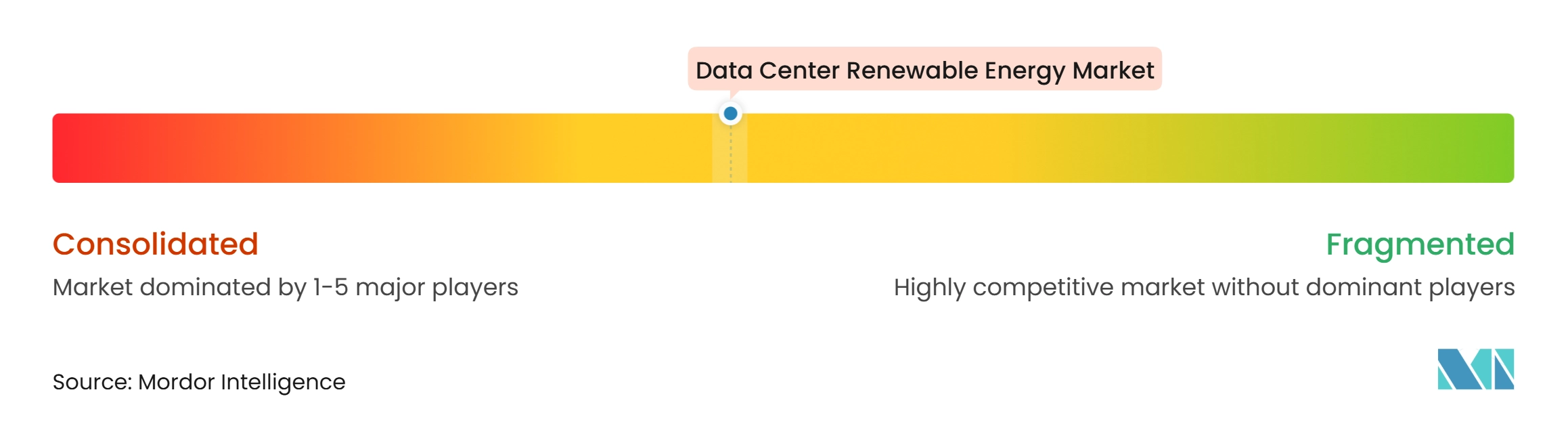
The data center renewable energy market is moderately concentrated among large independent power producers, utilities, and specialized renewable developers. Large cloud and social media companies serve as demand anchors because their contracts shape the tenor, credit quality, and technology selection. Suppliers need geographic reach and technical range because 24/7 clean power requires more than solar and wind. Interconnection queues, long development periods, and the capital needed for gigawatt-scale contracts limit rapid entry. Competitive strength, therefore, depends on the ability to deliver firm, clean supply, storage, or coordinated portfolios.
Iberdrola and Echelon Data Centers formed a joint venture in July 2025 for the 144 MW Madrid Sur project, with a 230 MW grid connection, planned on-site solar, and an Iberdrola clean power supply. The deal shows how utilities can take an equity role in data center infrastructure. Fervo Energy is building a position in enhanced geothermal power through Cape Station and its Google PPA. Brookfield and Google have also used a large hydropower framework agreement to secure long-duration clean supply. These examples link project ownership, firm generation, and long-term contracting as competitive capabilities.
Opportunities remain in firm clean power for operators below the hyperscale tier, on-site systems for edge and enterprise facilities, and emerging locations in Southeast Asia, India, and Sub-Saharan Africa. Energy management platforms can coordinate generation, storage, and electricity use across multi-source portfolios for hourly matching. EnergyTag provides a framework for time-based energy certificates that can support detailed clean electricity claims. A market concentration score of 5 reflects the reported moderate concentration and the presence of substantial entry barriers, while no combined top-player share was provided.
Data Center Renewable Energy Industry Leaders
-
Ørsted A/S
-
Iberdrola, S.A.
-
Enel Green Power S.p.A.
-
Brookfield Renewable Partners L.P.
-
NextEra Energy Resources, LLC
- *Disclaimer: Major Players sorted in no particular order
Data Center Renewable Energy Market Companies Covered in this Report
- NextEra Energy Resources, LLC
- Iberdrola, S.A.
- Enel Green Power S.p.A.
- Ørsted A/S
- RWE AG
- EDP Renováveis, S.A.
- Brookfield Renewable Partners L.P.
- The AES Corporation
- Invenergy LLC
- Lightsource Renewable Energy Holdings Limited
- ENGIE S.A.
- Statkraft AS
- Clearway Energy Group LLC
- Canadian Solar Inc.
- JinkoSolar Holding Co., Ltd.
- First Solar, Inc.
- BayWa r.e. AG
- Abu Dhabi Future Energy Company PJSC
- ACWA Power Company
- Adani Green Energy Limited
- Adani Green Energy
Recent Industry Developments in Data Center Renewable Energy Market
- March 2026: Cosmo Eco Power entered a Corporate PPA with Saison Technology to supply wind power from the Aizu-Wakamatsu Wind Farm to Saison's data centers beginning April 2026, enabling the operator to achieve 100% renewable energy usage across all facilities.
- February 2026: RWE and Amazon signed a 110 MW PPA for offshore wind from the Nordseecluster B project in Germany, building on a June 2025 strategic framework agreement linking RWE's renewable energy with Amazon Web Services cloud and AI services.
- February 2026: Microsoft announced it matched 100% of its annual electricity consumption with renewable energy in fiscal year 2025 for the first time, having contracted 40 GW of new renewable energy across 26 countries, with 19 GW already online.
- January 2026: Clearway Energy Group signed 3 long-term PPAs with Google totaling 1.17 GW across Missouri, Texas, and West Virginia, representing more than USD 2.4 billion in clean energy infrastructure investment, with contract durations of up to 20 years.
Global Data Center Renewable Energy Market Report Scope
The Data Center Renewable Energy Market reflects the growing integration of clean, sustainable power solutions into data center operations to meet rising electricity demand and reduce environmental impact. The market is driven by the rising adoption of renewable energy, corporate sustainability commitments, energy cost optimization, and the need for a reliable, long-term power supply.
The Data Center Renewable Energy Market Report is Segmented by Renewable Energy Source (Solar Power, Wind Power, Hydropower, Geothermal Power, Biomass and Biogas Power, and Other Renewable Sources), Procurement Model (On-Site Renewable Generation, Off-Site Physical PPAs, Virtual or Financial PPAs, Utility Green Power Programs, and Renewable Energy Certificates and Guarantees of Origin), Project Configuration (Standalone Renewable Projects, Hybrid Renewable Projects, Renewable Projects with Battery Storage, and Renewable Projects with Other Firming Solutions), Contract Duration (Short-Term Contracts, Medium-Term Contracts, and Long-Term Contracts), Primary Procurement Objective (Electricity Cost Optimization, Emissions Reduction, Renewable Energy Matching, and Long-Term Supply Security), Data Center Size (Small, Medium, Large, and Hyperscale), Data Center Type (Colocation, Cloud Service Providers, and Enterprise and Edge), and Geography (North America, South America, Europe, Middle East, Africa, and Asia-Pacific). The Market Forecasts are Provided in Terms of Value (USD), and Volume (MWh/GWh).
Segmentation Overview
| Solar Power |
| Wind Power |
| Hydropower |
| Geothermal Power |
| Biomass and Biogas Power |
| Other Renewable Sources |
| On-Site Renewable Generation |
| Off-Site Physical PPAs |
| Virtual or Financial PPAs |
| Utility Green Power Programs |
| Renewable Energy Certificates and Guarantees of Origin |
| Standalone Renewable Projects |
| Hybrid Renewable Projects |
| Renewable Projects with Battery Storage |
| Renewable Projects with Other Firming Solutions |
| Short-Term Contracts |
| Medium-Term Contracts |
| Long-Term Contracts |
| Electricity Cost Optimization |
| Emissions Reduction |
| Renewable Energy Matching |
| Long-Term Supply Security |
| Small |
| Medium |
| Large |
| Hyperscale |
| Colocation |
| Cloud Service Providers |
| Enterprise and Edge |
| North America | United States |
| Canada | |
| Mexico | |
| South America | Brazil |
| Chile | |
| Colombia | |
| Argentina | |
| Rest of South America | |
| Europe | United Kingdom |
| Germany | |
| France | |
| Netherlands | |
| Ireland | |
| Spain | |
| Italy | |
| Rest of Europe | |
| Middle East and Africa | United Arab Emirates |
| Saudi Arabia | |
| Qatar | |
| South Africa | |
| Egypt | |
| Rest of Middle East and Africa | |
| Asia-Pacific | China |
| India | |
| Japan | |
| Australia | |
| South Korea | |
| Malaysia | |
| Indonesia | |
| Rest of Asia-Pacific |
| By Renewable Energy Source | Solar Power | |
| Wind Power | ||
| Hydropower | ||
| Geothermal Power | ||
| Biomass and Biogas Power | ||
| Other Renewable Sources | ||
| By Procurement Model | On-Site Renewable Generation | |
| Off-Site Physical PPAs | ||
| Virtual or Financial PPAs | ||
| Utility Green Power Programs | ||
| Renewable Energy Certificates and Guarantees of Origin | ||
| By Project Configuration | Standalone Renewable Projects | |
| Hybrid Renewable Projects | ||
| Renewable Projects with Battery Storage | ||
| Renewable Projects with Other Firming Solutions | ||
| By Contract Duration | Short-Term Contracts | |
| Medium-Term Contracts | ||
| Long-Term Contracts | ||
| By Primary Procurement Objective | Electricity Cost Optimization | |
| Emissions Reduction | ||
| Renewable Energy Matching | ||
| Long-Term Supply Security | ||
| By Data Center Size | Small | |
| Medium | ||
| Large | ||
| Hyperscale | ||
| By Data Center Type | Colocation | |
| Cloud Service Providers | ||
| Enterprise and Edge | ||
| By Geography | North America | United States |
| Canada | ||
| Mexico | ||
| South America | Brazil | |
| Chile | ||
| Colombia | ||
| Argentina | ||
| Rest of South America | ||
| Europe | United Kingdom | |
| Germany | ||
| France | ||
| Netherlands | ||
| Ireland | ||
| Spain | ||
| Italy | ||
| Rest of Europe | ||
| Middle East and Africa | United Arab Emirates | |
| Saudi Arabia | ||
| Qatar | ||
| South Africa | ||
| Egypt | ||
| Rest of Middle East and Africa | ||
| Asia-Pacific | China | |
| India | ||
| Japan | ||
| Australia | ||
| South Korea | ||
| Malaysia | ||
| Indonesia | ||
| Rest of Asia-Pacific | ||
Key Questions Answered in the Report
What is the data center renewable energy market size?
The data center renewable energy market size is projected to rise from USD 14.81 billion in 2026 to USD 42.37 billion by 2032 at an 18.27% CAGR.
Which renewable source leads data center power procurement?
Solar power led by source with 46.32% share in 2026, supported by short development cycles and broad geographic availability.
Why are data centers signing renewable PPAs?
PPAs help operators secure long-term supply, manage power costs, and support corporate clean electricity commitments.
What is driving geothermal use in data centers?
Geothermal is projected to expand at a 19.47% CAGR because its nearly 90% capacity factor supports continuous AI inference workloads.
Which region has the highest projected expansion?
The Middle East is projected to expand at a 19.31% CAGR through 2032, supported by renewable investment programs and AI data center projects.
How do long-term renewable contracts support data centers?
Long-term contracts held 57.63% share in 2026 and can improve power cost visibility while helping developers finance new clean energy projects.