
Data Center Optical Connectivity Market Size and Share
Market Overview
| Study Period | 2021 - 2032 |
|---|---|
| Market Size (2027) | USD 45.12 Billion |
| Market Size (2032) | USD 101.26 Billion |
| Growth Rate (2027 - 2032) | 17.55 % |
| Fastest Growing Market | Asia-Pacific |
| Largest Market | North America |
| Market Concentration | Medium |
Major Players *Disclaimer: Major Players sorted in no particular order Image © Mordor Intelligence. Reuse requires attribution under CC BY 4.0. | |
Data Center Optical Connectivity Market Analysis by Mordor Intelligence
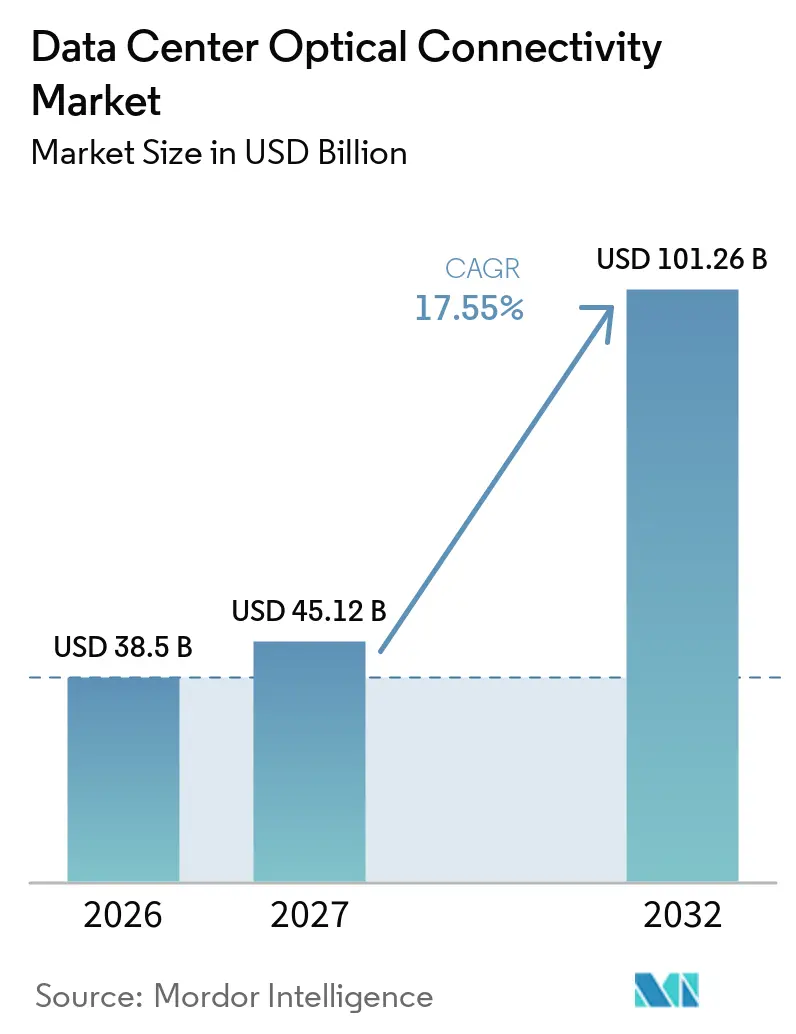
The Data Center Optical Connectivity Market size was valued at USD 38.50 billion in 2026 and is estimated to grow from USD 45.12 billion in 2027 to reach USD 101.26 billion by 2032, at a CAGR of 17.55% during the forecast period (2027-2032).
The data center optical connectivity market is being reshaped by AI training and inference systems that need much higher bandwidth between compute, switching, and storage resources, including dense traffic flows that move repeatedly across the same facility. Larger AI clusters also increase the amount of fiber, connectors, and short-reach links installed within each facility, because individual racks, pods, and data halls must exchange more information at the same time. The transition from 400G to 800G and 1.6T platforms is raising the optical content of new infrastructure projects. Supply commitments and product qualification are becoming more important because operators need dependable access to specialized lasers and modules, and because deployment schedules can be affected when a single part is unavailable. The data center optical connectivity market, therefore, offers opportunities for suppliers that can combine volume manufacturing, power efficiency, standards compliance, reliable delivery, and disciplined product qualification across complex customer deployments.
Key Report Takeaways
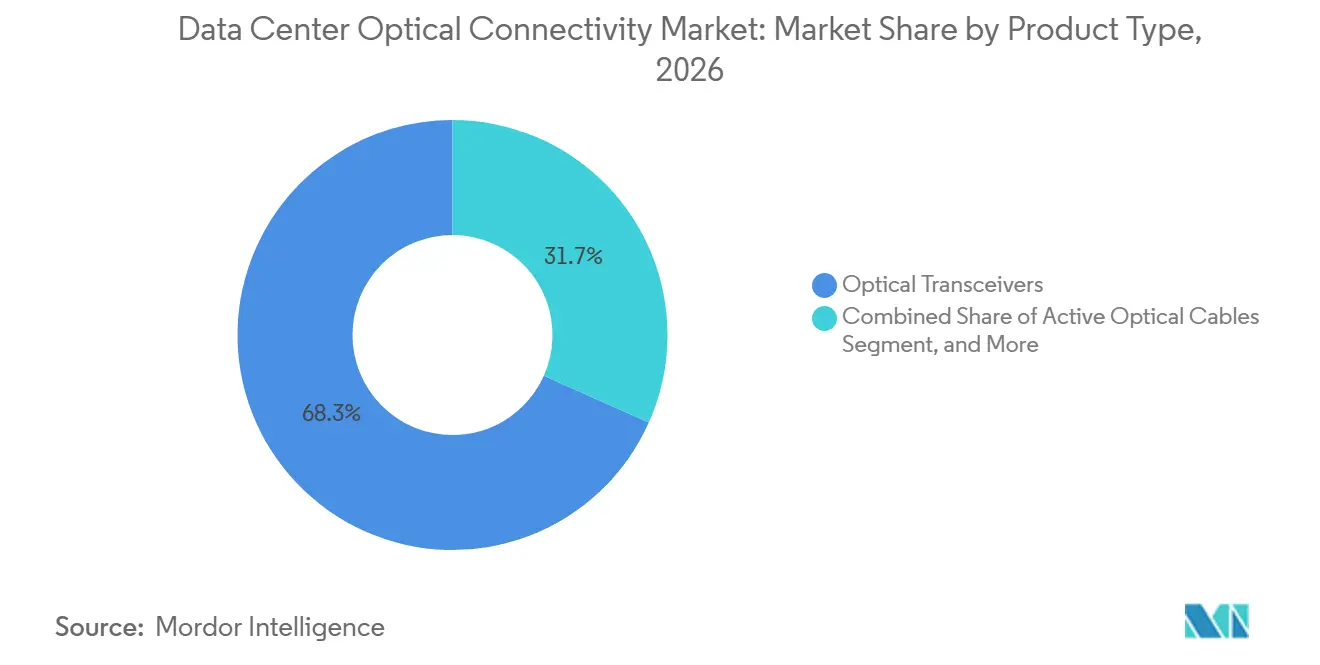
- By product type, optical transceivers led with 68.32% of the data center optical connectivity market share in 2026, while optical circuit switches are projected to expand at a 33.60% CAGR through 2032.
- By connectivity architecture, conventional pluggable optics held 86.71% share in 2026, while co-packaged optics are projected to expand at a 37.40% CAGR through 2032.
- By data rate, the up to 400 Gbps segment held 51.82% share in 2026, while the 1.6 Tbps segment is projected to expand at a 40.30% CAGR through 2032.
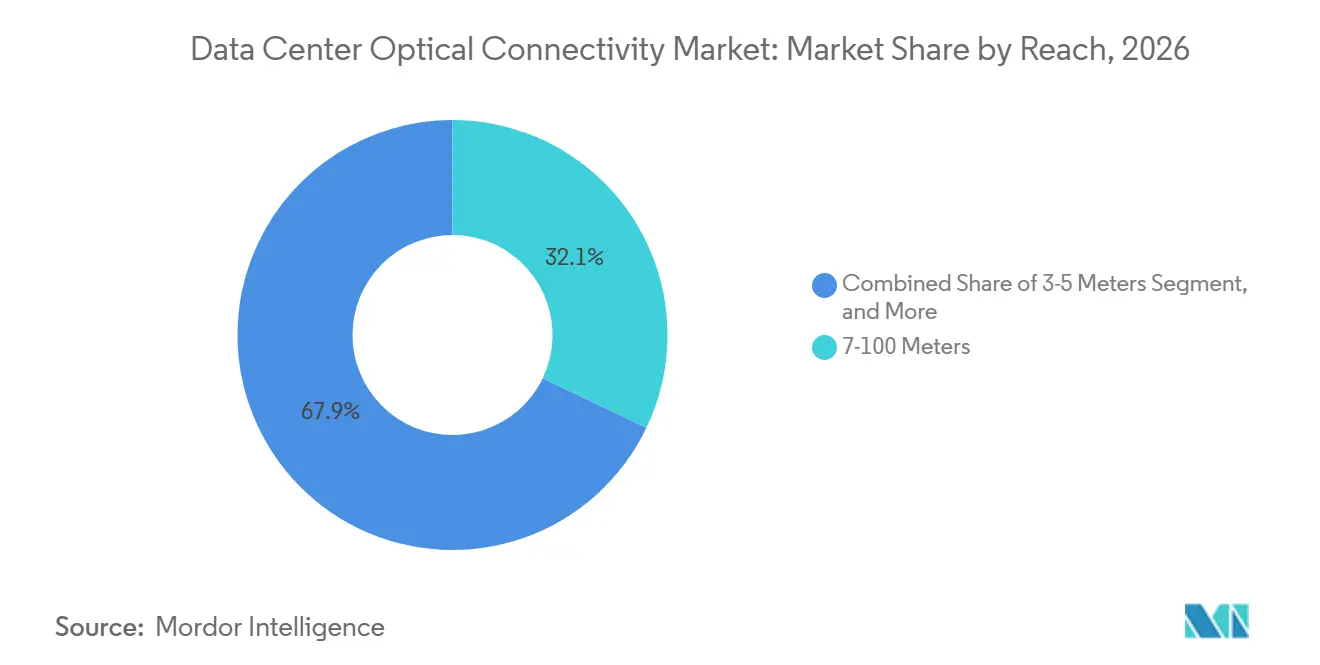
- By reach, the 7-100 meters segment held 32.10% share in 2026, while the 3-5 meters segment is projected to expand at an 18.10% CAGR through 2032.
- By application, GPU-to-Switch held 29.71% share in 2026, while GPU-to-GPU connections are projected to expand at a 30.15% CAGR through 2032.
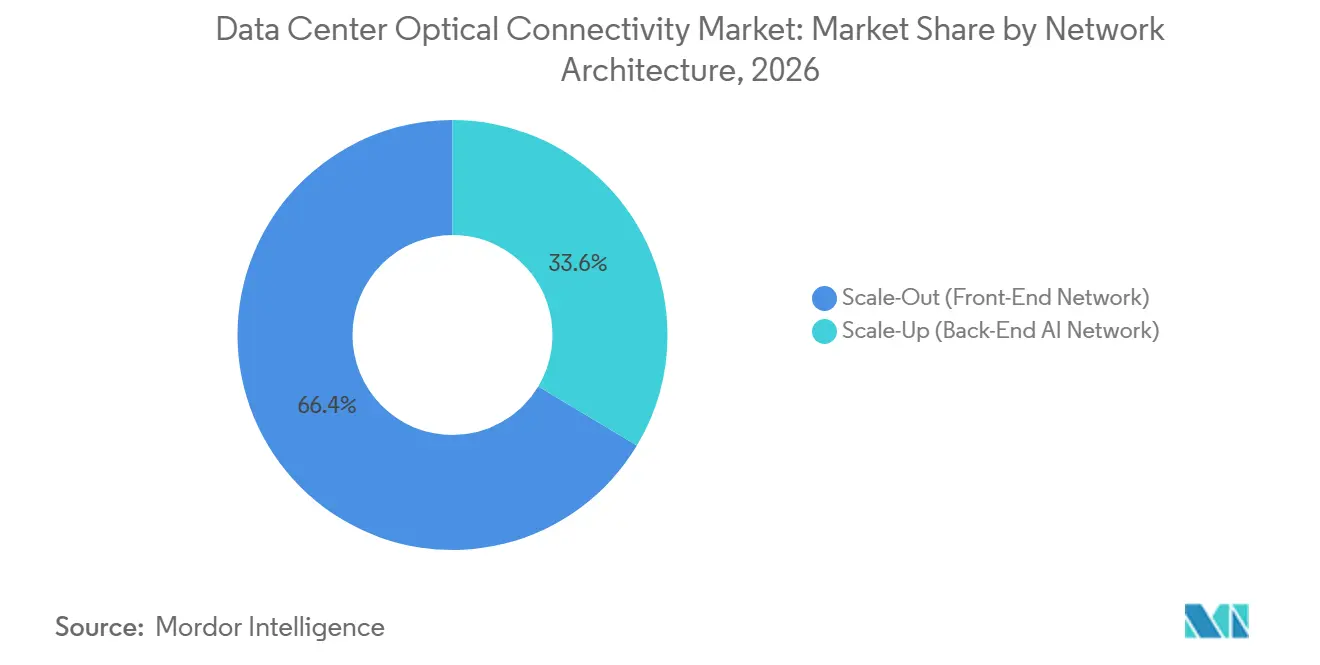
- By network architecture, Scale-Out held 66.40% share in 2026, while Scale-Up is projected to expand at a 32.23% CAGR through 2032.
- By data center type, hyperscale data centers held 65.71% share in 2026, while edge and micro data centers are projected to expand at a 25.89% CAGR through 2032.
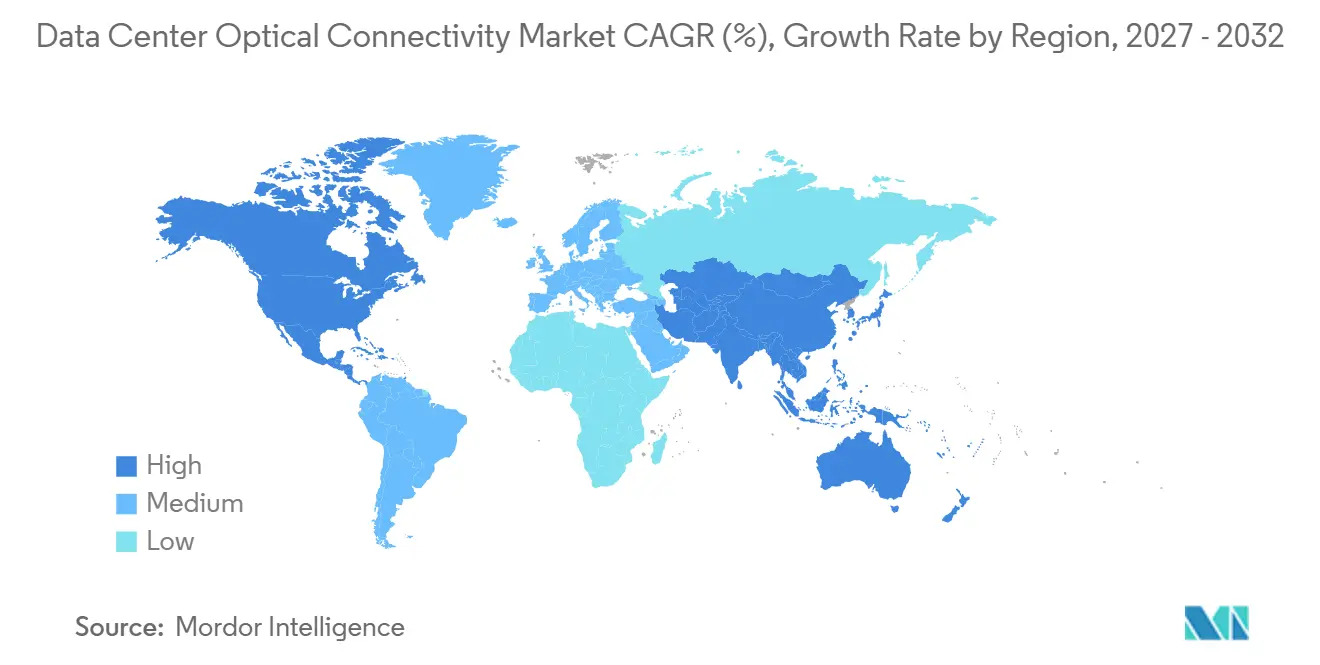
- By geography, North America held 36.12% share in 2026, while Asia-Pacific is projected to expand at an 18.58% CAGR through 2032.
Note: Market numbers in this report are based on Mordor Intelligence's proprietary estimation framework, which combines nine months of actuals with Q4 projections for base year 2026.
Market Trends and Insights
Drivers Impact Analysis of Data Center Optical Connectivity Market*
| Driver | (~) % Impact on CAGR Forecast | Geographic Relevance | Impact Timeline |
|---|---|---|---|
| Rapid Expansion of AI and Hyperscale Data Centers | +5.1% | Global, concentrated in North America and Asia-Pacific | Short term (≤ 2 years) |
| Increasing Adoption of 800G and 1.6T Optical Connectivity | +4.0% | North America, Asia-Pacific, Europe | Short term (≤ 2 years) |
| Rising GPU Density and East-West Data Traffic | +3.2% | North America, China, Europe | Medium term (2-4 years) |
| Growing Demand for Low-Latency and High-Bandwidth Connectivity | +2.7% | Global, Asia-Pacific core with spillover to Middle East | Medium term (2-4 years) |
| Increasing Data Center Network Speeds and Bandwidth Requirements | +2.3% | Global | Medium term (2-4 years) |
| Increasing Fiber Density and Port Density in Data Centers | +1.8% | North America and Europe, with early gains in India and UAE | Long term (≥ 4 years) |
| Source: Mordor Intelligence | |||
Rapid Expansion of AI and Hyperscale Data Centers
AI infrastructure programs are expanding the number and scale of optical links required in hyperscale facilities. New GPU clusters use more high-speed connections than conventional cloud deployments, particularly across switching layers and between clustered systems. Operators are also moving from short procurement cycles to multiyear supply arrangements for critical optical components. Meta entered a multiyear agreement with Corning through 2030, and Amazon also put in place a separate long-term supply arrangement. These commitments show that leading buyers view optical capacity as an operational requirement rather than a routine component purchase. The data center optical connectivity market benefits when these reservations support new builds and reduce uncertainty for qualified suppliers.
Increasing Adoption of 800G and 1.6T Optical Connectivity
The move toward 800G and 1.6T links is changing the design assumptions for new AI clusters. Higher-speed modules allow operators to increase bandwidth without expanding the number of switch ports at the same rate. The transition also raises the importance of laser performance, signal quality, packaging precision, and thermal control. NVIDIA's GB300 platform is associated with higher bandwidth requirements at cluster spine links, which supports demand for 1.6T connectivity. Buyers must qualify emerging platforms early because optical validation can take longer than a standard network refresh. The data center optical connectivity market is therefore moving through a period in which several speed generations will coexist within the same campus.
Rising GPU Density and East-West Data Traffic
Denser GPU configurations create substantial traffic between accelerators, switches, and storage resources. Mixture-of-experts models require frequent exchanges among distributed experts, which places added pressure on east-west network paths. This traffic pattern favors fabrics that can provide low latency while retaining flexibility across training stages. Optical circuit switching can reconfigure connections between workloads and reduce the need for repeated electrical conversion. Co-packaged optics can also reduce the power required for very high-speed links by moving optical functions closer to the switching silicon. The data center optical connectivity market gains from this change because each increase in GPU density raises the value of reliable short-reach optical paths.
Growing Demand for Low-Latency and High-Bandwidth Connectivity
Distributed AI training and inference require more than capacity because the timing of data exchange also affects system performance. Facilities linked across a campus or metropolitan area need predictable transmission and low variation in delay. Coherent pluggables and data center interconnect links address these requirements, where separate facilities operate as one computing environment. NTT-ME launched its Japan Premium Direct Connect All-Photonics Connect service in January 2026, demonstrating a commercial path for low-latency optical interconnection between Tokyo data centers.[1] The service reflects a wider need for high-capacity links that support workloads distributed beyond a single building. The data center optical connectivity market can benefit as more operators connect AI capacity across sites instead of concentrating every workload in one facility.
Restraints Impact Analysis of Data Center Optical Connectivity Market*
| Restraint | (~) % Impact on CAGR Forecast | Geographic Relevance | Impact Timeline |
|---|---|---|---|
| High Cost of Advanced Optical Connectivity | -2.7% | Global, most acute in emerging Asia-Pacific and Middle East markets | Short term (≤ 2 years) |
| Supply Constraints for Optical Components and Specialty Fiber | -2.0% | Global, most severe in North America and Europe | Short term (≤ 2 years) |
| Power, Thermal and Signal-Integrity Challenges | -1.5% | Global | Medium term (2-4 years) |
| Complexity of Upgrading Existing Data Center Networks | -1.1% | North America and Europe, with a large legacy installed base | Long term (≥ 4 years) |
| Source: Mordor Intelligence | |||
High Cost of Advanced Optical Connectivity
High-speed optical links carry higher component and qualification costs than earlier generations. Indium phosphide EML lasers require specialized manufacturing, optical alignment, and advanced packaging. A limited base of capable upstream suppliers can sustain pricing pressure when demand rises quickly. This creates a greater challenge for enterprise and colocation operators that do not have multiyear volume contracts. Cost pressure can delay upgrades to 800G platforms outside the largest cloud operators. The data center optical connectivity market may therefore see adoption progress unevenly across hyperscale, colocation, enterprise, and edge deployments.
Supply Constraints for Optical Components and Specialty Fiber
Supply constraints extend beyond modules to specialty fiber, laser substrates, and high-density cable assemblies. AI facilities need much more fiber than conventional data centers because their architecture has more high-speed links across racks, rows, and switching layers. Material availability and manufacturing capacity can delay delivery even when an operator has funds and construction capacity. Export restrictions on critical materials add another source of uncertainty for indium phosphide supply chains. Long-term fiber contracts can lower allocation risk, while operators without them can face delays in commissioning new capacity. These conditions reinforce the advantage of suppliers that have secured manufacturing capacity and diverse sourcing arrangements.
*Our forecasts treat driver/restraint impacts as directional, not additive. The impact forecasts reflect baseline growth, mix effects, and variable interactions.
Data Center Optical Connectivity Market Segment Analysis
By Product Type:
Optical Transceivers Anchor Demand as Circuit Switches AccelerateOptical transceivers captured 68.32% of the data center optical connectivity market share in 2026, reflecting their central role in established data center link designs. Their plug-and-play form factor supports replacement, repair, and upgrades without redesigning the full switching platform, an advantage that supports the data center optical connectivity market as operating fleets expand. This serviceability remains important for operators running large fleets across multiple facilities, where maintenance teams need to restore network capacity without interrupting wider cluster operations. Active optical cables and fiber-optic cable assemblies also serve high-fiber-count trunk routes within GPU clusters. These assemblies support dense spine connections and reduce complexity where many links must be installed in limited rack space, including the structured routes that connect repeated GPU and switch configurations.
Optical circuit switches are projected to expand at a 33.60% CAGR through 2032, making them the fastest-moving product category in the data center optical connectivity industry. Their appeal comes from the ability to reconfigure optical paths for changing training workloads, which can move communication requirements between groups of accelerators as model-training phases change. The Open Compute Project reported that an optical circuit switching approach in Google's Jupiter Fabric reduced network power by 41%, reduced capital expenditure by 30%, and improved throughput by 5x compared with electrical alternatives.[2] MEMS-based offerings from Lumentum, Molex, and Telescent are expanding the available commercial options. Optical connectors and interconnect assemblies will remain necessary because denser AI clusters need reliable cabling between racks, pods, and data halls.

By Connectivity Architecture:
Pluggable Optics Lead as Co-Packaged Optics Gain GroundConventional pluggable optics held 86.71% of the connectivity architecture segment in 2026, supported by a mature supply chain and extensive installed base. Operators value their field serviceability because modules can be replaced without changing the switch platform, an operational advantage for facilities that manage thousands of individual optical ports. Linear pluggable optics and linear receive optics offer an intermediate approach that reduces power use while retaining a familiar maintenance model in the data center optical connectivity market. Near-packaged optics address short GPU-to-GPU paths where electrical reach is limited, and bandwidth density is critical. Accelink's 6.4T near-packaged optics solution illustrates early commercial interest in these more integrated designs.
Co-packaged optics are projected to expand at a 37.40% CAGR through 2032, as operators move from technical validation toward volume deployments. The architecture places optics closer to switching silicon, which can reduce electrical loss and improve power efficiency at high port speeds, particularly where conventional electrical traces become harder to manage. Interface standards from the Optical Internetworking Forum can reduce lock-in concerns for buyers evaluating these tightly integrated systems. Broadcom's Tomahawk 6 Davisson and NVIDIA's Spectrum-X Photonics were identified as commercially shipping co-packaged optics-integrated switch platforms in 2026. The data center optical connectivity market will continue to rely on pluggables in the near term because operators need a mix of serviceability, interoperability, and high-density performance.
By Data Rate:
400 Gbps Transitions as 1.6T Enters Volume DeploymentThe up to 400 Gbps category held 51.82% of the data rate segment in 2026, due to its large installed base across data center networks. Much of this equipment was deployed from 2022 onward and remains useful for many cloud and enterprise workloads, even as newly designed AI clusters require a more demanding bandwidth profile. New AI cluster projects are increasingly built around 800G as the practical starting point for high-bandwidth leaf and spine connectivity. The above 1.6 Tbps tier remains at an early stage and includes platforms targeting 3.2T and higher rates. Its development is tied to advances in 200G-per-lane silicon and optical packaging, which remain central to the data center optical connectivity market.
The 1.6 Tbps segment is projected to expand at a 40.30% CAGR through 2032. It is closely linked to next-generation GPU systems and the need for higher spine-layer capacity. Higher data rates make thermal management, signal integrity, and optical qualification more demanding, so product selection increasingly depends on how modules, switches, cables, and cooling systems work together. Operators must often run 800G and 1.6T in parallel while their facilities transition to newer switch and module platforms. The data center optical connectivity industry will need compatibility approaches that allow breakout configurations and staged migration rather than a single replacement event.
By Reach:
Short-Reach Links Support GPU Cluster DensityThe 7-100 meters range held 32.10% of the reach segment in 2026, covering many spine-leaf connections within a campus. It is supported by the installed base of multimode fiber and VCSEL-based transceivers used for common intra-facility links, which continue to connect equipment across rows and halls within large campuses. The 100-500 meters range serves connections across buildings and data hall clusters. Links above 500 meters support campus-level data center interconnect needs. The shortest categories are smaller today, but their relevance rises as optics move closer to computing and switch to silicon.
The 3-5 meters segment is projected to expand at an 18.10% CAGR through 2032. Dense GPU racks create more short optical paths within co-located server and switching equipment, as designers work to retain bandwidth while fitting more compute and network resources into limited physical footprints. Co-packaged and near-packaged architectures can shift connection requirements from patch-panel distances to specialized sub-5-meter routes. These routes require low-loss fiber assemblies and connector interfaces designed for constrained spaces. The data center optical connectivity market will still require 7-100 meters links in large volumes because cluster expansion continues across racks and data halls.
By Application:
GPU-to-Switch Leads While GPU-to-GPU AcceleratesGPU-to-Switch accounted for 29.71% of the application segment in 2026, making it the largest application for optical connectivity. Scale-out AI networks depend on this path because GPUs connect to top-of-rack and higher-level switches, creating many repeated links that together form the network fabric for large training systems. Server-to-Switch and Switch-to-Switch links also remain essential across AI and conventional cloud facilities. Data center interconnect connects separate locations within a campus or metropolitan area for distributed training. Coherent 800ZR and 800ZR+ pluggables are relevant to these longer-distance requirements within the data center optical connectivity market.
GPU-to-GPU direct connections are projected to expand at a 30.15% CAGR through 2032. Their advance is tied to scale-up networks that need optical paths as cluster size exceeds the practical reach of copper, especially when accelerator systems must exchange information at much higher lane rates. NVLink and emerging UALink fabrics increase the importance of high-bandwidth accelerator connections. Storage connectivity also needs fast optical paths as inference services retrieve large model checkpoints. The data center optical connectivity market size for GPU-to-GPU applications is influenced by the pace at which co-packaged platforms move from development systems into deployed racks.
By Network Architecture:
Scale-Out Leads as Scale-Up Becomes StrategicScale-Out held 66.40% of the network architecture segment in 2026, reflecting the large installed base of front-end leaf-spine networks. These networks connect servers, GPUs, storage, and switches across the data center, and their familiar leaf-spine structure gives operators a manageable path for adopting new optical technologies. They are also an initial deployment point for switch-level co-packaged optics. Broadcom's Tomahawk 6 Davisson and NVIDIA's Spectrum-X Photonics brought co-packaged optics into production-oriented scale-out platforms during 2026. Purchase decisions in this area remain closely connected to the choices of data center operators and switch vendors.
Scale-Up is projected to expand at a 32.23% CAGR through 2032, supported by the longer-term move from copper to optical connections inside GPU pods. Scale-up requirements are increasingly shaped by GPU platform providers because those vendors define the back-end fabric, the accelerator interfaces, and the conditions for qualifying optical connections within tightly integrated systems. Optical circuit switching can support this architecture by changing paths between training phases. Cisco's OPUS photonic fabric work demonstrated an optical circuit switching approach on testbeds reaching 2,048 GPUs. The data center optical connectivity market will be affected by whether this technical validation converts into broad commercial qualification for production GPU systems.
By Data Center Type:
Hyperscale Anchors Demand as Edge Capacity ScalesHyperscale data centers held 65.71% of the data center type segment in 2026. This leading position reflects the concentration of AI capacity among the largest U.S. and Chinese operators in the data center optical connectivity market. AI training facilities also require more optical ports per rack than conventional cloud data centers, increasing the importance of suppliers that can support high-density cabling and dependable component delivery. Colocation providers serve tenants with different reach and speed needs, which sustains their preference for standards-based pluggables. Enterprise facilities are shifting toward hybrid arrangements, reducing some direct spending as workloads move into public clouds.
Edge and micro data centers are projected to expand at a 25.89% CAGR through 2032. They support AI inference, 5G edge computing, and latency-sensitive Internet of Things uses that need compute closer to users, rather than relying only on the long-distance paths that connect centralized cloud campuses. These facilities favor compact products with controlled power consumption and thermal performance. Active optical cables and short-reach transceiver assemblies are well suited to smaller facilities that do not use hyperscale chassis designs. This part of the data center optical connectivity industry broadens demand beyond the largest centralized cloud campuses.
Geography Analysis
The Americas Data Center Optical Connectivity Market
North America held 36.12% of the regional total in 2026. The region is supported by AI infrastructure investment from Amazon, Alphabet, Meta, Microsoft, and Oracle. High demand for 800G links and coherent pluggables has increased the importance of domestic component capacity. Coherent received a letter of intent for up to USD 50 million in CHIPS Act funding to expand its Sherman, Texas, facility.[3] Corning is increasing U.S. optical connectivity capacity and fiber production through planned facilities in North Carolina and Texas, while South America remains earlier in its deployment cycle, and Brazil is supported by hyperscaler builds and financial-sector demand.
EMEA Data Center Optical Connectivity Market
Europe is supported by major hyperscale and colocation locations in Germany, the United Kingdom, and France. The European AI Act is influencing infrastructure choices through requirements related to standards and accountable systems. These conditions can favor auditable and standards-based optical networks rather than proprietary approaches. The Middle East is being led by the UAE and Saudi Arabia, where national AI programs and hyperscaler investment are expanding digital infrastructure. Africa remains at an earlier stage, with South Africa, Egypt, and Nigeria linked to cable landing stations and regional cloud campuses, so supplier opportunities differ substantially across the region.
APAC Data Center Optical Connectivity Market
Asia-Pacific is projected to expand at an 18.58% CAGR through 2032, the fastest regional rate in the data center optical connectivity market. China has a large domestic optical component base that includes InnoLight, Eoptolink, Hisense Broadband, and Accelink, while India is supported by fiber expansion, 5G transport investment, and public digital infrastructure programs. Japan has become an important test environment for all-photonics networking through NTT-ME's January 2026 commercial service launch.[4] Taiwan and South Korea have a foundational supply-side role because advanced packaging processes support silicon photonics used in co-packaged optics, linking the region's manufacturing base closely to global infrastructure deployment.
Competitive Landscape
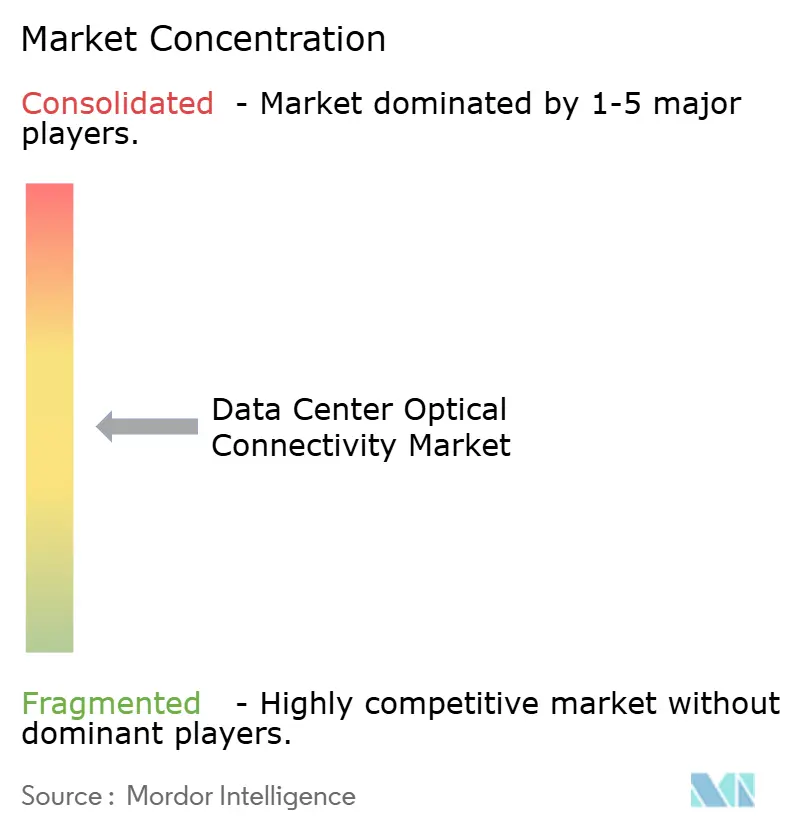
The data center optical connectivity market is moderately fragmented in transceivers and laser components, while cable, connector, and fiber assembly activities have a broader supplier base. Coherent, Lumentum, InnoLight, and Eoptolink have strong positions in high-speed module and laser-related supply. Corning, Amphenol, Molex, Sumitomo Electric, and Fujikura have important roles in cable, connector, and fiber assembly products. Competition is increasingly shaped by the ability to secure qualified capacity for AI-focused platforms. NVIDIA's investments and supply arrangements with optical component providers show how platform vendors are seeking direct access to upstream capability.
Molex announced an agreement to acquire Teramount in April 2026, adding detachable fiber-to-chip connectivity to its optical interconnect portfolio. The move addresses the growing need to connect optical systems directly to high-performance chips while enabling a more integrated supplier offering. In March 2026, US Conec, Corning, Fujikura, and Sumitomo Electric Lightwave announced a multi-source framework for expanded beam ferrules and MMC connectors. This approach can widen the qualified supply base for high-density AI links and limit dependence on one connector source. Molex also introduced its High-Radix Optical Circuit Switch Platform for AI cluster deployment, highlighting interest in fiber-level reconfiguration.
White space remains in optical circuit switching for operators below the largest hyperscale tier, in multicore fiber standardization, and in co-packaged optics for GPU scale-up connections. Sumitomo Electric and industry partners initiated a multi-source effort for an AI data center multicore fiber specification in February 2026. IEEE Ethernet requirements and Optical Internetworking Forum implementation agreements are becoming important for supplier qualification, which benefits established vendors that can support standards work, qualification cycles, and production scale at the same time. Smaller companies can still compete where they provide specialized expanded beam connectors, multicore fiber assemblies, or MEMS optical circuit switches that resolve a clear integration or capacity requirement for operators.
Data Center Optical Connectivity Industry Leaders
-
Coherent Corp.
-
Lumentum Holdings Inc.
-
Accelink Technologies Co., Ltd.
-
Eoptolink Technology
-
Applied Optoelectronics, Inc.
- *Disclaimer: Major Players sorted in no particular order
Data Center Optical Connectivity Market Companies Covered in this Report
- Coherent Corp.
- Lumentum Holdings Inc.
- InnoLight Technology
- Eoptolink Technology
- Applied Optoelectronics, Inc.
- Accelink Technologies Co., Ltd.
- Source Photonics, Inc.
- HG Genuine
- Hisense Broadband Multimedia Technology Co., Ltd
- Corning Incorporated
- Amphenol Corporation
- Molex, LLC
- Sumitomo Electric Industries, Ltd.
- Fujikura Ltd.
- Furukawa Electric Co., Ltd.
- US Conec Ltd.
- Senko Advanced Components, Inc.
- Sterlite Technologies (STL) Limited
- Ayar Labs, Inc.
- Lightmatter, Inc.
Recent Industry Developments in Data Center Optical Connectivity Market
- September 2026: Ayar Labs secured an additional USD 150 million, extending its 2026 total primary capital raise to USD 650 million and bringing cumulative funding to over USD 870 million. Wiwynn joined as a strategic investor alongside Nvidia, AMD, and MediaTek, with proceeds directed toward accelerating volume production of TeraPHY co-packaged optics and a new chip design center in Bengaluru, India, targeting product readiness by end of 2027.
- May 2026: NVIDIA and Corning announced a multiyear strategic partnership including a USD 500 million warrant deal. Corning committed to increasing U.S. optical connectivity manufacturing capacity tenfold and fiber production by more than 50%, with 3 new advanced manufacturing facilities planned in North Carolina and Texas to secure supply for next-generation AI data center networks.
- April 2026: Molex announced an agreement to acquire Teramount Ltd., an Israel-based developer of the TeraVERSE detachable fiber-to-chip co-packaged optics connectivity platform. The deal, expected to close in the second half of 2026, enables Molex to offer an end-to-end optical interconnect stack for hyperscale AI cluster deployments.
- March 2026: US Conec, Corning, Fujikura, and Sumitomo Electric Lightwave announced multi-source licensing agreements for the PRIZM TMT expanded beam ferrule and the associated MMC VSFF connector platform, broadening the high-density optical connectivity supply chain for AI factory link architectures and reducing single-vendor dependency.
Global Data Center Optical Connectivity Market Report Scope
Data center optical connectivity refers to high-speed fiber-optic components, cables, and transceivers engineered to facilitate high-bandwidth, low-latency data transmission within and between data centers worldwide.
The Data Center Optical Connectivity Market Report is Segmented by Product Type (Optical Transceivers, Active Optical Cables, Fiber-Optic Cable Assemblies, Optical Connectors, Optical Interconnect Assemblies, and Optical Circuit Switches), Connectivity Architecture (Conventional Pluggable Optics, Linear Pluggable Optics (LPO/LRO), Near-Packaged Optics (NPO), and Co-Packaged Optics (CPO)), Data Rate (Up to 400 Gbps, 800 Gbps, 1.6 Tbps, and Above 1.6 Tbps), Reach (Up to 3 Meters, 3-5 Meters, 5-7 Meters, 7-100 Meters, 100-500 Meters, and Above 500 Meters), Application (GPU-to-Switch, GPU-to-GPU, Switch-to-Switch, Server-to-Switch, Storage Connectivity, and Data Center Interconnect), Network Architecture (Scale-Up and Scale-Out), Data Center Type (Hyperscale, Colocation, Enterprise, and Edge and Micro Data Centers), and Geography (North America, South America, Europe, Asia-Pacific, and Middle East and Africa). The Market Forecasts are Provided in Terms of Value (USD).
Segmentation Overview
| Optical Transceivers |
| Active Optical Cables |
| Fiber-Optic Cable Assemblies |
| Optical Connectors |
| Optical Interconnect Assemblies |
| Optical Circuit Switches |
| Conventional Pluggable Optics |
| Linear Pluggable Optics (LPO/LRO) |
| Near-Packaged Optics (NPO) |
| Co-Packaged Optics (CPO) |
| Up to 400 Gbps |
| 800 Gbps |
| 1.6 Tbps |
| Above 1.6 Tbps |
| Up to 3 Meters |
| 3-5 Meters |
| 5-7 Meters |
| 7-100 Meters |
| 100-500 Meters |
| Above 500 Meters |
| GPU-to-Switch |
| GPU-to-GPU |
| Switch-to-Switch |
| Server-to-Switch |
| Storage Connectivity |
| Data Center Interconnect |
| Scale-Up |
| Scale-Out |
| Hyperscale |
| Colocation |
| Enterprise |
| Edge and Micro Data Centers |
| North America | United States |
| Canada | |
| Mexico | |
| South America | Brazil |
| Chile | |
| Argentina | |
| Rest of South America | |
| Europe | Germany |
| Netherlands | |
| United Kingdom | |
| Ireland | |
| Spain | |
| Italy | |
| Sweden | |
| Norway | |
| Finland | |
| Rest of Europe | |
| Asia-Pacific | China |
| India | |
| Japan | |
| Indonesia | |
| Australia | |
| Singapore | |
| Malaysia | |
| Vietnam | |
| Thailand | |
| Taiwan | |
| Philippines | |
| Rest of Asia-Pacific | |
| Middle East and Africa | Saudi Arabia |
| United Arab Emirates | |
| South Africa | |
| Nigeria | |
| Egypt | |
| Rest of Middle East and Africa |
| By Product Type | Optical Transceivers | |
| Active Optical Cables | ||
| Fiber-Optic Cable Assemblies | ||
| Optical Connectors | ||
| Optical Interconnect Assemblies | ||
| Optical Circuit Switches | ||
| By Connectivity Architecture | Conventional Pluggable Optics | |
| Linear Pluggable Optics (LPO/LRO) | ||
| Near-Packaged Optics (NPO) | ||
| Co-Packaged Optics (CPO) | ||
| By Data Rate | Up to 400 Gbps | |
| 800 Gbps | ||
| 1.6 Tbps | ||
| Above 1.6 Tbps | ||
| By Reach | Up to 3 Meters | |
| 3-5 Meters | ||
| 5-7 Meters | ||
| 7-100 Meters | ||
| 100-500 Meters | ||
| Above 500 Meters | ||
| By Application | GPU-to-Switch | |
| GPU-to-GPU | ||
| Switch-to-Switch | ||
| Server-to-Switch | ||
| Storage Connectivity | ||
| Data Center Interconnect | ||
| By Network Architecture | Scale-Up | |
| Scale-Out | ||
| By Data Center Type | Hyperscale | |
| Colocation | ||
| Enterprise | ||
| Edge and Micro Data Centers | ||
| By Geography | North America | United States |
| Canada | ||
| Mexico | ||
| South America | Brazil | |
| Chile | ||
| Argentina | ||
| Rest of South America | ||
| Europe | Germany | |
| Netherlands | ||
| United Kingdom | ||
| Ireland | ||
| Spain | ||
| Italy | ||
| Sweden | ||
| Norway | ||
| Finland | ||
| Rest of Europe | ||
| Asia-Pacific | China | |
| India | ||
| Japan | ||
| Indonesia | ||
| Australia | ||
| Singapore | ||
| Malaysia | ||
| Vietnam | ||
| Thailand | ||
| Taiwan | ||
| Philippines | ||
| Rest of Asia-Pacific | ||
| Middle East and Africa | Saudi Arabia | |
| United Arab Emirates | ||
| South Africa | ||
| Nigeria | ||
| Egypt | ||
| Rest of Middle East and Africa | ||
Key Questions Answered in the Report
What is the size of the data center optical connectivity market?
The data center optical connectivity market size is projected to rise from USD 38.50 billion in 2026 to USD 101.26 billion by 2032, at a 17.55% CAGR from 2027 to 2032.
What is driving demand for data center optical connectivity?
AI training and inference systems need more bandwidth, low-latency links, and higher optical port density across GPUs, switches, storage, and facilities.
Which product segment leads data center optical connectivity demand?
Optical transceivers led the product type segment with 68.32% share in 2026 because they support established, serviceable link architectures.
Which connectivity architecture is expanding fastest?
Co-packaged optics are projected to expand at a 37.40% CAGR through 2032 as operators seek lower electrical loss and better power efficiency at high speeds.
Which region is expanding fastest for data center optical connectivity?
Asia-Pacific is projected to expand at an 18.58% CAGR through 2032, supported by AI infrastructure programs, 5G deployment, and component manufacturing.
What constraints affect optical connectivity deployments?
Advanced component costs, supply constraints for specialty fiber and lasers, thermal requirements, and legacy network upgrades can slow adoption.