
Data Center On-Site Power Generation Market Size and Share
Market Overview
| Study Period | 2021 - 2032 |
|---|---|
| Market Size (2027) | USD 24.07 Billion |
| Market Size (2032) | USD 42.36 Billion |
| Growth Rate (2027 - 2032) | 11.97 % |
| Fastest Growing Market | Asia-Pacific |
| Largest Market | North America |
| Market Concentration | Medium |
Major Players *Disclaimer: Major Players sorted in no particular order Image © Mordor Intelligence. Reuse requires attribution under CC BY 4.0. | |
Data Center On-Site Power Generation Market Analysis by Mordor Intelligence
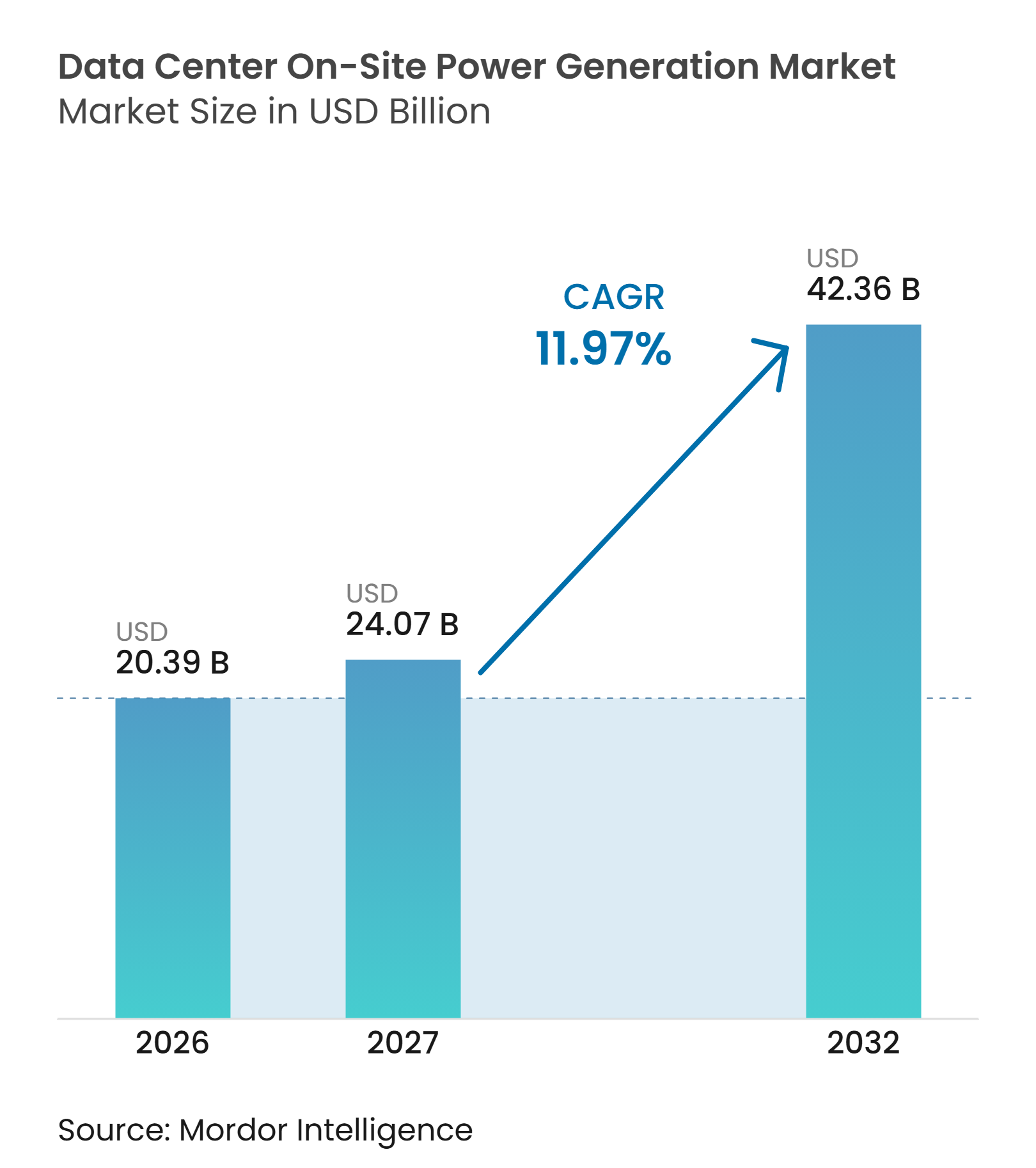
The Data Center On-Site Power Generation Market size is projected to be USD 20.39 billion in 2026, USD 24.07 billion in 2027, and reach USD 42.36 billion by 2032, growing at a CAGR of 11.97% from 2027 to 2032. Installed capacity is set to increase from 76.90 million MW in 2026 to 84.49 million MW in 2027 and 139.11 million MW by 2032, at a volume CAGR of 10.47%. Value is advancing faster than installed capacity because operators are buying more advanced assets, including fuel cells and gas engines, alongside diesel generator sets. Delays in utility connections have made on-site power a core decision during data center planning rather than a backup consideration. AI computing also requires larger and more responsive power systems, while the build time for new transmission infrastructure remains long. Suppliers that can provide equipment quickly, support larger campuses, and meet emissions requirements are positioned to address the most immediate opportunities in the Data Center On-Site Power Generation Market.
Key Report Takeaways
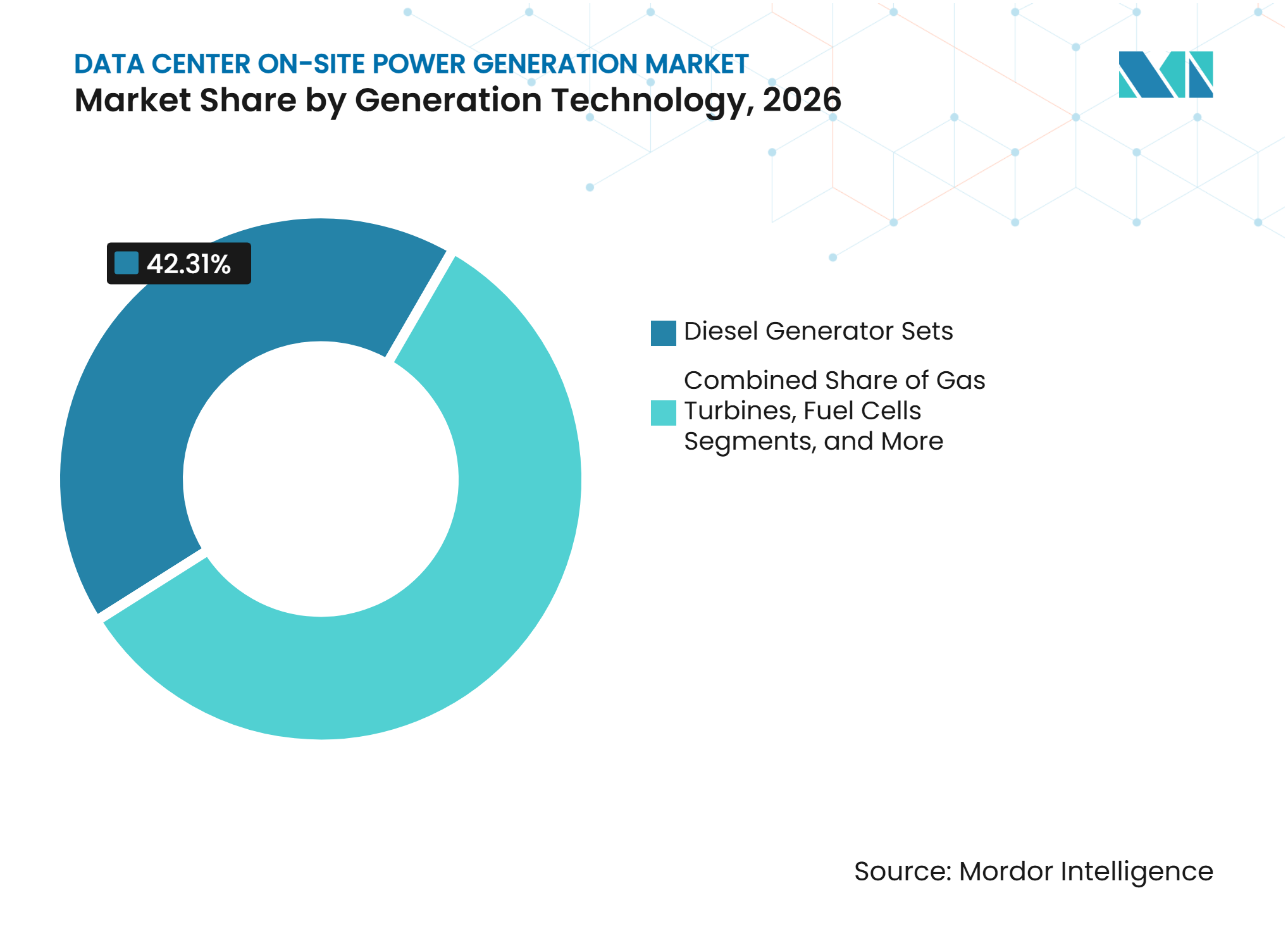
- By generation technology, diesel generator sets held 42.31% of the Data Center On-Site Power Generation Market in 2026, while fuel cells are projected to expand at a 13.17% CAGR through 2032.
- By installed generation capacity, the above 5-20 MW category accounted for 33.83% in 2026 of the Data Center On-Site Power Generation Market, while the above 20 MW category is expected to expand at a 12.76% CAGR through 2032.
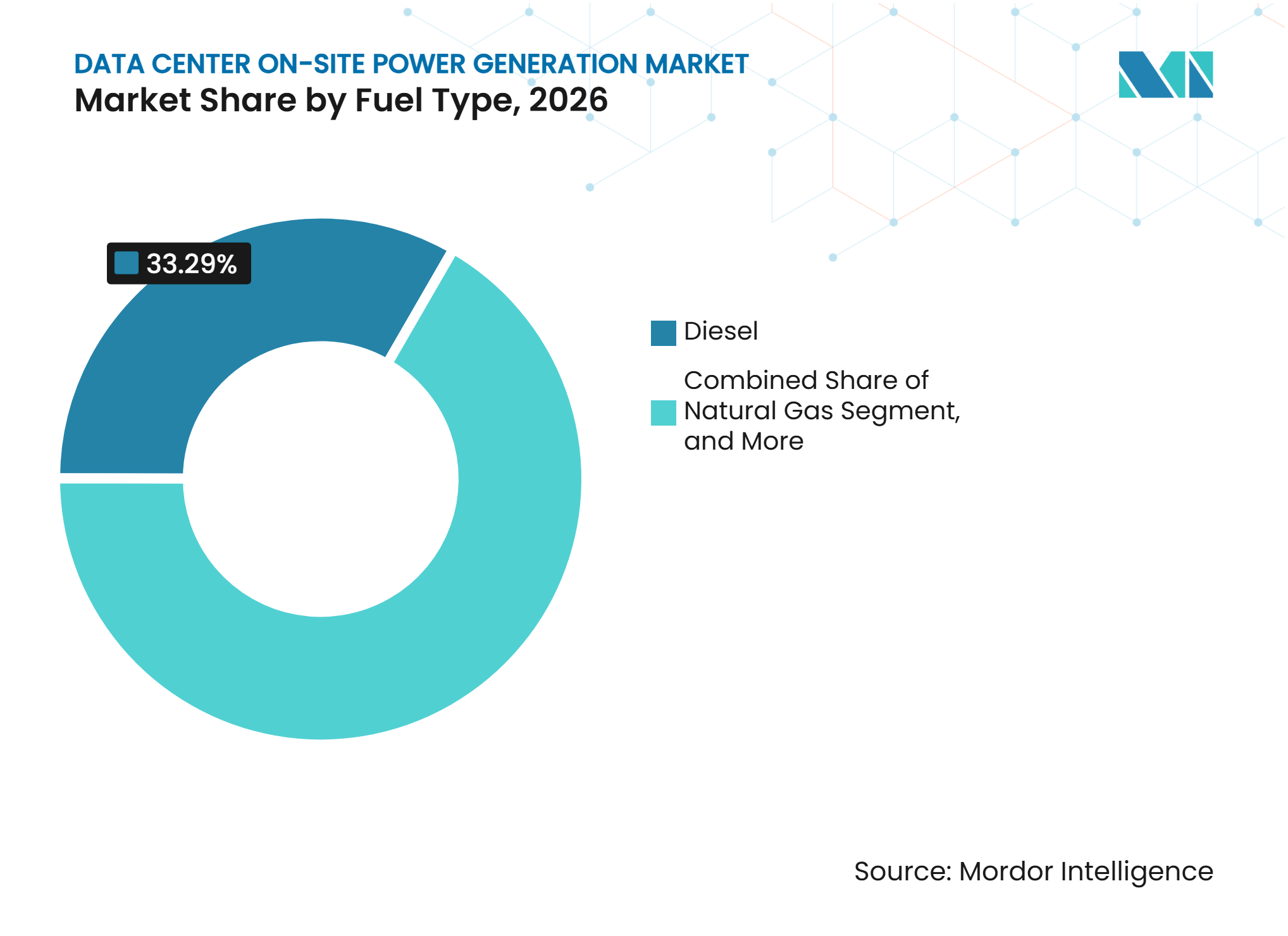
- By fuel type, diesel held 33.29% in 2026, while hydrogen and hydrogen blends are projected to expand at a 12.69% CAGR through 2032.
- By application, emergency backup power accounted for 57.17% in 2026, while temporary and bridge power is projected to expand at a 12.67% CAGR through 2032.
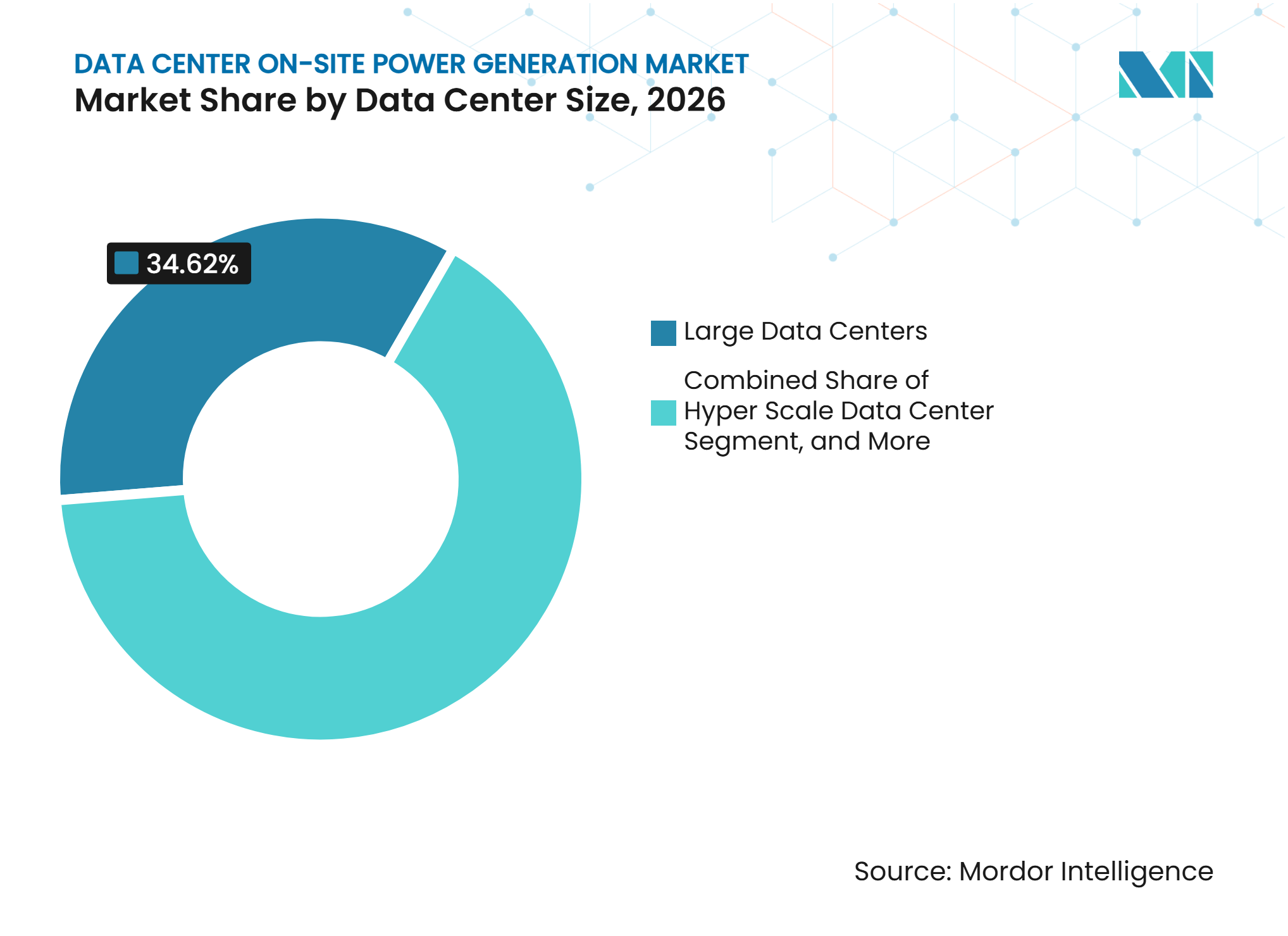
- By data center size, large data centers held 34.62% in 2026, while hyperscale data centers are expected to expand at a 12.34% CAGR through 2032.
- By data center type, cloud service providers accounted for 42.74% in 2026 and are projected to expand at a 12.53% CAGR through 2032.
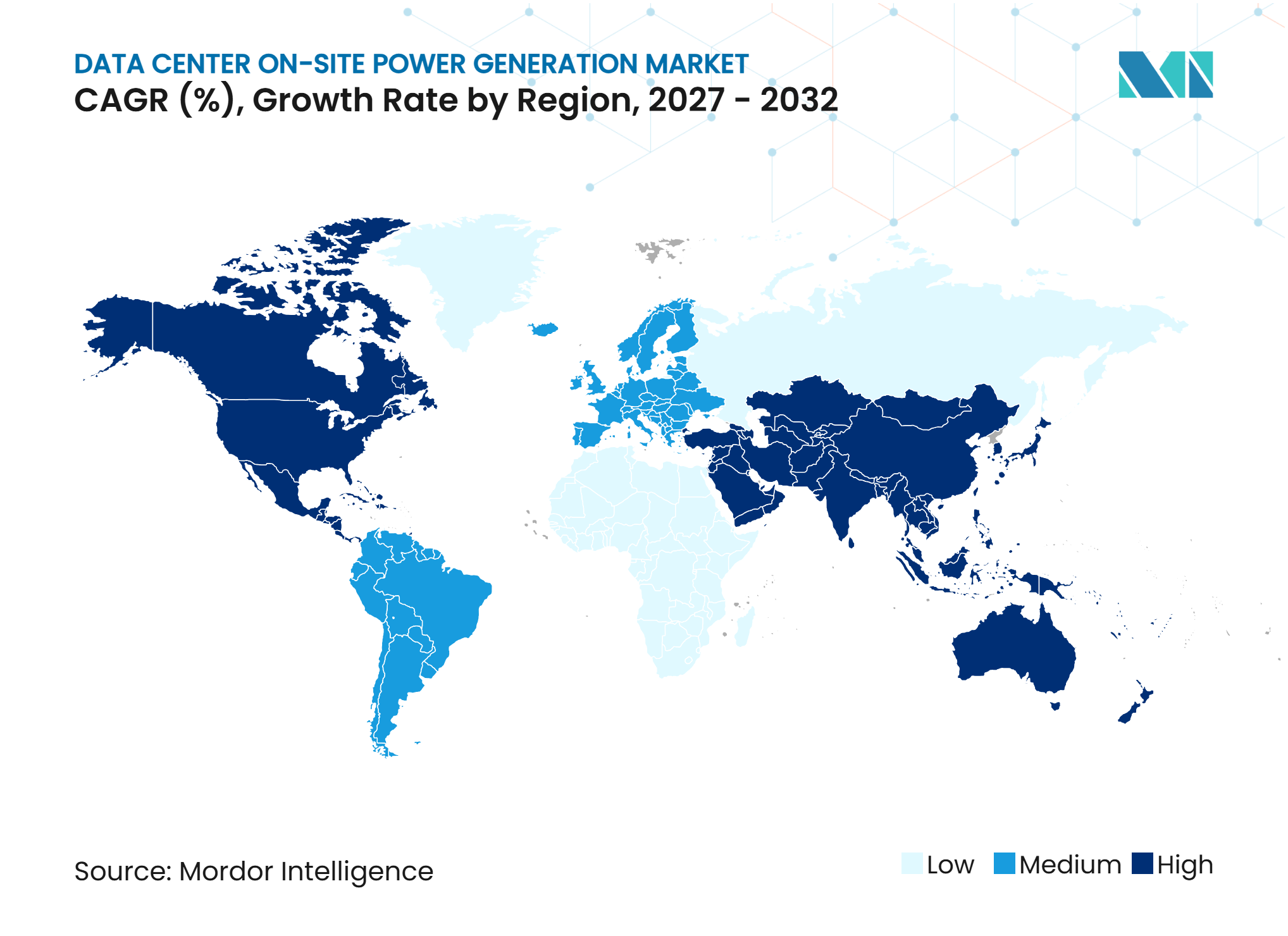
- By geography, North America held 43.22% in 2026, while Asia-Pacific is projected to expand at a 12.98% CAGR through 2032.
Note: Market numbers in this report are based on Mordor Intelligence's proprietary estimation framework, which combines nine months of actuals with Q4 projections for base year 2026.
Market Trends and Insights
Drivers Impact Analysis of Data Center On-Site Power Generation Market*
| Driver | (~) % Impact on CAGR Forecast | Geographic Relevance | Impact Timeline |
|---|---|---|---|
| Delays in Utility Grid Connections and Power Availability | +3.2% | Global, acute in North America and Asia-Pacific, with spillover to Europe | Short term (≤ 2 years) |
| Higher Power Demand From AI and High-Density Computing | +2.9% | Global, led by North America and Asia-Pacific, with spillover to Europe and Middle East | Long term (≥ 4 years) |
| Increasing Requirements for Uninterrupted Data Center Operations | +1.7% | Global | Medium term (2-4 years) |
| Adoption of Dedicated Gas-Fired Generation and Bridge Power | +1.3% | North America and Europe, early stage in Asia-Pacific and Middle East | Short term (≤ 2 years) |
| Demand for Energy Independence and Greater Control Over Supply | +0.9% | Global, particularly North America, Middle East, and Southeast Asia | Medium term (2-4 years) |
| Growth of Fuel Cells and Lower-Carbon On-Site Generation Technologies | +0.7% | North America, early stage in Europe and Asia-Pacific | Long term (≥ 4 years) |
| Source: Mordor Intelligence | |||
Delays in Utility Grid Connections and Power Availability
Grid interconnection delays have become a central reason for on-site generation in the Data Center On-Site Power Generation Market. The International Energy Agency stated that new transmission lines in advanced economies can take 4-8 years to build.[1] The agency also reported that waiting times for critical grid components doubled during the 3 years before 2026. Schneider Electric noted that some US grid connection queues extend beyond a decade, which does not align with typical data center construction schedules.[2] Operators are therefore selecting sites based more directly on available power, ahead of factors such as fiber access, land cost, and tax incentives.[3] This shift increases the value of generation systems that can operate before full grid service is available.
Higher Power Demand From AI and High-Density Computing
AI workloads in the Data Center On-Site Power Generation Market consume more electricity than many traditional storage and enterprise computing loads. The International Energy Agency expects data center electricity demand to increase as AI adoption expands. Bloom Energy stated that AI data center infrastructure can cost USD 30-USD 50 per watt, making delayed power access a significant financial risk for project owners. The Data Center On-Site Power Generation Market benefits because developers require solutions that can be deployed alongside high-density facilities. Load fluctuations from training and inference systems also increase the need for flexible, responsive generation equipment. Dedicated systems can help operators meet these power requirements while transmission projects remain under development.
Increasing Requirements for Uninterrupted Data Center Operations
Uninterrupted operation remains a primary procurement requirement for mission-critical data centers. Bloom Energy reported that its solid-oxide fuel cell systems can achieve availability between 99.9% and 99.999% and support more than 200,000 cycles. The company also stated that 109 MW of fuel cells can deliver the same 99.9% availability as 130-150 MW of gas turbines. Caterpillar documented that its G3516 natural gas generator sets can move from zero to full load in 7 seconds. Fast response is relevant for AI workloads that can change sharply within seconds. These operating requirements support purchases of purpose-built generation assets across the Data Center On-Site Power Generation Market.
Adoption of Dedicated Gas-Fired Generation and Bridge Power
Natural gas engines and turbines can provide power in the Data Center On-Site Power Generation Market on a shorter timeline than new grid infrastructure. Schneider Electric described on-site prime power as an option for data centers facing prolonged utility constraints. Bridge power can serve a facility between construction completion and final grid connection. Aggreko Japan launched a domestic bridging power service for data centers in November 2025. The company cited North American cases in which temporary power plants at the 50 MW scale advanced commissioning by 3 years. This model allows operators to commission computing capacity sooner and collect operating data before permanent utility service begins. The Data Center On-Site Power Generation Market is therefore gaining a role in project delivery as well as resiliency planning.
Restraints Impact Analysis of Data Center On-Site Power Generation Market*
| Restraint | (~) % Impact on CAGR Forecast | Geographic Relevance | Impact Timeline |
|---|---|---|---|
| High Upfront Investment and Installation Costs | -1.7% | Global, acute in emerging markets with limited financing options | Medium term (2-4 years) |
| Emissions Regulations and Environmental Permitting | -1.2% | North America and Europe | Medium term (2-4 years) |
| Natural Gas Availability and Fuel Infrastructure Constraints | -0.8% | Asia-Pacific, Middle East and Africa, and parts of South America | Long term (≥ 4 years) |
| Noise, Land, and Local Environmental Restrictions | -0.4% | Europe and urban North America | Medium term (2-4 years) |
| Source: Mordor Intelligence | |||
High Upfront Investment and Installation Costs
High installation costs can delay investment in power systems for the Data Center On-Site Power Generation Market. Engineering, procurement, and construction costs for gas turbine installations in the United States can be substantial. Fuel cells can have higher unit capital costs, although their operating profile can offset part of this difference over time. Smaller operators often rely on energy-as-a-service arrangements because these models reduce the initial capital requirement. Bridge power providers can also supply capacity as an operating expense rather than a large upfront purchase. This financing difference favors hyperscalers and cloud service providers with stronger balance sheets. It can also widen the adoption gap between large operators and smaller facilities in the Data Center On-Site Power Generation Market.
Emissions Regulations and Environmental Permitting
Emissions permitting can increase the time and cost required to deploy on-site generation. The US Environmental Protection Agency establishes emissions requirements that affect stationary combustion sources. Operators must consider federal, state, and local requirements before installing diesel engines, gas engines, or turbines. California has separate diesel engine and local air district requirements that add another compliance layer. European operators must also account for the Industrial Emissions Directive when relevant. These requirements favor suppliers that can support compliance across the Data Center On-Site Power Generation Market.
*Our forecasts treat driver/restraint impacts as directional, not additive. The impact forecasts reflect baseline growth, mix effects, and variable interactions.
Data Center On-Site Power Generation Market Segment Analysis
By Generation Technology:
Diesel Gensets Lead as Fuel Cells Reshape the Growth PipelineDiesel generator sets held 42.31% of the Data Center On-Site Power Generation Market share in 2026. Their position reflects established service networks, fast starts, and the ability to store fuel on site for emergency operation. Natural gas generator sets and reciprocating engines are gaining use for prime power and bridge power applications. Caterpillar and Cummins are directing significant capacity toward data center demand for natural gas generation equipment. Gas turbines from Solar Turbines, MAN Energy Solutions, and Wärtsilä serve larger facilities that need continuous operation and fuel flexibility.
Fuel cells are expected to register a 13.17% CAGR through 2032. Bloom Energy expanded its agreement with Oracle in April 2026 for up to 2.8 GW of solid-oxide fuel cell capacity, with 1.2 GW contracted and deployment underway. Bloom Energy stated that the first system was delivered in 55 days, ahead of a 90-day schedule. INNIO completed a 3 MW demonstration of 100% hydrogen-fueled backup power in April 2026. This supports the potential role of hydrogen-capable engines alongside fuel cells as fuel infrastructure develops.



By Installed Generation Capacity:
Hyperscale Build-Outs Favor Larger Capacity BandsThe 5-20 MW band accounted for 33.83% of installed capacity in the Data Center On-Site Power Generation Market in 2026. This range serves large colocation facilities and cloud campuses that built their on-site power systems around the scale of prior data center development. The below-1 MW category supports edge nodes and smaller facilities where compact fuel cells and containerized gas generator sets can fit on constrained sites. The 1-5 MW band serves mid-market colocation providers and enterprise facilities. These operators can combine distributed generation with battery storage in hybrid power arrangements.
The above 20 MW category is projected to expand at a 12.76% CAGR through 2032. Wärtsilä announced a 282 MW US data center power order in October 2026 using 15 Wärtsilä 50SG engines. The order demonstrates the larger project sizes entering the Data Center On-Site Power Generation Market. Framework agreements are also replacing site-by-site procurement for some hyperscale buyers. This approach rewards manufacturers with available production capacity and experience delivering equipment over several years.
By Fuel Type:
Diesel Retains Scale as Hydrogen Reaches the Commercial FrontierDiesel held 33.29% by fuel type in 2026. On-site fuel storage makes diesel useful for emergency backup power because the system does not depend on immediate fuel delivery during an outage. Natural gas is the second-largest fuel category and supports both gas engines and turbines used for primary and bridge power. Hydrotreated vegetable oil has emerged as a lower-lifecycle-emission replacement for diesel, while European operators are evaluating biomethane in dual-fuel gas-engine configurations. Fuel selection in the Data Center On-Site Power Generation Market depends on local availability, emissions rules, storage needs, and the intended duty cycle.
Hydrogen and hydrogen blends are expected to register a 12.69% CAGR through 2032. INNIO's 3 MW demonstration in Austria confirmed the technical viability of hydrogen-fueled reciprocating backup power at a relevant scale. Equinix launched a 12-week pilot at its DB3 Dublin facility in June 2026, using PEM fuel cells and green hydrogen to deliver up to 0.5 MW of continuous power. Bridge Data Centres and PacificLight Power also signed a memorandum for a hydrogen-ready natural gas plant in Singapore. Hydrogen infrastructure, storage, and supply remain the main limits on wider near-term deployment.

By Application:
Backup Power Anchors Demand as Bridge Power Changes Deployment EconomicsEmergency backup power accounted for 57.17% of the Data Center On-Site Power Generation Market size in 2026. Generator sets remain the final defense against grid outages for facilities with high uptime requirements. Tier IV classifications, lease commitments, and operational risk practices reinforce this demand. Prime and continuous power applications serve facilities seeking a greater degree of grid independence. These applications are most relevant where grid reliability cannot support AI-focused loads without substantial utility-side redundancy.
Temporary and bridge power is projected to expand at a 12.67% CAGR through 2032. A Data Center Frontier survey found that 6 in 10 developers would use on-site generation if utility power were unavailable in time. Aggreko Japan reported examples of 50 MW temporary power plants that advanced commissioning by 3 years. Bridge power can allow an operator to start computing operations before utility infrastructure is complete. This application expands the role of on-site equipment from outage protection to project commissioning.
By Data Center Size:
Large Facilities Anchor Demand as Hyperscale Drives GrowthLarge data centers held 34.62% of demand in the Data Center On-Site Power Generation Market in 2026. This category includes colocation campuses, regional cloud nodes, and enterprise facilities with significant IT loads. These sites have upgraded backup generation and, in some cases, adopted prime power for additional resilience. Medium facilities are a core addressable group for modular fuel cells and gas engines in the 1-10 MW range. Small data centers and edge nodes are increasing in number but contribute less installed generation capacity because each site is smaller.
Hyperscale data centers are expected to expand at a 12.34% CAGR through 2032. Caterpillar announced a 2 GW purchase agreement for G3516 natural gas generator sets at the Monarch Compute Campus in West Virginia in January 2026. Bloom Energy stated that Oracle's Project Jupiter could use up to 2.45 GW of fuel cell capacity. These developments show that power plants and data center campuses are increasingly designed as a single infrastructure program. Suppliers capable of producing and supporting large fleets are better placed to serve this segment.
By Data Center Type:
Cloud Service Providers Lead Both Scale and ExpansionCloud service providers accounted for 42.74% in 2026. They are the largest buyers of generation equipment because their data centers are typically larger and their capital programs are broader than those of other operator types. These providers often use multiyear equipment agreements and energy-as-a-service arrangements to secure supply. Such agreements can reserve manufacturing capacity before individual projects reach the final construction phase. Their procurement behavior has a substantial effect on equipment availability across the Data Center On-Site Power Generation Market.
Cloud service providers in the Data Center On-Site Power Generation Market are also projected to expand at a 12.53% CAGR through 2032. Google’s acquisition of Intersect Power, reported in February 2026, indicated that cloud providers may seek greater control over energy assets. Colocation providers are also adopting on-site generation because reliability and sustainability influence tenant decisions. Enterprise and edge data centers have smaller average capacities and remain more reliant on diesel backup. Advanced generation adoption is emerging in financial services, health care, and government facilities where uptime requirements justify a higher cost.
Geography Analysis
North America held 43.22% of the Data Center On-Site Power Generation Market share in 2026. The region has a large concentration of hyperscaler and colocation capacity. Caterpillar announced a USD 725 million expansion of its Lafayette engine facility in 2025, which is set to more than double output by 2027. This environment supports Data Center On-Site Power Generation Market suppliers capable of delivering natural gas, diesel, and lower-emission alternatives.
Asia-Pacific is projected to expand at a 12.98% CAGR through 2032. The region is experiencing cloud and AI build-outs across China, India, Southeast Asia, Japan, and other markets. Aggreko Japan began its domestic bridging power service in November 2025, citing grid connection delays of more than 5 years. Topco Group and Bloom Energy installed a 2.6-MW solid-oxide fuel cell system at a data center in Miaoli, Taiwan, in May 2026. South America remains the smallest geographic segment, with Brazil representing the region’s more developed data center base.
Europe faces significant power constraints alongside strong decarbonization requirements, creating a challenging operating environment for data center development and expansion. These conditions are increasing interest in cleaner and more reliable alternatives to conventional backup power solutions. Equinix's Dublin hydrogen pilot demonstrates the region's growing interest in hydrogen-based power systems as an alternative to diesel generation, particularly for supporting data center resilience while reducing emissions. The International Energy Agency identified Saudi Arabia's target of 1.9 GW of data center capacity by 2030 and 6.6 GW by 2034, reflecting the country's planned expansion of digital infrastructure. Meanwhile, the United Arab Emirates has agreements for 5 GW of AI data center capacity, underscoring the scale of planned AI-focused data center development in the region.
Competitive Landscape
Market Concentration
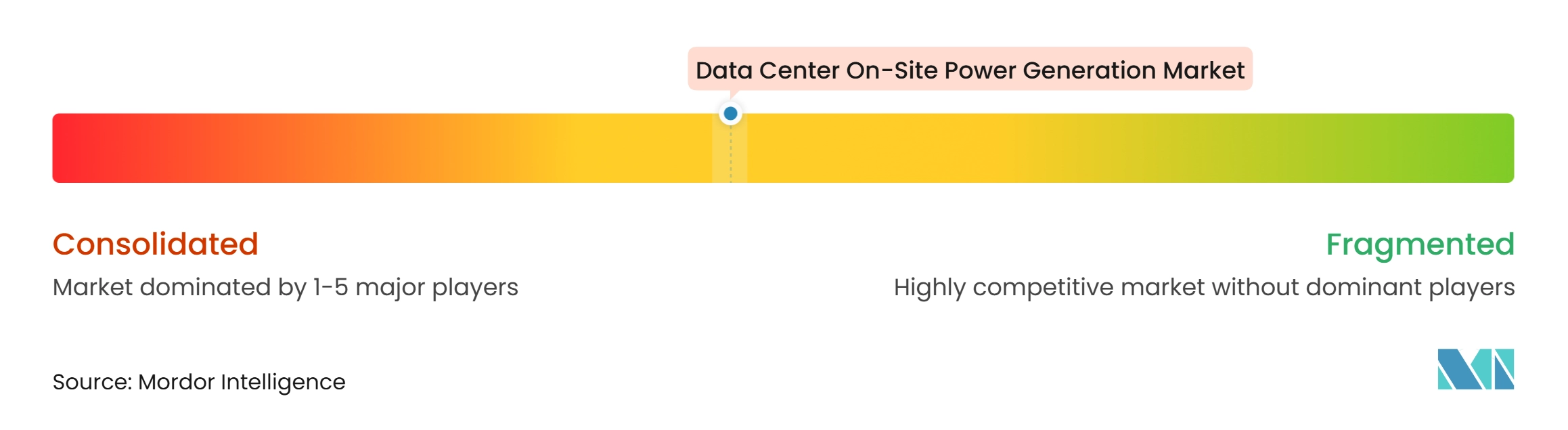
The Data Center On-Site Power Generation Market is moderately consolidated for large-capacity projects and more fragmented below 5 MW. Caterpillar, Cummins, and Wärtsilä are leading suppliers of natural gas and diesel reciprocating engine systems. Wärtsilä stated in October 2026 that its US data center orders exceeded 3 GW across 7 projects. The key differentiators are manufacturing capacity, delivery certainty, service coverage, and equipment performance.
Clean-power suppliers compete by deploying faster and emitting less directly. Bloom Energy has built a major position in solid-oxide fuel cells through its agreement with Oracle and its USD 5 billion partnership with Brookfield. INNIO is pursuing hydrogen-capable reciprocating engines, demonstrated through its 3 MW backup-power project in Austria. Aggreko and APR Energy serve the temporary power and energy-as-a-service segment. The Data Center On-Site Power Generation Market also offers opportunities for vendors that combine generation, battery storage, power management, and interconnection support within a single delivery model.
Caterpillar, Wärtsilä, and Bloom Energy have each made strategic moves that show the direction of competition. Caterpillar partnered with Joule Capital Partners and Wheeler Machinery to support 4 GW of energy for a high-performance computing campus in Utah. Wärtsilä secured a 282 MW natural gas power order for a US data center in October 2026. Bloom Energy expanded its Oracle partnership to deploy up to 2.8 GW of fuel cell capacity.
Data Center On-Site Power Generation Industry Leaders
-
Caterpillar
-
Cummins
-
Rolls-Royce Power Systems (MTU)
-
Rehlko
-
Mitsubishi Heavy Industries
- *Disclaimer: Major Players sorted in no particular order
Data Center On-Site Power Generation Market Companies Covered in this Report
- Caterpillar
- Cummins
- Rolls-Royce Power Systems (MTU)
- Rehlko
- Generac Power Systems
- Wärtsilä
- Mitsubishi Power
- Solar Turbines
- Baker Hughes
- MAN Energy Solutions
- INNIO
- 2G Energy
- Bloom Energy
- FuelCell Energy
- Bosch
- Mitsubishi Heavy Industries
- Doosan Enerbility
- Atlas Copco
- Aggreko
- APR Energy
Recent Industry Developments in Data Center On-Site Power Generation Market
- October 2026: Wärtsilä secured a 282 MW onsite natural gas power solution order from a major US independent power producer for a data center project, using 15 Wärtsilä 50SG engines. This was Wärtsilä's seventh US data center order, bringing total US data center capacity sold to more than 3 GW, with equipment delivery scheduled for 2028 and full commissioning expected in 2029.
- April 2026: Bloom Energy and Oracle expanded their strategic partnership under a master services agreement for up to 2.8 GW of solid-oxide fuel cell capacity for Oracle's US data center projects. An initial 1.2 GW was contracted, and deployment was underway, with the first fully operational system delivered in 55 days, more than a month ahead of the 90-day scheduled timeline.
- April 2026: PROPWR secured a strategic framework agreement with Caterpillar Inc. for data center power supply, positioning PROPWR to deliver 2.6 GW of power generation capacity by year-end 2031 for data center applications across a multi-phase build-out.
- April 2026: INNIO Group and the Net Zero Innovation Hub for Data Centers completed an industry-first demonstration of 100% hydrogen-fueled backup power at the 3 MW scale at INNIO's research facility in Jenbach, Austria, with technical validation from Microsoft, Google, and Data4 against real-world data center AI load profiles.
Global Data Center On-Site Power Generation Market Report Scope
The Data Center On-Site Power Generation Market comprises solutions that enable data centers to generate electricity within or adjacent to their facilities to ensure a reliable, resilient, and uninterrupted power supply. These systems support operational continuity by reducing dependence on external grids, mitigating the risk of power outages, and addressing the growing energy demands of digital infrastructure. The market includes technologies designed for backup, primary, and continuous power generation, helping operators enhance energy security, optimize operational efficiency, support sustainability objectives, and meet the increasing power requirements of modern, high-density computing environments.
The Data Center On-Site Power Generation Market Report is Segmented by Generation Technology (Diesel Generator Sets, Natural Gas Generator Sets, Gas Turbines, Reciprocating Gas Engines, Fuel Cells, and Other Generation Technologies), Installed Generation Capacity (Below 1 MW, 1–5 MW, 5–20 MW, and Above 20 MW), Fuel Type (Diesel, Natural Gas, Renewable Fuels and Biogas, Hydrogen and Hydrogen Blends, and Other Fuel Types), Application (Emergency Backup Power, Prime Power, Continuous Power, and Temporary and Bridge Power), Data Center Size (Small, Medium, Large, and Hyperscale), Data Center Type (Colocation, Cloud Service Providers, and Enterprise and Edge), and Geography (North America, South America, Europe, Middle East and Africa, and Asia-Pacific). The Market Forecasts are Provided in Terms of Value (USD) and Volume (MW).
Segmentation Overview
| Diesel Generator Sets |
| Natural Gas Generator Sets |
| Gas Turbines |
| Reciprocating Gas Engines |
| Fuel Cells |
| Other Generation Technologies |
| Below 1 MW |
| 1-5 MW |
| Above 5-20 MW |
| Above 20 MW |
| Diesel |
| Natural Gas |
| Renewable Fuels and Biogas |
| Hydrogen and Hydrogen Blends |
| Other Fuel Types |
| Emergency Backup Power |
| Prime Power |
| Continuous Power |
| Temporary and Bridge Power |
| Small |
| Medium |
| Large |
| Hyperscale |
| Colocation |
| Cloud Service Providers (CSPs) |
| Enterprise and Edge |
| North America | United States |
| Canada | |
| Mexico | |
| South America | Brazil |
| Chile | |
| Colombia | |
| Argentina | |
| Peru | |
| Rest of South America | |
| Europe | United Kingdom |
| Germany | |
| France | |
| Ireland | |
| Netherlands | |
| Spain | |
| Italy | |
| Finland | |
| Sweden | |
| Rest of Europe | |
| Middle East and Africa | Saudi Arabia |
| United Arab Emirates | |
| South Africa | |
| Israel | |
| Egypt | |
| Rest of Middle East and Africa | |
| Asia-Pacific | China |
| India | |
| Japan | |
| Australia | |
| Singapore | |
| South Korea | |
| Malaysia | |
| Indonesia | |
| Rest of Asia-Pacific |
| By Generation Technology | Diesel Generator Sets | |
| Natural Gas Generator Sets | ||
| Gas Turbines | ||
| Reciprocating Gas Engines | ||
| Fuel Cells | ||
| Other Generation Technologies | ||
| By Installed Generation Capacity | Below 1 MW | |
| 1-5 MW | ||
| Above 5-20 MW | ||
| Above 20 MW | ||
| By Fuel Type | Diesel | |
| Natural Gas | ||
| Renewable Fuels and Biogas | ||
| Hydrogen and Hydrogen Blends | ||
| Other Fuel Types | ||
| By Application | Emergency Backup Power | |
| Prime Power | ||
| Continuous Power | ||
| Temporary and Bridge Power | ||
| By Data Center Size | Small | |
| Medium | ||
| Large | ||
| Hyperscale | ||
| By Data Center Type | Colocation | |
| Cloud Service Providers (CSPs) | ||
| Enterprise and Edge | ||
| By Geography | North America | United States |
| Canada | ||
| Mexico | ||
| South America | Brazil | |
| Chile | ||
| Colombia | ||
| Argentina | ||
| Peru | ||
| Rest of South America | ||
| Europe | United Kingdom | |
| Germany | ||
| France | ||
| Ireland | ||
| Netherlands | ||
| Spain | ||
| Italy | ||
| Finland | ||
| Sweden | ||
| Rest of Europe | ||
| Middle East and Africa | Saudi Arabia | |
| United Arab Emirates | ||
| South Africa | ||
| Israel | ||
| Egypt | ||
| Rest of Middle East and Africa | ||
| Asia-Pacific | China | |
| India | ||
| Japan | ||
| Australia | ||
| Singapore | ||
| South Korea | ||
| Malaysia | ||
| Indonesia | ||
| Rest of Asia-Pacific | ||
Key Questions Answered in the Report
What is the size of the data center on-site power generation market?
The data center on-site power generation market is projected at USD 20.39 billion in 2026 and USD 42.36 billion by 2032, at an 11.97% CAGR from 2027 to 2032.
Why are data center operators adding on-site power generation?
Delayed utility connections, AI-related power demand, and uptime requirements are leading operators to use on-site systems for backup, prime, and bridge power.
Which generation technology leads current demand?
Diesel generator sets held 42.31% in 2026 because they offer proven emergency backup performance and on-site fuel storage.
Which power technology is expected to expand fastest?
Fuel cells are projected to expand at a 13.17% CAGR through 2032, supported by deployments that can be completed quickly.
Which region has the highest demand for on-site data center power?
North America held 43.22% in 2026, supported by its large concentration of hyperscale and colocation capacity.
What is driving bridge power adoption at data centers?
Bridge power allows data centers to commission sooner when utility connections are delayed, including temporary deployments that can support large sites.