
Data Center Insulation Market Size and Share
Market Overview
| Study Period | 2022 - 2032 |
|---|---|
| Market Size (2027) | USD 0.76 Billion |
| Market Size (2032) | USD 1.5 Billion |
| Growth Rate (2027 - 2032) | 14.67 % |
| Fastest Growing Market | Asia-Pacific |
| Largest Market | North America |
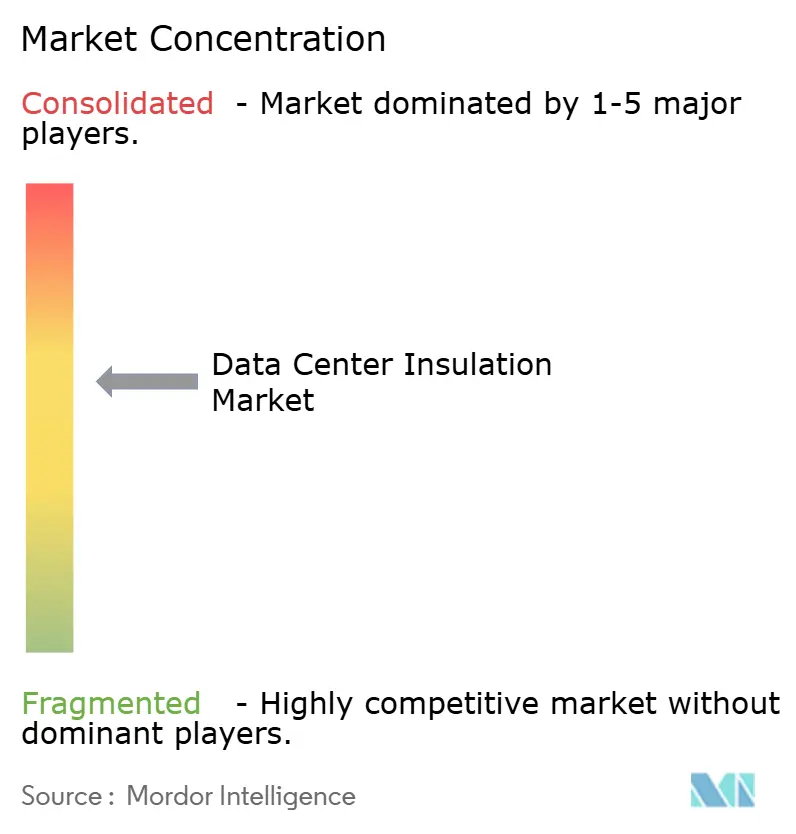
| Market Concentration | Medium |
Major Players *Disclaimer: Major Players sorted in no particular order Image © Mordor Intelligence. Reuse requires attribution under CC BY 4.0. | |
Data Center Insulation Market Analysis by Mordor Intelligence
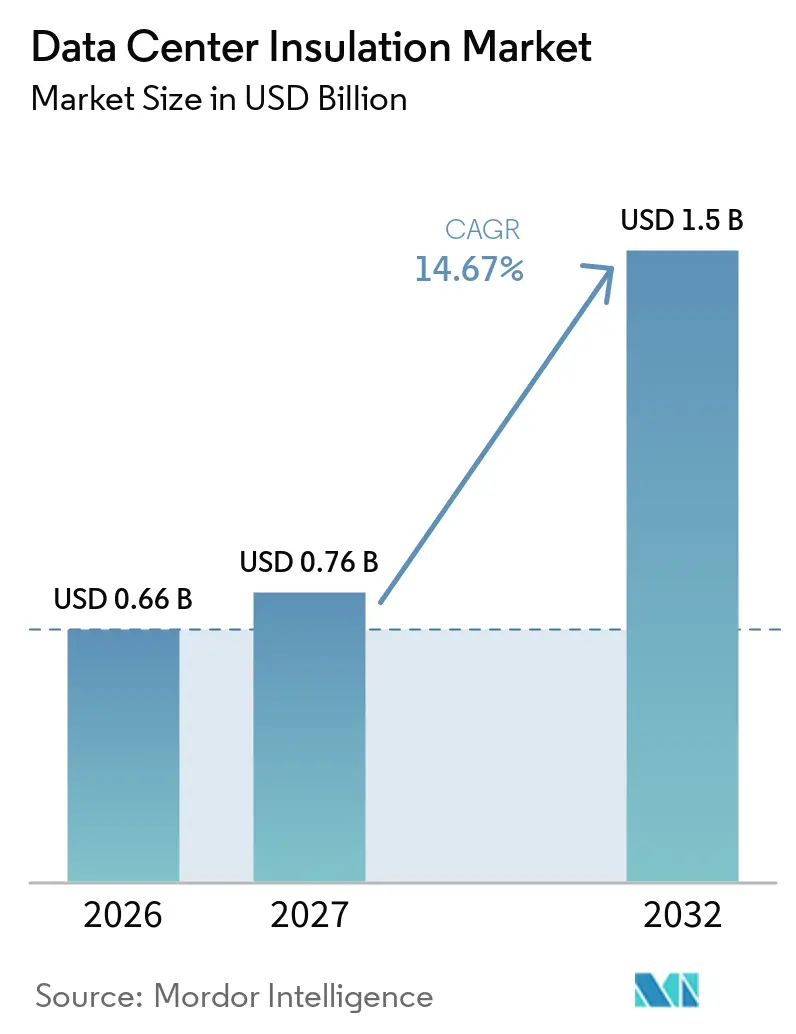
The Data Center Insulation Market size was valued at USD 0.66 billion in 2026 and is estimated to grow from USD 0.76 billion in 2027 to reach USD 1.50 billion by 2032, at a CAGR of 14.67% during the forecast period (2027-2032). The data center insulation market is supported by continued construction of hyperscale facilities and by upgrades to existing sites that need higher cooling capacity. Buyers are placing greater weight on thermal control, fire performance, and acoustic control because these factors affect energy use, site reliability, and facility compliance during construction and later operations. The data center insulation market also benefits from liquid cooling systems, which increase the need for insulated chilled-water, condenser-water, and refrigerant lines. Suppliers are responding with tested assemblies, closed-cell materials, and products designed for confined retrofit spaces where replacement work must be completed around operating equipment. Regulatory requirements for energy performance and reporting are making certified insulation systems more important in the data center insulation market.
Key Report Takeaways
- By material, mineral wool held 36.34% of the data center insulation market share in 2026, while flexible elastomeric foam is forecast to advance at a 15.12% CAGR through 2032.
- By insulation type, thermal insulation held 64.67% of the data center insulation market share in 2026, while acoustic insulation is forecast to advance at a 16.04% CAGR through 2032.
- By data center type, hyperscale held 41.89% of the data center insulation market share in 2026 and is forecast to advance at a 16.58% CAGR through 2032.
- By application, walls and roofs held 43.23% of the data center insulation market share in 2026, while pipes and ducts are forecast to advance at a 16.37% CAGR through 2032.
- By geography, North America held 36.45% of the data center insulation market share in 2026, while Asia-Pacific is forecast to advance at a 16.41% CAGR through 2032.
Note: Market numbers in this report are based on Mordor Intelligence's proprietary estimation framework, which combines nine months of actuals with Q4 projections for base year 2026.
Global Data Center Insulation Market Trends and Insights
Drivers Impact Analysis*
| Driver | (~) % Impact on CAGR Forecast | Geographic Relevance | Impact Timeline |
|---|---|---|---|
| Hyperscale and AI Data Center Construction | +5.5% | Global (concentrated in North America and APAC) | Short term (≤ 2 years) |
| Energy Efficiency and Power Usage Effectiveness Requirements | +3.2% | Global (regulatory intensity highest in EU and APAC) | Medium term (2–4 years) |
| Liquid Cooling and High-Density Thermal Management | +2.8% | Global (AI-focused hyperscale and colocation markets) | Short term (≤ 2 years) |
| Data Center Retrofit and Edge Facility Expansion | +2.1% | Global (North America, Europe, APAC secondary cities) | Medium term (2–4 years) |
| Stricter Fire, Building, and Sustainability Standards | +1.6% | North America & EU core, spillover to APAC | Long term (≥ 4 years) |
| Source: Mordor Intelligence | |||
Hyperscale and AI Data Center Construction
Large facilities require insulation across walls, roofs, pipes, ducts, mechanical rooms, and cooling systems. Artificial intelligence workloads create higher rack densities and place greater demands on thermal control. Those conditions raise the importance of materials that sustain a reliable thermal envelope throughout the facility. New facilities also need products that meet fire and acoustic requirements without adding unnecessary installation complexity. The construction cycle, therefore, supports demand for both enclosure insulation and mechanical-system insulation.
Energy Efficiency and Power Usage Effectiveness Requirements
Energy efficiency rules are moving insulation performance from a discretionary choice to a facility-level compliance issue. Germany's Energieeffizienzgesetz requires new data centers beginning operations from July 1, 2026, to achieve a Power Usage Effectiveness value of 1.2 or lower. The European Union Energy Efficiency Directive also requires monitoring and reporting from facilities above 500 kilowatts of information technology load[1]. These requirements encourage buyers to select products with dependable thermal properties and documented test performance. Whole-system thermal modeling is becoming more relevant than selection based only on a single material property. This shift supports tested assemblies and reduces the appeal of generic materials with uncertain site performance during commissioning and routine operation at each site.
Liquid Cooling and High-Density Thermal Management
The transition from air cooling to liquid cooling is changing demand across the data center insulation market. Higher rack densities increase the role of chilled-water, condenser-water, and refrigerant circuits. Each circuit needs insulation that limits heat loss and controls condensation. Closed-cell foam and aerogel-based products are relevant where pipes operate close to ambient dew-point conditions. Open-cell materials do not provide the same vapor-control performance in these applications. The result is a greater need for high-performance pipe insulation in artificial intelligence-focused facilities.
Stricter Fire, Building, and Sustainability Standards
Stricter fire, building, and sustainability standards also support the data center insulation market. Data centers need products that can be used within fire-rated walls, roofs, ducts, and pipe systems. FM Global guidance identifies noncombustible insulating materials, including mineral fiber wool, for relevant pipe and duct applications. The National Fire Protection Association (NFPA) establishes fire-protection requirements for information technology equipment facilities through National Fire Protection Association 75[2]. Listed and tested products can simplify compliance decisions for designers and operators. These standards favor suppliers that can provide documentation for complete assemblies rather than material samples alone.
Restraints Impact Analysis*
| Restraint | (~) % Impact on CAGR Forecast | Geographic Relevance | Impact Timeline |
|---|---|---|---|
| High Initial Material and Installation Costs | -1.8% | Global | Short term (≤ 2 years) |
| Skilled-Labor and Tested-Assembly Availability | -1.1% | North America & EU core, spillover to APAC | Medium term (2–4 years) |
| Fragmented Interface Standards Across Enclosure and MEP Trades | -0.7% | Global | Long term (≥ 4 years) |
| Source: Mordor Intelligence | |||
High Initial Material and Installation Costs
High initial material and installation costs can restrain adoption in the data center insulation market. Mineral wool, flexible elastomeric foam, and aerogel blankets can cost more than commodity insulation alternatives. Installation is also more difficult when cooling circuits are live, pressurized, or located within a constrained retrofit area. Buyers focused on initial procurement cost may defer upgrades or specify lower-performance products. That decision can increase cooling energy use over the life of a facility. The restraint is strongest where total operating cost analysis has not replaced upfront-cost procurement practices.
Skilled-Labor and Tested-Assembly Availability
Skilled-labor availability can slow the use of tested insulation assemblies in the data center insulation market. Fire-rated walls and jacketed pipe systems need installers who understand listed materials and assembly requirements. National Fire Protection Association 75 and FM Global guidance influence the materials and installation approaches used in these facilities. The pool of qualified installers can be limited in secondary locations where regional and edge sites are expanding. This limitation can lengthen installation schedules even when material budgets are available. It is a structural constraint because capital investment alone cannot quickly create qualified installation capacity.
*Our forecasts treat driver/restraint impacts as directional, not additive. The impact forecasts reflect baseline growth, mix effects, and variable interactions.
Segment Analysis
By Material: Mineral Wool Leads as Flexible Elastomeric Foam Accelerates
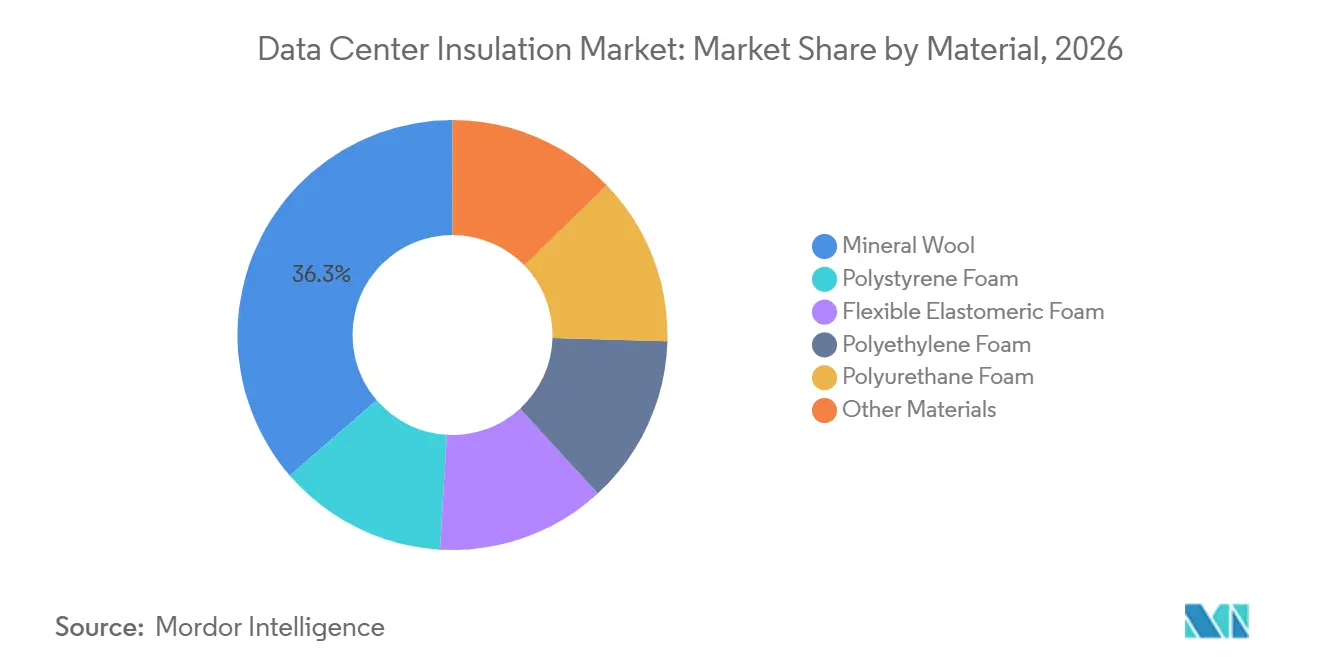
Mineral wool held 36.34% of the data center insulation market share in 2026. Its role in fire-rated walls, partitions, roofs, pipes, and ducts is reinforced by FM Global guidance that identifies noncombustible mineral fiber wool for relevant pipe and duct uses. This association with tested fire and thermal assemblies supports continued specification in insured facilities. Mineral wool also offers thermal and acoustic performance within one material family. That combination can reduce the number of products needed across a facility design.
Flexible elastomeric foam is projected to advance at a 15.12% CAGR through 2032. Its growth is linked to liquid cooling circuits that require closed-cell materials with low water-vapor transmission. These systems are used on chilled-water, condenser-water, and refrigerant lines. Armacell opened an aerogel insulation facility in Pune, India, in June 2025 and introduced the ArmaGel XG product line for demanding temperature applications. Armacell also launched ArmaGel XGC in April 2025 for cryogenic and dual-temperature insulation applications, while polyurethane foam, polyethylene foam, polystyrene foam, and cellular glass continue to serve mid-tier, raised-floor, and specialized equipment-room applications.

By Insulation Type: Thermal Insulation Leads as Acoustic Insulation Expands
Thermal insulation held 64.67% of the data center insulation market share in 2026. The segment is tied directly to cooling efficiency, thermal envelopes, and operating energy use. Its role covers building structures, pipes, ducts, and mechanical systems, while energy-performance requirements give thermal products a central role in design decisions. The European Union framework for data center energy performance supports this emphasis on measurable facility performance. Thermal insulation is therefore relevant in both new construction and upgrades to existing facilities.
Acoustic insulation is projected to advance at a 16.04% CAGR through 2032. Higher rack densities increase sound from cooling pumps, fans, and mechanical equipment. Acoustic requirements from workplace expectations and tenant specifications create demand for certified assemblies in server halls and shared colocation environments. Mineral wool can address thermal, fire, and acoustic needs in a single material family. This capability helps reduce system complexity where multiple performance requirements apply.
By Data Center Type: Hyperscale Lead in Scale and Growth
Hyperscale data centers held 41.89% of the data center insulation market share in 2026. These facilities have broad insulation needs because large building footprints and high-density layouts require tighter control of heat, moisture, and noise. The data center insulation market size associated with this segment reflects the scale of greenfield construction and continuing mechanical upgrades. Hyperscale operators often need tested assemblies that can be repeated across standardized campus designs. This favors suppliers with proven products and consistent manufacturing capabilities.
Hyperscale data centers are projected to advance at a 16.58% CAGR through 2032. Artificial intelligence deployments increase demand for cooling equipment and insulated piping circuits. Expansion of these campuses also raises demand for walls, roofs, ducts, equipment rooms, and raised-floor systems. Colocation facilities add capacity for customers needing outsourced infrastructure, while enterprise sites contribute through retrofits for newer computing loads and liquid cooling equipment. Together, these facility types give the data center insulation market a mix of large construction projects and ongoing renovation work.
By Application: Walls and Roofs Lead as Pipes and Ducts Gain Momentum
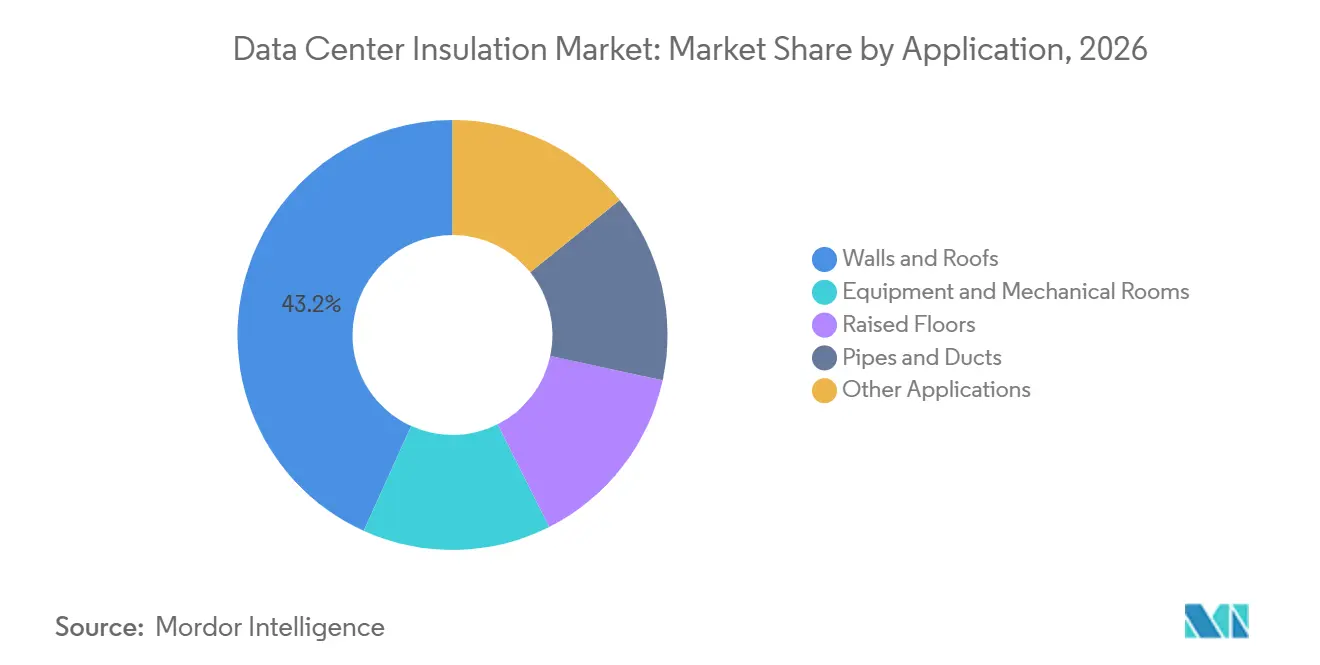
Walls and roofs held 43.23% of the data center insulation market share in 2026. Large facilities need continuous insulation across the building envelope to support energy and code requirements. The application includes perimeter walls, roofs, and related structural assemblies that every new facility needs before mechanical systems are commissioned. Mineral wool and other products are selected according to fire, thermal, acoustic, and installation needs. Building-envelope demand is therefore closely linked to the pace of new facility construction.
Pipes and ducts are projected to advance at a 16.37% CAGR through 2032. Liquid cooling adoption increases the footprint of chilled-water, condenser-water, refrigerant, and heating, ventilation, and air-conditioning circuits. These applications require insulation that limits thermal loss and controls condensation. FM Global requirements and National Fire Protection Association 75 support suitable listed materials, while raised floors remain relevant in legacy and colocation facilities with underfloor air distribution. Equipment and mechanical rooms are also gaining attention as cooling distribution units and pumping assemblies need dedicated thermal zoning.
Geography Analysis
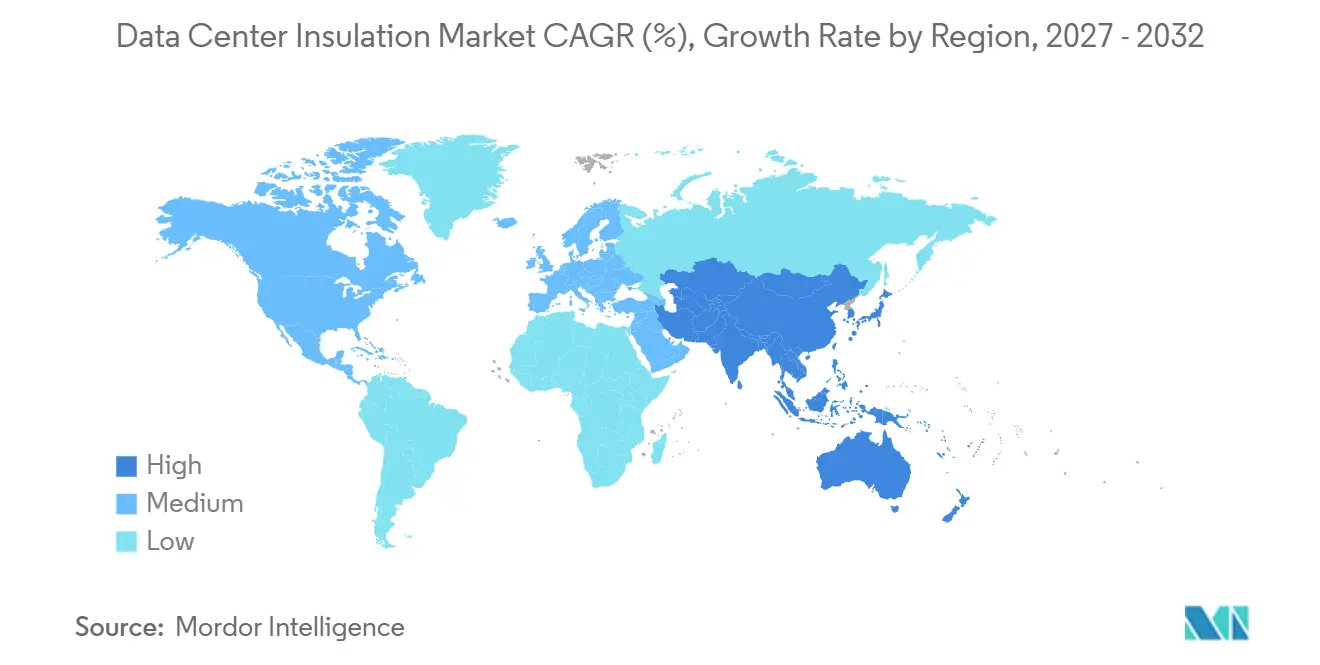
North America held 36.45% of the data center insulation market share in 2026. The United States concentrates hyperscale campuses in Northern Virginia, Texas, and the Pacific Northwest, supporting building-envelope and mechanical-system insulation demand. ROCKWOOL A/S began factory construction in Washington State and expanded capacity in Mississippi during 2025, while Knauf Insulation commissioned a pipe insulation production line in Shelbyville, Indiana, in the second quarter of 2026. National Fire Protection Association standards and FM Global guidance reinforce the use of tested and listed insulation assemblies.
Europe is shaped by regulatory compliance as well as construction activity. Germany's Energieeffizienzgesetz sets a Power Usage Effectiveness requirement for new sites beginning operations from July 1, 2026. The European Union Energy Efficiency Directive extends energy-performance monitoring to qualifying facilities. The United Kingdom, Germany, France, and the Nordic countries have substantial colocation and hyperscale activity. Italy and other European markets are adding colocation supply, while Saint-Gobain identified data centers in the United States and four European countries as priority end markets in its October 2025 Lead & Grow plan.
Asia-Pacific is projected to advance at a 16.41% CAGR through 2032. The region combines established capacity in China with expanding activity in India, Malaysia, Thailand, and Indonesia. This supports demand for complete insulation systems in new hyperscale facilities. Armacell inaugurated its Pune aerogel manufacturing facility in June 2025, demonstrating a commitment to regional supply. ASEAN locations are receiving demand from capacity-constrained Singapore, while South America, the Middle East, and Africa are adding capacity that increasingly requires internationally certified insulation assemblies.
Competitive Landscape
The data center insulation market is moderately concentrated, with the top five players including Armacell, Saint-Gobain, Kingspan Holdings (IRL) Limited, Johns Manville, and Owens Corning. Suppliers meeting fire, thermal, acoustic, and vapor-control requirements can address wider project needs, while specialists serve narrower material and application requirements.
Leading suppliers are expanding capacity and tailoring products to high-performance cooling applications. Armacell inaugurated its Pune facility in 2025, doubling global aerogel blanket capacity through a plant with 1 million square meters of annual capacity. ROCKWOOL A/S reported investment in a new Technical Insulation production line in the United States and added capacity in Romania during the first half of 2026. Knauf Insulation added a new pipe insulation production line in Shelbyville during the second quarter of 2026. These moves strengthen supply for heating, ventilation, and air-conditioning systems and liquid cooling circuits in high-growth North American and Asia-Pacific construction activity.
Compliance certification is an important competitive factor in the data center insulation market. UL Solutions updated UL 2755 in 2025 to address the needs of prefabricated modular data center systems. Products with listed performance can be easier to specify in complex projects, while aerogel products compete at the premium end through high thermal performance in limited space. Aspen Aerogels, Inc. canceled its planned Plant II expansion in February 2025 and shifted its supply approach toward expansion of existing capacity and external manufacturing. This creates a different supply strategy from Armacell's capacity buildout and leaves opportunities for prefabricated fire-rated modules and integrated vapor-barrier thermal systems for liquid cooling pipes. The competitive balance continues to depend on product approvals, plant capacity, application expertise, and the ability to support complex facility specifications across regional projects.
Data Center Insulation Industry Leaders
-
Armacell
-
Saint-Gobain
-
Kingspan Holdings (IRL) Limited
-
Johns Manville
-
Owens Corning
- *Disclaimer: Major Players sorted in no particular order
Recent Industry Developments
- October 2026: BASF expanded the application focus of its Ultrason® polyarylethersulfone portfolio to electrical and electronic components used in AI-driven data centers, including cable jacketing, electrical insulation, and thermal-management parts. The development supports the data center insulation market by advancing heat-resistant, electrically insulating materials for reliable power distribution and cooling infrastructure.
- September 2025: Knauf Insulation commissioned a new pipe insulation production line at its Shelbyville, Indiana, facility, alongside expanded glass capacity and a new blowing wool line, using modernized and automated manufacturing processes. The expansion supports the data center insulation market by increasing the supply of pipe insulation for Heating, Ventilation, and Air Conditioning (HVAC) systems and liquid-cooling circuits used in data center infrastructure.
Global Data Center Insulation Market Report Scope
Data center insulation comprises materials installed within data center buildings and infrastructure to manage heat transfer, reduce noise, and support stable operating conditions. These materials help improve thermal efficiency, control acoustic disturbances, and protect critical equipment and facility systems.
The Data Center Insulation Market is segmented by material, insulation type, data center type, application, and geography. By material, the market is segmented into mineral wool, flexible elastomeric foam, polyethylene foam, polyurethane foam, polystyrene foam, and other materials. By insulation type, the market is segmented into thermal insulation and acoustic insulation. By data center type, the market is segmented into hyperscale, colocation, enterprise, and other data center types. By application, the market is segmented into walls and roofs, raised floors, pipes and ducts, equipment and mechanical rooms, and other applications. The report also covers the market size and forecasts for data center insulation across 15 countries. For each segment, the market sizing and forecasts have been done on the basis of value (USD).
| Mineral Wool |
| Flexible Elastomeric Foam |
| Polyethylene Foam |
| Polyurethane Foam |
| Polystyrene Foam |
| Other Materials |
| Thermal Insulation |
| Acoustic Insulation |
| Hyperscale |
| Colocation |
| Enterprise |
| Other Data Center Types |
| Walls and Roofs |
| Raised Floors |
| Pipes and Ducts |
| Equipment and Mechanical Rooms |
| Other Applications |
| Asia-Pacific | China |
| India | |
| Japan | |
| South Korea | |
| ASEAN Countries | |
| Rest of Asia-Pacific | |
| North America | United States |
| Canada | |
| Mexico | |
| Europe | Germany |
| United Kingdom | |
| France | |
| Italy | |
| NORDIC Countries | |
| Rest of Europe | |
| South America | Brazil |
| Argentina | |
| Rest of South America | |
| Middle East and Africa | Saudi Arabia |
| South Africa | |
| Rest of Middle East and Africa |
| By Material | Mineral Wool | |
| Flexible Elastomeric Foam | ||
| Polyethylene Foam | ||
| Polyurethane Foam | ||
| Polystyrene Foam | ||
| Other Materials | ||
| By Insulation Type | Thermal Insulation | |
| Acoustic Insulation | ||
| By Data Center Type | Hyperscale | |
| Colocation | ||
| Enterprise | ||
| Other Data Center Types | ||
| By Application | Walls and Roofs | |
| Raised Floors | ||
| Pipes and Ducts | ||
| Equipment and Mechanical Rooms | ||
| Other Applications | ||
| By Geography | Asia-Pacific | China |
| India | ||
| Japan | ||
| South Korea | ||
| ASEAN Countries | ||
| Rest of Asia-Pacific | ||
| North America | United States | |
| Canada | ||
| Mexico | ||
| Europe | Germany | |
| United Kingdom | ||
| France | ||
| Italy | ||
| NORDIC Countries | ||
| Rest of Europe | ||
| South America | Brazil | |
| Argentina | ||
| Rest of South America | ||
| Middle East and Africa | Saudi Arabia | |
| South Africa | ||
| Rest of Middle East and Africa | ||
Key Questions Answered in the Report
What is the size of the data center insulation market?
The data center insulation market size was valued at USD 0.66 billion in 2026 and is estimated to grow from USD 0.76 billion in 2027 to reach USD 1.50 billion by 2032, at a CAGR of 14.67% during the forecast period (2027-2032).
Which material held the largest share in 2026?
Mineral wool led with 36.34% share in 2026 because it is widely used in fire-rated walls, roofs, pipes, and duct assemblies and can address thermal and acoustic needs within one material family.
Why is liquid cooling affecting insulation demand?
Liquid cooling requires insulated chilled-water, condenser-water, and refrigerant circuits that limit thermal loss and condensation, which raises the importance of closed-cell materials with strong vapor-control performance.
Which data center type is projected to advance fastest through 2032?
Hyperscale data centers are projected to advance at a 16.58% CAGR through 2032, supported by large-scale artificial intelligence infrastructure development and broad insulation needs.