
Data Center Grid Infrastructure and Interconnection Market Size and Share
Market Overview
| Study Period | 2021 - 2032 |
|---|---|
| Market Size (2027) | USD 36.41 Billion |
| Market Size (2032) | USD 68.09 Billion |
| Growth Rate (2027 - 2032) | 13.34 % |
| Fastest Growing Market | Asia-Pacific |
| Largest Market | North America |
| Market Concentration | Medium |
Major Players *Disclaimer: Major Players sorted in no particular order Image © Mordor Intelligence. Reuse requires attribution under CC BY 4.0. | |
Data Center Grid Infrastructure and Interconnection Market Analysis by Mordor Intelligence
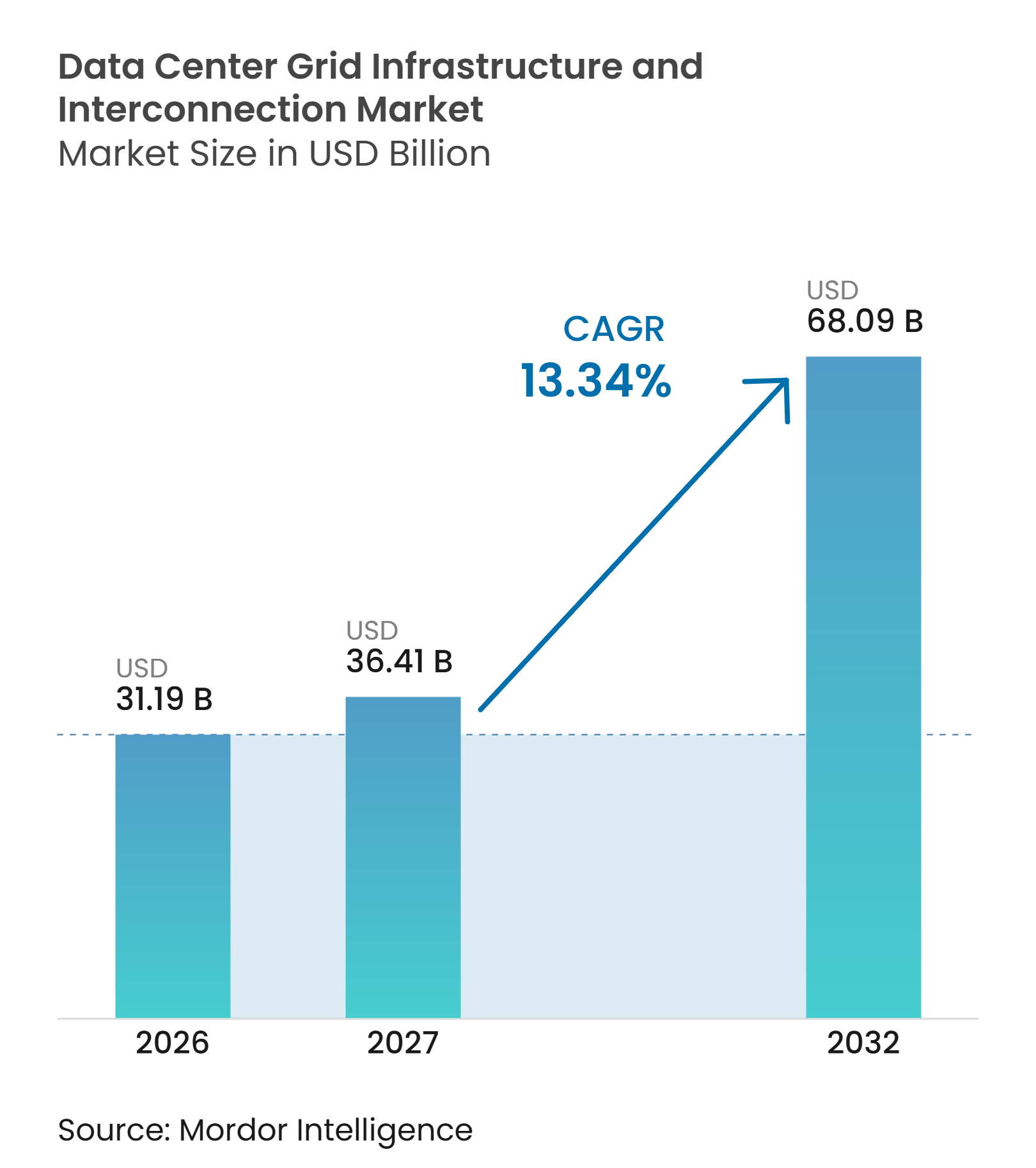
The data center grid infrastructure and interconnection market size is projected to be USD 31.19 billion in 2026, USD 36.41 billion in 2027, and reach USD 68.09 billion by 2032, at a CAGR of 13.34% from 2027 to 2032. The data center grid infrastructure and interconnection market is being shaped by the need to supply large campuses with reliable, high-capacity electricity. New facilities require dedicated substations, transmission lines, transformers, and control equipment before servers can be installed. Power availability is becoming a central factor in site selection, project financing, and construction schedules. Suppliers that can reserve equipment capacity and coordinate utilities, contractors, and grid operators are better placed to win large projects. The opportunity is strongest where utility investment, cloud demand, and rules for large-load connections are moving in the same direction.
Key Report Takeaways
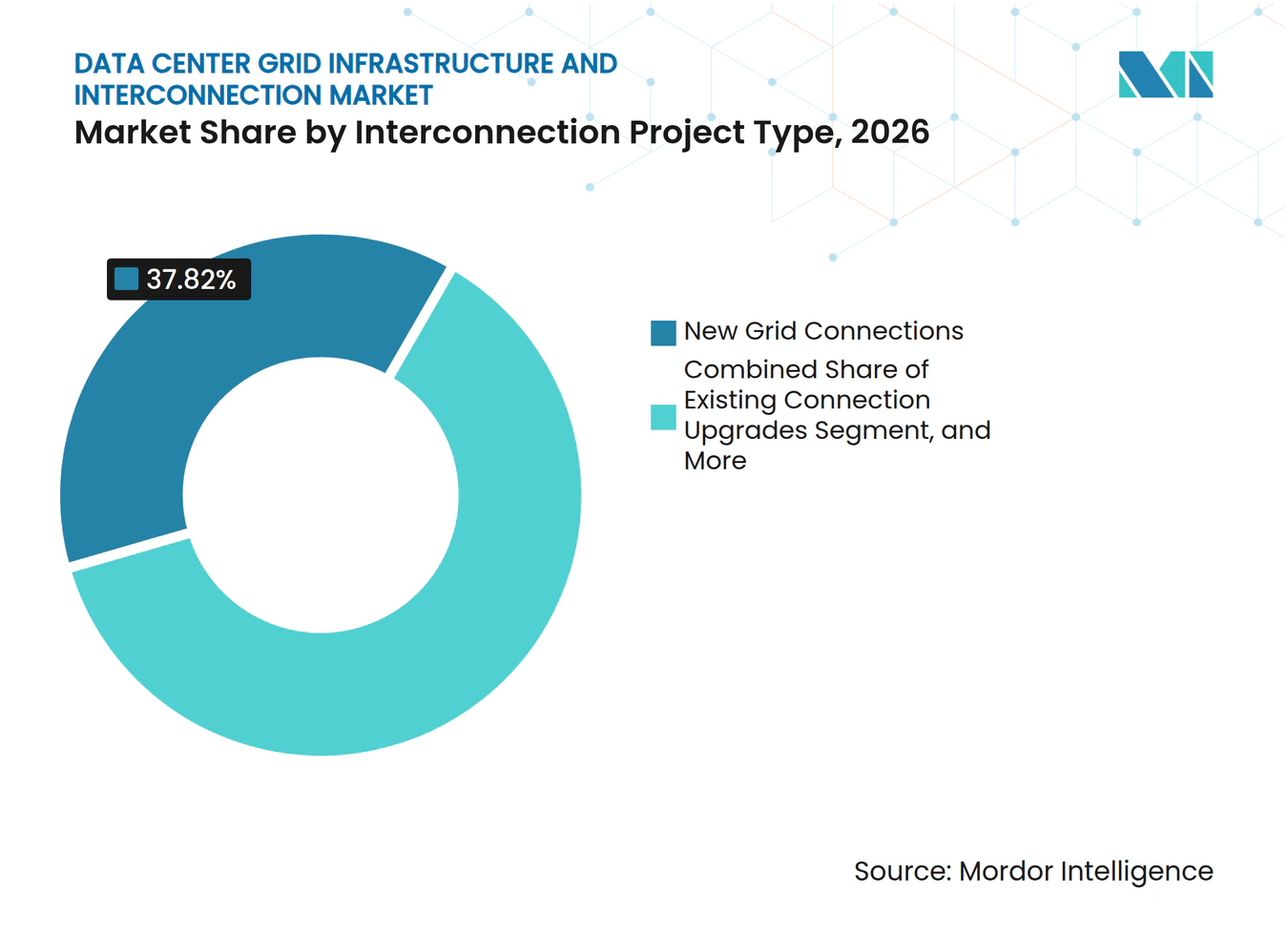
- By interconnection project type, new grid connections held 37.82% of the data center grid infrastructure and interconnection market share in 2026, while transmission lines and cables are projected to expand at a 14.14% CAGR through 2032.
- By infrastructure component, substations and switchyards accounted for 31.09% of the data center grid infrastructure and interconnection market size in 2026, while grid connection, control, and monitoring systems are expected to expand at a 14.33% CAGR through 2032.
- By voltage level, high-voltage infrastructure accounted for 46.79% of the market in 2026, while extra-high-voltage infrastructure is projected to grow at a 13.92% CAGR through 2032.
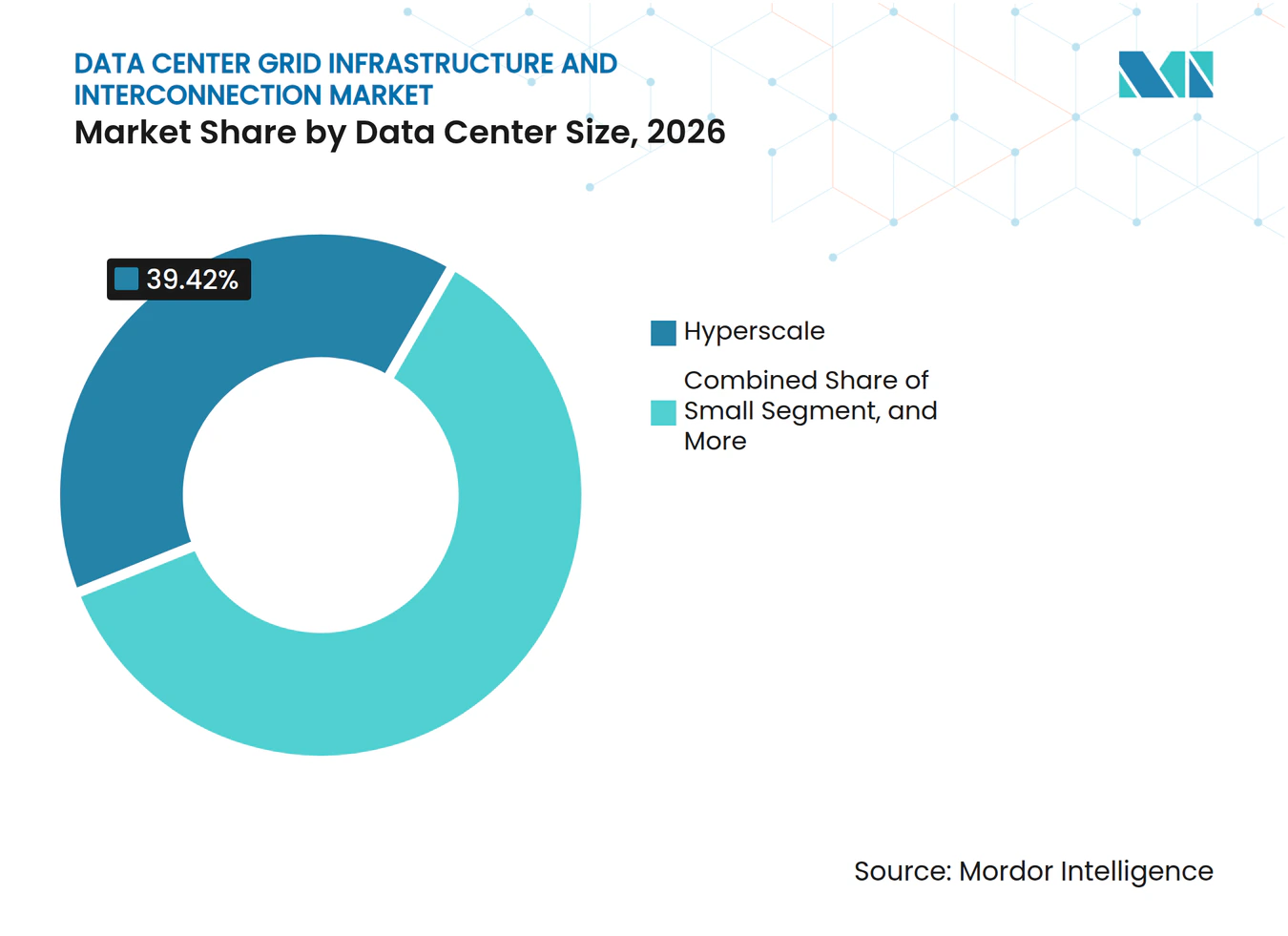
- By data center size, hyperscale data centers accounted for 39.42% of the market in 2026 and are projected to grow at a 14.06% CAGR through 2032.
- By data center type, cloud service providers held 48.40% of the market in 2026 and are projected to expand at a 13.89% CAGR through 2032.
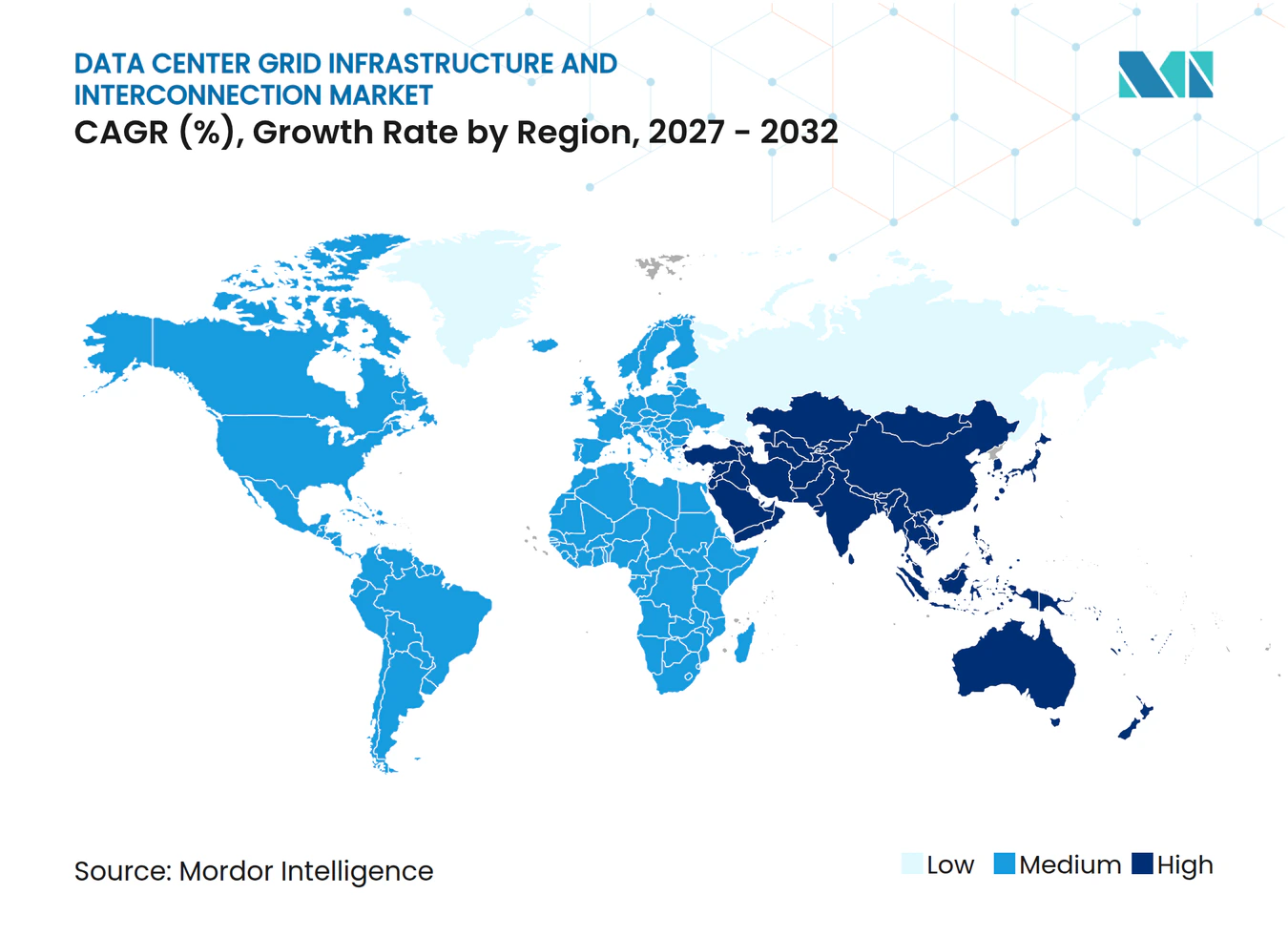
- By geography, North America held 45.51% of the market in 2026, while the Middle East and Africa are projected to advance at a 14.36% CAGR through 2032.
Note: Market numbers in this report are based on Mordor Intelligence's proprietary estimation framework, which combines nine months of actuals with Q4 projections for base year 2026.
Market Trends and Insights
Drivers Impact Analysis of Data Center Grid Infrastructure and Interconnection Market*
| Driver | (~) % Impact on CAGR Forecast | Geographic Relecance | Impact Timeline |
|---|---|---|---|
| Expansion of Hyperscale, Colocation, and AI Data Center Capacity | +2.8% | Global, concentrated in North America, Asia-Pacific, and Middle East and Africa | Short term (≤ 2 years) |
| Grid Connection Delays and Interconnection Queue Backlogs | +1.5% | North America and Europe, with spillover to Asia-Pacific | Medium term (2-4 years) |
| Rising Electricity Demand and Local Grid Capacity Constraints | +1.3% | Global, most acute in PJM, ERCOT, and Central Europe | Short term (≤ 2 years) |
| Investment in Transmission, Substations, and High-Voltage Infrastructure | +1.1% | North America, Middle East and Africa, and Europe | Medium term (2-4 years) |
| Growth of Large Data Center Campuses Requiring Dedicated Grid Connections | +0.9% | North America, Middle East and Africa, and emerging Asia-Pacific markets | Medium term (2-4 years) |
| Grid Modernization and Reliability Investment Initiatives | +0.8% | North America and Europe | Long term (≥ 4 years) |
| Source: Mordor Intelligence | |||
Expansion of Hyperscale, Colocation, and AI Data Center Capacity
The data center grid infrastructure and interconnection market benefits when operators develop campuses exceeding 300 MW, as these sites generally require dedicated high-voltage substations and transmission assets. In 2025, data centers increased electricity demand by 17%, compared with 3% growth in global electricity demand, highlighting the mismatch between digital load and existing grid capacity. The International Energy Agency also reported that capital expenditure by 5 major technology companies exceeded USD 400 billion in 2025 and was set to rise by 75% in 2026. This spending supports demand for transformers, switchgear, protection systems, and cables well before a new facility becomes operational. Campuses planned at 1 GW or more need extra-high-voltage equipment and dedicated lines, which can require 5 to 8 years to plan and deliver.
Grid Connection Delays and Interconnection Queue Backlogs
Connection delays are increasing the value of early equipment procurement in the data center grid infrastructure and interconnection market. The US Department of Energy asked the Federal Energy Regulatory Commission in October 2025 to address large-load interconnections, reflecting concern that existing processes were not keeping pace with demand.[1] Developers are responding by beginning interconnection studies and reserving long-lead equipment before site construction starts. This change favors buyers who can commit to equipment and connection costs early in the development process. It also favors suppliers with capacity reservation agreements and utilities with transparent queue management.
Rising Electricity Demand and Local Grid Capacity Constraints
Rising electricity demand is pushing utilities to reassess the transmission and substation capacity serving data center clusters. The data center grid infrastructure and interconnection market gains from these programs because the required work includes network reinforcement and final customer connections. American Electric Power announced a USD 72 billion capital plan for 2026-2030 after contracting 56 GW of incremental loads since fall 2025. PG&E announced a USD 73 billion transmission investment plan in September 2025 to accommodate 10 GW of anticipated data center demand. The scale of these plans means that manufacturing capacity and regulatory approvals can limit deployment even where demand is clear.
Investment in Transmission, Substations, and High-Voltage Infrastructure
Dedicated transmission is becoming a standard option for very large campuses rather than a project-specific exception. Entergy announced a USD 1.2 billion, 100-mile, 500-kV transmission project in Louisiana to serve Meta's planned 2-GW Hyperion campus. In Germany, 50Hertz signed a contract in July 2025 with VIRTUS Data Centers for a 380 kV direct connection to the Wustermark campus. ENTSO-E stated in April 2026 that data center connections in Europe trigger requirements under the EU grid connection network codes. These developments show that grid operators are incorporating large data center loads into transmission planning rather than treating them as isolated exceptions. They also expand the work available to firms capable of integrating engineering, procurement, construction, and grid compliance.
Restraints Impact Analysis of Data Center Grid Infrastructure and Interconnection Market*
| Restraint | (~) % Impact on CAGR Forecast | Geographic Relevance | Impact Timeline |
|---|---|---|---|
| Lengthy Grid Interconnection and Approval Processes | -2.1% | North America and Europe | Medium term (2-4 years) |
| High Capital Requirements for Substations and Transmission Upgrades | -1.6% | Global | Long term (≥ 4 years) |
| Long Lead Times for Transformers and High-Voltage Equipment | -1.2% | North America, Europe, and Asia-Pacific | Short term (≤ 2 years) |
| Land Acquisition, Right-of-Way, and Permitting Constraints | -0.8% | North America and Europe | Long term (≥ 4 years) |
| Source: Mordor Intelligence | |||
Lengthy Grid Interconnection and Approval Processes
Lengthy review processes constrain how quickly the data center grid infrastructure and interconnection market can translate planned projects into completed revenue. The Federal Energy Regulatory Commission opened its large-load interconnection proceeding in June 2026, which confirms that the federal framework for computational loads remains under development.[2] Rules related to interconnection studies, reliability, and cost allocation can change during the development of a multi-year project. Smaller 50 MW to 150 MW operators face particular difficulty because study deposits and connection costs require substantial funding before service is guaranteed. NERC standards, state public utility commission approvals, and FERC jurisdictional obligations can also create overlapping review periods.
High Capital Requirements for Substations and Transmission Upgrades
The capital required for substations and transmission upgrades limits the number of operators that can pursue direct grid connections. The data center grid infrastructure and interconnection market requires equipment costs, civil works, land, design, connection studies, and network upgrades to be funded within the same project schedule. Dominion Energy Virginia's planned 525-kV backbone in PJM's 2025 transmission plan targeted 3 GW of capacity for Northern Virginia by June 2032. High costs can direct mid-market colocation operators toward utility-owned capacity rather than dedicated transmission assets. Where capacity is limited, that choice can delay facilities or change site selection.
*Our forecasts treat driver/restraint impacts as directional, not additive. The impact forecasts reflect baseline growth, mix effects, and variable interactions.
Data Center Grid Infrastructure and Interconnection Market Segment Analysis
By Interconnection Project Type:
New Grid Connections Form the Core Revenue BaseNew grid connections held 37.82% of the data center grid infrastructure and interconnection market share in 2026. This position reflects the number of greenfield campuses moving from planning into construction across North America, Europe, the Middle East, and Africa. Large hyperscale projects generally require new substations and line infrastructure rather than modifications to existing service points. That requirement makes new connections the principal route to revenue for equipment suppliers, grid operators, and EPC contractors. Existing connection upgrades remain important for operating facilities that need larger transformers or higher-voltage configurations. These upgrades can also support new IT loads and onsite renewable integration without the full cost of a new transmission connection.
Transmission lines and cables are projected to expand at a 14.14% CAGR through 2032, the highest rate among the stated project-type categories. Their demand follows the growing length and voltage rating of dedicated links serving campuses at the gigawatt scale. Dedicated transmission infrastructure remains the smallest category, but it is necessary for campuses above 500 MW where conventional distribution links cannot provide the required capacity and redundancy. Quanta Services and NiSource announced in 2025 that Quanta would design, procure, and construct 3 GW of power generation and grid infrastructure for a large data center customer in Indiana, with completion expected by 2032. This type of arrangement extends the contractor's responsibility beyond a single substation to the wider campus power system. It also narrows the pool of firms capable of taking on complex transmission and interconnection work.



By Infrastructure Component:
Intelligent Systems Gain Importance as Physical Capacity TightensSubstations and switchyards accounted for 31.09% of the data center grid infrastructure and interconnection market size in 2026. They form the physical interface between the transmission network and a campus, especially for direct connections at 345 kV or higher. Each large campus requires a substation designed for its connection voltage, redundancy, and expected load profile. Power transformers are central to this equipment set and are often the most difficult items to obtain. Reuters reported in August 2025 that large power transformers had an average delivery time of 128 weeks and generator step-up units had an average delivery time of 144 weeks in the second quarter of 2025. Switchgear, protection systems, and transmission cables also benefit from increased starts at 345 kV to 765 kV.
Grid connection, control, and monitoring systems are projected to expand at a 14.33% CAGR through 2032. Their role is increasing because grid operators need accurate, real-time information on the changing load of data center facilities. The Federal Energy Regulatory Commission's July 2026 direction for NERC to consider reliability standards for computational loads highlights the importance of assessing large-load behavior. This requirement supports demand for upgrades to phasor measurement, supervisory control, and data acquisition, as well as automated demand response interfaces. VIRTUS installed 2,185 MVA super-grid transformers at Wustermark in June 2026, an example of equipment being used to match higher campus power densities. Control systems become more valuable as these connections increase in voltage and operational complexity.
By Voltage Level:
Extra-High Voltage Gains From Larger Campus RequirementsHigh-voltage infrastructure held 46.79% of the data center grid infrastructure market share in 2026. The 115 kV to 345 kV range remains the main connection tier for many large and hyperscale campuses. It provides a workable balance between capacity, cost, and available utility infrastructure in established markets. Low- and medium-voltage systems continue to play a role in edge locations, enterprise retrofits, and smaller projects. Their share of new capital is under pressure as new campus designs move toward larger power blocks. The data center grid infrastructure and interconnection market therefore has an increasingly clear link to transmission-level equipment.
Extra-high-voltage infrastructure is projected to advance at a 13.92% CAGR through 2032. Campuses targeting more than 500 MW increasingly require 500 kV or 765 kV service to meet power density and resilience requirements. National Grid awarded a GBP 45.9 billion (USD 59.4 billion) high-voltage direct current supply-chain framework in March 2025, including cable and converter positions across major equipment suppliers. Such awards reserve supply capacity years before equipment delivery. This can strengthen pricing power for established cable and converter specialists. NKT reported a EUR 10.2 billion (USD 11.1 billion) high-voltage order backlog at the end of 2025, showing the tight supply environment for these technologies.
By Data Center Size:
Hyperscale Facilities Lead DemandHyperscale data centers captured 39.42% of the data center grid infrastructure and interconnection market share in 2026. The segment also has the highest stated expansion rate, with a projected 14.06% CAGR through 2032. These facilities have the largest infrastructure requirements because operators increasingly plan campuses at 1 GW or more. Their connection requirements include extra-high-voltage substations, dedicated transmission lines, and sometimes new generation capacity. Large facilities, generally ranging from 20 MW to 500 MW, are the next important demand group. They support colocation expansion in Europe and Asia-Pacific, but have less ability to secure priority access to equipment than the largest operators.
Medium and small facilities represent a declining share of new infrastructure spending as more enterprise computing moves to cloud and colocation environments. They remain necessary where data sovereignty rules, latency requirements, or local resilience objectives limit full migration to shared capacity. Kentucky Power announced plans to develop 765-kV and 345-kV substations for TeraWulf's Muskie Data Campus in October 2026. The announcement stated that contracted capacity doubled from 500 MW to 1 GW after the second 500 MW phase was accelerated to 2029. The project demonstrates how larger operators are bringing forward infrastructure schedules when they gain confidence in demand. It also illustrates why grid construction now needs to begin well before the delivery date of the computing facilities.

By Data Center Type:
Cloud Service Providers Reshape ProcurementCloud service providers held 48.40% of the data center grid infrastructure and interconnection market share in 2026. They are also projected to expand at a 13.89% CAGR through 2032. Their scale allows them to commit to supply capacity before final construction milestones are complete. These advance agreements reduce their exposure to shortages of transformers, switchgear, and power modules. They also allow manufacturers to plan production against a visible multiyear order book. Colocation providers are the second-largest buyer group as cloud service providers use third-party capacity in edge and secondary markets.
Schneider Electric announced USD 2.3 billion in U.S. data center supply agreements in November 2025, including a USD 1.9 billion agreement with Switch and a USD 373 million agreement with Digital Realty. ABB also announced 3 orders with VoltaGrid in November 2025 to support grid stability at US AI data centers. Enterprise and edge deployments remain smaller and slower-moving because their IT spending increasingly favors cloud services and software. The data center grid infrastructure and interconnection market is consequently shaped by a buyer group with substantial purchasing power and a need for earlier equipment commitments. This approach makes supply certainty as important as unit price in the procurement process.
Geography Analysis
North America held 45.51% of the data center grid infrastructure and interconnection market share in 2026. The United States accounts for most of this demand because it has the largest concentration of hyperscale campuses and a growing requirement for transmission upgrades. PJM approved a USD 11.8 billion Regional Transmission Expansion Plan in February 2026, including a USD 2.3 billion, 185-mile, 525 kV underground backbone proposed by Dominion Energy Virginia to deliver 3 GW into Northern Virginia by June 2032. Canada is directing utility investment toward higher-capacity substation upgrades, while Mexico is gaining direct high-voltage connection projects.
Europe is the second-largest regional market and is supported by regulated transmission operators and EU network codes. In July 2025, 50Hertz signed a connection construction contract with VIRTUS Data Centers for a 300-MW, 380-kV connection in Berlin-Brandenburg. In December 2025, 50Hertz also signed a 380 kV underground cable connection contract for VANTAGE's BER1 campus expansion, with a contracted load of 300 MW and a planned expansion to 500 MW. The data center grid infrastructure and interconnection market has strong prospects in the Berlin-Brandenburg corridor, as 50Hertz plans to add 2 GW of total data center connections in the region by 2029. The United Kingdom has a substantial pipeline, with parliamentary evidence in 2026 reporting nearly 59 GW of data center projects seeking transmission-level connections.[3]
The Middle East and Africa are projected to expand at a 14.36% CAGR through 2032, the highest regional rate. Saudi Arabia's National Data Center Strategy, launched in June 2025, targets up to 1.5 GW of installed data center capacity by 2030. NEOM and DataVolt announced a USD 5 billion agreement in February 2025 for a 1.5 GW net-zero AI campus in Oxagon, with the first phase expected to become operational by 2028. Asia-Pacific demand reflects China's nationally governed grid programs and rising load in the Mumbai, Chennai, and Hyderabad hubs in India. Singapore remains tightly capacity managed, while Australia and South Korea are emerging as secondary hubs.
Competitive Landscape
Market Concentration
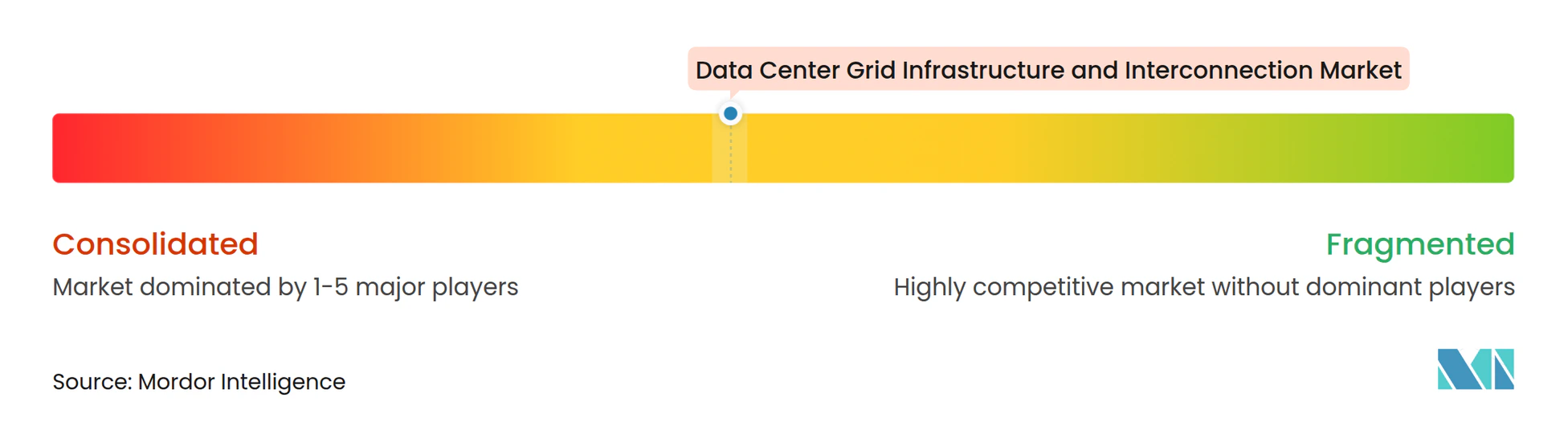
The data center grid infrastructure and interconnection market is moderately concentrated among Hitachi Energy, Siemens Energy, GE Vernova, ABB, and Schneider Electric. EPC services and cable supply are more dispersed, with Quanta Services, Prysmian, NKT, and Nexans holding distinct positions. Competition centers on manufacturing capacity, project execution, local presence, and the ability to manage large backlogs. Hitachi Energy announced a USD 1 billion U.S. manufacturing investment in September 2025, including USD 457 million for a large power transformer facility in South Boston, Virginia.[4] Siemens Energy announced a USD 1 billion manufacturing investment in the US in February 2026, including a transformer factory in Charlotte, North Carolina.
The market separates firms that can provide turnkey substations from those focused on individual components. GE Vernova and AWS signed a strategic framework agreement in March 2025 for electrification solutions, covering high-voltage switchyards, medium-voltage switchgear, renewable energy collaboration, and power generation services. Cable suppliers compete through factory capacity and long-term reservations rather than spot availability. Nexans reported increased investment in grid accessories and US medium-voltage capacity in its October 2026 financial disclosure.
The data center grid infrastructure and interconnection market offers opportunities for firms that can coordinate engineering, procurement, construction, and grid compliance across a full campus connection. AEP and Quanta Services announced strategic agreements in November 2025 for the design, engineering, procurement, construction, and domestic manufacturing development of extra-high-voltage equipment. Schneider Electric's supply capacity agreements and ABB's work with VoltaGrid show how equipment providers are locking in future demand through direct arrangements with data center buyers. Technical certification and the qualifications required for high-voltage systems create barriers for smaller manufacturers and contractors. Projects can still be delayed by approvals, right-of-way issues, transformer availability, or utility upgrade schedules.
Data Center Grid Infrastructure and Interconnection Industry Leaders
-
GE Vernova Inc.
-
Schneider Electric SE
-
ABB Ltd.
-
Hitachi Energy Ltd.
-
Siemens Energy
- *Disclaimer: Major Players sorted in no particular order
Data Center Grid Infrastructure and Interconnection Market Companies Covered in this Report
- Hitachi Energy
- Siemens Energy AG
- GE Vernova Inc.
- Schneider Electric SE
- ABB Ltd.
- Eaton Corporation plc
- Mitsubishi Electric Corporation
- Toshiba Energy Systems & Solutions Corporation
- HD Hyundai Electric Co., Ltd.
- CG Power and Industrial Solutions Limited
- Powell Industries, Inc.
- Virginia Transformer Corp.
- Schweitzer Engineering Laboratories, Inc.
- S&C Electric Company
- Efacec Power Solutions SGPS, S.A.
- NKT A/S
- Prysmian S.p.A.
- Nexans S.A.
- LS ELECTRIC Co., Ltd.
- Quanta Services, Inc.
Recent Industry Developments in Data Center Grid Infrastructure and Interconnection Market
- October 2026: Kentucky Power announced development of a 765 kV and 345 kV substation to serve TeraWulf's Muskie Data Campus in eastern Kentucky, with contracted capacity doubling from 500 MW to 1 GW after TeraWulf accelerated the second 500 MW phase to 2029. The project represents one of the first confirmed gigawatt-scale data center campuses to be served by an extra-high-voltage dedicated substation in the United States.
- October 2026: 50Hertz began construction to expand the Wustermark substation in Berlin-Brandenburg with an N-1 secure 380 kV grid connection for the VIRTUS campus, supporting 300 MW of initial capacity from a dedicated 500 MW substation and representing the first data center in the region connected at the extra-high-voltage tier.
- October 2026: Nexans' third-quarter 2026 financial disclosures cited increased investment in grid accessories and U.S. medium-voltage production capacity, positioning the company to serve data center and solar growth. The company also referenced leading positions in data center cable supply in Finland through subsidiary Reka Cables.
- June 2026: VIRTUS Data Centres confirmed installation of 2 185 MVA super-grid transformers at its Wustermark campus in Brandenburg, Germany. The campus connects directly to 50Hertz's 380 kV transmission network via a dedicated substation.
Global Data Center Grid Infrastructure and Interconnection Market Report Scope
The Data Center Grid Infrastructure and Interconnection Market comprises the infrastructure, equipment, and systems required to connect data centers to the electrical grid and ensure reliable, efficient, and scalable power delivery.
The Data Center Grid Infrastructure and Interconnection Market is Segmented by Interconnection Project Type (New Grid Connections, Existing Connection Upgrades, Dedicated Transmission Infrastructure, and Substation and Grid Interconnection Upgrades), Infrastructure Component (Substations and Switchyards, Power Transformers, Transmission Lines and Cables, Switchgear and Protection Systems, and Grid Connection, Control, and Monitoring Systems), Voltage Level (Low and Medium Voltage, High Voltage, and Extra-High Voltage), Data Center Size (Small, Medium, Large, and Hyperscale), Data Center Type (Colocation, Cloud Service Providers (CSPs), and Enterprise and Edge), and Geography (North America, South America, Europe, Middle East and Africa, and Asia-Pacific). The Market Forecasts are Provided in Terms of Value (USD).
Segmentation Overview
| New Grid Connections |
| Existing Connection Upgrades |
| Dedicated Transmission Infrastructure |
| Substation and Grid Interconnection Upgrades |
| Substations and Switchyards |
| Power Transformers |
| Transmission Lines and Cables |
| Switchgear and Protection Systems |
| Grid Connection, Control, and Monitoring Systems |
| Low and Medium Voltage |
| High Voltage |
| Extra-High Voltage |
| Small |
| Medium |
| Large |
| Hyperscale |
| Colocation |
| Cloud Service Providers (CSPs) |
| Enterprise and Edge |
| North America | United States |
| Canada | |
| Mexico | |
| South America | Brazil |
| Chile | |
| Colombia | |
| Argentina | |
| Peru | |
| Rest of South America | |
| Europe | United Kingdom |
| Germany | |
| France | |
| Netherlands | |
| Ireland | |
| Spain | |
| Italy | |
| Nordics | |
| Rest of Europe | |
| Middle East and Africa | Saudi Arabia |
| United Arab Emirates | |
| South Africa | |
| Israel | |
| Egypt | |
| Qatar | |
| Rest of Middle East and Africa | |
| Asia-Pacific | China |
| India | |
| Japan | |
| Australia | |
| Singapore | |
| South Korea | |
| Malaysia | |
| Indonesia | |
| Rest of Asia-Pacific |
| By Interconnection Project Type | New Grid Connections | |
| Existing Connection Upgrades | ||
| Dedicated Transmission Infrastructure | ||
| Substation and Grid Interconnection Upgrades | ||
| By Infrastructure Component | Substations and Switchyards | |
| Power Transformers | ||
| Transmission Lines and Cables | ||
| Switchgear and Protection Systems | ||
| Grid Connection, Control, and Monitoring Systems | ||
| By Voltage Level | Low and Medium Voltage | |
| High Voltage | ||
| Extra-High Voltage | ||
| By Data Center Size | Small | |
| Medium | ||
| Large | ||
| Hyperscale | ||
| By Data Center Type | Colocation | |
| Cloud Service Providers (CSPs) | ||
| Enterprise and Edge | ||
| By Geography | North America | United States |
| Canada | ||
| Mexico | ||
| South America | Brazil | |
| Chile | ||
| Colombia | ||
| Argentina | ||
| Peru | ||
| Rest of South America | ||
| Europe | United Kingdom | |
| Germany | ||
| France | ||
| Netherlands | ||
| Ireland | ||
| Spain | ||
| Italy | ||
| Nordics | ||
| Rest of Europe | ||
| Middle East and Africa | Saudi Arabia | |
| United Arab Emirates | ||
| South Africa | ||
| Israel | ||
| Egypt | ||
| Qatar | ||
| Rest of Middle East and Africa | ||
| Asia-Pacific | China | |
| India | ||
| Japan | ||
| Australia | ||
| Singapore | ||
| South Korea | ||
| Malaysia | ||
| Indonesia | ||
| Rest of Asia-Pacific | ||
Key Questions Answered in the Report
What is the data center grid infrastructure and interconnection market size?
The data center grid infrastructure and interconnection market is projected to be USD 31.19 billion in 2026, USD 36.41 billion in 2027, and USD 68.09 billion by 2032.
What is driving spending on data center grid infrastructure?
Larger hyperscale and AI campuses need dedicated substations, transformers, transmission lines, and control systems before they can receive reliable power.
Which interconnection project type holds the largest share?
New grid connections held 37.82% share in 2026 because greenfield campuses typically require dedicated power infrastructure.
Which infrastructure component is expanding fastest?
Grid connection, control, and monitoring systems are projected to expand at a 14.33% CAGR through 2032.
Which region leads the data center grid infrastructure and interconnection market?
North America held 45.51% share in 2026, supported by its concentration of hyperscale campuses and major transmission programs.
What is the main challenge for new data center power projects?
Long interconnection reviews, costly network upgrades, and long lead times for transformers can delay power delivery and construction schedules.