
Data Center Fire Protection and Life Safety Market Size and Share
Market Overview
| Study Period | 2021 - 2032 |
|---|---|
| Market Size (2027) | USD 3.76 Billion |
| Market Size (2032) | USD 5.66 Billion |
| Growth Rate (2027 - 2032) | 10.61 % |
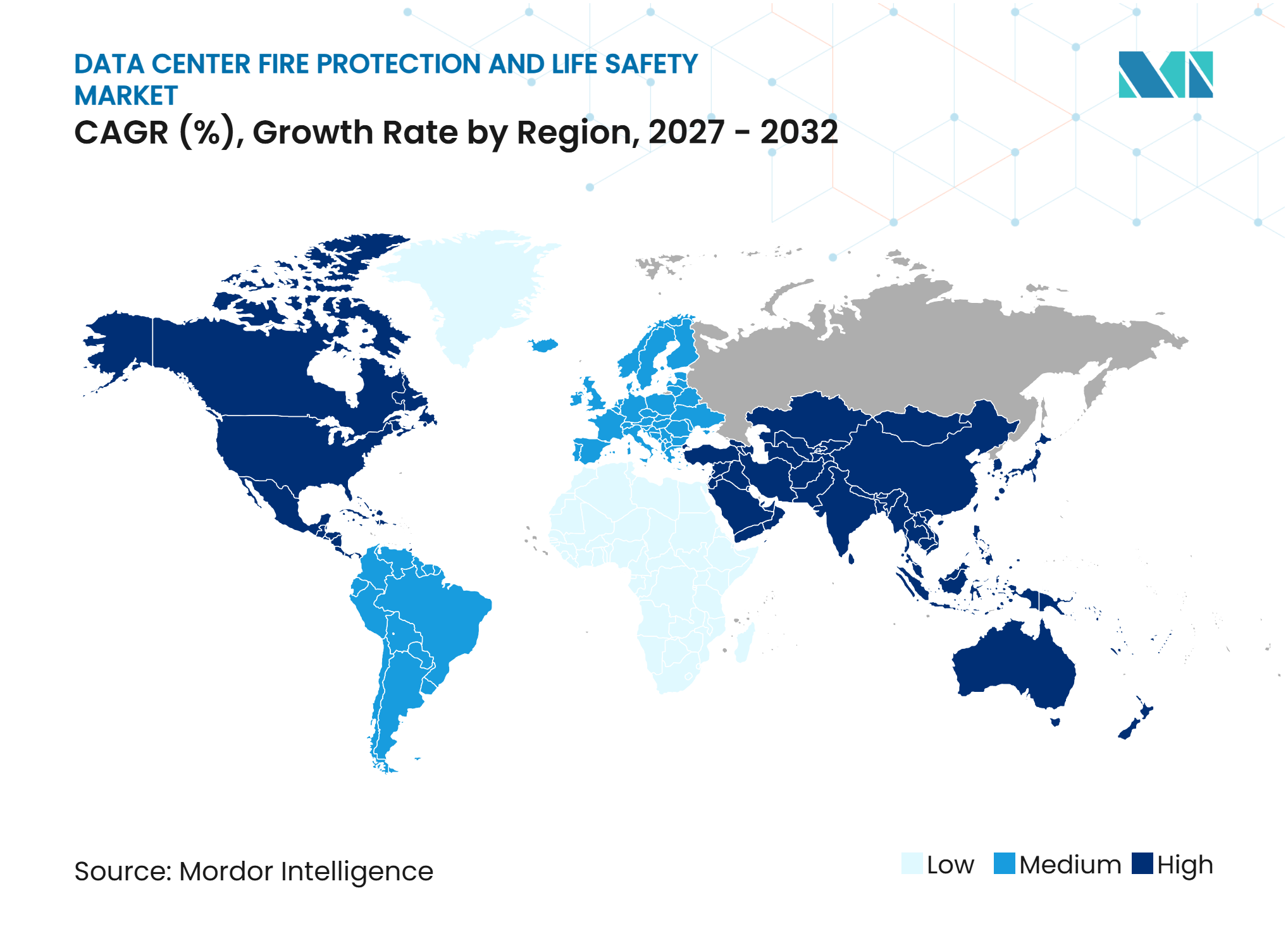
| Fastest Growing Market | Asia-Pacific |
| Largest Market | North America |
| Market Concentration | Medium |
Major Players *Disclaimer: Major Players sorted in no particular order Image © Mordor Intelligence. Reuse requires attribution under CC BY 4.0. | |
Data Center Fire Protection and Life Safety Market Analysis by Mordor Intelligence
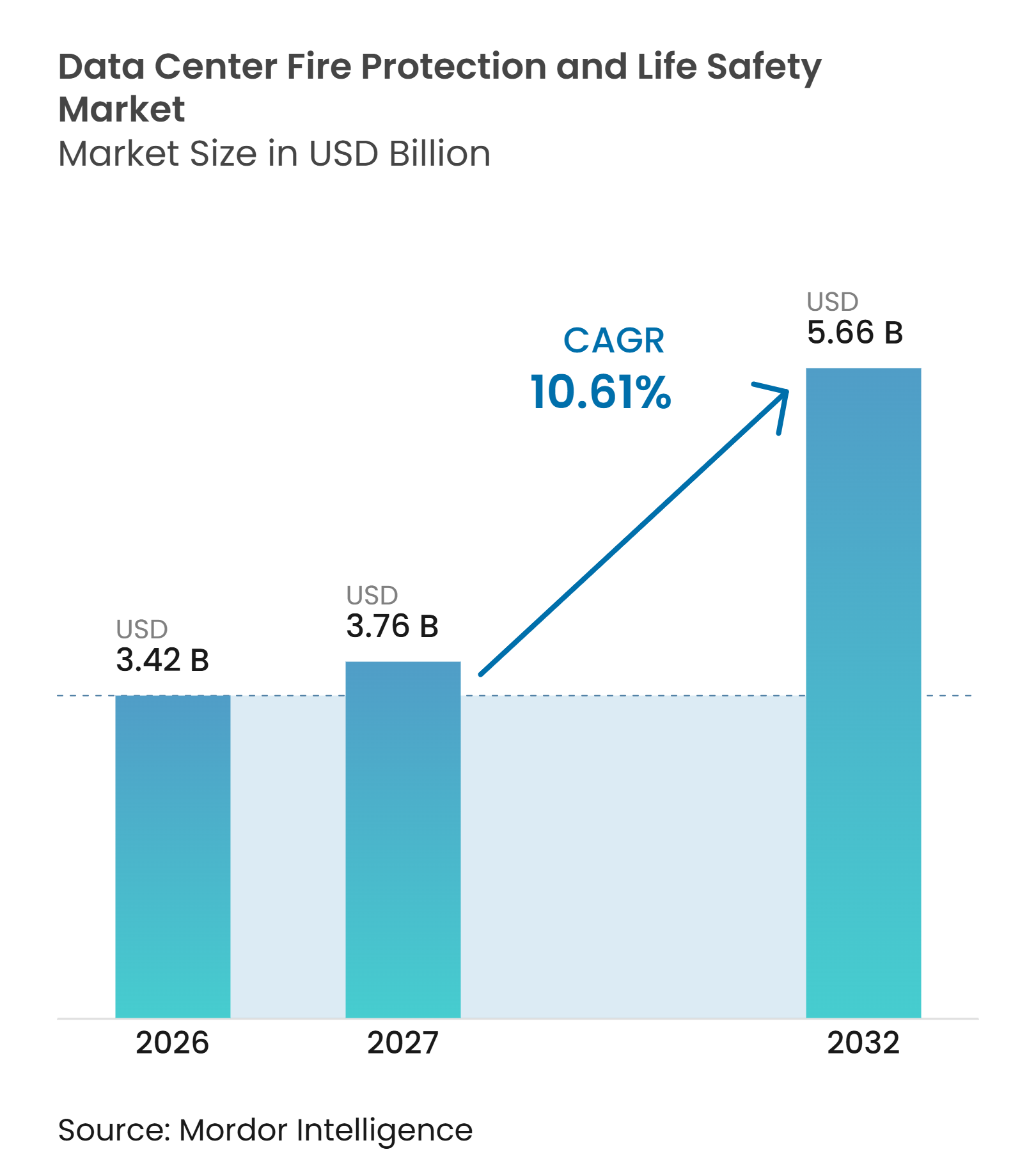
The Data Center Fire Protection and Life Safety Market size is projected to be USD 3.42 billion in 2026 and reach USD 5.66 billion by 2032, expanding at a CAGR of 10.61% from 2027 to 2032. The data center fire protection and life safety market is being reshaped by denser AI and GPU workloads, which increase thermal loads and introduce new risk patterns inside data halls. Wider use of lithium-ion battery energy storage in uninterruptible power supply systems also raises the need for detection, suppression, ventilation, and emergency response that work together. New hyperscale campuses create installation demand, while each commissioned facility adds inspection, testing, and maintenance work over its operating life. Suppliers are focusing on integrated monitoring platforms, layered suppression designs, and long-term service contracts because these systems become closely embedded in a facility after commissioning. The data center fire protection and life safety market also benefits when providers can connect equipment supply with long-term testing and maintenance. Regulation affecting hydrofluorocarbon clean agents and the shortage of experienced commissioning specialists may slow some projects, although they also encourage investment in alternatives and specialist services.
Key Report Takeaways
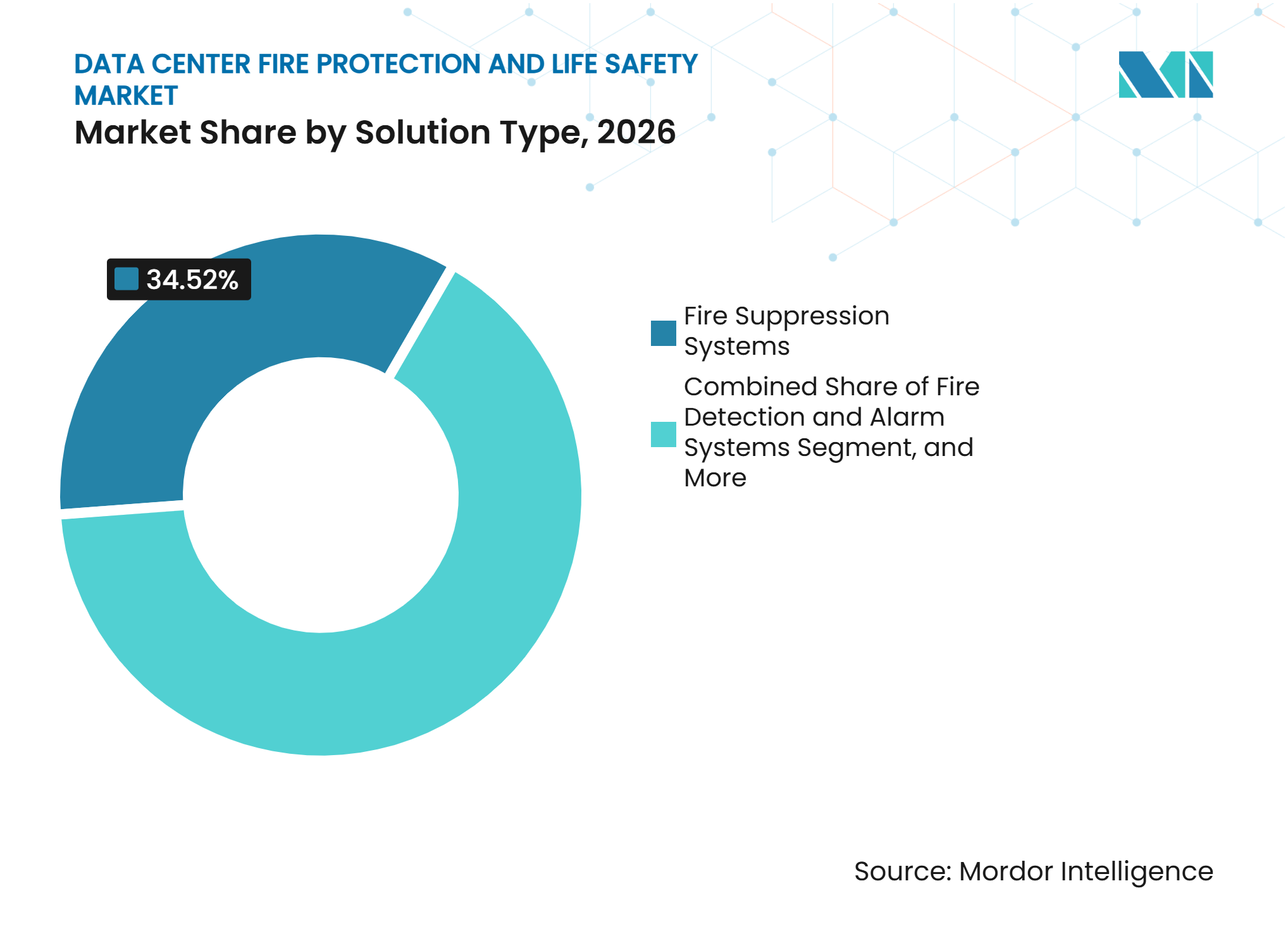
- By solution type, Fire Suppression Systems held 34.52% of revenue in 2026, while Fire Monitoring and Control Systems are projected to expand at an 11.81% CAGR through 2032.
- By fire protection technology, Smoke and Heat Detection accounted for 23.98% of revenue in 2026, while Water-Based Suppression is projected to expand at an 11.76% CAGR through 2032.
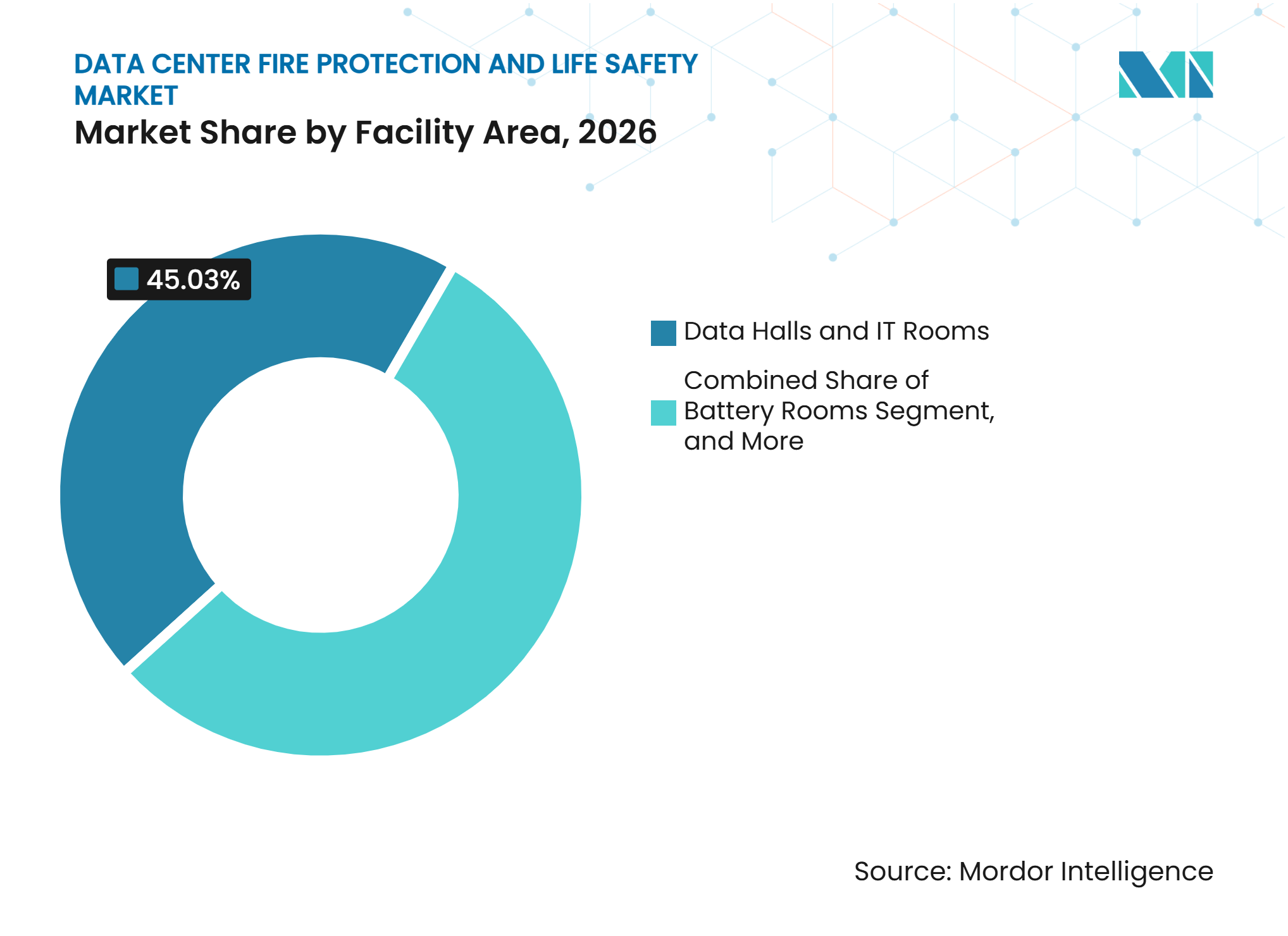
- By facility area, Data Halls and IT Rooms held 45.03% of revenue in 2026, while Battery Rooms are projected to expand at an 11.92% CAGR through 2032.
- By data center size, Hyperscale facilities accounted for 38.01% of revenue in 2026 and are projected to expand at an 11.69% CAGR through 2032.
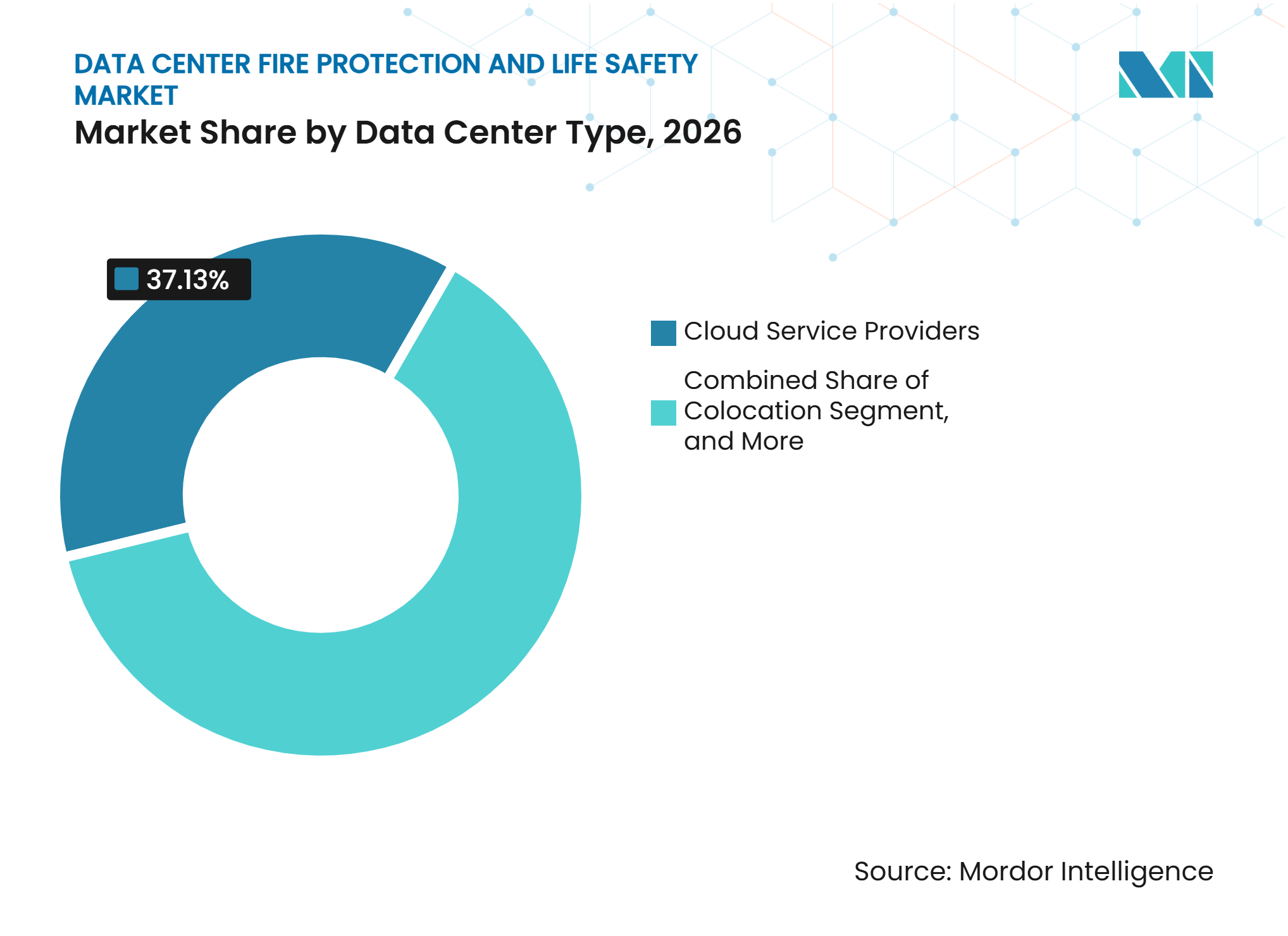
- By data center type, Cloud Service Providers held 37.13% of revenue in 2026 and are projected to expand at an 11.74% CAGR through 2032.
- By geography, North America held 38.89% of revenue in 2026, while Asia-Pacific is projected to expand at an 11.83% CAGR through 2032.
Note: Market numbers in this report are based on Mordor Intelligence's proprietary estimation framework, which combines nine months of actuals with Q4 projections for base year 2026.
Market Trends and Insights
Drivers Impact Analysis of Data Center Fire Protection and Life Safety Market*
| Driver | (~) % Impact on CAGR Forecast | Geographic Relevance | Impact Timeline |
|---|---|---|---|
| Hyperscale and Colocation Capacity Expansion | +3.5% | Global, with the greatest concentration in North America and Asia-Pacific | Short term (≤ 2 years) |
| AI and GPU-Intensive Compute Increasing Thermal Loads | +2.8% | Global, led by North America, Asia-Pacific, and Europe | Short term (≤ 2 years) |
| Mandatory Fire-Safety Compliance and Insurance Requirements | +1.6% | North America and Europe, expanding to Asia-Pacific and Middle East and Africa | Medium term (2-4 years) |
| Expansion of Edge and Modular Data Centers | +1.2% | Global, with early gains in Southeast Asia, Middle East and Africa, and South America | Medium term (2-4 years) |
| Lithium-Ion Battery and UPS Fire-Risk Management | +0.9% | Global, with greater exposure where energy storage is co-located with server environments | Short term (≤ 2 years) |
| Integration of Fire Protection With DCIM and Building Management Systems | +0.6% | Global, focused on Tier III and Tier IV hyperscale and colocation operators | Long term (≥ 4 years) |
| Source: Mordor Intelligence | |||
Hyperscale and Colocation Capacity Expansion
Hyperscale and colocation construction remains the largest demand driver for the data center fire protection and life safety market because each greenfield site requires a complete protection system. Large campuses require fire alarms, suppression equipment, smoke extraction, controls, emergency notification, and commissioning before facilities can enter service. Caverion signed a 2025 agreement with Nebius DC Oy covering fire alarm, extinguishing, smoke extraction, liquid cooling, and technical services for a 75-megawatt expansion in Mäntsälä, Finland. The contract value was EUR 80 million, equivalent to USD 86.4 million using the 2025 average EUR/USD rate stated in the source.[1] Every new hall also requires recurring inspection, testing, and maintenance work after completion. This makes service revenue more durable than one-time installation revenue as the protected asset base expands.
AI and GPU-Intensive Compute Increasing Thermal Loads
GPU-intensive computing changes the heat profile of server rooms and makes earlier detection more important in the data center fire protection and life safety market. UL Solutions reported that modular data center safety planning must coordinate fire suppression, emergency egress, lighting, and alarm systems across equipment from multiple suppliers.[2] High-density deployments increasingly use liquid cooling, which changes the materials and equipment that fire protection designs must address. A 2025 peer-reviewed study tested a passive cooling and suppression system for GPU servers that reduced average chip temperature by 9.2°C and contained simulated clean-agent discharge within 0.45 seconds. These results support interest in rack-level measures that can operate without facility power continuity. Aspirating smoke detection also becomes more relevant where high airflow can delay recognition of early smoldering events by conventional point detectors.
Mandatory Fire-Safety Compliance and Insurance Requirements
Fire safety spending is often non-discretionary because facility operators must meet code, insurer, and customer requirements before opening or expanding capacity. The National Electrical Manufacturers Association published NEMA BS 31060-2025 in February 2026 to guide early planning, detector placement, suppression selection, and coordinated detection and response in data centers.[3] The framework positions fire and life safety equipment as a core infrastructure system rather than a late-stage addition. The National Fire Protection Association has also described how its data center standards support safe capacity expansion as facility designs evolve. These compliance factors strengthen demand for documented commissioning, periodic testing, and integrated response systems. They also favor vendors and contractors that can demonstrate reliable installation and compliance support.
Expansion of Edge and Modular Data Centers
Edge and modular facilities extend the data center fire protection and life safety market into remote industrial sites, urban locations, retail settings, and other places without large resident engineering teams. UL 2755:2025 sets out safety considerations for modular data centers, including integrated fire suppression and coordination with emergency systems. This pushes suppliers toward factory-integrated protection packages that are evaluated as part of the complete modular unit. AWS describes fire suppression and monitoring as built-in components of its Modular Data Center infrastructure. Standardized, self-contained designs can reduce site-specific engineering demands and improve repeatability across distributed deployments. This creates an advantage for manufacturers with recognized certifications and modular product portfolios.
Restraints Impact Analysis of Data Center Fire Protection and Life Safety Market*
| Restraint | (~) % Impact on CAGR Forecast | Geographic Relevance | Impact Timeline |
|---|---|---|---|
| High Upfront Cost of Advanced Detection and Suppression Systems | -1.4% | Global, most acute in South America and parts of Middle East and Africa where budgets are constrained | Medium term (2-4 years) |
| Complex Retrofits in Operating Data Centers | -0.9% | Global, with stronger exposure in North America and Europe where legacy facilities are extensive | Medium term (2-4 years) |
| Shortage of Data-Center Fire-Safety Engineering and Commissioning Specialists | -0.5% | Global, most severe in Asia-Pacific and Middle East and Africa | Long term (≥ 4 years) |
| Uncertainty in Clean-Agent Availability and Environmental Compliance | -0.4% | North America and Europe, with exposure in facilities dependent on HFC-based agents | Long term (≥ 4 years) |
| Source: Mordor Intelligence | |||
High Upfront Cost of Advanced Detection and Suppression Systems
Advanced aspirating detection, inert gas suppression, and pre-action systems can cost more than conventional wet-pipe or single-zone arrangements. Battery room designs can require off-gas detection, ventilation coordination, separate suppression circuits, and emergency controls in addition to standard data hall protection. Smaller data centers may lack the purchasing scale needed to bundle equipment and maintenance services. Uptime Institute reported in 2026 that lithium-ion batteries in UPS systems were a clear contributing factor in a gradual rise in major data center fires. Providers are introducing financing and monitoring-as-a-service options to spread some capital costs over operating budgets. These models remain less established beyond major colocation customers, which can delay adoption in smaller deployments.
Complex Retrofits in Operating Data Centers
Retrofitting a live data center requires careful sequencing because a false discharge or extended shutdown can disrupt customer workloads and damage equipment. Older buildings may not have the floor heights, cable management, room integrity, or pipe routes needed for modern total-flooding systems. Modernization can require replacement of detectors, re-routing of suppression pipework, and reconfiguration of fire alarm controls at the same time. Operators often defer this work until a lease expiry, capacity expansion, or larger upgrade requires it. This behavior delays current retrofit spending even where legacy protection systems are technically outdated. It also creates an eventual replacement cycle for firms that can combine engineering, commissioning, and ongoing maintenance services.
*Our forecasts treat driver/restraint impacts as directional, not additive. The impact forecasts reflect baseline growth, mix effects, and variable interactions.
Data Center Fire Protection and Life Safety Market Segment Analysis
By Solution Type:
Monitoring Systems Gain Pace While Suppression Retains ScaleFire Suppression Systems held 34.52% of the data center fire protection and life safety market share in 2026, making suppression the largest solution category. Facilities require primary suppression and water-based backup arrangements because data halls contain high-value equipment and operate continuously. Layered designs increasingly combine pre-action sprinklers with clean-agent or high-pressure water mist systems. These designs address the limitations of relying on one agent in large open data halls. Fire Detection and Alarm Systems remain essential because rapid identification is required before a suppression sequence can begin. Very early warning systems are particularly relevant in high-airflow environments where smoke can become diluted or dispersed. Emergency Notification and Evacuation Systems complete the safety arrangement for campuses that need zone-specific communication. Coordinated messages can alert affected areas without unnecessarily disturbing adjacent spaces. The data center fire protection and life safety market size for suppression remains supported by the basic requirement to protect critical compute assets. This requirement applies in new projects as well as upgrades to operating facilities.
Fire Monitoring and Control Systems are projected to expand at an 11.81% CAGR through 2032, the fastest rate within solution types. Operators are moving beyond standalone control panels toward platforms that bring alarms, device status, testing, and response coordination into one operating view. Larger campuses can have many buildings and require a consistent way to observe safety systems across the site. Monitoring platforms also support recurring service activity because technicians need reliable records of events, tests, and device condition. Inspection, Testing, and Maintenance Services therefore form a recurring part of the solution mix. Periodic testing requirements create continuing work after the initial installation is complete. Suppliers can strengthen customer retention when controls, reporting, service, and replacement planning are linked. This supports longer commercial relationships than equipment-only sales. It also explains why integrated platforms are receiving greater attention from major building technology providers. The data center fire protection and life safety market benefits when these systems are specified during early facility design.



By Fire Protection Technology:
Water-Based Systems Gain Ground Against Clean AgentsSmoke and Heat Detection accounted for 23.98% of the data center fire protection and life safety market size in 2026 by technology. Detection is deployed across data halls, electrical rooms, battery rooms, cooling areas, and support spaces before other systems can respond. Aspirating smoke detection is gaining specification interest in hyperscale environments because it can identify low concentrations of smoke in high-airflow conditions. Siemens introduced Sinteso Nova and Cerberus Nova detectors in March 2026 with cloud-based self-checks, smoke entry supervision, and multi-wavelength detection. The portfolio supports integration with existing Siemens panels, which can reduce complexity in modernization projects. Technology investment is also focused on reducing false alarms, which are especially costly in continuously operating data halls. Detection systems remain the starting point for coordinated monitoring and suppression architectures. Their broad application keeps this technology category central to protection designs. Facility owners also rely on detection records to support maintenance and compliance documentation. These requirements sustain demand across both new construction and retrofit work.
Water-Based Suppression is projected to expand at an 11.76% CAGR through 2032, supported by demand for pre-action and water mist designs. Water mist can control fire through heat removal and oxygen displacement while using less water than conventional sprinklers in the cited applications. Clean Agent Suppression remains important for enclosed IT and electrical spaces that need residue-free total flooding. Its outlook is shaped by the availability and environmental position of replacement chemistries. The US Environmental Protection Agency has issued restrictions affecting certain HFC uses in data center cooling equipment from January 1, 2027. Inert gas systems retain relevance where buyers prioritize low ozone depletion and low global warming potential characteristics. Germany and Nordic countries are notable settings for this preference because compliance factors are strong. Water-based solutions can benefit where buyers seek alternatives to high-global-warming-potential agents. The result is a technology mix rather than a full replacement of clean agents.
By Facility Area:
Battery Rooms Broaden the Protection PerimeterData Halls and IT Rooms held 45.03% of revenue in 2026, reflecting their large footprints and concentration of computing equipment. These rooms require protection that avoids unnecessary equipment damage while responding quickly to real fire events. Their fire safety architecture commonly combines detection, control, suppression, and notification systems. Electrical and UPS Rooms have separate equipment and electrical hazards that need tailored system selection. Cooling and Mechanical Rooms also require designs that reflect machinery, fluid, and power risks. Administrative and Support Areas usually follow different occupancy and evacuation requirements. Data halls remain the primary spending center because uninterrupted IT operation is central to facility economics. Their leading position also reflects the scale of modern server campuses. False discharges remain a major concern because they can interrupt services and affect customer obligations. This strengthens demand for reliable detection and carefully coordinated release logic.
Battery Rooms are projected to expand at an 11.92% CAGR through 2032, the fastest rate among facility areas. Lithium-ion systems replace lead-acid batteries in many UPS installations but introduce the possibility of thermal runaway and escalation across battery modules. The International Telecommunication Union described how a failing cell can spread combustion to adjacent modules and release high-temperature toxic gases. Large-scale testing conducted with Delta Electronics and Equinix found that an original UPS configuration could allow propagation despite sprinkler activation. A redesigned configuration confined thermal runaway to the initiating module. These findings support separate off-gas detection, ventilation coordination, emergency power-off systems, and dedicated suppression designs. Battery protection is therefore becoming a distinct specification rather than an extension of the standard data hall package. Suppliers that can connect battery monitoring with facility fire controls have a clear opportunity. This shift broadens the technical scope of the data center fire protection and life safety market.

By Data Center Size:
Hyperscale Facilities Lead Spending and ExpansionHyperscale facilities accounted for 38.01% of revenue in 2026 and are projected to expand at an 11.69% CAGR through 2032. Large facilities concentrate substantial IT equipment, power infrastructure, battery capacity, cooling systems, and network equipment in one operating environment. Their scale increases the number of devices and systems that must be coordinated during an incident. Hyperscale operators often set detailed specifications for detection, suppression, monitoring, and testing. These specifications can influence expectations among colocation providers and enterprise buyers that compare their facilities with higher tiers. Campus-scale operations also need safety systems that coordinate responses across multiple buildings. This makes centralized monitoring and maintenance planning more valuable. The data center fire protection and life safety market size associated with hyperscale sites reflects both higher equipment intensity and more complex safety requirements. Suppliers must demonstrate performance, certification support, and reliable commissioning for these projects. Long procurement cycles can be offset by large contract values and recurring service requirements.
Large data centers follow hyperscale facilities in demand because cloud-adjacent colocation and enterprise workloads continue to move into professionally managed environments. Medium and Small facilities account for many individual sites but generally spend less on protection per location. These operators are more exposed to high initial system costs because they cannot spread complex infrastructure across the same scale. Compliance needs still establish a baseline for commercially insured deployments. Edge deployments add another dimension because protection must fit smaller and more distributed spaces. UL 2755:2025 supports the use of safety requirements that are coordinated within modular data center units. This encourages pre-engineered systems with integrated alarms, suppression, emergency egress, and lighting. Modular designs can improve consistency when a provider installs similar units across multiple locations. The size segmentation therefore includes both very large campus projects and a distributed set of smaller, standardized deployments.
By Data Center Type:
Cloud Providers Set the Safety Design PaceCloud Service Providers held 37.13% of revenue in 2026 and are projected to expand at an 11.74% CAGR through 2032. These operators build and operate infrastructure at a scale that requires detailed safety standards, consistent commissioning, and strong operational controls. Property insurance requirements, service-level commitments, and reputational exposure make fire protection a core part of their facility design. Cloud providers frequently set demanding specifications for early warning detection and integrated controls. Their procurement choices can influence the wider data center fire protection and life safety market because other operators often benchmark against the same facility standards. Large cloud campuses also require systems that can manage alarms and device health across extensive estates. Suppliers therefore compete on integration, scalability, testing support, and ongoing service capability. Standardization can favor vendors with broad product portfolios and established certification records. It can also accelerate adoption of emerging approaches once they have been accepted by major operators. This keeps cloud providers central to demand across technology categories.
Colocation providers represent the second-largest type segment and operate in a setting where base building specifications can be supplemented by tenant requirements. Some tenants may require additional protection in leased halls, which can create system coordination challenges for engineers and operators. Enterprise and Edge facilities form the third type segment. Traditional enterprise sites are consolidating and undergoing technology refresh, while edge sites are expanding where local processing is required. Manufacturing, healthcare, and financial services are among the settings that use distributed computing for latency-sensitive applications. UL Solutions has emphasized integrated safety features for modular data centers, supporting the use of self-contained protection architectures in these deployments. The shift of workloads toward cloud and colocation can reduce stand-alone enterprise site counts over time. However, the expanding edge tier creates demand for prefabricated systems that can be deployed with limited on-site engineering support. This creates a varied demand profile across the data center fire protection and life safety market.
Geography Analysis
North America
North America held 38.89% of revenue in 2026, the largest regional data center fire protection and life safety market share. The region has a dense base of hyperscale and colocation campuses in Northern Virginia, Phoenix, Dallas-Fort Worth, Chicago, and the Pacific Northwest. The National Fire Protection Association has described established codes and standards as a foundation for safer data center expansion, while NEMA BS 31060-2025 gives practical guidance on planning and equipment integration. Pre-action sprinkler designs remain common because insurers and facility specifications often expect water-based backup. Canada attracts investment interest in Ontario, Quebec, and British Columbia, while Mexico benefits from nearshore data sovereignty needs.
Asia-Pacific
Asia-Pacific is projected to expand at an 11.83% CAGR through 2032, the fastest regional rate in the data center fire protection and life safety market. Fast construction activity creates demand for protection systems early in project design, especially in new capacity centers such as Johor and Mumbai. Hong Kong’s Fire Services Department introduced a formal classification for data center premises through Circular Letter No. 2/2025, which took effect on August 1, 2025. Guangdong Province released a consultation draft for high-pressure water mist systems, while the China Fire Protection Association proposed full-chain measures for lithium-ion battery safety. These developments support more detailed local design requirements, but the region needs more trained design and commissioning specialists.
Europe, Middle East and Africa, and South America
Europe remains a major regional segment, with fire protection decisions shaped by detailed technical and environmental compliance requirements. VdS 6003 took effect for orders placed from June 1, 2025, setting requirements for IT rooms and data centers in Germany. Germany applies EN 54, EN 15004, and EN 12094, while the European F-Gas framework encourages interest in inert gas systems and EURALARM provides system-selection guidance. Middle East and Africa is developing local manufacturing capability, while South America remains an earlier-stage opportunity in the data center fire protection and life safety market.
Competitive Landscape
Market Concentration
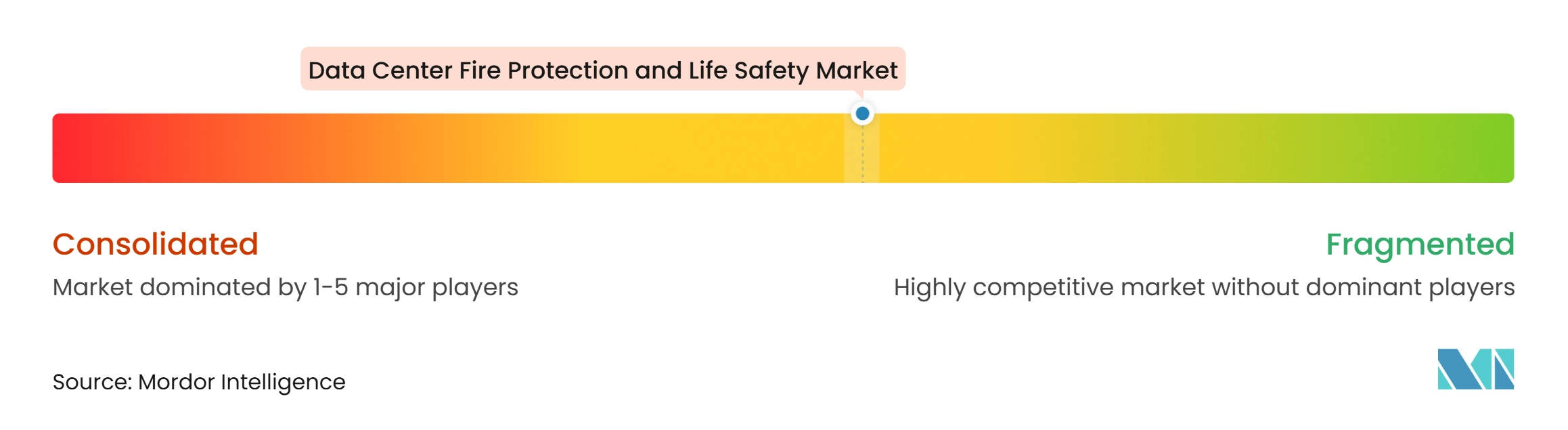
The data center fire protection and life safety market is moderately concentrated. Johnson Controls, Honeywell, Siemens, Robert Bosch, Eaton, ORR Protection Systems, and Minimax Viking collectively accounted for 35% of global revenue in the supplied data. The remaining revenue is shared by specialist regional providers and system integrators. Global firms compete on broad portfolios, certifications, and service reach, while specialists compete through detection, water mist, clean agents, inert gas, and commissioning expertise. Commodity hardware faces pricing pressure, but integrated controls and service contracts can strengthen customer retention.
Siemens also introduced Acend Intelligent, ASD+, and Fire Digital Twin at the 2026 NFPA Conference and Expo. Johnson Controls launched Simplex Incident Manager and Autocall Fire Site Administrator in August 2026, with each workstation supporting up to 250,000 devices and 687 fire alarm control units. These moves combine physical protection with digital monitoring, extending the data center fire protection and life safety market beyond equipment-only supply. Digital tools can also reduce commissioning errors and false-discharge risk in complex facilities.
Battery room protection remains fragmented because off-gas detection, thermal monitoring, ventilation coordination, emergency power-off, and suppression are often separate components. An integrated, certified offer could differentiate suppliers as lithium-ion UPS systems become more common. Peer-reviewed testing indicated that passive cooling-suppression technology can operate rapidly without relying on facility power continuity. Large suppliers remain well positioned for campus projects, while specialists can win retrofit and technology-specific work in the data center fire protection and life safety market.
Data Center Fire Protection and Life Safety Industry Leaders
-
Johnson Controls International plc
-
Honeywell International Inc.
-
Siemens AG
-
Robert Bosch GmbH
-
Eaton Corporation plc
- *Disclaimer: Major Players sorted in no particular order
Data Center Fire Protection and Life Safety Market Companies Covered in this Report
- Johnson Controls International plc
- Honeywell International Inc.
- Siemens AG
- Robert Bosch GmbH
- Eaton Corporation plc
- Carrier Global Corporation
- Kidde Global Solutions
- Fike Corporation
- Minimax Viking GmbH
- ORR Protection Systems, LLC
- WAGNER Group GmbH
- Hochiki Corporation
- Nohmi Bosai Ltd.
- Victaulic Company
- Marioff Corporation Oy
- The Chemours Company
- SEVO Systems, Inc.
- Securiton AG
- NAFFCO FZCO
- The Hiller Companies, LLC
Recent Industry Developments in Data Center Fire Protection and Life Safety Market
- August 2026: Johnson Controls launched the Simplex Incident Manager and Autocall Fire Site Administrator, its next-generation fire and life safety networking workstations, supporting up to 250,000 connected devices and 687 fire alarm control units per system, 2.5 times more than leading alternatives. The platforms integrate ISA/IEC 62443-aligned software for cybersecurity-resilient building safety operations and are UL, ULC, FM Approved, CSFM Listed, and accepted by New York City’s Material Equipment Acceptance.
- August 2026: Chemours launched Opteon ZE, R-1234ze(E), and Opteon 515B, R-515B, 2 low-global-warming-potential refrigerants engineered for stationary chiller applications in AI data centers ahead of the US EPA’s January 2027 GWP-700 restriction on data center cooling equipment.
- June 2026: Siemens introduced Acend Intelligent, an addressable notification appliance with cloud connectivity and Disturbance-Free Testing technology, alongside ASD+ aspirating smoke detection and Fire Digital Twin at the NFPA Conference and Expo 2026 in Las Vegas.
- March 2026: Siemens unveiled the Sinteso Nova and Cerberus Nova fire detector portfolio, with cloud-based 24/7 self-checks, Smoke Entry Supervision, and ASAplus multi-wavelength optical and dual thermal detection to reduce false alarms.
Global Data Center Fire Protection and Life Safety Market Report Scope
The Data Center Fire Protection and Life Safety Market comprises the technologies, systems, software, and services designed to detect, prevent, suppress, monitor, and manage fire-related incidents while ensuring personnel safety and business continuity within data center environments.
The Data Center Fire Protection and Life Safety Market Report is Segmented by Solution Type (Fire Detection and Alarm Systems, Fire Suppression Systems, Emergency Notification and Evacuation Systems, Fire Monitoring and Control Systems, and Inspection, Testing, and Maintenance Services), Fire Protection Technology (Smoke and Heat Detection, Aspirating Smoke Detection, Clean Agent Suppression, Inert Gas Suppression, Water-Based Suppression, and Other Fire Protection Technologies), Facility Area (Data Halls and IT Rooms, Electrical and UPS Rooms, Battery Rooms, Cooling and Mechanical Rooms, and Administrative and Support Areas), Data Center Size (Small, Medium, Large, and Hyperscale), Data Center Type (Colocation, Cloud Service Providers, and Enterprise and Edge), and Geography (North America [United States, Canada, and Mexico], South America [Brazil, Argentina, and Rest of South America], Europe [United Kingdom, Germany, France, Spain, Russia, and Rest of Europe], Asia-Pacific [China, India, Japan, Australia, Singapore, and Rest of Asia-Pacific], and Middle East and Africa [Saudi Arabia, United Arab Emirates, South Africa, and Rest of Middle East and Africa]). The Market Forecasts are Provided in Terms of Value (USD).
Segmentation Overview
| Fire Detection and Alarm Systems |
| Fire Suppression Systems |
| Emergency Notification and Evacuation Systems |
| Fire Monitoring and Control Systems |
| Inspection, Testing, and Maintenance Services |
| Smoke and Heat Detection |
| Aspirating Smoke Detection |
| Clean Agent Suppression |
| Inert Gas Suppression |
| Water-Based Suppression |
| Other Fire Protection Technologies |
| Data Halls and IT Rooms |
| Electrical and UPS Rooms |
| Battery Rooms |
| Cooling and Mechanical Rooms |
| Administrative and Support Areas |
| Small |
| Medium |
| Large |
| Hyperscale |
| Colocation |
| Cloud Service Providers |
| Enterprise and Edge |
| North America | United States |
| Canada | |
| Mexico | |
| South America | Brazil |
| Argentina | |
| Rest of South America | |
| Europe | United Kingdom |
| Germany | |
| France | |
| Spain | |
| Russia | |
| Rest of Europe | |
| Asia-Pacific | China |
| India | |
| Japan | |
| Australia | |
| Singapore | |
| Rest of Asia-Pacific | |
| Middle East and Africa | Saudi Arabia |
| United Arab Emirates | |
| South Africa | |
| Rest of Middle East and Africa |
| By Solution Type | Fire Detection and Alarm Systems | |
| Fire Suppression Systems | ||
| Emergency Notification and Evacuation Systems | ||
| Fire Monitoring and Control Systems | ||
| Inspection, Testing, and Maintenance Services | ||
| By Fire Protection Technology | Smoke and Heat Detection | |
| Aspirating Smoke Detection | ||
| Clean Agent Suppression | ||
| Inert Gas Suppression | ||
| Water-Based Suppression | ||
| Other Fire Protection Technologies | ||
| By Facility Area | Data Halls and IT Rooms | |
| Electrical and UPS Rooms | ||
| Battery Rooms | ||
| Cooling and Mechanical Rooms | ||
| Administrative and Support Areas | ||
| By Data Center Size | Small | |
| Medium | ||
| Large | ||
| Hyperscale | ||
| By Data Center Type | Colocation | |
| Cloud Service Providers | ||
| Enterprise and Edge | ||
| By Geography | North America | United States |
| Canada | ||
| Mexico | ||
| South America | Brazil | |
| Argentina | ||
| Rest of South America | ||
| Europe | United Kingdom | |
| Germany | ||
| France | ||
| Spain | ||
| Russia | ||
| Rest of Europe | ||
| Asia-Pacific | China | |
| India | ||
| Japan | ||
| Australia | ||
| Singapore | ||
| Rest of Asia-Pacific | ||
| Middle East and Africa | Saudi Arabia | |
| United Arab Emirates | ||
| South Africa | ||
| Rest of Middle East and Africa | ||
Key Questions Answered in the Report
What is the size of the data center fire protection and life safety market?
The market is valued at USD 3.42 billion in 2026 and is forecast to reach USD 5.66 billion by 2032, with a 10.61% CAGR from 2027 to 2032.
Which solution segment leads spending on data center fire protection?
Fire Suppression Systems lead solution spending with a 34.52% share in 2026, while Fire Monitoring and Control Systems have the fastest projected expansion at an 11.81% CAGR.
Why are battery rooms important in data center safety planning?
Battery Rooms are projected to expand at an 11.92% CAGR through 2032 because lithium-ion UPS systems require specialized detection, ventilation, suppression, and emergency controls.
Which fire protection technology is expanding fastest in data centers?
Water-Based Suppression is projected to expand at an 11.76% CAGR through 2032 as buyers consider pre-action and water mist designs alongside clean-agent systems.
Which region has the largest data center fire protection demand?
North America holds 38.89% of revenue in 2026, supported by high concentrations of hyperscale and colocation capacity and established compliance requirements.
Which region is projected to expand fastest through 2032?
Asia-Pacific is projected to expand at an 11.83% CAGR through 2032, supported by new construction and developing safety requirements in major capacity markets.