
Data Center Energy Storage and Microgrids Market Size and Share
Market Overview
| Study Period | 2021 - 2032 |
|---|---|
| Market Size (2027) | USD 7.52 Billion |
| Market Size (2032) | USD 17.18 Billion |
| Growth Rate (2027 - 2032) | 17.97 % |
| Fastest Growing Market | Asia-Pacific |
| Largest Market | North America |
| Market Concentration | Low |
Major Players *Disclaimer: Major Players sorted in no particular order Image © Mordor Intelligence. Reuse requires attribution under CC BY 4.0. | |
Data Center Energy Storage and Microgrids Market Analysis by Mordor Intelligence
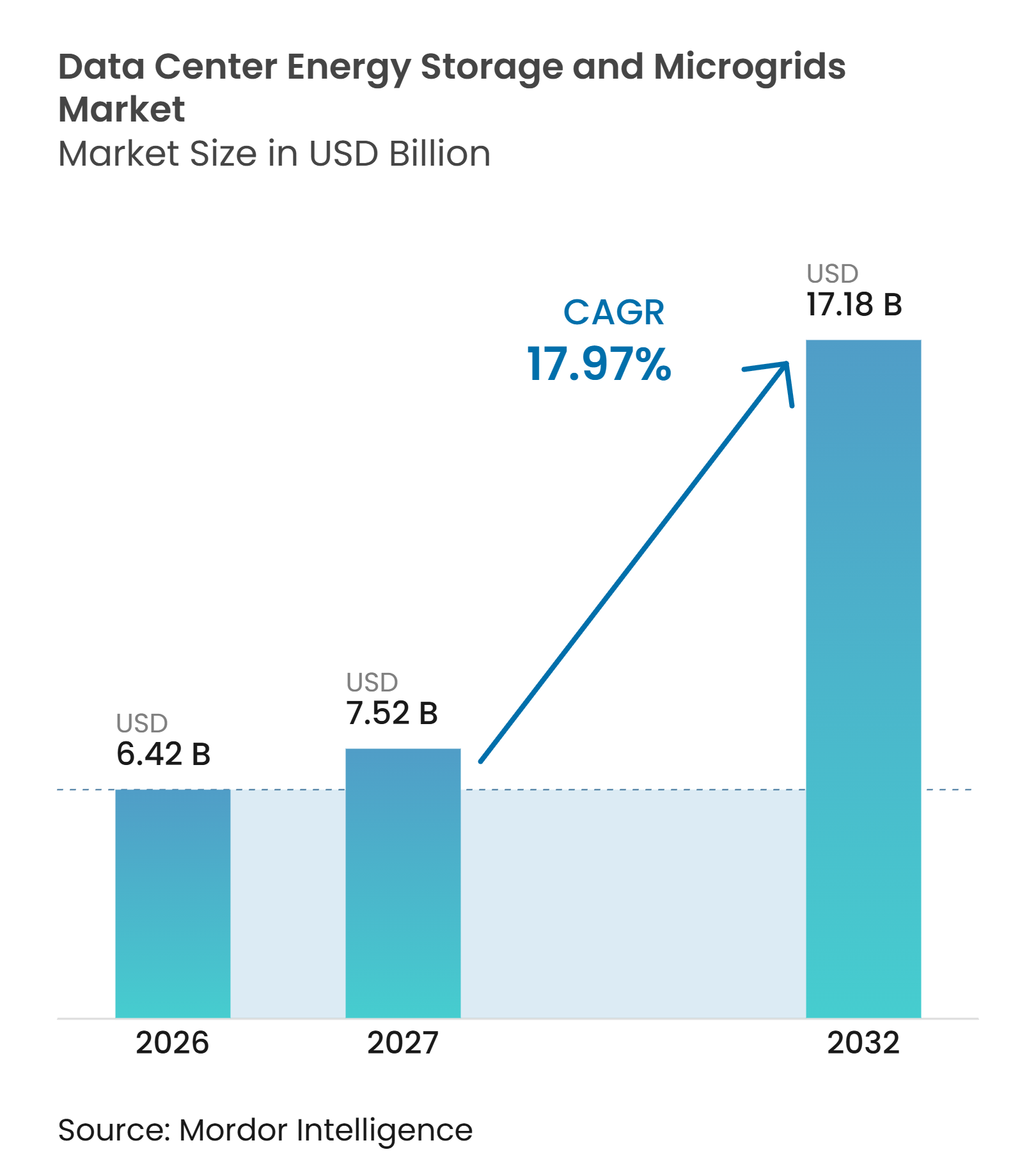
The data center energy storage and microgrids market size is projected to expand from USD 6.42 billion in 2026 to USD 7.52 billion in 2027, and to USD 17.18 billion by 2032, registering a CAGR of 17.97% between 2027 and 2032. Long grid connection timelines are moving on-site power systems from a contingency role into core campus infrastructure. Artificial intelligence workloads are also changing the power profile of data centers because GPU clusters can move from low demand to full demand in milliseconds. This makes energy storage, flexible generation, and controls more important for maintaining stable power quality. The data center energy storage and microgrids market is seeing growth as operators need capacity before a utility connection is available. Competition is increasingly centered on integrated delivery models that combine generation, storage, electrical equipment, and operating controls.
Key Report Takeaways
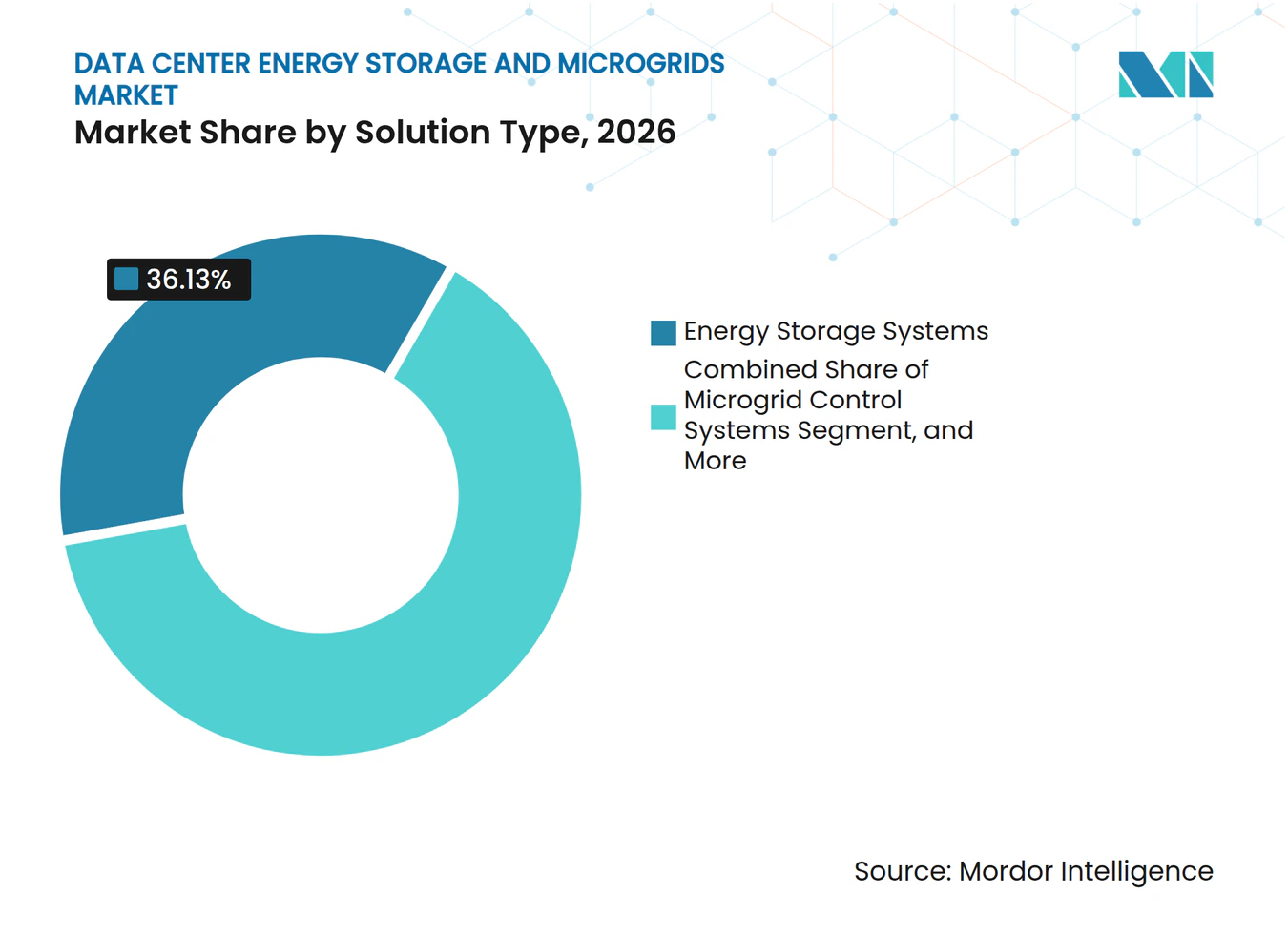
- By solution type, energy storage systems held 36.13% of the data center energy storage and microgrids market share in 2026, while microgrid control systems are projected to expand at an 18.97% CAGR through 2032.
- By storage technology, lithium-ion batteries held 62.32% of revenue in 2026, while flow batteries are projected to expand at an 18.94% CAGR through 2032.
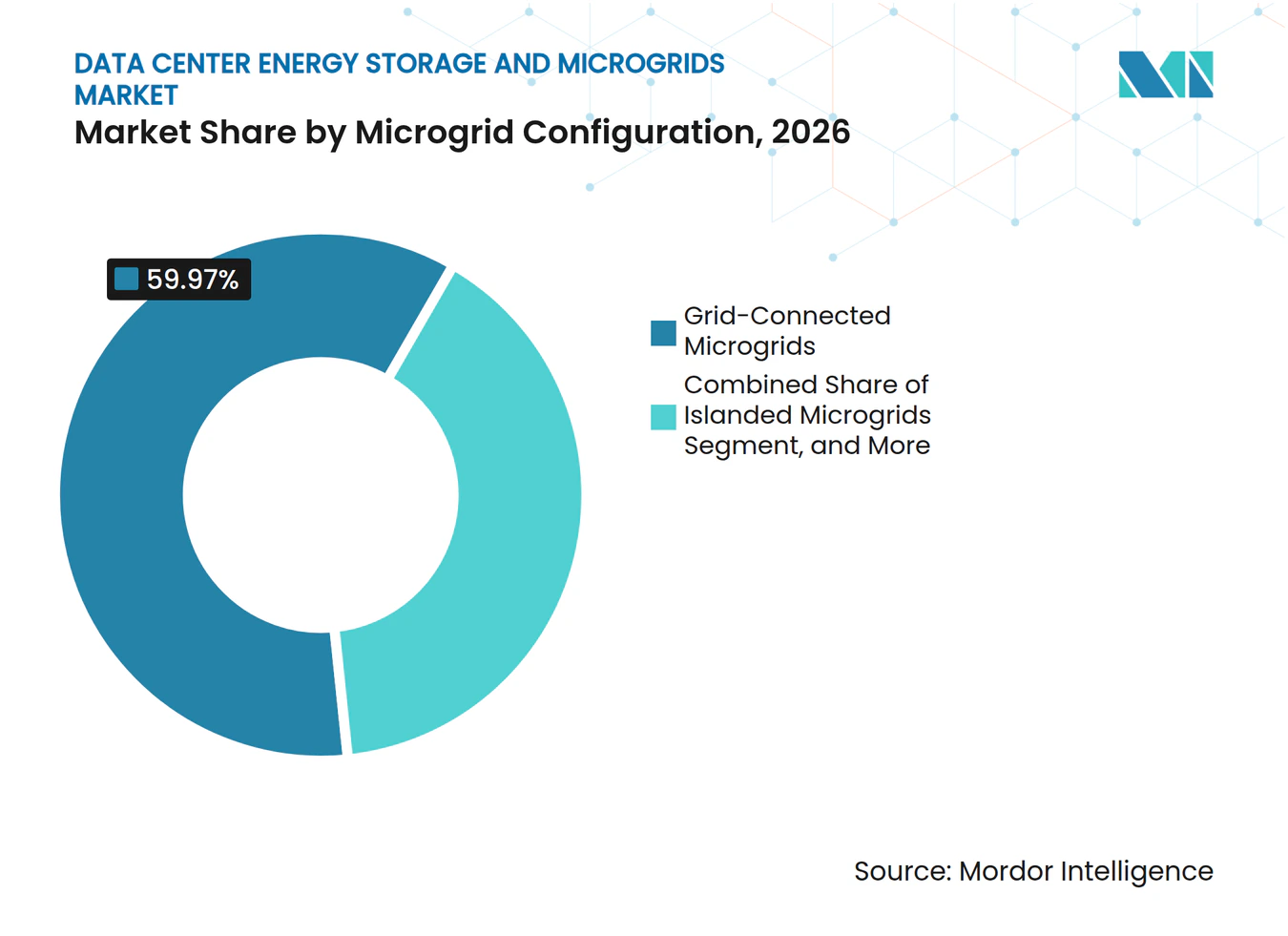
- By microgrid configuration, grid-connected microgrids accounted for 59.97% of revenue in 2026, while hybrid grid-connected and islandable microgrids are projected to expand at an 18.56% CAGR through 2032.
- By primary energy source, grid electricity held 45.01% of the data center energy storage and microgrids market revenue in 2026, while solar power is projected to expand at a 19.18% CAGR through 2032.
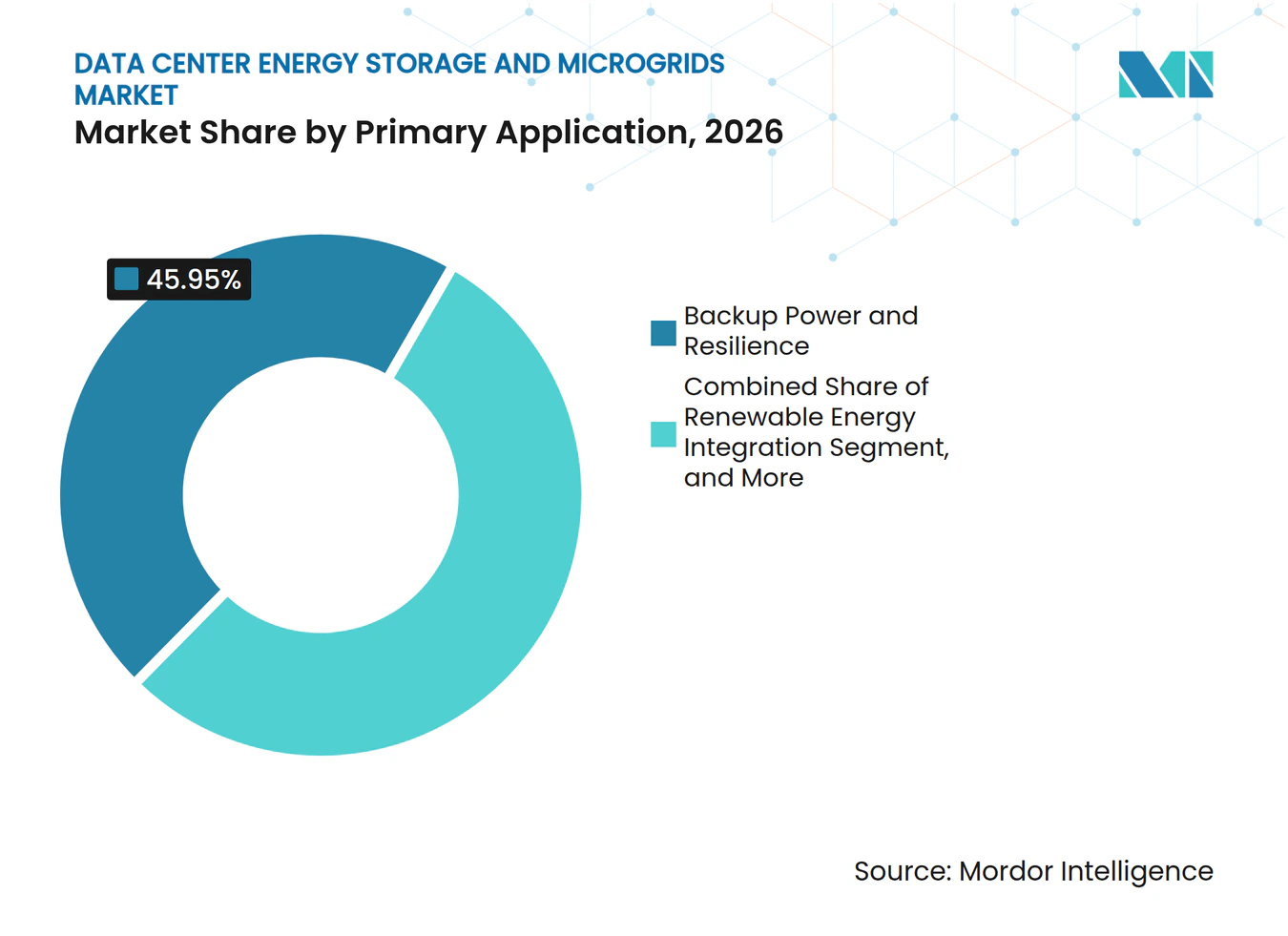
- By primary application, backup power and resilience accounted for 45.95% of revenue in 2026, while grid services are projected to expand at an 18.89% CAGR through 2032.
- By data center size, hyperscale facilities accounted for 38.94% of revenue in 2026 and are projected to grow at an 18.68% CAGR through 2032.
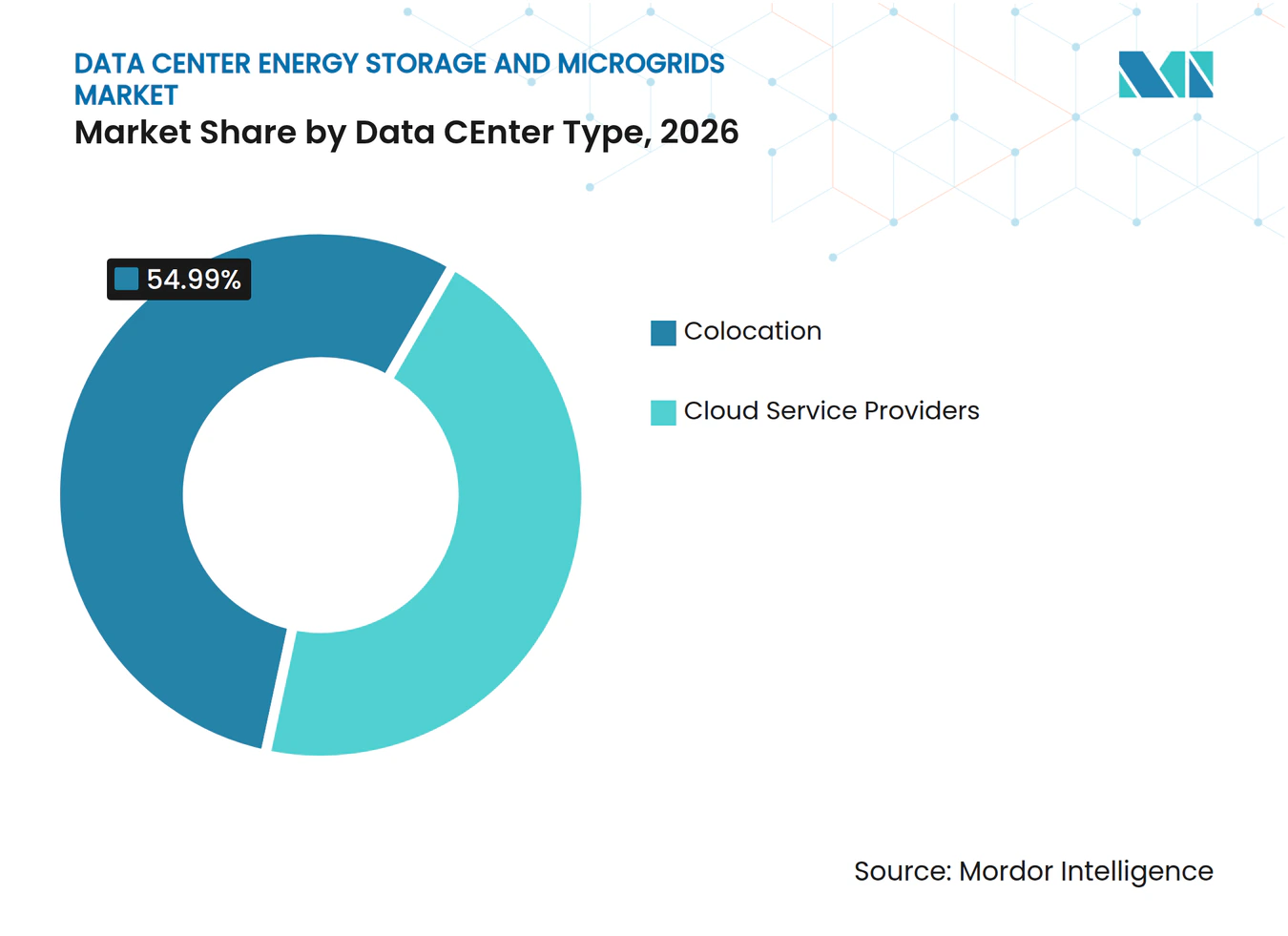
- By data center type, cloud service providers accounted for 45.01% of the data center energy storage and microgrids market revenue in 2026 and are projected to grow at an 18.72% CAGR through 2032.
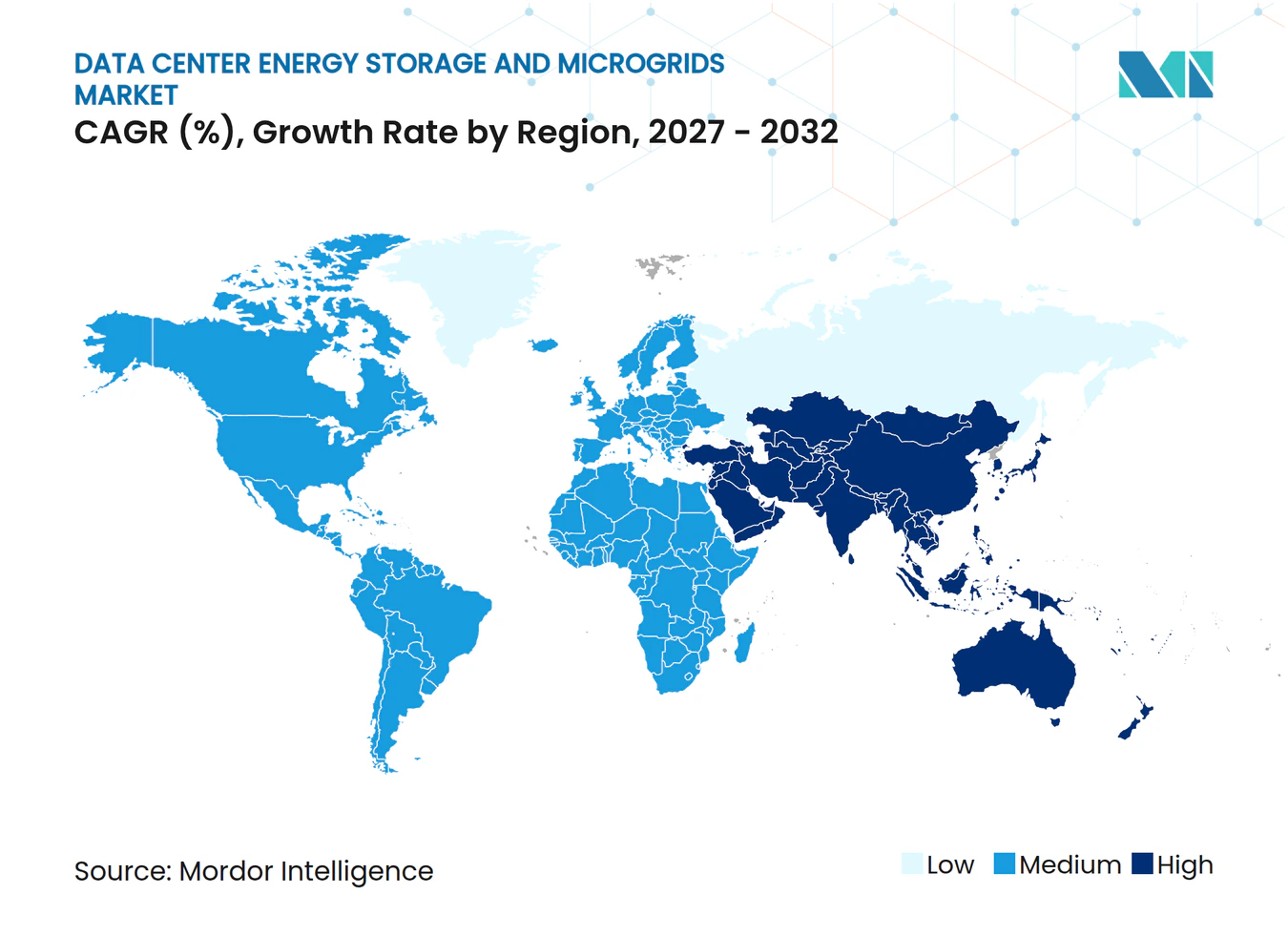
- By geography, North America held 45.19% of revenue in 2026, while Asia-Pacific is projected to expand at an 18.92% CAGR through 2032.
Note: Market numbers in this report are based on Mordor Intelligence's proprietary estimation framework, which combines nine months of actuals with Q4 projections for base year 2026.
Market Trends and Insights
Drivers Impact Analysis of Data Center Energy Storage and Microgrids Market*
| Driver | (~) % Impact on CAGR Forecast | Geographic Relevance | Impact Timeline |
|---|---|---|---|
| Growing Need for Power Resilience and Continuity | +5.2% | Global | Short term (≤ 2 years) |
| Increasing AI-Related Load Variability and Peak Demand | +4.8% | Global, North America and Asia-Pacific as primary epicenters | Short term (≤ 2 years) |
| Integration of Battery Storage With On-Site Generation | +3.3% | North America and Europe, spillover to Asia-Pacific | Medium term (2-4 years) |
| Demand for Peak Shaving and Electricity Cost Optimization | +2.4% | North America and Europe | Medium term (2-4 years) |
| Integration of Renewable Power With Data Center Operations | +2.1% | Europe and Asia-Pacific core, spillover to North America | Medium term (2-4 years) |
| Advances in Microgrid Controls and Energy Management Software | +1.6% | Global | Long term (≥ 4 years) |
| Source: Mordor Intelligence | |||
Growing Need for Power Resilience and Continuity
Data center operators are facing power access constraints that have made storage and local generation essential infrastructure. EY documented a 48 MW Santa Clara project that remained unoccupied in late 2025 while awaiting a USD 450 million utility upgrade scheduled for 2028. The same evidence showed that data center construction can take 12 to 24 months, while grid work can take considerably longer. This timing gap increases the appeal of on-site systems that can support operations before a full grid connection is completed. Pure Data Centers Group placed a 110 MW microgrid into service in Dublin during March 2026, using battery storage and dual-fuel Wärtsilä engines to provide primary power. The project shows why the data center energy storage and microgrids market is becoming relevant to campus development decisions rather than only resilience planning.
Increasing AI-Related Load Variability and Peak Demand
AI training creates rapid changes in electricity demand that conventional backup architectures were not designed to manage. A 2026 review found that AI data center loads can vary sharply at short intervals, requiring storage technologies and controls that can respond quickly. Microsoft research published in 2025 also found that synchronized load swings can interact with grid frequencies and affect power infrastructure. A Phoenix demonstration involving a 256-GPU Oracle cluster reduced power consumption by 25% for 3 hours during a peak event while maintaining computing performance. The result supports a model in which storage and intelligent workload scheduling work together. In the data center energy storage and microgrids market, control capability is therefore becoming as important as installed battery capacity.
Integration of Battery Storage With On-Site Generation
Battery storage is increasingly being deployed with on-site generation instead of being installed only as a standalone UPS asset. Eaton and Siemens Energy announced an approach in June 2025 that combines modular construction with 500-MW gas-turbine power plants, batteries, and optional renewable-grid connections. Wärtsilä reported data center-related engine orders totaling 1.2 GW in the United States across 2025 and early 2026. These systems are designed to operate alongside storage and renewable assets as part of an integrated power design. This structure can give operators dispatchable capacity during grid outages and flexibility after interconnection. It also creates a broader addressable market for data center energy storage and microgrids during initial campus commissioning.
Demand for Peak Shaving and Electricity Cost Optimization
Peak shaving can link the resilience case for storage to lower operating costs and potential grid service revenue. ABB stated that its 34.5 kV HiPerGuard UPS operates at 98% efficiency and estimated that each 1% efficiency gain can save USD 880,000 a year for a 100 MW AI data center. The National Renewable Energy Laboratory tested a 70 MW grid-interactive data center platform that responded to utility signals within 10 seconds without disrupting IT workloads.[1] Federal rules allow eligible storage resources to participate in capacity, energy, and ancillary-service markets. Operators can therefore use a single storage asset for backup, peak-demand reduction, and selected grid services. This layered use case strengthens the data center energy storage and microgrids market, where tariff exposure and interconnection limits are material.
Restraints Impact Analysis of Data Center Energy Storage and Microgrids Market*
| Restraints | (~) % Impact on CAGR Forecast | Geographic Relevance | Impact Timeline |
|---|---|---|---|
| High Capital Costs of Storage and Microgrid Deployment | -1.8% | Global | Short term (≤ 2 years) |
| Complex Integration With Existing Electrical Infrastructure | -1.4% | North America and Europe | Short term (≤ 2 years) |
| Uncertain Project Economics and Payback Periods | -1.2% | Global | Medium term (2-4 years) |
| Grid Interconnection and Electricity Export Restrictions | -1.0% | North America and Europe | Medium term (2-4 years) |
| Source: Mordor Intelligence | |||
High Capital Costs of Storage and Microgrid Deployment
Capital cost remains a constraint, especially for operators that cannot spread infrastructure spending across a large IT footprint. Senate testimony from DataBank described battery energy storage costs as high and cited physical footprint and community acceptance as further constraints.[2] Storage systems can require more upfront capital per kilowatt than conventional gas or diesel generation. This makes project economics sensitive to the value assigned to uptime, avoided peak demand, and future grid services. Standardized design guidance can reduce engineering variation, but its benefits will take time to reach installed-cost levels. The data center energy storage and microgrids market will therefore favor projects in which multiple revenue or operating benefits can be captured from the same asset.
Complex Integration With Existing Electrical Infrastructure
Integrating storage and microgrids into existing electrical infrastructure can add design work and project risk. ABB stated that conventional low-voltage UPS designs may not meet the needs of AI campuses and described architectures operating from 4.16 kV to 34.5 kV. These architectures must coordinate power conversion, protection, grid codes, generation, and data center loads. Different proprietary specifications can also complicate engineering reviews and procurement. Safety requirements remain important because NFPA 855 covers installation factors such as ventilation, fire suppression, and explosion control for stationary storage systems. This complexity can delay projects even where demand for the data center energy storage and microgrids market is strong.
*Our forecasts treat driver/restraint impacts as directional, not additive. The impact forecasts reflect baseline growth, mix effects, and variable interactions.
Data Center Energy Storage and Microgrids Market Segment Analysis
By Solution Type:
Storage Systems Anchor Revenue While Controls Gain ImportanceEnergy storage systems accounted for 36.13% of revenue in the data center energy storage and microgrids market in 2026. Battery installations support both traditional UPS needs and wider campus-level power strategies. Lithium-ion UPS units and containerized battery energy storage systems are common starting points for this deployment. Integrated microgrids and distributed generation systems become more relevant as operators need more than short-duration backup. Power conversion equipment remains essential for medium-voltage integration and protection. It is often purchased as part of a broader electrical infrastructure package rather than as a standalone power strategy. This arrangement places storage at the center of most solution architectures. It also makes equipment compatibility a practical procurement consideration.
Microgrid control systems are projected to expand at an 18.97% CAGR through 2032. The category gains importance when operators move from isolated equipment to coordinated storage, generation, and load management. The US Department of Energy identifies AI and machine-learning-enabled energy management as a priority for microgrid research and development. IEEE 2030.7-compliant controller design is also part of this development path. Controls can help a site select when to charge batteries, use local generation, respond to grid signals, or manage demand. This creates a need for systems that coordinate operating decisions in real time. Consequently, the data center energy storage and microgrids industry places more value on integration skills than on individual components alone.



By Storage Technology:
Lithium-Ion Leads While Flow Batteries Address Cycling NeedsLithium-ion batteries held 62.32% of the data center energy storage and microgrids market revenue share in 2026. Established supply chains and strong performance in sub-4-hour applications support their use in backup and peak-shaving systems. ZincFive reported that more than half of the surveyed facilities use lithium batteries for centralized UPS energy storage. Lead-acid batteries remain relevant in legacy retrofit installations. Flywheel systems also serve applications that require immediate ride-through support. Each technology has a distinct role based on discharge duration, response time, safety requirements, and maintenance needs. The installed base still favors lithium-ion systems for their maturity and availability.
Flow batteries are projected to expand at an 18.94% CAGR through 2032. They are suited to operating patterns that require repeated cycling over long periods. A scientific review of storage for AI data centers identified the need to match technology characteristics to fast-changing computing loads. This is relevant where operators expect frequent charging and discharging rather than occasional emergency use. Flow battery designs can separate energy storage capacity from power output through their external electrolyte tanks. That configuration can be attractive where asset life and longer duration are important. Safety and installation decisions must still comply with applicable standards, such as UL 9540 and NFPA 855. The data center energy storage and microgrids market will therefore use multiple storage chemistries rather than relying on a single design.
By Microgrid Configuration:
Grid-Connected Systems Lead While Hybrid Systems AdvanceGrid-connected microgrids accounted for 59.97% of data center energy storage and microgrids market revenue in 2026. Most established campuses still use the grid as their primary source of electricity. On-site equipment supplements the grid during disturbances, peak periods, or demand-response events. This configuration can reduce costs without requiring a complete separation from utility service. It also allows storage to support localized power-quality needs. Grid-connected systems are familiar to operators with existing campuses. Their installed base explains their leading revenue position. Their future role will depend on interconnection rules and the value of grid-facing services.
Hybrid grid-connected and islandable microgrids are projected to expand at an 18.56% CAGR through 2032. These systems can remain connected under normal conditions and shift to islanded operation when the grid is unavailable. The National Renewable Energy Laboratory demonstrated uninterrupted islanding and rapid load curtailment through its Verrus platform. This capability is useful for operators who require high IT availability during grid disturbances. Research also identified lithium iron phosphate batteries paired with supercapacitors or flywheels as options for responding across multiple time scales. Hybrid designs demand more capable controls and protection systems than conventional backup arrangements. They represent a technically demanding part of the data center energy storage and microgrids market.

By Primary Energy Source:
Solar Power Changes Campus Power PlanningGrid electricity accounted for 45.01% of data center energy storage and microgrids market revenue by primary energy source in 2026. Utility power remains the main supply for most operating data centers because it supports continuous, large-scale demand. Natural gas has gained attention as an on-site option where grid connections are delayed. Fuel cells are also emerging as a local power source that can be deployed before some grid upgrades are completed. These alternatives can supplement the utility supply rather than completely replace it. The appropriate mix depends on local fuel availability, emissions requirements, land availability, and utility rules. This gives developers several pathways for building resilient campuses. It also increases the need to integrate varied sources through a common operating system.
Solar power is projected to expand at a 19.18% CAGR through 2032. The Solar Energy Industries Association reported that 48% of utility-scale storage capacity installed in the first quarter of 2026 was co-located with solar generation. Meta and Enbridge announced a 365 MW solar project paired with 200 MW of battery storage and 1.6 GWh of Tesla Energy batteries near Cheyenne, Wyoming. The project targeted 8 hours of discharge at maximum power. Solar-plus-storage systems can support renewable procurement goals while improving the ability to manage variable production. They also affect site selection because land, generation potential, and transmission access must be considered together. These factors support the data center energy storage and microgrids market in regions with suitable solar resources.
By Primary Application:
Backup Power Leads While Grid Services ExpandBackup power and resilience accounted for 45.95% of the data center energy storage and microgrids market revenue in 2026. This application remains the first requirement for operators that need continuous service during outages or grid-quality events. Storage can provide immediate response while on-site generation starts or while workloads are stabilized. The same asset can also support peak shaving and the integration of renewables. This allows operators to derive greater value from an investment once designed solely for emergency use. Reliability requirements continue to shape equipment selection and site architecture. The leading position of backup power reflects the importance of protecting IT operations. It also provides the foundation for more advanced applications.
Grid services are projected to expand at an 18.89% CAGR through 2032. FERC Order 841 requires regional transmission organizations and independent system operators to allow eligible electric storage resources to participate in capacity, energy, and ancillary-service markets. The National Renewable Energy Laboratory found that grid-responsive operation can occur without disrupting core IT functions in a tested platform. These capabilities can allow a storage asset to serve the data center and provide selected services to the grid. Project economics improve when uptime protection and grid value can be combined. Participation still depends on local market rules and interconnection arrangements. This application makes the data center energy storage and microgrids market more closely linked to electricity-market design.
By Data Center Size:
Hyperscale Facilities Set the Investment PaceHyperscale facilities accounted for 38.94% of the data center energy storage and microgrids market revenue in 2026. Their large power requirements and financial capacity support investment in extensive microgrid designs. ABB noted that facilities above 200 MW are becoming common and require more capable electrical architectures. AI workloads add stringent needs for response speed, ride-through performance, and grid-forming capability. These needs are harder to meet through passive UPS equipment alone. Large campuses can also capture more savings from peak shaving and equipment efficiency. As a result, hyperscale projects are influential reference cases for system vendors. They are defining many technical expectations in the data center energy storage and microgrids market.
Hyperscale facilities are also projected to expand at an 18.68% CAGR through 2032. Their size can justify dedicated generation, battery storage, and controls that may be less economical at smaller facilities. Small and medium data centers remain meaningful in aggregate volume. Their investment is more likely to focus on standardized UPS replacement and modular storage. Bloom Energy reported that 73% of surveyed data center decision-makers are incorporating on-site power into long-term strategies. Generator suppliers are adjusting to this shift through purpose-built product offerings. The market is therefore broadening beyond the largest campuses, even though deployment depth varies by facility scale.
By Data Center Type:
Cloud Providers Lead and Colocation Providers FollowCloud service providers held 45.01% of the data center energy storage and microgrids market revenue share in 2026. They operate a large share of the AI training capacity that delivers high power density and demands high load behavior. Their scale also supports investment in campus-level energy infrastructure. Google has signed more than 50 renewable power purchase agreements globally and has advanced hourly carbon-free energy arrangements. Such procurement approaches require closer coordination between renewable supply, storage, and operating loads. Cloud providers are, therefore, important users of advanced microgrid controls. Their decisions can influence equipment design and contract models across the wider sector.
Cloud service providers are also projected to expand at an 18.72% CAGR through 2032. Colocation providers hold the next-largest share and are responding to tenants' expectations for resilient, lower-carbon power. Enterprise and edge facilities have different requirements because their smaller scale can limit the economics of full microgrids. Geographic distribution can still create demand for hybrid or islanded solutions where local grids are less reliable. The Open Compute Project described rack-level, facility-level, and microgrid-and-edge models for energy storage deployment. This framework can help bring more consistency to procurement across data center types. It also gives the data center energy storage and microgrids industry a common language for matching equipment to site conditions.
Geography Analysis
North America held 45.19% of the data center energy storage and microgrids market revenue share in 2026. The region combines a dense hyperscale base with significant pressure on electricity interconnection capacity. The Solar Energy Industries Association reported 9.7 GWh of US battery storage installations in the first quarter of 2026, 32% higher than the prior year. FERC opened a proceeding on large-load interconnection rules in June 2026. It also directed NERC in July 2026 to develop reliability standards for computational loads.[3] These actions may widen the role of storage-equipped sites in grid planning and operations. Canada and Mexico add opportunities as capacity development moves beyond congested US locations.
Europe is the second-largest regional market, and power access has become a central site-development issue. A Wärtsilä and AVK study described microgrids as a source of dispatchable flexibility that can support data center development and the wider energy transition. The 110 MW Dublin system operated by Pure Data Centers Group provides a practical example of local generation and storage being used before a conventional grid solution is available. Storage can also help operators manage demand during periods of system stress. European projects must account for varied market rules, emissions requirements, and local planning conditions. Those conditions can favor flexible, site-specific power strategies. The data center energy storage and microgrids market has a clear role where utilities cannot provide new capacity on project schedules.
Asia-Pacific is projected to expand at an 18.92% CAGR through 2032. Research in ACS Energy and Fuels examined the rising energy requirements of data centers in the region and their implications for power-system planning. Malaysia, Australia, Singapore, and Japan are among the countries where data center development is increasing the importance of power availability. Operators in the region must address both capacity growth and varied grid reliability. On-site storage can help manage peaks and provide a bridge where electricity connections are constrained. South America remains centered on Brazil's São Paulo corridor, with activity also emerging in Chile and Colombia. The Middle East and Africa are developing hyperscale-ready power infrastructure as part of state-backed digital strategies, with activity in Saudi Arabia and the UAE.
Competitive Landscape
Market Concentration
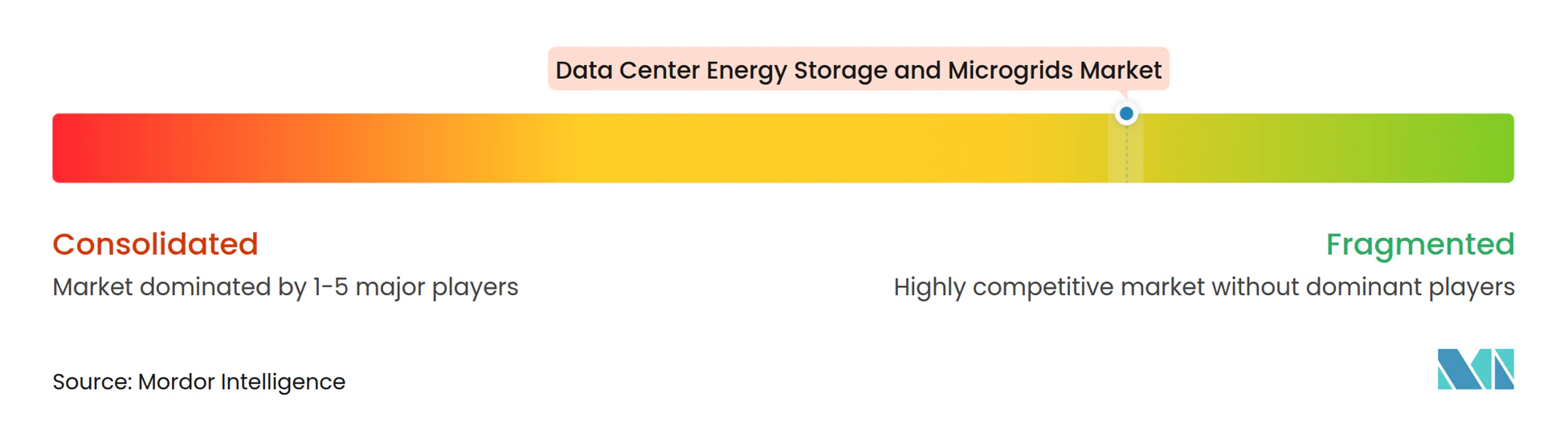
The data center energy storage and microgrids market is fragmented, bringing together established electrical infrastructure vendors, storage specialists, and flexible power providers. Schneider Electric, Siemens, ABB, Eaton, and Hitachi Energy hold important positions through electrical distribution, UPS equipment, and controls. ABB's HiPerGuard platform operates from 4.16 kV to 34.5 kV and supports applications that require grid-forming capability. ABB also announced a collaboration with NVIDIA in October 2025 on 800 VDC architecture for 1 MW server racks. These moves show how equipment suppliers are adapting their portfolios to the rising power density of AI facilities. Incumbents benefit from installed relationships and broad electrical product ranges. They also face pressure to provide faster and more integrated delivery.
Fluence, Tesla Energy, and Sungrow compete in the dedicated battery energy storage market. Wärtsilä, Bloom Energy, Caterpillar, Cummins, and Generac provide on-site power technologies that can be combined with storage. Wärtsilä reported 1.2 GW of US data center engine orders across 2025 and early 2026, which indicates the scale of demand for flexible generation. Eaton and Siemens Energy announced their 500 MW modular power offering in June 2025. Schneider Electric, Wärtsilä, and Stanley Consultants then introduced a coordinated Generator-to-Chip approach in September 2026. Such alliances reduce handoffs across generations, electrical design, automation, and engineering. They also raise the importance of system-level execution.
The competitive white space lies in integrating storage chemistry, generation assets, controls, and energy management software. Few suppliers can manage the full operating relationship between those systems without relying on several partners. This leaves room for vendors with proven controls, engineering depth, and delivery capability. The data center energy storage and microgrids industry is moderately concentrated because large electrical vendors have established positions, but it is becoming more fragmented as specialists enter specific layers. Standards are important because they can reduce the costs and risks associated with proprietary specifications. The National Electrical Manufacturers Association issued voluntary guidance for data center energy storage and microgrids in early 2026. Common design approaches can make procurement easier while preserving the need for site-specific engineering. Competition will remain focused on dependable delivery, safety, power quality, and control integration.
Data Center Energy Storage and Microgrids Industry Leaders
-
Schneider Electric SE
-
Siemens AG
-
ABB Ltd
-
Eaton Corporation plc
-
Vertiv Holdings Co
- *Disclaimer: Major Players sorted in no particular order
Data Center Energy Storage and Microgrids Market Companies Covered in this Report
- Schneider Electric
- Siemens
- ABB
- Eaton
- Hitachi Energy
- Honeywell
- Vertiv
- Delta Electronics
- Fluence
- Wärtsilä
- Tesla Energy
- Sungrow
- Huawei Digital Power
- Caterpillar
- Cummins
- Generac
- Bloom Energy
- Piller Power Systems
- Socomec
- Enchanted Rock
Recent Industry Developments in Data Center Energy Storage and Microgrids Market
- September 2026: Schneider Electric, Wärtsilä, and Stanley Consultants launched a “Generator-to-Chip” coordinated approach for US data center developers, aligning on-site generation, electrical architecture, automation, and engineering from a single delivery model to reduce handoffs and accelerate time-to-power versus traditional sequential contracting.
- July 2026: FERC directed NERC to develop new reliability standards for integrating computational loads, including AI data centers, into the grid, following FERC's June 2026 proceeding on large-load interconnection rules, establishing a compliance framework expected to expand grid service revenue for storage-equipped data center microgrids.
- June 2026: Liberty Energy's subsidiary signed an equipment supply contract with Wärtsilä North America valued at USD 332.6 million for power generation equipment to support data center and distributed power projects, with delivery milestones from 2029 through 2030, per SEC Form 8-K filed June 22, 2026.
- May 2026: Meta and Enbridge announced 365 MW of solar co-located with 200 MW/1.6 GWh of Tesla Energy batteries near Cheyenne, Wyoming, targeting 8 hours of discharge at maximum power, more than twice the current US average storage duration, per SEIA data.
Global Data Center Energy Storage and Microgrids Market Report Scope
The Data Center Energy Storage and Microgrids Market encompasses energy storage systems, microgrid control technologies, distributed power generation equipment, power conversion systems, and integrated microgrid solutions that improve the reliability, resilience, efficiency, and sustainability of data center power infrastructure.
The Data Center Energy Storage and Microgrids Market Report is Segmented by Solution Type (Energy Storage Systems, Microgrid Control Systems, Distributed Generation Systems, Integrated Microgrid Solutions, and Power Conversion Systems), Storage Technology (Lithium-Ion Batteries, Flow Batteries, Lead-Acid Batteries, Flywheel Energy Storage, and Other Storage Technologies), Microgrid Configuration (Grid-Connected Microgrids, Islanded Microgrids, and Hybrid Grid-Connected and Islandable Microgrids), Primary Energy Source (Grid Electricity, Solar Power, Wind Power, Fuel Cells, and Other Energy Sources), Primary Application (Backup Power and Resilience, Peak Shaving and Loaf Shifting, Renewable Energy Integration, Energy Cost Optimization, and Grid Services), Data Center Size (Hyperscale, Large, Medium, and Small), Data Center Type (Cloud Service Providers, Colocation, and Enterprise and Edge Data Centers), and Geography (North America, South America, Europe, Middle East and Africa, and Asia-Pacific). The Market Forecasts are Provided in Terms of Value (USD).
Segmentation Overview
| Integrated Microgrid Solutions |
| Energy Storage Systems |
| Microgrid Control Systems |
| Distributed Generation Systems |
| Power Conversion Systems |
| Lithium-Ion Batteries |
| Lead-Acid Batteries |
| Flow Batteries |
| Flywheel Storage |
| Other Storage Technologies |
| Grid-Connected Microgrids |
| Islanded Microgrids |
| Hybrid Grid-Connected and Islandable Microgrids |
| Grid Electricity |
| Diesel and Natural Gas |
| Solar Power |
| Wind Power |
| Fuel Cells |
| Other Energy Sources |
| Backup Power and Resilience |
| Peak Shaving and Load Shifting |
| Renewable Energy Integration |
| Grid Services |
| Energy Cost Optimization |
| Small |
| Medium |
| Large |
| Hyperscale |
| Colocation |
| Cloud Service Providers (CSPs) |
| Enterprise and Edge |
| North America | United States |
| Canada | |
| Mexico | |
| South America | Brazil |
| Chile | |
| Colombia | |
| Argentina | |
| Peru | |
| Rest of South America | |
| Europe | United Kingdom |
| Germany | |
| Netherlands | |
| Ireland | |
| France | |
| Spain | |
| Italy | |
| Nordics | |
| Rest of Europe | |
| Middle East and Africa | Saudi Arabia |
| United Arab Emirates | |
| South Africa | |
| Israel | |
| Egypt | |
| Qatar | |
| Rest of Middle East and Africa | |
| Asia-Pacific | China |
| India | |
| Japan | |
| Australia | |
| Singapore | |
| South Korea | |
| Malaysia | |
| Indonesia | |
| Rest of Asia-Pacific |
| By Solution Type | Integrated Microgrid Solutions | |
| Energy Storage Systems | ||
| Microgrid Control Systems | ||
| Distributed Generation Systems | ||
| Power Conversion Systems | ||
| By Storage Technology | Lithium-Ion Batteries | |
| Lead-Acid Batteries | ||
| Flow Batteries | ||
| Flywheel Storage | ||
| Other Storage Technologies | ||
| By Microgrid Configuration | Grid-Connected Microgrids | |
| Islanded Microgrids | ||
| Hybrid Grid-Connected and Islandable Microgrids | ||
| By Primary Energy Source | Grid Electricity | |
| Diesel and Natural Gas | ||
| Solar Power | ||
| Wind Power | ||
| Fuel Cells | ||
| Other Energy Sources | ||
| By Primary Application | Backup Power and Resilience | |
| Peak Shaving and Load Shifting | ||
| Renewable Energy Integration | ||
| Grid Services | ||
| Energy Cost Optimization | ||
| By Data Center Size | Small | |
| Medium | ||
| Large | ||
| Hyperscale | ||
| By Data Center Type | Colocation | |
| Cloud Service Providers (CSPs) | ||
| Enterprise and Edge | ||
| By Geography | North America | United States |
| Canada | ||
| Mexico | ||
| South America | Brazil | |
| Chile | ||
| Colombia | ||
| Argentina | ||
| Peru | ||
| Rest of South America | ||
| Europe | United Kingdom | |
| Germany | ||
| Netherlands | ||
| Ireland | ||
| France | ||
| Spain | ||
| Italy | ||
| Nordics | ||
| Rest of Europe | ||
| Middle East and Africa | Saudi Arabia | |
| United Arab Emirates | ||
| South Africa | ||
| Israel | ||
| Egypt | ||
| Qatar | ||
| Rest of Middle East and Africa | ||
| Asia-Pacific | China | |
| India | ||
| Japan | ||
| Australia | ||
| Singapore | ||
| South Korea | ||
| Malaysia | ||
| Indonesia | ||
| Rest of Asia-Pacific | ||
Key Questions Answered in the Report
What is the size of the data center energy storage and microgrids market?
The market is projected at USD 7.52 billion in 2027 and is expected to reach USD 17.18 billion by 2032, at a 17.97% CAGR from 2027 to 2032.
What is driving investment in data center energy storage?
Long grid connection timelines, AI-related power variability, and the need for resilient on-site power are driving investment.
Which solution type has the largest revenue share?
Energy storage systems led with 36.13% of revenue in 2026, reflecting their role in backup power, peak shaving, and integrated microgrids.
Which storage technology is expanding fastest?
Flow batteries are projected to expand at an 18.94% CAGR through 2032, supported by their ability to tolerate frequent cycling.
Which region is expanding fastest?
Asia-Pacific is projected to expand at an 18.92% CAGR through 2032 as data center capacity and electricity requirements rise.
How do microgrids support data centers?
Microgrids combine storage, local generation, and controls to improve power continuity, manage demand peaks, and support selected grid services.