
Data Center Emergency Power and Resilience Market Size and Share
Market Overview
| Study Period | 2021 - 2032 |
|---|---|
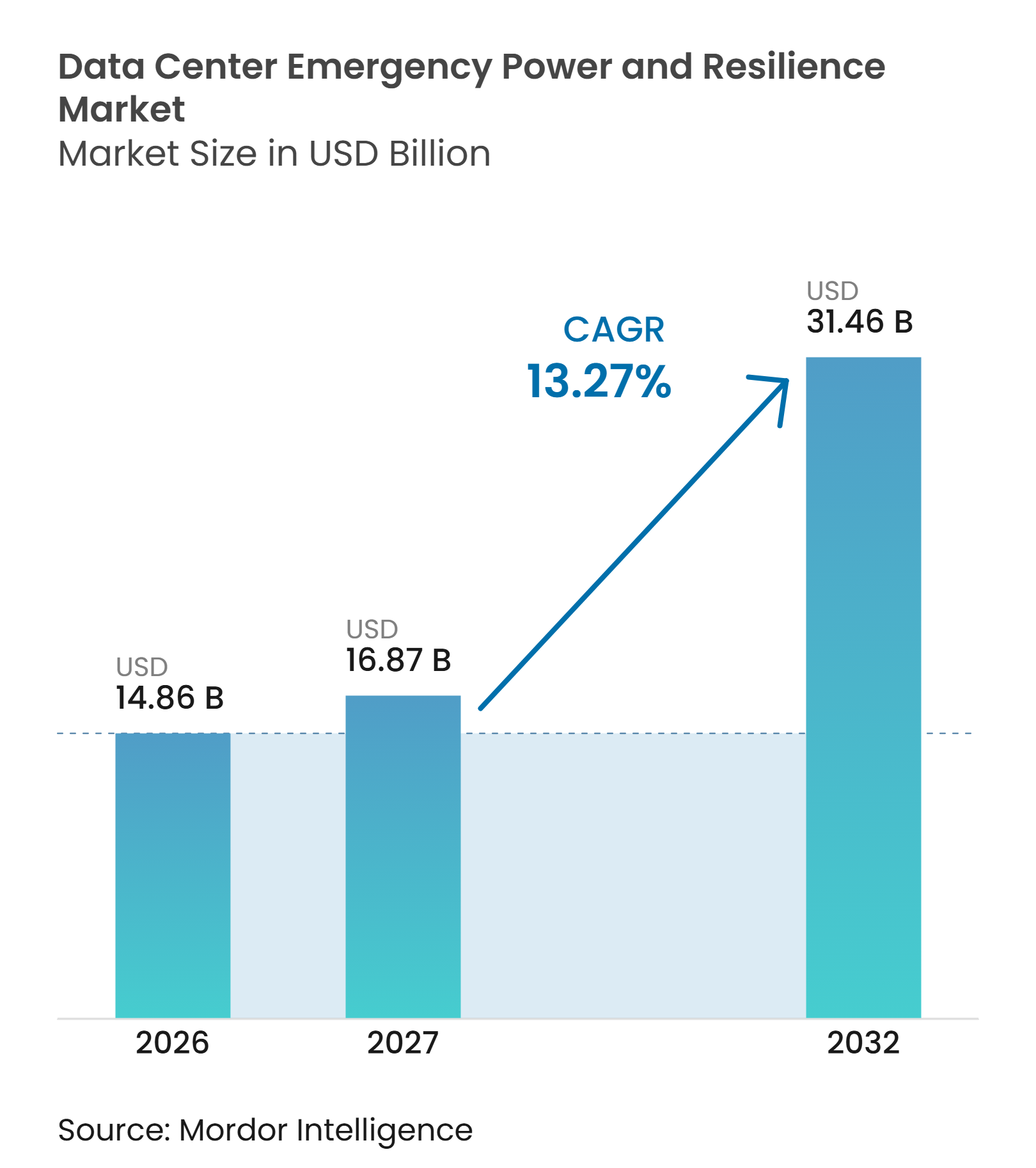
| Market Size (2027) | USD 16.87 Billion |
| Market Size (2032) | USD 31.46 Billion |
| Growth Rate (2027 - 2032) | 13.27 % |
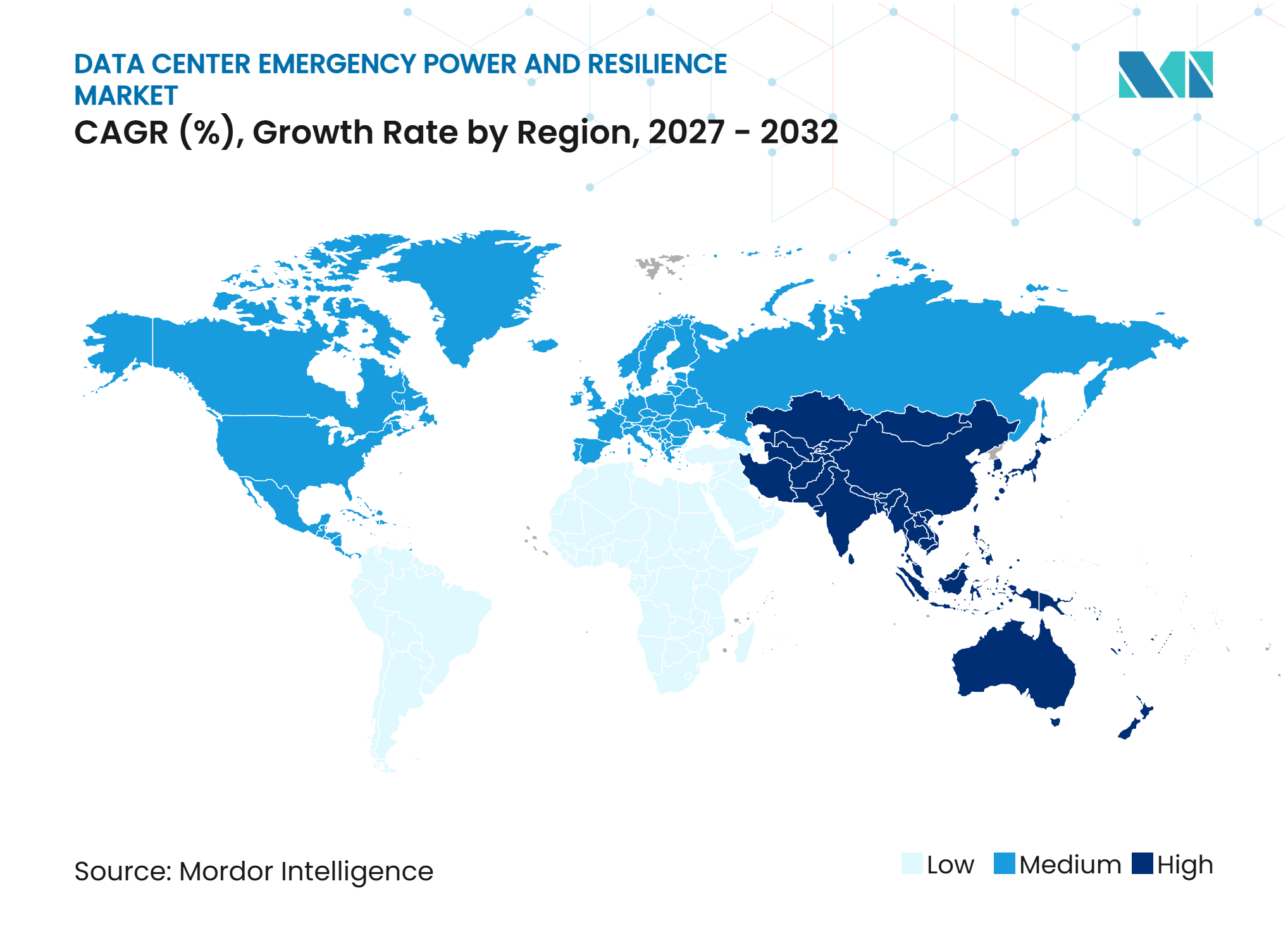
| Fastest Growing Market | Asia-Pacific |
| Largest Market | North America |
| Market Concentration | Medium |
Major Players *Disclaimer: Major Players sorted in no particular order Image © Mordor Intelligence. Reuse requires attribution under CC BY 4.0. | |
Data Center Emergency Power and Resilience Market Analysis by Mordor Intelligence
The data center emergency power and resilience market size is projected to expand from USD 14.86 billion in 2026 and USD 16.87 billion in 2027 to USD 31.46 billion by 2032, registering a CAGR of 13.27% between 2027 and 2032. Demand is tied to the rapid buildout of computing capacity and the higher power density of AI workloads. Emergency power is becoming part of core facility design because operators must protect continuous computing during grid disruption. Grid connection delays also encourage new campuses to use onsite generation, batteries, and other behind-the-meter systems. Large suppliers are extending their offerings from generators and UPS equipment toward integrated power, cooling, controls, and maintenance services. The data center emergency power and resilience market therefore benefits from both new construction and upgrades to existing facilities, especially where operators need to replace aging equipment, confirm redundancy performance, or provide longer fuel autonomy for critical loads, maintain operating continuity during prolonged utility disruption, and create a clear maintenance record for equipment that supports essential computing operations.
Key Report Takeaways
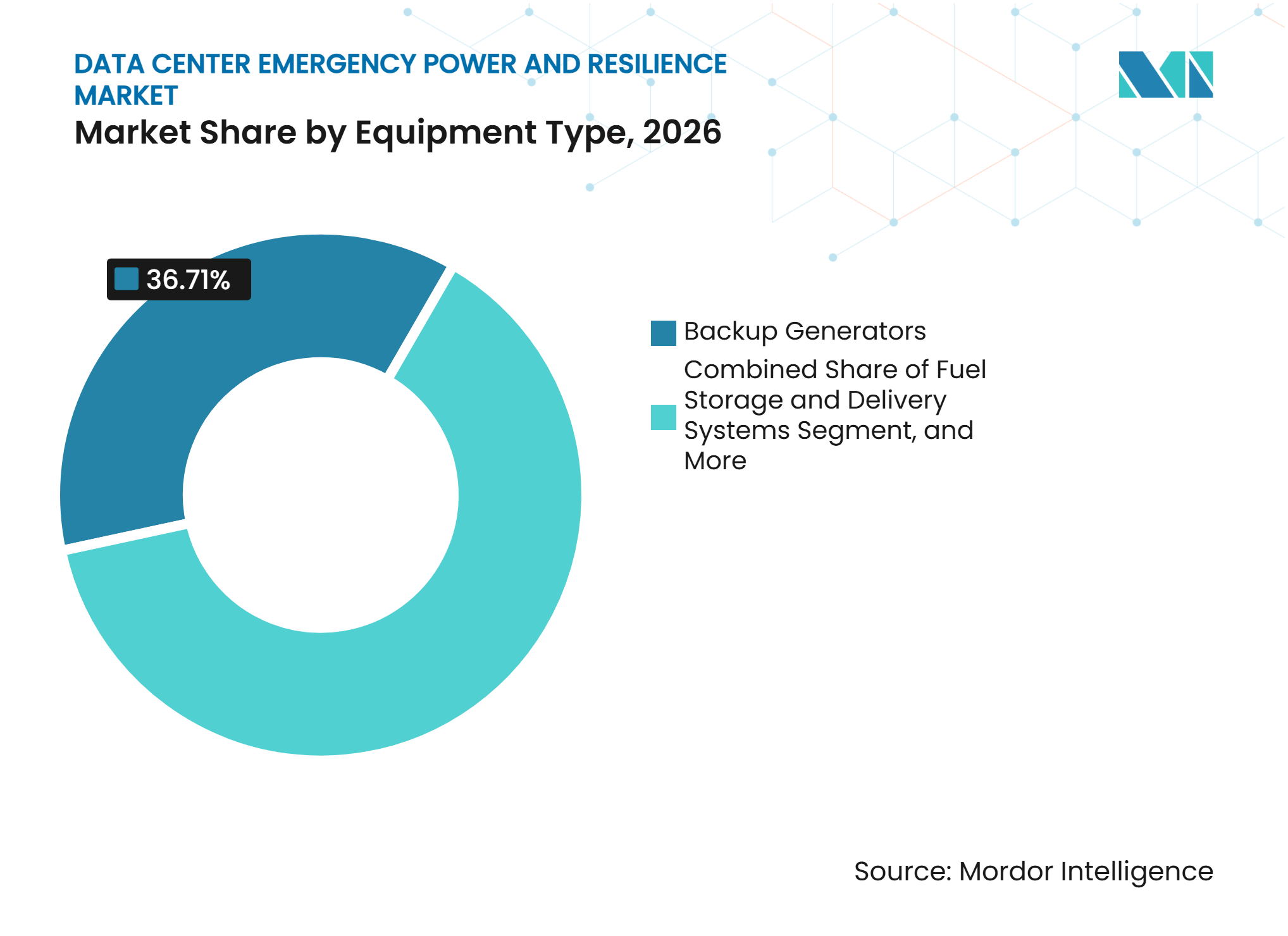
- By equipment type, backup generators held 36.71% of the data center emergency power and resilience market share in 2026, while backup batteries are projected to expand at a 14.26% CAGR through 2032.
- By power capacity, 5 MW to below 20 MW held 43.28% of revenue in 2026, while 20 MW and above is projected to expand at a 15.92% CAGR through 2032.
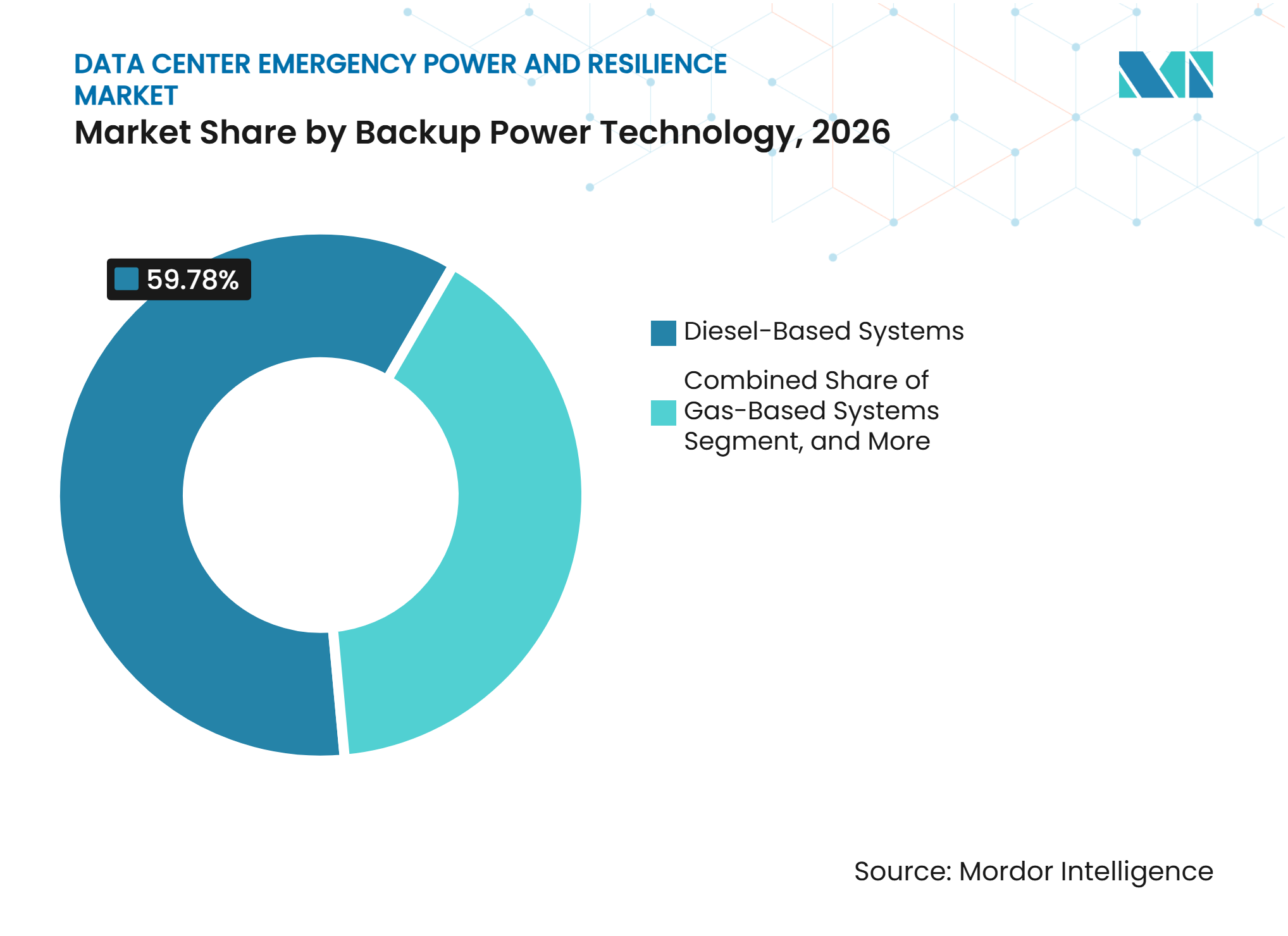
- By backup power technology, diesel-based systems held 59.78% of revenue in 2026, while fuel cell and other emerging systems are projected to expand at a 14.39% CAGR through 2032.
- By service type, preventive and corrective maintenance held 27.59% of service revenue in 2026, while power resilience consulting and assessment is projected to expand at a 16.51% CAGR through 2032.
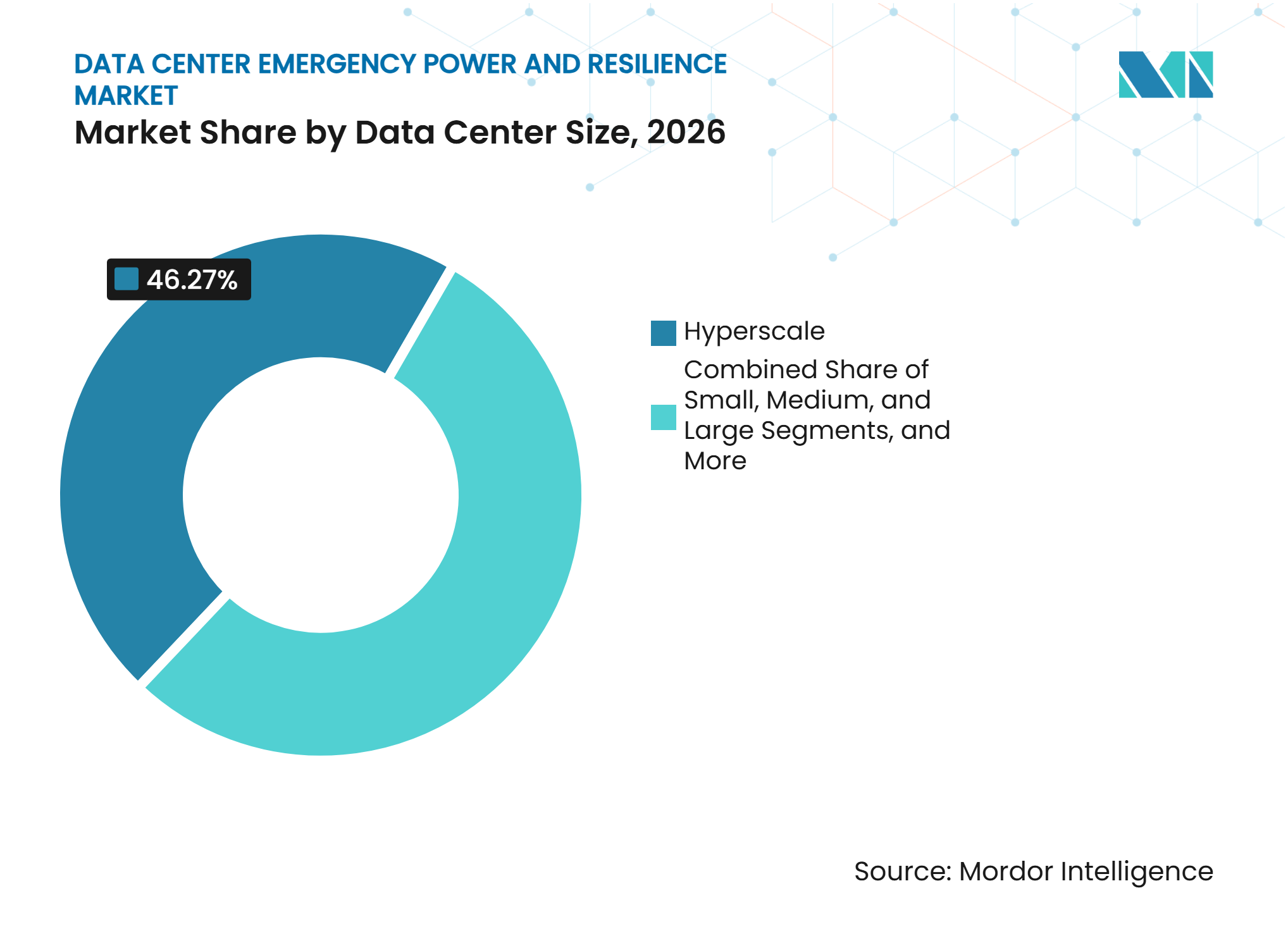
- By data center size, hyperscale facilities held 46.27% of revenue in 2026 and are projected to expand at a 15.62% CAGR through 2032.
- By data center type, colocation providers held 36.64% of revenue in 2026, while cloud service providers are projected to expand at a 14.38% CAGR through 2032.
- By geography, North America held 39.57% of the data center emergency power and resilience market revenue in 2026, while Asia-Pacific is projected to expand at a 17.91% CAGR through 2032.
Note: Market numbers in this report are based on Mordor Intelligence's proprietary estimation framework, which combines nine months of actuals with Q4 projections for base year 2026.
Market Trends and Insights
Drivers Impact Analysis of Data Center Emergency Power and Resilience Market*
| Driver | (~) % Impact on CAGR Forecast | Geographic Relevance | Impact Timeline |
|---|---|---|---|
| AI-Driven High-Density Workloads | +3.8% | Global, concentrated in North America, Asia-Pacific, and Western Europe | Short term (≤ 2 years) |
| Hyperscale and Cloud Data Center Expansion | +2.9% | Global, with rapid expansion in Asia-Pacific and Middle East | Short term (≤ 2 years) |
| Stricter Uptime and Redundancy Requirements | +1.7% | Global, with active compliance frameworks in North America and Europe | Medium term (2-4 years) |
| Rising Grid Interconnection Delays | +1.2% | North America and Europe, with spillover to Asia-Pacific and Middle East | Medium term (2-4 years) |
| Modularization and Lithium-Ion Battery Adoption | +0.9% | Global, accelerating in hyperscale-heavy markets | Medium term (2-4 years) |
| Behind-the-Meter Resilience and Grid-Interactive Demand | +0.6% | North America and emerging Asia-Pacific markets | Long term (≥ 4 years) |
| Source: Mordor Intelligence | |||
AI-Driven High-Density Workloads
AI facilities require more power per rack than conventional server installations, which changes the design basis for backup systems. A peer-reviewed study reported that AI data centers can require rack densities above 40 kW, while some liquid-cooled deployments can exceed 100 kW.[1] These loads require UPS systems and generators that can support high utilization without relying on average-load assumptions. The Congressional Research Service reported that training a large AI model required 25.3 MW of total power draw, and it noted that training energy needs could double annually. Operators consequently need multi-megawatt UPS capacity and fuel reserves that support extended autonomous operation. This raises the resilience content required for each new AI-focused facility in the Data Center Emergency Power and Resilience Market, where the design must address sudden load changes, sustained operation at high utilization, and a short response window when utility power is interrupted.
Hyperscale and Cloud Data Center Expansion
Hyperscale construction creates long-duration demand for backup generation, transfer switching, UPS systems, and related services. The International Energy Agency stated that data center electricity use increased 17% in 2025, while overall electricity demand increased 3%.[2] Large campuses require N+1 or 2N configurations to keep computing available during equipment failure or grid loss. This requirement makes resilience equipment a necessary part of the initial construction budget rather than an optional later addition. Colocation facilities also benefit because many enterprise users seek capacity in sites that already provide high-availability power designs. The Data Center Emergency Power and Resilience Market gains from this shift as cloud providers increase both campus count and individual campus scale.
Stricter Uptime and Redundancy Requirements
Compliance requirements are expanding the installed base of redundant power equipment in critical facilities. The Telecommunications Industry Association stated that more than 600 data centers across 51 countries were certified under ANSI/TIA-942 by March 2025. Certification and customer service commitments require documented failover performance, monitoring, and redundancy planning. These requirements support demand for generator sets, UPS systems, automatic transfer switches, and recurring testing services. Higher availability targets can require multiple independent power paths, increasing equipment content within each project. The Data Center Emergency Power and Resilience Market also benefits as operators modernize older facilities to meet newer customer expectations.
Rising Grid Interconnection Delays
Grid connection delays have become a direct reason for developers to consider on-site power systems. Lawrence Berkeley National Laboratory reported that the median time from an interconnection request to commercial operation exceeded 5 years for U.S. projects that reached operation in 2025. Long study periods can leave data center construction ready before utility capacity is available. Developers may then use behind-the-meter generation and battery systems to reduce dependence on a single connection timetable. This approach can allow phased commissioning while broader grid work continues. The Data Center Emergency Power and Resilience Market is supported because grid constraints increase the value of self-contained power resilience.
Restraints Impact Analysis of Data Center Emergency Power and Resilience Market*
| Restraint | (~) % Impact on CAGR Forecast | Geographic Relevance | Impact Timeline |
|---|---|---|---|
| High Capital Intensity of Resilience Infrastructure | -1.6% | Global, most acute for enterprise and mid-market data centers | Long term (≥ 4 years) |
| Transformer, Switchgear, and High-Horsepower Generator Bottlenecks | -1.1% | North America and Europe, with spillover to Asia-Pacific | Medium term (2-4 years) |
| Emissions Compliance and Permitting Complexity | -0.7% | North America and Europe, with selective enforcement in Asia-Pacific | Medium term (2-4 years) |
| Battery Lifecycle, Fire-Safety, and Insurance Requirements | -0.4% | Global, most pronounced in high-density deployments | Long term (≥ 4 years) |
| Source: Mordor Intelligence | |||
High Capital Intensity of Resilience Infrastructure
Tier III and Tier IV designs require extensive redundancy, which increases the upfront cost of a project. The cost burden includes transformers, generators, UPS systems, switchgear, controls, fuel storage, installation, and testing. High-cost equipment and long procurement periods can be difficult for enterprise and mid-market operators with constrained financing. This can defer projects or lead buyers to use colocation capacity rather than build their own sites. Well-capitalized hyperscalers and large colocation providers can absorb these costs more readily. The result is a spending environment in which the Data Center Emergency Power and Resilience Market remains active, but large buyers hold more purchasing power.
Transformer, Switchgear, and High-Horsepower Generator Bottlenecks
Constraints in transformers, switchgear, and large generators can delay construction and increase delivery risk. The U.S. Department of Energy has identified supply-chain concerns affecting the availability of distribution transformers and related grid equipment. Developers often place orders before final facility designs are complete to secure manufacturing capacity. This practice reduces schedule uncertainty but can create a cost problem when specifications change. Equipment shortages can also limit the ability of smaller firms to compete for large projects. These bottlenecks restrain near-term installation activity even as they reinforce the long-term need for power resilience.
*Our forecasts treat driver/restraint impacts as directional, not additive. The impact forecasts reflect baseline growth, mix effects, and variable interactions.
Data Center Emergency Power and Resilience Market Segment Analysis
By Equipment Type:
Generators Lead While Batteries Advance QuicklyBackup generators held 36.71% of the Data Center Emergency Power and Resilience Market share in 2026 because they can provide megawatt-scale power during extended outages. Their mature service networks support continued use at large sites, and this installed base gives the Data Center Emergency Power and Resilience Market a practical foundation for upgrades, capacity additions, parts replacement, and recurring service work as older facilities are modernized. UPS systems bridge the interval between grid loss and generator startup. Fuel storage, automatic transfer switches, and controls are important for facilities requiring 48-72 hours of autonomous operation. Microgrids and onsite systems are gaining relevance where grid capacity is limited.
Backup batteries are projected to expand at a 14.26% CAGR through 2032 as operators use lithium-ion systems for UPS backup and wider campus resilience. Batteries respond immediately to a power disturbance and protect sensitive AI hardware. They also support modular designs that can be expanded as rack density rises. Shoals Technologies and ON.energy began manufacturing and deliveries for a 1.1 GW grid-connected battery project at a U.S. hyperscale data center in August 2026.[3] Generators and batteries serve complementary roles across the Data Center Emergency Power and Resilience Market, with batteries providing immediate support and generator sets sustaining operations after an extended grid disruption, while control systems manage transfer events, protect sensitive loads, and give operators a clearer view of the condition of each part of the power chain.



By Power Capacity:
Mid-Range Systems Lead While Large Campuses ExpandThe 5 MW to below 20 MW category held 43.28% of revenue in 2026, reflecting the installed base of enterprise colocation and mid-size hyperscale facilities. These sites use backup systems that support several equipment rooms or a multi-tenant facility. Maintenance, load-bank testing, and parts replacement create recurring work after installation. The 1 MW to below 5 MW category serves enterprise and edge locations with limited space. Below-1-MW systems support distributed applications that require local computing.
The 20 MW and above category is projected to expand at a 15.92% CAGR through 2032 as large campuses add computing capacity. These facilities need multiple generator sets, medium-voltage UPS systems, and paralleling switchgear. Their designs can include onsite generation for emergency and longer-duration operating needs. This blurs the distinction between backup power and primary onsite supply. The shift toward campus-scale infrastructure raises project values across the Data Center Emergency Power and Resilience Market because a single project can require integrated generation, storage, switching, distribution, controls, and commissioning support, followed by years of testing, spare-parts planning, fuel management, software updates, and technician coverage that extend beyond the construction period.
By Backup Power Technology:
Diesel Leads While Fuel Cells EmergeDiesel-based systems held 59.78% of revenue in 2026 because they are widely deployed and can operate for long periods when fuel is available. They remain the reference technology for emergency generation at many large facilities. Gas-based systems attract interest where buyers seek lower emissions intensity and flexible fuel options. Battery systems address the first seconds or minutes of an outage. Generator systems then take over for longer events, with fuel storage defining the available runtime.
Fuel cell and other emerging systems are projected to expand at a 14.39% CAGR through 2032. Vertiv and Ballard Power Systems completed integration testing of a prefabricated hydrogen-powered UPS solution in March 2025.[4] The system was designed to scale from 200 kW to multiple MW for high-availability data center use. Honda started a Japanese demonstration that used recovered automotive fuel-cell stacks and by-product hydrogen to supply a distributed data center. Fuel-cell uptake depends on hydrogen availability, cost, permitting, proven performance at scale, and the availability of service arrangements that can support critical operations over the life of the equipment, especially at sites where operators must show that an alternative system can provide the same predictable response as a conventional generator under full facility demand.

By Service Type:
Maintenance Provides the Base While Consulting AcceleratesPreventive and corrective maintenance accounted for 27.59% of service revenue in 2026 because installed generators and UPS systems require inspection and testing. Operators use load-bank tests to verify performance under full load. Remote monitoring supports continuous review of batteries, generators, and power-quality conditions. Installation and commissioning closely follow new data center construction. Fuel management and emergency readiness are important as facilities require longer autonomous runtime.
Power resilience consulting and assessment is projected to expand at a 16.51% CAGR through 2032. Gigawatt-scale projects must coordinate grid access, power architecture, procurement schedules, permits, and equipment selection. Consulting providers can help select sites, define redundancy levels, and plan equipment delivery. These early assignments can develop into installation, testing, and maintenance contracts. Demand is strongest where delay risk is expensive and project designs are changing quickly, because early power decisions affect land selection, construction sequencing, equipment orders, and the final availability commitment made to customers, while a more complete assessment can identify issues in fuel logistics, redundancy layout, equipment access, testing procedures, and future expansion before they cause rework.
By Data Center Size:
Hyperscale Facilities Lead on Both MeasuresHyperscale facilities held 46.27% of revenue in 2026. Their backup systems commonly include several generator sets, dual UPS paths, on-site batteries, and long-term service agreements. These facilities need high availability because interruption can affect large cloud platforms and many customers at once. Large data centers use multi-megawatt backup configurations, while medium sites are upgrading toward higher-tier designs. Small sites support distributed edge computing and often favor compact, modular packages.
Hyperscale facilities are projected to expand at a 15.62% CAGR through 2032. Their power needs raise the scale of generator, UPS, switching, and fuel contracts. AI workloads add to this requirement because dense computing clusters need immediate and reliable power support. Facility owners also expect expansion capacity within the initial design. Hyperscale procurement will remain a primary driver of equipment specifications across the Data Center Emergency Power and Resilience Market, as suppliers standardize larger modules, higher-voltage equipment, and controls that coordinate complex power paths, accommodate rapid changes in computing demand, separate critical loads from noncritical loads, and give operations teams usable data during a transfer or restoration event.
By Data Center Type:
Colocation Holds Share While Cloud Providers ExpandColocation providers held 36.64% of revenue in 2026 because they share the cost of resilient infrastructure across many tenants. This model can make Tier III and Tier IV power designs more economical than enterprise self-builds. Colocation operators need dependable generator and UPS capacity to meet contractual availability commitments. Enterprise and edge locations also require backup systems but usually operate at a smaller scale. The Data Center Emergency Power and Resilience Market benefits as enterprises move workloads toward shared high-availability facilities, because providers can spread the cost of resilient designs across customers while maintaining common operating procedures.
Cloud service providers are projected to expand at a 14.38% CAGR through 2032. These operators are increasing both facility count and campus scale. Large cloud sites require generator systems that can synchronize many units and medium-voltage UPS systems. ABB announced a collaboration with NVIDIA in October 2025 to develop an 800 VDC power architecture for next-generation AI data centers. Suppliers must adapt equipment to high-density computing and coordinated campus-scale power management, including designs that simplify maintenance, validate failover performance, and keep expansion work from disrupting active computing loads.
Geography Analysis
North America
North America held 39.57% of regional revenue in 2026. The region combines a large hyperscale construction base with pressure on power systems and interconnection processes. Lawrence Berkeley National Laboratory found that the median U.S. interconnection period for projects reaching operation in 2025 exceeded 5 years. The U.S. Environmental Protection Agency issued 2025 guidance that clarified the 50-hour non-emergency operating allowance for certain reciprocating internal-combustion engines. These factors support earlier use of onsite generation and batteries in project planning, while also increasing the value of engineering work that aligns backup capacity, controls, fuel arrangements, and utility connection milestones, helping the Data Center Emergency Power and Resilience Market respond to a project environment where utility availability may change after the facility schedule is set.
Asia-Pacific
Asia-Pacific is projected to expand at a 17.91% CAGR through 2032. India, Japan, Singapore, and the Singapore-Johor-Riau corridor are important investment locations where power availability remains a key planning issue because grid capacity does not match new data center demand. Singapore uses capacity controls to protect system stability, while Chinese policy requires a high renewable-power share for new computing infrastructure in major hubs. The Data Center Emergency Power and Resilience Market has scope to expand as developers seek reliable capacity alongside local energy and permitting requirements, and as regional operators combine conventional backup equipment with systems that can be deployed in phases.
Europe, Middle East and Africa, and South America
Europe is expanding its Data Center Emergency Power and Resilience Market size through new construction and upgrades to meet stricter reliability needs. ENTSO-E expects European data center electricity demand to increase by more than 50% between 2025 and 2030. The revised EN 50600 framework affects redundancy documentation, monitoring, and backup power expectations for critical facilities. Middle Eastern markets are adding large-scale capacity, while African sites often require dependable backup supply because grid reliability can be limited. South American demand is concentrated in Brazil and Argentina, and buyers across these markets seek modular systems that meet local conditions, compliance needs, heat-management requirements, and varying levels of utility reliability.
Competitive Landscape
Market Concentration
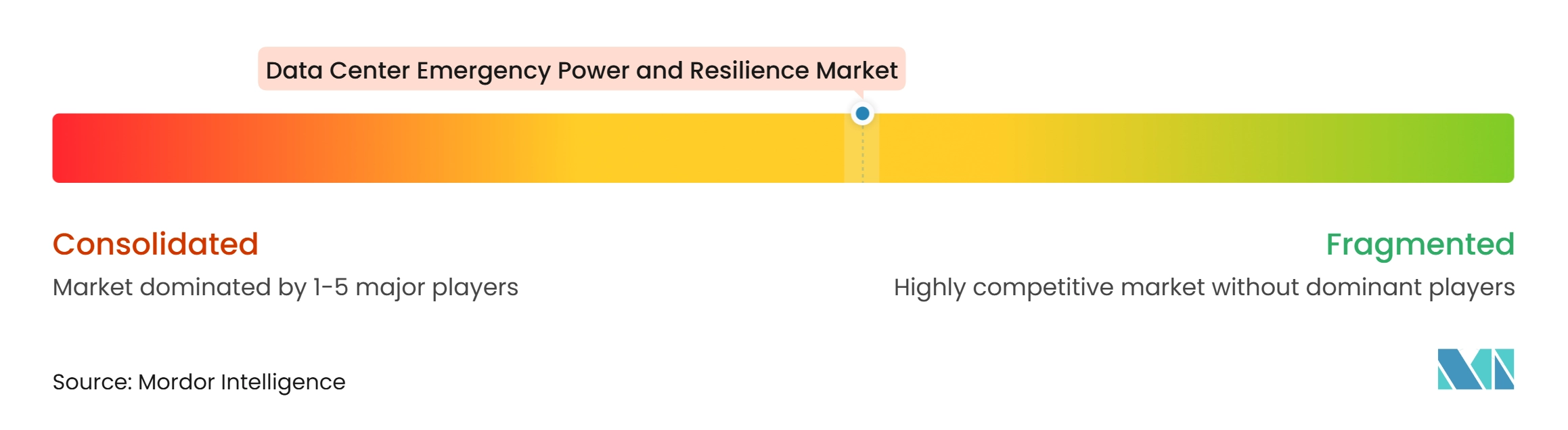
The data center emergency power and resilience market is moderately fragmented among major industrial and power-management suppliers, while specialist firms compete in batteries, fuel cells, controls, and services. Caterpillar and Cummins are extending generator capabilities to address AI-focused projects. Eaton has used acquisitions to combine electrical infrastructure, modular enclosures, and thermal management. This approach allows suppliers to offer more of the facility power system through one commercial relationship, which can strengthen their position in the Data Center Emergency Power and Resilience Market when customers value coordinated delivery, common testing procedures, and a single service organization for several power-system components. Smaller firms remain relevant where they offer specialized battery, fuel-cell, or software capabilities, particularly when their products address a specific power-quality issue, deployment constraint, or need for faster onsite integration, although their ability to scale depends on manufacturing capacity, installation partners, access to field service, and the confidence of major customers in long-term support.
Technology strategies increasingly focus on power architectures that support higher rack density. ABB and NVIDIA announced a collaboration in October 2025 to develop an 800 VDC architecture for next-generation AI data centers. Vertiv and Ballard completed system-level testing of a hydrogen-powered UPS solution in March 2025. Buyers are assessing equipment reliability, operating emissions, integration capability, availability of local service support, and the ability to validate performance during commissioning without affecting computing equipment, since a solution that performs well in isolation must also work with the site’s distribution design, monitoring platform, cooling equipment, operating staff, and emergency procedures.
Wärtsilä is another supplier applying gas-engine experience to data center power. In July 2025, Wärtsilä received a contract to supply 282 MW of flexible engines for a U.S. data center project in Ohio. Eaton acquired Fibrebond in March 2026 to add modular power enclosures and integrated electrical infrastructure for data centers. Suppliers that provide standardized, scalable systems can reduce deployment time for customers in the Data Center Emergency Power and Resilience Market. Compliance with ISO 50001 and applicable emissions requirements can influence procurement in sites pursuing high availability and energy-management targets, because documentation, monitoring, and operating limits can shape the acceptable configuration, the hours in which equipment may be used, the type of fuel that can be stored, and the evidence required for permitting, insurance, and customer due diligence.
Data Center Emergency Power and Resilience Industry Leaders
-
Caterpillar Inc.
-
Cummins Inc.
-
Generac Holdings Inc.
-
Rolls-Royce Holdings plc
-
Schneider Electric SE
- *Disclaimer: Major Players sorted in no particular order
Data Center Emergency Power and Resilience Market Companies Covered in this Report
- Caterpillar Inc.
- Cummins Inc.
- Generac Holdings Inc.
- Rolls-Royce Holdings plc
- Schneider Electric SE
- Vertiv Holdings Co
- Eaton Corporation plc
- ABB Ltd
- Huawei Technologies Co., Ltd.
- Legrand SA
- Mitsubishi Heavy Industries, Ltd.
- Kohler Co.
- Delta Electronics, Inc.
- Socomec Group S.A.
- Riello UPS S.p.A.
- Fuji Electric Co., Ltd.
- Toshiba International Corporation
- Pramac S.p.A.
- Aggreko plc
- Wärtsilä Corporation
- Bloom Energy Corporation
Recent Industry Developments in Data Center Emergency Power and Resilience Market
- October 2026: Cummins is actively expanding its next-generation AI data center backup power portfolio, deploying its QSK95 and Centum Series generators through tailored site assessments and integrated power system design, and incorporating battery energy storage system pairings for facilities requiring hybrid resilience architectures.
- August 2026: Shoals Technologies Group and ON.energy advanced manufacturing and deliveries for the 1.1 GW grid-connected battery project at a U.S. hyperscale data center, the largest such installation in the United States, with commissioning expected to begin in Q4 2026, the project integrates ON.energy's AI UPS with Shoals' PowerHub direct-current electrical architecture.
- August 2026: Caterpillar won a supply contract from Nscale to provide G3516 natural gas generators for the 2,250-acre Monarch Compute Campus in Mason County, West Virginia, designed to supply 1.35 GW of primary power to a Microsoft data center deploying NVIDIA Vera Rubin NVL72 GPUs, total campus capacity is expected to reach 8 GW by 2031.
- July 2026: Wärtsilä booked a 412 MW engine order for a hyperscale data center in Ohio comprising 40 units of its 34SG spark-ignited gas engines, the model's first data center deployment, pushing Wärtsilä's total U.S. data center engine capacity past 1.6 GW across 4 projects, with commercial operation targeted for early 2028.
Global Data Center Emergency Power and Resilience Market Report Scope
The data center emergency power and resilience market covers revenue from backup generation, uninterruptible power supply (UPS) systems, energy storage, switchgear, and resilience software deployed across global infrastructure. Growth is driven by the rapid expansion of cloud and AI workloads, escalating power densities, heightened risks of grid instability, and the continuous requirement for strict operational uptime and business continuity.
The Data Center Emergency Power and Resilience Market Report is Segmented by Equipment Type (Backup Generators, Uninterruptible Power Supply Systems, Backup Batteries, Automatic Transfer Switches and Switching Equipment, Fuel Storage and Delivery Systems, and Microgrid and On-Site Power Systems), Power Capacity (Below 1 MW, 1 MW to Below 5 MW, 5 MW to Below 20 MW, and 20 MW and Above), Backup Power Technology (Diesel-Based Systems, Gas-Based Systems, Battery-Based Systems, and Fuel Cell and Other Emerging Systems), Service Type (Installation and Commissioning, Preventive and Corrective Maintenance, Load Bank Testing and System Validation, Fuel Management and Emergency Readiness Services, and Power Resilience Consulting and Assessment), Data Center Size (Small, Medium, Large, and Hyperscale), Data Center Type (Colocation, Cloud Service Providers (CSPs), and Enterprise / Edge), and Geography (North America, South America, Europe, Asia-Pacific, Middle East, and Africa). The Market Forecasts are Provided in Terms of Value (USD).
Segmentation Overview
| Backup Generators |
| Uninterruptible Power Supply Systems |
| Backup Batteries |
| Automatic Transfer Switches and Switching Equipment |
| Fuel Storage and Delivery Systems |
| Microgrid and On-Site Power Systems |
| Below 1 MW |
| 1 MW to Below 5 MW |
| 5 MW to Below 20 MW |
| 20 MW and Above |
| Diesel-Based Systems |
| Gas-Based Systems |
| Battery-Based Systems |
| Fuel Cell and Other Emerging Systems |
| Installation and Commissioning |
| Preventive and Corrective Maintenance |
| Load Bank Testing and System Validation |
| Fuel Management and Emergency Readiness Services |
| Power Resilience Consulting and Assessment |
| Small |
| Medium |
| Large |
| Hyperscale |
| Colocation |
| Cloud Service Providers (CSPs) |
| Enterprise / Edge |
| North America | United States |
| Canada | |
| Mexico | |
| South America | Brazil |
| Argentina | |
| Rest of South America | |
| Europe | Germany |
| United Kingdom | |
| France | |
| Italy | |
| Rest of Europe | |
| Asia-Pacific | China |
| Japan | |
| India | |
| Singapore | |
| Rest of Asia-Pacific | |
| Middle East | United Arab Emirates |
| Saudi Arabia | |
| Turkey | |
| Rest of Middle East | |
| Africa | South Africa |
| Nigeria | |
| Egypt | |
| Rest of Africa |
| By Equipment Type | Backup Generators | |
| Uninterruptible Power Supply Systems | ||
| Backup Batteries | ||
| Automatic Transfer Switches and Switching Equipment | ||
| Fuel Storage and Delivery Systems | ||
| Microgrid and On-Site Power Systems | ||
| By Power Capacity | Below 1 MW | |
| 1 MW to Below 5 MW | ||
| 5 MW to Below 20 MW | ||
| 20 MW and Above | ||
| By Backup Power Technology | Diesel-Based Systems | |
| Gas-Based Systems | ||
| Battery-Based Systems | ||
| Fuel Cell and Other Emerging Systems | ||
| By Service Type | Installation and Commissioning | |
| Preventive and Corrective Maintenance | ||
| Load Bank Testing and System Validation | ||
| Fuel Management and Emergency Readiness Services | ||
| Power Resilience Consulting and Assessment | ||
| By Data Center Size | Small | |
| Medium | ||
| Large | ||
| Hyperscale | ||
| By Data Center Type | Colocation | |
| Cloud Service Providers (CSPs) | ||
| Enterprise / Edge | ||
| By Geography | North America | United States |
| Canada | ||
| Mexico | ||
| South America | Brazil | |
| Argentina | ||
| Rest of South America | ||
| Europe | Germany | |
| United Kingdom | ||
| France | ||
| Italy | ||
| Rest of Europe | ||
| Asia-Pacific | China | |
| Japan | ||
| India | ||
| Singapore | ||
| Rest of Asia-Pacific | ||
| Middle East | United Arab Emirates | |
| Saudi Arabia | ||
| Turkey | ||
| Rest of Middle East | ||
| Africa | South Africa | |
| Nigeria | ||
| Egypt | ||
| Rest of Africa | ||
Key Questions Answered in the Report
What is the size of the Data Center Emergency Power and Resilience Market?
The data center emergency power and resilience market size is projected to expand from USD 14.86 billion in 2026 and USD 16.87 billion in 2027 to USD 31.46 billion by 2032, registering a CAGR of 13.27% between 2027 to 2032.
Which equipment category has the largest revenue share?
Backup generators held 36.71% of revenue in 2026 because they provide extended megawatt-scale backup power.
Why are batteries gaining importance in data center resilience?
Backup batteries are projected to expand at a 14.26% CAGR through 2032 because they provide immediate response and support modular UPS designs.
Which region is expanding fastest for data center emergency power?
Asia-Pacific is projected to expand at a 17.91% CAGR through 2032, supported by an expanding development pipeline and power availability needs.
How do grid interconnection delays affect backup-power demand?
Delays encourage developers to consider onsite generation and batteries so projects can reduce dependence on utility connection timing.
Which data center customers create the strongest demand for resilience systems?
Hyperscale facilities held 46.27% of revenue in 2026 and are projected to expand at a 15.62% CAGR through 2032.