
Data Center Electricity Consumption Market Size and Share
Market Overview
| Study Period | 2021 - 2032 |
|---|---|
| Market Size (2027) | USD 28.28 Billion |
| Market Size (2032) | USD 39.51 Billion |
| Growth Rate (2027 - 2032) | 6.92 % |
| Fastest Growing Market | Asia-Pacific |
| Largest Market | North America |
| Market Concentration | Medium |
Major Players *Disclaimer: Major Players sorted in no particular order Image © Mordor Intelligence. Reuse requires attribution under CC BY 4.0. | |
Data Center Electricity Consumption Market Analysis by Mordor Intelligence
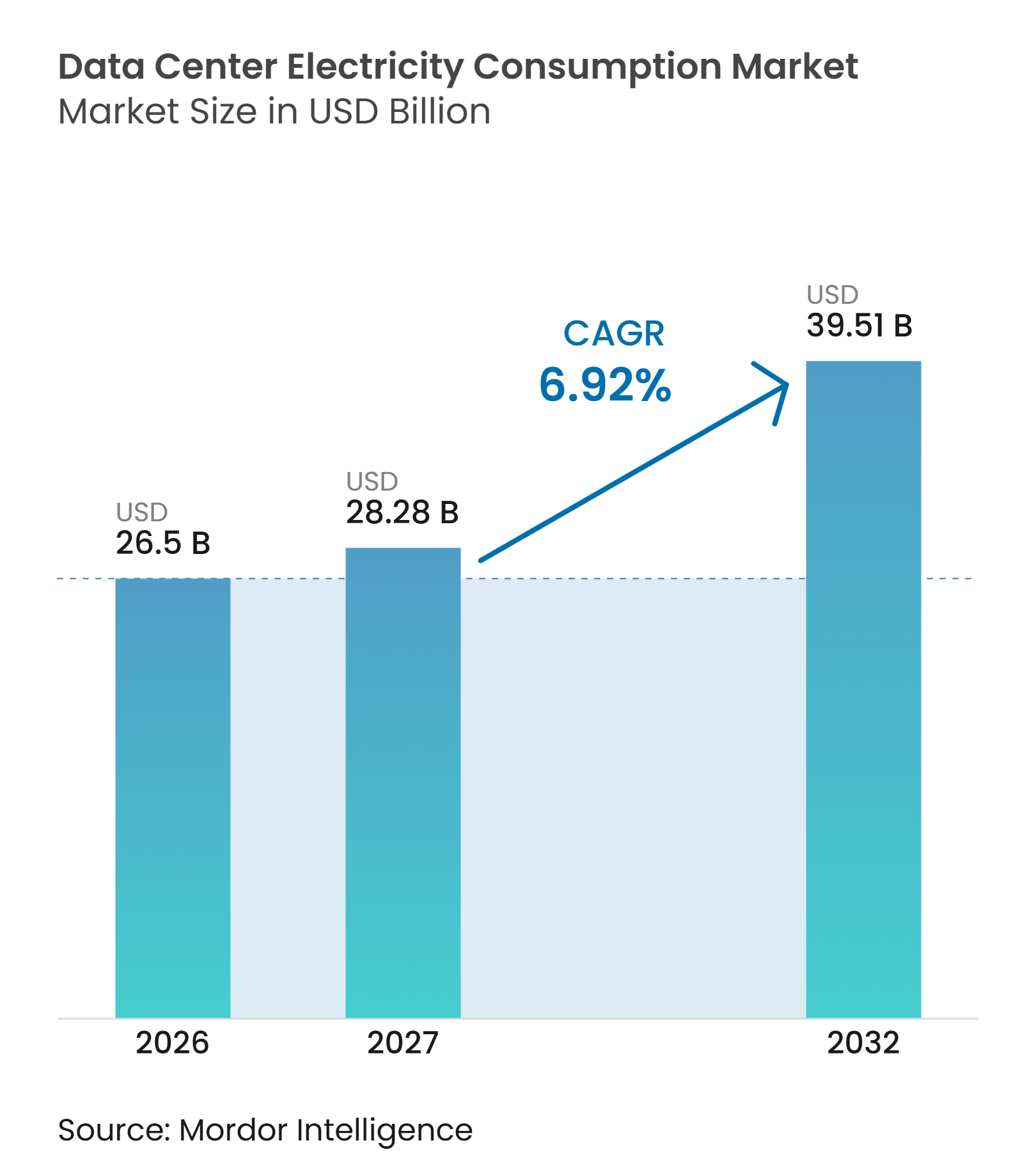
The data center electricity consumption market size is projected to be USD 26.50 billion in 2026, USD 28.28 billion in 2027, and reach USD 39.51 billion by 2032, expanding at a CAGR of 6.92% from 2027 to 2032. The data center electricity consumption market is being reshaped by the much higher and more continuous power needs of artificial intelligence workloads, particularly training clusters and always-on inference services. Infrastructure investment is shifting toward sites that can secure dependable high-voltage supply, obtain grid connections, and add cooling without limiting server density. Operators with long-term power contracts, onsite generation options, and established grid relationships are likely to have an advantage as connection delays persist in established hubs. The data center electricity consumption market also benefits from cloud migration and continued investment in hyperscale campuses, although electricity prices, efficiency rules, and local permitting requirements can delay project delivery.
Key Report Takeaways
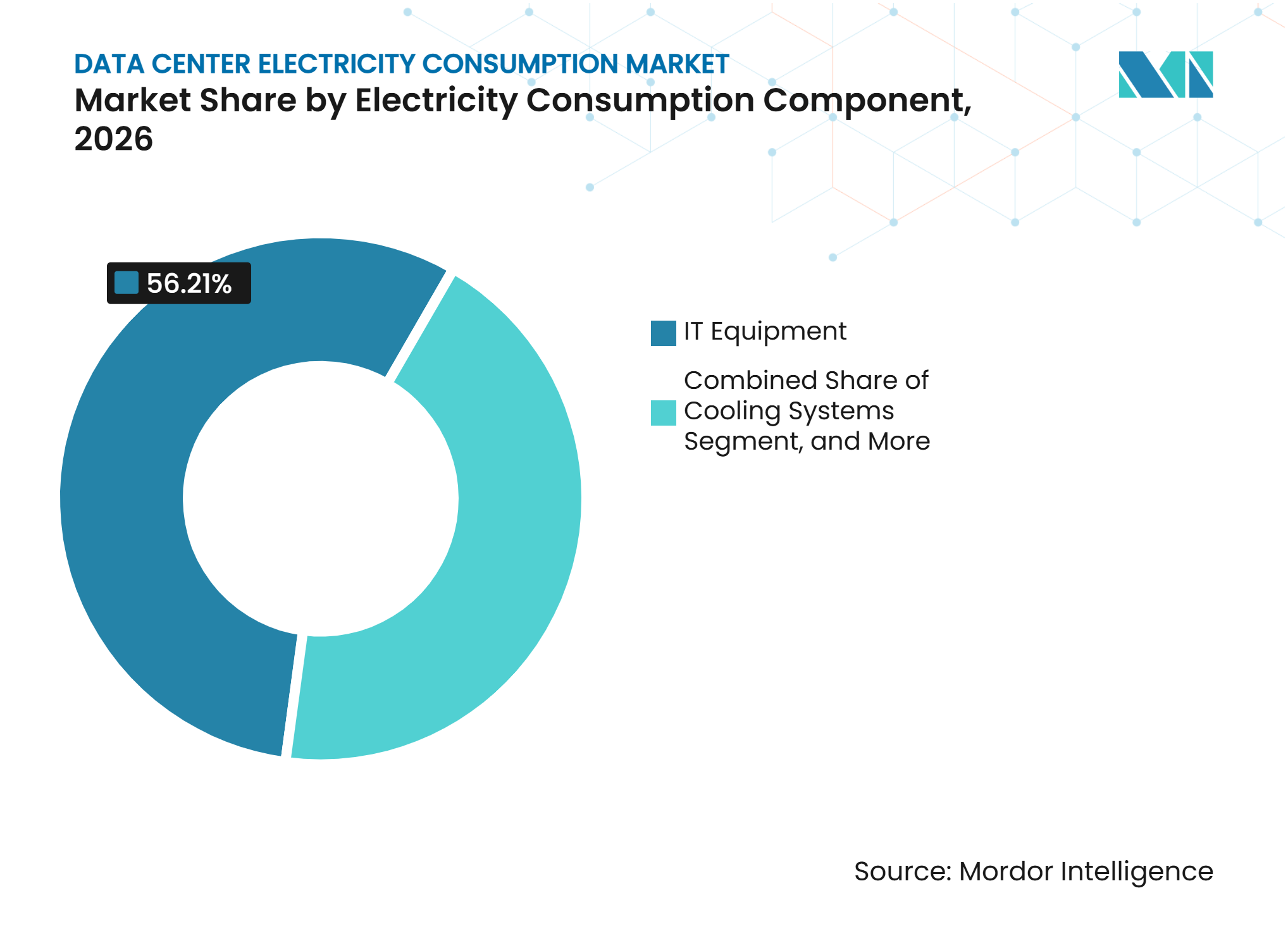
- By electricity consumption component, IT Equipment held 56.21% of the data center electricity consumption market in 2026, while Cooling Systems are projected to expand at an 8.14% CAGR through 2032.
- By data center size, Hyperscale facilities accounted for 54.18% of the data center electricity consumption market in 2026 and are projected to expand at an 8.46% CAGR through 2032.
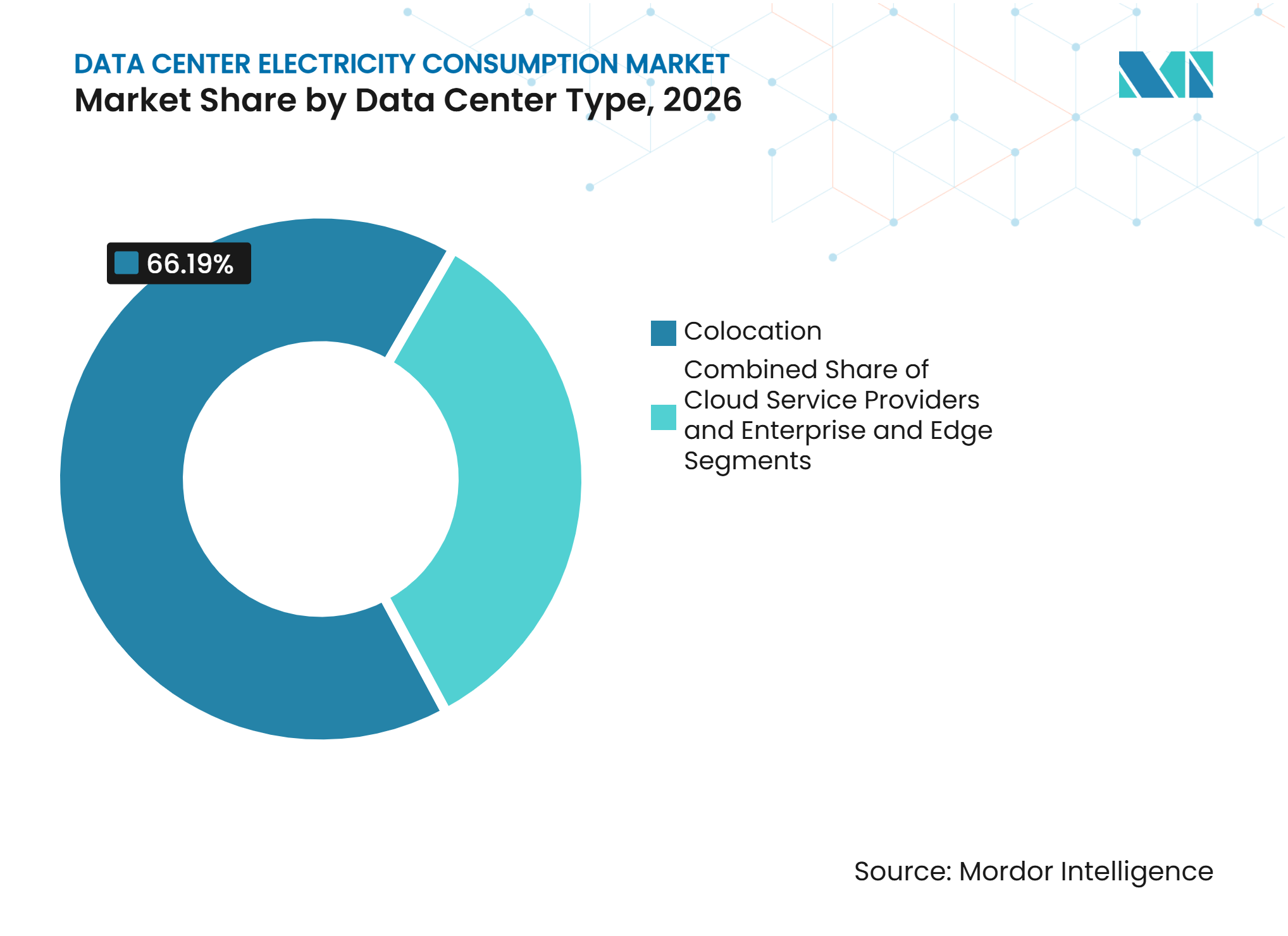
- By data center type, Colocation held 66.19% of the data center electricity consumption market in 2026, while Cloud Service Providers are projected to expand at an 8.72% CAGR through 2032.
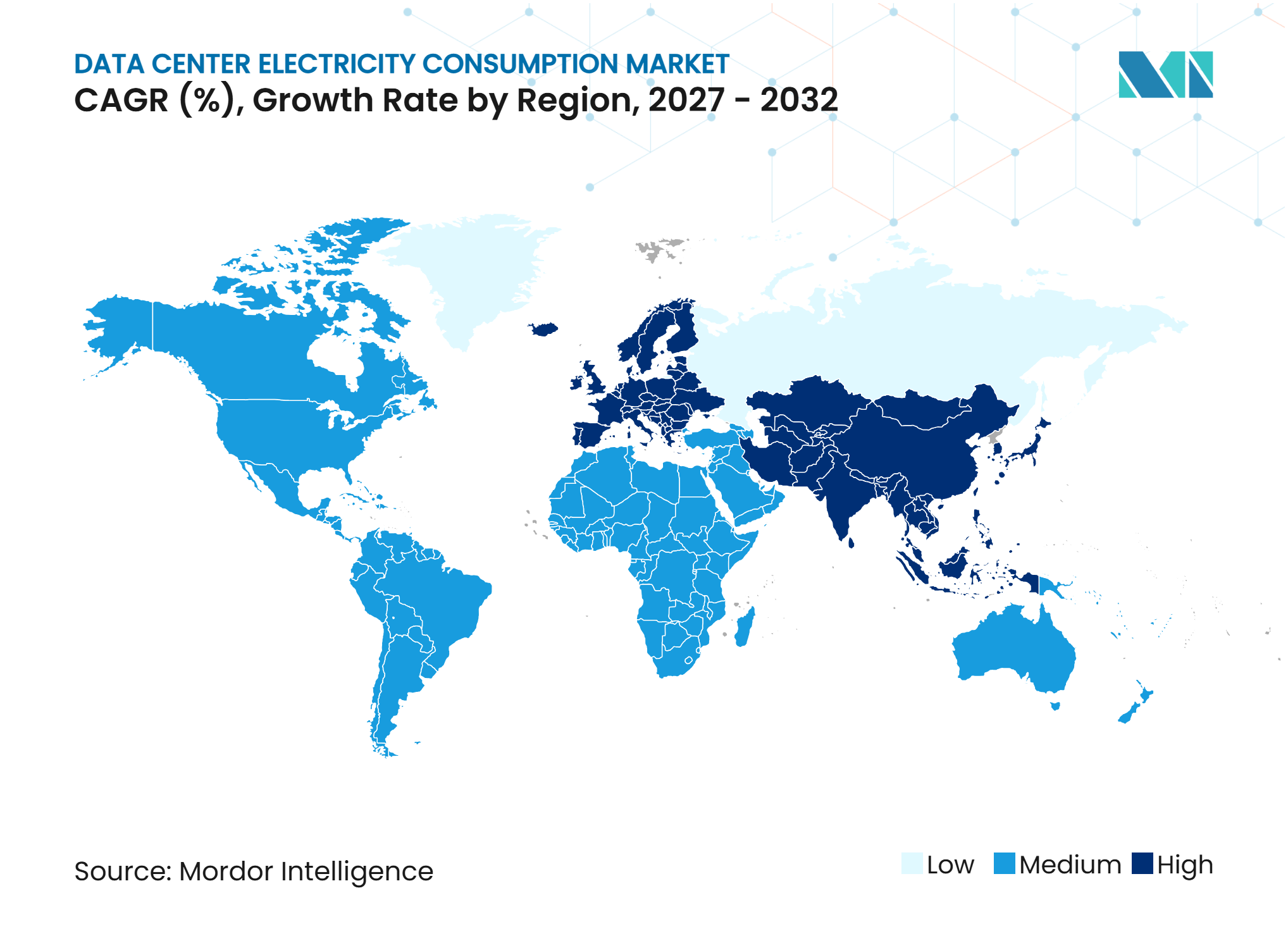
- By geography, North America held 38.14% of the data center electricity consumption market in 2026, while Asia-Pacific is projected to expand at a 7.81% CAGR through 2032.
Note: Market numbers in this report are based on Mordor Intelligence's proprietary estimation framework, which combines nine months of actuals with Q4 projections for base year 2026.
Market Trends and Insights
Drivers Impact Analysis of Data Center Electricity Consumption Market*
| Driver | (~) % Impact on CAGR Forecast | Geographic Relevance | Impact Timeline |
|---|---|---|---|
| AI Training, Inference, and High-Performance Computing | +2.2% | Global | Short term (≤ 2 years) |
| Cloud Computing and Global Data Center Capacity Expansion | +1.6% | Global, with strong concentration in North America and Asia-Pacific | Medium term (2-4 years) |
| Hyperscale and Colocation Facility Expansion | +1.1% | North America, Europe, Asia-Pacific | Medium term (2-4 years) |
| Rising Rack Density and Power Requirements | +0.9% | Global | Short term (≤ 2 years) |
| Digital Services, Data Storage, and Internet Traffic Expansion | +0.7% | Global, particularly Asia-Pacific and Middle East and Africa | Long term (≥ 4 years) |
| Cooling and Supporting Infrastructure Electricity Requirements | +0.5% | Global | Medium term (2-4 years) |
| Source: Mordor Intelligence | |||
Growth of AI Training, Inference, and High-Performance Computing
Artificial intelligence is increasing electricity demand across the data center market because model training and inference both require dense computing infrastructure. Electricity use at AI-focused data centers rose 50% in 2025, while total data center demand rose 17% and global electricity demand increased 3%. Major technology companies deployed more than USD 400 billion in capital expenditure for digital infrastructure in 2025, with further spending expected in 2026. Training runs require concentrated power, while inference services create a dispersed and persistent demand profile across many facilities. This combination makes it harder for utilities and operators to rely on past load patterns when planning new capacity, especially when demand can rise quickly after a new computing cluster enters service. The data center electricity consumption market therefore depends increasingly on facilities that can support high-density equipment without sacrificing reliability.
Expansion of Cloud Computing and Global Data Center Capacity
Cloud migration is expanding the data center electricity consumption market by moving enterprise workloads into larger shared environments. The U.S. Department of Energy and Lawrence Berkeley National Laboratory projected that U.S. data centers will consume 464 TWh in 2028 and 649 TWh in 2030, equal to 11.8% of U.S. electricity use in the latter year. The same assessment expects artificial intelligence servers to account for 84% of server energy use in its 2030 reference case. China reported that computing centers consumed 170 TWh in 2025, indicating that demand is spreading across multiple major national markets. Cloud providers are pursuing capacity in primary and secondary locations, broadening the range of utilities and grid operators involved in new projects and placing greater weight on regional power planning. The resulting demand supports the data center electricity consumption market even where traditional enterprise-owned facilities are being reduced.
Growth of Hyperscale and Colocation Facilities
Hyperscale and colocation development is raising the power requirements of individual campuses in the data center electricity consumption market. STACK Infrastructure was selected in September 2025 to deliver infrastructure for Oracle's Stargate campus in Doña Ana County, New Mexico, with more than 1 GW of AI-optimized capacity, an on-site microgrid, and a closed-loop cooling system. Such campuses require utilities to assess generation, transmission, substations, and interconnection capacity as a single, integrated issue, rather than treating each part of the power system as a separate consideration. Colocation providers are also adapting their facilities to accommodate higher-density customer equipment, which can increase consumption without a corresponding increase in building area. NTT DATA announced capacity agreements totaling more than 130 MW across campuses in Chicago, Dallas, Phoenix, and Virginia in December 2025 for artificial intelligence and machine learning workloads. The data center electricity consumption market gains from this expansion, but operators need power arrangements that can scale alongside customer deployments.
Increasing Rack Density and Power Requirements
Rising rack density changes the composition of electricity use in the data center electricity consumption market because each piece of equipment requires more power and more heat removal. Higher-density AI hardware concentrates demand within a smaller technical footprint and increases the importance of reliable electrical distribution, backup arrangements, physical layout, and close coordination between facility and equipment teams. Direct liquid cooling is becoming more relevant as air cooling reaches its operating limits in high-density racks. Eaton introduced an 800 VDC reference architecture for AI data centers in October 2025, developed with NVIDIA and designed for fast-cycle backup and high-density busbar distribution.[1] This architecture can reduce some conversion losses by moving power conversion closer to computing equipment. Yet greater efficiency per unit does not remove the need for large additions of electricity capacity as new AI hardware enters service.
Restraints Impact Analysis of Data Center Electricity Consumption Market*
| Restraint | (~) % Impact on CAGR Forecast | Geographic Relevance | Impact Timeline |
|---|---|---|---|
| Grid Capacity Limitations and Power Availability Constraints | -0.9% | North America and Europe | Short term (≤ 2 years) |
| High and Volatile Electricity Prices | -0.5% | Europe and North America | Medium term (2-4 years) |
| Efficiency Improvements That Moderate Electricity Use Per Unit of Computing | -0.3% | Global | Long term (≥ 4 years) |
| Energy Efficiency Regulations and Reporting Requirements | -0.2% | Europe and Asia-Pacific | Medium term (2-4 years) |
| Source: Mordor Intelligence | |||
Grid Capacity Limitations and Power Availability Constraints
Grid availability is a direct constraint on the data center electricity consumption market because completed facilities cannot operate at full capacity until they receive a power connection. The International Energy Agency reported that grid-connection queues in European FLAP-D hubs average 7-10 years. The same source identified grid congestion as a material barrier to European data center targets. Developers are responding through onsite generation, alternative locations, and early engagement with utilities, which can improve project visibility but does not guarantee a faster connection decision. These options can reduce risk for individual projects, but they can also increase capital needs and development complexity by requiring more equipment, additional permits, and operating capabilities outside a traditional facility model. The constraint is most acute where digital connectivity and land availability are strong but transmission capacity has not kept pace.
High and Volatile Electricity Prices
Electricity price exposure can limit investment in the data center electricity consumption market, especially for operators without long-term supply agreements. Higher prices affect operating margins, site selection, and the economics of cooling and backup systems. Smaller colocation providers and enterprise facilities generally have less purchasing leverage than the largest cloud operators and may find it more difficult to align electricity contracts with customer commitments. This difference can push demand toward locations with lower-cost power, even if those locations have weaker connectivity ecosystems. Energy efficiency programs and renewable power procurement can provide some protection, but neither removes exposure to local grid charges and market volatility or the risk of changing supply conditions during a long development cycle. Price uncertainty also makes it harder to evaluate multi-year customer contracts when a facility's main operating cost is unsettled, particularly when power requirements can change as a tenant deploys more computing equipment.
*Our forecasts treat driver/restraint impacts as directional, not additive. The impact forecasts reflect baseline growth, mix effects, and variable interactions.
Data Center Electricity Consumption Market Segment Analysis
By Electricity Consumption Component:
IT Equipment Anchors Demand, Cooling Systems Lead ExpansionIT Equipment held 56.21% of the data center electricity consumption market share in 2026, supported by servers, storage systems, and networking hardware. The component remains the main source of facility load because every workload depends on these systems. AI-optimized servers consumed 95 TWh globally in 2025 and are projected to reach 258 TWh by 2027. This rise reflects both greater deployment volumes and the higher electricity requirement of accelerated computing. Cooling Systems are projected to expand at an 8.14% CAGR through 2032 as thermal management becomes more central to new deployments.
Direct liquid cooling is being adopted where rack densities make conventional air-based approaches difficult to sustain. Google reported a fleet-wide average power usage effectiveness of 1.09 in 2025. This result shows the efficiency level that a purpose-built fleet can achieve through integrated facility design and continuous operating control. New 800 VDC designs can lower conversion losses, although the absolute electricity requirement still rises when AI capacity is added. Legacy facilities can retain higher overhead because their electrical and cooling systems were not designed for modern high-density workloads.



By Data Center Size:
Hyperscale Facilities Concentrate Electricity DemandHyperscale facilities accounted for 54.18% of the data center electricity consumption market size in 2026 and are projected to expand at an 8.46% CAGR through 2032. This position reflects the continuing concentration of cloud and AI capacity in campuses that support very large deployments. Hyperscale operators can secure land, power, network access, and equipment at a scale that smaller operators cannot always match. These facilities also enable standard designs that simplify the deployment of high-density computing systems.
The European Commission stated that efficiency standards for hyperscale facilities could yield 65 TWh of global annual energy savings. Even with these gains, new campuses may add significant load because installed computing capacity is increasing quickly, and the efficiency of individual systems cannot fully offset the impact of more extensive deployment. Small and Medium facilities continue to serve data sovereignty and latency needs, but workloads are shifting toward larger cloud platforms. Large data centers also remain important for enterprise and colocation customers, yet they face the same grid connection limits as hyperscale projects. The ISO/IEC 30134 series provides resource efficiency metrics that can make performance comparisons clearer across facility sizes. The data center electricity consumption market therefore combines rising physical concentration with ongoing demand for distributed local capacity.
By Data Center Type:
Colocation Leads While Cloud Service Providers Add CapacityColocation accounted for 66.19% of the data center electricity consumption market by type in 2026. The segment serves enterprise customers, network providers, and cloud customers through professionally managed multi-tenant sites. The European Data Center Association reported that colocation accounted for 48% of European data center electricity use, with 90% of that power from renewable or zero-carbon supply chains. This model remains important because it combines interconnection, security, and managed operations.
Cloud Service Providers are projected to expand at an 8.72% CAGR through 2032, supported by purpose-built environments for graphics processing units and other accelerated systems. NTT DATA's December 2025 capacity agreements show how providers are reserving large blocks of space and power for AI workloads.[2] Enterprise facilities are reducing some on-premises activity as workloads move to colocation and cloud platforms. Edge locations follow a different path because they can be scaled to support latency-sensitive inference and local processing. Equinix launched its first data center in Chennai in September 2025 with an initial investment of USD 69 million, extending direct-access infrastructure in India. These shifts increase the need for both centralized power-intensive sites and smaller distributed facilities, with each format requiring suitable power quality, cooling capability, network access, and local operational support.

Geography Analysis
North America
North America held 38.14% of the data center electricity consumption market share in 2026. The U.S. Department of Energy and Lawrence Berkeley National Laboratory projected U.S. data center electricity use at 464 TWh in 2028 and 649 TWh in 2030, a level that would make data centers an increasingly material source of national load. Northern Virginia remains a major hub, but power constraints are directing projects toward secondary locations with usable land, workable permitting paths, and a clearer route to new transmission capacity. Developers are considering available generation and transmission capacity as core selection criteria, thereby supporting activity in power-advantaged areas and reducing dependence on a single established cluster.
Asia-Pacific
Asia-Pacific is projected to expand at a 7.81% CAGR through 2032 in the data center electricity consumption market. China, India, Singapore, Japan, and Southeast Asia are adding demand through digital services, cloud adoption, AI development, expanding network infrastructure, and national policies that support domestic computing capacity. China's computing centers consumed 170 TWh in 2025, while its 8 national computing hub nodes recorded a 39.5% CAGR over 3 years. Japan faces transmission constraints that can delay new projects, even where generation capacity is available. Singapore's managed capacity allocation approach makes energy sourcing and efficiency central to regional project approvals, encouraging operators to connect capacity plans with lower-carbon electricity supply.
Europe, Middle East and Africa, and South America
Europe consumed 68 TWh of data center electricity in 2024 and is projected to reach 114 TWh by 2030, equal to 3.2% of European Union electricity demand. The European Commission's rating scheme and the Energy Efficiency Directive introduce stronger reporting and transparency requirements, encouraging investment in efficient cooling, renewable energy procurement, and consistent resource measurement. Germany remains an important location for data center investment, but grid capacity and permitting can restrict timing and increase the value of projects with early utility coordination. Middle East and Africa markets are earlier in their development cycle and are attracting interest where new energy capacity, fiber connectivity, and digital investment align. South America is led by Brazil, while data localization needs support incremental enterprise demand despite infrastructure constraints, giving the data center electricity consumption market additional routes for expansion beyond saturated hubs.
Competitive Landscape
Market Concentration
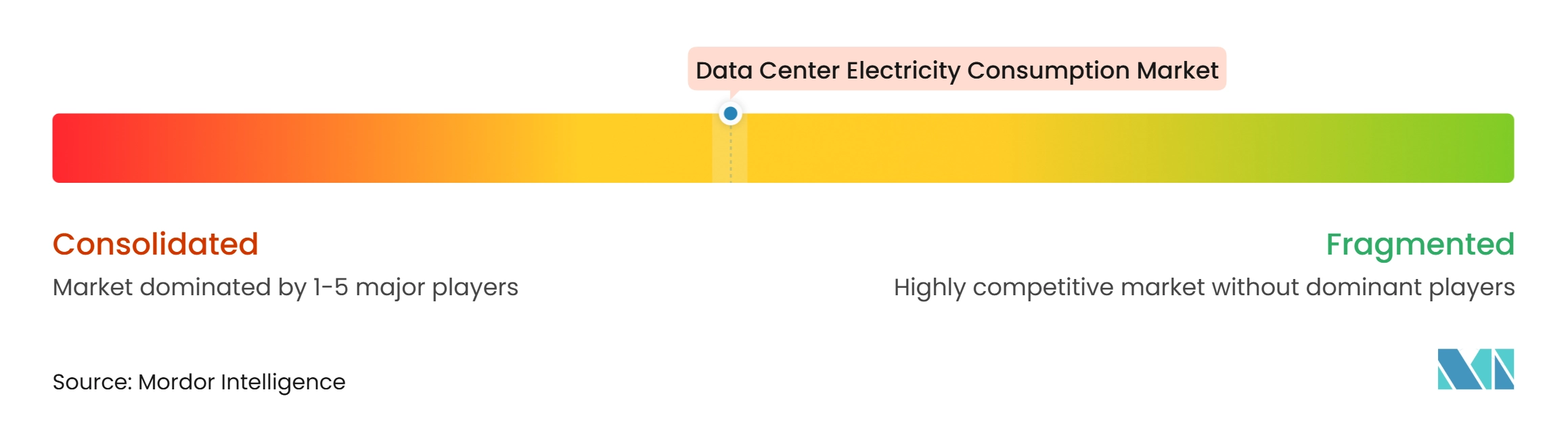
The data center electricity consumption market is moderately concentrated at the operating level because a limited group of hyperscale companies accounts for a large share of global electricity demand. Google, Microsoft, Amazon Web Services, Meta, Alibaba, and Tencent have the scale to secure long-duration power arrangements and build large campuses. Competition among colocation providers centers on reliable power delivery, interconnection, cooling readiness, and the ability to add capacity quickly. Equipment suppliers such as Schneider Electric, Vertiv, Eaton, ABB, and Siemens compete through systems that improve power distribution and thermal management.
Large technology companies use renewable procurement and long-term contracts to support computing expansion and reduce exposure to supply risk. Schneider Electric unveiled software-defined medium-voltage switchgear in September 2026 at an Equinix colocation facility, stating that it can enable 3x faster ordering and 2x faster commissioning.[3] The move shows how suppliers are responding to shorter deployment schedules and more complex power systems. It also reflects a stronger focus on commissioning speed, which matters where customer demand can change faster than conventional infrastructure delivery.
Power-advantaged areas with limited existing data center infrastructure remain attractive for new entrants. Campus-scale projects that pair computing capacity with on-site generation can avoid some utility queue constraints, although they entail additional development and operational responsibilities. Equinix introduced a Distributed AI infrastructure solution and an AI-ready backbone at its AI Summit in 2025, signaling a broader shift toward integrated AI infrastructure services. Digital Realty began construction of its 24 MW KIX15 site in Osaka in October 2026, using hybrid air and liquid cooling for hyperscale and cloud customers. These strategies show that power availability, cooling design, and location diversification are becoming linked competitive decisions.
Data Center Electricity Consumption Industry Leaders
-
Schneider Electric SE
-
Vertiv Group Corp.
-
ABB Ltd.
-
Eaton Corporation plc
-
Caterpillar Inc.
- *Disclaimer: Major Players sorted in no particular order
Data Center Electricity Consumption Market Companies Covered in this Report
- Equinix, Inc.
- Digital Realty Trust, Inc.
- NTT DATA Corporation
- QTS Realty Trust, Inc.
- ABB Ltd
- Caterpillar Inc.
- Switch, Inc.
- STACK Infrastructure, Inc.
- Google LLC
- Microsoft Corporation
- Amazon Web Services, Inc.
- Meta Platforms, Inc.
- Oracle Corporation
- Alibaba Group Holding Limited
- Tencent Holdings Limited
- Schneider Electric SE
- Vertiv Holdings Co
- Siemens Aktiengesellschaft
- Eaton Corporation plc
- Johnson Controls International plc
Recent Industry Developments in Data Center Electricity Consumption Market
- November 2026: Microsoft announced plans to raise USD 25 billion in bonds to fund infrastructure expansion for AI and cloud data center development, with the offering expected to close on November 4, 2026, signaling continued aggressive capacity investment among hyperscale operators.
- October 2026: Equinix completed its acquisition of atNorth from CPP Investments, adding 800 MW of active development pipeline and a 1 GW future expansion opportunity to its portfolio, while simultaneously reporting a total developable capacity pipeline of 3 GW with land, power, and permitting largely secured.
- October 2026: Digital Realty reported a development pipeline of 1.5 GW under construction at a projected cost of USD 22 billion, while expanding into its 65th global metro through a joint venture in Turkey with an initial 22 MW project in Ankara.
- October 2026: Digital Realty commenced construction of KIX15, a 24 MW data center at its KIX Campus in Osaka, Japan, through the MC Digital Realty joint venture with Mitsubishi Corporation, designed for hybrid air- and liquid-cooling to serve hyperscale and CSP customers.
Global Data Center Electricity Consumption Market Report Scope
The Data Center Electricity Consumption Market refers to the annual expenditure on electricity consumed by data center facilities to operate IT infrastructure, cooling systems, power distribution infrastructure, and supporting facility systems. The market measures electricity consumption costs incurred by colocation providers, cloud service providers, enterprise data centers, edge facilities, and hyperscale campuses to support computing, storage, networking, cooling, and ancillary building operations. The market is influenced by data center capacity growth, cloud adoption, artificial intelligence workloads, energy-efficiency improvements, electricity prices, and regional power availability.
The Data Center Electricity Consumption Market Report is Segmented by Electricity Consumption Component (IT Equipment, Cooling Systems, Power Conversion and Distribution Losses, and Lighting and Other Building Systems), Data Center Size (Small, Medium, Large, and Hyperscale), Data Center Type (Colocation, Cloud Service Providers [CSPs], and Enterprise and Edge), and Geography (North America, South America, Europe, Asia-Pacific, and Middle East and Africa). The Market Forecasts are Provided in Terms of Value (USD).
Segmentation Overview
| IT Equipment |
| Cooling Systems |
| Power Conversion and Distribution Losses |
| Lighting and Other Building Systems |
| Small |
| Medium |
| Large |
| Hyperscale |
| Colocation |
| Cloud Service Providers (CSPs) |
| Enterprise and Edge |
| North America | United States |
| Canada | |
| Mexico | |
| South America | Brazil |
| Chile | |
| Colombia | |
| Argentina | |
| Peru | |
| Rest of South America | |
| Europe | Germany |
| United Kingdom | |
| France | |
| Netherlands | |
| Ireland | |
| Spain | |
| Italy | |
| Nordics | |
| Rest of Europe | |
| Asia-Pacific | China |
| Japan | |
| India | |
| Australia | |
| Singapore | |
| South Korea | |
| Malaysia | |
| Indonesia | |
| Rest of Asia-Pacific | |
| Middle East and Africa | Saudi Arabia |
| United Arab Emirates | |
| South Africa | |
| Israel | |
| Egypt | |
| Qatar | |
| Rest of Middle East and Africa |
| By Electricity Consumption Component | IT Equipment | |
| Cooling Systems | ||
| Power Conversion and Distribution Losses | ||
| Lighting and Other Building Systems | ||
| By Data Center Size | Small | |
| Medium | ||
| Large | ||
| Hyperscale | ||
| By Data Center Type | Colocation | |
| Cloud Service Providers (CSPs) | ||
| Enterprise and Edge | ||
| By Geography | North America | United States |
| Canada | ||
| Mexico | ||
| South America | Brazil | |
| Chile | ||
| Colombia | ||
| Argentina | ||
| Peru | ||
| Rest of South America | ||
| Europe | Germany | |
| United Kingdom | ||
| France | ||
| Netherlands | ||
| Ireland | ||
| Spain | ||
| Italy | ||
| Nordics | ||
| Rest of Europe | ||
| Asia-Pacific | China | |
| Japan | ||
| India | ||
| Australia | ||
| Singapore | ||
| South Korea | ||
| Malaysia | ||
| Indonesia | ||
| Rest of Asia-Pacific | ||
| Middle East and Africa | Saudi Arabia | |
| United Arab Emirates | ||
| South Africa | ||
| Israel | ||
| Egypt | ||
| Qatar | ||
| Rest of Middle East and Africa | ||
Key Questions Answered in the Report
What is the data center electricity consumption market size?
The data center electricity consumption market is projected to be USD 26.50 billion in 2026, USD 28.28 billion in 2027, and USD 39.51 billion by 2032. The forecast period runs from 2027 to 2032 at a 6.92% CAGR.
What is driving data center electricity demand?
AI training, inference workloads, cloud migration, higher rack density, and new hyperscale facilities are raising electricity needs. These forces increase both the total volume of power required and the importance of dependable delivery at each location.
Which component uses the largest share of data center electricity?
IT Equipment held 56.21% of the market in 2026 because servers, storage systems, and networking hardware are the main sources of facility load. Cooling Systems are expected to require greater attention as high-density deployments become more common.
Why are cooling systems becoming more important for data centers?
Cooling Systems are projected to expand at an 8.14% CAGR through 2032 as direct liquid cooling supports denser AI equipment. Thermal management also affects the reliability and usable capacity of power-intensive hardware.
Which region is expected to add data center electricity demand fastest?
Asia-Pacific is projected to expand at a 7.81% CAGR through 2032, supported by activity in China, India, Singapore, Japan, and Southeast Asia. National computing policies and managed capacity approvals shape how this expansion reaches the grid.
What limits new data center development?
Grid connection delays, electricity price exposure, and energy efficiency requirements can delay projects or increase development costs.