
Data Center Distributed Energy Resources Market Size and Share
Market Overview
| Study Period | 2021 - 2032 |
|---|---|
| Market Size (2027) | USD 28.54 Billion |
| Market Size (2032) | USD 61.21 Billion |
| Growth Rate (2027 - 2032) | 16.49 % |
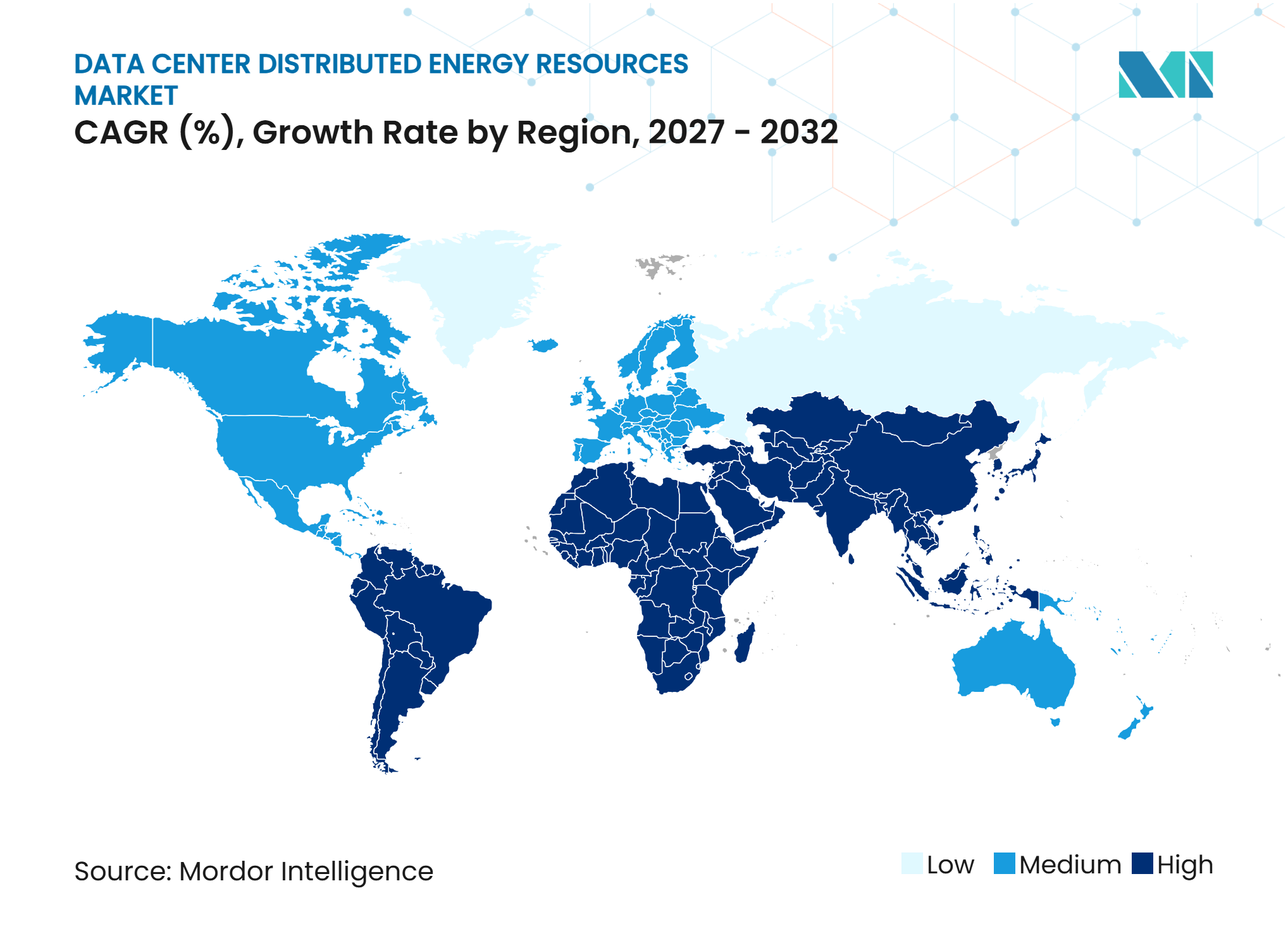
| Fastest Growing Market | Asia-Pacific |
| Largest Market | North America |
| Market Concentration | Medium |
Major Players *Disclaimer: Major Players sorted in no particular order Image © Mordor Intelligence. Reuse requires attribution under CC BY 4.0. | |
Data Center Distributed Energy Resources Market Analysis by Mordor Intelligence
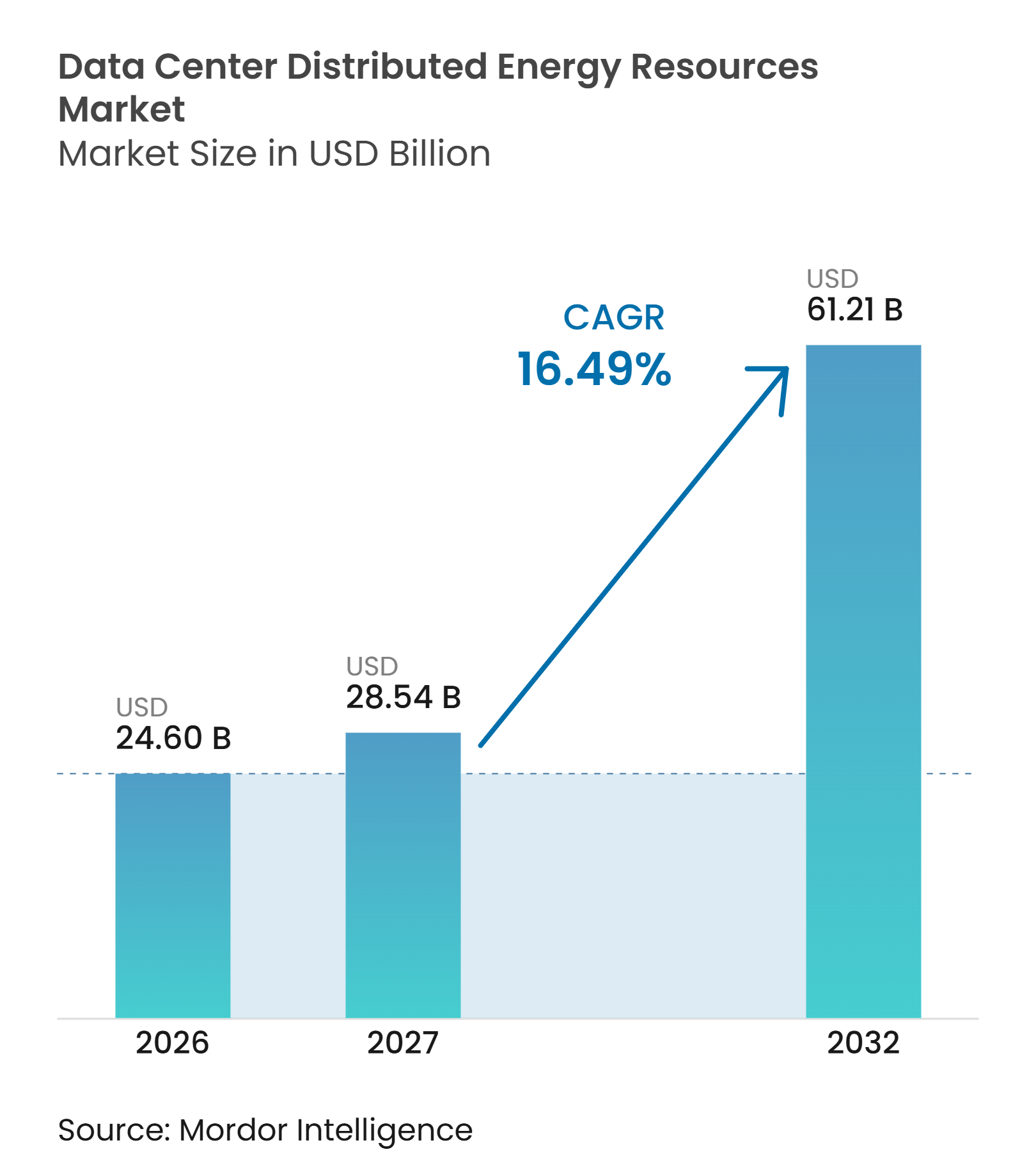
The data center distributed energy resources market size is projected to expand from USD 24.60 billion in 2026 to USD 28.54 billion in 2027, and to USD 61.21 billion by 2032, registering a CAGR of 16.49% between 2027 and 2032. Grid constraints are changing the way data center developers secure power, particularly where utility connections take several years. On-site generation, batteries, and local renewable systems are becoming part of core campus planning rather than a reserve option. The data center distributed energy resources market is also being shaped by the growing demand for uninterrupted power for AI workloads and cloud services. Suppliers are responding with integrated systems that link generation, storage, and control software to grid participation. This favors providers that can reduce deployment time while helping operators manage cost, reliability, and compliance requirements. The data center distributed energy resources market will therefore reward projects that treat power planning as part of data center design from the earliest site-selection stage, rather than as a late connection and backup-power decision.
Key Report Takeaways
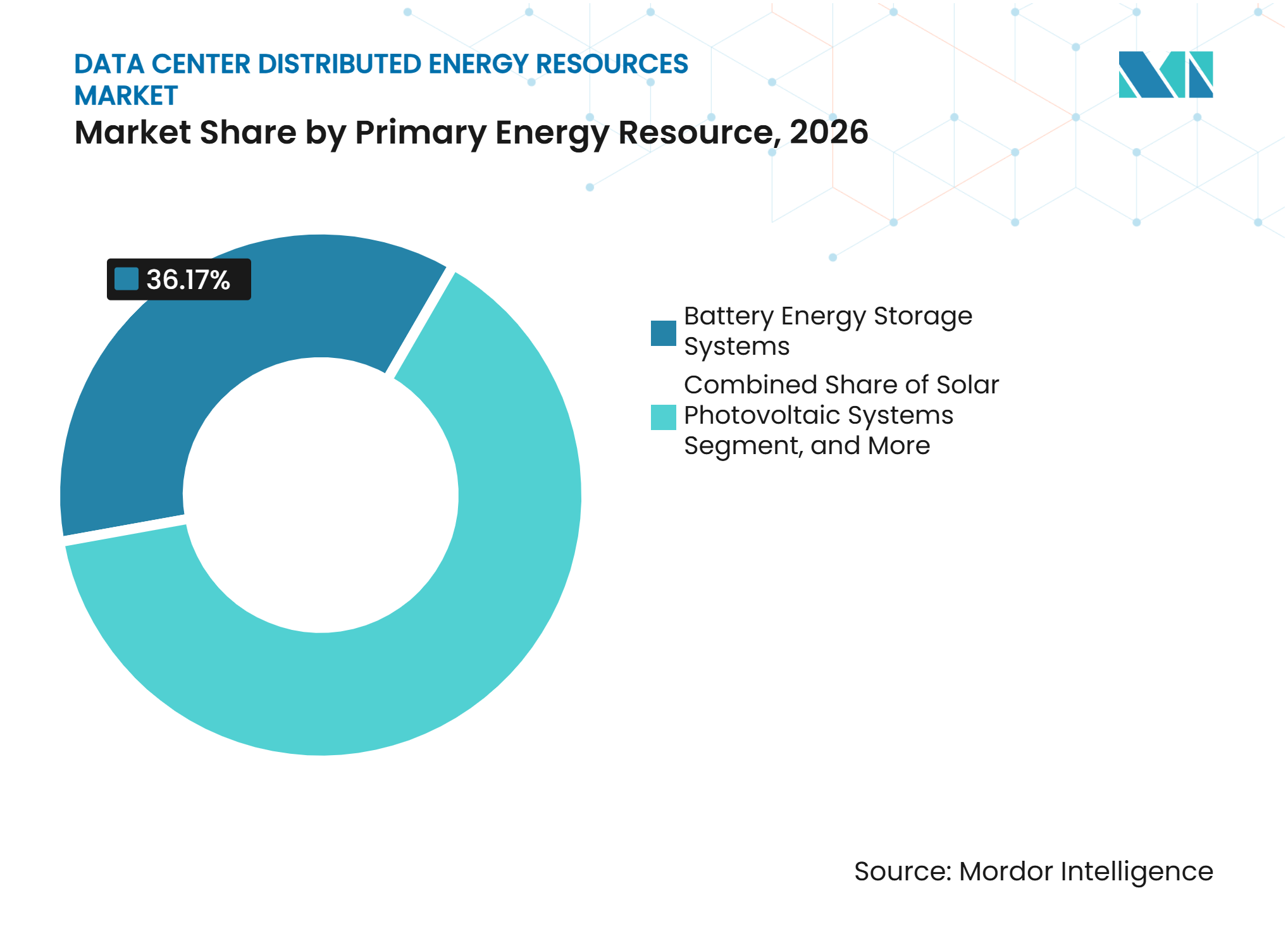
- By primary energy resource, battery energy storage systems held 36.17% of the data center distributed energy resources market share in 2026, while fuel cells are projected to expand at a 17.35% CAGR through 2032.
- By system configuration, hybrid distributed energy systems accounted for 56.19% of the data center distributed energy resources market share in 2026, while virtual power plant-connected resources are expected to advance at an 18.23% CAGR through 2032.
- By ownership model, data center-owned systems held 55.23% of the data center distributed energy resources market share in 2026, while Energy-as-a-Service is projected to expand at an 18.56% CAGR through 2032.
- By application, backup power and resilience accounted for 37.18% of the data center distributed energy resources market share in 2026, while grid and ancillary services are expected to advance at a 17.68% CAGR through 2032.
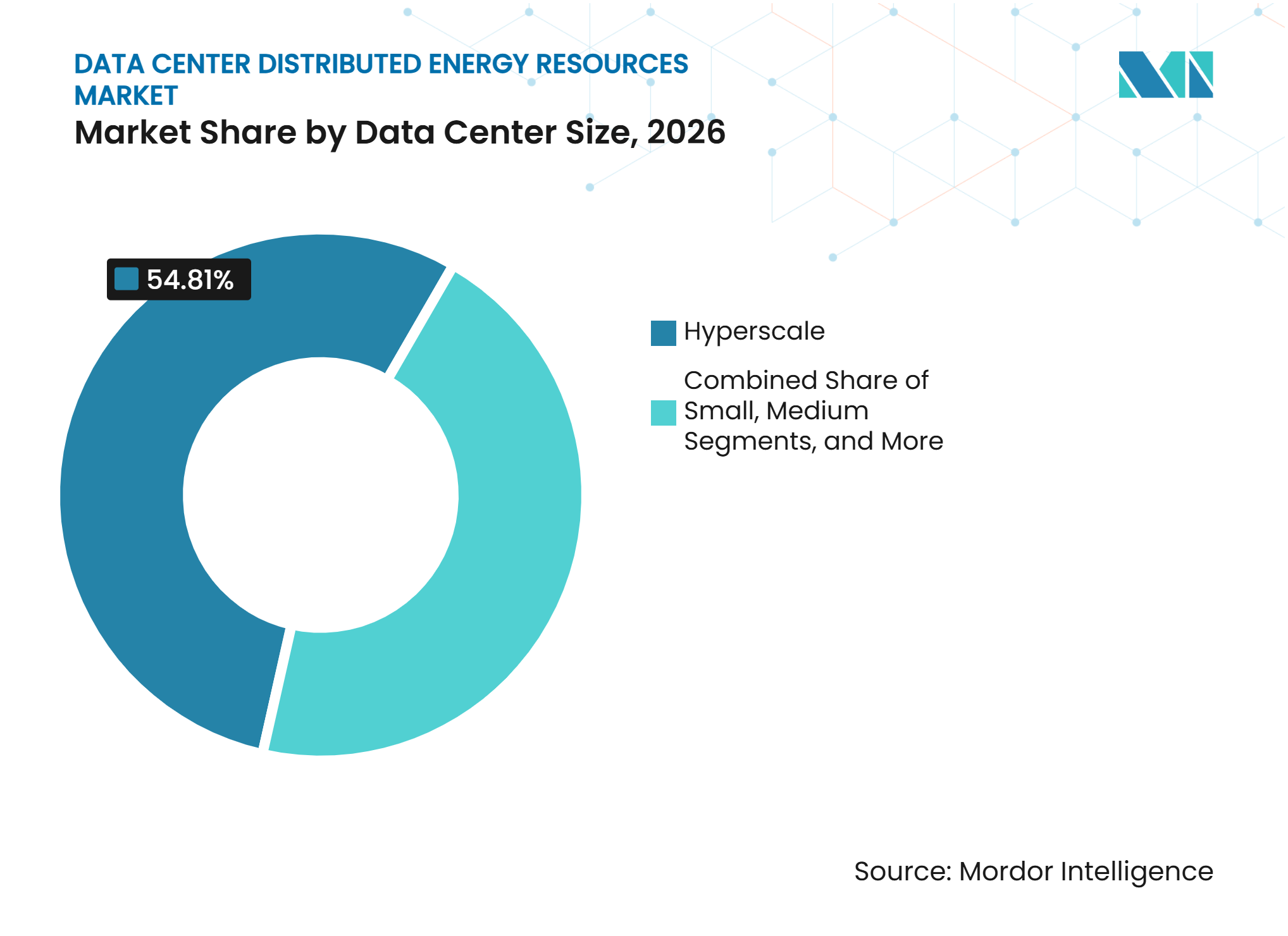
- By data center size, hyperscale facilities held 54.81% of the data center distributed energy resources market share in 2026 and are projected to expand at an 18.77% CAGR through 2032.
- By data center type, colocation facilities accounted for 62.91% of the data center distributed energy resources market share in 2026, while cloud service providers are expected to advance at a 19.05% CAGR through 2032.
- By geography, North America held 40.31% of the data center distributed energy resources market share in 2026, while Asia-Pacific is projected to expand at a 17.91% CAGR through 2032.
Note: Market numbers in this report are based on Mordor Intelligence's proprietary estimation framework, which combines nine months of actuals with Q4 projections for base year 2026.
Market Trends and Insights
Drivers Impact Analysis of Data Center Distributed Energy Resources Market*
| Driver | (~) % Impact on CAGR Forecast | Geographic Relevance | Impact Timeline |
|---|---|---|---|
| Integration of Local Energy Resources | +4.1% | Global, concentrated in North America and Asia-Pacific | Medium term (2-4 years) |
| Behind-the-Meter Generation and Storage Adoption | +3.4% | North America and Europe, with spillover to Asia-Pacific | Short term (≤ 2 years) |
| Grid Congestion and Utility Supply Constraints | +2.8% | North America and Europe, with secondary impact in Asia-Pacific | Short term (≤ 2 years) |
| Need for Power Resilience and Energy Independence | +2.0% | Global | Short term (≤ 2 years) |
| Virtual Power Plants and Aggregated Resources | +1.5% | North America and Europe, early stage in Asia-Pacific and Middle East and Africa | Medium term (2-4 years) |
| Distributed Energy Resource Management Systems Adoption | +1.0% | Global, with early gains in North America | Long term (≥ 4 years) |
| Source: Mordor Intelligence | |||
Integration of Solar, Batteries, Generators, and Other Local Energy Resources
Integrated local energy systems are supporting data center projects that need dependable power without relying on a single supply source. A 2025 peer-reviewed analysis of six grid-tied, behind-the-meter designs for ERCOT data centers reported levelized energy costs ranging from USD 64.50 per MWh for geothermal-plus-solar arrangements to USD 94.20 per MWh for small modular reactor-based designs. The study used a USD 75.00-per-MWh grid-only case as its comparison point. The results show that certain combined portfolios can meet cost and reliability requirements at a level comparable to grid supply. Batteries can smooth load changes, generators can provide firm capacity, and solar can support renewable procurement needs. The data center distributed energy resources market therefore increasingly competes on system design rather than on any single equipment category. Developers need to determine how much local capacity is needed, how that capacity will interact with the grid, and which resources can meet both operating and sustainability requirements over the campus's expected life.
Increasing Adoption of Behind-The-Meter Power Generation and Storage
Behind-the-meter systems are increasingly used as a means to achieve earlier power availability across large data center campuses. Their role includes providing on-site capacity while the utility connection is delayed or constrained. This approach can also reduce exposure to peak demand charges and support continuity during grid disruptions. The wider adoption of these systems changes the relationship between utilities and large-load customers, as self-generation can reduce the volume of electricity purchased from the network. Developers that maintain an operational connection to the grid can offer flexible capacity rather than treating local generation solely as an isolated supply source. The data center distributed energy resources market benefits when system designs combine site-level reliability with a practical plan for grid interaction.
Grid Congestion and Constraints on Utility-Supplied Electricity
Grid congestion is making speed-to-power a central concern for data center developers across several established hubs. Rocky Mountain Institute modeled a Memphis cluster in which 750 MW of solar, 280 MW of battery storage, and virtual power plant resources could offset 65% of peak demand from a 560 MW data center cluster. The finding illustrates the scale at which local portfolios can reduce a project’s immediate grid requirement. In June 2026, the Southwest Power Pool received approval for its Conditional High Impact Large Load Service framework, which can provide conditional transmission service while designated generation is developed. Similar approaches could help developers match new load with verifiable local supply. Such regulatory changes create a stronger commercial case for coordinated generation and storage.
Demand for Greater Power Resilience and Energy Independence
Continuous computing workloads make resilience a core operating requirement for data center operators. Bloom Energy states that its solid oxide fuel cells can provide 99.9% to 99.999% availability and support more than 200,000 charge cycles.[1] This operating profile supports their use for primary-load applications where downtime can disrupt customer services. Local generation also gives operators more control over fuel, maintenance, and dispatch decisions during grid events. The need is especially relevant for campuses with high AI processing density because these facilities can have substantial and less flexible electricity demand. The data center distributed energy resources market gains from this shift toward power architectures designed for continuous service.
Restraints Impact Analysis of Data Center Distributed Energy Resources Market*
| Restraint | (~) % Impact on CAGR Forecast | Geographic Relevance | Impact Timeline |
|---|---|---|---|
| High Capital and Integration Costs | -2.5% | Global, most acute in South America and Middle East and Africa | Short term (≤ 2 years) |
| Fragmented Electricity Market Regulations | -1.7% | North America and Europe | Medium term (2-4 years) |
| Grid Interconnection and Electricity Export Restrictions | -1.2% | North America, Europe, and early-stage Asia-Pacific markets | Medium term (2-4 years) |
| Complexity of Coordinating Multiple Energy Technologies | -0.9% | Global | Long term (≥ 4 years) |
| Source: Mordor Intelligence | |||
High Capital and Integration Costs
High upfront costs can delay adoption, particularly at enterprise and edge sites that cannot spread investment across a large portfolio. The National Renewable Energy Laboratory reported in June 2025 that a four-hour battery system cost USD 1,300 per kW, compared with USD 1,000 per kW for a comparable reciprocating generator. This cost gap means batteries are frequently deployed alongside conventional backup equipment rather than replacing it outright. Integrated projects also require engineering, control software, installation, and operating expertise. Energy-as-a-Service models can reduce the initial financial burden by allowing a specialist to finance and manage the assets. These models may be particularly relevant where resilience is required, but capital must remain available for computing infrastructure.
Fragmented Regulations Across Electricity Markets
Regulatory requirements differ across the locations that are attracting new data center capacity. Ireland’s CRU/2025236 policy requires data centers above 10 MVA to provide dispatchable on-site or proximate generation and storage equal to 100% of maximum import capacity, with participation in the wholesale electricity market. Germany requires data centers to meet electricity demand with renewable sources from January 2027 under its energy-efficiency framework. These requirements can increase project complexity because developers must align equipment, contracts, and operating procedures with local rules. In North America, requirements vary by state and utility territory, raising legal and planning costs for multi-site operators. Clearer, more consistent rules could shorten development cycles in the data center distributed energy resources market.
*Our forecasts treat driver/restraint impacts as directional, not additive. The impact forecasts reflect baseline growth, mix effects, and variable interactions.
Data Center Distributed Energy Resources Market Segment Analysis
By Primary Energy Resource:
Battery Storage Anchors the Installed BaseBattery energy storage systems held a 36.17% share in 2026. Their installed base reflects their ability to support multiple operational needs with a single asset. Batteries can smooth demand, reduce peak charges, provide short-duration backup, and respond to grid signals. This functional range makes them useful at facilities ranging from small edge sites to hyperscale campuses. Natural gas generation remains important for primary load and emergency supply because the equipment is familiar and can be delivered within known project schedules. Solar photovoltaic systems and combined heat and power plants serve complementary roles where renewable procurement or local thermal needs justify their use. The data center distributed energy resources market relies on this mix because no single resource meets every site requirement. Equipment selection therefore depends on the local grid, fuel supply, load pattern, and resilience target.
Fuel cells are projected to expand at a 17.35% CAGR through 2032, the highest rate among primary energy resources. Bloom Energy reported that it can deploy on-site fuel cell power for Oracle data center projects within 90 days. This timing is valuable when the utility connection does not align with the campus delivery schedule. Solid oxide fuel cells are being considered for continuous power because they offer high availability and lower local emissions than many conventional alternatives. Emerging categories, including enhanced geothermal and small modular reactor-adjacent concepts, remain less established in installed capacity. Their relevance lies in giving operators additional options for long-term power planning. Procurement teams can match the technology choice with the expected construction date and the required period of continuous operation. This keeps the data center distributed energy resources market open to several power pathways as demand conditions change.



By System Configuration:
Hybrid Architectures Capture a Commanding ShareHybrid systems accounted for 56.19% of the market in 2026. These systems generally combine dispatchable generation, renewable supply, and battery storage under a common control platform. The architecture gives operators more choices when fuel costs, grid conditions, or load requirements change. It also helps campuses maintain supply when one resource is unavailable or performing maintenance. Standalone systems remain relevant for smaller facilities with simpler load profiles and limited capital budgets. Integrated microgrids add islanding and two-way grid capability, which can be useful where local rules allow a site to provide flexible capacity. A common operating platform is important because it coordinates the timing of each resource. This reduces the need for operators to manage separate systems during a power event.
Virtual power plant-connected resources are expected to advance at an 18.23% CAGR through 2032. These models aggregate batteries, responsive loads, and local generation into a dispatchable portfolio. Rocky Mountain Institute estimates that US virtual power plant capacity could reach 160 GW by 2030, covering 20% of peak demand. In June 2026, Google and Voltus announced an arrangement to develop up to 100 MW of accredited distributed capacity in PJM.[2] This model can help a data center meet capacity obligations without building all resources in a single location. It also makes dispatch software and communications standards more important to project performance. The approach can create a commercial role for capacity that would otherwise go unused on-site. The data center distributed energy resources market can therefore benefit from revenue opportunities as well as power reliability needs.
By Ownership Model:
Direct Ownership Leads, Service Models Gain GroundData center-owned assets accounted for 55.23% in 2026. Large operators often prefer direct control when on-site power performance affects availability commitments. Ownership can also give a campus greater control over operating procedures and future equipment upgrades. This approach is most practical for hyperscale operators with dedicated energy teams and substantial capital resources. Utility-owned and third-party-owned systems serve facilities that prefer to limit asset management responsibilities. They can also provide access to specialized technical and commercial capabilities. The choice between ownership models often reflects a customer’s ability to accept capital expenditure and operating responsibility. It also affects how quickly a project can move from design to operation.
Energy-as-a-Service is projected to expand at an 18.56% CAGR through 2032. In this model, a specialist can design, finance, own, and operate on-site resources under a performance-based agreement. The customer receives a defined power service while avoiding much of the initial capital commitment. This can make local energy systems more accessible to colocation providers and enterprise operators. The model can also help standardize maintenance, monitoring, and contract management across a portfolio. Service-based structures will be important where a customer needs resilient power but does not want to operate a complex energy system. They can align the provider’s compensation with availability, cost control, and performance. This helps broaden participation in the data center distributed energy resources market beyond the largest operators. It can allow a customer to select an operating outcome, such as defined availability or predictable service costs, without first building internal expertise in financing, engineering, dispatch, maintenance, and compliance management.
By Primary Application:
Resilience Leads as Grid Participation ExpandsBackup power and resilience accounted for 37.18% in 2026. Data centers need dependable electricity to meet service commitments to cloud, enterprise, and colocation customers. Many sites are updating diesel-only backup arrangements with batteries, natural gas generation, and fuel cells. These combinations can improve operating flexibility while addressing local air-quality requirements. Energy cost optimization is also relevant because local resources can reduce demand charges and support load shifting. This use case is more important in markets with variable electricity prices and defined peak periods. It also allows the same assets to support both risk management and routine operating efficiency. Project economics improve when resources have several practical uses. For the data center distributed energy resources market, this means that equipment selection should consider daily power needs, emergency operation, and the potential value of responding to grid conditions, instead of considering each use in isolation.
Grid and ancillary services are projected to advance at a 17.68% CAGR through 2032. This application turns a data center from a passive electricity user into a participant capable of providing flexible capacity. It depends on control systems that coordinate batteries, responsive loads, and generators in response to grid instructions. IEEE 2030.5 supports communication between distributed energy devices and grid systems. Peak shaving, renewable integration, and demand response remain related uses for the same equipment base. The opportunity is strongest where tariffs and market rules pay large loads for flexible operation. Operators must still preserve their service commitments before offering any resource to the grid. Clear operating rules are necessary to ensure that grid participation does not weaken site resilience.
By Data Center Size:
Hyperscale Sites Lead on Scale and Growth RateHyperscale facilities held a 54.81% share in 2026 and are projected to expand at an 18.77% CAGR through 2032. Their scale allows operators to evaluate large fuel cell, battery, microgrid, and behind-the-meter projects. These projects can achieve per-megawatt economics that smaller facilities struggle to match. Large fuel cell and generator procurement commitments show the scale that these operators can bring to on-site power planning. Bloom Energy’s work with Oracle Cloud Infrastructure demonstrated an on-site fuel cell deployment approach designed for short delivery schedules. Large contracts of this kind influence manufacturing priorities across the power equipment supply chain. They also encourage suppliers to plan capacity around fewer but much larger customer commitments. This purchasing pattern is a defining feature of the data center distributed energy resources market. It also makes supply planning important for equipment makers because a small number of large orders can affect factory capacity, component allocation, installation schedules, and the availability of qualified service personnel.
Large and medium data centers generally use batteries, backup generators, and, in some locations, rooftop solar. Their focus is usually on cost control and continuity rather than on operating a full primary power plant. Small sites and edge facilities incur higher per-MW costs and have fewer resources for complex project development. Modular equipment and service-based contracts can reduce those barriers. These sites remain important because they often serve locations with weaker grid reliability. Their demand can support standardized, repeatable distributed energy packages. Providers that simplify design and installation can make distributed systems more practical for this tier. The segment offers a route to adoption outside the largest cloud campuses. The data center distributed energy resources market can reach a wider installed base when packaged systems reduce the time needed to assess site conditions, select equipment, and establish the service and maintenance arrangements required for dependable operation.

By Data Center Type:
Colocation Facilities Hold the Largest ShareColocation facilities accounted for 62.91% of the market in 2026. These operators manage shared infrastructure for multiple tenants with different power profiles and sustainability commitments. That operating model creates continuing demand for batteries, flexible generation, and energy management software. Colocation sites must balance tenant requirements with aggregate capacity limits and their own reliability commitments. A 2025 IEEE study found that virtual energy storage methods could improve infrastructure use and reduce provisioning costs by 32% in colocation environments. This supports the case for more detailed control of distributed resources in shared facilities. It also shows why customer-level allocation and transparent operating data matter in multi-tenant environments. These requirements can strengthen demand for management software alongside physical equipment.
Cloud service providers are projected to expand at a 19.05% CAGR through 2032. AI computing expansion is increasing their need for scalable power at new campuses. Many cloud providers also have renewable electricity and carbon commitments that shape procurement choices. Local resources can help them secure capacity while supporting those commitments across new high-density computing campuses and the local energy infrastructure and operating systems that support them. Enterprise and edge facilities represent a separate demand base with different site constraints. Edge deployments can benefit from local power in locations where grid reliability is lower, or capacity is less predictable. Their smaller scale does not remove the need for uptime, particularly for workloads that support local users. Providers can serve this demand with modular systems that are easier to deploy and maintain.
Geography Analysis
North America
North America held a 40.31% share in 2026. The region has a large concentration of hyperscale facilities and an established supply base for on-site power equipment. Long utility connection timelines have encouraged developers to consider generation and storage while planning new campuses. The Southwest Power Pool’s Conditional High Impact Large Load Service framework shows a regulatory route for pairing large new loads with designated supply resources. US standards such as IEEE 1547 influence how distributed resources interconnect with the grid. Canada and Mexico also offer development opportunities as operators seek capacity near established connectivity corridors. Local power systems can help projects manage uncertain connection schedules.
Asia-Pacific
Asia-Pacific is projected to expand at a 17.91% CAGR through 2032. Data center construction is rising across China, India, Japan, Singapore, and Southeast Asia, increasing pressure on local electricity systems. China has a large battery storage base and is developing energy storage applications for high-load facilities. Singapore is exploring a distributed virtual power plant with DayOne and Blue Whale Energy that would coordinate batteries across commercial and industrial sites.[3] India’s state policies for renewable energy and storage can support co-located systems. South Korea is also attracting new capacity from national technology firms and international power suppliers. These markets create demand for adaptable designs that account for local land, network, and permitting constraints. The data center distributed energy resources market must also accommodate diverse fuel options, weather conditions, reliability standards, and rules governing exporting or aggregating capacity, rather than relying on a single regional design approach.
Europe, Middle East and Africa, and South America
Europe is notable for rules that directly link data center development with energy and sustainability obligations. Ireland’s large-energy-user policy requires qualifying sites to provide dispatchable generation and storage equal to maximum import capacity. Germany’s strategy includes renewable electricity requirements starting in January 2027, making energy sourcing a compliance requirement for data center operators. Germany’s Federal Network Agency reported that net applications for battery storage grid connections rose 194% in 2025. Middle East and Africa markets offer greenfield opportunities, especially where new campuses can be developed with dedicated generation from the outset. South America remains smaller, although Brazil’s grid reliability needs and Chile’s regulated electricity structure support different behind-the-meter and third-party ownership cases. These regions will require commercial models that align with local regulations, available fuel, and grid conditions. The data center distributed energy resources market has an opportunity in these locations when developers design the generation, storage, financing, and grid-connection approach around each location’s conditions rather than importing a configuration built for a different power system.
Competitive Landscape
Market Concentration
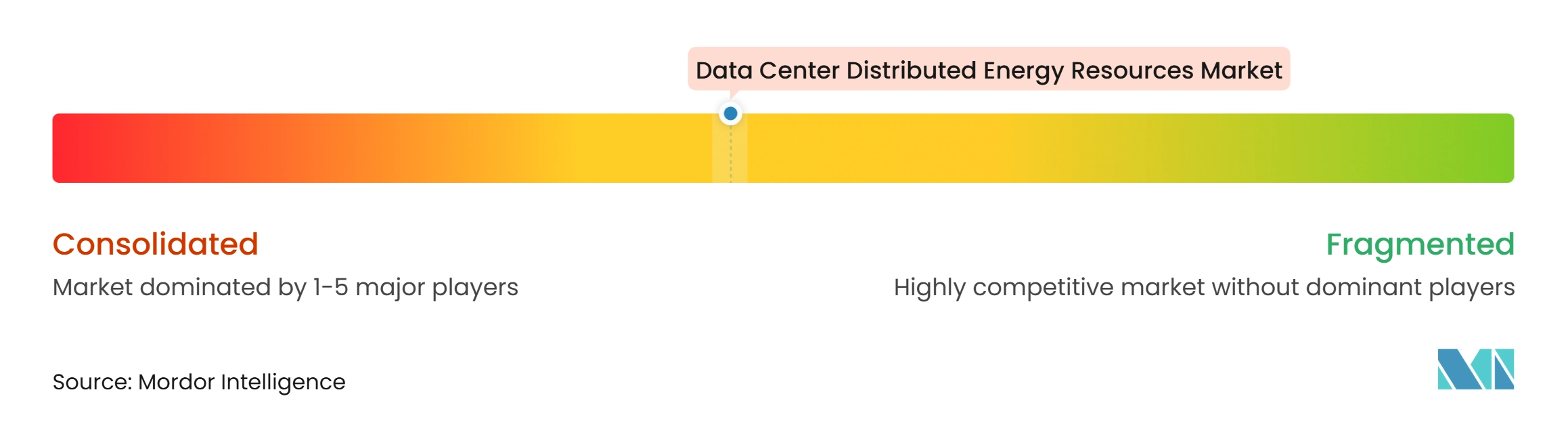
The data center distributed energy resources market includes industrial equipment suppliers, energy management software providers, storage companies, and grid-services platforms. Schneider Electric, Siemens, ABB, and Eaton compete by offering broad portfolios of electrical equipment and by building relationships with data center infrastructure buyers. Bloom Energy is a specialist in solid oxide fuel cells for continuous on-site power. Fluence focuses on battery storage and related software. Wärtsilä supplies flexible engine generation for large-load applications. Competition is increasingly based on the ability to integrate physical equipment with monitoring, dispatch, and project services. This favors suppliers that can address the full operating life of a system.
Company strategies increasingly involve partnerships because data center power projects require equipment, project development, utility coordination, and customer commitments. ABB and NVIDIA announced a 2025 collaboration focused on 800 VDC power architecture for 1 MW server racks.[4] The work positions power infrastructure around the needs of high-density AI computing. Eaton and Siemens Energy announced a 2025 collaboration to develop modular, integrated on-site power and electrical systems for data centers. Bloom Energy and Equinix expanded their agreement in February 2025 beyond 100 MW across 19 US data centers in 6 states. These moves show that suppliers are pursuing repeatable designs and long-term customer arrangements.
Software interoperability is becoming more important as operators connect on-site assets to utility and wholesale market programs. IEEE 1547 and IEEE 2030.5 provide relevant technical frameworks for interconnection and device communications. Energy-as-a-Service providers can address customers that need resilient local power but do not want direct asset ownership. Smaller developers and virtual power plant operators can compete by simplifying access to grid programs. Large established suppliers retain an advantage in equipment breadth, installation capacity, and existing customer relationships. Specialized firms retain an advantage when a project requires a particular storage, fuel cell, or software capability. The competitive outcome will depend on whether providers can deliver reliable systems within the customer’s required construction schedule. In the data center distributed energy resources market, suppliers also need to show that equipment, software, controls, and service arrangements can operate together without creating unnecessary interfaces or uncertainty for the customer.
Data Center Distributed Energy Resources Industry Leaders
-
Schneider Electric SE
-
Siemens AG
-
ABB Ltd.
-
Eaton Corporation plc
-
Honeywell International Inc.
- *Disclaimer: Major Players sorted in no particular order
Data Center Distributed Energy Resources Market Companies Covered in this Report
- Schneider Electric SE
- Siemens AG
- ABB Ltd.
- Eaton Corporation plc
- Honeywell International Inc.
- Generac Holdings Inc.
- Tesla, Inc.
- Fluence Energy, Inc.
- Sungrow Power Supply Co., Ltd.
- Huawei Digital Power Technologies Co., Ltd.
- Enel X S.r.l.
- AutoGrid Systems, Inc.
- EnergyHub, Inc.
- Voltus, Inc.
- Caterpillar Inc.
- Cummins Inc.
- Bloom Energy Corporation
- Wärtsilä Corporation
- Kraken Technologies Limited
- Enchanted Rock Holdings, LLC
Recent Industry Developments in Data Center Distributed Energy Resources Market
- October 2026: American Electric Power announced plans to invest approximately USD 4 billion in a 702 MW fuel cell project using Bloom Energy's technology to supply Google data centers under a 20-year power purchase agreement, marking one of the largest single-utility commitments to fuel cell-based data center power and demonstrating that regulated utilities are actively financing onsite distributed generation to capture large-load customers.
- August 2026: Bloom Energy and MiTAC Computing expanded their partnership to deploy Bloom fuel cell systems at an AI server manufacturing campus in Fremont, California, extending fuel cell deployments beyond pure data center operations into manufacturing facilities with similar mission-critical uptime requirements.
- July 2026: Generac Holdings' data center generator backlog reached approximately USD 1.6 billion as of July 29, 2026, following the company's entry into the large-megawatt data center genset market in mid-2025; backlog growth was driven by commitments from multiple hyperscale customers and reflected sustained order intake at a pace exceeding the company's historical generator business.
- June 2026: Google and Voltus announced a three-year agreement under which Google funds a Voltus-operated VPP comprising up to 100 MW of accredited distributed capacity within PJM Interconnection, establishing a commercially replicable model for hyperscalers to procure capacity market obligations through aggregated distributed energy resources rather than dedicated generation assets.
Global Data Center Distributed Energy Resources Market Report Scope
The Data Center Distributed Energy Resources (DER) Market refers to the market for decentralized energy generation, storage, and management systems deployed within or adjacent to data center facilities to enhance power resilience, energy efficiency, sustainability, and grid interaction capabilities. These resources include solar photovoltaic systems, battery energy storage systems, fuel cells, onsite generation technologies, combined heat and power systems, and other distributed energy assets that support backup power, peak-demand management, renewable energy integration, energy-cost optimization, demand response participation, and ancillary grid services across colocation, cloud, enterprise, edge, and hyperscale data center environments.
The Data Center Distributed Energy Resources Market Report is Segmented by Primary Energy Resource (Solar Photovoltaic Systems, Battery Energy Storage Systems, Fuel Cells, Natural Gas and Other Onsite Generation, Combined Heat and Power Systems, and Other Distributed Energy Resources), System Configuration (Standalone Distributed Energy Resources, Hybrid Distributed Energy Systems, Integrated Microgrids, and Virtual Power Plant-Connected Resources), Ownership Model (Data Center-Owned, Utility-Owned, Third-Party-Owned, and Energy-as-a-Service [EaaS]), Primary Application (Backup Power and Resilience, Energy Cost Optimization, Peak Shaving and Load Shifting, Renewable Energy Integration, Demand Response, and Grid and Ancillary Services), Data Center Size (Small, Medium, Large, and Hyperscale), Data Center Type (Colocation, Cloud Service Providers [CSPs], and Enterprise and Edge), and Geography (North America, South America, Europe, Asia-Pacific, and Middle East and Africa). The Market Forecasts are Provided in Terms of Value (USD).
Segmentation Overview
| Solar Photovoltaic Systems |
| Battery Energy Storage Systems |
| Fuel Cells |
| Natural Gas and Other Onsite Generation |
| Combined Heat and Power Systems |
| Other Distributed Energy Resources |
| Standalone Distributed Energy Resources |
| Hybrid Distributed Energy Systems |
| Integrated Microgrids |
| Virtual Power Plant-Connected Resources |
| Data Center-Owned |
| Utility-Owned |
| Third-Party-Owned |
| Energy-as-a-Service (EaaS) |
| Backup Power and Resilience |
| Energy Cost Optimization |
| Peak Shaving and Load Shifting |
| Renewable Energy Integration |
| Demand Response |
| Grid and Ancillary Services |
| Small |
| Medium |
| Large |
| Hyperscale |
| Colocation |
| Cloud Service Providers (CSPs) |
| Enterprise and Edge |
| North America | United States |
| Canada | |
| Mexico | |
| South America | Brazil |
| Chile | |
| Colombia | |
| Argentina | |
| Peru | |
| Rest of South America | |
| Europe | Germany |
| United Kingdom | |
| France | |
| Netherlands | |
| Ireland | |
| Spain | |
| Italy | |
| Nordics | |
| Rest of Europe | |
| Asia-Pacific | China |
| Japan | |
| India | |
| Australia | |
| Singapore | |
| South Korea | |
| Rest of Asia-Pacific | |
| Middle East and Africa | Saudi Arabia |
| United Arab Emirates | |
| South Africa | |
| Israel | |
| Egypt | |
| Qatar | |
| Rest of Middle East and Africa |
| By Primary Energy Resource | Solar Photovoltaic Systems | |
| Battery Energy Storage Systems | ||
| Fuel Cells | ||
| Natural Gas and Other Onsite Generation | ||
| Combined Heat and Power Systems | ||
| Other Distributed Energy Resources | ||
| By System Configuration | Standalone Distributed Energy Resources | |
| Hybrid Distributed Energy Systems | ||
| Integrated Microgrids | ||
| Virtual Power Plant-Connected Resources | ||
| By Ownership Model | Data Center-Owned | |
| Utility-Owned | ||
| Third-Party-Owned | ||
| Energy-as-a-Service (EaaS) | ||
| By Primary Application | Backup Power and Resilience | |
| Energy Cost Optimization | ||
| Peak Shaving and Load Shifting | ||
| Renewable Energy Integration | ||
| Demand Response | ||
| Grid and Ancillary Services | ||
| By Data Center Size | Small | |
| Medium | ||
| Large | ||
| Hyperscale | ||
| By Data Center Type | Colocation | |
| Cloud Service Providers (CSPs) | ||
| Enterprise and Edge | ||
| By Geography | North America | United States |
| Canada | ||
| Mexico | ||
| South America | Brazil | |
| Chile | ||
| Colombia | ||
| Argentina | ||
| Peru | ||
| Rest of South America | ||
| Europe | Germany | |
| United Kingdom | ||
| France | ||
| Netherlands | ||
| Ireland | ||
| Spain | ||
| Italy | ||
| Nordics | ||
| Rest of Europe | ||
| Asia-Pacific | China | |
| Japan | ||
| India | ||
| Australia | ||
| Singapore | ||
| South Korea | ||
| Rest of Asia-Pacific | ||
| Middle East and Africa | Saudi Arabia | |
| United Arab Emirates | ||
| South Africa | ||
| Israel | ||
| Egypt | ||
| Qatar | ||
| Rest of Middle East and Africa | ||
Key Questions Answered in the Report
What is the data center distributed energy resources market size?
The data center distributed energy resources market size is USD 24.60 billion in 2026 and is projected to reach USD 61.21 billion by 2032 at a 16.49% CAGR.
Why are data centers adopting distributed energy resources?
Grid constraints, the need for continuous power, and demand from AI workloads are encouraging on-site generation, battery storage, and local energy systems.
Which energy resource has the largest share in data center distributed energy resources?
Battery energy storage systems hold the largest primary energy resource share at 36.17% in 2026.
Which data center segment is expanding fastest?
Cloud service providers are projected to expand at a 19.05% CAGR through 2032, driven by increasing AI cloud computing capacity.
Which region leads data center distributed energy resources adoption?
North America leads with a 40.31% share in 2026, supported by hyperscale activity and the need to manage utility connection constraints.
How do virtual power plants support data centers?
Virtual power plants can coordinate batteries, flexible loads, and local generation so operators can provide capacity and ancillary services to the grid.