
Data Center Disaster Resilience and Business Continuity Market Size and Share
Market Overview
| Study Period | 2021 - 2032 |
|---|---|
| Market Size (2027) | USD 5.46 Billion |
| Market Size (2032) | USD 9.36 Billion |
| Growth Rate (2027 - 2032) | 11.38 % |
| Fastest Growing Market | Asia-Pacific |
| Largest Market | North America |
| Market Concentration | Medium |
Major Players *Disclaimer: Major Players sorted in no particular order Image © Mordor Intelligence. Reuse requires attribution under CC BY 4.0. | |
Data Center Disaster Resilience and Business Continuity Market Analysis by Mordor Intelligence
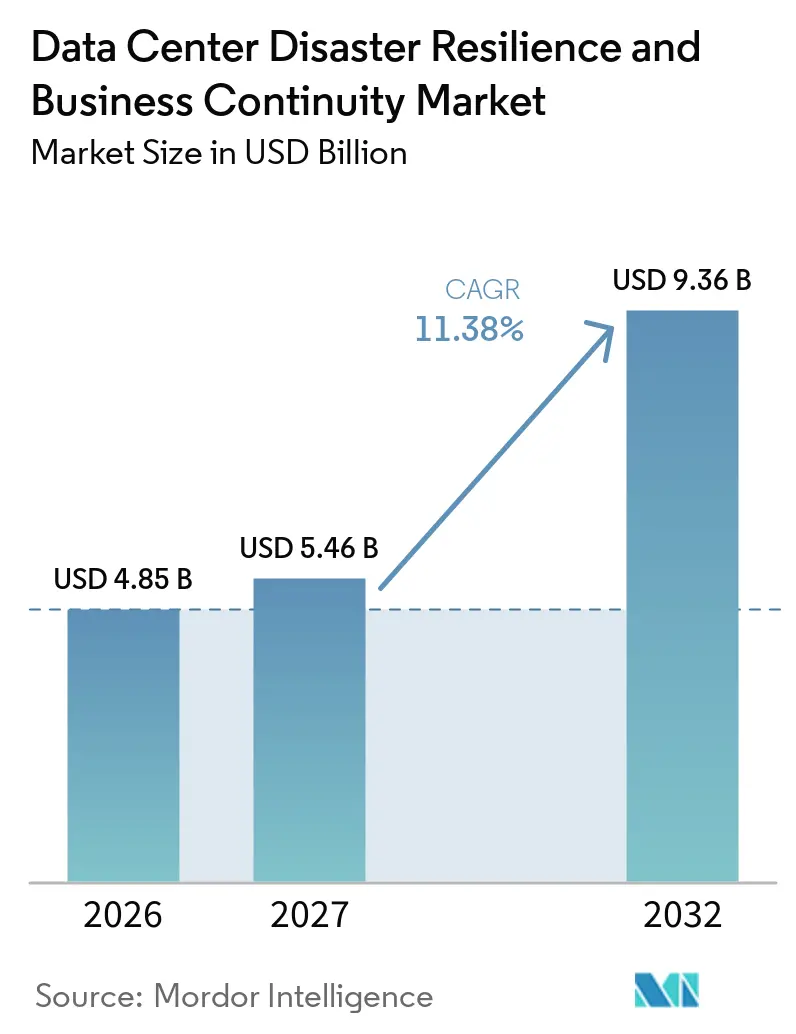
The Data Center Disaster Resilience And Business Continuity Market size is expected to increase from USD 4.85 billion in 2026 to USD 5.46 billion in 2027 and reach USD 9.36 billion by 2032, growing at a CAGR of 11.38% over 2027-2032. Rising outage costs are moving resilience spending from discretionary technology budgets into capital decisions overseen by finance leaders and audit committees. The data center disaster resilience and business continuity market is also being shaped by cloud expansion, AI workloads, and stricter continuity obligations for operators and their critical suppliers. Buyers increasingly seek platforms that connect impact analysis, planning, testing, crisis coordination, and recovery management rather than separate tools. This favors providers that can combine software with implementation, simulation, and managed services. Competitive activity is widening the use of AI-assisted testing and scenario modeling, while talent shortages and complex hybrid estates continue to slow program deployment.
Key Report Takeaways
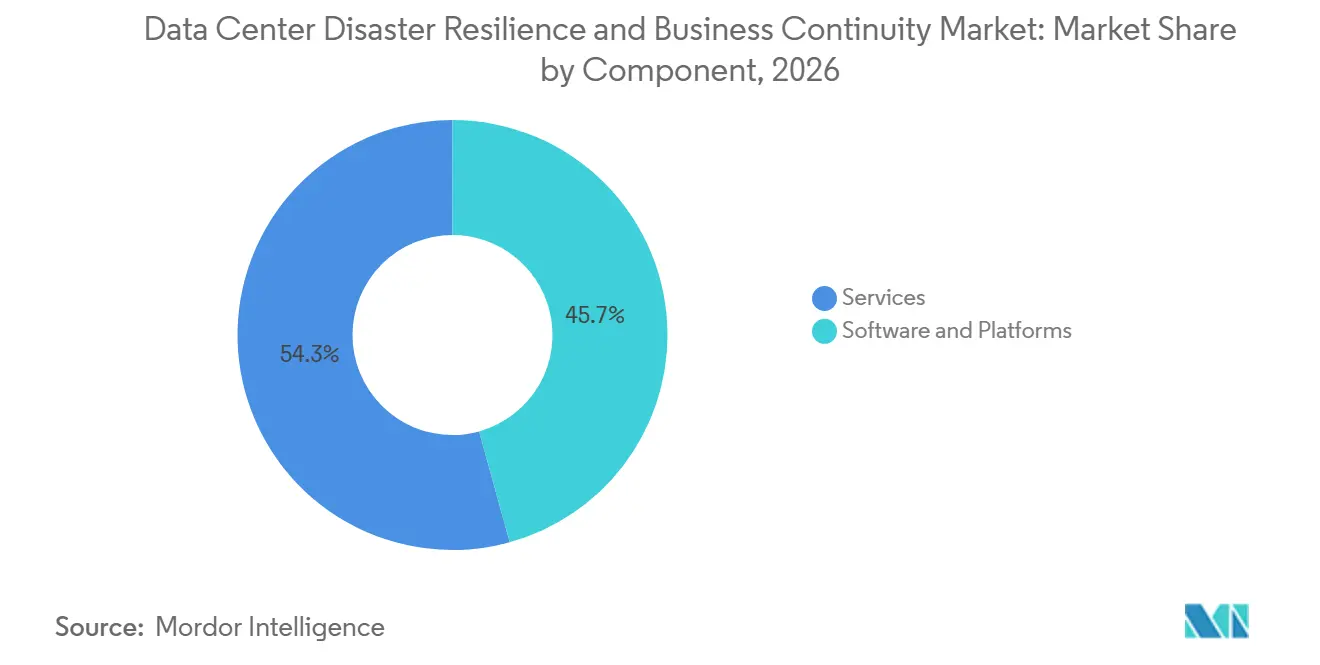
- By component, software and platforms held 45.71% of the data center disaster resilience and business continuity market share in 2026, while services are expected to expand at an 11.78% CAGR through 2032.
- By deployment mode, cloud held 58.97% share in 2026, while hybrid is projected to expand at an 11.81% CAGR through 2032.
- By data center type, enterprise and edge data centers held a 36.91% share in the data center disaster resilience and business continuity market in 2026, while cloud service providers are expected to expand at an 11.87% CAGR through 2032.
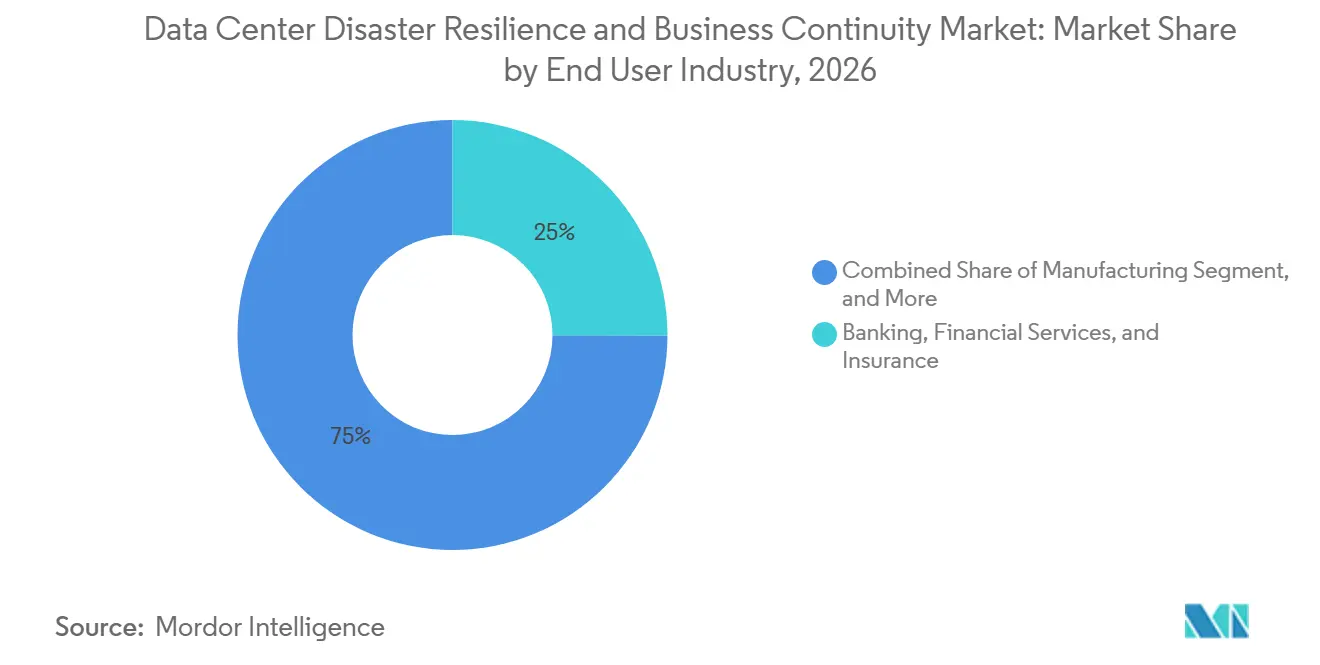
- By end-user industry, BFSI held a 25.03% share in 2026, while IT and telecommunications are projected to expand at a 12.62% CAGR through 2032.
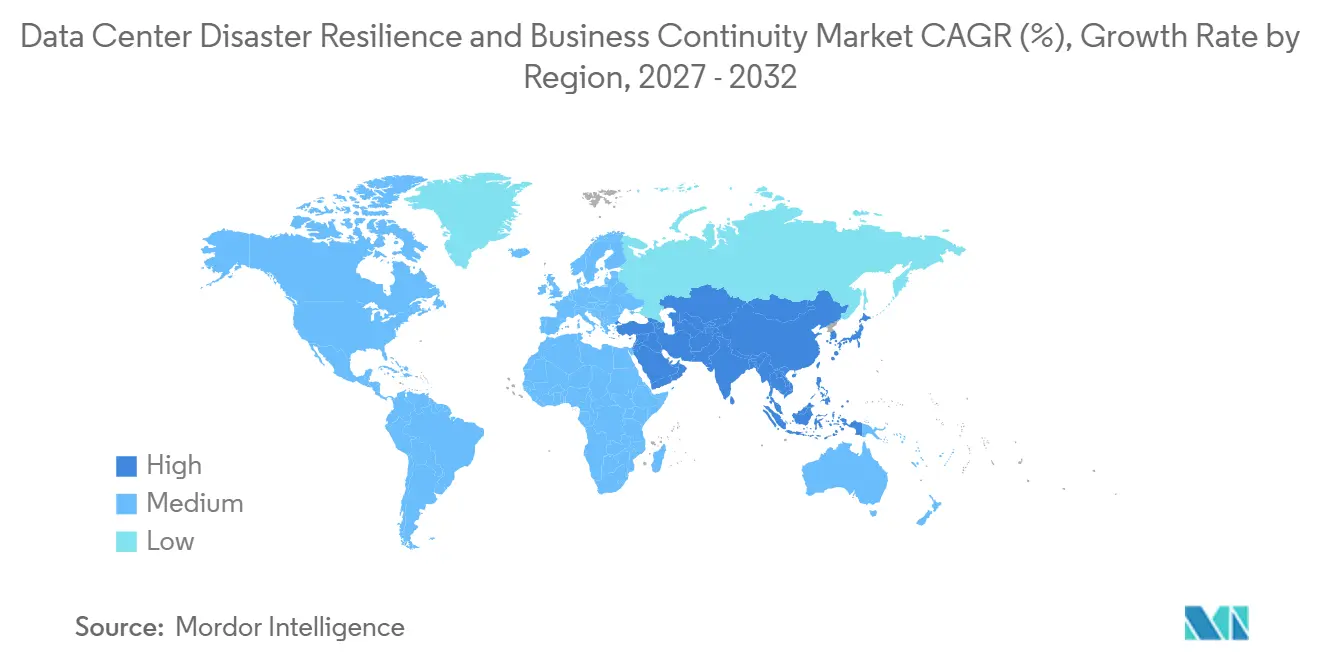
- By geography, North America held 42.06% share in 2026, while Asia-Pacific is expected to expand at a 12.36% CAGR through 2032.
Note: Market numbers in this report are based on Mordor Intelligence's proprietary estimation framework, which combines nine months of actuals with Q4 projections for base year 2026.
Market Trends and Insights
Drivers Impact Analysis of Data Center Disaster Resilience and Business Continuity Market*
| Driver | (~) % Impact on CAGR Forecast | Geographic Relevance | Impact Timeline |
|---|---|---|---|
| Increasing Financial Losses and Contractual Exposure From Data Center Downtime | 2.80% | Global, concentrated in North America and Europe | Short term (≤ 2 years) |
| Expansion of Cloud, AI, and Mission-Critical Workloads Requiring Continuous Availability | 2.30% | Global | Medium term (2-4 years) |
| Exposure to Extreme Weather, Natural Disasters, and Utility Disruptions | 1.90% | Global, highest exposure in southern United States and Asia-Pacific coastal locations | Medium term (2-4 years) |
| Regulatory and Customer Requirements for Documented and Tested Continuity Programs | 2.20% | Europe and North America, extending to Asia-Pacific and the Middle East | Medium term (2-4 years) |
| Cyberattack and Ransomware Risks Requiring Coordinated Continuity and Crisis Response | 1.40% | Global | Short term (≤ 2 years) |
| Insurer, Lender, and Investor Scrutiny of Resilience Controls and Recovery Readiness | 0.80% | North America and Europe, extending to the Middle East | Long term (≥ 4 years) |
| Source: Mordor Intelligence | |||
Increasing Financial Losses and Contractual Exposure Associated with Data Center Downtime
The cost of an unplanned outage increasingly determines whether a resilience program receives capital approval. The Uptime Institute reported that 57% of organizations that experienced a major outage in the previous 3 years incurred costs exceeding USD 100,000, and 20% exceeded USD 1 million.[1] Power failures caused 56% of major outages in 2026, up from 45% in 2025, placing utility conditions and on-site power management at the center of continuity planning. Hyperscale, colocation, and cloud agreements increasingly include financial consequences when service-level commitments are not met. A disruption can therefore create contractual claims even when physical assets have not been damaged. Enterprises facing such exposure are extending recovery-readiness requirements to critical providers, which broadens demand across the data center disaster resilience and business continuity market.
Expansion of Cloud, AI, and Mission-Critical Workloads Requiring Continuous Availability
AI workloads create recovery requirements that differ from conventional applications because high-density computing, high-bandwidth storage, and specialized cooling are difficult to replicate quickly at another site. Nokia found that 50% of surveyed data center operators planned to use AI-driven automation to reduce operational errors, while 42% identified incident response and recovery as their leading investment priority for 2026. These priorities support wider use of automation in the data center disaster resilience and business continuity market. Operators need recovery processes that account for dependencies across compute, networks, storage, cooling, and cloud services. This requirement increases the value of scenario testing and recovery orchestration. It also makes continuity capability an operational issue for the providers hosting AI-related workloads, rather than a planning exercise completed at intervals.
Exposure to Extreme Weather, Natural Disasters, and Utility Disruptions
Grid disruption is becoming a direct driver for testing power resilience and recovery procedures. On July 22, 2026, nearly 3,800 megawatts of data center load disconnected from the PJM grid in northern Virginia, causing voltage and frequency disturbances as facilities moved to backup generation. PJM later proposed reliability standards for large-load disconnection events, thereby increasing attention to ride-through capability and utility-disruption testing. These events expose the limits of continuity assessments focused on a single facility. Organizations with nearby facilities that rely on the same utility node can face simultaneous disruption. The data center disaster resilience and business continuity market, therefore, benefits from multi-site scenarios that include grid conditions, fuel availability, and coordinated restart procedures.
Regulatory and Customer Requirements for Documented and Tested Continuity Programs
The European Union Digital Operational Resilience Act, DORA, applied from January 17, 2025, and requires financial entities and designated critical ICT providers to maintain tested ICT continuity policies, conduct business-impact analyses, and document recovery plans. The framework reaches cloud platforms, colocation providers, and software suppliers that support financial institutions. This expands demand beyond regulated firms to the data center services ecosystem around them. Australia’s APRA CPS 230, effective from July 2025, similarly strengthened operational risk, service-provider, and business continuity obligations for supervised institutions. ISO 22301 certification and related continuity standards also continue to shape procurement expectations across regulated supply chains. These requirements favor providers in the data center disaster resilience and business continuity market who can demonstrate testing, governance, and recovery readiness.
Restraints Impact Analysis of Data Center Disaster Resilience and Business Continuity Market*
| Restraint | (~) % Impact on CAGR Forecast | Geographic Relevance | Impact Timeline |
|---|---|---|---|
| High Implementation Costs and Competing Infrastructure Investment Priorities | -1.40% | Global, most acute in mid-market and emerging locations | Short term (≤ 2 years) |
| Integration Complexity Across Legacy Infrastructure and Fragmented Management Systems | -0.90% | Global, most pronounced in North America and Europe | Medium term (2-4 years) |
| Shortage of Business Continuity and Data Center Resilience Specialists | -0.60% | Global | Long term (≥ 4 years) |
| Difficulty Quantifying Avoided Losses and Demonstrating Return on Investment | -0.50% | Global | Medium term (2-4 years) |
| Source: Mordor Intelligence | |||
High Implementation Costs and Competing Infrastructure Investment Priorities
Integrated continuity programs require spending on licenses, data migration, dependency mapping, training, and repeated testing. These costs compete with AI computing capacity, network modernization, cybersecurity tools, and other infrastructure projects. The Business Continuity Institute reported that 65.5% of organizations increased resilience resources in 2025, but budget competition continued to affect procurement schedules. Large enterprise implementations that include professional services can reach 7-figure totals. Phased adoption, managed services, and consumption-based software can reduce the barrier to entry. However, complex legacy environments still need significant work before the organization can use the program effectively.
Integration Complexity Across Legacy Infrastructure and Fragmented Management Systems
Many data center estates contain incomplete asset inventories, disconnected configuration records, and monitoring tools that do not share dependency information. This makes it harder to map the relationships needed for an effective recovery program. Hybrid estates must connect continuity platforms with IT service management, governance, risk and compliance, configuration management, and cloud management systems. The required configuration and application programming interface work can be difficult to staff, especially when continuity specialists are scarce. Prebuilt connectors and AI-assisted dependency discovery can reduce some of this burden. Even so, fragmented environments often require a multiyear program before recovery procedures and underlying infrastructure records are aligned.
*Our forecasts treat driver/restraint impacts as directional, not additive. The impact forecasts reflect baseline growth, mix effects, and variable interactions.
Data Center Disaster Resilience and Business Continuity Market Segment Analysis
By Component:
Services Narrow the Gap With Platform LeadersSoftware and platforms held 45.71% of the data center disaster resilience and business continuity market share in 2026. Integrated platforms bring business impact analysis, plan management, testing, and crisis coordination into a single operating environment. This approach reduces the need for separate planning and response tools. Standalone applications for dependency mapping, continuity planning, crisis response, and exercise management remain relevant, although their features are converging with the integrated platform model. The Disaster Recovery Journal reported that BCM platforms and threat-intelligence feeds had the highest planned implementation rates in its 2025 resilience research.
Services are projected to expand at an 11.78% CAGR from 2027 to 2032. Advisory services, impact analysis, plan development, implementation, systems integration, simulation, and managed program delivery support this segment. Regulatory deadlines and shortages of experienced practitioners make external support important for many organizations. The Business Continuity Institute found that 45.5% of respondents identified operational resilience as a stand-alone function in 2025, compared with 39.4% in 2023.[2] This reflects stronger internal governance while retaining a clear role for specialists when advanced testing or remediation is needed.
By Deployment Mode:
Cloud Leads While Hybrid Addresses Recovery-Path ConcernsCloud held 58.97% of the data center disaster resilience and business continuity market share in 2026. Subscription delivery enables organizations to scale access to plans, workflow, and collaboration tools without duplicating platform infrastructure. Yet public cloud concentration creates a continuity issue when the platform holding the plans is unavailable during a cloud disruption. Only 12% of organizations considered public cloud resilient for all mission-critical workloads, while 24% considered it unsuitable for any mission-critical workload. This makes recovery-path design central to deployment decisions.
Hybrid deployment is projected to expand at an 11.81% CAGR from 2027 to 2032. It combines cloud collaboration and scalable recovery targets with on-premises control-plane reliability and offline access to critical plans. This configuration supports access to recovery information during an active cloud outage. On-premises deployments retain relevance where data sovereignty, air-gap security requirements, or data-localization rules limit cloud hosting. Germany, France, India, and Gulf Cooperation Council jurisdictions remain relevant locations for these requirements.
By Data Center Type:
Enterprise and Edge Facilities Anchor Demand While Cloud Providers Face Expanding ObligationsEnterprise and edge data centers held 36.91% share of the data center disaster resilience and business continuity market size in 2026. Large enterprises operate private facilities and edge sites that require recovery objectives aligned with their operating priorities. Their continuity programs must cover local infrastructure and dependencies on networks, cloud services, and third parties. Colocation operators maintain site-level continuity certifications to attract regulated tenants. This creates a dual demand pattern: operators need their own controls, accounting for 36.91% of the data center disaster resilience and business continuity market, while clients need evidence from their providers.
Cloud service providers are projected to expand at an 11.87% CAGR from 2027 to 2032. As hyperscale and neocloud operators enter new locations, they encounter governance and continuity expectations from regulated enterprise customers. DORA treats designated cloud providers as critical ICT third-party providers, increasing direct supervisory attention for suppliers serving European financial entities. Service providers must demonstrate recovery capability across a large shared infrastructure environment. This need for testing, documentation, and third-party oversight supports the data center disaster resilience and business continuity market.
By End User Industry:
BFSI Sets a High Baseline While IT and Telecommunications AcceleratesBFSI held 25.03% of the data center disaster resilience and business continuity market share in 2026. The sector has a long history of formal continuity testing and mandated risk management. Financial institutions need to protect critical services, payment activities, customer records, and interconnected technology providers. DORA reinforces these duties in the European Union, while comparable operational resilience requirements apply across other regulated financial systems. This sustains demand for platform upgrades, testing, and supplier oversight as requirements change.
IT and telecommunication is projected to expand at a 12.62% CAGR from 2027 to 2032. Operators and digital infrastructure providers carry customer commitments tied to AI workloads, cloud connectivity, and colocation services. They need coordinated recovery across networks, compute infrastructure, storage, and customer-facing operations. Retail and e-commerce prioritize payment continuity, while manufacturers focus on operational technology and supply-chain resilience. Energy and utility users remain focused on power resilience and compliance with NERC and comparable grid-reliability requirements.

Geography Analysis
North America
North America held 42.06% of the data center disaster resilience and business continuity market share in 2026. The region combines regulated financial institutions, hyperscale campuses, and a mature ecosystem of software, advisory, and managed-service providers. In the United States, AI infrastructure investment and the July 2026 PJM event have increased executive attention on power resilience and multi-site recovery planning. Canadian institutions are also addressing technology and cyber-risk requirements under OSFI Guideline E-21. Insurers and lenders increasingly seek evidence of business interruption preparedness, which is moving continuity discussions closer to finance and risk committees.
Europe
Europe is the second-largest geography, with DORA driving structured continuity spending across financial institutions, technology suppliers, and cloud providers. The framework requires covered entities to test ICT continuity and recovery capabilities, raising the importance of documented evidence and supplier oversight. The United Kingdom, Germany, the Netherlands, and Ireland combine financial services concentration with major data center hubs. A 2025 report produced by F24 and the Business Continuity Institute found that 60.3% of German-speaking organizations used dedicated emergency notification or crisis management tools.[3] ISO 22301 remains a relevant compliance factor for organizations seeking consistent business continuity management systems.
Asia-Pacific, South America, and the Middle East and Africa
Asia-Pacific is projected to expand at a 12.36% CAGR from 2027 to 2032, supported by new data center capacity and formal continuity obligations. CBRE reported USD 11.6 billion in Asia-Pacific data center investment in 2025, while Johor recorded a 53% year-on-year increase in live data center capacity. South America remains at an earlier stage, while sovereign data infrastructure investment is widening the addressable base in Saudi Arabia, the UAE, Qatar, and South Africa.
Competitive Landscape
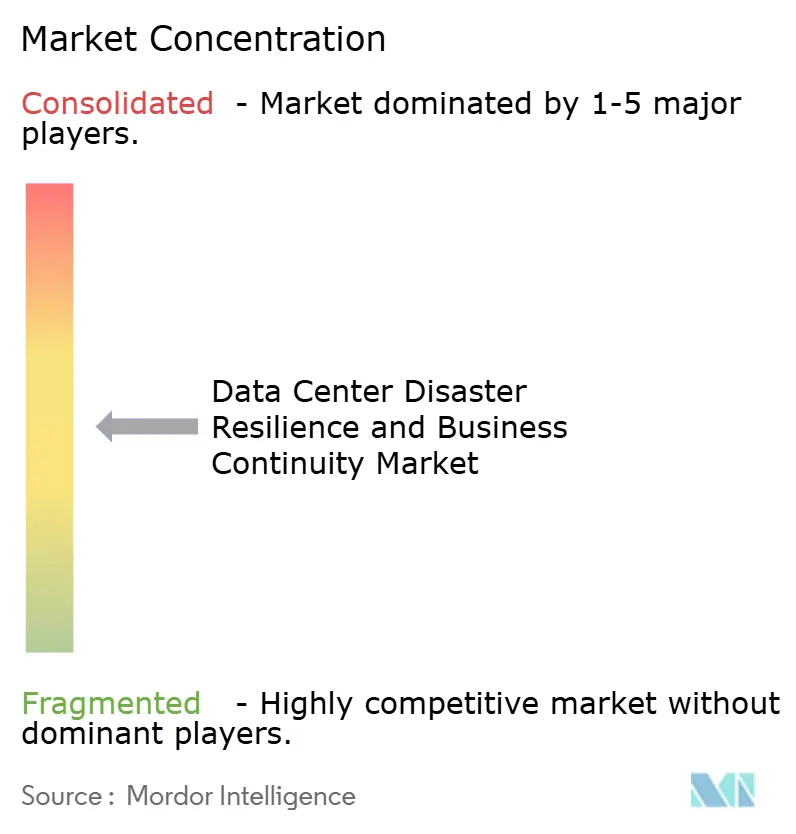
The data center disaster resilience and business continuity market is moderately fragmented because large buyers often require software, advisory services, systems integration, and managed delivery from multiple providers. Dedicated platform vendors include Fusion Risk Management, Riskonnect, Archer Technologies, MetricStream, Onspring Technologies, LogicManager, F24 AG, Premier Continuum, and Continuity2. ServiceNow and Kyndryl compete by offering broader IT operations and governance platforms that can reduce tool proliferation among existing customers. Advisory and managed-service firms operate in a separate delivery layer. Customer relationships, integration capability, and support for regulated workflows, therefore, matter alongside product features.
Fusion Risk Management launched its Enterprise Resilience Decision System in August 2026, adding the Enterprise Resilience Index and Recovery Optimization with Scenario Testing to its platform. The move reflects a shift in the data center disaster resilience and business continuity market from storing plans toward measuring recovery outcomes and testing decisions. Kyndryl launched Intelligent Recovery Service in February 2026, combining AI-powered recovery orchestration with visibility into recovery objectives, system health, and compliance metrics across hybrid and multi-cloud environments. F24 acquired Creolytix in December 2025 to add AI-supported multi-source threat intelligence to its resilience offering.[4] These moves connect recovery execution, operational data, and earlier risk detection.
White-space activity centers on AI-native scenario simulation, automated dependency discovery, and third-party risk signals that can trigger continuity plans. Buyers need visibility into recovery dependencies across hybrid cloud environments, suppliers, and physical infrastructure. Compliance requirements under DORA and related frameworks raise the value of real-time evidence that recovery capabilities have been tested. Providers able to connect these functions without creating an additional disconnected system have a clear advantage.
Data Center Disaster Resilience and Business Continuity Industry Leaders
-
ServiceNow, Inc.
-
International Business Machines Corporation
-
Everbridge, Inc.
-
Riskonnect, Inc.
-
Fusion Risk Management, Inc.
- *Disclaimer: Major Players sorted in no particular order
Data Center Disaster Resilience and Business Continuity Market Companies Covered in this Report
- Fusion Risk Management, Inc.
- Riskonnect, Inc.
- ServiceNow, Inc.
- Everbridge, Inc.
- IBM
- The British Standards Institution (BSI)
- PricewaterhouseCoopers LLP (PwC)
- Deloitte LLP
- Ernst & Young LLP (EY)
- LogicManager, Inc.
- Onspring Technologies, LLC
- Archer Technologies LLC
- Quantivate, LLC
- MetricStream Inc.
- Premier Continuum Inc.
- Protiviti Inc.
- Control Risks Group Limited
- Continuity2 Limited
Recent Industry Developments in Data Center Disaster Resilience and Business Continuity Market
- October 2026: ServiceNow launched its Operational Resilience solution for financial institutions, unifying risk, security, governance, third-party risk management, business continuity, and AI governance on the ServiceNow AI Platform. Accompanying research found that 91% of banks experienced an agentic security incident in the past year, and only 32% contained it within 24 hours, positioning the solution as a response to converging AI governance and DORA compliance obligations.
- August 2026: Fusion Risk Management announced the Enterprise Resilience Decision System, a decision layer above existing GRC and ITSM platforms computing disruption impact in real time, along with the Enterprise Resilience Index benchmark framework and Recovery Optimization with Scenario Testing. The capabilities were released broadly after an early-adopter program with global financial services firms.
- June 2026: ServiceNow and IBM announced a multiyear collaboration integrating IBM watsonx.data, Red Hat Ansible, Instana, and HashiCorp Terraform into the ServiceNow AI Platform. The collaboration targets autonomous infrastructure operations relevant to continuity and recovery automation.
- February 2026: Kyndryl launched the Intelligent Recovery Service, a cloud-based AI-powered service that automates recovery across hybrid and multi-cloud environments through Kyndryl Bridge. It provides real-time visibility into recovery objectives, system health, and compliance metrics.
Global Data Center Disaster Resilience and Business Continuity Market Report Scope
The Data Center Disaster Resilience and Business Continuity Market refers to the market for software solutions, resilience management platforms, advisory services, and business continuity services designed to help data center operators prevent, prepare for, respond to, and recover from disruptions affecting critical IT infrastructure, facilities, utilities, workforce operations, and third-party service providers.
The Data Center Disaster Resilience and Business Continuity Market Report is Segmented by Component (Software and Platforms [Integrated Continuity and Resilience Management Platforms, Standalone Business Impact Analysis and Dependency Mapping Software, Standalone Continuity Planning and Documentation Software, Standalone Crisis Response and Incident Coordination Software, and Others [Standalone Resilience Exercise and Testing Management Software, etc.]) and Services [Advisory, Business Impact Analysis, and Resilience Assessment Services, Continuity and Crisis Response Plan Development Services, Software Implementation and Systems Integration Services, Resilience Testing, Simulation, and Training Services, and Managed Continuity Program Services]), Deployment Mode (Cloud, On-Premises, and Hybrid), Data Center Type (Cloud Service Provider, Colocation, and Enterprise and Edge), and End-User Industry (IT and Telecom, BFSI, Government and Public Administration, Healthcare and Life Sciences, Manufacturing, Retail and E-Commerce, Energy and Utilities, and Other End User Industries). The Market Forecasts are Provided in Terms of Value (USD).
Segmentation Overview
| Software and Platforms | Integrated Continuity and Resilience Management Platforms |
| Standalone Business Impact Analysis and Dependency Mapping Software | |
| Standalone Continuity Planning and Documentation Software | |
| Standalone Crisis Response and Incident Coordination Software | |
| Others (Standalone Resilience Exercise and Testing Management Software, etc) | |
| Services | Advisory, Business Impact Analysis, and Resilience Assessment Services |
| Continuity and Crisis Response Plan Development Services | |
| Software Implementation and Systems Integration Services | |
| Resilience Testing, Simulation, and Training Services | |
| Managed Continuity Program Services |
| Cloud |
| On-Premises |
| Hybrid |
| Cloud Service Provider |
| Colocation |
| Enterprise and Edge |
| IT and Telecom |
| BFSI |
| Government and Public Administration |
| Healthcare and Life Sciences |
| Manufacturing |
| Retail and E-Commerce |
| Energy and Utilities |
| Other End User Industries |
| North America | United States |
| Canada | |
| Mexico | |
| Europe | United Kingdom |
| Germany | |
| France | |
| Netherlands | |
| Ireland | |
| Spain | |
| Italy | |
| Rest of Europe | |
| Asia-Pacific | China |
| Japan | |
| India | |
| South Korea | |
| Australia | |
| Singapore | |
| Malaysia | |
| Indonesia | |
| Rest of Asia-Pacific | |
| South America | Brazil |
| Chile | |
| Argentina | |
| Rest of South America | |
| Middle East and Africa | Saudi Arabia |
| United Arab Emirates | |
| South Africa | |
| Rest of Middle East and Africa |
| By Component | Software and Platforms | Integrated Continuity and Resilience Management Platforms |
| Standalone Business Impact Analysis and Dependency Mapping Software | ||
| Standalone Continuity Planning and Documentation Software | ||
| Standalone Crisis Response and Incident Coordination Software | ||
| Others (Standalone Resilience Exercise and Testing Management Software, etc) | ||
| Services | Advisory, Business Impact Analysis, and Resilience Assessment Services | |
| Continuity and Crisis Response Plan Development Services | ||
| Software Implementation and Systems Integration Services | ||
| Resilience Testing, Simulation, and Training Services | ||
| Managed Continuity Program Services | ||
| By Deployment Mode | Cloud | |
| On-Premises | ||
| Hybrid | ||
| By Data Center Type | Cloud Service Provider | |
| Colocation | ||
| Enterprise and Edge | ||
| By End User Industry | IT and Telecom | |
| BFSI | ||
| Government and Public Administration | ||
| Healthcare and Life Sciences | ||
| Manufacturing | ||
| Retail and E-Commerce | ||
| Energy and Utilities | ||
| Other End User Industries | ||
| By Geography | North America | United States |
| Canada | ||
| Mexico | ||
| Europe | United Kingdom | |
| Germany | ||
| France | ||
| Netherlands | ||
| Ireland | ||
| Spain | ||
| Italy | ||
| Rest of Europe | ||
| Asia-Pacific | China | |
| Japan | ||
| India | ||
| South Korea | ||
| Australia | ||
| Singapore | ||
| Malaysia | ||
| Indonesia | ||
| Rest of Asia-Pacific | ||
| South America | Brazil | |
| Chile | ||
| Argentina | ||
| Rest of South America | ||
| Middle East and Africa | Saudi Arabia | |
| United Arab Emirates | ||
| South Africa | ||
| Rest of Middle East and Africa | ||
Key Questions Answered in the Report
What is the size of the data center disaster resilience and business continuity market?
The sector is valued at USD 4.85 billion in 2026 and is projected to reach USD 9.36 billion by 2032, at an 11.38% CAGR from 2027 to 2032.
What is driving adoption of data center resilience solutions?
In the data center disaster resilience and business continuity market, outage costs, contractual commitments, AI workloads, grid risks, and DORA-related requirements support adoption.
Which component has the largest share in this sector?
Software and platforms lead the data center disaster resilience and business continuity market with a 45.71% share in 2026, while services are projected to expand at an 11.78% CAGR through 2032.
Why are hybrid continuity deployments gaining traction?
Across the data center disaster resilience and business continuity market, hybrid configurations combine cloud-scale collaboration with on-premises controls and offline plan access when cloud services are disrupted.
Which end-user sector is expanding fastest?
In the data center disaster resilience and business continuity market, IT and telecommunications is projected to expand at a 12.62% CAGR through 2032 as operators support AI workloads, connectivity, and colocation commitments.
Which region is expected to expand fastest?
Within the data center disaster resilience and business continuity market, Asia-Pacific is projected to expand at a 12.36% CAGR through 2032, supported by investment and emerging continuity requirements.