
Data Center Disaster Recovery Infrastructure Market Size and Share
Market Overview
| Study Period | 2021 - 2032 |
|---|---|
| Market Size (2027) | USD 9.71 Billion |
| Market Size (2032) | USD 17.52 Billion |
| Growth Rate (2027 - 2032) | 12.53 % |
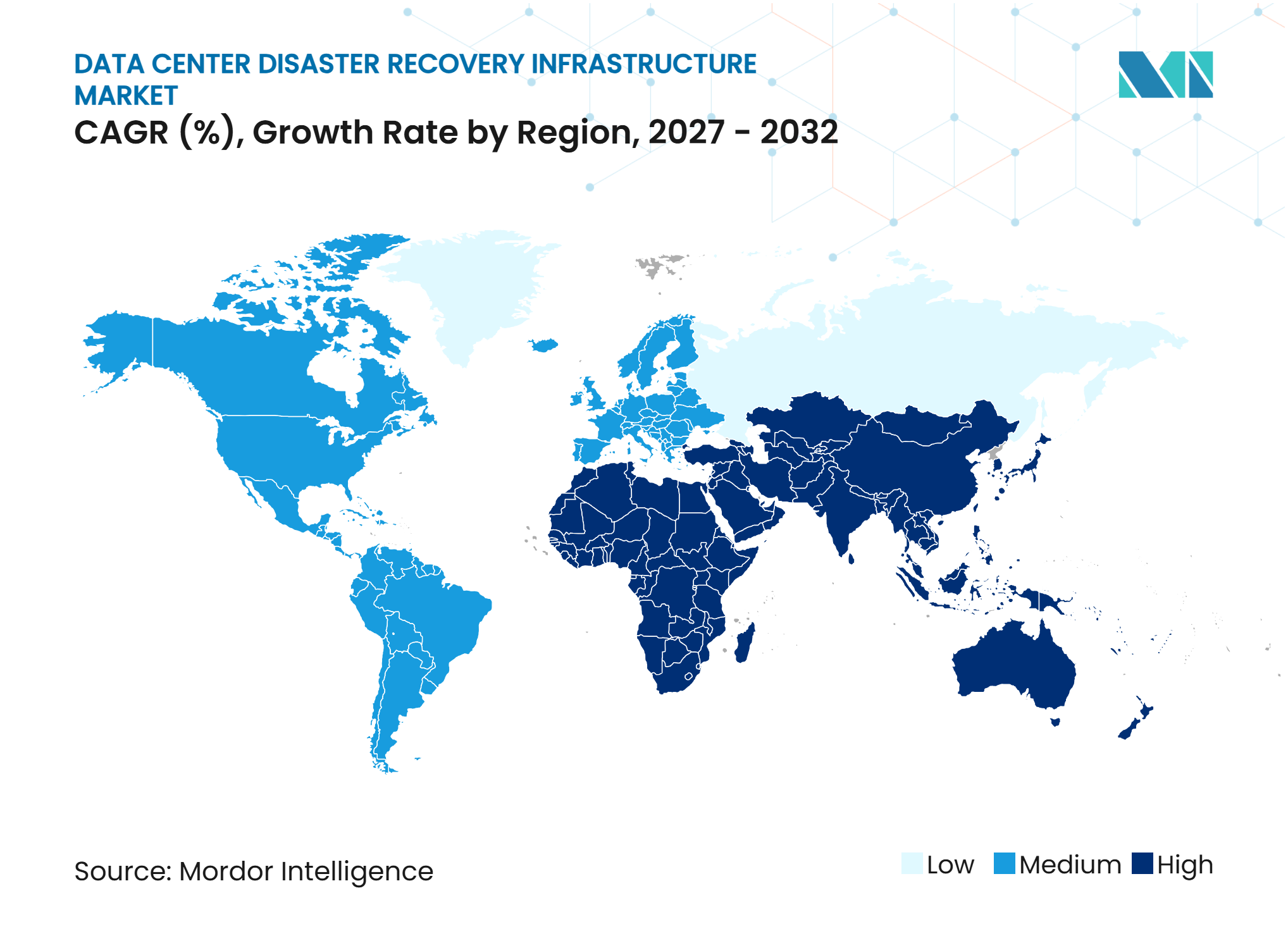
| Fastest Growing Market | Asia-Pacific |
| Largest Market | North America |
| Market Concentration | Medium |
Major Players *Disclaimer: Major Players sorted in no particular order Image © Mordor Intelligence. Reuse requires attribution under CC BY 4.0. | |
Data Center Disaster Recovery Infrastructure Market Analysis by Mordor Intelligence
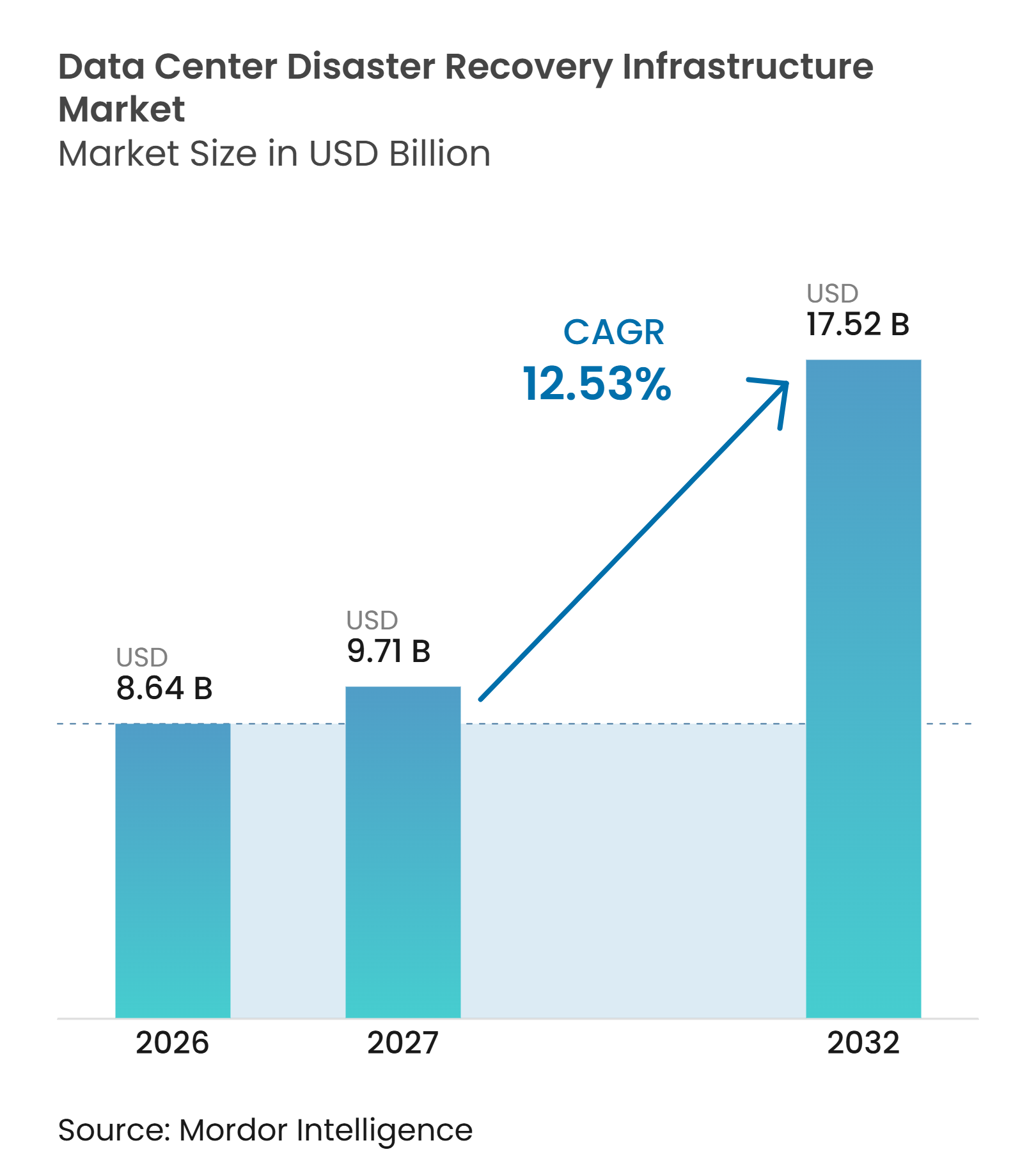
The data center disaster recovery infrastructure market size is projected to expand from USD 8.64 billion in 2026 and USD 9.71 billion in 2027 to USD 17.52 billion by 2032, registering a CAGR of 12.53% between 2027 to 2032. The data center disaster recovery infrastructure market is moving from periodic backup planning toward recovery environments that are designed, tested, and funded as core operating infrastructure. Ransomware has raised the cost of disruption because attackers increasingly target data, identity systems, and backup repositories together. Hybrid and multicloud estates also create more recovery dependencies across on-premises systems, public clouds, and software-as-a-service platforms. Vendors are responding by combining backup, orchestration, identity recovery, and clean-room capabilities in broader platforms. This leaves room for providers that can simplify recovery testing, reduce staffing needs, and provide evidence that recovery plans work.
Key Report Takeaways
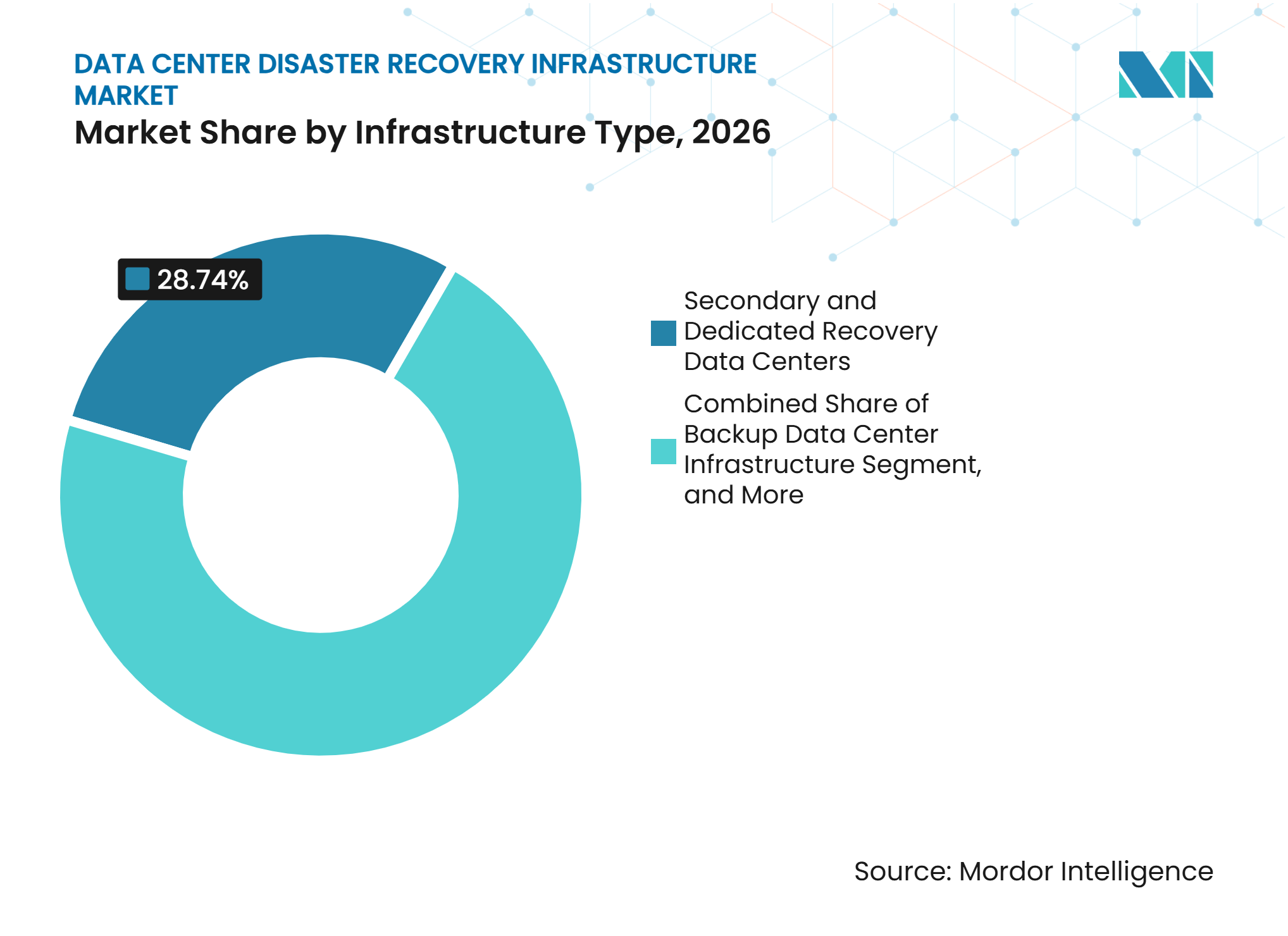
- By infrastructure type, secondary and dedicated recovery data centers held 28.74% of the data center disaster recovery infrastructure market share in 2026, while cloud-based disaster recovery infrastructure is projected to expand at a 13.37% CAGR through 2032.
- By deployment model, on-premises disaster recovery held a 32.68% share in 2026, while disaster recovery as a service is projected to expand at a 13.43% CAGR through 2032.
- By recovery architecture, active-passive architecture held a 26.93% share in 2026, while continuous data replication is projected to expand at a 13.29% CAGR through 2032.
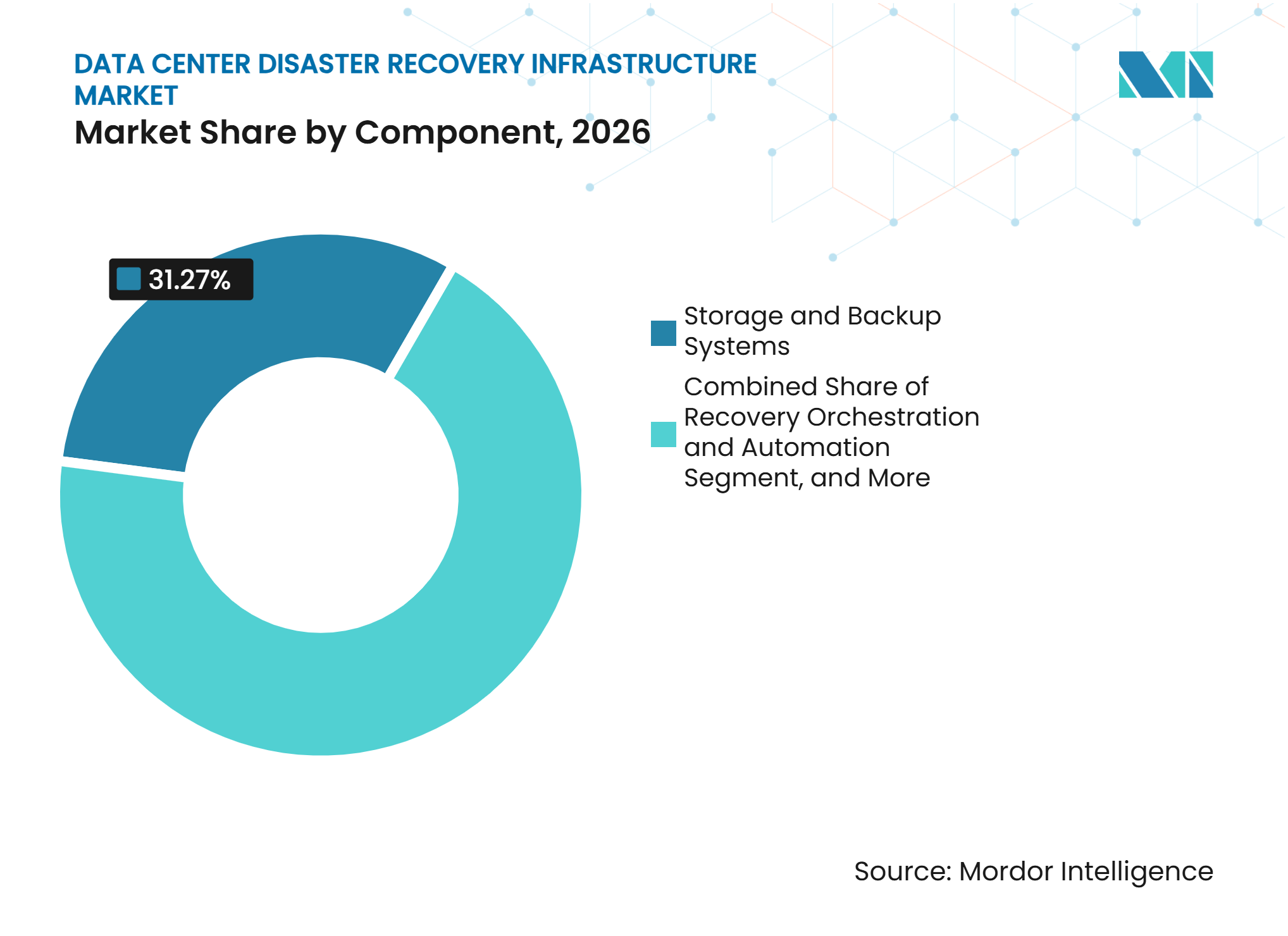
- By component, storage and backup systems held a 31.27% share in 2026, while recovery orchestration and automation is projected to expand at a 13.32% CAGR through 2032.
- By application, critical business application recovery held a 35.82% share in 2026, while cloud-native application recovery is projected to expand at a 13.26% CAGR through 2032.
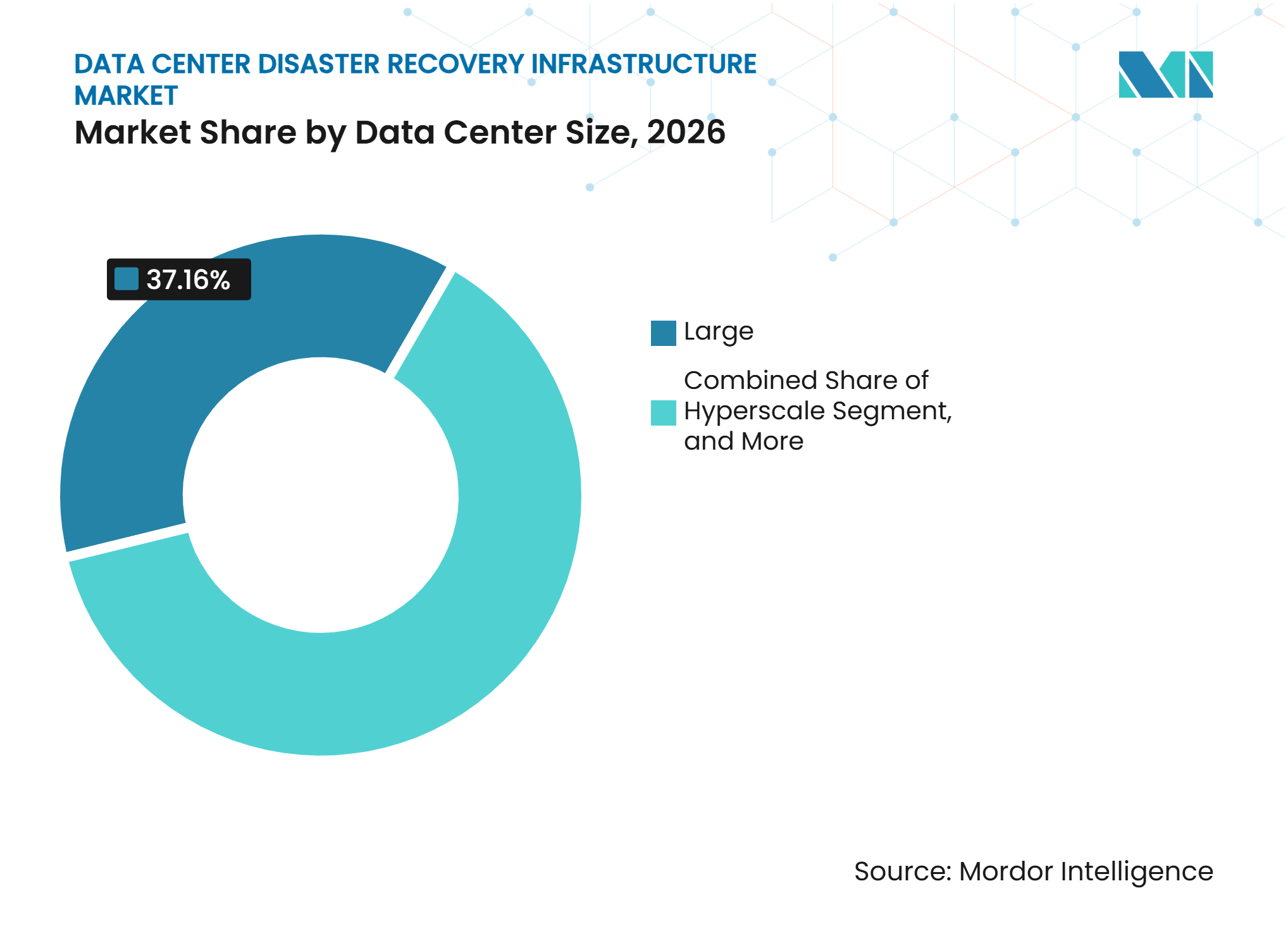
- By data center size, large data centers held a 37.16% share in 2026, while hyperscale facilities are projected to expand at a 13.39% CAGR through 2032.
- By data center type, colocation held a 42.39% share in 2026, while cloud service providers are projected to expand at a 13.46% CAGR through 2032.
- By geography, North America held a 38.43% share in 2026, while Asia-Pacific is projected to expand at a 13.24% CAGR through 2032.
Note: Market numbers in this report are based on Mordor Intelligence's proprietary estimation framework, which combines nine months of actuals with Q4 projections for base year 2026.
Market Trends and Insights
Drivers Impact Analysis of Data Center Disaster Recovery Infrastructure Market*
| Driver | (~) % Impact on CAGR Forecast | Geographic Relevance | Impact Timeline |
|---|---|---|---|
| Rising Cyberattacks and Ransomware Recovery Requirements | +3.2% | Global | Short term (≤ 2 years) |
| Expansion of Hybrid and Multicloud Data Estates | +2.4% | Global, strongest in North America and Asia-Pacific | Short term (≤ 2 years) |
| Increasing Enterprise Data Volumes and Digital Workloads | +1.9% | Global, led by Asia-Pacific and North America | Medium term (2-4 years) |
| Regulatory Requirements for Recovery Testing and Data Resilience | +1.6% | North America and Europe, extending to Asia-Pacific and Middle East | Medium term (2-4 years) |
| Recovery Control-Plane Automation for Bandwidth-Constrained and Unstaffed Sites | +1.1% | Global, with early adoption in North America and Europe | Medium term (2-4 years) |
| Clean-Room Recovery and Identity-Resilience Requirements After Backup-System Compromise | +0.9% | Global, most acute in financial services and healthcare | Long term (≥ 4 years) |
| Source: Mordor Intelligence | |||
Rising Cyberattacks and Ransomware Recovery Requirements
Ransomware has shifted from file encryption toward campaigns that extract data and damage recovery systems. Zscaler reported that data exfiltrated by major ransomware groups rose 275.8% year over year to 896.2 terabytes between April 2025 and March 2026.[1] Its report also cited Munich Re claims data showing that business interruption represented 51% of ransomware-related costs. Sophos found that 66% of organizations used backups to recover encrypted data in 2026, compared with 54% in the prior year. The same study placed average recovery costs, excluding ransom, at USD 1.7 million per incident. These conditions support demand in the data center disaster recovery infrastructure market for immutable storage, isolated recovery environments, and tested restoration procedures.
Expansion of Hybrid and Multicloud Data Estates
Organizations now operate workloads across their own facilities, private clouds, public cloud regions, and software-as-a-service applications. This model expands the number of systems and dependencies that must be restored in the right sequence after an outage. Kyndryl reported that resilient organizations distribute workloads across multiple hyperscalers to reduce reliance on one provider. Unitrends found that organizations used an average of more than 3 backup solutions, while nearly 60% of Azure virtual machine deployments lacked true disaster recovery capabilities. The issue is not only protecting copies of data, because applications also depend on identities, network settings, and linked services. This supports demand for platforms that map dependencies and orchestrate recovery across different environments in the data center disaster recovery infrastructure market.
Increasing Enterprise Data Volumes and Digital Workloads
Artificial intelligence workloads increase the amount of data organizations must retain, secure, and recover. An IDC survey commissioned by Western Digital found that 86% of organizations stored more data due to the adoption of AI and generative AI. The study also found that 61% of respondents experienced at least 25% growth in data volume in the previous 12 months. Recovery targets set for smaller workloads can fail when models, training datasets, and inference logs need to be restored together. Nokia reported that 50% of surveyed data center operators planned to use AI-driven automation to reduce manual errors. The data center disaster recovery infrastructure market therefore benefits when organizations adopt automated sequencing and anomaly detection for increasingly large recovery sets.
Regulatory Requirements for Recovery Testing and Data Resilience
Rules for operational resilience are making recovery testing more formal and more visible to management teams. The European Securities and Markets Authority states that the Digital Operational Resilience Act applies from January 17, 2025. The framework requires financial entities to manage information and communication technology risk and test operational resilience. ISACA notes that DORA and NIS2 place greater emphasis on governance, incident reporting, resilience testing, and supply chain exposure. This turns recovery evidence into a procurement requirement alongside restoration speed. Vendors with audit-ready reporting and repeatable testing workflows have an advantage in regulated deployments. The effect extends the data center disaster recovery infrastructure market beyond backup capacity into compliance-oriented services.
Restraints Impact Analysis of Data Center Disaster Recovery Infrastructure Market*
| Restraint | (~) % Impact on CAGR Forecast | Geographic Relevance | Impact Timeline |
|---|---|---|---|
| Complexity of Protecting Heterogeneous Physical, Virtual, Cloud, SaaS, and Containerized Workloads | -1.5% | Global | Short term (≤ 2 years) |
| High Total Cost of Ownership for Retention, Replication, Egress, and Recovery Capacity | -1.2% | Global, most acute in mid-market and emerging markets | Medium term (2-4 years) |
| Recovery-Window Bottlenecks From Cross-Cloud Egress and Constrained Inter-Site Bandwidth | -0.7% | Global, with acute impact on latency-sensitive Asia-Pacific and Middle East and Africa deployments | Medium term (2-4 years) |
| Shortage of Cross-Domain Recovery Operators and Weak Evidence of Recovery Readiness | -0.6% | Global, most severe in Asia-Pacific and Middle East | Long term (≥ 4 years) |
| Source: Mordor Intelligence | |||
Complexity of Protecting Heterogeneous Physical, Virtual, Cloud, SaaS, and Containerized Workloads
Physical servers, virtual machines, containers, software-as-a-service platforms, and cloud-native services require different protection methods. Datto found that organizations used an average of more than 3 backup solutions in 2025. Multiple tools can cover gaps, but they also require separate skills, policies, and recovery runbooks. Kubernetes workloads present a particular challenge because restoration must account for persistent volumes, secrets, namespaces, and service dependencies. Teams can protect their established applications well while leaving newer containerized and software-as-a-service workloads less prepared. This fragmentation can slow procurement in the data center disaster recovery infrastructure market because buyers seek fewer, broader platforms without sacrificing workload-specific protection.
High Total Cost of Ownership for Retention, Replication, Egress, and Recovery Capacity
The cost of a recovery environment includes storage, replication bandwidth, compute, software, testing, and idle capacity. Hybrid designs combine the capital and maintenance costs of on-premises infrastructure with cloud storage and compute charges. Cloud egress charges can also make large-scale tests expensive when data must move between environments. Subscription-based disaster recovery as a service reduces upfront capital needs, but expenditure can rise with data growth and testing frequency. Mid-sized organizations often lack dedicated teams to model these cost patterns over long retention periods. Providers that price based on protected workloads rather than on volatile data movement can reduce uncertainty and support adoption in the data center disaster recovery infrastructure market.
*Our forecasts treat driver/restraint impacts as directional, not additive. The impact forecasts reflect baseline growth, mix effects, and variable interactions.
Data Center Disaster Recovery Infrastructure Market Segment Analysis
By Infrastructure Type:
Cloud Adoption Changes Recovery Site PlanningSecondary and dedicated recovery data centers held 28.74% of the data center disaster recovery infrastructure market share in 2026. Regulated organizations and operators of tier-1 workloads continue to use geographically separate sites for strong isolation and predictable recovery capacity. These facilities support active-passive and active-active designs where recovery systems must remain available even during a regional failure. Backup data center infrastructure, replication and data protection infrastructure, orchestration infrastructure, backup storage, and network connectivity remain necessary across both physical and cloud designs. Network capacity has become more important because replication traffic can set the practical limit for recovery point objectives.
Cloud-based disaster recovery infrastructure is projected to expand at a 13.37% CAGR through 2032. It allows organizations to obtain recovery compute capacity without building a full secondary site before it is needed. Rubrik introduced Autonomous Business Recovery for Cloud Applications in June 2026, using agentic orchestration to rebuild compute, data, networking, identity, and configurations from a validated clean point.[2] This approach moves cloud recovery beyond mirroring a physical site. It also makes recovery planning more dependent on application relationships and automated sequencing. The data center disaster recovery infrastructure market is consequently shifting toward designs that connect infrastructure, identity, and operations.



By Deployment Model:
On-Premises Systems Remain Important as Services ExpandOn-premises disaster recovery held 32.68% of the data center disaster recovery infrastructure market share in 2026. The installed base remains large among organizations that use their own facilities for sensitive or tightly controlled workloads. Colocation-based, hybrid, and cloud-based recovery models are gaining ground in current purchasing decisions. These alternatives give buyers more flexibility in where data is replicated and where applications can restart. Data sovereignty requirements still limit a full move to public cloud recovery for many regulated deployments.
Disaster recovery as a service is projected to expand at a 13.43% CAGR through 2032. The model shifts some recovery capacity and operational duties to a specialist provider. It can also reduce the internal effort needed to maintain runbooks and execute tests. Commvault reported SaaS annual recurring revenue of USD 335.7 million and a 125% SaaS net dollar retention rate in its fiscal second-quarter 2026 results. These figures show continued movement toward subscription and cloud-delivered protection services. Hybrid recovery is likely to remain relevant where organizations need local control but also want cloud-based recovery capacity.
By Recovery Architecture:
Continuous Replication Raises Recovery ExpectationsActive-passive architecture held a 26.93% share in 2026. In this design, the primary site runs production workloads while the secondary site remains ready for activation. It provides a lower-cost option than continuously operating two live environments. Active-active, warm standby, cold standby, and backup-and-restore configurations serve different recovery time and recovery point needs. The architecture selected often depends on whether downtime affects trading, customer transactions, operations, or internal applications.
Continuous data replication is projected to expand at a 13.29% CAGR through 2032. It supports low recovery point objectives where losing several hours of data is unacceptable. Kyndryl observed that organizations use multicloud designs to reduce dependence on a single provider. Continuous replication is a key element of these architectures, though it raises bandwidth and management requirements. Ransomware concerns also reinforce demand, as a recent clean recovery point can be critical after a compromise. The data center disaster recovery infrastructure industry is therefore placing greater value on designs that balance near-real-time protection with manageable network cost.
By Component:
Storage Remains Foundational While Automation Gains GroundStorage and backup systems accounted for 31.27% in 2026. This category includes immutable repositories, air-gapped environments, and tiered storage that preserve data for recovery. Compute and server infrastructure, replication software, connectivity systems, and monitoring tools each support the broader recovery stack. Physical refresh cycles remain relevant in secondary and colocation facilities. Even in cloud-delivered models, buyers still need confidence that recovery data is isolated, retained, and available at the required scale.
Recovery orchestration and automation is projected to expand at a 13.32% CAGR through 2032. Nokia found that 42% of surveyed operators identified improving incident response and recovery as their leading investment priority. Automation reduces the dependence on manual runbooks when teams must restore several interconnected systems under pressure. It can also create a repeatable record of recovery tests for internal review and regulation. Vendors increasingly compete on their ability to coordinate technical tasks across data, networking, identity, and applications. This makes automation a central differentiator in the data center disaster recovery infrastructure market.

By Application:
Critical Systems Lead Spending and Cloud-Native Workloads ExpandCritical business application recovery accounted for 35.82% in 2026. Enterprise resource planning, financial transaction processing, and core operating systems are included in this segment. Organizations treat recovery for these workloads as an operating requirement because disruption can quickly affect revenue and customer service. Database recovery, virtual machine recovery, enterprise IT recovery, and high-availability restoration form the established middle of demand. Procurement for these uses often emphasizes vendor consolidation, cost control, and proven restoration procedures.
Cloud-native application recovery is projected to expand at a 13.26% CAGR through 2032. Kubernetes and microservices environments require recovery procedures that account for containers, secrets, persistent volumes, and dependencies. Druva upgraded Active Directory forest recovery to a fully automated, zero-touch workflow in 2026. The release covered domain controller isolation, system-state restoration, metadata cleanup, and FSMO role reassignment. Such workflow-specific automation helps address recovery needs that generic snapshots cannot cover. It widens the role of the data center disaster recovery infrastructure market within modern application operations.
By Data Center Size:
Large Facilities Lead While Hyperscale Needs ChangeLarge data centers accounted for 37.16% in 2026. These facilities have mature power, cooling, and connectivity systems that can support steady replication workloads. They represent an established base for active-passive and warm-standby configurations. Medium-sized facilities serve regional and mid-sized organizations, where staff availability and capital budgets can limit investment in recovery. Small sites more often use cloud-based recovery or disaster recovery as a service to avoid maintaining a second facility.
Hyperscale facilities are projected to expand at a 13.39% CAGR through 2032. APREA reported that average new data center facilities in Asia-Pacific exceeded 100 MW and that cumulative capital requirements from 2026 to 2030 could exceed USD 280 billion. Large AI workloads introduce recovery issues involving GPU-dense compute, high-bandwidth memory connections, and specialized cooling. These assets cannot always be recreated quickly at an alternate site. Facility planning increasingly needs to incorporate recovery capacity before AI workloads enter service. This creates opportunities for recovery designs that account for both digital workloads and physical infrastructure limits.
By Data Center Type:
Colocation Is Established as Cloud Providers AccelerateColocation held a 42.39% share in 2026. Enterprises use colocation facilities as geographically separated recovery sites while retaining their own hardware and control over key systems. The model offers managed facility services without requiring a complete shift to a public cloud provider. Enterprise and edge facilities form another part of the landscape. Distributed edge sites can be harder to protect because they may have limited local staff and restricted inter-site bandwidth.
Cloud service providers are projected to expand at a 13.46% CAGR through 2032. Cloud regions give enterprises elastic recovery capacity and access to native orchestration services. Production workloads already running in hyperscale environments can often be protected there with fewer architectural changes. This creates a practical route for new recovery investment, especially when organizations lack available physical secondary space. The data center disaster recovery infrastructure market will continue to include both colocation and provider-led models because recovery needs vary by workload, regulatory requirements, and operating capabilities.
Geography Analysis
North America
North America held 38.43% of the data center disaster recovery infrastructure market share in 2026. The region has a high concentration of enterprise data centers and a well-developed disaster recovery-as-a-service supplier base. Fortinet identified 3,381 confirmed ransomware victims in the United States, out of 7,831 global victims, in 2025. This exposure supports spending on isolated recovery environments and identity protection. Financial institutions also operate under continuity expectations shaped by the Federal Deposit Insurance Corporation and the Office of the Comptroller of the Currency. Vendor platforms in the region increasingly combine backup, recovery orchestration, anomaly detection, and identity resilience. These integrated offerings can reduce the number of tools used in a recovery program. The shortage of available colocation capacity in major markets can also encourage cloud-based and service-led recovery choices.
Asia-Pacific
Asia-Pacific is projected to expand at a 13.24% CAGR through 2032. New construction gives operators a chance to build recovery considerations into facilities before workloads are deployed. India is a major driver of future activity, as cloud providers and local groups are increasing their data center commitments. The region also has an opportunity to improve compound-shock planning across cyber incidents, power loss, and cooling failures. Suppliers that offer coordinated resilience testing can address this maturity gap. Regulatory influence is becoming more visible as countries establish data protection and critical infrastructure requirements.
Europe, South America, the Middle East, and Africa
Europe is shaped by DORA and NIS2 requirements that increase the value of documented and tested recovery plans. The European Commission maintains the legislation and implementing measures supporting DORA.[3] Germany recorded 291 confirmed ransomware victims in 2025, creating a clear risk signal for local organizations. South America is developing as cloud regions and colocation capacity expand, particularly in Brazil and Argentina. Brazil's Lei Geral de Proteção de Dados influences data protection practices and recovery planning. Middle Eastern investment in national digital programs is creating early-stage demand for recovery capacity in sovereign and government cloud environments. Africa remains less developed, although South Africa, Nigeria, and Egypt are important deployment locations. Financial services and telecommunications providers are likely to lead formal recovery investment across these mixed geographies.
Competitive Landscape
Market Concentration
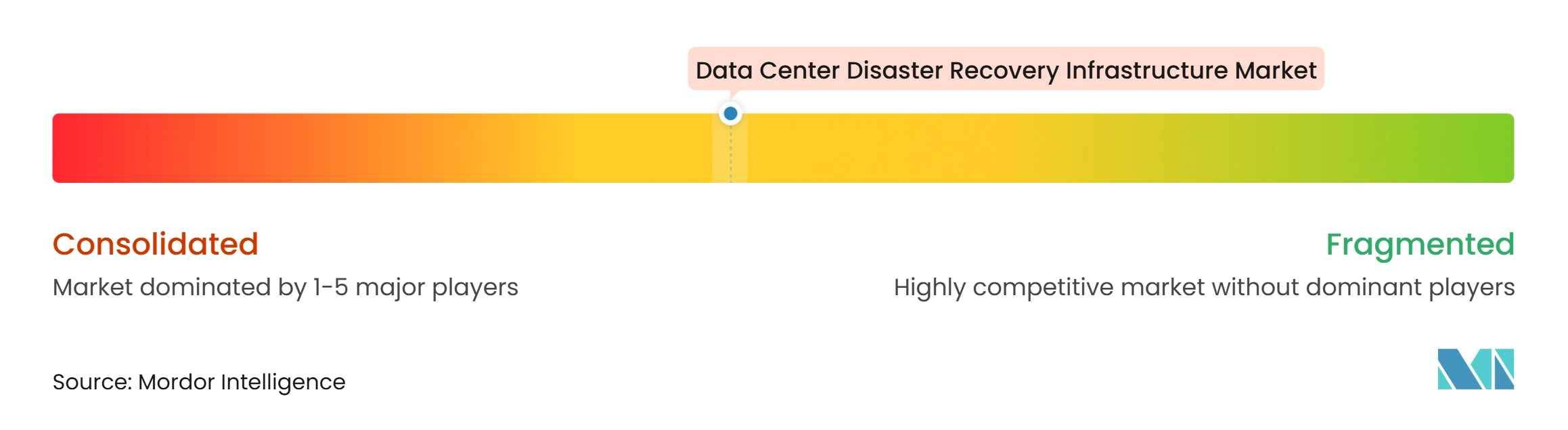
The data center disaster recovery infrastructure market is moderately consolidated. Veeam, Commvault, Rubrik, and Cohesity have broad platform coverage across backup, recovery, cloud, and identity-related functions. Smaller providers including Druva, Arcserve, NAKIVO, and HYCU focus on workload coverage, simpler operations, and mid-sized customers. Commvault reported total annual recurring revenue above USD 1 billion in fiscal second-quarter 2026. The company also reported SaaS annual recurring revenue of USD 335.7 million.[4] These results reflect demand for recurring cloud-platform relationships rather than only perpetual infrastructure licenses.
Rubrik introduced Autonomous Business Recovery for Cloud Applications in June 2026. It also acquired Strata.io to add identity-provider failover and introduced Identity Roll Forward for Active Directory recovery. Veeam announced the acquisition of Securiti AI in January 2026 for USD 1.725 billion in cash and stock. This move connected data classification and governance with recovery operations. Cohesity introduced Agent Resilience in September 2026 for select customers to protect the infrastructure that supports AI agents. The competitive focus is widening from restoring data quickly to restoring applications, identities, and operational confidence.
Clean-room recovery services, AI workload recovery, and cross-cloud identity continuity remain areas where there is room for differentiation. ISO/IEC 27031 provides guidance for information and communication technology readiness for business continuity. DORA also increases the need for proof that organizations can test and recover their operations. Vendors that produce test evidence and make complex recovery easier to operate can strengthen their position. The data center disaster recovery infrastructure industry remains competitive because buyers often use several tools and face different rules across workloads and regions. No combined top-player share was provided, so a numerical market concentration score cannot be derived without creating unsupported data.
Data Center Disaster Recovery Infrastructure Industry Leaders
-
Veeam Software Group GmbH
-
Commvault Systems, Inc.
-
Rubrik, Inc.
-
Cohesity, Inc.
-
Acronis International GmbH
- *Disclaimer: Major Players sorted in no particular order
Data Center Disaster Recovery Infrastructure Market Companies Covered in this Report
- Veeam Software Group GmbH
- Commvault Systems, Inc.
- Rubrik, Inc.
- Cohesity, Inc.
- Acronis International GmbH
- Druva Inc.
- Arcserve LLC
- Asigra Inc.
- ExaGrid Systems, Inc.
- HYCU, Inc.
- Infrascale, Inc.
- NAKIVO, Inc.
- Bacula Systems SA
- Storware Sp. z o.o.
- FalconStor Software, Inc.
- Kaseya US Inc.
- DataCore Software Corporation
- Scality, Inc.
- OpenText Corporation
Recent Industry Developments in Data Center Disaster Recovery Infrastructure Market
- September 2026: Cohesity introduced Agent Resilience for select customers, designed to detect, protect, and recover the infrastructure supporting AI agents across hybrid environments. The capability addresses a nascent but structurally important gap, as AI agent dependencies on identity systems, APIs, and configuration stores create failure modes that conventional workload recovery frameworks do not cover. General availability is planned for end-2026.
- August 2026: Druva upgraded its Active Directory forest recovery capability to a fully automated, zero-touch workflow. The release eliminates manual PowerShell execution during forest recovery, covering domain controller isolation, system-state restoration, metadata cleanup, and FSMO role reassignment, reducing return-to-operation time for identity-dependent enterprise environments.
- June 2026: Rubrik launched Autonomous Business Recovery (ABR) for Cloud Applications at Rubrik FORWARD, introducing agentic orchestration that reconstructs an organization's minimum viable business, including compute, data, networking, identity, and configurations, from a pre-validated clean point at machine speed.
- June 2026: Rubrik advanced identity resilience through its acquisition of Strata.io, enabling automatic failover to a secondary identity provider during a primary outage and introducing Identity Roll Forward, an industry-first capability that surgically reconstructs Active Directory while removing attacker persistence without reverting legitimate changes.
Global Data Center Disaster Recovery Infrastructure Market Report Scope
The data center disaster recovery infrastructure market comprises hardware, software, and services that enable organizations to protect critical data, applications, and IT systems and restore operations following disruptions such as cyberattacks, natural disasters, power outages, or system failures. This infrastructure includes backup and recovery solutions, replication tools, disaster recovery sites, cloud-based recovery services, and related management solutions.
The Data Center Disaster Recovery Infrastructure Market Report is Segmented by Infrastructure Type (Secondary and Dedicated Recovery Data Centers, Backup Data Center Infrastructure, Replication and Data Protection Infrastructure, Failover and Recovery Orchestration Infrastructure, Backup Storage Infrastructure, Network and Connectivity Infrastructure for Recovery, and Cloud-Based Disaster Recovery Infrastructure), Deployment Model (On-Premises Disaster Recovery, Colocation-Based Recovery, Cloud-Based Disaster Recovery, Hybrid Disaster Recovery, and Disaster Recovery-as-a-Service (DRaaS)), Recovery Architecture (Active-Active, Active-Passive, Warm Standby, Cold Standby, Backup and Restore, and Continuous Data Replication), Component (Compute and Server Infrastructure, Storage and Backup Systems, Data Replication Software, Network and Connectivity Systems, Recovery Orchestration and Automation, and Monitoring, Testing, and Failover Management), Application (Critical Business Application Recovery, Database and Data Platform Recovery, Virtual Machine and Workload Recovery, Cloud-Native Application Recovery, Enterprise IT Recovery, and High-Availability and Continuous Service Restoration), Data Center Size (Small, Medium, Large, and Hyperscale), Data Center Type (Colocation, Cloud Service Providers (CSPs), and Enterprise and Edge), and Geography (North America, South America, Europe, Asia-Pacific, Middle East, and Africa). The Market Forecasts are Provided in Terms of Value (USD).
Segmentation Overview
| Secondary and Dedicated Recovery Data Centers |
| Backup Data Center Infrastructure |
| Replication and Data Protection Infrastructure |
| Failover and Recovery Orchestration Infrastructure |
| Backup Storage Infrastructure |
| Network and Connectivity Infrastructure for Recovery |
| Cloud-Based Disaster Recovery Infrastructure |
| On-Premises Disaster Recovery |
| Colocation-Based Recovery |
| Cloud-Based Disaster Recovery |
| Hybrid Disaster Recovery |
| Disaster Recovery-as-a-Service (DRaaS) |
| Active-Active |
| Active-Passive |
| Warm Standby |
| Cold Standby |
| Backup and Restore |
| Continuous Data Replication |
| Compute and Server Infrastructure |
| Storage and Backup Systems |
| Data Replication Software |
| Network and Connectivity Systems |
| Recovery Orchestration and Automation |
| Monitoring, Testing, and Failover Management |
| Critical Business Application Recovery |
| Database and Data Platform Recovery |
| Virtual Machine and Workload Recovery |
| Cloud-Native Application Recovery |
| Enterprise IT Recovery |
| High-Availability and Continuous Service Restoration |
| Small |
| Medium |
| Large |
| Hyperscale |
| Colocation |
| Cloud Service Providers (CSPs) |
| Enterprise and Edge |
| North America | United States |
| Canada | |
| Mexico | |
| South America | Brazil |
| Argentina | |
| Rest of South America | |
| Europe | Germany |
| United Kingdom | |
| France | |
| Italy | |
| Spain | |
| Russia | |
| Rest of Europe | |
| Asia-Pacific | China |
| India | |
| Japan | |
| South Korea | |
| Australia | |
| Rest of Asia-Pacific | |
| Middle East | Saudi Arabia |
| United Arab Emirates | |
| Turkey | |
| Rest of Middle East | |
| Africa | South Africa |
| Egypt | |
| Nigeria | |
| Rest of Africa |
| By Infrastructure Type | Secondary and Dedicated Recovery Data Centers | |
| Backup Data Center Infrastructure | ||
| Replication and Data Protection Infrastructure | ||
| Failover and Recovery Orchestration Infrastructure | ||
| Backup Storage Infrastructure | ||
| Network and Connectivity Infrastructure for Recovery | ||
| Cloud-Based Disaster Recovery Infrastructure | ||
| By Deployment Model | On-Premises Disaster Recovery | |
| Colocation-Based Recovery | ||
| Cloud-Based Disaster Recovery | ||
| Hybrid Disaster Recovery | ||
| Disaster Recovery-as-a-Service (DRaaS) | ||
| By Recovery Architecture | Active-Active | |
| Active-Passive | ||
| Warm Standby | ||
| Cold Standby | ||
| Backup and Restore | ||
| Continuous Data Replication | ||
| By Component | Compute and Server Infrastructure | |
| Storage and Backup Systems | ||
| Data Replication Software | ||
| Network and Connectivity Systems | ||
| Recovery Orchestration and Automation | ||
| Monitoring, Testing, and Failover Management | ||
| By Application | Critical Business Application Recovery | |
| Database and Data Platform Recovery | ||
| Virtual Machine and Workload Recovery | ||
| Cloud-Native Application Recovery | ||
| Enterprise IT Recovery | ||
| High-Availability and Continuous Service Restoration | ||
| By Data Center Size | Small | |
| Medium | ||
| Large | ||
| Hyperscale | ||
| By Data Center Type | Colocation | |
| Cloud Service Providers (CSPs) | ||
| Enterprise and Edge | ||
| By Geography | North America | United States |
| Canada | ||
| Mexico | ||
| South America | Brazil | |
| Argentina | ||
| Rest of South America | ||
| Europe | Germany | |
| United Kingdom | ||
| France | ||
| Italy | ||
| Spain | ||
| Russia | ||
| Rest of Europe | ||
| Asia-Pacific | China | |
| India | ||
| Japan | ||
| South Korea | ||
| Australia | ||
| Rest of Asia-Pacific | ||
| Middle East | Saudi Arabia | |
| United Arab Emirates | ||
| Turkey | ||
| Rest of Middle East | ||
| Africa | South Africa | |
| Egypt | ||
| Nigeria | ||
| Rest of Africa | ||
Key Questions Answered in the Report
What is the data center disaster recovery infrastructure market size?
The data center disaster recovery infrastructure market is projected to reach USD 17.52 billion by 2032, from USD 9.71 billion in 2027, at a 12.53% CAGR.
What is driving demand for data center disaster recovery infrastructure?
Ransomware, hybrid and multicloud complexity, rising data volumes, and operational resilience requirements are increasing demand for tested recovery capabilities.
Which infrastructure type is growing fastest?
Cloud-based disaster recovery infrastructure is projected to grow at a 13.37% CAGR through 2032 as organizations seek flexible recovery capacity.
Why are recovery orchestration tools important?
Automation helps teams restore interconnected applications, data, networks, and identities with less reliance on manual runbooks.
Which region is growing fastest for disaster recovery infrastructure?
Asia-Pacific is projected to grow at a 13.24% CAGR through 2032, supported by new data center construction and growing resilience needs.
What role does disaster recovery as a service play?
Disaster recovery as a service is projected to grow at a 13.43% CAGR through 2032 because it can provide recovery capacity, testing, and operational support through a service model.