
Data Center Cyber-Physical Security Market Size and Share
Market Overview
| Study Period | 2021 - 2032 |
|---|---|
| Market Size (2027) | USD 2.97 Billion |
| Market Size (2032) | USD 5.89 Billion |
| Growth Rate (2027 - 2032) | 14.68 % |
| Fastest Growing Market | Asia-Pacific |
| Largest Market | North America |
| Market Concentration | Medium |
Major Players *Disclaimer: Major Players sorted in no particular order Image © Mordor Intelligence. Reuse requires attribution under CC BY 4.0. | |
Data Center Cyber-Physical Security Market Analysis by Mordor Intelligence
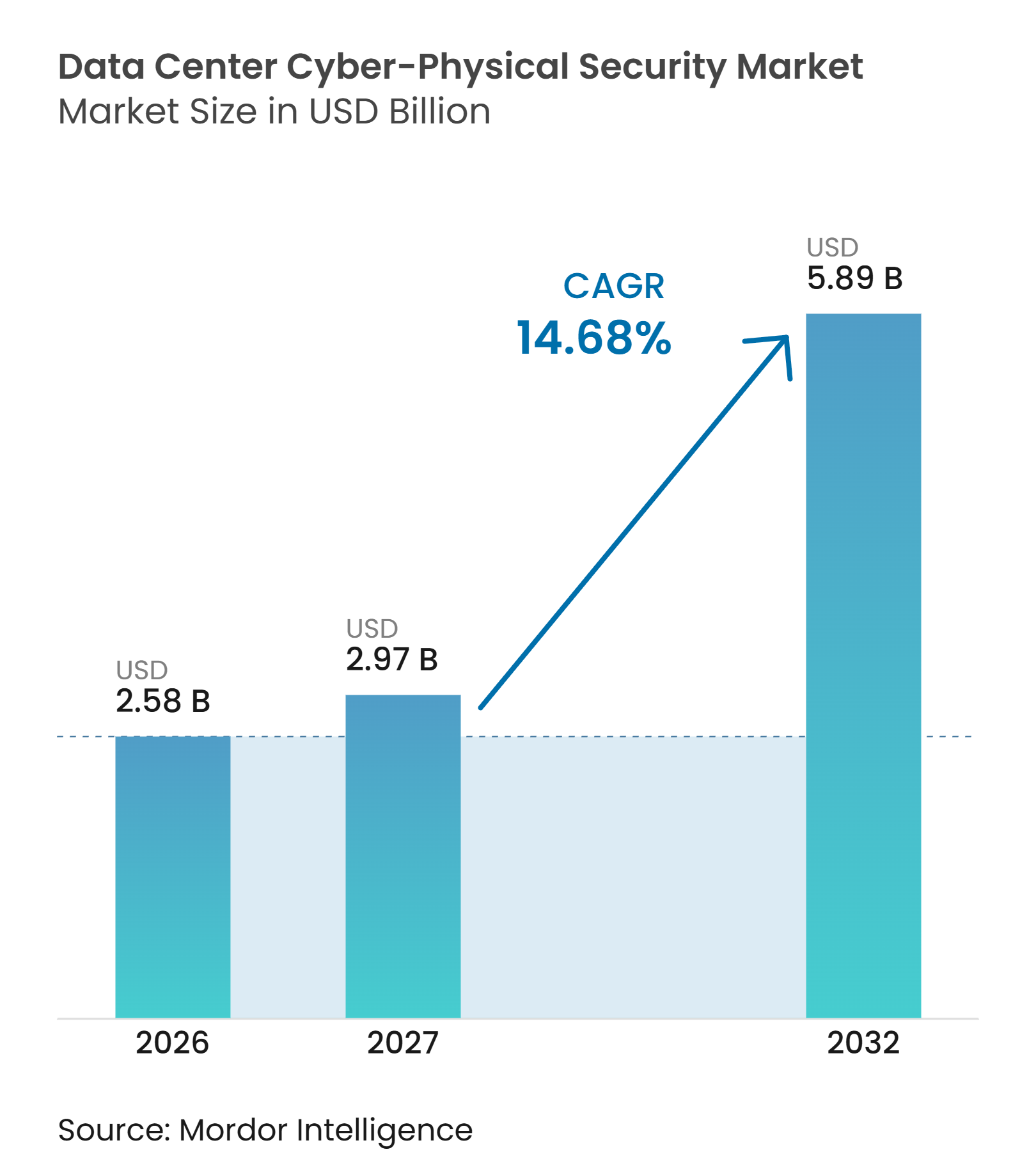
The data center cyber-physical security market size was valued at USD 2.58 billion in 2026 and is estimated to grow from USD 2.97 billion in 2027 to reach USD 5.89 billion by 2032, at a CAGR of 14.68% during the forecast period (2027-2032). Rising AI compute density is making cooling, power distribution, and facility controls more important to operational resilience. Operators are connecting building management systems, operational technology, and physical security tools with IT networks, which creates a wider and more interdependent risk surface. The data center cyber-physical security market is therefore moving toward platforms that correlate access events, video alerts, environmental readings, and network activity. Large cloud and colocation operators are setting more demanding security requirements during construction and operations. High integration costs and legacy operational technology constraints may delay deployments, particularly at older and multi-site facilities.
Key Report Takeaways
- By solution type, Unified Cyber-Physical Security Platforms accounted for 31.72% of the data center cyber-physical security market's segment revenue in 2026, while Network and Operational Technology Security Solutions are projected to expand at a 16.26% CAGR through 2032.
- By security layer, Integrated Security Operations Platforms accounted for 29.38% of the data center cyber-physical security market size in 2026, while Physical Access Control Systems are projected to expand at a 17.92% CAGR through 2032.
- By deployment model, Cloud-Based Solutions held 64.78% of the data center cyber-physical security market share in 2026 and are projected to expand at a 15.39% CAGR through 2032.
- By service type, System Integration and Implementation held 26.54% in 2026, while Security Auditing and Compliance Services are projected to expand at a 16.59% CAGR through 2032.
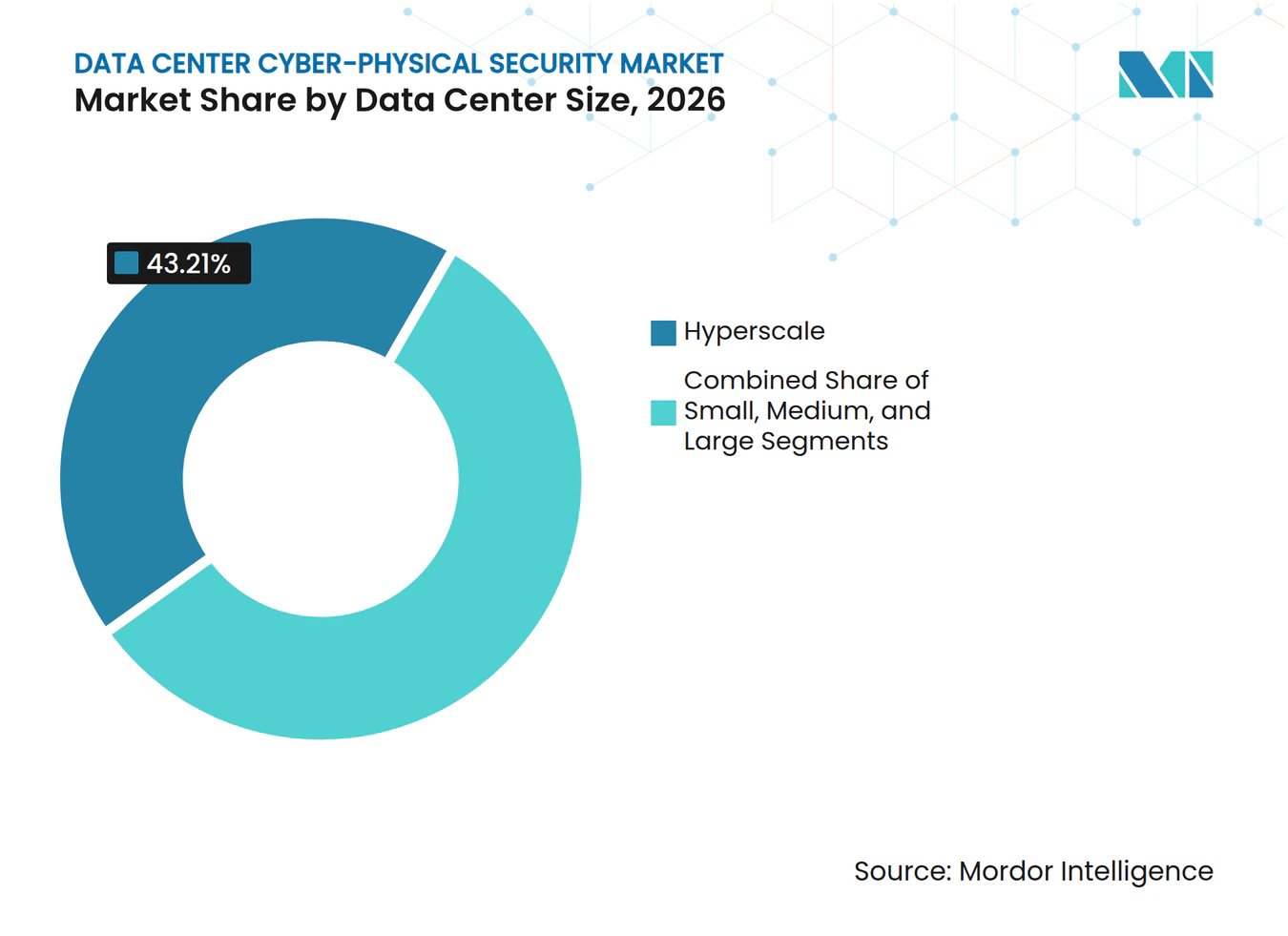
- By data center size, Hyperscale Data Centers accounted for 43.21% in 2026 and are projected to expand at an 18.27% CAGR through 2032.
- By data center type, Cloud Service Providers held 41.64% in 2026, while Enterprise and Edge Data Centers are projected to expand at a 17.38% CAGR through 2032.
- By geography, North America held 39.53% of the data center cyber-physical security market in 2026, while Asia-Pacific is projected to expand at a 16.93% CAGR through 2032.
Note: Market numbers in this report are based on Mordor Intelligence's proprietary estimation framework, which combines nine months of actuals with Q4 projections for base year 2026.
Market Trends and Insights
Drivers Impact Analysis of Data Center Cyber-Physical Security Market*
| Driver | (~) % Impact on CAGR Forecast | Geographic Relevance | Impact Timeline |
|---|---|---|---|
| Hyperscale and Colocation Data Center Expansion | +3.2% | Global, concentrated in North America, Asia-Pacific, and Europe | Short term (≤ 2 years) |
| Increasing Hybrid Cyber-Physical Attack Risk | +2.6% | Global, with high urgency in North America and the EU | Medium term (2-4 years) |
| Stricter Data Protection and Critical Infrastructure Compliance | +2.0% | EU, UK, North America, with spillover to Asia-Pacific | Medium term (2-4 years) |
| Adoption of AI-Powered Video Analytics and Automated Monitoring | +1.7% | Global, especially hyperscale and colocation facilities | Short term (≤ 2 years) |
| AI Workloads Increasing Facility Density and Resilience Requirements | +1.4% | North America, Asia-Pacific, Gulf states, and EU data-sovereignty zones | Medium term (2-4 years) |
| Government Classification of Data Centers as Critical Infrastructure | +1.1% | UK, Germany, Singapore, Japan, South America, and Africa | Long term (≥ 4 years) |
| Source: Mordor Intelligence | |||
Hyperscale and Colocation Data Center Expansion
The expansion of hyperscale and colocation campuses is creating demand for security programs that can be designed and deployed during construction. Physical security for a major campus can take 12 to 18 months to design and staff, while compressed construction schedules can bring facilities online in less than 12 months. This timing gap places a premium on pre-integrated security platforms that can be configured quickly. AFCOM reported that 78% of data center operators had overhauled physical security protocols in the preceding 2 years, while 57% identified physical security threats as a leading organizational risk. Colocation sites also need tenant-isolated access controls because multiple customers share the same facility. The data center cyber-physical security market benefits as new sites require coordinated access, monitoring, and incident management from the outset.
Increasing Hybrid Cyber-Physical Attack Risk
A compromise involving a building management system, access-control platform, or remote monitoring tool can disrupt cooling, power distribution, fire suppression, or site access. These links make a digital intrusion capable of causing physical operational failure. A Department of Energy technical report identified fragmented governance, vulnerabilities in interconnection architecture, and AI-driven load instability as cross-cutting risks among surveyed operators, utilities, and vendors. The report also identified gaps at utility and data center boundaries, where responsibility can be unclear. Operators are responding with continuous operational technology, telemetry monitoring, and segmented networks. This need for coordinated detection supports the data center cyber-physical security market across both new and established facilities.
Stricter Data Protection and Critical Infrastructure Compliance
The NIS2 framework places data center service operators within the scope of digital infrastructure security requirements. ENISA guidance covers physical security, cryptography, network segmentation, multi-factor authentication, supply-chain controls, and incident reporting. The UK Cyber Security and Resilience Bill proposes essential-service treatment for qualifying data centers and identifies 1 MW of rated IT load as the proposed threshold.[1] These requirements encourage operators to consolidate logs and create clear evidence of the effectiveness of controls. Multinational operators are also using similar standards outside Europe when defining supplier requirements. The data center cyber-physical security market is supported by the need for systems that provide traceability across physical and digital controls.
Adoption of AI-Powered Video Analytics and Automated Monitoring
AI-enabled video tools can identify behavioral anomalies, unusual dwell times, multi-person entry events, and after-hours activity in real time. They reduce reliance on constant manual review of camera feeds. Johnson Controls introduced exacqVision 26.2 and Software House CCURE IQ 3.20 at GSX 2026, combining video, incident response, reporting, and spatial analytics within connected security workflows.[2] Comparable object-recognition features are becoming more widely available across vendors. Differentiation is shifting toward the ability to correlate a video alert with access, network, and operational technology data. This shift favors the data center cyber-physical security market solutions that operate across multiple security domains.
Restraints Impact Analysis of Data Center Cyber-Physical Security Market*
| Restraint | (~) % Impact on CAGR Forecast | Geographic Relevance | Impact Timeline |
|---|---|---|---|
| High Capital and Integration Costs | -1.8% | Global, most acute for multi-site colocation and enterprise operators | Short term (≤ 2 years) |
| Operational and Return on Investment Concerns | -1.3% | Global, especially mid-market operators | Medium term (2-4 years) |
| Legacy BMS and OT Patching Constraints | -0.9% | Global, especially older facilities in Europe and North America | Medium term (2-4 years) |
| Fragmented Governance Across Operators, Utilities, and Contractors | -0.5% | Global, particularly at utility-data center interfaces and multi-tenant sites | Long term (≥ 4 years) |
| Source: Mordor Intelligence | |||
High Capital and Integration Costs
A unified platform may require hardware replacement, software licenses, integration services, training, and managed support at the same time. Older sites often use separate suppliers for access control, video, building management, and network monitoring. Their systems may have proprietary data models and limited interoperability. Integration without disrupting live operations usually requires specialized work. The Department of Energy report also identified inconsistent vendor-access protocols as a recurring governance gap. These costs can divert spending toward power-density upgrades and connectivity projects that have easier financial justification.
Operational and Return on Investment Concerns
Security convergence does not directly create capacity revenue, which can make its return on investment difficult to quantify. Facility, IT security, and operational technology teams may also work under separate budgets and approval processes. This organizational structure can complicate a unified business case. The UK Government cited productivity losses and unplanned IT costs after a 2022 NHS Trust data center outage. The data center cyber-physical security market may gain traction as buyers use compute-hour losses and service-level penalties to evaluate avoided downtime. Formal risk models can help security teams connect resilience investment to operational exposure.
*Our forecasts treat driver/restraint impacts as directional, not additive. The impact forecasts reflect baseline growth, mix effects, and variable interactions.
Data Center Cyber-Physical Security Market Segment Analysis
By Solution Type:
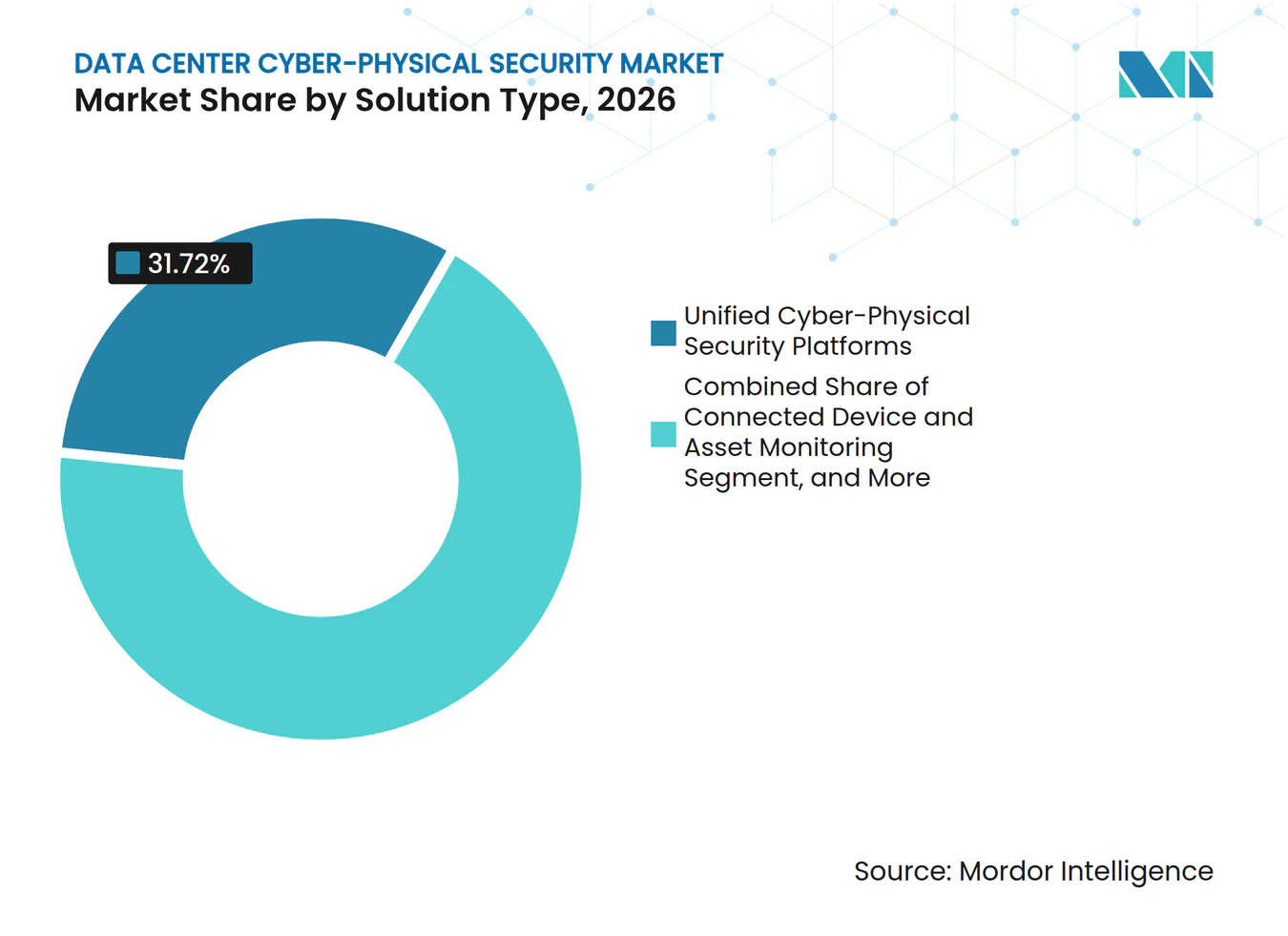
Unified Platforms Lead While OT Security AcceleratesUnified Cyber-Physical Security Platforms held 31.72% of the data center cyber-physical security market size by solution type in 2026. They centralize feeds from badge readers, video systems, environmental sensors, and network monitoring tools. This approach helps security teams identify an unusual remote login alongside an unauthorized access event. It also reduces the separation between physical security and IT security teams. Audit requirements under ISO/IEC 27001 and SOC 2 Type II reinforce the need to retain clear records of logical and physical access. Unified platforms can provide those records through a common operating view. The data center cyber-physical security market is consequently favoring platforms that combine detection with evidence collection. This model is especially relevant to operators managing complex, multi-site estates.
Network and Operational Technology Security Solutions are projected to expand at a 16.26% CAGR from 2027 to 2032. Cooling units, uninterruptible power supplies, power distribution units, and data center infrastructure management systems can create material risk when connected to wider networks. Connected device monitoring and event-correlation tools are gaining importance as operators install more Internet of Things sensors for predictive maintenance. Identity and access management tools also support zero-trust requirements at regulated facilities. Integration and incident response services connect these tools into an operational workflow. Moxa identifies IEC 62443-4-2 capabilities such as secure boot, user authentication, and network access control as important hardware-level safeguards for AI data center operational technology.[3] The data center cyber-physical security industry is placing more weight on protection below the conventional IT perimeter. Hardware and software vendors must therefore address both device integrity and operational visibility.



By Security Layer:
Integrated Operations Hold the Largest PositionIntegrated Security Operations Platforms accounted for 29.38% of the data center cyber-physical security market share by security layer in 2026. They aggregate physical access events, cyber signals, and environmental readings for security operations centers. Their central role makes them a focus of large procurement programs. Physical Access Control Systems are projected to expand at a 17.92% CAGR from 2027 to 2032. Operators are moving beyond static badge entry toward combinations of biometrics, personal identification numbers, and time-bound rules. These systems can flag anti-passback violations and unusual credential activity. The data center cyber-physical security market requires these controls from perimeter gates through server cages. Stronger access verification is becoming necessary where sensitive equipment and tenants share a campus.
Video surveillance is moving from passive recording to active detection of defined behavioral anomalies. Building management and facility control systems are also becoming a critical integration target. Cooling, power, and access systems increasingly operate on shared networking layers. Environmental monitoring is becoming more important in high-density AI halls, where thermal, humidity, and power readings need close oversight. An unusual reading may indicate an equipment issue or an attempted cyber-physical disruption. The data center cyber-physical security industry therefore needs controls that can distinguish operational variation from malicious activity. Securing the building management system has become a first-tier requirement rather than a facility-only responsibility. The resulting architecture links surveillance, access control, and infrastructure protection.
By Deployment Model:
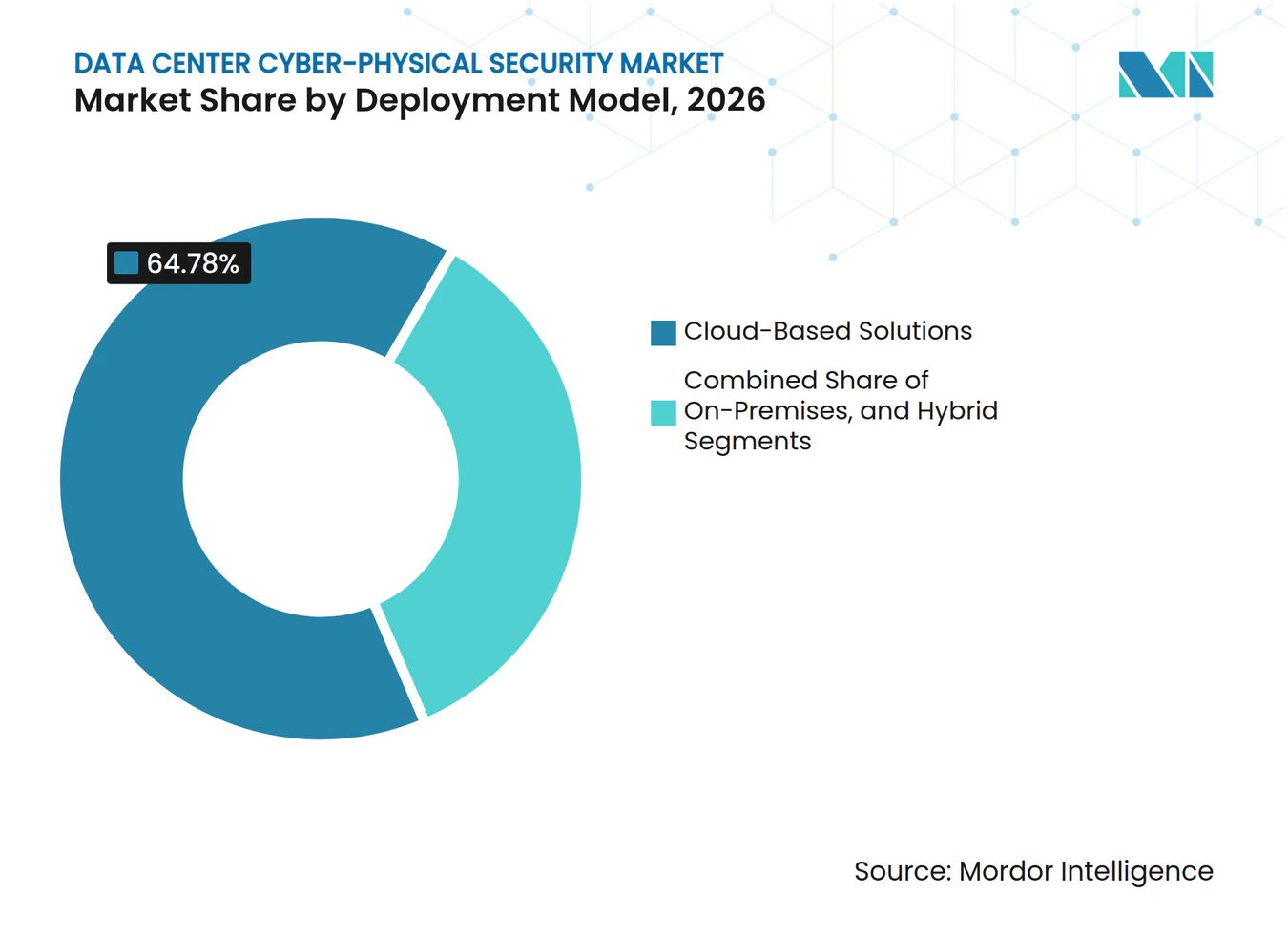
Cloud-Based Platforms Maintain LeadershipCloud-Based Solutions accounted for 64.78% of the data center cyber-physical security market by deployment model in 2026. They allow operators to manage access permissions, updates, and audit logs across multiple campuses from a centralized platform. This reduces dependence on separate local servers and appliances. Global operators can apply common policies across sites without physically visiting each location. Cloud-Based Solutions are also projected to expand at a 15.39% CAGR from 2027 to 2032. Their continued expansion from a leading position indicates that centralized management remains a priority. The data center cyber-physical security market is using cloud delivery to simplify the administration of geographically distributed facilities. It also allows remote teams to review security events and device status.
On-Premise Solutions retain importance where data residency, classification, or internal policy limits the transfer of security telemetry. Hybrid Solutions offers another route by keeping sensitive access records on site while using cloud services for analytics and remote management. This model can fit operators that need both local control and centralized oversight. Verkada received FedRAMP Moderate Authorization for its Command Platform, with the US Department of Energy as agency sponsor, illustrating progress in cloud-based physical security compliance for federal use.[4] Such approvals can reduce a historical adoption barrier in government-linked settings. Buyers still need to assess network resilience, data handling, and integration needs before selecting a model. The data center cyber-physical security market therefore accommodates cloud, on-premise, and hybrid approaches. Deployment decisions continue to depend on facility criticality and regulatory obligations.

By Service Type:
Integration Is Essential While Compliance Auditing AcceleratesSystem Integration and Implementation held 26.54% of the data center cyber-physical security market by service type in 2026. This reflects the difficulty of connecting access control, video management, operational technology monitoring, and building systems across mixed estates. Many operators require a service partner because the deployment is not an off-the-shelf task. Integration work can span legacy and newer systems at the same time. It must also avoid interrupting mission-critical services. The data center cyber-physical security market has created sustained demand for specialists who can coordinate these dependencies. Their role includes translating security requirements into workable facility workflows. It also includes testing systems before they enter live operations.
Security Auditing and Compliance Services are projected to expand at a 16.59% CAGR from 2027 to 2032. Regulatory duties are adding weight to formal assessment, evidence collection, and incident-readiness programs. Managed Monitoring and Detection services can serve operators who cannot support a 24/7 internal security operations center. Cyber-Physical Risk Assessment services help buyers evaluate blended attack scenarios before committing to a platform investment. Incident Response and Recovery providers are developing operational technology-aware playbooks because equipment cannot always be taken offline for remediation. Johnson Controls introduced managed services capabilities for organizations operating with constrained security staffing. The data center cyber-physical security market is broadening from technology delivery into ongoing operational support. Service providers that understand facility constraints can address a meaningful buyer need.
By Data Center Size:
Hyperscale Facilities Set Architecture StandardsHyperscale Data Centers accounted for 43.21% of segment spending by facility size in 2026. They are also projected to expand at an 18.27% CAGR from 2027 to 2032. Their scale allows them to establish specifications that influence colocation tenants, equipment vendors, and integrators. A hyperscale requirement for zero-trust access, IEC 62443-compliant operational technology hardware, or behavioral video analytics can become a wider ecosystem expectation. These facilities need standardized security through construction and operations. They also need to coordinate highly concentrated computing assets and large workforces. The data center cyber-physical security market responds by delivering repeatable, scalable control architectures. This creates demand for common design patterns across sites.
Large data centers are adopting more hyperscale-grade practices as AI tenants impose stronger security requirements. Medium-sized facilities are expanding in Southeast Asia, the Middle East, and Europe to support sovereign AI infrastructure. They often need modular platforms that can expand with the site. Small data centers remain more price-sensitive and may prioritize integrated solutions following a mandate or incident. This creates a gap between high spending at hyperscale sites and the broad base of smaller facilities. Managed delivery models may help vendors address this gap without requiring a full capital-intensive program. The data center cyber-physical security industry can serve this range through flexible design and commercial models. The most accessible solutions will need to preserve credible protection while reducing integration burden.
By Data Center Type:
Cloud Providers Lead While Edge Facilities AccelerateCloud Service Providers held 41.64% of the data center cyber-physical security market by data center type in 2026. Their global infrastructure footprints and mature security investment practices support this leading position. These providers were early adopters of converged security because they face threats and compliance obligations across multiple jurisdictions. They also use proprietary architectures that can influence tenant and supplier expectations. Enterprise and Edge Data Centers are projected to expand at a 17.38% CAGR from 2027 to 2032. Edge deployments multiply physical locations outside the controlled perimeter of a primary campus. The data center cyber-physical security market needs remotely managed and lightweight controls for these distributed environments. Each node can introduce a new access, device, and operational technology risk.
Colocation operators face a complex operating position because they support customers with different security requirements on shared infrastructure. They need to meet demanding tenant expectations while maintaining cost efficiency. Nozomi Networks reported that its platform protects more than 115 million industrial and Internet of Things assets across more than 12,000 installations. This scale shows the broad role of operational technology monitoring in critical environments. Edge computing is increasing the need to extend zero-trust access and monitoring beyond large central campuses. The data center cyber-physical security market needs products that can operate without constant local staffing. Vendors must balance consistent central policy with the constraints of smaller, remote sites. This requirement is altering the way platforms are designed and managed.
Geography Analysis
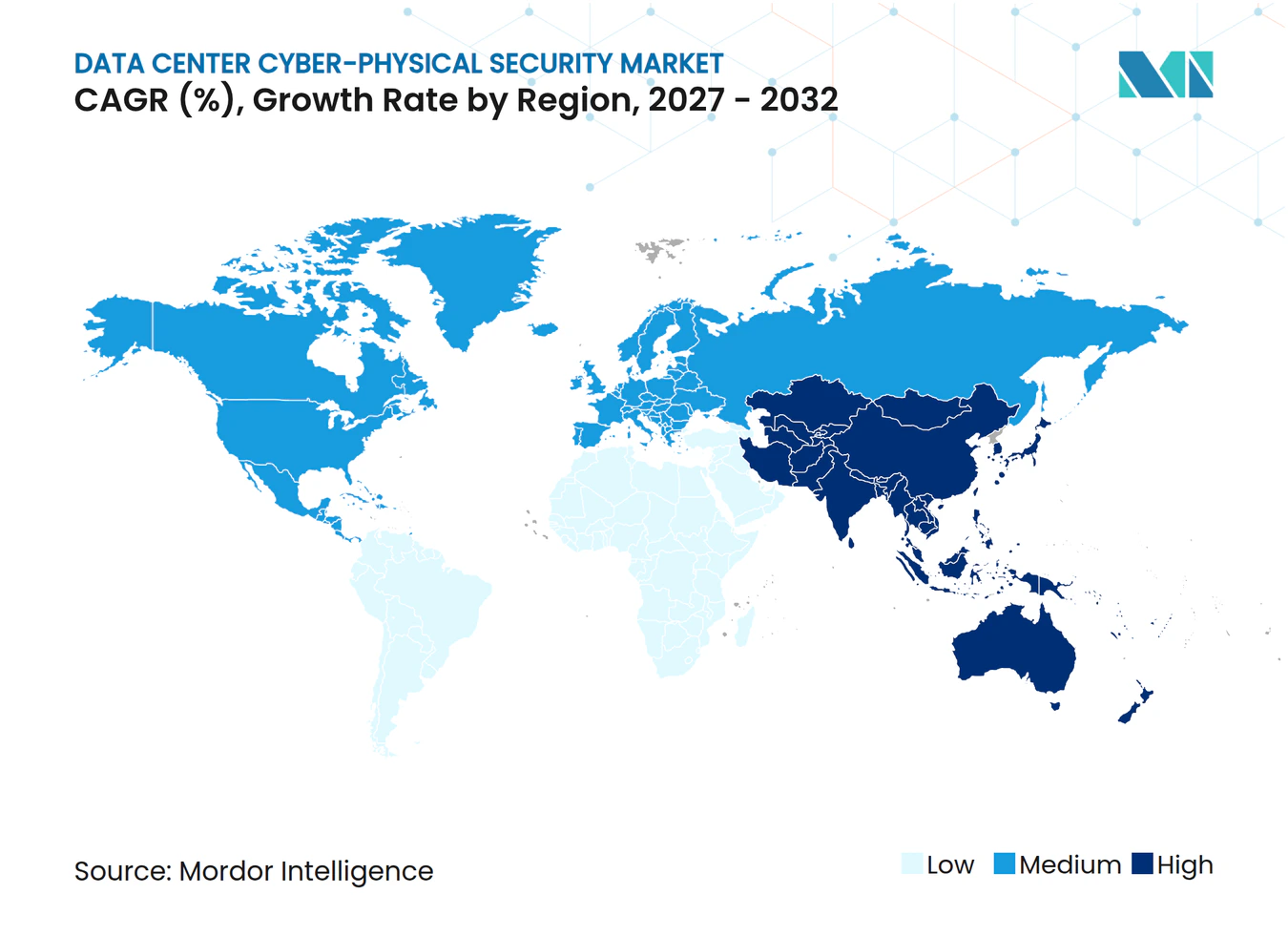
North America held 39.53% of global revenue in 2026. The region has a high concentration of hyperscale and colocation operators in the United States, Canada, and Mexico. It also has a policy environment shaped by critical infrastructure security requirements. The White House issued an executive order in July 2025 to accelerate federal permitting for data center infrastructure and allow the use of federally owned land for development. This direction reflects the strategic importance assigned to AI-related data center capacity. Security specifications established by large US facilities can extend to nearshore campuses in Canada and Mexico. Operators in the region are seeking more consistent controls across access, building systems, and network infrastructure. This reinforces demand for converged programs across the data center cyber-physical security market.
Asia-Pacific is projected to expand at a 16.93% CAGR from 2027 to 2032. Sovereign AI programs, data-localization requirements, and new construction across Singapore, Japan, Australia, China, and Southeast Asia support this pace. Japan established the Cyber-Physical Security Research Division within the National Institute of Advanced Industrial Science and Technology in April 2025. National policy and research activity are making security-by-design a more visible procurement factor. Operators in the region also face practical pressure around cooling, power, and grid capacity. These conditions raise the importance of securing the operational systems that support resilient service. The data center cyber-physical security market in Asia-Pacific will need to address both regulatory expectations and facility-level operational exposure. Regional projects will also require solutions that fit diverse national compliance environments.
Europe is being shaped by NIS2 and the Commission Implementing Regulation 2024/2690, which establish security expectations for digital infrastructure providers. Germany, the UK, and France are significant regional markets because operators face formal resilience and security obligations. The UK bill would establish a compliance framework for data centers above the proposed 1 MW threshold. Middle East activity is supported by sovereign cloud programs in the UAE and Saudi Arabia. South America and Africa are at earlier stages of adoption, though global hyperscale investment is bringing established security specifications into new locations. Brazil is leading South American investment in colocation security upgrades aligned with data protection needs. South Africa and Nigeria are attracting hyperscale projects that may bring similar operational expectations. These regional patterns extend the data center cyber-physical security market beyond its most mature geographies.
Competitive Landscape
Market Concentration
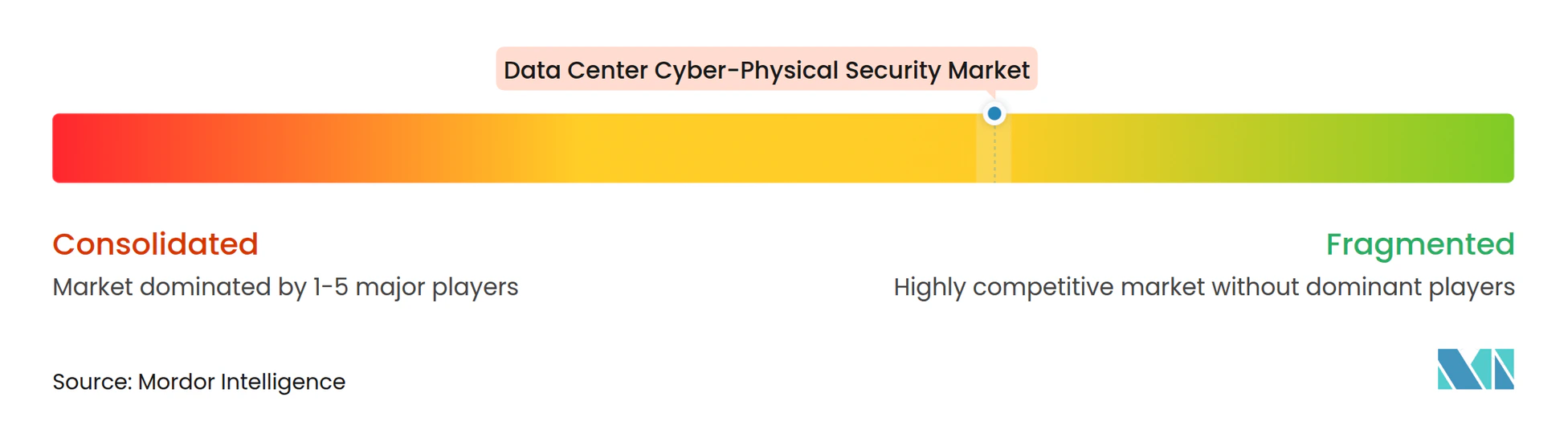
The data center cyber-physical security market is moderately fragmented because no vendor has a commanding share across operational technology, IT security, and physical security. Building-technology companies have strengths in access management and facility control. Operational technology specialists have strengths in agentless monitoring, protocol-aware detection, and vulnerability management. Competition follows two broad models. Some vendors expand a single platform to ingest data from previously separate systems. Others build open architectures and use partnerships to connect different products. Johnson Controls aligned Metasys 16.0 with IEC 62443-4-2 Security Level 2 protections, strengthening its building automation security credentials. The middle market offers room for managed services that avoid the need for a large initial integration program.
Cloud-native delivery and AI behavioral analytics are creating a route for newer competitors. Camera fleets that analyze data at the edge can reduce response latency and reduce the volume of data sent to centralized platforms. This approach can scale across campuses without a proportionate increase in centralized infrastructure costs. Claroty integrated its xDome and Continuous Threat Detection offerings with Google Security Operations in August 2025. The integration allows security teams to correlate operational technology, Internet of Things, and building management alerts with enterprise security telemetry. Vendors are competing on asset discovery, behavioral anomaly detection, and compliance evidence across several frameworks. These functions matter where buyers need a consolidated view of heterogeneous environments. The data center cyber-physical security market rewards vendors that can translate technical telemetry into clear operational priorities.
Genetec deployed Security Center for TEPCO Power Grid in September 2026, centralizing management of more than 30,000 cameras across the utility's critical infrastructure network. Johnson Controls also introduced AI-enabled video, integrated access workflows, and managed services for mission-critical operations in September 2026. These moves show how platform providers are linking video, access, analytics, and operational support. Product differentiation increasingly depends on the ability to correlate physical events with network and operational technology signals. Buyers also value compliance evidence that can support NIS2, SOC 2, ISO 27001, and NERC CIP obligations from a common environment. Partnerships remain important because few suppliers can own every layer of a cyber-physical architecture. The data center cyber-physical security market is therefore likely to retain a diverse vendor base. The competitive position of each company depends on integration capability as much as on individual product functions.
Data Center Cyber-Physical Security Industry Leaders
-
Honeywell International Inc.
-
Johnson Controls International plc
-
Siemens AG
-
Schneider Electric SE
-
Bosch Security Systems
- *Disclaimer: Major Players sorted in no particular order
Data Center Cyber-Physical Security Market Companies Covered in this Report
- Honeywell International Inc.
- Johnson Controls International plc
- Siemens AG
- Schneider Electric SE
- Bosch Security Systems
- Genetec Inc.
- Motorola Solutions
- Claroty
- Nozomi Networks
- Other Key Market Participants
- Legrand SA
- dormakaba Group
- Axis Communications AB
- Verkada Inc.
- Gunnebo AB
- Genetec Inc.
- Salto Systems S.L.
- Gallagher Group Limited
- Suprema Inc.
- Securitas Technology
- Convergint Technologies LLC
- Avigilon Corporation
- Pelco, Inc.
- Senstar Corporation
Recent Industry Developments in Data Center Cyber-Physical Security Market
- September 2026: Johnson Controls launched AI-enabled security innovations at GSX 2026, including exacqVision 26.2 video management software with AI-driven insights across distributed camera fleets and Software House C•CURE IQ 3.20, which integrates video management, incident response, reporting, and spatial analytics into a single web-based access control platform. The company also introduced new Managed Services and Proactive Video Solutions designed for organizations expanding security operations in mission-critical environments.
- September 2026: TEPCO Power Grid deployed Genetec Security Center to unify security operations across its critical infrastructure network, centralizing management of over 30,000 cameras and establishing a scalable platform supporting future digital transformation across the TEPCO grid. This deployment signals growing adoption of unified physical security platforms in energy-adjacent critical infrastructure with operational parallels to large data center campuses.
- June 2026: Mexico's federal government set a national data center investment target of USD 82.5 billion through 2031, signaling a sustained pipeline of hyperscale and colocation facility construction across Querétaro, Mexico City, and Nuevo León. Each new facility entering construction represents a discrete security infrastructure procurement opportunity requiring integrated physical-cyber protection from the ground up.
- March 2026: Johnson Controls unveiled C-CURE IQ 3.2, IQ Panel 5 updates, and PowerSeries Neo 5 hybrid intrusion platform configurations at ISC West 2026. The release combines access control, video management, and incident workflows into a unified interface for mission-critical environments, including data centers.
Global Data Center Cyber-Physical Security Market Report Scope
The data center cyber-physical security market comprises the revenue generated from security solutions and services that protect data center facilities against combined cyber, physical, and operational technology threats. It includes unified cyber-physical security platforms, surveillance and video analytics, access control, biometric and identity management, network and OT security, alarm systems, environmental monitoring, integration, incident response, and managed security services deployed across colocation, cloud service provider, enterprise, and edge data centers.
The Data Center Cyber-Physical Security Market Report is Segmented by Solution Type (Unified Cyber-Physical Security Platforms, Connected Device and Asset Monitoring Solutions, Security Information and Event Correlation Solutions, Network and Operational Technology Security Solutions, Identity and Access Management Solutions, and Integration and Incident Response Services), Security Layer (Physical Access Control Systems, Video Surveillance Systems, Building Management and Facility Control Systems, Environmental and Infrastructure Monitoring Systems, and Integrated Security Operations Platforms), Deployment Model (On-Premise Solutions, Cloud-Based Solutions, and Hybrid Solutions), Service Type (Cyber-Physical Risk Assessment, System Integration and Implementation, Managed Monitoring and Detection, Incident Response and Recovery, and Security Auditing and Compliance Services), Data Center Size (Small, Medium, Large, and Hyperscale), Data Center Type (Colocation, Cloud Service Providers (CSPs), and Enterprise / Edge), and Geography (North America, South America, Europe, Asia-Pacific, and Middle East and Africa). The Market Forecasts are Provided in Terms of Value (USD).
Segmentation Overview
| Unified Cyber-Physical Security Platforms |
| Connected Device and Asset Monitoring Solutions |
| Security Information and Event Correlation Solutions |
| Network and Operational Technology Security Solutions |
| Identity and Access Management Solutions |
| Integration and Incident Response Services |
| Physical Access Control Systems |
| Video Surveillance Systems |
| Building Management and Facility Control Systems |
| Environmental and Infrastructure Monitoring Systems |
| Integrated Security Operations Platforms |
| On-Premise Solutions |
| Cloud-Based Solutions |
| Hybrid Solutions |
| Cyber-Physical Risk Assessment |
| System Integration and Implementation |
| Managed Monitoring and Detection |
| Incident Response and Recovery |
| Security Auditing and Compliance Services |
| Small |
| Medium |
| Large |
| Hyperscale |
| Colocation |
| Cloud Service Providers (CSPs) |
| Enterprise / Edge |
| North America | United States | |
| Canada | ||
| Mexico | ||
| South America | Brazil | |
| Argentina | ||
| Rest of South America | ||
| Europe | Germany | |
| United Kingdom | ||
| France | ||
| Italy | ||
| Rest of Europe | ||
| Asia-Pacific | China | |
| Japan | ||
| Australia | ||
| Singapore | ||
| Rest of Asia-Pacific | ||
| Middle East and Africa | Middle East | United Arab Emirates |
| Saudi Arabia | ||
| Turkey | ||
| Rest of Middle East | ||
| Africa | South Africa | |
| Nigeria | ||
| Rest of Africa | ||
| By Solution Type | Unified Cyber-Physical Security Platforms | ||
| Connected Device and Asset Monitoring Solutions | |||
| Security Information and Event Correlation Solutions | |||
| Network and Operational Technology Security Solutions | |||
| Identity and Access Management Solutions | |||
| Integration and Incident Response Services | |||
| By Security Layer | Physical Access Control Systems | ||
| Video Surveillance Systems | |||
| Building Management and Facility Control Systems | |||
| Environmental and Infrastructure Monitoring Systems | |||
| Integrated Security Operations Platforms | |||
| By Deployment Model | On-Premise Solutions | ||
| Cloud-Based Solutions | |||
| Hybrid Solutions | |||
| By Service Type | Cyber-Physical Risk Assessment | ||
| System Integration and Implementation | |||
| Managed Monitoring and Detection | |||
| Incident Response and Recovery | |||
| Security Auditing and Compliance Services | |||
| By Data Center Size | Small | ||
| Medium | |||
| Large | |||
| Hyperscale | |||
| By Data Center Type | Colocation | ||
| Cloud Service Providers (CSPs) | |||
| Enterprise / Edge | |||
| By Geography | North America | United States | |
| Canada | |||
| Mexico | |||
| South America | Brazil | ||
| Argentina | |||
| Rest of South America | |||
| Europe | Germany | ||
| United Kingdom | |||
| France | |||
| Italy | |||
| Rest of Europe | |||
| Asia-Pacific | China | ||
| Japan | |||
| Australia | |||
| Singapore | |||
| Rest of Asia-Pacific | |||
| Middle East and Africa | Middle East | United Arab Emirates | |
| Saudi Arabia | |||
| Turkey | |||
| Rest of Middle East | |||
| Africa | South Africa | ||
| Nigeria | |||
| Rest of Africa | |||
Key Questions Answered in the Report
What is the size of the data center cyber-physical security market?
The data center cyber-physical security market size was valued at USD 2.58 billion in 2026 and is estimated to grow from USD 2.97 billion in 2027 to reach USD 5.89 billion by 2032, at a CAGR of 14.68% during the forecast period (2027-2032).
What is driving demand for cyber-physical security in data centers?
AI-driven facility density, hybrid cyber-physical risk, critical infrastructure requirements, and expansion of hyperscale and colocation campuses are increasing demand.
Which solution type leads data center cyber-physical security spending?
Unified Cyber-Physical Security Platforms held 31.72% of spending by solution type in 2026, reflecting demand for centralized visibility across physical and digital systems.
Which deployment model is most widely used for data center security?
Cloud-Based Solutions held 64.78% of the deployment model segment in 2026 and are projected to expand at a 15.39% CAGR through 2032.
Which data center facilities are expanding fastest for security adoption?
Hyperscale Data Centers are projected to expand at an 18.27% CAGR, while Enterprise and Edge Data Centers are projected to expand at a 17.38% CAGR through 2032.
Which region is expected to expand fastest?
Asia-Pacific is projected to expand at a 16.93% CAGR from 2027 to 2032, supported by sovereign AI programs, data-localization requirements, and new facility construction.