
Data Center Critical Infrastructure Resilience Market Size and Share
Market Overview
| Study Period | 2021 - 2032 |
|---|---|
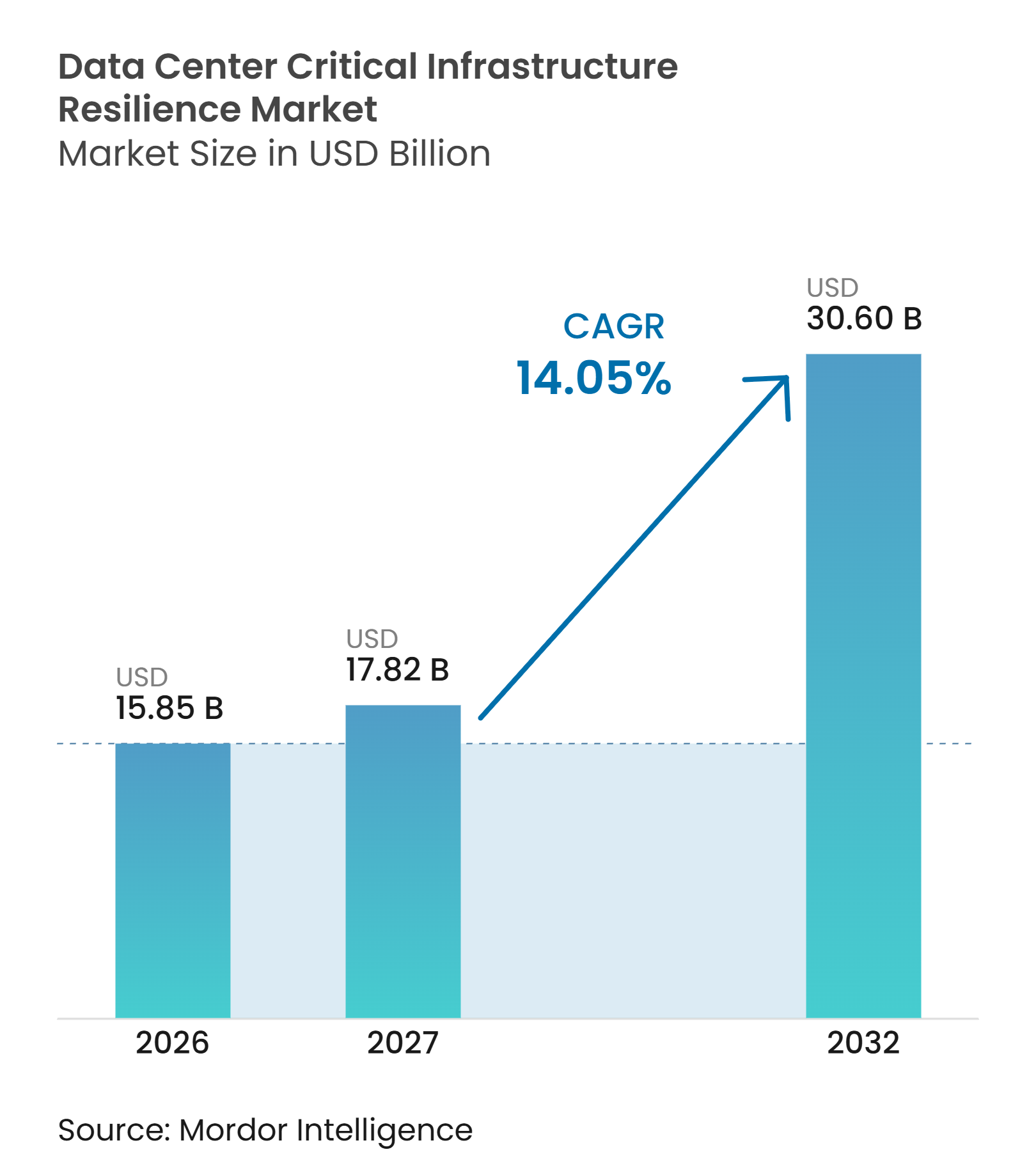
| Market Size (2027) | USD 17.82 Billion |
| Market Size (2032) | USD 30.60 Billion |
| Growth Rate (2027 - 2032) | 14.05 % |
| Fastest Growing Market | Asia-Pacific |
| Largest Market | North America |
| Market Concentration | Medium |
Major Players *Disclaimer: Major Players sorted in no particular order Image © Mordor Intelligence. Reuse requires attribution under CC BY 4.0. | |
Data Center Critical Infrastructure Resilience Market Analysis by Mordor Intelligence
The data center critical infrastructure resilience market size is projected to be USD 15.85 billion in 2026 and reach USD 30.60 billion by 2032, expanding at a CAGR of 14.05% from 2027 to 2032. The data center critical infrastructure resilience market is being shaped by higher computing density, larger cloud estates, and tighter service commitments. Operators are treating redundant power, cooling, connectivity, and recovery processes as core operating requirements rather than optional safeguards. The data center critical infrastructure resilience market also benefits from demand for tested continuity plans among operators that serve financial services, healthcare, government, and other essential services. Suppliers are responding by combining facility equipment, monitoring software, recovery planning, and certification support. This creates openings for vendors that can connect physical and digital risk information without adding complexity to day-to-day operations.
Key Report Takeaways
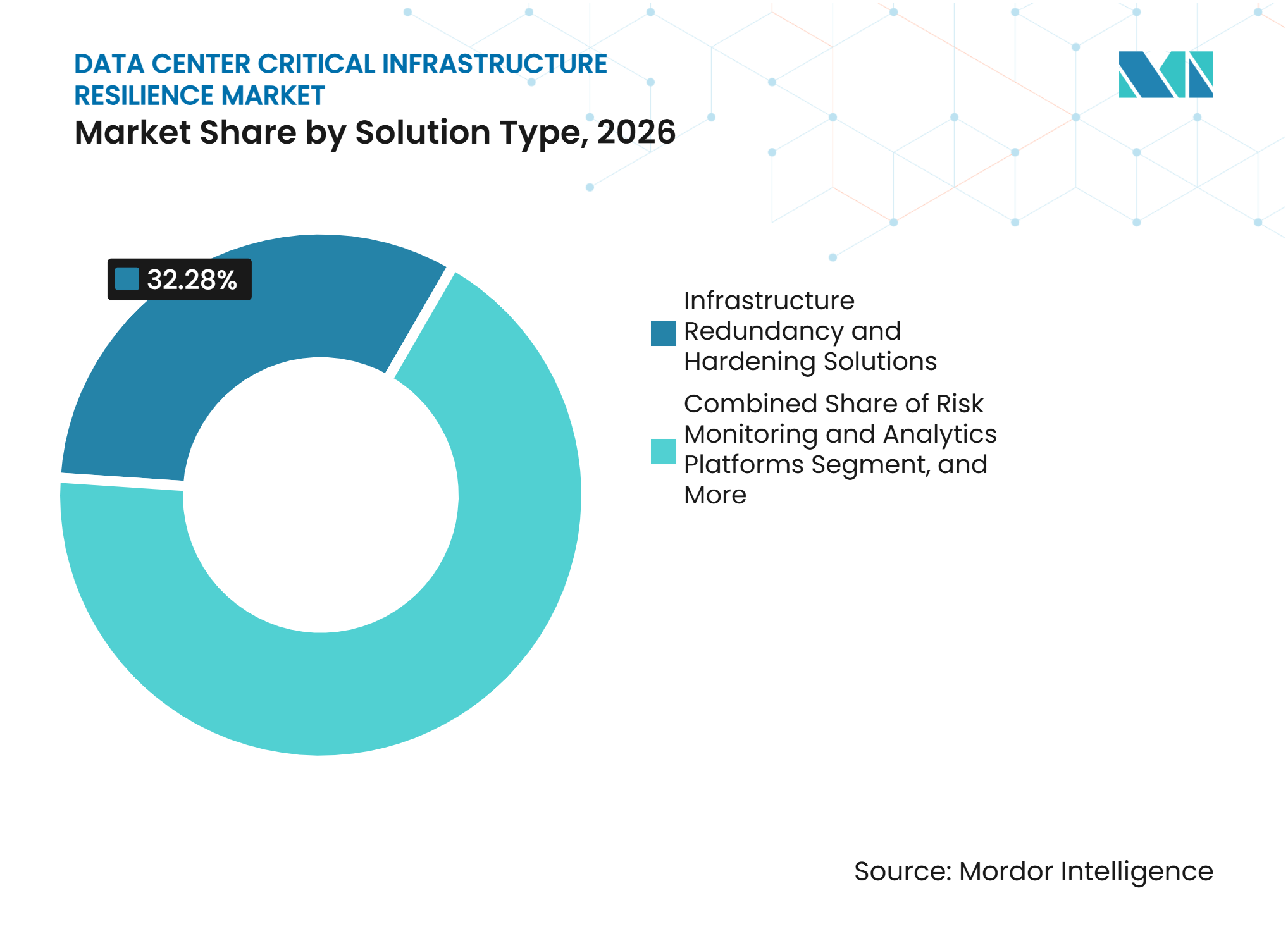
- By solution type, Infrastructure Redundancy and Hardening Solutions held 32.28% of the data center critical infrastructure resilience market share in 2026, while Risk Monitoring and Analytics Platforms are projected to expand at a 15.68% CAGR through 2032.
- By risk category, Power and Utility Disruption accounted for 30.96% of the data center critical infrastructure resilience market size in 2026, while Network and Connectivity Disruption is projected to expand at a 15.74% CAGR through 2032.
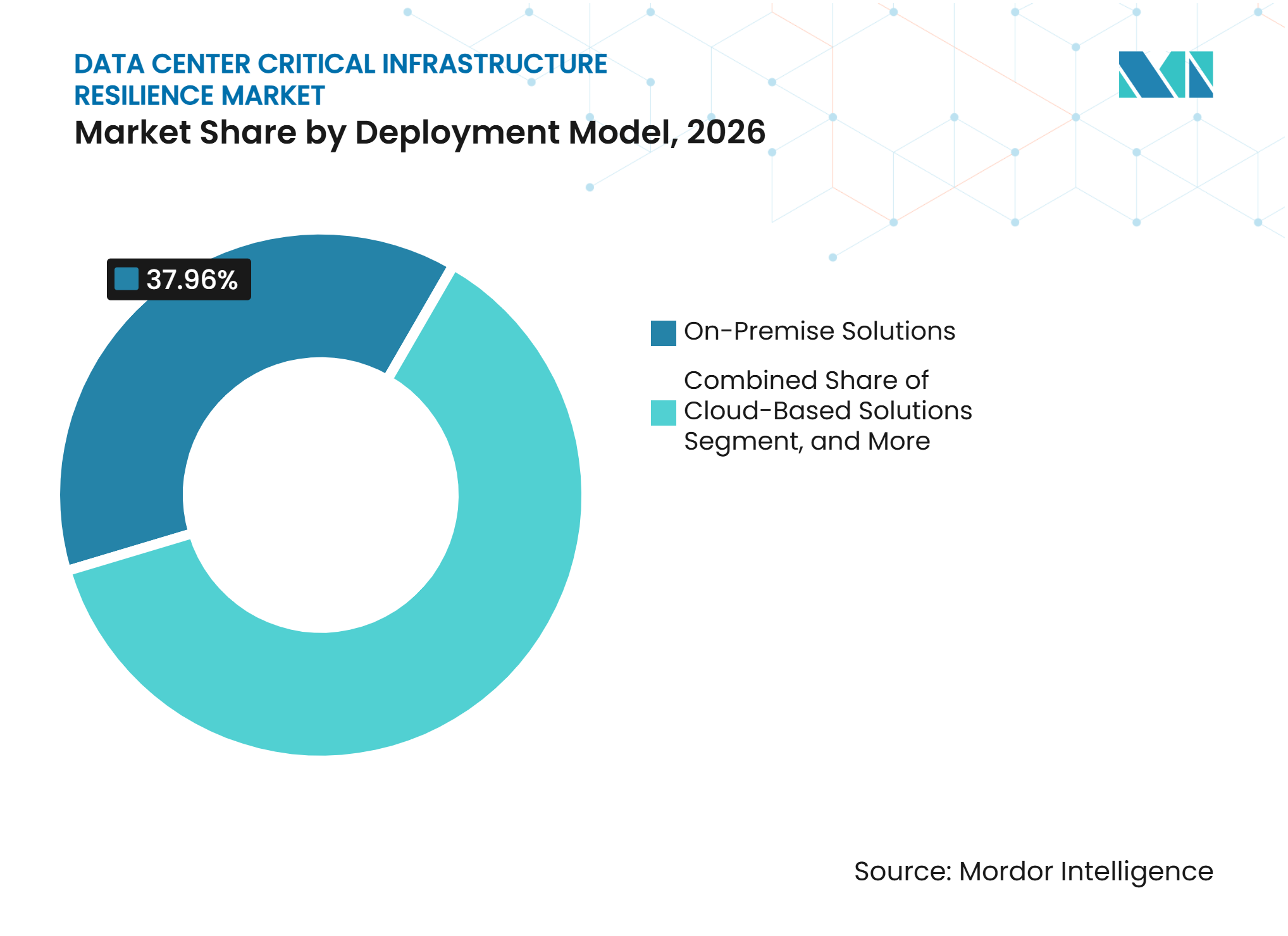
- By deployment model, On-Premise Solutions held 37.96% revenue share in 2026, while Cloud-Based Solutions are projected to expand at a 15.78% CAGR through 2032.
- By data center size, Large Data Centers held 35.37% revenue share in 2026, while Hyperscale Data Centers are projected to expand at a 15.85% CAGR through 2032.
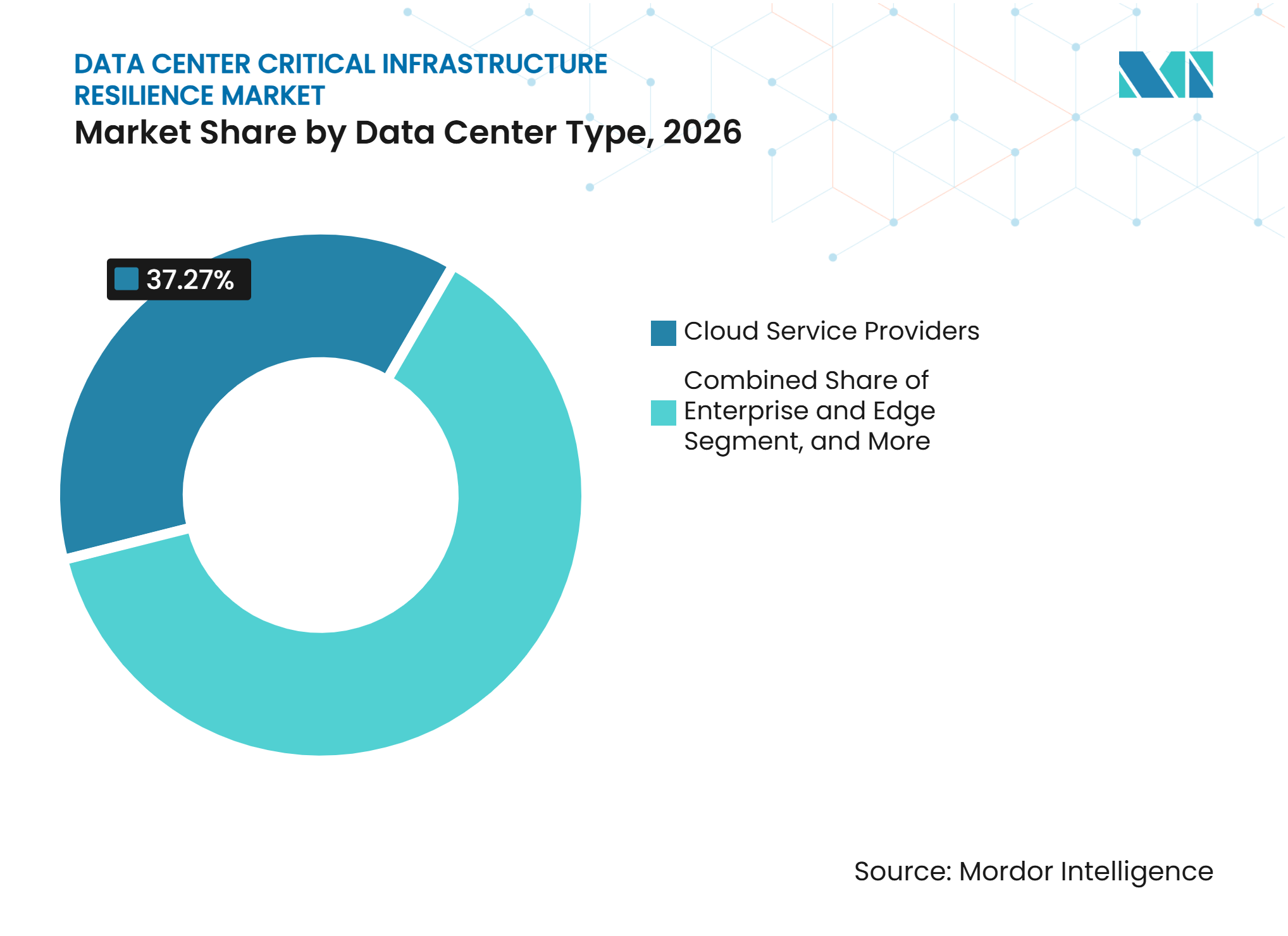
- By data center type, Cloud Service Providers held 37.27% revenue share in 2026 and are projected to expand at a 15.69% CAGR through 2032.
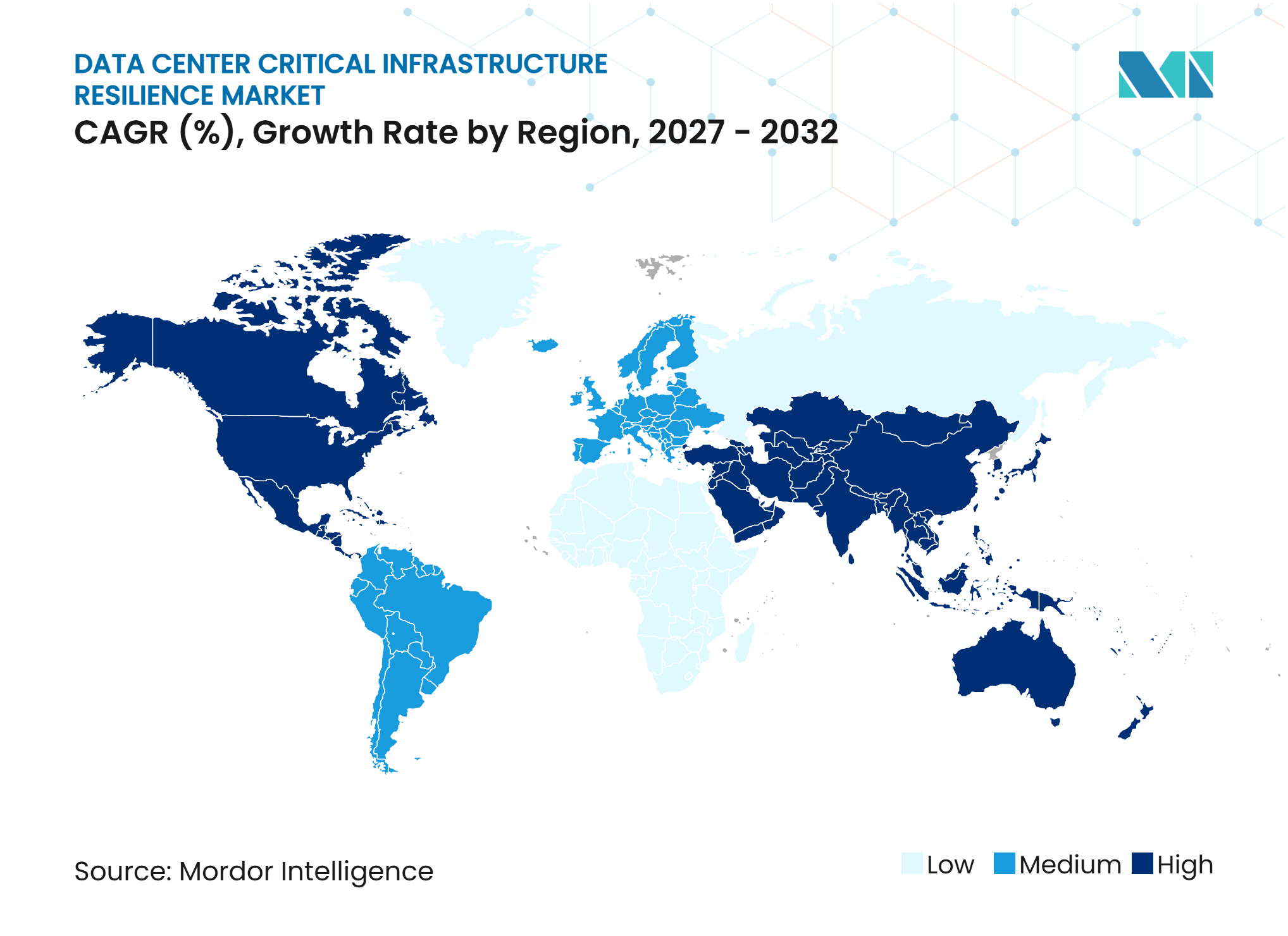
- By geography, North America held 39.35% revenue share in 2026, while Asia-Pacific is projected to expand at a 15.81% CAGR through 2032.
Note: Market numbers in this report are based on Mordor Intelligence's proprietary estimation framework, which combines nine months of actuals with Q4 projections for base year 2026.
Market Trends and Insights
Drivers Impact Analysis of Data Center Critical Infrastructure Resilience Market*
| Driver | (~) % Impact on CAGR Forecast | Geographic Relevance | Impact Timeline |
|---|---|---|---|
| Increasing Downtime Costs and Contractual Exposure | +3.2% | Global | Short term (≤ 2 years) |
| Expansion of Cloud, AI, and Mission-Critical Workloads | +3.0% | Global, with intensity in North America and Asia-Pacific | Medium term (2-4 years) |
| Extreme Weather and Utility Disruption Exposure | +2.3% | Global, heightened in North America, Asia-Pacific, and Europe | Long term (≥ 4 years) |
| Regulatory and Customer Requirements for Tested Continuity | +1.9% | European Union and North America core, expanding to Asia-Pacific | Medium term (2-4 years) |
| Cyberattack and Ransomware Recovery Requirements | +1.6% | Global, most acute in Asia-Pacific and North America | Short term (≤ 2 years) |
| Grid-Event Ride-Through and Coordinated Restart Readiness | +1.2% | North America and Europe | Medium term (2-4 years) |
| Source: Mordor Intelligence | |||
Increasing Downtime Costs and Contractual Exposure
The data center critical infrastructure resilience market is supported by the direct cost of service interruptions and the growing use of availability commitments in customer contracts. Uptime Institute reported that 20% of respondents said their most recent significant outage cost more than USD 1 million.[1] A failure can affect recovery work, customer operations, service credits, and confidence in the operator at the same time. This makes outage prevention relevant to both facility budgets and commercial risk management. Operators are therefore testing service commitments separately from property-damage coverage and recovery procedures. The data center critical infrastructure resilience market gains demand where monitoring and response arrangements can identify a problem before it becomes a customer-facing event.
Expansion of Cloud, AI, and Mission-Critical Workloads
Cloud and AI workloads are raising the performance expectations placed on power, thermal, and network systems. Uptime Institute found that high-density rack deployment is increasing across the data center sector, which increases the consequence of a failure within a smaller physical footprint. The data center critical infrastructure resilience market is responding as operators build redundancy into new facilities earlier in the design process. These operators need equipment that supports commissioning, maintenance, and expansion without interrupting live workloads. The shift favors coordinated designs that align electrical systems, cooling systems, network paths, and recovery procedures. It also gives testing and certification providers a larger role before a site begins production service.
Extreme Weather and Utility Disruption Exposure
Extreme heat, drought, and other climate hazards are increasing the need to protect power and cooling capacity at data centers. The World Economic Forum stated that climate hazards could add USD 81 billion to annual global data center operating costs by 2035.[2] Heat events can increase cooling demand while also placing pressure on the electricity network that supports the facility. This dual exposure makes backup power, thermal capacity, and coordinated restart plans more important. The data center critical infrastructure resilience market is also affected by insurance requirements where operators must demonstrate physical adaptation measures. Resilience reviews are moving earlier in site selection and facility design because lenders and insurers need evidence of how future climate exposure will be managed.
Regulatory and Customer Requirements for Tested Continuity
Regulatory requirements are making documented continuity testing a more formal operating obligation for many data center customers. The Central Bank of Ireland explains that DORA requires covered financial entities to address ICT risk management, testing, incident reporting, and third-party risk.[3] Data center providers that serve regulated clients can face more detailed requests for audit evidence and recovery documentation. NIS2 also identifies data center service providers as entities within the European Union’s digital infrastructure framework. The data center critical infrastructure resilience market benefits when customers require tested recovery objectives, tier certification, and routine verification in supplier contracts. ISO 22301 can provide a common basis for business continuity management, while customer agreements determine how those controls must operate in practice.
Restraints Impact Analysis of Data Center Critical Infrastructure Resilience Market*
| Restraint | (~) % Impact on CAGR Forecast | Geographic Relevance | Impact Timeline |
|---|---|---|---|
| High Implementation Costs and Competing Infrastructure Priorities | -2.4% | Global | Short term (≤ 2 years) |
| Legacy-System Integration and Fragmented Dependency Records | -1.8% | Global, most prevalent in North America and Europe | Medium term (2-4 years) |
| Specialist Resilience Talent Shortages | -1.4% | Global, most acute in Asia-Pacific and Middle East and Africa | Long term (≥ 4 years) |
| Difficulty Quantifying Avoided Losses and Return on Investment | -0.9% | Global | Short term (≤ 2 years) |
| Source: Mordor Intelligence | |||
High Implementation Costs and Competing Infrastructure Priorities
High capital requirements can delay resilience upgrades, especially at facilities that are also adding computing capacity and new cooling systems. The data center critical infrastructure resilience market faces uneven adoption because large operators can include redundancy in new designs, while smaller sites may need costly changes to existing infrastructure. Equipment lead times, labor needs, and tenant commitments can further limit the windows available for facility work. The result is a difference in resilience maturity between new hyperscale sites and older enterprise or colocation facilities. Operators may prioritize capacity additions when demand is immediate, even where an upgrade would reduce future exposure. This constraint favors modular designs and phased programs that allow facilities to improve protection without taking critical services offline.
Legacy-System Integration and Fragmented Dependency Records
Legacy sites often have incomplete records of dependencies between power, cooling, networking, and business applications. Nokia identifies configuration drift as a cause of network reliability problems when production environments differ from their intended design. The data center critical infrastructure resilience market must address facilities that use equipment from several vendors and generations. Fusion Risk Management introduced Recovery Optimization to sequence restoration activities using dependency context across enterprise systems. Live failover exercises can expose undocumented single points of failure, which can add unplanned remediation work. Integration needs can lengthen purchasing and deployment cycles even where the business case for resilience is clear.
*Our forecasts treat driver/restraint impacts as directional, not additive. The impact forecasts reflect baseline growth, mix effects, and variable interactions.
Data Center Critical Infrastructure Resilience Market Segment Analysis
By Solution Type:
Physical Redundancy Leads While Analytics Platforms AdvanceInfrastructure Redundancy and Hardening Solutions held 32.28% of 2026 revenue, making physical protection the largest solution category in the data center critical infrastructure resilience market. The category includes redundant power paths, uninterruptible power supply systems, backup cooling capacity, network diversity, and modular distribution equipment. These measures provide the foundation that operators need before they add software-based monitoring or formal recovery workflows. Vertiv reported a USD 15 billion year-end order backlog and 24% year-over-year revenue expansion in the first quarter of 2025, reflecting strong demand for critical power and cooling infrastructure. The data center critical infrastructure resilience industry depends on this hardware layer because high-density facilities cannot rely on a single utility feed, cooling route, or network path. Business Continuity and Disaster Recovery Solutions, Resilience Assessment and Consulting, Emergency Planning and Response Services, and Testing, Auditing, and Certification Services extend that foundation. These services support recurring work as operators verify plans, prepare teams, and show customers that recovery procedures have been tested. Tenant requirements for evidence of continuity are making third-party validation more relevant in facility procurement.
Risk Monitoring and Analytics Platforms are projected to expand at a 15.68% CAGR through 2032. The segment is moving from simple alarm management toward systems that identify changing conditions before they interrupt service. Schneider Electric introduced AI-driven predictive disaster recovery capabilities in its EcoStruxure DCIM platform in October 2026. The platform approach can bring facility signals, cyber events, and continuity data into a shared operating view. This reduces the reliance on separate teams to interpret individual alarms without the wider operational context. The data center critical infrastructure resilience market rewards providers that make dependency information easier to use during normal operations and during recovery. Analytics platforms can also support post-event reviews, allowing operators to test whether an incident response worked as intended. The data center critical infrastructure resilience industry therefore has room for vendors that connect equipment health with business-service priorities.



By Risk Category:
Power Exposure Leads While Connectivity Risk IncreasesPower and Utility Disruption held 30.96% of 2026 spending across risk categories. Uptime Institute continues to identify power problems as the most common cause of serious and severe data center outages. Higher rack densities raise the operational effect of an electrical interruption, particularly where AI and cloud workloads run continuously. Operators are investing in transfer systems, energy storage, backup generation, and designs that isolate faults before they affect wider capacity. Cooling and Environmental Failure is also a major concern because denser equipment raises the thermal consequences of lost cooling. Natural Disasters and Extreme Weather require attention where a site may face both weather-related damage and a grid disruption. Physical Security Incidents and Operational and Supply Chain Disruption receive smaller allocations today, but they can expose critical equipment, documentation, or maintenance capacity. The data center critical infrastructure resilience market is increasingly addressing these risk categories through coordinated rather than standalone controls.
Network and Connectivity Disruption is projected to expand at a 15.74% CAGR through 2032. Uptime Institute reported that fiber and connectivity events contribute to extended disruptions, which can be especially damaging for workloads that need continuous external access. Operators are responding through diverse fiber routes, independent carriers, improved network observability, and tested failover paths. The need is wider than connectivity hardware because a recovery plan must identify which applications, sites, and customer services depend on each route. This creates a closer link between network engineering, incident response, and business continuity teams. The data center critical infrastructure resilience market is also affected by the overlap between cyber and physical risks. A single risk view can help operators understand whether a security incident could affect equipment access, network control, or service restoration.
By Deployment Model:
On-Premise Systems Remain Important While Cloud-Based Solutions ExpandOn-Premise Solutions held 37.96% of 2026 revenue. Financial services, healthcare, government, and critical infrastructure operators often need direct control over architecture, testing, and audit evidence. These organizations may retain on-site systems because data sovereignty, latency, and contractual responsibilities limit how much recovery validation can be delegated. Legacy mainframe and IBM Power environments also support demand for local resilience arrangements. Kyndryl expanded Cloud Uplift to Microsoft Azure regions in Tokyo and Osaka in May 2026, offering a route for enterprises to move legacy AIX, IBM i, and x86 workloads to a cloud environment. The data center critical infrastructure resilience market continues to serve on-premise users because modernization programs must preserve service continuity throughout migration. Hybrid arrangements are relevant for organizations that need local control but want centrally managed continuity workflows. They also offer a gradual way to move selected workloads without changing the control model for every critical application.
Cloud-Based Solutions are projected to expand at a 15.78% CAGR through 2032. Cloud delivery allows multi-site organizations to manage recovery status, third-party risks, and incident actions from a shared interface. ServiceNow launched its Operational Resilience solution in 2026 to connect risk, security, IT management, third-party risk, and business continuity processes. The approach shows how cloud platforms can cover a broader operating model than traditional disaster recovery tools. The data center critical infrastructure resilience market gains from this model when users need visibility across many sites, suppliers, and applications. Shared platforms can also help customers apply consistent recovery objectives and reporting practices. Their value depends on clear data ownership, access controls, and reliable integration with on-premise facility systems.

By Data Center Size:
Large Facilities Provide Scale While Hyperscale Demand AcceleratesLarge Data Centers held 35.37% of 2026 revenue. These facilities support established cloud zones, enterprise colocation estates, and large corporate environments where resilience spending is often recurring. Their scale supports dedicated power and cooling designs, security operations, and established relationships with auditors and service providers. Medium Data Centers are important as regional operators improve service levels to meet tenant expectations set by larger facilities. Small Data Centers spend less per site, but their combined installed base can support demand for subscription-based monitoring and continuity tools. The data center critical infrastructure resilience market needs different delivery models because smaller operators may not have large on-site resilience teams. Cloud-managed services can give these users access to monitoring, recovery guidance, and support without a full internal specialist function. Larger sites, by contrast, often need customized designs that fit their existing infrastructure and service commitments.
Hyperscale Data Centers are projected to expand at a 15.85% CAGR through 2032. These sites need resilience measures that support large live workloads during construction, maintenance, and capacity upgrades. Schneider Electric introduced software-defined medium-voltage switchgear in September 2026 and stated that its Equinix pilot enabled zero-downtime upgrades. The design reduced control wiring by 87%, terminal count by 91%, and copper content by 85%. The data center critical infrastructure resilience market is influenced by these technical requirements because a long shutdown can be commercially unacceptable at hyperscale sites. Suppliers need to support staged construction, live upgrades, and tested handover procedures. This reinforces demand for hardware that combines physical redundancy with software visibility and operational controls.
By Data Center Type:
Cloud Service Providers Lead Demand and Maintain MomentumCloud Service Providers held 37.27% of 2026 revenue across data center types. Public cloud operators compete on availability commitments, which makes resilience spending a means of protecting revenue and customer trust. They can buy across fleets instead of on a facility-by-facility basis, creating concentrated demand for infrastructure suppliers. The data center critical infrastructure resilience market is supported by this purchasing pattern because cloud providers need consistent designs and recovery practices across regions. High-density deployments add pressure on power, cooling, connectivity, and maintenance arrangements. Uptime Institute has identified the sector-wide rise in high-density racks, strengthening the need for capacity planning and controlled failure isolation. Colocation operators are also affected because their cloud tenants increasingly apply similar audit and resilience requirements. Enterprise and Edge Data Centers remain smaller segments, yet edge sites can face limited local staffing and greater exposure to local grid or weather events.
Cloud Service Providers are projected to expand at a 15.69% CAGR through 2032, making them both the largest and fastest-expanding data center type. Vertiv and Infineon signed a 3-year strategic partnership in November 2026 for the supply of silicon and silicon carbide power semiconductors for critical power products, including 800 V DC systems. The agreement shows how suppliers are securing components that support continuing demand from AI-ready facilities. The data center critical infrastructure resilience market is shaped by the need for predictable equipment availability as providers expand their estates. Colocation operators remain important buyers because hyperscale tenants may impose resilience requirements through lease and service agreements. Enterprise and edge operators create a different demand pattern that favors remote monitoring, cloud-managed recovery, and lower-touch operating models. Vendors therefore need portfolios that can serve both large centralized sites and distributed locations.
Geography Analysis
North America
North America held 39.35% of 2026 revenue, the largest data center critical infrastructure resilience market share among regions. The region has a high concentration of hyperscale facilities, colocation capacity, regulated customers, and detailed uptime commitments. The U.S. Department of Energy states that data centers are an important focus of federal energy-efficiency resources and actions. The combination of high computing density and networked business services increases the importance of power protection and coordinated recovery. Grid planning is becoming a strategic consideration because facility growth can add demand in the same local areas. Pacific Gas and Electric announced infrastructure planning intended to support new data center load through 2030. Operators are responding with backup power, energy storage, improved cooling capacity, and procedures for grid-event ride-through. Cybersecurity and infrastructure protection are also central to resilience programs because service obligations can be affected by both physical and digital disruptions. The data center critical infrastructure resilience market in North America benefits from mature audit practices, although compound events still require deeper planning across power, weather, and cyber scenarios.
Asia-Pacific
Asia-Pacific is projected to expand at a 15.81% CAGR through 2032, the highest regional rate in the data center critical infrastructure resilience market. Data center demand is being supported by cloud adoption, digital transformation, and new AI infrastructure across India, Malaysia, Japan, Singapore, and South Korea. The regional operating environment is shaped by power availability, water constraints, land limits, construction cost pressure, and uneven grid reliability. These factors make site planning and local utility engagement more important before a facility enters service. IDC Frontier reported an October 2026 ransomware incident in East Japan Region 1 that affected multiple systems and customers. The incident demonstrates the continuity exposure created by multi-tenant infrastructure and supports demand for tested restoration processes. Providers in the region are adopting more remote monitoring, multi-site recovery, and controls that protect connectivity as well as facility equipment. The data center critical infrastructure resilience market has opportunities where operators can adapt global standards to local grid, weather, data-sovereignty, and supply conditions. Cyber recovery is becoming a larger part of infrastructure planning, rather than a separate IT activity.
Europe, Middle East and Africa, and South America
Europe is a major revenue contributor because DORA and NIS2 have created detailed continuity, oversight, and reporting expectations for many digital-service relationships. The regulatory influence of DORA is increasing demand for testing, auditing, documentation, and evidence that third-party arrangements can support operational resilience. Germany’s Energy Efficiency Act adds another compliance factor for data center operators by linking facility operations with energy-efficiency requirements. In the Middle East and Africa, new facilities in Saudi Arabia and the United Arab Emirates need resilience architecture from the commissioning stage, including physical security, threat intelligence, and tested continuity plans. South America remains the smallest regional grouping, with Brazil as the main center of activity. Operators there can face grid instability and a smaller pool of certified specialists, which strengthens the case for remotely managed resilience platforms. The data center critical infrastructure resilience market requires local operating models because the constraints and compliance needs differ across these regions. Across the mixed group, certification and structured testing can give customers a common way to compare resilience capability across locations.
Competitive Landscape
Market Concentration
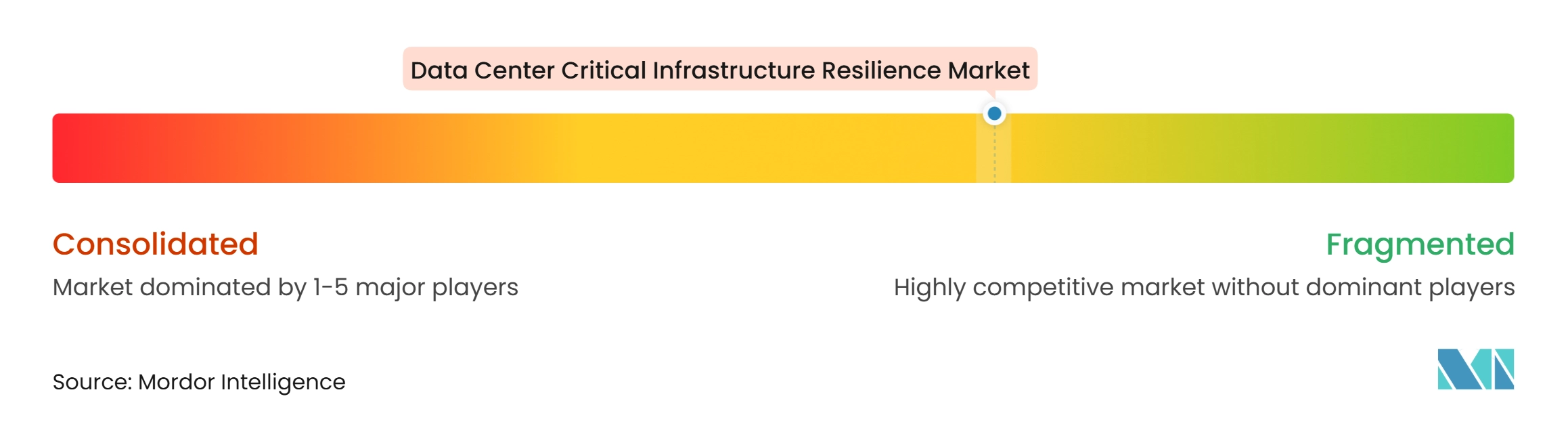
The data center critical infrastructure resilience market is moderately fragmented because physical infrastructure vendors, software providers, professional services firms, and certification bodies address different parts of the operating problem. Schneider Electric and Vertiv are notable suppliers of critical power, cooling, and related facility infrastructure. Schneider Electric reported group revenue of EUR 40 billion in 2025, equivalent to USD 43.6 billion using the annual average rate stated in the source material. Competition also comes from platforms that connect risk management, security operations, IT management, and continuity workflows. Uptime Institute Tier certification remains an important contractual reference point for colocation customers that need independent evidence of facility capability. Suppliers that design systems to meet verification requirements can reduce remediation work after deployment. Mid-market operators may still need several vendors to cover assessment, monitoring, recovery planning, and physical hardening. That creates room for providers that can offer better coordination across these activities.
Technology is shaping competition in the data center critical infrastructure resilience market because operators need faster detection, clearer dependency maps, and recovery procedures that account for live conditions. Schneider Electric’s 2026 predictive disaster recovery capability is one example of suppliers adding forecasting functions to data center management platforms. Fusion Risk Management’s Recovery Optimization is another example, using dependency context to improve the sequence of system restoration. These tools compete on their ability to turn infrastructure information into practical actions during an incident. Hardware vendors are also developing architectures that support upgrades without a full production shutdown. The distinction between equipment suppliers and software providers is becoming less clear where customers expect a single operating view of their facility and recovery readiness. Newer cyber-physical resilience specialists can compete by linking threat intelligence to the physical dependencies of IT services. The data center critical infrastructure resilience market therefore favors open integration, proven delivery capability, and support for audit evidence.
Supply-chain reliability is another competitive factor as demand increases for high-density power and thermal systems. Vertiv’s November 2026 agreement with Infineon was designed to secure long-term supply of silicon and silicon carbide semiconductors for critical power products. The agreement supports product availability for 800 V DC systems used in AI data center infrastructure. Eaton’s acquisition of Boyd Corporation’s thermal business in November 2025 also expanded its liquid-cooling capability. Johnson Controls invested in Accelsius in October 2025, adding direct-to-chip liquid-cooling capability to its thermal-management portfolio. These moves show that leading companies are extending their offerings toward the power and cooling needs of denser facilities. Market concentration score: 5 out of 10, as several large vendors are active across distinct solution categories and the available information does not show a single supplier or top group controlling a high combined share.
Data Center Critical Infrastructure Resilience Industry Leaders
-
Schneider Electric SE
-
Vertiv Holdings Co.
-
Eaton Corporation plc
-
ServiceNow, Inc.
-
IBM Corporation
- *Disclaimer: Major Players sorted in no particular order
Data Center Critical Infrastructure Resilience Market Companies Covered in this Report
- Fusion Risk Management, Inc.
- Riskonnect, Inc.
- ServiceNow, Inc.
- Everbridge, Inc.
- IBM Corporation
- The British Standards Institution
- PricewaterhouseCoopers LLP
- Deloitte LLP
- Ernst & Young LLP
- LogicManager, Inc.
- Onspring Technologies, LLC
- Archer Technologies LLC
- Quantivate, LLC
- MetricStream Inc.
- Premier Continuum Inc.
- Protiviti Inc.
- Control Risks Group Limited
- Continuity2 Limited
- Kyndryl, Inc.
- Uptime Institute, LLC
- Schneider Electric SE
- Vertiv Holdings Co.
- Eaton Corporation plc
- Siemens AG
- Johnson Controls International plc
Recent Industry Developments in Data Center Critical Infrastructure Resilience Market
- November 2026: Vertiv Holdings Co. and Infineon Technologies AG signed a 3-year strategic partnership to secure long-term supply of silicon and silicon carbide power semiconductors for Vertiv's critical power product portfolio, including next-generation 800 V DC power systems designed for AI data center infrastructure. The agreement supports supply continuity and reliable delivery as Vertiv scales production to meet demand for AI-ready resilience infrastructure.
- October 2026: Schneider Electric introduced AI-driven predictive disaster recovery capabilities within its EcoStruxure Data Center Infrastructure Management platform, using neural networks and graph ontologies to predict data center failures before they occur and shift recovery from reactive response to anticipatory prevention.
- September 2026: Schneider Electric unveiled software-defined medium-voltage switchgear at the YOTTA 2026 conference, deployed in an Equinix colocation data center pilot. The architecture reduces control wiring by 87%, terminal count by 91%, and copper content by 85%, while enabling zero-downtime upgrades.
- September 2026: Everbridge launched Everbridge 360 AI Bridge, an organizational resilience solution that maps assets and dependencies to business services, monitors impact tolerances against live operational data, and creates a continuous feedback loop between continuity planning and real-time incident response.
Global Data Center Critical Infrastructure Resilience Market Report Scope
The Data Center Critical Infrastructure Resilience Market Report is Segmented by Solution Type (Infrastructure Redundancy and Hardening Solutions, Risk Monitoring and Analytics Platforms, Business Continuity and Disaster Recovery Solutions, Resilience Assessment and Consulting, Emergency Planning and Response Services, Testing, Auditing, and Certification Services), Risk Category (Power and Utility Disruption, Network and Connectivity Disruption, Cooling and Environmental Failure, Natural Disasters and Extreme Weather, Cybersecurity-Linked Physical Risk, Physical Security Incidents, Operational and Supply Chain Disruption), Deployment Model (On-Premise, Cloud-Based, Hybrid), Data Center Size (Small, Medium, Large, Hyperscale), Data Center Type (Colocation, Cloud Service Providers, Enterprise, Edge), and Geography (North America, South America, Europe, Middle East and Africa, Asia-Pacific). The Market Forecasts are Provided in Terms of Value (USD).
Segmentation Overview
| Resilience Assessment and Consulting |
| Risk Monitoring and Analytics Platforms |
| Business Continuity and Disaster Recovery Solutions |
| Infrastructure Redundancy and Hardening Solutions |
| Emergency Planning and Response Services |
| Testing, Auditing, and Certification Services |
| Power and Utility Disruption |
| Cooling and Environmental Failure |
| Natural Disasters and Extreme Weather |
| Physical Security Incidents |
| Network and Connectivity Disruption |
| Operational and Supply Chain Disruption |
| On-Premise Solutions |
| Cloud-Based Solutions |
| Hybrid Solutions |
| Small Data Centers |
| Medium Data Centers |
| Large Data Centers |
| Hyperscale Data Centers |
| Colocation |
| Cloud Service Providers |
| Enterprise and Edge |
| North America | United States |
| Canada | |
| Mexico | |
| South America | Brazil |
| Argentina | |
| Rest of South America | |
| Europe | United Kingdom |
| Germany | |
| France | |
| Spain | |
| Rest of Europe | |
| Middle East and Africa | Saudi Arabia |
| United Arab Emirates | |
| South Africa | |
| Rest of Middle East | |
| Asia-Pacific | China |
| India | |
| Japan | |
| Australia | |
| Singapore | |
| Rest of Asia-Pacific |
| By Solution Type | Resilience Assessment and Consulting | |
| Risk Monitoring and Analytics Platforms | ||
| Business Continuity and Disaster Recovery Solutions | ||
| Infrastructure Redundancy and Hardening Solutions | ||
| Emergency Planning and Response Services | ||
| Testing, Auditing, and Certification Services | ||
| By Risk Category | Power and Utility Disruption | |
| Cooling and Environmental Failure | ||
| Natural Disasters and Extreme Weather | ||
| Physical Security Incidents | ||
| Network and Connectivity Disruption | ||
| Operational and Supply Chain Disruption | ||
| By Deployment Model | On-Premise Solutions | |
| Cloud-Based Solutions | ||
| Hybrid Solutions | ||
| By Data Center Size | Small Data Centers | |
| Medium Data Centers | ||
| Large Data Centers | ||
| Hyperscale Data Centers | ||
| By Data Center Type | Colocation | |
| Cloud Service Providers | ||
| Enterprise and Edge | ||
| By Geography | North America | United States |
| Canada | ||
| Mexico | ||
| South America | Brazil | |
| Argentina | ||
| Rest of South America | ||
| Europe | United Kingdom | |
| Germany | ||
| France | ||
| Spain | ||
| Rest of Europe | ||
| Middle East and Africa | Saudi Arabia | |
| United Arab Emirates | ||
| South Africa | ||
| Rest of Middle East | ||
| Asia-Pacific | China | |
| India | ||
| Japan | ||
| Australia | ||
| Singapore | ||
| Rest of Asia-Pacific | ||
Key Questions Answered in the Report
What is the size of the data center critical infrastructure resilience market?
The data center critical infrastructure resilience market is valued at USD 15.85 billion in 2026 and is projected to reach USD 30.60 billion by 2032 at a 14.05% CAGR.
What is driving investment in data center resilience?
Higher computing density, service-level commitments, climate exposure, and continuity requirements are increasing investment in resilient power, cooling, network, and recovery arrangements.
Which solution type leads data center resilience spending?
Infrastructure Redundancy and Hardening Solutions lead with 32.28% revenue share in 2026 because physical protection remains the base layer for resilient facility operations.
Which data center risk category is expanding fastest?
Network and Connectivity Disruption is projected to expand at a 15.74% CAGR through 2032 as operators add fiber diversity, carrier redundancy, and tested failover paths.
Which deployment model is expanding fastest for resilience tools?
Cloud-Based Solutions are projected to expand at a 15.78% CAGR through 2032, supported by centralized continuity and risk-management capabilities across multiple sites.
Which region has the fastest projected expansion?
Asia-Pacific is projected to expand at a 15.81% CAGR through 2032, supported by cloud expansion, AI infrastructure, and ongoing capacity development.