
Data Center Counter-Drone and Airspace Security Market Size and Share
Market Overview
| Study Period | 2021 - 2032 |
|---|---|
| Market Size (2027) | USD 359.60 Million |
| Market Size (2032) | USD 893.55 Million |
| Growth Rate (2027 - 2032) | 25.65 % |
| Fastest Growing Market | Middle East |
| Largest Market | North America |
| Market Concentration | Medium |
Major Players *Disclaimer: Major Players sorted in no particular order Image © Mordor Intelligence. Reuse requires attribution under CC BY 4.0. | |
Data Center Counter-Drone and Airspace Security Market Analysis by Mordor Intelligence
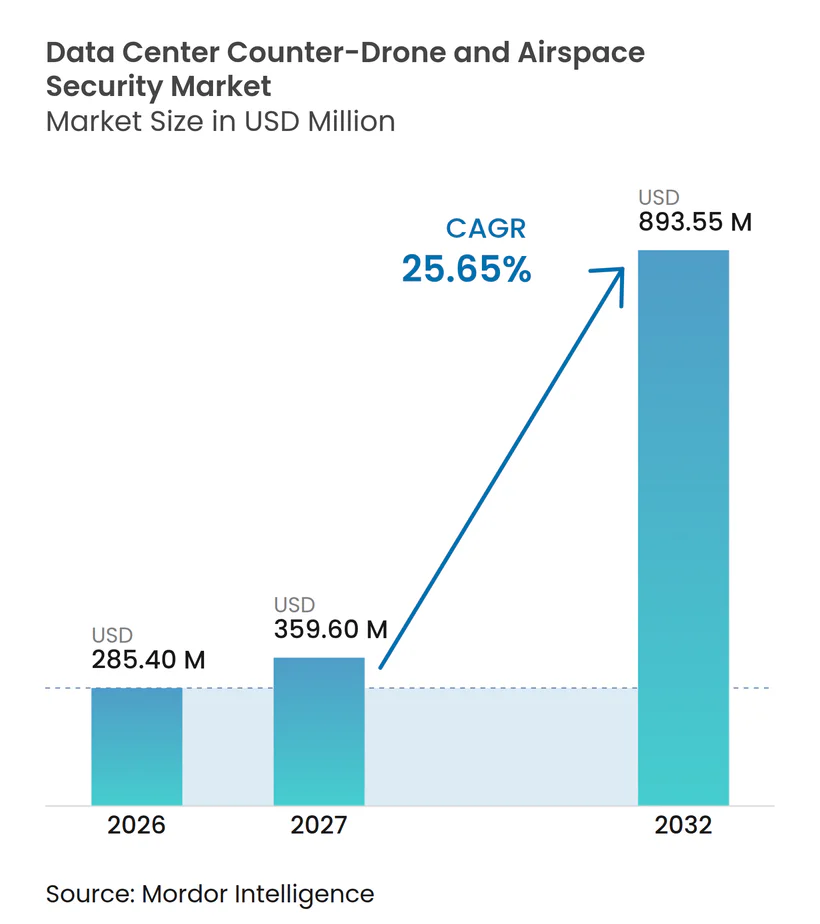
The Data Center Counter-Drone and Airspace Security market size is valued at USD 285.40 million in 2026 and is forecast to reach USD 893.55 million by 2032, expanding at a CAGR of 25.65% during 2027-2032. The data center counter-drone and airspace security market is being shaped by the rapid construction of large computing campuses and the need to protect those sites from low-cost aerial systems. New facilities can incorporate airspace security into perimeter design, which supports demand for fixed detection networks and related support services. Commercial drone availability has also made reconnaissance more accessible, increasing the value of reliable identification and alerting systems. Operators are prioritizing platforms that combine several sensors because a single detection method cannot cover every flight condition. Regulatory changes are widening public-sector counter-drone activity, but private operators in major markets still face limits on active mitigation.
Key Report Takeaways
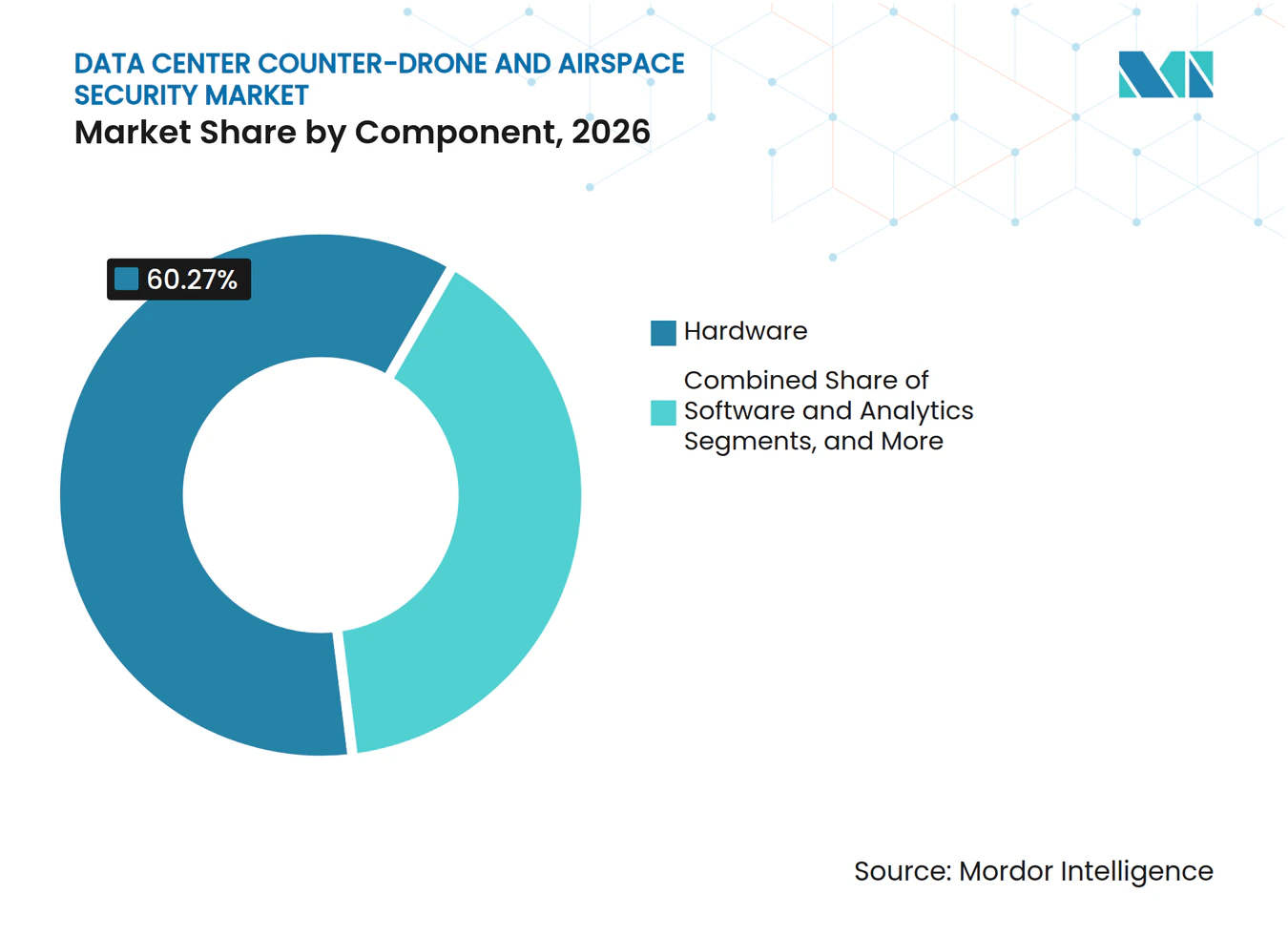
- By component, hardware held 60.27% of the data center counter-drone and airspace security market share in 2026, while software and analytics is projected to expand at a 26.32% CAGR through 2032.
- By technology, RF detection accounted for 30.34% of the data center counter-drone and airspace security market share in 2026, while integrated multi-sensor systems is projected to expand at a 26.81% CAGR through 2032.
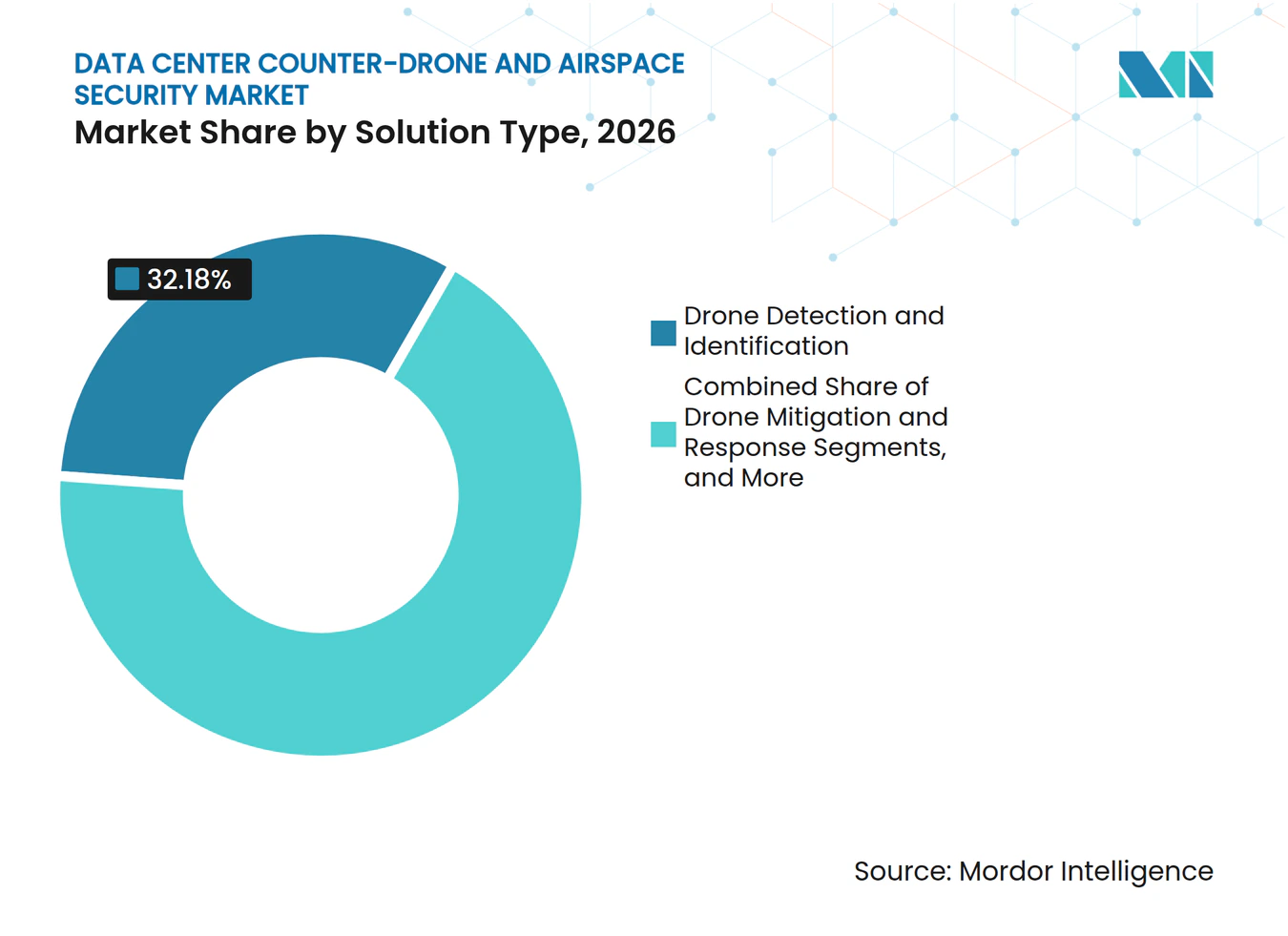
- By solution type, drone detection and identification held 32.18% share in 2026, while integrated counter-drone platforms is projected to expand at a 26.18% CAGR through 2032.
- By deployment type, fixed installations accounted for 78.42% of the data center counter-drone and airspace security market size in 2026 and are projected to expand at a 26.91% CAGR through 2032.
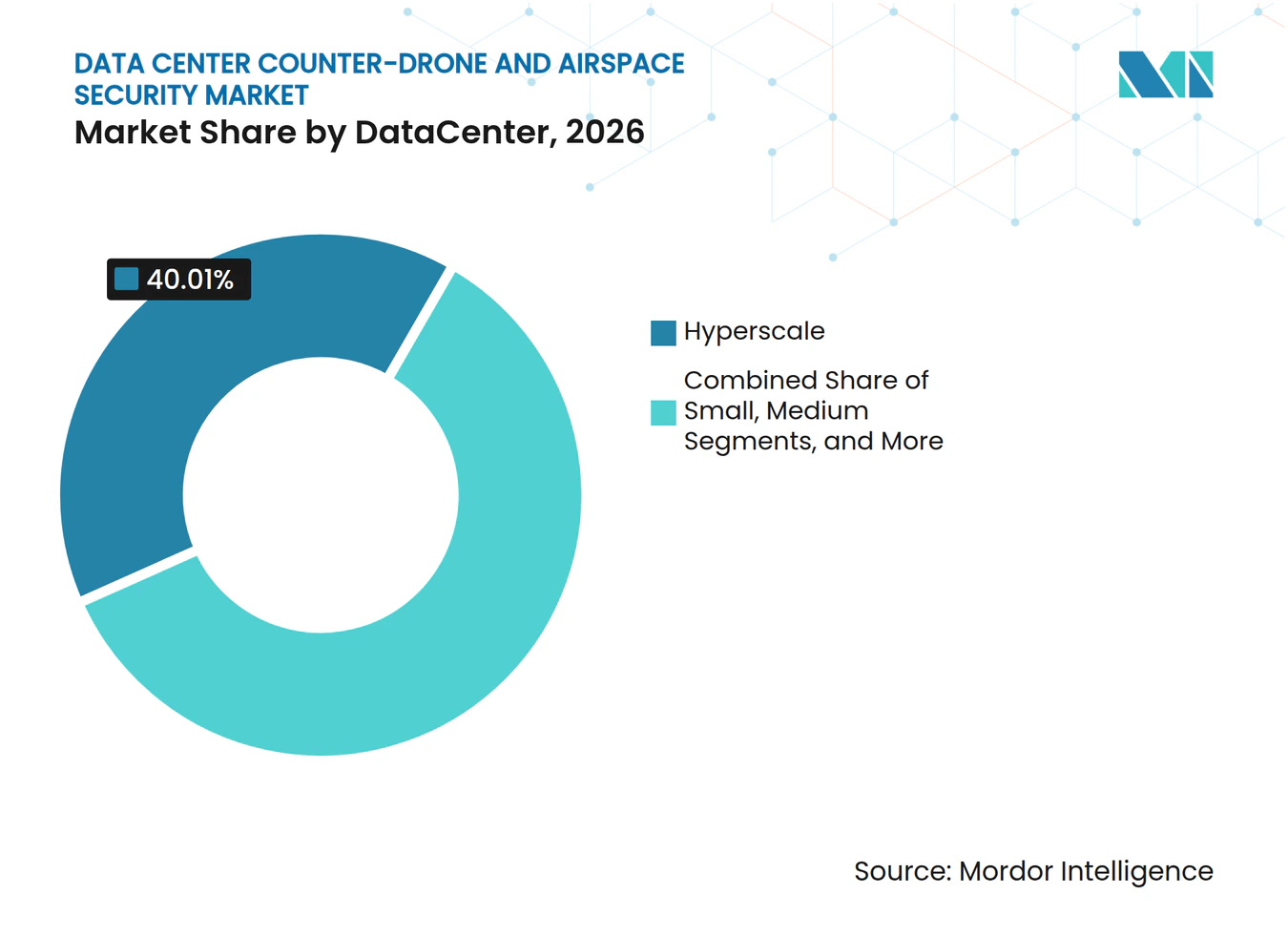
- By data center size, hyperscale facilities held 40.01% share in 2026 and are projected to expand at a 26.76% CAGR through 2032.
- By data center type, cloud service providers held 45.34% share in 2026 and are projected to expand at a 26.73% CAGR through 2032.
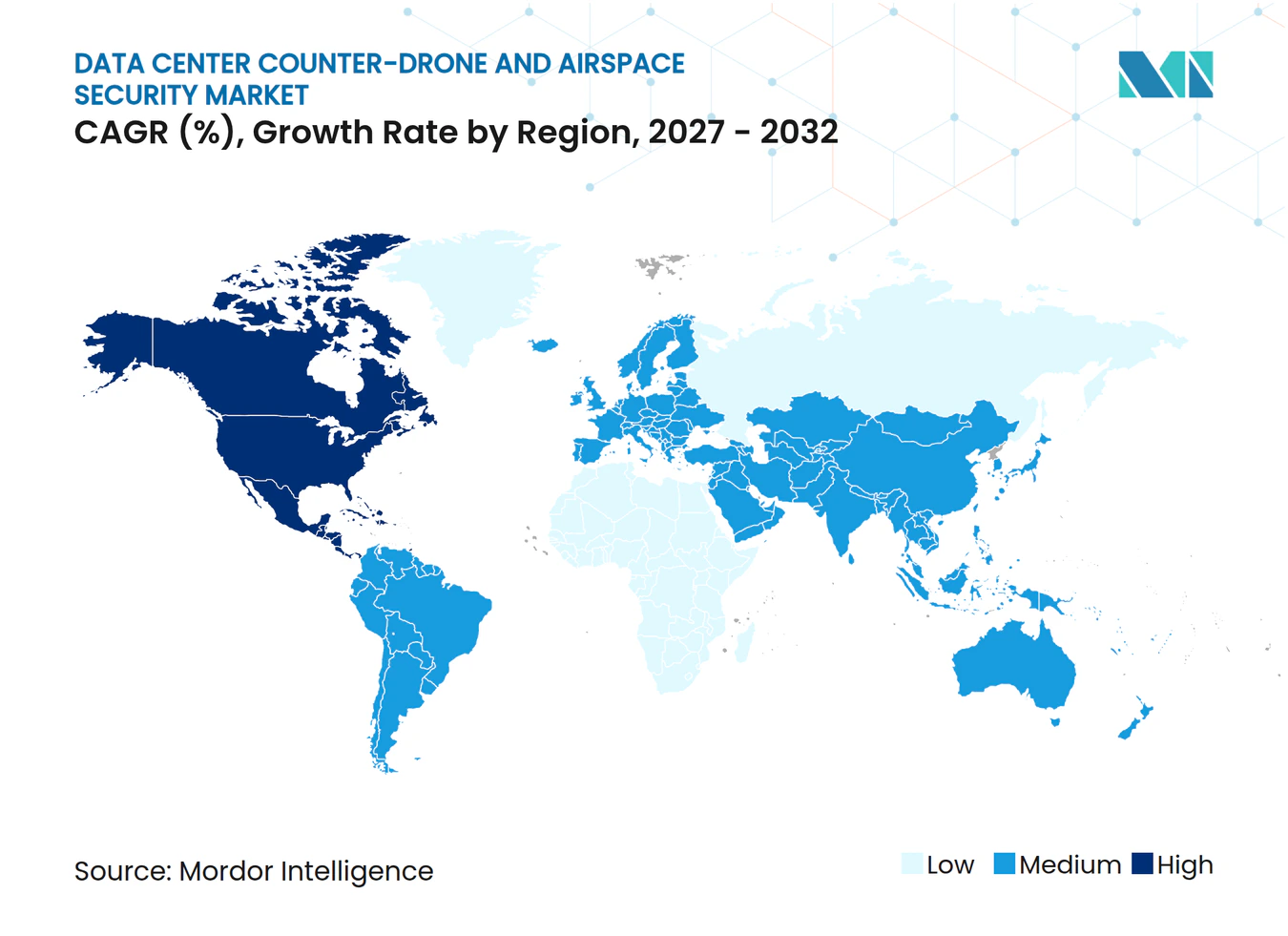
- By geography, North America held 45.56% share in 2026, while the Middle East is projected to expand at a 26.64% CAGR through 2032.
Note: Market numbers in this report are based on Mordor Intelligence's proprietary estimation framework, which combines nine months of actuals with Q4 projections for base year 2026.
Market Trends and Insights
Drivers Impact Analysis of Data Center Counter-Drone and Airspace Security Market*
| Driver | (~) % Impact on CAGR Forecast | Geographic Relevance | Impact Timeline |
|---|---|---|---|
| Hyperscale and AI Data Center Capacity Expansion | +5.5% | Global, concentrated in North America and Asia-Pacific | Long term (≥ 4 years) |
| Rising Drone Reconnaissance and Attack Risk | +4.9% | Global, acute in the Middle East and NATO eastern flank | Short term (≤ 2 years) |
| Critical Infrastructure Airspace Protection Mandates | +4.2% | North America and Europe, with spillover to the Middle East and Asia-Pacific | Medium term (2-4 years) |
| Layered Multi-Sensor Detection and Command-and-Control Adoption | +3.8% | Global, led by North America and Europe | Medium term (2-4 years) |
| Autonomous, Low-Signature, and Swarm Drone Threats | +3.2% | Global, with early exposure in the Middle East and Eastern Europe | Short term (≤ 2 years) |
| Data Center Insurer and Customer Security Requirements | +2.6% | North America and Europe | Medium term (2-4 years) |
| Source: Mordor Intelligence | |||
Expansion of Hyperscale and Artificial Intelligence Data Center Capacity
The data center counter-drone and airspace security market benefits when security requirements are considered during the design of new computing campuses. Hyperscale operators are planning large amounts of owner-occupied capacity, which creates a broad base of sites that need permanent perimeter protection. OpenAI, Oracle, and SoftBank announced 5 new Stargate sites in October 2025, extending their planned AI infrastructure footprint in the United States.[1] Each campus can require mobile coverage during construction before fixed systems are commissioned for ongoing operation. This sequence supports vendors that can provide both temporary systems and long-lived, integrated deployments.
The scale of these campuses changes the economics of detection because a security failure can affect large volumes of computing capacity. New construction also offers vendors a chance to integrate sensors with access control, surveillance, and central security operations before systems become difficult to alter. The data center counter-drone and airspace security market therefore has a closer relationship with the construction pipeline than with isolated procurement announcements. Facilities operators can standardize approved designs across regional portfolios, which lowers implementation friction at later sites. Long-term service agreements can then keep software, signature databases, and operator processes current. These conditions favor providers that can support complex, multi-location deployments without requiring each site to build a separate security program.
Rising Drone-Based Reconnaissance and Physical Attack Risk
The data center counter-drone and airspace security market is responding to a clearer operational risk from accessible, commercially derived aircraft. Dedrone reported a 4.3-fold increase in DIY drone detections in Europe, the Middle East, and Asia during 2025 compared with 2024.[2] The same company reported that 37.5% of its regional detections occurred at night, which raises the importance of continuous surveillance and dependable alert review. Fixed infrastructure sites may be used for reconnaissance even when no direct attack occurs, making detection and identification important operational functions. This threat profile makes passive systems relevant for private data center operators that are not authorized to use active mitigation. It also increases demand for well-tested procedures that distinguish legitimate activity from a potential security event.
Drone activity can impose costs through operational disruption, investigation requirements, and the need to protect sensitive facility information. The 2025 CISA guidance provides owners and operators with a structured approach for assessing suspicious unmanned aircraft activity at critical infrastructure. Data center teams can use those procedures to link airspace alerts to existing physical-security response processes. The data center counter-drone and airspace security market consequently depends on more than sensor sales because operators need training, incident documentation, and clear coordination with law enforcement. Systems that reduce uncertain alerts can preserve response-team attention during low-staffing periods. The commercial opportunity is strongest where a platform can provide evidence suitable for escalation rather than only a raw alert.
Critical-Infrastructure Airspace Protection Mandates and Procurement Programs
Government action is changing the counter-drone environment for critical infrastructure owners and public agencies. Executive Order 14305, issued in June 2025, directed action to address threats posed by unauthorized unmanned aircraft and called for measures concerning fixed-site critical infrastructure.[3] The European Commission released its Action Plan on Drone and Counter-Drone Security in February 2026 and identified coordinated detection measures for critical infrastructure. These policies give site owners a clearer basis for reviewing airspace risk alongside traditional physical protection. They also increase the importance of systems that can meet formal procurement and reporting requirements. The data center counter-drone and airspace security market is likely to benefit when public-sector standards become reference points for private-sector security teams.
Public procurement programs can influence civilian deployments by establishing technical expectations for detection, evidence handling, and command software. The Federal Register published the Counter-UAS Authority rule for state, local, tribal, and territorial law enforcement in July 2026. This framework creates clearer roles for authorized agencies when an incident occurs near a private facility. It can also encourage data center operators to select systems that support shared situational awareness with public responders. Vendors with experience in government compliance may have an advantage as customers seek systems aligned with established operational practices. However, private entities remain subject to separate limits on mitigation, which keeps detection and coordination at the center of many commercial deployments.
Increasing Adoption of Layered Multi-Sensor Detection and Command-and-Control
The data center counter-drone and airspace security market is shifting toward architectures that use several sensor types under common command software. CISA published UAS Detection Technology Guidance for critical infrastructure in August 2025, outlining a layered approach for operators assessing detection capabilities. RF tools can identify common controllers, while radar can track objects that do not transmit RF signals. Optical and infrared systems can provide visual confirmation, and acoustic systems can add coverage in selected perimeter environments. Command-and-control software brings these inputs together for investigation and response. The resulting architecture reduces dependence on the weaknesses of any individual sensor.
Integrated systems are particularly relevant at large sites with demanding availability requirements and multiple surrounding RF sources. DroneShield launched DroneSentry-C2 Enterprise in October 2025 for centralized command-and-control across distributed critical infrastructure locations. HENSOLDT and Rheinmetall demonstrated the integration of passive radar within the Skymaster system during the Timber Express 2026 exercise under NATO Link 16 conditions. These examples show that interoperability is becoming a core purchasing consideration. Software also becomes more valuable as it incorporates drone signatures and user workflows from prior deployments. This trend supports recurring revenue from updates, centralized administration, and managed detection services. Integrated systems are particularly relevant at large sites with demanding availability requirements and multiple surrounding RF sources. HENSOLDT and Rheinmetall demonstrated the integration of passive radar within the Skymaster system during the Timber Express 2026 exercise under NATO Link 16 conditions. These examples show that interoperability is becoming a core purchasing consideration. Software also becomes more valuable as it incorporates drone signatures and user workflows from prior deployments. This trend supports recurring revenue from updates, centralized administration, and managed detection services.
Restraints Impact Analysis of Data Center Counter-Drone and Airspace Security Market*
| Restraint | (~) % Impact on CAGR Forecast | Geographic Relevance | Impact Timeline |
|---|---|---|---|
| Legal Limits on Jamming, Spoofing, and Kinetic Mitigation | -3.4% | North America, most restrictive, and Europe and Asia-Pacific, moderate | Short term (≤ 2 years) |
| High False-Alarm Rates in RF-Dense and Urban Environments | -2.9% | Global, most acute in urban North America and Asia-Pacific | Medium term (2-4 years) |
| Integration Complexity Across Physical Security and Data Center Operations | -2.2% | Global | Medium term (2-4 years) |
| Power, Spectrum, and Safety Constraints at High-Density Facilities | -1.7% | Global, highest at colocation and hyperscale sites | Long term (≥ 4 years) |
| Source: Mordor Intelligence | |||
Legal Limits on Jamming, Spoofing, and Kinetic Mitigation
Legal limits on active countermeasures are a significant restraint for commercial users. The FCC states that jammers are generally illegal to operate, market, or sell in the United States because they can interfere with authorized communications. The FCC clarified conditions for authorized experimental testing of counter-UAS jamming technology by non-federal entities in July 2026. That clarification did not create broad permission for commercial operational deployment. Data center operators may therefore detect and document an aircraft while relying on authorized public agencies for any active response. This legal boundary limits the immediate value that private buyers can derive from systems designed around mitigation.
The restriction also affects product design and purchasing priorities. Commercial buyers have stronger reason to invest in accurate detection, identification, recording, and escalation capabilities than in effectors they cannot activate. The data center counter-drone and airspace security market must accommodate different authority structures across federal, state, and private users. The July 2026 federal rule provides an operational framework for eligible state, local, tribal, and territorial law enforcement agencies, rather than a general commercial authorization. Private facilities can benefit where local responders have compatible systems and established processes. Until authorities broaden, passive capabilities and coordinated response will remain central to commercial adoption.
High False-Alarm Rates in RF-Dense and Urban Environments
False alarms remain a practical concern at data center campuses located near enterprise networks, cellular infrastructure, and other radio-emitting equipment. RF-based systems can encounter dense background signals that require careful classification before an alert reaches a security team. Repeated ambiguous alerts can reduce confidence in the system and consume the attention needed for genuine events. The data center counter-drone and airspace security market therefore places a premium on sensor fusion and software that can validate a detected object. Nighttime activity is a further challenge because visual review may be more difficult when security staffing is lower. Dedrone’s reported concentration of nighttime detections reinforces the need for systems that support continuous, calibrated assessment.
False-alarm performance also affects the economics of managed services. A site that generates a high volume of unqualified alerts needs more operator time, which can weaken the cost case for deployment. Multi-sensor validation can reduce this burden by combining radio, radar, and optical evidence before escalating an event. CISA’s 2025 guidance supports a structured assessment of detection technologies rather than reliance on one modality. The data center counter-drone and airspace security market will favor providers that can demonstrate reliable alert quality in complex urban conditions. Better classification supports both customer retention and the broader transition toward subscription-based monitoring.
*Our forecasts treat driver/restraint impacts as directional, not additive. The impact forecasts reflect baseline growth, mix effects, and variable interactions.
Data Center Counter-Drone and Airspace Security Market Segment Analysis
By Component:
Hardware Anchors Revenue While Software ScalesHardware held 60.27% of the data center counter-drone and airspace security market share in 2026, reflecting the cost of radar, RF sensors, electro-optical and infrared cameras, and acoustic equipment. These physical components establish the detection layer around a campus perimeter. Larger installations often require multiple sensor positions to manage line-of-sight limitations and coverage gaps. Hardware purchasing can create long supplier relationships because integration, calibration, and maintenance are site specific. That installed base can also provide a route for later upgrades as threat conditions change. The data center counter-drone and airspace security industry benefits from this recurring service requirement. Hardware remains essential even as software becomes a larger part of the customer’s operating model.
Software and analytics is projected to expand at a 26.32% CAGR through 2032. This segment helps operators combine sensor data, classify alerts, and manage activity across more than 1 location. Its value rises when customers need constant monitoring rather than occasional equipment checks. DroneShield stated in February 2026 that it was targeting SaaS revenue above 30% of total revenue within 5 years and cited gross profit margins of 65% for that model. Integration and support services add commissioning, training, and managed detection work to the customer relationship. These services can make advanced systems more accessible to operators without dedicated counter-drone specialists.



By Technology:
RF Detection Leads, Multi-Sensor Fusion Races AheadRF detection held 30.34% of the data center counter-drone and airspace security market share in 2026. The technology can identify widely used controllers and operates at a lower deployment cost than many other sensing methods. It is useful for early warning where a drone is transmitting recognizable radio signals. RF detection can also help analysts associate signals with known device characteristics. However, aircraft operating without an active RF link can fall outside its coverage. This limitation makes RF systems more effective when they are deployed with complementary technologies. The data center counter-drone and airspace security market consequently treats RF detection as a core layer rather than a complete solution.
Integrated multi-sensor systems are projected to expand at a 26.81% CAGR through 2032. These platforms combine sensor types to improve detection, tracking, and validation across changing conditions. Radar provides persistent object tracking, including for platforms that emit no controller signal. Electro-optical and infrared tools support identification and can help distinguish an authorized aircraft from an unknown one. Acoustic detection has a narrower role but can add value in selected perimeter conditions. CISA’s layered guidance supports this approach for high-risk facilities. HENSOLDT and Rheinmetall’s 2026 demonstration further showed the practical direction toward combined passive radar, active radar, and electro-optical inputs.
By Solution Type:
Detection Drives Volume, Integrated Platforms Drive ValueDrone detection and identification held 32.18% of the data center counter-drone and airspace security market share in 2026. It is the starting point for many operators developing an airspace security program. The segment is supported by rules that limit active mitigation for commercial users in North America and Europe. Detection systems can provide awareness, maintain records, and support communication with authorized responders. They can also be installed before a company develops a more advanced command-and-control process. This makes the solution relevant for operators seeking a practical first step. It also gives suppliers an opportunity to build a relationship before a customer adopts broader platform capabilities.
Integrated counter-drone platforms are projected to expand at a 26.18% CAGR through 2032. These systems bring detection, tracking, classification, and response workflows into a single operating view. They are attractive to customers with several facilities or complex security arrangements. Drone tracking and classification support a transition from simple detection alerts to evidence-based decisions. Airspace monitoring and alerting can serve a similar role at earlier stages of system maturity. Drone mitigation and response remains smaller because private operators face legal restrictions on active measures. The data center counter-drone and airspace security market can gain additional value from integration even where mitigation authority remains limited.

By Deployment Type:
Fixed Installations Dominate, Mobile Provides RunwayFixed installations accounted for 78.42% of the data center counter-drone and airspace security market size in 2026 and are projected to expand at a 26.91% CAGR through 2032. They provide continuous, grid-powered coverage for large campuses and other sites with permanent protection needs. Fixed sensors can be positioned to support repeatable coverage and established alert procedures. This is important for hyperscale and large colocation sites that require around-the-clock visibility. Permanent installations can also be integrated with wider physical-security infrastructure. Their high share reflects the importance of reliable coverage at facilities with concentrated computing assets. Long-term maintenance and software updates can further extend the value of the deployment.
Mobile and portable systems address a different operational need. They can support construction sites before permanent equipment is commissioned. They can also provide temporary protection during maintenance or an incident response. These systems can be useful for distributed edge sites that do not warrant a full fixed installation. Mobile coverage is therefore complementary to the fixed segment rather than a direct substitute. Construction-phase deployments may identify facilities that will later convert to permanent systems. This relationship gives vendors a pathway to build customer familiarity before the final campus design is completed. It also allows operators to test procedures and response workflows before committing to a long-term layout.
By Data Center Size:
Hyperscale Sets the StandardHyperscale facilities held 40.01% of the data center counter-drone and airspace security market share in 2026 and are projected to expand at a 26.76% CAGR through 2032. Their scale can justify the cost of specialized sensors, integration, and dedicated operating procedures. These sites also represent high-visibility computing assets, which increases the need for careful perimeter protection. Large facilities are the next most significant size category because they have similar priorities at a smaller footprint. Smaller and medium facilities may lack internal teams that can manage complex, multi-sensor deployments. They are more likely to seek simplified services that limit upfront cost and operational burden. This leaves an opening for providers offering managed detection with per-location pricing.
Hyperscale customers can influence technology choices throughout the data center counter-drone and airspace security market. Their procurement standards can become templates for regional or colocation portfolios. OpenAI, Oracle, and SoftBank announced additional Stargate data center sites in October 2025, illustrating the concentration of AI capacity planning in large facilities. Vendors with established relationships at these sites can gain access to high-value security programs. However, the same concentration can place pressure on suppliers to meet demanding integration and availability expectations. The ability to support mobile construction coverage and later fixed protection is especially relevant. Managed services may help extend proven technology to smaller operators that cannot replicate hyperscale security staffing.
By Data Center Type:
Cloud Service Providers Lead, Colocation ScalesCloud service providers held 45.34% of the data center counter-drone and airspace security market share in 2026 and are projected to expand at a 26.73% CAGR through 2032. These providers manage facilities that support many customers and critical digital services. They have a strong incentive to maintain consistent security standards across large regional networks. Airspace security can become part of a wider operational resilience program for these sites. Centralized monitoring is particularly useful because cloud providers often manage multiple campuses. Their scale can also support investment in layered technology and trained security teams. These characteristics make cloud service providers important reference customers for the wider supplier base.
Colocation operators are another important customer group because a single site may host many enterprise tenants. An airspace incident at a shared campus can therefore affect multiple organizations at once. This structure creates incentives for clear monitoring processes and visible security commitments. Enterprise and edge sites face different conditions because they may be less staffed and located in more dispersed settings. Automated detection and remote review can be especially valuable at those facilities. The data center counter-drone and airspace security industry can address this variation through service models suited to each operating environment. Providers that adjust system complexity and support levels for these buyer groups can reach a broader base of facilities.
Geography Analysis
North America held 45.56% of the data center counter-drone and airspace security market share in 2026. The region combines dense hyperscale and colocation infrastructure with an established counter-drone policy framework. The United States has a large pipeline of computing facilities that can require airspace protection as they are commissioned. Executive Order 14305 in June 2025 placed unauthorized unmanned aircraft threats at the center of federal airspace policy. The federal rule issued in July 2026 further established requirements for eligible state, local, tribal, and territorial law enforcement operations. These developments support closer coordination between private facilities and authorized public responders. Canada and Mexico can add demand as operators apply common security approaches across North American portfolios.
Europe represents a significant part of the data center counter-drone and airspace security market because policy activity is increasing at the regional level. The European Commission’s February 2026 action plan identified critical infrastructure as a priority for coordinated drone and counter-drone measures. Germany, the United Kingdom, and France are important contributors because they combine digital infrastructure with established defense and security supply bases. HENSOLDT and Rheinmetall demonstrated multi-sensor integration during Timber Express 2026, showing the technical emphasis on interoperability and common operating pictures. The data center counter-drone and airspace security market in Europe is likely to place strong value on systems that align with coordinated public-security practices. Civilian users may prioritize detection and evidence functions where active countermeasures remain restricted. This makes software integration and trusted reporting important regional requirements.
The Middle East is projected to expand at a 26.64% CAGR through 2032. Saudi Arabia and the United Arab Emirates are important demand centers because of substantial digital and AI infrastructure plans. Regional security conditions increase attention to the physical protection of computing facilities. The data center counter-drone and airspace security market can benefit when new projects integrate monitoring systems at the earliest design stage. Asia-Pacific is also a growing volume region, led by hyperscale activity in Australia, Singapore, Japan, India, and China. Site density and RF complexity in many urban locations strengthen the case for layered detection rather than a single sensor. Regional suppliers and global vendors must adapt systems to local authority structures, spectrum conditions, and operating procedures.
Competitive Landscape
Market Concentration
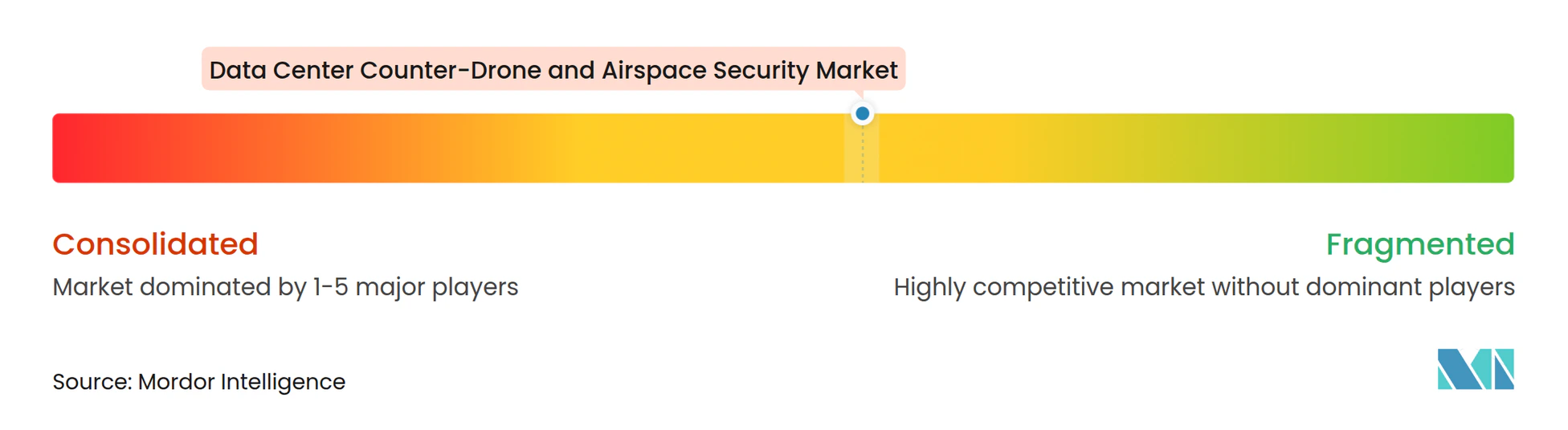
The data center counter-drone and airspace security market has a moderately fragmented structure. Pure-play specialists compete with defense suppliers that adapt established technologies for critical infrastructure sites. Dedrone, DroneShield, D-Fend Solutions, and Fortem Technologies focus on detection, software, and civilian deployment experience. Anduril, RTX, HENSOLDT, and Rheinmetall bring broader defense portfolios and experience with integrated command systems. Competition increasingly centers on sensor fusion, drone signature libraries, and the ability to support customer operations over time. Hardware remains necessary, but software and data quality can influence a customer’s long-term switching costs. This mix leaves room for specialists and larger suppliers to compete for different facility types.
Providers are using product integration to strengthen their position in the data center counter-drone and airspace security market. HENSOLDT and Rheinmetall demonstrated the integration of Twinvis passive radar with the Skymaster system in August 2026. Anduril announced a counter-UAS contract from the Dutch Ministry of Defence in May 2026, with initial operating capability achieved within 1 month of the contract signature. These actions show how vendors are emphasizing interoperable command software and faster deployment. They also indicate that proven performance in public-sector settings can support credibility with critical infrastructure buyers.
A material opportunity remains in the mid-market colocation tier, where operators need institutional security practices without the cost of a dedicated specialist team. Cloud-managed detection services can address this requirement by providing centralized review and software updates. The data center counter-drone and airspace security market is also likely to reward suppliers that make complex sensor combinations easier to operate. CISA guidance gives customers a recognized basis for comparing layered capabilities and operating procedures. Suppliers that integrate into existing physical-security environments can reduce adoption barriers. Strong service networks and relevant signature data may therefore become as important as individual sensors.
Data Center Counter-Drone and Airspace Security Industry Leaders
-
Dedrone by Axon
-
DroneShield Limited
-
RTX Corporation
-
Anduril Industries, Inc.
-
Thales Group
- *Disclaimer: Major Players sorted in no particular order
Data Center Counter-Drone and Airspace Security Market Companies Covered in this Report
- Dedrone by Axon
- DroneShield Limited
- RTX Corporation
- Anduril Industries, Inc.
- Thales Group
- D-Fend Solutions AD Ltd.
- Fortem Technologies, Inc.
- Leonardo S.p.A.
- Lockheed Martin Corporation
- Northrop Grumman Corporation
- Rafael Advanced Defense Systems Ltd.
- Saab AB
- HENSOLDT AG
- Elbit Systems Ltd.
- Rheinmetall AG
- QinetiQ Group plc
- Teledyne FLIR LLC
- Motorola Solutions, Inc.
- SRC, Inc.
- OpenWorks Engineering Ltd.
Recent Industry Developments in Data Center Counter-Drone and Airspace Security Market
- August 2026: Rheinmetall and HENSOLDT demonstrated the integration of HENSOLDT's Twinvis passive radar into Rheinmetall's Skymaster command-and-weapon-engagement system during the German Air Force's Timber Express 2026 exercise under live NATO Link 16 networking conditions, establishing a reference architecture for multi-sensor C-UAS at fixed critical infrastructure.
- July 2026: The FCC issued Declaratory Ruling DA 26-654, clarifying that non-federal entities with experimental FCC authorizations may test RF jamming technologies for C-UAS purposes without violating section 333 of the Communications Act, broadening the commercial testing ecosystem for active countermeasures.
- July 2026: The Federal Register published the Counter-UAS Authority rule for SLTT law enforcement, operationalizing the SAFER SKIES Act's authorization framework and requiring SLTT agencies to obtain FCC approvals before deploying any C-UAS system.
- May 2026: Anduril Industries was awarded a C-UAS contract by the Dutch Ministry of Defence, delivering integrated air defense systems on the Lattice platform with initial operating capability achieved within 1 month of contract signature.
Global Data Center Counter-Drone and Airspace Security Market Report Scope
The Data Center Counter-Drone and Airspace Security Market encompasses hardware, software, and services for detecting, identifying, tracking, monitoring, and mitigating unauthorized drones across data center facilities globally. The market is Segmented by Component (Hardware, Software and Analytics, and Integration and Support Services), Technology (Radar-Based Detection, Radio Frequency Detection, Electro-Optical and Infrared Detection, Acoustic Detection, and Integrated Multi-Sensor Systems), Solution Type (Drone Detection and Identification, Drone Tracking and Classification, Airspace Monitoring and Alerting, Drone Mitigation and Response, and Integrated Counter-Drone Platforms), Deployment Type (Fixed Installations, and Mobile and Portable Systems), Data Center Size (Small, Medium, Large, and Hyperscale), Data Center Type (Colocation, Cloud Service Providers (CSPs), and Enterprise/Edge), and Geography (North America, South America, Europe, Middle East, Africa, Asia-Pacific). Market Forecasts in Value (USD).The Market Forecasts are Provided in Terms of Value (USD).
Segmentation Overview
| Hardware |
| Software and Analytics |
| Integration and Support Services |
| Radar-Based Detection |
| Radio Frequency Detection |
| Electro-Optical and Infrared Detection |
| Acoustic Detection |
| Integrated Multi-Sensor Systems |
| Drone Detection and Identification |
| Drone Tracking and Classification |
| Airspace Monitoring and Alerting |
| Drone Mitigation and Response |
| Integrated Counter-Drone Platforms |
| Fixed Installations |
| Mobile and Portable Systems |
| Small |
| Medium |
| Large |
| Hyperscale |
| Colocation |
| Cloud Service Providers (CSPs) |
| Enterprise / Edge |
| North America | United States |
| Canada | |
| Mexico | |
| South America | Brazil |
| Argentina | |
| Rest of South America | |
| Europe | United Kingdom |
| Germany | |
| France | |
| Spain | |
| Russia | |
| Rest of Europe | |
| Middle East | Saudi Arabia |
| United Arab Emirates | |
| Turkey | |
| Rest of Middle East | |
| Africa | South Africa |
| Rest of Africa | |
| Asia-Pacific | China |
| India | |
| Japan | |
| Australia | |
| Singapore | |
| Rest of Asia-Pacific |
| By Component | Hardware | |
| Software and Analytics | ||
| Integration and Support Services | ||
| By Technology | Radar-Based Detection | |
| Radio Frequency Detection | ||
| Electro-Optical and Infrared Detection | ||
| Acoustic Detection | ||
| Integrated Multi-Sensor Systems | ||
| By Solution Type | Drone Detection and Identification | |
| Drone Tracking and Classification | ||
| Airspace Monitoring and Alerting | ||
| Drone Mitigation and Response | ||
| Integrated Counter-Drone Platforms | ||
| By Deployment Type | Fixed Installations | |
| Mobile and Portable Systems | ||
| By Data Center Size | Small | |
| Medium | ||
| Large | ||
| Hyperscale | ||
| By Data Center Type | Colocation | |
| Cloud Service Providers (CSPs) | ||
| Enterprise / Edge | ||
| By Geography | North America | United States |
| Canada | ||
| Mexico | ||
| South America | Brazil | |
| Argentina | ||
| Rest of South America | ||
| Europe | United Kingdom | |
| Germany | ||
| France | ||
| Spain | ||
| Russia | ||
| Rest of Europe | ||
| Middle East | Saudi Arabia | |
| United Arab Emirates | ||
| Turkey | ||
| Rest of Middle East | ||
| Africa | South Africa | |
| Rest of Africa | ||
| Asia-Pacific | China | |
| India | ||
| Japan | ||
| Australia | ||
| Singapore | ||
| Rest of Asia-Pacific | ||
Key Questions Answered in the Report
What is the size of the data center counter-drone and airspace security market?
The market is valued at USD 285.40 million in 2026 and is forecast to reach USD 893.55 million by 2032, at a 25.65% CAGR during 2027-2032.
Why are data center operators adopting counter-drone systems?
New hyperscale construction, drone reconnaissance risk, and the need for reliable airspace awareness are increasing adoption of detection and command systems.
Which component leads demand for data center airspace security?
Hardware leads with 60.27% share in 2026 because fixed deployments require radar, RF sensors, cameras, and other physical detection equipment.
Which technology is projected to expand fastest through 2032?
Integrated multi-sensor systems is projected to expand at a 26.81% CAGR because it combines complementary detection methods under common software.
Which facilities account for the greatest share of demand?
Cloud service providers lead by data center type with 45.34% share, while hyperscale facilities lead by size with 40.01% share in 2026.
What limits private operators from using active counter-drone measures?
U.S. rules generally prohibit commercial jamming and other active interference, so private operators focus on detection, evidence, and coordination with authorized agencies.