
Data Center Copper and Electrical Materials Market Size and Share
Market Overview
| Study Period | 2021 - 2032 |
|---|---|
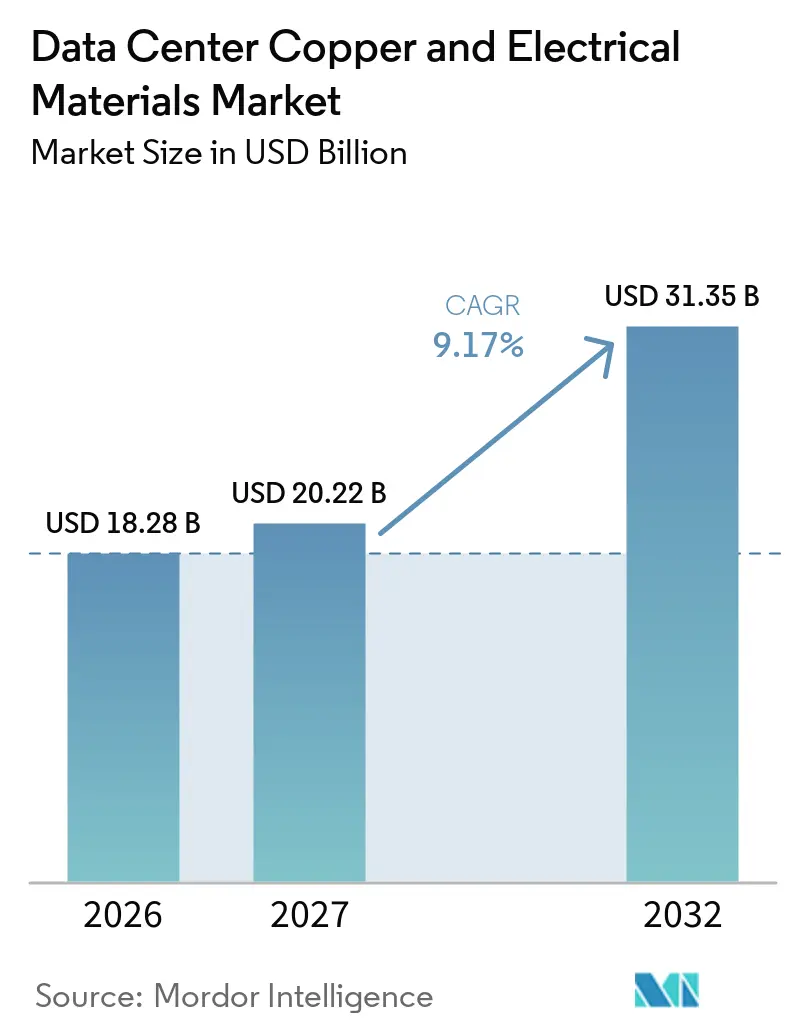
| Market Size (2027) | USD 20.22 Billion |
| Market Size (2032) | USD 31.35 Billion |
| Growth Rate (2027 - 2032) | 9.17 % |
| Fastest Growing Market | Asia-Pacific |
| Largest Market | North America |
| Market Concentration | Medium |
Major Players *Disclaimer: Major Players sorted in no particular order Image © Mordor Intelligence. Reuse requires attribution under CC BY 4.0. | |
Data Center Copper and Electrical Materials Market Analysis by Mordor Intelligence
The Data Center Copper and Electrical Materials Market size is projected to expand from USD 18.28 billion in 2026 and USD 20.22 billion in 2027 to USD 31.35 billion by 2032, registering a CAGR of 9.17% between 2027 to 2032. The Data Center Copper and Electrical Materials Market is supported by the rapid buildout of AI-focused computing capacity, which raises requirements for conductors, power equipment, and thermal systems. Large technology companies increased infrastructure investment as AI training and inference workloads required more capacity and higher rack power. Copper remains essential in cables, busbars, transformers, switchgear, cold plates, and grid connections because these uses require electrical and thermal performance at high current levels. The Data Center Copper and Electrical Materials Market also benefits from the shift toward liquid cooling and modular electrical systems, which bring power and thermal equipment closer together. Higher voltage distribution may reduce copper intensity per rack over time, but the pace of data center construction is expected to sustain aggregate materials demand.
Key Report Takeaways
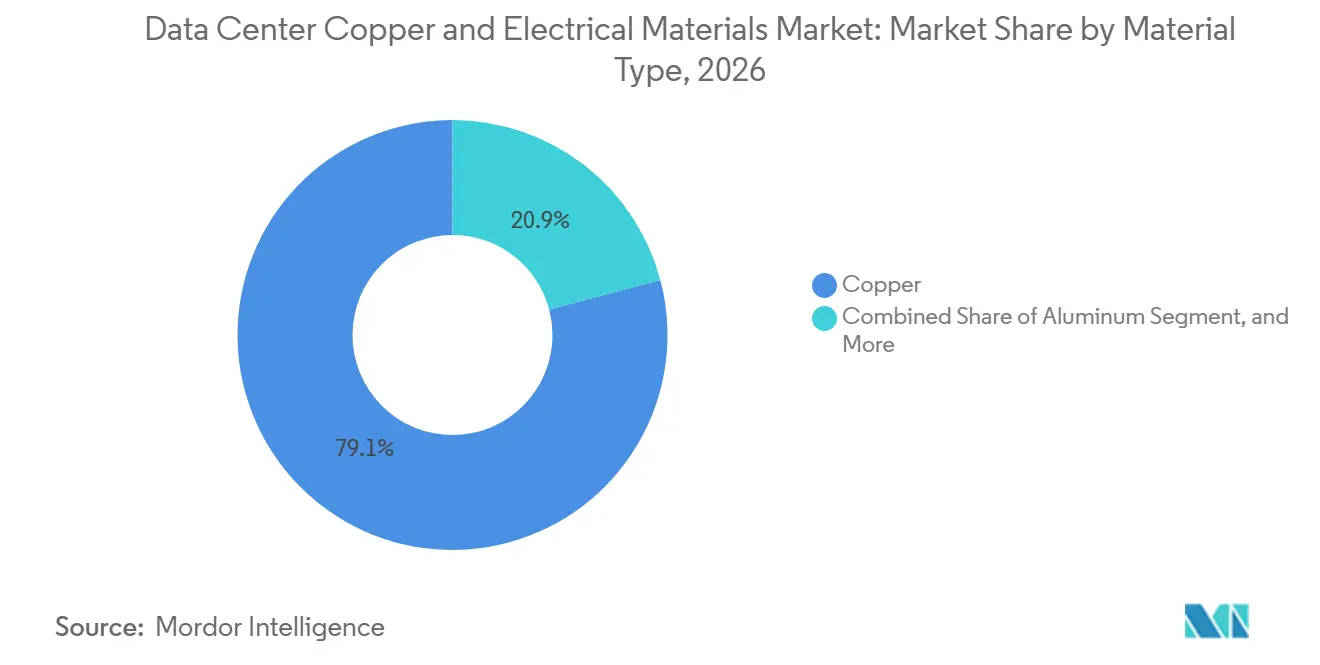
- By material type, copper held 79.12% of the Data Center Copper and Electrical Materials Market share in 2026 and is projected to expand at a 10.12% CAGR through 2032.
- By product type, electrical cables and conductors held a 42.54% share in 2026, while busbars and busways are projected to expand at an 11.02% CAGR through 2032.
- By application, power distribution accounted for 47.81% of the Data Center Copper and Electrical Materials Market size in 2026 and is projected to expand at a 10.25% CAGR through 2032.
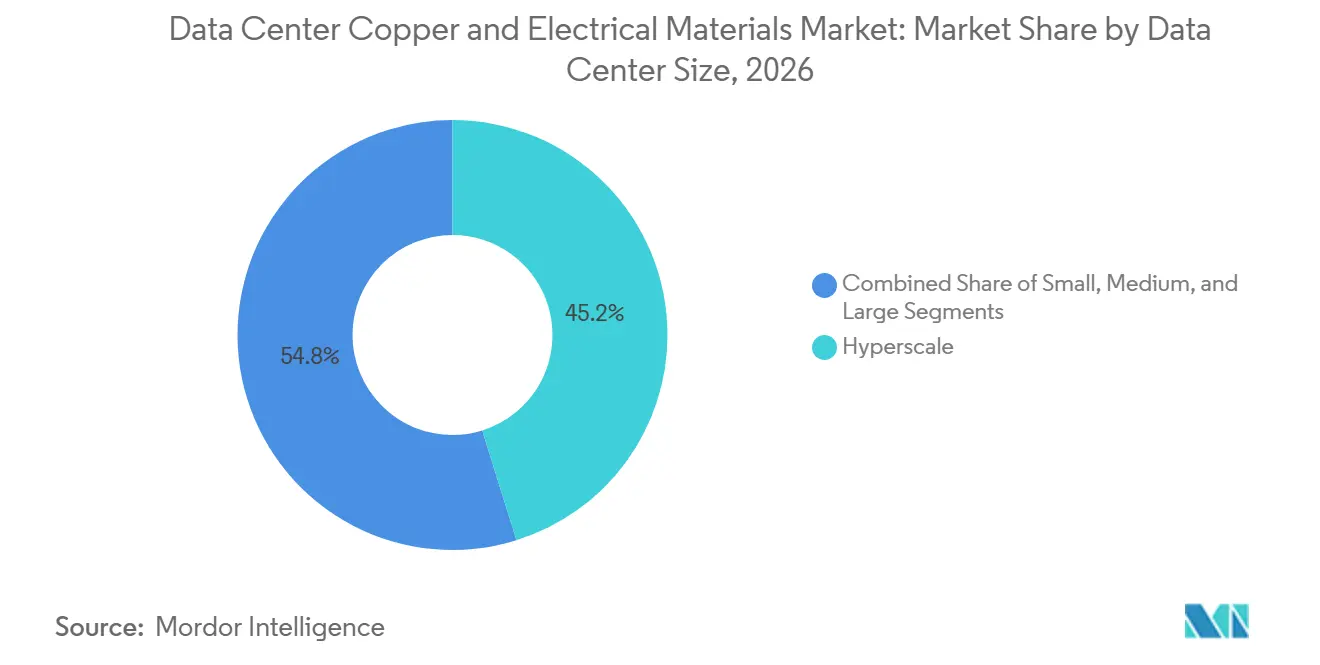
- By data center size, hyperscale facilities held a 45.19% share in 2026 and are projected to expand at a 12.45% CAGR through 2032.
- By data center type, cloud service providers held a 44.60% share in 2026 and are projected to expand at an 11.72% CAGR through 2032.
- By geography, North America held a 39.21% share in 2026, while Asia-Pacific is projected to expand at a 10.89% CAGR through 2032.
Note: Market numbers in this report are based on Mordor Intelligence's proprietary estimation framework, which combines nine months of actuals with Q4 projections for base year 2026.
Market Trends and Insights
Drivers Impact Analysis of Data Center Copper and Electrical Materials Market*
| Driver | (~) % Impact on CAGR Forecast | Geographic Relevance | Impact Timeline |
|---|---|---|---|
| AI and Hyperscale Data Center Expansion | +2.4% | Global, core in North America and Asia-Pacific | Short term (≤ 2 years) |
| Copper Intensity of AI Power and Cooling Architectures | +1.8% | Global, strongest in the United States, China, and Singapore | Medium term (2-4 years) |
| Liquid Cooling and Copper-Intensive Thermal Management | +1.4% | Global, led by North America and Asia-Pacific hyperscale clusters | Medium term (2-4 years) |
| Rising Rack Power Density and High-Ampacity Distribution | +1.1% | Global, concentrated in North America, Europe, and East Asia | Short term (≤ 2 years) |
| Modular Busways and Faster Data Center Deployment | +0.7% | North America and Europe, with spillover to Asia-Pacific | Medium term (2-4 years) |
| Grid Expansion for Data Center Load Growth | +0.5% | Global, prominent in the United States, European Union, India, and Gulf Cooperation Council countries | Long term (≥ 4 years) |
| Source: Mordor Intelligence | |||
AI and Hyperscale Data Center Expansion
AI infrastructure is increasing demand for power cables, busbars, switchgear, transformers, cooling assemblies, and grid equipment. Data center demand for cable and non-cable copper and aluminum materials is expected to reach 850-900 kilotonnes in 2026 and exceed 1,500 kilotonnes by 2030. The Data Center Copper and Electrical Materials Market benefits because much of this material sits outside the server room in power delivery, redundancy systems, and external connections. A USD 500 million Chicago data center used 2,177 metric tons of copper, or 27 metric tons per megawatt. Planning and grid constraints are extending construction schedules, which creates a multi-year procurement cycle rather than a single equipment purchase. Data localization requirements in the United States and Europe are also supporting new capacity closer to users and regulated workloads.
Copper Intensity of AI Power and Cooling Architectures
Successive AI accelerator systems need more electrical input and to remove more heat from a smaller physical space. NVIDIA stated that a 1 MW rack at 54 V DC could require up to 200 kilograms of copper busbar. The Copper Development Association reported that modern liquid-cooled data centers use 20-40 metric tons of copper for each megawatt of applied power. This makes conductor design central to project delivery, rather than a minor electrical procurement decision. Copper represented less than 0.5% of a data center's capital expenditure in the cited construction analysis, limiting the effect of metal price changes on project specifications. The Data Center Copper and Electrical Materials Market therefore has a different demand profile from end uses where commodity prices more readily delay investment.
Liquid Cooling and Copper-Intensive Thermal Management
Liquid cooling moved into wider AI deployment as heat output exceeded the capability of many conventional air-cooled designs. Copper manifolds, tubing, and cold plates are used because their thermal performance suits direct liquid cooling systems.[1] Copper cold plates with diamond-shaped pin fins achieved chip-to-coolant thermal resistance of 6.9 K/kW in peer-reviewed testing. The Data Center Copper and Electrical Materials Market is gaining as cold plates move from specialized use into standard high-density rack designs. Cooling and electrical procurement are also becoming more closely linked through prefabricated overhead modules. Future high-power configurations require materials that manage electrical load and heat in the same installation schedule.
Rising Rack Power Density and High-Ampacity Distribution
Rack power requirements are rising faster than many legacy electrical layouts can accommodate. The Uptime Institute found that 1 in 5 operators deployed racks at or above 30 kW in 2025, an increase of 7 percentage points from 2023. Higher current loads increase demand for busways, power distribution units, switchgear, and larger conductors. Electrical design must also comply with NFPA 70 and IEC 60364 requirements for conductor sizing and equipment ratings. These compliance factors help maintain specifications for high-quality conductors even when operators move to higher voltage systems. The Data Center Copper and Electrical Materials Market is consequently tied to both IT density and mandatory electrical safety requirements.
Restraints Impact Analysis of Data Center Copper and Electrical Materials Market*
| Restraint | (~) % Impact on CAGR Forecast | Geographic Relevance | Impact Timeline |
|---|---|---|---|
| Copper Price Volatility and Procurement Uncertainty | -1.4% | Global, amplified in Asia-Pacific and Gulf Cooperation Council markets with high import dependency | Short term (≤ 2 years) |
| Grid-Connection Bottlenecks and Project Delays | -1.0% | North America and Europe primarily, emerging in Asia-Pacific | Medium term (2-4 years) |
| Aluminum, Fiber, and Higher-Voltage Substitution | -0.7% | Global, strongest in North America and Europe | Long term (≥ 4 years) |
| Mining, Refining, and Permitting Lead Times | -0.5% | Global supply constraint, most acute in the United States, Australia, and the Democratic Republic of the Congo | Long term (≥ 4 years) |
| Source: Mordor Intelligence | |||
Copper Price Volatility and Procurement Uncertainty
Copper price changes can make electrical packages more difficult to price and procure. London Metal Exchange copper prices exceeded USD 14,500 per tonne during January 2026 amid mine disruptions and inventory repositioning.[2] Electrical contractors face greater exposure when contracts have fixed prices but copper-intensive equipment has a long lead time. The Data Center Copper and Electrical Materials Market can experience longer procurement cycles for busways, switchgear, and cable packages in such conditions. Project teams may also reduce contingency allowances when volatility persists. These pressures are particularly material where imports account for a large portion of copper supply.
Grid-Connection Bottlenecks and Project Delays
Grid connection delays can postpone the point at which a completed data center requires final electrical commissioning. Amazon Web Services stated that European transmission connections can take up to 7 years, while a data center can be developed in 2 years. The Federal Energy Regulatory Commission issued show-cause orders to 6 regional grid operators in June 2026 regarding large-load interconnection rules. Delayed energization defers orders for transformers, utility feeder cables, and connection switchgear. The constraint is strongest in North America and Europe, but it is emerging in fast-developing Asian hubs. The Data Center Copper and Electrical Materials Market remains exposed because new capacity cannot enter service until grid infrastructure is available.
*Our forecasts treat driver/restraint impacts as directional, not additive. The impact forecasts reflect baseline growth, mix effects, and variable interactions.
Data Center Copper and Electrical Materials Market Segment Analysis
By Material Type:
Copper Retains Structural Primacy Across ApplicationsCopper held 79.12% of the Data Center Copper and Electrical Materials Market share in 2026 and is projected to expand at a 10.12% CAGR through 2032. Its position reflects its use in power cables, busbars, switchgear, transformers, grounding conductors, and cooling assemblies. Copper has both electrical and thermal roles, which makes complete substitution difficult in high-current equipment. The International Copper Association found that copper content increased across recent server rack generations, with cooling systems contributing much of the increase. High-density computing therefore creates demand across more than one equipment category. This broad use limits the ability of a single technology change to replace copper throughout a facility.
Higher voltage distribution can reduce conductor mass for a given load, but it does not eliminate the need for copper in critical systems. Aluminum can be used in selected cable and structural electrical applications, especially where weight or carbon intensity is important. Prysmian and Rio Tinto deployed low-carbon aluminum cables at an Amazon data center in Ohio during September 2026. The move shows that operators are seeking lower-carbon materials in suitable applications. Copper remains preferred in cold plates, busway taps, and high-ampacity switchgear, where performance requirements are demanding. JX Metals and Japan Steel Works also announced a JPY 10 billion (USD 67 million) investment to increase titanium-copper alloy capacity by 50% by FY2029 for AI server connectors. The investment supports the continuing role of specialized copper materials in advanced server equipment.

By Product Type:
Busbars and Busways Support Faster DeploymentElectrical cables and conductors held 42.54% of the market share in 2026. They remain the main current-carrying medium across facilities, from utility connections to rack-level distribution. Busbars and busways are projected to expand at an 11.02% CAGR through 2032. Their growth follows the movement from fixed-circuit remote power panel layouts to modular overhead systems. Live tap-off units allow operators to adjust power layouts without extensive shutdowns. This feature is valuable in data halls that must accommodate changing AI rack configurations.
Busways can also simplify construction by reducing field wiring and supporting more repeatable installation. Vertiv launched its SmartRun prefabricated overhead portfolio in March 2026, combining power busbar, liquid cooling piping, containment, and network cabling.[3] The system was designed for deployment at more than 1 MW per day with one installation crew. Prysmian opened a 340,800-square-foot copper building wire plant in McKinney, Texas, in April 2026. Upstream rod and strip supply remains important because these products feed cable and busbar manufacturing. Connectors and terminations are also gaining importance as each rack carries more current and requires reliable connections.
By Application:
Power Distribution Links Rack Density to Electrical DemandPower distribution accounted for 47.81% of the Data Center Copper and Electrical Materials Market size in 2026 and is projected to expand at a 10.25% CAGR through 2032. Higher rack power moves upstream through power distribution units, busways, switchgear, transformers, and feeder cables. This makes power distribution the central application for copper-intensive equipment. A larger rack load affects equipment at every stage between the utility connection and the server. The result is continuing demand for larger conductors and equipment with higher current ratings. Compliance with NFPA 70 and IEC 60364 also supports minimum requirements for conductor and busbar design.
Power backup systems remain a major application because colocation and hyperscale operators commonly use N+1 or 2N redundancy designs. These systems require additional conductors in uninterruptible power supply and generator infrastructure. Grid connection equipment is becoming more important as larger campuses seek dedicated transmission-level access. Grounding and bonding remain mandatory across facility types and support demand for copper conductors. Prefabricated overhead systems now combine busbars with liquid cooling piping. This arrangement makes electrical and cooling decisions more interdependent than under earlier data center designs. The Data Center Copper and Electrical Materials Market is therefore influenced by both power delivery and thermal architecture choices.
By Data Center Size:
Hyperscale Facilities Set the Demand ProfileHyperscale facilities held 45.19% of the market share in 2026 and are projected to expand at a 12.45% CAGR through 2032. These facilities are the main users of large AI training clusters and require extensive power and cooling infrastructure. A hyperscale AI campus can require up to 50,000 metric tons of copper, compared with 5,000-15,000 metric tons for a conventional data center. This difference explains why a small number of large projects can influence supplier order books. Hyperscale projects also favor standardized, prefabricated equipment that can be installed quickly across multiple halls.
Large data centers represent a significant retrofit opportunity as they prepare existing facilities for AI inference workloads. These projects may add busways and liquid cooling while retaining much of the original building structure. Medium and small facilities support distributed deployments where data residency requirements favor local processing capacity. Such demand is relevant in Southeast Asia, the Middle East, and continental Europe. The European Union Energy Efficiency Directive requires reporting from data centers above 500 kW. Reporting requirements encourage attention to power efficiency and low-resistance electrical infrastructure. The Data Center Copper and Electrical Materials Market spans both new hyperscale construction and upgrades to installed capacity.
By Data Center Type:
Cloud Service Providers Concentrate ProcurementCloud service providers held 44.60% of the market share in 2026 and are projected to expand at an 11.72% CAGR through 2032. Their large development programs give a limited number of procurement teams substantial influence over specifications, lead times, and supplier qualification. They buy through engineering, procurement, and construction contractors and materials distributors. Their requirements often become reference specifications for the wider data center sector. Large orders also encourage cable and power equipment suppliers to add dedicated capacity. This procurement concentration supports standardization in busway, switchgear, and cooling systems.
Colocation providers remain significant because enterprise customers continue to lease capacity and hyperscalers use wholesale facilities. Enterprise data centers and edge sites are upgrading selected halls with AI inference pods. These upgrades require compact power distribution units, busbars, and liquid cooling equipment. ISO/IEC 22237 provides requirements for data center facilities and infrastructure, including power and cooling design. The standard supports consistent specifications across a diverse set of operators. The Data Center Copper and Electrical Materials Market therefore serves centralized cloud construction alongside distributed upgrades. This mix broadens demand even as large cloud providers retain the greatest purchasing influence.
Geography Analysis
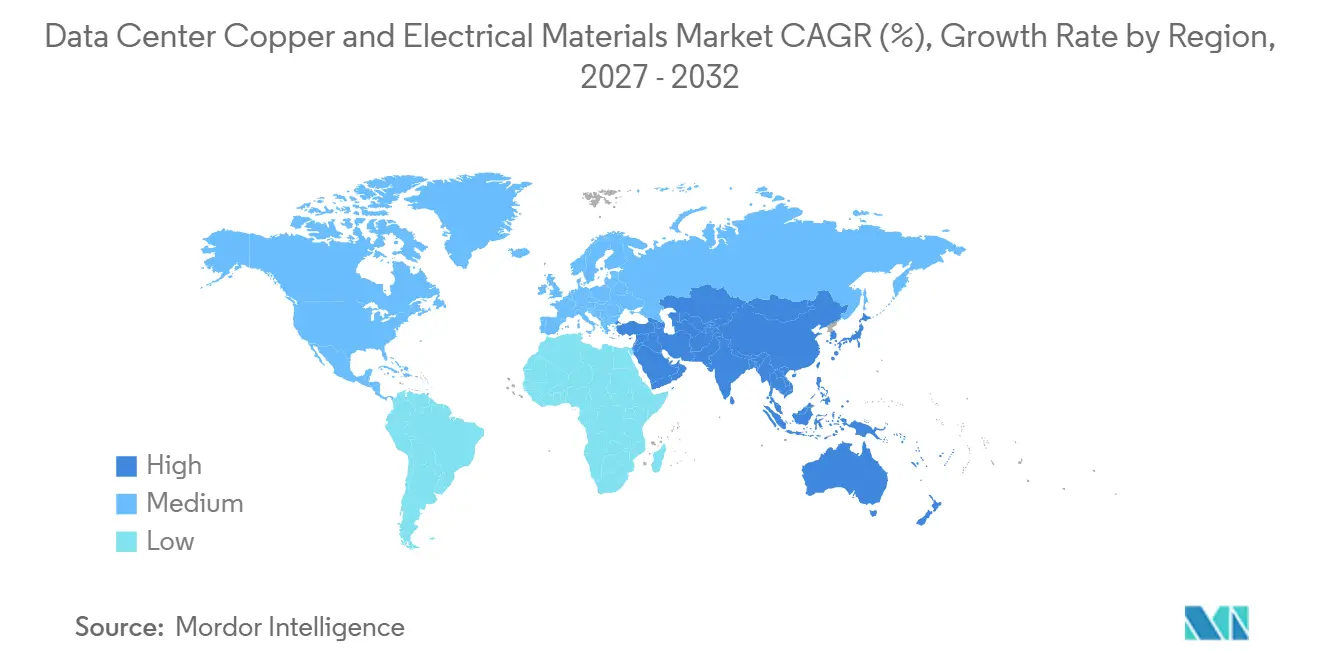
North America
North America held 39.21% of the market share in 2026. The region has a large concentration of AI training campuses in Northern Virginia, central Texas, and the Pacific Northwest. A Chicago data center with USD 500 million in construction value used 2,177 metric tons of copper. Domestic supply is expanding as Prysmian increased building wire capacity in Texas and evaluated additional copper rod capacity. FERC actions on large-load interconnection rules remain important because they affect when campuses can be energized. These delays can defer orders for grid-facing transformers, cables, and switchgear. Suppliers with local manufacturing and modular power systems are positioned to reduce delivery risk for developers.
Asia-Pacific
Asia-Pacific is projected to expand at a 10.89% CAGR through 2032. Regional data center investment reached USD 11.6 billion in 2025 as power access reshaped site selection.[4] Johor recorded a 53% increase in live data center capacity during 2025, while Melbourne recorded a 37% increase. Operators are shifting investment toward areas with available power and clearer development pathways. Japan’s wire and cable sector expects data center demand to support copper wire use through FY2030. The region also faces procurement pressure from higher copper prices and varying import exposure. Local capacity additions in copper foil and specialty materials support AI server supply chains and reduce dependence on external sourcing.
Europe, Middle East and Africa, and South America
Europe remains a major demand pool, supported by cumulative data center investment expected between 2026 and 2031. Germany’s data center capacity reached 2,980 MW in 2025, and AI-specific facilities are targeted to reach 2,020 MW by 2030. EU energy efficiency requirements and sustainable finance criteria make efficient electrical systems and verifiable material sourcing more important. The Middle East and Africa is drawing investment through sovereign AI programs and digital infrastructure policies in the United Arab Emirates and Saudi Arabia. South America remains smaller, with Brazil leading regional investment but financing and grid reliability constraining larger-scale expansion. These different conditions mean suppliers must combine common product platforms with local grid, financing, and compliance approaches.
Competitive Landscape
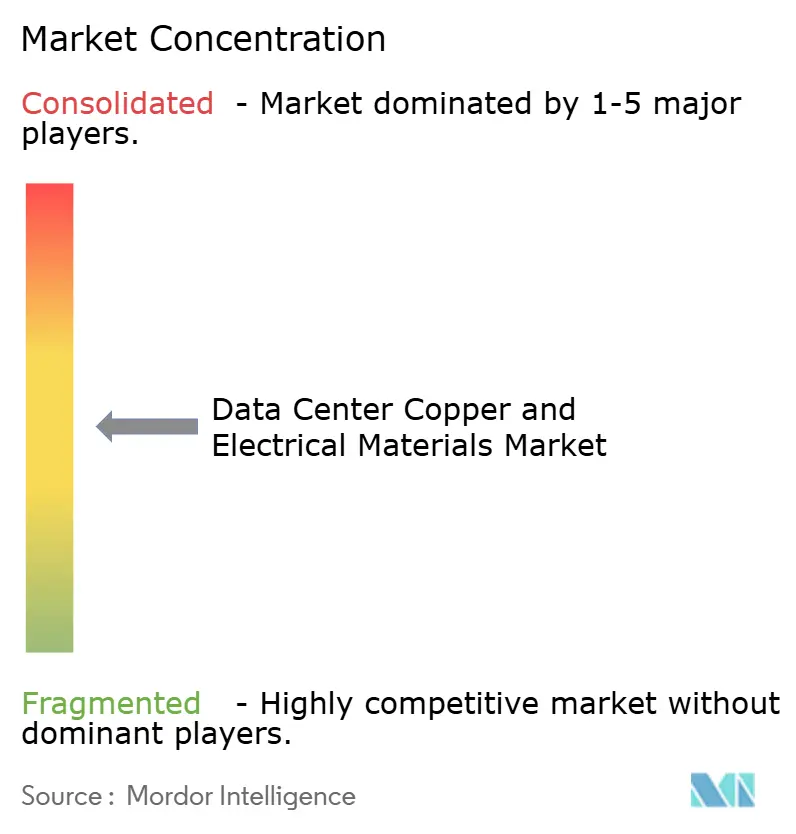
The Data Center Copper and Electrical Materials Market is moderately consolidated in upstream refining and copper rod production, but it is fragmented across equipment manufacturing and system integration. Prysmian and Nexans compete through cable manufacturing, capacity additions, recycled feedstock, and stronger access to copper rod supply. Prysmian signed a 10-year agreement with Molex in July 2026 that could be valued at EUR 5.5 billion (USD 6.2 billion). The arrangement was supported by EUR 1.25 billion (USD 1.41 billion) in fiber capacity investment through 2031. It shows how suppliers seek long-term contracts with data center value-chain partners. Nexans has also increased North American manufacturing capacity through acquisitions and expanded production schedules.
Recycling is becoming a more visible competitive factor as buyers seek lower-carbon materials and more secure supply. Aurubis commissioned its Complex Recycling Hamburg facility in July 2026, adding capacity for more than 30,000 metric tons of complex recycling materials each year. Wieland reported 82.4% recycled raw material content in FY2024/25 and set a target above 90% by 2030. Suppliers can use this evidence in tenders where low-carbon material sourcing is important. ISO 50001 certification and EU Taxonomy criteria are becoming meaningful procurement considerations in Europe. These requirements favor suppliers that can document energy management and material traceability. The Data Center Copper and Electrical Materials Market therefore rewards both production scale and credible sustainability records.
Vertiv, Eaton, Schneider Electric, Siemens, ABB, and nVent compete through integrated power, cooling, and deployment solutions. Vertiv’s March 2026 SmartRun launch combined busbar, liquid cooling piping, containment, and cabling in a prefabricated platform. Eaton and Siemens Energy announced a partnership for simultaneous data center construction and modular power generation. Siemens committed USD 285 million in United States capacity and EUR 100 million (USD 112.8 million) in German switchgear capacity for AI data center demand. ABB reported double-digit data center order expansion during 2025, with data centers contributing 7% of revenue. Competition is consequently centered on integrated designs, fast installation, and the ability to support high-density AI equipment.
Data Center Copper and Electrical Materials Industry Leaders
-
Nexans S.A.
-
Prysmian Group
-
LS Cable & System
-
Legrand SA
-
Vertiv Holdings Co
- *Disclaimer: Major Players sorted in no particular order
Data Center Copper and Electrical Materials Market Companies Covered in this Report
- Nexans S.A.
- Prysmian Group
- outhwire Company, LLC
- LS Cable & System
- Legrand SA
- Schneider Electric SE
- ABB Ltd.
- Wieland Group
- Aurubis AG
- Vertiv Holdings Co
- Eaton Corporation plc
- Siemens AG
- Delta Electronics, Inc.
- Rittal GmbH and Co. KG
- EAE Elektrik A.S.
- GE Vernova Inc.
- Huawei Digital Power Technologies Co., Ltd.
- Mitsubishi Electric Corporation
- C and S Electric Limited
- Sumitomo Electric Industries, Ltd.
- Starline Holdings, LLC
- nVent Electric plc
- Chint Group Corporation
- Larsen and Toubro Limited
Recent Industry Developments in Data Center Copper and Electrical Materials Market
- October 2026: JX Metals and Japan Steel Works announced a JPY 10 billion (USD 67 million) joint investment to expand titanium-copper alloy production capacity by 50% versus FY2026 levels by FY2029, serving AI server connectors where high GPU heat loads require materials with superior thermal stability and conductivity.
- October 2026: Mitsui Metal Mining announced its third production capacity expansion for data center copper foil in FY2026, accelerating the FY2026-2028 phase of a multi-phase program in response to demand surpassing earlier projections.
- September 2026: Prysmian Group and Rio Tinto completed the first known deployment of ELYSIS inert-anode-smelted, low-carbon aluminum cables at an Amazon data center in Ohio, demonstrating raw-material-level carbon reduction for data center electrical infrastructure.
- August 2026: Digital Shovel completed a 493 MW busway delivery for IREN ahead of schedule, concluding a partnership established in February 2024. The busway infrastructure supports IREN's AI cloud computing and Bitcoin mining data centers powered entirely by renewable energy.
Global Data Center Copper and Electrical Materials Market Report Scope
The Data Center copper and electrical materials market encompasses the global procurement, manufacturing, and deployment of copper, aluminum, and alternative conducting materials engineered for high-density computing infrastructure. This market evaluates the end-to-end supply chain of specialized components, including electrical cables, busbars, copper rods, and grounding systems segmented by application across power distribution, backup systems, and grid connections to meet the escalating infrastructural demands of diverse small, medium, large, and hyperscale facilities across colocation, cloud service, and enterprise operations.
The Data Center Copper and Electrical Materials Market Report is Segmented by Material Type (Copper, Aluminum, and Other Electrical Conductive Materials), Product Type (Electrical Cables and Conductors, Busbars and Busways, Copper Rods and Strips, Electrical Connectors and Termination Materials, and Other Electrical Materials), Application (Power Distribution, Power Backup Systems, Grid Connection and Electrical Infrastructure, Grounding and Bonding, and Other Electrical Applications), Data Center Size ( Small, Medium, Large, and Hyperscale), Data Center Type (Colocation, Cloud Service Providers [CSPs], and Enterprise / Edge), and Geography (North America, South America, Europe, Asia-Pacific, Middle East, and Africa). The Market Forecasts are Provided in Terms of Value (USD).
Segmentation Overview
| Copper |
| Aluminum |
| Other Electrical Conductive Materials |
| Electrical Cables and Conductors |
| Busbars and Busways |
| Copper Rods and Strips |
| Electrical Connectors and Termination Materials |
| Other Electrical Materials |
| Power Distribution |
| Power Backup Systems |
| Grid Connection and Electrical Infrastructure |
| Grounding and Bonding |
| Other Electrical Applications |
| Small |
| Medium |
| Large |
| Hyperscale |
| Colocation |
| Cloud Service Providers (CSPs) |
| Enterprise / Edge |
| North America | United States |
| Canada | |
| Mexico | |
| South America | Brazil |
| Argentina | |
| Rest of South America | |
| Europe | United Kingdom |
| Germany | |
| France | |
| Spain | |
| Rest of Europe | |
| Asia-Pacific | China |
| India | |
| Japan | |
| Australia | |
| Singapore | |
| Rest of Asia-Pacific | |
| Middle East and Africa | Saudi Arabia |
| United Arab Emirates | |
| South Africa | |
| Rest of Middle East and Africa |
| By Material Type | Copper | |
| Aluminum | ||
| Other Electrical Conductive Materials | ||
| By Product Type | Electrical Cables and Conductors | |
| Busbars and Busways | ||
| Copper Rods and Strips | ||
| Electrical Connectors and Termination Materials | ||
| Other Electrical Materials | ||
| By Application | Power Distribution | |
| Power Backup Systems | ||
| Grid Connection and Electrical Infrastructure | ||
| Grounding and Bonding | ||
| Other Electrical Applications | ||
| By Data Center Size | Small | |
| Medium | ||
| Large | ||
| Hyperscale | ||
| By Data Center Type | Colocation | |
| Cloud Service Providers (CSPs) | ||
| Enterprise / Edge | ||
| By Geography | North America | United States |
| Canada | ||
| Mexico | ||
| South America | Brazil | |
| Argentina | ||
| Rest of South America | ||
| Europe | United Kingdom | |
| Germany | ||
| France | ||
| Spain | ||
| Rest of Europe | ||
| Asia-Pacific | China | |
| India | ||
| Japan | ||
| Australia | ||
| Singapore | ||
| Rest of Asia-Pacific | ||
| Middle East and Africa | Saudi Arabia | |
| United Arab Emirates | ||
| South Africa | ||
| Rest of Middle East and Africa | ||
Key Questions Answered in the Report
What is the Data Center Copper and Electrical Materials Market size?
The Data Center Copper and Electrical Materials Market is valued at USD 18.28 billion in 2026 and is projected to reach USD 31.35 billion by 2032 at a 9.17% CAGR.
Why is copper important in AI data centers?
Copper is used in power cables, busbars, transformers, switchgear, grounding, and liquid cooling equipment. High-density AI systems increase electrical and thermal requirements.
Which material leads data center electrical materials demand?
Copper held 79.12% share in 2026 and is projected to expand at a 10.12% CAGR through 2032.
Which data center type has the strongest demand for electrical materials?
Cloud service providers held 44.60% share in 2026 and are projected to expand at an 11.72% CAGR through 2032. Their large construction programs concentrate procurement.
Which region has the highest demand for data center copper and electrical materials?
North America held 39.21% share in 2026 due to its concentration of hyperscale AI campuses and related electrical infrastructure investment.
What is the main constraint on new data center electrical infrastructure?
Grid connection delays can postpone commissioning, which defers demand for transformers, feeder cables, switchgear, and other grid-facing equipment.