
Data Center Construction Materials Supply Chain Market Size and Share
Market Overview
| Study Period | 2021 - 2032 |
|---|---|
| Market Size (2027) | USD 19.81 Billion |
| Market Size (2032) | USD 31.22 Billion |
| Growth Rate (2027 - 2032) | 9.52 % |
| Fastest Growing Market | Asia-Pacific |
| Largest Market | North America |
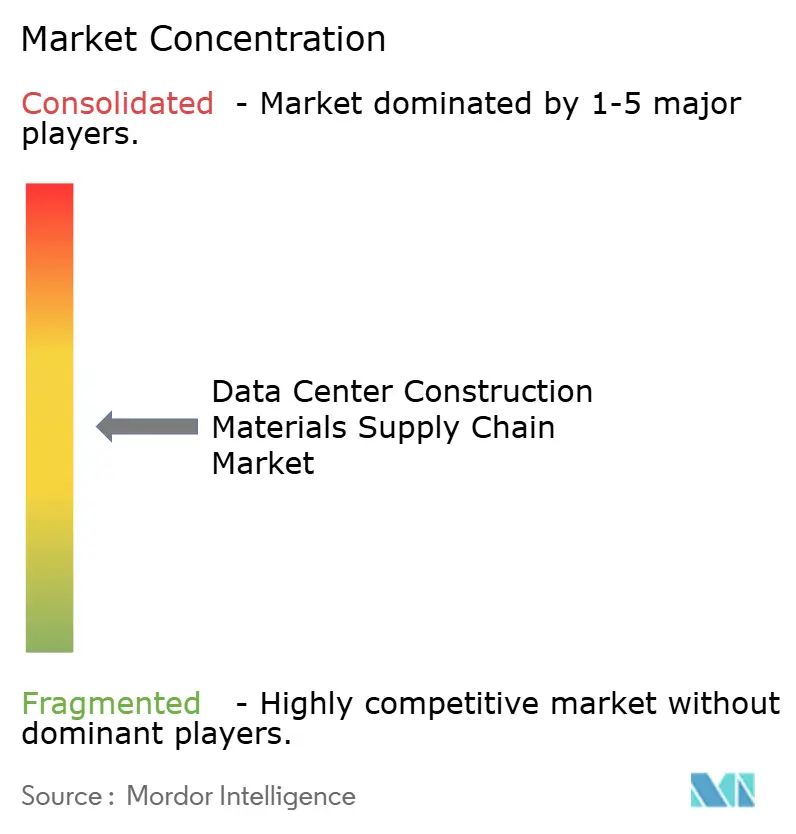
| Market Concentration | Medium |
Major Players *Disclaimer: Major Players sorted in no particular order Image © Mordor Intelligence. Reuse requires attribution under CC BY 4.0. | |
Data Center Construction Materials Supply Chain Market Analysis by Mordor Intelligence
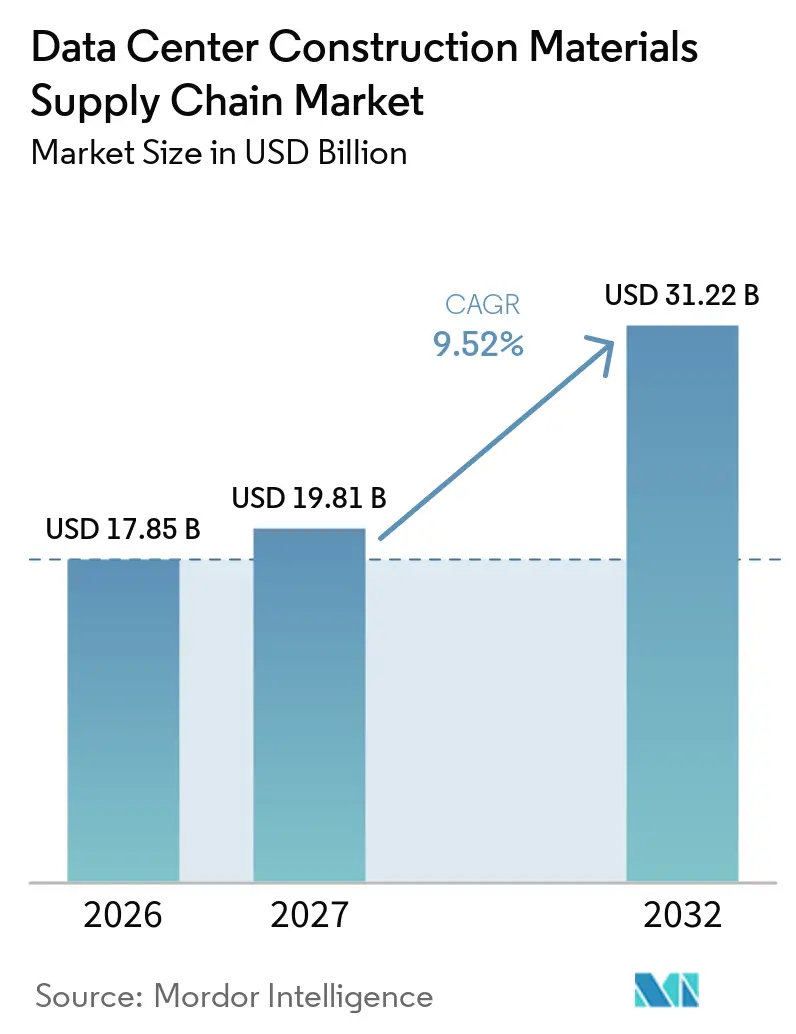
The data center construction materials supply chain market size was valued at USD 17.85 billion in 2026 and is estimated to increase from USD 19.81 billion in 2027 to reach USD 31.22 billion by 2032, at a CAGR of 9.52% during the forecast period 2027-2032. The data center construction materials supply chain market is being shaped by sustained spending on AI training capacity and cloud infrastructure, which has made large projects a more regular source of demand for steel, concrete, insulation, roofing, and waterproofing products. In the data center construction materials supply chain market, suppliers are increasingly selected on their ability to manage delivery risk, certify material origin, and meet technical requirements across several building systems. Carbon specifications are becoming more central as major operators apply lower-emission requirements to concrete and steel purchasing. Modular systems and precast components are also helping developers reduce dependence on scarce on-site labor and shorten critical construction stages. Grid delays have encouraged earlier material commitments, making framework agreements and dependable logistics important commercial tools in the data center construction materials supply chain market.
Key Report Takeaways
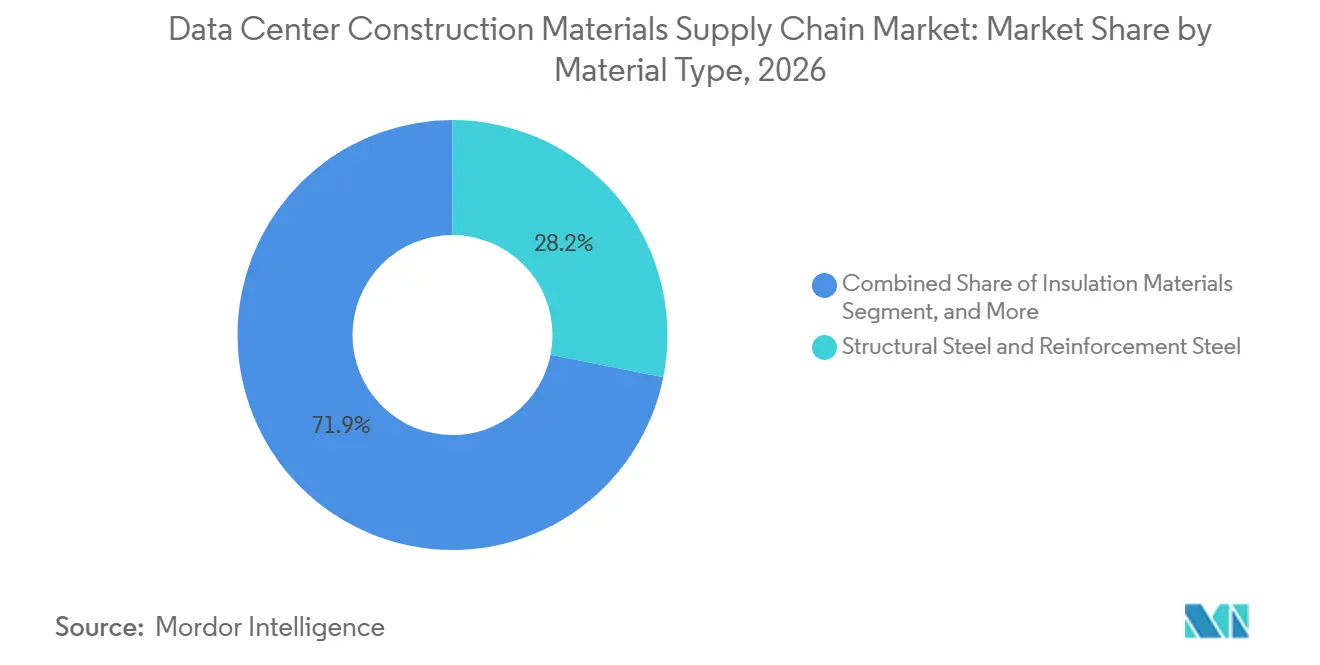
- By material type, structural steel and reinforcement steel held 28.15% of the data center construction materials supply chain market share in 2026, while precast concrete products are projected to expand at an 11.87% CAGR through 2032.
- By the construction phase, structural construction accounted for 38.57% of the market in 2026, while building envelope and roofing are projected to expand at a 10.47% CAGR through 2032.
- By procurement model, EPC-led procurement held 48.30% of the market in 2026, while direct procurement by data center developers and operators is expected to expand at an 11.53% CAGR through 2032.
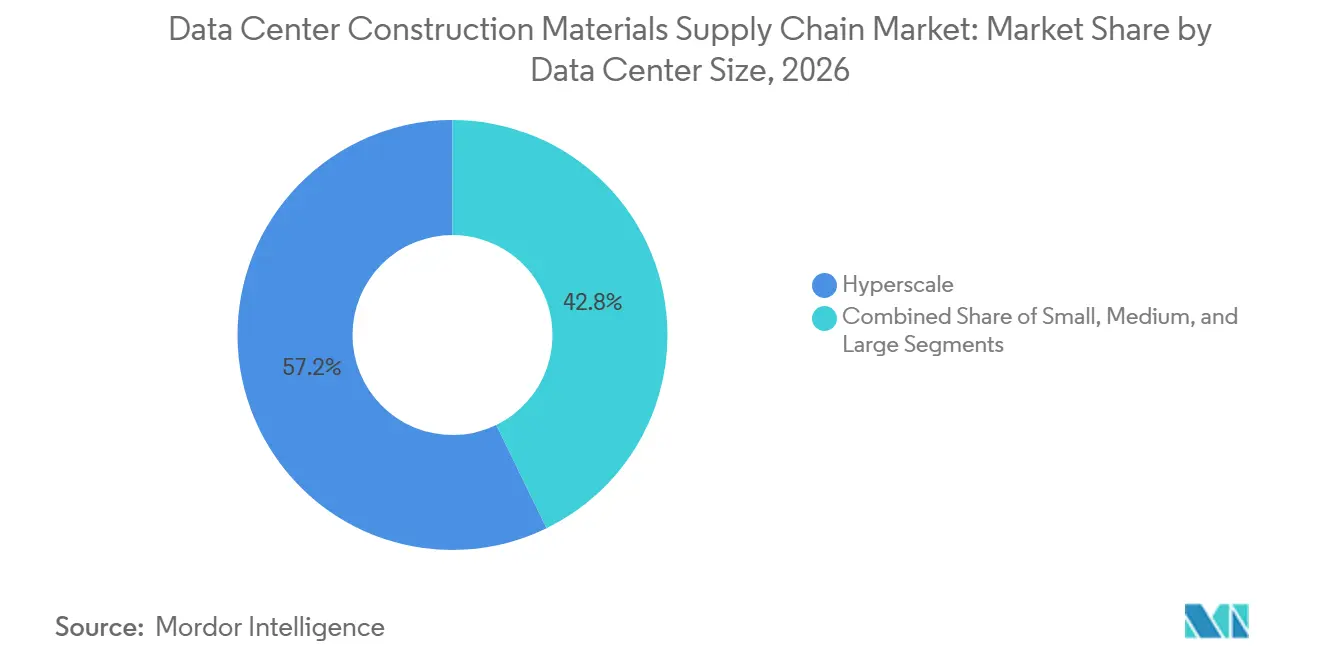
- By data center size, hyperscale facilities held 57.21% of the data center construction materials supply chain market share in 2026 and are projected to expand at a 10.97% CAGR through 2032.
- By data center type, cloud service providers held 50.41% of the market in 2026 and are projected to expand at a 10.71% CAGR through 2032.
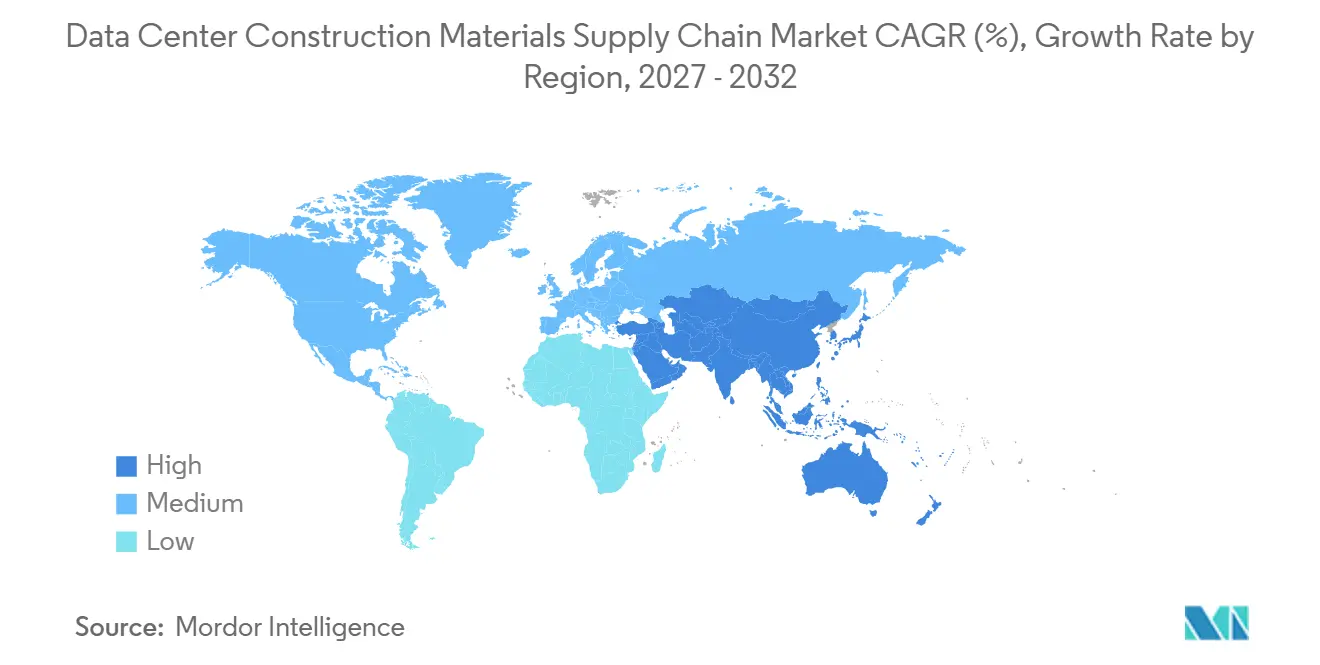
- By geography, North America held 40.96% of the data center construction materials supply chain market share in 2026, while Asia-Pacific is projected to expand at an 11.43% CAGR through 2032.
Note: Market numbers in this report are based on Mordor Intelligence's proprietary estimation framework, which combines nine months of actuals with Q4 projections for base year 2026.
Market Trends and Insights
Drivers Impact Analysis of Data Center Construction Materials Supply Chain Market*
| Driver | (~) % Impact on CAGR Forecast | Geographic Relevance | Impact Timeline |
|---|---|---|---|
| AI and Hyperscale Construction Raising Structural Materials Demand | +3.8% | Global, concentrated in North America, Asia-Pacific core markets, and Western Europe | Short term (≤ 2 years) |
| Prefabricated and Modular Materials Reducing Build Schedules | +1.3% | Global, with advanced adoption in North America and Europe and growing use in Asia-Pacific | Medium term (2-4 years) |
| High-Density Cooling and Thermal Materials for AI Facilities | +1.0% | Global, strongest in North America and Asia-Pacific | Medium term (2-4 years) |
| Low-Carbon Concrete and Steel Specifications | +0.9% | North America and Europe, with spillover to Asia-Pacific and Middle East and Africa | Long term (≥ 4 years) |
| Earlier Material Commitment to Manage Supply Risk | +0.6% | Global, particularly North America, Europe, and mature Asia-Pacific markets | Short term (≤ 2 years) |
| Material Optimization for Liquid-Cooled AI Facilities | +0.5% | North America and Asia-Pacific core markets, with spillover to Middle East and Africa | Medium term (2-4 years) |
| Source: Mordor Intelligence | |||
AI and Hyperscale Data Center Construction
The data center construction materials supply chain market draws its strongest demand from AI and hyperscale projects that require large amounts of structural material over several construction seasons. The American Cement Association projected in 2025 that U.S. AI data centers would require 1 million metric tons of cement, while these facilities could represent 38.6% of U.S. office-related construction spending by 2027. Nucor reported that a 250,000-square-foot data center requires 3,500 tons of steel across structural sections, pipe, insulated panels, and rack-related infrastructure.[1] CEMEX reported a 185% increase in ready-mix volumes supplied to data centers during 2025. CRH described an East Texas hyperscale project that required 3 million tons of aggregates over multiple seasons. These projects give producers better visibility than short, isolated construction contracts and make local production capacity more valuable.
AI facilities also affect product specifications, not just material volumes. Higher floor loads and dense power systems require foundations, slabs, and structural members that can support heavier equipment. Operators therefore assess delivery capacity, product consistency, and technical support alongside price. The data center construction materials supply chain market benefits when operators standardize design requirements across a portfolio of sites. That approach lets suppliers build repeat orders around common steel sections, concrete mixes, panels, and protective systems. It also supports direct discussions between material producers, engineers, and data center operators before construction begins.
Accelerating Demand for Prefabricated and Modular Materials
Prefabricated materials help developers manage short delivery schedules and shortages of specialist site labor. Bain reported in 2025 that modular design, prefabricated equipment, and advanced procurement can reduce construction timelines by up to 1 year. Network Environments stated that 49% of organizations use specialized integrator sites to pre-assemble mission-critical systems. Precast wall panels, hollow-core slabs, and columns can be manufactured while site preparation proceeds. This parallel work reduces the risk that weather, labor availability, or a late trade contractor interrupts the main construction sequence. It also gives builders a clearer view of delivery dates and installation needs.
The data center construction materials supply chain market is seeing greater interest in suppliers that can manufacture components to consistent dimensions and deliver them in a defined order. Factory production can improve quality control for repeated components, particularly where building layouts are standardized. Precast systems can reduce the amount of work performed at the site and ease coordination among structural, mechanical, and electrical teams. The value of these systems is strongest where a project needs to proceed before all grid capacity is available. Suppliers that combine components with engineering support and logistics are better placed to serve this demand. Unit price remains important, but schedule reliability is becoming a more meaningful part of procurement decisions.
Growth of High-Density Cooling and Thermal Management Materials
AI chips place greater thermal loads on buildings and mechanical systems than conventional computing equipment. Turner and Townsend reported that AI-ready U.S. facilities cost 10% more than conventional builds, with advanced facilities ranging from USD 14.00 to USD 16.00 per watt. Liquid cooling requires stainless steel piping, protected water loops, reinforced floor slabs, and roofing systems that help limit thermal gain. These needs change the mix of products specified for foundations, floors, walls, and roofs. They also require more coordination between structural suppliers and mechanical contractors. The result is a wider role for technical materials in facility design.
Sika stated that its waterproofing, flooring, and roofing systems can avoid 13,000 tonnes of CO₂-equivalent over the lifetime of a 25,000-square-meter data center. Such products are being assessed for durability, water management, fire performance, and energy use rather than a single physical characteristic. Concrete designs are also being adapted to accommodate higher sustained loads from cooling equipment. This gives the data center construction materials supply chain market a larger role in how facilities manage thermal performance. It favors companies that can provide tested systems rather than individual products. The shift may also increase demand for suppliers that can support site-specific engineering decisions.
Rising Specification of Low-Carbon Concrete and Steel
Major cloud operators are moving embodied-carbon requirements from voluntary targets into material purchasing. AWS used concrete with 64% less embodied carbon at new Tokyo data centers in 2025 through work with Takenaka, Shimizu, and Obayashi. STACK Infrastructure used electrochemically produced low-carbon cement at its Virginia campus in August 2025.[2] Meta and Amrize developed a concrete mix that reached 4,000-psi strength 43% faster and reduced embodied carbon by 35% for a Minnesota campus. These examples show that lower-carbon materials are being tested within live data center projects, not only in laboratory settings. Suppliers need verified product data if they want to qualify for comparable contracts.
Electric arc furnace steel and cement blends with lower clinker content are especially relevant to the data center construction materials supply chain market. A 2025 scientific review found that recycled electric arc furnace steel produced 0.4 to 0.8 tonnes of CO₂-equivalent per tonne, compared with 1.8 to 2.5 tonnes for virgin steel. Low-carbon choices can affect cost, availability, strength development, and local sourcing. Buyers are therefore seeking material traceability and documentation that can be used in design and sustainability reviews. The European Union’s carbon rules add further importance to emission information for cement, steel, and aluminum imports. This is likely to favor producers that can supply verified lower-emission products at regional scale.
Restraints Impact Analysis of Data Center Construction Materials Supply Chain Market*
| Restraint | (~) % Impact on CAGR Forecast | Geographic Relevance | Impact Timeline |
|---|---|---|---|
| Volatile Steel, Cement, Copper, Energy, and Freight Costs | -0.9% | Global, most acute in North America and Europe | Short term (≤ 2 years) |
| Long Lead Times for Specialized Construction Inputs | -0.6% | Global, with greater exposure in Asia-Pacific and Middle East and Africa | Medium term (2-4 years) |
| Skilled Trade and Specialist Installation Constraints | -0.5% | North America and Europe, emerging in higher-cost Asia-Pacific markets | Medium term (2-4 years) |
| Grid, Permitting, and Site-Readiness Delays | -0.4% | North America, Europe, and selected Asia-Pacific markets | Long term (≥ 4 years) |
| Source: Mordor Intelligence | |||
Volatile Steel, Cement, Copper, Energy, and Freight Costs
Construction cost pressure remains a challenge for developers and suppliers. ConstructConnect reported that 70% of a typical data center project’s expenses were rising faster than bid prices in early 2026. These pressures come from metal, electrical components, and labor costs. U.S. tariffs implemented in 2025 affected imported steel, aluminum, and selected cement supplies. The changes encourage domestic sourcing but can increase project input costs. European importers also face added carbon-related obligations under the Carbon Border Adjustment Mechanism. Cost volatility makes it harder to lock budgets for projects that are planned years before commissioning. Copper is particularly important because it is used in electrical distribution, cabling, and cooling systems. Rising transport, energy, and financing costs can also reduce the value of quoted contract prices. The data center construction materials supply chain market must manage these risks through indexed contracts, regional capacity, and early supplier engagement. Companies with local production may be less exposed to trade disruptions, but they can still face higher energy and labor expenses. Developers may spread purchases among suppliers to reduce the effect of a single cost increase.
Long Lead Times for Specialized Construction Inputs
Long lead times can disrupt construction even when bulk steel or cement is available. Bain found that lead times for critical equipment can range from 8 to 24 months. A 2025 analysis by American Clean Power and Wood Mackenzie reported average power-transformer lead times of 128 weeks and switchgear lead times of 44 weeks. Developers now secure selected inputs 18 to 24 months before site use. They may use supplier storage, foreign-trade zones, and framework agreements to maintain delivery flexibility. These measures add cost but help avoid construction interruptions.
A delayed power or cooling system can prevent later construction work from proceeding. Materials may then be delivered to a site before an active installation sequence is ready. This creates storage, working capital, and damage risks for all parties. The data center construction materials supply chain market rewards suppliers that can commit volumes, coordinate shipments, and provide clearer delivery schedules. Lead-time pressure is most serious where specialist manufacturing capacity is limited. It also explains why developers are more willing to build long-term relationships with suppliers that can manage several categories of material.
*Our forecasts treat driver/restraint impacts as directional, not additive. The impact forecasts reflect baseline growth, mix effects, and variable interactions.
Data Center Construction Materials Supply Chain Market Segment Analysis
By Material Type:
Structural Steel Supports Volume While Precast Gains UseStructural steel and reinforcement steel held 28.15% of the overall market in 2026 because they are used from foundations through interior fit-out. Steel provides the primary building frame, reinforcement, sprinkler pipe, insulated panels, and supports for cooling and rack-related systems. Nucor stated that it supplies more than 95% of steel product types used in data center construction. Cement, concrete, and aggregates remain the largest-volume inputs for foundations and slabs. CEMEX reported a 185% increase in ready-mix volumes for data centers during 2025. Cladding, insulation, and flooring are gaining importance because facilities need fire protection, thermal control, anti-static performance, and fast installation.
Precast concrete products are projected to expand at an 11.87% CAGR through 2032. The data center construction materials supply chain industry is using more precast components because they can be manufactured during site preparation and installed quickly. Deep-stem double tees can support floor loads approaching 400 pounds per square foot. A 2025 scientific review found lower embodied carbon for ground-granulated blast furnace slag concrete than for Portland cement concrete. Reflective roofing and waterproofing are also receiving more attention because they support thermal control. Sika noted that fiber reinforcement can reduce the need for steel reinforcement in slabs-on-ground. Adhesives, coatings, sealants, and cable-management products serve smaller but increasingly specialized applications.

By Construction Phase:
Structural Construction Leads While Envelope Requirements IncreaseStructural construction accounted for 38.57% of the data center construction materials market size in 2026. This phase uses large quantities of aggregates, concrete, rebar, and structural steel to create foundations, slabs, columns, and primary utility routes. Decisions made at this stage determine floor-load capacity, column spacing, and the ability to install later cooling and power systems. A large hyperscale campus can extend across more than 85 acres, creating a multi-season materials program. Material demand is therefore concentrated before the building envelope and interior works are installed. Vertically integrated suppliers can benefit by serving multiple structural product needs under one relationship.
Building envelopes and roofing are projected to expand at a 10.47% CAGR through 2032. Liquid-cooled facilities require penetrations for coolant lines, drainage systems, and stronger fire protection. The data center construction materials supply chain industry is consequently assigning more importance to panels, glazing, insulation, and roofing systems. Saint-Gobain signed a Microsoft framework agreement in October 2026 covering panels, fire-rated glazing, cooling tubes, and low-carbon admixtures across 1,085 projects in 32 countries. Interior work is also more technical because cable trays, partitions, anti-static screeds, and cooling interfaces are increasingly set during design. This favors suppliers that can meet several system requirements with coordinated products.
By Procurement Model:
EPC-Led Purchasing Retains Scale While Direct Buying ExpandsEPC-led procurement held 48.30% of the data center construction materials supply chain market in 2026. Developers use EPC firms to coordinate supplier qualification, delivery schedules, procurement, and construction risk. These contractors can handle complex material flows across large portfolios of projects. Their role is valuable when cooling requirements change during construction and trigger revisions to structural or mechanical specifications. Linesight identified data center and power infrastructure work as an important source of resilience for EPC-led U.S. construction in 2026. This model remains attractive for developers seeking single-point responsibility for cost and schedule control.
Direct procurement by developers and operators is projected to expand at an 11.53% CAGR through 2032. Larger operators use their purchasing scale to negotiate volume terms, specify lower-carbon materials, and secure supply across several years. Meta, AWS, and Google have established direct relationships with concrete suppliers and steel producers. The Amrize, Meta, and University of Illinois collaboration illustrates how direct buyer engagement can influence concrete design. Direct procurement provides more control, but it also requires the buyer to manage supplier performance and logistics. Distributor-led buying remains relevant for smaller colocation and edge sites that cannot achieve the same scale. The balance between these models will depend on project size, internal procurement capability, and supply risk.
By Data Center Size:
Hyperscale Facilities Set Demand Patterns While Edge Sites Broaden ReachHyperscale facilities held 57.21% of the data center construction materials supply chain market in 2026 and are projected to expand at a 10.97% CAGR through 2032. Their large footprints create long-running demand for structural steel, concrete, aggregates, roofing, insulation, and specialist systems. Bain projects that global data center capacity demand will reach 163 GW by 2030. CEMEX noted that data center projects can sustain material deliveries for 2 to 3 consecutive years. This duration can make regional supply agreements more valuable to both buyers and producers. Scale also increases scrutiny of energy use, material emissions, and product traceability.
Large and medium facilities account for significant spending outside the hyperscale tier. Small and edge facilities are increasing in number across distributed locations. The data center construction materials supply chain market size for these projects is lower per site, but local sourcing and modular assembly matter more. Germany’s Energy Efficiency Act requires existing data centers to achieve a power usage effectiveness of 1.5 by July 2027. The European Union also requires energy performance reporting for facilities above 500 kW under the Energy Efficiency Directive. These requirements can raise demand for efficient envelopes, insulation, and materials that support cooling performance. Edge sites may use lightweight precast systems and modular envelope components to reduce site work.
By Data Center Type:
Cloud Service Providers Lead While Colocation Supports Regional DemandCloud service providers held 50.41% of the data center construction materials supply chain market in 2026 and are projected to expand at a 10.71% CAGR through 2032. Microsoft Azure, AWS, and Google Cloud continue to require facilities with standardized structural, cooling, and carbon-related specifications. Their projects often need materials that meet defined floor-load ratings and engineering standards. Corning and Meta started construction on an optical cable manufacturing expansion in North Carolina in March 2026 under a multiyear USD 6 billion supply agreement.[3] This shows that large cloud operators are extending supply relationships upstream. Their purchasing approach supports more direct engagement with manufacturers and long-term material planning.
Colocation operators provide demand that is more geographically distributed and less dependent on a single large campus. Their projects require reliable local access to structural products, fire-rated materials, flooring, and compact cooling systems. Enterprise and edge sites generally use less concrete and steel per project, but still need precise performance standards. India recorded a data center vacancy rate of 2.8% in the first half of 2026, supporting further capacity additions. South Korea’s planned AIDC Special Act is expected to provide a clearer policy setting for related construction activity. These patterns create opportunities for suppliers that can serve many smaller projects with consistent technical support.
Geography Analysis
North America
North America held 40.96% of the data center construction materials supply chain market share in 2026. U.S. data center construction starts reached USD 53.7 billion through November 2025, up 138.6% from the prior year. The region has a dense base of cloud operators and material producers. U.S. tariff changes in 2025 encouraged buyers to consider domestic steel, aluminum, and cement supplies. Nucor’s network of more than 300 North American facilities provides an integrated route from scrap to finished steel products. Grid connection wait times reaching 4 years are increasing the need for early material purchases and framework agreements. These conditions favor suppliers with regional manufacturing capacity, transparent logistics, and strong storage capabilities.
Canada also faces higher demand for copper and construction inputs as digital infrastructure and manufacturing activity expand. Local production can reduce some trade exposure but does not remove energy, transport, and labor costs. More buyers are pursuing domestic supply relationships before final site schedules are fixed. This favors companies that can manage material releases across long periods. Low-carbon concrete and electric arc furnace steel are gaining attention because cloud operators increasingly need product emissions information. The data center construction materials supply chain market in North America is also likely to reward suppliers that can combine volume capacity with project-specific engineering support.
Asia-Pacific
Asia-Pacific is projected to expand at an 11.43% CAGR through 2032. The regional pipeline reached 26,455 MW in the first half of 2026, including 4,764 MW under active construction. Japan has high construction costs and strict performance expectations for building systems. AWS committed JPY 2.26 trillion (USD 14.9 billion) to Japan through 2027 and is using lower-carbon concrete in Tokyo facilities. Tokyo and Osaka led the 2026 cost index at USD 18.28 and USD 17.15 per watt, respectively. These conditions support demand for durable, efficient, and carefully specified materials.
India’s low vacancy rate is encouraging more construction in Mumbai, Chennai, and other demand centers. Malaysia’s Johor had 1,800 MW under construction, while Singapore approved 1.2 GW of new capacity. China’s East Data West Computing program is moving some capacity development toward western provinces. This can establish new demand centers away from coastal hubs and require local supply networks. Regional buyers need solutions that can address varied power costs, regulations, land conditions, and climate risks. Prefabricated systems are gaining relevance where construction schedules are tight and on-site labor is constrained. This creates opportunities for materials producers that can pair factory output with reliable local installation support.
Europe, Middle East and Africa, and South America
Europe faces compliance factors that affect insulation, envelope systems, and heat-management materials. The European Union requires reporting from data centers above 500 kW, while Germany requires existing data centers to meet a power usage effectiveness of 1.5 by July 2027. The European Commission adopted a delegated regulation in September 2026 for a common data center sustainability rating scheme. The rules strengthen demand for documented energy and water performance. The Carbon Border Adjustment Mechanism also creates a cost and compliance consideration for imported cement, steel, and aluminum. These measures give lower-carbon, locally supplied materials a stronger position in European procurement.
Saudi Arabia and the United Arab Emirates are developing large AI and cloud capacity programs. The combined Saudi Arabia and UAE data center valuation is projected to rise from USD 35 billion in 2025 to USD 115 billion by the end of 2027. Saudi Arabia’s Vision 2030 masterplan includes USD 18 billion for data centers, while the Stargate UAE cluster is expected to energize its first 200 MW in 2026. South Africa is emerging as a regional hub, but specialist material supply chains remain less developed. Brazil has the largest data center base in South America and a stronger manufacturing and energy position than many regional peers. These mixed geographies need suppliers that can adapt product choices to local logistics, climate, power availability, and compliance conditions.
Competitive Landscape
The data center construction materials supply chain market is moderately fragmented by product category, but buyers increasingly favor suppliers that can support several material requirements. ArcelorMittal, Nucor, and Tata Steel compete through steel availability, technical range, and lower-emission production options. Nucor has expanded its Data Systems unit into server cabinets, hot-aisle containment, and related support components. This extends its role beyond basic structural steel. Holcim, Amrize, Heidelberg Materials, CEMEX, CRH, and Vulcan Materials compete across aggregates, cementitious products, concrete, and paving. Suppliers with broad regional product portfolios can offer a simpler buying process for large campuses.
Specialty suppliers compete on system performance rather than only on the delivered material price. Sika, Kingspan, Owens Corning, ROCKWOOL, Knauf, and Metl-Span provide roofing, waterproofing, insulation, flooring, and envelope solutions. Sika reported that its solutions have been used in more than 1,000 data centers globally. Saint-Gobain’s October 2026 Microsoft agreement combines sandwich panels, fire-rated glazing, cooling tubes, and low-carbon admixtures across a global project pipeline. This illustrates a global-specification and local-delivery model. It is especially useful for customers that want consistent performance across several countries.
Lower-carbon materials and digital product development are creating new competitive openings. Meta piloted mass timber at its Aiken, South Carolina campus in July 2025 and reported a 41% reduction in structural embodied carbon for substituted materials. STACK Infrastructure’s trial of electrochemical cement shows that data center developers can validate new inputs within operational construction programs. Covestro is supplying polycarbonate applications for AI data center power distribution and thermal management. Suppliers that can document compliance with LEED, BREEAM, and European sustainability requirements may improve their ability to serve multinational customers.
Data Center Construction Materials Supply Chain Industry Leaders
-
ArcelorMittal
-
Nucor Corporation
-
Tata Steel Limited
-
Heidelberg Materials AG
-
CRH plc
- *Disclaimer: Major Players sorted in no particular order
Data Center Construction Materials Supply Chain Market Companies Covered in this Report
- ArcelorMittal
- Nucor Corporation
- Tata Steel Limited
- Heidelberg Materials AG
- Holcim AG
- Amrize Ltd.
- CEMEX, S.A.B. de C.V.
- CRH plc
- Saint-Gobain
- Kingspan Group plc
- Owens Corning
- ROCKWOOL A/S
- Sika AG
- BASF SE
- Covestro AG
- Chryso Group (Saint-Gobain)
- Hilti Group
- Knauf Gips KG
- James Hardie Industries plc
- Vulcan Materials Company
- Martin Marietta Materials, Inc.
- The Sherwin-Williams Company
- Holcim Building Envelope Solutions
- Metl-Span
Recent Industry Developments in Data Center Construction Materials Supply Chain Market
- October 2026: Saint-Gobain signed a framework agreement with Microsoft to accelerate data center construction using Saint-Gobain's integrated building envelope and interior solutions, prefabricated sandwich panels, fire-rated glazing, high-performance polymer tubes for cooling, and low-carbon concrete admixtures, across 1,085 data center projects in 32 countries. The agreement also targets AI-assisted enhancement of Saint-Gobain's manufacturing sustainability processes.
- September 2026: The European Commission adopted a delegated regulation on a Common Union Sustainability Rating Scheme for data centers, formalizing energy performance reporting, water footprint tracking, and sustainability KPI disclosure for facilities above 500 kW of IT load. The scheme will shape materials specification across the European construction pipeline.
- August 2026: All Weather Insulated Panels (AWIP), a North American provider of high-performance building envelope solutions across industrial and commercial sectors, strategically expanded its data center division, scaling its operations to meet unprecedented market demand for advanced, energy-efficient building materials.
- March 2026: Corning and Meta marked the start of construction on an optical cable manufacturing expansion in Hickory, North Carolina, part of a multiyear USD 6 billion supply agreement. The project shows how hyperscalers are co-investing in upstream manufacturing capacity to secure AI data center supply chains.
Global Data Center Construction Materials Supply Chain Market Report Scope
The data center construction materials supply chain refers to the global sourcing, manufacturing, and logistics network required to deliver specialized structural, architectural, and foundational materials to facility sites. It focuses on securing the procurement timelines, regulatory compliance, and cost-efficiencies of high-demand inputs, such as structural steel, concrete, fireproofing insulation, and modular enclosures, essential for building scalable hyper-scale and colocation infrastructure.
The Data Center Construction Materials Supply Chain Market Report is Segmented by Material Type (Structural Steel and Reinforcement Steel, Cement, Concrete, and Aggregates, Precast Concrete Products, Roofing and Waterproofing Materials, Insulation Materials, Façade and Cladding Materials, Flooring and Interior Construction Materials, and Other Construction Materials), Construction Phase (Site Preparation and Civil Works, Structural Construction, Building Envelope and Roofing, and Interior and Fit-Out Works), Procurement Model (Direct Procurement by Data Center Developers and Operators, Engineering, Procurement, and Construction-Led Procurement, and Distributor and Supplier-Led Procurement), Data Center Size (Small, Medium, Large, and Hyperscale), Data Center Type (Colocation, Cloud Service Providers [CSPs], and Enterprise / Edge), and Geography (North America, South America, Europe, Asia-Pacific, Middle East and Africa). The Market Forecasts are Provided in Terms of Value (USD).
Segmentation Overview
| Structural Steel and Reinforcement Steel |
| Cement, Concrete, and Aggregates |
| Precast Concrete Products |
| Roofing and Waterproofing Materials |
| Insulation Materials |
| Façade and Cladding Materials |
| Flooring and Interior Construction Materials |
| Other Construction Materials |
| Site Preparation and Civil Works |
| Structural Construction |
| Building Envelope and Roofing |
| Interior and Fit-Out Works |
| Direct Procurement by Data Center Developers and Operators |
| Engineering, Procurement, and Construction-Led Procurement |
| Distributor and Supplier-Led Procurement |
| Small |
| Medium |
| Large |
| Hyperscale |
| Colocation |
| Cloud Service Providers (CSPs) |
| Enterprise / Edge |
| North America | United States |
| Canada | |
| Mexico | |
| South America | Brazil |
| Argentina | |
| Rest of South America | |
| Europe | United Kingdom |
| Germany | |
| France | |
| Spain | |
| Rest of Europe | |
| Asia-Pacific | China |
| India | |
| Japan | |
| Australia | |
| Singapore | |
| Rest of Asia-Pacific | |
| Middle East and Africa | Saudi Arabia |
| United Arab Emirates | |
| South Africa | |
| Rest of Middle East and Africa |
| By Material Type | Structural Steel and Reinforcement Steel | |
| Cement, Concrete, and Aggregates | ||
| Precast Concrete Products | ||
| Roofing and Waterproofing Materials | ||
| Insulation Materials | ||
| Façade and Cladding Materials | ||
| Flooring and Interior Construction Materials | ||
| Other Construction Materials | ||
| By Construction Phase | Site Preparation and Civil Works | |
| Structural Construction | ||
| Building Envelope and Roofing | ||
| Interior and Fit-Out Works | ||
| By Procurement Model | Direct Procurement by Data Center Developers and Operators | |
| Engineering, Procurement, and Construction-Led Procurement | ||
| Distributor and Supplier-Led Procurement | ||
| By Data Center Size | Small | |
| Medium | ||
| Large | ||
| Hyperscale | ||
| By Data Center Type | Colocation | |
| Cloud Service Providers (CSPs) | ||
| Enterprise / Edge | ||
| By Geography | North America | United States |
| Canada | ||
| Mexico | ||
| South America | Brazil | |
| Argentina | ||
| Rest of South America | ||
| Europe | United Kingdom | |
| Germany | ||
| France | ||
| Spain | ||
| Rest of Europe | ||
| Asia-Pacific | China | |
| India | ||
| Japan | ||
| Australia | ||
| Singapore | ||
| Rest of Asia-Pacific | ||
| Middle East and Africa | Saudi Arabia | |
| United Arab Emirates | ||
| South Africa | ||
| Rest of Middle East and Africa | ||
Key Questions Answered in the Report
What is the data center construction materials supply chain market size?
The market was valued at USD 17.85 billion in 2026 and is estimated to reach USD 31.22 billion by 2032 at a 9.52% CAGR.
Which material leads data center construction demand?
Structural steel and reinforcement steel held a 28.15% share in 2026 because they are used in foundations, frames, utilities, and interior systems.
Which material category is expected to expand fastest?
Precast concrete products are projected to expand at an 11.87% CAGR through 2032 as developers seek faster installation and more predictable schedules.
Why are low-carbon materials important for data center projects?
Cloud operators are specifying lower-carbon concrete and steel to support emissions targets and respond to evolving European carbon and sustainability requirements.
Which region is expected to expand fastest for data center materials?
Asia-Pacific is projected to expand at an 11.43% CAGR through 2032, supported by a large construction pipeline and sustained demand in Japan, India, Malaysia, Singapore, and China.
How are procurement models changing for data center projects?
EPC-led procurement remains the leading model, while direct procurement is projected to expand at an 11.53% CAGR as large operators seek stronger control of supply, carbon specifications, and pricing.