
Data Center Battery Energy Storage Market Size and Share
Market Overview
| Study Period | 2021 - 2032 |
|---|---|
| Market Size (2027) | USD 18.92 Billion |
| Market Size (2032) | USD 39.64 Billion |
| Growth Rate (2027 - 2032) | 15.94 % |
| Fastest Growing Market | Asia-Pacific |
| Largest Market | North America |
| Market Concentration | Low |
Major Players *Disclaimer: Major Players sorted in no particular order Image © Mordor Intelligence. Reuse requires attribution under CC BY 4.0. | |
Data Center Battery Energy Storage Market Analysis by Mordor Intelligence
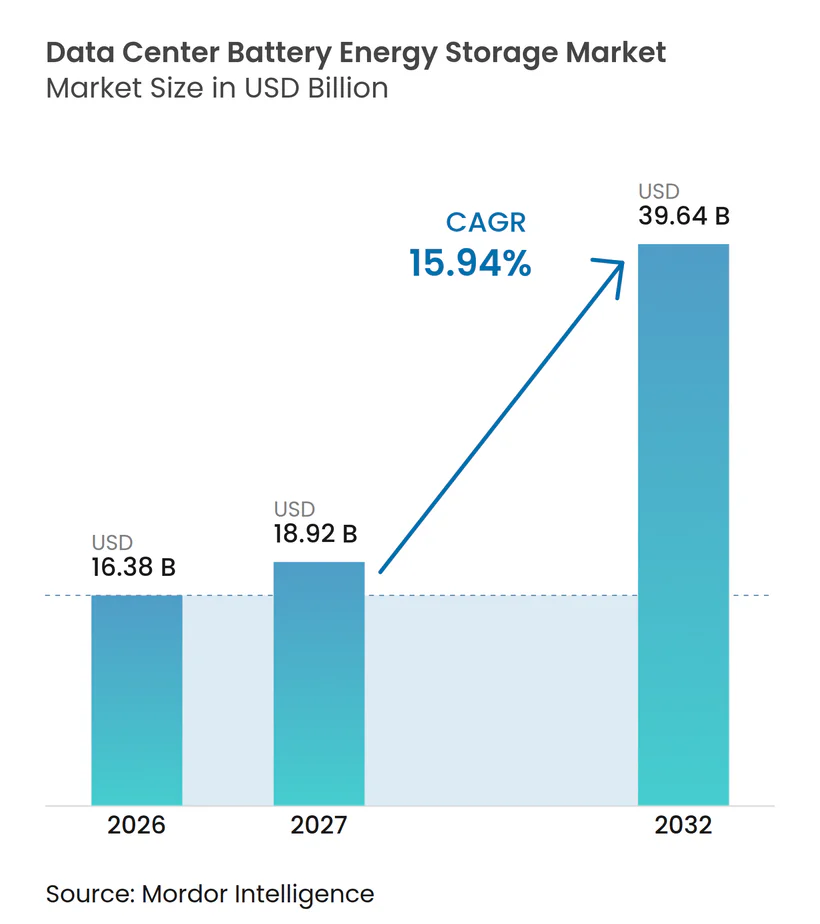
The data center battery energy storage market size is projected to be USD 16.38 billion in 2026, USD 18.92 billion in 2027, and reach USD 39.64 billion by 2032, growing at a CAGR of 15.94% from 2027 to 2032. Generative AI workloads create rapid power changes that conventional diesel UPS architectures were not designed to manage continuously. This shifts battery systems from a backup asset toward core infrastructure within facility power design. Longer grid interconnection queues in major United States markets reinforce the value of behind-the-meter storage for facilities that need earlier access to capacity. The data center battery energy storage market also benefits from clean electricity commitments that require storage to align variable renewable output with continuous computing demand. Competition increasingly depends on the ability to combine cells, power equipment, and dispatch controls in configurations designed for data center operations.
Key Report Takeaways
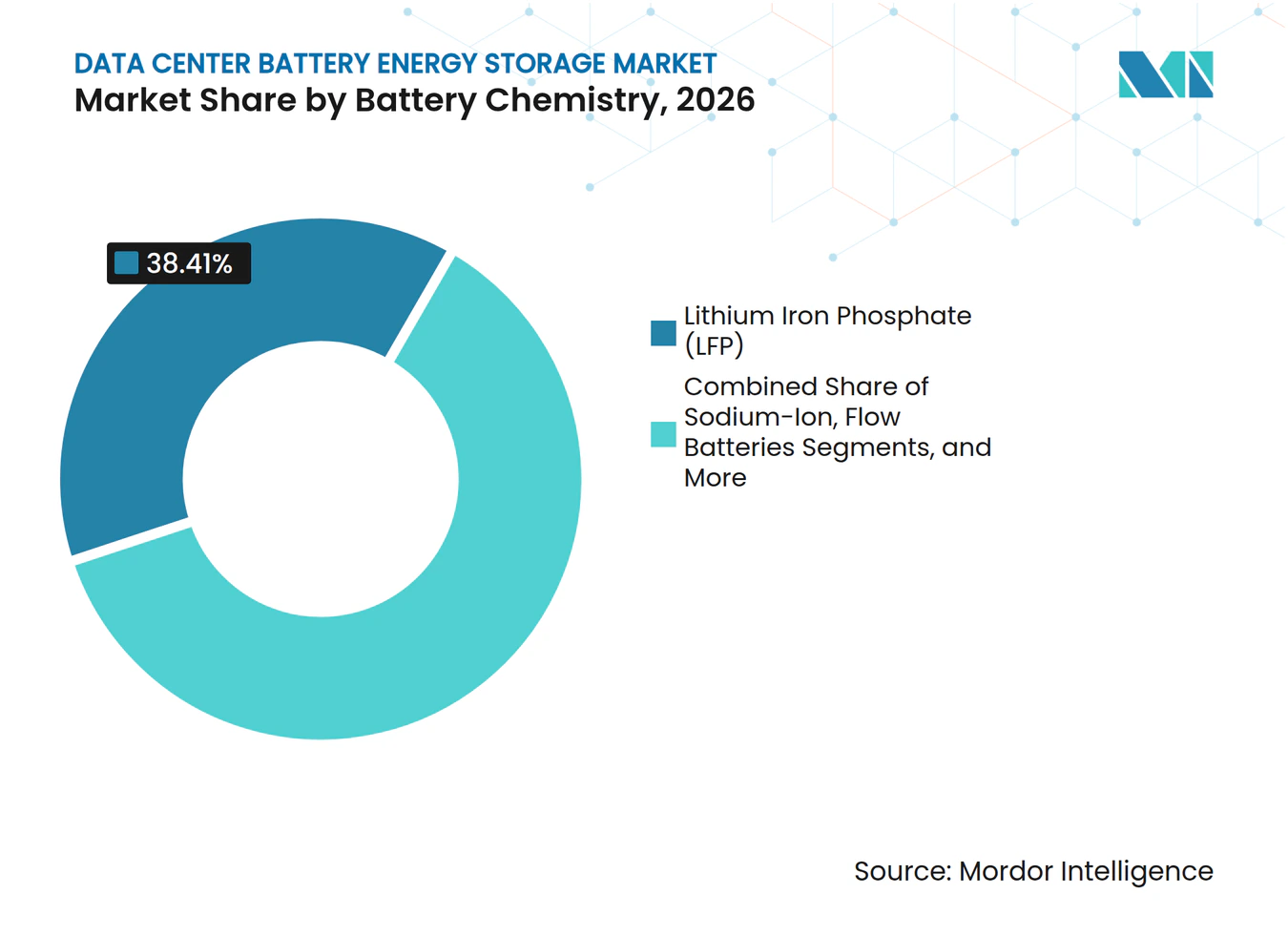
- By battery chemistry, LiFePO₄ held a 38.41% of the data center battery energy storage market revenue share in 2026, while sodium-ion is projected to expand at a 16.71% CAGR through 2032.
- By system component, battery cells and modules held a 37.81% of the data center battery energy storage market revenue share in 2026, while energy management software is projected to expand at a 17.05% CAGR through 2032.
- By primary application, UPS and short-duration backup held a 45.12% of the data center battery energy storage market revenue share in 2026, while renewable energy integration is projected to expand at a 17.33% CAGR through 2032.
- By storage duration, below-1-hour systems held a 58.19% of the data center battery energy storage market revenue share in 2026, while above-4-hour systems are projected to expand at an 18.02% CAGR through 2032.
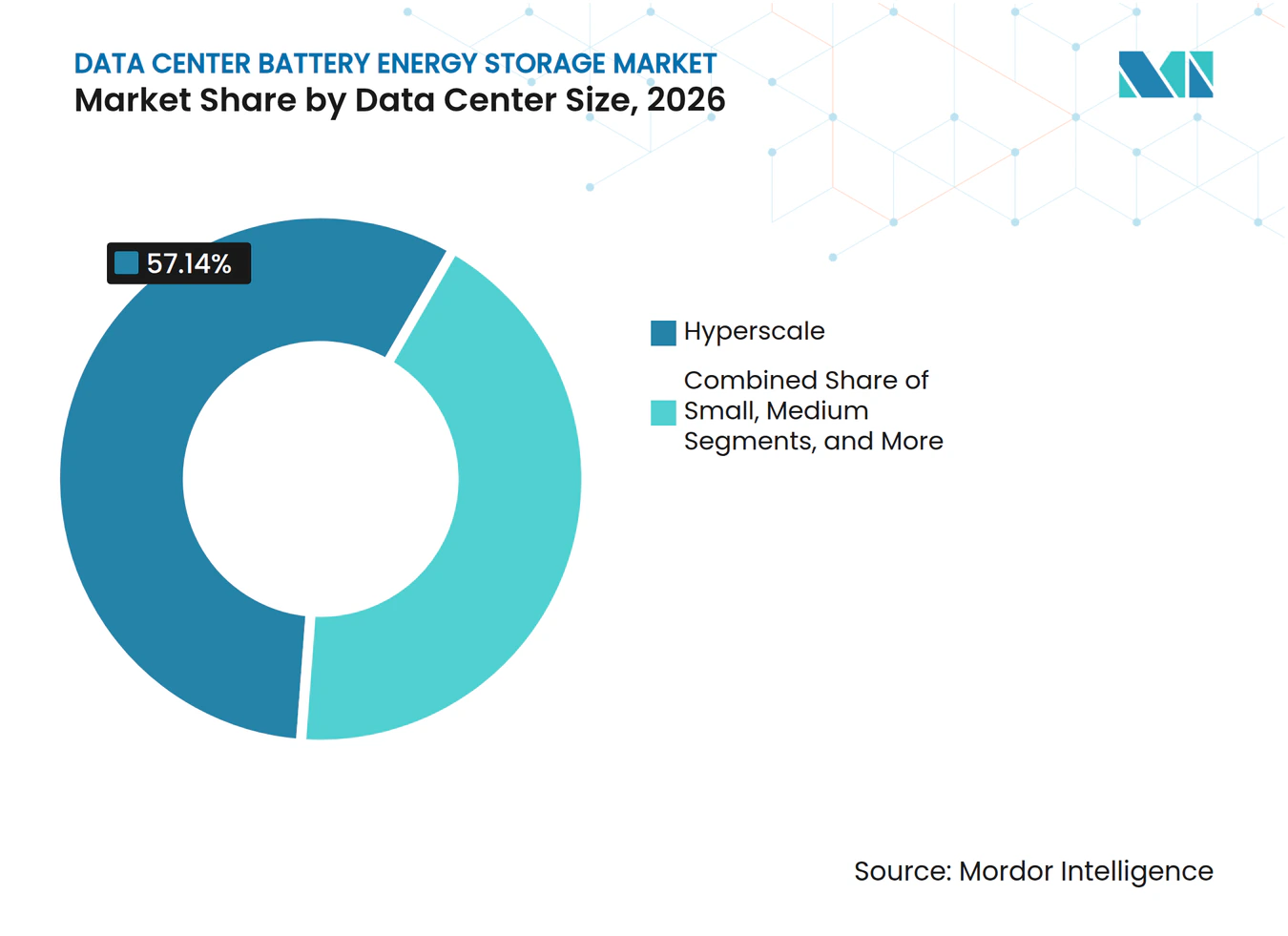
- By data center size, hyperscale facilities held a 57.14% of the data center battery energy storage market revenue share in 2026 and are projected to expand at an 18.34% CAGR through 2032.
- By data center type, colocation facilities held a 66.29% of the data center battery energy storage market revenue share in 2026, while cloud service providers are projected to expand at an 18.69% CAGR through 2032.
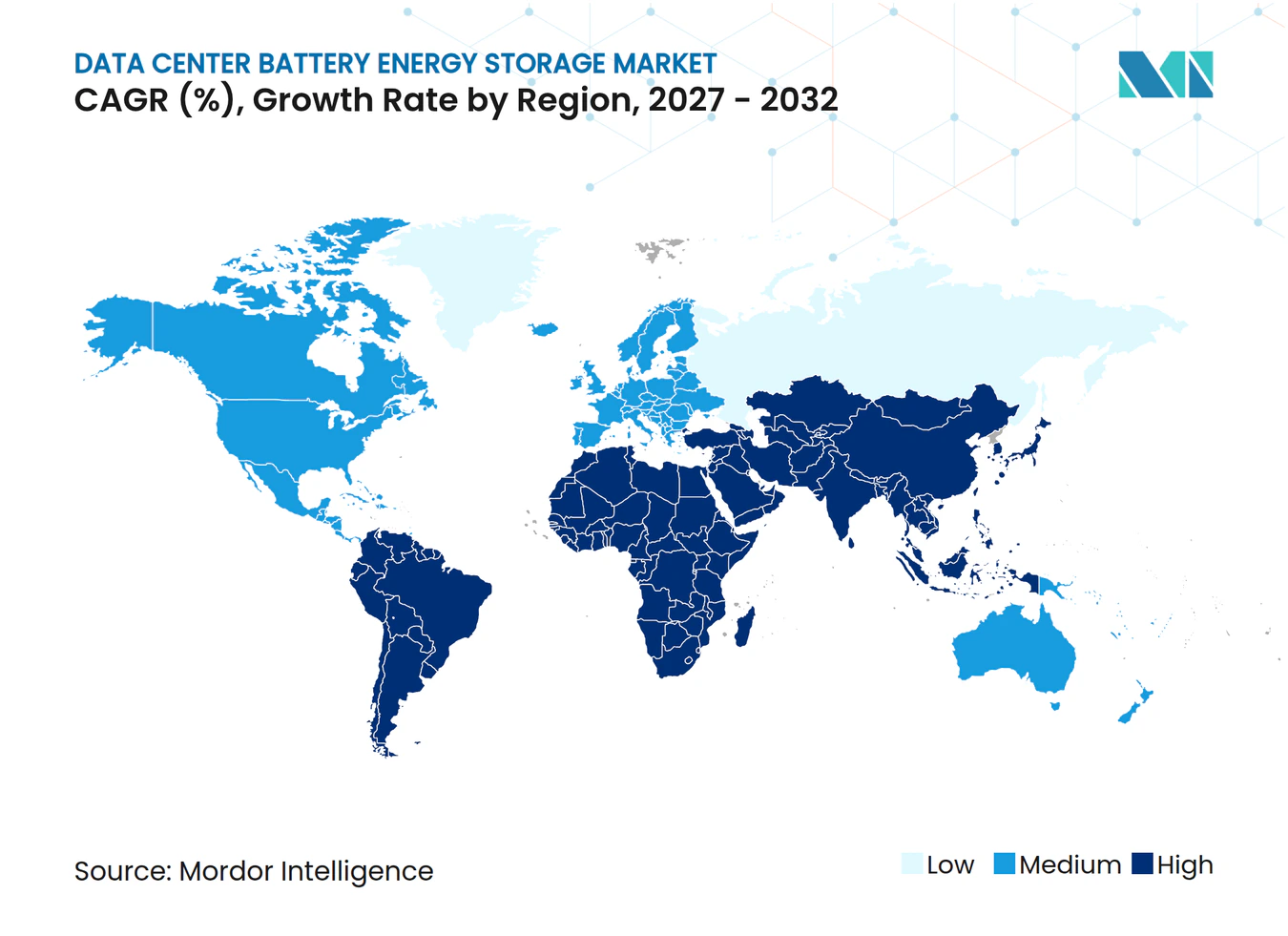
- By geography, North America held a 42.11% of the data center battery energy storage market share in 2026, while Asia-Pacific is projected to expand at a 17.68% CAGR through 2032.
Note: Market numbers in this report are based on Mordor Intelligence's proprietary estimation framework, which combines nine months of actuals with Q4 projections for base year 2026.
Market Trends and Insights
Drivers Impact Analysis of Data Center Battery Energy Storage Market*
| Driver | (~) % Impact on CAGR Forecast | Geographic Relevance | Impact Timeline |
|---|---|---|---|
| Demand for Backup Power and Operational Resilience | +4.8% | Global, concentrated in North America and Asia-Pacific | Short term (≤ 2 years) |
| Integration of Renewable Power with Data Center Electricity Supply | +2.9% | North America, Europe, and Asia-Pacific core | Medium term (2-4 years) |
| Growing Use of Batteries for Peak Shaving and Load Shifting | +2.3% | North America and Asia-Pacific core, spillover to Middle East and Africa | Short term (≤ 2 years) |
| Adoption of Battery Storage in Demand Response and Microgrid Applications | +1.8% | North America and Europe | Medium term (2-4 years) |
| Improvements in Battery Energy Density, Performance, and Costs | +1.5% | Global | Long term (≥ 4 years) |
| Expansion of Large Campuses Requiring Flexible Energy Storage | +1.2% | North America, Asia-Pacific, and Europe | Medium term (2-4 years) |
| Source: Mordor Intelligence | |||
Demand for Backup Power and Operational Resilience
AI training loads can change by 10%-50% per minute, which places greater stress on facility power systems. A North American facility documented by NERC shifted from 450 MW to 40 MW and back within 36 seconds. Medium-voltage battery systems can support power during voltage transients while also helping stabilize the host grid. A 2026 peer-reviewed review found that LiFePO₄, lithium titanate oxide, and supercapacitor combinations are well-suited to AI data centers because they pair rapid response with high cycle life. Saft launched its Flex'ion Gen3 in July 2026, delivering 268 kW from a 67 kWh cabinet, demonstrating continued development of high-rate UPS battery platforms. The data center battery energy storage market, therefore, favors systems that support both continuity and rapid response rather than standby capacity alone.
Integration of Renewable Power With Data Center Electricity Supply
Corporate 24/7 carbon-free electricity commitments require storage to match renewable generation with continuous computing loads. The U.S. Department of Energy provides support through its USD 10.5 billion Grid Resilience and Innovation Partnerships program and Section 48E investment tax credits for qualifying installations.[1] Enbridge and Meta confirmed investment in a 365 MW solar project with a 200 MW, 1,600 MWh battery system near Cheyenne, Wyoming, with service expected by the end of 2027. China’s four-ministry action plan requires that 80% of computing power hubs be powered by green electricity by 2030. This requirement moves storage procurement from a voluntary sustainability measure toward a planned infrastructure commitment. The data center battery energy storage market gains a clearer long-term demand base where renewable procurement and computing expansion are planned together.
Growing Use of Batteries for Peak Shaving and Load Shifting
Demand charges linked to the highest 15-minute or 30-minute interval can account for 30%-50% of a typical United States data center electricity bill. This cost structure gives operators a direct reason to use batteries for peak reduction. Medium-voltage architecture moves storage beyond a low-voltage UPS block, enabling it to interact with site power systems. That approach can free up space previously required for copper cabling and create more room for GPU racks. Faster deployment can also help campuses operate while waiting for broader grid capacity upgrades. The data center battery energy storage market consequently has value in lower electricity costs, improved power access, and better use of existing building space.
Adoption of Battery Storage in Demand Response and Microgrid Applications
Data centers that can reduce load through storage dispatch in 10 seconds can participate in frequency regulation programs. The NREL and Verrus Vulcan platform validated a 10-second grid-event response and seamless islanding against a 70 MW virtual data center model without breaching customer service-level agreements. California ISO has described batteries as core infrastructure for power system reliability. The California Energy Commission facilitated 1,850 MW of new battery installations during the preceding 12 months under its expedited permitting program. Hitachi and Tokyo Electric Power Company completed a multi-site demand-response demonstration in July 2025 at 3 Tokyo-Kanagawa data center sites. These operating models make storage useful for resilience and for managed participation in grid services.
Restraints Impact Analysis of Data Center Battery Energy Storage Market*
| Restraint | (~) % Impact on CAGR Forecast | Geographic Relevance | Impact Timeline |
|---|---|---|---|
| High Upfront Investment and Installation Costs | -1.6% | Global, most acute in Middle East and Africa and South America | Short term (≤ 2 years) |
| Fire Safety and Thermal Runaway Risks | -1.2% | Global, with stricter enforcement in North America and Europe | Medium term (2-4 years) |
| Battery Degradation and Replacement Costs | -0.8% | Global | Long term (≥ 4 years) |
| Concentration of Battery Material and Cell Supply Chains | -0.6% | North America and Europe | Medium term (2-4 years) |
| Source: Mordor Intelligence | |||
High Upfront Investment and Installation Costs
Power conversion systems, battery management systems, thermal management racks, and medium-voltage switchgear add 40%-60% to cell cost in a complete installation. Smaller enterprises and colocation operators can find this cost difficult to justify without multi-year savings from demand charges. Integration risk is highest at commissioning and during the first 2 operating years, when dispatch governance and controls can cause project failures. Lower cell prices improve the economics of large-scale projects, but integration premiums remain a constraint for smaller buyers. The 58.19% share held by below-1-hour systems reflects a preference for the minimum configuration that meets technical needs. The data center battery energy storage market must therefore demonstrate operational value as well as lower equipment cost for broader adoption.
Fire Safety and Thermal Runaway Risks
LiFePO₄ is thermally stable up to 270°C, compared with 150°C for NMC, thereby supporting its use in indoor systems. Fire incidents at grid-scale installations can still extend permitting schedules and increase insurance premiums. NFPA 855 prescriptive limits may require costly suppression infrastructure in some jurisdictions. China does not yet have a unified battery safety standard for AI data centers, leading to inconsistent procurement criteria across projects. ESS Tech introduced its Bridge sodium-ion platform in June 2026 and identified fire and insurance exposure as a central customer concern. The safety requirement creates a barrier, while also supporting demand for chemistries and enclosure designs that reduce thermal risk.
*Our forecasts treat driver/restraint impacts as directional, not additive. The impact forecasts reflect baseline growth, mix effects, and variable interactions.
Data Center Battery Energy Storage Market Segment Analysis
By Battery Chemistry:
LiFePO₄ Leads While Sodium-Ion Gains GroundLiFePO₄ held 38.41% of the data center battery energy storage market share in 2026. Its position reflects lower cell prices, a mature safety-certification base, and cycle life suited to daily UPS and peak-shaving operations. Saft’s July 2026 Flex'ion Gen3 illustrates continued high-rate LiFePO₄ product development for UPS applications.[2] Indoor installation requirements also favor a chemistry with stronger thermal stability. Product availability across UPS vendors further supports the replacement of older valve-regulated lead-acid systems. This creates a practical transition path for operators that need to update established backup infrastructure. NMC remains relevant in colocation environments with strict space constraints. Lead-acid systems continue to serve legacy enterprise UPS installations. Flow batteries retain a role in applications that need extended discharge duration. Procurement teams can therefore choose among several chemistries according to space, safety, duration, and installed equipment requirements.
Sodium-ion is projected to expand at a 16.71% CAGR through 2032. Procurement strategies that seek alternatives to lithium supply chains affected by restrictions imposed by Foreign Entity of Concern support this position. CATL signed a 60 GWh sodium-ion supply agreement aimed at AI data center deployments in 2026. A Chinese computing park tender in July 2026 allowed sodium-ion batteries to compete with LiFePO₄ on equal technical terms for the first time. This opening broadens the set of projects where buyers can assess sodium-ion performance. Its appeal is strongest where supply diversification has a high procurement value. System costs remained higher than comparable LiFePO₄ systems in China. That gap limits adoption where upfront cost is the primary selection criterion. Operators must weigh that price premium against supply-chain diversification and potentially lower insurance exposure. As more tenders include chemistry, performance records will become more important to buyer decisions.



By System Component:
Software Shapes System ValueBattery cells and modules held 37.81% of revenue in 2026. This reflects a bill of materials that remains heavily influenced by cell cost. Samsung SDI introduced the U8A1 UPS system at RE+ 2025, featuring AI-based predictive maintenance and 33% improved space efficiency over its predecessor. LG Energy Solution presented its JP6 UPS rack system at ees Europe 2026, featuring LiFePO₄ cells manufactured in Wrocław, Poland. These launches show that power density, predictive maintenance, and localized supply are becoming relevant alongside cell specification. Rack layout and service access also affect how easily systems can be deployed in active facilities. Component suppliers must support both compact layouts and long operating life. This favors modules designed for consistent performance under regular cycling. The data center battery energy storage industry now places greater value on equipment that can fit dense computing facilities and meet regional procurement requirements. Hardware choices increasingly reflect installation conditions as well as initial purchase cost.
Energy management software is projected to expand at a 17.05% CAGR through 2032. Software turns battery capacity into a controlled resource for backup, demand management, and grid-service operations. Siemens and Fluence issued a reference design for NVIDIA AI data centers in June 2026 that combined battery systems, power skids, liquid cooling, and unified controls. This model centers on dispatch coordination rather than individual hardware components. Controls can help operators determine when capacity is reserved for backup and when it can support the site's power needs. This can reduce operational uncertainty where multiple applications use the same asset. Buyers are increasingly assessing performance guarantees and electricity cost reductions across the entire system. The data center battery energy storage market thus gives software a larger role in differentiating otherwise similar battery hardware. Suppliers that integrate controls with equipment can simplify commissioning and ongoing site management. This may strengthen demand for systems that provide a single view of power availability.
By Primary Application:
Backup Retains Scale While Renewable Integration AdvancesUPS and short-duration backup held 45.12% of revenue in 2026. Tier III and Tier IV certification requirements support demand because they allow less than 10 milliseconds of outage. The application is moving from VRLA systems toward LiFePO₄ medium-voltage platforms. These platforms can also provide grid-interactive services without requiring operators to create a separate use case. This supports a more productive role for equipment that was once held in reserve. The approach can improve asset utilization while preserving the primary continuity function. The Open Compute Project has published energy storage requirements to guide the design of data center equipment. This standardization helps align battery selection with operational reliability requirements. It also gives facility teams a clearer basis for comparing suppliers. Backup, therefore, remains the foundational application even as systems take on broader site-power roles.
Renewable energy integration is projected to expand at a 17.33% CAGR through 2032. The Enbridge and Meta Wyoming project provides a model for a storage-supported clean electricity supply to a hyperscale campus. China’s requirement for 80% green electricity at computing hubs by 2030 also makes storage a planned integration asset. A peer-reviewed Energy study published in October 2026 found that coordinated on-site solar and battery operations under time-of-use tariffs could reduce electricity costs while maintaining operational feasibility. Storage can help maintain a cleaner supply profile when solar production does not match the facility's load. This function is important for facilities with continuous service commitments. This use case becomes more relevant as operators pursue renewable supply without compromising continuous service. It gives the data center battery energy storage market a route to capture spending linked to both energy and computing infrastructure. Long-term power planning can therefore put battery capacity alongside generation capacity in the same project design. This makes system sizing and controls central to the economics of clean-power procurement.
By Storage Duration:
Short Duration Leads While Longer Systems Gain InterestBelow-1-hour systems held 58.19% of revenue in 2026. Their position reflects the historical importance of UPS's ride-through capability. The 1-2-hour and 2-4-hour-plus categories are gaining attention as operators select durations aligned with grid interconnection timelines. Behind-the-meter storage can allow a United States campus to open 1-3 years before grid capacity expansion is complete. This application can be particularly relevant for campuses in constrained power markets. It also reduces the need to install a longer-duration system where it is not technically necessary. Shorter systems can be selected around a clear continuity requirement. This preserves capital for computing, cooling, and other facility investments. It also helps explain why shorter systems remain common while operators evaluate longer-duration configurations. Duration selection remains closely tied to the expected role of the battery at each site.
Above-4-hours systems are projected to expand at an 18.02% CAGR through 2032. Longer-duration configurations address periods when renewable output is lower or grid capacity is constrained for extended intervals. Form Energy raised USD 750 million in August 2026 to expand iron-air battery production and cited data center demand in its plans. The company reported more than 80 GWh of commercial agreements. These systems can support facilities that place greater value on resilience over time. They also broaden the range of technologies considered for data center power planning. Investor interest has moved beyond lithium-ion as long-duration needs gain attention. Thermal, redox-flow, and iron-air technologies are therefore being considered where multi-day resilience is important. The requirement for more discharge time can change both equipment selection and project design. It can also favor suppliers that can demonstrate a long operating life under repeated use.
By Data Center Size:
Hyperscale Facilities Set Product RequirementsHyperscale facilities accounted for 57.14% of revenue in 2026 and are projected to grow at an 18.34% CAGR through 2032. This dual position places their requirements at the center of product planning across the data center battery energy storage market. GPU-driven load changes of 10%-50% per minute exceed the capability of many standard UPS products. Such conditions require high-rate configurations designed for demanding power profiles. Large campuses can also assess storage across several buildings and a larger power envelope. This creates a stronger case for direct technical engagement between manufacturers and operators. CATL deployed AI-ready storage packs at Alibaba Cloud’s Zhangbei and Tencent’s Qingyuan computing centers. The reported 587 Ah cells shipped more than 5 GWh by mid-2026, illustrating direct manufacturer-to-hyperscaler procurement. These programs can shorten feedback cycles between equipment design and operating conditions. They also influence the specifications offered to other facility sizes.
Small and medium-sized facilities benefit from the expansion of edge computing and enterprise migration to colocation environments. Their growth is more gradual because a greater share of workloads is moving toward hyperscale and colocation locations. Edge sites can still benefit as regulations tighten around diesel backup generation. These facilities often need solutions that fit existing sites and avoid disruptive construction. Their procurement decisions may therefore favor standardized systems with simpler installation requirements. Cost control can also be more important where electrical demand is lower than at a hyperscale campus. Sungrow’s May 2026 order at China Tower Energy’s Hunan facility shows that larger-site architectures can move into this tier. Panasonic Energy disclosed plans in August 2025 to triple domestic lithium-ion battery production capacity by 2028 compared with 2025 levels. The company identified United States hyperscalers as its main target customers. The segment retains a role for vendors capable of adapting high-performance designs for smaller deployments.

By Data Center Type:
Colocation Leads While Cloud Providers Change ProcurementColocation facilities held 66.29% of revenue in 2026. Their multi-tenant structure provides several reasons to invest in behind-the-meter storage. Operators can offer faster time-to-power for incoming tenants and reduce peak demand charges. These benefits can improve lease economics rather than relying only on energy arbitrage. Storage can also support discussions with tenants that need firm availability for computing capacity. It gives operators another way to manage shared power infrastructure across the facility. Enterprise and edge sites expand more slowly as workloads move to hyperscale and colocation providers. Edge deployments can nonetheless gain from rules that limit diesel backup generation. This keeps the colocation model important for vendors seeking large, repeatable deployment opportunities. It also reinforces the value of systems that can serve multiple tenants without affecting uptime commitments.
Cloud service providers are projected to expand at an 18.69% CAGR through 2032. Aligned Data Centers and Calibrant deployed a United States battery system designed to accelerate grid interconnection for a large campus. The project was structured as a grid-responsive asset under the Department of Energy’s Critical Facility Energy Resilience grants. A single cloud facility decision can involve hundreds of MWh of battery capacity. This scale gives integrators a reason to create cloud-provider configurations and direct contract structures. Cloud providers can also set detailed technical requirements for power quality and system controls. Their procurement scale helps justify solutions designed around a specific computing load profile. It also shifts procurement away from standard channel sales and toward coordinated campus-level projects. The data center battery energy storage market gains larger opportunities when storage is planned early in cloud-campus development. These arrangements can favor suppliers that can coordinate equipment, software, commissioning, and ongoing service.
Geography Analysis
North America
North America held 42.11% of the data center battery energy storage market share in 2026. Hyperscale campus density and demand-charge tariffs support peak-shaving economics across the region. EPRI projects that data centers in the United States could use up to 9% of annual electricity generation by 2030, up from 4% in 2023. The California Energy Commission facilitated 1,850 MW of new battery installations during the preceding 12 months. FERC Order 841 requires the removal of barriers to storage participation in wholesale markets for capacity, energy, and ancillary services. This regulatory influence can give data center operators another route to earn revenue from behind-the-meter assets. The data center battery energy storage market in North America is also shaped by the need to manage rapid AI-related load changes without waiting for long grid upgrades.
Asia-Pacific
Asia-Pacific is projected to expand at a 17.68% CAGR through 2032. State-led AI infrastructure investment and mandated storage rules support demand across the region. China’s May 2026 action plan requires storage ratios of 15%-20% and a backup duration of 2-4 hours for new computing facilities. The Chinese data center storage battery market is forecast at CNY 18.3 billion (USD 2.5 billion) in 2026, up 42.2% year over year. PowerX and IIJ signed a February 2026 memorandum of understanding to develop battery-integrated containerized data centers in Japan. Hitachi and Tokyo Electric Power Company also completed a multi-site demand response demonstration in July 2025.[3] Australia’s AEMO is evaluating grid-forming battery systems at hyperscale sites to reduce synchronous-condenser costs and accelerate connections.
Europe, Middle East and Africa, and South America
Europe remains a major cluster around the Netherlands, Ireland, and Germany, where the EU Taxonomy and corporate net-zero targets support the integration of battery-backed renewables. LG Energy Solution’s Wrocław-made LiFePO₄ cells in the JP6 UPS rack system show how compliance factors can shape sourcing decisions. The Middle East is adding data center capacity as Saudi Arabia and the United Arab Emirates pursue domestic AI infrastructure. BYD’s 12.5 GWh deployment for the Saudi Electricity Company signals substantial adjacent grid investment. South America is led by Brazil, where São Paulo’s role as a cable-landing hub supports colocation activity. High peak-demand tariffs can improve the case for batteries in this location. Africa remains at an earlier stage, but integrators are exploring demand-response projects in grid-constrained commercial zones.
Competitive Landscape
Market Concentration
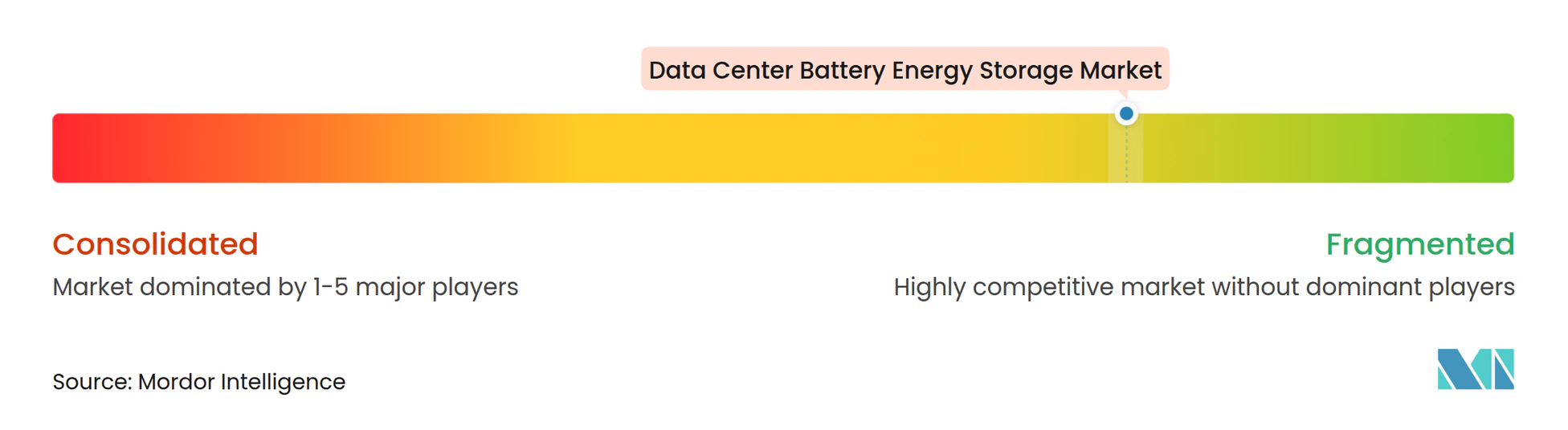
The data center battery energy storage market is moderately concentrated among vertically integrated manufacturers, specialist integrators, and UPS-focused suppliers. BYD, CATL, LG Energy Solution, and Samsung SDI compete with integrators such as Sungrow, Fluence, and Tesla Energy. Eaton, Vertiv, Schneider Electric, and Saft provide UPS and power management capabilities. BYD held 13% of the global BESS integrator share in 2025, while Tesla held 10%. Sungrow led a 2026 integrator ranking. Pure integrators increased their combined share from 20% in 2023 to 30% in the first half of 2025. Falling cell prices have reduced the cost advantage that in-house manufacturing once provided.
Fluence reported a record USD 6.4 billion quarterly backlog in August 2026, reflecting buyer interest in both integrated dispatch software and hardware. Tesla’s USD 4.3 billion LiFePO₄ cell agreement with LG Energy Solution for Megapack 3, beginning in August 2027, indicates a move to diversify battery supply. The agreement is consistent with procurement efforts that reduce exposure to Chinese supply dependencies. Saft’s Flex'ion Gen3 launch in July 2026 added a higher-power UPS option for data center applications. Samsung SDI’s U8A1 UPS system introduced predictive maintenance features and passed UL 9540A fire-safety zone testing. These examples show competition shifting toward system design, safety assurance, and power-management controls.
Form Energy, Antora Energy, and Peak Energy target applications that need alternatives to conventional lithium-ion systems. Form Energy raised USD 750 million in August 2026 for its iron-air battery plant and reported more than 80 GWh of commercial agreements. Antora Energy raised USD 550 million in 2026 to develop thermal storage. Peak Energy focuses on United States-made sodium-ion battery systems. These entrants target longer-duration data center contracts where established LiFePO₄ products have a narrower operating profile.
Data Center Battery Energy Storage Industry Leaders
-
BYD Company Limited
-
LG Energy Solution, Ltd.
-
Samsung SDI Co., Ltd.
-
Panasonic Energy Co., Ltd.
-
GS Yuasa International Ltd.
- *Disclaimer: Major Players sorted in no particular order
Data Center Battery Energy Storage Market Companies Covered in this Report
- Tesla Energy Operations, Inc.
- Fluence Energy, Inc.
- Sungrow Power Supply Co., Ltd.
- BYD Company Limited
- Contemporary Amperex Technology Co., Limited (CATL)
- EVE Energy Co., Ltd.
- LG Energy Solution, Ltd.
- Samsung SDI Co., Ltd.
- Panasonic Energy Co., Ltd.
- Saft Groupe SAS
- EnerSys
- Exide Industries Limited
- East Penn Manufacturing Company, Inc.
- GS Yuasa International Ltd.
- Mitsubishi Electric Corporation
- Schneider Electric SE
- Vertiv Holdings Co.
- Eaton Corporation plc
- Huawei Digital Power Technologies Co., Ltd.
- Socomec SAS
Recent Industry Developments in Data Center Battery Energy Storage Market
- October 2026: CATL launched its 9 MWh TENER+ BESS and the TENER Sodium sodium-ion system at All-Energy Australia, signing MoUs with Hitachi Energy, EPEC Group, and UNSW Sydney covering PCS integration, project delivery, and skills development for Asia-Pacific data center operators.
- August 2026: Form Energy raised USD 750 million in a Series G round led by T. Rowe Price, with Sequoia Capital and GE Vernova participating, to expand its iron-air plant in Weirton, West Virginia. The company holds more than 80 GWh of data-center-linked agreements, including deals with Google/Xcel Energy for a Minnesota data center and 12 GWh with Crusoe for AI data center support.
- August 2026: Fluence reported its first significant data center BESS contracts and a record USD 6.4 billion quarterly backlog. Its Smartstack 10 MWh platform at Intersolar Europe achieved 680 MWh per acre with up to 40% lower balance-of-plant costs.
- July 2026: ESS Tech introduced its Bridge sodium-ion BESS in modular 1.2 MWh building blocks using Alsym Energy cells, targeting data centers with air-cooled, thermal-runaway-free storage. Early-stage pipeline approached USD 1 billion.
Global Data Center Battery Energy Storage Market Report Scope
The Data Center Battery Energy Storage Market comprises battery-based energy storage systems, associated hardware, software, and management solutions deployed within data centers to provide backup power, energy optimization, renewable energy integration, grid-interactive capabilities, and resilience services. These systems support uninterrupted operations, improve power quality, reduce energy costs, enable peak-load management, facilitate participation in grid-service programs, and help data center operators achieve sustainability and decarbonization objectives across colocation, cloud, enterprise, edge, and hyperscale facilities.
The Data Center Battery Energy Storage Market Report is Segmented by Battery Chemistry (Lithium Iron Phosphate [LFP], Nickel Manganese Cobalt [NMC], Lead-Acid, Sodium-Ion, Flow Batteries, and Other Battery Chemistries), System Component (Battery Cells and Modules, Battery Racks and Cabinets, Battery Management Systems [BMS], Power Conversion Systems [PCS], Thermal Management and Safety Systems, and Energy Management Software), Primary Application (UPS and Short-Duration Backup, Extended-Duration Backup Power, Peak Shaving and Load Shifting, Renewable Energy Integration, and Microgrid and Grid Services), Storage Duration (Below 1 Hour, 1-2 Hours, Above 2-4 Hours, and Above 4 Hours), Data Center Size (Small, Medium, Large, and Hyperscale), Data Center Type (Colocation, Cloud Service Providers [CSPs], and Enterprise and Edge), and Geography (North America, South America, Europe, Asia-Pacific, and Middle East and Africa). The Market Forecasts are Provided in Terms of Value (USD).
Segmentation Overview
| Lithium Iron Phosphate (LFP) |
| Nickel Manganese Cobalt (NMC) |
| Lead-Acid |
| Sodium-Ion |
| Flow Batteries |
| Other Battery Chemistries |
| Battery Cells and Modules |
| Battery Racks and Cabinets |
| Battery Management Systems (BMS) |
| Power Conversion Systems (PCS) |
| Thermal Management and Safety Systems |
| Energy Management Software |
| UPS and Short-Duration Backup |
| Extended-Duration Backup Power |
| Peak Shaving and Load Shifting |
| Renewable Energy Integration |
| Microgrid and Grid Services |
| Below 1 Hour |
| 1-2 Hours |
| Above 2-4 Hours |
| Above 4 Hours |
| Small |
| Medium |
| Large |
| Hyperscale |
| Colocation |
| Cloud Service Providers (CSPs) |
| Enterprise and Edge |
| North America | United States |
| Canada | |
| Mexico | |
| South America | Brazil |
| Chile | |
| Colombia | |
| Argentina | |
| Peru | |
| Rest of South America | |
| Europe | Germany |
| United Kingdom | |
| France | |
| Netherlands | |
| Ireland | |
| Spain | |
| Italy | |
| Nordics | |
| Rest of Europe | |
| Asia-Pacific | China |
| Japan | |
| India | |
| Australia | |
| Singapore | |
| South Korea | |
| Rest of Asia-Pacific | |
| Middle East and Africa | Saudi Arabia |
| United Arab Emirates | |
| South Africa | |
| Israel | |
| Egypt | |
| Qatar | |
| Rest of Middle East and Africa |
| By Battery Chemistry | Lithium Iron Phosphate (LFP) | |
| Nickel Manganese Cobalt (NMC) | ||
| Lead-Acid | ||
| Sodium-Ion | ||
| Flow Batteries | ||
| Other Battery Chemistries | ||
| By System Component | Battery Cells and Modules | |
| Battery Racks and Cabinets | ||
| Battery Management Systems (BMS) | ||
| Power Conversion Systems (PCS) | ||
| Thermal Management and Safety Systems | ||
| Energy Management Software | ||
| By Primary Application | UPS and Short-Duration Backup | |
| Extended-Duration Backup Power | ||
| Peak Shaving and Load Shifting | ||
| Renewable Energy Integration | ||
| Microgrid and Grid Services | ||
| By Storage Duration | Below 1 Hour | |
| 1-2 Hours | ||
| Above 2-4 Hours | ||
| Above 4 Hours | ||
| By Data Center Size | Small | |
| Medium | ||
| Large | ||
| Hyperscale | ||
| By Data Center Type | Colocation | |
| Cloud Service Providers (CSPs) | ||
| Enterprise and Edge | ||
| By Geography | North America | United States |
| Canada | ||
| Mexico | ||
| South America | Brazil | |
| Chile | ||
| Colombia | ||
| Argentina | ||
| Peru | ||
| Rest of South America | ||
| Europe | Germany | |
| United Kingdom | ||
| France | ||
| Netherlands | ||
| Ireland | ||
| Spain | ||
| Italy | ||
| Nordics | ||
| Rest of Europe | ||
| Asia-Pacific | China | |
| Japan | ||
| India | ||
| Australia | ||
| Singapore | ||
| South Korea | ||
| Rest of Asia-Pacific | ||
| Middle East and Africa | Saudi Arabia | |
| United Arab Emirates | ||
| South Africa | ||
| Israel | ||
| Egypt | ||
| Qatar | ||
| Rest of Middle East and Africa | ||
Key Questions Answered in the Report
What is the data center battery energy storage market size?
The data center battery energy storage market size is projected to be USD 16.38 billion in 2026 and USD 39.64 billion by 2032, at a 15.94% CAGR from 2027 to 2032.
Which battery chemistry leads data center energy storage?
LiFePO₄ leads with a 38.41% share in 2026 because its safety profile and cycle life suit UPS and peak-shaving duty.
Why are data centers adopting battery storage systems?
Operators use storage for backup power, peak shaving, renewable integration, faster grid connection, and grid-service participation.
Which application has the largest share in data center battery storage?
UPS and short-duration backup leads with a 45.12% share in 2026, supported by stringent uptime requirements.
Which region is expanding fastest for data center battery storage?
Asia-Pacific is projected to expand at a 17.68% CAGR through 2032, supported by AI infrastructure investment and storage requirements.
How do cloud service providers affect battery procurement?
Cloud service providers are projected to expand at an 18.69% CAGR through 2032, and their large campuses support direct, site-specific battery contracts.