
Data Center Access Control Market Size and Share
Market Overview
| Study Period | 2021 - 2032 |
|---|---|
| Market Size (2027) | USD 1.86 Billion |
| Market Size (2032) | USD 3.09 Billion |
| Growth Rate (2027 - 2032) | 10.62 % |
| Fastest Growing Market | Asia-Pacific |
| Largest Market | North America |
| Market Concentration | Medium |
Major Players *Disclaimer: Major Players sorted in no particular order Image © Mordor Intelligence. Reuse requires attribution under CC BY 4.0. | |
Data Center Access Control Market Analysis by Mordor Intelligence
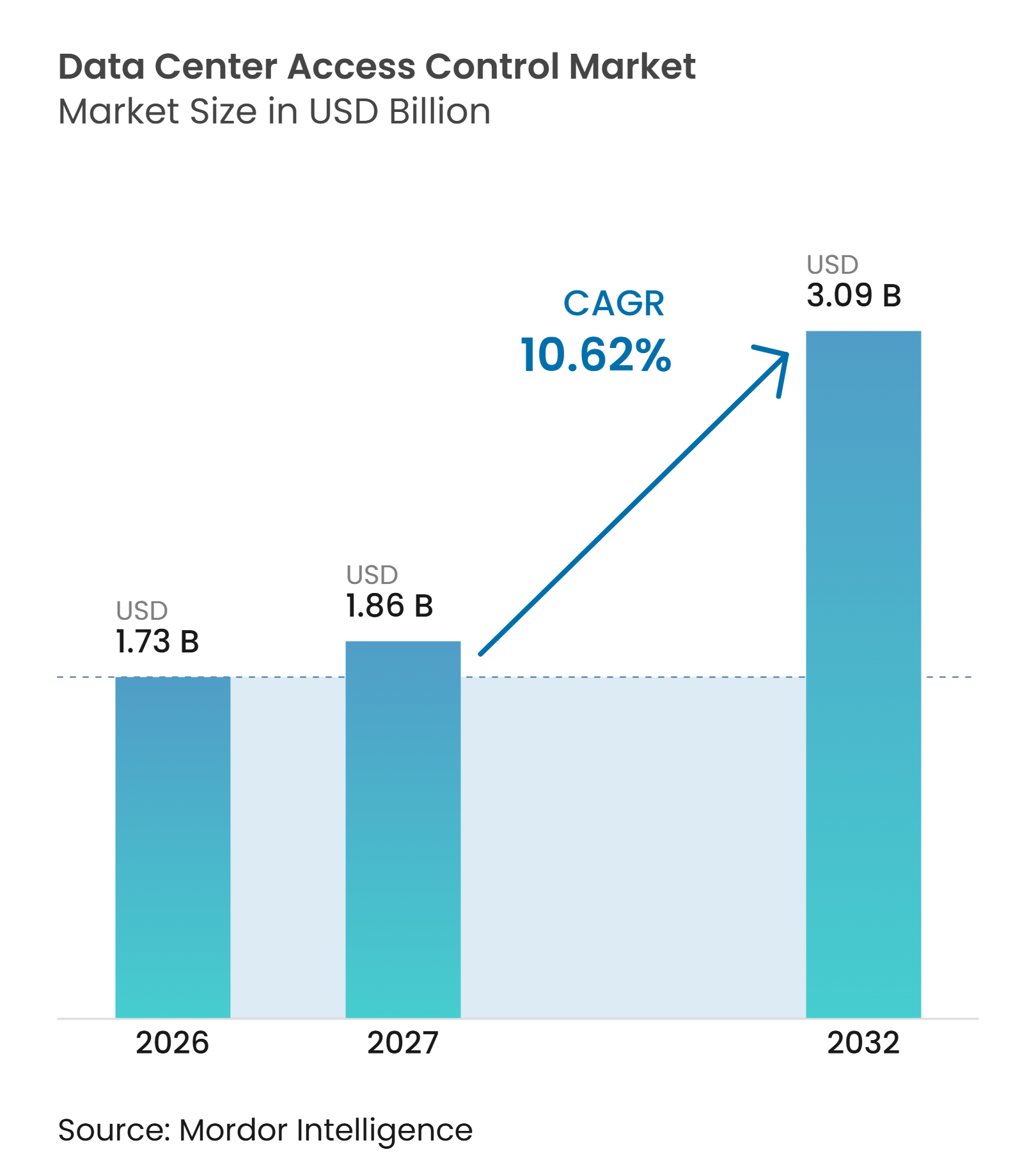
The data center access control market size is projected to be USD 1.73 billion in 2026, USD 1.86 billion in 2027, and reach USD 3.09 billion by 2032, expanding at a CAGR of 10.62% from 2027 to 2032. The data center access control market is tied closely to new facility construction because readers, controllers, identity tools, and integration work are specified before a site can operate. Higher spending on AI infrastructure is also increasing the value of equipment held in restricted areas, which supports deeper protection at entrances, server halls, and individual cabinets. Physical security is becoming part of operational risk management as operators need reliable records for employees, contractors, visitors, and tenants. Suppliers are responding by combining hardware, cloud administration, mobile credentials, and security analytics in one offer. The data center access control market also faces timing pressure because fast construction schedules can leave security design and commissioning behind other building systems.
Key Report Takeaways
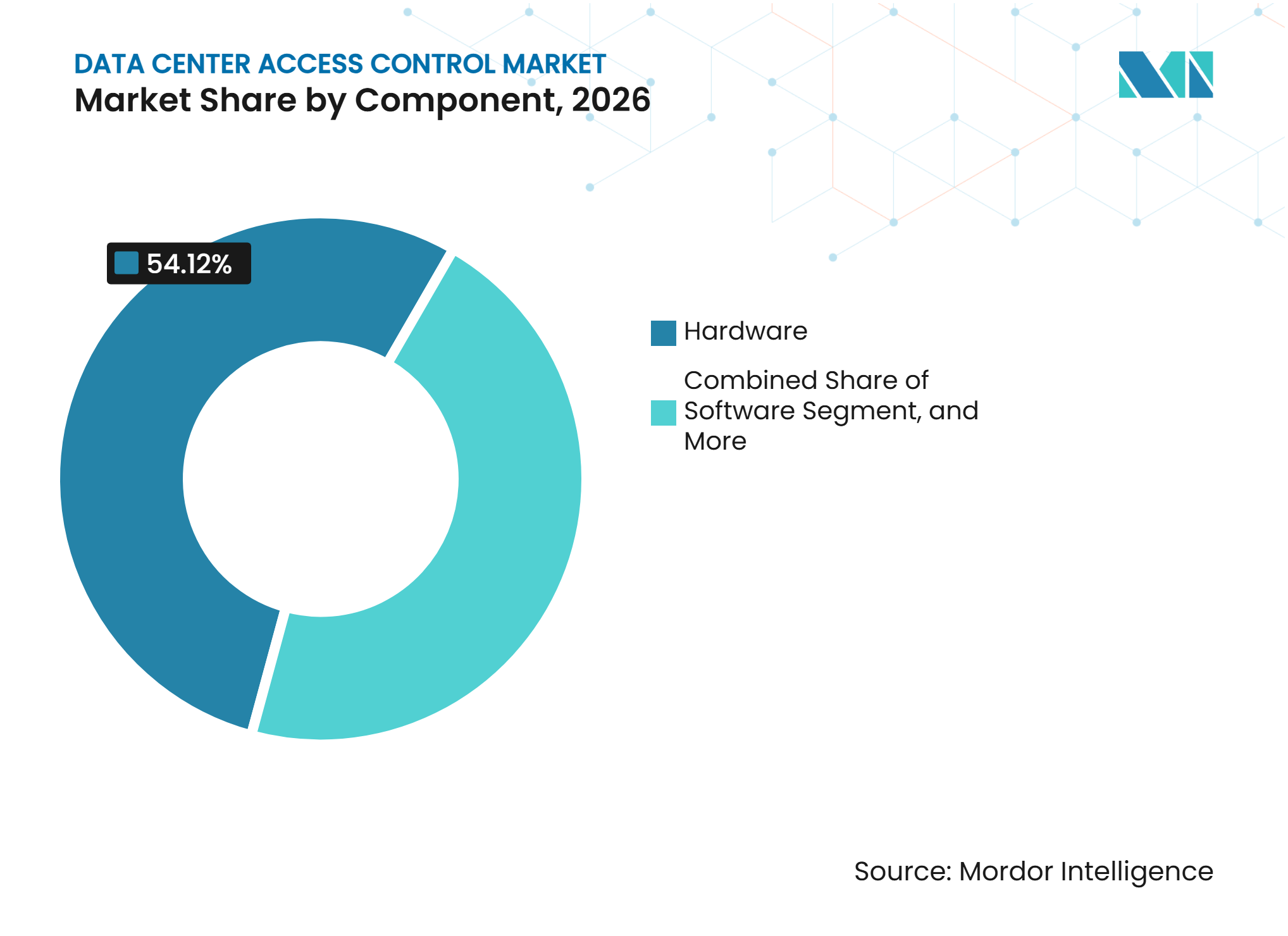
- By component, hardware held 54.12% of the data center access control market in 2026, while software is projected to expand at a CAGR of 12.50% through 2032.
- By technology, card and credential-based systems held 31.28% share in 2026, while mobile and digital credentials are projected to expand at a CAGR of 15.30% through 2032.
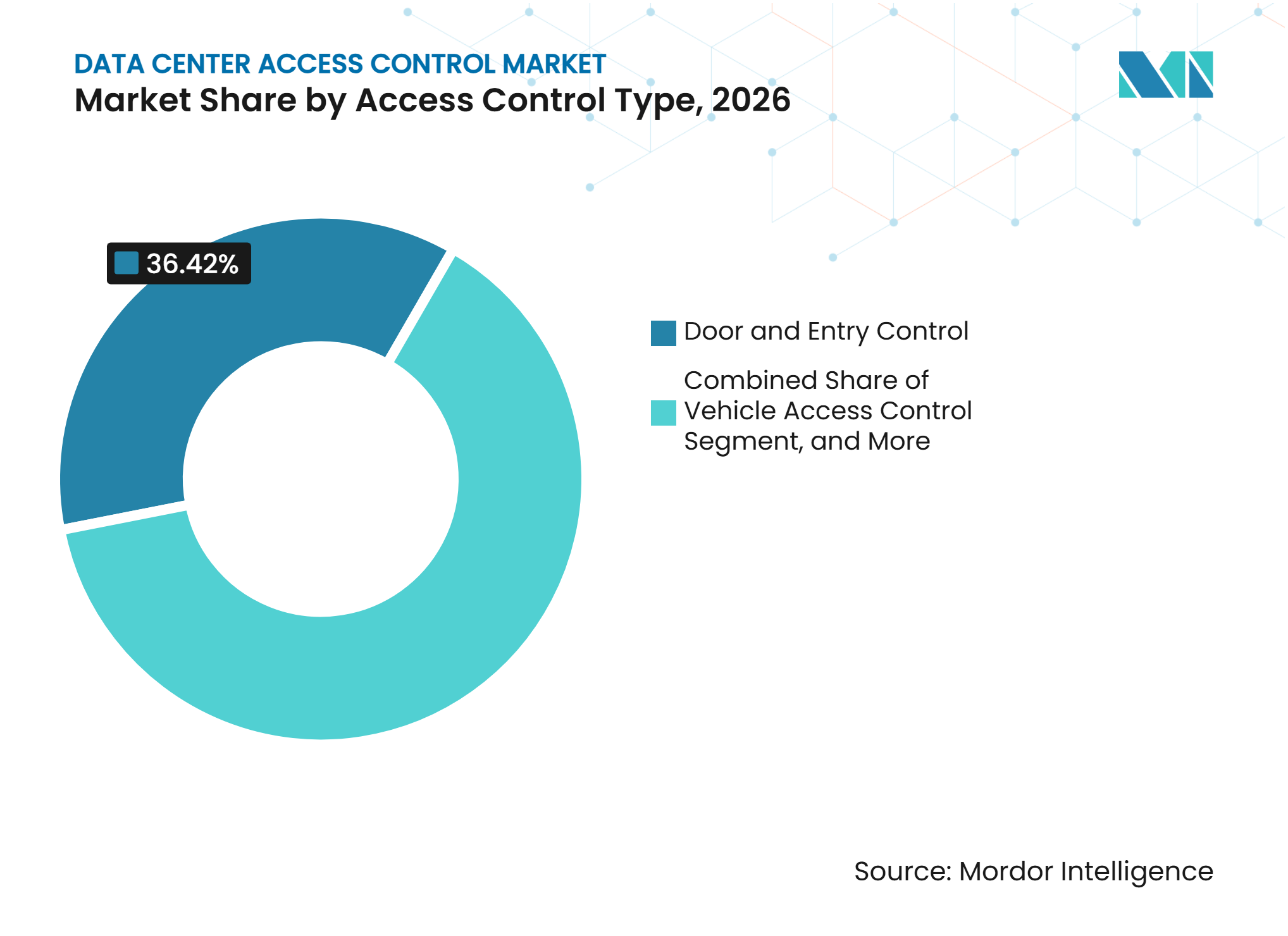
- By access control type, door and entry control held 36.42% share in 2026, while rack-level and restricted-zone access control is projected to expand at a CAGR of 15.60% through 2032.
- By deployment model, on-premises systems held 52.36% share in 2026, while cloud-based systems are projected to expand at a CAGR of 15.00% through 2032.
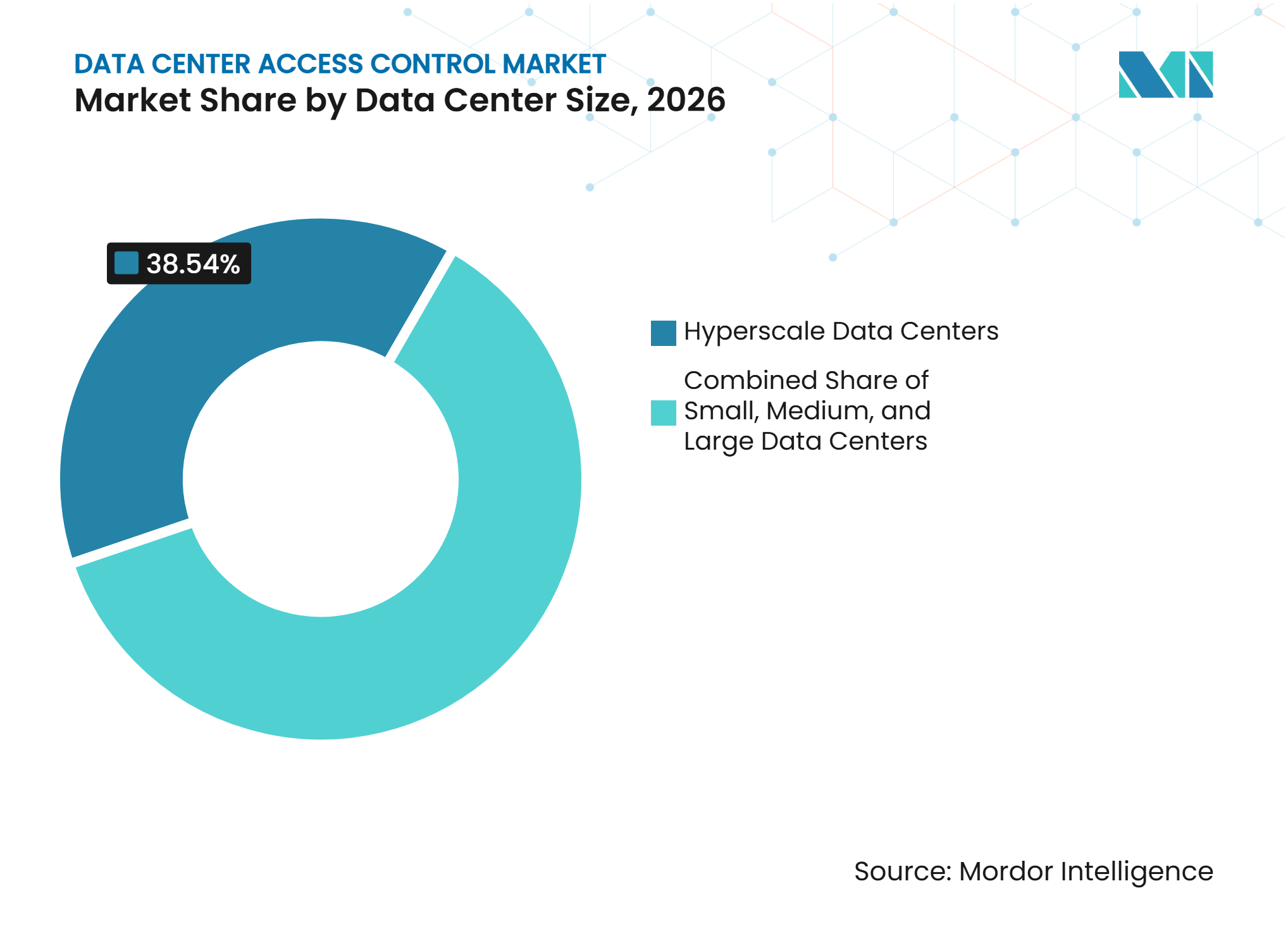
- By data center size, hyperscale facilities held 38.54% share in 2026 and are projected to expand at a CAGR of 13.40% through 2032.
- By data center type, cloud service providers held 39.26% share in 2026, while enterprise and edge data centers are projected to expand at a CAGR of 13.70% through 2032.
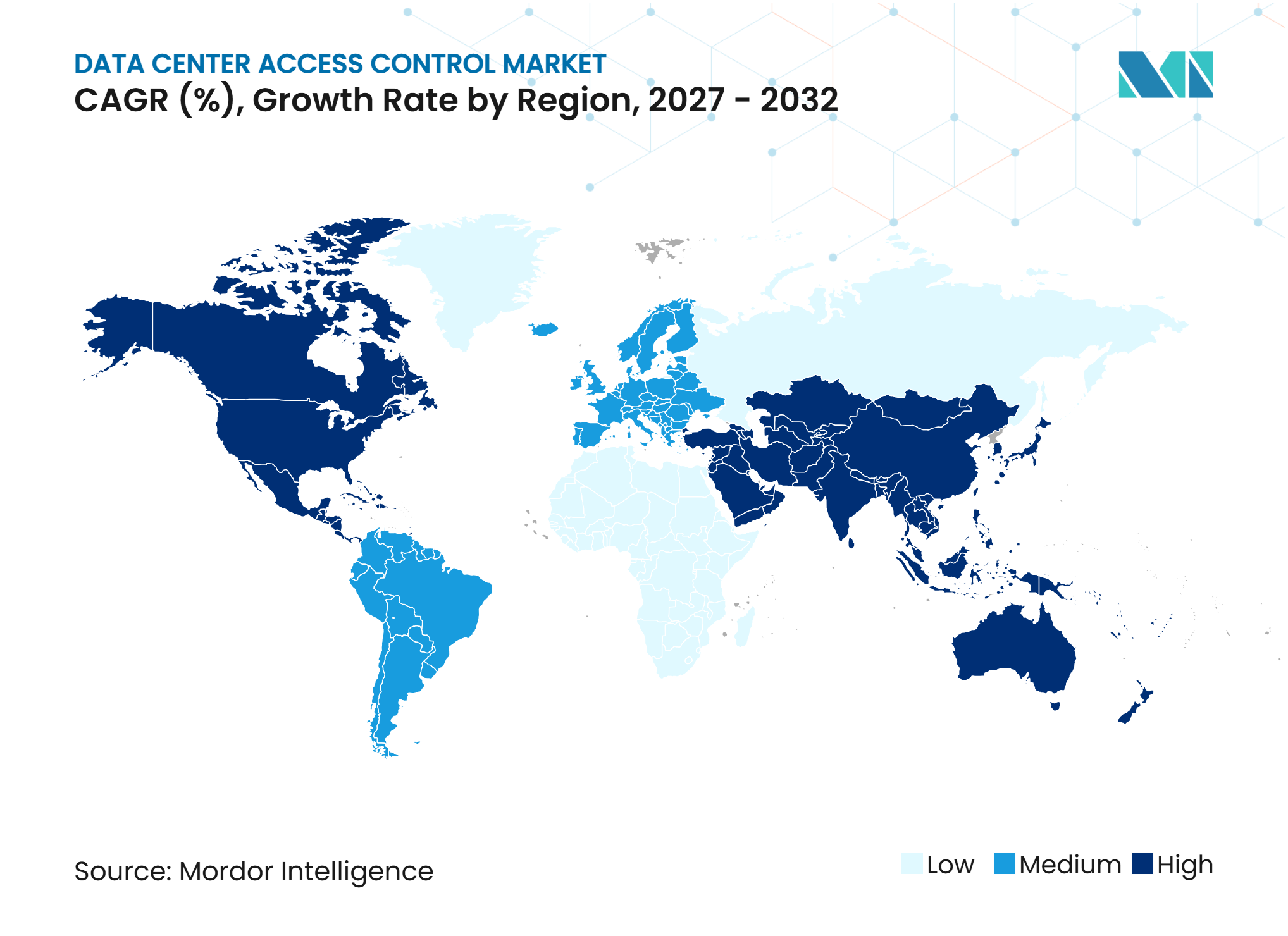
- By geography, North America held 40.04% share in 2026, while Asia-Pacific is projected to expand at a CAGR of 12.31% through 2032.
Note: Market numbers in this report are based on Mordor Intelligence's proprietary estimation framework, which combines nine months of actuals with Q4 projections for base year 2026.
Market Trends and Insights
Drivers Impact Analysis of Data Center Access Control Market*
| Driver | (~) % Impact on CAGR Forecast | Geographic Relevance | Impact Timeline |
|---|---|---|---|
| Hyperscale and Colocation Data Center Expansion | +2.5% | Global, concentrated in North America and Asia-Pacific | Short term (≤ 2 years) |
| Rising Cyber-Physical Security and Compliance Requirements | +1.9% | Global, strongest in North America, Europe, and GCC | Medium term (2-4 years) |
| Cloud-Based and Mobile Credential Modernization | +1.5% | North America and Europe, extending to Asia-Pacific and South America | Medium term (2-4 years) |
| AI-Ready Data Center Density and Rack-Level Protection | +1.2% | North America and Asia-Pacific, with emerging use in the Middle East | Long term (≥ 4 years) |
| Zero-Trust Physical Security Adoption | +0.9% | Global, led by North American enterprise and hyperscale operators | Medium term (2-4 years) |
| Remote and Unmanned Edge Site Protection | +0.6% | North America, Europe, and peripheral Asia-Pacific locations | Long term (≥ 4 years) |
| Source: Mordor Intelligence | |||
Hyperscale and Colocation Data Center Expansion
The data center access control market benefits when projects move from design to construction because physical entry systems are required before staff, contractors, and equipment can safely use controlled areas. Colocation facilities have added requirements that conventional office deployments do not address, including tenant-specific cage permissions, contractor screening, escorted access, and auditable rights for each visitor. These operators also need records that can support customer reviews of PCI DSS controls and other contractual obligations. Construction-phase operations create a separate security need because servers, networking equipment, and specialist labor can arrive before permanent access systems are fully commissioned. This timing issue supports phased credentialing, temporary access workflows, and earlier coordination between security suppliers, construction teams, and facility operators. The data center access control market therefore favors providers that can support design-phase selection and installation schedules rather than only deliver hardware at final commissioning.
Rising Cyber-Physical Security and Compliance Requirements
The European Commission's NIS2 implementing regulation requires covered cloud computing service providers and data center operators to apply risk-management measures that address physical and environmental security at their premises.[1] These obligations make controlled entry, monitoring, and evidence retention relevant to the operating model instead of treating them as optional building features. SOC 2 Type II reviews and customer security assessments also increase demand for reliable records of access attempts, visitor activity, and response procedures. Security Industry Association guidance identifies physical access control, visitor management, and protection of critical areas as central elements of data center physical-security planning.[2] The data center access control market gains support when compliance teams need systems that can show who entered a sensitive location, when access occurred, and whether permissions followed policy. This requirement is particularly important for multi-tenant sites that must demonstrate separation between customers, contractors, and operating staff.
Cloud-Based and Mobile Credential Modernization
Kastle announced in March 2026 that it deployed Aliro 1.0 credentials across Apple Wallet, Google Wallet, and Samsung Wallet at enterprise scale.[3] The Connectivity Standards Alliance describes Aliro as a common access-control credential standard designed to improve interoperability across mobile devices and readers. This approach can reduce dependence on a single card format or proprietary credential ecosystem. Mobile credentials also allow operators to issue, change, and revoke permissions without recovering a physical card from a contractor or visitor. Cloud administration gives security teams a common way to manage these workflows across more than one site. The data center access control market is therefore shifting value toward credential lifecycle management, system updates, and identity rules while retaining the need for compatible readers at each controlled point.
AI-Ready Data Center Density and Rack-Level Protection
AI deployments are concentrating valuable compute equipment inside dense server racks, which increases the value of controls that protect individual cabinets and restricted technical zones. Fingerprint Cards reported that ActChip introduced a server-rack access solution in India using its AllKey biometric technology in February 2026. Cabinet-level authentication can complement, rather than replace, perimeter doors and server-hall controls where operators need several levels of verification. This layered approach is relevant when different teams require different rights to enter a facility, a room, a cage, or a specific rack. The data center access control market can benefit as suppliers connect locks, readers, access events, and video information into systems that help teams investigate unusual activity. It also creates a longer equipment cycle because an operator can add rack protection after first installing door-level controls.
Restraints Impact Analysis of Data Center Access Control Market*
| Restraint | (~) % Impact on CAGR Forecast | Geographic Relevance | Impact Timeline |
|---|---|---|---|
| High Capital and Integration Costs | -1.5% | Global, most acute in South America and emerging Asia-Pacific | Medium term (2-4 years) |
| Cybersecurity Vulnerabilities in Connected Access Systems | -1.0% | Global, elevated in the Middle East during geopolitical disruption | Short term (≤ 2 years) |
| Legacy BMS and OT Interoperability Constraints | -0.7% | Europe and mature North American locations with aging installed bases | Long term (≥ 4 years) |
| Biometric Privacy, Consent, and Governance Complexity | -0.4% | Europe, U.S. states with BIPA-style rules, and Southeast Asia | Medium term (2-4 years) |
| Source: Mordor Intelligence | |||
High Capital and Integration Costs
A comprehensive deployment can include readers, controllers, cabinet locks, visitor software, network connections, and integration with existing building systems. Smaller colocation operators and owners in developing locations may stage those purchases because security budgets compete with power, cooling, and core IT requirements. Integration work can be demanding when video surveillance, building management, heating and cooling monitoring, and fire systems use separate data formats. This creates a need for specialized design and installation skills that are not always available at the pace required by construction programs. Cloud-managed tools can simplify administration, but they do not remove the cost of replacing aging readers, controllers, and cabling. The data center access control market can therefore face longer selection cycles where operators need to balance security improvements against the capital needs of a broader facility buildout.
Cybersecurity Vulnerabilities in Connected Access Systems
Connected access systems introduce a cyber risk that must be managed alongside the physical risk of unauthorized entry. A compromised credential system may expose information about entry events or create a path to disrupt devices that are connected to a wider network. The Security Industry Association recommends a risk-based approach that considers system architecture, secure configuration, credential management, monitoring, and planned maintenance for physical-security technology. Older on-premises controllers can be difficult to update when they have limited security features or were installed as separate systems. Replacing those systems can defer procurement because the upgrade may require hardware, software, network, and operating-process changes at the same time. The data center access control market must address this issue through secure firmware practices, restricted remote management, and clear responsibility for patching and monitoring.
*Our forecasts treat driver/restraint impacts as directional, not additive. The impact forecasts reflect baseline growth, mix effects, and variable interactions.
Data Center Access Control Market Segment Analysis
By Component:
Software Growth Changes the Access Control Value ChainHardware held 54.12% of revenue in 2026 because every new or upgraded facility needs readers, controllers, locks, and other physical equipment at controlled locations. The data center access control market size for hardware remains connected to facility openings, refresh projects, and the number of doors, cages, cabinets, and loading points requiring protection. Hardware demand is supported by the practical requirement to authenticate people at the point of entry, even when the management layer moves to the cloud. New construction also creates installation demand before a site begins normal operations. Hardware suppliers need to keep compatibility with mobile credentials, biometrics, and network security requirements as customer specifications evolve.
Software is projected to expand at a CAGR of 12.50% through 2032 as operators centralize credential issuance, policy enforcement, audit records, and event review. Subscription-based platforms can help customers manage multiple facilities and reduce dependence on local management servers. Services remain important because installation teams must connect access systems with video, building management, and operational technology environments. Johnson Controls and NVIDIA announced a collaboration on reference architectures for gigawatt-scale AI data centers, showing that building-system planning is increasingly being addressed early in large AI campus design. The data center access control industry is consequently moving toward a mix of physical equipment, recurring software administration, and specialized deployment support.



By Technology:
Mobile Credentials Challenge the Legacy Card ModelCard and credential-based systems held 31.28% in 2026, reflecting the broad installed base of badges and card readers across operational facilities. This base continues to serve staff, visitors, and contractors where operators need familiar workflows and dependable entry at many locations. The data center access control market keeps card systems relevant because they can operate within layered security designs that also include PINs, biometrics, and escort procedures. Existing card estates also create a gradual replacement cycle rather than an immediate technology change. Reader compatibility will remain important as facility managers update equipment in stages.
Mobile and digital credentials are projected to expand at a CAGR of 15.30% through 2032 as interoperability reduces barriers to wallet-based access. Aliro gives suppliers a common framework for devices and access readers, which can make mobile deployment more practical across diverse portfolios. Biometric systems remain suited to higher-security zones where a stronger link between a person and an access event is needed. PIN and keypad systems can provide a further verification step in mantraps and other locations that require deliberate entry. The data center access control market has room for these technologies to coexist because each serves a different balance of speed, assurance, privacy, and operational simplicity.
By Access Control Type:
Rack-Level Security Follows Compute DensityDoor and entry control accounted for 36.42% of the data center access control market share in 2026 because every facility must protect its perimeter, lobbies, mantraps, and server-room entrances. These systems establish the initial access layers that determine who can move from public space into operational space. Door controls also support timed permissions for employees, visitors, contractors, and delivery personnel. They remain the first physical-security purchase for new sites and a common upgrade point for existing buildings. The category must support clear records that can be reviewed after an incident or during a customer audit.
Rack-level and restricted-zone controls are projected to expand at a CAGR of 15.60% through 2032 as AI equipment increases the value concentrated in specific cabinets and technical areas. Electronic rack locks and cabinet readers can add a separate permission layer after a person has passed a building or server-hall door. Turnstiles and personnel controls help reduce tailgating in high-throughput entrances, while visitor management systems support escorted access and time-limited credentials. Vehicle access controls are also relevant at large campuses where construction, delivery, and maintenance traffic must be directed through controlled gates. The data center access control market will increasingly depend on systems that connect these layers without making routine operations unnecessarily difficult.

By Deployment Model:
Cloud Deployment Gains Ground Against the Installed BaseOn-premises systems held 52.36% in 2026 because many colocation and enterprise facilities were built around locally managed controllers and site-based servers. Operators may retain these systems where policies, internal processes, or existing investments favor local control. On-premises deployment can also be selected when a facility needs direct oversight of sensitive data or operates within strict local data-handling conditions. This installed base gives suppliers a large upgrade and integration opportunity. The data center access control market must support modernization without interrupting critical facility operations.
Cloud-based systems are projected to expand at a CAGR of 15.00% through 2032 because they can manage permissions, updates, and system status across distributed locations. They are useful for organizations with contractors or support teams that move between sites and need their rights changed quickly. Hybrid designs can keep sensitive information locally while providing selected cloud management capabilities. Genetec describes its Cloudlink approach as a way to connect existing security devices to cloud services, reflecting the interest in migration paths that do not require a full system replacement. The data center access control industry will continue to support all 3 models because customer requirements differ by installed base, compliance needs, and operational scale.
By Data Center Size:
Hyperscale Facilities Lead Scale and Spending IntensityHyperscale facilities held 38.54% in 2026 and are projected to expand at a CAGR of 13.40% through 2032. Their scale requires protection for extensive perimeters, multiple buildings, logistics areas, server halls, network rooms, and restricted technical zones. These projects also involve large construction and maintenance workforces, making temporary credentials, visitor controls, and clear audit records important. Large facilities follow similar needs, although their programs can be smaller and less standardized across sites. The data center access control market benefits when operators incorporate security architecture into the early stages of campus planning.
Medium facilities can be attractive for cloud-managed offers that reduce the need for a large internal security administration team. Small facilities and enterprise-edge locations are often more sensitive to capital cost, which can favor preconfigured packages over highly customized deployments. Hyperscale buyers, by contrast, may seek systems that integrate with multiple operational and security tools across a broad estate. The highest-value projects can therefore require a mix of standard products, extensive integration, and detailed service support. The data center access control market continues to serve distinct buyer needs even when the core objective remains controlled, traceable physical entry.
By Data Center Type:
Enterprise and Edge Sites Form the Fastest-Growing CohortCloud service providers held 39.26% in 2026 because their large physical footprints and customer responsibilities require comprehensive protection across many facilities. Their requirements often include tenant separation, strict visitor processes, and reliable evidence for customer and regulatory reviews. Colocation sites face comparable complexity because many organizations share a single building while needing separate rights to rooms, cages, and cabinets. These environments make identity administration and audit reporting central product requirements. The data center access control market supports these operators with systems that can apply different policies without creating gaps between tenants.
Enterprise and edge data centers are projected to expand at a CAGR of 13.70% through 2032 as organizations use more distributed computing environments. Edge sites may operate with few staff members and need remote management, tamper alerts, and local functions that continue during network disruption. NIST's zero trust guidance emphasizes that access decisions should be continuously evaluated rather than assumed from network location alone. This logic supports tighter coordination between physical permissions and broader security processes at remote locations. The data center access control market can address this segment with resilient controllers, remote credential administration, and clear escalation paths for unusual access events.
Geography Analysis
North America
North America held 40.04% of the data center access control market share in 2026, supported by a deep concentration of cloud, colocation, and AI infrastructure activity. The region's buyers often require formal visitor records, access logs, and defined controls for sensitive areas because they serve enterprise and public-sector customers. FedRAMP requires cloud service providers working with the U.S. government to meet defined security-control requirements, which makes documented operational security processes material to procurement. The region also has a broad installed base of conventional card systems, creating opportunities to introduce mobile credentials and cloud administration during refresh projects. Security suppliers can differentiate by offering a practical route from older equipment to connected systems without disrupting a facility that operates continuously.
Asia-Pacific
Asia-Pacific is projected to expand at a CAGR of 12.31% through 2032 as operators add capacity across established and emerging data center locations. The data center access control market size in the region is supported by greenfield projects, where security systems can be designed with building plans instead of added later. India is relevant for biometric and cabinet-level protection as providers target high-density facilities and local component requirements. Fingerprint Cards' work with ActChip shows that biometric rack access is being developed for Indian data center use. Singapore's controlled capacity releases can make permitted developments especially important opportunities for security suppliers. China also applies data center design standards that shape facility classification and the physical protections needed at each level, so compliance factors remain important for projects across the region.
Europe, the Middle East, South America, and Africa
Europe is a mature upgrade environment where NIS2 physical-security obligations support investment in controls, monitoring, and recorded access events at covered facilities. Data protection rules, including the General Data Protection Regulation, can influence how operators select biometric tools and manage sensitive identity information. The Middle East is attracting new data center development, and suppliers can use hybrid designs where local data handling is required alongside centralized management features. South America remains an earlier adoption environment where entry and lobby controls can be initial priorities before a site implements more detailed cabinet protection. African deployments commonly begin with perimeter and entry-tier systems, although cloud management can improve coverage for sites with limited local staffing. Across these mixed geographies, the data center access control market can expand through modular products that suit both new facilities and gradual upgrades.
Competitive Landscape
Market Concentration
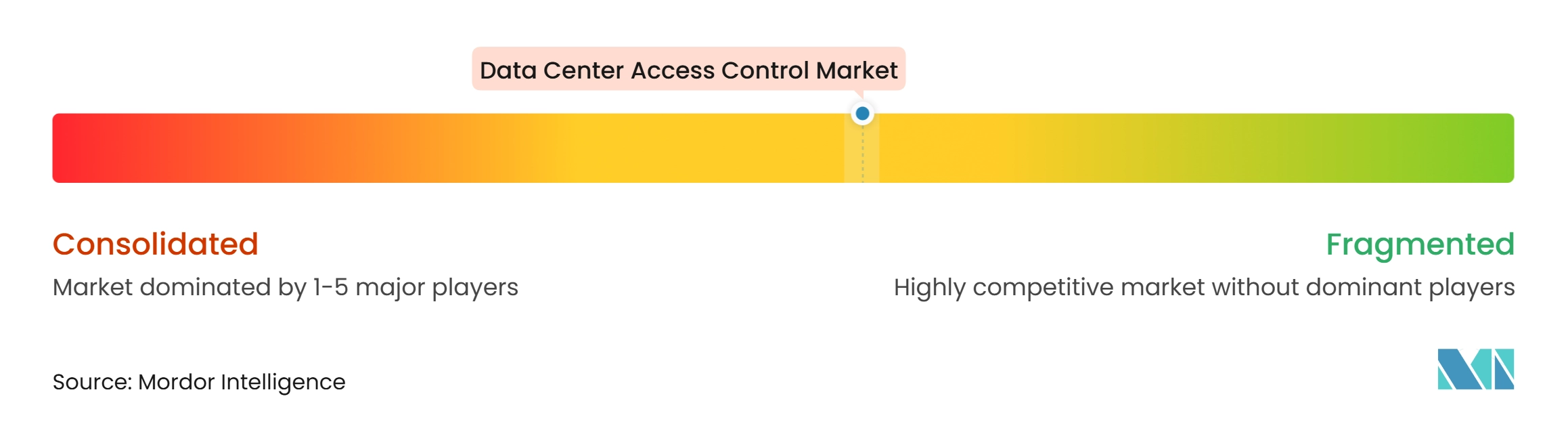
The data center access control market includes large integrated security suppliers, specialist access-platform providers, and companies focused on biometric or cabinet-level protection. ASSA ABLOY, dormakaba, Honeywell, Johnson Controls, Allegion, Genetec, Brivo, Suprema, and IDEMIA Identity and Security serve different parts of this competitive field. Buyers may select integrated offers when they want one supplier for doors, readers, controllers, locks, and operating support. Other buyers may choose specialist platforms where cloud administration, biometric assurance, or compatibility with existing devices is more important. This mix keeps the competitive environment broad rather than controlled by a single product type or supplier.
Dormakaba completed its acquisition of TANlock in July 2025, adding electromechanical rack locks and IP readers for data centers and critical infrastructure. The company also announced its August 2026 acquisition of Azure Access Technology and Apollo Security operating businesses to expand its U.S. access-control position. ASSA ABLOY announced its acquisition of Kentix in October 2025, extending its digital access and monitoring portfolio for data center applications. These actions show that larger suppliers are filling portfolio gaps in cabinet security, monitoring, controller flexibility, and cloud-connected identity management. The data center access control market is likely to favor suppliers that can link entry control with wider physical-security workflows.
AI-supported review of badge events, video signals, and unusual movement patterns is becoming an area of differentiation for security platforms. Mobile credentials are another focus because operators want easier issuance and revocation for contractors and temporary staff. The unmanned edge segment remains open to suppliers that can provide rugged controls, remote administration, tamper alerts, and reliable local operation. No company in the supplied material is shown to hold a dominant share of this specialized segment. Competition therefore continues to depend on deployment capability, interoperability, system security, and support for a facility's specific operating model.
Data Center Access Control Industry Leaders
-
ASSA ABLOY AB
-
dormakaba Holding AG
-
Johnson Controls International plc
-
Honeywell International Inc.
-
Allegion plc
- *Disclaimer: Major Players sorted in no particular order
Data Center Access Control Market Companies Covered in this Report
- ASSA ABLOY AB
- dormakaba Holding AG
- Johnson Controls International plc
- Honeywell International Inc.
- Allegion plc
- HID Global Corporation
- Siemens AG
- Schneider Electric SE
- Robert Bosch GmbH
- Genetec Inc.
- Axis Communications AB
- Gallagher Group Limited
- Suprema Inc.
- Nedap N.V.
- Salto Systems S.L.
- Brivo Systems, LLC
- NEC Corporation
- IDEMIA Identity & Security SAS
- AMAG Technology, Inc.
- Gunnebo AB
- Verkada Inc.
- Convergint Technologies LLC
Recent Industry Developments in Data Center Access Control Market
- August 2026: dormakaba acquired the operating businesses of Azure Access Technology Inc. and Apollo Security in Newport Beach, California, with the transaction signed and closed on August 14, 2026. Azure Access offers an open-architecture controller platform for OEM integrators. Apollo Security develops access control and integrated security systems. Together, the businesses add approximately 30 employees and strengthen dormakaba's North American data center retrofit capabilities.
- March 2026: Kastle became the first provider to deploy Aliro 1.0 credentials simultaneously across Apple Wallet, Google Wallet, and Samsung platforms at enterprise scale, eliminating proprietary credential fragmentation across access control hardware vendors. The milestone accelerates mobile credential adoption for data center operators using Kastle's managed physical security services and establishes Aliro as a viable enterprise standard.
- January 2026: ASSA ABLOY showcased its expanded data center and IoT security portfolio at Intersec Dubai 2026, held January 12-14, featuring the KentixONE platform acquired through the October 2025 Kentix transaction. KentixONE integrates access control with monitoring for more than 40 physical threat types, including fire, power anomalies, and intrusion, across data center white space. The activity signals ASSA ABLOY's strategic emphasis on the GCC data center market.
- November 2025: Dormakaba made a venture investment in RealSense, an AI-powered computer vision company, and partnered with the company to develop intelligent access control solutions combining behavioral analytics with physical access decision-making. The investment positions dormakaba to offer AI-correlated access and video management at data center entry points beyond traditional badge-reader authorization.
Global Data Center Access Control Market Report Scope
The Data Center Access Control Market comprises security solutions that manage, authenticate, and monitor physical access to data center facilities, critical infrastructure, and restricted zones. These systems help prevent unauthorized entry, safeguard high-value IT assets, and ensure operational continuity through identity verification, access authorization, real-time monitoring, and audit capabilities. Market growth is driven by rising cybersecurity risks, increasing investments in hyperscale and colocation data centers, stricter compliance requirements, and the growing need for robust physical security across mission-critical digital infrastructure.
The Data Center Access Control Market Report is Segmented by Component (Hardware, Software, and Installation, Integration, and Support Services), Technology (Card and Credential-Based Systems, Biometric Systems, Mobile and Digital Credentials, PIN and Keypad Systems, and Multi-Factor Authentication Systems), Access Type (Door and Entry Control, Turnstiles and Personnel Entry Systems, Vehicle Access Control, Visitor and Contractor Management, and Rack-Level and Restricted-Zone Access Control), Deployment (On-Premises Systems, Cloud-Based Systems, and Hybrid Systems), Size (Small, Medium, Large, and Hyperscale), Type (Colocation, Cloud Service Providers, and Enterprise and Edge), and Geography (North America, South America, Europe, Asia-Pacific, Middle East, Africa). The Market Forecasts are Provided in Terms of Value (USD).
Segmentation Overview
| Hardware |
| Software |
| Installation, Integration, and Support Services |
| Card and Credential-Based Systems |
| Biometric Systems |
| Mobile and Digital Credentials |
| PIN and Keypad Systems |
| Multi-Factor Authentication Systems |
| Door and Entry Control |
| Turnstiles and Personnel Entry Systems |
| Vehicle Access Control |
| Visitor and Contractor Management |
| Rack-Level and Restricted-Zone Access Control |
| On-Premises Systems |
| Cloud-Based Systems |
| Hybrid Systems |
| Small |
| Medium |
| Large |
| Hyperscale |
| Colocation |
| Cloud Service Providers |
| Enterprise and Edge |
| North America | United States |
| Canada | |
| Mexico | |
| South America | Brazil |
| Argentina | |
| Rest of South America | |
| Europe | United Kingdom |
| Germany | |
| France | |
| Spain | |
| Russia | |
| Rest of Europe | |
| Middle East | Saudi Arabia |
| United Arab Emirates | |
| Turkey | |
| Rest of Middle East | |
| Africa | South Africa |
| Rest of Africa | |
| Asia-Pacific | China |
| India | |
| Japan | |
| Australia | |
| Singapore | |
| Rest of Asia-Pacific |
| By Component | Hardware | |
| Software | ||
| Installation, Integration, and Support Services | ||
| By Technology | Card and Credential-Based Systems | |
| Biometric Systems | ||
| Mobile and Digital Credentials | ||
| PIN and Keypad Systems | ||
| Multi-Factor Authentication Systems | ||
| By Access Control Type | Door and Entry Control | |
| Turnstiles and Personnel Entry Systems | ||
| Vehicle Access Control | ||
| Visitor and Contractor Management | ||
| Rack-Level and Restricted-Zone Access Control | ||
| By Deployment Model | On-Premises Systems | |
| Cloud-Based Systems | ||
| Hybrid Systems | ||
| By Data Center Size | Small | |
| Medium | ||
| Large | ||
| Hyperscale | ||
| By Data Center Type | Colocation | |
| Cloud Service Providers | ||
| Enterprise and Edge | ||
| By Geography | North America | United States |
| Canada | ||
| Mexico | ||
| South America | Brazil | |
| Argentina | ||
| Rest of South America | ||
| Europe | United Kingdom | |
| Germany | ||
| France | ||
| Spain | ||
| Russia | ||
| Rest of Europe | ||
| Middle East | Saudi Arabia | |
| United Arab Emirates | ||
| Turkey | ||
| Rest of Middle East | ||
| Africa | South Africa | |
| Rest of Africa | ||
| Asia-Pacific | China | |
| India | ||
| Japan | ||
| Australia | ||
| Singapore | ||
| Rest of Asia-Pacific | ||
Key Questions Answered in the Report
What is the data center access control market size?
The data center access control market is projected to be USD 1.73 billion in 2026, USD 1.86 billion in 2027, and USD 3.09 billion by 2032, at a CAGR of 10.62% from 2027 to 2032.
Which component holds the largest share in data center access control?
Hardware leads with 54.12% in 2026 because facilities need readers, controllers, locks, and other equipment at controlled entry points.
Which technology is expected to expand fastest?
Mobile and digital credentials are projected to expand at a CAGR of 15.30% through 2032 as interoperable wallet credentials and cloud administration become more widely used.
Why is rack-level protection gaining importance in data centers?
AI equipment can increase the value held in a single cabinet, encouraging operators to add electronic locks and stronger identity checks beyond door-level controls.
Which region leads access control demand for data centers?
North America holds 40.04% in 2026, supported by hyperscale, cloud, colocation, enterprise, and public-sector facility requirements.
How do cloud-based access systems help operators?
They can centralize credential management, support remote revocation, enable multi-site administration, and provide a path for managing distributed facilities.