
Cybersecurity Audit Automation Market Size and Share
Market Overview
| Study Period | 2020 - 2031 |
|---|---|
| Market Size (2026) | USD 1.54 Billion |
| Market Size (2031) | USD 3.26 Billion |
| Growth Rate (2026 - 2031) | 16.20 % |
| Fastest Growing Market | Asia-Pacific |
| Largest Market | North America |
| Market Concentration | Low |
Major Players *Disclaimer: Major Players sorted in no particular order Image © Mordor Intelligence. Reuse requires attribution under CC BY 4.0. | |
Cybersecurity Audit Automation Market Analysis by Mordor Intelligence
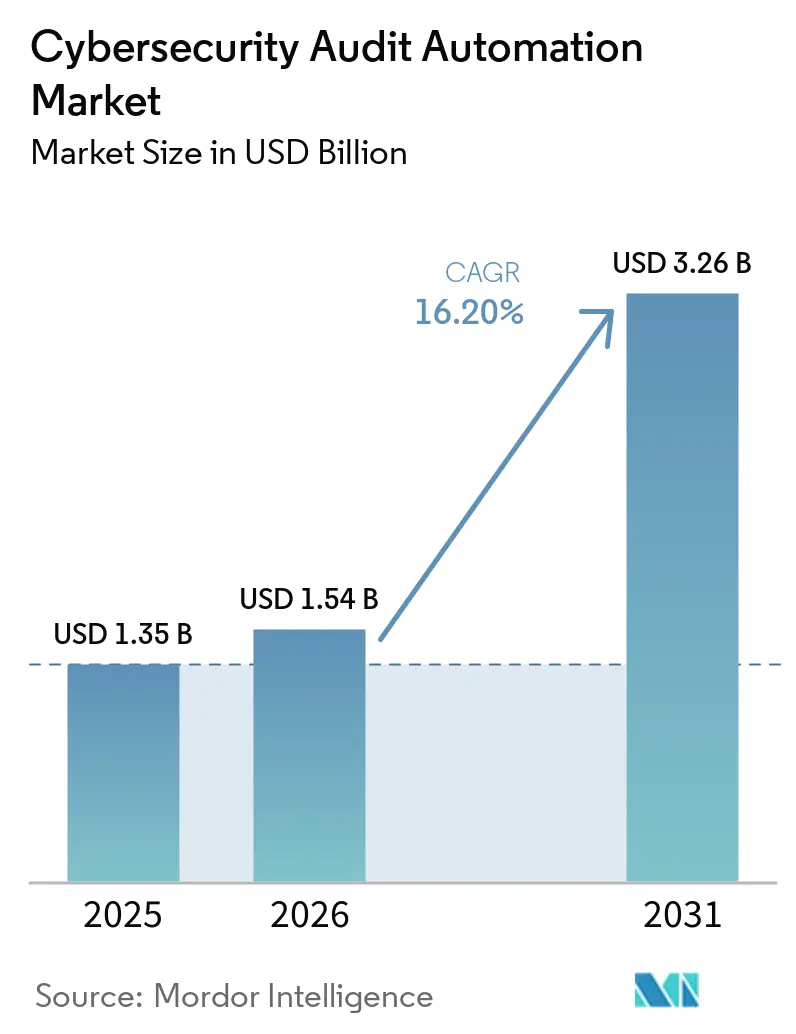
The Cybersecurity audit automation market size was valued at USD 1.35 billion in 2025 and is estimated to grow from USD 1.54 billion in 2026 to reach USD 3.26 billion by 2031, at a CAGR of 16.20% during the forecast period (2026-2031). The Cybersecurity audit automation market is expanding as organizations replace periodic reviews with programs that maintain evidence and control records year-round. New requirements across financial services, healthcare, energy, transport, and digital infrastructure are raising the cost of managing several compliance programs through manual processes. Buyers are seeking tools that connect evidence to multiple control frameworks and reduce duplicate work across internal and external audits. Product competition is shifting toward autonomous workflows that can collect evidence, identify gaps, and prepare audit materials with less manual effort. The Cybersecurity audit automation market also has room to grow among smaller organizations as subscription delivery and pre-built integrations reduce infrastructure and implementation barriers.
Key Report Takeaways
- By component, software held 67.35% of the Cybersecurity audit automation market revenue share in 2025, while services are projected to expand at a 17.55% CAGR through 2031.
- By deployment, cloud held 70.21% of the Cybersecurity audit automation market revenue share in 2025 and is projected to expand at a 17.29% CAGR through 2031.
- By organization size, large enterprises held 68.10% of the Cybersecurity audit automation market revenue share in 2025, while SMEs are projected to expand at a 17.89% CAGR through 2031.
- By end-user industry, BFSI held 30.89% of the Cybersecurity audit automation market revenue share in 2025, while healthcare and life sciences are projected to expand at a 16.65% CAGR through 2031.
- By geography, North America held 36.54% revenue share of the Cybersecurity audit automation market in 2025, while Asia-Pacific is projected to expand at a 16.91% CAGR through 2031.
Note: Market size and forecast figures in this report are generated using Mordor Intelligence’s proprietary estimation framework, updated with the latest available data and insights as of January 2026.
Global Cybersecurity Audit Automation Market Trends and Insights
Drivers Impact Analysis*
| Driver | (~) % Impact on CAGR Forecast | Geographic Relevance | Impact Timeline |
|---|---|---|---|
| Growing Regulatory and Multi-Framework Compliance Burden | +4.2% | Global, concentrated in EU, North America, and Asia-Pacific financial centers | Medium term (2-4 years) |
| Increasing Complexity and Frequency of Cybersecurity Audits | +3.5% | Global | Short term (≤ 2 years) |
| Expansion of Cloud, SaaS, and Distributed IT Environments | +2.8% | Global, led by North America, Western Europe, and Asia-Pacific digital economies | Medium term (2-4 years) |
| Shift Toward Continuous Compliance and Real-Time Control Assurance | +2.1% | North America and EU core, spill-over to Asia-Pacific and MEA | Long term (≥ 4 years) |
| Rising Pressure to Reduce Audit Preparation Time and Compliance Operating Costs | +1.8% | Global, intensified in BFSI, healthcare, and energy | Short term (≤ 2 years) |
| Increasing Adoption of Automated Evidence Collection and Intelligent Audit Workflows | +1.5% | North America, Western Europe, Asia-Pacific core | Long term (≥ 4 years) |
| Source: Mordor Intelligence | |||
Growing Regulatory and Multi-Framework Compliance Burden
The Cybersecurity audit automation market benefits from regulatory requirements that overlap across business functions and jurisdictions. DORA became mandatory for EU financial entities in January 2025, introducing requirements for ICT governance, third-party oversight, and resilience testing. NIS2 is also introducing supervisory measures in essential sectors across Europe. A business subject to DORA, NIS2, and GDPR must retain different evidence sets, meet different reporting schedules, and address different incident thresholds. NIST CSF 2.0, ISO 27001, and SOC 2 can help organizations connect sector-specific requirements to a shared control library. The proposed HIPAA Security Rule would require annual compliance audits and at least twice-yearly vulnerability scanning for covered healthcare entities.
Increasing Complexity and Frequency of Cybersecurity Audits
Modern IT environments have increased the volume and variety of evidence needed for an audit. Cloud-native systems, containers, and distributed SaaS environments create records across multiple systems simultaneously. The BSI C5:2026 catalog includes additional expectations for container management, supply chain security, and post-quantum cryptography readiness. Each framework can also require its own evidence format, request process, and assessment schedule. The Cybersecurity audit automation market is responding with platforms that store artifacts in a single repository and link them to multiple requirements. These capabilities enable audit packages to be maintained over time rather than assembled under a deadline.
Expansion of Cloud, SaaS, and Distributed IT Environments
Large SaaS estates make evidence collection more difficult because critical services sit outside an organization’s own infrastructure. Under DORA and NIS2, buyers remain responsible for controls over integrated providers that support critical functions. Platforms use application programming interfaces to collect configuration information, access records, and other evidence of control from connected services. The Cloud Security Alliance reported that 55% of employees adopted SaaS applications without security team involvement, while 57% of respondents reported fragmented SaaS administration. These conditions can leave material gaps in a company’s record of its technology environment and increase the need for the Cybersecurity audit automation market to provide connected evidence workflows. BSI C5:2026 also sets out complementary customer controls that increase cloud buyers' evidence responsibilities.
Shift Toward Continuous Compliance and Real-Time Control Assurance
Organizations are moving from reviews at a fixed point in time toward continuous control monitoring. A periodic review assesses control performance at the time of the assessment and may not reveal issues that emerge afterward. EU and U.S. requirements are placing greater emphasis on timely reporting and on evidence that can be traced to a specific time. Continuous programs, therefore, depend on the accuracy and coverage of integrations across enterprise systems. Buyers also assess whether automated actions can be reviewed and whether the platform can flag control drift in time for remediation. The Cybersecurity audit automation market offers vendors an opportunity to compete on operational capabilities rather than solely on framework coverage.
Restraints Impact Analysis*
| Restraint | (~) % Impact on CAGR Forecast | Geographic Relevance | Impact Timeline |
|---|---|---|---|
| High Integration Complexity Across Legacy and Heterogeneous IT Environments | -1.2% | Global, concentrated in industrial, government, and large financial institutions with mature on-premises estates | Long term (≥ 4 years) |
| High Total Cost of Ownership and Uncertain ROI for Smaller Organizations | -0.9% | Global, most acute in South America, Africa, and SME segments across all regions | Medium term (2-4 years) |
| Data Privacy, Residency, and Security Concerns Around Automated Evidence Collection | -0.6% | EU, Asia-Pacific data-localization jurisdictions, and regulated U.S. sectors | Medium term (2-4 years) |
| Limitations in Automating Judgment-Intensive Audit Procedures and Complex Control Assessments | -0.4% | Global | Long term (≥ 4 years) |
| Source: Mordor Intelligence | |||
High Integration Complexity Across Legacy and Heterogeneous IT Environments
Large on-premises estates and varied technology stacks remain a barrier to adoption. Mainframes, legacy enterprise resource planning systems, and custom applications often lack interfaces that platforms can query directly. Teams may still need to collect evidence manually, reducing the efficiency expected from automation. The European Union Agency for Cybersecurity found that 68% of respondents to its June 2026 SME Cyber Resilience Act survey identified technical tools for compliance assessments as a significant unmet need.[1] This shows that demand can exist even when implementation remains difficult. The Cybersecurity audit automation market will continue to face slower adoption in industrial, government, and established financial institutions with proprietary systems.
High Total Cost of Ownership and Uncertain ROI for Smaller Organizations
Smaller organizations may find it difficult to justify the total cost of an automated compliance program. Platform licenses, implementation work, audit fees, and internal labor create costs that must be weighed against limited security budgets. The benefit from a prevented breach or an avoided penalty does not appear directly in a procurement comparison. This makes purchase decisions harder where compliance tools are not required by regulation or customer contracts. Subscription models and vertical offerings can lower the barrier to entry, but implementation and audit readiness still require time. The Cybersecurity audit automation market can therefore face slower initial uptake among buyers who need a clearer financial case before committing to a formal compliance program.
*Our forecasts treat driver/restraint impacts as directional, not additive. The impact forecasts reflect baseline growth, mix effects, and variable interactions.
Segment Analysis
By Component: Services Growth Changes the Revenue Mix
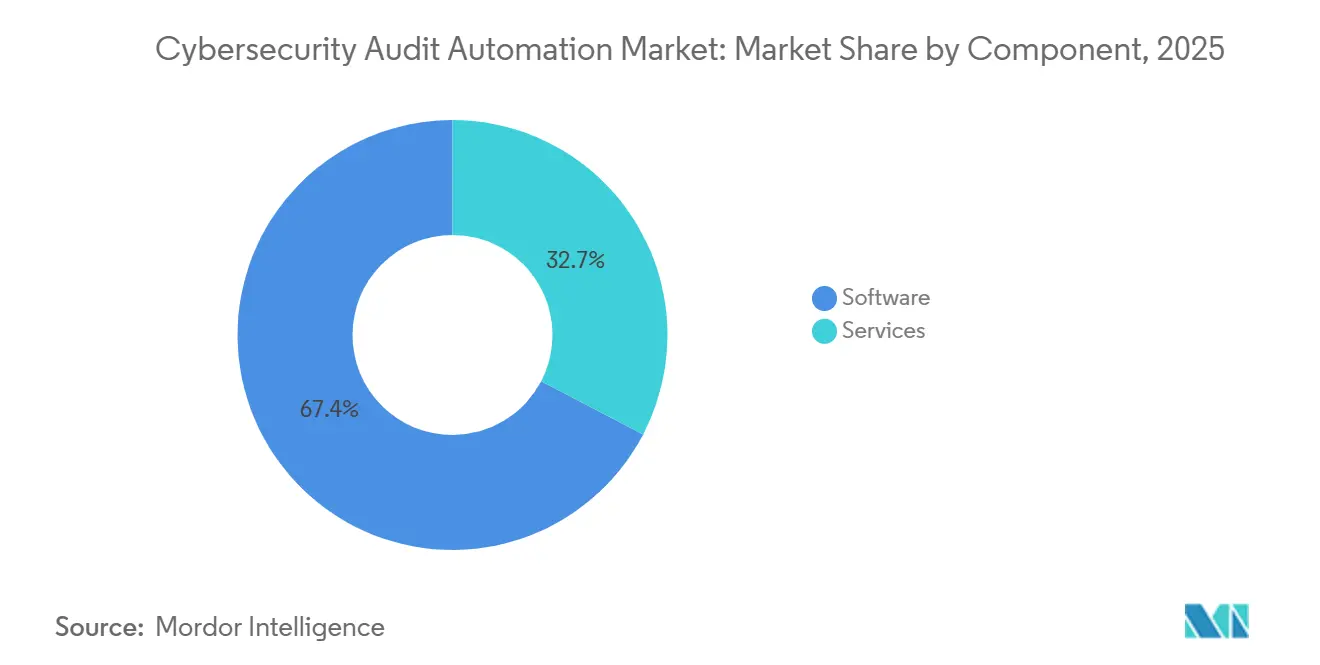
Software held 67.35% of the Cybersecurity audit automation market share in 2025. Organizations have favored unified applications that automate evidence collection, control mapping, and audit workflow management. These platforms can support several frameworks through a shared set of controls and artifacts. SaaS delivery also limits the infrastructure work required to put the tools into use. Software vendors are therefore central to the Cybersecurity audit automation market as buyers formalize continuous assurance programs.
Services are projected to grow at a 17.55% CAGR from 2026 to 2031. More complex programs require implementation, managed compliance, and advisory support alongside the platform itself. Providers can help clients configure frameworks, connect systems, and prepare teams for assessments. Independent assessment firms remain important because they provide the external validation that a software provider cannot supply. The combination of software and services supports adoption by organizations with different compliance maturity levels.
By Deployment: Cloud Delivery Extends Its Lead
Cloud accounted for 70.21% of revenue in 2025 and is projected to grow at a 17.29% CAGR through 2031. It is the only category that was both the largest and the fastest-growing within its segment. Cloud platforms can integrate with hosted SaaS and infrastructure services where much of the required evidence already resides. Automatic updates and elastic computing can also help users keep pace with changing requirements. This delivery model has become the standard choice for many buyers in the Cybersecurity audit automation market.
On-premises deployments retain a role in air-gapped government settings, critical infrastructure, and locations with strict data-residency requirements. These users may limit external connections or keep sensitive data within a controlled environment. Sovereign cloud options can provide an alternative for some organizations that need cloud services with stronger location and control assurances. AWS reported that its European Sovereign Cloud achieved SOC 2 and C5 Type 1 compliance attestation in 2026.[2] This can reduce, but not remove, the reason some buyers prefer on-premises deployment. The pace of change will depend on local legal requirements and each organization’s risk policy.
By Organization Size: SMEs Gain Access to Formal Compliance Programs
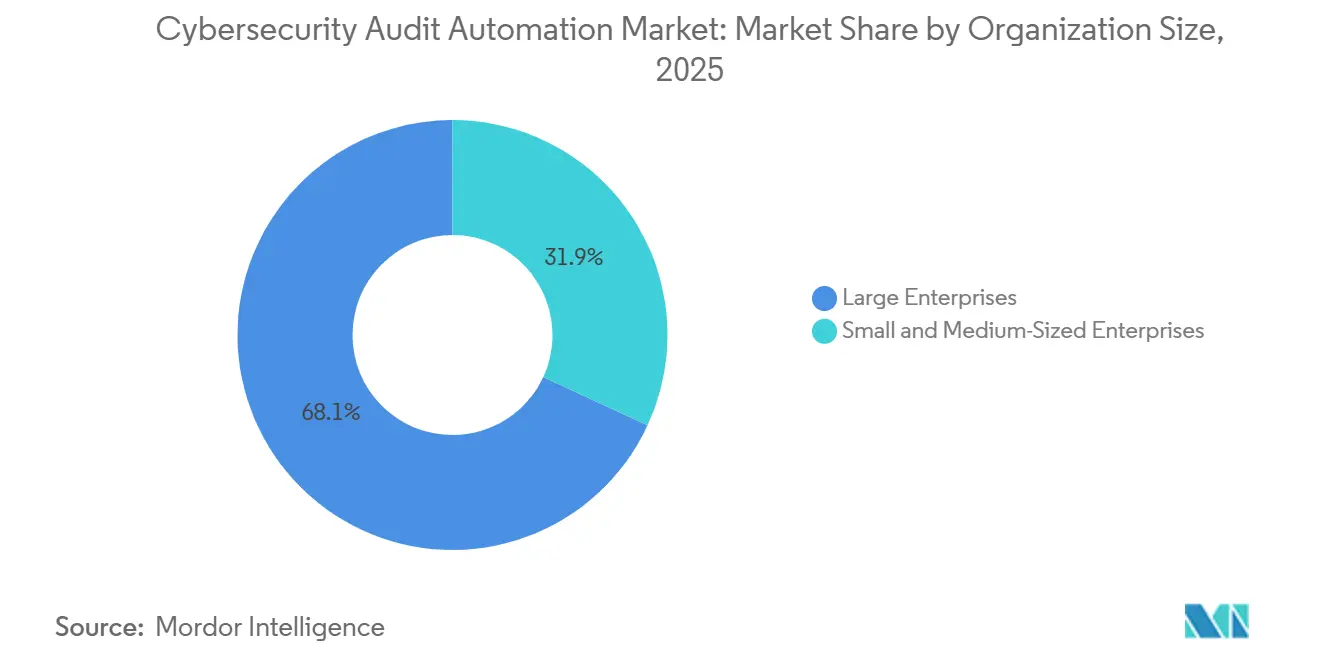
Large enterprises accounted for 68.10% of revenue in 2025. Their spending reflects the number of regulations, countries, systems, and business units they must manage. Large organizations also tend to operate in sectors with established internal audit and risk functions. Their requirements often include multi-framework mapping, third-party risk review, and continuous reporting. These needs make them important customers for broad platform suites and specialist providers.
SMEs are projected to grow at a 17.89% CAGR from 2026 to 2031. Subscription delivery allows smaller teams to use tools that previously required larger IT budgets and dedicated compliance personnel. Customer security reviews and supply chain due diligence are making SOC 2 and ISO 27001 evidence increasingly important in commercial relationships. These requirements can encourage adoption even without a direct regulatory mandate. The Cybersecurity audit automation industry is responding with more focused products and pricing that suit smaller teams. The segment’s growth also reflects its smaller starting base relative to large enterprises.
By End-User Industry: BFSI Leads While Healthcare and Life Sciences Expands Faster
BFSI held 30.89% of revenue in 2025. Financial institutions handle high-value data and work within dense regulatory environments, creating demand for detailed and reliable control records. The Cybersecurity audit automation market size linked to BFSI benefits from the need to manage multiple compliance frameworks at the same time. Automated crosswalks can reduce duplicate evidence requests across those frameworks. Third-party risk, operational resilience, and cyber controls are central areas of spending for this group.
Healthcare and life sciences is projected to expand at a 16.65% CAGR through 2031. The proposed HIPAA Security Rule includes annual compliance audits, vulnerability scanning at least twice each year, and ongoing asset inventory requirements for covered entities. These obligations would increase the need for organized and current audit evidence. IT and telecommunications, industrial manufacturing, retail and e-commerce, and energy and utilities also add to demand. Their requirements include sector cybersecurity rules, operational technology and IT control reviews, and PCI DSS obligations. This broader customer base reduces reliance on one end-user group.
Geography Analysis
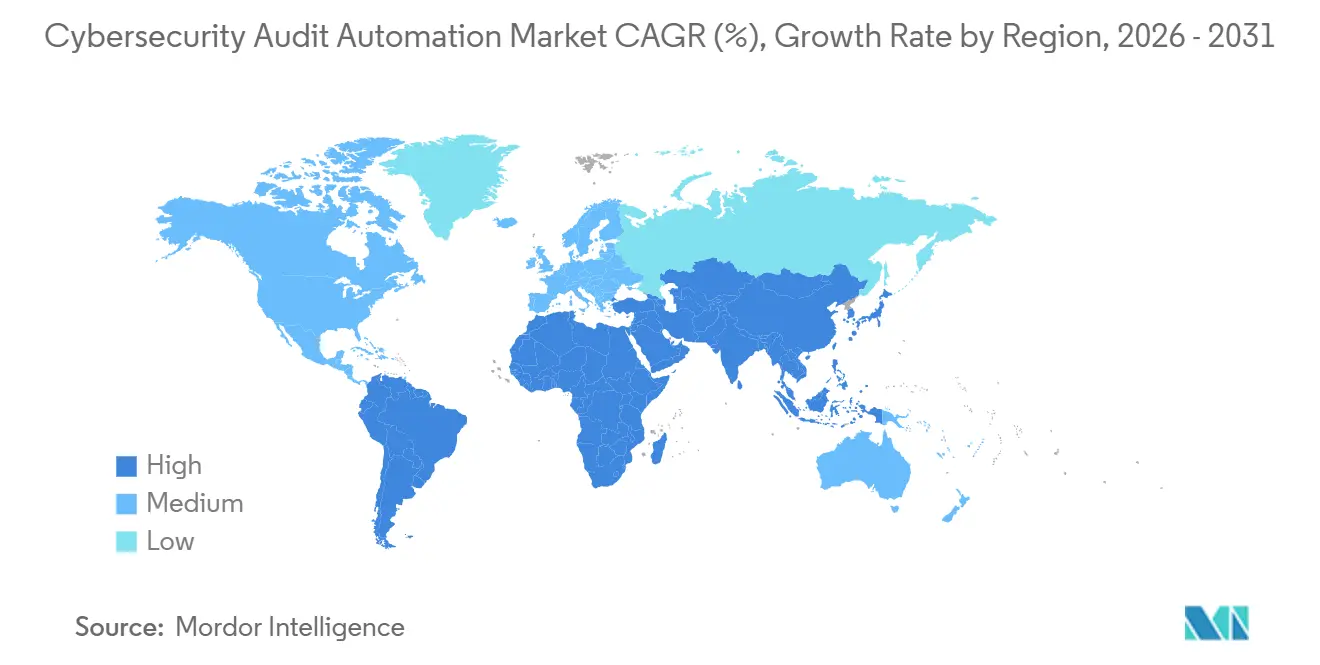
North America accounted for 36.54% of revenue in 2025. The Cybersecurity audit automation market share in the region reflects the concentration of financial services, healthcare, federal contracting, and established software providers. SEC cybersecurity disclosure rules, NYDFS Part 500, and FINRA oversight have raised expectations for audit-ready evidence among U.S. companies and financial institutions. This position makes North America a key commercial base for the Cybersecurity audit automation market. South America remains an emerging area of demand as Brazil’s Lei Geral de Proteção de Dados drives data-protection audit needs, while Argentina and Mexico build national cybersecurity frameworks despite infrastructure and cost constraints.
Europe has a central role because DORA, NIS2, the EU AI Act, and the Cyber Resilience Act create overlapping compliance responsibilities. This environment favors the Cybersecurity audit automation market because platforms can reuse evidence across several obligations. Financial institutions with EU operations may need to coordinate resilience, privacy, and cyber requirements through a shared control model. The Middle East is formalizing requirements through national strategies in the UAE and Saudi Arabia, while adoption in Africa is concentrated in South Africa and Nigeria, where banking regulators are establishing cybersecurity audit requirements.
Asia-Pacific is projected to grow at a 16.91% CAGR from 2026 to 2031. Singapore, Australia, India, and Indonesia have added sector-specific obligations that differ across jurisdictions. India’s SEBI Cybersecurity and Cyber Resilience Framework entered its first full audit cycle in FY 2026-27.[3] Japan and South Korea are increasing their focus on audit cadence in financial services and data protection, while China’s evolving rules are driving demand for localized compliance management. The Cybersecurity audit automation market can serve regional organizations that need a common evidence repository across these different requirements.
Competitive Landscape
The Cybersecurity audit automation market has 2 principal groups of competitors. Purpose-built providers include Vanta, Drata, Thoropass, Sprinto Technologies, Secureframe, and Scytale, which began with SOC 2 and ISO 27001 automation for smaller technology companies. Enterprise governance, risk, and compliance providers include MetricStream, ServiceNow, Archer Technologies, LogicGate, and Diligent, which are adding continuous monitoring and automated workflows to wider suites. The Cybersecurity audit automation market is becoming more competitive as these providers pursue the same large enterprise accounts and seek to meet requirements ranging from evidence collection to third-party oversight. Customers can select focused automation products or suites that join controls, third-party risk, and audit management.
Vanta expanded its Agentic Trust Platform in March 2026 with Compliance, TPRM, and Customer Trust agents, together with a unified control framework that reuses controls across frameworks. LogicGate introduced Config Newton in April 2026 to reduce implementation and configuration work from weeks to days. MetricStream’s April 2026 release added red-flag detection, regulatory alert summaries, and a model gateway for internal large language models. These moves show that the Cybersecurity audit automation market is competing on faster implementation and ongoing operational support, particularly where teams need reliable evidence across several related workflows.
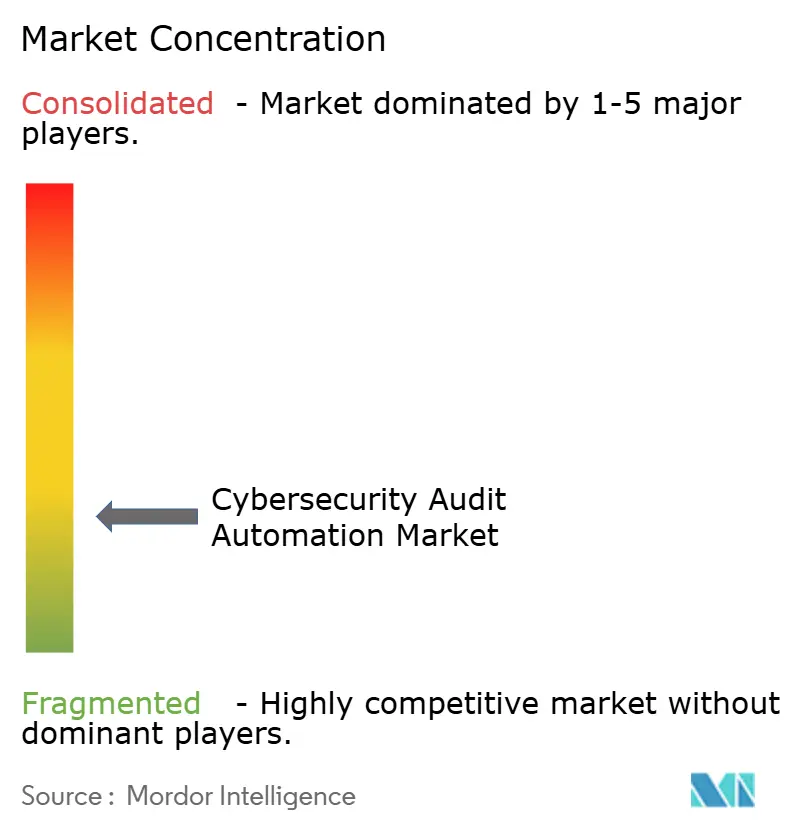
Specialist assessment firms retain a complementary role because independent validation is still needed for many audits. Software platforms can organize evidence and flag issues, but they do not replace the external assurance required by customers or regulators. ServiceNow’s Security and Risk product exceeded USD 1 billion in annual contract value in 2025, showing the continued strength of established enterprise providers, while Vanta’s Q2 2026 recognition showed growing enterprise interest in automation-first vendors. The Cybersecurity audit automation market remains fragmented because specialized platforms compete alongside broad governance suites, and no combined market share for its leading providers was provided. Competitive results will depend on integration depth, framework coverage, data controls, and the credibility of automated audit outputs.
Cybersecurity Audit Automation Industry Leaders
-
Vanta Inc.
-
Drata, Inc.
-
Sprinto Technologies Private Limited
-
Secureframe, Inc.
-
Hyperproof, Inc.
- *Disclaimer: Major Players sorted in no particular order
Recent Industry Developments
- September 2026: LogicGate released its Summer 2026 platform update, making GRC Agents broadly available across use cases spanning Third-Party Risk Management, Enterprise Risk Management, AI Governance, and Business Continuity Management. The release extended agentic automation to a general customer base and marked a transition from agent demonstration to production deployment for enterprise GRC teams.
- July 2026: MetricStream was named GRC Product of the Year in the Operational Risk Management category at the 2026 Risk Technology Awards hosted by Risk.net, recognizing its AI-native platform spanning enterprise risk, regulatory compliance, audit and controls, cyber GRC, and third-party risk management.
- July 2026: Vanta launched the Agent for Risk, combining internal and third-party risk management into a continuously updated view built on the Trust Graph, spanning 400+ integrations and 1,400+ continuous tests. Vanta simultaneously disclosed that its annual recurring revenue surpassed USD 300 million, tripling since 2024, and that it hasand that it has more than 16,000 organizations on the platform.
- June 2026: LogicGate released its Spring 2026 platform update, introducing 7 new AI Workflow Agents across TPRM, Enterprise Risk Management, AI Governance, and Business Continuity Management, and announced a strategic alliance with a Big 4 advisory firm to deliver GRC advisory services across varied verticals and geographies.
Global Cybersecurity Audit Automation Market Report Scope
The Cybersecurity Audit Automation Market comprises software platforms and related services that automate cybersecurity audit activities, including control testing, evidence collection, compliance monitoring, audit workflow management, risk assessment, policy validation, remediation tracking, and audit reporting. These solutions help organizations streamline internal and external audits, reduce manual compliance efforts, continuously assess security controls, and maintain readiness for regulatory and cybersecurity frameworks such as ISO 27001, SOC 2, PCI DSS, HIPAA, NIST, and GDPR.
The Cybersecurity Audit Automation Market Report is Segmented by Component (Software, and Services), Deployment (Cloud, and On-Premises), Organization Size (Large Enterprises, and Small and Medium-Sized Enterprises), End-User Industry (Banking, Financial Services, and Insurance [BFSI], IT and Telecommunication, Healthcare and Life Sciences, Industrial Manufacturing, Retail and E-Commerce, Energy and Utilities, and Other End-User Industries), and Geography (North America, South America, Europe, Asia-Pacific, Middle East, and Africa). The Market Forecasts are Provided in Terms of Value (USD).
| Software |
| Services |
| Cloud |
| On-Premises |
| Large Enterprises |
| Small and Medium-Sized Enterprises |
| Banking, Financial Services, and Insurance (BFSI) |
| IT and Telecommunication |
| Healthcare and Life Sciences |
| Industrial Manufacturing |
| Retail and E-Commerce |
| Energy and Utilities |
| Other End User Inudstries |
| North America | United States |
| Canada | |
| South America | Brazil |
| Argentina | |
| Mexico | |
| Rest of South America | |
| Europe | United Kingdom |
| Germany | |
| France | |
| Italy | |
| Spain | |
| Rest of Europe | |
| Asia-Pacific | China |
| Japan | |
| India | |
| South Korea | |
| Australia | |
| Singapore | |
| Rest of Asia-Pacific | |
| Middle East | United Arab Emirates |
| Saudi Arabia | |
| Turkey | |
| Israel | |
| Rest of Middle East | |
| Africa | South Africa |
| Nigeria | |
| Egypt | |
| Rest of Africa |
| By Component | Software | |
| Services | ||
| By Deployment | Cloud | |
| On-Premises | ||
| By Organization Size | Large Enterprises | |
| Small and Medium-Sized Enterprises | ||
| By End-User Industry | Banking, Financial Services, and Insurance (BFSI) | |
| IT and Telecommunication | ||
| Healthcare and Life Sciences | ||
| Industrial Manufacturing | ||
| Retail and E-Commerce | ||
| Energy and Utilities | ||
| Other End User Inudstries | ||
| By Geography | North America | United States |
| Canada | ||
| South America | Brazil | |
| Argentina | ||
| Mexico | ||
| Rest of South America | ||
| Europe | United Kingdom | |
| Germany | ||
| France | ||
| Italy | ||
| Spain | ||
| Rest of Europe | ||
| Asia-Pacific | China | |
| Japan | ||
| India | ||
| South Korea | ||
| Australia | ||
| Singapore | ||
| Rest of Asia-Pacific | ||
| Middle East | United Arab Emirates | |
| Saudi Arabia | ||
| Turkey | ||
| Israel | ||
| Rest of Middle East | ||
| Africa | South Africa | |
| Nigeria | ||
| Egypt | ||
| Rest of Africa | ||
Key Questions Answered in the Report
What is the cybersecurity audit automation market size?
The Cybersecurity audit automation market size is estimated at USD 1.54 billion in 2026 and is projected to reach USD 3.26 billion by 2031 at a 16.20% CAGR. The outlook reflects the growing use of tools that gather evidence, map controls, and maintain audit materials across several compliance requirements.
What is driving demand for cybersecurity audit automation?
Overlapping regulatory requirements, more complex cloud environments, and continuous control monitoring are increasing demand. Organizations need a clearer record of how controls work across systems and frameworks, particularly where manual evidence collection creates gaps or delays.
Which deployment model leads cybersecurity audit automation?
Cloud led with 70.21% revenue share in 2025 and is projected to expand at a 17.29% CAGR through 2031. It can connect to hosted SaaS and infrastructure services where configuration, identity, and access evidence are already generated, which helps users manage distributed systems through a single operating model.
Which organizations are adopting cybersecurity audit tools fastest?
SMEs are projected to grow at a 17.89% CAGR through 2031 as subscription delivery makes compliance tools more accessible. Customer security reviews and supply-chain due diligence can also make formal control evidence important even when a direct regulatory mandate does not apply, especially for businesses that serve larger enterprise customers.
Which end-user sector has the largest share?
BFSI held 30.89% revenue share in 2025 because of its extensive regulatory, resilience, and third-party risk obligations. Financial institutions often need to manage multiple frameworks, maintain records across several systems, and avoid creating duplicate evidence packages for each review.
Which region is growing fastest?
Asia-Pacific is projected to expand at a 16.91% CAGR through 2031, supported by digital transformation and changing regulatory requirements. Businesses in the region must manage different national rules, which can increase the value of a shared evidence repository and consistent workflows for compliance teams.