
Customer Loyalty Ecosystems Market Size and Share
Market Overview
| Study Period | 2022 - 2031 |
|---|---|
| Market Size (2026) | USD 12.14 Billion |
| Market Size (2031) | USD 21.32 Billion |
| Growth Rate (2026 - 2031) | 11.92 % |
| Fastest Growing Market | Asia-Pacific |
| Largest Market | North America |
| Market Concentration | Low |
Major Players *Disclaimer: Major Players sorted in no particular order Image © Mordor Intelligence. Reuse requires attribution under CC BY 4.0. | |
Customer Loyalty Ecosystems Market Analysis by Mordor Intelligence
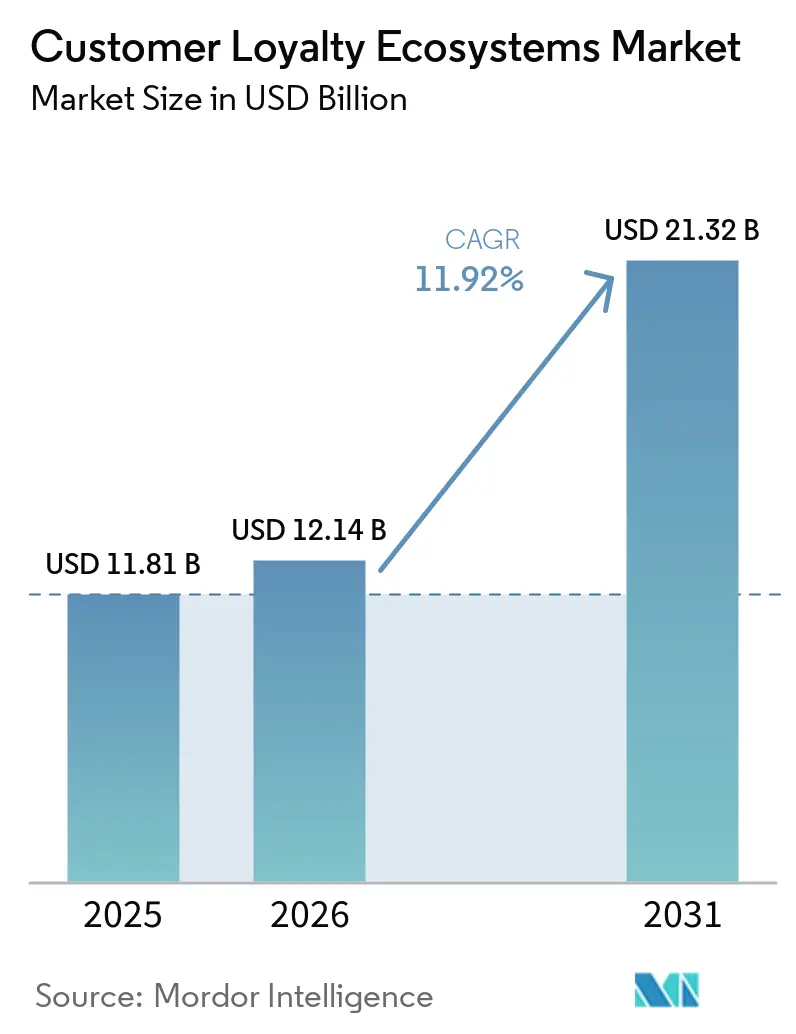
The Customer Loyalty Ecosystems Market size is expected to grow from USD 11.81 billion in 2025 to USD 12.14 billion in 2026 and is forecast to reach USD 21.32 billion by 2031 at 11.92% CAGR over 2026-2031.
The Customer Loyalty Ecosystems Market is moving beyond its earlier role as a promotional cost line and is now being treated as a revenue-supporting retention system that shapes repeat purchase behavior, share of wallet, and customer lifetime value. This shift is becoming increasingly important as digital commerce intensifies competition, reduces product-level differentiation, and makes switching across retail, BFSI, travel, and service channels easier. The Customer Loyalty Ecosystems Market is also benefiting from a broader shift toward real-time engagement, in which rewards, offers, and recognition are increasingly tied to transaction moments rather than periodic campaign cycles. Vendors are responding by combining loyalty tools with payment and customer data platforms and AI-based decisioning, enabling programs to influence behavior across channels with greater precision. Growth in the Customer Loyalty Ecosystems Market is still tempered by privacy compliance burdens, legacy integration issues, and rising reward liabilities, but operators that treat loyalty as a behavioral engine rather than a discount layer are better placed to capture incremental value through 2031.[1]
Key Report Takeaways
- By reward type, points-based rewards led with 46.82% revenue share in 2025, while subscription benefits are forecast to expand at a 13.92% CAGR through 2031.
- By business model, B2C held 78.43% of revenue in 2025, while B2B recorded the highest projected CAGR at 12.73% through 2031.
- By organization size, large enterprises accounted for 68.94% of revenue in 2025, while SMEs are projected to grow at a 14.35% CAGR through 2031.
- By industry vertical, retail and consumer goods accounted for 31.61% of revenue in 2025, while healthcare is expected to grow at a 15.43% CAGR through 2031.
- By geography, North America held 37.85% revenue share in 2025, while Asia-Pacific is projected to expand at a 14.81% CAGR through 2031.
Note: Market size and forecast figures in this report are generated using Mordor Intelligence’s proprietary estimation framework, updated with the latest available data and insights as of January 2026.
Global Customer Loyalty Ecosystems Market Trends and Insights
Drivers Impact Analysis*
| Drivers | (~) % Impact on CAGR Forecast | Geographic Relevance | Impact Timeline |
|---|---|---|---|
| Rising Need for Customer Retention Across Competitive Digital Channels | +2.5% | Global | Short term (≤ 2 years) |
| AI-Driven Personalization and Real-Time Offer Orchestration | +2.5% | Global, with early gains in North America and APAC | Medium term (2-4 years) |
| Escalating Customer Acquisition Costs in Retail and BFSI | +1.8% | North America and Western Europe | Short term (≤ 2 years) |
| Omnichannel Commerce Expansion Across Apps, POS, and Marketplaces | +1.5% | Global, APAC and North America as primary markets | Medium term (2-4 years) |
| Coalition and Partner Ecosystem Scaling for Cross-Brand Rewards | +1.2% | Global, concentrated in North America, MEA, and APAC | Medium term (2-4 years) |
| Sustainability-Linked Loyalty Incentives for Younger Consumers | +0.7% | Europe and North America, early adoption in APAC | Long term (≥ 4 years) |
| Source: Mordor Intelligence | |||
Rising Need for Customer Retention Across Competitive Digital Channels
The Customer Loyalty Ecosystems Market is gaining momentum as the need to retain repeat customers grows in digital channels, where switching costs are low and new entrants can scale quickly. Loyalty programs now play a wider role in protecting margins because repeat demand is becoming more valuable than one-time transaction growth in many consumer-facing categories. This shift is changing how operators measure program performance, with a greater focus on active engagement, purchase frequency, and wallet retention rather than simple enrollment counts. In this environment, passive membership has less value because large program bases do not automatically translate into durable brand preference or repeat spending. The Customer Loyalty Ecosystems Market is therefore moving toward engagement-depth models that use milestones, streak-based activity, and more responsive reward timing to keep members active. Brands that align loyalty with actual retention behavior rather than broad enrollment campaigns are better placed to defend share in high-pressure digital environments.
AI-Driven Personalization and Real-Time Offer Orchestration
The Customer Loyalty Ecosystems Market is being reshaped by AI tools that can monitor behavior and trigger offers closer to the moment of decision. This changes loyalty from a periodic campaign function into a more active system that can respond to context, payment behavior, and channel movement in near real time. In April 2026, Tesco and Adobe announced a strategic AI partnership to integrate agentic AI capabilities into Clubcard loyalty experiences, beginning with the launch of the Tesco x Adobe Innovation Lab. The main commercial benefit of this shift is better timing: rewards and content can be delivered when intent is still active, rather than after the purchase window has passed. The Customer Loyalty Ecosystems Market will continue to favor vendors and brands that combine AI with a unified customer data layer, since fragmented systems still limit the ability to act on behavioral signals at scale.
Escalating Customer Acquisition Costs in Retail and BFSI
The Customer Loyalty Ecosystems Market is also supported by the rising cost of customer acquisition in retail and BFSI, where paid growth channels are becoming harder to justify on a unit economics basis. As acquisition spending rises, firms are redirecting more budget toward programs that can improve repeat purchase rates, card usage, account activity, and cross-sell conversion from existing users. This changes the role of loyalty from a promotional overlay into a financial lever that can reduce payback periods and stabilize customer economics. The effect is especially visible in categories where the first transaction carries thin margins or a negative contribution after marketing and fulfillment costs. In such cases, loyalty participation becomes a mechanism for recovering acquisition expense through later purchases rather than a separate branding activity. The Customer Loyalty Ecosystems Market is therefore benefiting from a broader reallocation of spending, in which retention infrastructure now directly competes with acquisition budgets for capital.
Omnichannel Commerce Expansion Across Apps, POS, and Marketplaces
The Customer Loyalty Ecosystems Market is expanding as brands are forced to support customer journeys that move across apps, stores, payment interfaces, and third-party marketplaces. Loyalty is increasingly expected to work as a connective layer that recognizes the same user across all of these touchpoints and preserves value continuity between earning and redemption. When programs fail to connect store activity, app engagement, and external commerce channels, members see a fragmented value proposition that weakens participation and slows redemption. Mobile-led enrollment is becoming increasingly important in this setup, as phones increasingly serve as the first point of discovery, identity verification, and transaction confirmation in loyalty-led commerce. This is pushing operators to prioritize POS integration, wallet compatibility, payment-linked rewards, and real-time status visibility within one member view. The Customer Loyalty Ecosystems Market is likely to reward vendors that can standardize these cross-channel connections without forcing large enterprises to replace their existing commerce systems.
Restraints Impact Analysis*
| Restraints | (~) % Impact on CAGR Forecast | Geographic Relevance | Impact Timeline |
|---|---|---|---|
| Data Privacy, Consent, and Cross-Border Compliance Complexity | -1.3% | EU (GDPR), North America (CCPA and state laws), APAC (PDPA, PIPL) | Short term (≤ 2 years) |
| Integration Burden with Legacy CRM, POS, and Payments Stacks | -1.1% | Global, most acute in North America and Europe | Medium term (2-4 years) |
| Loyalty Program Fatigue and Low Differentiation in Mature Markets | -0.9% | Western Europe, North America | Medium term (2-4 years) |
| Rising Reward Liability, Fulfillment, and Breakage Management Pressure | -0.7% | Global, most acute in large enterprise programs | Long term (≥ 4 years) |
| Source: Mordor Intelligence | |||
Data Privacy, Consent, and Cross-Border Compliance Complexity
The Customer Loyalty Ecosystems Market faces a meaningful restraint from the growing complexity of privacy regulation, consent capture, and cross-border data governance. Loyalty programs depend on identity, transaction history, and behavior analysis, which makes compliance burdens central to program design rather than a back-end legal issue. The challenge becomes more difficult when operators work across GDPR, CCPA, national privacy laws in the United States, China’s PIPL, and Thailand’s PDPA, because each framework carries different rules for consent, data transfer, and customer rights. This increases compliance cost, slows product rollout, and creates friction for brands trying to scale a single loyalty model across multiple jurisdictions. It also affects partner-led ecosystems, where reward sharing and cross-brand data flows require tighter governance than stand-alone programs. The Customer Loyalty Ecosystems Market will continue to face uneven rollout speed where firms do not have modular consent systems and jurisdiction-specific controls built into their operating model.
Integration Burden with Legacy CRM, POS, and Payments Stacks
The Customer Loyalty Ecosystems Market is also constrained by the integration burden posed by legacy CRM, POS, and payment systems. Many enterprises still run fragmented architectures in which transaction data, customer records, and reward systems reside on separate platforms with limited real-time connectivity. This reduces the effectiveness of modern loyalty programs because points, offers, and status changes cannot be synchronized fast enough across channels. The problem is especially visible in retail and BFSI, where long technology replacement cycles have produced deeply layered stacks with mixed vendors and uneven API support. As a result, even firms with strong loyalty intent can struggle to deliver personalized rewards when customer attention is at its highest. The Customer Loyalty Ecosystems Market, therefore, favors API-first vendors and composable architectures, but the pace of adoption still depends on how quickly large operators can modernize their surrounding systems.
*Our forecasts treat driver/restraint impacts as directional, not additive. The impact forecasts reflect baseline growth, mix effects, and variable interactions.
Segment Analysis
By Reward Type: Subscription Models Redefine Program Economics From the Ground Up
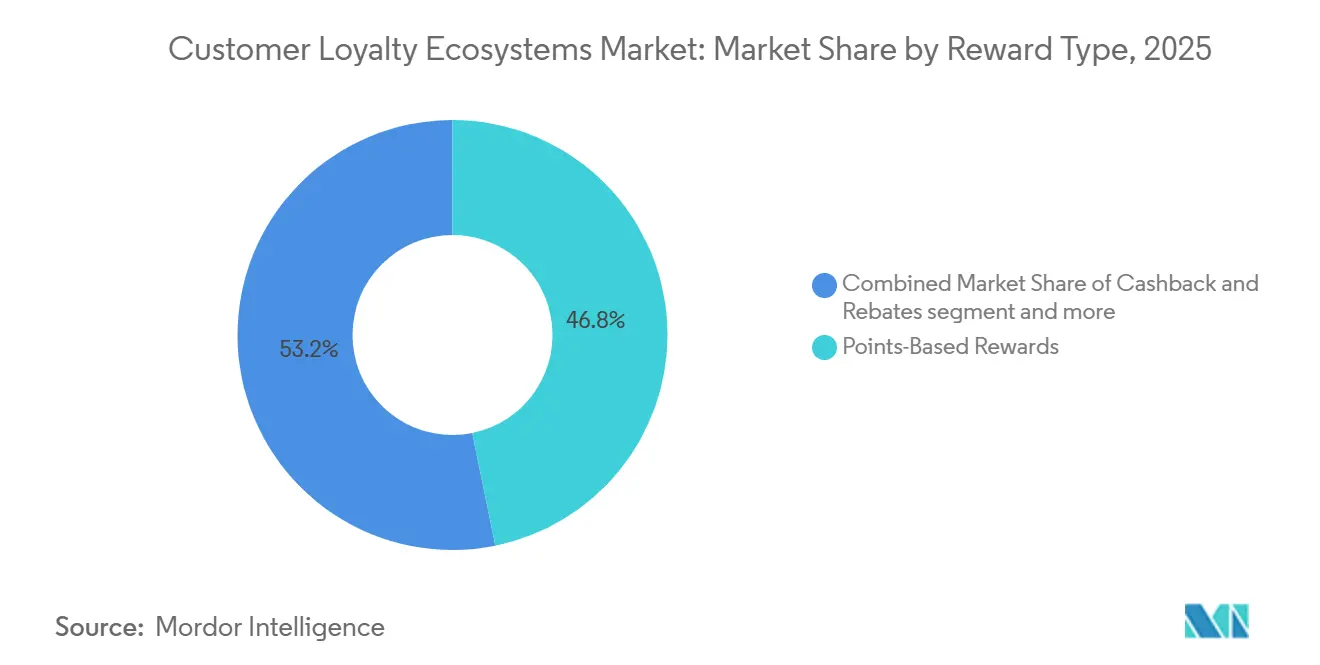
Points-based rewards held 46.82% of the Customer Loyalty Ecosystems market size in 2025, keeping them in the lead across retail, BFSI, and hospitality, where frequent transactions support repeat earning and predictable redemption behavior. Their continued strength comes from consumer familiarity, ease of communication, and operational simplicity in large-volume environments, where members want a clear link between spend and reward accumulation. These models also fit well with enterprise systems that already track purchase events, transaction frequency, and account history at scale. At the same time, widespread adoption has made the format easier to copy, weakening differentiation when brands offer similar earn rates and redemption catalogs. This limits the behavioral edge of points programs when they are treated as standard benefits rather than as a more tailored engagement system.
Cashback and rebate structures address a different member need, because they reduce uncertainty around point value and provide a more immediate perception of financial return. That makes them attractive in value-sensitive categories and in settings where members prefer a direct statement credit or visible savings over future redemption planning. Tiered programs add another layer of commercial value by leveraging status and recognition to increase purchase frequency among higher-value customers. Still, they often require more administrative effort and communication to remain credible. Subscription benefits are projected to grow at a 13.92% CAGR through 2031, reflecting the appeal of membership-first models that collect recurring fees and create stronger retention loops. Recurly’s 2026 subscription benchmarks reported 67% retention in subscription models and noted that 37% of consumers spend more with brands that offer retail subscriptions, reinforcing the appeal of paid loyalty architectures. The Customer Loyalty Ecosystems Market is therefore shifting toward a more mixed reward environment where traditional points retain scale, but subscription-based models improve funding logic and deepen engagement.

By Business Model: B2B Loyalty Closes the Channel Engagement Gap With Enterprises
B2C accounted for 78.43% of Customer Loyalty Ecosystems market share in 2025, reflecting the large installed base of programs across retail, hospitality, telecom, and consumer-facing financial services. This dominance is tied to higher member volumes, wider reward visibility, and a longer history of consumer program deployment in both offline and digital channels. B2C structures also benefit from stronger public familiarity, which lowers onboarding friction and makes the value exchange easier to communicate at scale. Even so, mature consumer programs in developed markets are finding it harder to sustain excitement through enrollment growth alone, especially as reward structures converge. That is why the Customer Loyalty Ecosystems Market is increasingly giving more strategic attention to B2B loyalty, where formal incentive architecture still has room to deepen.
B2B loyalty is projected to expand at a 12.73% CAGR from 2026 to 2031, supported by the need to influence distributors, resellers, and channel partners in sectors such as manufacturing, IT and telecom, and automotive. In these segments, structured incentives can shape procurement behavior, product prioritization, and launch execution more directly than broad brand communication alone. The move is important because many partner ecosystems still depend heavily on relationship-led engagement, leaving room for more systematic incentive design. Salesforce highlights this direction by supporting partner-channel loyalty structures alongside consumer use cases in its Loyalty Management platform, which shows how enterprise software providers are addressing the technical fragmentation that once limited B2B program scale. The Customer Loyalty Ecosystems industry is therefore opening a distinct growth lane in which loyalty is increasingly used to guide indirect sales performance rather than solely consumer retention. This gives the Customer Loyalty Ecosystems Market a stronger foothold in commercial channels where reward-linked influence has historically been underdeveloped.
By Organization Size: Cloud-Native Platforms Unlock SME Loyalty Participation at Scale
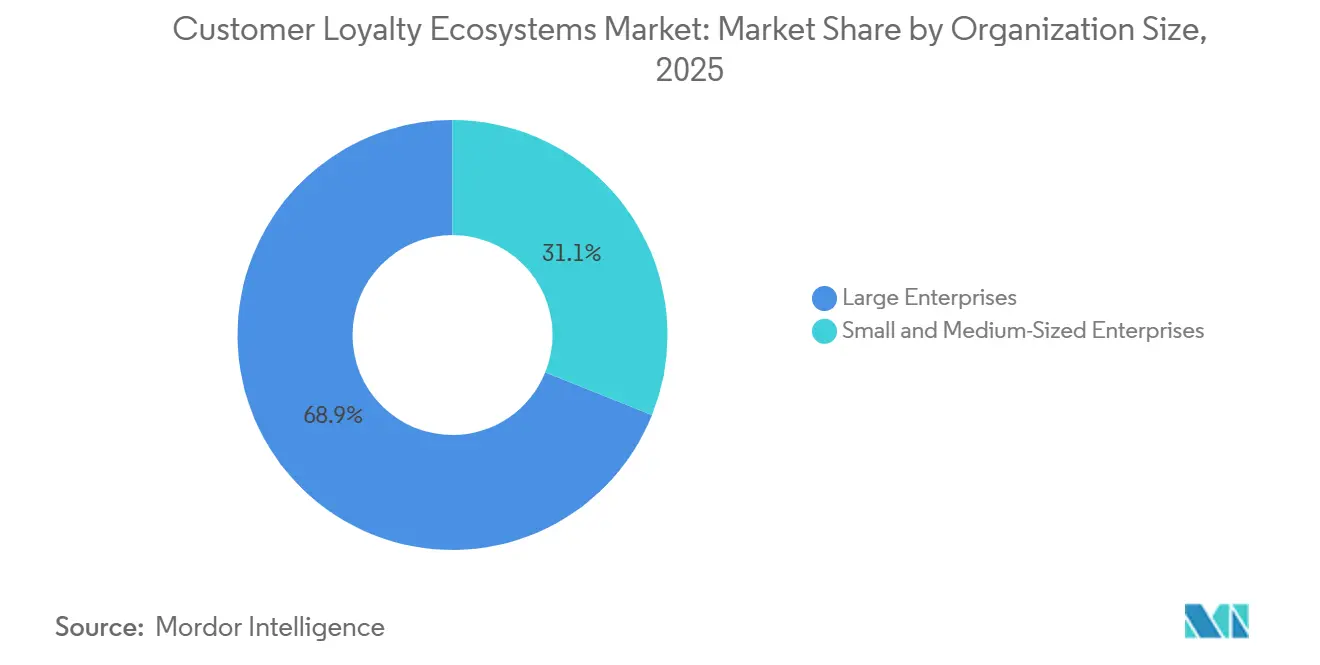
Large enterprises held 68.94% revenue share in 2025, supported by larger technology budgets, dedicated loyalty teams, and stronger relationships with reward fulfillment partners. Their scale allows them to support multi-country programs, broader redemption catalogs, and deeper integration with ERP, CRM, and data platforms. This also gives them an advantage in handling compliance, accounting, and customer data governance across more complex operating environments. However, legacy complexity can slow the pace at which these firms update program logic, connect channels, or launch more flexible loyalty features. The Customer Loyalty Ecosystems Market is therefore showing a split pattern, where large enterprises still account for most revenue but do not always lead in deployment speed or real-time adaptability.
SMEs are forecast to grow at a 14.35% CAGR through 2031, making them the fastest-expanding organization size segment in the Customer Loyalty Ecosystems Market. This expansion is supported by SaaS-based platforms that reduce upfront investment and allow smaller operators to launch structured loyalty programs without building large internal technology teams. Pre-built templates, mobile-led deployment, and simpler analytics are making loyalty more accessible to businesses that previously lacked the scale to support custom systems. The U.S. Chamber of Commerce reported in 2025 that 78% of small businesses now use digital tools for operations, and 20% of small-business investments are focused on technology to drive growth. This trend matters because it broadens the addressable market for the Customer Loyalty Ecosystems Market beyond large corporations and enables steady volume growth through mid-market adoption. The Customer Loyalty Ecosystems industry is thus seeing a meaningful democratization of loyalty infrastructure, even as enterprise-scale programs continue to command the largest spending base.[2]
By Industry Vertical: Healthcare's Patient Loyalty Shift Accelerates Retention Investment
Retail and consumer goods accounted for 31.61% of the Customer Loyalty Ecosystems market size in 2025, supported by high transaction frequency, broad consumer reach, and the ease with which retail settings can embed earning and redemption into everyday purchases. This vertical benefits from the widest touchpoint footprint among all sectors in the study, which gives operators more opportunities to influence repeat behavior and test reward design. BFSI also remains a major user of loyalty systems because reward-linked cards, cashback, and tier benefits continue to influence product choice and account activity. Travel and hospitality maintain a strong presence as well, but their loyalty structures are increasingly shifting toward experiential rewards and partner-led ecosystems that go beyond standard point accumulation. Together, these segments continue to provide the broad commercial base of the Customer Loyalty Ecosystems Market, especially where scale, frequency, and partner integration are already established.
Healthcare is projected to expand at a 15.43% CAGR from 2026 to 2031, making it the fastest-growing vertical in the Customer Loyalty Ecosystems Market. The driver is not only digital health adoption, but also the wider shift toward patient consumerism, where service quality, app usability, and ongoing engagement affect retention in ways that resemble retail behavior. Providers and health plans are increasingly using reminders, preventive care incentives, and app-linked engagement tools to improve participation and strengthen long-term member relationships. This vertical also brings a more complex compliance layer, particularly when reward structures touch health-related behavior and protected data. As a result, the Customer Loyalty Ecosystems Market is expanding in healthcare through a more careful model that blends engagement value with privacy, consent, and regulated communication requirements. Even with these constraints, healthcare offers a wide opportunity set because retention logic is becoming more important as patients behave more like informed service consumers across digital channels.
Geography Analysis
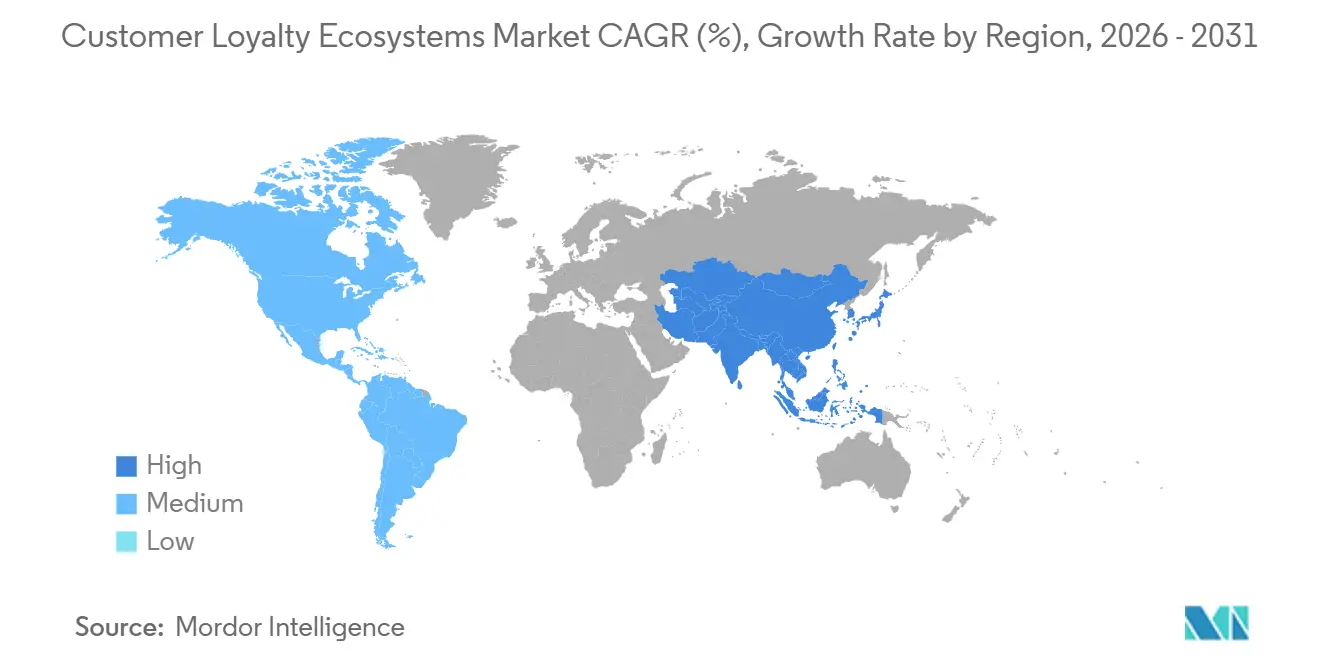
North America held 37.85% revenue share in 2025, giving it the leading position in the Customer Loyalty Ecosystems Market and reflecting the region’s strong enterprise base across retail, BFSI, and travel. The regional advantage comes from mature program infrastructure, deep card-linked offer penetration, and a long history of loyalty investment by large consumer-facing firms. The United States remains the main anchor because loyalty programs are closely tied to financial services, retail media, and broader customer data strategies across major enterprises. Canada is also gaining importance through coalition structures, most notably the March 2025 partnership between the Royal Bank of Canada and Canadian Tire Corporation, which will connect Avion Rewards and Triangle Rewards for eligible cardholders. The Customer Loyalty Ecosystems Market in North America, therefore, combines structural maturity with ongoing redesign, especially in programs that now need better personalization, stronger data governance, and more flexible partner integration.
Europe presents a more mixed picture for the Customer Loyalty Ecosystems Market because mature Western markets face participation fatigue while newer opportunities remain in less saturated parts of the region. Program operators in Western Europe must work harder to justify value because consumers already understand the category and often compare several schemes before increasing engagement. At the same time, regulatory pressure from privacy law and cross-border data rules continues to shape how programs collect, store, and activate customer information. The region is also seeing stronger digital expectations, with firms under pressure to combine real-time reward visibility, personalized content, and seamless mobile access into a single member journey. This means Europe remains commercially relevant, but growth increasingly depends on the quality of program redesign rather than on the simple expansion of member bases.
Asia-Pacific is forecast to grow at a 14.81% CAGR through 2031, making it the fastest-growing geography in the Customer Loyalty Ecosystems Market and the most structurally different from Western loyalty models. In this region, loyalty is often embedded into payment and commerce ecosystems from the start, which lowers friction and makes reward earning part of routine digital behavior. Japan’s enterprise loyalty infrastructure is also evolving quickly, as seen in Hitachi Solutions’ March 2026 AI agent integration for PointInfinity, which supports the broader shift toward automated loyalty operations. India adds another layer of growth because digital payments and mobile commerce create a strong foundation for real-time reward issuance across large user bases. The Customer Loyalty Ecosystems Market in Asia-Pacific is, therefore, benefiting from a structural alignment between mobile commerce, digital identity, and reward activation that many other regions are still trying to build.
South America remains an earlier-stage but meaningful growth corridor in the Customer Loyalty Ecosystems Market, with Brazil standing out due to expanding digital engagement across retail and BFSI. The region offers room for greater loyalty penetration, as digital payment adoption is improving and merchants seek more effective ways to retain users across competitive consumer channels. The Middle East and Africa are also becoming increasingly important, especially as operators launch coalition-style loyalty models rather than starting with isolated brand programs. In May 2026, Majid Al Futtaim launched its SHARE rewards platform in Saudi Arabia, connecting more than 65 brands, including Carrefour and VOX Cinemas, into one ecosystem. The Customer Loyalty Ecosystems Market in these regions is still smaller than in North America or Europe. Still, the structure of new launches suggests a leap toward integrated digital ecosystems rather than a slow path through stand-alone brand programs.[3]
Competitive Landscape
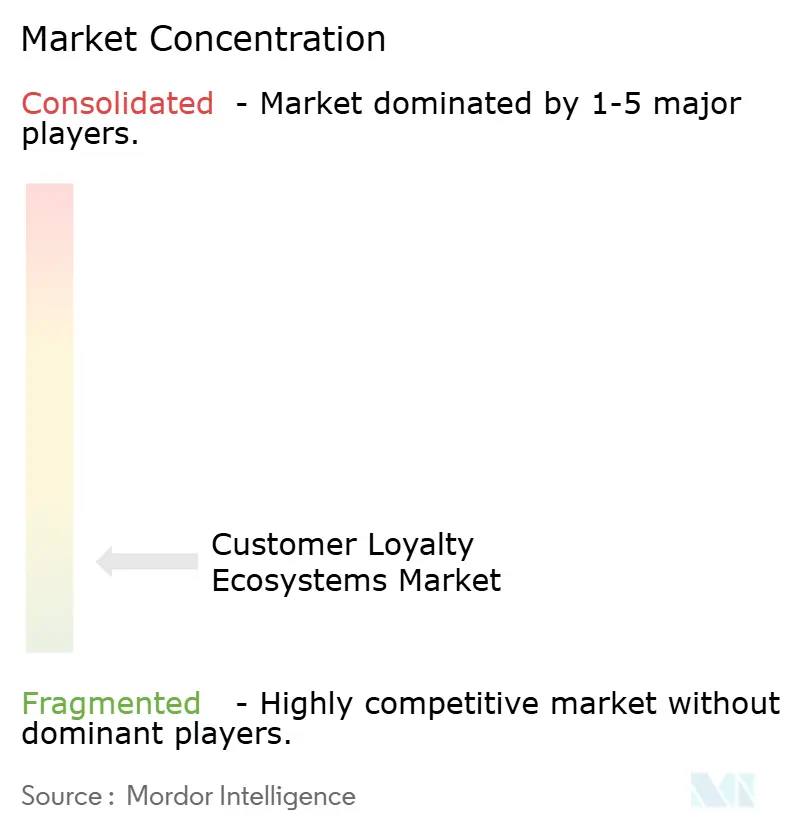
The Customer Loyalty Ecosystems Market remains highly fragmented, with no single company holding dominant control across enterprise software, specialist loyalty engines, and service-led implementation models. Competition spans ERP-embedded vendors such as Oracle, SAP, and Salesforce, as well as purpose-built platforms such as Capillary Technologies, Antavo, LoyaltyLion, and Giift. This fragmented structure reflects the fact that buyer needs vary widely by vertical, program scale, region, and integration complexity. Large enterprises often prefer vendors that can fit loyalty into broader CRM or ERP environments. At the same time, mid-market firms and newer digital operators often choose platforms that emphasize speed, modularity, and faster configuration. The Customer Loyalty Ecosystems Market, therefore, supports multiple parallel vendor models rather than a single dominant technology standard.
A clear strategic shift in the Customer Loyalty Ecosystems Market is the convergence of payment infrastructure and loyalty decisioning. In April 2026, Adyen announced a definitive agreement to acquire Talon for EUR 750 million (USD 870.78 million), with the transaction expected to close in the second half of 2026. SAP also strengthened its position in October 2025 with the launch of SAP Customer Loyalty Management, designed to support a single loyalty profile across brands, regions, and partners within its enterprise software environment. These moves matter because they show that loyalty is being recast as operational infrastructure connected to payments, planning, and enterprise data rather than only a promotional application. The Customer Loyalty Ecosystems Market is thus seeing higher competition from vendors that can embed loyalty more deeply into transaction and operating systems.
Purpose-built vendors continue to compete by offering faster deployment, greater configurability, and API-first design for enterprises that do not want to rely on a full suite. Salesforce has also positioned loyalty as part of a broader engagement stack by supporting loyalty, referral, and offer management within a single environment, helping reduce technical fragmentation across both B2C and partner-led use cases. Hitachi Solutions added another competitive signal in March 2026 with the launch of an AI agent integration for PointInfinity, showing that incumbents in established regional platforms are using AI to extend relevance and automation. Security, privacy controls, and enterprise-grade governance are also becoming more important in procurement as buyers look beyond reward mechanics and evaluate long-term platform resilience. The Customer Loyalty Ecosystems industry is therefore competitive on more than feature breadth, because execution speed, compliance readiness, data unification, and integration depth now shape vendor selection as strongly as front-end program flexibility. This leaves the Customer Loyalty Ecosystems Market structurally open, with space for both large enterprise suites and specialized loyalty platforms as buyer needs continue to diverge.
Customer Loyalty Ecosystems Industry Leaders
-
Oracle Corporation
-
Salesforce, Inc.
-
Epsilon Data Management LLC
-
SAP SE
-
Comarch SA
- *Disclaimer: Major Players sorted in no particular order
Recent Industry Developments
- April 2026: Adyen N.V. announced a definitive agreement to acquire Talon.One GmbH for EUR 750 million (approximately USD 838 million), positioning Adyen's payment infrastructure to incorporate real-time loyalty decisioning at the transaction layer. Talon.One serves 300+ global merchants and was projecting approximately EUR 60 million in ARR by end-2026. The transaction is expected to close in the second half of 2026, subject to regulatory approvals.
- April 2026: Tesco and Adobe announced a strategic AI partnership deploying Adobe's agentic AI and Firefly Foundry capabilities across Tesco's 24 million Clubcard households to enable predictive personalization and real-time offer delivery. The partnership marks one of the largest AI-driven loyalty deployments in European retail history.
- March 2026: Hitachi Solutions launched the PointInfinity AI Agent Integration Solution in Japan, enabling automated marketing workflows through AI agents on a platform that serves over 50 companies with approximately 400 million enrolled member accounts. This represents the first large-scale AI agent deployment on an established national loyalty infrastructure in Asia.
- October 2025: SAP launched SAP Customer Loyalty Management at its SAP Connect conference, delivering a single loyalty profile per customer across brands, regions, and partners natively integrated into SAP Private Cloud ERP and SAP Business Suite. The product was released commercially in Q4 2025.
Global Customer Loyalty Ecosystems Market Report Scope
| Points-Based Rewards |
| Cashback & Rebates |
| Tiered Loyalty Programs |
| Subscription Benefits |
| Business-to-Business |
| Business-to-Customer |
| Large Enterprises |
| Small and Medium Enterprises |
| Retail and Consumer Goods |
| BFSI |
| Travel and Hospitality |
| IT and Telecom |
| Healthcare |
| Manufacturing |
| Automotive |
| North America | United States |
| Canada | |
| Mexico | |
| South America | Brazil |
| Peru | |
| Chile | |
| Argentina | |
| Rest of South America | |
| Europe | United Kingdom |
| Germany | |
| France | |
| Spain | |
| Italy | |
| BENELUX (Belgium, Netherlands, and Luxembourg) | |
| NORDICS (Denmark, Finland, Iceland, Norway, and Sweden) | |
| Rest of Europe | |
| Asia-Pacific | India |
| China | |
| Japan | |
| Australia | |
| South Korea | |
| South East Asia (Singapore, Malaysia, Thailand, Indonesia, Vietnam, and Philippines) | |
| Rest of Asia-Pacific | |
| Middle East And Africa | United Arab Emirates |
| Saudi Arabia | |
| South Africa | |
| Nigeria | |
| Rest of Middle East And Africa |
| By Reward Type | Points-Based Rewards | |
| Cashback & Rebates | ||
| Tiered Loyalty Programs | ||
| Subscription Benefits | ||
| By Business Model | Business-to-Business | |
| Business-to-Customer | ||
| By Organization Size | Large Enterprises | |
| Small and Medium Enterprises | ||
| By Industry Vertical | Retail and Consumer Goods | |
| BFSI | ||
| Travel and Hospitality | ||
| IT and Telecom | ||
| Healthcare | ||
| Manufacturing | ||
| Automotive | ||
| By Geography | North America | United States |
| Canada | ||
| Mexico | ||
| South America | Brazil | |
| Peru | ||
| Chile | ||
| Argentina | ||
| Rest of South America | ||
| Europe | United Kingdom | |
| Germany | ||
| France | ||
| Spain | ||
| Italy | ||
| BENELUX (Belgium, Netherlands, and Luxembourg) | ||
| NORDICS (Denmark, Finland, Iceland, Norway, and Sweden) | ||
| Rest of Europe | ||
| Asia-Pacific | India | |
| China | ||
| Japan | ||
| Australia | ||
| South Korea | ||
| South East Asia (Singapore, Malaysia, Thailand, Indonesia, Vietnam, and Philippines) | ||
| Rest of Asia-Pacific | ||
| Middle East And Africa | United Arab Emirates | |
| Saudi Arabia | ||
| South Africa | ||
| Nigeria | ||
| Rest of Middle East And Africa | ||
Key Questions Answered in the Report
What is the size of the Customer Loyalty Ecosystems Market in 2026?
The Customer Loyalty Ecosystems Market stands at USD 12.14 billion in 2026 and is projected to reach USD 21.32 billion by 2031 at an 11.92% CAGR.
Which reward format leads revenue generation?
Points-based rewards remain the leading format, holding 46.82% share in 2025 because they are easy to understand and fit high-frequency transaction environments.
Which business model is growing the fastest?
B2B is the fastest-growing business model, with a forecast CAGR of 12.73% through 2031 as firms formalize channel partner and distributor incentives.
Why are SMEs becoming more important in this space?
SMEs are projected to grow at a 14.35% CAGR because SaaS-native loyalty platforms reduce upfront cost, simplify setup, and improve access to enterprise-style tools.
Which end-use segment offers the strongest growth opportunity?
Healthcare is the fastest-growing vertical at a 15.43% CAGR, supported by rising patient consumerism and stronger use of digital engagement tools.
Which region should executives watch most closely for future expansion?
Asia-Pacific is the fastest-growing region, with a 14.81% CAGR through 2031, driven by super-app integration, mobile-first commerce, and payment-linked rewards.