
Current Transformer Market Size and Share
Market Overview
| Study Period | 2021 - 2031 |
|---|---|
| Market Size (2026) | USD 3.31 Billion |
| Market Size (2031) | USD 4.43 Billion |
| Growth Rate (2026 - 2031) | 6.02 % |
| Fastest Growing Market | Asia-Pacific |
| Largest Market | Asia-Pacific |
| Market Concentration | Medium |
Major Players *Disclaimer: Major Players sorted in no particular order Image © Mordor Intelligence. Reuse requires attribution under CC BY 4.0. | |
Current Transformer Market Analysis by Mordor Intelligence
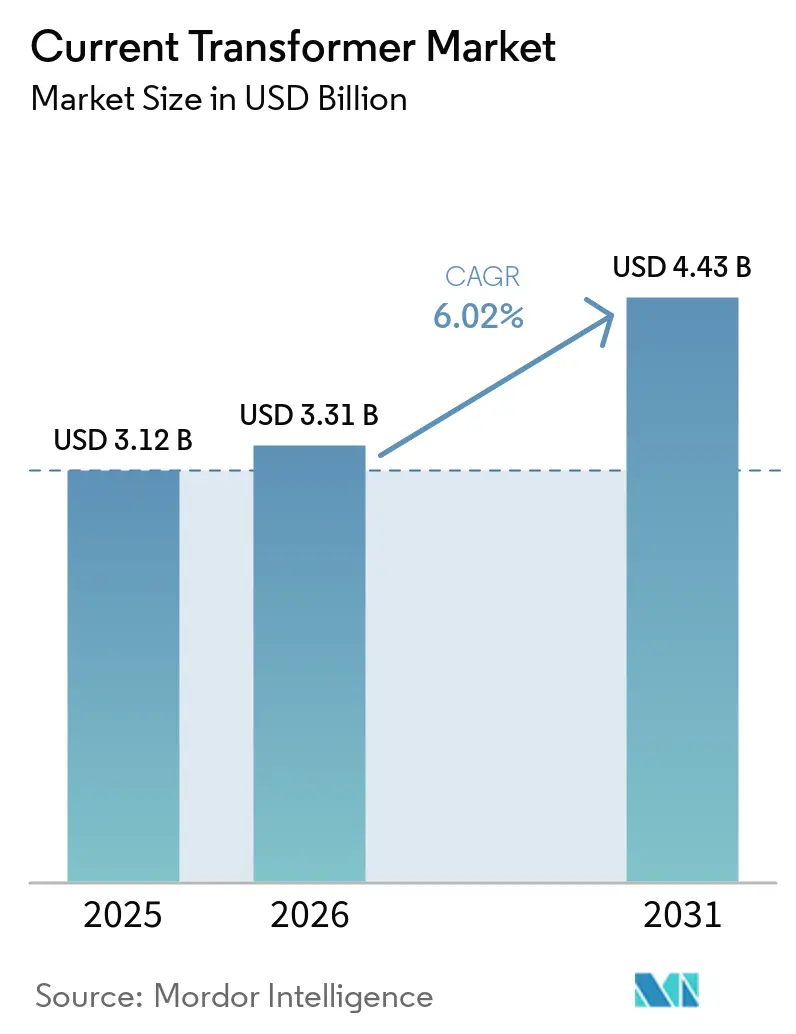
The Current Transformer Market size is expected to grow from USD 3.12 billion in 2025 to USD 3.31 billion in 2026 and is forecast to reach USD 4.43 billion by 2031 at 6.02% CAGR over 2026-2031. Current transformers remain necessary components in substations because they support measurement, protection, and monitoring at each switchgear node. Grid construction and refurbishment, therefore, create demand that is tied to power-system investment rather than discretionary equipment purchases. Global grid investment exceeded USD 470 billion in 2025, and the International Energy Agency expects annual investment to rise materially to meet electricity demand by 2030[1]International Energy Agency, “Grids,” Electricity 2026, iea.org.. The current transformer market is supported by a growing pipeline of transmission projects, digital substation programs, renewable interconnections, and new electricity loads. Suppliers with qualified high-voltage and digital products can benefit when large projects move from planning into procurement and equipment delivery becomes an immediate, essential project requirement for utilities.
Key Report Takeaways
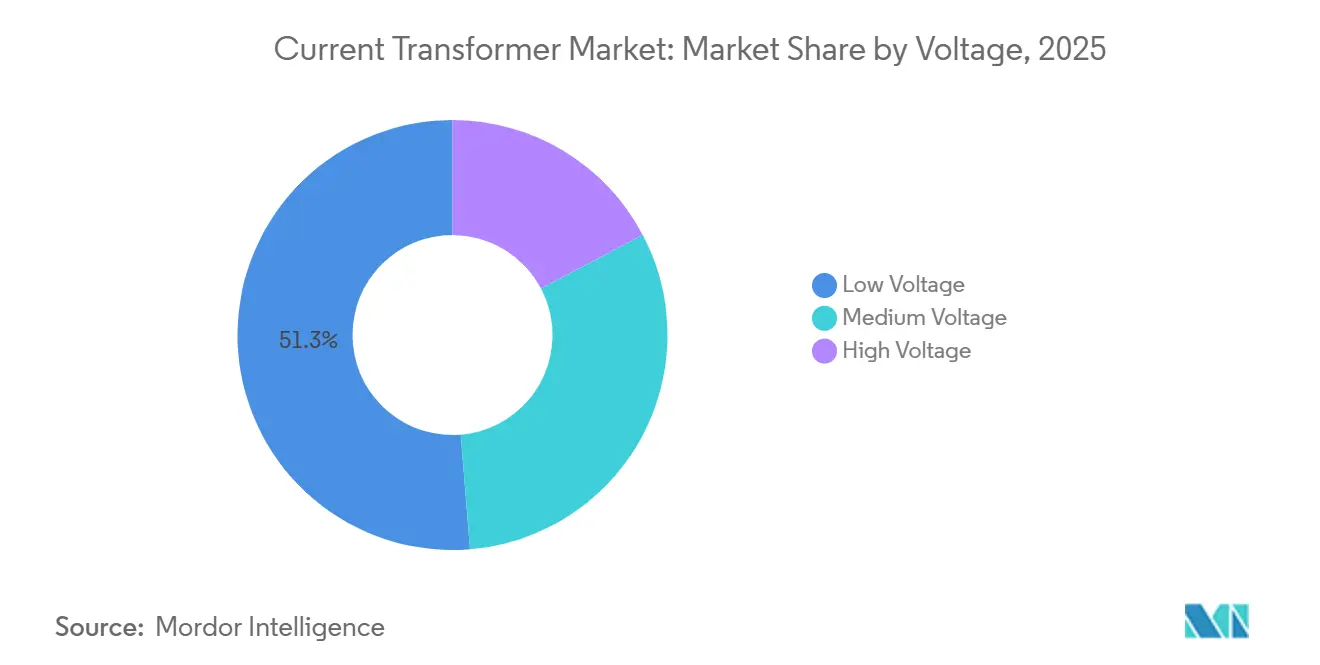
- By voltage, medium voltage held 51.3% of the current transformer market share in 2025, while high voltage is forecast to grow at a 6.7% CAGR through 2031.
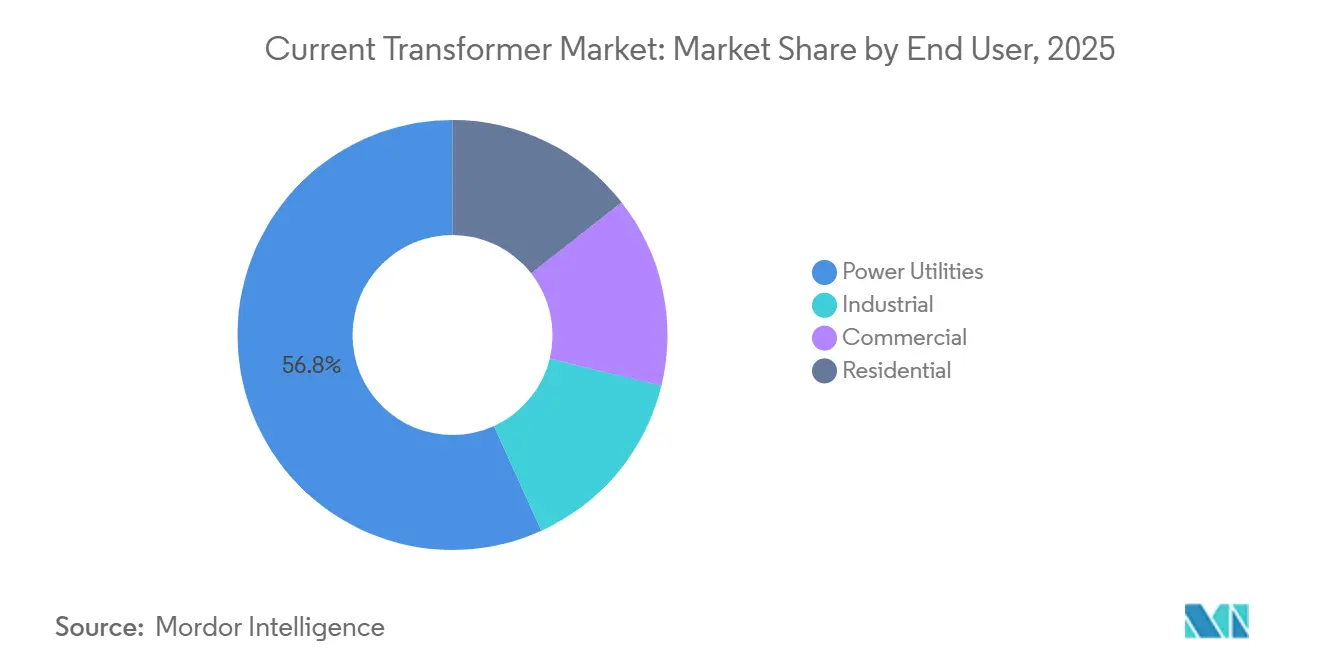
- By end user, power utilities held 56.8% of the current transformer market share in 2025, while industrial users are forecast to grow at a 6.9% CAGR through 2031.
- By geography, Asia-Pacific held 39.5% of the current transformer market share in 2025 and is forecast to grow at a 7.6% CAGR through 2031.
Note: Market size and forecast figures in this report are generated using Mordor Intelligence’s proprietary estimation framework, updated with the latest available data and insights as of January 2026.
Global Current Transformer Market Trends and Insights
Drivers Impact Analysis*
| Driver | (~) % Impact on CAGR Forecast | Geographic Relevance | Impact Timeline |
|---|---|---|---|
| Grid Modernization and Transmission Expansion | +1.20% | Global, concentrated in North America, Europe, and APAC | Short term (≤ 2 years) |
| Renewable-Energy Integration and Distributed Generation | +0.90% | Global, strongest in China, India, United States, Germany | Medium term (2-4 years) |
| Smart-Grid, Digital-Substation, and Advanced-Metering Adoption | +0.80% | North America, Europe, APAC core | Medium term (2-4 years) |
| Industrial Electrification and Data-Center Power Monitoring | +0.60% | North America, Europe, Southeast Asia | Short term (≤ 2 years) |
| Process-Bus Timing, Interoperability, and Digital-CT Retrofit Demand | +0.40% | Europe, North America, Japan | Medium term (2-4 years) |
| Harmonic-Rich Inverter Loads Increasing Demand for Wide-Bandwidth Measurement | +0.30% | Global, with early pressure in high-renewable-penetration markets | Long term (≥ 4 years) |
| Source: Mordor Intelligence | |||
Grid Modernization and Transmission Expansion
Transmission spending converts into current transformer orders because new and upgraded substations require equipment for protection, revenue metering, and operational monitoring. Each project can require several instrument transformers across bays and voltage levels, depending on the layout and protection design. The IEA reported that global grid investment exceeded USD 470 billion in 2025, reflecting a period of expanded network spending. This investment supports the current transformer market because transmission lines, switchyards, and substations are developed together, and each facility needs coordinated metering and protection equipment before it can enter service. The relationship is particularly direct where utilities replace aging infrastructure rather than simply maintaining existing assets. Large programs also concentrate procurement into fewer and larger tenders, which favors suppliers that already meet utility qualification requirements. The current transformer market therefore has opportunities for manufacturers with established high-voltage product lines and the capacity to support project delivery schedules.
Renewable Energy Integration and Distributed Generation
Solar and wind additions change the current conditions that a transformer must measure in renewable interconnection substations. These sites can operate across a wide current range, so buyers increasingly require higher accuracy classes that retain performance at low and high loading conditions. China had more than 1,200 GW of renewable capacity by May 2026, while India is upgrading distribution infrastructure at large scale. The BHEL and Hitachi Energy consortium contract for the 6,000 MW, ±800 kV, 950 km Bhadla Fatehpur HVDC link shows how a renewable corridor can create a concentrated requirement for related power equipment. HVDC and converter-based systems also require designs that can operate under asymmetric and nontraditional fault-current conditions. This creates demand for engineering capability beyond standard product configurations in the current transformer market. Suppliers need to consider core behavior, insulation, accuracy, and the specific protection duties that apply to converter-based transmission projects. These requirements can lengthen qualification work, but they can also limit participation by manufacturers without relevant high-voltage experience.
Smart Grid, Digital Substation, and Advanced Metering Adoption
Digital substations replace much of the analog copper wiring used for measurement signals with Ethernet-based sampled-value communication. This shift separates conventional analog equipment from digital current transformers designed for digital substation architectures. IEC TC 38 approved IEC 61869-9/AMD1 for registration as an FDIS in June 2026, advancing the framework for the digital interface used by instrument transformers[2]IEC, “IEC 61869-9:2016 Instrument Transformers Part 9 Digital Interface for Instrument Transformers,” IEC Webstore, iec.ch.. Utilities moving toward IEC 61850-based designs must either specify compatible digital equipment or deploy separate merging units. The standardization process makes digital upgrades more structured for utilities that are planning substation modernization. It also gives engineering teams a common reference when they select devices, test communications, and validate the timing needed for sampled-value systems. This matters where utilities want to reduce analog cabling while maintaining dependable protection and metering functions. Suppliers able to provide products for both metering and protection applications can address the changing specification requirements within the current transformer market.
Harmonic Rich Inverter Loads and Wide Bandwidth Measurement
Inverter-based generation and industrial power electronics can introduce harmonic distortion and altered fault-current behavior. Conventional wound-core designs may not provide the same measurement performance under these conditions as they do in conventional systems. A 2025 IEEE study addressed the effects of grid-forming inverters and current limiting controls on protection behavior[3]Institute of Electrical and Electronics Engineers, “Impact of Grid-Forming Inverters on Protective Relays,” IEEE Transactions on Industrial Electronics, ieee.org.. Buyers are consequently assessing alternative designs, including Rogowski coils and low-power instrument transformers, for selected uses. Equipment that can support protection, metering, and harmonic monitoring has a clearer role in such installations. The long-term effect on the current transformer market is a wider set of performance requirements for systems with high shares of power electronics. Utilities and industrial operators will need to assess accuracy across normal operation, fault conditions, and distorted waveforms rather than relying only on conventional ratings. Manufacturers that can document this performance through testing can make a stronger case for inclusion in new specifications. The shift also makes technical support more important during selection and commissioning.
Restraints Impact Analysis*
| Restraint | (~) % Impact on CAGR Forecast | Geographic Relevance | Impact Timeline |
|---|---|---|---|
| High Retrofit and Certification Costs | -0.40% | North America and Europe; markets requiring IEC/IEEE dual certification | Medium term (2-4 years) |
| Copper, Electrical-Steel, and Insulation-Material Price Volatility | -0.50% | Global, most acute in USD-denominated procurement markets | Short term (≤ 2 years) |
| CT Saturation Under Inverter-Dominated Fault Profiles | -0.30% | Global, most acute in high-renewable-penetration markets (Germany, Spain, Denmark, California, South Australia) | Medium term (2-4 years) |
| Long Utility Qualification Cycles and Scarcity of Calibration Capacity | -0.20% | North America and Europe; emerging pressure in APAC markets adopting IEC/IEEE dual-certification standards | Long term (≥ 4 years) |
| Source: Mordor Intelligence | |||
High Retrofit and Certification Costs
Replacing a current transformer in an energized substation can require outage coordination, relay review, and installation testing. Digital equipment can add firmware validation and configuration work with existing intelligent electronic devices. Qualification cycles in North America may take 18 to 36 months, particularly for high-voltage and revenue-metering applications. Dual compliance with IEC 61869 and IEEE C57.13 can extend the approval process for some products. Limited access to accredited calibration capability for Class 0.2S equipment above 132 kV can narrow the field of qualified suppliers. These factors can delay the conversion of approved grid budgets into orders for the current transformer market. The delay is important because capital approval does not automatically produce an equipment order when utilities still need to schedule outages, review relay settings, and complete acceptance testing. New suppliers can face a particularly difficult entry path when customers prefer devices that match established designs and operational practices.
Copper, Electrical Steel, and Insulation Material Price Volatility
Copper prices reached USD 13,387.5 per ton in January 2026, and the source material indicated further increases during the first half of the year. Copper winding is an important direct material input for current transformer production, so price changes affect costs and contract margins. Grain-oriented electrical steel is also essential because its magnetic properties determine core performance. Manufacturers working under multiyear utility contracts may be unable to recover all input-cost movements through pricing adjustments. Copper and electrical steel can rise together when energy-intensive production costs increase, limiting the value of separate hedging strategies. This cost exposure can restrain profitability in the current transformer market even when order volumes remain strong. Long delivery schedules make the issue more difficult because futures markets may not provide complete protection for contracts extending three to five years. Manufacturers must therefore manage purchasing, contract language, and production planning carefully when serving large transmission and distribution programs.
*Our forecasts treat driver/restraint impacts as directional, not additive. The impact forecasts reflect baseline growth, mix effects, and variable interactions.
Segment Analysis
By Voltage: Medium Voltage Anchors Demand While High Voltage Leads Growth
Medium voltage held 51.3% of the current transformer market share in 2025, supported by its use in utility distribution substations and industrial distribution systems. This voltage range connects generation assets, switchgear, protective relays, and billing meters across many power networks. Medium-voltage equipment commonly serves installations from 11 kV to 66 kV. The segment benefits from the broad installed base of distribution substations and the need to replace or upgrade equipment during grid programs. Cast-resin and epoxy-insulated designs are widely used in indoor switchgear, where they have displaced many oil-immersed alternatives. Renewable collector substations are also adopting dual-ratio sensing because operating and fault current can differ substantially.
The current transformer market size for high-voltage equipment is forecast to expand at a 6.7% CAGR from 2026 to 2031, the fastest rate among voltage tiers. High-voltage products operate above 66 kV and can extend to 800 kV for HVDC applications. Trench Group received a 765 kV CVT project award for ERCOT's first 765 kV transmission lines in Texas during 2026[4]Trench Group, “Trench Group Commits to America’s Grid Transformation,” Trench Group, trench-group.com.. BHEL also issued a 2026 tender process for partnerships supporting 765 kV current transformer supply to POWERGRID projects, as described in the supplied material. HVDC projects need products designed for specialized insulation, DC withstand capability, and performance under inverter load conditions. These higher specifications can support price differentiation that is less available in standard medium-voltage equipment. The distinction matters because high-voltage projects tend to require deeper engineering review and a narrower group of qualified providers. Their order flow can be uneven, but individual projects can create meaningful procurement events for suppliers that meet the required standards.



By End User: Utilities Lead on Volume, Industrial Accelerates on New Applications
Power utilities accounted for 56.8% of the current transformer market share in 2025, making utilities the largest buyer group. Transmission and distribution networks need current transformers for protection, metering, control, and monitoring functions. Digital substation programs can raise the revenue per device when buyers select IEC 61869-9-compatible equipment with digital interfaces. Utilities may replace several analog components with digitally enabled products, while maintaining the required measurement and protection functions. Commercial and residential users support demand through smart metering and building energy monitoring. These buyers typically favor standardized low-voltage split-core products that can be supplied at higher volume and with shorter lead times.
The current transformer market size for industrial users is projected to grow at a 6.9% CAGR from 2026 to 2031. Data centers require dedicated monitoring and protection at utility interconnection points, creating demand for medium-voltage equipment. Industrial electrification also expands the need for accurate measurement in chemical plants, steel mills, and other power-intensive sites. IEEE research published in 2025 examined how inverter-related conditions can affect protection performance. Industrial purchasers may therefore specify Rogowski-coil or low-power instrument-transformer designs for applications with high harmonic distortion. These products can offer wider measurement ranges and suit demanding thermal or electrical conditions better than standard catalog products. The combination of accuracy, harmonic performance, and environmental capability increases the value of application engineering. It can also deepen customer relationships because a device selected for a complex process is less easily replaced by a lower-cost standard alternative.
Geography Analysis
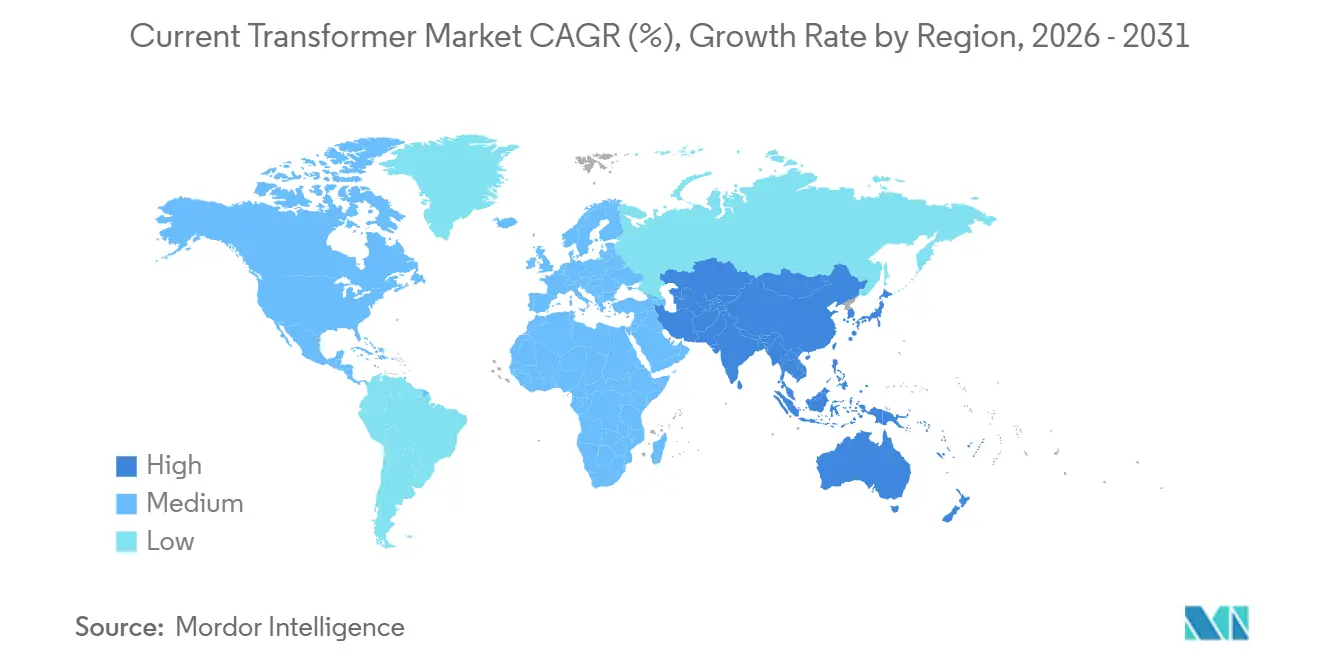
Asia-Pacific held 39.5% of the current transformer market share in 2025 and is forecast to grow at a 7.6% CAGR through 2031. China is expanding grid digitization and renewable power connections, while India is increasing transmission and distribution capacity. The Bhadla Fatehpur HVDC project includes a 6,000 MW link extending 950 km and demonstrates the scale of regional renewable transmission development. India also targets 250 million smart meter installations by 2027. Vietnam, Thailand, and Indonesia are expanding industrial zones and manufacturing capacity. Their need for IEC-compliant substation equipment supports recurring medium-voltage demand across the region.
North America is the second-largest regional market in the supplied research and is shaped by replacement investment and new electricity-load connections. PJM approved a USD 11.8 billion transmission expansion plan in February 2026, including 765 kV overhead lines and a 525 kV underground backbone. California ISO approved 38 transmission projects totaling USD 6.7 billion in its 2025-2026 plan. Aging assets and data-center interconnection requests are increasing the need for substation upgrades. FERC Order 881 can require utilities to assess whether installed metering equipment meets the accuracy requirements associated with temperature-adjusted line ratings. This can create a replacement trigger, although administrative review and qualification work can slow the pace of orders. The regional demand pattern therefore combines necessary replacement activity with new capacity needs created by large electricity users.
Europe benefits from planned transmission and distribution investment as countries retire coal-fired generation and expand power networks. Germany, France, and Poland are important locations for substation modernization within the regional program described in the supplied research. South America has demand centered on Brazilian transmission expansion and Chilean renewable corridors. Outdoor installations in these markets may require designs that account for altitude and pollution conditions. The Middle East and Africa are earlier in their investment cycle, with grid expansion in Saudi Arabia, the United Arab Emirates, Morocco, and Egypt supporting demand. Chinese engineering, procurement, and construction projects in Sub-Saharan Africa provide an additional supply route for current transformer equipment. These projects can use factory-to-site supply arrangements that do not always follow the multiyear Western qualification process. The resulting demand remains earlier in its development than Asia-Pacific demand, but it broadens the regional base for medium-voltage infrastructure equipment.

Competitive Landscape
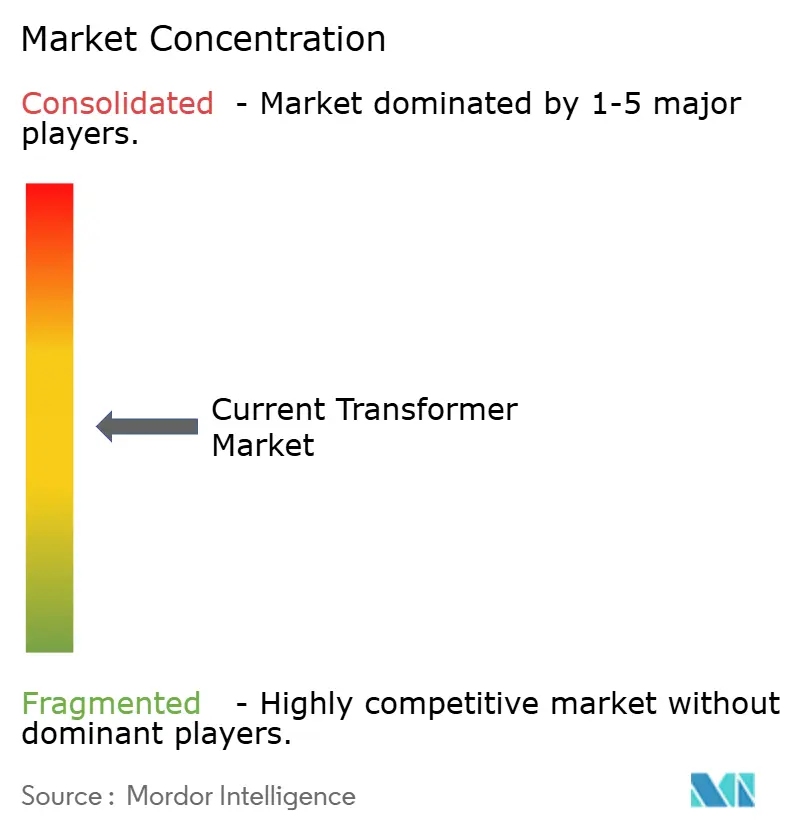
The current transformer market is moderately consolidated, with integrated electrical-equipment companies and specialist instrument-transformer manufacturers serving different parts of the value chain. Hitachi Energy, Siemens Energy, GE Vernova, and Schneider Electric compete through broad electrification and grid portfolios. Trench Group, PFIFFNER, RITZ, and Arteche Group compete through focused technical expertise in high-voltage and digital categories. Product qualification, manufacturing capacity, accuracy performance, and delivery reliability influence supplier selection. Medium-voltage products face more direct price competition because specifications are more standardized. High-voltage and digital applications allow greater differentiation where customers need proven engineering and testing capability. This split leaves manufacturers with two different competitive tasks, which are controlling costs in standardized product lines and demonstrating technical reliability in demanding applications. The balance between those tasks affects margins, investment priorities, and the ability to retain utility relationships.
Trench Group signed long-term framework agreements with GE Vernova, Hitachi Energy, and Siemens Energy in May 2025 for instrument transformers, air-core coils, and transformer bushings. The agreements extend into the mid-2030s and show that system integrators can rely on specialist suppliers for high-voltage components. GE Vernova announced an investment of USD 30 million in expanded electrification manufacturing capacity in Italy during March 2026. The investment forms part of a wider USD 11 billion capital expenditure and research program through 2028, according to the company. These actions indicate that capacity and supply assurance remain important competitive factors. Suppliers also need to align their product development with utility standards and digital substation requirements. In practice, that means managing product availability alongside certification, testing, and documentation work. Utilities often value a dependable delivery record because delays in one component can affect the commissioning schedule for an entire substation. This gives established suppliers an advantage, while specialists can compete where their technical scope is closely aligned with the project need.
Schneider Electric launched its One Digital Grid Platform in late 2025, combining distribution management, real-time analytics, and edge automation functions. A digital platform can influence equipment specifications by linking field devices to a wider utility architecture. There remains a product opportunity for high-accuracy equipment that can support metering, protection, and harmonic monitoring within one application. This requirement is becoming more relevant as inverter-based resources increase across power systems. Manufacturers that can validate performance across these functions can strengthen their position with utilities and industrial buyers. The competitive setting remains consistent with a market concentration score of 5 because the supplied research identifies several major integrated and specialist suppliers, but provides no combined-share figure that would support a higher score.
Current Transformer Industry Leaders
Siemens Energy AG
Hitachi Energy Ltd.
Schneider Electric SE
GE Vernova Inc.
Eaton Corporation plc
- *Disclaimer: Major Players sorted in no particular order

Recent Industry Developments
- August 2026: BHEL won a USD 61 million contract from Power Grid Corporation of India for 23 units of 500 MVA, 765/400 kV single-phase transformers under PGCIL's Lot-7 bulk procurement program. The order was awarded on August 24, 2026, through domestic competitive bidding with five qualified participants, including CG Power, GE Vernova T&D India, and Siemens Energy India.
- July 2026: Trench Group, through subsidiary HSP US, opened its first U.S. high-voltage bushing manufacturing facility in Charlotte, North Carolina, with an investment exceeding USD 60 million. The 170,000-square-foot plant produces 25 kV to 765 kV transformer bushings compliant with Build America, Buy America requirements. Initial deliveries from the 230 kV range are confirmed for late 2026, with 765 kV deliveries following in 2028.
- June 2026: IEC TC 38 approved IEC 61869-9/AMD1 for registration as an FDIS, advancing the compliance framework governing digital current transformers and merging units in IEC 61850-compliant digital substations globally.
- May 2026: Trench Group was awarded a 765 kV CVT project for ERCOT in Texas, supporting the state's first 765 kV transmission lines. The company also presented its 765 kV portfolio at IEEE PES T&D 2026 in Chicago.


Global Current Transformer Market Report Scope
A current transformer (CT) is an electrical device used to measure or monitor high electric current safely. It reduces a large current flowing in a power line to a smaller, proportional current that can be measured by meters or protective relays.
The Current Transformer Market Report is segmented by voltage, end user, and geography. By voltage, the market is segmented into low voltage, medium voltage, and high voltage. By end user, the market is segmented into power utilities, industrial, commercial, and residential. The report also covers the market size and forecasts for the global current transformer market across 26 countries in major regions. For each segment, the market sizing and forecasts have been provided on the basis of value (USD).
| Low Voltage |
| Medium Voltage |
| High Voltage |
| Power Utilities |
| Industrial |
| Commercial |
| Residential |
| North America | United States |
| Canada | |
| Mexico | |
| Europe | Germany |
| France | |
| Italy | |
| Spain | |
| United Kingdom | |
| Poland | |
| Russia | |
| Rest of Europe | |
| Asia-Pacific | China |
| India | |
| Japan | |
| South Korea | |
| Australia | |
| Indonesia | |
| Vietnam | |
| Thailand | |
| Rest of Asia-Pacific | |
| South America | Brazil |
| Argentina | |
| Chile | |
| Rest of South America | |
| Middle East and Africa | Saudi Arabia |
| United Arab Emirates | |
| Egypt | |
| South Africa | |
| Morocco | |
| Rest of Middle East and Africa |
| By Voltage | Low Voltage | |
| Medium Voltage | ||
| High Voltage | ||
| By End User | Power Utilities | |
| Industrial | ||
| Commercial | ||
| Residential | ||
| By Geography | North America | United States |
| Canada | ||
| Mexico | ||
| Europe | Germany | |
| France | ||
| Italy | ||
| Spain | ||
| United Kingdom | ||
| Poland | ||
| Russia | ||
| Rest of Europe | ||
| Asia-Pacific | China | |
| India | ||
| Japan | ||
| South Korea | ||
| Australia | ||
| Indonesia | ||
| Vietnam | ||
| Thailand | ||
| Rest of Asia-Pacific | ||
| South America | Brazil | |
| Argentina | ||
| Chile | ||
| Rest of South America | ||
| Middle East and Africa | Saudi Arabia | |
| United Arab Emirates | ||
| Egypt | ||
| South Africa | ||
| Morocco | ||
| Rest of Middle East and Africa | ||


Key Questions Answered in the Report
What is driving demand for current transformers through 2031?
Grid modernization, renewable interconnections, digital substations, industrial electrification, and data-center power monitoring support demand.
What is the projected growth rate for current transformers?
The current transformer market is projected to grow at a 6.02% CAGR from 2026 to 2031, reaching USD 4.43 billion.
Which voltage category has the largest share?
Medium voltage held 51.3% of revenue in 2025, reflecting its role in distribution substations and industrial power systems.
Which customer group is growing fastest?
Industrial users are forecast to grow at a 6.9% CAGR through 2031, supported by data centers and electrified industrial processes.
Which region is growing fastest?
Asia-Pacific is projected to grow at a 7.6% CAGR through 2031 and held 39.5% of revenue in 2025.
Why are digital current transformers becoming more relevant?
Digital substations use sampled-value communication and require equipment that aligns with the IEC 61869-9 digital-interface framework.
Page last updated on:





