
Crystalware and Glassware Market Size and Share
Market Overview
| Study Period | 2021 - 2032 |
|---|---|
| Market Size (2027) | USD 9.57 Billion |
| Market Size (2032) | USD 11.90 Billion |
| Growth Rate (2027 - 2032) | 4.45 % |
| Fastest Growing Market | Asia-Pacific |
| Largest Market | Asia-Pacific |
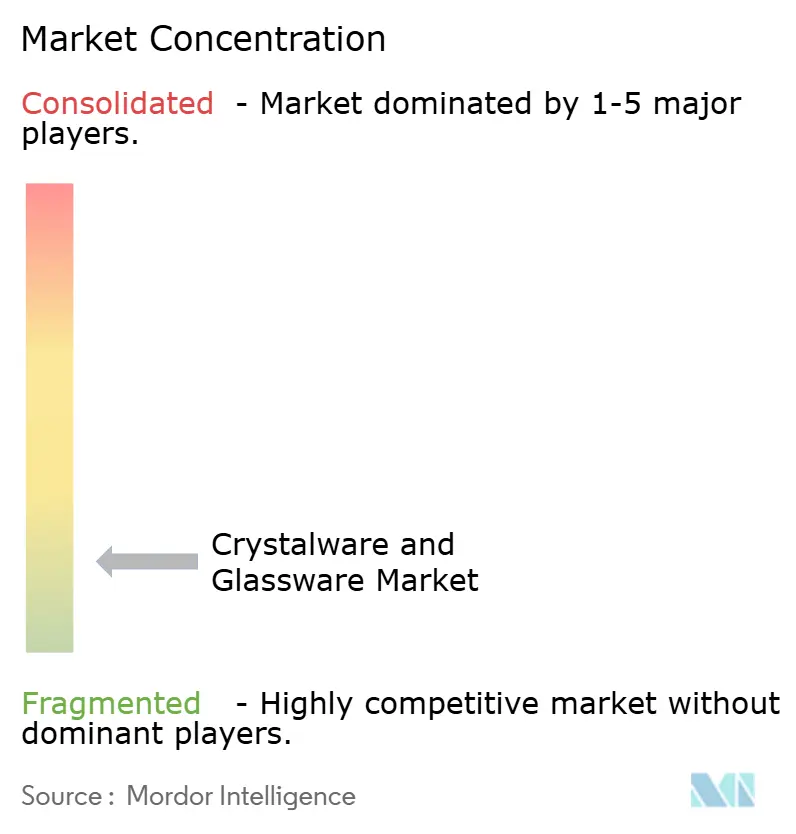
| Market Concentration | Low |
Major Players *Disclaimer: Major Players sorted in no particular order Image © Mordor Intelligence. Reuse requires attribution under CC BY 4.0. | |
Crystalware and Glassware Market Analysis by Mordor Intelligence
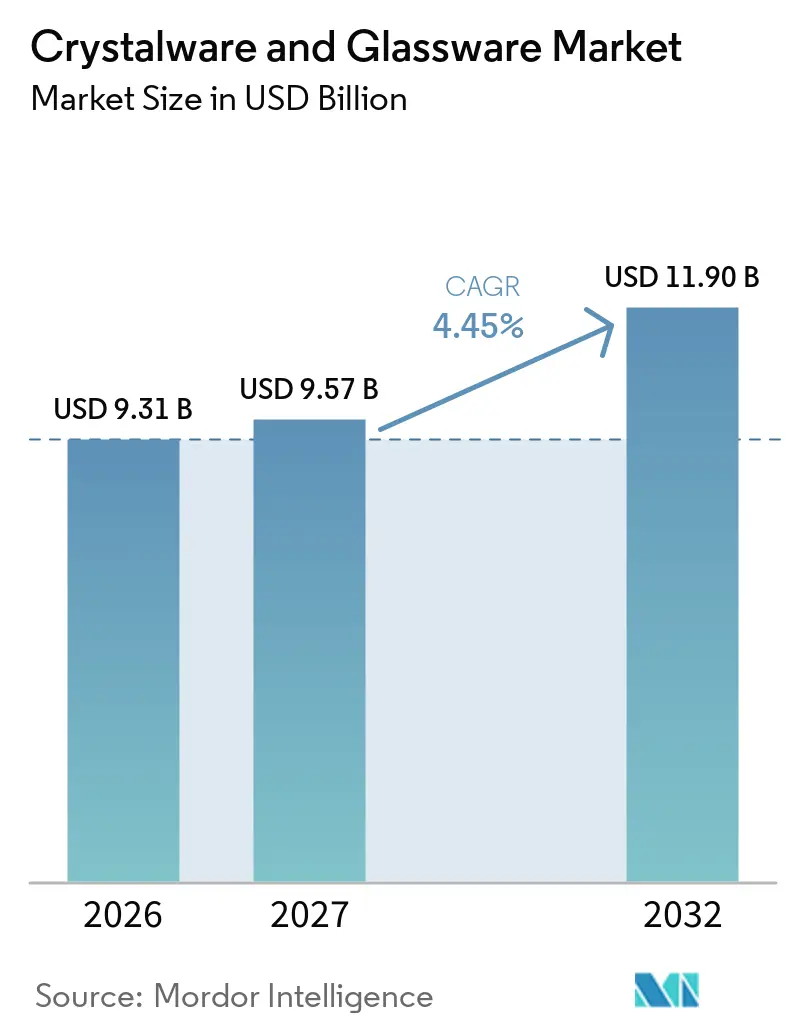
The crystalware and glassware market size was valued at USD 9.31 billion in 2026 and is estimated to grow from USD 9.57 billion in 2027 to reach USD 11.90 billion by 2032, at a CAGR of 4.45% during the forecast period (2027-2032). The crystalware and glassware market is supported by recurring replacement demand from hotels, restaurants, airlines, and other foodservice operators, alongside consumer spending on premium tableware for home entertaining and gifting. Demand is also influenced by evolving preferences for distinctive designs, durable materials, and products that balance aesthetics with everyday functionality. E-commerce is expanding manufacturers’ reach beyond traditional retail networks, providing consumers with greater access to branded, premium, and specialty glassware, particularly across Asia-Pacific and the Middle East. Sustainability and product performance are becoming increasingly important purchasing considerations, encouraging demand for lead-free crystal, dishwasher-resistant glassware, and recyclable materials. Competition spans mass-market manufacturers that emphasize production scale, cost efficiency, and broad distribution, as well as heritage brands that differentiate through craftsmanship, design innovation, brand prestige, and premium retail experiences.
Key Report Takeaways
- By product type, glassware accounted for 73.26% of revenue in 2026, while crystalware is projected to register a 6.54% CAGR through 2032.
- By material, soda-lime glass accounted for 43.16% of revenue in 2026, while borosilicate glass is projected to record a 6.06% CAGR through 2032.
- By end-user, residential users accounted for 62.41% of revenue in 2026, while commercial users are projected to achieve a 6.26% CAGR through 2032.
- By distribution channel, B2C/retail accounted for 70.44% of revenue in 2026 and is projected to post a 5.80% CAGR through 2032.
- By geography, Asia-Pacific accounted for 37.65% of revenue in 2026 and is projected to deliver a 6.39% CAGR through 2032.
Note: Market numbers in this report are based on Mordor Intelligence's proprietary estimation framework, which combines nine months of actuals with Q4 projections for base year 2026.
Market Trends and Insights
Drivers Impact Analysis of Crystalware and Glassware Market*
| Driver | (~) % Impact on CAGR Forecast | Geographic Relevance | Impact Timeline |
|---|---|---|---|
| Hospitality and Foodservice Replacement Demand | +1.2% | Global, with highest uplift in Asia-Pacific and Middle East and Africa | Medium term (2-4 years) |
| Premium Home Entertaining and Beverage Presentation | +0.9% | North America, Europe, Asia-Pacific urban centers | Medium term (2-4 years) |
| Online Discovery and Direct-to-Consumer Luxury Retail | +0.6% | Global, with highest channel shift in Asia-Pacific and Middle East and Africa | Short term (≤ 2 years) |
| Reusable, Recyclable, and Lead-Free Tableware | +0.5% | Europe and North America core, spill-over to Asia-Pacific | Long term (≥ 4 years) |
| Beverage-Specific Glass Engineering and Sensory Presentation | +0.5% | Europe and North America, emerging in Asia-Pacific | Medium term (2-4 years) |
| Lifecycle-Cost Procurement for Durability and Breakage | +0.4% | Global, with commercial concentration in Europe and Asia-Pacific | Medium term (2-4 years) |
| Source: Mordor Intelligence | |||
Expansion of Hospitality and Foodservice Replacement Demand
The crystalware and glassware market benefits from replacement demand because hospitality operators require steady replenishment of service items. Restaurants replace damaged or worn glasses as part of routine operating expenditure rather than as a one-time capital purchase. This need supports stable orders even when discretionary household spending is less certain. In April 2026, Korean Air completed a KRW 110 billion (~USD 76.3 million) renovation of its Incheon Terminal 2 lounges and selected Baccarat and RIEDEL glassware for its First Class and Prestige Class service environments[1]. The example shows that premium hospitality venues use crystalware as part of their service positioning. Suppliers that obtain approved status with hotel groups, restaurant chains, or airline operators can benefit from repeat orders and consistent specification requirements.
Premiumization of Home Entertaining and Beverage Presentation
The crystalware and glassware market is gaining traction among consumers who use tableware to support home dining, gifting, and personal expression. Premium products are no longer limited to formal occasions because consumers increasingly use distinctive glasses for regular entertaining. This broadens demand for wine stems, decanters, cocktail glasses, and serving pieces. Swarovski reported 6% organic revenue growth to EUR 1.97 billion (~USD 2.32 billion) in 2025, with like-for-like growth in retail and online channels across 9 of its 10 largest markets[2]. Similarly, Fiskars Group’s premium homeware Business Area Vita recorded 3.0% comparable net sales growth in 2025, supported by strong performance from Georg Jensen, Royal Copenhagen, and Moomin Arabia, alongside direct-to-consumer and e-commerce sales. The performance highlights continued consumer interest in premium design-led homeware and gifting products. The result supports the view that demand for premium crystal products is spread across multiple regions. Producers can address this demand by offering coordinated collections that combine everyday products with higher-value gifting items.
Growth of Online Discovery and Direct-to-Consumer Luxury Retail
The crystalware and glassware market is changing as manufacturers build direct relationships with consumers through branded websites and digital retail platforms. This approach gives companies more control over product education, brand presentation, and customer service. It also lets niche producers reach buyers outside established specialty retail networks. Josephinenhütte moved from a B2B model to direct online sales and reported a 287% increase in shipping volume, reaching more than 40 countries by February 2025[3]. Reliable protective packaging and specialized logistics are necessary because breakage can quickly weaken customer confidence. Direct sales also create data that can support replacement reminders, gift purchases, and collection-based marketing.
Beverage-Specific Glass Engineering and Sensory Presentation
The crystalware and glassware market is also supported by more specialized glass designs for wine, beer, spirits, and cocktails. Hospitality buyers use these products to improve presentation and create a more differentiated drinking experience. RIEDEL has used sensory workshops across trade channels to demonstrate that glass shape affects the perceived aroma, structure, and finish of wine[4]. Zwiesel Glas published guidance in 2025 that links bowl geometry and opening size to specific beer styles. Toyo Sasaki Glass states that its Fine Crystal® material offers optical qualities comparable to lead crystal and can withstand at least 4,500 commercial dishwasher cycles. These features help operators balance visual quality with the durability required for repeated service.
Restraints Impact Analysis of Crystalware and Glassware Market*
| Restraint | (~) % Impact on CAGR Forecast | Geographic Relevance | Impact Timeline |
|---|---|---|---|
| Fragility, Breakage, and Packaging Exposure | -0.4% | Global, highest operational impact in high-volume commercial channels | Short term (≤ 2 years) |
| Substitution by Steel, Ceramics, Plastic, Melamine, and Tritan | -0.5% | Global, most acute in outdoor, quick-service, and cost-sensitive segments | Medium term (2-4 years) |
| Furnace Energy, Raw-Material, and Skilled-Labor Costs | -0.6% | Europe and North America core, with secondary exposure in Asia-Pacific manufacturing hubs | Long term (≥ 4 years) |
| Artisanal Capacity and Lead-Free Formulation Constraints | -0.3% | Central Europe and specialty Asia-Pacific producers | Long term (≥ 4 years) |
| Source: Mordor Intelligence | |||
Fragility, Breakage and Packaging Exposure
The crystalware and glassware market faces a direct operating challenge because fragile items are vulnerable during distribution and daily use. Breakage raises replacement costs for restaurants, hotels, retailers, and consumers. It can also damage the customer experience in direct sales, where packaging is closely associated with the brand. Thin-rim premium crystal has limited scope for heavier construction because its visual and acoustic qualities depend on a refined form. Makers therefore need packaging that protects products without making shipping uneconomic or weakening presentation. This challenge supports demand for stronger materials, careful carton design, and product formats suited to commercial handling.
Furnace Energy, Raw-Material and Skilled-Labor Costs
The crystalware and glassware market remains exposed to high energy requirements because melting glass requires sustained, high-temperature furnace operation. A 2025 study of the German glass sector found that melting can account for up to 85% of production energy consumption. The same study reported that Germany’s glass manufacturing sector used 16.9 TWh of energy in 2023, with natural gas representing 72% of the fuel mix. Şişecam commissioned frosted glass and energy-glass lines at Tarsus in September 2025 through a EUR 200 million (USD 235.3 million) investment. Smaller craft producers also face the cost of lead-free reformulation and difficulty finding experienced glassblowers and cutters. These pressures favor companies with stronger capital resources, technical capabilities, and production scale.
*Our forecasts treat driver/restraint impacts as directional, not additive. The impact forecasts reflect baseline growth, mix effects, and variable interactions.
Crystalware and Glassware Market Segment Analysis
By Product Type:
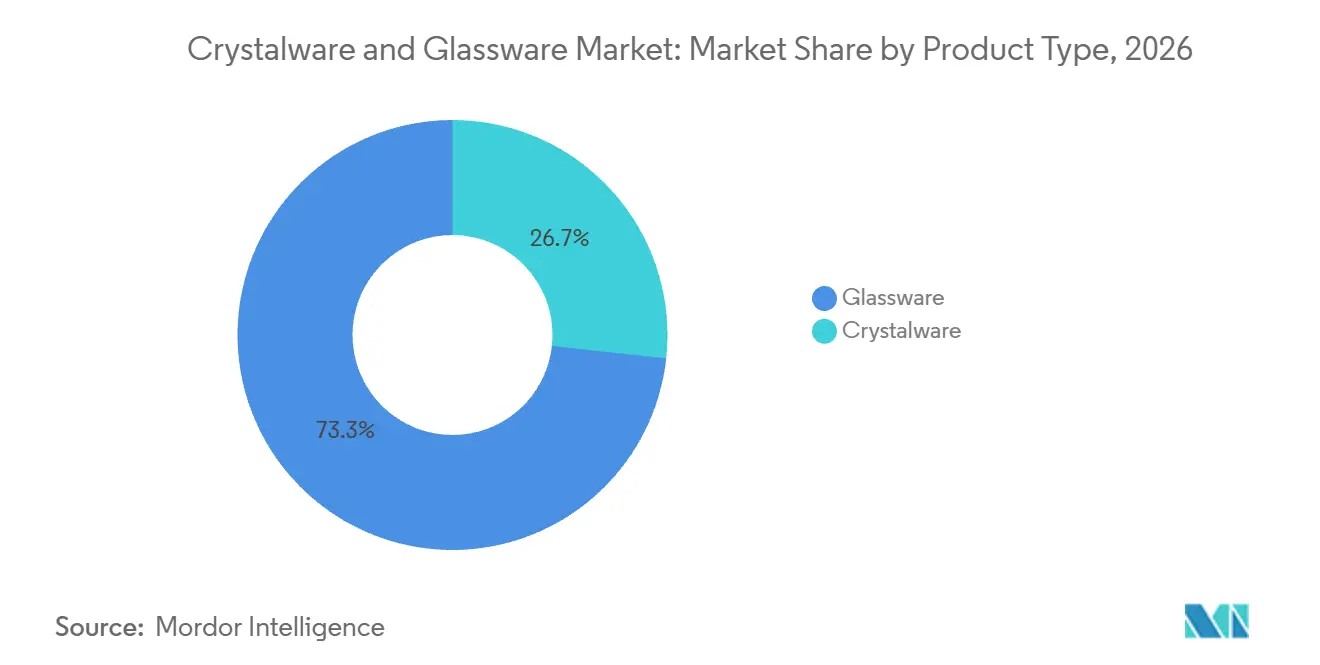
Glassware Volume Anchors the Market While Crystalware Commands the Growth PremiumGlassware held 73.26% of the crystalware and glassware market share in 2026, providing the volume base across foodservice, retail, and household uses. Its position reflects recurring purchases of cups, mugs, bowls, serving vessels, and everyday drinkware; commercial customers value price, dependable supply, and products that can withstand routine turnover. The broad category also faces price pressure from high-volume production centers. Crystalware is forecast to grow at a 6.54% CAGR through 2032, which makes it the fastest-growing product category. The crystalware and glassware market size for crystalware is supported by demand for premium stems, decanters, gift items, and design-led serving products. Lead-free materials help brands address health and sustainability expectations without removing the visual appeal associated with crystal. Heritage makers are using retail launches and design events to introduce collections that are more suitable for everyday premium use.
The crystalware and glassware market continues to depend on glassware for replacement demand in restaurants and hospitality venues. Casual dining operators and cafés use distinctive products as a low-cost way to improve table presentation. Glass plates and dinnerware remain a smaller category. Still, they benefit from the same search for differentiated serving formats. Specialty barware also gains from the expansion of cocktail-focused venues. Arc 1825 reported EUR 628 million (~USD 738.7 million) in revenue in 2025 and launched its Extra-Thin collection at Host Milan in October 2025. The collection used walls 40% thinner than its standard range and targeted premium dining requirements. This strategy shows how scaled producers are moving toward finer products without relying solely on handmade crystal. The result is stronger competition between machine-made fine glass and traditional luxury crystal.

By Material:
Soda-Lime Provides Scale, Borosilicate Earns the Value UpliftSoda-lime glass represented 43.16% of the crystalware and glassware market share in 2026. It remains widely used because it is cost-competitive, readily recyclable, and suitable for automated production lines. These characteristics make it practical for mass retail and high-volume foodservice procurement. Its limits become clearer where thermal shock, repeated hot cleaning, or thin-wall design are important. Borosilicate glass is forecast to grow at a 6.06% CAGR through 2032. The crystalware and glassware market size for borosilicate products is supported by their resistance to thermal shock and their stability during repeated heating and cooling. This makes the material suitable for commercial kitchens and consumers seeking durable everyday products. The category can command more value where operators prioritize lifecycle cost rather than initial purchase price.
Lead-free crystal glass occupies a different position because it seeks to preserve brilliance and sound while responding to food-contact concerns. Manufacturers use materials such as barium oxide, zinc oxide, and potassium compounds to replace lead in crystal formulations. Waterford committed to producing 100% lead-free crystal by the end of 2025 and stated that its formulation is recyclable, twice as strong as lead crystal, and capable of sharper cutting. Lead crystal retains relevance in heritage gifting and collector segments, though its role is narrowing. Specialty materials also include borosilicate-alumina compositions with high optical clarity and dishwasher resistance. Material innovation therefore gives suppliers a way to offer premium attributes without depending on traditional lead-based products. This direction is important for the crystalware and glassware market as buyers increasingly compare durability, safety, and design in one purchasing decision.
By End-User:
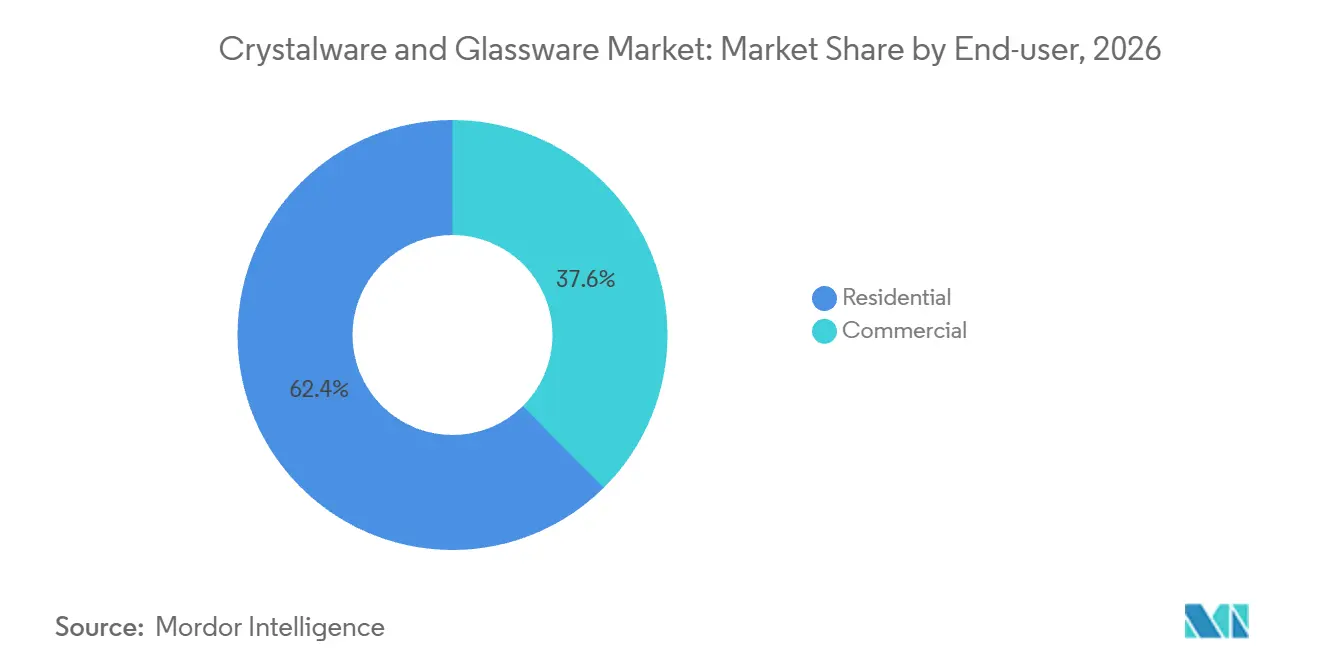
Residential Scale Meets Commercial Growth VelocityResidential consumers held 62.41% of the crystalware and glassware market share in 2026. This large base includes practical purchases of everyday drinkware as well as gifting, bridal registry, and home styling purchases. Premium buyers place more value on recognized brands, craft stories, and collectible design. Mid-market consumers focus more closely on dishwasher safety, chip resistance, and coordinated table settings. Commercial users are forecast to grow at a 6.26% CAGR through 2032. The crystalware and glassware market benefits from demand at hotels, resorts, fine-dining restaurants, cafés, caterers, and airline lounges. These buyers increasingly seek products that combine presentation quality with dependable replenishment. Catering and event operators also favor stackable and reinforced designs that reduce handling losses.
Commercial demand is not uniform across venues. Fine-dining restaurants and luxury hotels use bespoke stemware and signature collections to reinforce brand positioning. Cafés and specialty beverage outlets create higher-volume demand through the expansion of coffee, craft beer, and cocktail service. Healthcare and institutional catering prioritize safety, availability, and cleaning performance. Korean Air’s selection of Baccarat and RIEDEL for renovated premium lounges shows how high-service operators use glassware in the overall guest experience. Residential buyers increasingly purchase daily-use and premium products from the same brand. That behavior gives manufacturers a chance to cross-sell and build broader household collections. It also reduces the historical separation between formal crystal retail and everyday glassware retail.
By Distribution Channel:
B2C/Retail Scales Through Digital While B2B Captures Institutional ValueB2C/Retail held 70.44% of the crystalware and glassware market share in 2026 and is forecast to grow at a 5.80% CAGR through 2032. The channel benefits from its reach across online stores, specialty retailers, supermarkets, home centers, and local stores. Brand-owned online sales offer a broader assortment and more detailed product explanations than many physical outlets. Digital content also helps consumers understand the use of specific wine, beer, cocktail, and serving formats. Specialty stores remain relevant where buyers want to see and handle premium products before purchase. Supermarkets and home centers retain a role in practical, lower-priced categories. In price-sensitive regions, local independent stores remain important because they provide access and established consumer trust. The crystalware and glassware market needs channel strategies that balance digital discovery and local retail realities.
B2B and direct sales play an important role in hospitality procurement, as operators require consistent product specifications, timely replenishment, and customization to meet their operational needs. Direct supplier relationships facilitate quality control and reliable supply across multi-location restaurant and hotel chains. Large distributors further streamline procurement by offering multiple tabletop product categories through a single channel, reducing purchasing complexity for commercial buyers. These advantages strengthen the role of B2B distribution in serving institutional customers, while single-category suppliers can improve market access through strategic distribution partnerships.
Geography Analysis
Asia-Pacific held 37.65% of the crystalware and glassware market share in 2026 and is forecast to grow at a 6.39% CAGR through 2032. The region combines hospitality investment with larger urban consumer groups that are moving beyond generic household products. China, India, and Southeast Asia support both commercial replacement demand and higher-value residential purchases. Specialty coffee, craft beer, and cocktail venues also increase demand for differentiated serviceware. Baccarat opened its first India flagship boutique at The Chanakya in New Delhi in April 2025. The company identified a wider Indian expansion plan that included additional city locations. These moves show the region’s importance for luxury retail as well as commercial glassware.
Europe remains the design, heritage, and manufacturing center for many leading brands in the crystalware and glassware market. The region includes RIEDEL, Zwiesel Glas, Waterford, Baccarat, Saint-Louis, Lalique, Arc 1825, and Bormioli Rocco. Mature consumer markets limit volume growth, so the main opportunity is higher average selling value through premium products and design differentiation. Arc 1825 completed an ownership transfer to Timothée Durand in April 2026 after court-supervised restructuring proceedings, preserving more than 2,700 jobs at Arques. The company secured EUR 50 million in continuation financing. European makers also face an energy transition challenge because production remains reliant on gas-intensive furnace operations.
North America is a stable, premium-oriented crystalware and glassware market where gifting, direct sales, and foodservice replacement demand support purchases. Heritage brands use bridal registry, gift occasions, and online product education to maintain relevance. Full-service restaurants and premium hospitality establishments generate recurring demand for durable serviceware. South America is smaller, with Brazil and Chile standing out through luxury hotels and premium dining, though import conditions and macroeconomic conditions constrain demand. The Middle East and Africa offer different opportunities because luxury hospitality development supports premium commercial procurement. The Baccarat Hotel and Residences Dubai project was announced for a 2026 opening, while Baccarat Residences Saadiyat in Abu Dhabi was designed by Sou Fujimoto. These projects support visibility for high-end crystal brands. Nigeria and South Africa remain longer-term residential opportunities as formal retail access and disposable incomes develop.
Competitive Landscape
The crystalware and glassware market is fragmented. This concentration level indicates that no company has enough share to control pricing across the market. Scale manufacturers, including Şişecam, Arc 1825, Libbey, Bormioli Rocco, and Ocean Glass, compete through production efficiency, distribution reach, and reliable supply. Heritage houses, including RIEDEL, Baccarat, Saint-Louis, Lalique, and Waterford, compete through craftsmanship, brand history, product design, and premium retail. This division creates room for companies that can offer fine visual quality at more accessible price points. The crystalware and glassware market also rewards suppliers that can combine lead-free materials with consistent dishwasher durability. The result is a competitive field where product engineering and channel execution matter as much as brand recognition.
Leading manufacturers are pursuing different strategic moves. Arc 1825 launched its Extra-Thin collection in October 2025, with stemware that it said was 40% thinner than its standard range. In September 2025, Şişecam commissioned new frosted glass and energy-glass lines at Tarsus under a EUR 200 million (USD 235.3 million) investment program. In April 2025, Baccarat expanded its retail presence in India through the opening of its New Delhi flagship. These actions show that companies are using product development, manufacturing investment, and geographic retail expansion in parallel. The crystalware and glassware market gives an advantage to suppliers that can tailor these approaches to commercial and residential buyers. Companies without scale or a differentiated brand may struggle to absorb energy, compliance, and logistics costs.
Materials technology is becoming a more meaningful competitive factor. In September 2025, Penn State University and Bormioli Luigi completed a pilot trial for LionGlass, a composition designed to melt at up to 400°C below soda-lime glass temperatures and remove direct CO2 emissions from the batch process. The company example suggests that lower-temperature production may become an important route to reduce energy exposure. Schott Zwiesel’s Tritan crystal glass and Toyo Sasaki’s Fine Crystal® show the commercial potential of strong, clear, lead-free materials. Compliance requirements also raise the minimum technical standard for suppliers and can reduce the appeal of unqualified low-cost products. The crystalware and glassware market remains open to new entrants, but they need clear material, design, or route-to-market advantages. Established players can defend their positions by combining proven quality with digital sales and hospitality relationships.
Crystalware and Glassware Industry Leaders
-
Şişecam Group
-
Fiskars Group
-
Villeroy & Boch AG
-
Lifetime Brands, Inc.
-
Libbey, Inc.
- *Disclaimer: Major Players sorted in no particular order
Crystalware and Glassware Market Companies Covered in this Report
- Şişecam Group
- Fiskars Group
- Villeroy & Boch AG
- Lifetime Brands, Inc.
- Libbey, Inc.
- Stolzle Glass Group
- Dartington Crystal
- Arc International
- Bormioli Luigi S.p.A.
- Bormioli Rocco
- RIEDEL Glass Works
- Zwiesel Kristallglas AG
- Waterford
- Baccarat SA
- Saint-Louis
- Lalique Group SA
- Duralex International
- Ocean Glass Public Company Limited
- Lucaris
- Borosil Limited
Recent Industry Developments in Crystalware and Glassware Market
- October 2026: Bormioli Luigi unveiled Indue at Luxe Pack Monaco 2026, the first dual-compartment glass bottle designed for luxury cosmetic formulations requiring on-demand mixing of sensitive active ingredients. The innovation addresses a format previously available only in plastic, adding a glass-luxury dimension to dual-formula packaging in collaboration with Aptar Beauty.
- June 2026: Arc 1825 launched the Mylla and Galéa tasting-glass collections, machine-produced stemware with 4mm stems and 0.7mm rim walls, matching the fineness of handmade crystal at industrial scale. The achievement, realized through cross-functional work on the Arques "L" furnace and a breakthrough in high-temperature hot-cut technology, represents a step-change in the price-performance curve of machine-made fine glassware.
- April 2026: Korean Air opened redesigned First Class and Prestige Class lounges at Incheon Terminal 2 following a KRW 110 billion, 42-month renovation. Baccarat and Riedel glassware were specified for first-class table service, demonstrating the growing role of luxury crystalware in premium airline lounge positioning.
- March 2026: Arc France’s assets were transferred to Timothée Durand. The plan preserved more than 2,700 jobs at the Arques site, provided EUR 50 million in continuation financing, and led to the rebrand as Arc 1825.
Global Crystalware and Glassware Market Report Scope
Segmentation Overview
| Glassware | Glass Cups and Mugs |
| Glass Bowls | |
| Glass Plates and Dinnerware | |
| Glass Jars and Containers | |
| Glass Bottles Used Within Tabletop and Serveware Portfolios | |
| Others | |
| Crystalware | Crystal Glasses |
| Crystal Vases | |
| Crystal Bowls | |
| Crystal Decanters | |
| Crystal Figurines and Collectibles | |
| Crystal Serveware | |
| Others |
| Soda-Lime Glass |
| Borosilicate Glass |
| Lead-Free Crystal Glass |
| Lead Crystal Glass |
| Others |
| Residential | |
| Commercial | Hotels and Resorts |
| Restaurants and Fine Dining | |
| Cafés and Specialty Beverage Outlets | |
| Catering and Event Management | |
| Others Commercial End Users |
| B2B/Direct Sales from Manufacturers | |
| B2C/Retail | Home Centers/DIY |
| Supermarkets and Hypermarkets | |
| Specialty Stores | |
| Local Mom and Pop Stores | |
| Online | |
| Other Distribution Channels |
| North America | Canada |
| United States | |
| Mexico | |
| South America | Brazil |
| Peru | |
| Chile | |
| Argentina | |
| Rest of South America | |
| Europe | United Kingdom |
| Germany | |
| France | |
| Spain | |
| Italy | |
| BENELUX (Belgium, Netherlands, Luxembourg) | |
| NORDICS (Denmark, Finland, Iceland, Norway, Sweden) | |
| Rest of Europe | |
| Asia-Pacific | India |
| China | |
| Japan | |
| Australia | |
| South Korea | |
| South-East Asia | |
| Rest of Asia-Pacific | |
| Middle East & Africa | United Arab Emirates |
| Saudi Arabia | |
| South Africa | |
| Nigeria | |
| Rest of Middle East & Africa |
| By Product Type | Glassware | Glass Cups and Mugs |
| Glass Bowls | ||
| Glass Plates and Dinnerware | ||
| Glass Jars and Containers | ||
| Glass Bottles Used Within Tabletop and Serveware Portfolios | ||
| Others | ||
| Crystalware | Crystal Glasses | |
| Crystal Vases | ||
| Crystal Bowls | ||
| Crystal Decanters | ||
| Crystal Figurines and Collectibles | ||
| Crystal Serveware | ||
| Others | ||
| By Material | Soda-Lime Glass | |
| Borosilicate Glass | ||
| Lead-Free Crystal Glass | ||
| Lead Crystal Glass | ||
| Others | ||
| By End-User | Residential | |
| Commercial | Hotels and Resorts | |
| Restaurants and Fine Dining | ||
| Cafés and Specialty Beverage Outlets | ||
| Catering and Event Management | ||
| Others Commercial End Users | ||
| By Distribution Channel | B2B/Direct Sales from Manufacturers | |
| B2C/Retail | Home Centers/DIY | |
| Supermarkets and Hypermarkets | ||
| Specialty Stores | ||
| Local Mom and Pop Stores | ||
| Online | ||
| Other Distribution Channels | ||
| By Geography | North America | Canada |
| United States | ||
| Mexico | ||
| South America | Brazil | |
| Peru | ||
| Chile | ||
| Argentina | ||
| Rest of South America | ||
| Europe | United Kingdom | |
| Germany | ||
| France | ||
| Spain | ||
| Italy | ||
| BENELUX (Belgium, Netherlands, Luxembourg) | ||
| NORDICS (Denmark, Finland, Iceland, Norway, Sweden) | ||
| Rest of Europe | ||
| Asia-Pacific | India | |
| China | ||
| Japan | ||
| Australia | ||
| South Korea | ||
| South-East Asia | ||
| Rest of Asia-Pacific | ||
| Middle East & Africa | United Arab Emirates | |
| Saudi Arabia | ||
| South Africa | ||
| Nigeria | ||
| Rest of Middle East & Africa | ||
Key Questions Answered in the Report
What is the projected value of the crystalware and glassware market by 2032?
The crystalware and glassware market is projected to reach USD 11.90 billion by 2032, growing at a 4.45% CAGR from 2027.
Which product category has the largest share of crystalware and glassware sales?
Glassware held 73.26% of revenue in 2026, supported by everyday household and commercial replacement demand.
Which material is expected to grow fastest through 2032?
Borosilicate glass is forecast to grow at 6.06% CAGR because of its thermal-shock resistance and durability in frequent cleaning cycles.
Why are lead-free crystal products becoming more important?
Lead-free products address food-contact and sustainability expectations while preserving the brilliance and cutting qualities consumers expect from premium crystal.
Which region is expected to grow fastest for crystalware and glassware?
Asia-Pacific is forecast to grow at a 6.39% CAGR through 2032, supported by hospitality development and rising demand for premium home products.