
Critical Illness Insurance Market Size and Share
Market Overview
| Study Period | 2021 - 2032 |
|---|---|
| Market Size (2027) | USD 126.10 Billion |
| Market Size (2032) | USD 163.30 Billion |
| Growth Rate (2027 - 2032) | 5.30 % |
| Fastest Growing Market | Middle East and Africa |
| Largest Market | Asia-Pacific |
| Market Concentration | Low |
Major Players *Disclaimer: Major Players sorted in no particular order Image © Mordor Intelligence. Reuse requires attribution under CC BY 4.0. | |
Critical Illness Insurance Market Analysis by Mordor Intelligence
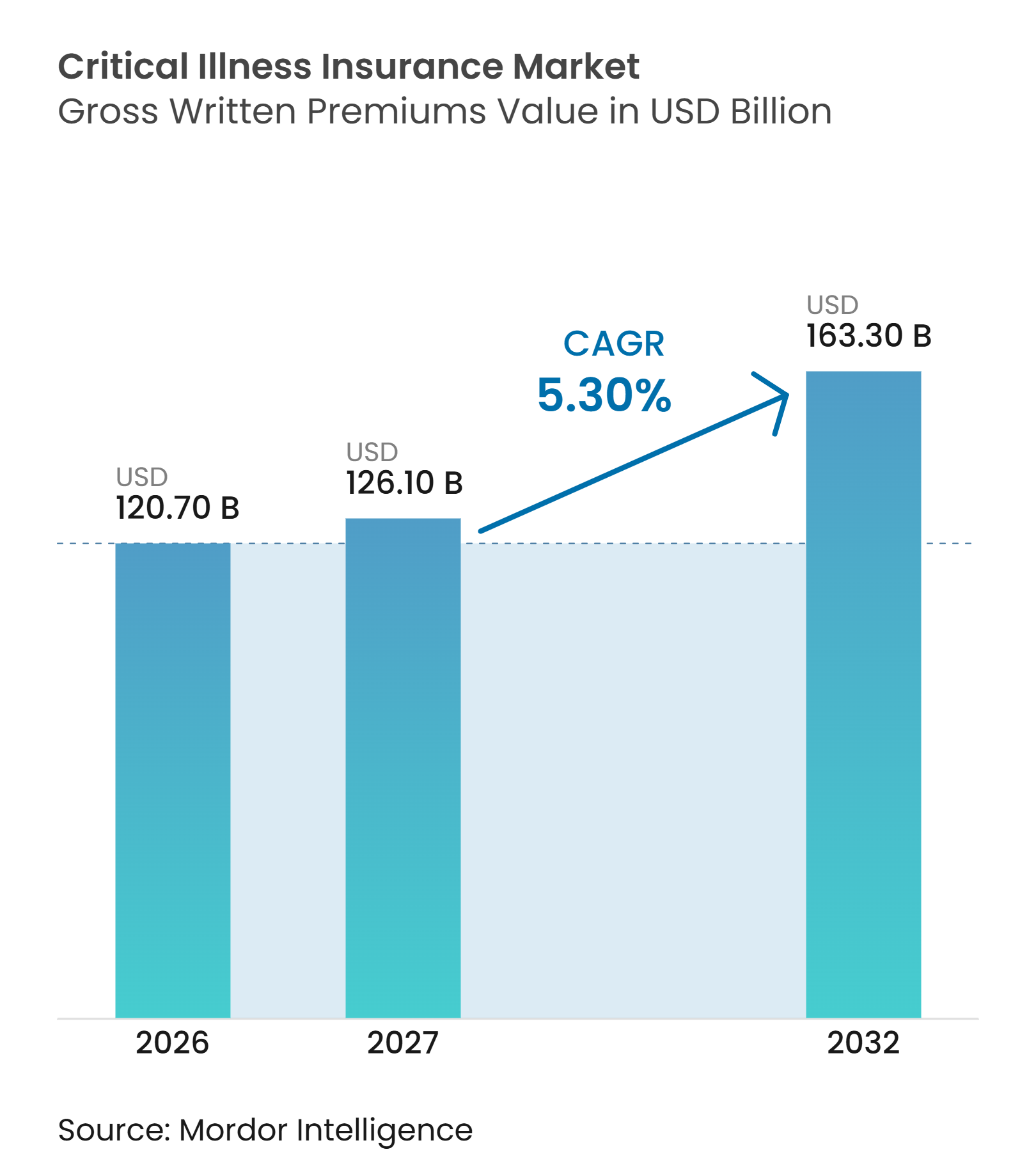
The Critical Illness Insurance Market size in terms of gross written premiums value is projected to be USD 120.70 billion in 2026, USD 126.10 billion in 2027, and reach USD 163.30 billion by 2032, growing at a CAGR of 5.30% from 2027 to 2032.
The product provides a cash payment after a covered diagnosis, which can support lost income, childcare, home changes, and treatments outside standard health plans. Higher diagnosis rates and longer survival after cancer, stroke, and cardiac events are expanding the need for protection that continues beyond the first claim. Insurers are responding through broader disease definitions, multi-claim designs, employer plans, and digital distribution. These changes also raise claims costs and make affordability a more important product-design issue. The critical illness insurance market is becoming more dependent on strong underwriting, reinsurance capacity, and clear policy definitions as products become more comprehensive.
Key Report Takeaways
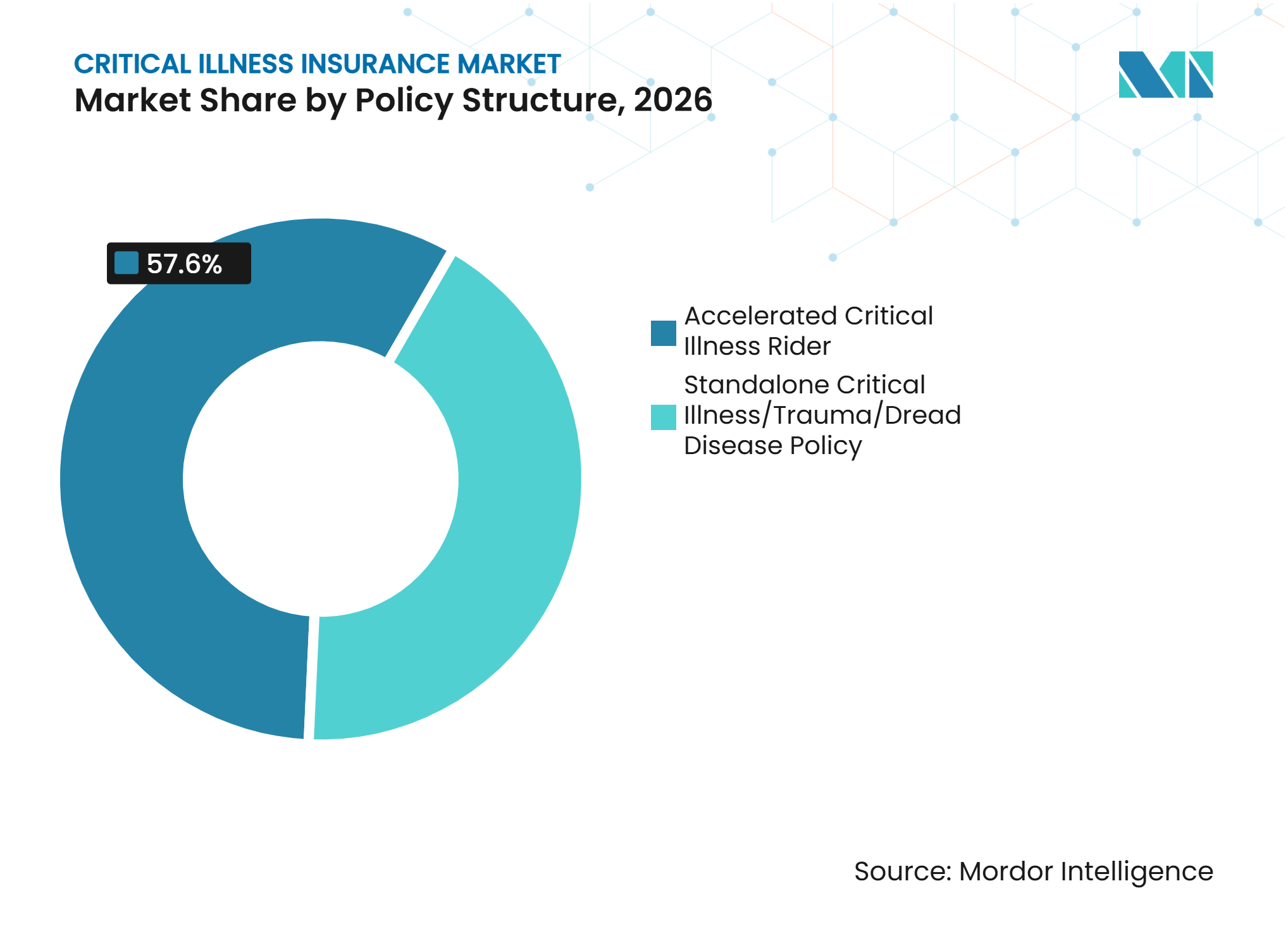
- By policy structure, accelerated critical illness riders captured 57.6% of the critical illness insurance market share in 2026, while standalone critical illness, trauma, and dread disease policies are projected to grow at a 7.2% CAGR through 2032.
- By contract form, individual retail policies held 66.8% of the critical illness insurance market share in 2026, while group policies are projected to grow at 6.8% CAGR through 2032.
- By benefit payment structure, lump-sum benefits accounted for 77.5% of the critical illness insurance market share in 2026, while combined and hybrid benefits are projected to grow at 8.1% CAGR through 2032.
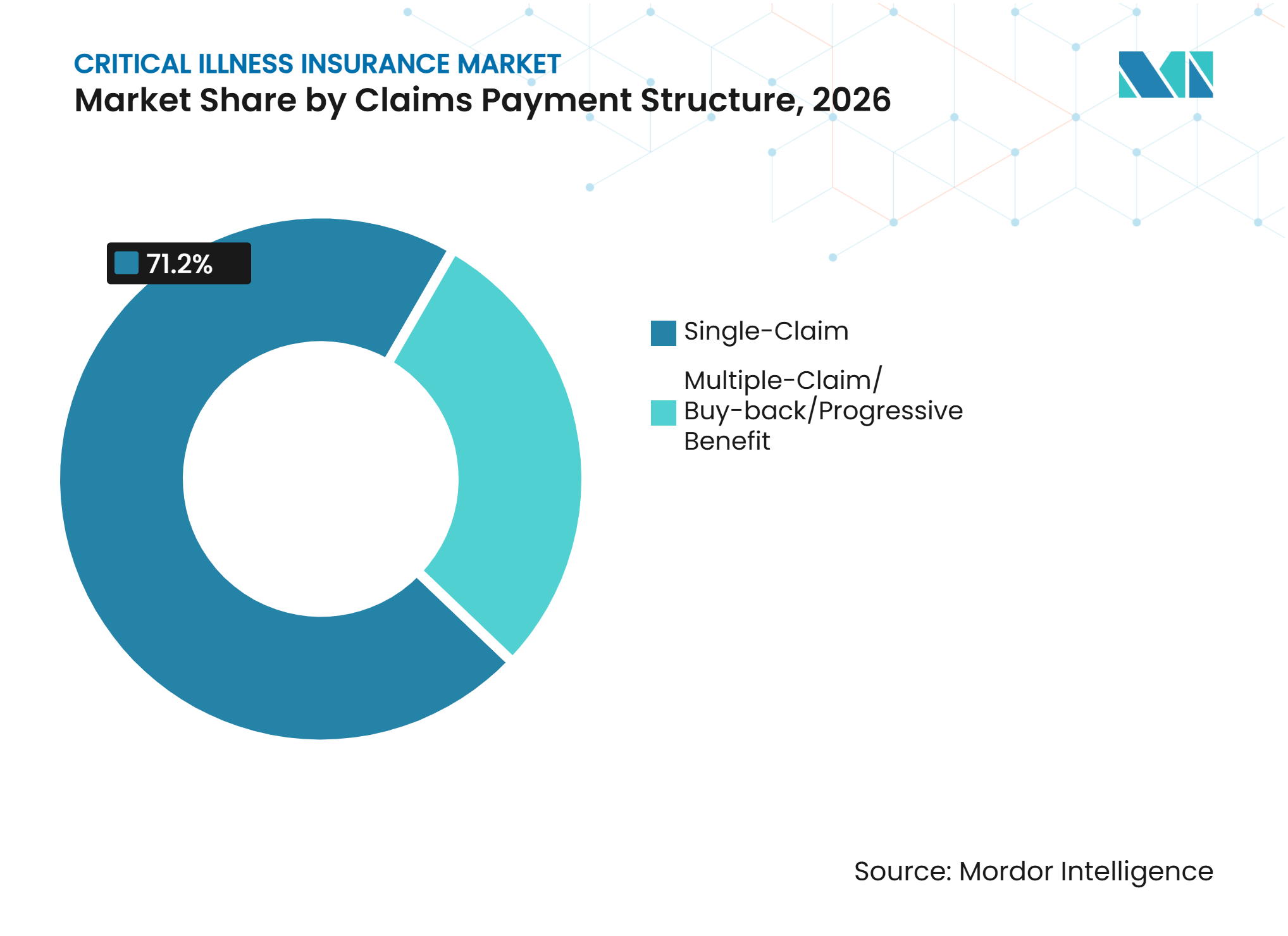
- By claims payment structure, single-claim policies held 71.2% of the critical illness insurance market share in 2026, while multiple-claim, buy-back, and progressive benefits are projected to grow at 9.2% CAGR through 2032.
- By distribution channel, agents and brokers captured 55.9% of the critical illness insurance market share in 2026, while digital aggregators and third-party portals are projected to grow at 10.4% CAGR through 2032.
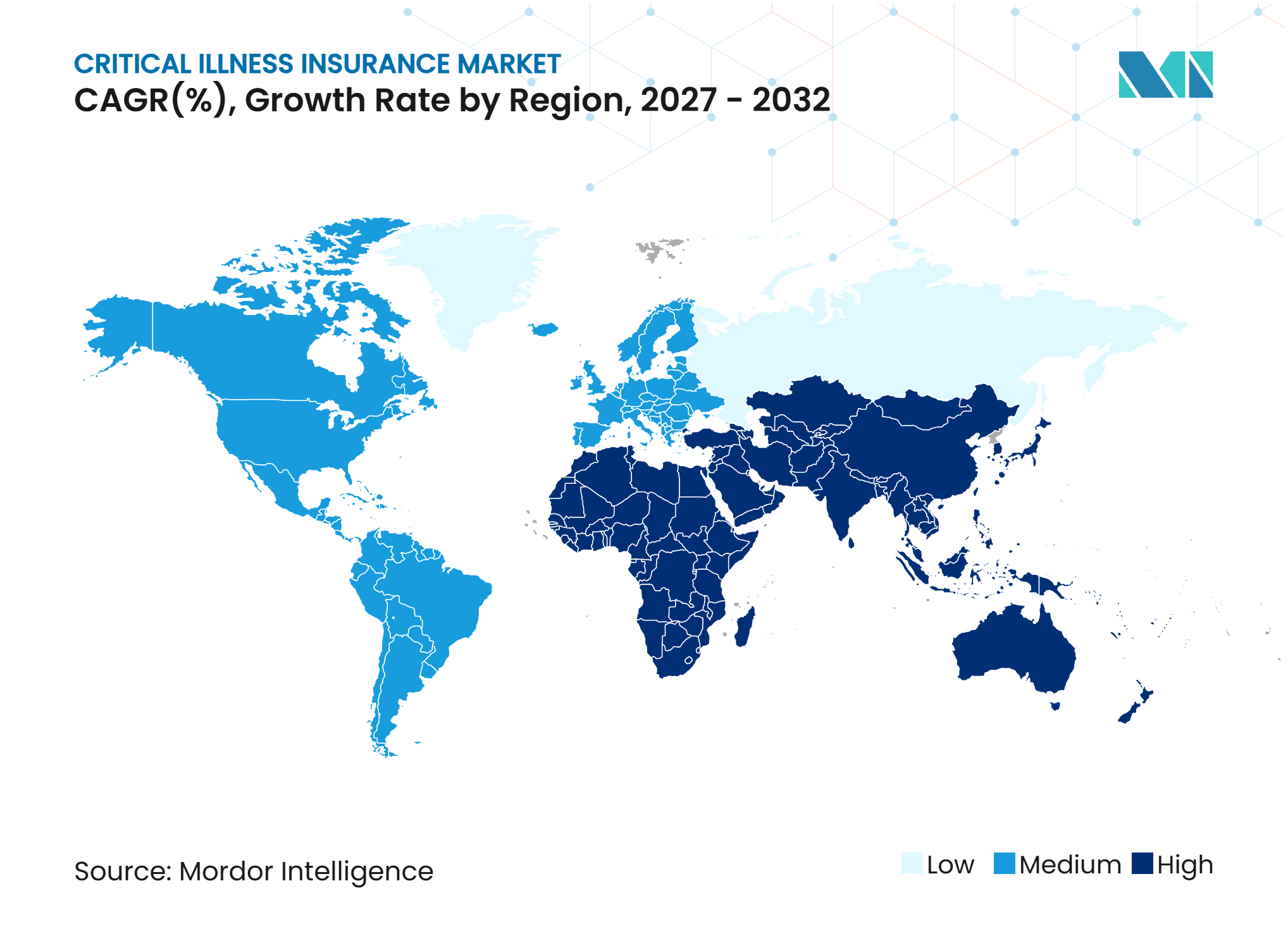
- By geography, Asia-Pacific captured 48.7% of the critical illness insurance market share in 2026, while the Middle East and Africa is projected to grow at an 8.6% CAGR through 2032.
Note: Market numbers in this report are based on Mordor Intelligence's proprietary estimation framework, which combines nine months of actuals with Q4 projections for base year 2026.
Market Trends and Insights
Drivers Impact Analysis of Critical Illness Insurance Market*
| Driver | (~) % Impact on CAGR Forecast | Geographic Relevance | Impact Timeline |
|---|---|---|---|
| Rising Critical Disease Incidence and Unmet Financial Protection Needs | 1.2% | Global | Long term (≥ 4 years) |
| Growing Demand for Lump-Sum Financial Protection Against Income Loss and Non-Medical Expenses | 0.9% | Global, strongest in Asia-Pacific and North America | Medium term (2–4 years) |
| Expansion of Employer-Sponsored and Voluntary Critical Illness Coverage | 0.7% | North America & Asia-Pacific | Medium term (2–4 years) |
| Digital Policy Distribution and Simplified Critical Illness Underwriting | 0.8% | Asia-Pacific core, spill-over to MEA | Short term (≤ 2 years) |
| Embedded Critical Illness Protection Through Banking, Workplace, and Healthcare Ecosystems | 0.6% | Global | Medium term (2–4 years) |
| Growing Adoption of Comprehensive, Early-Stage, and Multi-Claim Critical Illness Products | 0.7% | Asia-Pacific and Europe | Long term (≥ 4 years) |
| Source: Mordor Intelligence | |||
Rising Critical Disease Incidence and Unmet Financial Protection Needs
Cancer, cardiovascular disease, and stroke account for most critical illness claims in measured markets, while stronger diagnostic tools are identifying more cases. Gen Re’s Hong Kong study covered 10 insurers representing more than 95% of that market and recorded 69,000 claims through 2023. Cancer, heart conditions, and stroke represented 87% of claims among men and 94% among women in the study. Greater use of low-dose computed tomography in China has contributed to more lung-cancer claims among nonsmoking women, which creates risk estimates that may not reflect current diagnosis patterns. Aviva paid more than GBP 388 million (USD 493 million) in 2025 across 5,586 individual critical illness, children’s benefit, and total permanent disability claims[1]. Better survival after serious illness also increases the need for products that can respond to later medical events.
Demand for Lump-Sum Protection Against Income Loss and Non-Medical Expenses
Lump-sum protection addresses costs that medical reimbursement plans may not cover, including income loss, home adaptation, childcare, and treatment outside benefit schedules. This feature remains central to the critical illness insurance market because a policyholder can decide how to use the payment after a covered diagnosis. South Africa’s formally employed population held ZAR 1.1 trillion (USD 60 billion) in critical illness cover at the end of 2024 against annual earnings of ZAR 4 trillion (USD 218 billion), producing a 26% coverage ratio. The gap indicates that many households would have limited financial protection after a major diagnosis. In Singapore, total weighted new business premiums grew 14.3% year on year in the first quarter of 2026, showing demand for cover that supplements public health programs[2]. Employer sick-pay policies and public income-replacement reforms in Europe can still affect the relative demand for individual lump-sum cover.
Employer-Sponsored and Voluntary Coverage, Including Embedded Protection
Employer-sponsored group coverage is extending from large employers into mid-sized businesses and voluntary benefit programs. Employers use these plans to address employee concerns about income disruption after a serious diagnosis. MassMutual introduced group critical illness insurance in May 2025 with benefits that increase for more severe diagnoses and progression features that allow total payments of up to 200% of the certificate benefit. The United Kingdom Group Risk Development (GRiD) data showed 888,040 people insured for critical illness benefits in 2025, with GBP 70.4 billion (USD 95.0 billion) in total in-force sum assured and GBP 190.8 million (USD 257.6 million) paid to 2,475 claimants[3]. Cancer represented 69% of those group claims. AIA New Zealand introduced Severe Trauma cover for corporate clients in May 2026 at half the premium cost of traditional critical illness cover, seeking to lower adoption barriers for smaller employers.
Digital Distribution, Simplified Underwriting, and Comprehensive Multi-Claim Products
Digital distribution is reducing the distance between consumer interest and active coverage, particularly across Southeast Asia. Online sales can also extend reach beyond agency networks and major cities. Aviva expanded its artificial intelligence medical-report summarization tool to individual critical illness applications in March 2026 and reported that it halved review time for medical reports[4]. The Monetary Authority of Singapore (MAS) amended Notice 321 to align Direct Purchase Insurance (DPI) definitions with the Life Insurance Association’s Critical Illness Framework 2024 from October 1, 2025. Standardized definitions can make digital products easier to compare and understand. The same channels can support multi-claim products, which are becoming more relevant as people survive their first serious illness and later experience another covered event.
Restraints Impact Analysis of Critical Illness Insurance Market*
| Restraint | (~) % Impact on CAGR Forecast | Geographic Relevance | Impact Timeline |
|---|---|---|---|
| Limited Consumer Awareness of Covered Conditions, Disease Definitions, and Claim Eligibility | -0.4% | Global, most acute in MEA and South Asia | Long term (≥ 4 years) |
| Premium Affordability Constraints and Increasing Cost of Risk Protection | -0.3% | Global | Medium term (2–4 years) |
| Rising Early-Stage and Repeat-Claim Incidence Increasing Claims Volatility | -0.2% | Asia-Pacific, Europe | Long term (≥ 4 years) |
| Adverse Selection and Medical Evidence Constraints in Critical Illness Underwriting | -0.2% | Global | Medium term (2–4 years) |
| Source: Mordor Intelligence | |||
Limited Awareness of Covered Conditions, Definitions, and Claim Eligibility
Consumer understanding remains a major constraint because many buyers overestimate the conditions covered and underestimate the precise requirements for a claim. South Africa’s 2025 insurance-gap study placed critical illness protection at the lowest penetration level among protection categories for formally employed workers. The study also reported that more than 24,000 income earners were expected to receive a serious illness diagnosis in 2025. Aviva’s 2025 claims information showed that a diagnosis failing to meet the policy definition was a common reason for claim non-payment. The Monetary Authority of Singapore asked the Life Insurance Association to consider whether future definitions should rely less on specified procedures and more on disease severity. Clearer definitions could reduce disputes and improve consumer confidence.
Premium Affordability, Claims Volatility, Adverse Selection, and Medical Evidence Constraints
Long-duration policies face pressure when lower investment yields, wider disease definitions, and rising incidence rates raise the cost of protection. Broader coverage can improve the value of a policy but can also make it less affordable for lower-income households. Insurers must also manage adverse selection when simplified underwriting provides limited medical evidence at the point of sale. More early-stage and repeat claims increase claims volatility, especially in products that provide buy-back or multiple-claim features. The critical illness insurance industry must balance wider access with adequate pricing and reserves. In Malaysia, medical inflation of 15%-16% has increased affordability pressure, even as the case for income protection has become stronger.
*Our forecasts treat driver/restraint impacts as directional, not additive. The impact forecasts reflect baseline growth, mix effects, and variable interactions.
Critical Illness Insurance Market Segment Analysis
By Policy Structure:
Riders Remain Established, While Standalone Cover ExpandsAccelerated critical illness riders held 57.6% of the critical illness insurance market share in 2026. Their position reflects the traditional practice of adding critical illness protection to term or whole-life contracts. A rider normally pays an early benefit from the life policy’s sum assured after a covered diagnosis. This structure can reduce the remaining death benefit when a critical illness claim is made. Standalone critical illness, trauma, and dread disease policies are forecast to grow at 7.2% CAGR through 2032. The faster growth reflects demand for cover that can be selected separately from life insurance.
Legal & General launched standalone critical illness cover in the United Kingdom in October 2026, allowing advisers to recommend this protection independently from a life policy. The launch responds to adviser demand for more flexibility in protection planning. AIA China’s Ying Ruyi series, launched in September 2025, combined participating whole-life coverage with critical illness protection, supporting its protection-focused product strategy. Protection products accounted for 44% of agency-channel value of new business (VONB) in the second half of 2025. Standalone policies can make benefit levels, product terms, and pricing easier to assess against a buyer’s life cover. Riders nevertheless remain relevant where consumers want a single application and a combined protection package. The critical illness insurance market will continue to include both approaches because they address different buying preferences.


By Contract Form:
Individual Retail Policies Lead, While Group Plans Broaden AccessIndividual retail policies held a 66.8% share of the critical illness insurance market size in 2026. This position reflects established demand across Asia-Pacific, North America, and Europe, where many working-age consumers buy voluntary health protection directly. Individual plans allow customers to select benefit amounts and add features based on personal financial needs. Their growth depends on adviser access, consumer awareness, and the affordability of premiums. Group policies are expected to grow at a 6.8% CAGR through 2032. Employers are using voluntary and employer-paid options to address income protection gaps among their workforce.
MassMutual’s 2025 group launch used severity-linked and progression-linked benefits rather than competing only on premiums. Such designs can increase payments as a condition becomes more severe. Group Risk Development recorded 888,040 people insured for group critical illness benefits in the United Kingdom during 2025. Group schemes can introduce employees to critical illness cover before they consider individual top-up protection. AIA New Zealand’s lower-cost Severe Trauma cover shows how insurers are trying to make employer plans more accessible to small and mid-sized businesses.
By Benefit Payment Structure:
Lump-Sum Benefits Reflect the Core Need, While Hybrid Plans Address Longer CareLump-sum benefits accounted for 77.5% of the critical illness insurance market share in 2026. This structure pays unrestricted cash after diagnosis, allowing a customer to prioritize income replacement, medical costs, home changes, or daily expenses. It remains the clearest expression of the product’s role as financial protection rather than reimbursement. The payment can be used without submitting invoices for each expense. Combined and hybrid benefits are projected to grow at an 8.1% CAGR through 2032. These products combine an initial cash payment with periodic income support or related benefits.
Hybrid plans respond to treatment pathways that can extend for months or years, especially for major cancers and neurological conditions. The Association of British Insurers reported an average critical illness payment of GBP 67,000 (USD 85,600) in 2025. AIA Philippines launched AIA Critical Protect Plus in April 2026 with up to 3 major illness claims, 106 covered conditions, and coverage expandable to 146 conditions through riders. Periodic income benefits remain smaller than lump-sum coverage but are relevant for buyers focused on salary continuity. The critical illness insurance market size for hybrid products is supported by the need to spread protection across a prolonged recovery period.
By Claims Payment Structure:
Single-Claim Plans Lead, While Repeat-Claim Cover Grows FasterSingle-claim policies accounted for 71.2% of the critical illness insurance market size in 2026. The structure was designed around one material diagnosis and one major payment that ends the cover. It remains widely used because it is simple for customers and insurers to understand. However, higher survival rates mean that more people can recover from a first event and later experience another serious illness. Multiple-claim, buy-back, and progressive benefits are projected to grow at a 9.2% CAGR through 2032. This is the highest forecast growth rate across the reported segmentation types.
AIA Hong Kong launched its On Your Side series in November 2025 with up to 10 additional claims and maximum benefits of 1,100% of the initial sum assured across 115 conditions. The product demonstrates how insurers are adapting benefit design to repeat diagnoses and longer survival. Multiple-claim structures require careful pricing because early-stage, repeat, and later claims can increase lifetime payments. They also require clear explanations of waiting periods, buy-back terms, and conditions for subsequent claims. Comparison tools can help customers distinguish the trade-offs between lower-cost single-claim cover and broader repeat-claim protection. This category is reshaping product design across the critical illness insurance market.

By Distribution Channel:
Advice Channels Lead, While Digital Aggregators Expand ReachAgents and brokers captured a 55.9% share in 2026 because critical illness cover often requires detailed discussion of definitions, exclusions, and benefit choices. The role of advice remains important when buyers are considering serious medical events and long-term financial protection. Agents and brokers can also help customers coordinate cover with employer benefits and life insurance. Digital aggregators and third-party portals are projected to grow at 10.4% CAGR through 2032. Their expansion reflects demand for easier comparison, faster applications, and self-service purchasing.
Aviva and Tesco Insurance expanded their protection partnership in May 2026 by launching critical illness cover through Tesco’s digital channels and store network. The plan covers 52 conditions and includes children’s critical illness benefits of up to GBP 25,000 (USD 33,500). Digital channels tend to first support simpler products, while more comprehensive plans may still need adviser guidance. The channel can nevertheless improve access for people who do not use independent financial advisers. Bancassurance, direct-to-consumer sales, and embedded partnerships are also gaining relevance as banks, employers, and retailers add protection products to wider customer relationships. The critical illness insurance industry is therefore balancing digital reach with the value of advice for more complex decisions.
Geography Analysis
Asia-Pacific
Asia-Pacific accounted for 48.7% of the critical illness insurance market in 2026. China, Hong Kong, Singapore, and other developing Asian insurance markets support the region's importance. The Society of Actuaries Research Institute identified Hong Kong, Malaysia, Taiwan, Thailand, South Korea, Japan, and Singapore as priority markets for research into critical illness incidence and claims severity, with additional interest in Indonesia, the Philippines, and Vietnam. Singapore's life insurance industry paid SGD 555 million (USD 429 million) in death, critical illness, and total permanent disability claims during Q1 2026. The industry also recorded SGD 1.69 billion (USD 1.31 billion) in total weighted new business premiums, representing 14.3% year-on-year growth, according to the revised LIA results. Singapore's Monetary Authority amended its Direct Purchase Insurance requirements to align the definitions of 30 critical illnesses with the Life Insurance Association's updated 2024 Critical Illness Framework, effective October 1, 2025. This supports greater consistency in product definitions and comparison.
Middle East and Africa
The Middle East and Africa is projected to grow at an 8.6% CAGR through 2032, making it the fastest-growing geographic segment. South Africa illustrates the protection gap: critical illness coverage among formally employed income earners stood at only 26% of their aggregate annual earnings at the end of 2024, while more than 85% had no critical illness cover. PPS paid ZAR 792.8 million (USD 43.6 million) in critical illness benefits in 2025, an increase of 51% from 2024. In the Middle East, the Society of Actuaries Research Institute has also sought research on critical illness cost trends, highlighting the need for better regional data to support product design, claims assessment, and pricing.
North America, Europe, and South America
North America benefits from an established employer-sponsored voluntary benefits market. In the United States, 53% of employers offered critical illness insurance in 2025, up from 51% in 2024, according to the Society for Human Resource Management. This indicates growing availability of critical illness coverage through workplace benefit programs. Europe has an established individual protection market, with the United Kingdom providing evidence of continued demand. United Kingdom insurers paid GBP 1.25 billion (USD 1.58 billion) in individual critical illness claims in 2025, while Legal & General (L&G) introduced standalone critical illness cover in October 2026, giving advisers greater flexibility to offer it independently of life insurance. In South America, Brazil provides a sizeable private-health distribution base: the country's regulator reported approximately 53.1 million beneficiaries of private medical plans in June 2026, including substantial participation in employer-sponsored plans.
Competitive Landscape
Market Concentration
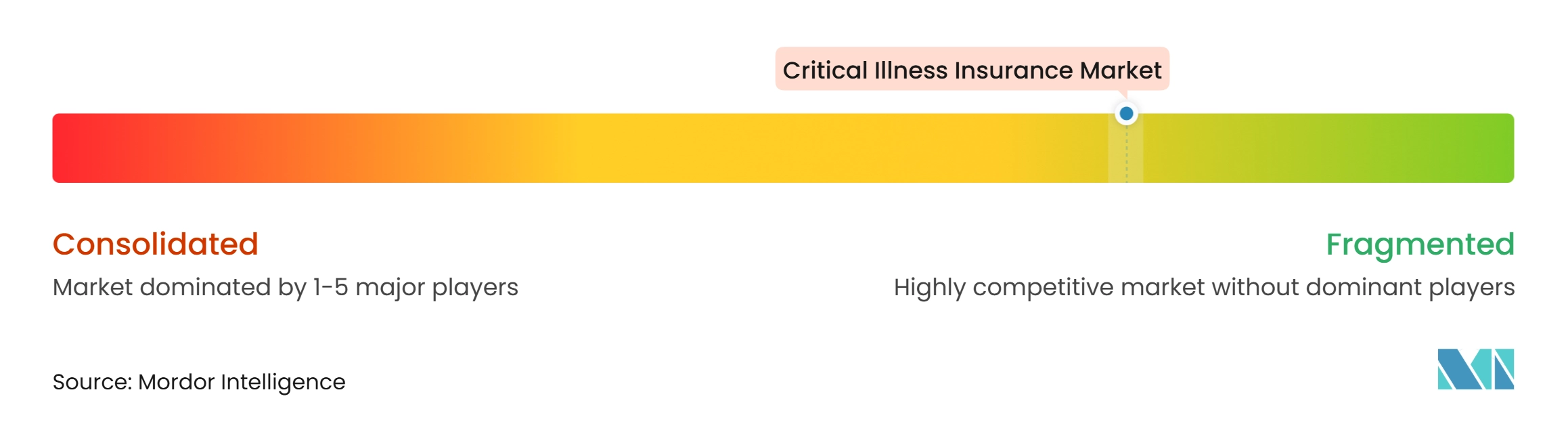
The Asia-Pacific critical illness insurance market is fragmented, with competition distributed among domestic insurers, regional life insurance groups, and multinational insurance companies. China Life, Ping An Insurance, and China Pacific Insurance hold major in-force premium positions in China, supported by their established customer bases and distribution networks. AIA, Prudential plc, AXA, Aviva, and Allianz compete across several regional markets through agency, bancassurance, and other distribution channels. However, the leading insurers' positions vary across individual countries. Competition is increasingly based on product design, broader disease coverage, multiple-claim benefits, digital underwriting, and claims management capabilities rather than pricing alone.
Product differentiation is becoming more prominent as insurers move beyond traditional single-payout critical illness policies. In November 2025, AIA Hong Kong introduced its On Your Side Critical Illness Protection Series, with one plan offering coverage for 115 diseases, up to 10 additional claims, and maximum benefits of 1,100% of the initial sum assured. In April 2026, AIA Philippines launched Critical Protect Plus, offering up to three major illness claims and coverage for 106 conditions, expandable to 146 through optional riders. Other insurers have followed similar strategies: Cigna Healthcare Hong Kong introduced its VitalGuard Critical Illness Plan in January 2026, while AIA Singapore launched Protect 3 in May 2026, providing multi-stage protection against cancer, heart attack, and stroke. In August 2026, Allianz Life Malaysia introduced HealthCover Prime, offering multiple claims and potential benefits of up to 635% of the insured amount. Chubb Life Hong Kong also launched its Chubb Care Critical Illness Series in August 2026, extending coverage options to cancer survivors and individuals with cardiovascular disease or diabetes histories. These developments demonstrate increasing competition around repeat claims, condition-specific protection, and coverage for customers with more complex medical histories.
Technology adoption and regulatory developments are further influencing competitive dynamics. In March 2026, Aviva extended its artificial intelligence underwriting summarization tool to individual critical illness applications, reducing the time underwriters spend reviewing medical reports by approximately 50%. In September 2025, China's National Financial Regulatory Administration issued guidance directing insurers to update critical illness definitions and develop products addressing the needs of people with pre-existing conditions and rare diseases. In August 2026, Bowtie announced the adoption of the Hong Kong Federation of Insurers' standardized critical illness definitions across new and existing policies, supporting greater consistency in policy coverage. FWD Hong Kong subsequently launched its Crisis AllSupporter Insurance Plan Series in October 2026, incorporating standardized definitions, multiple-claim protection, and coverage across three generations. These developments create opportunities for insurers with strong actuarial capabilities, medical-risk assessment systems, and reinsurance relationships, while established carriers retain advantages in distribution and claims experience. Overall, competition remains fragmented, with product innovation, underwriting efficiency, transparent policy definitions, and broader customer eligibility shaping competitive positioning.
Critical Illness Insurance Industry Leaders
-
China Life Insurance Company Limited
-
Ping An Insurance (Group) Company of China, Ltd.
-
Aflac Incorporated
-
AIA Group Limited
-
Allianz SE
- *Disclaimer: Major Players sorted in no particular order
Critical Illness Insurance Market Companies Covered in this Report
- Aflac Incorporated
- AIA Group Limited
- Ping An Insurance (Group) Company of China, Ltd.
- Allianz SE
- Aviva plc
- China Life Insurance Company Limited
- Sun Life Financial Inc.
- Manulife Financial Corporation
- MetLife, Inc.
- Legal & General Group plc
- Zurich Insurance Group Ltd.
- Sun Life Financial Inc.
- The Cigna Group
- Unum Group
- Royal London Mutual Insurance Society Limited
- Chubb Limited
- Bupa Group
- FWD Group Holdings Limited
- ICICI Prudential Life Insurance Company Limited
- HSBC Holdings plc
Recent Industry Developments in Critical Illness Insurance Market
- October 2026: Legal & General launched Standalone Critical Illness Cover in the United Kingdom, enabling advisers to recommend critical illness cover independently of a life insurance policy. The launch was developed in response to adviser and market insights and reflects growing demand for protection planning flexibility, extending Legal & General’s existing life and critical illness proposition.
- September 2026: MoneyHero Limited launched a critical illness insurance comparison marketplace in Hong Kong, listing 13 plans from 5 insurers covering up to 71 conditions with sums assured up to HKD 4 million (USD 512,000), allowing users to directly compare single-claim and multiple-claim options.
- May 2026: Aviva and Tesco Insurance expanded their protection partnership with the launch of critical illness cover distributed through Tesco’s digital channels and store network, building on their 2025 life insurance co-branded product, covering 52 conditions and including children’s critical illness benefits up to GBP 25,000 (USD 31,750).
- May 2026: AIA Singapore launched AIA Protect 3, a multi-stage critical illness plan covering cancer, heart attack, and stroke from early to major stages with protection up to age 85, targeting Singapore’s 74% critical illness protection gap with premiums from SGD 0.565 (USD 0.42) per day.
Global Critical Illness Insurance Market Report Scope
Segmentation Overview
| Standalone Critical Illness / Trauma / Dread Disease Policy |
| Accelerated Critical Illness Rider |
| Individual Retail Policies |
| Group Policies |
| Lump-Sum Benefit |
| Periodic Income Benefit |
| Combined / Hybrid Benefit |
| Single-Claim |
| Multiple-Claim / Buy-back / Progressive Benefit |
| Agents and Brokers |
| Bancassurance |
| Direct-to-Consumer Insurer Channels |
| Digital Aggregators and Third-Party Portals |
| Affinity and Embedded Partnerships |
| North America | United States |
| Canada | |
| Mexico | |
| South America | Brazil |
| Argentina | |
| Rest of South America | |
| Europe | United Kingdom |
| Germany | |
| France | |
| Italy | |
| Spain | |
| Rest of Europe | |
| Asia-Pacific | China |
| Japan | |
| India | |
| South Korea | |
| Australia | |
| Indonesia | |
| Thailand | |
| Malaysia | |
| Singapore | |
| Vietnam | |
| Rest of Asia-Pacific | |
| Middle East and Africa | Saudi Arabia |
| United Arab Emirates | |
| Turkey | |
| South Africa | |
| Egypt | |
| Rest of Middle East and Africa |
| By Policy Structure | Standalone Critical Illness / Trauma / Dread Disease Policy | |
| Accelerated Critical Illness Rider | ||
| By Contract Form | Individual Retail Policies | |
| Group Policies | ||
| By Benefit Payment Structure | Lump-Sum Benefit | |
| Periodic Income Benefit | ||
| Combined / Hybrid Benefit | ||
| By Claims Payment Structure | Single-Claim | |
| Multiple-Claim / Buy-back / Progressive Benefit | ||
| By Distribution Channel | Agents and Brokers | |
| Bancassurance | ||
| Direct-to-Consumer Insurer Channels | ||
| Digital Aggregators and Third-Party Portals | ||
| Affinity and Embedded Partnerships | ||
| By Geography | North America | United States |
| Canada | ||
| Mexico | ||
| South America | Brazil | |
| Argentina | ||
| Rest of South America | ||
| Europe | United Kingdom | |
| Germany | ||
| France | ||
| Italy | ||
| Spain | ||
| Rest of Europe | ||
| Asia-Pacific | China | |
| Japan | ||
| India | ||
| South Korea | ||
| Australia | ||
| Indonesia | ||
| Thailand | ||
| Malaysia | ||
| Singapore | ||
| Vietnam | ||
| Rest of Asia-Pacific | ||
| Middle East and Africa | Saudi Arabia | |
| United Arab Emirates | ||
| Turkey | ||
| South Africa | ||
| Egypt | ||
| Rest of Middle East and Africa | ||
Key Questions Answered in the Report
What is the projected growth rate for critical illness insurance?
The critical illness insurance market is projected to grow at a 5.3% CAGR from 2027 to 2032 and reach USD 163.3 billion by 2032.
Which policy structure holds the largest share of critical illness cover?
Accelerated critical illness riders lead with 57.6% share in 2026, which supports their established position in the critical illness insurance market. Standalone policies are the faster-growing policy structure at 7.2% CAGR.
Why are multi-claim critical illness plans growing?
More people survive initial cancer, stroke, and cardiac events, increasing demand for protection against later covered illnesses in the critical illness insurance market. Multiple-claim plans are forecast to grow at 9.2% CAGR.
Which distribution channel is growing fastest for critical illness cover?
Digital aggregators and third-party portals are projected to grow at 10.4% CAGR through 2032, extending access to the critical illness insurance market through comparison tools and streamlined applications.
Which region has the largest critical illness insurance share?
Asia-Pacific holds 48.7% share in 2026, supported by China, Hong Kong, Singapore, India, Indonesia, and Vietnam. This makes the region central to the critical illness insurance market.
Which region is expected to grow fastest for critical illness cover?
The Middle East and Africa is forecast to grow at 8.6% CAGR through 2032, supported by protection gaps and employer health insurance requirements that are shaping the critical illness insurance market.