
Cordierite Market Size and Share
Market Overview
| Study Period | 2022 - 2032 |
|---|---|
| Market Size (2027) | USD 2.99 Billion |
| Market Size (2032) | USD 3.84 Billion |
| Growth Rate (2027 - 2032) | 5.12 % |
| Fastest Growing Market | Asia-Pacific |
| Largest Market | Asia-Pacific |
| Market Concentration | Medium |
Major Players *Disclaimer: Major Players sorted in no particular order Image © Mordor Intelligence. Reuse requires attribution under CC BY 4.0. | |
Cordierite Market Analysis by Mordor Intelligence
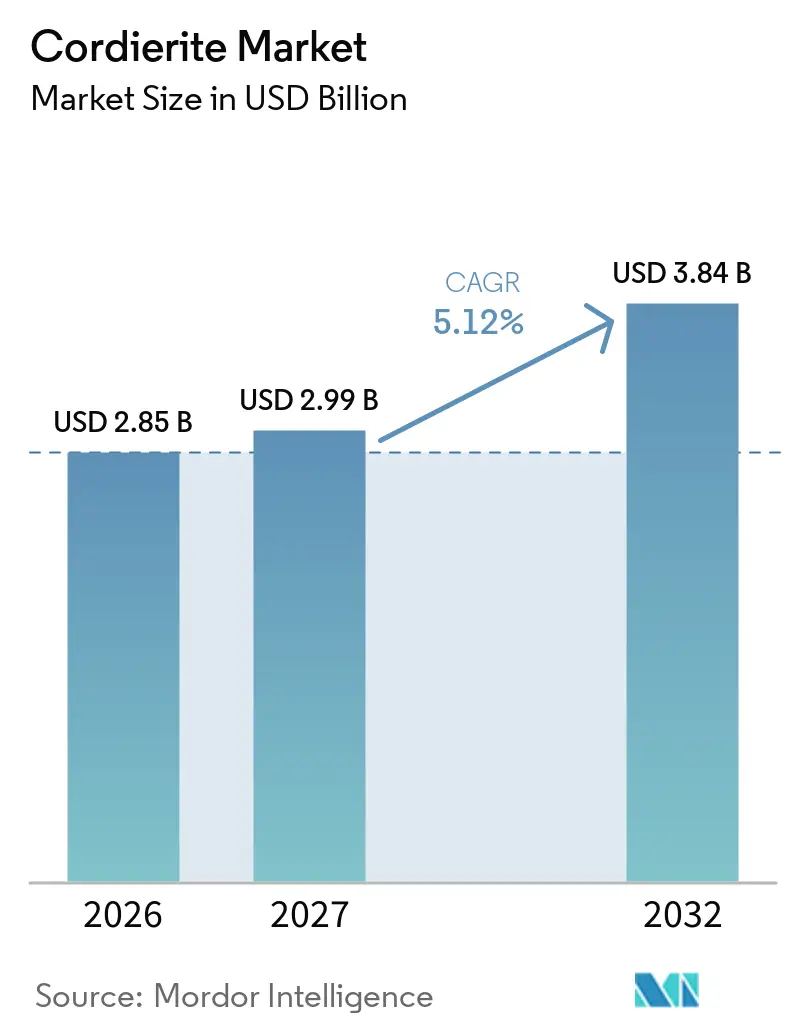
The cordierite market size was valued at USD 2.85 billion in 2026 and is estimated to grow from USD 2.99 billion in 2027 to USD 3.84 billion by 2032, at a CAGR of 5.12% during the forecast period (2027-2032). The cordierite market remains closely tied to vehicle emission-control systems, as honeycomb substrates are used in catalytic converters and gasoline particulate filters. Demand is also expanding through regenerative thermal oxidizer systems used by chemical, pharmaceutical, and surface-coating facilities to control volatile organic compounds. This broader industrial base helps limit the impact of battery electric vehicle adoption on the cordierite market. Regulatory requirements remain central to purchasing decisions, with higher durability and filtration standards increasing demand for advanced ceramic substrates. Suppliers are responding through thin-wall designs, higher cell densities, and new applications of honeycomb ceramics in carbon-removal equipment.
Key Report Takeaways
- By product type, sintered cordierite held 69.13% of the cordierite market share in 2026, while porous cordierite is forecast to grow at a 5.78% CAGR through 2032.
- By application, automotive parts accounted for 30.56% of the cordierite market share in 2026 and are projected to expand at a 6.34% CAGR through 2032.
- By geography, Asia-Pacific held 45.27% of the cordierite market share in 2026 and is forecast to grow at a 5.65% CAGR through 2032.
Note: Market numbers in this report are based on Mordor Intelligence's proprietary estimation framework, which combines nine months of actuals with Q4 projections for base year 2026.
Market Trends and Insights
Drivers Impact Analysis of Cordierite Market*
| Drivers | (~) % Impact on CAGR Forecast | Geographic Relevance | Impact Timeline |
|---|---|---|---|
| Tightening Vehicle Emission Standards | +1.8% | Global, with intensity in Europe, North America, China, and India | Medium term (2-4 years) |
| Continued Internal Combustion Engine (ICE) and Hybrid Vehicle Production | +1.2% | Asia-Pacific, especially China, India, and ASEAN, with spillover to North America, the Middle East, and Africa | Medium term (2-4 years) |
| Expansion of Diesel and Gasoline Particulate Filter Mandates | +1.0% | China, Europe, India, South Korea, Brazil, and ASEAN | Short term (≤ 2 years) |
| Industrial Air-Pollution Control and Regenerative Thermal Oxidizer Adoption | +0.6% | Global, especially China, Europe, and North America, chemical and coating sectors | Long term (≥ 4 years) |
| Thin-Wall and High-Cell-Density Substrate Innovation | +0.5% | Global Original Equipment Manufacturer (OEM) supply chain, concentrated in Japan, the United States, and Germany | Medium term (2-4 years) |
| Source: Mordor Intelligence | |||
Tightening Vehicle Emission Standards
Tighter vehicle emission regulations are a direct source of demand for the cordierite market, as catalytic substrates are required to reduce exhaust emissions. Euro 7 extends durability requirements across several vehicle categories, raising the performance level required for emission-control systems. The U.S. EPA rules for 2027 engine models require nitrogen oxide reductions of more than 75%, which are expected to necessitate stronger aftertreatment systems. These requirements support higher-cell-density cordierite substrates, as manufacturers need more active surface area within limited installation space. Longer durability obligations also encourage OEMs to use substrates that can maintain performance over the required service life. The cordierite market therefore benefits not only from vehicle output but also from the increasing technical content of each compliant vehicle.
Continued ICE and Hybrid Vehicle Production
Internal combustion engine and hybrid vehicle production continue to support the cordierite market, as hybrid powertrains still use full catalytic converter systems. Corning stated in its 2025 annual report that demand for internal combustion engines is expected to remain strong for another 2-3 decades. Hybrid vehicles retain an engine and require the same core exhaust-treatment components as conventional vehicles, allowing substrate demand to continue even as consumers shift toward electrified drivetrains. Growth in vehicle production across India, Thailand, and Indonesia provides an additional source of demand for catalytic substrates. For suppliers, these markets offer a more stable short-term path for output growth than a strategy based solely on material substitution or new substrate designs.
Expansion of Diesel and Gasoline Particulate Filter Mandates
Particulate filter mandates are increasing the demand for porous cordierite substrates. China 6b requires gasoline particulate filters in new gasoline passenger vehicles, supporting steady procurement of wall-flow ceramic filters. Gasoline direct-injection engines produce ultrafine particles under real-world driving conditions, underscoring the need for effective particulate filtration[1]. This requirement favors porous material grades that can trap particles while maintaining acceptable exhaust flow. The China 6b test protocol and GB 18352.6-2016 compliance framework shape vehicle design and supplier qualification requirements. Similar emissions-control requirements in Europe, India, South Korea, Brazil, and ASEAN are creating a need for suppliers to establish regional capacity before local production reaches full scale.
Industrial Air-Pollution Control and Regenerative Thermal Oxidizer Adoption
Industrial regenerative thermal oxidizers provide a non-automotive source of demand for the cordierite market. These systems are used in chemical processing, coatings, and pharmaceutical production to destroy volatile organic compounds. Cordierite honeycomb regenerators provide heat recovery rates of 85-95% and can reduce fuel consumption by 30-50% compared with traditional media. This performance helps operators meet tighter air-quality requirements while controlling operating costs. Replacing ceramic balls or brick regenerators with structured honeycomb media also creates recurring demand for replacements. In 2025, NGK displayed honeycomb ceramic substrates for direct air capture systems and gas-separation applications, reflecting its efforts to extend its ceramic expertise into non-automotive environmental applications.
Restraints Impact Analysis of Cordierite Market*
| Restraints | (~) % Impact on CAGR Forecast | Geographic Relevance | Impact Timeline |
|---|---|---|---|
| Battery Electric Vehicle Penetration Reducing Catalytic-Substrate Demand | -0.8% | China and Western Europe, with an emerging effect in North America | Long term (≥ 4 years) |
| Competition from Silicon Carbide and Aluminum Titanate | -0.5% | Global, especially heavy-duty diesel filters and premium passenger vehicle filters | Medium term (2-4 years) |
| Energy-Intensive Shaping and Firing Costs | -0.3% | Global, with greater exposure in Europe and Japan | Short term (≤ 2 years) |
| Source: Mordor Intelligence | |||
Battery Electric Vehicle Penetration Reducing Catalytic-Substrate Demand
Battery electric vehicles (BEVs) eliminate the need for catalytic substrates, creating a structural restraint for the cordierite market. This constraint is most visible in China and Western Europe, where electric vehicle adoption is strong and gasoline particulate filter requirements are advanced. This creates a mixed outcome, as the largest potential filter markets may also experience the fastest decline in demand for combustion engine vehicles. Hybrid vehicles partly offset this effect, as they retain an internal combustion engine and require a full catalytic system. The cordierite market will therefore depend on the pace of transition from hybrids to fully electric vehicles in its major production regions.
Competition From Silicon Carbide and Aluminum Titanate
Silicon carbide and aluminum titanate compete with cordierite in high-thermal-load applications. Silicon carbide can withstand regeneration temperatures above 2,000°C, compared with the practical ceiling for cordierite at 1,460°C. However, its production cost is 30-40% higher than that of cordierite, which limits its use primarily to demanding heavy-duty and premium filter applications. A 2025 Society of Automotive Engineers (SAE) paper from NGK Insulators, Ltd. examined both cordierite and silicon carbide for advanced particulate emission targets, indicating that material selection continues to depend on the specific application. Aluminum titanate is used where very low thermal expansion at elevated temperatures is required. Longer Euro 7 durability requirements may favor silicon carbide under operating conditions involving repeated and severe regeneration events.
*Our forecasts treat driver/restraint impacts as directional, not additive. The impact forecasts reflect baseline growth, mix effects, and variable interactions.
Cordierite Market Segment Analysis
By Product Type:
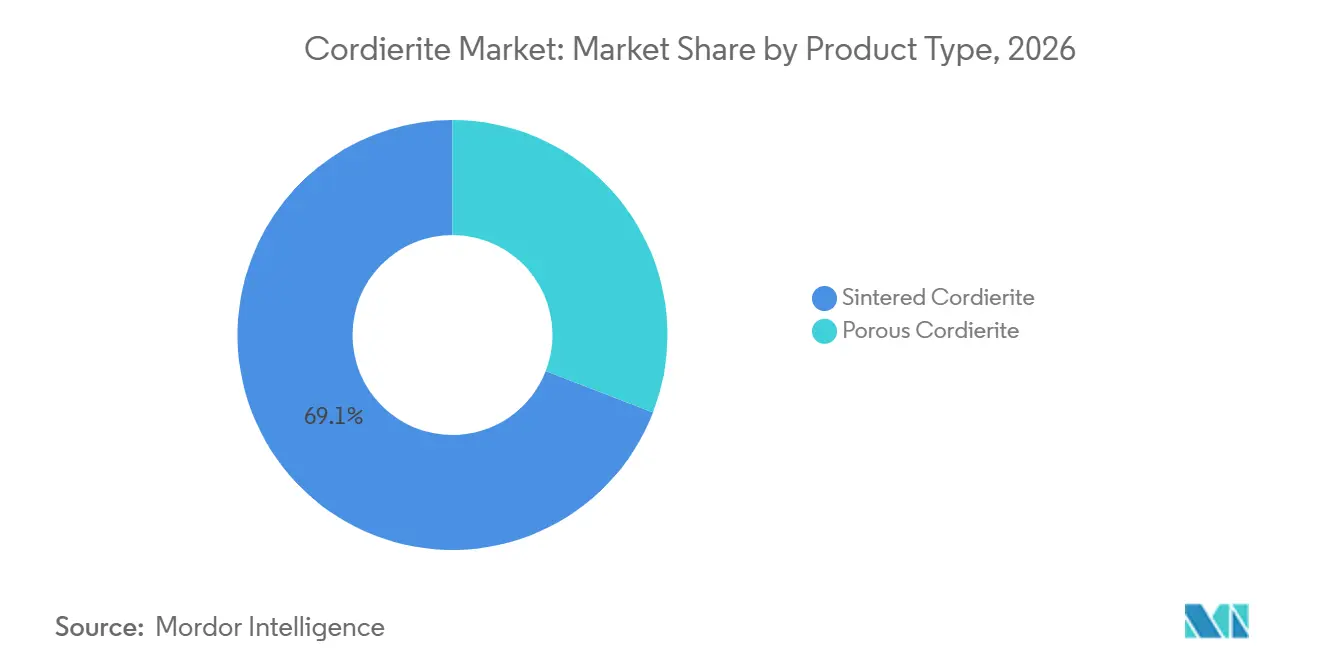
Sintered Variants Lead by Share While Porous Grades Record Faster GrowthSintered cordierite held 69.13% of the cordierite market share in 2026, supported by its long-standing use as a flow-through substrate in three-way catalytic converters. The material has a low thermal expansion coefficient of 1.5×10⁻⁶ /°C, which helps it withstand repeated changes in exhaust temperature. Extrusion and continuous tunnel firing support cost-efficient production at automotive scale. Washcoat adhesion is well understood, which reduces qualification risk for vehicle manufacturers. These characteristics make sintered cordierite a standard component in mainstream gasoline passenger-vehicle catalytic converters. Its established production base makes it difficult for alternative materials to displace it in applications that do not require extreme thermal performance.
Porous cordierite is projected to grow at a 5.78% CAGR through 2032, exceeding the broader cordierite market growth rate. It is engineered for wall-flow filtration in gasoline and diesel particulate filters. China 6b, Euro 7, and EPA 2027 regulations support its adoption, as filters are required to meet particulate-emission requirements. Research published in 2025 confirmed that cordierite-supported monolithic catalysts remain competitive for soot oxidation in gasoline particulate filter applications. Rare-earth washcoat formulations are also improving particulate oxidation performance on cordierite carriers. These improvements allow porous grades to serve applications that previously relied more heavily on silicon carbide.

By Application:
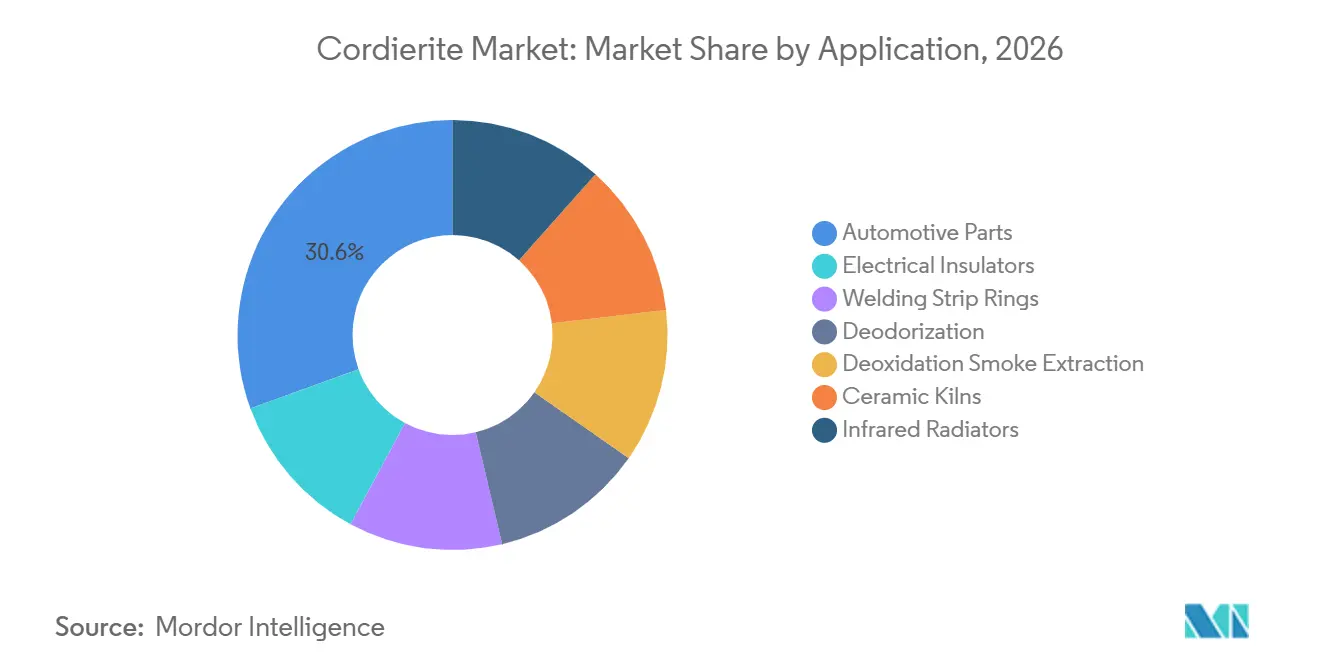
Automotive Parts Leads on Both Share and Growth MomentumAutomotive parts accounted for 30.56% of the cordierite market share in 2026 and are forecast to grow at a 6.34% CAGR through 2032. This application combines the largest share with the fastest growth among the segments covered. Honeycomb monoliths are used in catalytic converters, gasoline particulate filters, and diesel particulate filters. Corning reported that it produces ceramic substrates and filters, including low-mass FLORA substrates and DuraTrap GC gasoline particulate filters. The company operates relevant manufacturing facilities in New York, Virginia, China, South Korea, Taiwan, and Germany. Regulatory requirements are increasing the demand for components that provide both filtration and catalytic function within compact exhaust systems.
Deodorization applications use cordierite-supported catalysts to oxidize odor-causing organic compounds in HVAC and building-ventilation systems. These uses generate replacement-cycle demand from commercial building operators. Ceramic kilns use cordierite shelves, setters, and batts because the material resists thermal shock during firing cycles. Infrared radiators, electrical insulators, welding strip rings, and deoxidation smoke-extraction equipment represent smaller application areas. These uses rely on cordierite's electrical resistivity and thermal properties, which are difficult to replicate at comparable cost. Automotive compliance is influenced by Euro 7, U.S. aftermarket catalytic converter requirements, and China 6b testing conditions. This range of applications supports demand for cordierite beyond passenger-vehicle exhaust systems.
Geography Analysis
Asia-Pacific
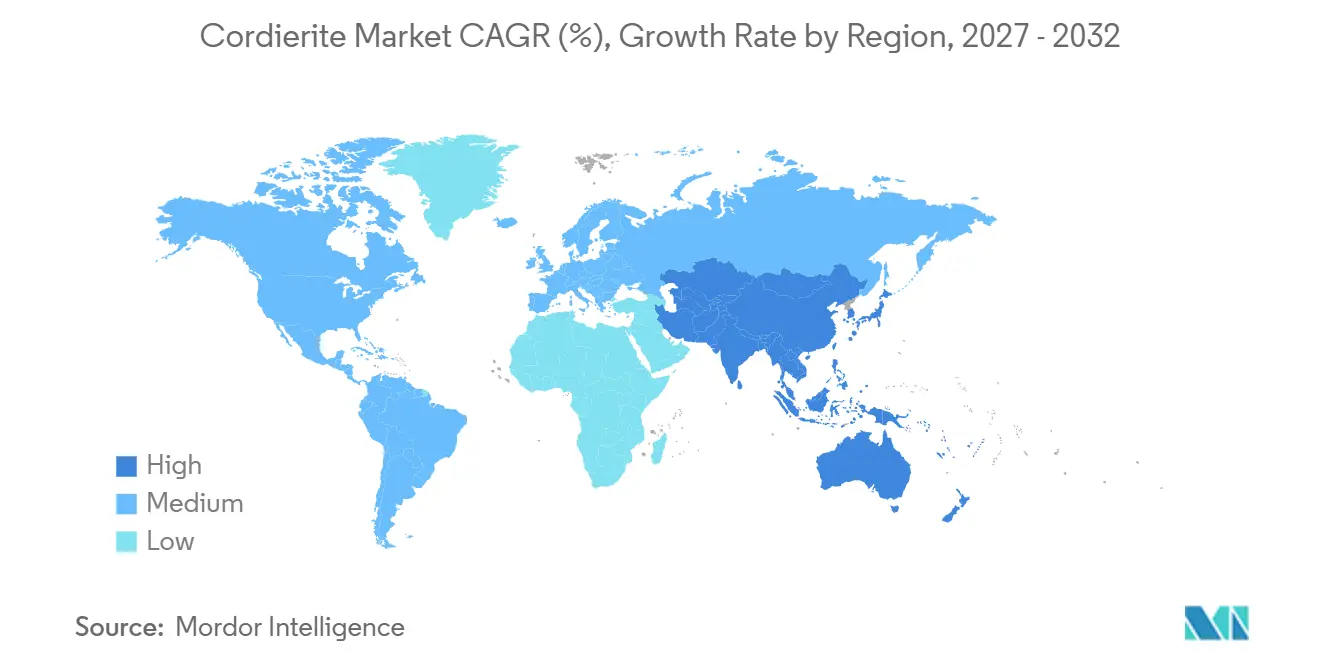
Asia-Pacific accounted for 45.27% of the cordierite market share in 2026 and is projected to grow at a 5.65% CAGR through 2032. China is the primary demand base, as mandatory gasoline particulate filter requirements drive porous cordierite purchasing. Its large gasoline- and hybrid-vehicle production base provides the scale needed for high-output substrate supply. Japan offers a separate technical base through NGK Insulators and IBIDEN, both of which are integrated into domestic OEM supply chains. India adds demand through Bharat Stage VI Phase 2 real-world emissions testing. A proposed Bharat Stage VII framework could increase future requirements for particulate and nitrogen oxide control.
North America
North America is the second-largest geography in the cordierite market, supported by established supply relationships and the 2027 EPA rules. Corning manufactures ceramic substrates and filters in New York and Virginia, reinforcing the region's production base. Environmental Protection Agency (EPA) requirements increase the need for durable aftertreatment equipment with a higher active surface area. This favors substrate technologies that can deliver emissions performance without excessive exhaust backpressure. The region also has industrial demand through chemical and coating facilities that use regenerative thermal oxidizers. OEM quality requirements and emissions rules make product qualification, process control, and long-term supply reliability important competitive factors.
Europe and Other Regions
Europe remains strategically important as Euro 7 requires greater durability for heavy-duty vehicle emission-control systems[2]. This requirement creates an upgrade cycle for commercial-vehicle catalytic systems between 2028 and 2030. The cordierite market in South America is concentrated in Brazil and Argentina, where vehicle production is driven by regional economic conditions and environmental regulations that increasingly align with Euro-based frameworks. The Middle East and Africa remain the smallest regional segment, with Saudi Arabia and South Africa as the main demand centers for industrial air-pollution control and automotive aftermarket products. Across these geographies, regulatory alignment and industrial emissions controls create opportunities for suppliers capable of serving smaller-scale demand with technical support and dependable delivery.
Competitive Landscape
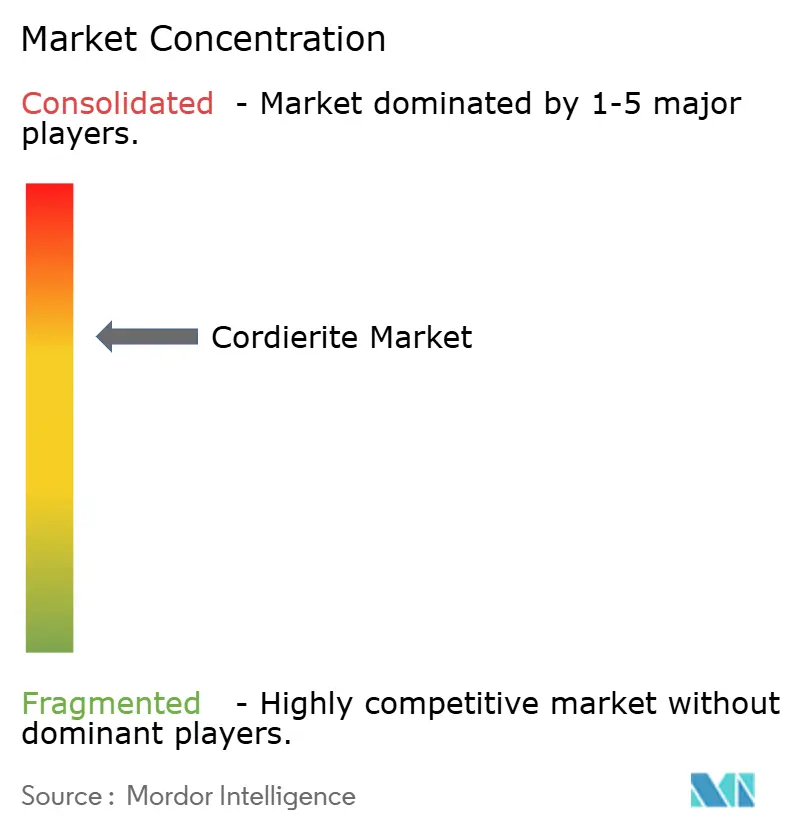
The cordierite market is moderately consolidated, with Corning Incorporated, NGK Insulators, and IBIDEN as the principal players. Corning identifies NGK Insulators and IBIDEN as its main competitors in the automotive segment. All three companies benefit from proprietary ceramic formulations, precision extrusion-die capability, and long OEM qualification cycles. These capabilities create high barriers for new suppliers, as automotive customers require consistent product quality at scale. Corning's automotive segment represented 11% of its total segment net sales in 2025. Given that OEMs depend on qualified sources, a disruption at a major supplier could affect vehicle emission-system schedules.
The non-automotive cordierite market is more fragmented than the automotive substrates segment. Companies such as CoorsTek, CeramTec GmbH, Rauschert Heinersdorf-Pressig GmbH, and Du-Co Ceramics compete through customized technical ceramics and application-specific performance. CeramTec introduced alumina substrate solutions for power electronics in 2025, reflecting continued investment in advanced ceramic applications. While this supports the broader demand for thermal-management ceramics, it does not alter the concentration seen in automotive substrates. ISO 9001 and OEM-specific quality systems remain baseline requirements for suppliers. Competitive strength is determined more by material expertise, production yields, and customer qualification records than by price alone.
Technology is the primary basis of competition in the cordierite market. Suppliers focus on thin-wall structures, controlled pore-size distribution, and coated gasoline particulate filters that combine filtration and catalytic activity. NGK's participation in the Carbon Capture Technology Expo Europe 2025 showcased honeycomb ceramic substrates for direct air capture, gas separation, and carbon dioxide sensors, demonstrating how established ceramic manufacturing capabilities are being applied to carbon-removal infrastructure. Corning continues to supply low-mass substrates and gasoline particulate filter products to meet evolving vehicle emission requirements. These developments indicate that ceramic manufacturers are pursuing opportunities beyond conventional automotive emission control.
Cordierite Industry Leaders
-
Corning Incorporated
-
NGK Corporation
-
IBIDEN
-
DENSO Corporation
-
KYOCERA Corporation
- *Disclaimer: Major Players sorted in no particular order
Cordierite Market Companies Covered in this Report
- CeramTec GmbH
- CoorsTek, Inc.
- Corning Incorporated
- Denka Company Limited
- DENSO Corporation
- Du-Co Ceramics Company
- Goodfellow Corporation
- IBIDEN
- KYOCERA Corporation
- Morgan Advanced Materials
- NGK Corporation
- Rauschert Heinersdorf-Pressig GmbH
- TOTO LTD.
- Unifrax I LLC
- Vesuvius
Recent Industry Developments in Cordierite Market
- May 2026: Denka Company Limited announced capacity reinforcement for ALSINK, its heat-dissipating aluminum-ceramic composite base plate, at its Omuta Plant (Japan) and Denka Electronics Materials Dalian Co. (China). The expansion targets approximately 1.3x capacity and is expected to be operational in the second half of FY2027. While primarily serving power module applications, the investment reflects a broader strategy to expand specialty ceramics capacity in anticipation of EV-driven electronics demand.
- October 2025: NGK Insulators exhibited cordierite-based honeycomb ceramic substrates for direct air capture systems, ceramic gas separation membranes, and CO₂ sensors at the Carbon Capture Technology Expo Europe 2025 in Hamburg. The participation extended the company's automotive ceramic manufacturing capabilities into carbon-removal infrastructure.
Global Cordierite Market Report Scope
Cordierite is a magnesium, iron, and aluminum cyclosilicate mineral, commonly known as the gemstone iolite or water sapphire. Cordierite is characterized by its distinct pleochroism, displaying different colors when viewed from different angles, ranging from blue and violet to yellow and gray. The mineral is found in metamorphic and igneous rocks and is widely used in industrial applications due to its low thermal expansion and high thermal stability.
The cordierite market is segmented by product type, application, and geography. By product type, the market is segmented into sintered cordierite and porous cordierite. By application, the market is segmented into automotive parts, deodorization, deoxidation smoke extraction, ceramic kilns, infrared radiators, electrical insulators, and welding strip rings. The report also covers market sizes and forecasts for the cordierite across 15 countries in major regions. The market sizes and forecasts are provided in terms of value (USD).
Segmentation Overview
| Sintered Cordierite |
| Porous Cordierite |
| Automotive Parts |
| Deodorization |
| Deoxidation Smoke Extraction |
| Ceramic Kilns |
| Infrared Radiators |
| Electrical Insulators |
| Welding Strip Rings |
| Asia-Pacific | China |
| India | |
| Japan | |
| South Korea | |
| ASEAN Countries | |
| Rest of Asia-Pacific | |
| North America | United States |
| Canada | |
| Mexico | |
| Europe | Germany |
| United Kingdom | |
| France | |
| Italy | |
| NORDIC Countries | |
| Rest of Europe | |
| South America | Brazil |
| Argentina | |
| Rest of South America | |
| Middle East and Africa | Saudi Arabia |
| South Africa | |
| Rest of Middle East and Africa |
| By Product Type | Sintered Cordierite | |
| Porous Cordierite | ||
| By Application | Automotive Parts | |
| Deodorization | ||
| Deoxidation Smoke Extraction | ||
| Ceramic Kilns | ||
| Infrared Radiators | ||
| Electrical Insulators | ||
| Welding Strip Rings | ||
| By Geography | Asia-Pacific | China |
| India | ||
| Japan | ||
| South Korea | ||
| ASEAN Countries | ||
| Rest of Asia-Pacific | ||
| North America | United States | |
| Canada | ||
| Mexico | ||
| Europe | Germany | |
| United Kingdom | ||
| France | ||
| Italy | ||
| NORDIC Countries | ||
| Rest of Europe | ||
| South America | Brazil | |
| Argentina | ||
| Rest of South America | ||
| Middle East and Africa | Saudi Arabia | |
| South Africa | ||
| Rest of Middle East and Africa | ||
Key Questions Answered in the Report
What is current market size of Cordierite Market?
The cordierite market size was valued at USD 2.85 billion in 2026 and is estimated to grow from USD 2.99 billion in 2027 to USD 3.84 billion by 2032, at a CAGR of 5.12% during the forecast period (2027-2032).
Which product type is growing fastest?
Porous cordierite is forecast to grow at a 5.78% CAGR through 2032 because it is used in gasoline and diesel particulate filters.
Which application has the strongest growth outlook?
Automotive parts hold a 30.56% share in 2026 and are forecast to grow at a 6.34% CAGR through 2032.
Which region leads cordierite demand?
Asia-Pacific leads with a 45.27% share in 2026 and is projected to grow at a 5.65% CAGR through 2032.