
Container Registry Security Market Size and Share
Market Overview
| Study Period | 2020 - 2031 |
|---|---|
| Market Size (2026) | USD 1.21 Billion |
| Market Size (2031) | USD 3.28 Billion |
| Growth Rate (2026 - 2031) | 22.07 % |
| Fastest Growing Market | Asia-Pacific |
| Largest Market | North America |
| Market Concentration | Medium |
Major Players *Disclaimer: Major Players sorted in no particular order Image © Mordor Intelligence. Reuse requires attribution under CC BY 4.0. | |
Container Registry Security Market Analysis by Mordor Intelligence
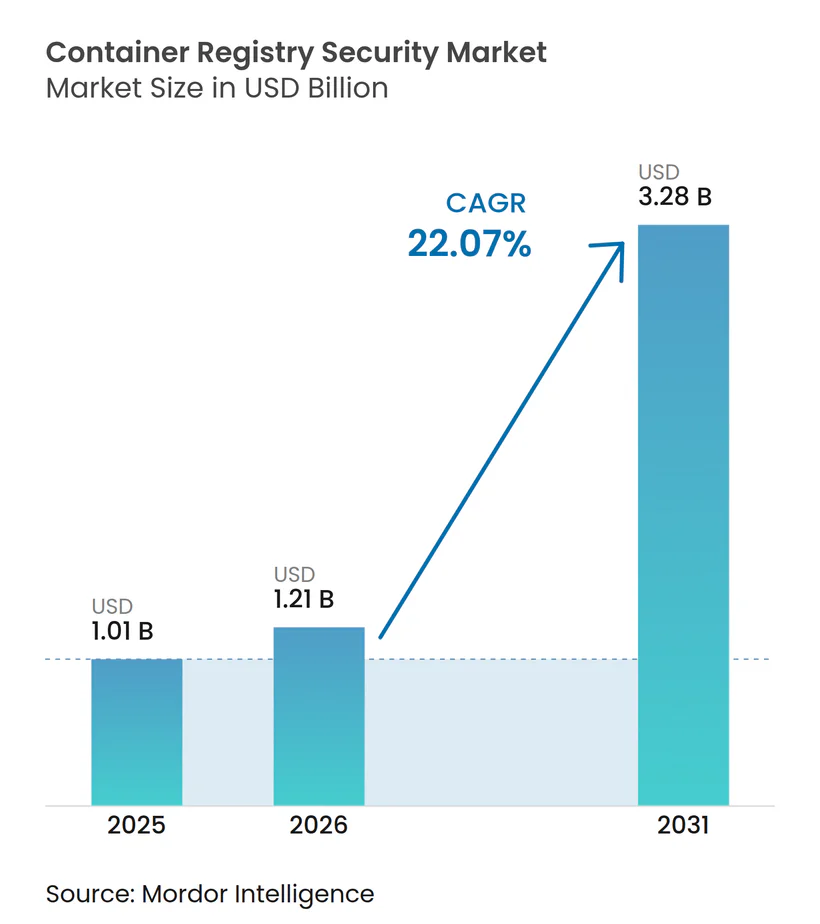
The container registry security market size is projected to grow from USD 1.01 billion in 2025 to USD 1.21 billion in 2026, and is forecast to reach USD 3.28 billion by 2031, growing at a CAGR of 22.07% from 2026 to 2031. The container registry security market is being shaped by more frequent attacks on software supply chains and by the wider use of cloud-native applications. Within the container registry security market, rules on software bills of materials, image provenance, and signing are moving registry controls from a secondary review activity into routine security practice. Organizations using multiple clouds and private environments need consistent checks across all registries that store or distribute images. In the container registry security market, this need favors suppliers that can integrate scan results, policy controls, and audit evidence without adding manual work. The container registry security market also faces pricing pressure as large cloud platforms include basic scanning in broader security packages.
Key Report Takeaways
- By component, software held 69.82% of the container registry security market in 2025, while services are projected to expand at a 23.94% CAGR through 2031.
- By deployment, cloud-based solutions accounted for 61.48% of revenue in 2025 and are projected to record the highest CAGR of 24.86% through 2031.
- By organization size, large enterprises held 71.29% of the container registry security market revenue in 2025, while small and medium-sized enterprises are projected to grow at a 26.41% CAGR through 2031.
- By end-user industry, IT and telecommunications accounted for 26.37% of revenue in 2025, while healthcare and life sciences are projected to grow at a 26.11% CAGR through 2031.
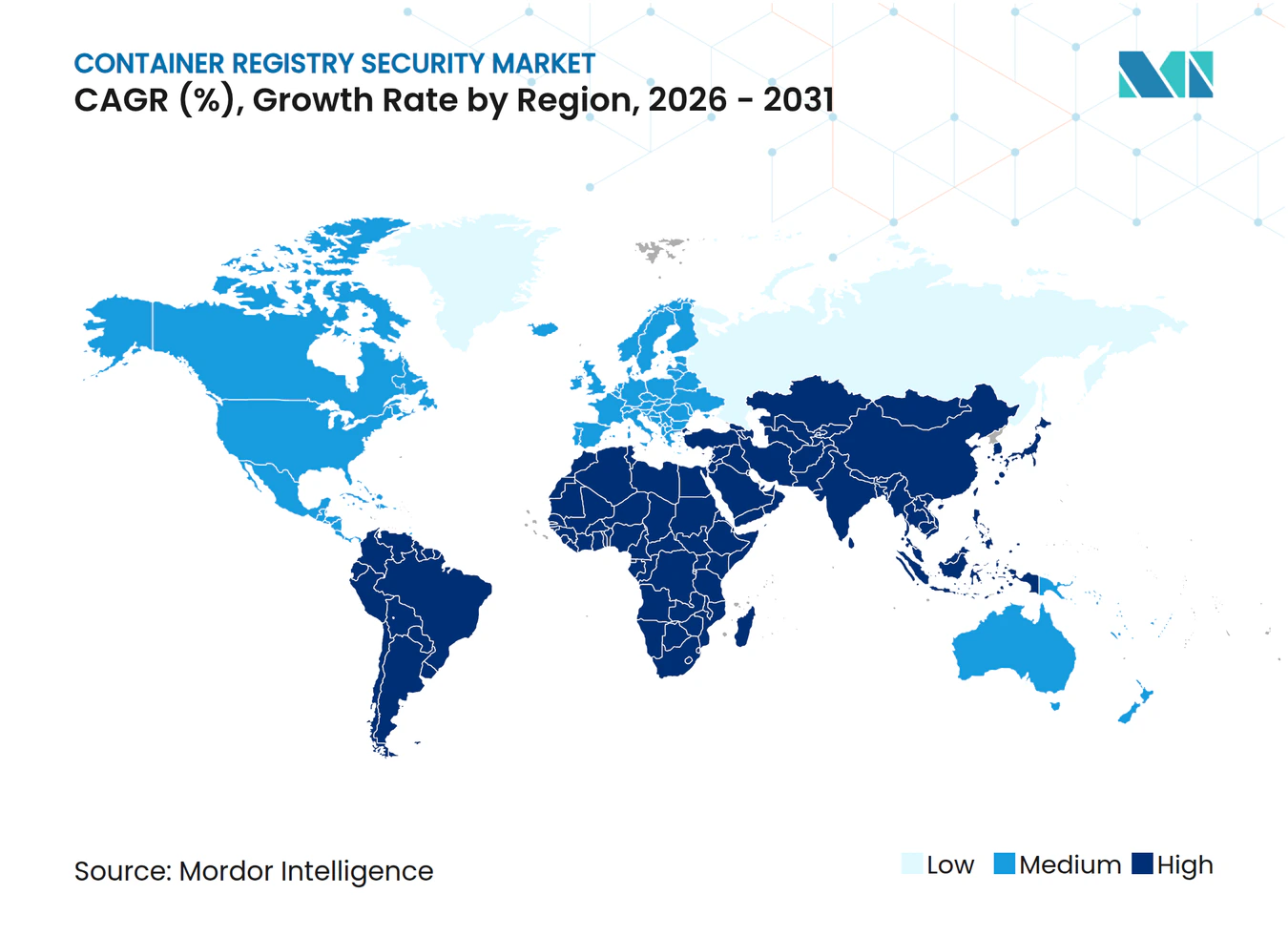
- By geography, North America held 42.38% of the container registry security market revenue in 2025, while Asia-Pacific is projected to grow at a 27.93% CAGR through 2031.
Note: Market size and forecast figures in this report are generated using Mordor Intelligence’s proprietary estimation framework, updated with the latest available data and insights as of January 2026.
Market Trends and Insights
Drivers Impact Analysis of Container Registry Security Market*
| Driver | (~) % Impact on CAGR Forecast | Geographic Relevance | Impact Timeline |
|---|---|---|---|
| Rising Software Supply-Chain Attacks | +5.3% | Global, with concentrated impact in North America and Europe | Short term (≤ 2 years) |
| Growth of Cloud-Native Applications and Microservices | +4.8% | Global, with fastest conversion in Asia-Pacific and North America | Medium term (2-4 years) |
| SBOM, Provenance, and Image-Signing Requirements | +4.1% | North America and the EU core, with spillover to Asia-Pacific | Short term (≤ 2 years) |
| Registry-Level Enforcement in DevSecOps Pipelines | +3.5% | Global, led by North America, the United Kingdom, and Germany | Medium term (2-4 years) |
| Expansion of Hybrid and Multi-Cloud Workloads | +2.7% | Global, with the highest density in North America and Asia-Pacific core markets | Medium term (2-4 years) |
| Edge, 5G, and Air-Gapped Container Deployments | +1.7% | Asia-Pacific, the Middle East, and early-adopter EU defense and telecom sectors | Long term (≥ 4 years) |
| Source: Mordor Intelligence | |||
Rising Software Supply-Chain Attacks Drive Registry Security Investment
Software supply chains became a major attack surface in 2025, making registry controls more important for development and security teams. Open-source registries recorded 21,764 malicious packages in the first quarter of 2026, equal to 1 new malicious package every 6 minutes.[1] ReversingLabs reported a 73% increase in malicious open-source packages during 2025, with nearly 90% of detections in npm. Docker reported that 77% of organizations had experienced a software supply-chain incident in the prior 12 months, while 40% identified AI-generated code as the main emerging risk. Germany's BSI reported a March 2026 compromise involving Aqua Security's Trivy scanner, showing that scanning tools can also introduce risk into the delivery chain. The container registry security market, therefore, benefits when buyers require signed and reproducible toolchain images as well as protected application registries.
Cloud-Native Application Growth Expands the Registry Attack Surface
The cloud-native developer population reached 19.9 million in the first quarter of 2026, up 28% from 15.6 million in the third quarter of 2025.[2] The same research found that 52% of backend developers were cloud-native and that these developers accounted for 39% of the global developer population. Each containerized service creates an image that must be scanned, signed, stored, and checked again when a relevant vulnerability is disclosed. This workload grows with the number of services and cannot be handled reliably through periodic manual reviews. Cloud-native adoption is also moving into gaming, industrial Internet of Things, and AI workloads, which can involve unfamiliar provenance paths. These conditions expand the need for automated controls at the image-push stage across the container registry security market.
SBOM, Provenance, and Image-Signing Requirements Create Compliance Demand
PCI DSS v4.0.1 Requirement 6.3.2 became mandatory on March 31, 2025, requiring payment card organizations to maintain an up-to-date inventory of custom software and embedded third-party components. Automated software bills of materials at the registry layer can help organizations maintain that inventory as images change. Article 21(2)(d) of the EU NIS2 Directive establishes related supply chain security obligations for essential and important entities. The EU Cyber Resilience Act entered into force in December 2024 and includes implementation milestones through December 2027, while BSI TR-03183 addresses cyber-resilience requirements for manufacturers and SBOMs. Organizations supplying several regulated jurisdictions must address requirements that overlap yet differ. This creates continuing demand in the container registry security market for SBOM creation, compatible image signing, and recorded provenance.
Registry-Level Enforcement Strengthens DevSecOps Controls
Security checks were historically concentrated at the source-code scanning stage, while registries were often treated as passive storage. Policy-as-code controls can now reject unsigned images, block builds without attestation, and prevent deployment when a required SBOM is absent. A 2026 IEEE paper found that a policy-as-code admission controller blocked 92% of critical misconfigurations before production in healthcare Kubernetes environments. Red Hat described SWIFT's zero-touch automation for security policies and vulnerability scans across hundreds of clusters serving more than 11,500 financial institutions. JFrog found that only 14.8% of high and critical CVEs were highly exploitable, supporting the use of rules informed by runtime context rather than static alerts alone. The container registry security market is supported by tools that translate these checks into controls operating at enterprise scale.
Restraints Impact Analysis of Container Registry Security Market*
| Restraint | (~) % Impact on CAGR Forecast | Geographic Relevance | Impact Timeline |
|---|---|---|---|
| High False-Positive Rates in Vulnerability Scanning | -1.8% | Global, most acute in organizations with limited security operations capacity | Short term (≤ 2 years) |
| Security Tool Consolidation and Bundling by Large DevSecOps Platforms | -1.5% | North America and Western Europe, where platform consolidation is most advanced | Medium term (2-4 years) |
| Complexity of Integrating Security Across Multiple Registry Platforms | -1.2% | Global, most pronounced in enterprises with multi-cloud registry estates | Medium term (2-4 years) |
| Limited Visibility Into Proprietary and Third-Party Image Components | -0.8% | Global, with concentration in industrial manufacturing and government sectors | Long term (≥ 4 years) |
| Source: Mordor Intelligence | |||
High False-Positive Rates in Vulnerability Scanning Limit Tool Adoption
Container scanners can flag every vulnerability in an installed package, even when an application never loads that package. An IEEE Access study published in 2025 found that a query-based analytical layer reduced inconsistencies among major scanning tools by 70%.[3] The research indicates that the problem is structural and has not been fully resolved in mainstream offerings. JFrog's review of 183 high and critical CVEs found that 14.8% were highly exploitable, leaving 85.2% without practical exploitation risk. Persistent alert volumes can cause security teams to deprioritize scanner output and act only after an incident occurs. Vendors in the container registry security market can address this restraint through reachability analysis, runtime context, and exploit-probability filtering.
Platform Bundling Pressures Standalone Vendor Pricing
Prisma Cloud, Microsoft Defender for Containers, and Google Cloud Security Command Center include registry scanning as part of their broader cloud security portfolios. A bundled tool may meet baseline compliance requirements for buyers even when a specialist offers deeper runtime detection or cross-registry governance. Google completed its USD 32 billion acquisition of Wiz in March 2026, adding the cloud security platform to Google Cloud while retaining Wiz's multi-cloud commitment. This combination increases the capabilities that specialist suppliers must address simultaneously. Specialized providers are focusing on continuous rescanning of dormant images, portable provenance, and lower-overhead offerings for smaller organizations. The container registry security market could see further pricing pressure if platform-native scanning closes the capability gap.
*Our forecasts treat driver/restraint impacts as directional, not additive. The impact forecasts reflect baseline growth, mix effects, and variable interactions.
Container Registry Security Market Segment Analysis
By Component:
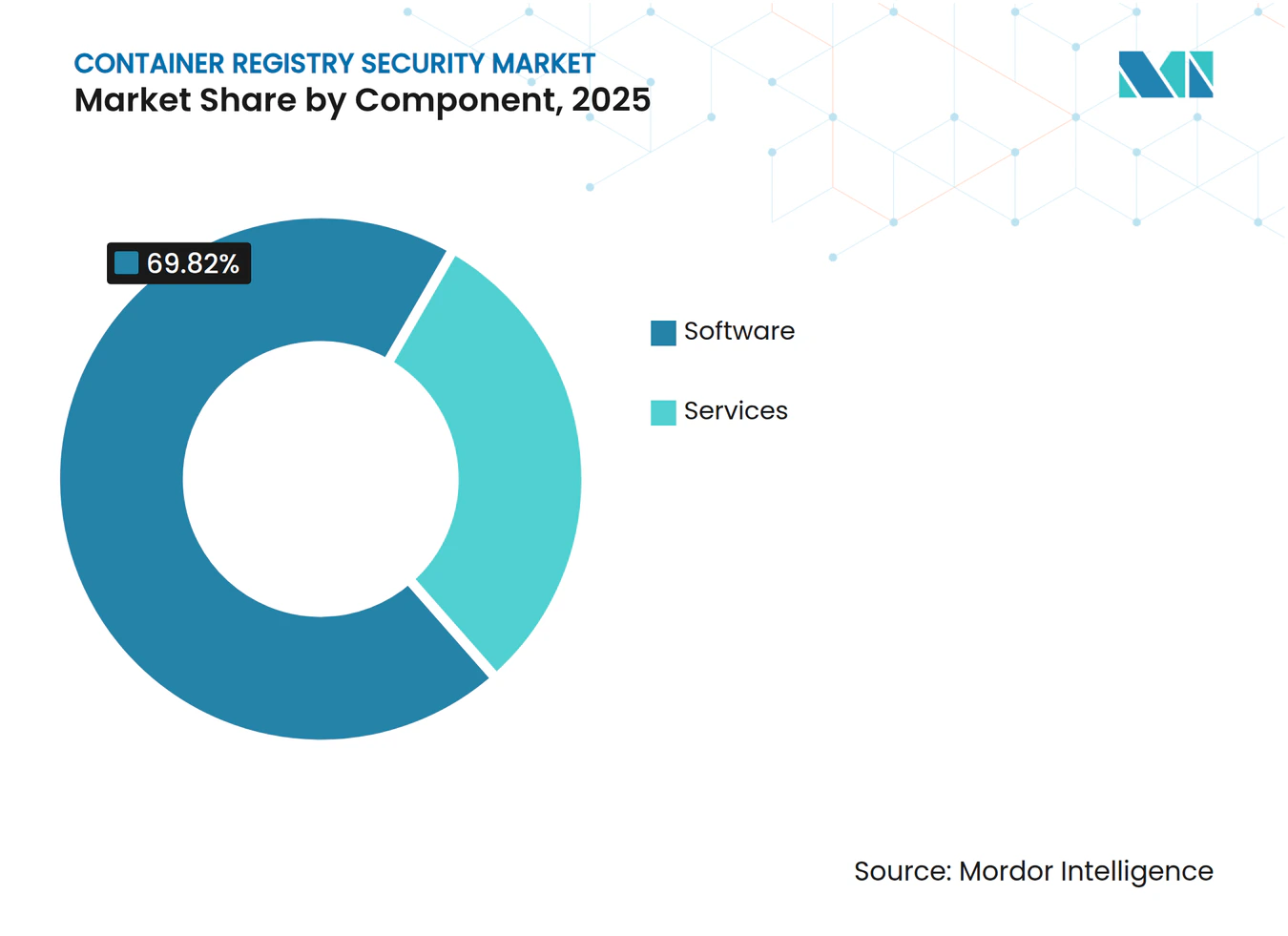
Software Leads Revenue While Services Grow FasterSoftware held 69.82% of the container registry security market share in 2025. It includes vulnerability-scanning engines, policy-as-code frameworks, SBOM tools, and image-signing platforms that cover activities from build inspection through runtime rescanning. The segment remains central because new CVE databases, image architectures, and registry formats require continuing coverage updates. ARM64, WASM, OCI artifact stores, and AI model registries each add requirements that software platforms must address. The 2025 IEEE Access research on tool inconsistency supports demand for platforms that use runtime reachability filtering rather than static matching alone.
Services are projected to grow at a 23.94% CAGR through 2031. Large organizations increasingly need managed registry security, integration, and implementation support across AWS Elastic Container Registry, Google Artifact Registry, and Azure Container Registry. Multi-registry deployments can exceed the capacity of internal security teams to integrate and maintain controls. Managed security providers can operate scanning and remediation processes while internal teams focus on policy decisions. The container registry security industry, therefore, has room for services even while software retains the larger revenue base.


By Deployment:
Cloud Broadens Coverage While On-Premises Serves Regulated NeedsCloud-based deployment accounted for 61.48% of the container registry security market share in 2025. It is also projected to record a 24.86% CAGR through 2031, making it the largest and fastest-growing deployment option. Its growth reflects broader scan coverage of previously unmonitored images rather than the removal of all on-premises systems. Public cloud registries offer native scanning interfaces through AWS InspectorScan, Google Artifact Analysis, and Azure Defender for Containers. Red Hat Hardened Images received support in the AWS InspectorScan API and Amazon ECR Basic scanning, showing how native workflows can support supply-chain integrity checks.
On-premises deployment remains relevant in defense, classified government settings, air-gapped industrial systems, and financial institutions with data-residency requirements. These environments need registry security that works without depending on a public cloud control plane. Germany's BSI finalized C5:2026 in March 2026, adding container management and supply-chain governance criteria to its cloud security catalog for European public-sector and regulated buyers.[4] SUSE Edge Image Builder supports air-gapped Kubernetes deployments for telecommunications settings, illustrating the specialized conditions that on-premises controls must meet. The container registry security market will continue to require both cloud and locally operated security models.
By Organization Size:
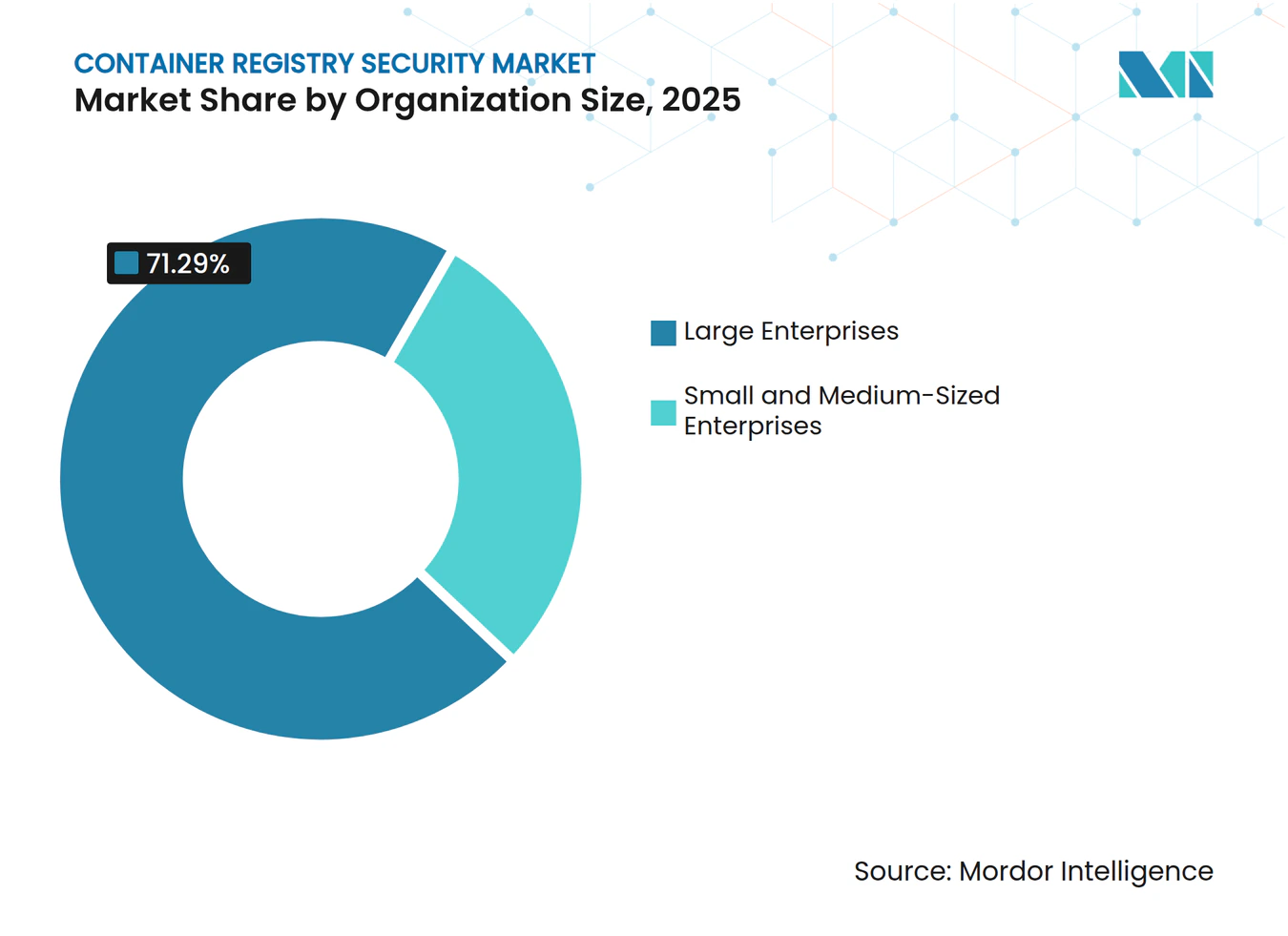
Enterprises Lead Spending While SMEs Adopt FasterLarge enterprises held 71.29% of the container registry security market in 2025. Their container estates can include thousands of images across business units, regions, and registry platforms. Compliance exposure under PCI DSS 4.0, HIPAA, and SOC 2 supports spending on automated governance because manual review cannot handle this scale. Red Hat reported that SWIFT used zero-touch automation across hundreds of clusters that connect more than 11,500 financial institutions in over 200 countries. Large organizations remain an important source of demand for specialist deployments and managed operations.
Small and medium-sized enterprises are projected to expand at a 26.41% CAGR through 2031. SaaS pricing and managed cloud scanning make registry protection accessible where internal security expertise is limited and reduce major initial deployment spending. Snyk made Container Registry Sync generally available in April 2026, automating registry inventory monitoring and new-image ingestion through customizable rules. Developer-focused tools can place checks in integrated development environments and delivery pipelines instead of a separate security console. This design can reduce friction and narrow the adoption gap between smaller organizations and enterprises.

By End User Industry:
IT and Telecommunication Lead While Healthcare RisesIT and telecommunications accounted for 26.37% of revenue in 2025. The sector relies on containerized microservices for network functions, customer platforms, and cloud-native service delivery, while telecommunications providers use Kubernetes for 5G core networks. Red Hat, NVIDIA, and Palo Alto Networks collaborated on an AI-native telecommunications security architecture that includes protection in Red Hat OpenShift environments. Banking, financial services, and insurance constitute another important demand cluster due to PCI DSS inventory requirements. These buyers also need controls that can document registry governance at scale.
The healthcare and life sciences industry is projected to grow at a 26.11% CAGR through 2031. HIPAA technical safeguards apply to containerized environments that handle protected health information. FDA cybersecurity guidance on SBOM disclosure also creates a direct need to document image components and provenance. Docker reported that Medplum, a healthcare platform serving more than 20 million patients, migrated to Docker Hardened Images using 54 lines of changes across 5 files.[5] Government, industrial manufacturing, retail and e-commerce, transportation and logistics, energy and utilities, media and entertainment, and education also contribute to demand as their use of containers matures.
Geography Analysis
North America Container Registry Security Market
North America held 42.38% of revenue in 2025. The region has a high concentration of cloud-native enterprises, security vendors, and federal supply-chain security requirements. The United States was the principal revenue contributor, while Canada showed strong financial-services adoption and Mexico remained earlier stage, with demand centered on multinational manufacturing and financial-services organizations. IBM and Red Hat expanded Project Lightwell in July 2026, naming AWS, JFrog, GitLab, Microsoft, NVIDIA, and Palo Alto Networks as partners in a USD 5 billion open-source security commitment.[6] This activity supports demand for registry-level SBOMs in North America.
Europe Container Registry Security Market
Europe is shaped by NIS2 requirements and the EU Cyber Resilience Act, which require stronger documentation and software inventory practices. Germany, the United Kingdom, and France are the leading European markets in the supplied analysis. Germany's BSI published C5:2026 in March 2026, and its container management and supply-chain governance criteria provide a procurement reference for public-sector cloud buyers. Registry-integrated SBOM automation can help organizations meet these related documentation requirements. The container registry security market in Europe is also shaped by Russia's separation from Western cloud ecosystems.
APAC, MEA and South America Container Registry Security Market
Asia-Pacific is projected to grow at a 27.93% CAGR through 2031. China’s sovereign-cloud requirements support platforms aligned with national cybersecurity standards, while India's digital public infrastructure increases the need for automated scanning and runtime visibility. Japan and South Korea use edge Kubernetes in factory automation, semiconductor, and telecommunications applications, where low-latency telemetry is important. Australia’s banking guidance and Singapore’s financial-services governance support regional activity, while South America, the Middle East, and Africa remain earlier-stage markets led by Brazil, Saudi Arabia, the United Arab Emirates, South Africa, Nigeria, and Egypt.
Competitive Landscape
Market Concentration
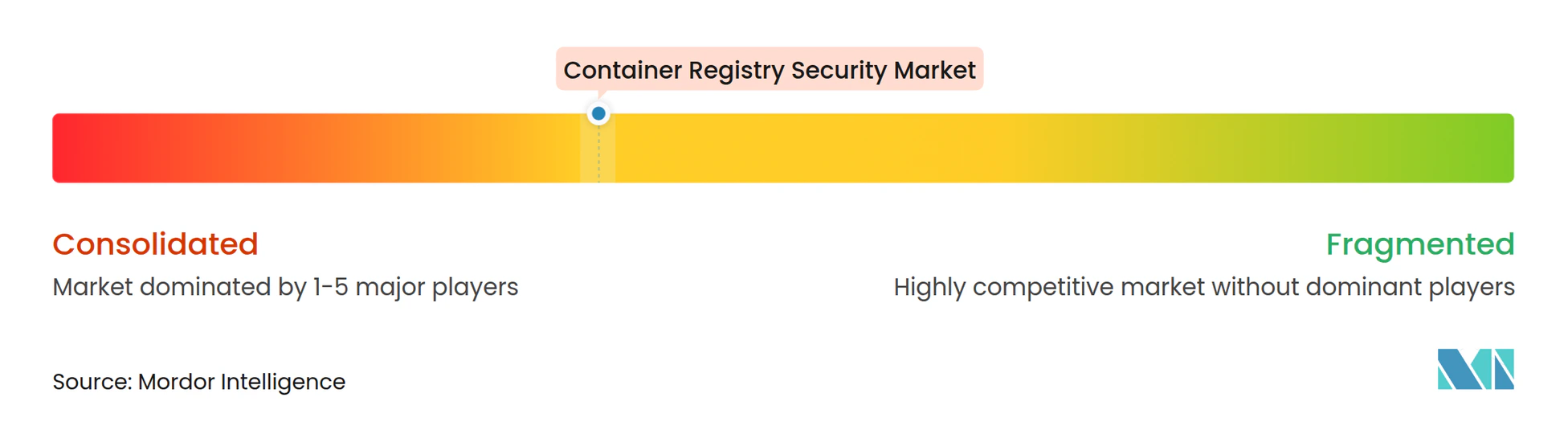
The container registry security market is moderately consolidated at the platform level. AWS, Microsoft, and Google have advantages from native registry integration, bundled pricing within cloud commitments, and established customer relationships. Google completed its USD 32 billion acquisition of Wiz in March 2026, integrating the platform into Google Cloud while continuing to support its use across AWS, Microsoft Azure, and Oracle Cloud. Aqua Security, JFrog, Sysdig, and Snyk compete through eBPF-based runtime detection, cross-registry provenance controls, and contextual vulnerability prioritization. The container registry security market, therefore, requires buyers to weigh bundle convenience against specialist depth in regulated and complex environments.
Sysdig launched Sysdig Secure AI in August 2026, using its eBPF runtime engine to investigate incidents, generate fixes, and contain active risks. JFrog announced a September 2026 integration with Wiz that combines artifact provenance and contextual CVE data with cloud runtime visibility. These moves reflect different competitive approaches, deeper specialist automation, and interoperability with a hyperscaler security platform. Continuous rescanning of inactive images and portable provenance remain open opportunities for suppliers serving customers across several cloud providers. The container registry security market still has room for tools that make vulnerability findings easier for non-security users to act on.
Differentiation also depends on SBOM quality, support for x86, ARM64, and WASM images, and the scope of admission-control enforcement. Platform bundles can create price pressure when basic compliance scanning is sufficient. IBM, Red Hat, and Palo Alto Networks expanded Project Lightwell in June 2026 to combine virtual patching with verified software fixes. The container registry security market must meet the security depth expected by regulated buyers and the price expectations created by cloud platforms.
Container Registry Security Industry Leaders
-
Aqua Security
-
JFrog Ltd.
-
Red Hat, Inc.
-
Microsoft Corporation
-
Amazon Web Services, Inc.
- *Disclaimer: Major Players sorted in no particular order
Container Registry Security Market Companies Covered in this Report
- Aqua Security
- JFrog Ltd.
- Red Hat, Inc.
- Microsoft Corporation
- Amazon Web Services, Inc.
- Anchore, Inc.
- Palo Alto Networks, Inc.
- Sysdig, Inc.
- Docker, Inc.
- Google LLC
- GitLab Inc.
- Sonatype, Inc.
- Snyk Limited
- Trend Micro Incorporated
- Qualys, Inc.
- Tenable Holdings, Inc.
- Rapid7, Inc.
- Black Duck Software, Inc.
- Checkmarx Ltd.
- SUSE S.A.
- Mirantis, Inc.
- VMware, Inc.
- Wiz, Inc.
- Orca Security Ltd.
- Tigera, Inc.
Recent Industry Developments in Container Registry Security Market
- September 2026: JFrog Ltd. announced a new integration with Wiz, now part of Google Cloud, at swampUP 2026, pairing JFrog Artifactory's artifact provenance and Xray's contextual CVE data with Wiz's agentless cloud runtime visibility, enabling security and engineering teams to identify what is running, where it originated, and whether it is trusted from a unified view, spanning code to cloud.
- August 2026: Sysdig launched Sysdig Secure AI at Black Hat USA, an AI-native security layer built on the Sysdig Secure CNAPP that deploys AI agents to investigate incidents, hunt threats, generate remediation fixes, and contain active risks at the speed of AI-powered attacks, helping organizations close the detection-to-response gap as AI tools accelerate adversary activity.
- July 2026: IBM and Red Hat expanded Project Lightwell with new commercial offerings, naming Amazon Web Services, JFrog, GitLab, Microsoft, NVIDIA, and Palo Alto Networks as ecosystem partners, and now integrating AI-driven software remediation with supply-chain-level SBOM traceability under the initiative's USD 5 billion open-source security commitment.
- June 2026: IBM, Red Hat, and Palo Alto Networks expanded Project Lightwell to integrate Palo Alto Networks' Virtual Patching capability with IBM and Red Hat's open-source remediation platform, creating a dual-action defense that deploys network-level protection on day 1 while delivering verified software fixes across open-source software, commercial applications, operational technology, and healthcare technologies.
- March 2026: Google LLC completed its USD 32 billion acquisition of Wiz, the largest acquisition in Google's history, integrating Wiz's cloud and AI security platform into Google Cloud while maintaining Wiz's multi-cloud commitment to operate across AWS, Microsoft Azure, and Oracle Cloud environments.
Global Container Registry Security Market Report Scope
The container registry security market focuses on protecting container images and OCI-compliant artifacts throughout the software supply chain, from build through deployment. This market includes solutions for automated vulnerability scanning (detecting CVEs, malware, and misconfigurations in image layers), cryptographic image signing and verification (using tools like Cosign, Notation, and Docker Content Trust), software bill of materials (SBOM) generation, access control and RBAC for registry operations, and policy enforcement to block non-compliant or untrusted images from deployment. Security capabilities ensure image integrity and authenticity, prevent tampering, enable provenance tracking, and integrate with CI/CD pipelines to automatically scan, sign, and validate images before they enter production environments, supporting compliance requirements for SOC 2, ISO 27001, PCI-DSS, and FedRAMP.
The Container Registry Security Market Report is Segmented by Component (Software, and Services [Managed Registry Security, and Integration and Implementation Services]), Deployment (Cloud-Based, and On-Premises), Organization Size (Large Enterprises, and Small and Medium-Sized Enterprises), End Use Industry (Government and Public Administration, Industrial Manufacturing, Retail and E-Commerce, Transportation and Logistics, Energy and Utilities, IT and Telecommunication, Media and Entertainment, Education and Research Institutions, Healthcare and Life Sciences, Banking, Financial Services, and Insurance (BFSI), and Other End Use Industries), and Geography (North America, South America, Europe, Asia-Pacific, Middle East, and Africa). The Market Forecasts are Provided in Terms of Value (USD).
Segmentation Overview
| Software | |
| Services | Managed Registry Security |
| Integration and Implementation Services |
| Cloud-Based |
| On-Premises |
| Large Enterprises |
| Small and Medium-Sized Enterprises |
| Government and Public Administration |
| Industrial Manufacturing |
| Retail and E-Commerce |
| Transportation and Logistics |
| Energy and Utilities |
| IT and Telecommunication |
| Media and Entertainment |
| Education and Research Institutions |
| Healthcare and Life Sciences |
| Banking, Financial Services, and Insurance (BFSI) |
| Other End Use Industries |
| North America | United States |
| Canada | |
| South America | Brazil |
| Argentina | |
| Rest of South America | |
| Europe | Germany |
| United Kingdom | |
| France | |
| Italy | |
| Spain | |
| Russia | |
| Rest of Europe | |
| Asia-Pacific | China |
| Japan | |
| India | |
| South Korea | |
| Australia | |
| Rest of Asia-Pacific | |
| Middle East | Saudi Arabia |
| United Arab Emirates | |
| Turkey | |
| Rest of Middle East | |
| Africa | South Africa |
| Nigeria | |
| Egypt | |
| Rest of Africa |
| By Component | Software | |
| Services | Managed Registry Security | |
| Integration and Implementation Services | ||
| By Deployment | Cloud-Based | |
| On-Premises | ||
| By Organization Size | Large Enterprises | |
| Small and Medium-Sized Enterprises | ||
| By End Use Industry | Government and Public Administration | |
| Industrial Manufacturing | ||
| Retail and E-Commerce | ||
| Transportation and Logistics | ||
| Energy and Utilities | ||
| IT and Telecommunication | ||
| Media and Entertainment | ||
| Education and Research Institutions | ||
| Healthcare and Life Sciences | ||
| Banking, Financial Services, and Insurance (BFSI) | ||
| Other End Use Industries | ||
| By Geography | North America | United States |
| Canada | ||
| South America | Brazil | |
| Argentina | ||
| Rest of South America | ||
| Europe | Germany | |
| United Kingdom | ||
| France | ||
| Italy | ||
| Spain | ||
| Russia | ||
| Rest of Europe | ||
| Asia-Pacific | China | |
| Japan | ||
| India | ||
| South Korea | ||
| Australia | ||
| Rest of Asia-Pacific | ||
| Middle East | Saudi Arabia | |
| United Arab Emirates | ||
| Turkey | ||
| Rest of Middle East | ||
| Africa | South Africa | |
| Nigeria | ||
| Egypt | ||
| Rest of Africa | ||
Key Questions Answered in the Report
What is the projected size of the container registry security market?
The container registry security market size is projected to grow from USD 1.01 billion in 2025 to USD 1.21 billion in 2026, and is forecast to reach USD 3.28 billion by 2031, growing at a CAGR of 22.07% from 2026 to 2031.
What is driving demand for container registry security?
Rising software supply-chain attacks, cloud-native application growth, and SBOM and image-signing requirements are increasing demand for registry controls.
Which deployment model is growing fastest for container registry security?
Cloud-based deployment is projected to grow at a 24.86% CAGR through 2031, while it held 61.48% of revenue in 2025.
Which organizations are adopting registry security most rapidly?
Small and medium-sized enterprises are projected to expand at a 26.41% CAGR through 2031 as SaaS pricing and managed scanning reduce adoption barriers.
Which end user sector will grow fastest through 2031?
Healthcare and life sciences are projected to grow at a 26.11% CAGR, supported by HIPAA safeguards and SBOM disclosure needs.
Which region will record the fastest growth through 2031?
Asia-Pacific is projected to grow at a 27.93% CAGR, supported by sovereign-cloud programs and expanding enterprise containerization.