
Construction Technical Textile Market Size and Share
Market Overview
| Study Period | 2021 - 2032 |
|---|---|
| Market Size (2027) | USD 26.51 Billion |
| Market Size (2032) | USD 34.64 Billion |
| Growth Rate (2027 - 2032) | 5.50 % |
| Fastest Growing Market | Middle East and Africa |
| Largest Market | Asia-Pacific |
| Market Concentration | Medium |
Major Players *Disclaimer: Major Players sorted in no particular order Image © Mordor Intelligence. Reuse requires attribution under CC BY 4.0. | |
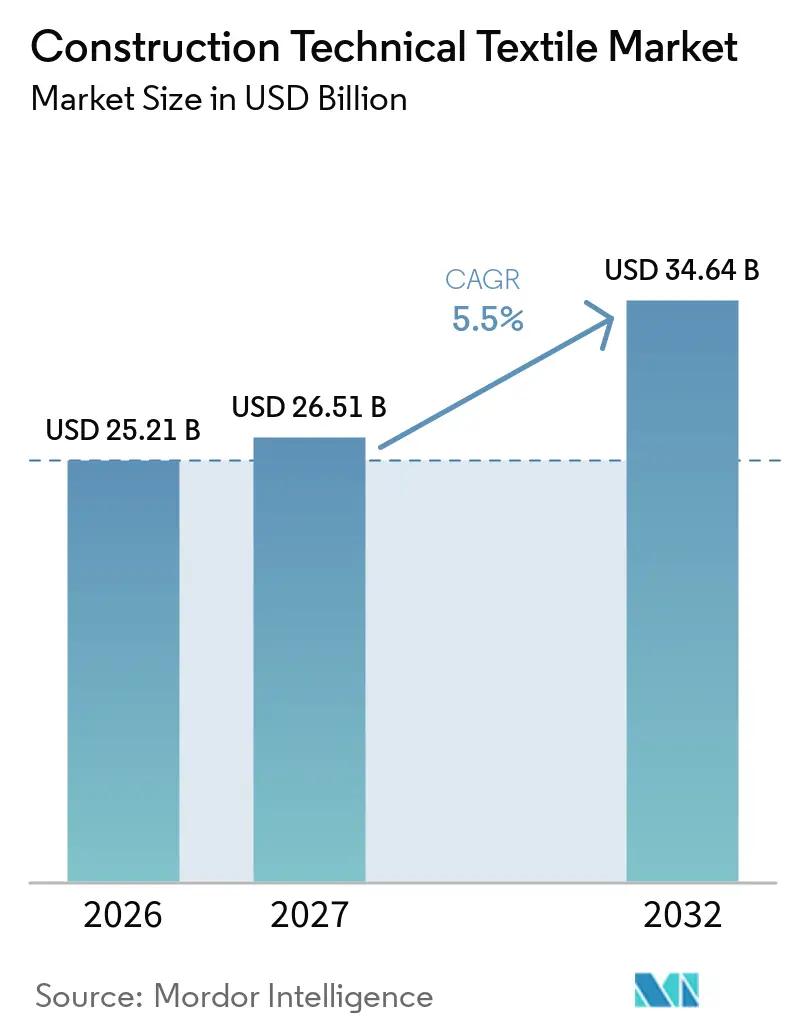
Construction Technical Textile Market Analysis by Mordor Intelligence
The Construction Technical Textile Market size is expected to grow from USD 25.21 billion in 2026 to USD 26.51 billion in 2027 and is forecast to reach USD 34.64 billion by 2032 at 5.5% CAGR over 2027-2032.
The construction technical textile market serves the building envelope through roofing underlays, architectural membranes, façade wraps, fiberglass reinforcement meshes, insulation facings, and site-protection nets. Demand is supported by construction activity and by building rules that place greater weight on energy performance, fire classification, and material durability. These requirements favor materials that manage moisture, reinforce building systems, and reduce installation time. Renovation programs and lightweight construction methods also broaden the use cases for performance textiles. The construction technical textile market remains exposed to changes in polymer and specialty additive costs, yet renovation demand and energy code compliance provide support through the forecast period.
Key Report Takeaways
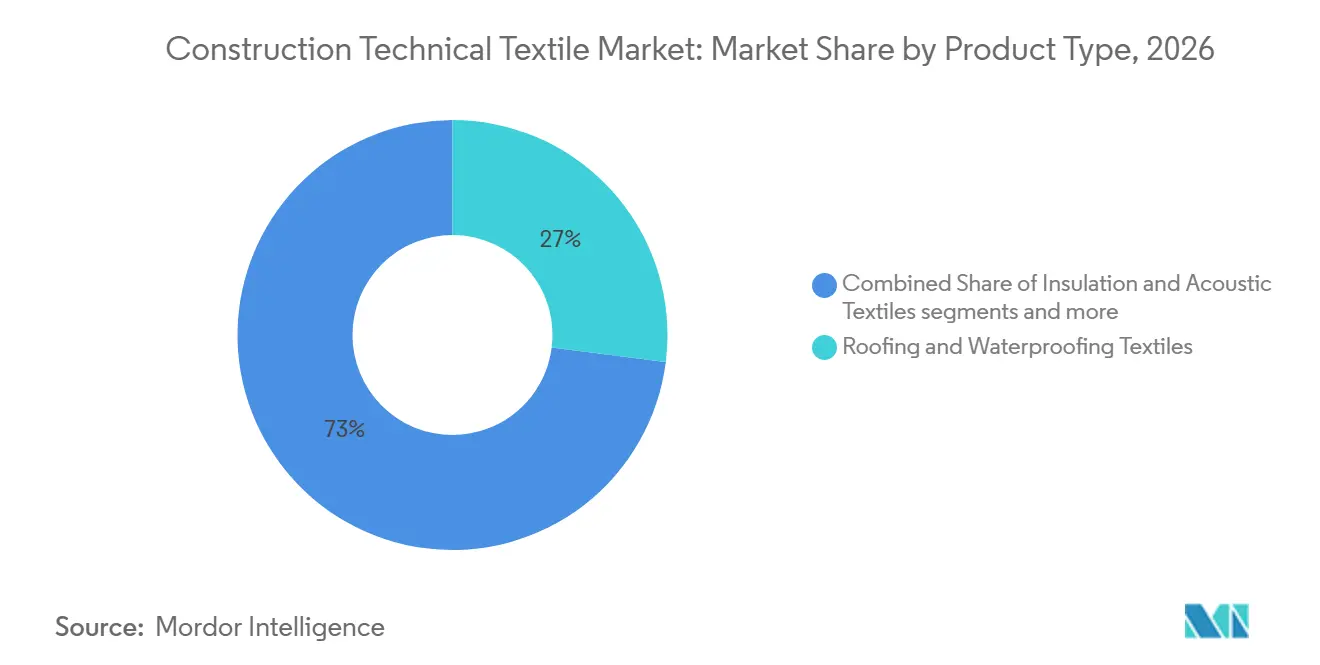
- By product type, roofing and waterproofing textiles held 27% of the construction technical textile market share in 2026, while Architectural membranes and tensile fabrics are forecast to grow at a 7.2% CAGR through 2032.
- By material type, polyester held 32% of the construction technical textile market size in 2026, while carbon, aramid, and other high-performance fibers are forecast to grow at a 7.5% CAGR through 2032.
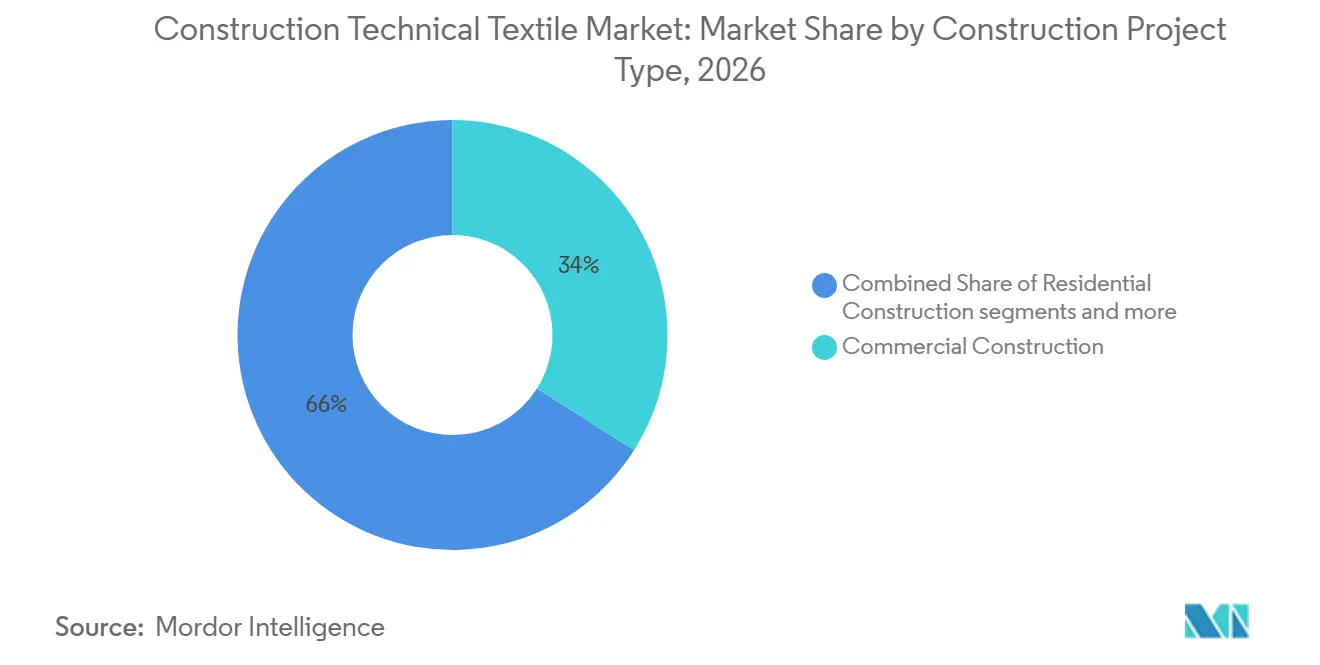
- By construction project type, commercial construction accounted for 34% of the market in 2026, while industrial and logistics construction is forecast to grow at a 6.8% CAGR through 2032.
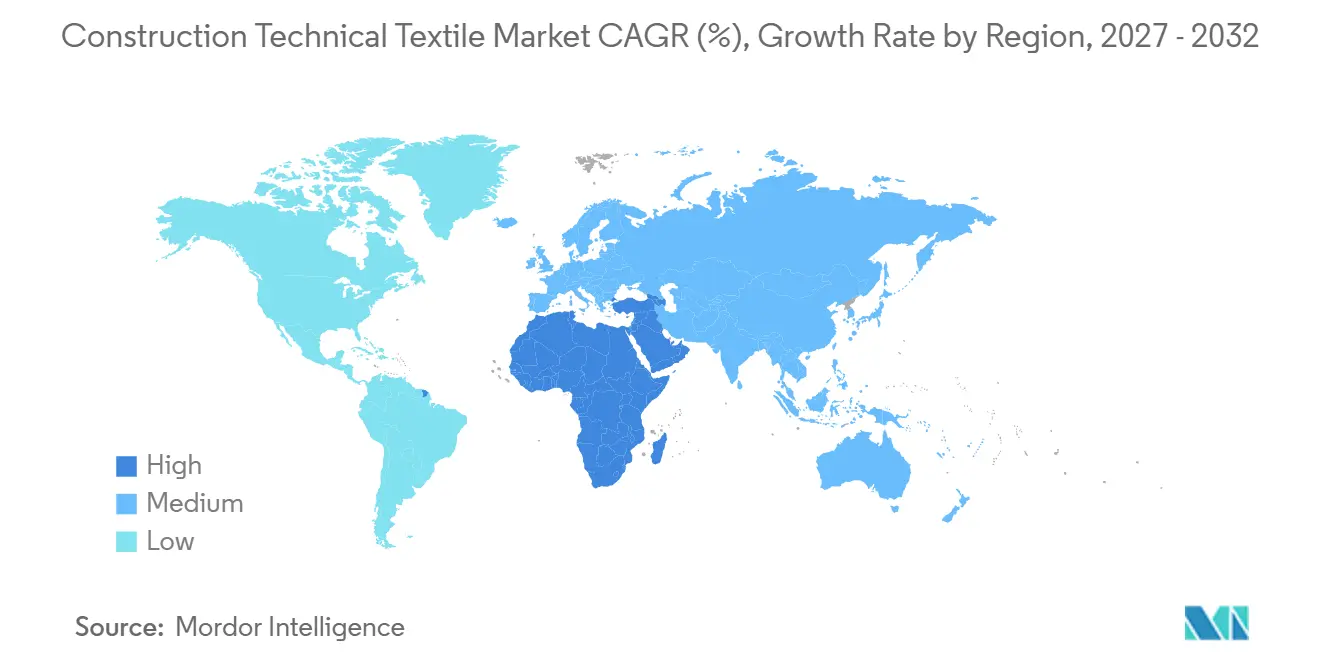
- By geography, Asia-Pacific accounted for 42.5% of the market in 2026, while the Middle East and Africa is forecast to grow at a 6.5% CAGR through 2032.
Note: Market numbers in this report are based on Mordor Intelligence's proprietary estimation framework, which combines nine months of actuals with Q4 projections for base year 2026.
Market Trends and Insights
Drivers Impact Analysis of Construction Technical Textile Market*
| Driver | (~) % Impact on CAGR Forecast | Geographic Relevance | Impact Timeline |
|---|---|---|---|
| Expansion of Commercial, Industrial and Institutional Building Construction | +1.5% | Global, led by Asia-Pacific and Middle East and Africa | Short term (≤ 2 years) to Medium term (2-4 years) |
| Increasing Building Energy Efficiency and Thermal Insulation Requirements | +1.2% | European Union core, with spillover to North America and Asia-Pacific | Medium term (2-4 years) |
| Growing Demand for Lightweight and High-Strength Construction Materials | +1% | Global, accelerating in South Asia and the Middle East and Africa | Medium term (2-4 years) |
| Rising Building Renovation and Façade Retrofitting Activities | +0.8% | Europe primarily, extending to North America | Medium term (2-4 years) |
| Increasing Adoption of Architectural Membranes and Tensile Fabric Structures | +0.7% | Asia-Pacific, Middle East and Africa, and select European urban centers | Short term (≤ 2 years) to Medium term (2-4 years) |
| Stricter Building Fire Safety and Construction Material Performance Requirements | +0.5% | European Union and United Kingdom primary, with global compliance spillover | Short term (≤ 2 years) |
| Source: Mordor Intelligence | |||
Expansion of Commercial, Industrial, and Institutional Building Construction
Commercial, industrial, and institutional projects drive much of the demand for construction textiles because they require weather protection, acoustic control, insulation, and durable roofing systems. Data center projects are a key application because they use weatherization membranes, acoustic insulation, and raised-floor vapor barriers. These products help contractors manage moisture and installation schedules in technically demanding buildings. The construction technical textile market also benefits from industrial and logistics facilities, where large roof spans and durable barriers are important. Commercial buildings use roofing substrates, façade wraps, and reinforcement fabrics in new construction and renovation. This broad application base supports recurring demand across several building types rather than relying on a single project category.
Increasing Building Energy Efficiency and Thermal Insulation Requirements
Directive EU 2024/1275 entered into force in May 2024 and requires Member States to prepare national renovation plans and strengthen minimum energy performance standards for buildings.[1] The directive focuses on insulation, windows, and air barriers, which makes building-envelope performance a central part of construction planning. Breathable membranes and fiber-based insulation facings can support these requirements by managing air and moisture within wall and roof assemblies. A 2024 study by Germany’s Federal Institute for Research on Building, Urban Affairs and Spatial Development examined adaptive membrane façade modules and their potential to reduce embodied carbon and operational energy.[2] The construction technical textile market therefore gains from regulations that turn building-envelope upgrades into planned compliance work. Demand can extend across insulation facings, roofing underlays, and façade wraps when building owners update existing assets.
Growing Demand for Lightweight and High-Strength Construction Materials
Modular building panels and lightweight structural components use technical textiles for reinforcement, vapor control, and surface finishing. India’s Central Building Research Institute is validating 2D and 3D textiles, including PBO, glass-fiber, and geogrid formats, for structural and geotechnical uses, from basement retaining walls to thin-shell concrete and prefabricated façade components. Alkali-resistant glass textiles and carbon mesh composites can reduce the cover depth needed in certain reinforced concrete elements compared with conventional steel reinforcement. This gives designers more flexibility in thin structural parts and façade components. Fraunhofer IBP has also reported that textile façade systems can replace conventional external thermal insulation composite system plaster layers and offer stronger crack resistance under thermal cycling. These uses strengthen the role of the construction technical textile market in lightweight systems where a lower structural load and controlled installation are important.
Rising Building Renovation and Façade Retrofitting Activities
Building renovation creates a separate source of demand from new construction because existing assets often require low-weight systems that can be installed with limited disruption. Textile façade approaches can provide shading, thermal, and visual functions within a single system. Schüco’s FACID M system uses a tensioning approach that transfers membrane loads within the aluminum frame and can use A2-rated glass-fiber fabrics for fire-compliant applications. Renovation of older commercial buildings also favors products that can be fitted quickly while retaining occupants in the building. The construction technical textile market can therefore address projects where installation speed, design flexibility, and low added weight are central purchasing factors.
Restraints Impact Analysis of Construction Technical Textile Market*
| Restraint | (~) % Impact on CAGR Forecast | Geographic Relevance | Impact Timeline |
|---|---|---|---|
| Volatility in Polyester, Polypropylene and Specialty Fiber Prices | -0.7% | Global, concentrated in Asia-Pacific production hubs | Short term (≤ 2 years) to Medium term (2-4 years) |
| High Production and Installation Costs of Advanced Architectural Membranes | -0.6% | Middle East and Africa, South America, and price-sensitive Asia-Pacific markets | Medium term (2-4 years) to Long term (≥ 4 years) |
| Stringent Product Certification and Building Code Compliance Requirements | -0.5% | European Union and North America primary, with global spillover | Medium term (2-4 years) |
| Durability, UV Degradation and Weathering Concerns | -0.3% | Middle East and Africa, South Asia, and tropical Asia-Pacific markets | Long term (≥ 4 years) |
| Source: Mordor Intelligence | |||
Volatility in Polyester, Polypropylene, and Specialty Fiber Prices
Input-price movement complicates margin planning for producers of roofing textiles, geotextiles, and coated membranes. The British Plastics Federation reported changes in polypropylene pricing across North America, Europe, and Asia during 2025, reflecting differing regional supply and demand conditions.[3] Lower commodity polypropylene prices can reduce input costs for high-volume converters, but they can also increase price competition in finished products. Specialty materials follow a different cost pattern because flame retardants and high-tenacity polyester are procured through more specialized supply chains. SergeFerrari cited pressure on strategic raw materials, including antimony, when discussing selective price increases in 2025. The construction technical textile market is more exposed when a producer has limited purchasing power or holds inventory bought at a higher cost.
High Production and Installation Costs of Advanced Architectural Membranes
PTFE-coated fiberglass and ETFE cushion systems need specialized design, fabrication, and installation, which raises their cost relative to conventional roofing and cladding. Tensile structures often require engineers with expertise in cable-net design, form finding, and precision fabrication. This specialist requirement can make fixed-price bids difficult, especially where projects are publicly procured and cost certainty is important. The cost barrier is most significant in price-sensitive locations, where simpler PVC-coated polyester canopies may remain the accessible choice. The construction technical textile market therefore has different adoption patterns across premium institutional projects and lower-cost commercial work. Certification and weathering concerns also add testing, specification, and replacement considerations for buyers selecting advanced membrane systems.
*Our forecasts treat driver/restraint impacts as directional, not additive. The impact forecasts reflect baseline growth, mix effects, and variable interactions.
Construction Technical Textile Market Segment Analysis
By Product Type:
Roofing Textiles Support Volume While Membranes Drive GrowthRoofing and waterproofing textiles accounted for 27% of the Construction technical textile market size in 2026. Spunbonded polyester and glass-fiber substrates support moisture protection and bitumen reinforcement in residential and commercial roofing. Ahlstrom’s FibRoc Plasterboard and FibRoc Ceiling platforms use wetlaid glass fiber and needlepunch nonwovens in fire-resistant garage shafts, elevator enclosures, and moisture-resistant wet-room linings. This extends textile use beyond exterior roofing components into interior building applications.
Architectural membranes and Tensile Fabrics are forecast to grow at a 7.2% CAGR through 2032. Airports, data-center roofs, sports facilities, and public-realm structures benefit from large spans and lower structural weight. Façade and Building Envelope Textiles also gain from renovation programs that use breathable housewraps and weather-resistive barriers. Protektor identifies fiber reinforcement mesh as a component used in modern external thermal insulation composite systems, supporting recurring demand in façade work. The varied applications of roofing, reinforcement, insulation, shading, and site-protection products reduce reliance on a single category within the construction technical textile market.

By Material Type:
High-Performance Fibers Raise the Value MixPolyester held 32% of the market in 2026 because it combines tensile strength, dimensional stability, ultraviolet resistance, and cost efficiency. It is used in roofing underlays, façade wraps, and reinforcement meshes. Polypropylene remains important in geotextiles and site-protection nets, while glass fiber supports insulation reinforcement mesh, bitumen membrane reinforcement, and PTFE-coated membrane substrates. Acrylic and polyamide fibers serve specialized uses in solar shading, acoustic absorbers, and decorative façades.
Carbon, Aramid, and Other High-Performance Fibers are forecast to grow at a 7.5% CAGR through 2032. Textile Reinforced Concrete systems support thinner structural elements than traditional reinforced concrete in relevant applications. A 2025 scientific article reported that carbon textile-reinforced concrete composites reached uniaxial tensile strengths approaching 2,200 MPa in the warp direction. Polyethylene is used in site-protection nets and high-density polyethylene tarpaulins, while natural and regenerated fibers remain a smaller option in sustainability-focused insulation applications. The construction technical textile market can increase its value mix as these high-performance applications expand.
By Construction Project Type:
Commercial Projects Lead While Logistics Buildings GrowCommercial construction accounted for 34% of the market in 2026. Offices, retail sites, hospitality facilities, and data centers use roofing membranes, shading systems, acoustic textiles, and façade wraps. Institutional buildings, including healthcare, education, and civic facilities, add demand for certified fire-resistant and acoustic products. The Construction technical textile industry benefits where buyers prioritize proven compliance and durable performance over the lowest initial material cost.
Industrial and Logistics Construction is forecast to grow at a 6.8% CAGR through 2032. E-commerce fulfillment sites, cold-chain facilities, and reshored manufacturing plants require large building envelopes and efficient construction schedules. Residential construction remains a volume application for breathable roofing underlay and weatherization products, though textile use per building is lower than in large commercial projects. The mix of commercial, industrial, residential, and institutional projects gives the construction technical textile market several demand channels.
Geography Analysis
Asia-Pacific accounted for 42.5% of the construction technical textile market size in 2026. China’s manufacturing base, India’s construction activity, and urban development in Southeast Asia support the region’s leading position. India’s construction sector grew 9% in 2025, according to Freudenberg Group’s annual report. India’s National Technical Textiles Mission had an approved outlay of INR 1,480 crore (USD 164.7 million) through 2025-26 and had approved 168 research projects. It also issued 68 Quality Control Orders, including 20 related to geotechnical textiles.
The regional supply base also serves nearby export markets. South Korea, Taiwan, Japan, Vietnam, and Indonesia each have different demand patterns. Higher-technology fiberglass reinforcement is relevant in South Korea and Taiwan, while roofing underlays and site-protection nets are more prominent in parts of Vietnam and Indonesia. This range of demand profiles supports the volume position of the construction technical textile market.
Europe and North America are established regions where regulation and product specifications shape demand. EU Directive 2024/1275 supports building-envelope improvements and can raise demand for insulation facings, roofing underlays, and textile façade systems. Middle East and Africa is forecast to grow at a 6.5% CAGR through 2032, supported by demand for membranes, shading systems, and high-performance façade textiles in large regional projects. South America remains smaller and more project-led, with activity in commercial construction, infrastructure, geosynthetics, and site-protection uses.
Competitive Landscape
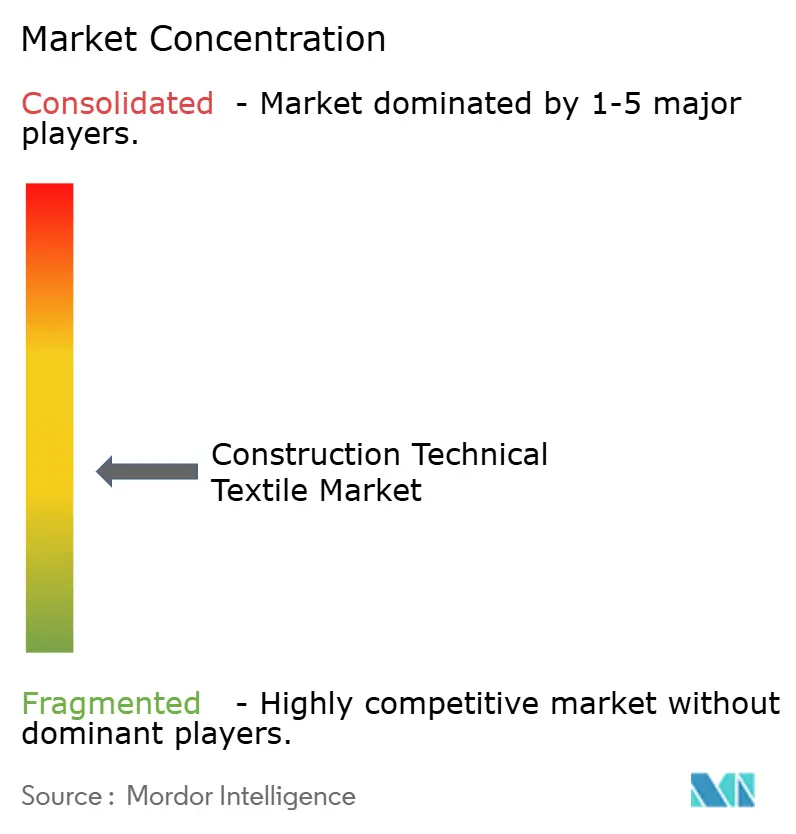
The construction technical textile market exhibits a medium level of market concentration. Global integrated producers compete with specialist fabricators and regional nonwoven producers. Freudenberg Performance Materials, SergeFerrari Group, Sioen Industries, Saint-Gobain ADFORS, and Owens Corning are prominent companies with positions across fibers, glass yarns, coated materials, and converted products. Freudenberg completed the integration of Heytex into its Coated Technical Textiles division during 2025 while closing its Fulda site as part of portfolio rationalization. Freudenberg Performance Materials reported sales of more than EUR 1.4 billion in 2025 (USD 1.6 billion).
Owens Corning agreed in February 2025 to sell its global glass reinforcements business as part of a strategic review and a focus on North American and European building products. SergeFerrari ended industrial operations at its Tersuisse PET spinning site in Switzerland in April 2026, with the company expecting the closure to improve operational profitability from 2027. Sioen completed the acquisition of ISL-Chemie in January 2026 through its European Master Batch subsidiary. Smaller suppliers such as Taiyo Kogyo, SATTLER PRO-TEX, and Seaman Corporation compete through application engineering and custom membrane fabrication. Complex specifications can protect such specialists from direct competition with standard commodity textile products in the construction technical textile market.
Sustainability documentation and coating innovation are becoming more relevant in institutional buying decisions. Sika launched SikaShield modified bitumen products in the United States during 2025, including the SikaShield HB79 hybrid membrane, extending its roofing and waterproofing portfolio. Sika also reported 7 acquisitions during 2025, including transactions involving roofing, waterproofing, and green-roof products. Competition also depends on product performance, certification, application expertise, geographic reach, and the ability to respond to procurement requirements.
Construction Technical Textile Industry Leaders
-
Serge Ferrari Group
-
Sioen Industries NV
-
Freudenberg Performance Materials
-
Saint-Gobain ADFORS
-
SATTLER PRO-TEX GmbH
- *Disclaimer: Major Players sorted in no particular order
Construction Technical Textile Market Companies Covered in this Report
- Serge Ferrari Group
- Sioen Industries NV
- Freudenberg Performance Materials (including MehlerHeytex)
- Saint-Gobain ADFORS
- SATTLER PRO-TEX GmbH
- Seaman Corporation
- Herculite Products Inc.
- Hiraoka & Co., Ltd.
- DuPont de Nemours, Inc.
- Ahlstrom Oyj
- Fibertex Nonwovens A/S
- CHOMARAT
- Owens Corning
- Sika AG
- RENOLIT SE
- Glen Raven, Inc.
- Phifer Incorporated
- TENAX
- Shreeram Nets
- Taiyo Kogyo Corporation
Recent Industry Developments in Construction Technical Textile Market
- April 2026: SergeFerrari Group ceases industrial operations at its Tersuisse PET spinning site in Emmenbrücke, Switzerland, as part of its ongoing industrial footprint rationalization. The closure incurs EUR 1.5 million (USD 1.76 million) in non-recurring costs and is expected to improve operational profitability from 2027 by reducing capital intensity in raw fiber production.
- January 2026: Sioen Industries completes the strategic acquisition of ISL-Chemie GmbH in Germany through its European Master Batch N.V. subsidiary. ISL-Chemie specializes in pigment pastes for polyurethane applications and in-mold coatings used across the construction, automotive, coatings, adhesives, sealants, elastomers, and footwear markets, strengthening Sioen’s integrated coloring solutions and opening new cross-sell opportunities in coated construction fabrics.
- December 2025: SergeFerrari Group completes a EUR 105 million (USD 123.5 million) refinancing, securing its long-term financial structure amid a challenging operating environment marked by weak final-market demand and elevated strategic raw-material costs, including antimony trioxide.
- November 2025: RENOLIT officially inaugurated its new production site in Yingde, Guangdong, China, with an initial annual capacity of 10,000 tons targeting protective films and building-protection applications. Capacity is planned to increase to 12,000 tons as demand scales.
Global Construction Technical Textile Market Report Scope
The Construction Technical Textile Market Report is Segmented by Product Type (Roofing and Waterproofing Textiles, Insulation and Acoustic Textiles, and more), by Material Type (Polyester (PET), Polypropylene (PP) and more), by Construction Project (Residential Construction, Commercial Construction, and more ), by Geography (North America, Europe and more) . The Market Forecasts are Provided in Terms of Value (USD).
Segmentation Overview
| Architectural Membranes and Tensile Fabrics (PVC-Coated Membranes, PTFE-Coated Fiberglass Membranes, etc.) |
| Roofing and Waterproofing Textiles |
| Façade and Building Envelope Textiles (Wraps & weather-Resistive Barriers, Façade Membrane Fabrics, etc.) |
| Construction Reinforcement Textiles (Fiberglass Plaster, Reinforcement Fabric & Meshes, Scrims, etc.) |
| Insulation and Acoustic Textiles |
| Architectural Shading and Canopy Textiles |
| Construction Site Protection Textiles (Debris Nets, Dust and Containment Fabrics, etc.) |
| Other Construction Technical Textiles |
| Polyester (PET) |
| Polypropylene (PP) |
| Polyethylene (PE) |
| Glass Fiber |
| Acrylic and Polyamide Fibers |
| Carbon, Aramid, and Other High-Performance Fibers |
| Natural and Regenerated Fibers |
| Other Specialty Materials |
| Residential Construction |
| Commercial Construction |
| Industrial and Logistics Construction |
| Institutional and Other Building Construction |
| North America | United States |
| Canada | |
| Mexico | |
| Europe | Germany |
| United Kingdom | |
| France | |
| Italy | |
| Spain | |
| Netherlands | |
| Rest of Europe | |
| Asia-Pacific | China |
| Japan | |
| India | |
| South Korea | |
| Taiwan | |
| Australia | |
| Indonesia | |
| Vietnam | |
| Rest of Asia-Pacific | |
| Middle East and Africa | Saudi Arabia |
| United Arab Emirates | |
| Turkey | |
| South Africa | |
| Rest of Middle East and Africa | |
| South America | Brazil |
| Argentina | |
| Chile | |
| Rest of South and Central America |
| By Product Type | Architectural Membranes and Tensile Fabrics (PVC-Coated Membranes, PTFE-Coated Fiberglass Membranes, etc.) | |
| Roofing and Waterproofing Textiles | ||
| Façade and Building Envelope Textiles (Wraps & weather-Resistive Barriers, Façade Membrane Fabrics, etc.) | ||
| Construction Reinforcement Textiles (Fiberglass Plaster, Reinforcement Fabric & Meshes, Scrims, etc.) | ||
| Insulation and Acoustic Textiles | ||
| Architectural Shading and Canopy Textiles | ||
| Construction Site Protection Textiles (Debris Nets, Dust and Containment Fabrics, etc.) | ||
| Other Construction Technical Textiles | ||
| By Material Type | Polyester (PET) | |
| Polypropylene (PP) | ||
| Polyethylene (PE) | ||
| Glass Fiber | ||
| Acrylic and Polyamide Fibers | ||
| Carbon, Aramid, and Other High-Performance Fibers | ||
| Natural and Regenerated Fibers | ||
| Other Specialty Materials | ||
| By Construction Project Type | Residential Construction | |
| Commercial Construction | ||
| Industrial and Logistics Construction | ||
| Institutional and Other Building Construction | ||
| By Geography | North America | United States |
| Canada | ||
| Mexico | ||
| Europe | Germany | |
| United Kingdom | ||
| France | ||
| Italy | ||
| Spain | ||
| Netherlands | ||
| Rest of Europe | ||
| Asia-Pacific | China | |
| Japan | ||
| India | ||
| South Korea | ||
| Taiwan | ||
| Australia | ||
| Indonesia | ||
| Vietnam | ||
| Rest of Asia-Pacific | ||
| Middle East and Africa | Saudi Arabia | |
| United Arab Emirates | ||
| Turkey | ||
| South Africa | ||
| Rest of Middle East and Africa | ||
| South America | Brazil | |
| Argentina | ||
| Chile | ||
| Rest of South and Central America | ||
Key Questions Answered in the Report
What is the projected value of construction technical textiles by 2032?
The construction technical textile market is projected to reach USD 34.64 billion by 2032, growing at a 5.50% CAGR from 2027 to 2032.
Which product category has the largest share in construction technical textiles?
In the construction technical textile market, Roofing and Waterproofing Textiles lead with 27% in 2026, supported by broad use in underlays, roofing substrates, and moisture-protection systems.
Which material is growing fastest in construction technical textiles?
Carbon, Aramid, and other High-Performance Fibers are forecast to grow at a 7.5% CAGR through 2032 as textile reinforcement gains use in thin structural elements.
Which project type uses the most construction technical textiles?
Commercial construction accounted for 34% in 2026 because the construction technical textile market supports roofing, façade, shading, and acoustic systems in offices, retail buildings, hospitality projects, and data centers.
Which region leads demand for construction technical textiles?
Asia-Pacific led with 42.5% in 2026, supported by manufacturing capacity and construction activity in China, India, and Southeast Asia. The Construction technical textile market has its largest regional base there.
What limits adoption of advanced architectural membranes?
Specialized design and installation requirements, higher costs, certification obligations, and exposure to weathering considerations can restrict use in price-sensitive projects. Buyers also assess fire classification, moisture management, tensile performance, ultraviolet resistance, installation skills, and available test records before selecting a membrane system.