
Market Overview
| Study Period | 2020 - 2031 |
|---|---|
| Forecast Data Period | 2026 - 2031 |
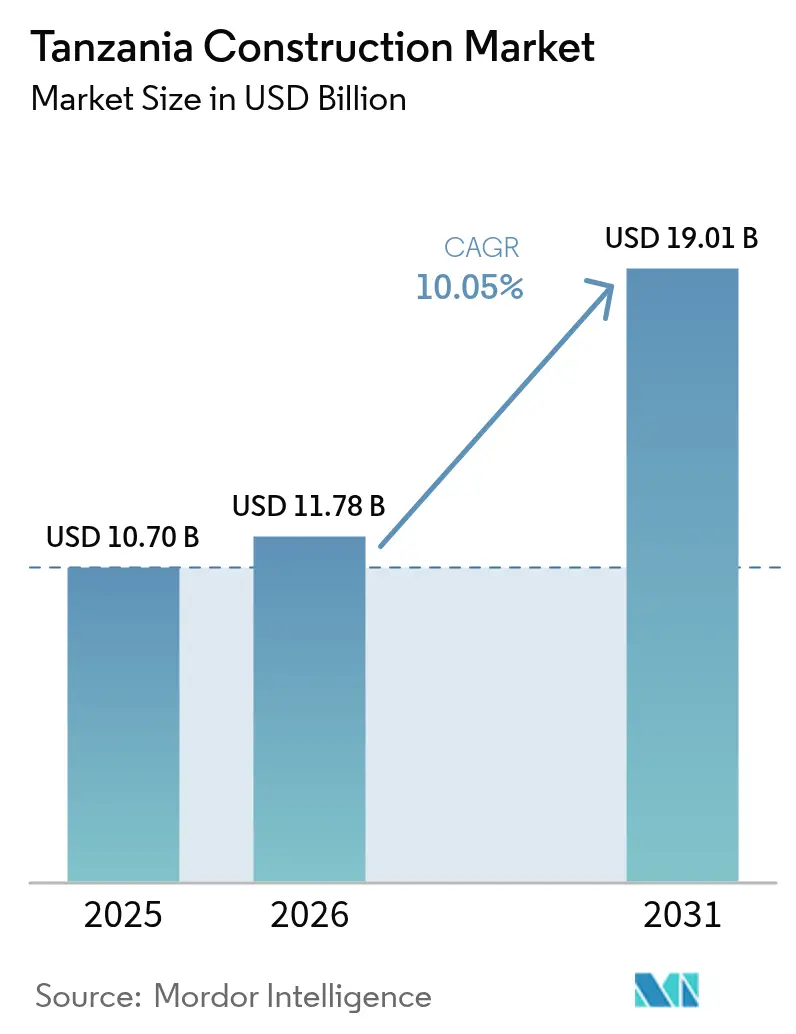
| Base Year Market Size (2025) | USD 10.70 Billion |
| Market Size (2026) | USD 11.78 Billion |
| Market Size (2031) | USD 19.01 Billion |
| Growth Rate (2026 - 2031) | 10.05 % |
| Market Concentration | Low |
Major Players *Disclaimer: Major Players sorted in no particular order Image © Mordor Intelligence. Reuse requires attribution under CC BY 4.0. | |
Tanzania Construction Market Analysis by Mordor Intelligence
The Tanzania Construction market size is expected to grow from USD 10.70 billion in 2025 to USD 11.78 billion in 2026 and is forecast to reach USD 19.01 billion by 2031 at 10.05% CAGR over 2026-2031. Momentum stems from Tanzania’s lower-middle-income transition, steady public spending, and a reform agenda that now attracts deeper private capital. Infrastructure projects such as the Standard Gauge Railway and Julius Nyerere Hydropower Project continue to dominate order books, while affordable housing policies, green building incentives, and modern construction methods provide new demand layers. Growing urban populations, particularly in Dar es Salaam, expand the pipeline for residential and mixed-use schemes, and the gradual adoption of prefabrication is beginning to compress project cycles. At the same time, material-price volatility and pockets of skilled-labour shortages weigh on near-term margins, nudging developers toward closer supplier partnerships, wider use of local inputs, and more formal training programs. Competitive intensity remains high, with international contractors leading megaprojects and local firms consolidating around mid-sized civil works.
Key Report Takeaways
- By sector, Infrastructure captured 38.55% of the Tanzania construction market share in 2025. Tanzania construction market size for infrastructure is projected to grow at 11.32% CAGR between 2026-2031.
- By construction type, New construction captured 83.40% of the Tanzania construction market share in 2025. Tanzania construction market size for new construction is projected to grow at 10.12% CAGR between 2026-2031.
- By construction method, Conventional on-site techniques captured 84.20% of overall market revenue in 2025. Tanzania construction market size for modern construction methods is projected to grow at 13.35% CAGR between 2026-2031.
- By investment source, Public funding captured 64.30% of total 2025 spending. Tanzania construction market size supported by private investment is projected to grow at 11.95% CAGR between 2026-2031.
- By geography, Dar es Salaam captured 37.60% of 2025 activity. Tanzania construction market size in the Central and Lake Zones is projected to grow at 11.75% CAGR between 2026-2031.
Note: Market size and forecast figures in this report are generated using Mordor Intelligence’s proprietary estimation framework, updated with the latest available data and insights as of 2026.
Market Trends and Insights
Drivers Impact Analysis of Tanzania Construction Market*
| Drivers | (~) % Impact on CAGR Forecast | Geographic Relevance | Impact Timeline |
|---|---|---|---|
| Sustained government infrastructure investment & PPP expansion | +3.2% | National; Dar es Salaam, Dodoma, transport corridors | Long term (≥ 4 years) |
| Rising urbanization & affordable-housing programs | +2.5% | Dar es Salaam, Northern Zone, Lake Zone | Medium term (2-4 years) |
| Growth in power generation & transmission build-out | +1.8% | National; Southern Highlands, Central Zone | Medium term (2-4 years) |
| Nationwide scale-up of road, rail, port, and airport links | +2.4% | Economic corridors, coastal ports | Long term (≥ 4 years) |
| Source: Mordor Intelligence | |||
Sustained Government Infrastructure Investment and Expansion of Public–Private Partnerships (PPPs)
Tanzania’s 2024/25 budget prioritizes flagship civil works, and revisions to the PPP Act have removed key procedural frictions, prompting an uptick in registered projects and accelerating job creation.[1] The Tanzania Electronic Investment Window shortens lead times for approvals, while the scrapping of 374 minor fees trims project overheads. Robust PPP pipelines are emerging across rail, energy, and logistics corridors, giving private operators a clearer revenue-risk profile that aligns with multilateral lending guidelines. These frameworks underpin the Tanzania construction market’s ability to mobilize long-tenor finance, improve cost recovery, and accommodate life-cycle maintenance provisions.
Rising Urbanization and Government-Backed Affordable Housing Initiatives Across Major Cities
Dar es Salaam’s population of nearly 5 million and a national housing deficit of 3 million units underpin the case for scaled residential delivery. Funding flowing to the Samia Housing Scheme and National Housing Corporation projects broadens mortgage access and stimulates institutional demand for serviced land trade.gov. Pension-fund-backed Watumishi Housing Investment is replicating a rent-to-own model across 19 regions, illustrating how the Tanzania construction market now absorbs diversified financing channels. Rising disposable incomes, coupled with new zoning rules that encourage higher-density projects, further support multi-family and mixed-use formats.
Steady Growth in Power Generation and Transmission Infrastructure to Meet Energy Demand
Completion of the 2,115-MW Julius Nyerere Hydropower Project in 2025 will add significant baseload supply and unlock secondary construction around transmission lines and industrial estates. Rural electrification has already lifted access to 43%, driving demand for sub-stations, small-scale renewable plants, and distribution upgrades. The Tanzania construction market therefore benefits from a positive feedback loop where new power capacity spurs manufacturing growth, which in turn requires more warehouse, factory, and ancillary infrastructure.
Nationwide Scale-Up of Transport Infrastructure Including Roads, Rail, Ports, and Airports
Tanzania is witnessing a significant scale-up of its transport infrastructure, encompassing roads, railways, ports, and airports. Notable initiatives include Phase 4 of the Standard Gauge Railway (SGR), 2,000 km of planned national highways, and port dredging at Lake Victoria, which collectively underpin a multi-modal strategy aimed at enhancing regional trade connectivity. This infrastructure expansion is being supported by innovative financing mechanisms such as the Samia Infrastructure Bond, valued at approximately USD 58 million (TZS 150 billion), reflecting the government's growing reliance on market-based instruments to mobilize domestic capital for public works. These initiatives are driving a robust construction pipeline, improving equipment utilization rates and sustaining order visibility for contractors, thereby strengthening the medium- to long-term growth prospects of the Tanzania construction market.
Restraints Impact Analysis of Tanzania Construction Market*
| Restraint | (~) % Impact on CAGR Forecast | Geographic Relevance | Impact Timeline |
|---|---|---|---|
| Volatility in Construction Material Prices Driven by Global and Regional Disruptions | -1.2% | National, with greater impact in inland regions | Short term (≤ 2 years) |
| Skilled Labour Shortages Across Engineering, Project Management, and Technical Trades | -0.8% | National, more severe in emerging construction hubs | Medium term (2-4 years) |
| High Dependence on Imported Equipment and Materials Increasing Project Costs and Delays | -0.6% | National, with concentration in major infrastructure projects | Medium term (2-4 years) |
| Source: Mordor Intelligence | |||
Volatility in Construction Material Prices Driven by Global and Regional Disruptions
Cement prices rose to USD 7.5 per bag even as capacity climbed past 9.1 million tonnes, highlighting supply-chain and tax-related distortions thecitizen.co.tz. Steel inputs mirror this pattern. Although upstream projects such as Liganga iron ore and Mchuchuma coal aim to localize production, the Tanzania construction market remains vulnerable to import duty shifts and logistics bottlenecks. Developers respond by negotiating index-linked contracts, batching material orders earlier, and exploring alternative aggregates to manage cost exposure.
Skilled Labour Shortages Across Engineering, Project Management, and Technical Trades
A persistent mismatch between Technical and Vocational Education and Training curricula and site-level competencies constrains delivery timelines, especially for complex civil works researchgate.net. Wage gaps and gender imbalances further reduce the available talent pool. Capacity-building interventions now focus on structured apprenticeships, supervisory-skills upgrades, and bundled contractor financing that embeds on-the-job training clauses. These measures will temper the near-term drag but will require concerted stakeholder coordination to close the skills gap fully.
*Our forecasts treat driver/restraint impacts as directional, not additive. The impact forecasts reflect baseline growth, mix effects, and variable interactions.
Tanzania Construction Market Segment Analysis
By Sector:
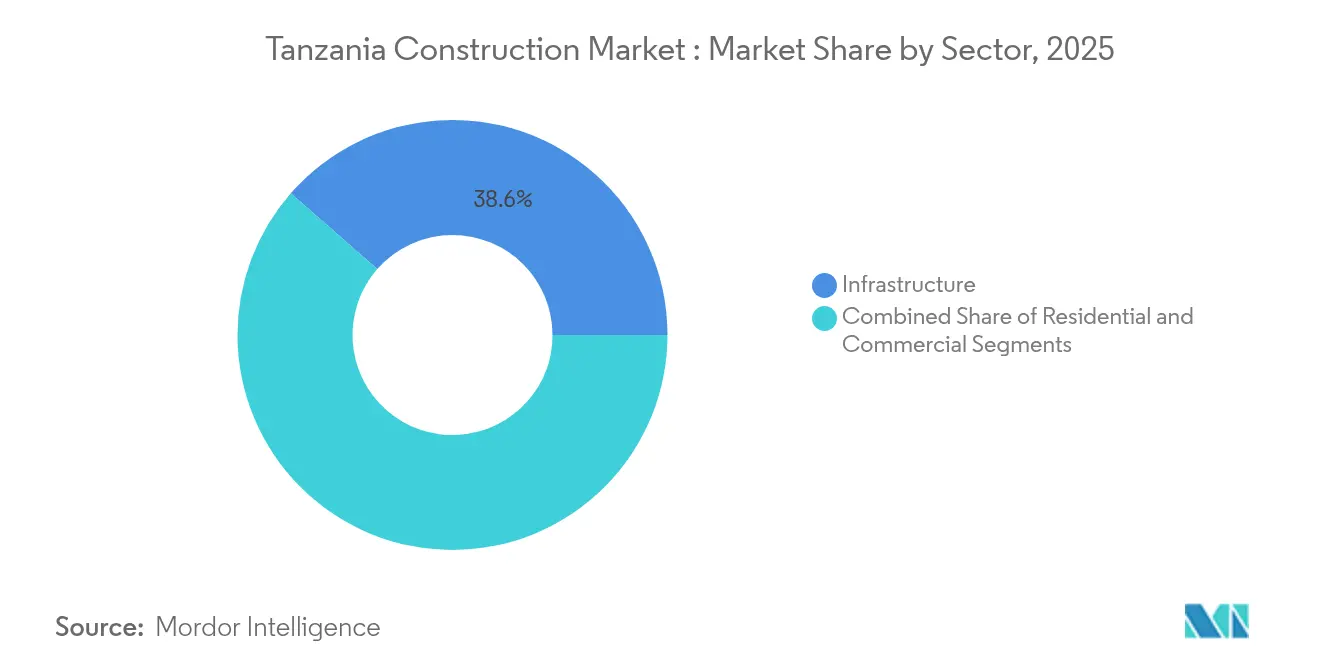
Infrastructure Sustains Leadership Through Flagship Civil WorksInfrastructure accounted for 38.55% of 2025 spending, giving the segment the single largest Tanzania construction market share. The World Bank’s USD 200 million backing for the Dodoma Integrated and Sustainable Transport project underscores ongoing multilateral support and is forecast to lift city output by 2% once completed. Such investments positions infrastructure to deliver an 11.32% CAGR until 2031. This growth path hinges on corridor connectivity gains, spill-over benefits from port expansion, and the maturing PPP framework that channels private capital into toll roads and logistics parks. The Tanzania construction market therefore views infrastructure as both demand stabilizer and innovation testbed, particularly for digital project-management systems.
Residential construction ranks second by value. The government seeks to close a 3 million-unit deficit through policy incentives and public land release. Mortgage reforms, combined with National Housing Corporation projects valued at USD 400 million, expand credit penetration, while mixed-income projects broaden addressable demand. Commercial space trails both sectors and grapples with 70% office occupancy in Dar es Salaam, leading landlords to pivot toward flexible floorplates and co-working formats. Retail supply is increasingly bundled into mixed-use precincts, as exemplified by Peninsula Plaza’s USD 12 million scheme. These dynamics echo a gradual repositioning within the Tanzania construction market as developers adopt multi-asset risk hedging.

By Construction Type:
New Builds Dominate as Greenfield Demand Outpaces RenovationsNew construction retained an 83.40% share in 2025, reflecting the Tanzania construction market size bias toward foundational infrastructure and new housing stock. At a projected 10.12% CAGR, new projects will remain the primary earnings engine, anchored by the Annual Development Plan that allocates USD 6.3 billion for civil and social facilities. Public agencies prefer greenfield builds to meet stringent capacity benchmarks, while private developers deploy new schemes to capture first-mover pricing in emerging districts.
Renovation work is comparatively small yet strategically important. Port-upgrade contracts such as the Kigoma Port refurbishment worth USD 16.7 million focus on throughput gains and safety standards. Building-retrofit demand is rising too, with corporate tenants requesting energy audits ahead of lease renewals. Although margins can be higher, project fragmentation and legacy-building documentation challenges limit scale. Nonetheless, targeted incentives for energy-efficient retrofits could widen the revenue base for specialized contractors within the Tanzania construction market.
By Construction Method:
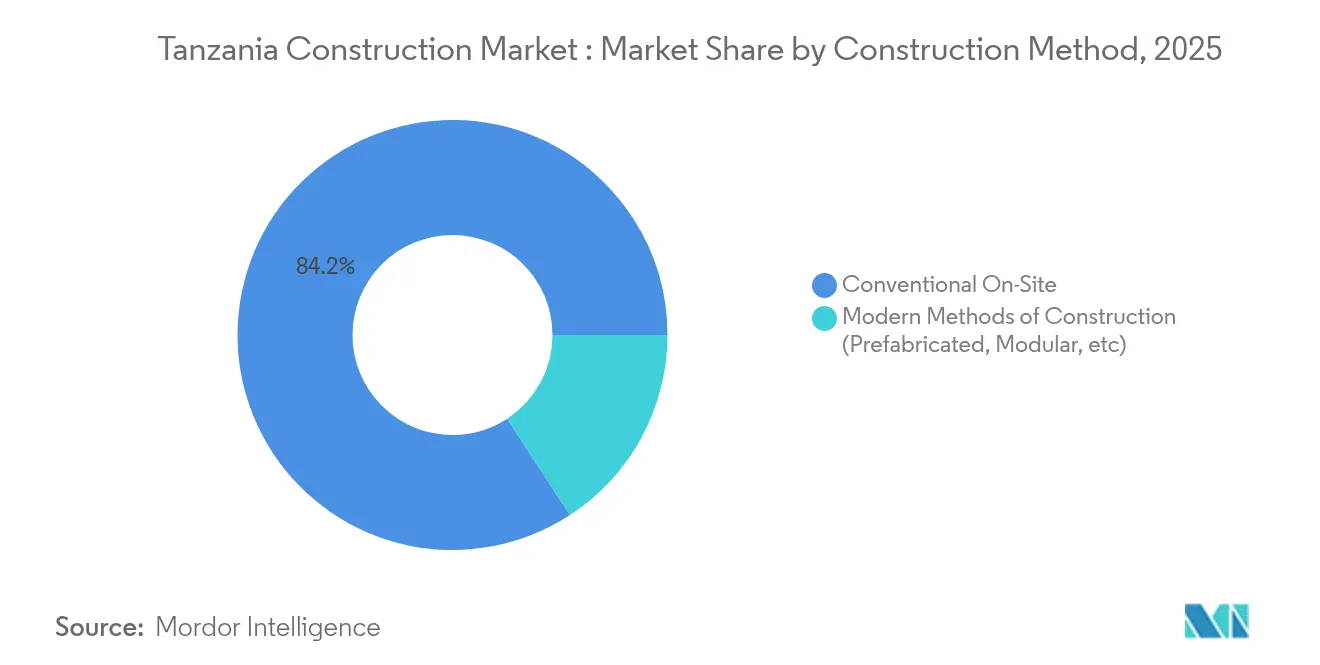
Modern Techniques Accelerate but Conventional Builds Remain PredominantConventional on-site approaches held 84.20% of revenue in 2025. Familiarity, established supply chains, and readily available labour explain the dominance, especially on small and mid-sized sites. However, evolving building codes and stricter delivery schedules are pushing developers to reconsider methodology. Prefabricated housing kits now appear in government-led social-housing programs, validating factory-assembled structural systems in the Tanzania construction market.
Modern construction methods command only 15.80% of current spending yet are forecast to climb at a 13.35% CAGR to 2031. Prefabrication shortens project cycles, cuts waste, and improves occupational safety metrics. Research indicates that scaling such approaches hinges on standardized design templates, digital inventory tracking, and adaptive policy support. Early adopters report improved bankability as financiers recognize lower completion risk. While upfront capital costs are higher, value-engineering savings and quicker tenant occupancy bolster net economics, helping to anchor the Tanzania construction market’s transition toward industrialized building systems.
By Investment Source:
Public Spending Dominates but Private Capital Gains VelocityPublic allocations represented 64.30% of 2025 activity, cementing the state’s orchestrating role in national build-out. Treasury commitments focus on social facilities, transport corridors, and strategic energy assets. Project-preparation units within ministries collaborate more closely with lenders to meet disclosure and environmental standards, a practice that reduces delay risk across the Tanzania construction market.
Private investment, though smaller, will grow the fastest at a 11.95% CAGR to 2031 as PPP reforms kick in. Domestic banks are scaling syndicated-loan desks for sizable deals, and capital-market regulators are enabling infrastructure-bond listings. Challenges persist around pipeline transparency and bankable concession structures, yet early success stories in toll-road and port berths demonstrate improving feasibility. The rising role of corporate green bonds and pension-fund vehicles suggests a diversified funding mix that will reshape future contract structures within the Tanzania construction market size narrative.
Geography Analysis
Dar es Salaam accounted for 37.60% of total construction turnover in 2025, driven by its position as a national trade gateway, a dense residential base, and consistent demand for commercial and logistics spaces. Despite a dip in prime office rents to USD 15/m², high-end residential rentals continued to rise, underscoring a bifurcated sub-market dynamic. Developers are actively repositioning towards mixed-use precincts and last-mile logistics hubs, in response to the growth of e-commerce and urban delivery needs. While Dar es Salaam is expected to retain its core status in the national construction landscape, escalating land prices and traffic congestion are encouraging spillover growth into peri-urban districts. The city is projected to grow at a CAGR of 11.62% from 2026 to 2031, sustaining its lead through high-value urban and infrastructure investments.
The Central Corridor, anchored by Dodoma’s role as the administrative capital, is set to headline future growth alongside the Lake Zone. Government-led developments such as the Government City in Mtumba, paired with multilateral-backed infrastructure initiatives—including highways and airports—are expanding the region’s construction footprint. Notably, airport modernization in Dodoma is expected to reinforce its connectivity to inland trade routes.
The Lake Zone, including cities such as Mwanza, is emerging as a key inland logistics and industrial hub. The region is experiencing a construction surge driven by upgrades to Lake Victoria ports and associated transport corridors. Airport enhancements in Mwanza further improve its regional trade function. The Southern Highlands, notably Mbeya and Iringa, are leveraging infrastructure spillovers from the Julius Nyerere Hydropower Project, which is stimulating the development of agro-processing estates and local housing. Meanwhile, Zanzibar is accelerating infrastructure activity with a USD 210 million road upgrade program covering 103.5 km, designed to unlock tourism corridors and drive localized development. While smaller in scale, these regions play a vital role in decentralizing demand, contributing to multi-regional resilience across the Tanzania construction market.
Regulatory Landscape
Construction activity in Tanzania is governed by a multi-agency compliance framework led by the Ministry of Works, which provides policy oversight for roads, bridges, airports, ferries, and public buildings. Mandatory professional and contractor registration is used to enforce eligibility, with the Contractors Registration Board (CRB) regulating contractor registration and classification, and requiring project registration for participation in formal works. The Engineers Registration Board (ERB) enforces the Engineers Registration Act (Cap 63), including competence rules and mandatory site inspections for engineering works.
On the built-environment side, Urban Planning (Building) Regulations (2018) and Urban Planning (Planning Space Standards) Regulations (2018) set planning controls such as design parameters and space standards, which influence plot development intensity and approval workflows. Technical compliance is anchored by the Tanzania Bureau of Standards (TBS), which issues and maintains construction-related standards, including codes of practice for foundations and materials, shaping specifications used in tendering and quality assurance across public and private projects.
Value Chain Analysis
Tanzania's construction value chain begins with project origination and financing, where public agencies and SOEs drive large programs and private capital comes in through PPP and EPC+F structures. The work then moves into design, procurement, construction execution, commissioning, and operations, with international EPC contractors playing a major role in megaproject delivery on rail and hydropower, while domestic contractors tend to focus on municipal works and mid-sized civil packages.
Upstream inputs mix local production, such as cement and aggregates, with imported equipment and selected materials, leaving contractors exposed to foreign exchange swings, logistics frictions, and tax and distribution costs. Contractors manage these pressures through approaches like bulk purchasing initiatives (including National Housing Corporation efforts to negotiate bulk material supply) and, where feasible, moves toward vertical integration to secure quality and availability. Downstream, logistics-linked infrastructure increasingly influences construction productivity: the Standard Gauge Railway (planned as a 4,752-kilometre network) and port-connected inland distribution help improve the economics of moving heavy materials and equipment from Dar es Salaam into interior work sites, which tightens schedule control for corridor projects and large public works programs.
Competitive Landscape
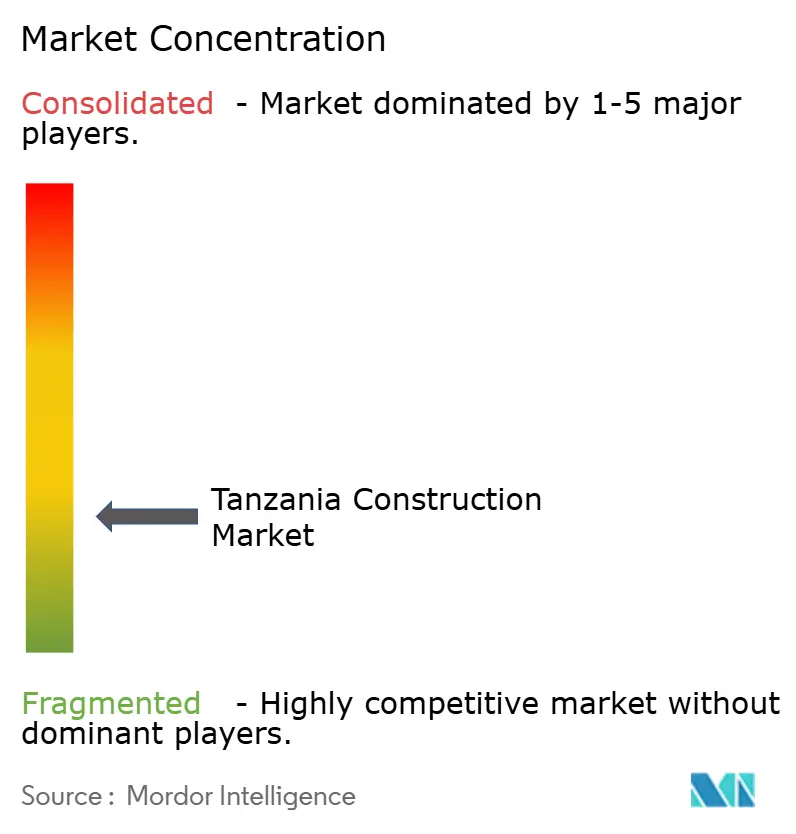
The competitive field remains fragmented, with top international firms dominating landmark projects and a long tail of domestic contractors handling feeder roads, municipal facilities, and public-housing lots. China Civil Engineering Construction Corporation, Sinohydro, and Yapi Merkezi command strong project pipelines, supported by export-credit financing and turnkey delivery capacity. Local contractors, while numerous, face working-capital constraints and limited equipment fleets. Government policy now reserves select road contracts for Tanzanian entities, including dedicated quotas for female-owned firms; this intervention is gradually improving indigenous capacity.
Strategic positioning is increasingly thematic. International players focus on rail, hydropower, and deep-water terminals where scale efficiencies matter. Domestic firms target schools, health clinics, and mid-rise housing, capitalizing on localized procurement rules. Green building and affordable-housing solutions present new whitespace, supported by the Tanzania Green Building Council and International Finance Corporation financing lines. Engineering, Procurement, and Construction contracts that align with FIDIC clauses are now mainstream in megaproject bidding.
Risk-sharing structures are evolving as lenders demand stronger cost-overrun protections and performance guarantees. Digital tools such as Building Information Modeling and drone-based site monitoring are slowly entering high-value projects, improving stakeholder visibility and dispute resolution speeds. Labour-market tightness is prompting firms to invest in in-house academies and collaborate with vocational institutes. Overall, the Tanzania construction market sees intensifying competition converging with capability upgrades that collectively raise delivery standards.
Tanzania Construction Industry Leaders
-
Advent Construction Ltd
-
Estim Construction Co. Ltd
-
Becco Limited
-
Salem Construction Limited
-
Mohammedi Builders Ltd
- *Disclaimer: Major Players sorted in no particular order
Tanzania Construction Market Companies Covered in this Report
- Advent Construction Ltd
- Estim Construction Co. Ltd
- Becco Limited
- Salem Construction Limited
- Mohammedi Builders Ltd
- China Civil Engineering Construction Corporation (CCECC) Tanzania
- Yapi Merkezi
- Arab Contractors (Osman Ahmed Osman & Co.)
- CRJE (EAST AFRICA) Ltd
- Group Six International Ltd
- Milembe Construction Co. Ltd
- Nordic Construction Company Ltd
- Skol Building Contractors Ltd
- Masasi Construction Co. Ltd
- Stirling Civil Engineering Ltd
- Mota-Engil Africa
- Khato Civils (T) Limited
- Megha Engineering & Infrastructures Ltd (MEIL)
- Sinohydro Corporation Ltd
- Imperial Construction Company Ltd
Market Opportunities and Future Outlook
Transport-led programs are creating near-term opportunities in logistics-adjacent construction, including terminals, warehousing, and urban mobility packages that cluster around the Standard Gauge Railway (SGR) and the Port of Dar es Salaam. In May 2026, Tanzania Railways Corporation commenced cargo operations at the Malindi area of the Port of Dar es Salaam using the SGR, directly linking port cargo to Ihumwa in Dodoma. This step shifts demand toward intermodal yards, access roads, and supporting industrial and logistics real estate. Public budgeting also supports pipeline depth, with the Ministry of Transport requesting TZS 2.87 trillion for FY 2026/27 in May 2026, including TZS 1.51 trillion for the SGR, reinforcing the scale of rail-related civil works and contractor opportunities across track, stations, depots, and feeder infrastructure.
A second opportunity lane is delivery upgrading through standardization and compliance-led procurement, which expands the addressable market for firms with stronger governance, QA/QC, and procurement systems. In March 2026, TBS circulated draft building and civil engineering standards for stakeholder comment, including construction project governance and procurement standards aligned to ISO 6082:2025, aimed at supporting more uniform tendering and project controls across owners and contractors. With the active PPP pipeline maintained by the PPP Centre and site packaging roles played by agencies such as the Tanzania Buildings Agency, the market has clear space for developers, contractors, and consultants to structure bankable projects, execute to tighter standards, and integrate modern methods where schedule certainty is built into contracts.
Recent Industry Developments in Tanzania Construction Market
- July 2026: The Tanzania Buildings Agency (TBA) invited expressions of interest for 38 public-private partnership development sites across 20 regions, spanning commercial, residential, and logistics-oriented projects. The pipeline broadens the pool of packaged, investable real estate opportunities beyond Dar es Salaam and creates bid flow for developers, contractors, and financiers aligned to PPP delivery.
- April 2026: Standard Chartered secured a syndicated financing package exceeding USD 2.33 billion to support expansion of the Standard Gauge Railway between Makutupora and Isaka, implemented by Yapi Merkezi. The financing strengthens procurement visibility for rail civils, stations, and associated supply-chain work, while improving payment certainty for large contractor and supplier packages tied to the corridor.
- December 2024: Tanzania and CRDB Bank launched the Samia Infrastructure Bond (about USD 60 million) to finance road upgrades through TARURA. The instrument expanded domestic capital-market participation in public works and supported a clearer funding channel for regional road rehabilitation and maintenance-linked construction contracts.
Tanzania Construction Market Report Scope and Research Methodology
Market Definition and Coverage
For this study, the Tanzania construction market is defined as the value of construction work put in place in the country across building and civil works, covering activity funded by public and private sources.
Scope exclusions: Mining extraction facilities and specialized oil and gas EPC work are excluded to avoid overlap with adjacent industrial spend reporting.
Segments Covered in This Report
- By Sector
- Residential
- Apartments/Condominiums
- Villas/Landed Houses
- Commercial
- Office
- Retail
- Industrial and Logistics
- Others
- Infrastructure
- Transportation Infrastructure (Roadways, Railways, Airways, others)
- Energy & Utilities
- Others
- Residential
- By Construction Type
- New Construction
- Renovation
- By Construction Method
- Conventional On-Site
- Modern Methods of Construction (Prefabricated, Modular, etc)
- By Investment Source
- Public
- Private
- By Region (Tanzania)
- Dar es Salaam
- Dodoma & Central Corridor
- Northern Tanzania
- Lake Zone
- Rest of Tanzania
Data Sources, Market Sizing, and Validation
Desk Research
Desk work starts with building the demand and supply context for Tanzania construction using public series that are stable and explainable. We typically refer to sources such as the National Bureau of Statistics (Tanzania), Bank of Tanzania publications, Ministry of Works and Transport budget and project disclosures, and the Tanzania National Roads Agency program updates to understand spend direction and timing.
To keep inputs grounded, we also check public procurement portals, customs and trade statistics for construction-linked materials where relevant, and development finance project documents that list committed values and milestones. Company annual reports, audited financial statements, investor presentations, and credible local press are used to cross-check delivery capacity and the pace of award activity. Select paid subscriptions are used only for company financials and news screening, and for patent databases when construction methods or materials shifts need validation. This list is illustrative, and many other public sources were also used for data collection, validation, and clarification.
Primary Interviews and Surveys
Primary work uses interviews and surveys with contractors, developers, material suppliers, public project stakeholders, and channel specialists in Tanzania. Respondents help clarify project pipelines, material price changes, capacity utilization, payment delays, and informal activity. These inputs are reconciled with desk data, and respondents are re-contacted when a reported change conflicts with official output or budget signals.
Distribution of primary research fieldwork respondents
| Company type | Respondent position |
|---|---|
| Top tier: 28% | CXOs: 18% |
| Mid tier: 47% | Functional/Unit leaders: 32% |
| Smaller Players: 25% | Managers: 50% |
Market-Sizing & Forecasting
Sizing is built using top-down logic where national construction activity is reconstructed from works-put-in-place signals and project execution realities, and then allocated across major construction types based on what is getting built and delivered. To make sure totals are sensible, results are corroborated with selective bottom-up approximations, such as sampled project values converted into annualized spend, channel checks on materials throughput, and indicative ASP times volume estimates for key construction inputs.
Key inputs used in the model include government capital expenditure plans and disbursement patterns, road and transport program milestones, building permit and urban development indicators where available, construction input cost inflation, and the planned versus actual pace of project delivery reported by stakeholders. When primary feedback shows gaps in project timing, we apply conservative ramp-up profiles so a delayed start does not inflate the current year. Forecasts are produced using scenario analysis supported by trend smoothing, where drivers like public infrastructure pipeline, private real estate momentum, and funding availability are varied, and then aligned to the most consistent expert consensus.
Data Validation & Update Cycle
Outputs are checked against independent signals so the final number stays tied to real execution, not only announcements, and then variances are reviewed before sign-off. We run reasonableness checks on implied growth versus macro indicators, compare pricing assumptions with observed cost movement, and re-check any sharp step changes that do not match known project starts.
The report is refreshed annually, and interim updates are triggered when material events occur, such as major budget revisions, funding shocks, or the start or pause of large programs. Before delivery, the full model is reviewed again so clients receive the latest view with assumptions that were revalidated through recent desk checks and re-contacts where needed.
Mordor Intelligence's Tanzania Construction Sector Market Sizing Compared With Other Published Estimates
It is common to see different market size numbers for Tanzania construction because publishers do not always count the same type of value, and they also apply different timing and pricing conventions. The biggest differences usually come from whether the estimate uses awarded project values versus work put in place, whether the currency conversion is done at a single spot rate or a year-average, and how input-cost inflation is treated.
In this study, the refresh cycle and conversion timing are kept tight, and pricing is normalized before converting to USD so short-term shilling swings do not distort the current-year view. This is also why the 2026 market size is presented as USD 11.78 B (2026) by Mordor Intelligence.
Benchmark comparison
| Source | Market Size | Gaps in Research Methodology |
|---|---|---|
| Mordor Intelligence | USD 11.78 B (2026) | |
| Trade Bulletin A | USD 11.00 B (2025) | Uses a rounded headline value and mixes local-currency series with limited disclosure on FX timing, and it may lean more on announced market growth rather than verified work-put-in-place conversion. |
| Regional Consultancy B | USD 13.20 B (2026) | Likely counts a broader spend pool that can include adjacent EPC-heavy industrial works and uses a faster cost-escalation path, which can push up the USD total when inflation is passed through aggressively. |
The spread in the table is mainly explained by how current-year value is translated from local activity into USD, and by what gets treated as delivered construction value versus pipeline value. By keeping the steps traceable to execution timing, price normalization, and cross-checks on public spend signals, the final estimate stays balanced and repeatable for planning.
Key Questions Answered in the Report
What is the current size of the Tanzania construction market in 2026?
The market is valued at USD 11.78 billion in 2026 and is on track to reach USD 19.01 billion by 2031.
Which sector holds the largest share of construction spending in 2025?
Infrastructure leads with 38.55% of 2025 revenue, anchored by projects such as the Standard Gauge Railway and Julius Nyerere Hydropower Plant.
How fast is private investment growing compared with public funding during 2026-2031?
Private capital is projected to expand at a 11.95% CAGR during 2026-2031, outpacing the overall market despite public projects still accounting for 64.30% of 2025 spend.
Which regions will see the quickest construction growth through 2031?
The Central and Lake Zones show the fastest trajectory, forecast to post an 11.75% CAGR on the back of Dodoma’s capital relocation and port upgrades around Lake Victoria.
What are the main challenges facing developers today?
Volatile cement and steel prices, plus a persistent skilled-labour shortage, are squeezing margins and extending project timelines.
How are modern construction methods impacting the market through 2031?
Prefabricated and modular techniques, though only 15.80% of current activity, are expected to grow at a 13.35% CAGR as developers seek faster delivery and lower waste.