
Condensing Unit Market Size and Share
Market Overview
| Study Period | 2022 - 2032 |
|---|---|
| Market Size (2027) | USD 52.86 Billion |
| Market Size (2032) | USD 73.60 Billion |
| Growth Rate (2027 - 2032) | 6.84 % |
| Fastest Growing Market | Asia-Pacific |
| Largest Market | Asia-Pacific |
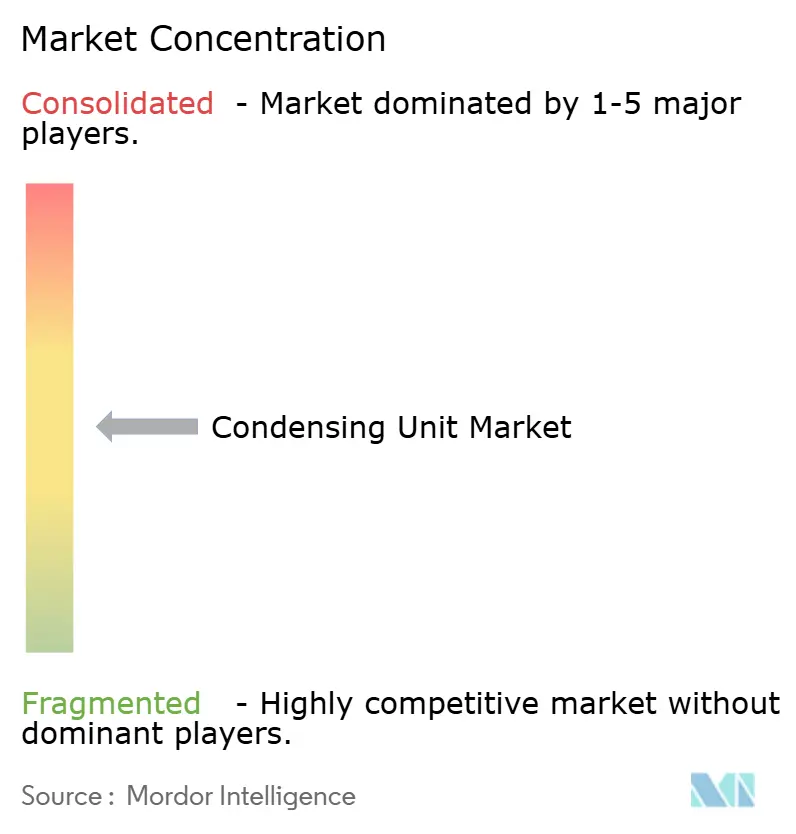
| Market Concentration | Medium |
Major Players *Disclaimer: Major Players sorted in no particular order Image © Mordor Intelligence. Reuse requires attribution under CC BY 4.0. | |
Condensing Unit Market Analysis by Mordor Intelligence
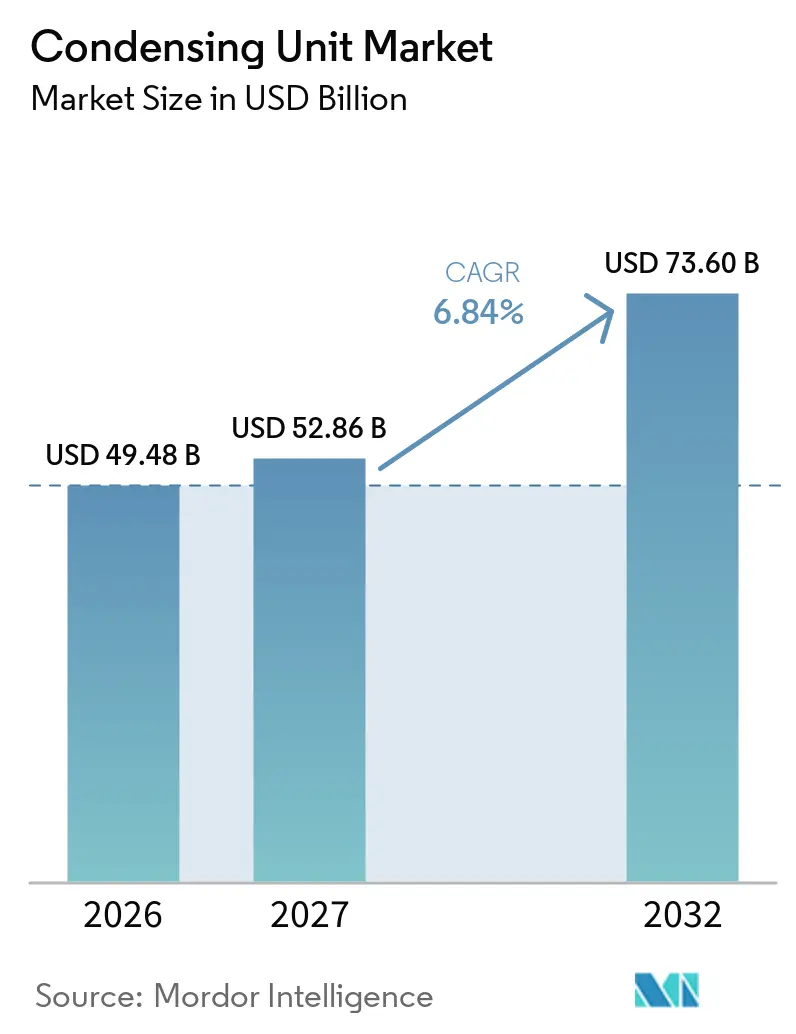
The Condensing Unit Market size was valued at USD 49.48 billion in 2026 and is estimated to grow from USD 52.86 billion in 2027 to reach USD 73.60 billion by 2032, at a CAGR of 6.84% during the forecast period (2027-2032). Cold-chain investment and refrigerant rules are creating replacement demand in the Condensing Unit Market across food retail, pharmaceutical logistics, industrial facilities, and transportation refrigeration. The EU F-Gas framework restricts the servicing of refrigeration equipment with fluorinated gases at or above a global warming potential of 2,500 from January 2025, which has increased the need for lower-GWP equipment choices. The Condensing Unit Market is also supported by larger data-center cooling loads and building electrification, which extend demand beyond conventional refrigeration applications. Equipment suppliers in the Condensing Unit Market are responding with natural-refrigerant systems, inverter-compatible products, and remote diagnostic functions that reduce service requirements. These conditions create Condensing Unit Market opportunities in mid-capacity equipment, retrofit projects, and systems that can operate reliably in different climates.
Key Report Takeaways
- By type, air-cooled units held 56.4% revenue share in 2026 and are forecast to grow at a 7.2% CAGR through 2032.
- By compressor type, reciprocating compressors held 40.2% revenue share in 2026, while scroll compressors are forecast to grow at a 7.6% CAGR through 2032.
- By refrigerant type, fluorocarbons held 58.8% revenue share in 2026, while hydrocarbons are forecast to grow at an 8.1% CAGR through 2032.
- By application, commercial refrigeration held 39.1% revenue share in 2026, while air conditioning is forecast to grow at a 7.4% CAGR through 2032.
- By end user, commercial users held 43.5% revenue share in 2026, while industrial users are forecast to grow at a 7.5% CAGR through 2032.
- By cooling capacity, the 10–50 kW band held 30.9% revenue share in 2026 and is forecast to grow at a 7.8% CAGR through 2032.
- By geography, the Asia-Pacific held 37.5% revenue share in 2026 and is forecast to grow at a 7.1% CAGR through 2032.
Note: Market numbers in this report are based on Mordor Intelligence's proprietary estimation framework, which combines nine months of actuals with Q4 projections for base year 2026.
Market Trends and Insights
Drivers Impact Analysis of Condensing Unit Market*
| Driver | (~) % Impact on CAGR Forecast | Geographic Relevance | Impact Timeline |
|---|---|---|---|
| Expansion of Cold-Chain Infrastructure and Food Retail | +1.60% | Global, with concentrated spend in Asia-Pacific, Latin America, and Middle East | Medium term (2–4 years) |
| Refrigerant Phase-Down and Low-GWP Equipment Replacement | +1.30% | EU and North America primarily; spill-over to APAC via MNC procurement | Short to medium term (≤ 4 years) |
| Growth of Commercial Cooling and Data-Center Applications | +1.10% | Global, with high intensity in North America, Asia-Pacific, and Northern Europe | Medium term (2–4 years) |
| Adoption of Energy-Efficient Variable-Speed and Inverter Systems | +0.90% | Global; regulatory-led in EU and North America; cost-led in APAC | Medium term (2–4 years) |
| Retailer-Led Natural-Refrigerant Procurement Standards | +0.50% | North America and Western Europe, with early gains in Japan and Australia | Medium to long term (3–5 years) |
| Heat-Recovery Integration in Refrigeration Systems | +0.30% | Northern and Central Europe; early-mover markets in Scandinavia and Germany | Long term (≥ 4 years) |
| Source: Mordor Intelligence | |||
Expansion of Cold-Chain Infrastructure and Food Retail
Cold-chain construction is supporting unit demand across temperature-controlled storage, food distribution, and retail facilities. The Global Cold Chain Alliance reported 7.76 billion cubic feet of temperature-controlled warehouse capacity among its Global Top 25 operators in 2026, while Latin America recorded 8.6% growth[1]. Americold Realty Trust and EQT announced a USD 1.3 billion North American cold-storage venture in May 2026 that includes 124 million cubic feet of U.S. capacity. Such projects require refrigeration equipment at multiple temperature ranges and support orders for packaged systems. Pharmaceutical distribution adds demand for compact equipment with stable temperature performance and monitoring functions. The Condensing Unit Market, therefore, benefits when logistics investors add capacity and when retailers replace older refrigeration equipment.
Refrigerant Phase-Down and Low-GWP Equipment Replacement
Refrigerant policy is moving deferred replacement activity into current procurement cycles. The U.S. Environmental Protection Agency states that the AIM Act directs an 85% reduction in hydrofluorocarbon production and consumption by 2036, and its Technology Transitions program restricts higher-GWP refrigerants in specified equipment. The EU regulation sets a 42.9 million metric-ton CO2-equivalent HFC quota for 2025 and 2026, compared with 82.3 million metric tons in 2023. The rules increase the value of product portfolios based on CO2, hydrocarbons, and lower-GWP blends. Manufacturers with established compliant equipment can serve customers who need to avoid future refrigerant constraints. The Condensing Unit Market is affected as equipment buyers combine compliance planning with normal replacement schedules.
Growth of Commercial Cooling and Data-Center Applications
Commercial cooling demand is broadening as data centers require more site-level thermal management. Johnson Controls acquired Alloy Enterprises in May 2026 to strengthen its data-center thermal management portfolio. Mitsubishi Electric announced a USD 30 million IT cooling equipment facility in Ohio in July 2026, with production scheduled to begin in April 2027. These actions show that suppliers are building capabilities around data-center cooling systems. Modular and edge facilities can favor distributed equipment where rapid installation and local backup capacity matter. The Condensing Unit Market can gain from this shift because packaged systems address cooling loads that do not always require a centralized chiller plant.
Adoption of Energy-Efficient Variable-Speed and Inverter Systems
Variable-speed technology is becoming more important where cooling loads change during the day. Danfoss states that inverter compressor systems can reduce annual energy bills by 30% or more compared with fixed-speed systems under typical part-load conditions[2]. CalNEXT field demonstrations found average energy savings of 20% to 22% after variable-frequency drives were retrofitted to validated fixed-speed compressor sites[3]. This strengthens demand for equipment that can match output more closely to load. Scroll platforms are well-positioned because their design is compatible with inverter operation and broad capacity modulation. The Condensing Unit Market benefits when operators evaluate equipment using energy use and service life rather than purchase price alone.
Restraints Impact Analysis of Condensing Unit Market*
| Restraint | (~) % Impact on CAGR Forecast | Geographic Relevance | Impact Timeline |
|---|---|---|---|
| High Upfront Cost of Low-GWP and Natural-Refrigerant Systems | -1.50% | Global, most acute in price-sensitive emerging markets | Medium term (2–4 years) |
| Shortage of Skilled Refrigeration Technicians | -1.00% | North America, Western Europe, Australia; emerging constraint in Southeast Asia | Medium term (2–4 years) |
| High-Pressure and Flammability Safety Requirements | -0.70% | Global; strongest in markets without established CO₂/hydrocarbon handling norms | Long term (≥ 4 years) |
| Volatility in Copper, Aluminum, and Electronic-Component Costs | -0.90% | Global; acute in regions with limited domestic metal refining capacity | Short term (≤ 2 years) |
| Source: Mordor Intelligence | |||
High Upfront Cost of Low-GWP and Natural-Refrigerant Systems
Natural-refrigerant systems can require a higher initial investment than legacy HFC equipment. Danfoss describes its CO2 refrigeration platform as equipment for medium- and low-temperature applications, where system design must accommodate the operating requirements of R744. Higher-pressure components and specialized assemblies can increase the cost of CO2 installations. Hydrocarbon systems also require design and safety practices that can add project complexity. Large retail chains can evaluate energy savings and refrigerant compliance over the system life, while smaller operators often focus more heavily on initial cost. The Condensing Unit Market may therefore see faster uptake among large operators than among independent stores and small regional customers.
Shortage of Skilled Refrigeration Technicians
A limited technician base can slow the installation and service of advanced refrigeration systems. The U.S. Bureau of Labor Statistics projects 40,100 annual openings for heating, air conditioning, and refrigeration mechanics and installers over the 2024 to 2034 period[4]. The North American Sustainable Refrigeration Council described a workforce cycle in which difficult schedules contribute to attrition and deepen labor shortages. The shortage is especially relevant for CO2 and hydrocarbon systems that need trained personnel for commissioning and maintenance. Suppliers can address part of this constraint with easier commissioning, integrated diagnostics, and remote monitoring. The Condensing Unit Market has greater potential where equipment design reduces the amount of specialist field work required.
*Our forecasts treat driver/restraint impacts as directional, not additive. The impact forecasts reflect baseline growth, mix effects, and variable interactions.
Condensing Unit Market Segment Analysis
By Type:
Air-Cooled Units Lead Demand Across ApplicationsAir-cooled units held 56.4% of the Condensing Unit Market share in 2026 and are forecast to grow at a 7.2% CAGR through 2032. Their position reflects a relatively simple installation and the absence of a water-supply requirement. They are used in supermarkets, cold rooms, rooftop HVAC installations, and modular cooling systems. Their broad fit across climates and building types supports replacement and new-build demand. European food retailers are also expanding CO2 refrigeration installations as F-Gas requirements tighten.
Water-cooled units serve applications where operators need capacity control and lower noise levels. They can be useful in high-ambient settings and industrial locations with suitable water infrastructure. Evaporative units are used for large food-processing, cold-storage, and industrial refrigeration systems. These alternatives require more supporting infrastructure than air-cooled designs. The Condensing Unit Market includes all 3 types because project requirements differ by site, climate, water access, and cooling load.
By Compressor Type:
Scroll Systems Gain Ground on EfficiencyReciprocating compressors held 40.2% of the global condensing unit share in 2026, while scroll compressors are forecast to grow at a 7.6% CAGR through 2032. Reciprocating designs retain a broad operating range and an established cost position. They are compatible with many legacy and newer refrigerants. Scroll systems are gaining use where buyers value inverter compatibility and part-load efficiency. A 2025 study found that variable-speed reciprocating compressors face motor losses at low speeds and fluid-dynamic losses at high speeds.
Screw compressors remain relevant for higher-capacity industrial systems, including ammonia and CO2 booster installations. Rotary compressors are used in residential and light-commercial applications where compact design and lower noise are important. Centrifugal variants are more specialized and have limited overlap with packaged condensing unit applications. Efficiency standards and seasonal performance requirements influence compressor selection in regulated markets. The Condensing Unit Market is shifting toward modulating technology as users seek lower operating costs and more responsive cooling output.
By Refrigerant Type:
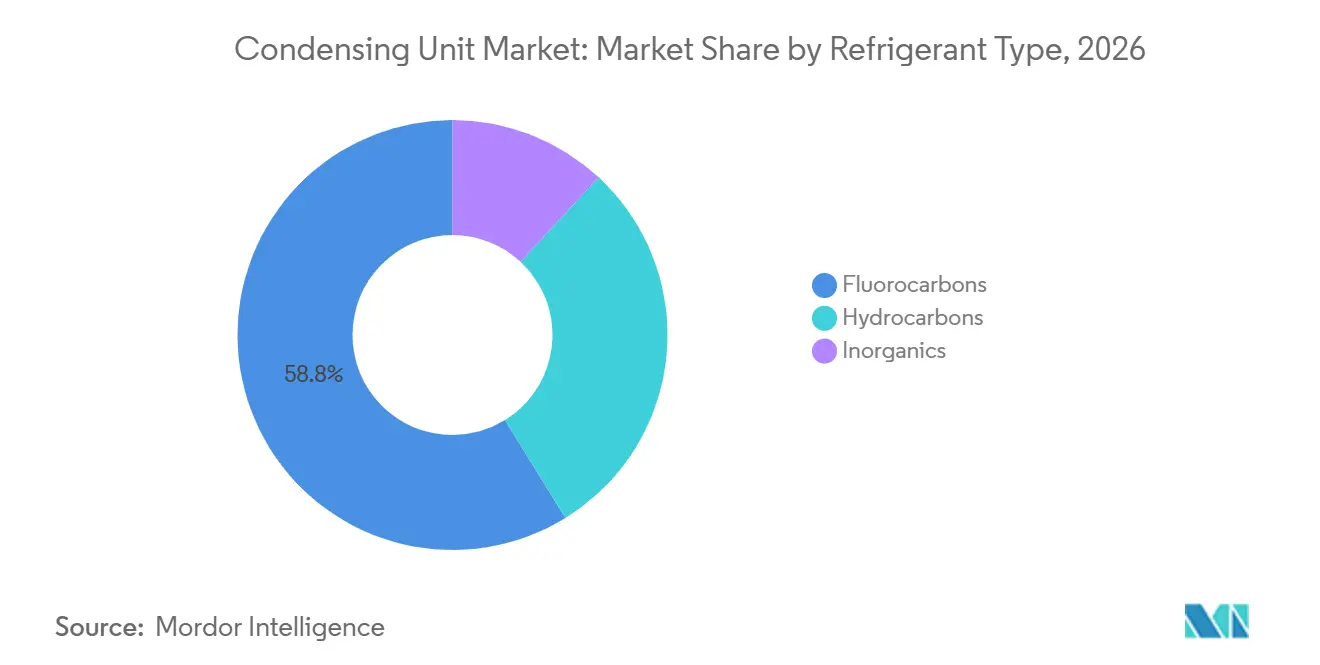
Hydrocarbons Expand as Fluorocarbons Retain the Installed BaseFluorocarbons held 58.8% of the global condensing unit share in 2026, while hydrocarbon equipment is forecast to grow at an 8.1% CAGR through 2032. Fluorocarbon demand remains supported by the installed base and the use of lower-GWP HFO blends. Hydrocarbon systems are gaining ground in light-commercial applications, particularly those that use propane. CO2 is also increasing its role in medium- and low-temperature commercial refrigeration. The EU regulatory framework is accelerating the move away from high-GWP gases in servicing and new equipment decisions.
Inorganic refrigerants, mainly ammonia and CO2, are important in large industrial facilities. Their efficiency at scale can outweigh the need for more specialized handling practices. Material selection remains important because high-pressure CO2 systems need robust components. Danfoss expects natural refrigerants to become increasingly important across HVACR segments in Europe and North America. The Condensing Unit Market will continue to contain transition refrigerants and natural alternatives as operators make equipment choices based on application size, safety requirements, and regulation.
By Application:
Commercial Refrigeration Remains the Largest Use CaseCommercial refrigeration held 39.1% of the global condensing unit share in 2026, while air conditioning is forecast to grow at a 7.4% CAGR through 2032. Supermarkets, convenience stores, food-service facilities, and pharmaceutical retail support the large commercial refrigeration base. The North American Sustainable Refrigeration Council reported that 1,470 of more than 2,000 planned new stores from 2025 to 2029 selected a transcritical CO2 system. This selection pattern supports replacement demand for compliant refrigeration equipment. Air-conditioning demand is gaining from data-center cooling and building electrification projects.
Industrial refrigeration, transportation refrigeration, and cold storage provide a substantial base of additional demand. Pharmaceutical-grade cold storage requires tighter temperature control and monitoring functions. Transportation refrigeration is beginning to move toward electric equipment for stationary cold storage uses. Carrier Transicold introduced the all-electric Vector 8200 for stationary trailer cold storage in North America in August 2026. Specialized process cooling also supports demand at the upper end of the capacity range.
By End User:
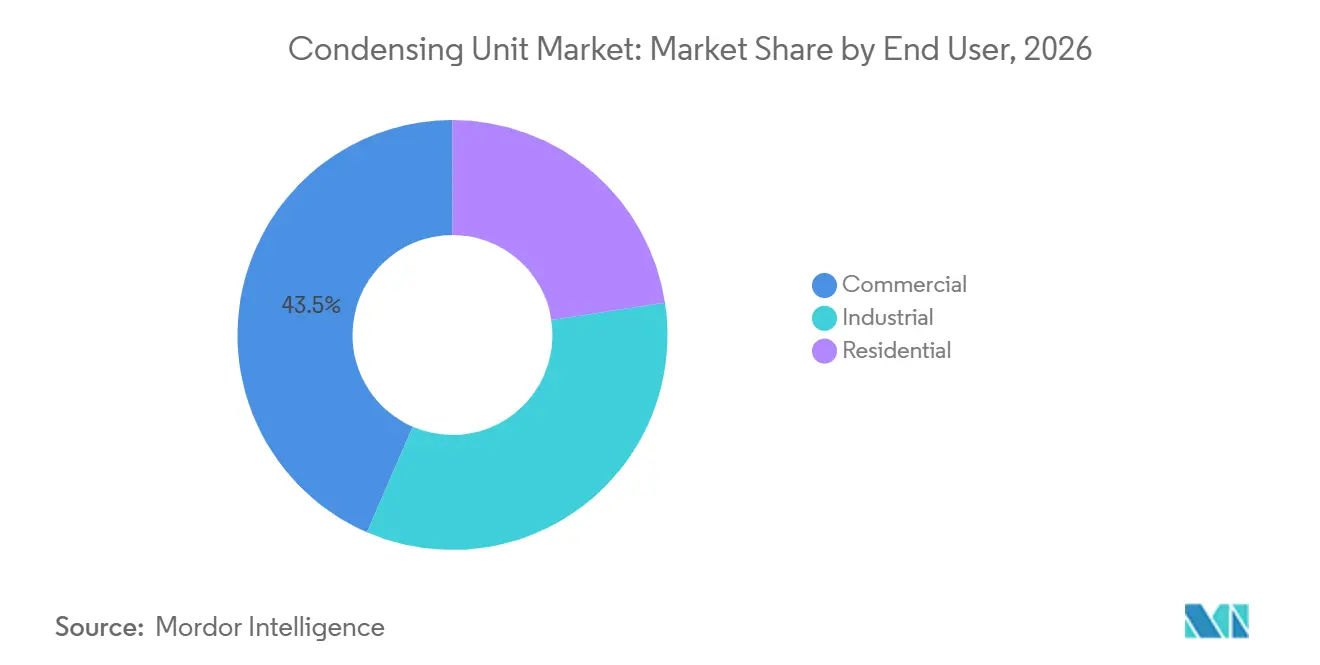
Commercial Demand Is Broad While Industrial Demand Grows FasterCommercial end users held 43.5% of the global condensing unit share in 2026, while industrial end users are forecast to grow at a 7.5% CAGR through 2032. Food retail, hospitality, healthcare facilities, and office buildings make up the commercial customer base. The scale of the supermarket estate provides recurring replacement and upgrade activity. Equipment decisions are increasingly shaped by refrigerant availability, energy use, and compliance needs. These factors support demand for inverter-driven and natural-refrigerant-ready systems.
Industrial users are adding capacity in food production, pharmaceutical manufacturing, chemical processing, and large cold-storage hubs. These users are increasingly considering lifetime operating costs alongside equipment price. Residential users represent a smaller proportion and mainly use smaller air-cooled systems for HVAC and cold-room applications. Urban growth in Southeast Asia, India, and the Middle East supports gradual residential demand. The Condensing Unit Market serves these groups with different product sizes, controls, and installation requirements.
By Cooling Capacity:
The 10–50 kW Range Forms the Core OpportunityThe 10–50 kW segment held 30.9% of the global condensing unit share in 2026 and is forecast to grow at a 7.8% CAGR through 2032. This range matches the requirements of convenience stores, small supermarkets, gas stations, and light-industrial cold rooms. These customers are replacing equipment to improve efficiency and meet refrigerant requirements. Danfoss launched its Optyma iCO2 range extension in April 2026 with 37 kW medium-temperature and 19 kW low-temperature capacity points. The product launch directly addresses commercial refrigeration needs in this range.
Capacity below 10 kW serves residential and very small commercial sites, where cost sensitivity remains high. The 50–100 kW band serves medium-format retail and food-service operations. Systems from 100–300 kW and above 300 kW are used by larger commercial and industrial customers. Larger systems can also be evaluated for heat recovery rather than cooling alone. A 2026 study of Swedish grocery stores estimated 1,840 GWh of annual recoverable heat potential across the national grocery stock.
Geography Analysis
APAC Condensing Unit Market
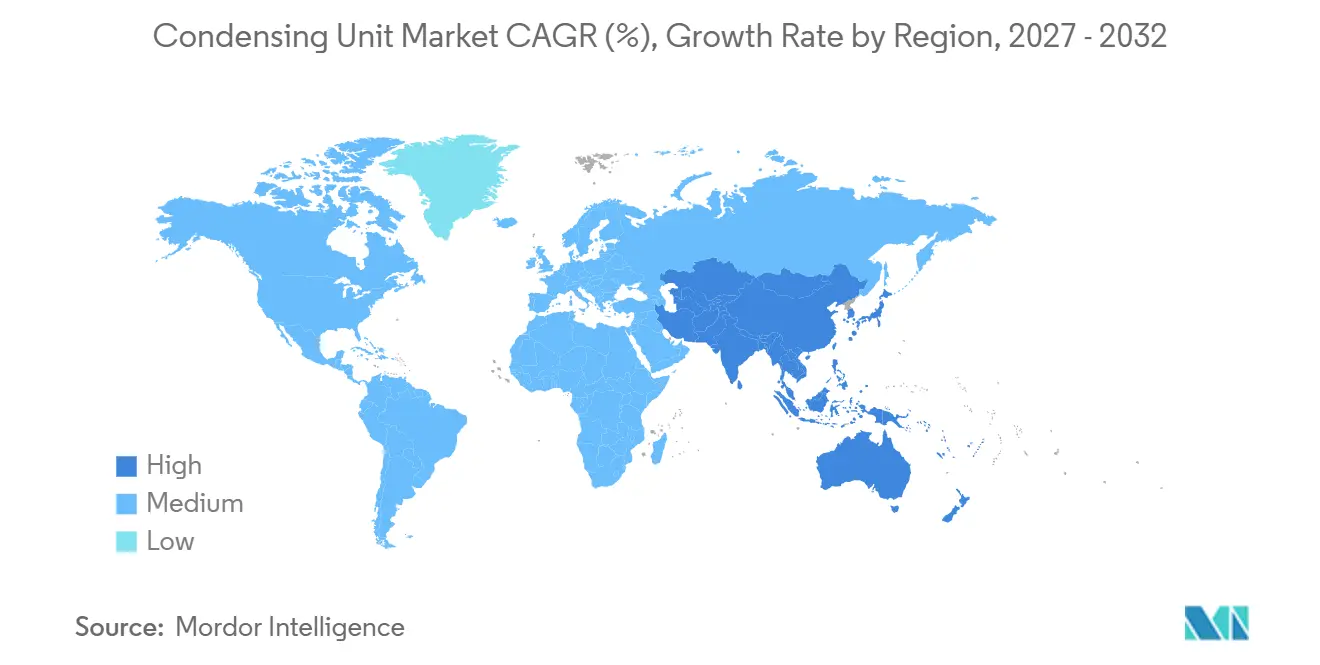
Asia-Pacific held 37.5% of the Condensing Unit Market share in 2026 and is forecast to grow at a 7.1% CAGR through 2032. China is the regional anchor for cold-chain equipment demand because of modern retail, e-commerce storage, and pharmaceutical manufacturing. India is also adding food-processing and cold-chain capacity through policy support for eligible food processors. Vietnam, Thailand, and Indonesia are generating demand as modern retail formats reach smaller cities. Japan’s energy-efficiency requirements support advanced scroll and inverter products that can also be sold in export markets.
North America and Europe Condensing Unit Market
North America and Europe are major equipment-transition regions because refrigerant rules are directly affecting replacement plans. In the United States, the AIM Act and Technology Transitions program are restricting higher-GWP refrigerant uses in specified equipment. Carrier announced USD 1 billion in additional U.S. manufacturing and research investment in May 2025, including expansion for heat pumps and advanced refrigeration components. In Europe, the F-Gas quota reduction is supporting the adoption of CO2 and hydrocarbon equipment. Germany, Italy, and the United Kingdom remain active transition markets, while Eastern Europe is progressing under the same framework.
South America and MEA Condensing Unit Market
South America and the Middle East and Africa provide further expansion opportunities for the Condensing Unit Market. Latin America recorded 8.6% cold-chain capacity growth in 2026, led by activity linked to food exports in Brazil, Argentina, and Chile. Abu Dhabi Food Hub agreed in May 2026 to develop a 37,000 square meter cold-chain facility with Axione Development, targeting readiness in Q4 2026. These regions still have significant fluorocarbon equipment use. This gives suppliers time to develop lower-GWP products that meet local cost and high-ambient-temperature needs.
Competitive Landscape
The Condensing Unit Market is moderately concentrated, and the market is led by large multinational suppliers in commercial and industrial applications, while regional competitors remain important in residential and light-commercial equipment. Carrier, Daikin, Mitsubishi Electric, Panasonic, Johnson Controls, and GEA have broad refrigeration or cooling portfolios. Their strategies in 2025 and 2026 have centered on natural refrigerants, commercial cooling, and data-center thermal management. Johnson Controls completed the sale of its residential and light-commercial HVAC business to Bosch in August 2025, increasing its focus on commercial and mission-critical buildings. It then completed the acquisition of Alloy Enterprises in May 2026 to add data-center cooling technology.
Product launches show how suppliers are responding to regulation and customer demand. Danfoss introduced the Optyma iCO2 37 kW MT and 19 kW LT condensing unit in April 2026 for commercial refrigeration. Hussmann introduced a complete A2L store solution in North America during April 2026, including compressorized systems, condensing units, and evaporators. BITZER presented its ECOLITE CO2 condensing unit family in February 2026 for kiosks, convenience stores, and supermarkets. These offerings give customers more options for complying with refrigerant rules while selecting systems by capacity and operating environment.
Competition in the Condensing Unit Market also depends on service capability, verified performance, and product controls. Smaller specialists such as Dorin, Frascold, and SCM Frigo supply components that can be used in third-party assemblies. Remote monitoring and embedded diagnostics can help suppliers support customers facing technician shortages. Heat recovery can improve the economics of larger systems in colder regions where recovered heat has a practical use. Certification requirements from bodies such as AHRI and Eurovent can make it harder for smaller suppliers to compete without validated performance claims. The Condensing Unit Market has no reported combined share for the top suppliers, so a share-based concentration measure cannot be calculated from the supplied information.
Condensing Unit Industry Leaders
-
Emerson Electric Co.
-
Carrier Global Corporation
-
Danfoss A/S
-
GEA Group AG
-
BITZER SE
- *Disclaimer: Major Players sorted in no particular order
Condensing Unit Market Companies Covered in this Report
- Baltimore Aircoil Company
- BITZER SE
- Blue Star Limited
- Carrier Global Corporation
- Daikin Industries, Ltd.
- Danfoss A/S
- Dorin S.p.A.
- Emerson Electric Co.
- EVAPCO, Inc.
- Frascold S.p.A.
- GEA Group AG
- Heatcraft Refrigeration Products LLC
- Hussmann Corporation
- Johnson Controls International plc
- LU-VE S.p.A.
- Mayekawa Mfg. Co., Ltd.
- Mitsubishi Electric Corporation
- Panasonic Holdings Corporation
- SCM Frigo S.p.A.
- Tecumseh Products Company LLC
Recent Industry Developments in Condensing Unit Market
- August 2026: Carrier Transicold launched the Vector 8200, an all-electric, engineless transport refrigeration unit for stationary trailer cold storage, now commercially available in North America. The unit uses no direct diesel and supports multi-temperature operation, marking a structural shift in trailer refrigeration toward grid-powered stationary cold storage.
- July 2026: Mitsubishi Electric announced the establishment of MEHITS US, Inc., a USD 30 million IT cooling equipment manufacturing facility in Mason, Ohio, scheduled to begin production in April 2027. The investment targets the growing U.S. data center cooling systems market and expands the company’s engineering-to-maintenance service capability.
- July 2026: Mitsubishi Electric acquired the HVAC sales, installation, and maintenance businesses of the APAC and COMPAC groups in the Netherlands to expand its European data center cooling and IT cooling services footprint.
- July 2026: Daikin launched the NEXIO Max inverter-driven rooftop heat pump for light-commercial applications in North America, using low-GWP R-32 refrigerant and variable-speed technology across 5, 8.5, and 10 ton capacities.
Global Condensing Unit Market Report Scope
A condensing unit is an outdoor component of a refrigeration or air-conditioning system that removes heat from the refrigerant, converting it from a high-temperature, high-pressure gas into a high-pressure liquid. It typically consists of a compressor, condenser coil, condenser fan, receiver, and associated controls. The unit receives low-pressure refrigerant vapor from the evaporator, compresses it to a higher pressure and temperature, and passes it through the condenser, where heat is rejected to the surrounding air or water. The resulting liquid refrigerant is then supplied to the expansion device and evaporator to continue the refrigeration cycle.
The Condensing Unit Market is segmented by type, compressor, refrigerant, application, end user, cooling capacity, and geography. By type, the market is segmented into air-cooled, water-cooled, and evaporative condensing units. By compressor type, the market is segmented into reciprocating, scroll, screw, and rotary compressors. By refrigerant, the market is segmented into fluorocarbons, hydrocarbons, and inorganic refrigerants. By application, the market is segmented into commercial, industrial, transport, and other applications. By end user, the market is segmented into residential, commercial, industrial, and other end users. By cooling capacity, the market is segmented into low, medium, and high cooling capacity. The report also covers the market size and forecasts for the global condensing unit market across 26 countries in key regions. For each segment, the market sizing and forecasts have been provided on the basis of value (USD).
Segmentation Overview
| Air-Cooled Condensing Units |
| Water-Cooled Condensing Units |
| Evaporative Condensing Units |
| Other Condensing Unit Types |
| Reciprocating Compressors |
| Scroll Compressors |
| Screw Compressors |
| Rotary Compressors |
| Other Compressor Types |
| Fluorocarbons |
| Hydrocarbons |
| Inorganics |
| Commercial Refrigeration |
| Industrial Refrigeration |
| Transportation Refrigeration |
| Air Conditioning |
| Cold Storage |
| Other Applications |
| Residential |
| Commercial |
| Industrial |
| Below 10 kW |
| 10–50 kW |
| 50–100 kW |
| 100–300 kW |
| Above 300 kW |
| North America | United States |
| Canada | |
| Mexico | |
| Europe | Germany |
| France | |
| Italy | |
| Spain | |
| United Kingdom | |
| Poland | |
| Russia | |
| Rest of Europe | |
| Asia-Pacific | China |
| India | |
| Japan | |
| South Korea | |
| Australia | |
| Indonesia | |
| Vietnam | |
| Thailand | |
| Rest of Asia-Pacific | |
| South America | Brazil |
| Argentina | |
| Chile | |
| Rest of South America | |
| Middle East and Africa | Saudi Arabia |
| United Arab Emirates | |
| Egypt | |
| South Africa | |
| Morocco | |
| Rest of Middle East and Africa |
| By Type | Air-Cooled Condensing Units | |
| Water-Cooled Condensing Units | ||
| Evaporative Condensing Units | ||
| Other Condensing Unit Types | ||
| By Compressor Type | Reciprocating Compressors | |
| Scroll Compressors | ||
| Screw Compressors | ||
| Rotary Compressors | ||
| Other Compressor Types | ||
| By Refrigerant Type | Fluorocarbons | |
| Hydrocarbons | ||
| Inorganics | ||
| By Application | Commercial Refrigeration | |
| Industrial Refrigeration | ||
| Transportation Refrigeration | ||
| Air Conditioning | ||
| Cold Storage | ||
| Other Applications | ||
| By End User | Residential | |
| Commercial | ||
| Industrial | ||
| By Cooling Capacity | Below 10 kW | |
| 10–50 kW | ||
| 50–100 kW | ||
| 100–300 kW | ||
| Above 300 kW | ||
| By Geography | North America | United States |
| Canada | ||
| Mexico | ||
| Europe | Germany | |
| France | ||
| Italy | ||
| Spain | ||
| United Kingdom | ||
| Poland | ||
| Russia | ||
| Rest of Europe | ||
| Asia-Pacific | China | |
| India | ||
| Japan | ||
| South Korea | ||
| Australia | ||
| Indonesia | ||
| Vietnam | ||
| Thailand | ||
| Rest of Asia-Pacific | ||
| South America | Brazil | |
| Argentina | ||
| Chile | ||
| Rest of South America | ||
| Middle East and Africa | Saudi Arabia | |
| United Arab Emirates | ||
| Egypt | ||
| South Africa | ||
| Morocco | ||
| Rest of Middle East and Africa | ||
Key Questions Answered in the Report
What is the forecast for the Condensing Unit Market?
The Condensing Unit Market is forecast to reach USD 73.6 billion by 2032, growing at a 6.84% CAGR from 2027.
Which condensing unit type has the largest share?
Air-cooled units led with 56.4% share in 2026 and are forecast to grow at a 7.2% CAGR through 2032.
Which refrigerant category is growing fastest?
Hydrocarbons are forecast to grow at an 8.1% CAGR through 2032, the highest rate among refrigerant categories.
What is driving replacement of refrigeration equipment?
Refrigerant phase-down rules, cold-chain investment, and energy-efficiency needs are increasing replacement demand.
Which application leads demand for condensing units?
Commercial refrigeration held 39.1% share in 2026, while air conditioning is forecast to grow at a 7.4% CAGR.
What cooling-capacity range is growing fastest?
The 10–50 kW range held 30.9% share in 2026 and is forecast to expand at a 7.8% CAGR through 2032.