
Size and Share of Composites In Oil and Gas Industry Market
Market Overview
| Study Period | 2022 - 2032 |
|---|---|
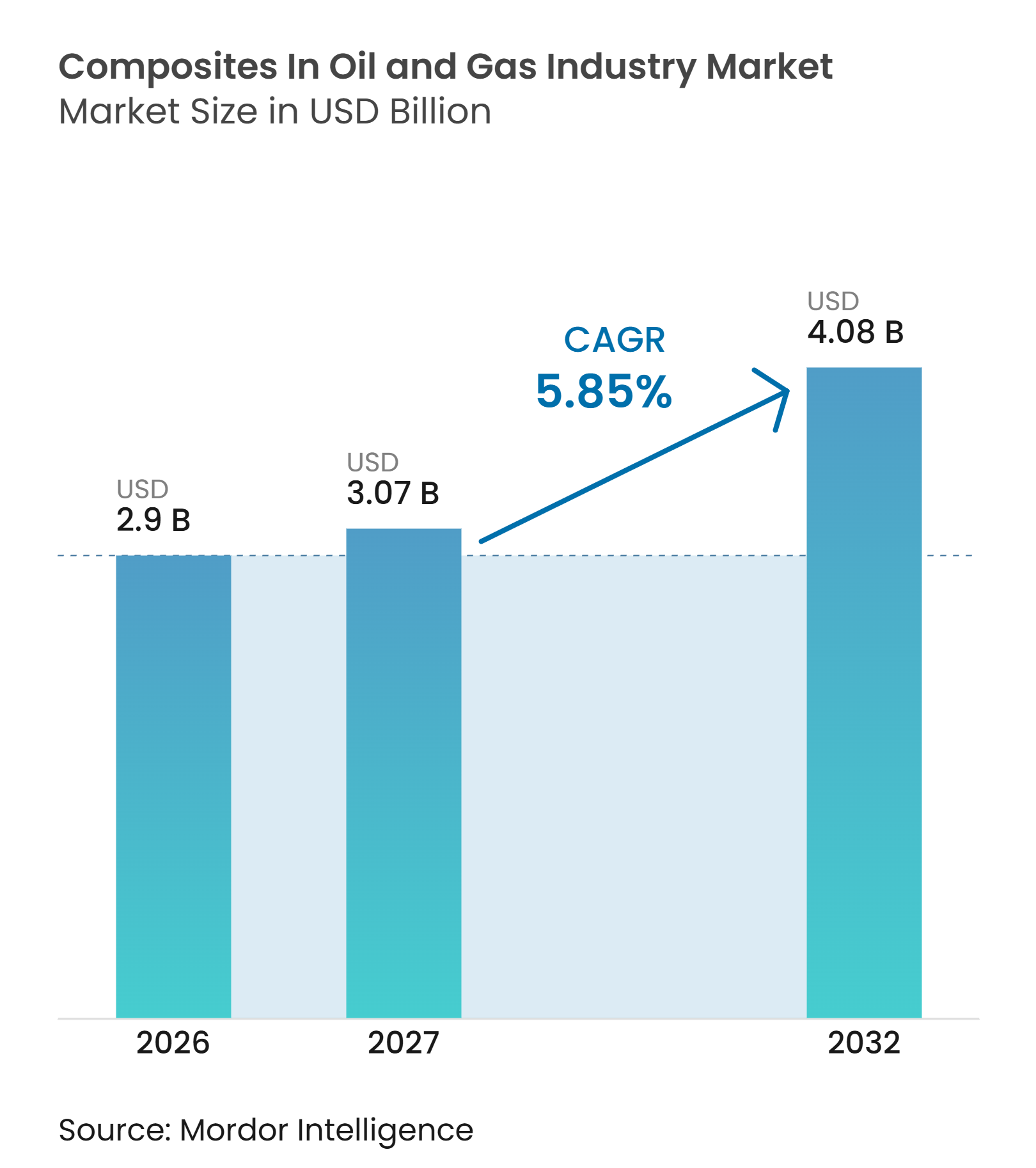
| Market Size (2027) | USD 3.07 Billion |
| Market Size (2032) | USD 4.08 Billion |
| Growth Rate (2027 - 2032) | 5.85 % |
| Fastest Growing Market | Asia-Pacific |
| Largest Market | Asia-Pacific |
| Market Concentration | Medium |
Major Players *Disclaimer: Major Players sorted in no particular order Image © Mordor Intelligence. Reuse requires attribution under CC BY 4.0. | |
Analysis of Composites In Oil and Gas Industry Market by Mordor Intelligence
The Composites in Oil and Gas Industry Market size was valued at USD 2.90 billion in 2026 and is estimated to grow from USD 3.07 billion in 2027 to reach USD 4.08 billion by 2032, at a CAGR of 5.85% during the forecast period (2027-2032). Demand is moving toward materials that resist corrosion and reduce equipment weight across upstream, midstream, and offshore operations. Operators are increasingly assessing piping, topside structures, and downhole tools on lifecycle cost rather than initial purchase cost. Deepwater activity and a wider qualification record for thermoplastic composite pipe systems support this shift. The composites in oil and gas industry market also faces a supply-chain challenge because qualified pipe dimensions, pressure ratings, installation capabilities, and inspection records take time to develop, particularly when projects require nonstandard designs. This leaves the composites in oil and gas industry market reliant on suppliers able to combine product engineering, field termination support, and evidence from prior operating conditions. Established suppliers can benefit from this gap because their field data, installation experience, and non-destructive evaluation records are difficult for new entrants to replicate, while operators can avoid the technical and scheduling risk associated with establishing new qualification programs for each project, particularly where critical production assets must remain in continuous, dependable service throughout the full operating cycle.
Key Report Takeaways
- By resin type, epoxy held 38.12% of the composites in oil and gas industry market share in 2026 and is forecast to advance at a 6.34% CAGR through 2032.
- By fiber type, glass fiber held 56.34% of the composites in oil and gas industry market share in 2026, while carbon fiber is forecast to advance at a 6.78% CAGR through 2032.
- By application, pipes and piping systems held 44.91% of the composites in oil and gas industry market share in 2026 and are forecast to advance at a 7.37% CAGR through 2032.
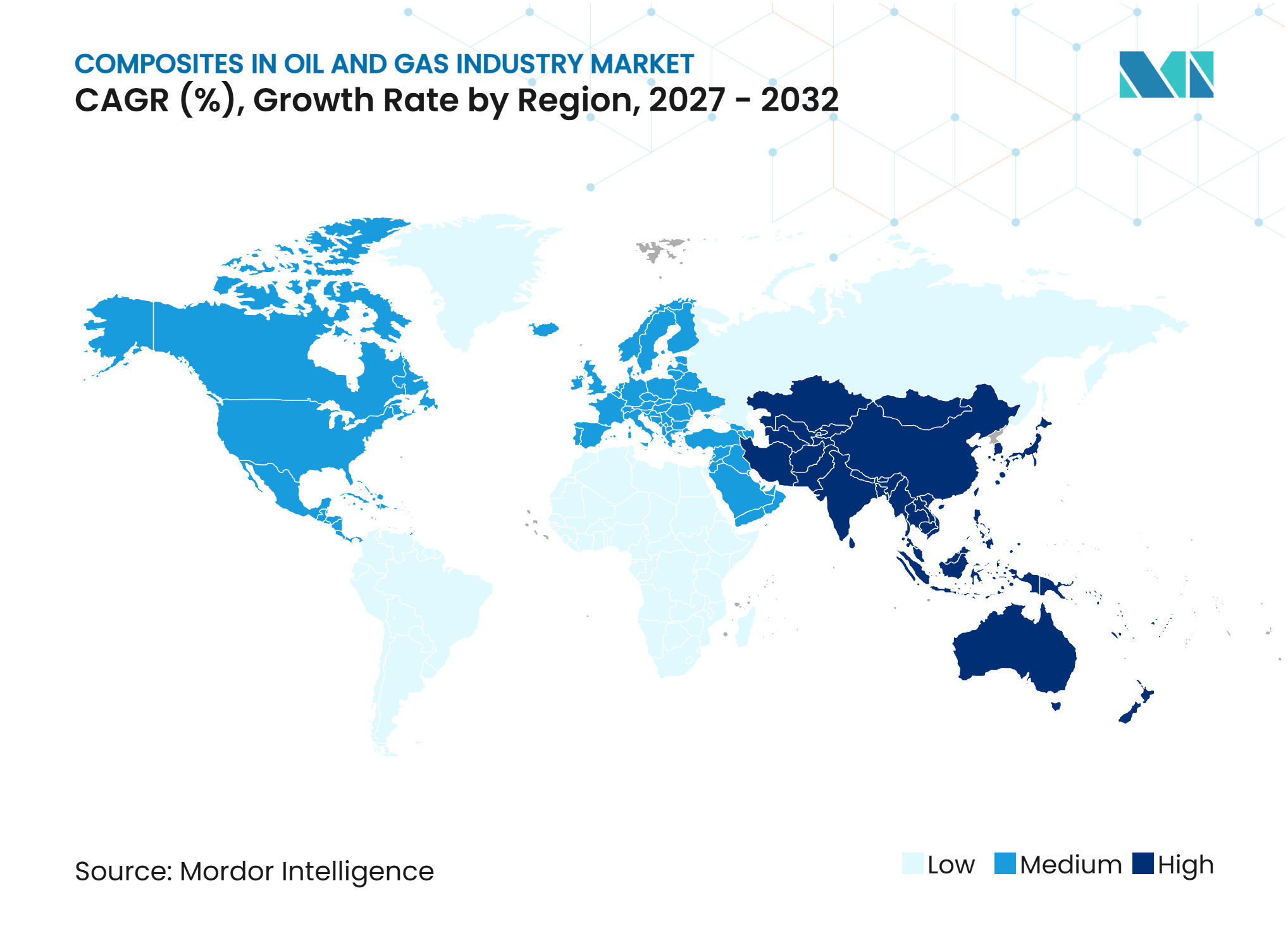
- By geography, Asia-Pacific held 32.67% of the composites in oil and gas industry market share in 2026 and is forecast to advance at a 6.66% CAGR through 2032
Note: Market numbers in this report are based on Mordor Intelligence's proprietary estimation framework, which combines nine months of actuals with Q4 projections for base year 2026.
Market Trends and Insights
Drivers Impact Analysis of Composites In Oil and Gas Industry Market*
| Driver | (~) % Impact on CAGR Forecast | Geographic Relevance | Impact Timeline |
|---|---|---|---|
| Corrosion Reduction and Lifecycle-Cost Advantages | +2.0% | Global; highest in Middle East, APAC offshore, and North Sea | Long term (≥ 4 years) |
| Expansion of Offshore and Deepwater Oil and Gas Production | +1.4% | APAC, South America (Brazil, Guyana), West Africa | Medium term (2-4 years) |
| Lightweighting of Offshore and Deepwater Infrastructure | +0.9% | Global offshore, concentrated in ultra-deepwater APAC and GoA | Medium term (2-4 years) |
| Qualification of Thermoplastic Composite Pipe for Ultra-Deepwater Applications | +0.7% | Brazil pre-salt, APAC deepwater, North Sea | Long term (≥ 4 years) |
| Growth of Unconventional Drilling and Multi-Stage Hydraulic Fracturing | +0.5% | North America (Permian, Marcellus, Montney), APAC (China, Australia) | Short term (≤ 2 years) |
| Source: Mordor Intelligence | |||
Corrosion Reduction and Lifecycle-Cost Advantages
Corrosion creates repeated maintenance demands in offshore systems, while composites offer resistance within the material rather than through recurring coatings or repairs. Composite piping systems can exceed 50 years of service life and can reduce maintenance requirements by up to 60% compared with carbon steel alternatives. Their lower weight can also reduce the structural work needed during brownfield retrofits. Future Pipe Industries received a January 2025 award to supply Wavistrong glass-reinforced epoxy pipelines for 520 recovery wells in Dubai. That project shows how mature fields are replacing legacy steel specifications where corrosion and maintenance costs are persistent. Research on accelerated degradation testing for nonmetallic downhole pipes is also strengthening the long-service evidence that operators require before extending qualification periods.
Expansion of Offshore and Deepwater Oil and Gas Production
Deepwater projects increase the need for materials that can operate under corrosive conditions while reducing load on offshore infrastructure. China’s Deep Sea No. 1 Phase 2 reached its designed annual production capacity of 4.5 billion cubic meters in June 2025, at water depths exceeding 1,500 meters[1]. The project illustrates how deeper developments place greater emphasis on material performance in flowline and related infrastructure. In India, Cairn oil and gas and TechnipFMC formed a March 2025 alliance to support future deepwater work at water depths of 500 to 2,500 meters. As water depth rises, the weight-to-tension advantage of composite systems becomes more relevant. This makes deepwater investment a change in material requirements, not only an increase in equipment volumes.
Lightweighting of Offshore and Deepwater Infrastructure
Topside weight limits the design flexibility of floating production platforms and shapes equipment selection. A 2025 study found that optimized fiber-reinforced polymer risers had unit mass equal to 27.0% of comparable metal risers. Lower suspended weight can reduce top-tension requirements and reduce dependence on the highest-capacity installation vessels. Baker Hughes Company and Strohm signed a May 2026 memorandum of understanding to develop a hybrid flexible pipe for ultra-deepwater risers and flowlines. The proposed system is expected to be 50% lighter than conventional flexible pipe and to lower total suspended weight by 40% at water depths above 3,000 meters. This can widen the set of vessels able to install deepwater systems without major modification.
Qualification of Thermoplastic Composite Pipe for Ultra-Deepwater Applications
Thermoplastic composite pipe adoption depends on successful testing under conditions that closely match field use. Strohm completed deepwater field trials with Petrobras in the Campos Basin in July 2025 at water depths near 1,500 meters. The work included crushing, deep-immersion, and vertical-connection testing under methods Petrobras uses for conventional flexible pipe. Petrobras, Shell plc, and Strohm also completed a program for a 6-inch carbon fiber and polyamide 12 pipe for water-alternating-gas injection in pre-salt conditions. The program included more than 50,000 test hours, equivalent to 6 calendar years of continuous service, under DNV-ST-F119. The Dutch NEN 3650-6 standard, published in June 2025, also provided a formal framework for thermoplastic composite pipe in onshore applications.
Restraints Impact Analysis of Composites In Oil and Gas Industry Market*
| Restraint | (~) % Impact on CAGR Forecast | Geographic Relevance | Impact Timeline |
|---|---|---|---|
| High Initial Cost and Specialized Installation Requirements | -1.4% | Global; most acute in cost-sensitive NOC-dominated markets (Middle East, West Africa) | Medium term (2-4 years) |
| Long Qualification Cycles for Critical Pressure-Bearing Components | -0.8% | Global; concentrated in deepwater Brazil, APAC, North Sea | Long term (≥ 4 years) |
| Limited Standardization and Inspection Methods for Composite Assets | -0.5% | Global, most acute in brownfield retrofit markets | Long term (≥ 4 years) |
| Source: Mordor Intelligence | |||
High Initial Cost and Specialized Installation Requirements
Composite piping can cost 20% to 40% more than carbon steel at the initial purchase stage for comparable configurations. The difference grows when systems require specialized connectors, electrofusion couplers, field-termination equipment, and trained installation crews. This remains difficult in markets where capital budgets receive greater weight than later maintenance savings. Skilled crews for thermoplastic composite pipe terminations are concentrated among a limited number of contractors. Strohm used a local Saudi workforce for pipe termination on the Aramco Fadhili gas plant project, supporting in-country capability development. However, less developed local supply chains can still leave installed costs higher in the Middle East and Southeast Asia than in established European supply centers.
Long Qualification Cycles for Critical Pressure-Bearing Components
Critical pressure-bearing components require extensive design verification, material characterization, and field testing before operators approve them for production service. This process is especially demanding for risers, production flowlines, and high-pressure downhole tubulars. TechnipFMC plc and Petrobras began a Hybrid Flexible Pipe technology program in May 2025 that uses carbon fiber and polyether ether ketone thermoplastic composite materials. The program is targeted for commercial availability from 2028, which demonstrates the extended timing associated with deepwater qualification. While test programs are under way, operators can delay major commitments until field performance data is available. Joint industry projects can spread these costs, but they also require operators to work within shared technical programs.
*Our forecasts treat driver/restraint impacts as directional, not additive. The impact forecasts reflect baseline growth, mix effects, and variable interactions.
Composites In Oil and Gas Industry Market Segment Analysis
By Resin Type:
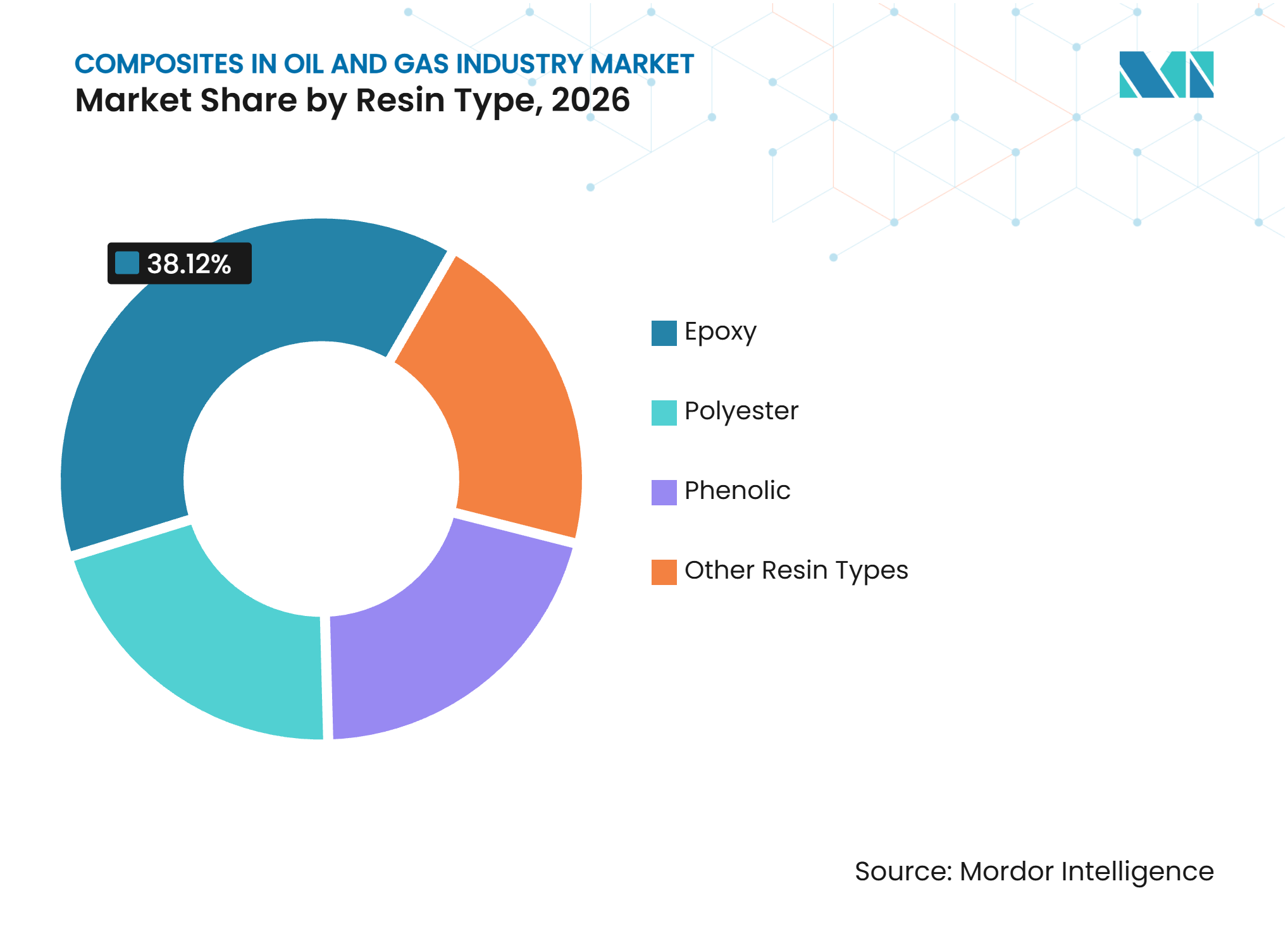
Epoxy Anchors Both Scale and GrowthEpoxy held 38.12% of the composites in oil and gas industry market share in 2026 and is projected to advance at a 6.34% CAGR through 2032. Its chemical resistance supports use in systems exposed to hydrogen sulfide, carbon dioxide, and brine. Glass-reinforced epoxy pipe is used for production headers, injection lines, and gathering systems in sour-service environments. A 2025 Society of Petroleum Engineers paper described glass-reinforced epoxy tubulars as a cost-effective option for sour or corrosive producer wells. It reported supply lead times of 7 months for glass-reinforced epoxy tubulars, compared with 12 to 13 months for corrosion-resistant alloy tubulars.
Polyester resins serve lower-pressure and lower-temperature uses, including water injection, firewater, and produced-water reinjection. Phenolic resins remain important in fire-rated gratings, handrails, and structural profiles used on offshore installations. These systems need fire performance suited to applicable marine and offshore requirements. Vinyl ester and thermoplastic matrices, including polyamide 12 and polyether ether ketone, are gaining relevance as thermoplastic composite pipe use expands. ISO 14692 remains a key compliance factor for glass-reinforced plastics piping qualification, which favors resin systems supported by established records. The resulting qualification advantage helps epoxy retain a strong position in the composites in oil and gas industry market.



By Fiber Type:
Glass Fiber Scale Meets Carbon Fiber's Deepwater CalculusGlass fiber held 56.34% of the composites in oil and gas industry market share in 2026 because it has an extensive field record and established manufacturing capacity. It remains the common reinforcement in glass-reinforced plastic pipe, tanks, topside structures, and downhole liners. Its cost-to-performance balance is suitable for moderate-pressure applications that handle corrosive fluids. Manufacturers in the Middle East, Southeast Asia, and South America have built large-volume capacity for glass fiber composite pipe. That scale supports replacement programs where users compare composite solutions with steel. Carbon fiber is projected to advance at a 6.78% CAGR through 2032, supported by demand for dynamic, high-pressure, and weight-sensitive deepwater systems.
Carbon fiber offers high specific strength, fatigue resistance, and corrosion resistance that are particularly useful in thermoplastic composite pipe applications. Its use is more aligned with demanding risers, flowlines, and subsea connections than with standard static piping. Glass fiber and carbon fiber therefore serve different operating requirements rather than directly replacing each other. Aramid fiber has value where impact and blast resistance are important. Basalt fiber remains relevant for cost-sensitive corrosion-resistant pipe applications in developing markets.
By Application:
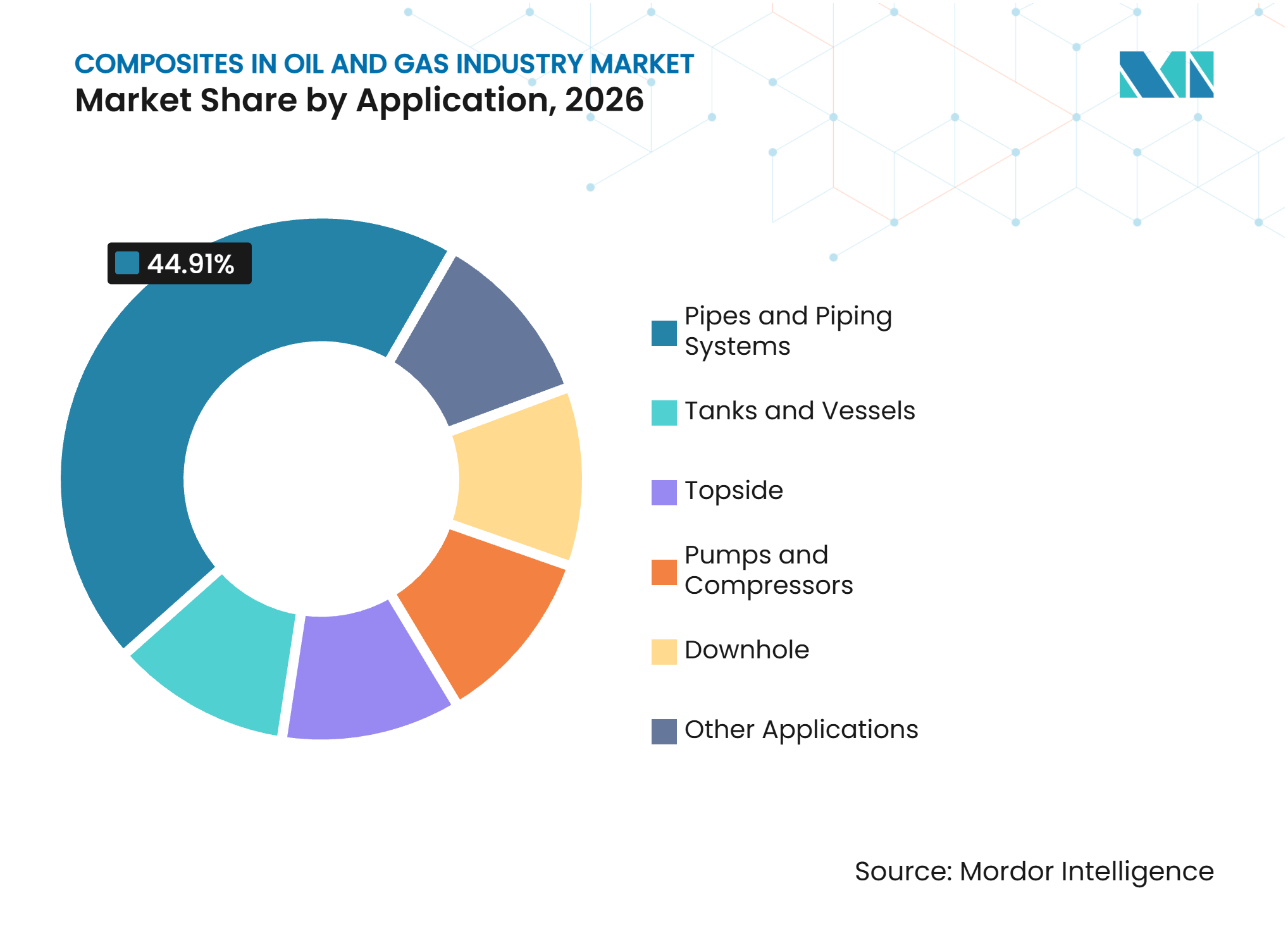
Pipes and Piping Systems Drive Revenue and GrowthPipes and piping systems held 44.91% of the composites in oil and gas industry market share in 2026 and are projected to advance at a 7.37% CAGR through 2032. The segment includes glass-reinforced plastic gathering lines, glass-reinforced epoxy production headers, reinforced thermoplastic pipe for onshore gathering, and thermoplastic composite pipe for offshore subsea applications. This breadth links demand for both replacement of aging steel infrastructure and new deepwater development. NOV reported record annual composite revenue in 2025, with stronger composite pipe demand from the Middle East and floating production, storage, and offloading vessels. Its fourth-quarter bookings also reached their highest level in 3 years, according to the company’s 2025 results discussion.
Tanks and vessels are used for chemical storage, produced-water handling, and fuel containment, where corrosion resistance supports longer operating life. Topside products such as gratings, structural shapes, stair treads, handrails, and cable trays are widely used on offshore platforms where weight and maintenance matter. Pumps, compressors, and downhole uses remain less mature because their service conditions require more qualification evidence. Other uses include composite centralizers, wellhead protection systems, and subsea structural components. The application mix allows suppliers to combine pipe sales with installation, design, inspection, and monitoring services.

Geography Analysis
Asia-Pacific
Asia-Pacific held 32.67% of the composites in oil and gas industry market share in 2026 and is projected to advance at a 6.66% CAGR through 2032. The region combines deepwater development, energy-security investment, and replacement needs for aging onshore and shallow-water steel pipelines. China’s Deep Sea No. 1 Phase 2 operated at its designed capacity from June 2025, with water depths above 1,500 meters and conditions that increase the need for corrosion-resistant systems. India’s deepwater alliance between Cairn oil and gas and TechnipFMC also covers prospective work from 500 to 2,500 meters of water depth. In Malaysia, Strohm received an August 2025 order for four large-bore carbon fiber and polyamide 12 thermoplastic composite pipe jumpers for gas service at water depths of up to 1,500 meters. These developments show a wider move from standard pipe replacement to deepwater systems that need proven material performance.
North America
North America has demand tied to unconventional drilling, aging Gulf of America assets, and replacement of underground fuel-storage systems. The Bureau of Safety and Environmental Enforcement issued its American Energy Dominance blueprint in 2026, supporting a more streamlined approach to offshore energy production[2]. Regulatory influence remains important because nonmetallic offshore systems require credible qualification evidence before broad deployment. Composite frac plugs are an established use in multi-stage hydraulic fracturing, including products rated to 12,000 pounds per square inch and 250 °F. The underground storage tank replacement cycle also supports demand for fiber-reinforced plastic systems through Mattr’s Xerxes business. This creates an end market that is less directly tied to short-term upstream spending. Suppliers can therefore balance offshore innovation with established onshore replacement demand.
Europe, Middle East, Africa, and South America
Europe’s North Sea and Norwegian Continental Shelf remain demanding settings for offshore pipe qualification, and successful deployments can influence adoption elsewhere. Strohm delivered more than 11 kilometers of thermoplastic composite pipe to the Wilhelmshaven 2 Green Gas Terminal in Germany in 2025, marking the first delivery of gas to Europe through newly installed thermoplastic composite pipe subsea infrastructure. In the Middle East, Future Pipe Industries signed a November 2025 memorandum of understanding with Saudi Aramco to strengthen local composite manufacturing and testing capability. Strohm’s Fadhili project involves 33 kilometers of thermoplastic composite pipe and an entirely nonmetallic electrofusion coupler, which supports the shift from pilot work to larger deployment. Brazil’s pre-salt activity continues to support joint qualification work among Petrobras, Shell, TechnipFMC, NOV, and Strohm. The composites in oil and gas industry market size in these mixed geographies is shaped by differing regulatory and local-content conditions, but high-carbon dioxide deepwater service gives all of them a clear need for durable material systems.
Competitive Landscape
Market Concentration
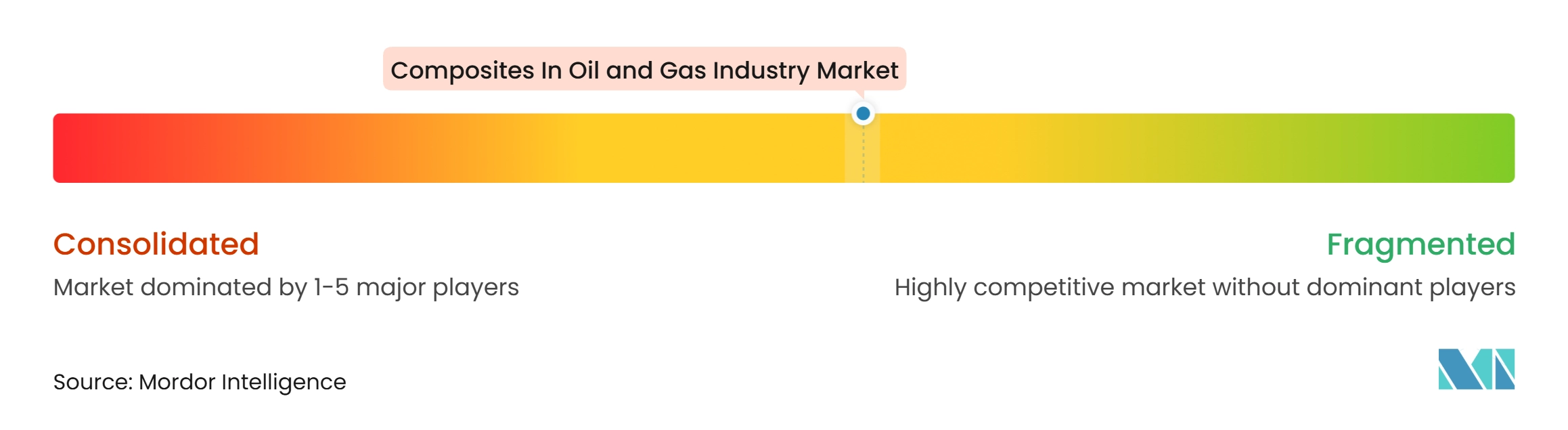
The composites in oil and gas industry market is moderately concentrated, with the top five players including Baker Hughes Company, Strohm, NOV, Future Pipe Industries, and Amiantit Company. Companies are using partnerships to spread the cost and timing of qualification programs. Baker Hughes Company and Strohm’s May 2026 collaboration on a hybrid flexible pipe is an example of this approach for ultra-deepwater applications. TechnipFMC plc and Petrobras also continued their hybrid flexible pipe program in 2025 to develop a standardized response to carbon dioxide stress corrosion cracking in pre-salt settings.
Localization is another important competitive approach, particularly in Saudi Arabia and other markets that seek domestic industrial capability. Future Pipe Industries and Saudi Aramco formalized cooperation on local manufacturing and testing infrastructure in November 2025. SLB partnered with Roboze for local production of qualified polyether ether ketone and carbon fiber polyether ether ketone parts in Saudi Arabia, which can shorten supply routes for specialized components. NOV also entered a pre-commercial agreement with Petrobras in 2025 to develop carbon dioxide-resistant flexible pipes for deepwater use. These moves indicate that suppliers are competing through technical qualification and manufacturing presence, not only through pipe supply.
Digital monitoring is becoming more relevant because in-service inspection methods for pressurized composite assets remain limited. Suppliers that can embed fiber-optic or acoustic-emission monitoring in pipe walls may gain access to recurring integrity-management work. Halliburton received U.S. Patent 12,331,613 B2 in June 2025 for filament-wound thermoplastic composite downhole tools designed to prioritize hoop strength. Syensqo supplies specialty polymer materials relevant to composite systems after its oil and gas business divestiture, while Mattr operates the Xerxes and Flexpipe businesses.
Leaders of Composites In Oil and Gas Industry Market
-
Baker Hughes Company
-
Strohm
-
NOV
-
Future Pipe Industries
-
Amiantit Company
- *Disclaimer: Major Players sorted in no particular order
Composites In Oil and Gas Industry Market Companies Covered in this Report
- Amiantit Company
- Baker Hughes Company
- Enduro Composites Group
- Exel Composites
- Future Pipe Industries
- Halliburton
- NOV
- SLB
- Solvay
- Strohm
- Strongwell Corporation
- TechnipFMC plc
- Vello Nordic AS
- Weatherford
- ZCL Composites
Recent Industry Developments in Composites In Oil and Gas Industry Market
- September 2026: Petrobras, Shell and Strohm completed a joint industry qualification program and offshore field trials for thermoplastic composite pipe (TCP) technology designed for Brazil's pre-salt oil fields. The 6-inch carbon-fiber-reinforced polyamide 12 pipe completed more than 40 full-scale tests and demonstrated suitability for water-alternating-gas injection, supporting the composites in oil and gas industry market through expanded use of corrosion-resistant composite flowlines in deepwater operations.
- July 2026: AIS completed its acquisition of Matrix Composites & Engineering, an Australian manufacturer of advanced composite materials and subsea engineering solutions. The acquisition combines AIS's engineering and manufacturing capabilities with Matrix's syntactic foam and subsea buoyancy technologies, supporting the composites in oil and gas industry market through expanded manufacturing capabilities for offshore energy and subsea infrastructure.
Scope of Report on Composites In Oil and Gas Industry Market
Composites used in the oil and gas industry are engineered materials made by combining reinforcing fibers with polymer resins to achieve specific mechanical and chemical properties. They offer corrosion resistance, high strength-to-weight ratios, and durability in demanding operating environments.
The Composites in Oil and Gas Industry Market is segmented by resin type, fiber type, application, and geography. By resin type, the market is segmented into epoxy, polyester, phenolic, and other resin types. By fiber type, the market is segmented into glass fiber, carbon fiber, aramid fiber, basalt fiber, and other fiber types. By application, the market is segmented into pipes and piping systems, tanks and vessels, topside, pumps and compressors, downhole, and other applications. The report also covers the market size and forecasts for composites in oil and gas industry across 17 countries. For each segment, the market sizing and forecasts have been done on the basis of value (USD).
Segmentation Overview
| Epoxy |
| Polyester |
| Phenolic |
| Other Resin Types |
| Glass Fiber |
| Carbon Fiber |
| Aramid Fiber |
| Basalt Fiber |
| Other Fiber Types |
| Pipes and Piping Systems |
| Tanks and Vessels |
| Topside |
| Pumps and Compressors |
| Downhole |
| Other Applications |
| Asia-Pacific | China |
| India | |
| Japan | |
| South Korea | |
| ASEAN Countries | |
| Rest of Asia-Pacific | |
| North America | United States |
| Canada | |
| Mexico | |
| Europe | Germany |
| United Kingdom | |
| France | |
| Italy | |
| NORDIC Countries | |
| Russia | |
| Rest of Europe | |
| South America | Brazil |
| Argentina | |
| Rest of South America | |
| Middle East and Africa | Saudi Arabia |
| United Arab Emirates | |
| South Africa | |
| Rest of Middle East and Africa |
| By Resin Type | Epoxy | |
| Polyester | ||
| Phenolic | ||
| Other Resin Types | ||
| By Fiber Type | Glass Fiber | |
| Carbon Fiber | ||
| Aramid Fiber | ||
| Basalt Fiber | ||
| Other Fiber Types | ||
| By Application | Pipes and Piping Systems | |
| Tanks and Vessels | ||
| Topside | ||
| Pumps and Compressors | ||
| Downhole | ||
| Other Applications | ||
| By Geography | Asia-Pacific | China |
| India | ||
| Japan | ||
| South Korea | ||
| ASEAN Countries | ||
| Rest of Asia-Pacific | ||
| North America | United States | |
| Canada | ||
| Mexico | ||
| Europe | Germany | |
| United Kingdom | ||
| France | ||
| Italy | ||
| NORDIC Countries | ||
| Russia | ||
| Rest of Europe | ||
| South America | Brazil | |
| Argentina | ||
| Rest of South America | ||
| Middle East and Africa | Saudi Arabia | |
| United Arab Emirates | ||
| South Africa | ||
| Rest of Middle East and Africa | ||
Key Questions Answered in the Report
What is the size of the composites in oil and gas industry market?
The composites in oil and gas industry market size was valued at USD 2.90 billion in 2026 and is estimated to grow from USD 3.07 billion in 2027 to reach USD 4.08 billion by 2032, at a CAGR of 5.85% during the forecast period (2027-2032).
Which resin type is projected to advance fastest through 2032?
Epoxy is projected to grow at a 6.34% CAGR through 2032.
Which fiber type is projected to advance fastest through 2032?
Carbon fiber is projected to advance at a 6.78% CAGR through 2032.
Which application is projected to advance fastest through 2032?
Pipes and piping systems are projected to advance at a 7.37% CAGR through 2032.