
Composite Resin Market Size and Share
Market Overview
| Study Period | 2021 - 2031 |
|---|---|
| Market Size (2026) | USD 28.39 Billion |
| Market Size (2031) | USD 38.81 Billion |
| Growth Rate (2026 - 2031) | 6.45 % |
| Fastest Growing Market | Asia-Pacific |
| Largest Market | Asia-Pacific |
| Market Concentration | Medium |
Major Players *Disclaimer: Major Players sorted in no particular order Image © Mordor Intelligence. Reuse requires attribution under CC BY 4.0. | |
Composite Resin Market Analysis by Mordor Intelligence
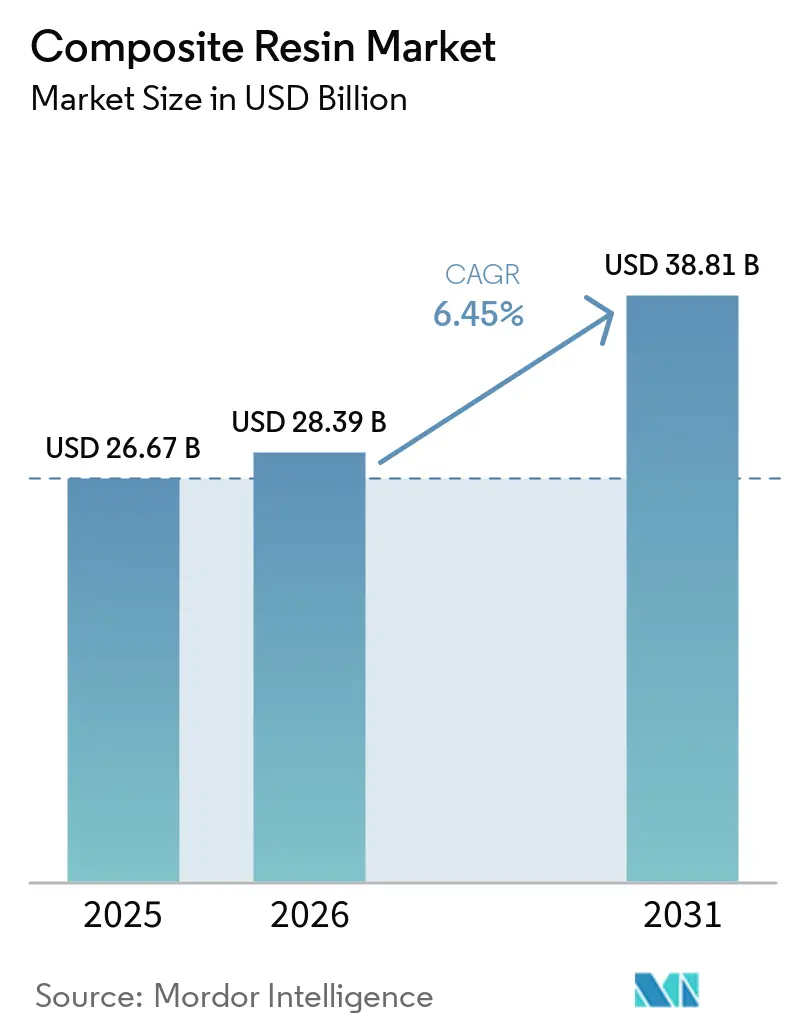
The Composite Resin Market size was valued at USD 26.67 billion in 2025 and is estimated to grow from USD 28.39 billion in 2026 to reach USD 38.81 billion by 2031, at a CAGR of 6.45% during the forecast period (2026-2031). Demand is supported by vehicle electrification, wind-energy construction, and replacement of steel with corrosion-resistant fiber-reinforced materials. These needs span transportation, energy, civil construction, and industrial piping, which give suppliers several routes to demand. The composite resin market also depends on suppliers meeting demanding technical specifications and long customer qualification cycles. These favor established producers with broad formulation portfolios and technical support capabilities. At the same time, recyclable and bio-based chemistries are becoming more important as customers address end-of-life requirements.
Key Report Takeaways
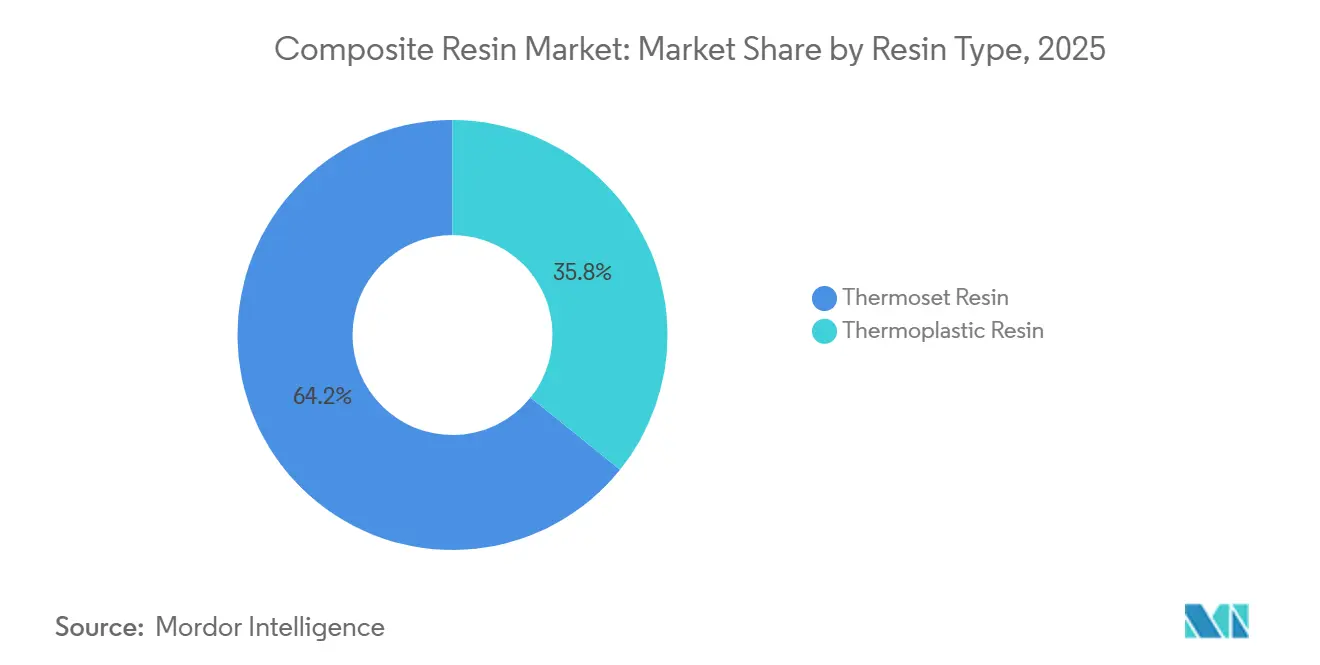
- By resin type, thermoset resin held 64.23% of the composite resin market share in 2025, while thermoplastic resin is projected to advance at a 7.23% CAGR through 2031.
- By manufacturing process, layup held 34.54% of the composite resin market share in 2025, while resin transfer molding is projected to advance at a 7.45% CAGR through 2031.
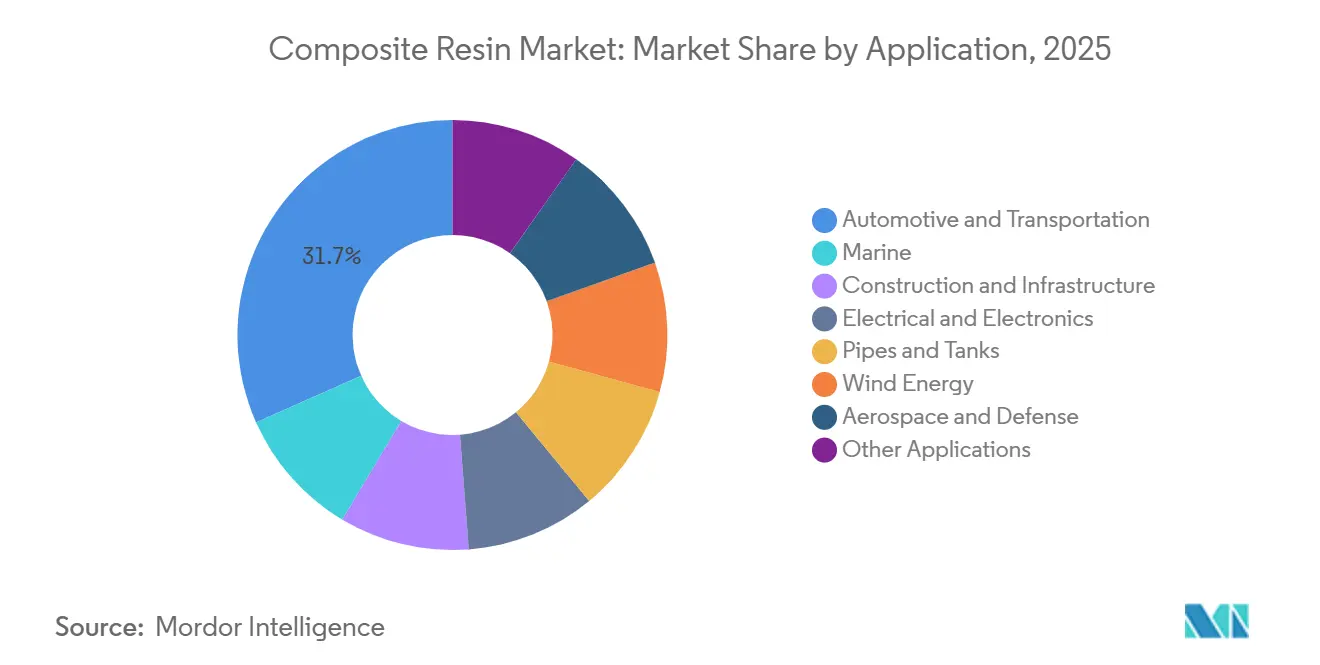
- By application, automotive and transportation held 31.67% of the composite resin market share in 2025, while wind energy is projected to advance at a 7.68% CAGR through 2031.
- By geography, Asia-Pacific held 42.79% of the composite resin market share in 2025 and is projected to advance at a 7.37% CAGR through 2031.
Note: Market size and forecast figures in this report are generated using Mordor Intelligence’s proprietary estimation framework, updated with the latest available data and insights as of January 2026.
Global Composite Resin Market Trends and Insights
Drivers Impact Analysis*
| Driver | (~) % Impact on CAGR Forecast | Geographic Relevance | Impact Timeline |
|---|---|---|---|
| Lightweighting and Fuel-Efficiency Requirements | +1.5% | Global, concentrated in North America, Europe, and APAC automotive corridors | Short term (≤ 2 years) |
| Wind-Energy Capacity Expansion | +1.2% | APAC (China, India), North America, Europe (offshore) | Medium term (2-4 years) |
| Electrification of Automotive and Transportation Platforms | +1.0% | North America, China, and Europe under EU Green Deal vehicle mandates | Medium term (2-4 years) |
| Infrastructure Demand for Corrosion-Resistant Materials | +0.8% | APAC, Middle East and Africa, South America | Long term (≥ 4 years) |
| Automated High-Throughput Composite Processing | +0.5% | North America, Europe, Japan, South Korea | Medium term (2-4 years) |
| Source: Mordor Intelligence | |||
Lightweighting and Fuel-Efficiency Requirements
Mass reduction remains a central reason for vehicle manufacturers to use composite materials in both combustion and battery-electric platforms. Composite resins can support structural weight savings of 30% to 40% compared with equivalent steel applications. Battery-electric vehicles require 15% to 25% more resin content by weight than comparable combustion-engine vehicles. Battery enclosures, power-electronics housings, and lightweight structural components create this added need. These components also require dielectric performance and flame resistance. The composite resin market benefits because resin grades must be qualified for specific vehicle programs, and qualification can take 18 to 36 months.
Electrification of Automotive and Transportation Platforms
Electrification increases the importance of specialty resin performance in transportation applications. Global electric-vehicle sales exceeded 17 million units in 2024[1]International Energy Agency, “Global EV Outlook 2025,” International Energy Agency, iea.org. Battery-adjacent applications require thermal stability above 180 °C, low ionic contamination, and Underwriters Laboratories (UL) 94 V-0 flame ratings. SABIC introduced NORYL GTX LMX310 in February 2025 for inline-paintable electric-vehicle service flaps. The company stated that the material had 85% lower equilibrium moisture absorption than incumbent polyamide compounds. Vehicle makers continue to use thermosets in primary structures while adopting thermoplastic composites for interior and semi-structural parts, widening requirements across the composite resin market
Wind-Energy Capacity Expansion
Wind turbine blades create demand that is closely linked to renewable-energy policy and project pipelines. Global wind installations reached 165 GW in 2025, a record level, according to the Global Wind Energy Council. Cumulative global wind capacity surpassed 1,299 GW during the same year. India added 6.34 GW of onshore capacity in 2025, up 85% year over year. Blades longer than 100 meters need materials with fatigue resistance and controlled heat release during infusion. This supports demand for qualified epoxy systems and vinyl ester systems in the composite resin market.
Automated High-Throughput Composite Processing
Automation is expanding the role of resin transfer molding and layup in scalable production. The University of Delaware Center for Composite Materials reported in August 2026 that machine learning and liquid injection molding simulation can reduce resin-flow variation in resin transfer molding[2]University of Delaware Center for Composite Materials, “Perdue Advances Resin Transfer Molding Through Machine Learning and Simulation,” University of Delaware, udel.edu. Better control can reduce structural defects and yield losses in parts with complex geometries. High-pressure resin transfer molding can reduce cycle times below 5 minutes in some automotive applications. This changes resin requirements toward faster cure, controlled heat release, and predictable gel windows. Suppliers in the composite resin market can strengthen customer relationships when they support these process changes.
Restraints Impact Analysis*
| Restraint | (~) % Impact on CAGR Forecast | Geographic Relevance | Impact Timeline |
|---|---|---|---|
| High Composite Manufacturing and Qualification Costs | -0.9% | Global, most acute in North America and Europe | Short term (≤ 2 years) |
| Difficult Recycling of Cross-Linked Thermoset Matrices | -0.6% | Europe (regulatory pressure), North America, APAC | Long term (≥ 4 years) |
| Limited Repair, Inspection, and End-of-Life Infrastructure | -0.4% | South America, Middle East and Africa, and emerging APAC markets | Long term (≥ 4 years) |
| Source: Mordor Intelligence | |||
High Composite Manufacturing and Qualification Costs
Qualifying a resin system from formulation through production deployment can take 18 to 36 months. Aerospace, automotive, and wind-energy testing can add USD 500,000 to USD 5 million for each resin grade and customer program. This burden is especially difficult for mid-tier suppliers that must fund several customer programs at the same time. Epoxy, polyester, and vinyl ester feedstocks are also exposed to crude-oil and naphtha cycles. Bisphenol-A, maleic anhydride, and epichlorohydrin transmit this volatility into producer margins. Composite resins can cost 3x to 5x more than conventional engineering thermoplastics in equivalent-density applications, which limits adoption in price-sensitive applications.
Difficult Recycling of Cross-Linked Thermoset Matrices
Cross-linked thermosets cannot be recycled through conventional melt processing. Mechanical shredding reduces fiber length and matrix integrity, leaving material that is often directed to lower-value filler or construction applications. A 2026 peer-reviewed study found that Fenton-based degradation can break down thermoset matrices under mild conditions while retaining 90% of fiber tensile strength. European landfill bans for wind turbine blades increase end-of-life costs for current blade specifications. The composite resin market therefore has a commercial opening for recyclable thermoset formulations that can meet both performance and end-of-life requirements.
*Our forecasts treat driver/restraint impacts as directional, not additive. The impact forecasts reflect baseline growth, mix effects, and variable interactions.
Segment Analysis
By Resin Type: Thermoset Resin Leads Demand, While Thermoplastic Resin Drives Growth
Thermoset resin held 64.23% of the composite resin market share in 2025. Its position was supported by established qualification in wind blades, aerospace panels, and industrial piping. Cross-linked matrices remain the commercially proven choice for many primary structural applications. Thermosets provide thermal stability and chemical resistance for demanding service conditions. They also involve more difficult processing and end-of-life management than thermoplastic systems. Despite these limits, replacement in core structural uses remains difficult because customers rely on tested performance and qualified supply chains.
Thermoplastic resin is projected to advance at a 7.23% CAGR through 2031. Shorter injection-molding and compression-molding cycles support its adoption in automotive substructures, electronics housings, and sports equipment. Its reprocessability is also aligned with end-of-life requirements in Europe and North America. Original equipment manufacturers are accelerating qualification as these requirements enter material specifications. Arkema presented a recyclable speed board at JEC World 2026 using Elium resin and recycled carbon fiber. The prototype demonstrated chemical recyclability through depolymerization and showed how liquid thermoplastic systems could serve infused structural parts.


By Manufacturing Process: Layup Scales, While Resin Transfer Molding Accelerates
Layup held 34.54% of the composite resin market share in 2025. Marine hulls and wind nacelles are among the applications that use this approach. The method is compatible with polyester, vinyl ester, and epoxy resin families. This broad chemistry compatibility supports its continuing use in established production settings. Layup also remains relevant where producers need practical tooling economics rather than short cycle times.
Resin transfer molding is projected to advance at a 7.45% CAGR through 2031. High-pressure closed-mold variants can improve surface quality and reduce cycle times in automotive parts and wind-blade root inserts. The University of Delaware research on predictive resin-flow control addresses defects in complex components. Filament Winding supports pressure vessels and pipes, while Pultrusion is used for continuous structural profiles. Compression molding serves flat structural components with defined production needs. Injection molding is used in shorter-cycle automotive applications with resin systems designed for tighter gelation windows.
By Application: Automotive and Transportation Leads Demand, While Wind Energy Drives Growth
Automotive and transportation held 31.67% of the composite resin market share in 2025. Its leadership came from a wide component base across passenger vehicles, commercial trucks, and rail. Body panels, bumpers, structural reinforcements, battery enclosures, interior composites, and chassis modules all require resin systems. This application breadth supports demand even when vehicle manufacturers face cost pressure. The composite resin industry supplies different material grades because each component has its own mechanical, thermal, electrical, and processing requirements. Qualified materials are important in high-stress structural zones and battery-related applications.
Wind energy is projected to advance at a 7.68% CAGR through 2031. The composite resin market size for the application is supported by expanding capacity additions and larger turbine designs. Wind installations reached 165 GW globally in 2025, according to the Global Wind Energy Council. Each megawatt of installed wind capacity uses 8 to 12 metric tons of composite materials across blades, nacelles, and spinners. Aerospace and defense is recovering through higher composite content in next-generation single-aisle aircraft. Marine producers use vinyl ester resins for osmotic blister resistance, while Pipes and Tanks use filament-wound epoxy and polyester systems for chemical containment.

Geography Analysis
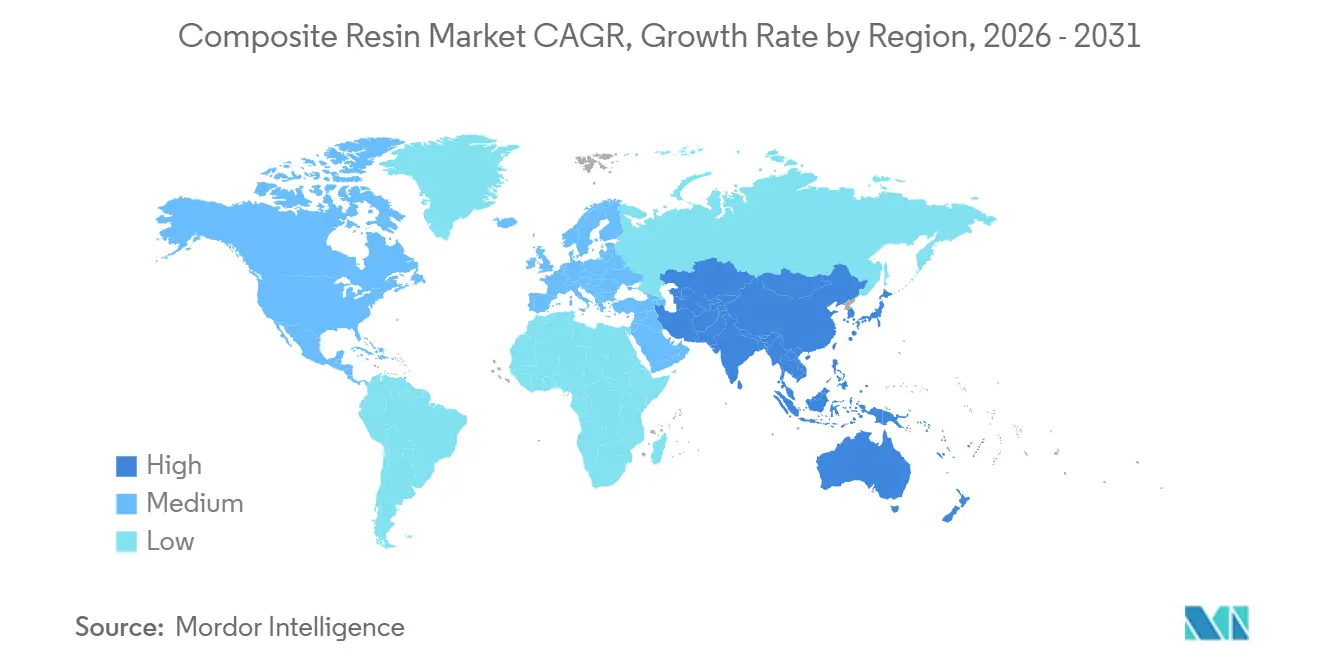
Asia-Pacific held 42.79% of the composite resin market share in 2025 and is projected to advance at a 7.37% CAGR through 2031. China’s integrated resin production and composite manufacturing base support this position. Manufacturing clusters in Shandong, Jiangsu, and Guangdong combine petrochemical feedstock supply with downstream fabrication. India added 6.34 GW of onshore wind capacity in 2025, an 85% increase from the prior year. This supports demand for blade-grade epoxy and vinyl ester resins in Tamil Nadu, Gujarat, and Rajasthan. Japan and South Korea remain important for carbon-fiber prepregs and specialty formulations.
North America drives demand through aerospace programs, wind development, and vehicle redesign. Wind projects in Texas and the Midwest support blade-grade composite requirements. Automotive production in the Great Lakes corridor also supports demand for composite subassemblies. The Inflation Reduction Act continues to support domestic clean-energy manufacturing investment. Europe’s composite resin market is shaped by renewable-energy targets and chemical regulation. REACH requirements are directing development toward low-styrene and styrene-free formulations in unsaturated polyester and vinyl ester uses.
Germany, the United Kingdom, France, Italy, and the Nordic countries remain important European end-user manufacturing locations. A 2025 Life Cycle Inventory study commissioned by members of the Cefic UP/VE Sector Group reported global-warming-potential values for unsaturated polyester and vinyl ester resins that were 2% to 8% lower than prior figures. The study reported a 16% lower global warming potential for recycled polyethylene terephthalate (rPET)-based resins. South America and the Middle East and Africa remain smaller revenue areas with specific demand drivers. Brazil’s fiberglass base and wind sector support regional consumption. Scott Bader established Scott Bader Brasil in Serra, Espírito Santo, in June 2024 to produce Crystic gelcoats and tooling products locally.

Competitive Landscape
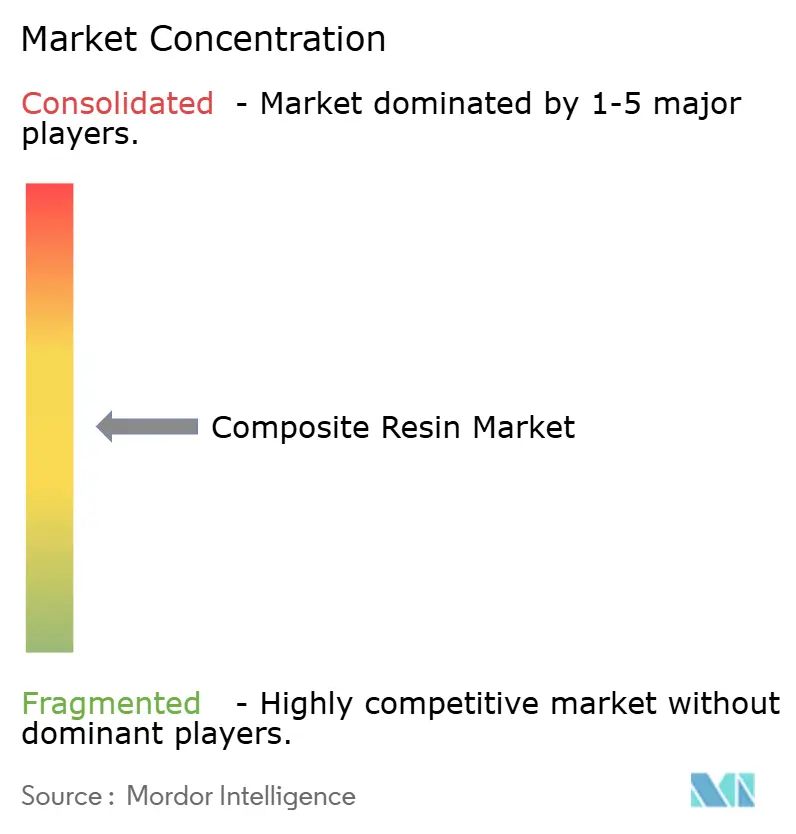
The composite resin market is moderately concentrated, with the top five players including Huntsman International LLC, Hexion Inc., BASF, Dow, and Polynt S.p.A. BASF, Dow, Huntsman International LLC, and Evonik Industries AG compete through formulation breadth, technical service, and raw-material integration. Polynt S.p.A., KUKDO CHEMICAL CO., LTD., and Scott Bader Company Limited compete through application knowledge and regional supply proximity. Sustainability and application specialization are shaping supplier positioning. Suppliers that can meet automotive, aerospace, wind, and industrial qualifications have an advantage because customer approval processes are lengthy. The composite resin market also rewards producers that can support customer process development and production consistency.
Huntsman International LLC published European patent EP4547728A4 in July 2026 for curable epoxy resin compositions with high glass-transition temperatures for aerospace and automotive structural bonding. The development supports its position in premium thermoset systems with demanding thermal requirements. Toray Performance Materials Corporation introduced Stratex 2300r in June 2026, a carbon-fiber composite using post-consumer recycled polyethylene terephthalate. The company stated that the product maintained 1:1 mechanical performance parity with virgin-polyethylene-terephthalate unidirectional composites. These moves show why recycled-content credentials are becoming part of customer qualification criteria. They also show the importance of intellectual property in applications that require long requalification cycles.
Growth opportunities include bio-based thermosets for wind and marine uses, recyclable thermoplastic systems for structural infusion, and low-emission alternatives to styrene. Vitrimers are being developed as thermoset systems that can be reprocessed while maintaining cross-linked performance. These materials are not yet commercially scaled, but wind original equipment manufacturers and automotive Tier 1 suppliers are showing qualification interest. Digital manufacturing is a secondary differentiator for formulators that help customers improve resin transfer molding control and cure management. Portfolio ownership also changed when INEOS divested its composites business to KPS Capital Partners in October 2024. The transaction covered unsaturated polyester resin, vinyl ester resin, and gel coat operations across 17 production sites, with annual revenue exceeding USD 840 million, and had a value of USD 1.78 billion.
Composite Resin Industry Leaders
Huntsman International LLC
Hexion Inc.
BASF
Dow
Polynt S.p.A.
- *Disclaimer: Major Players sorted in no particular order

Recent Industry Developments
- January 2026: Researchers at Empa developed a phosphorus-based additive that converts conventional epoxy resin into a flame-retardant and thermomechanically recyclable material. The development supports the shift toward recyclable and high-performance epoxy systems in composite manufacturing.
- November 2025: Exel Composites announced a purchase agreement with INEOS for more than 100 metric tons of ENVIREZ bio-based resin system, supporting its transition away from hydrocarbon-derived resins. The agreement expanded the use of bio-based resin systems in composite production and supports demand for more sustainable composite resins.


Global Composite Resin Market Report Scope
Composite resins are polymer matrices used to bind and support reinforcing fibers in composite materials, providing structural integrity and transferring loads between reinforcement elements. They enable the production of lightweight, durable, and application-specific composite components with tailored mechanical, thermal, and chemical properties.
The Composite Resin Market is segmented by resin type, manufacturing process, application, and geography. By resin type, the market is segmented into thermoset resin and thermoplastic resin. By manufacturing process, the market is segmented into layup, filament winding, injection molding, pultrusion, compression molding, resin transfer molding, and other manufacturing processes. By application, the market is segmented into automotive and transportation, construction and infrastructure, electrical and electronics, pipes and tanks, wind energy, marine, aerospace and defense, and other applications. The report also covers the market size and forecasts for composite resins in 15 countries across major regions. For each segment, the market sizing and forecasts have been done on the basis of value (USD).
| Thermoset Resin |
| Thermoplastic Resin |
| Layup |
| Filament Winding |
| Injection Molding |
| Pultrusion |
| Compression Molding |
| Resin Transfer Molding |
| Other Manufacturing Processes |
| Automotive and Transportation |
| Construction and Infrastructure |
| Electrical and Electronics |
| Pipes and Tanks |
| Wind Energy |
| Marine |
| Aerospace and Defense |
| Other Applications |
| Asia-Pacific | China |
| India | |
| Japan | |
| South Korea | |
| ASEAN Countries | |
| Rest of Asia-Pacific | |
| North America | United States |
| Canada | |
| Mexico | |
| Europe | Germany |
| United Kingdom | |
| France | |
| Italy | |
| NORDIC Countries | |
| Rest of Europe | |
| South America | Brazil |
| Argentina | |
| Rest of South America | |
| Middle East and Africa | Saudi Arabia |
| South Africa | |
| Rest of Middle East and Africa |
| By Resin Type | Thermoset Resin | |
| Thermoplastic Resin | ||
| By Manufacturing Process | Layup | |
| Filament Winding | ||
| Injection Molding | ||
| Pultrusion | ||
| Compression Molding | ||
| Resin Transfer Molding | ||
| Other Manufacturing Processes | ||
| By Application | Automotive and Transportation | |
| Construction and Infrastructure | ||
| Electrical and Electronics | ||
| Pipes and Tanks | ||
| Wind Energy | ||
| Marine | ||
| Aerospace and Defense | ||
| Other Applications | ||
| By Geography | Asia-Pacific | China |
| India | ||
| Japan | ||
| South Korea | ||
| ASEAN Countries | ||
| Rest of Asia-Pacific | ||
| North America | United States | |
| Canada | ||
| Mexico | ||
| Europe | Germany | |
| United Kingdom | ||
| France | ||
| Italy | ||
| NORDIC Countries | ||
| Rest of Europe | ||
| South America | Brazil | |
| Argentina | ||
| Rest of South America | ||
| Middle East and Africa | Saudi Arabia | |
| South Africa | ||
| Rest of Middle East and Africa | ||


Key Questions Answered in the Report
What is the size of the composite resin market?
The composite resin market stands at USD 28.39 billion in 2026 and is projected to reach USD 38.81 billion by 2031.
Which resin type led the market demand in 2025?
Thermoset resin led with 64.23% share in 2025, supported by its established use in wind, aerospace, and industrial piping applications.
Which application is projected to grow fastest through 2031?
Wind energy is projected to advance at a 7.68% CAGR through 2031, supported by expanding wind capacity and larger turbine blades.
Why are electric vehicles important for resin suppliers?
Battery enclosures, power-electronics housings, and structural components require materials with thermal stability, dielectric performance, and flame resistance.
Page last updated on:





