
Composite Repair Market Size and Share
Market Overview
| Study Period | 2021 - 2031 |
|---|---|
| Market Size (2026) | USD 16.39 Billion |
| Market Size (2031) | USD 22.82 Billion |
| Growth Rate (2026 - 2031) | 6.85 % |
| Fastest Growing Market | Asia Pacific |
| Largest Market | Asia Pacific |
| Market Concentration | Medium |
Major Players *Disclaimer: Major Players sorted in no particular order Image © Mordor Intelligence. Reuse requires attribution under CC BY 4.0. | |
Composite Repair Market Analysis by Mordor Intelligence
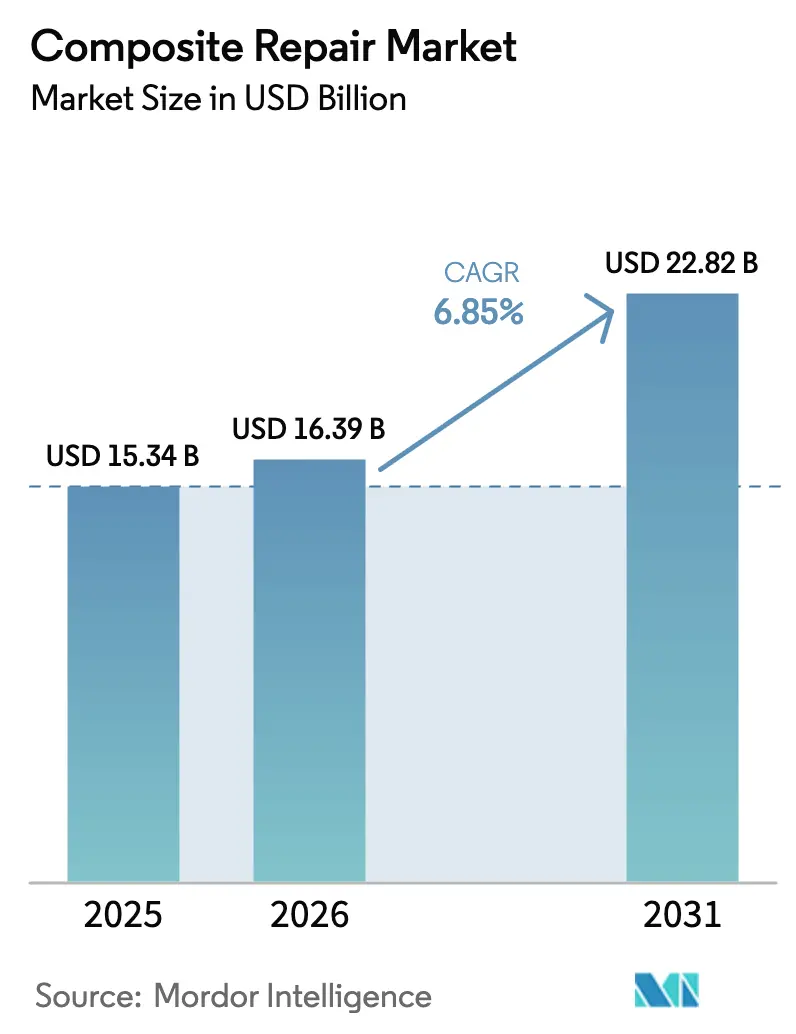
The Composite Repair Market size is projected to be USD 15.34 billion in 2025, USD 16.39 billion in 2026, and reach USD 22.82 billion by 2031, growing at a CAGR of 6.85% from 2026 to 2031. Widening adoption of carbon-fiber reinforced polymer (CFRP) structures in aircraft, wind turbines, and industrial assets has shifted repair from a reactive cost center to a strategic capital-preservation tool. The 2024 update of FAA Advisory Circular 20-107B shortened structural-repair approvals by one-third, releasing deferred maintenance budgets and giving operators a faster route to keep high-value assets in service. Asia-Pacific is setting the pace, propelled by COMAC C919 fleet expansion and an offshore-wind build-out across the Taiwan Strait and the Yellow Sea, while parallel investment in certified maintenance, repair, and overhaul (MRO) hubs lifts demand for mobile autoclave services. Composite material suppliers are integrating downstream to capture service revenue, and operators increasingly weigh on-site repair economics against replacement lead times, reinforcing the composite repair market as a balance-sheet lever rather than a maintenance expense.
Key Report Takeaways
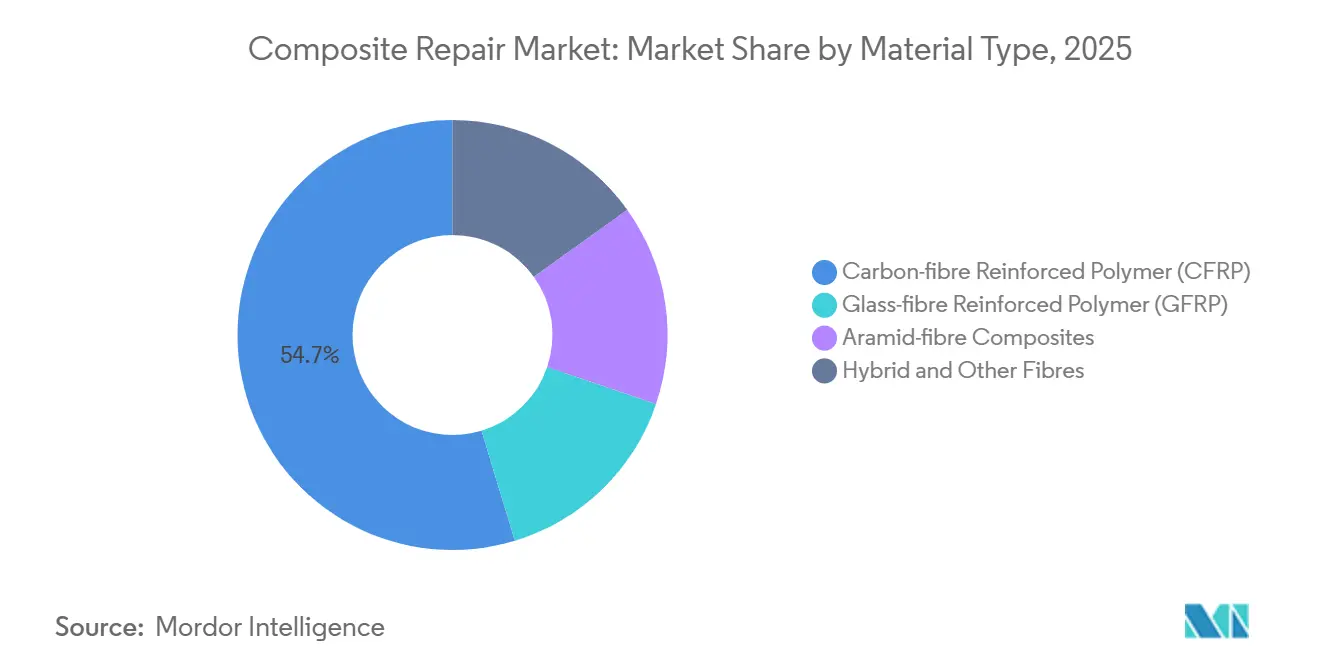
- By material type, Carbon-fibre Reinforced Polymer (CFRP) commanded 54.69% of the composite repair market share in 2025, while aramid-fiber composites are forecast to post a 7.85% CAGR through 2031.
- By product type, structural accounted for 44.71% of 2025 revenue, and cosmetic is expected to grow at a 7.71% CAGR to 2031.
- By repair process, hand lay-up led with 38.78% revenue share in 2025; autoclave is projected to advance at an 8.15% CAGR to 2031.
- By end-user industry, aerospace and defense held 44.22% revenue share in 2025; wind energy is poised to register a 7.81% CAGR through 2031.
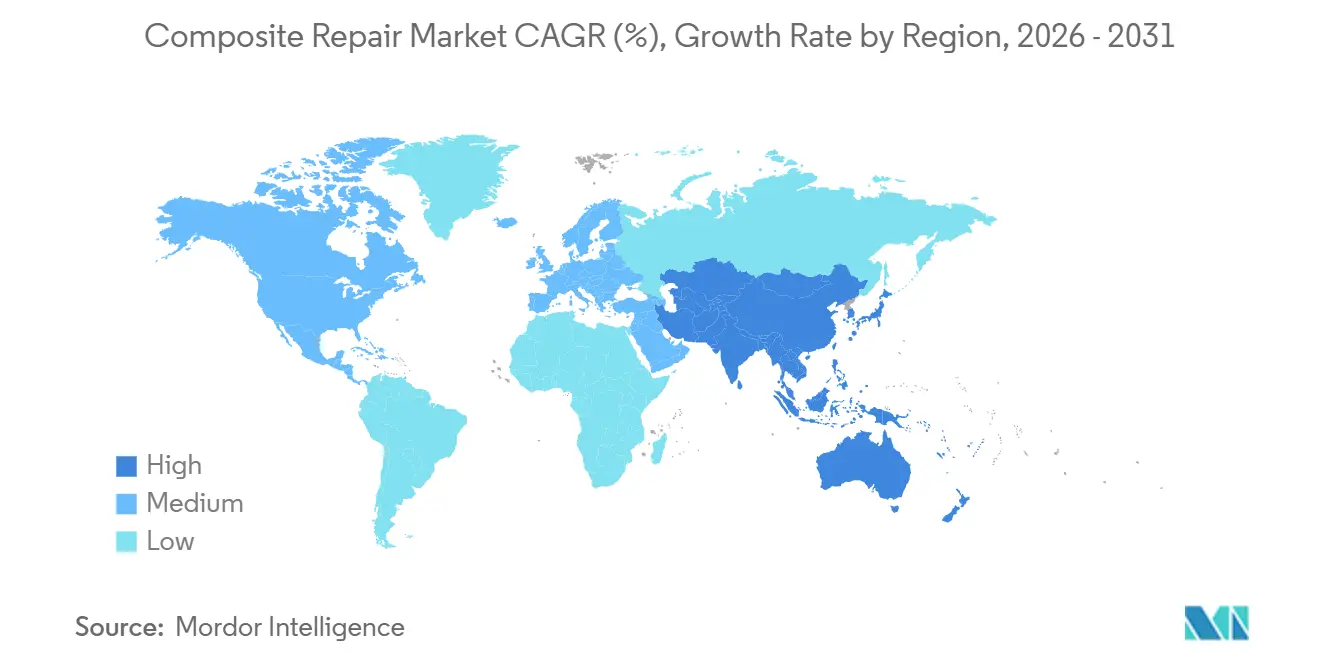
- By geography, Asia-Pacific generated 38.54% of 2025 revenue and is forecast to expand at an 8.29% CAGR to 2031.
Note: Market size and forecast figures in this report are generated using Mordor Intelligence’s proprietary estimation framework, updated with the latest available data and insights as of January 2026.
Market Trends and Insights
Drivers Impact Analysis of Composite Repair Market*
| Driver | (~) % Impact on CAGR Forecast | Geographic Relevance | Impact Timeline |
|---|---|---|---|
| Surging Investment in Aging-Asset Life-Extension Programs | +1.8% | Global, concentrated in North America offshore oil & gas, Europe industrial infrastructure | Medium term (2-4 years) |
| Cost Advantages of On-Site Composite Repair Versus Metallic Part Replacement | +2.1% | Global, particularly Asia-Pacific aerospace MRO hubs and North America wind farms | Short term (≤ 2 years) |
| Increasing Use of Composites in Aerospace and Defense Industry | +1.5% | Global, led by North America and Europe OEM production, spillover to Asia-Pacific MRO | Long term (≥ 4 years) |
| Offshore Wind-Blade Length Growth Demanding In-Situ Repair Capability | +1.2% | Europe (North Sea), Asia-Pacific (Taiwan Strait and Yellow Sea), emerging in the US Atlantic Coast | Medium term (2-4 years) |
| Hydrogen Pipeline Retrofits Needing Non-Metallic Reinforcement | +0.8% | Europe hydrogen corridors, Middle East petrochemical hubs, North America industrial clusters | Long term (≥ 4 years) |
| Source: Mordor Intelligence | |||
Surging Investment in Aging-Asset Life-Extension Programs
Operators are redirecting capital from new builds to life-extension projects as replacement lead times stretch beyond two years and regulatory hurdles tighten. The U.S. Department of Energy earmarked USD 1.2 billion in 2025 for composite wrapping of nuclear-plant cooling-water piping, enabling upgrades without reactor shutdowns[1]. Gulf of Mexico oil platforms commissioned in the 1980s now employ glass-fiber overwraps that extend riser life by up to 20 years at one-third the steel-replacement cost. TD Williamson secured multi-year subsea pipeline contracts from Chevron and Shell after expanding its composite division in 2024. Europe mirrors the trend: North Sea operators doubled composite integrity spending to EUR 800 million in 2025, evidence that composite repair preserves cash flow while deferring the environmental scrutiny triggered by new construction approvals.
Cost Advantages of On-Site Composite Repair Versus Metallic Part Replacement
Field repair economics favor composites by a wide margin. Lufthansa Technik quantified that on-wing repair of a Boeing 777 composite radome costs USD 35,000 over 48 hours, whereas replacement is USD 120,000 and grounds the jet for seven days, causing USD 200,000 revenue loss. Wind-farm operators echo these savings: in-situ repair of a 90-meter blade costs USD 80,000, compared with USD 250,000 for depot work and two-week generation loss. HAECO’s mobile repair units trimmed narrow-body turnaround from five days to 18 hours at Asia-Pacific airports in 2025, illustrating how time-value benefits amplify direct cost savings.
Increasing Use of Composites in the Aerospace and Defense Industry
Composite content in commercial aircraft rose from 20% in 2015 to 35% in 2025, creating a deferred repair wave as early CFRP structures reach 15-year inspections. COMAC C919 airframes will require their first major composite checks in 2026-2027, driving demand for certified repair stations across Asia-Pacific. The U.S. Air Force awarded Toray a USD 45 million contract in 2024 for rapid-cure prepreg systems that cut F-35 stealth-coating downtime from 72 hours to 12 hours. EASA’s 2025 standards now mandate non-destructive testing for all primary-structure repairs, raising entry barriers yet validating the long-term demand for high-skill composite repair services.
Offshore Wind Blade Length Growth Demanding In-Situ Repair Capability
Blades exceeding 115 meters make depot repair economically prohibitive. A 2025 Technical University of Denmark analysis showed transport of a 110-meter blade from a North Sea farm to Germany costs EUR 400,000, while rope-access repair costs EUR 90,000. The U.S. Department of Energy flagged blade repair as a bottleneck for Atlantic Coast projects in its 2024 roadmap. Wind speeds up to 15 m/s let crews fix blades during short weather windows, safeguarding turbine availability.
Restraints Impact Analysis of Composite Repair Market*
| Restraint | (~) % Impact on CAGR Forecast | Geographic Relevance | Impact Timeline |
|---|---|---|---|
| Emergence of Self-Healing Composite Laminates | -0.6% | Global, earliest adoption in automotive and consumer electronics, slower in aerospace due to certification timelines | Long term (≥ 4 years) |
| Scarcity of Certified Composite Repair Technicians | -0.9% | Global, most acute in North America and Europe aerospace MRO, moderate in Asia-Pacific wind energy | Short term (≤ 2 years) |
| Lack of Harmonised Repair Codes for Subsea Composite Pipelines | -0.4% | Global offshore oil & gas regions, particularly North Sea, Gulf of Mexico, West Africa deepwater fields | Medium term (2-4 years) |
| Source: Mordor Intelligence | |||
Emergence of Self-Healing Composite Laminates
Self-healing resin systems are moving from labs to limited commercial trials. Oak Ridge National Laboratory licensed a thermoplastic healing system to automotive suppliers in 2025, enabling EV battery enclosures to self-repair micro-cracks and is forecast to cut cosmetic repair volume by up to 20% within five years. CompPair HealTech closed EUR 12 million funding in 2024 to pilot bio-inspired resins for wind-blade trailing edges, targeting a 2027 rollout. Aerospace certification will lag, but widespread adoption in automotive and wind could erode low-margin cosmetic repair demand.
Scarcity of Certified Composite Repair Technicians
Workforce shortages already constrain revenue. IACMI reported in 2025 that only 12% of U.S. community-college composite programs include FAA-recognized repair modules, and the average technician age is 54 years. Lufthansa Technik turned away USD 80 million in composite repair work in 2024 for lack of staff. EASA estimates Europe needs 3,000 additional certified technicians by 2028 but current programs graduate only 800 annually. Wage premiums in wind energy lure aerospace technicians, aggravating shortages across MRO hubs.
*Our forecasts treat driver/restraint impacts as directional, not additive. The impact forecasts reflect baseline growth, mix effects, and variable interactions.
Composite Repair Market Segment Analysis
By Material Type:
CFRP Dominance Masks Aramid AccelerationThe Carbon-fibre Reinforced Polymer (CFRP) accounts for 54.69% of global revenue in 2025. Boeing 787 fuselage delamination alone generated USD 420 million in CFRP repair orders that year, underscoring the segment’s scale. Glass-fiber retains the cost-sensitive mid-market, and the U.S. Navy’s USD 28 million GFRP superstructure repair program on Arleigh Burke-class destroyers highlights its defense relevance[2]. Hybrid and natural-fiber systems remain niche but gain traction in infrastructure rehabilitation as environmental rules tighten.
Aramid composites occupy a swiftly growing niche. Hydrogen pipeline operators favor aramid-fibre composites that resist cryogenic embrittlement, driving a 7.85% CAGR through 2031. Ballistic-protection retrofits for military vehicles add further pull. Regulatory specificity also shapes share: FAA AC 43-214A restricts cosmetic CFRP repairs to OEM-approved materials, effectively locking lower-cost substitutes out and anchoring CFRP’s position. Taken together, CFRP keeps numerical leadership, yet aramid’s high-value opportunities and regulatory loopholes present outsized upside relative to scale.

By Product Type:
Structural Repairs Command Premium PricingStructural generated 44.71% of 2025 value because downtime risk and certification requirements allow premiums. A composite wing-to-body fairing repair on a Boeing 777 can fetch USD 180,000, contrasting with USD 12,000 for an equivalent cosmetic fix. Semi-structural repairs, such as wind-blade trailing-edge treatments, grew as offshore turbine operators favored repair over replacement.
Cosmetic work is the fastest segment at 7.71% CAGR through 2031 but faces long-run headwinds from self-healing materials. Oak Ridge National Laboratory’s licensed thermoplastic system could trim cosmetic volumes by up to 20% inside five years. Still, near-term growth is fueled by electric-vehicle adoption: collision centers now handle CFRP battery enclosures that require certified technicians and rapid-cure epoxies. Crawford Composites developed a vacuum-infusion kit that field teams use without autoclaves, capturing semi-structural contracts across U.S. wind farms.
By Repair Process:
Autoclave Growth Signals Quality EscalationHand lay-up produced 38.78% of 2025 revenue owing to its suitability for field work where autoclave access is limited, yet autoclave is projected to post the highest growth at an 8.15% CAGR through 2031. Lufthansa Technik’s mobile autoclave trailer demonstrates the shift toward bringing controlled cures to airport aprons, meeting EASA non-destructive testing mandates without ferry flights or component shipping. Vacuum-infusion methodologies, helped by the Technical University of Denmark’s PrintRepair 3D-mold platform, are rising in offshore wind applications where large repair areas demand precise resin-fiber ratios.
The composite repair market size for autoclave-based processes is growing as aerospace OEMs stipulate vacuum-bag consolidation for any repair covering more than 10% of a primary control surface. HAECO reports 40% margin premiums on autoclave work, prompting the firm to prioritize capital toward high-spec curing even though hand lay-up volumes rise in absolute terms. The bifurcation will likely widen: asset owners of high-liability platforms will continue to push for capital-intensive, quality-assured processes, while cost-sensitive sectors maintain reliance on field-friendly lay-up techniques.
By End-user Industry:
Wind Energy Outpaces Aerospace GrowthThe composite repair market size for aerospace and defense accounts for 44.22% of global revenue in 2025. Boeing’s 787 fuselage fixes alone drove USD 420 million, yet production delays capped incremental upside. Wind energy, by contrast, expanded at 7.81% through 2031 as blades exceeded 100 meters and offshore maintenance costs for depot work skyrocketed. North Sea operators spent EUR 650 million on blade repair in 2025, doubling 2023 outlays.
Automotive also accelerates as EV uptake lifts the installed base of CFRP battery enclosures. Tesla’s collision guidelines compel OEM-certified repairs, creating a captive aftermarket. Marine and construction applications round out demand: the U.S. Navy contract for GFRP superstructures and Sika’s flax-fiber bridge-repair system illustrate how defense and infrastructure budgets underpin steady, if smaller, revenue streams.

Geography Analysis
APAC Composite Repair Market
Asia-Pacific generated 38.54% of 2025 revenue for the composite repair market and is forecast to grow at 8.29% through 2031. COMAC C919 composite checks, Toray’s 20% carbon-fiber capacity expansion, and India’s 5 GW of wind-power additions in 2025 underpin multi-segment demand. HAECO’s USD 85 million Singapore repair center exemplifies regional capacity build-out, while South Korea’s frigate program embeds composite superstructures requiring long-term service infrastructure.
North America Composite Repair Market
North America’s demand is driven by U.S. aerospace MRO concentration and wind-farm expansion across the Great Plains and Atlantic Coast. The Department of Energy’s 2024 roadmap funded mobile blade-repair training, and TD Williamson’s CAD 120 million Canadian pipeline contracts show industrial adoption beyond aerospace. Technician shortages, however, push overflow work to Mexican hubs where labor supply is more elastic though regulatory limits confine scope to non-primary structures.
EMEA and South America Composite Repair Market
Europe’s share is anchored by Lufthansa Technik’s mobile autoclave trailer and the United Kingdom’s 15 GW offshore wind capacity that produced GBP 480 million in blade repairs during 2025. Germany’s EV battery-enclosure adoption brings new collision-repair volume, and Sika’s flax-fiber system supports bridge-strengthening contracts across Germany and France. South America, the Middle East, and Africa contribute the lower share, led by Brazil’s wind build-out and Saudi pipeline retrofits that employ composite wraps for Vision 2030 infrastructure objectives.
Value Chain Analysis
The composite repair value chain begins with specialty inputs, including carbon, glass, and aramid reinforcements, epoxy and phenolic resin systems, adhesives and surfacing products, consumables (peel ply, release films, vacuum bagging), and NDT and inspection media. Aerospace-grade prepreg and qualified resin-fiber combinations are concentrated among a small set of suppliers (notably Toray Industries, Hexcel Corporation, and Syensqo), and qualification and requalification burdens (often 12 to 24 months) tie repair stations and operators to approved material stacks. Midstream conversion includes prepregging, kit cutting, patch and scarf repair preparation, and tooling (including portable molds), followed by repair execution by MROs and field-service providers using hand lay-up, vacuum infusion, or autoclave cures. Downstream, certification, documentation, and NDT sign-off determine return-to-service and warranty liability.
Value capture is shifting toward integrated service ecosystems that secure material access and shorten cycle time. Partnerships such as Strata Manufacturing and Lufthansa Technik Middle East (radome-focused composite repairs) show how OEM-adjacent manufacturing capability connects directly to repair execution, while technology developers such as Fraunhofer IFAM (thermoformable, recyclable FRP patches with fast setting) feed new repair consumables into the chain. Logistics and port variability also affect delivery windows for infrastructure-grade wraps and resins, and collaboration activity around healable materials, including CompPair with Diab on healable sandwich structures and CompPair with Adultimum AG to assess LCM HealTech resin in production environments, points to an upstream-to-downstream feedback loop between material innovation and repair process qualification.
Competitive Landscape
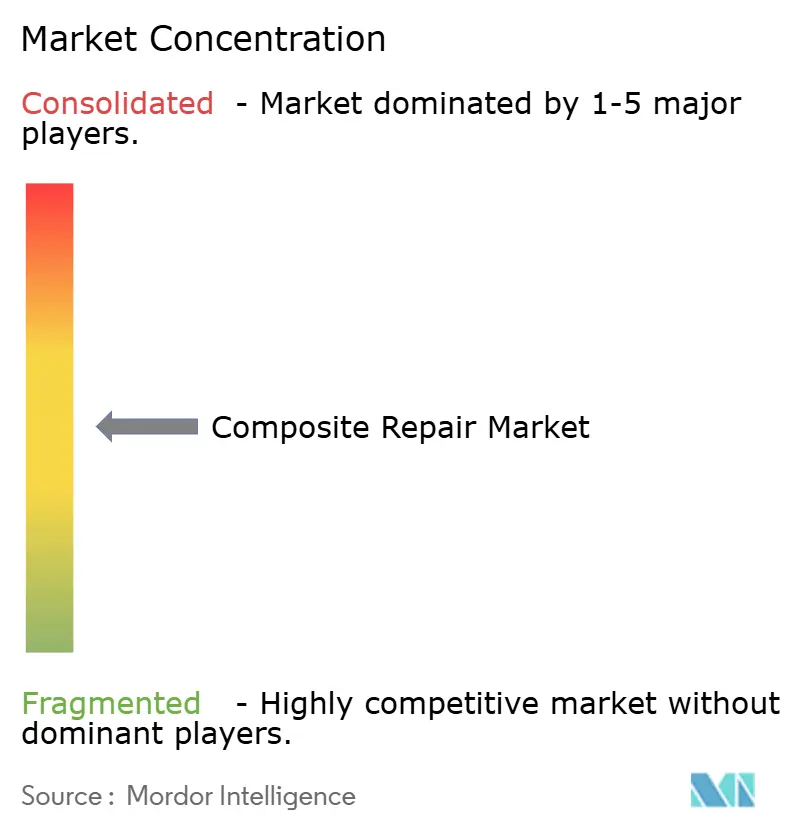
The top 5 firms accounted for an estimated 52% of 2025 revenue, illustrating moderate fragmentation. Hexcel’s 2024 partnership with Spain’s FIDAMC to automate wind-blade trailing-edge repairs shows materials suppliers shifting downstream to lock in recurring service income. Boeing’s USD 150 million investment in MRO partnerships across Singapore, Dubai, and Frankfurt underlines OEM intent to retain aftermarket share and mitigate production volatility. Toray mirrors the model through repair-focused joint ventures in Japan and the United States.
Specialists such as Crawford Composites and WR Composites exploit gaps in subsea-pipeline wrapping, where ISO and API standards lag and project-specific certifications provide defensible niches. Technology bifurcation deepens: aerospace and defense repairs require automated lay-up and integrated non-destructive testing systems that favor capital-rich incumbents, while wind and automotive work remains open to smaller operators leveraging hand lay-up and vacuum-infusion kits.
White-space growth avenues include mobile autoclave units for remote wind farms, integration consulting for self-healing materials, and technician-training ventures aligned with FAA and EASA curricula. Start-up activity focuses on self-healing resins; CompPair HealTech’s 2024 funding round aims to commercialize trailing-edge systems capable of reducing blade repair frequency by 30% by 2028.
Composite Repair Industry Leaders
-
Lufthansa Technik
-
3M
-
Henkel AG & Co. KGaA
-
Sika AG
-
Belzona International Ltd.
- *Disclaimer: Major Players sorted in no particular order
Composite Repair Market Companies Covered in this Report
- 3M
- Advanced FRP Systems
- Belzona International Ltd.
- Boeing
- Composite Technology Inc.
- Crawford Composites LLC
- DIAB Group
- Gurit Holding AG
- HAECO Group
- Henkel AG & Co. KGaA
- Hexcel Corporation
- Lufthansa Technik
- ResinTech Inc.
- Sika AG
- TD Williamson Inc.
- TEAM, Inc.
- Toray Advanced Composites
- WR Composites
Market Opportunities and Future Outlook
Near-term whitespace centers on scaling certified capacity and inspection capability that matches higher-spec structural repairs, particularly where turnaround time and access constraints increase the appeal of mobile and in-house solutions. North American investment signals this direction: WHI Global opened a 78,600-square-foot Aerobond Composites facility in Enfield, Connecticut (May 2026) with a 10-foot diameter autoclave and multiple laser ply projection cells, while Royal Engineered Composites announced a USD 5 million expansion in Minden, Nebraska (April 2026) that adds advanced inspection equipment, including a gantry C-scan system. Together, these moves support an opportunity for repair providers and material suppliers to bundle curing, scanning, and documentation workflows, reducing reliance on external inspection queues and enabling faster release of high-value components.
A second opportunity involves making bonded composite repairs more certifiable for primary load-bearing structures by tightening surface preparation control and improving detectability of bond-line defects. R&D programs such as NASA TechPort's NONA Repair of Composite Structures project (active in 2026) aim to reduce infrastructure footprint and shorten repair preparation time, which aligns with shop-floor automation needs. Standardization and training frameworks create a parallel runway for workforce and process repeatability (for example, SAE AIR6671 issued in June 2025 for standardized composite training programs), supporting scalable technician development and internal qualification. On the materials side, Syensqo breaking ground on an expansion at Havre de Grace, Maryland (July 2026) to lift capacity for structural adhesives and surfacing products by over 30% underscores a supply-led pathway for more repair-focused adhesive portfolios, especially where repairs depend on consistent cure behavior, long-term durability, and traceable application processes.
Recent Industry Developments in Composite Repair Market
- July 2026: 3M launched a Textured Parts Repair Pilot program with partners including Plasnomic, 4Plastic, Mirka, PPG, Polyvance, and SEM to validate methods for repairing textured plastic parts. The collaboration is designed to produce repeatable repair outcomes on surfaces that are often replaced due to cosmetic and finish-matching constraints, supporting repair-over-replace workflows in automotive and related composite-adjacent applications.
- September 2025: Henkel introduced the Bonderite M-CR 1132 M AERO Pen for precision corrosion repair in confined aircraft fastener holes. The product targets maintenance efficiency and process control in tight-access areas, complementing composite-heavy airframe maintenance where consistent surface protection and localized repair capability help reduce rework and downtime.
- August 2024: Lufthansa Technik Middle East and Strata Manufacturing formalized a collaboration to conduct repair operations on aircraft composite components, initially focusing on radomes. The tie-up expands specialized composite repair capacity in the Middle East and links local composite manufacturing know-how with MRO execution, strengthening regional turnaround options for operators.
Composite Repair Market Report Scope and Research Methodology
Market Definition and Coverage
For this study, the composite repair market is defined as the spending tied to restoring damaged fiber-reinforced polymer parts back to safe, certified performance using established repair methods and consumables, along with the labor and access needed to execute the repair.
Scope exclusions: We exclude retrofit strengthening projects, original equipment composite manufacturing, self-healing materials, and routine cosmetic refinishing that does not restore structural capability.
Segments Covered in This Report
- By Material Type
- Carbon-fibre Reinforced Polymer (CFRP)
- Glass-fibre Reinforced Polymer (GFRP)
- Aramid-fibre Composites
- Hybrid and Other Fibres
- By Product Type
- Structural
- Semi-structural
- Cosmetic
- By Repair Process
- Hand Lay-up
- Vacuum Infusion
- Autoclave
- Other Processes
- By End-user Industry
- Aerospace and Defense
- Wind Energy
- Automotive
- Marine
- Construction
- Other End-user Industries
- By Geography
- Asia-Pacific
- China
- Japan
- India
- South Korea
- ASEAN Countries
- Rest of Asia-Pacific
- North America
- United States
- Canada
- Mexico
- Europe
- Germany
- United Kingdom
- France
- Italy
- Spain
- NORDIC Countries
- Rest of Europe
- South America
- Brazil
- Argentina
- Rest of South America
- Middle-East and Africa
- Saudi Arabia
- South Africa
- Rest of Middle-East and Africa
- Asia-Pacific
Data Sources, Market Sizing, and Validation
Desk Research
Desk work started by mapping where composite repairs happen most often and what triggers them, and then building a list of demand indicators we can track consistently by region. Public sources were used to anchor the basic demand pool, such as FAA and EASA airworthiness and maintenance guidance, IEA wind statistics, national transport and infrastructure agencies, and customs trade data portals for relevant resin and fiber inputs.
Next, we reviewed company filings, investor presentations, repair manual references shared in open forums, and reputable press to understand repair cycles, labor intensity, and typical kit contents across end uses. Where public data was thin, a paid subscription for company financials and a separate patent database were used to spot activity levels and technology direction without leaning on any single point estimate. These are examples only, and many other sources were also referenced to collect, cross-check, and clarify data.
Primary Interviews and Surveys
Primary work focused on repair material suppliers, service providers, MRO teams, and end users across aerospace, wind, marine, and industrial assets, so our assumptions match real repair behavior and purchasing patterns. We used these conversations to confirm typical repair frequency, split between structural and cosmetic work, labor and downtime drivers, and regional differences in certification and training. When desk signals and field feedback did not line up, follow-up calls were done to recheck the input before it was used in the final model.
Distribution of primary research fieldwork respondents
| Company type | Respondent position | Region |
|---|---|---|
| Top tier: 33% | CXOs: 12% | APAC: 46% |
| Mid tier: 50% | Functional/Unit leaders: 30% | EMEA: 34% |
| Smaller Players: 17% | Managers: 58% | Americas: 20% |
Market-Sizing & Forecasting
Sizing was built using a top-down demand reconstruction that starts from the installed base of composite-intensive assets and their expected repair incidence, which is then translated into annual repair events by region and end use. Those events are costed using a practical cost stack covering materials, labor hours, tooling use, and access setup, since these components shift by repair type and certification needs.
To keep the model grounded, we used a selective bottom-up check using sampled pricing and volume logic, including repair kit consumption per event, technician-hour ranges by process (such as hand lay-up and vacuum infusion), and typical shop versus field repair splits. Key inputs that were tracked and stress-tested include aircraft fleet size and utilization, wind turbine blade installations and aging profile, composite material adoption rates, repair turnaround targets, and resin and fiber price direction as it affects consumable costs.
Forecasting relied on scenario analysis supported by expert consensus, since demand is sensitive to maintenance cycles, asset aging, and regulatory and safety practices that change unevenly by region. Where bottom-up inputs were missing for smaller end uses, gaps were handled using proxy event rates from similar asset classes and then adjusted based on interview feedback before totals were finalized.
Data Validation & Update Cycle
Outputs were triangulated against independent signals such as composite material penetration trends, MRO activity indicators, and repair-process adoption patterns, and then checked for sudden year-to-year jumps that did not match known market realities. Any variance that exceeded a reasonable band triggered a recheck of the event-rate logic, pricing assumptions, and currency conversions, followed by a second analyst review before sign-off.
The report is refreshed annually, and interim updates are made when material events occur, such as changes in certification guidance, major capacity additions, or visible swings in input prices. Before delivery, the model is re-run with the latest available data so clients receive an updated view rather than an older snapshot.
Mordor Intelligence's Composite Repair Market Size Versus Other Published Estimates
Published market sizes for composite repair often vary because the counting rules are not the same across studies, even when the titles look identical. The biggest differences usually come from what is treated as a true repair event, what cost items are included in the repair value, and how aggressive the assumed repair frequency is for aging assets.
Some estimates widen the scope by blending in retrofit strengthening programs or general refinishing work that does not restore certified load-bearing performance. In Mordor Intelligence, value is counted only when a composite structure is brought back to verified service capability through defined repair processes, and then priced using a materials plus labor plus access cost stack that is rechecked through field interviews.
Benchmark comparison
| Source | Market Size | Gaps in Research Methodology |
|---|---|---|
| Mordor Intelligence | USD 15.34 B (2025) | |
| Global Consultancy A | USD 17.80 B (2024) | Uses a broader current-year view and may include a wider set of infrastructure and pipeline applications, with fewer explicit checks on what qualifies as a certified repair event versus preventive work. |
| Industry Research Group B | USD 16.63 B (2024) | Starts from a higher 2024 base and can differ on what is priced inside the repair value (for example, counting more ancillary services and overhead), which shifts totals even if end-use splits look similar. |
The spread in values is mainly explained by how repair events are defined and which cost elements are counted inside the market number. By keeping the event definition tied to verified restoration work and then validating event rates and pricing inputs through repeated field checks, the final total stays traceable to a clear set of drivers and repeatable calculation steps.
Key Questions Answered in the Report
What CAGR is forecast for the composite repair market between 2026 and 2031?
The market is expected to register a 6.85% CAGR, rising from USD 16.39 billion in 2026 to USD 22.82 billion by 2031.
Which region is projected to grow fastest in composite repair services?
Asia-Pacific leads with an 8.29% forecast CAGR, driven by expanding aviation fleets and offshore wind capacity.
Why are autoclave-based repairs gaining share?
Regulatory requirements and higher quality assurance in aerospace are pushing operators toward autoclave curing despite greater capital cost, resulting in an 8.15% forecast CAGR through 2031 for the process.
How will self-healing composites affect repair demand?
Commercialization of self-healing laminates could cut cosmetic repair volume by up to 20% within five years, especially in automotive and wind-energy segments.