
Commercial Roofing Market Size and Share
Market Overview
| Study Period | 2021 - 2032 |
|---|---|
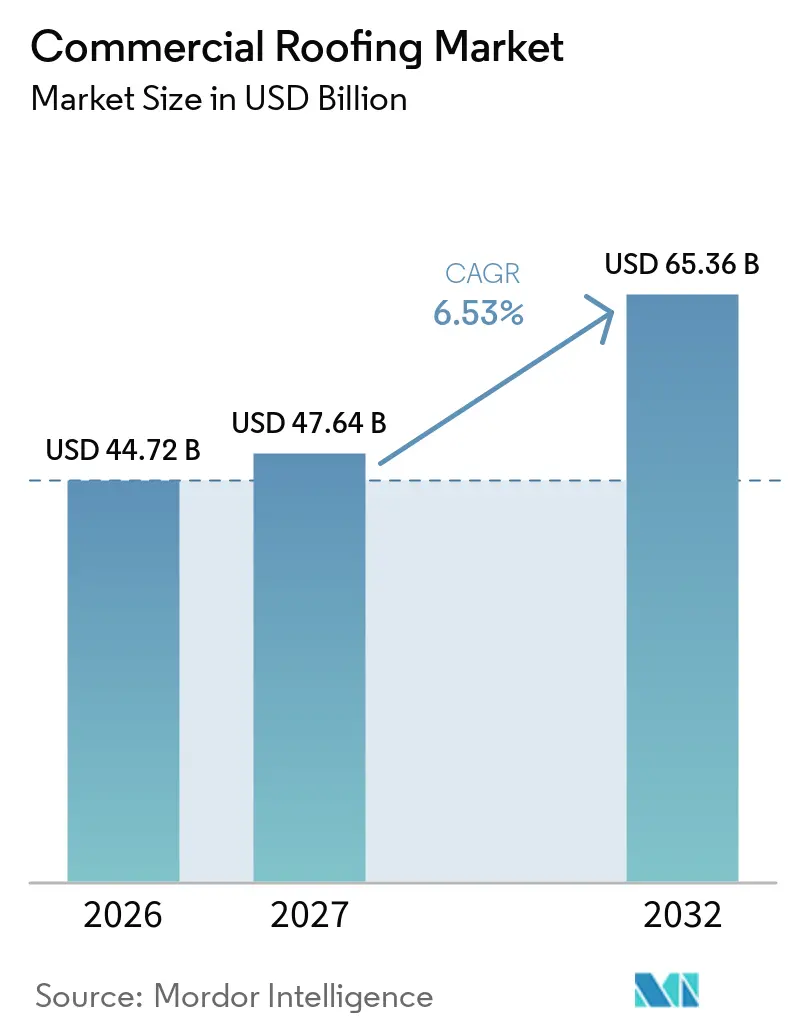
| Market Size (2027) | USD 47.64 Billion |
| Market Size (2032) | USD 65.36 Billion |
| Growth Rate (2027 - 2032) | 6.53 % |
| Fastest Growing Market | North America |
| Largest Market | Asia-Pacific |
| Market Concentration | Medium |
Major Players *Disclaimer: Major Players sorted in no particular order Image © Mordor Intelligence. Reuse requires attribution under CC BY 4.0. | |
Commercial Roofing Market Analysis by Mordor Intelligence
The Commercial Roofing Market size is expected to increase from USD 44.72 billion in 2026 to USD 47.64 billion in 2027 and reach USD 65.36 billion by 2032, growing at a CAGR of 6.53% over 2027-2032.
Replacement demand gives the commercial roofing market a more stable base than many construction categories because owners must protect occupied assets and maintain roof performance. Reroofing demand is reinforced by insurance, lender, and tenant requirements, which can continue even when financing conditions weaken. Growth in logistics facilities and data centers is also increasing the need for large, low-slope roof systems. Energy codes and rooftop solar requirements are shifting specifications toward reflective, durable roof assemblies. These conditions favor suppliers that can provide complete systems, trained installers, and reliable product support.
Key Report Takeaways
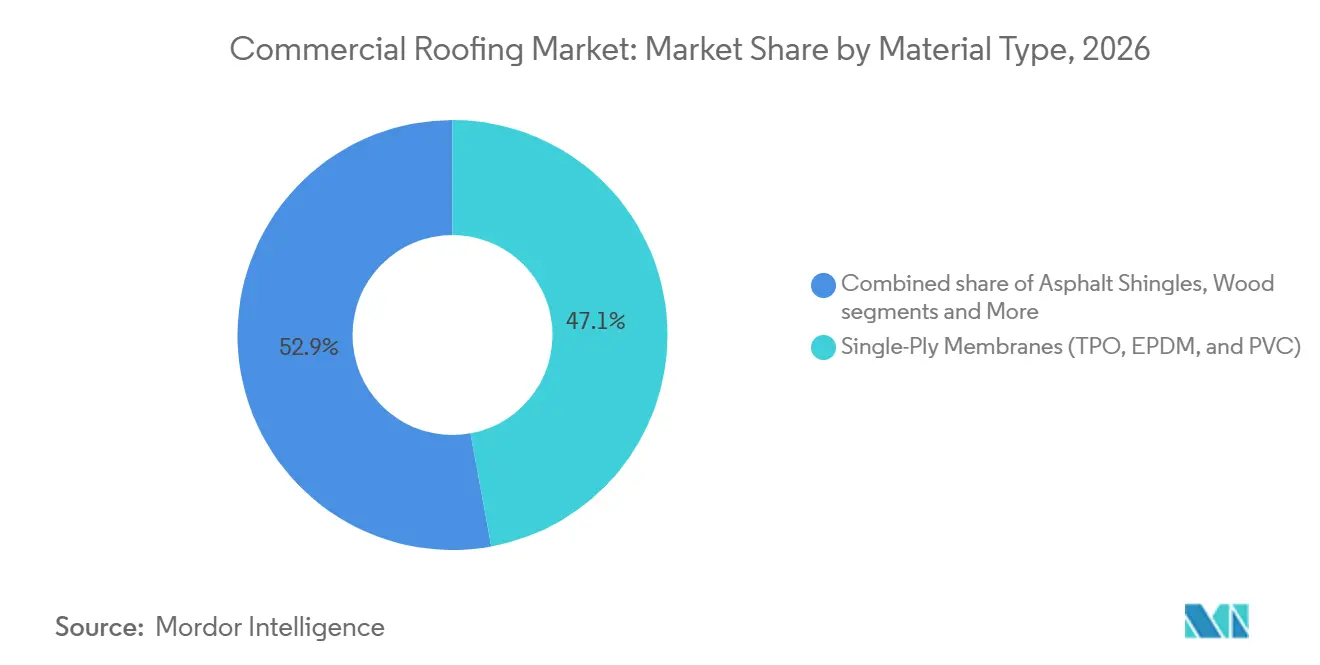
- By material type, single-ply membranes held 47.12% of the commercial roofing market share in 2026, while other material are forecast to grow at a 7.14% CAGR through 2032.
- By construction type, new construction held a 65.00% share in 2026, while reroofing and replacement are forecast to grow at a 7.55% CAGR through 2032.
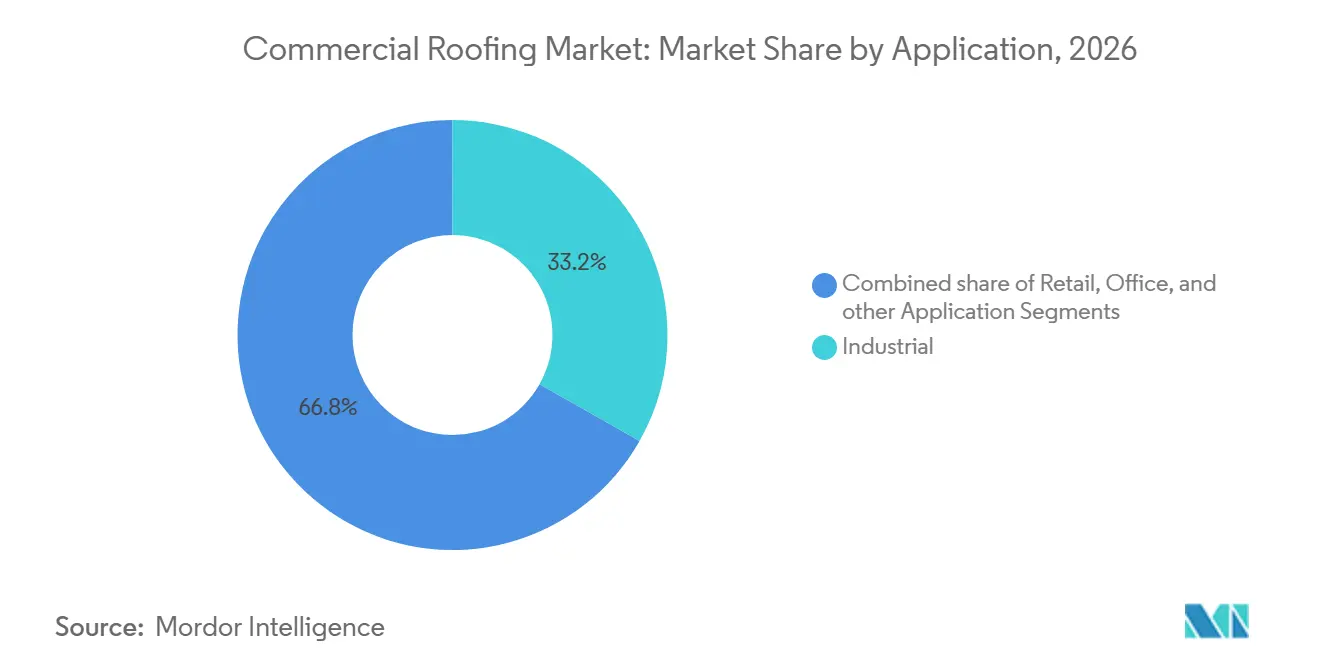
- By application, the industrial category held a 33.2% share in 2026 and is forecast to grow at an 8.10% CAGR through 2032.
- By geography, North America held 34.76% of the commercial roofing market share in 2026, while Asia-Pacific is forecast to grow at a 7.69% CAGR through 2032.
Note: Market numbers in this report are based on Mordor Intelligence's proprietary estimation framework, which combines nine months of actuals with Q4 projections for base year 2026.
Global Commercial Roofing Market Trends and Insights
Drivers Impact Analysis*
| Drivers | (~) % Impact on CAGR Forecast | Geographic Relevance | Impact Timeline |
|---|---|---|---|
| Data-Center and Logistics-Facility Expansion | +1.4% | North America, Asia-Pacific core, spill-over to Middle East and Africa | Short term (≤ 2 years) |
| Aging Commercial Building Stock and Reroofing Cycles | +1.2% | North America and Europe, spill-over to Asia-Pacific | Medium term (2-4 years) |
| Energy Codes, Cool Roofs, and Building Performance Targets | +1.1% | North America and Europe, spill-over to Asia-Pacific | Medium term (2-4 years) |
| Severe-Weather Resilience and Insurance Requirements | +0.9% | North America, Asia-Pacific coastal markets, Middle East and Africa | Short term (≤ 2 years) |
| Predictive Roof Inspection and Preventive Maintenance Adoption | +0.7% | Global, led by North America | Long term (≥ 4 years) |
| Under-Roof Solar, Green Roof, and Electrification Readiness | +0.6% | Europe, Asia-Pacific, and North America | Long term (≥ 4 years) |
| Source: Mordor Intelligence | |||
Data-Center and Logistics-Facility Expansion
Data centers and logistics facilities are generating concentrated new-build demand for the commercial roofing market. Their wide-span buildings typically use low-slope assemblies that are suited to single-ply membranes. Prologis said that it planned USD 4 billion to USD 5 billion of development starts in 2026, with 40% directed toward data centers. Related manufacturers and power infrastructure suppliers may also require nearby logistics space, extending the construction effect beyond the data center itself. These projects favor commercial roofing market materials that can address large roof areas, mechanical loads, and demanding warranty requirements. The resulting specifications can strengthen demand for thermoplastic polyolefin and polyvinyl chloride membrane systems within the commercial roofing market.
Aging Commercial Building Stock and Reroofing Cycles
Reroofing demand supports the commercial roofing market because replacement work is often necessary rather than optional. Owners of occupied properties must maintain waterproofing, meet insurance requirements, and protect tenant operations. Carlisle stated that reroofing represented 70% of its commercial roofing activity in its 2025 results, which helped stabilize demand while new construction softened[1]. Reroofing projects can generate more revenue per square foot because they may require tear-off work, disposal, insulation improvements, and phased work around active operations. Wienerberger also identified renovation activity in France and Germany as a support for roofing performance in 2025[2]. This replacement cycle gives established suppliers a reason to prioritize long warranties, contractor relationships, and retrofit-ready systems.
Energy Codes, Cool Roofs, and Building Performance Targets
Energy requirements are making reflective roof systems a more important part of the commercial roofing market. California’s 2025 Title 24 Energy Code took effect on January 1, 2026, and requires qualifying new nonresidential low-slope roofs to meet an aged Solar Reflectance Index of 75[3]. These requirements favor assemblies in the commercial roofing market that can meet reflectance standards without compromising waterproofing performance. The National Renewable Energy Laboratory has documented that building performance standards place recurring energy targets on existing buildings. Roof replacement can therefore become part of a broader efficiency upgrade. European requirements for solar-ready buildings further increase the importance of roof assemblies that can support photovoltaic equipment.
Severe-Weather Resilience and Insurance Requirements
Severe weather exposure is creating a more urgent replacement trigger for parts of the commercial roofing market. Wind and hail loss experience can lead insurers to apply tighter roof conditions at renewal. This may bring forward replacement decisions that owners would otherwise postpone. Class-rated roof systems can become important where impact resistance affects coverage terms and property risk management. Manufacturers benefit when they can pair durable materials with tested system configurations and approved installer networks. This driver is especially relevant in regions where hail, wind, or severe storms are part of routine commercial property planning.
Restraints Impact Analysis*
| Restraints | (~) % Impact on CAGR Forecast | Geographic Relevance | Impact Timeline |
|---|---|---|---|
| Volatile Prices for Polymers, Bitumen, Metals, and Insulation | -1.3% | Global | Short term (≤ 2 years) |
| Skilled Installer Shortages and Certification Bottlenecks | -1.0% | North America and Europe | Medium term (2-4 years) |
| Roofing Waste, Tear-Off Disposal, and Limited Recycling Capacity | -0.6% | North America and Europe | Long term (≥ 4 years) |
| Operational Disruption and Compliance Risk During Occupied-Building Projects | -0.5% | Global | Medium term (2-4 years) |
| Source: Mordor Intelligence | |||
Volatile Prices for Polymers, Bitumen, Metals, and Insulation
Material cost volatility remains a near-term constraint on the commercial roofing market. Polypropylene, polyvinyl chloride resin, bitumen, ethylene propylene diene monomer rubber, metals, and insulation can affect membrane and system costs. Volatility is difficult for smaller contractors that commit to fixed-price work before installation begins. Supplier qualification requirements can also lengthen lead times for reinforcement materials during active construction periods. Larger producers can be better positioned to manage risk through scale, purchasing discipline, and broader product portfolios. These conditions can pressure project margins without eliminating the underlying need for roof replacement.
Skilled Installer Shortages and Certification Bottlenecks
Installer availability constrains how quickly the commercial roofing market can convert demand into completed projects. The Bureau of Labor Statistics reported a 4.6% job-opening rate for the U.S. construction sector in April 2026. Commercial membrane installation requires trained crews that can meet product, warranty, and code requirements. Labor costs rose in 2025, which increased pressure on project budgets and contractor capacity. Certification requirements can slow throughput even when a contractor has added staff. Manufacturers with training programs and stable contractor networks are better placed to manage this constraint.
*Our forecasts treat driver/restraint impacts as directional, not additive. The impact forecasts reflect baseline growth, mix effects, and variable interactions.
Segment Analysis
By Material Type: Single-Ply Systems Define Commercial Specifications
Single-ply membranes held a 47.12% share in 2026, making them the largest material category. Thermoplastic polyolefin, ethylene propylene diene monomer, and polyvinyl chloride are included in this category. Their use reflects the need for standardized installation, reflectance performance, and warranty support. Polyvinyl chloride is forecast to grow at a 7.14% CAGR through 2032, the fastest rate among the material subcategories. Its chemical resistance can be useful in industrial settings with HVAC exhausts and process-related exposure. China’s GB 55030 waterproofing standard supports the shift toward higher-performance membrane specifications. Thermoplastic polyolefin maintains broad contractor acceptance, while ethylene propylene diene monomer remains relevant in cold climates and locations with hail exposure.
Bituminous and modified bitumen systems retain an important installed base in Europe. The German roofing membrane association reported that plastic and elastomer membrane share on flat roofs increased from 37% to 39% in 2025. This movement shows how reflective and higher-performance systems are gradually taking share from older flat-roof approaches. Metal roofing remains relevant for long-span industrial and logistics buildings because structural performance, recyclability, and long life can justify a higher initial cost. Asphalt shingles, clay tiles, concrete tiles, and wood mainly serve steep-slope or architectural commercial projects. ISO 9001 quality management and ENERGY STAR cool roof certification are commonly used by specifiers when qualifying membrane suppliers.

By Construction Type: Reroofing Momentum Grows Against New Build’s Lead
New construction accounted for 65.00% of the commercial roofing market size in 2026, supported by industrial, logistics, data center, and mixed-use development. New projects often allow faster installation because site access is less restricted. Reroofing and replacement are forecast to grow at a 7.55% CAGR through 2032, ahead of new construction. This reflects aging roof systems and the need to upgrade insulation or reflective surfaces during replacement. A reroofed distribution center can require tear-off, disposal, insulation improvements, and phased work. Those requirements can raise installed revenue per square foot. Carlisle’s 2025 results identified reroofing as the main part of its commercial roofing activity.
Building performance standards support retrofit work by setting energy goals for existing commercial properties. A roof upgrade can be a practical route to meeting those requirements because it can combine insulation and reflective-surface improvements. Storm damage and insurance inspections can also create replacement demand outside the normal capital planning cycle. In Europe, energy performance requirements encourage owners to consider roof improvements during renovation. New construction will remain important for large industrial projects, but reroofing offers a more stable source of activity when development slows. This split means the commercial roofing industry needs both new-build specifications and retrofit capabilities. It also favors suppliers that can support occupied-building projects without disrupting operations.
By Application: Industrial Demand Reshapes Contract Composition
The industrial category held a market share of 33.2% of the commercial roofing market size in 2026, and its leading position reflects the range of industrial assets that require ongoing roof maintenance and replacement. Industrial applications are forecast to grow at an 8.10% CAGR through 2032. Warehouses, manufacturing sites, and data centers often need wide-span, low-slope roof systems. These buildings can also carry heavier mechanical and power infrastructure loads that require engineered assemblies. The commercial roofing market is therefore increasingly tied to industrial construction budgets and technology-related investment. Product performance and installation speed are central to these projects.
Retail and office demand is more closely tied to building repositioning and refurbishment. Retail centers may require roof upgrades as owners adapt layouts and improve older properties. Office demand can come from the modernization of Class B and Class C space and fit-outs in stronger urban locations. Sika introduced the GRO Vista Modular Tray vegetated roof system in 2025 for projects requiring stormwater management and longer roof-life performance. The product illustrates the role of roof systems in office and mixed-use renovation decisions. Industrial demand has a stronger growth premium because more current construction capital is being directed to logistics, manufacturing, and data infrastructure. This difference will shape where suppliers allocate contractor training and product development resources.
Geography Analysis
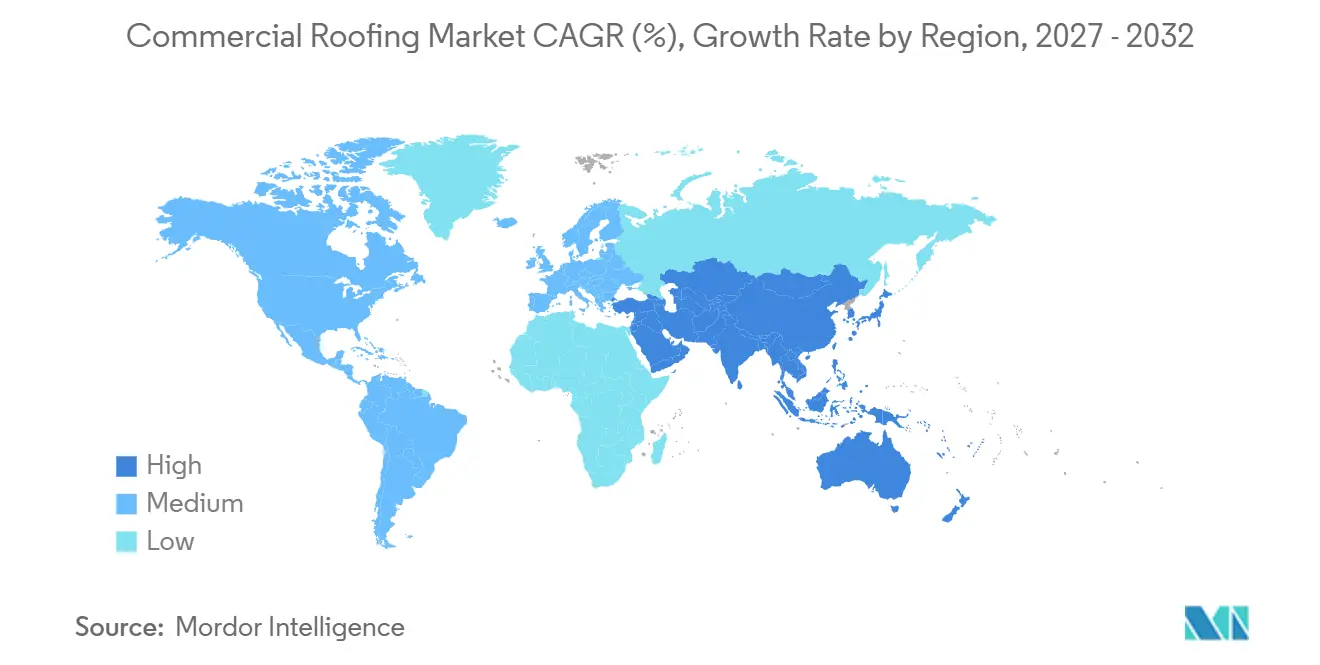
North America held a 34.76% share in 2026, the largest regional position. The region has a large base of aging flat roofs and a well-developed manufacturer and contractor network. Established producers include GAF Materials, Carlisle Companies, IKO Industries, Atlas Roofing, TAMKO Building Products, and Duro-Last. National distribution and certified contractor programs support consistent specifications and system warranties. California’s current energy code supports greater use of high-reflectance assemblies for qualifying nonresidential low-slope roofs. Insurance-related replacement demand also adds a source of activity that is less dependent on real estate investment conditions.
Asia-Pacific is forecast to record a 7.69% CAGR through 2032, the fastest regional rate in the commercial roofing market. India is supported by industrial development, urban expansion, and more formal specifications for commercial construction. Solar-related building requirements raise the value of waterproofing systems that can support photovoltaic installations. China remains a large regional market by volume, with industrial and logistics construction sustaining demand for membrane systems. The GB 55030 standard supports higher-performance waterproofing requirements in commercial construction. Japan and South Korea have renovation-driven demand, while Vietnam, Malaysia, and Indonesia are seeing more engineered specifications at foreign-invested industrial sites.
Europe, South America, and the Middle East and Africa have distinct demand patterns within the commercial roofing market. Germany’s roofing membrane volume fell 5.3% to 132.4 million m² in 2025, although plastic and elastomer membranes recorded positive growth. European solar and energy requirements should continue to support flat-roof upgrades. Brazil and Chile lead South American demand through logistics, retail, mining infrastructure, and commercial property investment. The United Arab Emirates and Saudi Arabia support premium roof specifications through major hospitality and commercial projects. Nigeria and South Africa offer longer-cycle opportunities through retail, healthcare, and institutional construction.
Competitive Landscape
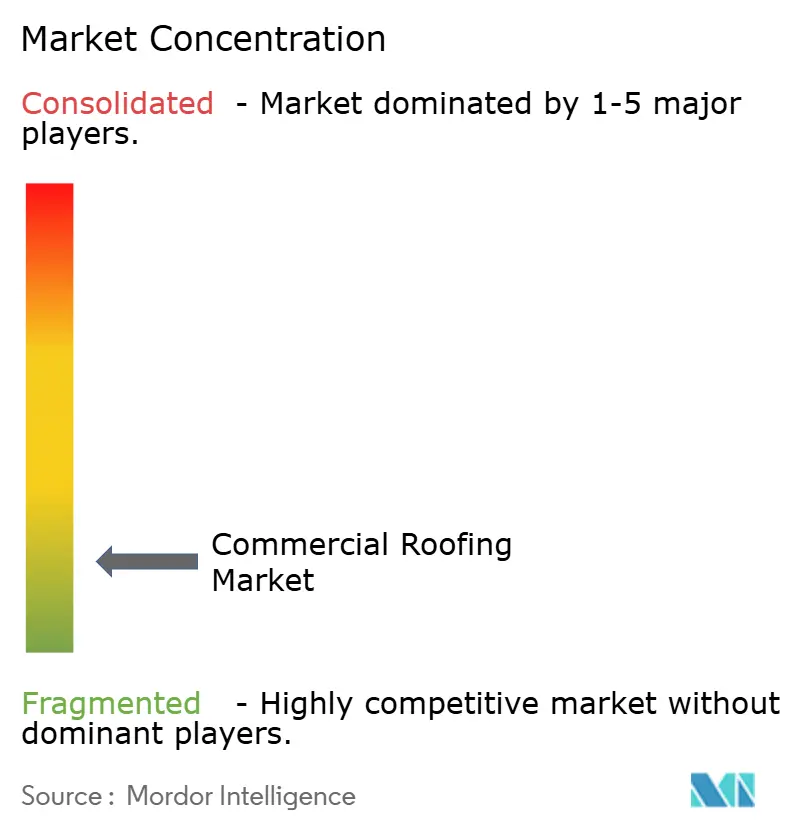
The commercial roofing market is moderately fragmented among manufacturers and more fragmented among contractors. Competition centers on product performance, warranty strength, distribution reach, and the depth of contractor relationships. Leading suppliers increasingly sell integrated systems that combine membrane, insulation, adhesive, fasteners, and drainage. This approach can make installation simpler and create a single warranty structure for owners. Owens Corning reported a 32% adjusted EBITDA margin for its roofing business in 2025, showing the value of brand and product mix in the category. The commercial roofing industry therefore rewards suppliers that combine material capability with dependable field support.
Capacity investment remains an important competitive response in the commercial roofing market. IKO opened its Clay Hill manufacturing campus in Florida in June 2026, a USD 240 million investment across 3 production lines and a 300,000-square-foot site. IKO also expanded its metal roofing capability through its Ennis, Texas plant, which opened in July 2025. Wienerberger strengthened its in-roof photovoltaic position by increasing its stake in GSEi in France in 2025. These moves show that suppliers are investing in capacity and adjacent roof-energy offerings rather than competing only on basic material supply.
Technology and sustainability are creating further distinctions in the commercial roofing market. Condition-monitoring platforms can help manufacturers extend their role from installation to maintenance planning. Gecko Robotics and NAES introduced StratoSight in 2025 for large roof assessments, showing the growing interest in technology-enabled inspection. Rooftop photovoltaic integration, vegetated systems, and membrane recycling programs are additional areas of competition. ISO 9001 quality practices and ENERGY STAR cool roof certification can act as qualification requirements in institutional and corporate projects. The competitive structure remains dispersed, but scale and integrated offerings can create an advantage in large specification-led contracts.
Commercial Roofing Industry Leaders
-
Standard Industries
-
BMI Group
-
Owens Corning
-
Holcim
-
Carlisle Companies
- *Disclaimer: Major Players sorted in no particular order
Recent Industry Developments
- July 2026: IKO Industries opened 2 fiberglass and glass-mat manufacturing facilities in Chester County, South Carolina, completing a USD 500 million North American investment program that strengthens the company’s vertically integrated shingle production capabilities.
- June 2026: IKO Industries celebrated the grand opening of its Clay Hill manufacturing campus in Clay County, Florida, a USD 240 million investment across 3 production lines and a 300,000-square-foot campus.
- January 2026: IKO Industries announced the upcoming launch of 2 manufacturing plants in Chester, South Carolina, and its Clay Hill, Florida campus, completing a multi-year expansion program exceeding USD 500 million in North American manufacturing investment.
Global Commercial Roofing Market Report Scope
| Asphalt Shingles |
| Clay & Concrete Tiles |
| Metal Roofing |
| Bituminous / Modified Bitumen Membranes |
| Single-Ply Membranes (TPO, EPDM, and PVC) |
| Wood |
| Others |
| New Construction |
| Reroofing and Replacement |
| Retail |
| Office |
| Industrial |
| Others |
| North America | United States |
| Canada | |
| Mexico | |
| Europe | Germany |
| United Kingdom | |
| France | |
| Italy | |
| Spain | |
| Rest of Europe | |
| Asia-Pacific | China |
| India | |
| Japan | |
| South Korea | |
| Australia | |
| Rest of Asia-Pacific | |
| South America | Brazil |
| Argentina | |
| Chile | |
| Rest of South America | |
| Middle East & Africa | United Arab Emirates |
| Saudi Arabia | |
| South Africa | |
| Nigeria | |
| Rest of Middle East & Africa |
| By Material Type | Asphalt Shingles | |
| Clay & Concrete Tiles | ||
| Metal Roofing | ||
| Bituminous / Modified Bitumen Membranes | ||
| Single-Ply Membranes (TPO, EPDM, and PVC) | ||
| Wood | ||
| Others | ||
| By Construction Type | New Construction | |
| Reroofing and Replacement | ||
| By Application | Retail | |
| Office | ||
| Industrial | ||
| Others | ||
| By Region | North America | United States |
| Canada | ||
| Mexico | ||
| Europe | Germany | |
| United Kingdom | ||
| France | ||
| Italy | ||
| Spain | ||
| Rest of Europe | ||
| Asia-Pacific | China | |
| India | ||
| Japan | ||
| South Korea | ||
| Australia | ||
| Rest of Asia-Pacific | ||
| South America | Brazil | |
| Argentina | ||
| Chile | ||
| Rest of South America | ||
| Middle East & Africa | United Arab Emirates | |
| Saudi Arabia | ||
| South Africa | ||
| Nigeria | ||
| Rest of Middle East & Africa | ||
Key Questions Answered in the Report
What is driving commercial roofing demand through 2032?
Replacement needs, energy codes, data center construction, logistics facilities, and insurance-related upgrades support demand through 2032.
Which commercial roof material is largest in 2026?
Single-ply membranes are the largest material group, holding a 47.12% share in 2026.
Which commercial roof material is growing fastest?
Single-Ply membranes are forecast to grow at a 7.14% CAGR through 2032.
Is reroofing growing faster than new commercial roof construction?
Yes. Reroofing and replacement are forecast to grow at a 7.55% CAGR through 2032, while new construction remained the largest construction type in 2026.
Which application is growing fastest for commercial roof systems?
Industrial applications are forecast to grow at an 8.10% CAGR through 2032, supported by logistics, manufacturing, and data center projects.
Which region is growing fastest for commercial roof systems?
Asia-Pacific is forecast to grow at a 7.69% CAGR through 2032.