
Commercial Heat Pump Market Size and Share
Market Overview
| Study Period | 2021 - 2032 |
|---|---|
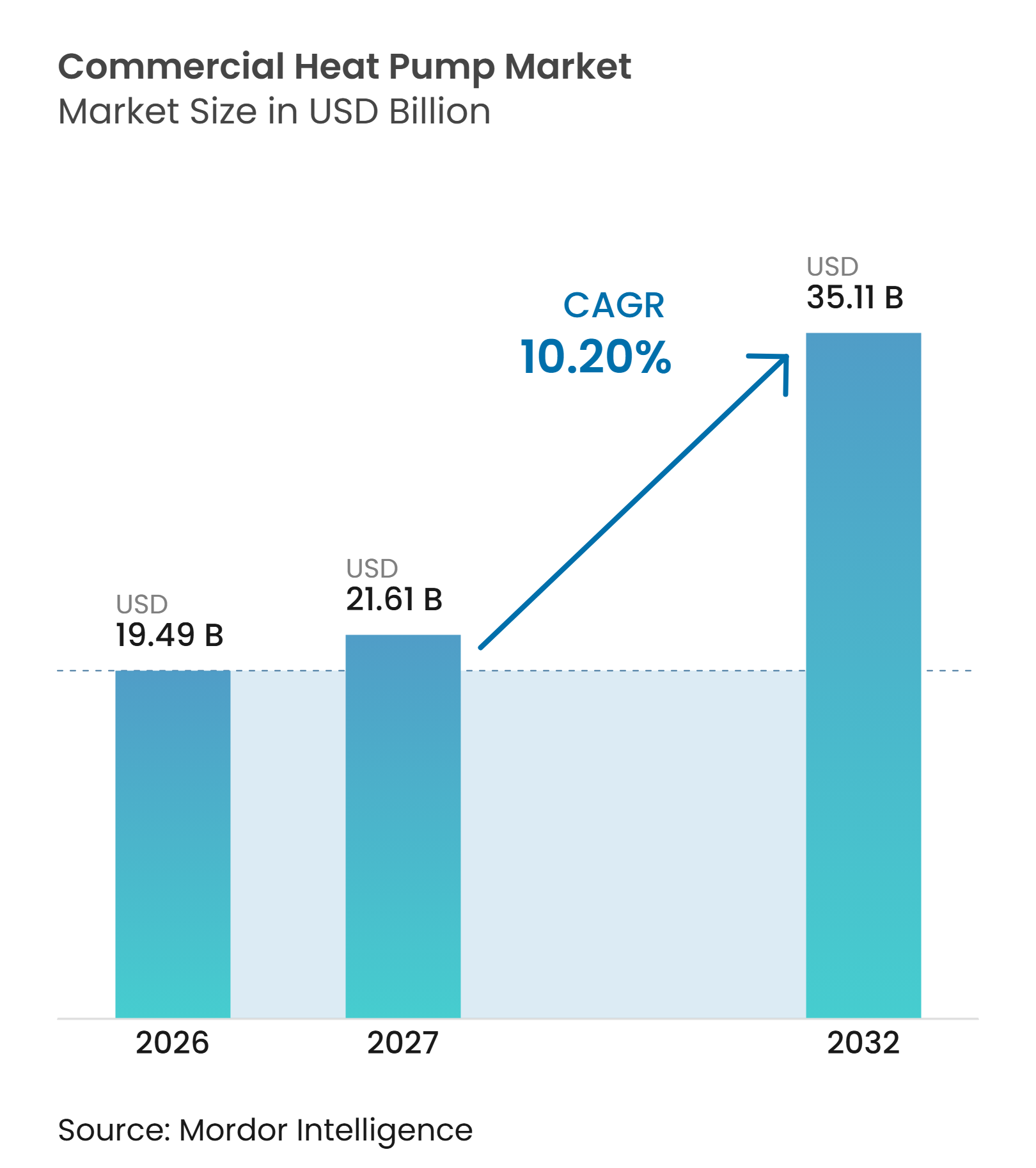
| Market Size (2027) | USD 21.61 Billion |
| Market Size (2032) | USD 35.11 Billion |
| Growth Rate (2027 - 2032) | 10.20 % |
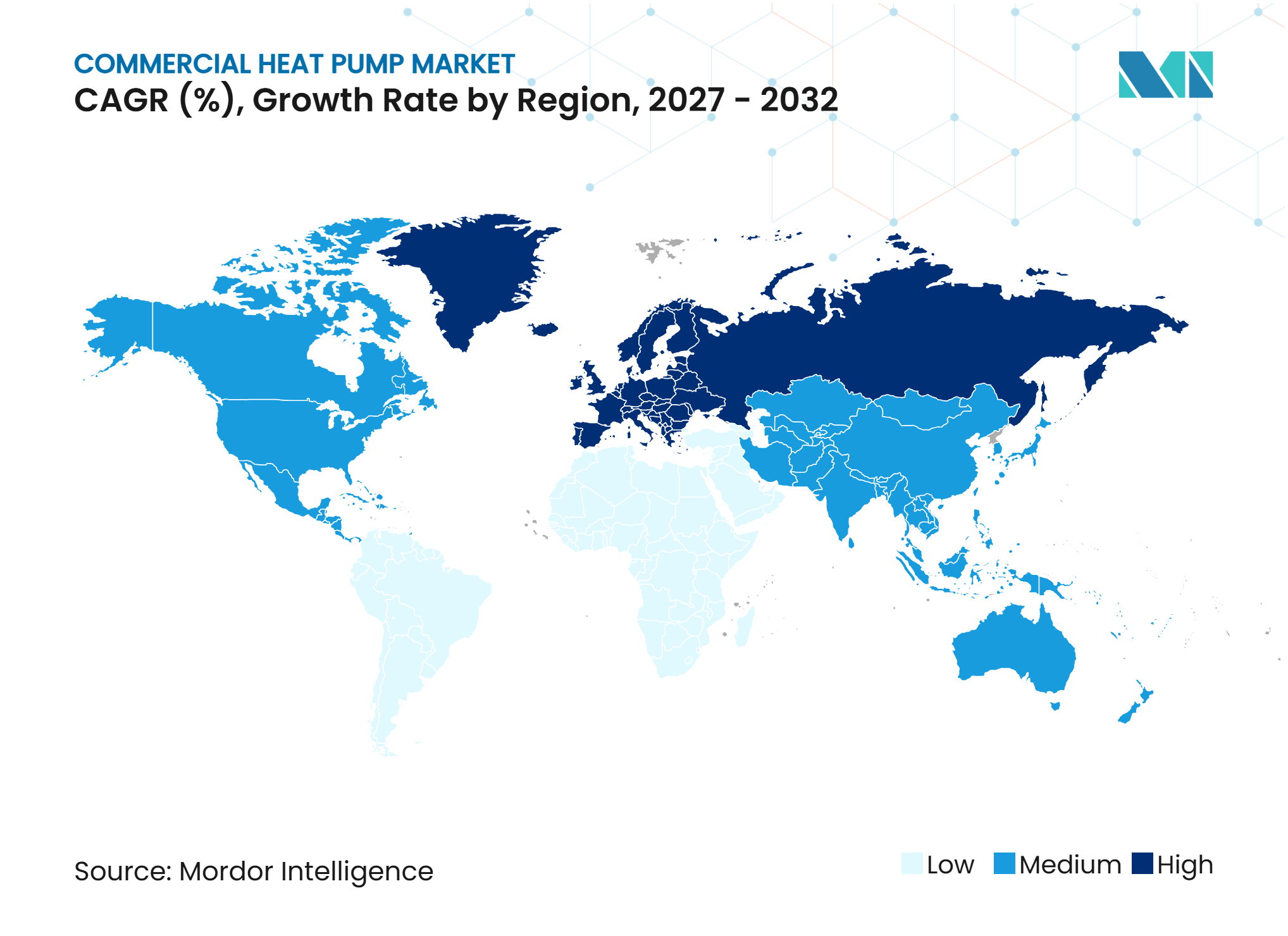
| Fastest Growing Market | Europe |
| Largest Market | Asia-Pacific |
| Market Concentration | Medium |
Major Players *Disclaimer: Major Players sorted in no particular order Image © Mordor Intelligence. Reuse requires attribution under CC BY 4.0. | |
Commercial Heat Pump Market Analysis by Mordor Intelligence
The Commercial Heat Pump Market size was valued at USD 19.49 billion in 2026 and is estimated to grow from USD 21.61 billion in 2027 to reach USD 35.11 billion by 2032, at a CAGR of 10.20% during the forecast period (2027-2032).
The commercial heat pump market is moving beyond an incentive-led adoption cycle as boiler replacement requirements, energy price considerations, and tenant environmental requirements affect procurement decisions across offices, hotels, campuses, retail properties, and light-industrial sites. Commercial property owners are increasingly assessing electrified heating alongside cooling and hot water needs rather than as a stand-alone equipment decision, particularly where year-round demand creates an opportunity to recover heat that would otherwise be wasted. Compliance requirements in major economies are reinforcing replacement activity in existing buildings, while industrial users are expanding demand for lower-temperature process heat solutions that can replace fossil-fuel equipment without changing the end use of the heat. Manufacturers in the commercial heat pump market are responding with high-temperature equipment, modular configurations, and refrigerant platforms that can meet tighter requirements while fitting the piping, space limitations, and staged investment plans of existing commercial properties. Project timing remains a practical constraint because grid upgrades, hydronic redesign, permitting, and the availability of qualified engineers can delay installations even when owners have identified clear operating-cost or compliance benefits.
Key Report Takeaways
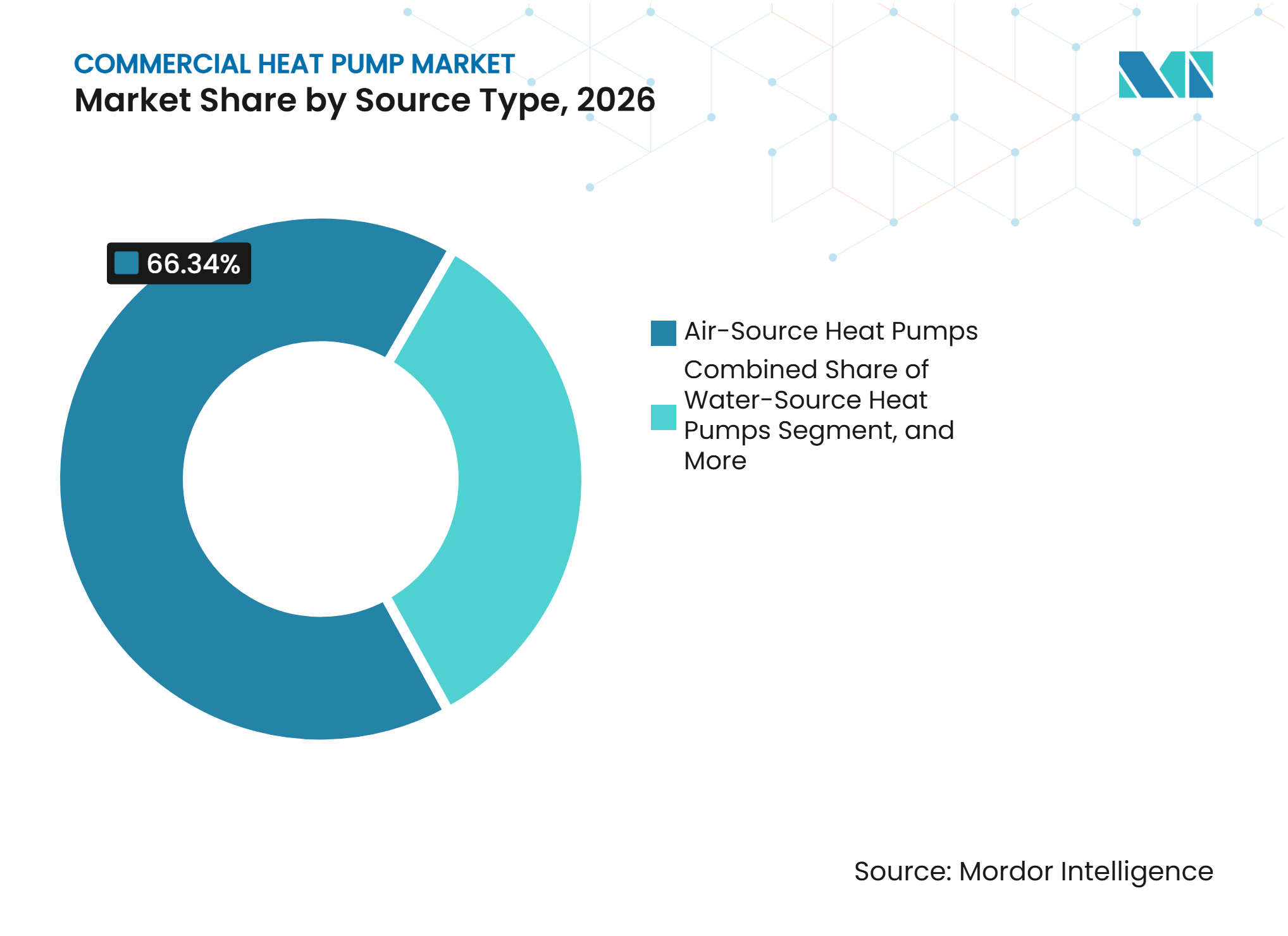
- By source type, air-source heat pumps held 66.34% of the commercial heat pump market share in 2026, while heat-recovery heat pumps are projected to expand at an 11.01% CAGR through 2032.
- By rated capacity, the 20-50 kW range accounted for 34.29% of the commercial heat pump market size in 2026, while the above 100 kW range is expected to expand at a 10.87% CAGR through 2032.
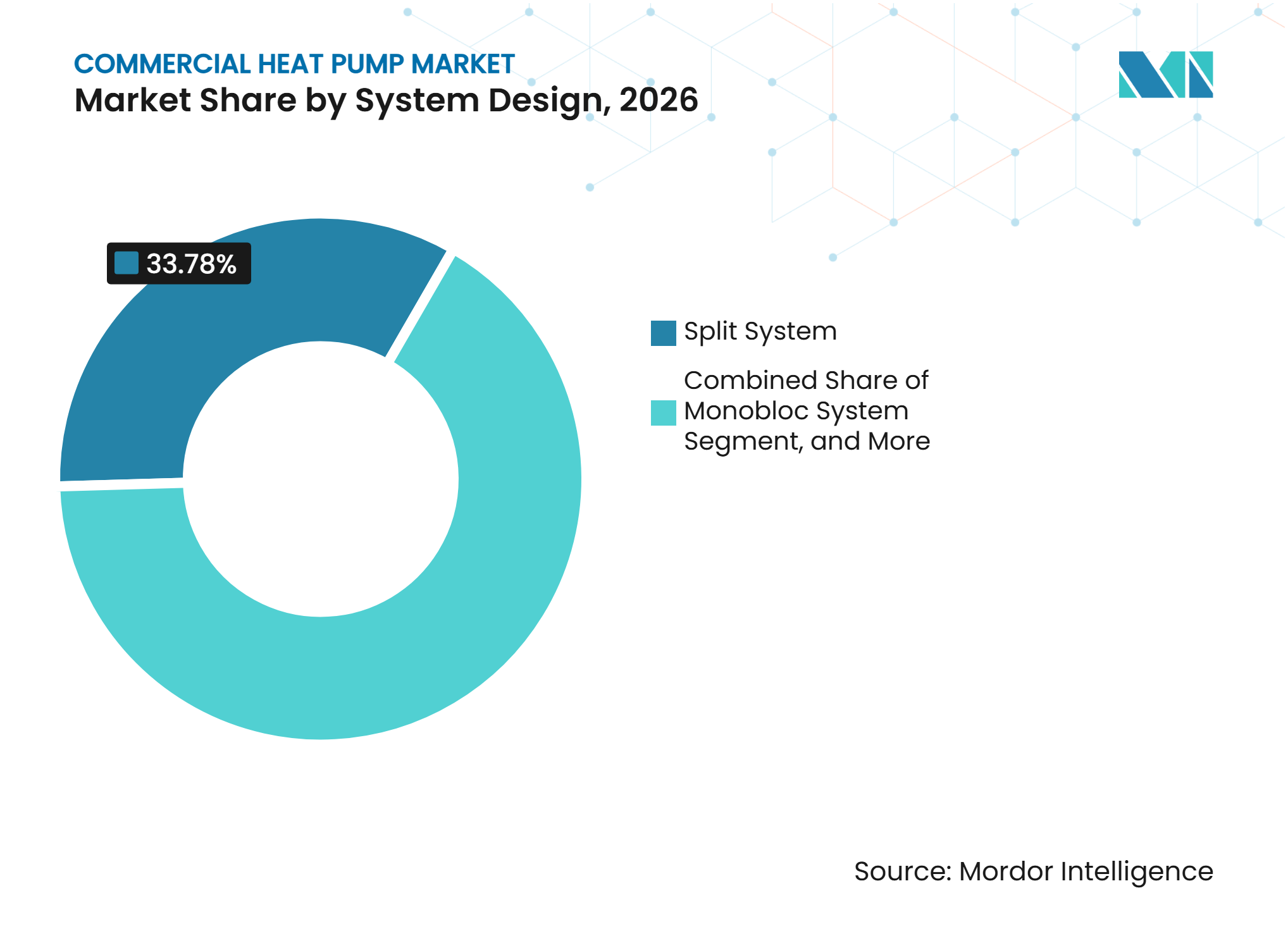
- By system design, split systems held a 33.78% share in 2026, while modular cascade systems are projected to expand at an 11.12% CAGR through 2032.
- By application, combined heating and cooling accounted for a 29.46% share in 2026, while process and industrial heating is expected to expand at an 11.38% CAGR through 2032.
- By geography, Asia-Pacific held a 41.18% share in 2026, while Europe is projected to expand at an 11.14% CAGR through 2032.
Note: Market numbers in this report are based on Mordor Intelligence's proprietary estimation framework, which combines nine months of actuals with Q4 projections for base year 2026.
Market Trends and Insights
Drivers Impact Analysis of Commercial Heat Pump Market*
| Driver | (~) % Impact on CAGR Forecast | Geographic Relevance | Impact Timeline |
|---|---|---|---|
| Building Electrification and Fossil-Fuel Boiler Replacement | +2.8% | Global, leading intensity in the EU, UK, and China | Short term (≤ 2 years) |
| Commercial Building Energy-Performance Standards | +2.2% | North America and the EU, with spillover to Asia-Pacific | Medium term (2-4 years) |
| Demand for Integrated Heating, Cooling and Hot Water | +1.6% | Global, strongest in Asia-Pacific and the Middle East | Medium term (2-4 years) |
| Decarbonization of Low- and Medium-Temperature Process Heat | +1.4% | Industrial centers in the EU, Japan, and China | Long term (≥ 4 years) |
| Heat-Pump Modularity for Phased Retrofit Projects | +1.0% | North America and the EU, with spillover to South America | Medium term (2-4 years) |
| Waste-Heat Recovery from Commercial and Light-Industrial Sites | +0.6% | The EU and East Asia, with early gains in Nordic markets | Long term (≥ 4 years) |
| Source: Mordor Intelligence | |||
Building Electrification and Fossil-Fuel Boiler Replacement
National policies are changing the commercial heat pump market from an incentive-led cycle into a replacement pipeline shaped by compliance requirements. The recast Energy Performance of Buildings Directive requires EU member states to stop financial incentives for stand-alone fossil-fuel boilers from 2025, which changes the commercial investment case for replacement heating equipment. It also establishes a pathway to phase out fossil-fuel heating from the building stock by 2040, giving owners and equipment suppliers a longer planning horizon for capital allocation and product development. New buildings must meet zero-emission standards from 2030 under the directive, increasing the relevance of electrified solutions during early design and specification decisions. Germany recorded 299,000 heat pump sales in 2025, a 55% increase from 2024, and heat pumps represented 48% of heating systems sold. Building modernization accounted for 81% of those installations, which indicates that replacement demand is central to current adoption.
Commercial Building Energy-Performance Standards
For the commercial heat pump market, energy codes for non-residential buildings are increasingly linked to minimum performance requirements and financial consequences, which makes efficiency performance part of asset risk management as well as energy planning. The U.S. Department of Energy issued updated conservation standards for commercial package air conditioners and heat pumps in May 2024. Compliance with the higher IVEC and IVHE efficiency thresholds is required from January 1, 2029. Trane Technologies completed the 55 Water Street retrofit in New York City in September 2025, using a heat-recovery system at the 3.8 million sq ft office building. The project reported USD 1.5 million in annual utility savings and a 72% reduction in steam use. It also reported USD 1.2 million in annual Local Law 97 fines avoided and USD 14.5 million in utility rebates and federal tax credits.
Demand for Integrated Heating, Cooling and Hot Water
In the commercial heat pump market, integrated systems can replace separate gas heating, electric cooling, and domestic hot water equipment with a single electrically powered installation. This design is relevant to hospitality, healthcare, and mixed-use properties because their operating patterns can support simultaneous heat recovery across different zones and times of day. Seasonal load diversity can improve compressor efficiency at the system level. China issued a national action plan in April 2025 that promotes heat pump water heaters in schools, hospitals, hotels, and offices.[1] The plan targets a 20% improvement in key heat pump product efficiency levels by 2030. Heat pumps in Europe, China, and Japan collectively saved 53 bcm of natural gas in 2025, indicating the scale of gas displacement associated with wider deployment.
Decarbonization of Low- and Medium-Temperature Process Heat
Industrial operators face greater pressure to electrify process heat below 200°C, which broadens the commercial heat pump market beyond building applications. This temperature range represents 37% of Europe’s industrial final energy demand for process heating, or 722 TWh. High-temperature heat pumps can use on-site waste heat and support applications that previously depended on fossil-fuel boilers. A 2025 peer-reviewed study found that these systems can deliver levelized heat costs 30-60% lower than hydrogen boilers and up to 37% lower than biomass boilers under 2030 assumptions. Daily thermal storage reduced modeled costs by up to 15% in the same analysis.
Restraints Impact Analysis of Commercial Heat Pump Market*
| Restraint | (~) % Impact on CAGR Forecast | Geographic Relevance | Impact Timeline |
|---|---|---|---|
| High Upfront Installation and Electrical-Upgrade Costs | -1.8% | Global, most acute in North America and Southern Europe | Short term (≤ 2 years) |
| Shortage of Qualified Commercial Heat-Pump Installers | -1.4% | The UK, Germany, North America, and emerging Asia-Pacific markets | Medium term (2-4 years) |
| Hydronic-System Redesign and Commissioning Complexity | -0.9% | Europe’s retrofit-heavy markets and North America | Medium term (2-4 years) |
| Refrigerant Charge, Fire-Safety and Permitting Constraints | -0.5% | Global, heightened in dense urban markets | Long term (≥ 4 years) |
| Source: Mordor Intelligence | |||
High Upfront Installation and Electrical-Upgrade Costs
Total project costs extend beyond the equipment price. Electrical service upgrades, commissioning, hydronic rework, controls integration, and tenant disruption can collectively match hardware costs. These expenses can challenge conventional capital cycles in commercial real estate. High upfront installation and electrical-upgrade costs remain a material adoption barrier for commercial and industrial electrification projects. The issue is particularly relevant where electricity rates are high and full natural-gas displacement is not feasible within the initial project scope. Germany’s July 2026 change to the heating replacement rule created additional policy uncertainty, and BWP indicated that adjusted grant commitments could materially affect demand.
Shortage of Qualified Commercial Heat-Pump Installers
Commercial installations require refrigeration engineers who can complete hydronic commissioning, building management system integration, and large-charge refrigerant work. General HVAC training routes do not consistently provide this combination of skills. The Institute of Refrigeration identified 4,000-7,000 live vacancies in the UK RACHP sector during 2026. Its report found that 59% of employers had greater difficulty recruiting technical staff and 73% expected demand to rise over the following 2-3 years.[2] The most significant gaps concerned natural refrigerants, system integration, and heat pump commissioning. This shortage can delay large projects because the above 100 kW category requires more complex commissioning and longer payback validation.
*Our forecasts treat driver/restraint impacts as directional, not additive. The impact forecasts reflect baseline growth, mix effects, and variable interactions.
Commercial Heat Pump Market Segment Analysis
By Source Type:
Heat Recovery Reshapes the Installed BaseAir-source heat pumps held 66.34% of the commercial heat pump market share in 2026 because they offer lower installation costs than ground-source and water-source alternatives. Their broad climate suitability also supports deployment across varied building types. Inverter compressor improvements have reinforced their role in mainstream commercial applications. Ground-source and water-source systems serve large campuses, district energy networks, and high-humidity industrial sites. These systems can justify higher initial expenditure where stable ground-loop temperatures support predictable performance, longer operating hours, and a strong need to manage seasonal heating and cooling loads.
Heat-recovery heat pumps are projected to expand at an 11.01% CAGR from 2027 to 2032, the fastest rate within the source type category. Their role extends beyond space heating because they recover thermal energy from refrigeration circuits, server exhaust, and process streams. A 200 MW absorption heat pump installation in Qianxi, China, used waste heat from steel production and shows the scale possible in large commercial and industrial settings. Manufacturers are designing equipment around higher supply temperatures and lower-GWP refrigerants. These developments allow recovered heat to serve applications that need a stable and usable thermal output. They also place greater importance on engineering capability when systems must connect refrigeration, process, and building loads.



By Rated Capacity:
Large-Capacity Units Gain Structural ShareThe 20-50 kW category accounted for 34.29% of category revenue in 2026. It aligns with the installed footprint of smaller and medium-sized commercial buildings such as retail units, clinics, boutique hotels, and standalone office floors. The 50-100 kW category serves mid-rise properties and light-industrial sites, which are a core part of the commercial heat pump market. Below 20 kW equipment supports compact retail and food-service operations. These use cases make the 20-50 kW category a stable part of the commercial heat pump market and place a premium on compact equipment and manageable installation requirements.
Within the commercial heat pump market, the above 100 kW category is expected to expand at a 10.87% CAGR through 2032. Large portfolios and district heating investment in Northern Europe are supporting this movement, particularly where property owners can consolidate thermal demand across several buildings or public facilities. Larger systems can support campus-scale installations and building groups that need higher thermal output. Japan’s industrial heat pump installations reached 49,227 kW across 485 units in fiscal 2024, compared with 36,740 kW in fiscal 2023.[3] Water-source units averaged 280 kW per installation, supporting the shift toward larger commercial and industrial applications.
By System Design:
Modular Cascade Systems Lead Future SpecificationSplit systems held 33.78% of category revenue in 2026, supported by their established base in office and retail buildings. Monobloc systems offer a space-efficient option where plant room capacity is limited. Packaged rooftop systems remain common in North American commercial construction. Hybrid systems pair heat pumps with existing gas equipment where full boiler replacement cannot be completed in one capital phase. This range of designs allows owners to match installation decisions to space, budget, existing infrastructure, and the degree to which a project must maintain operations during construction and commissioning.
Modular cascade systems are projected to expand at an 11.12% CAGR from 2027 to 2032, the fastest rate for system design. They can address high-temperature hydronic retrofits while allowing staged capital deployment. Trane’s air-to-water cascade system can supply hot water at up to 210°F, or 99°C, at an ambient temperature of -15°F. This capability can allow building owners to retain existing piping and terminal coils. Modular configurations can also be scaled from 45 kW to 1,320 kW, giving retrofit projects a phased implementation route.

By Application:
Process Heating Becomes a Core Commercial VerticalCombined heating and cooling held 29.46% of category revenue in 2026. The application suits offices, hospitality properties, and retail premises that need simultaneous perimeter heating and internal cooling. Space heating remains a significant secondary use, especially in Northern Europe and Northeast Asia. District and campus heating is gaining traction as municipalities invest in lower-carbon energy networks that can connect larger heat sources, users, storage assets, and distribution infrastructure. Germany had 900 MW of district heating heat pump capacity under construction or in planning.
Process and industrial heating is expected to expand at an 11.38% CAGR through 2032. This category is drawing investment because equipment can serve a wider range of lower-temperature industrial loads. The European Heat Pump Association stated that industrial heat pumps are technically mature for supply temperatures up to 200°C. Research and development programs are targeting 300°C capability by 2035. Japan’s 7th Basic Energy Plan, adopted in February 2025, identified commercial and industrial heat pumps as a demand-side decarbonization priority.
Geography Analysis
Asia-Pacific: Structural Scale Underpins Demand Leadership
Asia-Pacific accounted for 41.18% of category revenue in 2026. China’s commercial construction activity, building electrification programs, and industrial manufacturing base support the region’s scale. The April 2025 national action plan promotes heat pump adoption in public commercial buildings, including schools, hospitals, hotels, and offices. Japan had cumulative industrial heat pump capacity of 601,861 kW at the end of fiscal 2024, with food and beverage applications leading installed volume. Government-aligned projections place Japan’s industrial heat pump stock at 16,506,000 kW by 2040 under a high-deployment carbon-neutral scenario.
Europe: Policy Intensity Supports the Fastest Expansion
Europe is projected to expand at an 11.14% commercial heat pump market CAGR from 2027 to 2032. The recast EPBD provides a legislated path away from fossil-fuel heating in the building stock by 2040, encouraging owners to review replacement cycles before existing boilers reach the end of their useful life. Germany sold 299,000 water-based heat pumps in 2025, representing 48% of heating systems sold. Federal BEG-EM grants committed EUR 5.4 billion (USD 5.94 billion) for 2025 approvals, while KfW Program 522 provided a 30% base subsidy for non-residential building upgrades. European suppliers are increasingly investing in lower-GWP refrigerant product platforms as compliance requirements tighten.
North America, South America, the Middle East, and Africa: Distinct Demand Profiles
North America is the second-largest commercial heat pump geography, and commercial heat pump market demand is shaped by building performance standards in New York, California, and Massachusetts, which can bring operating costs and compliance planning into replacement decisions. ISO New England’s draft 2026 forecast projects that more than 2.4 billion sq ft of commercial space heating will be electrified by 2050, while the end of U.S. IRA heat pump credits in 2025 can shift near-term demand toward lease-based deployment models.[4] South America presents an earlier-stage opportunity in commercial water heating and process applications, while the Middle East supports combined cooling and hot water systems in hotel portfolios, and Daikin began Jeddah facility construction in November 2025. The commercial heat pump market remains at an earlier stage in Africa, and South Africa is the most active submarket because of its commercial real estate concentration and grid cost volatility.
Competitive Landscape
Market Concentration
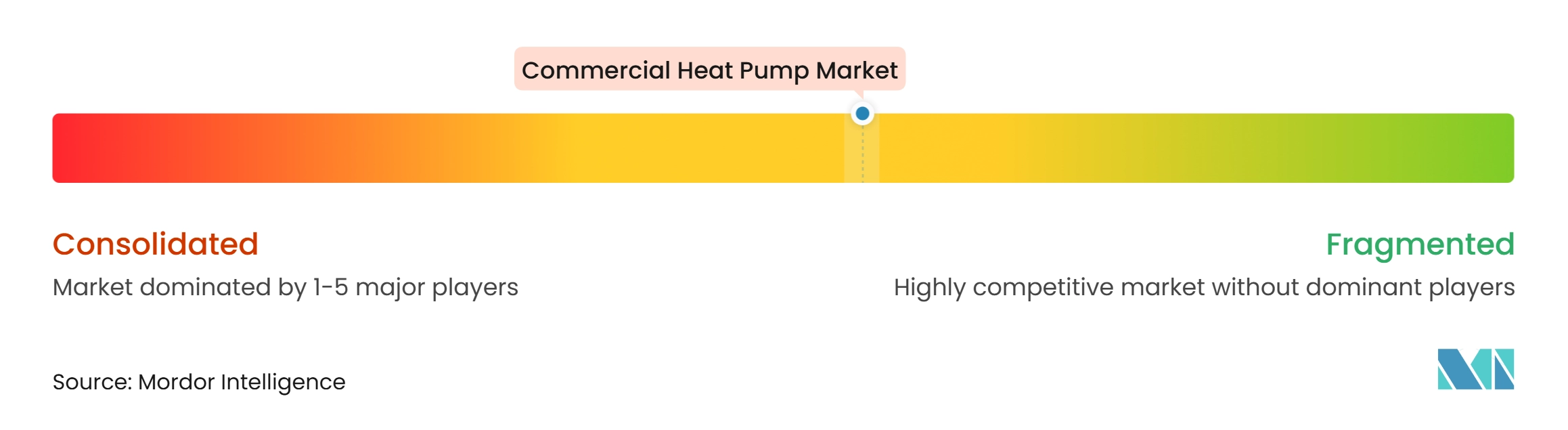
The commercial heat pump market is moderately fragmented. Daikin Industries, Carrier Global, Mitsubishi Electric, Trane Technologies, and Johnson Controls hold leadership roles across major geographies and product categories. Their manufacturing integration, service networks, and proprietary compressor and refrigerant technologies strengthen their position in the commercial heat pump market in the above-100 kW and industrial categories. NIBE Industrier, Vaillant, and Stiebel Eltron retain established roles in European retrofit markets. Midea, Gree, and Haier are extending commercial offerings beyond their domestic bases through cost-competitive manufacturing.
Competition in the commercial heat pump market centers on high-temperature equipment for boiler replacement, modular systems for phased retrofits, and refrigerant platforms that anticipate tighter requirements. Johnson Controls opened an expanded heat pump and chiller facility in Holme, Denmark, in May 2026. The site added 2,300 m² of production space and an 1,800 m² testing center compliant with EN 14511. The expansion doubled production capacity and was expected to create more than 100 jobs. Bosch completed its USD 8 billion acquisition of Johnson Controls’ residential and light commercial HVAC business in July 2025, expanding Bosch Home Comfort’s manufacturing footprint from 17 to 33 plants.
Supplier opportunities remain concentrated in above 100 kW industrial equipment and in the Middle East and Southeast Asia, where projects can require larger systems, specialized engineering, and combined cooling and hot water capability. Cooling combined with water heating creates a demand profile in these areas that differs from Europe’s boiler-replacement cycle. Carrier introduced the AquaForce 23XW and 23XQ in February 2026, with 281-850 kW heating capacity, 140°F output capability, and R-1234ze(E) or R-515B refrigerants for commercial boiler replacement. Carrier also launched the AquaSnap 30RQM in August 2025, a modular reversible air-source heat pump that can link up to 16 units and reflects the focus on scalable, lower-GWP equipment.
Commercial Heat Pump Industry Leaders
-
A. O. Smith Corporation
-
Rheem Manufacturing Company
-
Noritz Corporation
-
Mitsubishi Heavy Industries Thermal Systems, Ltd.
-
Sanden Holdings Corporation
- *Disclaimer: Major Players sorted in no particular order
Commercial Heat Pump Market Companies Covered in this Report
- DAIKIN INDUSTRIES, Ltd.
- Carrier Global Corporation
- Mitsubishi Electric Corporation
- Johnson Controls International plc
- LG Electronics Inc.
- Panasonic Holdings Corporation
- Trane Technologies plc
- Midea Group Co., Ltd.
- Guangdong Gree Electric Appliances Inc. of Zhuhai
- Haier Smart Home Co., Ltd.
- NIBE Industrier AB
- Ariston Holding N.V.
- Lennox International Inc.
- Samsung Electronics Co., Ltd.
- Fujitsu General Limited
- Rheem Manufacturing Company
- Stiebel Eltron GmbH & Co. KG
- Vaillant GmbH
- Glen Dimplex Group Limited
- Kensa Heat Pumps Ltd.
- OCHSNER Wärmepumpen GmbH
- WaterFurnace International, Inc.
- Ecoforest Geotermia S.L.
- Robert Bosch GmbH
Recent Industry Developments in Commercial Heat Pump Market
- October 2026: Rinnai Australia has released two new commercial air-to-water heat pumps, the CHP025 (25kW) and CHP050 (50kW), marking a significant step forward in the company’s commitment to electrification, energy efficiency, and a lower-carbon future for commercial hot water in Australia.
- October 2026: Clivet has commenced production at a new heat pump manufacturing facility in Feltre, Italy, in response to growing international demand for heat pumps and high-efficiency air-conditioning solutions. The new facility spans approximately 14,000 square meters and represents a total investment of EUR 24 million (USD 26.39 million). It is dedicated to the large-scale production of heat pumps, focusing on commercial applications and natural refrigerants.
- September 2026: Rheem Manufacturing Company has introduced the Torin Commercial Air-to-Water Heat Pump, a system engineered to meet the domestic hot water and space heating requirements of commercial facilities. Suitable for both indoor and outdoor installations, this solution is designed to serve key sectors such as multifamily residences, hospitality venues, corporate offices, schools, and university campuses.
- May 2026: Johnson Controls opened its expanded Holme, Denmark, heat pump and chiller facility, adding 2,300 m² of production space and an 1,800 m² EN 14511-compliant customer testing center for large-capacity industrial and district heating heat pumps. The expansion doubles production capacity and is expected to create more than 100 new jobs.
Global Commercial Heat Pump Market Report Scope
The commercial heat pumps are high-capacity electric thermal transfer systems engineered to provide efficient space heating, cooling, and domestic hot water for non-residential buildings. This market segment encompasses air-source, ground-source, and water-source technologies deployed across offices, retail spaces, hospitality venues, healthcare facilities, and educational institutions.
The Commercial Heat Pump Market Report is segmented by Source Type (Air-Source Heat Pumps, Water-Source Heat Pumps, Ground-Source Heat Pumps, and Heat-Recovery Heat Pumps), Rated Capacity (Below 20 kW, 20-50 kW, 50-100 kW, and Above 100 kW), Split System (Monobloc System, Packaged Rooftop System, Modular Cascade System, and Hybrid Heat-Pump System), Application (Space Heating, Space Cooling, Commercial Water Heating, Combined Heating and Cooling, Process and Industrial Heating, and District and Campus Heating), and Geography (North America, South America, Europe, Asia-Pacific, Middle East, and Africa). The Market Forecasts are Provided in Terms of Value (USD).
Segmentation Overview
| Air-Source Heat Pumps |
| Water-Source Heat Pumps |
| Ground-Source Heat Pumps |
| Heat-Recovery Heat Pumps |
| Below 20 kW |
| 20-50 kW |
| 50-100 kW |
| Above 100 kW |
| Split System |
| Monobloc System |
| Packaged Rooftop System |
| Modular Cascade System |
| Hybrid Heat-Pump System |
| Space Heating |
| Space Cooling |
| Commercial Water Heating |
| Combined Heating and Cooling |
| Process and Industrial Heating |
| District and Campus Heating |
| North America | United States |
| Canada | |
| Mexico | |
| South America | Brazil |
| Argentina | |
| Rest of South America | |
| Europe | Germany |
| France | |
| Italy | |
| United Kingdom | |
| Russia | |
| Rest of Europe | |
| Asia-Pacific | China |
| Japan | |
| South Korea | |
| India | |
| ASEAN | |
| Rest of Asia-Pacific | |
| Middle East | Saudi Arabia |
| United Arab Emirates | |
| Turkey | |
| Rest of Middle East | |
| Africa | South Africa |
| Nigeria | |
| Rest of Africa |
| By Source Type | Air-Source Heat Pumps | |
| Water-Source Heat Pumps | ||
| Ground-Source Heat Pumps | ||
| Heat-Recovery Heat Pumps | ||
| By Rated Capacity | Below 20 kW | |
| 20-50 kW | ||
| 50-100 kW | ||
| Above 100 kW | ||
| By System Design | Split System | |
| Monobloc System | ||
| Packaged Rooftop System | ||
| Modular Cascade System | ||
| Hybrid Heat-Pump System | ||
| By Application | Space Heating | |
| Space Cooling | ||
| Commercial Water Heating | ||
| Combined Heating and Cooling | ||
| Process and Industrial Heating | ||
| District and Campus Heating | ||
| By Geography | North America | United States |
| Canada | ||
| Mexico | ||
| South America | Brazil | |
| Argentina | ||
| Rest of South America | ||
| Europe | Germany | |
| France | ||
| Italy | ||
| United Kingdom | ||
| Russia | ||
| Rest of Europe | ||
| Asia-Pacific | China | |
| Japan | ||
| South Korea | ||
| India | ||
| ASEAN | ||
| Rest of Asia-Pacific | ||
| Middle East | Saudi Arabia | |
| United Arab Emirates | ||
| Turkey | ||
| Rest of Middle East | ||
| Africa | South Africa | |
| Nigeria | ||
| Rest of Africa | ||
Key Questions Answered in the Report
What is the size of the commercial heat pump market?
The commercial heat pump market is estimated at USD 21.61 billion in 2027 and is projected to reach USD 35.11 billion by 2032 at a 10.20% CAGR. Replacement activity, integrated heating and cooling needs, and process heat electrification are the demand factors described in this report.
Which source type leads commercial heat pump adoption?
Air-source heat pumps led with 66.34% share in 2026, while heat-recovery heat pumps are projected to record the fastest expansion at an 11.01% CAGR through 2032. Heat-recovery equipment can capture thermal energy from refrigeration circuits, server exhaust, and process streams for useful heating applications.
Which capacity range has the largest commercial installation base?
The 20-50 kW range held 34.29% share in 2026, reflecting its fit with small and medium-sized commercial properties. Retail units, clinics, boutique hotels, and standalone office floors are examples of locations that align with this capacity range.
What application is expected to expand fastest through 2032?
Process and industrial heating is expected to expand at an 11.38% CAGR, supported by efforts to electrify lower-temperature industrial heat. Industrial heat pumps are technically mature for supply temperatures up to 200°C, and development programs are targeting higher capability.
Which region leads demand and which region expands fastest?
Asia-Pacific held 41.18% share in 2026, while Europe is projected to expand at an 11.14% CAGR through 2032. China’s policy direction and manufacturing base underpin Asia-Pacific demand, while European rules and natural refrigerant requirements support regional procurement.
What are the principal barriers to commercial heat pump deployment?
Upfront project and electrical upgrade costs, installer shortages, hydronic redesign requirements, and permitting constraints can slow installation schedules. These factors are especially relevant when large systems must operate in occupied buildings or integrate with legacy hydronic equipment.