
Commercial Fitness Equipment Market Size and Share
Market Overview
| Study Period | 2027 - 2032 |
|---|---|
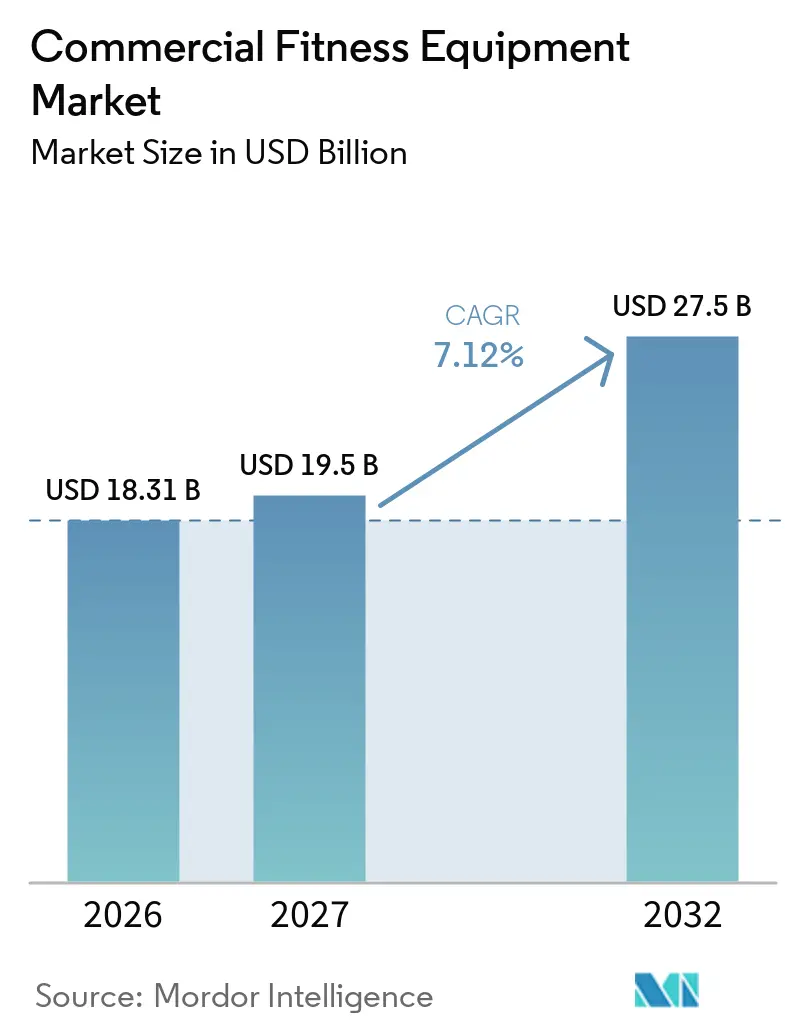
| Market Size (2027) | USD 19.5 Billion |
| Market Size (2032) | USD 27.5 Billion |
| Growth Rate (2027 - 2032) | 7.12 % |
| Fastest Growing Market | Asia-Pacific |
| Largest Market | North America |
| Market Concentration | Medium |
Major Players *Disclaimer: Major Players sorted in no particular order Image © Mordor Intelligence. Reuse requires attribution under CC BY 4.0. | |
Commercial Fitness Equipment Market Analysis by Mordor Intelligence
The commercial fitness equipment market size is estimated at USD 18.31 billion in 2026 and is projected to grow from USD 19.50 billion in 2027 to USD 27.50 billion by 2032, at a CAGR of 7.12% during the forecast period (2027–2032). The expansion of health clubs and commercial fitness centers, rising corporate investment in employee wellness, and increasing demand for technology-enabled fitness solutions are supporting market growth. Fitness equipment manufacturers are increasingly incorporating connected technologies and digital features to enhance workout monitoring, equipment utilization, and user engagement. Additionally, growing investments in hospitality facilities, educational institutions, and other commercial fitness spaces are creating opportunities for equipment suppliers. Demand for strength training equipment is expected to grow as fitness facilities expand their equipment offerings, while smart and connected equipment is gaining traction through technology integration. North America is estimated to remain the largest regional market, supported by its established fitness infrastructure, while Asia-Pacific is expected to record the fastest growth amid expanding fitness facilities and rising health awareness.
Key Report Takeaways
- By product type, treadmills led with an estimated 28.54% share of the commercial fitness equipment market in 2026, while strength training equipment is projected to grow at a CAGR of 8.12% through 2032.
- By category, conventional equipment accounted for an estimated 74.85% share in 2026, while smart/connected equipment is forecast to expand at a CAGR of 8.73% during 2027–2032.
- By price range, the mass segment held an estimated 55.40% share in 2026, while the premium segment is projected to grow at a CAGR of 8.45% through 2032.
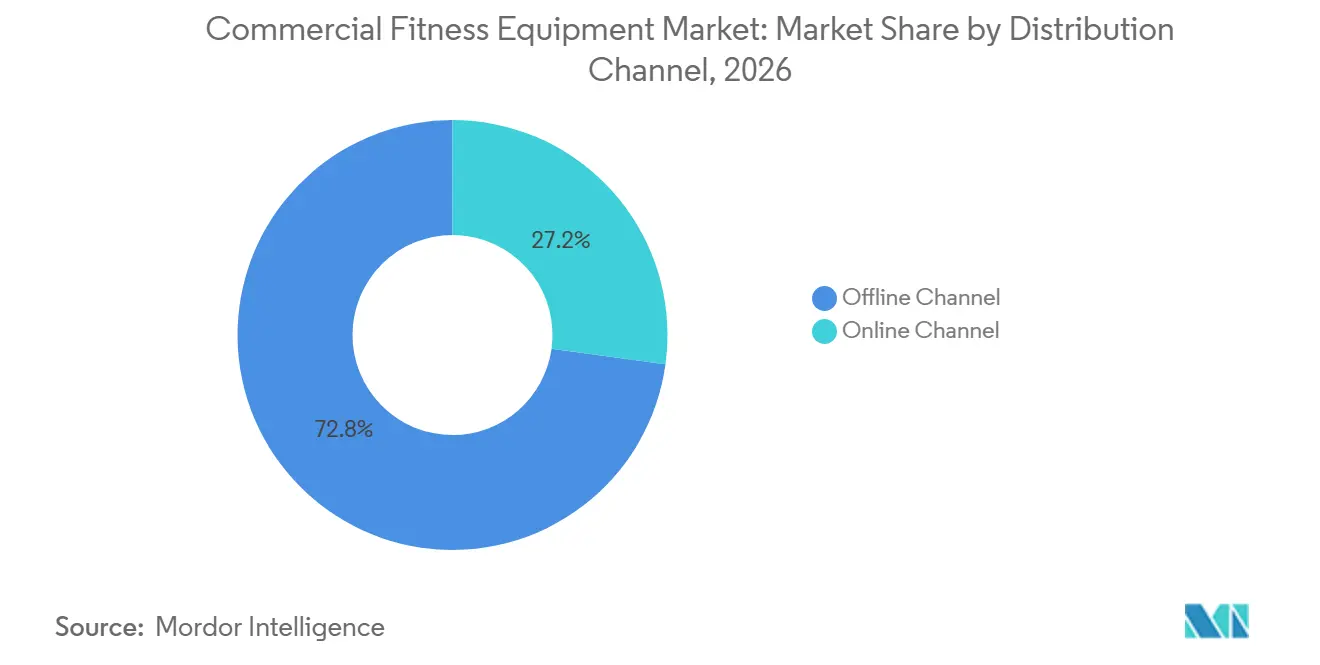
- By distribution channel, offline channels accounted for an estimated 72.82% share in 2026, while online channels are forecast to grow at a CAGR of 9.00% during 2027–2032.
- By geography, North America held an estimated 38.05% share in 2026, while Asia-Pacific is projected to record the fastest growth, at a CAGR of 8.56% through 2032.
Note: Market numbers in this report are based on Mordor Intelligence's proprietary estimation framework, which combines nine months of actuals with Q4 projections for base year 2026.
Market Trends and Insights
Drivers of Commercial Fitness Equipment Market*
| DRIVER | (~) % IMPACT ON CAGR FORECAST | GEOGRAPHIC RELEVANCE | IMPACT TIMELINE |
|---|---|---|---|
| Expansion of Health Clubs and Commercial Fitness Centers | +1.0% | Global; North America, Europe, and Asia-Pacific | Medium term (2–4 years) |
| Rising Corporate Investment in Employee Wellness and Workplace Fitness | +0.7% | Global; North America, Europe, and Asia-Pacific | Medium term (2–4 years) |
| Growing Demand for Connected and Technology-Enabled Fitness Equipment | +0.9% | Global; North America, Europe, and Asia-Pacific | Short term (2 years or less) |
| Increasing Health and Fitness Awareness and Membership Participation | +0.8% | Global; North America, Europe, and Asia-Pacific | Short term (2 years or less) |
| Expansion of Hospitality, Residential, and Institutional Fitness Facilities | +0.7% | Global; Asia-Pacific, Middle East and Africa, and North America | Long term (4 years or more) |
| Source: Mordor Intelligence | |||
Expansion of Health Clubs and Commercial Fitness Centers
The expansion of health clubs, gym chains, and specialized fitness studios is supporting demand for commercial fitness equipment as operators invest in new facilities, expand training areas, and upgrade existing equipment. In August 2025, the Health & Fitness Association (HFA) reported that global fitness facility memberships increased by 6% year over year in 2024, the number of facilities grew by nearly 4%, and industry revenue increased by an average of 8% [1]. This expansion creates opportunities for suppliers of treadmills, stationary cycles, elliptical machines, and strength training equipment. For manufacturers, increasing facility numbers and membership participation support demand for durable equipment designed for frequent use, alongside installation and maintenance services. However, high initial procurement costs and ongoing servicing requirements can constrain investment, particularly among smaller independent operators. Suppliers can address these challenges through flexible financing, service contracts, and equipment portfolios tailored to different facility sizes and budgets.
Rising Corporate Investment in Employee Wellness and Workplace Fitness
Corporate investment in employee wellness programs is creating opportunities for commercial fitness equipment suppliers as employers seek to support workforce health, physical activity, and employee well-being. Workplace fitness facilities may include cardiovascular machines, strength training equipment, and functional training areas, depending on the employer's available space and wellness strategy. Wellhub's Work-Life Wellness 2025 report highlights the relationship between workplace wellness programs and employee-reported well-being, including fitness [2]. This supports the relevance of workplace wellness as a potential channel for commercial fitness equipment demand, although it does not establish equipment purchasing growth directly. For manufacturers, corporate offices and workplace wellness providers represent an additional customer group alongside conventional gyms and fitness clubs. However, budget limitations, space availability, and employee participation can influence investment decisions. Suppliers can respond with compact equipment, flexible installation packages, and maintenance services suited to corporate environments.
Growing Demand for Connected and Technology-Enabled Fitness Equipment
The integration of digital technologies into commercial fitness equipment is creating opportunities for manufacturers to differentiate their products through personalized training, workout tracking, and connected member experiences. Smart equipment can link exercise machines with applications, digital training content, and club management platforms, enabling operators to offer more customized services and monitor member engagement. Technogym's connected ecosystem, for example, integrates fitness equipment, applications, artificial intelligence, and digital training content, while its Mywellness platform supports fitness clubs in managing and personalizing member experiences [3]. Such solutions can help operators differentiate their facilities and strengthen engagement, although the commercial benefits depend on adoption, implementation costs, and how effectively the technology is integrated into club operations. Manufacturers can capitalize on this trend by combining reliable hardware with intuitive interfaces, interoperable software, and ongoing digital support.
Increasing Health and Fitness Awareness and Membership Participation
Growing awareness of the health benefits of regular physical activity is supporting participation in organized fitness programs and creating demand for equipment used in commercial gyms and fitness centers. In June 2024, the World Health Organization (WHO) reported that 31% of adults worldwide, equivalent to approximately 1.8 billion people, did not meet recommended physical activity levels, highlighting the continuing need to promote active lifestyles [4]. Health organizations' emphasis on physical activity and the expansion of fitness services can support participation in structured exercise programs. As membership grows, commercial operators may invest in additional treadmills, stationary cycles, strength training machines, and other equipment to accommodate users and diversify workout options. For manufacturers, this creates opportunities to serve both new facilities and established gyms seeking to expand capacity
Restraints of Commercial Fitness Equipment Market*
| RESTRAINT | (~) % IMPACT ON CAGR FORECAST | GEOGRAPHIC RELEVANCE | IMPACT TIMELINE |
|---|---|---|---|
| High Initial Investment and Equipment Procurement Costs | −0.9% | Global, particularly price-sensitive markets and smaller fitness operators in Asia-Pacific and Latin America | Medium term (2–4 years) |
| Maintenance, Repair, and Equipment Downtime Costs | −0.6% | Global, particularly markets where access to specialized technicians and replacement parts is limited | Long term (More than 4 years) |
| Space Constraints and High Facility Setup Costs | −0.5% | Global, especially densely populated urban markets and locations with limited commercial floor space | Medium term (2–4 years) |
| Competition from Low-Cost Equipment and Alternative Fitness Formats | −0.4% | Global, particularly price-sensitive markets and regions with growing adoption of home fitness and budget fitness options | Short term (Less than 2 years) |
| Source: Mordor Intelligence | |||
High Initial Investment and Equipment Procurement Costs
Commercial fitness equipment requires substantial upfront investment, particularly for fitness centers seeking to equip multiple workout zones with treadmills, elliptical machines, stationary cycles, and strength training equipment. The total investment may also include equipment installation, delivery, flooring preparation, and integration of connected fitness systems. These costs can create financial pressure for new fitness centers, smaller independent gym operators, and businesses expanding into additional locations. Premium and smart equipment may require higher initial spending because of advanced features, digital connectivity, and specialized components. Although durable equipment can support long-term operations, purchasing decisions remain influenced by available capital, financing options, and expected facility utilization. Consequently, high initial procurement costs can delay equipment upgrades and restrict investment in new commercial fitness facilities, particularly among budget-conscious operators.
Maintenance, Repair, and Equipment Downtime Costs
Commercial fitness equipment experiences repeated use throughout the day, which can increase the need for preventive maintenance, component replacement, and periodic repairs. Treadmills, stationary cycles, elliptical machines, and strength training systems may require servicing to maintain performance, safety, and operational reliability. Maintenance expenses can include technician visits, replacement parts, software updates for connected equipment, and service agreements. Equipment downtime can also disrupt workout schedules, reduce the number of machines available to members, and create operational challenges for fitness facility managers. These requirements may be particularly difficult for smaller operators with limited maintenance budgets or restricted access to specialized service providers. Consequently, ongoing servicing costs and the risk of equipment downtime can influence purchasing decisions and encourage operators to prioritize durability, warranty coverage, and after-sales support when selecting suppliers.
*Our forecasts treat driver/restraint impacts as directional, not additive. The impact forecasts reflect baseline growth, mix effects, and variable interactions.
Commercial Fitness Equipment Market Segment Analysis
By Product Type:
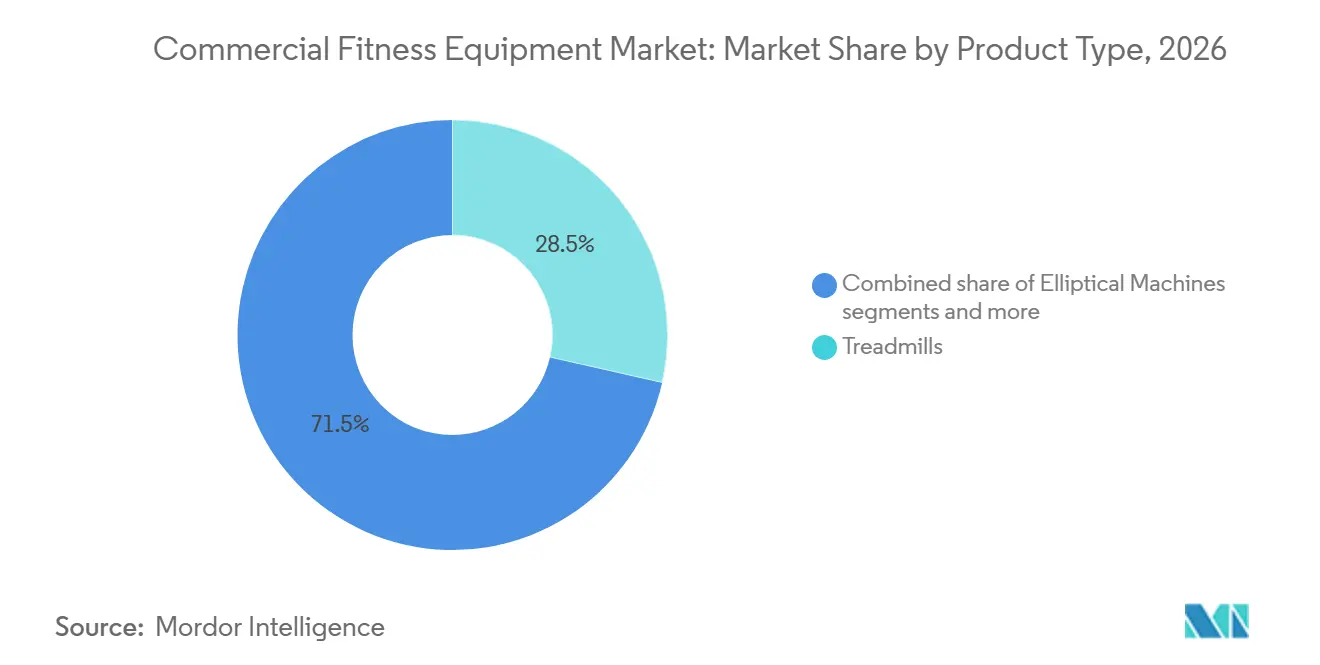
Treadmills Lead While Strength Training Equipment ExpandsIn 2026, treadmills accounted for an estimated 28.54% of the Commercial Fitness Equipment Market share, reflecting their role as a core cardiovascular training option across commercial gyms, health clubs, and fitness centers. Demand is supported by their use in walking, running, and structured cardio workouts for users with different fitness levels. Meanwhile, strength training equipment is projected to grow at a CAGR of 8.12% through 2032, supported by fitness facilities expanding resistance-training options and offering more varied workout programs. Equipment such as weight machines, cable systems, and free-weight stations can help operators accommodate different training preferences and fitness objectives.
Elliptical machines, stationary cycles, rowing machines, and other equipment types also contribute to commercial fitness facility offerings by supporting different exercise routines and space requirements. However, equipment selection depends on purchase budgets, floor space, expected utilization, durability, and maintenance needs. Manufacturers that balance equipment reliability, user experience, and after-sales support can better address the requirements of both established gym chains and smaller fitness operators.

By Category:
Conventional Equipment Leads While Smart and Connected Solutions AdvanceIn 2026, conventional equipment accounted for an estimated 74.85% of the Commercial Fitness Equipment Market share, reflecting the continued importance of established cardiovascular and strength training machines in commercial fitness facilities. These products support routine exercise programs and remain relevant for operators prioritizing durability, ease of use, and equipment availability. Meanwhile, smart and connected equipment is projected to grow at a CAGR of 8.73% through 2032 as manufacturers incorporate digital interfaces, workout tracking, connected applications, and personalized training features. These technologies can help fitness operators enhance member engagement and differentiate their facilities through more interactive workout experiences.
Connected equipment can also support digital training services and integration with fitness applications or club management platforms. However, higher purchase costs, software compatibility, maintenance requirements, and technology upgrades can influence adoption, particularly among operators with limited budgets. Manufacturers that combine reliable hardware with intuitive digital features and ongoing technical support may be better positioned to serve facilities seeking technology-enabled fitness experiences.
By Price Range:
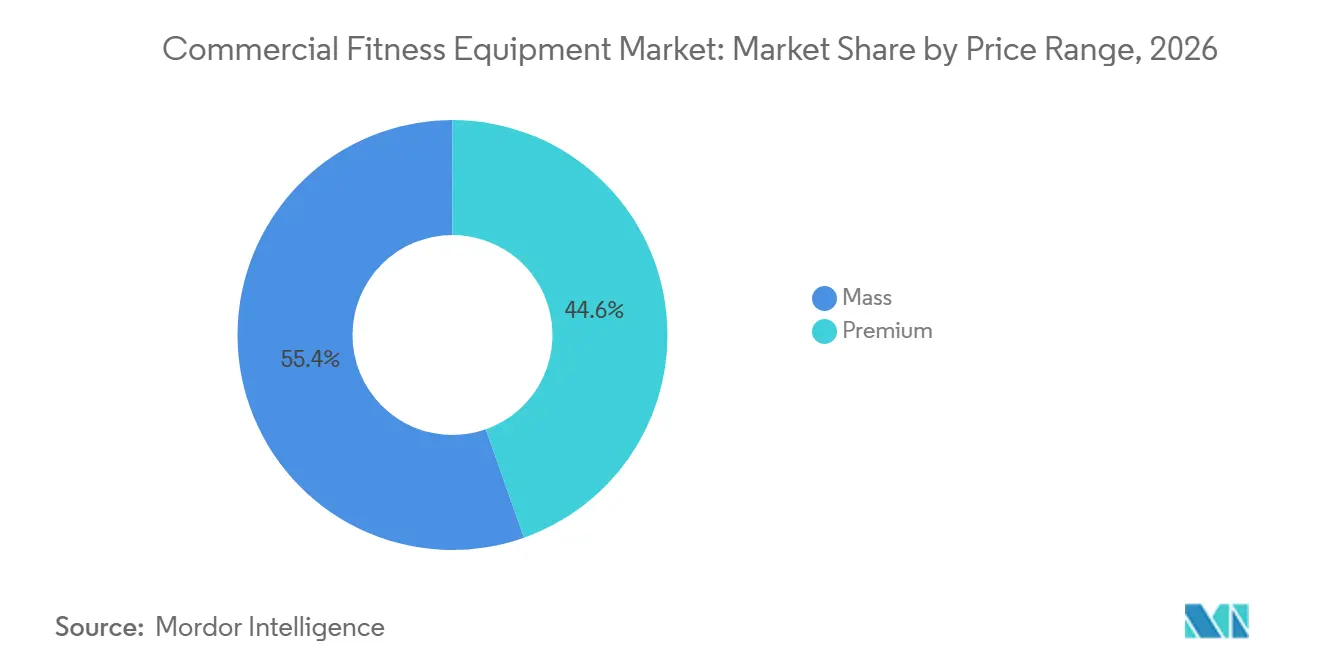
Mass-Market Equipment Leads While Premium Equipment Gains TractionIn 2026, mass-market equipment accounted for an estimated 55.40% of the Commercial Fitness Equipment Market share, reflecting the importance of affordability for gyms and fitness facilities managing equipment procurement budgets. This category can appeal to independent operators, budget fitness centers, and facilities seeking to equip multiple workout areas while controlling initial expenditure. Meanwhile, premium equipment is projected to grow at a CAGR of 8.45% through 2032, supported by opportunities for products offering advanced functionality, enhanced user interfaces, specialized training features, and connected capabilities. Premium equipment may also appeal to fitness operators seeking to differentiate their services and deliver a more specialized member experience.
Both price categories serve different operational requirements. Mass-market equipment can help operators manage upfront investment, while premium products may offer features suited to facilities emphasizing technology, design, and specialized training. However, purchasing decisions depend on available capital, expected equipment utilization, maintenance costs, and the value operators assign to additional features. Manufacturers must therefore align product specifications, durability, warranties, and service offerings with the budgets and positioning of their target customers.
By Distribution Channel:
Offline Sales Lead While Online Channels ExpandIn 2026, offline channels accounted for an estimated 72.82% of the Commercial Fitness Equipment Market share, reflecting the importance of direct sales, specialized fitness equipment dealers, and in-person product evaluation in commercial procurement. Gym operators and institutional buyers may need to assess equipment dimensions, construction quality, operating features, and installation requirements before making substantial purchases. Offline channels can also support product demonstrations, facility planning, delivery coordination, installation, and after-sales servicing. Meanwhile, online channels are projected to grow at a CAGR of 9.00% through 2032 as digital platforms provide opportunities for product discovery, specification comparisons, quotation requests, and supplier engagement.
Online channels can improve access to product information and help buyers compare equipment options across manufacturers and distributors. However, commercial purchases may still require technical consultations, customized quotations, installation arrangements, and service support that extend beyond a standard online transaction. Suppliers that integrate digital product information and enquiry systems with consultation, delivery, and after-sales services can address these requirements while improving the purchasing experience for commercial customers.
Geography Analysis
North America Commercial Fitness Equipment Market
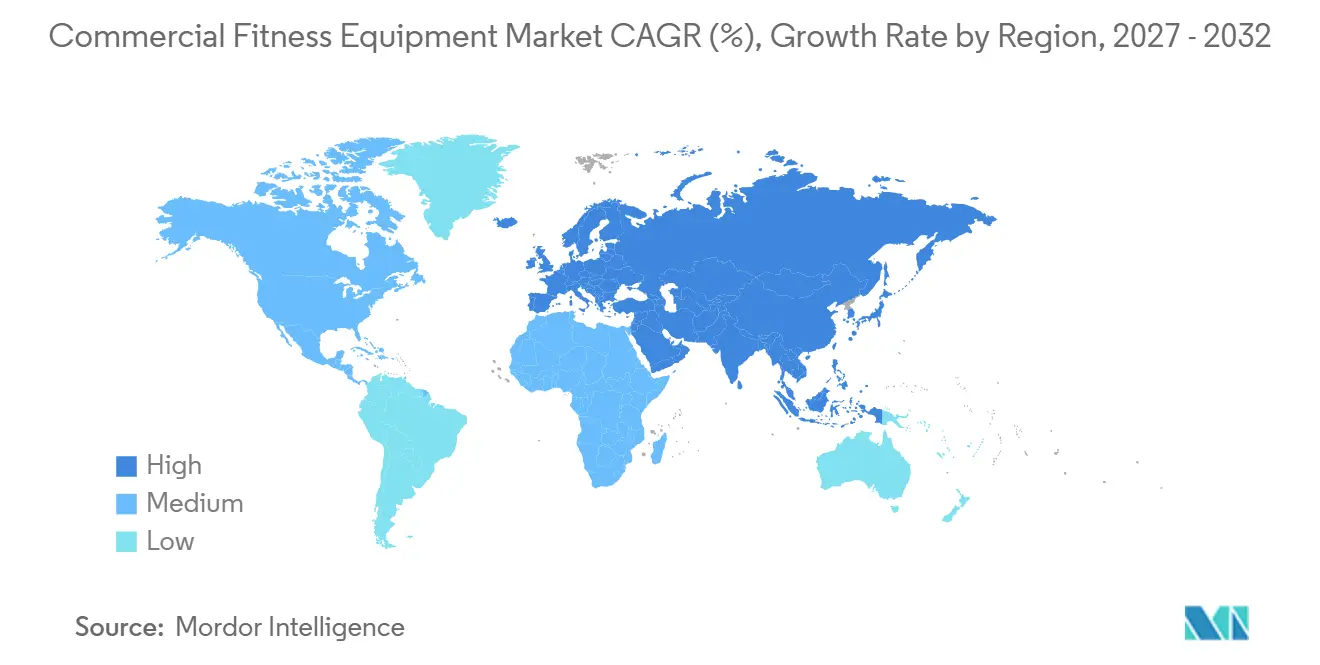
In 2026, North America accounted for an estimated 38.05% of the Commercial Fitness Equipment Market, reflecting its established commercial fitness infrastructure and demand from gyms, health clubs, and fitness studios. The region's market is supported by equipment procurement for cardiovascular training, strength training, and technology-enabled workouts. Operators may also invest in equipment upgrades to improve member experiences, expand training options, and maintain competitive fitness facilities. The presence of established equipment manufacturers and service networks supports access to commercial-grade products and after-sales services. However, high equipment procurement costs, maintenance requirements, and competition among fitness operators can influence investment decisions. Manufacturers can address these requirements through durable equipment, connected features, financing options, and comprehensive maintenance support.
Asia-Pacific Commercial Fitness Equipment Market
Asia-Pacific is projected to be the fastest-growing regional market, with a CAGR of 8.56% through 2032. Growth opportunities are associated with expanding fitness infrastructure, urbanization, rising health awareness, and the development of commercial gyms and fitness centers across regional markets. Investments in new facilities and the upgrading of existing workout spaces can increase demand for treadmills, stationary cycles, strength training equipment, and connected fitness solutions. The region also includes diverse markets with different consumer spending levels, fitness participation patterns, and equipment procurement requirements. These differences create opportunities for manufacturers offering products across multiple price ranges and facility formats. However, affordability, access to technical servicing, and uneven fitness infrastructure development may affect adoption. Suppliers that combine competitive pricing with reliable distribution, installation, and maintenance services can better address the region's varied market requirements.
Europe Commercial Fitness Equipment Market
Europe represents an established market for commercial fitness equipment, supported by a developed network of gyms, health clubs, boutique fitness studios, and sports facilities. Demand comes from operators investing in cardiovascular machines, strength training systems, and equipment upgrades to accommodate varied exercise preferences. Growing attention to preventive health, physical activity, and member experience also creates opportunities for fitness facilities to expand their equipment offerings. Connected equipment and digital training features can help operators differentiate their services and support more personalized workout experiences. However, differences in purchasing power, facility investment budgets, and operating costs across European countries can influence equipment procurement. Manufacturers can address these requirements through energy-efficient products, durable equipment, flexible product portfolios, and dependable maintenance services.
Competitive Landscape
The Commercial Fitness Equipment Market features established global manufacturers competing across cardiovascular equipment, strength training systems, and technology-enabled fitness solutions. Key players include Technogym S.p.A., Johnson Health Tech Co. Ltd., Life Fitness, Core Health & Fitness, and other specialized equipment manufacturers. These companies compete through product innovation, equipment durability, product portfolio breadth, distribution networks, and after-sales service capabilities. Their offerings serve a range of customers, including commercial gyms, health clubs, hotels, corporate fitness facilities, and institutional buyers.
Technology integration is an important area of competition in the market. Manufacturers are incorporating connected interfaces, digital training applications, workout tracking, and personalized fitness features into their equipment portfolios. Technogym, for example, offers an integrated digital ecosystem connecting equipment, applications, and training content, while connected solutions can help fitness operators enhance member engagement. However, adoption depends on acquisition costs, software compatibility, ease of use, and the availability of technical support. As a result, manufacturers must balance technology differentiation with equipment reliability and the operational requirements of commercial customers.The market is moderately consolidated, with established global manufacturers and specialized regional suppliers.
The competitive landscape is also shaped by differences in pricing, distribution strategies, and customer service. Established manufacturers compete for large gym chains and premium fitness facilities, while value-oriented suppliers can appeal to operators seeking to control procurement costs. Installation support, maintenance contracts, spare-parts availability, and equipment warranties can influence purchasing decisions because commercial equipment is subject to frequent use. Manufacturers are therefore positioned to differentiate themselves not only through equipment specifications but also through comprehensive service offerings and long-term customer relationships. Competition is likely to remain focused on product innovation, connected capabilities, durability, pricing, and the ability to meet the needs of fitness facilities across different budgets and operating environments.
Recent Industry Developments in Commercial Fitness Equipment Market
- May 2026: Technogym Reported First-Quarter Revenue Growth of 10.1%. Technogym reported consolidated revenue of EUR 236.8 million for the first quarter of 2026, up 10.1% year over year, with its commercial business-to-business segment recording 10.8% growth. Revenue increased across all reported geographic areas, highlighting the company's continued business momentum and reinforcing competitive activity among established suppliers serving commercial fitness facilities.
- April 2026: Vision Fitness Announced More Than 60 Product Launches Planned for 2026. Johnson Health Tech's Vision Fitness brand announced a major expansion of its commercial equipment portfolio, following launches that included the Summit Stairclimber and two selectorized strength equipment lines.
- March 2026: Life Fitness / Hammer Strength Partnered with Merrithew for Pilates Equipment Distribution in the United States. The exclusive partnership added Merrithew's premium Pilates equipment and studio solutions to the Life Fitness portfolio, extending its reach across commercial fitness, hospitality, corporate wellness, and institutional markets.
- March 2026: Precor and Peloton Introduced Their Integrated Commercial Fitness Business Unit. Precor and Peloton announced plans to showcase their combined commercial offering at HFA, NIRSA, and FIBO 2026, bringing Precor's commercial equipment engineering together with Peloton's connected fitness technology and workout content.
Global Commercial Fitness Equipment Market Report Scope
For this study, the Commercial Fitness Equipment Market is defined as the sales value of fitness equipment designed for use in commercial fitness facilities, including gyms, health clubs, fitness studios, hotels, corporate fitness centers, and institutional fitness facilities. The market covers treadmills, elliptical machines, stationary cycles, rowing machines, strength training equipment, and other product types, segmented by category into conventional and smart/connected equipment; by price range into mass and premium; and by distribution channel into offline and online channels. The market is analyzed across North America, Europe, Asia-Pacific, South America, and the Middle East and Africa. Market sizing and forecasts are presented in value terms (USD billion).
Segmentation Overview
| Treadmills |
| Elliptical Machines |
| Stationary Cycles |
| Rowing Machines |
| Strength Training Equipment |
| Other Product Types |
| Other Materials |
| Conventional |
| Smart/Connected Equipment |
| Mass |
| Premium |
| Offline Channel |
| Online Channel |
| North America | United States |
| Canada | |
| Mexico | |
| Rest of North America | |
| Europe | United Kingdom |
| Germany | |
| France | |
| Italy | |
| Spain | |
| Sweden | |
| Belgium | |
| Poland | |
| Netherlands | |
| Rest of Europe | |
| Asia-Pacific | China |
| Japan | |
| India | |
| Thailand | |
| Singapore | |
| Indonesia | |
| Korea | |
| Australia | |
| Rest of Asia-Pacific | |
| South America | Brazil |
| Argentina | |
| Colombia | |
| Peru | |
| Chile | |
| Rest of South America | |
| Middle East and Africa | South Africa |
| Saudi Arabia | |
| United Arab Emirates | |
| Nigeria | |
| Egypt | |
| Morocco | |
| Turkey | |
| Rest of Middle East and Africa |
| By Product Type | Treadmills | |
| Elliptical Machines | ||
| Stationary Cycles | ||
| Rowing Machines | ||
| Strength Training Equipment | ||
| Other Product Types | ||
| Other Materials | ||
| By Category | Conventional | |
| Smart/Connected Equipment | ||
| By Price Range | Mass | |
| Premium | ||
| By Distribution Channel | Offline Channel | |
| Online Channel | ||
| By Geography | North America | United States |
| Canada | ||
| Mexico | ||
| Rest of North America | ||
| Europe | United Kingdom | |
| Germany | ||
| France | ||
| Italy | ||
| Spain | ||
| Sweden | ||
| Belgium | ||
| Poland | ||
| Netherlands | ||
| Rest of Europe | ||
| Asia-Pacific | China | |
| Japan | ||
| India | ||
| Thailand | ||
| Singapore | ||
| Indonesia | ||
| Korea | ||
| Australia | ||
| Rest of Asia-Pacific | ||
| South America | Brazil | |
| Argentina | ||
| Colombia | ||
| Peru | ||
| Chile | ||
| Rest of South America | ||
| Middle East and Africa | South Africa | |
| Saudi Arabia | ||
| United Arab Emirates | ||
| Nigeria | ||
| Egypt | ||
| Morocco | ||
| Turkey | ||
| Rest of Middle East and Africa | ||
Key Questions Answered in the Report
What is the Commercial Fitness Equipment Market size in 2026?
The Commercial Fitness Equipment Market size is estimated at USD 18.31 billion in 2026.
What is the Commercial Fitness Equipment Market size in 2032?
The market is projected to reach USD 27.50 billion by 2032.
What is the CAGR of the Commercial Fitness Equipment Market during 2027–2032?
The Commercial Fitness Equipment Market is projected to grow at a CAGR of 7.12% during the 2027–2032 forecast period.
Which region is expected to grow the fastest in the Commercial Fitness Equipment Market?
Asia-Pacific is expected to be the fastest-growing region, with a projected CAGR of 8.56% through 2032.