
Commercial Cooking Ranges Market Size and Share
Market Overview
| Study Period | 2021 - 2031 |
|---|---|
| Market Size (2026) | USD 6.01 Billion |
| Market Size (2031) | USD 7.93 Billion |
| Growth Rate (2026 - 2031) | 5.27 % |
| Fastest Growing Market | Asia-Pacific |
| Largest Market | North America |
| Market Concentration | Medium |
Major Players *Disclaimer: Major Players sorted in no particular order Image © Mordor Intelligence. Reuse requires attribution under CC BY 4.0. | |
Commercial Cooking Ranges Market Analysis by Mordor Intelligence
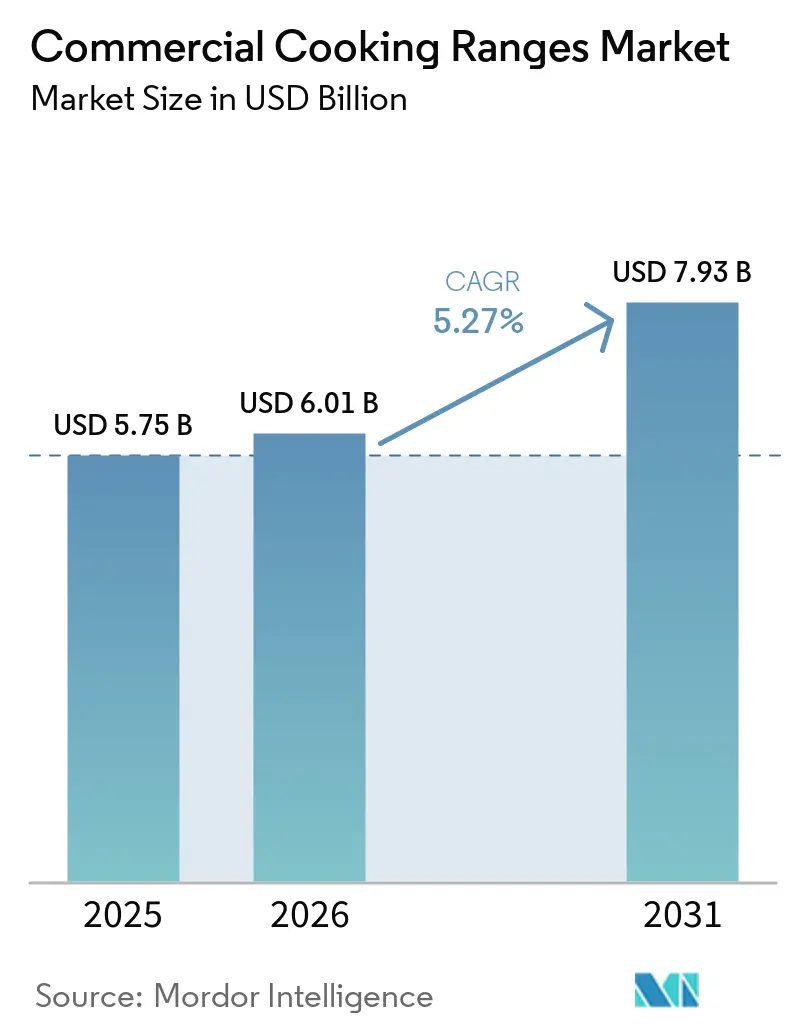
The Commercial Cooking Ranges Market size is projected to be USD 5.75 billion in 2025, USD 6.01 billion in 2026, and reach USD 7.93 billion by 2031, growing at a CAGR of 5.7% from 2026 to 2031. The outlook reflects continued investment in foodservice capacity, commercial kitchen upgrades, and equipment replacement. New restaurant openings support demand because each location needs a complete and compliant cooking line. Operators are also reviewing energy use, workflow consistency, and available space when selecting equipment. These priorities are shortening replacement decisions for some commercial kitchens and raising interest in electric, induction, and modular equipment. The commercial cooking ranges market therefore offers suppliers opportunities to pair product design with installation support, service coverage, and easier procurement.
Key Report Takeaways
- By fuel type, gas ranges held 51.56% of the commercial cooking ranges market share in 2025, while induction is forecast at an 8.39% CAGR through 2031.
- By installation and product configuration, freestanding and floor-standing ranges accounted for 59.25% revenue share in 2025, while countertop ranges are projected to expand at a 6.84% CAGR through 2031.
- By burner and cooking-zone configuration, 5-6 burner units held 37.56% of the commercial cooking ranges market share in 2025, while 1-2 burner units are forecast at a 7.03% CAGR through 2031.
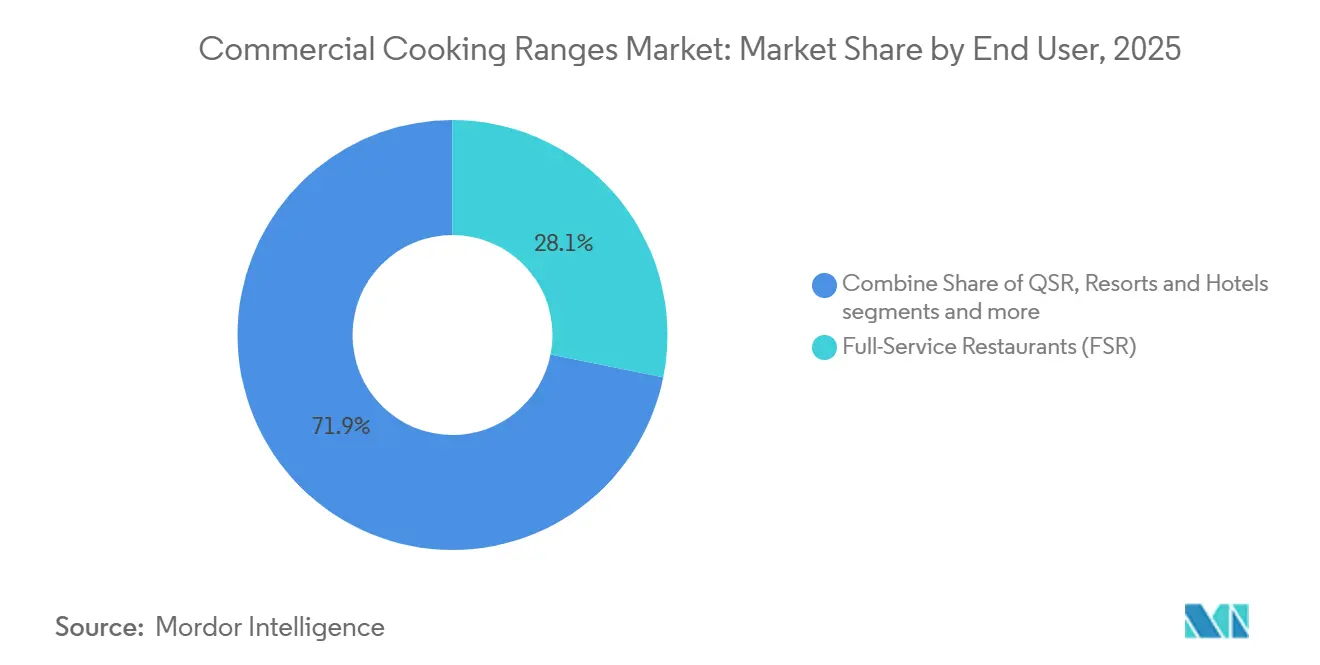
- By end user, full-service restaurants held 28.14% of the commercial cooking ranges market share in 2025, while cloud and ghost kitchens are projected at a 9.72% CAGR through 2031.
- By distribution channel, commercial kitchen equipment distributors held 41.15% revenue share in 2025, while the online channel is forecast to grow at a 10.41% CAGR through 2031.
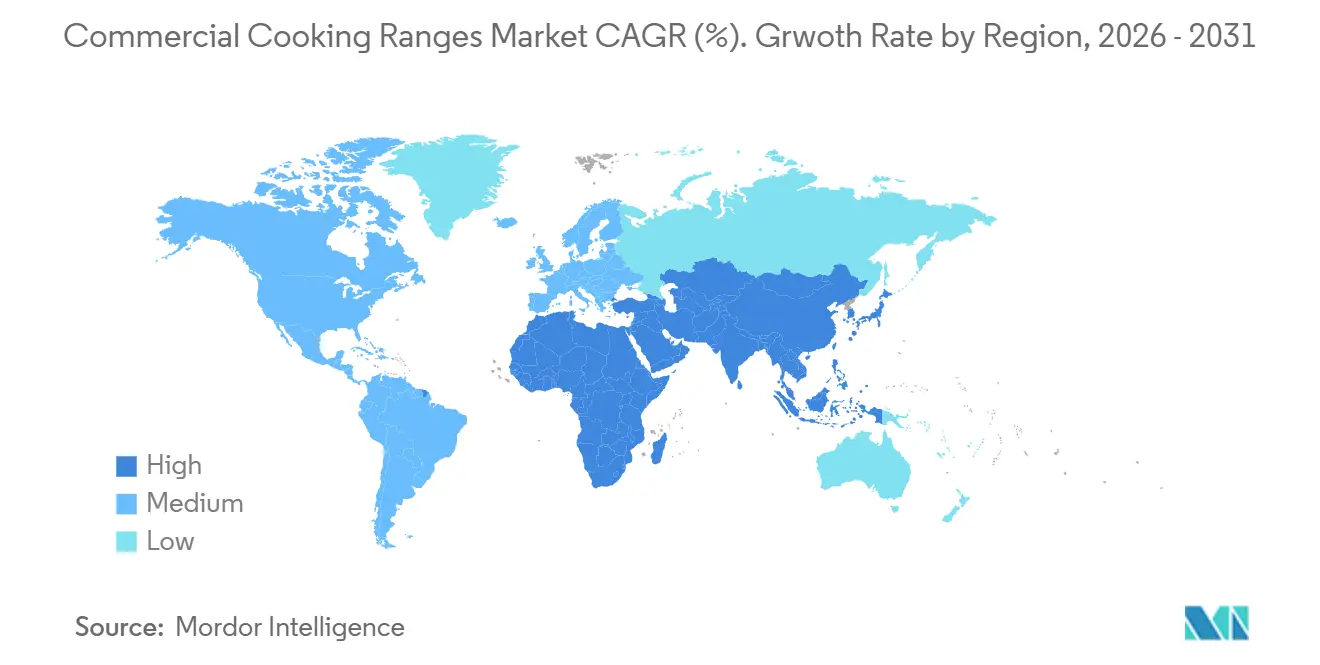
- By geography, North America held 33.15% of the commercial cooking ranges market share in 2025, while Asia-Pacific is projected to grow at a 7.11% CAGR through 2031.
Note: Market size and forecast figures in this report are generated using Mordor Intelligence’s proprietary estimation framework, updated with the latest available data and insights as of January 2026.
Market Trends and Insights
Drivers Impact Analysis of Commercial Cooking Ranges Market*
| Driver | (~) % Impact on CAGR Forecast | Geographic Relevance | Impact Timeline |
|---|---|---|---|
| Expansion of QSR and Full-Service Foodservice Networks | 1.40% | Global, with concentration in North America and Asia-Pacific | Medium term (2-4 years) |
| Commercial Kitchen Modernization and Replacement Demand | 1.10% | North America & Europe | Medium term (2-4 years) |
| Cloud Kitchens and Delivery-First Formats Requiring Compact Cooklines | 0.90% | Asia-Pacific, North America, MEA | Short term (≤ 2 years) |
| Electrification and Demand for Energy-Efficient Cooking | 0.80% | Europe, North America | Long term (≥ 4 years) |
| Labor Scarcity Increasing Demand for Programmable, Consistent Cooking | 0.60% | North America, Asia-Pacific core | Short term (≤ 2 years) |
| Modular Range Configurations for Space-Constrained and Multi-Menu Kitchens | 0.50% | Global | Medium term (2-4 years) |
| Source: Mordor Intelligence | |||
Expansion of QSR and Full-Service Foodservice Networks
Restaurant network expansion continues to create demand for new cooking equipment. QSR chains and full-service operators need complete cooklines when they open new sites. This demand is supported by franchise agreements and real estate commitments, which can remain in place during moderate economic slowdowns. Brand standards increasingly consider energy performance alongside fuel choice when operators approve equipment. This can support the replacement of older gas-fired ranges with certified electric or induction alternatives. In 2025, Welbilt, an Ali Group company, opened a 130,000+ sq ft Experience Center in Coppell, Texas, to train operators and distributors on current cookline configurations.
Cloud Kitchens and Delivery-First Formats Requiring Compact Cooklines
Delivery-first kitchens are changing the equipment requirements for commercial food preparation. These facilities need high output from limited floor space and fast heat cycling for multiple menus. Countertop induction and compact modular units can meet these needs more directly than large freestanding gas ranges. The commercial cooking ranges market benefits when operators fit smaller production spaces with equipment that can be repositioned or replaced quickly. Compact formats also suit limited-menu workflows that do not need a full restaurant cookline. This link between delivery-focused operations and smaller equipment formats supports demand for practical, standardized product lines. Operators in these settings can need equipment that fits a changing mix of brands and menu items. A compact range can support a focused preparation task without committing scarce floor space to a full suite. The model also increases the value of equipment that can be purchased, installed, and put into service with limited disruption. These requirements favor clear product specifications and dependable fulfillment. They also reinforce the connection between compact equipment and online purchasing.
Electrification and Demand for Energy-Efficient Cooking
The move from gas to electric cooking is increasingly influenced by operating costs and not only by sustainability policies. Managed electrical loads can be more appealing than variable gas costs in certain markets. Electrolux Professional introduced its e-XP 900 Free-zone Induction modular range in late 2025 with stated energy efficiency above 90% and limited surface heat loss[1]Electrolux Professional, “e-XP 900 Free-Zone Induction,” Electrolux Professional, electroluxprofessional.com. Lower heat loss can reduce the cooling burden in commercial kitchens. Equipment that meets relevant certification and listing requirements can also give buyers clearer performance and compliance expectations. These factors support the role of induction in the commercial cooking ranges market, even when kitchen electrical capacity remains a constraint. The purchasing decision remains dependent on the kitchen's existing electrical system and the costs of any required upgrades. Operators must also consider cookware compatibility and the operating preferences of kitchen staff. Those practical issues can slow a change in fuel type, especially for smaller businesses. Even so, energy efficiency and controllable heat output remain clear reasons for buyers to consider induction. The resulting demand is strongest where installation conditions are manageable.
Labor Scarcity Increasing Demand for Programmable, Consistent Cooking
Labor shortages have increased the value of equipment that supports consistent cooking and simpler operation. Programmable induction ranges can store temperature settings and reduce some line-cook training requirements. This is useful for operators with high staff turnover or limited access to experienced kitchen workers. Its 2026 Kitchen Innovation Award recipients included Imperial MFG's Pro Series Electric Wafer Plate Range, which uses sealed elements and reaches 650°F during startup and recovery[2]Middleby Corporation, “Three Middleby Brands Chosen as 2026 Kitchen Innovation Award Recipients,” Middleby Corporation, middleby.com. The commercial cooking ranges market is consequently placing greater value on controls, repeatability, and equipment that reduces routine maintenance needs.
Restraints Impact Analysis of Commercial Cooking Ranges Market*
| Restraint | (~) % Impact on CAGR Forecast | Geographic Relevance | Impact Timeline |
|---|---|---|---|
| High Upfront Cost and Electrical-Retrofit Burden | -0.80% | North America, Europe | Medium term (2-4 years) |
| Installation, Maintenance, and Skilled-Service Requirements | -0.50% | Global, accentuated in emerging markets | Long term (≥ 4 years) |
| Gas-to-Electric Performance and Menu-Compatibility Trade-Offs | -0.30% | North America, MEA | Medium term (2-4 years) |
| Electrical Capacity Bottlenecks in Dense Urban Kitchens | -0.30% | Asia-Pacific core, North America & EU urban hubs | Long term (≥ 4 years) |
| Source: Mordor Intelligence | |||
High Upfront Cost and Electrical-Retrofit Burden
Upfront costs remain a material barrier for independent operators and institutional buyers in emerging markets. A move from gas to induction may require electrical panel upgrades, dedicated circuits, and ventilation changes. These requirements can add costs that equal or exceed the equipment purchase price. The burden can delay adoption even where lifecycle economics favor electric equipment. Leasing and equipment-as-a-service models may reduce the immediate capital requirement for operators. Their use remains more established in North America and Northern Europe than in many other regions of the commercial cooking ranges market.
Installation, Maintenance, and Skilled-Service Requirements
High-output gas ranges and precision induction units need trained technicians for installation, calibration, and service. This need becomes more important as product designs incorporate digital controls and connected features. Thin service networks can leave operators facing extended downtime after equipment failures. That risk favors established suppliers with stronger dealer and service coverage. It can also reduce the practical return on advanced equipment for buyers in markets with limited technical support. The commercial cooking ranges market must therefore address service capacity alongside equipment innovation. Buyers need confidence that a technician can install and maintain equipment throughout its useful life. That confidence can be decisive when kitchens cannot tolerate unexpected downtime. Suppliers with local dealer relationships have an advantage in supporting this requirement. Product design and the availability of trained service teams are therefore linked in the buyer's decision. This is particularly relevant for connected and programmable equipment that requires more specialized support.
*Our forecasts treat driver/restraint impacts as directional, not additive. The impact forecasts reflect baseline growth, mix effects, and variable interactions.
Commercial Cooking Ranges Market Segment Analysis
By Fuel Type:
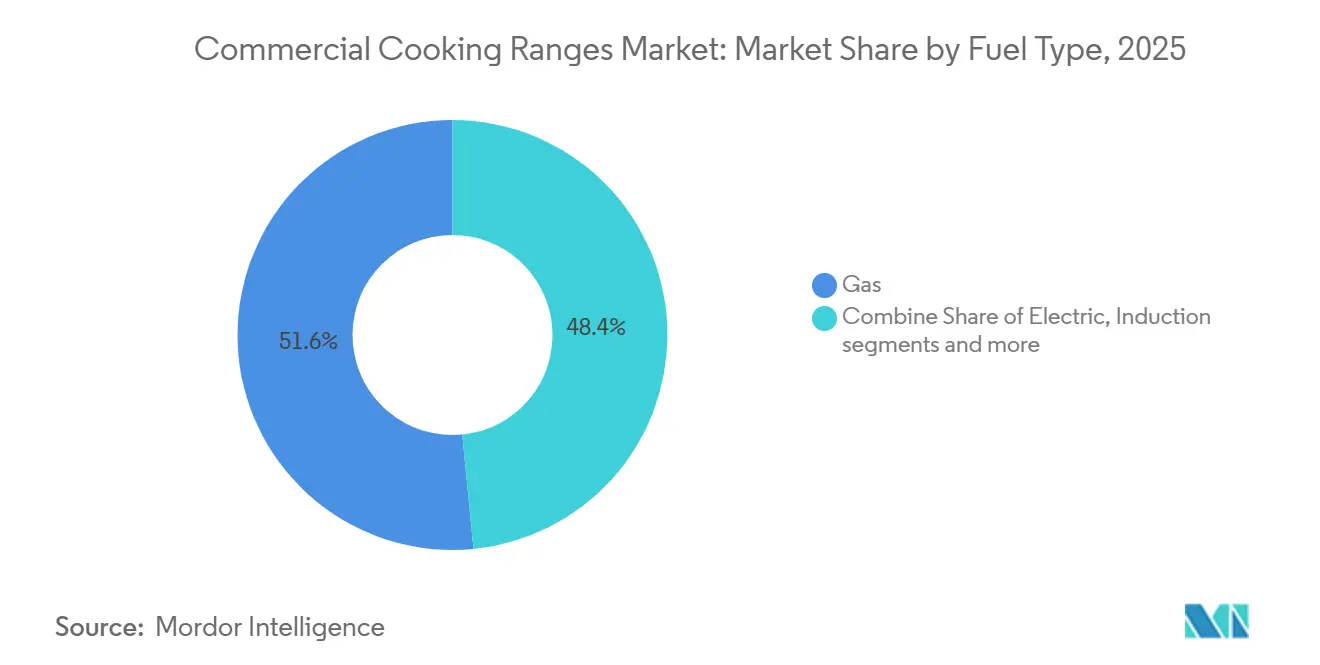
Gas Retains the Largest Base While Induction Gains MomentumGas ranges held 51.56% of the commercial cooking ranges market share in 2025. Their installed base spans QSR chains, full-service restaurants, and institutional cafeterias. Existing gas infrastructure reduces the immediate reason for many operators to switch. Gas units also continue to fit familiar kitchen workflows and established staff practices. This preserves demand across a wide range of commercial foodservice settings. Many operators also continue to value the familiar controls, maintenance routines, and cookware compatibility associated with gas equipment. Gas remains a practical choice where utility connections already exist, and menus depend on fast, visible heat control. These factors keep the installed base relevant even as buyers evaluate electric alternatives. Replacement purchases often follow the specifications and utility connections already in a kitchen. Operators can avoid added renovation costs when they retain a familiar fuel type. Gas equipment also remains relevant where kitchen teams prefer its direct control and existing menu processes. This slows any immediate shift in the overall fuel mix.
Electric ranges hold a stable secondary role in institutional kitchens where gas access is limited. Dual-fuel ranges serve a narrower group of fine-dining operators that value open-flame responsiveness and oven consistency. Induction is the fastest-growing fuel type, with an 8.39% CAGR forecast for 2026-2031. The commercial cooking ranges market size for induction is supported by demand for heat precision, programmability, and safer cooking surfaces. Electrolux Professional's e-XP 900 Free-zone Induction has independent zone controls and stated efficiency above 90%, illustrating the focus on modular, multi-menu kitchen use.e Higher unit prices can support induction revenue even while gas maintains greater unit volumes during the forecast period. The category is particularly suitable for buyers seeking more control over cooking zones in compact kitchens. Its lower surface heat can also support safer operating conditions for staff. These benefits matter in healthcare catering and delivery-focused facilities where consistent output is important.



By Installation/Product Configuration:
Freestanding Units Lead While Countertop Demand RisesFreestanding and floor-standing ranges accounted for 59.25% revenue share in 2025. They support high-volume kitchens that need several burners and an oven within one footprint. This flexibility makes them a common choice for established restaurants and institutional facilities. Their format also suits operators who build conventional kitchen lines around permanent utility connections. These applications keep freestanding equipment at the center of current procurement volumes. A single freestanding unit can simplify kitchen planning when an operator needs burners and an oven in one purchase. The format also supports standard replacement decisions in established restaurants. Buyers often select these units when their layout, ventilation, and utility infrastructure are already configured for conventional equipment. This familiarity helps sustain demand in the commercial cooking ranges market.
Drop-in and built-in units serve a smaller premium segment where customized line integration supports the added installation cost. Modular and line-mounted systems are used in larger institutional kitchens that require flexible and high-throughput cooklines. Countertop ranges are forecast to grow at a 6.84% CAGR from 2026 to 2031. Cloud kitchens, food kiosks, and fast-casual formats support this demand because they often operate in smaller sites. The Southbend P36N-ISI offers 4 3,500W Ceran glass hobs in a 36-inch countertop or modular format, showing how established suppliers are addressing compact layouts. A larger share of smaller units may place modest pressure on average transaction values as equipment volumes rise. Countertop products can be easier to integrate into temporary, repurposed, or flexible food preparation spaces.
By Burner/Cooking Zone Configuration:
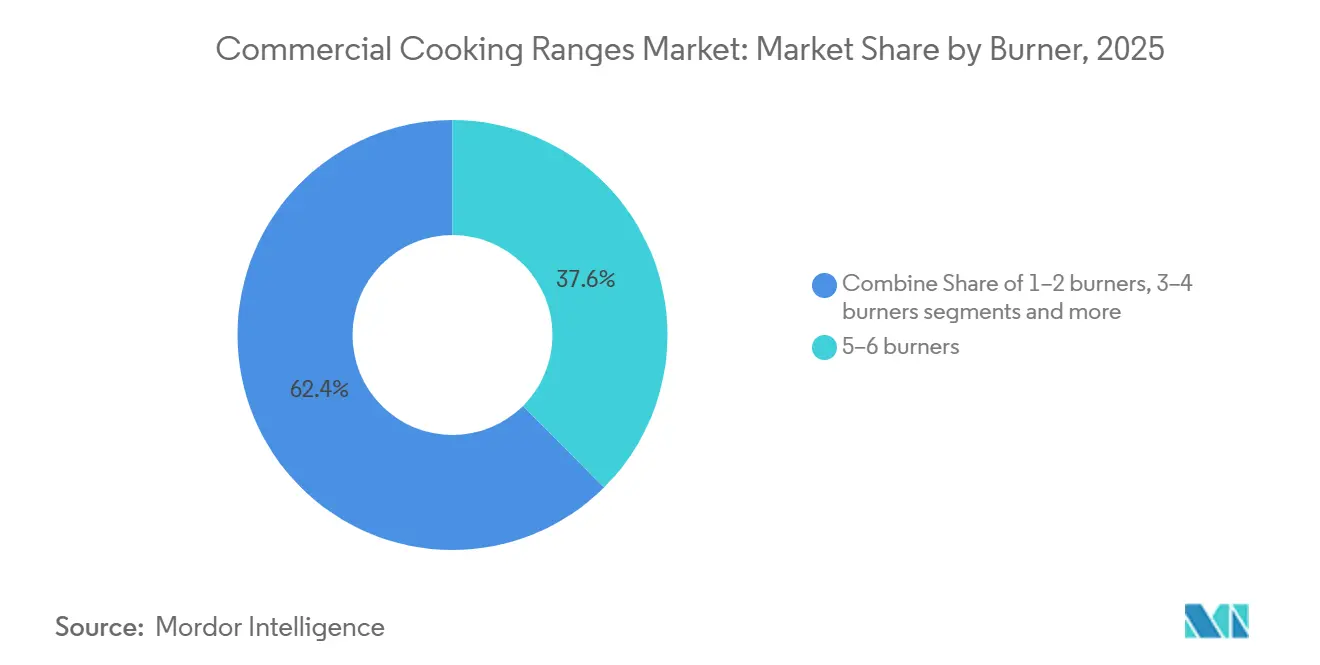
5-6 Burner Units Lead While Compact Units ExpandThe 5-6 burner configuration held 37.56% revenue share in 2025. It is a standard choice for full-service restaurant cooklines with separate stations for sauces, sautéing, and protein preparation. This arrangement helps kitchens manage multiple cooking tasks during peak service. Its capacity fits restaurants that need more than a compact unit but do not require a large institutional suite. The configuration, therefore, remains central to volume demand across conventional restaurant formats. It provides enough simultaneous cooking capacity for a broad menu without the footprint of larger institutional equipment. This balance is important for restaurants that manage variable peak periods. Operators can assign distinct cooking tasks to separate burners and avoid congestion during service. The configuration also aligns with the layout of many established full-service restaurant kitchens. These factors preserve its role in the commercial cooking ranges market.
The 7-8 and 9+ burner configurations serve central production kitchens, hotel banqueting operations, stadium catering, and other high-output facilities. The 3-4 burner category covers many small and mid-sized restaurants, room-service kitchens, and catering operations. The 1-2 burner category is forecast to grow at a 7.03% CAGR from 2026 to 2031. Single and dual-zone induction units fit limited-menu production and use less electrical load per unit than multi-burner gas suites. This creates a high-volume opportunity for suppliers that can offer compact induction equipment at competitive prices. The category is particularly relevant to delivery-focused kitchens and small urban foodservice sites. Compact units allow an operator to match capacity to a narrow menu and add stations gradually.
By End User:
Full-Service Restaurants Lead While Cloud Kitchens Grow FasterFull-service restaurants represented 28.14% revenue share in 2025. These restaurants require large freestanding ranges, high-BTU gas capacity, and complete oven suites. The value of each installed cooking line supports its continued leadership in procurement revenue. QSR operators form the next major user group and typically select standardized equipment for high-cycle, limited-menu production. Institutional canteens, resorts, hotels, hospitals, healthcare facilities, railway dining, and catering services add a stable layer of demand through planned replacement cycles. These buyers often need durable equipment that meets established operating and procurement requirements. Their purchases can be less dependent on a single restaurant concept or local menu change. The range of end users gives the commercial cooking ranges market a broad demand base. It also creates a need for suppliers to support different capacities, fuel, and installation requirements.
Cloud and ghost kitchens are forecast to grow at a 9.72% CAGR from 2026 to 2031. Their procurement decisions prioritize multi-brand flexibility, fast equipment changes, and financing models that preserve working capital. This differs from full-service restaurant expansion, which generally depends on a fixed kitchen line and a broader menu. The commercial cooking ranges market size for this end-user group is linked to demand for compact, efficient, and automation-compatible equipment. Suppliers without products designed for this format may lose the fastest-growing demand area to specialized or Asia-Pacific competitors. The segment also reinforces demand for online procurement and compact induction equipment. Delivery-only operations often need to balance throughput with limited space and available electrical load.
By Distribution Channel:
Distributors Lead While Online Purchasing ExpandsCommercial kitchen equipment distributors held 41.15% revenue share in 2025. Their role includes application engineering, installation coordination, and after-sales service. These services are difficult to reproduce through other channels for complex equipment. Direct business-to-business sales serve large chains and institutional buyers that need compliant specifications and dedicated account management. Specialty stores remain important for independent operators who want localized advice and hands-on product selection. Their role is useful when buyers are comparing equipment features, installation needs, and available service support. Distributors remain especially important for products that require site assessment and coordinated installation. This preserves their advantage for larger gas ranges and complex cooking lines, where site planning, installation, and future service are closely connected. The channel mix reflects the fact that commercial equipment purchases range from standardized compact units to highly specified installations.
The online channel is forecast to grow at a 10.41% CAGR from 2026 to 2031. Cloud kitchen operators and smaller independent groups value transparent pricing and fast fulfillment. The channel is more suitable for countertop induction units and compact electric ranges than for high-BTU freestanding products. Complex gas ranges generally still require installation coordination, venting, and connection support. Suppliers can improve digital sales with accurate specification sheets, compatibility guidance, and reliable fulfillment. These capabilities can connect compact product lines with delivery-focused end users more efficiently. Online purchasing does not eliminate the need for distributors where installation and maintenance are complex.
Geography Analysis
North America Commercial Cooking Ranges Market
North America held 33.15% revenue share in 2025. The United States has a high concentration of QSR headquarters, contract foodservice operators, and full-service restaurants. These buyers support regular equipment replacement and new-site procurement. Canada adds demand through commercial kitchen modernization in institutional and healthcare facilities. Mexico offers additional potential as international QSR brands and domestic hotel groups expand kitchen infrastructure. The region combines mature procurement systems with ongoing demand for newer cooking formats. Large chains can support standardized equipment purchases, while independent operators may require more local service support. Kitchen modernization adds another reason for buyers to review energy use and operating efficiency. These conditions help North America retain a large position in the commercial cooking ranges market.
United States and APAC Commercial Cooking Ranges Market
Welbilt opened its 130,000+ sq ft Experience Center in Coppell, Texas, in 2025, where operators, dealers, and distributors can view commercial cooking equipment and training programs[3]“Welbilt Announces New State-of-the-Art Experience Center in Coppell, Texas,” Ali Group, aligroup.com. The facility reflects a buyer base that is considering smart kitchen automation and energy-efficient cooking technology. Asia-Pacific is forecast to grow at a 7.11% CAGR between 2026 and 2031. China is moving from volume-led gas range purchases toward higher-specification modular and induction formats as attention to commercial kitchen energy standards increases. India is supported by an expanding organized foodservice sector and operator interest in managing LPG costs. Japan and South Korea remain premium markets for compact, high-precision professional cooking systems. Across Asia-Pacific, demand patterns differ by local infrastructure, restaurant formats, and price sensitivity. This requires suppliers to adapt product portfolios rather than rely on one standard offering. Smaller urban kitchens can favor compact formats, while hospitality development can support larger equipment purchases. The region's growth is therefore spread across several foodservice applications. Its 7.11% forecast CAGR reflects the combined effect of these varied demand conditions.
ASEAN, EMEA and South America Commercial Cooking Ranges Market
Southeast Asian markets, including Singapore, Vietnam, and Indonesia, combine hospitality construction with cost-sensitive procurement. This mix supports continued use of mid-tier freestanding gas equipment and modular induction units. Europe has more advanced commercial induction adoption than North America because of stronger grid infrastructure and established modular cookline design. Electrolux Professional confirmed investment in its e-XP modular cooking platform and Thermaline free-zone induction system at its 2025 Investor Day[4]Electrolux Professional, “e-XP 900 Free-Zone Induction,” Electrolux Professional, electroluxprofessional.com. South America and the Middle East and Africa are smaller but growing parts of the commercial cooking ranges market, supported by hospitality investment, tourism projects, and QSR expansion. In the Middle East and Africa, new hotel and tourism projects can create equipment demand beyond routine replacement cycles. QSR growth in Nigeria and South Africa provides an additional source of foodservice equipment demand. Cost sensitivity and local service availability remain important to procurement decisions. Suppliers that can balance product value with service support are better placed to address these developing markets.

Competitive Landscape
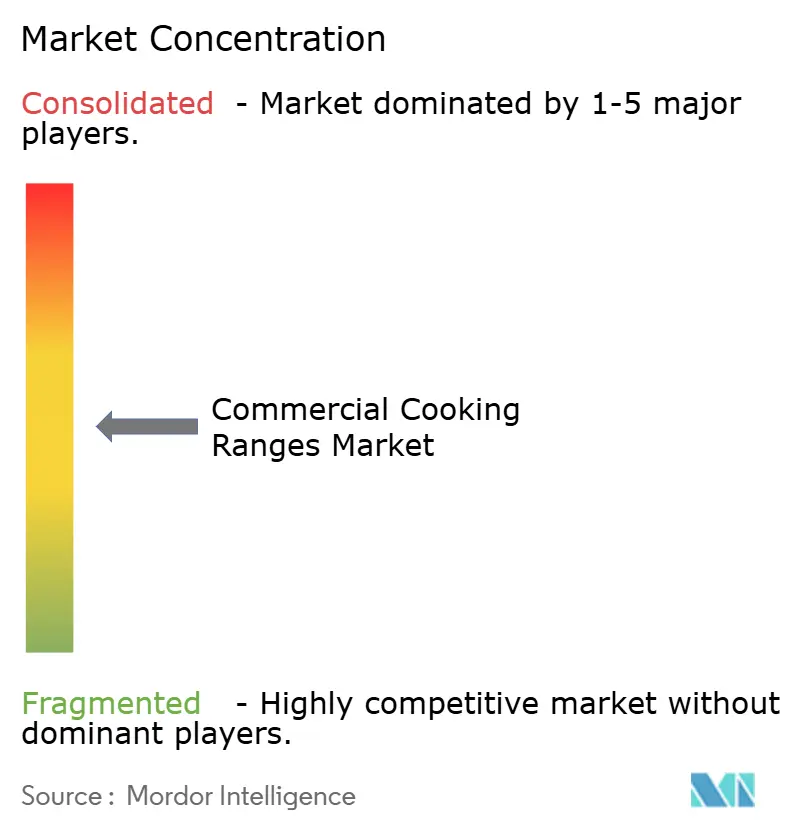
The commercial cooking ranges market is moderately fragmented at the brand level and more concentrated at the corporate parent level. Illinois Tool Works, through Vulcan, Ali Group, through Garland and Welbilt, Middleby Corporation, through Southbend, Imperial, and Jade Range, and Electrolux Professional have broad portfolios and established service coverage. Their scale supports product availability, distributor relationships, and after-sales support. This makes it difficult for new entrants to replicate their position quickly. Brand recognition, established dealer relationships, and technical service coverage can influence a buyer's decision as much as a product feature. Larger groups can also support customers across several equipment categories. That breadth helps them retain accounts when operators upgrade existing cooklines. It gives the commercial cooking ranges market a competitive structure in which parent companies have meaningful influence. Their portfolios cover gas, electric, and induction equipment, allowing them to retain customers when kitchen requirements change.
Established suppliers are using product development and portfolio investment to respond to changing cooking needs. Electrolux Professional launched the e-XP 900 Free-zone Induction range in 2025 with 4 independent cooking zones, 30 power levels, and a stated temperature range from 30°C to 190°C. The product is intended for mid-sized and large commercial kitchens that need flexible induction cooking within a modular line. Ali Group's Welbilt Experience Center also provides a direct setting for product demonstrations and training. These moves show how leading suppliers are aligning their portfolios with the needs for energy management, consistent output, and more efficient workflows. The product approach also gives buyers options across fuel types and cooking formats. Supplier investment in training and demonstrations can help operators assess more complex technology before they make a purchase. This is particularly important when a kitchen is considering a change from gas equipment to induction.
Open opportunities remain in compact induction ranges for cloud and ghost kitchens and in connected equipment that supports monitoring, maintenance planning, and performance review. Smaller Asia-Pacific suppliers are placing pressure on mid-market prices for countertop electric and basic induction products. This pressure is most visible in emerging markets where buyers place less weight on extensive after-sales service coverage. Compliance requirements from NSF and UL remain barriers for suppliers targeting the United States and Canadian institutional procurement. The competitive position of larger groups is strengthened by their service networks and their ability to offer several fuel types. The available draft does not provide a combined market share for the leading companies, so a concentration rating cannot be derived from the stated market-share thresholds without introducing new data. Competition is strongest where suppliers can combine relevant equipment, product knowledge, installation support, and responsive maintenance. New entrants can find room in compact electric and induction formats, but must still address compliance and service needs. The commercial cooking ranges market, therefore, combines the scale advantages of established parent groups with specialized opportunities in newer product formats.
Commercial Cooking Ranges Industry Leaders
The Middleby Corporation
Illinois Tool Works Inc.
Ali Group S.r.l.
Electrolux Professional AB
RATIONAL AG
- *Disclaimer: Major Players sorted in no particular order
Commercial Cooking Ranges Market Companies Covered in this Report
- The Middleby Corporation
- Illinois Tool Works Inc.
- Ali Group S.r.l.
- Electrolux Professional AB
- RATIONAL AG
- Alto-Shaam, Inc.
- Henny Penny Corporation
- Garland Group
- Vulcan
- Southbend
- Blodgett Corporation
- MKN Maschinenfabrik Kurt Neubauer GmbH & Co. KG
- Blue Seal Limited
- Falcon Foodservice Equipment
- Moffat Group Pty Ltd
- American Range Corporation
- Montague Company
- Imperial Commercial Cooking Equipment
- The Vollrath Company, LLC
- Hatco Corporation

Recent Industry Developments in Commercial Cooking Ranges Market
- July 2026: Atoms, the parent built around Travis Kalanick’s CloudKitchens business, raised USD 1.7 billion in a round led by Andreessen Horowitz, with Uber, Bain Capital, Fifth Wall, and others participating.
- July 2026: Stovekraft Limited (India) launched the Pigeon ENDURO 3,500W heavy-duty induction cooktop and Pigeon EGNITE infrared commercial cooktop, targeting small restaurants, institutional kitchens, and caterers.
- November 2025: Electrolux Professional Group announced an agreement to acquire the assets of Royal Range, a US commercial cooking company with one factory in Eastvale, California, approximately 40 employees, and expected 2025 sales of approximately SEK 100 million.
- November 2025: Electrolux Professional launched the e-XP 900 Free-zone Induction modular cooking range, featuring 4 independent cooking zones, over 90% energy efficiency, a glass-ceramic surface compatible with all cookware sizes, and temperature precision from 30°C to 190°C across 30 power levels.


Global Commercial Cooking Ranges Market Report Scope
| Gas |
| Electric |
| Induction |
| Dual Fuel |
| 1-2 burners |
| 3-4 burners |
| 5-6 burners |
| 7-8 burners |
| 9+ burners |
| Freestanding/Floor-standing Ranges |
| Countertop Ranges |
| Drop-In/Built-In Ranges |
| Modular / line-mounted Ranges |
| Quick-Service Restaurants (QSR) |
| Full-Service Restaurants (FSR) |
| Cloud / Ghost Kitchens |
| Institutional Canteens |
| Resorts and Hotels |
| Hospitals and Healthcare |
| Railway Dining |
| Catering Services |
| Other End-Users |
| Direct Sales / B2B |
| Commercial kitchen equipment distributors |
| Specialty Stores |
| Online |
| Other Distribution Channels |
| North America | Canada |
| United States | |
| Mexico | |
| South America | Brazil |
| Peru | |
| Chile | |
| Argentina | |
| Rest of South America | |
| Europe | United Kingdom |
| Germany | |
| France | |
| Spain | |
| Italy | |
| BENELUX (Belgium, Netherlands, and Luxembourg) | |
| NORDICS (Denmark, Finland, Iceland, Norway, and Sweden) | |
| Rest of Europe | |
| Asia-Pacific | India |
| China | |
| Japan | |
| Australia | |
| South Korea | |
| South East Asia (Singapore, Malaysia, Thailand, Indonesia, Vietnam, and the Philippines) | |
| Rest of Asia-Pacific | |
| Middle East and Africa | United Arab Emirates |
| Saudi Arabia | |
| South Africa | |
| Nigeria | |
| Rest of the Middle East and Africa |
| By Fuel Type | Gas | |
| Electric | ||
| Induction | ||
| Dual Fuel | ||
| By Burner/Cooking Zone Configuration | 1-2 burners | |
| 3-4 burners | ||
| 5-6 burners | ||
| 7-8 burners | ||
| 9+ burners | ||
| By Installation/Product Configuration | Freestanding/Floor-standing Ranges | |
| Countertop Ranges | ||
| Drop-In/Built-In Ranges | ||
| Modular / line-mounted Ranges | ||
| By End-User | Quick-Service Restaurants (QSR) | |
| Full-Service Restaurants (FSR) | ||
| Cloud / Ghost Kitchens | ||
| Institutional Canteens | ||
| Resorts and Hotels | ||
| Hospitals and Healthcare | ||
| Railway Dining | ||
| Catering Services | ||
| Other End-Users | ||
| By Distribution Channel | Direct Sales / B2B | |
| Commercial kitchen equipment distributors | ||
| Specialty Stores | ||
| Online | ||
| Other Distribution Channels | ||
| By Geography | North America | Canada |
| United States | ||
| Mexico | ||
| South America | Brazil | |
| Peru | ||
| Chile | ||
| Argentina | ||
| Rest of South America | ||
| Europe | United Kingdom | |
| Germany | ||
| France | ||
| Spain | ||
| Italy | ||
| BENELUX (Belgium, Netherlands, and Luxembourg) | ||
| NORDICS (Denmark, Finland, Iceland, Norway, and Sweden) | ||
| Rest of Europe | ||
| Asia-Pacific | India | |
| China | ||
| Japan | ||
| Australia | ||
| South Korea | ||
| South East Asia (Singapore, Malaysia, Thailand, Indonesia, Vietnam, and the Philippines) | ||
| Rest of Asia-Pacific | ||
| Middle East and Africa | United Arab Emirates | |
| Saudi Arabia | ||
| South Africa | ||
| Nigeria | ||
| Rest of the Middle East and Africa | ||


Key Questions Answered in the Report
What is the forecast for commercial cooking ranges through 2031?
The commercial cooking ranges market is projected to reach USD 7.93 billion by 2031 from USD 5.99 billion in 2026, at a 5.7% CAGR.
Which fuel type leads commercial range purchases?
Gas ranges led with 51.56% share in 2025, while induction is projected to grow faster at an 8.39% CAGR through 2031.
Why are induction cooking ranges gaining adoption?
Buyers value induction for heat precision, programmable controls, surface safety, and energy efficiency.
Which end user is growing fastest for commercial cooking equipment?
Cloud and ghost kitchens are forecast to grow at a 9.72% CAGR through 2031, supported by demand for compact and flexible equipment.
Page last updated on:





