
Commercial Aircraft Inflight Entertainment and Connectivity Systems Market Size and Share
Market Overview
| Study Period | 2026 - 2031 |
|---|---|
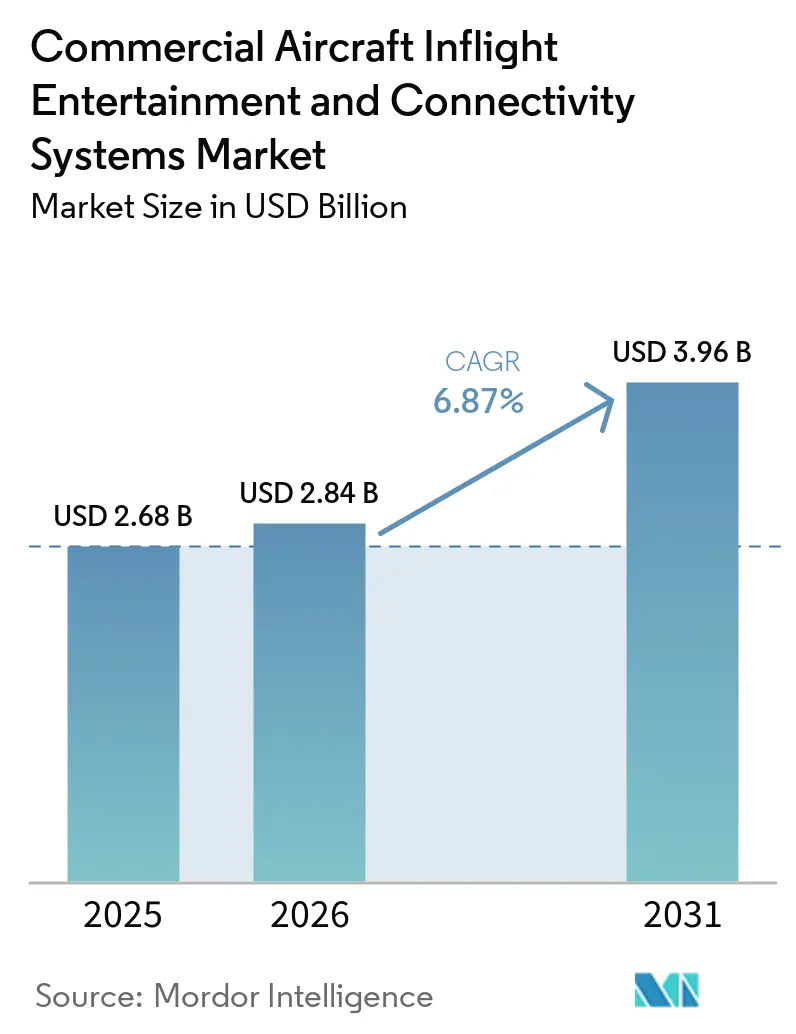
| Market Size (2026) | USD 2.84 Billion |
| Market Size (2031) | USD 3.96 Billion |
| Growth Rate (2026 - 2031) | 6.87 % |
| Fastest Growing Market | Asia-Pacific |
| Largest Market | North America |
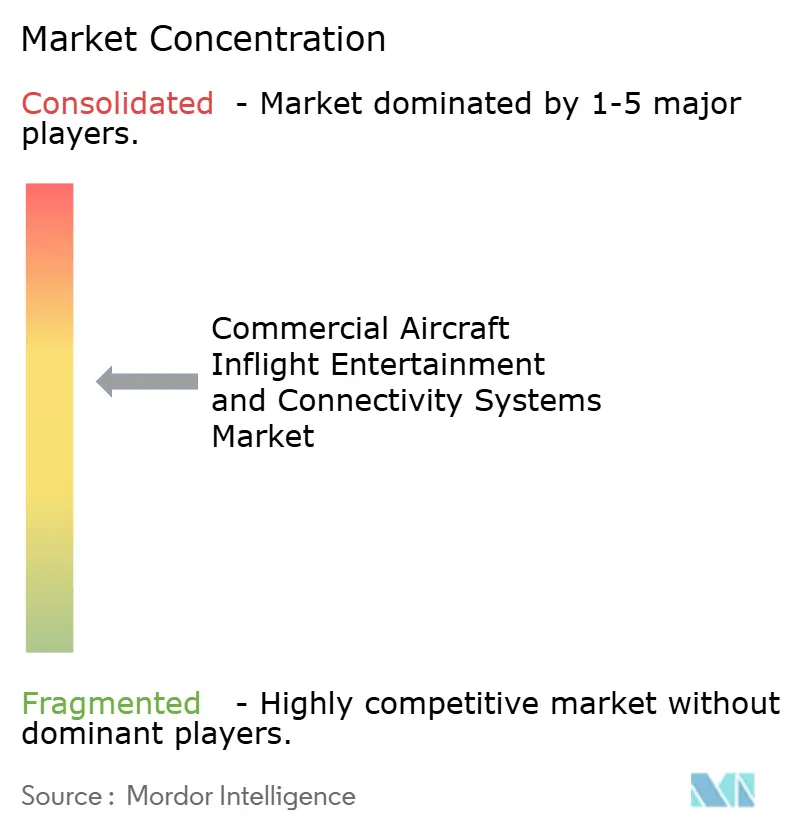
| Market Concentration | Medium |
Major Players *Disclaimer: Major Players sorted in no particular order Image © Mordor Intelligence. Reuse requires attribution under CC BY 4.0. | |
Commercial Aircraft Inflight Entertainment and Connectivity Systems Market Analysis by Mordor Intelligence
The commercial aircraft inflight entertainment and connectivity systems market was valued at USD 2.68 billion in 2025 and is estimated to grow from USD 2.84 billion in 2026 to reach USD 3.96 billion by 2031, at a CAGR of 6.86% during the forecast period (2026-2031). Demand is increasing as airlines shift their competitive focus from fares to differentiated onboard experiences that improve Net Promoter Scores and repeat-booking rates. Lower connectivity costs from LEO constellations, large Asia-Pacific fleet renewal programs, and growing recognition of IFE-driven ancillary revenue are the key drivers of this growth. Seat-back systems remain standard in most widebody cabins, while bandwidth-rich Wi-Fi and streaming servers are gaining incremental line fit orders as operators assess the total cost of ownership against passenger technology expectations. Vendors that offer modular hardware paired with cloud-native software are well-positioned, as airlines increasingly require faster upgrade cycles and data monetization features comparable to those of ground-based e-commerce platforms.
Key Report Takeaways
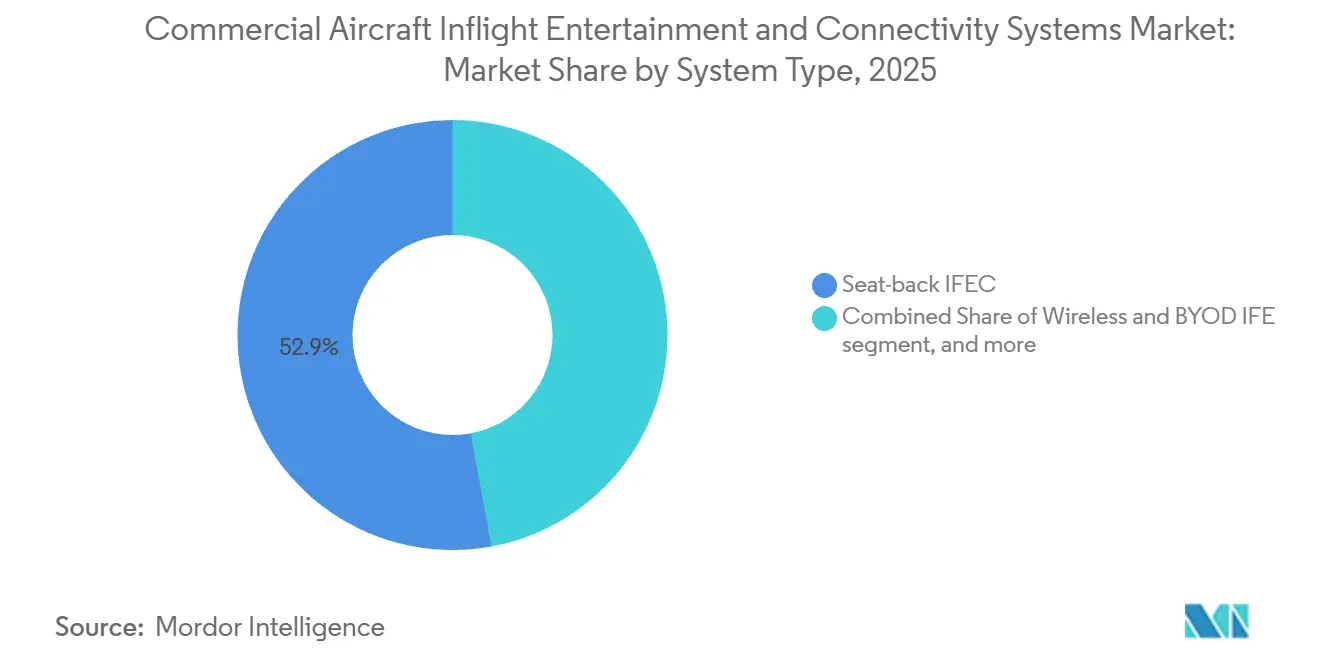
- By system type, seat-back hardware accounted for 52.88% of the commercial aircraft inflight entertainment and connectivity systems market in 2025; cabin connectivity systems are forecast to grow at a 7.25% CAGR through 2031.
- By aircraft type, narrowbody installations accounted for 49.35% of the commercial aircraft inflight entertainment and connectivity systems market size in 2025, while regional jets are forecast to grow at a 7.80% CAGR through 2031.
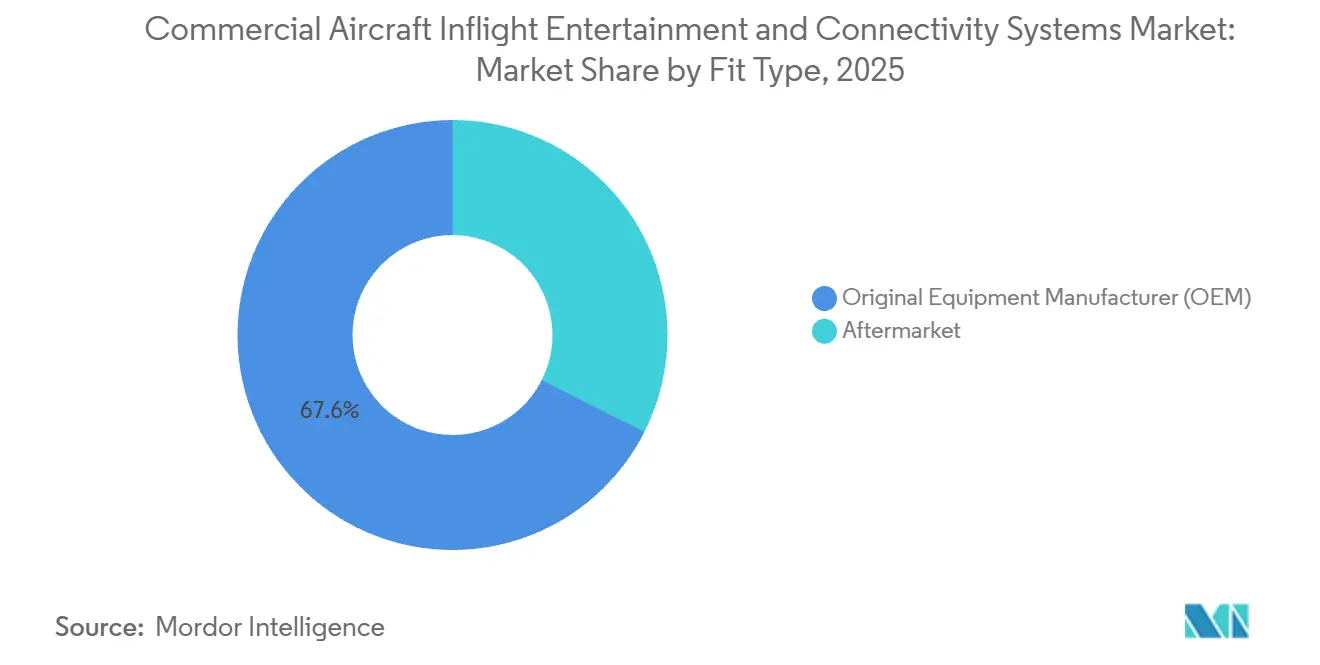
- By fit type, linefit retained 67.55% of the commercial aircraft inflight entertainment and connectivity systems market share in 2025. In contrast, retrofit activity is forecast to grow at a 7.65% CAGR during the forecast period.
- By cabin class, Economy class commanded 70.62% of cabin installations in 2025, whereas Premium Economy class is expanding at a 8.35% CAGR through 2031.
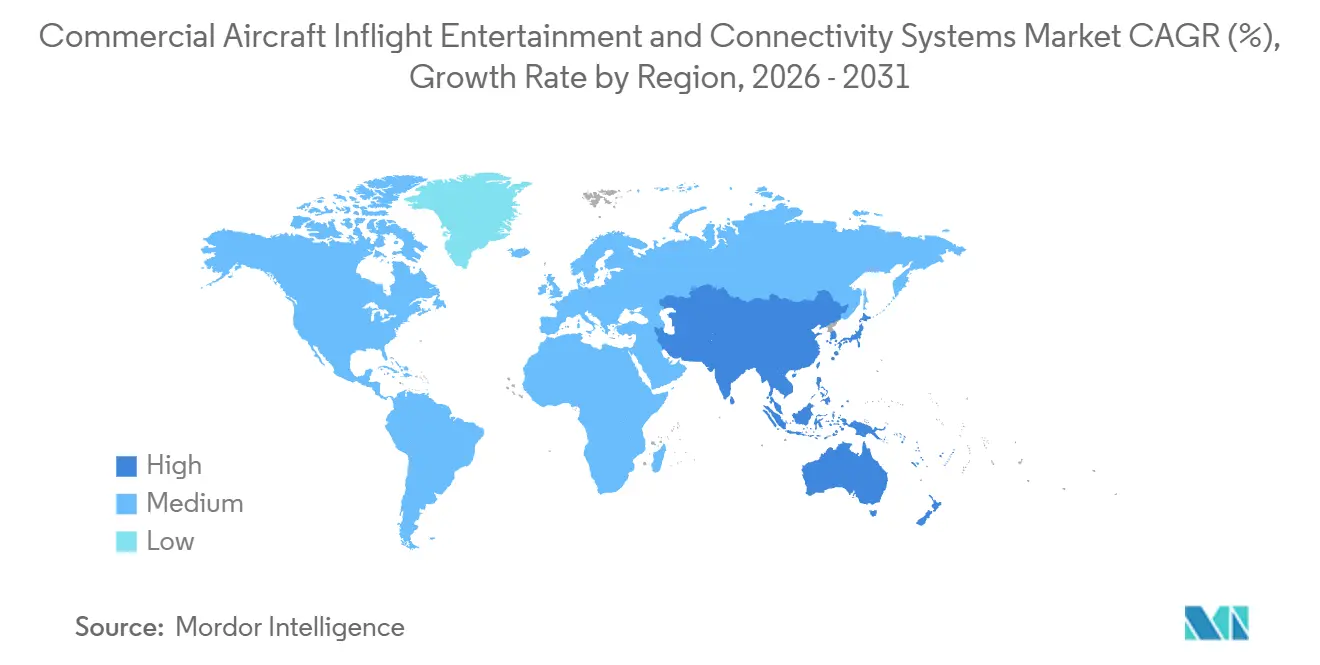
- By geography, North America accounted for 30.88% of the commercial aircraft inflight entertainment and connectivity systems market in 2025, while the Asia-Pacific is forecast to grow at a 7.95% CAGR through 2031.
Note: Market size and forecast figures in this report are generated using Mordor Intelligence’s proprietary estimation framework, updated with the latest available data and insights as of January 2026.
Global Commercial Aircraft Inflight Entertainment and Connectivity Systems Market Trends and Insights
Drivers Impact Analysis*
| Driver | (~) % Impact on CAGR Forecast | Geographic Relevance | Impact Timeline |
|---|---|---|---|
| Passenger-experience driven cabin differentiation | +2.10% | Global with premium focus in North America and Europe | Medium term (2–4 years) |
| Asia-Pacific fleet and passenger boom | +1.80% | Asia-Pacific core, spill-over to Middle East | Long term (≥ 4 years) |
| High-speed satcom enabling streaming-grade bandwidth | +1.50% | Global, led by North America and Europe | Medium term (2–4 years) |
| Bring Your Own Device (BYOD) retrofit cost advantage | +1.20% | Global, concentrated in Asia-Pacific and Europe LCCs | Short term (≤ 2 years) |
| Low Earth Orbit (LEO) satellite bandwidth cost collapse | +1.00% | Global | Long term (≥ 4 years) |
| IFE-enabled onboard e-commerce revenue | +0.70% | North America and Europe premium routes | Medium term (2–4 years) |
| Source: Mordor Intelligence | |||
Passenger-Experience Driven Cabin Differentiation
Commercial airlines are increasingly using inflight entertainment and connectivity systems to differentiate the onboard passenger experience. Carriers are adopting 4K displays, Bluetooth audio, spatial audio, and high-power USB-C charging across both widebody and narrowbody fleets. Panasonic Avionics' Astrova system, first deployed by Icelandair on its A321LR in December 2024, offers 4K OLED HDR10+ displays, Bluetooth-enabled spatial audio, and 67W USB-C charging.[1]Association of Asia Pacific Airlines, “Asia Pacific Airlines April 2024 Traffic Results,” aapairlines.org SWISS Senses similarly combines 4K entertainment displays, Bluetooth connectivity, advanced cabin lighting, and enhanced premium-seat controls on the A350-900. Cathay Pacific has also introduced 4K seatback displays and Bluetooth audio across its A321neo cabins, reflecting the growing role of advanced inflight entertainment and connectivity systems in airline cabin differentiation.[2]Bluebox Aviation Systems, “Vietjet Thailand Takes Flight Experience to New Heights with Blueview IFE,” blueboxaviation.com
Asia-Pacific Fleet and Passenger Boom
Asia-Pacific passenger growth and fleet expansion continue to support demand for inflight entertainment and connectivity. International passenger demand among Asia-Pacific airlines increased 5.3% year on year in H1 2026, while July 2026 revenue passenger kilometers (RPKs) remained 1.1% above July 2025 levels. Airbus expects Asia-Pacific to require 19,560 new passenger aircraft through 2044, representing 46% of global demand, while regional digital and connectivity services are projected to grow from USD 2.9 billion in 2025 to USD 11.2 billion by 2044.[3]Airbus, “Airbus Forecasts Asia-Pacific Aviation Services Market to Reach US$138.7 Billion by 2044,” airbus.com LCC adoption is also expanding, with Vietjet Thailand selecting Bluebox Aviation's Blueview platform across its 18-aircraft Airbus narrowbody fleet, with planned expansion to incoming B737 MAX aircraft. These developments support broader inflight entertainment and connectivity systems penetration across both FSCs and LCCs.
High-Speed Satcom Enabling Streaming-Grade Bandwidth
High-speed satellite connectivity is enabling airlines to deliver streaming-grade entertainment and live content during flights. In June 2026, United Airlines and DIRECTV enabled live television, including sports and news, on seatback screens across up to 150 Starlink-equipped aircraft. Starlink was already active on more than 400 United aircraft, with fleetwide installation targeted before the end of 2027. Higher-capacity connectivity also supports broader digital airline applications, while cloud-native platforms allow carriers to adjust Wi-Fi packages, pricing, content, and loyalty-based entitlements more dynamically. These developments strengthen the business case for scalable connectivity systems that support both passenger entertainment and airline digital services.
Bring Your Own Device (BYOD) retrofit cost advantage
BYOD-based wireless entertainment provides airlines with a lower-complexity route to modernizing existing cabins without installing seatback displays across every seat. In April 2025, TUI Airlines selected Immfly's digital platform for its B737-800 and B737-8 fleet, with up to 60 aircraft planned to be operational by summer 2025. The platform delivers entertainment, messaging, and destination services directly to passengers' personal devices and is designed for deployment without extensive structural modifications. Immfly's antenna-agnostic architecture can also integrate with existing and future connectivity networks, allowing airlines to upgrade connectivity while retaining the same onboard digital platform. This reduces retrofit complexity while maintaining opportunities for digital retail and ancillary revenue.
Restraints Impact Analysis*
| Restraint | (~) % Impact on CAGR Forecast | Geographic Relevance | Impact Timeline |
|---|---|---|---|
| Capex and weight penalty of seat-back systems | -1.50% | Global, acute for LCCs and regional operators | Medium term (2–4 years) |
| Certification hurdles for EMI/EMC | -0.80% | Global, with stricter EU and US rules | Long term (≥ 4 years) |
| Cross-border content licensing complexity | -0.60% | Global, chiefly on international routes | Short term (≤ 2 years) |
| Cyber-security risks in open Wi-Fi architectures | -0.40% | Global, heightened in security-sensitive regions | Medium term (2–4 years) |
| Source: Mordor Intelligence | |||
CAPEX and Weight Penalty of Seat-Back Systems
Traditional seat-back IFE systems require displays, power, wiring, seat integration, and supporting hardware, which increases aircraft modification costs and installed weight compared with wireless entertainment alternatives. Weight remains an important design consideration: Thales' Optiq 4K displays are around 30% lighter than the previous generation while also reducing total cost of ownership. Cost pressure is also driving retrofit-focused solutions. In April 2026, Panasonic Avionics introduced eXNeo as a cost-effective drop-in replacement for legacy X Series monitors, allowing airlines to upgrade existing IFE without replacing seats or completing a full cabin overhaul. These developments highlight the ongoing trade-off between premium seat-back experiences and the cost, weight, and complexity of installed systems.
Certification Hurdles for EMI/EMC
New inflight entertainment and connectivity antennas, wireless equipment, servers, and displays must meet aircraft safety and electromagnetic compatibility requirements before installation. FAA guidance recognizes RTCA DO-160 environmental qualification and dedicated aircraft-level EMC assessment, while EASA guidance similarly requires evaluation of RF emissions and interference with aircraft systems. Certification can also be aircraft-type specific and may require a Supplemental Type Certificate (STC), adding engineering, testing, and approval work to retrofit programs. This trend continued in 2026, with the FAA issuing an STC in March 2026 covering the installation of the Starlink Aero Terminal on multiple A320neo and A321neo variants. These requirements can extend the deployment schedules for inflight entertainment and connectivity systems and increase integration costs.
*Our forecasts treat driver/restraint impacts as directional, not additive. The impact forecasts reflect baseline growth, mix effects, and variable interactions.
Segment Analysis
By System Type: Seat-Back Devices Lead; Cabin Connectivity Servers Grow Fastest
Seat-back devices accounted for 52.88% of the market in 2025, supported by their continued use across premium and long-haul cabins and increasing adoption on narrowbody aircraft. Panasonic Avionics' Astrova had been selected by more than 30 airlines across 100 airline programs by December 2025, while Air Canada began operating the system on its A321 in April 2026 as part of an 86-aircraft deployment. Modular designs are also reducing upgrade complexity. Panasonic's eXNeo, introduced in April 2026, uses existing harnesses and mechanical interfaces and is designed to minimize certification effort and aircraft downtime during upgrades of legacy seat-back systems.
Cabin connectivity servers are projected to record growth at a 7.25% CAGR, as airlines expand wireless entertainment, cloud-based content management, and connected onboard applications. Panasonic's Converix platform combines inflight entertainment and connectivity systems integration, onboard computing, scalable storage, OTT streaming, and dynamic content caching within a modular server architecture. Server-based connectivity is also expanding across wireless cabins; Viasat's 2026 certification records include its next-generation mobile application server and cabin wireless access points, while Panasonic's eXW wireless IFE has been selected across 172 Air Arabia aircraft. These developments support increasing demand for flexible onboard servers capable of supporting both seat-back and passenger-device services.



By Aircraft Type: Narrowbody Leadership; Regional Jets Grow Fastest
Narrowbody aircraft accounted for 49.35% of the commercial aircraft inflight entertainment and connectivity systems market in 2025, supported by their large installed base and continued fleet expansion. Airbus' 2026 outlook expects single-aisle aircraft to account for 81% of the 42,060 new aircraft required through 2045, reinforcing the long-term opportunity for installing inflight entertainment and connectivity systems. Advanced systems are also moving deeper into narrowbody fleets. Air Canada is line-fitting Panasonic Astrova on 23 new A220-300s and 30 A321XLRs, while retrofitting another 19 A321 aircraft with 4K OLED displays, Bluetooth audio, and upgraded passenger interfaces. This is narrowing the technology gap between single-aisle and traditional long-haul cabins.
Regional jets are projected to grow at a 7.80% CAGR, supported by fleet renewal, secondary-city connectivity, and increasing availability of lightweight wireless inflight entertainment and connectivity systems. Embraer's 2026 outlook forecasts demand for 8,500 sub-150-seat jets through 2045, valued at USD 650 billion. Connectivity capability is also improving, with Embraer offering Intelsat's multi-orbit high-speed connectivity system as a factory-installed option on E-Jets E2, supporting speeds of up to 275 Mbps. Virgin Australia Regional Airlines' E190-E2s also feature high-bandwidth Wi-Fi and entertainment streamed directly to passengers' personal devices, demonstrating growing inflight entertainment and connectivity systems adoption on smaller aircraft.
By Fit Type: OEM Linefit Leads; Aftermarket Retrofit Grows Fastest
OEM linefit accounted for 67.55% of the commercial aircraft inflight entertainment and connectivity systems market in 2025, supported by the integration of connectivity, wiring, antennas, and entertainment hardware during aircraft production. Air Canada is line-fitting Astrova on 67 new aircraft, including 23 A220-300s, 30 A321XLRs, and 14 B787-10s. Factory integration is also expanding into smaller aircraft, with Embraer making Intelsat's multi-orbit connectivity system available as a linefit option on E-Jets E2. Continued demand for new aircraft supports this segment, with Airbus forecasting 42,060 aircraft deliveries through 2045, including 33,920 single-aisle aircraft.
Aftermarket retrofit is projected to grow the fastest at a 7.65% CAGR, as airlines upgrade connectivity and entertainment systems across existing fleets. Panasonic introduced eXNeo in April 2026 as a drop-in replacement for legacy X Series seatback monitors, enabling upgrades without new seats or a full cabin overhaul. Large-scale connectivity retrofits are also accelerating: United reported Starlink installed on 450 mainline and United Express aircraft by Q2 2026, with nearly 1,000 aircraft expected to be equipped by year-end. These programs reflect the growing demand for retrofit solutions that modernize existing aircraft while reducing the complexity and downtime associated with cabin modifications.
By Cabin Class: Economy Leads; Premium Economy Grows Fastest
Economy class accounted for 70.62% of the commercial aircraft inflight entertainment and connectivity systems market in 2025, driven by its larger seat base across commercial aircraft and continued airline investment in economy-class digital experience. Cathay Pacific achieved 100% seatback IFE and Wi-Fi availability across its fleet from August 2025, while SWISS's A350 Economy cabin offers 13.3-inch HD screens, Bluetooth connectivity, and USB-A/USB-C ports at every seat. Emirates is also introducing upgraded in-seat charging and new lightweight Economy seats as part of its 2026 fleet retrofit program. These investments sustain demand for inflight entertainment and connectivity hardware and connectivity across the largest passenger cabin segment.
Premium Economy is projected to grow the fastest at a 8.35% CAGR, as airlines expand the cabin and introduce technologies closer to premium-class standards. By September 2026, Emirates offered Premium Economy on 137 aircraft, while its latest A350 product features wireless charging, USB-C power, and a 13.3-inch 4K HDR display. Cathay Pacific's redesigned Premium Economy similarly includes a 15.6-inch 4K screen, 4K on-demand content, and Bluetooth audio. Growing Premium Economy capacity and enhanced IFE features are increasing inflight entertainment and connectivity systems spending per seat as airlines look to differentiate between Economy and Business Class.
Geography Analysis
North America accounted for 30.88% of the commercial aircraft inflight entertainment and connectivity systems market in 2025, supported by large connected fleets and continued investment in high-speed onboard connectivity. By Q2 2026, United Airlines had installed Starlink on 450 aircraft, with nearly 1,000 expected by year-end and fleetwide coverage targeted by 2027. Delta's free Delta Sync Wi-Fi covered more than 1,200 aircraft by May 2026 and had recorded over 160 million customer sessions since launch. Hawaiian Airlines also provides free Starlink across its A330 and A321neo fleet. With connectivity already widespread, regional demand is increasingly shifting toward fleet upgrades, faster satellite systems, and integrated digital passenger services.
Asia-Pacific is projected to record the fastest growth at a 7.95% CAGR, supported by rapid fleet expansion and passenger traffic growth. Airbus expects the region to require 19,560 new passenger aircraft through 2044, accounting for 46% of global demand, with passenger traffic growing at 4.4% annually. Cathay Pacific achieved seatback IFE and high-speed Wi-Fi availability across its entire fleet from August 2025, while Vietjet Thailand selected Bluebox's Blueview wireless IFE platform for 18 Airbus aircraft, with expansion planned to include incoming B737 MAX aircraft. These investments are expanding the adoption of in-flight entertainment and connectivity systems across both premium and LCCs.
Europe, the Middle East, and Africa continue to show a mix of adoption of premium seatback and wireless inflight entertainment and connectivity systems. SWISS introduced its SWISS Senses A350 cabin in 2025, while TUI deployed Immfly's digital platform across 59 B737 aircraft to support entertainment, messaging, and destination bookings. In the Middle East, Saudia introduced Panasonic Astrova on its A321XLR in June 2026 and has committed to retrofitting the platform across another 46 A321, A330, and B777 aircraft, supporting further inflight entertainment and connectivity systems modernization across both narrowbody and widebody fleets.

Competitive Landscape
The market remains relatively consolidated, with established suppliers benefiting from large installed fleets, certification expertise, OEM relationships, and global support networks. Key participants include Panasonic Avionics, Thales, Burrana, Collins Aerospace/RTX, and RAVE Aerospace, as well as connectivity-focused companies such as Viasat. Burrana continues to expand its RISE platform across seatback, wireless, overhead, and in-seat power applications. The competitive landscape also changed in 2026, when Safran completed the sale of Safran Passenger Innovations in January 2026; the business was subsequently renamed RAVE Aerospace and is now owned by Kingswood Capital Management.
Competition in the commercial aircraft inflight entertainment and connectivity systems market increasingly centers on lightweight hardware, modular architecture, connectivity performance, and integrated digital platforms. Thales' AVANT Up Optiq displays are approximately 30% lighter and 50% more reliable than the previous generation, while Panasonic Avionics continues to scale its modular Astrova platform. As of December 2025, Astrova had been selected by more than 30 airlines across 100 airline programs, highlighting the importance of scalable product portfolios, strong OEM relationships, and long-term airline partnerships.
Software capability and personalization are becoming equally important competitive differentiators. Panasonic's Modular Interactive platform allows airlines to tailor content, promotions, loyalty experiences, and interfaces by route, cabin class, and passenger profile. Viasat's Connected Partner Platform similarly supports retail, destination services, maps, games, and other onboard applications. These developments are shifting competition beyond standalone IFE hardware toward integrated digital ecosystems that combine connectivity, entertainment, personalization, and ancillary revenue opportunities.
Commercial Aircraft Inflight Entertainment and Connectivity Systems Industry Leaders
Panasonic Holdings Corporation
Thales Group
RAVE Aerospace, LLC
Astronics Corporation
Burrana Pty Ltd.
- *Disclaimer: Major Players sorted in no particular order

Recent Industry Developments
- May 2026: Eutelsat and Anuvu signed a multi-year capacity agreement for the EUTELSAT 10B satellite. Under the deal, Anuvu will use high-throughput Ku-band capacity to strengthen its inflight connectivity services, including support for a major global airline. The agreement expands Anuvu’s bandwidth capabilities while supporting Eutelsat’s multi-orbit aviation connectivity strategy.
- April 2026: Air India selected Panasonic Avionics’ Panasonic Technical Services (PTS) Total Care Package to provide maintenance support for IFE systems across 74 aircraft. The agreement covers several aircraft types, including the B787-9, A350-1000, A350-900, and A321neo, strengthening Panasonic Avionics’ role in supporting Air India’s expanding fleet of IFE-equipped aircraft.


Global Commercial Aircraft Inflight Entertainment and Connectivity Systems Market Report Scope
Commercial aircraft inflight entertainment and connectivity systems comprise onboard, passenger-facing solutions that provide entertainment, wireless content access, device connectivity, and power during flights. These systems include seat-back entertainment displays and associated hardware, wireless and Bring Your Own Device (BYOD) entertainment platforms, and in-seat power and peripheral systems installed on commercial aircraft. The market covers systems supplied for new aircraft installations as well as upgrades and replacements for aircraft already in service.
The commercial aircraft inflight entertainment and connectivity systems market is segmented by system type, aircraft type, fit type, cabin class, and geography. By system type, the market is segmented into seat-back IFEC, wireless and BYOD IFE, and in-seat power and peripherals. By aircraft type, the market is segmented into narrowbody aircraft, widebody aircraft, and regional jets. By fit type, the market is segmented into original equipment manufacturer (OEM) and aftermarket. By cabin class, the market is segmented into First Class, Business Class, Premium Economy Class, and Economy Class. The report also covers the market sizes and forecasts for the commercial aircraft inflight entertainment and connectivity systems market in major countries across different regions. For each segment, the market size is provided in terms of value (USD).
| Seat-back IFEC |
| Wireless and BYOD IFE |
| In-seat Power and Peripherals |
| Narrowbody Aircraft |
| Widebody Aircraft |
| Regional Jets |
| Original Equipment Manufacturer (OEM) |
| Aftermarket |
| First Class |
| Business Class |
| Premium Economy Class |
| Economy Class |
| North America | United States | |
| Canada | ||
| Mexico | ||
| Europe | United Kingdom | |
| France | ||
| Germany | ||
| Spain | ||
| Italy | ||
| Russia | ||
| Rest of Europe | ||
| Asia-Pacific | China | |
| India | ||
| Japan | ||
| South Korea | ||
| Australia | ||
| Rest of Asia-Pacific | ||
| South America | Brazil | |
| Rest of South America | ||
| Middle East and Africa | Middle East | United Arab Emirates |
| Saudi Arabia | ||
| Turkey | ||
| Rest of Middle East | ||
| Africa | South Africa | |
| Rest of Africa | ||
| By System Type | Seat-back IFEC | ||
| Wireless and BYOD IFE | |||
| In-seat Power and Peripherals | |||
| By Aircraft Type | Narrowbody Aircraft | ||
| Widebody Aircraft | |||
| Regional Jets | |||
| By Fit Type | Original Equipment Manufacturer (OEM) | ||
| Aftermarket | |||
| By Cabin Class | First Class | ||
| Business Class | |||
| Premium Economy Class | |||
| Economy Class | |||
| By Geography | North America | United States | |
| Canada | |||
| Mexico | |||
| Europe | United Kingdom | ||
| France | |||
| Germany | |||
| Spain | |||
| Italy | |||
| Russia | |||
| Rest of Europe | |||
| Asia-Pacific | China | ||
| India | |||
| Japan | |||
| South Korea | |||
| Australia | |||
| Rest of Asia-Pacific | |||
| South America | Brazil | ||
| Rest of South America | |||
| Middle East and Africa | Middle East | United Arab Emirates | |
| Saudi Arabia | |||
| Turkey | |||
| Rest of Middle East | |||
| Africa | South Africa | ||
| Rest of Africa | |||


Key Questions Answered in the Report
How large is the global commercial aircraft inflight entertainment and connectivity systems market, and how is it expected to grow?
The commercial aircraft inflight entertainment and connectivity systems market was valued at USD 2.68 billion in 2025 and is projected to reach USD 3.96 billion by 2031. Fleet modernization, cabin retrofit programs, rising passenger expectations for digital services, and the increasing adoption of wireless entertainment and in-seat power solutions support this growth.
How fast is global passenger demand driving new inflight entertainment and connectivity systems installations?
Annual growth of 6.87% through 2031 is forecasted as airlines align cabin upgrades with rising digital expectations and long-haul fleet renewals.
Which commercial aircraft class is adding inflight entertainment and connectivity systems hardware most quickly?
Regional jets show the highest projected CAGR at 7.80% as LCCs extend routes into secondary markets.
Are airlines shifting away from traditional seat-back screens?
Not entirely. Seat-back systems still account for a 52.88% share; however, wireless streaming servers are gaining traction because they support BYOD and e-commerce models while reducing aircraft weight.
What role does satellite technology play in upcoming inflight entertainment and connectivity systems strategies?
High-throughput Ka-band and emerging Starlink LEO networks provide the bandwidth necessary for live TV, cloud-based content updates, and real-time retail portals.
How are airlines using inflight entertainment and connectivity systems to create additional revenue opportunities?
Airlines increasingly use inflight entertainment and connectivity systems platforms to support advertising, premium Wi-Fi packages, onboard digital retail, destination services, and personalized offers. These platforms transform the connected cabin into an additional commercial channel beyond ticket sales.
Page last updated on:





