
Commercial Aircraft Actuation Systems Market Size and Share
Market Overview
| Study Period | 2020 - 2032 |
|---|---|
| Market Size (2027) | USD 7.38 Billion |
| Market Size (2032) | USD 9.56 Billion |
| Growth Rate (2027 - 2032) | 5.31 % |
| Fastest Growing Market | Asia-Pacific |
| Largest Market | North America |
| Market Concentration | Medium |
Major Players *Disclaimer: Major Players sorted in no particular order Image © Mordor Intelligence. Reuse requires attribution under CC BY 4.0. | |
Commercial Aircraft Actuation Systems Market Analysis by Mordor Intelligence
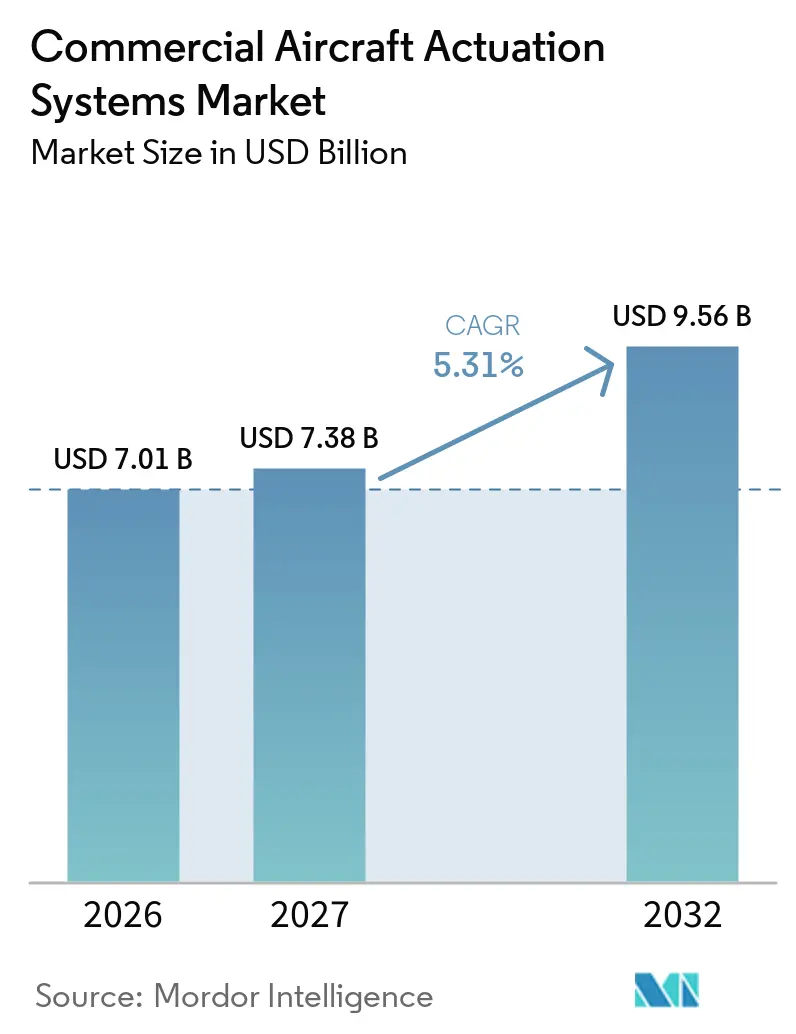
The commercial aircraft actuation systems market size was valued at USD 7.01 billion in 2026 and is forecast to grow from USD 7.38 billion in 2027 to reach USD 9.56 billion by 2032, at a 5.31% CAGR during the forecast period (2027-2032). Commercial aircraft manufacturers are raising narrowbody output, which supports a steadier flow of actuator orders. The market also benefits from replacement demand because hydraulic systems require approved maintenance, repair, and overhaul work throughout an aircraft’s service life. More-electric aircraft programs are increasing the role of electromechanical systems, although established hydraulic equipment remains essential for many flight-critical functions. Suppliers are therefore investing in both new electric designs and lifecycle support for installed hydraulic fleets. The commercial aircraft actuation systems market is shaped by long certification cycles, production constraints, and the need to prove safe performance in demanding operating conditions.
Key Report Takeaways
- By actuation technology, hydraulic actuation held 67.45% of the commercial aircraft actuation systems market share in 2026, while electromechanical actuation is forecast to grow at a 7.21% CAGR through 2032.
- By type, linear systems held 69.76% of the commercial aircraft actuation systems market share in 2026, while rotary systems are forecast to grow at a 6.89% CAGR through 2032.
- By application, primary flight control held 43.56% of the commercial aircraft actuation systems market share in 2026, while thrust reverser and nacelle are forecast to grow at a 7.14% CAGR through 2032.
- By aircraft type, narrowbody aircraft held 59.86% of the commercial aircraft actuation systems market share in 2026 and are forecast to grow at a 6.23% CAGR through 2032.
- By installation type, the aftermarket held 56.89% of the commercial aircraft actuation systems market share in 2026, while OEM installations are forecast to grow at a 6.76% CAGR through 2032.
- By geography, North America held 34.78% of the commercial aircraft actuation systems market share in 2026, while Asia-Pacific is forecast to grow at a 7.55% CAGR through 2032.
Note: Market numbers in this report are based on Mordor Intelligence's proprietary estimation framework, which combines nine months of actuals with Q4 projections for base year 2026.
Market Trends and Insights
Drivers Impact Analysis of Commercial Aircraft Actuation Systems Market*
| Driver | (~) % Impact on CAGR Forecast | Geographic Relevance | Impact Timeline |
|---|---|---|---|
| Narrowbody production backlogs and fleet expansion | +1.40% | Global, concentrated in North America and Asia-Pacific | Short term (≤ 2 years) |
| More-electric aircraft architecture adoption | +1.20% | Global, led by European and North American OEM programs | Long term (≥ 4 years) |
| Predictive maintenance ready actuator demand | +0.80% | Global, with early adoption in North America and Europe | Medium term (2-4 years) |
| Increasing actuator content per aircraft | +0.70% | Global | Long term (≥ 4 years) |
| Commercial aircraft replacement and retrofit cycles | +0.60% | Global, concentrated in Asia-Pacific and Middle East | Medium term (2-4 years) |
| Additive manufacturing and part consolidation | +0.50% | North America and Europe | Medium term (2-4 years) |
| Source: Mordor Intelligence | |||
Narrowbody Backlogs Create a Structurally Elevated Demand Floor
Commercial aircraft actuation systems market demand gains support from narrowbody production backlogs and fleet expansion. Airbus reported a record backlog in its 2026 half-year results and continued to plan for a monthly A320 Family production rate of 70-75 aircraft by the end of 2027. Higher aircraft output increases call-off volumes for flight control, landing gear, thrust reverser, and fuel control equipment. The same production activity supports component makers that supply parts to Tier 1 actuation integrators. Widebody output also provides a demand base because aircraft such as the B787 and A350 require complex, high-lift and primary flight control systems. The commercial aircraft actuation systems market therefore has demand visibility across narrowbody and widebody programs, even though narrowbody aircraft remain the larger volume driver. This visibility does not remove the pressure to meet strict delivery quality and schedule commitments. It does, however, give suppliers a clearer basis for production planning, workforce allocation, and long-lead material procurement.
More-Electric Aircraft Architecture Restructures Actuator Supply Chains
The commercial aircraft actuation systems market is also being reshaped by more-electric aircraft architecture. Safran stated that the Airbus Wing of Tomorrow program could require more actuator units due to its high-aspect-ratio wing and folding wingtip design. Electric actuation creates opportunities for motor, power electronics, sensor, and control software suppliers. EASA’s continuing-airworthiness specifications for electric and hybrid-propulsion aircraft show that compliance requirements are being formalized as electrification advances. Hydraulic equipment will remain necessary where force demand, redundancy, and certification evidence still favor proven system designs. The shift is consequently a change in the system mix rather than a uniform replacement of hydraulic equipment. This creates a need for suppliers capable of integrating mechanical, hydraulic, electrical, and digital capabilities.
Predictive Maintenance and Replacement Cycles Support Lifecycle Demand
Predictive maintenance, replacement cycles, and retrofit activity strengthen the aftermarket position of the commercial aircraft actuation systems market. Moog renewed its total support agreement with All Nippon Airways for the B787 primary and high-lift flight-control actuators for 10 years under a flight-hours structure.[1] Such agreements reward suppliers that prevent unscheduled removals through condition monitoring and timely repair. Suppliers can use data from ball screw wear, hydraulic leakage patterns, and motor insulation performance to plan service interventions. HAECO and Safran Electronics & Defense established a partnership for A320 and A330 hydraulic flight control maintenance in Xiamen in 2026.[2] Regional maintenance capacity supports fleets as they mature, while higher actuator content per new aircraft adds to the equipment base that will require future service. These programs also place value on repair turnaround times and documented component history. Airlines can use these capabilities to reduce disruptions caused by unplanned actuator removals.
Additive Manufacturing Supports More Compact Actuation Designs
Additive manufacturing and part consolidation support new product development in the commercial aircraft actuation systems market. Liebherr presented an additively manufactured valve block for the A350 lower cargo-door actuation system that had entered series production. The company also showed an air-liquid heat exchanger intended to improve thermal management in electrified aircraft systems. These approaches can reduce part counts and help engineers work within constrained installation spaces. Eaton opened a European aerospace additive manufacturing center in 2026 that brings together design, engineering, printing, and validation activities. Their value depends on repeatable quality controls and qualification in accordance with aerospace standards, particularly when components serve safety-critical aircraft functions. Design teams can use additive processes to combine components that previously required multiple manufacturing steps. The approach remains subject to validation before it can be applied across high-load flight control parts.
Restraints Impact Analysis of Commercial Aircraft Actuation Systems Market*
| Restraint | (~) % Impact on CAGR Forecast | Geographic Relevance | Impact Timeline |
|---|---|---|---|
| Certification burden for safety critical actuation | -1.50% | Global, primarily Europe and North America | Long term (≥ 4 years) |
| Thermal management limits for electromechanical actuators | -1.00% | Global | Medium term (2-4 years) |
| Supply concentration for high performance magnets and power electronics | -0.80% | Global, most acute in North America and Europe | Short term (≤ 2 years) |
| Fleet downtime and integration risk during retrofit programs | -0.60% | Global, concentrated in Asia-Pacific and Middle East | Medium term (2-4 years) |
| Source: Mordor Intelligence | |||
Regulatory Compliance Requirements Slow Safety Critical Actuation Transitions
Certification requirements can slow the transition to new equipment in the commercial aircraft actuation systems market. The FAA issued an airworthiness directive in February 2025 requiring further modifications to thrust and horizontal stabilizer actuators on specified A330 and A340 aircraft. The action shows that even established actuator designs require continuing compliance work. Novel electromechanical systems require extensive evidence on redundancy, failure behavior, environmental endurance, and safe operation. EASA CS-25 and FAA Part 25 remain central frameworks for the flight control architecture of transport category aircraft. Smaller suppliers face a particular challenge because qualification campaigns require engineering resources, test capacity, and long engagement with aircraft manufacturers and regulators. The certification process can lengthen the path from a promising design to a revenue-generating aircraft program. It also gives established suppliers an advantage where they already have approved designs and prior test evidence.
Thermal, Supply Chain, and Retrofit Risks Limit Faster Adoption
Thermal limits, supply concentration, and retrofit disruption can restrain the commercial aircraft actuation systems market. Retrofit programs can impose fleet downtime and integration risk because operators must balance modification work with aircraft availability. Reliance on specialized magnets and power electronics adds procurement exposure for designs that use electric motors and advanced control systems. Suppliers must account for these risks when selecting materials and developing alternative sources. The need to keep aircraft available can make airlines cautious about retrofit schedules, even where a new system offers operating benefits.
*Our forecasts treat driver/restraint impacts as directional, not additive. The impact forecasts reflect baseline growth, mix effects, and variable interactions.
Commercial Aircraft Actuation Systems Market Segment Analysis
By Actuation Technology:
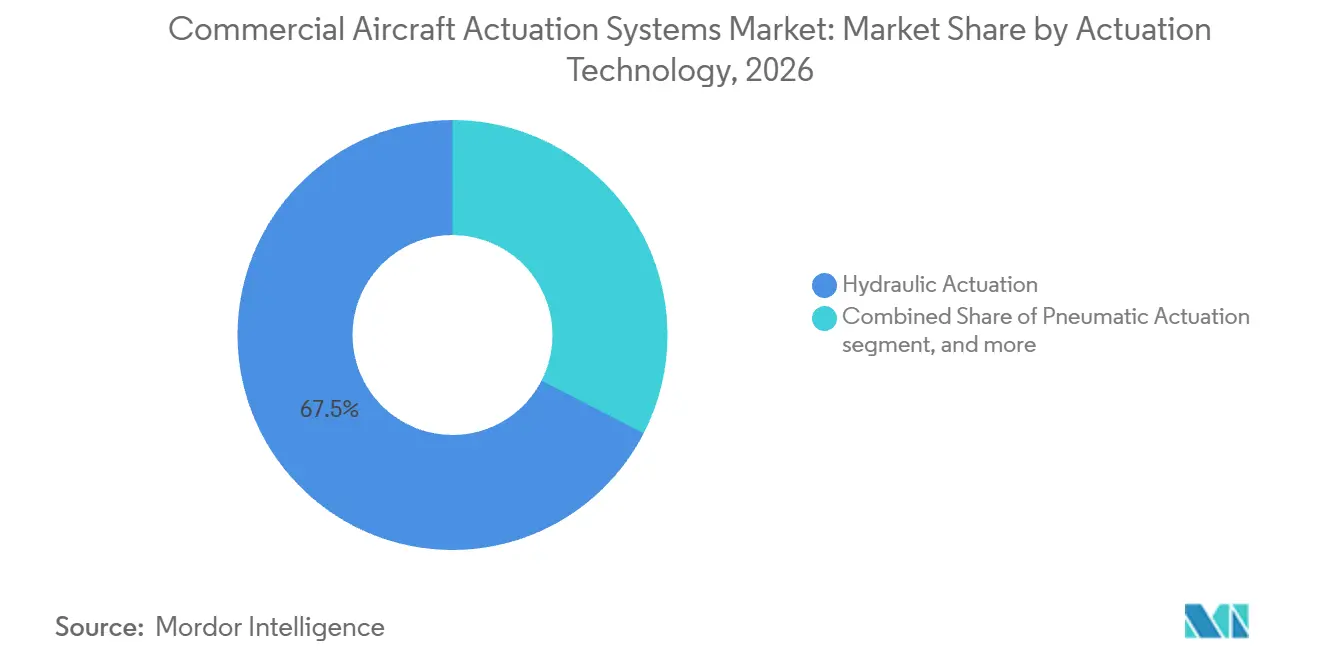
Hydraulic Dominance Persists Alongside Electromechanical MomentumHydraulic systems held 67.45% of the commercial aircraft actuation systems market share in 2026, while electromechanical systems are forecast to grow at a 7.21% CAGR through 2032. Hydraulic designs retain their leading position because they deliver high force density for primary controls, landing gear, and other demanding uses. Their installed base is extensive across in-service commercial fleets. Their known failure behavior is also deeply reflected in aircraft certification practices. Pneumatic systems serve more limited functions, including some bleed-air and door applications. The commercial aircraft actuation systems market will continue to depend on hydraulic maintenance services as airlines keep existing aircraft in operation.
Electromechanical equipment gains importance as aircraft makers seek to reduce hydraulic system complexity. Electric motors and power electronics can support distributed architectures and new control approaches. However, mechanical jamming, thermal loading, and power electronics qualification remain material design issues. Safran acquired Collins Aerospace flight-control and actuation activities in 2025, while Woodward acquired Safran’s North American electromechanical actuation business.[3] Those transactions show how suppliers are positioning for both installed hydraulic fleets and emerging electric platforms. They also underline the importance of holding the capabilities needed to support an aircraft over its full service life. A supplier with both technology families can address current fleet needs while preparing for future airframes.

By Type:
Linear Solutions Anchor Volume as Rotary Applications Build MomentumLinear actuators held 69.76% of the commercial aircraft actuation systems market share in 2026. They are widely used where aircraft systems require controlled translational movement. Primary control surfaces, landing gear retraction, cargo doors, and thrust reversers all use this motion pattern. The broad application base makes linear units the volume foundation of the commercial aircraft actuation systems market. Their design and support requirements vary according to load, duty cycle, and system redundancy. Suppliers must also maintain quality controls for components used in safety-critical aircraft systems.
Rotary actuators are forecast to expand at a 6.89% CAGR through 2032. Their growth is linked to electromechanical designs that use rotary electric motors with ball-screw or roller-screw mechanisms. Such equipment can be used in secondary controls, landing-gear steering, and compact integrated systems. RTCA DO-160G environmental testing remains relevant for equipment qualification. AS9100 and EN 9100:2018 quality management requirements also influence supplier processes as manufacturing methods evolve. Rotary solutions must demonstrate reliable performance across vibration, temperature, and other environmental conditions. This keeps qualification discipline central to their wider use in commercial aircraft.
By Application:
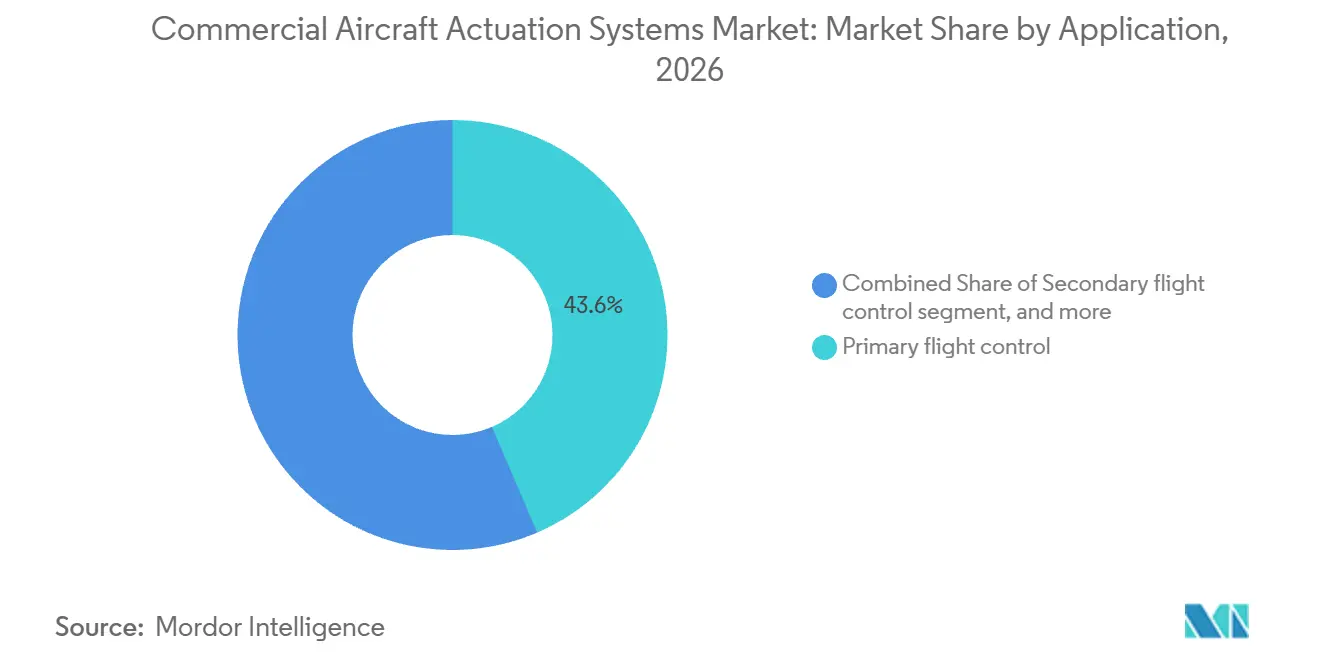
Primary Controls Lead as Thrust Reverser Electrification AcceleratesPrimary flight control held 43.56% of the commercial aircraft actuation systems market share in 2026. Aileron, elevator, and rudder systems use redundant actuation arrangements to meet transport-aircraft safety requirements. This need for multiple active or standby units supports their leading share. Secondary controls include flaps, slats, and spoilers, while other applications include landing gear, steering, braking, engines, and fuel systems. Each category has distinct loads, service intervals, and integration needs. The market benefits from this diversity, as suppliers can serve multiple aircraft subsystems.
Thrust reverser and nacelle are forecast to grow at a 7.14% CAGR through 2032. Collins Aerospace stated that its elecTRAS system had logged more than 15 million flight hours and 2.2 million flight cycles across more than 700 A350 aircraft by 2025. The system can reduce nacelle weight by 15% to 20% at the integrated level. Collins opened its Wolverhampton Engineering Center of Excellence in 2026 to support the development and certification of electric thrust reversers. These deployments support adoption on future narrowbody programs. They also give aircraft manufacturers operating experience with electric actuation in a demanding nacelle application. Suppliers can draw on this experience when pursuing additional applications that require weight reduction and simpler interfaces.
By Aircraft Type:
Narrowbody Aircraft Drives Both Market Scale and GrowthNarrowbody aircraft held 59.86% of the commercial aircraft actuation systems market share in 2026 and are forecast to grow at a 6.23% CAGR through 2032. Their position reflects the high production importance of single-aisle aircraft for global airline networks. Increasing output of A320 Family aircraft and B737 aircraft creates recurring demand for flight-control, landing-gear, and nacelle equipment. These programs also create a substantial installed base for maintenance providers. The commercial aircraft actuation systems market is strongly exposed to narrowbody fleet renewal. Aircraft manufacturers and their suppliers must still manage ramp-up quality and supply chain performance. A delay at any actuator tier can affect a wider aircraft delivery schedule. This makes stable supplier coordination as important as the volume opportunity itself.
Widebody aircraft represent lower unit volumes but can carry higher actuation content per airframe. Larger control surfaces and multi-redundancy systems raise equipment needs. Airbus has described flight-control architectures that combine hydraulic and electric power sources to improve system resilience. Regional jets have more limited new-program activity, although compact electromechanical systems attract interest for smaller hybrid-electric aircraft. On this note, Parker-Hannifin reported USD 7.06 billion in Aerospace Systems net sales during FY2026, reflecting a broad demand across commercial transport, regional transport, and business aviation applications. It also shows why large integrators seek exposure across several aircraft categories rather than relying on a single program. Broader coverage can help balance different production cycles.
By Installation Type:
Aftermarket Retains Majority as OEM Channels RampThe aftermarket accounted for 56.89% of the commercial aircraft actuation systems market share in 2026. The installed fleet requires scheduled replacement, repair, overhaul, and performance upgrades throughout its operating life. Hydraulic systems create durable service demand for seals, pistons, servo valves, and related components. Maintenance activity must follow approved procedures and aircraft authority requirements. HAECO’s 2026 Xiamen agreement with Safran Electronics & Defense covers maintenance for primary and secondary hydraulic flight-control components on A320 and A330 fleets. This investment shows the importance of regional repair capability as Asia-Pacific fleets grow.
OEM installations are forecast to grow at a 6.76% CAGR through 2032. Growth follows the planned delivery ramp at Airbus and Boeing. New aircraft also feature an increasing level of electromechanical equipment. Moog identified B787 and A350 primary and high-lift flight controls as major commercial commitments in its 2025 annual report. The supplier also reported record orders, sales, and backlog in fiscal year 2025. As new aircraft enter service, they add to the future repair base. This link between new installations and later maintenance helps stabilize the commercial aircraft actuation systems market. OEM suppliers can therefore build future service opportunities by delivering components for new airframes. The mix of new production and fleet support can reduce reliance on one demand channel.
Geography Analysis
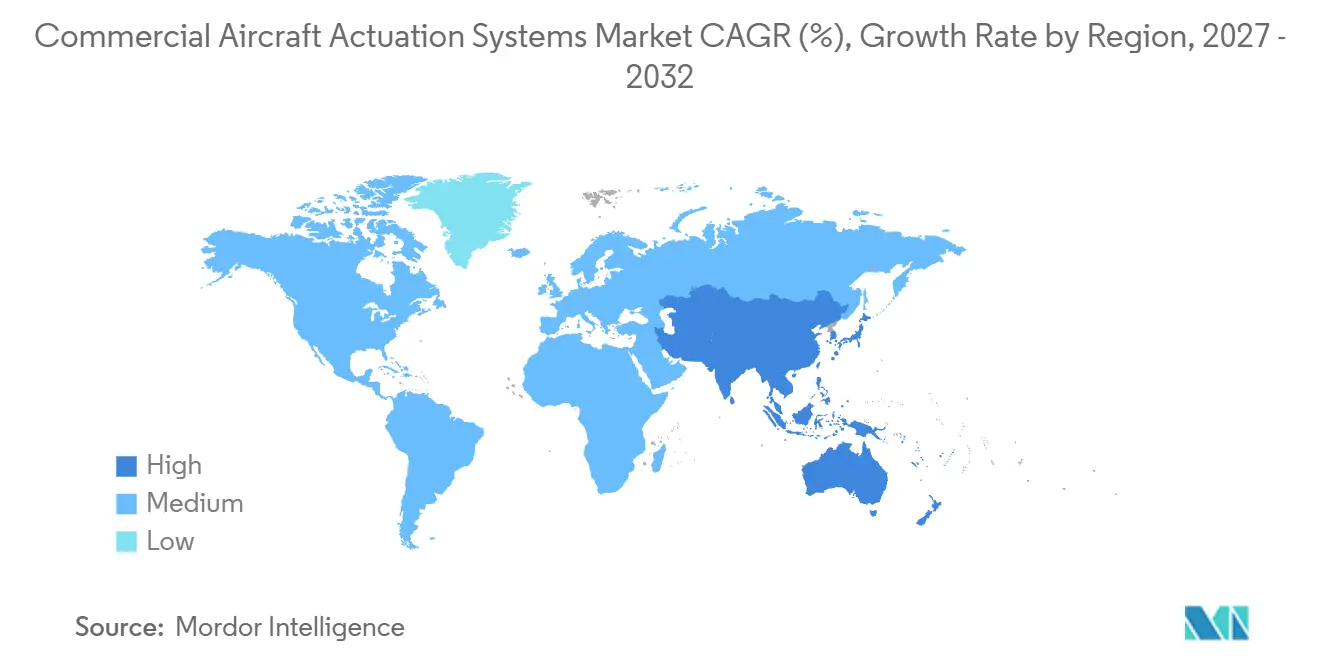
North America held 34.78% of the commercial aircraft actuation systems market share in 2026. The region hosts major suppliers including Honeywell, Parker-Hannifin, Moog, Woodward, RTX, and several Boeing commercial operations. Parker-Hannifin reported USD 7.06 billion in Aerospace Systems net sales in FY2026, following USD 6.19 billion in FY2025. Its FY2025 fourth-quarter aerospace order rate rose 12%, supported by commercial OEM and aftermarket activity. The FAA shapes certification and continuing-airworthiness requirements for aircraft equipment in the region. North American suppliers are also working to secure electric-motor materials and advanced electronics for future electromechanical systems. This adds a supply chain dimension to the region’s technology transition. Established engineering and test capabilities remain important as electric actuation designs move through certification.
Asia-Pacific is forecast to grow at a 7.55% CAGR through 2032, the highest rate in the commercial aircraft actuation systems market. Airbus forecasts that the region will need 19,560 new passenger aircraft over the next 20 years, accounting for 46% of global demand. China, India, and Southeast Asia are central to the region’s fleet expansion. HAECO and Safran Electronics & Defense established their Xiamen maintenance agreement before this expected fleet growth. These service investments position suppliers closer to operators that need component repair and overhaul capacity. The region’s scale can justify localized inventory, repair capability, and technical support. This may shorten turnaround times for operators as fleet utilization increases.
Europe remains a focal point for actuation development, while the Middle East, South America, and Africa have distinct fleet and service opportunities. Each region therefore contributes through a different combination of engineering activity, fleet renewal, and maintenance demand. This varied regional profile broadens the customer base for major integrators.
Competitive Landscape
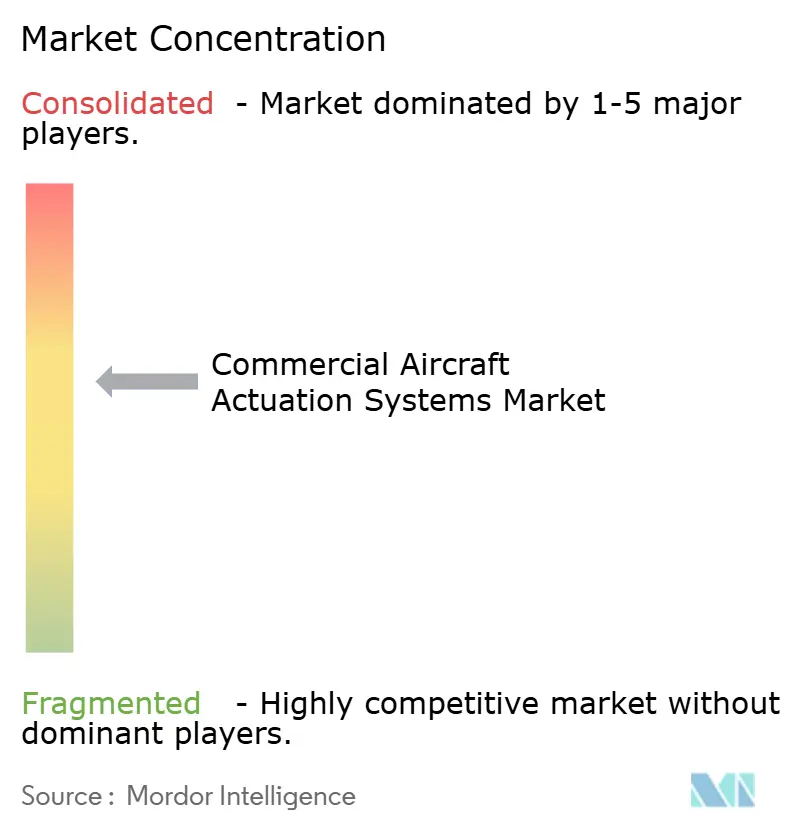
The commercial aircraft actuation systems market is moderately concentrated among large Tier 1 suppliers. Safran SA, RTX Corporation, Honeywell Aerospace, Inc., Moog Inc., and Parker-Hannifin Corporation supply primary and secondary flight-control equipment across major aircraft platforms. Their positions reflect established design approvals, manufacturing capacity, and aftermarket networks. Safran SA completed its acquisition of Collins Aerospace’s flight-control and actuation activities in July 2025. The transaction brought hydraulic, mechanical, and electromechanical capabilities together across 180 aircraft platforms. Competition centers on equipment reliability, program access, certification ability, and lifecycle service coverage. Leading companies are expected to maintain both manufacturing performance and engineering depth over long aircraft program cycles. This makes a proven installed base especially valuable when airlines and aircraft manufacturers select suppliers.
Suppliers are extending their positions through long-term support arrangements and electrification investment. Moog’s 10-year support renewal with All Nippon Airways is one example of a flight-hours maintenance contract that can build recurring revenue. RTX’s Wolverhampton facility combines design, testing, and certification work for electric thrust-reverser systems. Liebherr was selected by Wisk Aero for the Generation 6 electromechanical actuation system. These moves show that companies are building electric-system experience across both conventional aircraft and adjacent aviation programs. Digital monitoring and compact thermal solutions are becoming important areas of differentiation. These capabilities can support condition-based maintenance and help manage the design limits of electric systems. They also connect component supply to longer-term service relationships.
The competitive environment still favors companies with deep certification resources and established customer relationships. New entrants face demanding qualification requirements for safety-critical applications. They must also demonstrate dependable production performance during aircraft ramp-ups. Additive manufacturing can provide a route to more compact components, but each application requires validation and quality controls. Suppliers with hydraulic installed-base expertise retain an advantage in repair and overhaul activity. At the same time, companies that can provide electric actuation, sensors, health monitoring, and support contracts have opportunities on future aircraft programs. The commercial aircraft actuation systems market therefore supports competition between integrated suppliers rather than a rapid replacement of established leaders. Companies must balance investment in new technology with dependable support for existing aircraft. This balance favors suppliers that can combine product engineering, certification, and aftermarket operations.
Commercial Aircraft Actuation Systems Industry Leaders
-
Honeywell Aerospace Inc.
-
RTX Corporation
-
Parker-Hannifin Corporation
-
Moog Inc.
-
Safran SA
- *Disclaimer: Major Players sorted in no particular order
Commercial Aircraft Actuation Systems Market Companies Covered in this Report
- Honeywell Aerospace Inc.
- RTX Corporation
- Parker-Hannifin Corporation
- Moog Inc.
- Safran SA
- Eaton Corporation plc
- Woodward, Inc.
- Liebherr-International Deutschland GmbH (Liebherr Group)
- Curtiss-Wright Corporation
- Nabtesco Corporation
- Crane Company
- BAE Systems plc
- Triumph Group, Inc.
- Héroux-Devtek Inc.
- ITT Inc.
- AMETEK, Inc.
- Astronics Corporation
- Electromech Technologies LLC
- Whippany Actuation Systems LLC (TransDigm Group)
- Arkwin Industries, Inc.
Recent Industry Developments in Commercial Aircraft Actuation Systems Market
- October 2026: Woodward, Inc. announced that it will provide an actuation system to support Airbus' Folding Wing research activity. The ground-based demonstrator aims to explore how longer wings can reduce drag and improve aerodynamic efficiency for future aircraft.
- February 2026: Salient Motion announced a partnership with Aviointeriors to provide Seat Actuation Control Systems for the Allegra and Allegra HD business class seating programs. The contract covers actuator systems for a few hundred seats to be installed by two airlines on narrowbody Airbus and Boeing aircraft.
- July 2025: Woodward, Inc. announced the completion of its acquisition of Safran's Electronics & Defense electromechanical actuation business, operating in the US, Mexico, and Canada.
Global Commercial Aircraft Actuation Systems Market Report Scope
The commercial aircraft actuation systems market comprises mechanical, hydraulic, pneumatic, and electromechanical systems designed to control and operate movable components across commercial aircraft. The scope includes linear and rotary actuators supplied for new commercial aircraft production, fleet modernization, component replacement, and aftermarket programs. The market focuses exclusively on commercial aircraft applications, excluding military aircraft, helicopters, business jets, and drones.
The commercial aircraft actuation systems market is segmented by actuation technology, type, application, aircraft type, installation type, and geography. By actuation technology, the market is segmented into hydraulic actuation, pneumatic actuation, electromechanical actuation, and others. By type, the market is segmented into linear and rotary actuators. By application, the market is segmented into primary flight control, secondary flight control, landing gear, steering and braking, thrust reverser and nacelle, engine and fuel control, and other applications. By aircraft type, the market is segmented into narrowbody aircraft, widebody aircraft, and regional jets. By installation type, the market is segmented into original equipment manufacturer (OEM) and aftermarket. The report also covers market sizes and forecasts for the commercial aircraft actuation systems market in major countries across the regions. For each segment, the market size is provided in terms of value (USD).
Segmentation Overview
| Hydraulic Actuation |
| Pneumatic Actuation |
| Electromechanical Actuation |
| Others |
| Linear |
| Rotary |
| Primary Flight Control |
| Secondary Flight Control |
| Landing Gear, Steering, and Braking |
| Thrust Reverser and Nacelle |
| Engine and Fuel-Control |
| Other Applications |
| Narrowbody Aircraft |
| Widebody Aircraft |
| Regional Jets |
| Original Equipment Manufacturer (OEM) |
| Aftermarket |
| North America | United States | |
| Canada | ||
| Mexico | ||
| Europe | United Kingdom | |
| France | ||
| Germany | ||
| Italy | ||
| Russia | ||
| Rest of Europe | ||
| Asia-Pacific | China | |
| India | ||
| Japan | ||
| South Korea | ||
| Australia | ||
| Rest of Asia-Pacific | ||
| South America | Brazil | |
| Rest of South America | ||
| Middle East and Africa | Middle East | Saudi Arabia |
| United Arab Emirates | ||
| Turkey | ||
| Africa | South Africa | |
| Rest of Africa | ||
| By Actuation Technology | Hydraulic Actuation | ||
| Pneumatic Actuation | |||
| Electromechanical Actuation | |||
| Others | |||
| By Type | Linear | ||
| Rotary | |||
| By Application | Primary Flight Control | ||
| Secondary Flight Control | |||
| Landing Gear, Steering, and Braking | |||
| Thrust Reverser and Nacelle | |||
| Engine and Fuel-Control | |||
| Other Applications | |||
| By Aircraft Type | Narrowbody Aircraft | ||
| Widebody Aircraft | |||
| Regional Jets | |||
| By Installation Type | Original Equipment Manufacturer (OEM) | ||
| Aftermarket | |||
| By Geography | North America | United States | |
| Canada | |||
| Mexico | |||
| Europe | United Kingdom | ||
| France | |||
| Germany | |||
| Italy | |||
| Russia | |||
| Rest of Europe | |||
| Asia-Pacific | China | ||
| India | |||
| Japan | |||
| South Korea | |||
| Australia | |||
| Rest of Asia-Pacific | |||
| South America | Brazil | ||
| Rest of South America | |||
| Middle East and Africa | Middle East | Saudi Arabia | |
| United Arab Emirates | |||
| Turkey | |||
| Africa | South Africa | ||
| Rest of Africa | |||
Key Questions Answered in the Report
What is driving commercial aircraft actuation systems demand?
The commercial aircraft actuation systems market is valued at USD 7.01 billion in 2026 and is forecast to reach USD 9.56 billion by 2032, driven by Higher narrowbody production, fleet replacement, and the need for maintenance support.
Which actuation technology leads commercial aircraft applications?
Hydraulic systems lead with 67.45% share in 2026 because they provide proven high-force performance and support a large installed fleet.
Why are electromechanical actuators growing faster?
Electromechanical actuation is forecast to grow at 7.21% CAGR through 2032 because aircraft manufacturers are pursuing more-electric architectures and distributed systems.
Which aircraft category creates the largest demand for actuators?
Narrowbody aircraft account for 59.86% share in 2026 and are forecast to grow at 6.23% CAGR through 2032.
What is the largest application for commercial aircraft actuators?
Primary flight control leads with 43.56% share in 2026 because aileron, elevator, and rudder systems require redundant actuation arrangements.
Which region is growing fastest for commercial aircraft actuation systems?
Asia-Pacific is forecast to grow at 7.55% CAGR through 2032, supported by fleet expansion in China, India, and Southeast Asia.